Was Quibi the good kind of startup failure?

Editor’s note: Get this free weekly recap of TechCrunch news that any startup can use by email every Saturday morning (7 a.m. PT). Subscribe here.

Startup failure is easy to hold up as a type of martyrdom for progress, especially if the founders are starting out scrappy in the first place and trying to save the world. But heroic narrative gets complicated when the startup failure involves the biggest names in entertainment, dubious product decisions, and well over $1 billion in losses in an already very competitive consumer tech subcategory.

I was going to skip any mention of Quibi because, like me, you have heard more than enough already. But this week its shutdown announcement turned into a debate on Twitter about the nature of startup failure and whether this was still the right kind. Many in the startup world said it was still good, basically because most any ambitious startup effort leads to progress. Danny Crichton, in turn, argues that the negativity was fully justified in this case.

Let’s be honest: Most startups fail. Most ideas turn out wrong. Most entrepreneurs are never going to make it. That doesn’t mean no one should build a startup, or pursue their passions and dreams. When success happens, we like to talk about it, report on it and try to explain why it happens — because ultimately, more entrepreneurial success is good for all of us and helps to drive progress in our world.

But let’s also be clear that there are bad ideas, and then there are flagrantly bad ideas with billions in funding from smart people who otherwise should know better. Quibi wasn’t the spark of the proverbial college dropout with a passion for entertainment trying to invent a new format for mobile phones with ramen money from friends and family. Quibi was run by two of the most powerful and influential executives in the United States today, who raised more money for their project than other female founders have raised collectively this year.

Ouch. However, I think this still misses the bigger dynamic happening.

Quibi was so easy to criticize that it created an opportunity to plausibly defend for anyone who wants to show that they are here for the startups no matter how crazy. When you defend Quibi, you’re defending your own process, and making it clear to the next generation of startups that you’re personally not scared off from other people with crazy ideas and have the will to try even if the result is a big mess. Which is who founders want to hire in the early days, and who investors want to bet on.

I support both sides of this mass-signaling game. Analysts and journalists have provided a broad range of valuable insights about how Quibi was doing it wrong, that are no doubt being internalized by founders of all types. Meanwhile, Quibi defenders are no doubt sorting through their inbound admirers for great new deals. All in all, Quibi and the debate around it might ultimately make future companies a little better. Which is what we all wanted in the first place, right?

Root Insurance plans pricing as Datto goes public

The IPO market has not shut down (yet) for election turmoil and whatnot. First up, managed service provider Datto went out on Wednesday and has inched up since then — a strong outcome for the company and its private equity owner, even if third parties did not benefit from an additional pop. A few more notes from Alex Wilhelm:

Datto’s CEO Tim Weller  told TechCrunch  in a call that the company will still be well-capitalized after the public offering, saying that it will have a very strong cash position.

The company should have places to deploy its remaining cash. In its S-1 filings, Datto highlighted a COVID-19 tailwind stemming from companies accelerating their digital transformation efforts. TechCrunch asked the company’s CEO whether there was an international component to that story, and whether digital transformation efforts are accelerating globally and not merely domestically. In a good omen for startups not based in the United States, the executive said that they were.

Next to market, Root Insurance released its stock pricing set this week, raising the goal to a valuation above $6 billion. It’s definitely on track to be Ohio’s biggest tech IPO to date. Here’s Alex again, with a comparison against Lemonade, another recently IPOed insurance tech provider for Extra Crunch:

[I]t appears that Root at around $6 billion is cheap compared to Lemonade’s pricing today. So, if you’d like to anticipate that Root raises its IPO price range to bring it closer to the multiples that Lemonade enjoys, feel free as you are probably not wrong. Are we saying that Root will double its valuation to match Lemonade’s current metrics? No. But closing the gap a bit? Sure.

For insurtech startups, even Root’s current pricing is strong. Recall that Root was worth $3.65 billion just last August. At $6.34 billion, the company has appreciated massively in just the last year and change. A small repricing could boost Root’s valuation differential to a flat 100% rather easily.

So, for MetroMile and ClearCover and the rest of the related players, do enjoy these good times as long as they last….

Image Credits: Dong Wenjie (opens in a new window) / Getty Images

AR/VR is coming (sooner than expected)

A year ago, the market looked quite young. But now, the pandemic has made the value of augmented and virtual reality clearer to the world. Lucas Matney, who has been covering the topic here for years, just conducted a survey of seven top investors in the space. While they mostly continue to see the vertical as a bit early, they see it getting relevant fast. Here’s one key response, from Brianne Kimmel of Work Life Ventures, on Extra Crunch:

Most investors I chat with seem to be long-term bullish on AR, but are reticent to invest in an explicitly AR-focused startup today. What do you want to see before you make a play here?

I think it all comes down to a unique insight and a competitive advantage when it comes to distribution. And so, I’ll use these new [Zoom] apps as an example, I think that they’re a great example where there are certain aspects of roles and certain highly specialized skills where teaching educating and doing your daily job on Zoom won’t actually cut it. I do foresee AR applications becoming an integral part of certain types of work. I also think that now that as a lot of the larger platforms such as Zoom are more open, people will start building on the platforms and there will be AR-specific use cases that can help industries where, you know, a traditional video conferencing experience doesn’t quite cut it.

Busy Zurich street scene with blurred electric car and pedestrians. Luxury electric cars are popular in Zurich. In the background are retail shops and offices. Zürich often ranks in the top ten most liveable cities in the world.

Zurich startup scene loaded with talent

In other survey news, Mike Butcher continues his (sadly virtual) tour across European startup hubs for EC, this week checking in with investors in Zurich, Switzerland. Here’s a tidy explanation of the city and country’s deep technical experience, from Michael Blank of investiere:

Which industries in your city and region seem well-positioned to thrive, or not, long term? What are companies you are excited about (your portfolio or not), which founders?

Switzerland has always been at the forefront of technological innovation in areas such as precision engineering or life sciences. We strongly believe that Switzerland will also thrive in the long run in those areas. Thinking for example about additive manufacturing startups such as 9T Labs or Scrona, drone companies such as Verity or Wingtra or health tech startups such as Aktiia or Versantis.

Brussels investors, Mike is headed your way next. You can reach him here.

Around TechCrunch

Announcing the agenda for TC Sessions: Space 2020
Rocket Lab’s Peter Beck is coming to TC Sessions: Space 2020
Extra Crunch Partner Perk: Get 6 months free of Zendesk Support and Sales CRM

Across the week

TechCrunch

This serial founder is taking on Carta with cap table management software she says is better for founders

Equity Monday: Three neat venture rounds, and Alibaba’s latest

The smart speaker market is expected to grow 21% next year

Financial institutions can support COVID-19 crowdfunding campaigns

Ready Set Raise, an accelerator for women built by women, announces third class

Extra Crunch

Here’s how fast a few dozen startups grew in Q3 2020

Late-stage deals made Q3 2020 a standout VC quarter for US-based startups

Founders don’t need to be full-time to start raising venture capital

Three views on the future of media startups

Dear Sophie: What visa options exist for a grad co-founding a startup?

#EquityPod

From Alex:

Hello and welcome back to Equity, TechCrunch’s venture capital-focused podcast (now on Twitter!), where we unpack the numbers behind the headlines.

Myself, along with Danny and Natasha had a lot to get through, and more to say than expected. A big thanks to Chris for cutting the show down to size.

Now, what did we get to? Aside from a little of everything, we ran through:

Whew! It was a lot, but also very good fun. Look for clips on YouTube if you’d like, and we’ll chat you all next Monday.

SpaceX launches 60 more satellites during 15th Starlink mission

SpaceX has launched another batch of 60 Starlink satellites, the primary ingredient for its forthcoming global broadband internet service. The launch took place at 11:31 AM EDT, with a liftoff from Cape Canaveral Air Force Station in Florida. This is the fifteenth Starlink launch thus far, and SpaceX has now launched nearly 900 of the small, low Earth orbit satellites to date.

This launch used a Falcon 9 first stage booster that twice previously, both times earlier this year, including just in September for the delivery of a prior batch of Starlink satellites. The booster was also recovered successfully with a landing at sea aboard SpaceX’s ‘Just Read the Instructions’ floating autonomous landing ship in the Atlantic Ocean.

Earlier this week, Ector County Independent School District in Texas announced itself as a new pilot partner for SpaceX’s Starlink network. Next year, that district will gain connectivity to low latency broadband via Starlink’s network, connecting up to 45 households at first, with plans to expand it to 90 total household customers as more of the constellation is launched and brought online.

SpaceX’s goal with Starlink is to provide broadband service globally at speeds and with latency previously unavailable in hard-to-reach and rural areas. Its large constellation, which will aim to grow to tens of thousands of satellites before it achieves its max target coverage, offers big advantages in terms of latency and reliability vs. large geosynchronous satellites that provide most current satellite-based internet available commercially.

This Week in Apps: Quibi dies, Snapchat soars, Halide upgrades for iPhone 12

Welcome back to This Week in Apps, the TechCrunch series that recaps the latest OS news, the applications they support and the money that flows through it all.

The app industry is as hot as ever, with a record 204 billion downloads and $120 billion in consumer spending in 2019. People are now spending three hours and 40 minutes per day using apps, rivaling TV. Apps aren’t just a way to pass idle hours — they’re a big business. In 2019, mobile-first companies had a combined $544 billion valuation, 6.5x higher than those without a mobile focus.

Top Stories

Quibi dies…and no one was surprised

There was so much wrong with Quibi’s premise that it’s sometimes hard to even know where to start. But at the core, its problem was that it fundamentally misunderstood how, when and why users would watch video on their phones.

The company’s thinking was that you could fund high-production value content ($100K/minute, yikes) then chop it up into smaller “bites,” add a technology layer, then call this a reinvention of cinema.

The reality is there was little demand for this sort of content, and it didn’t fit with how people want to be entertained on their phones.

When people want to appreciate high-quality filmmaking (or even TV production), they tend to want a bigger screen — they’ve spent money for their fancy high-def or 4K TV, after all. Pre-COVID, they might even pay to go a movie theater. On mobile, the production value of content is far less of a concern, if it even registers.

Quibi also misunderstood what users want to watch in terms of video on their phones when they have a few minutes to kill.

By positioning its app in this space, it had to compete with numerous and powerful sources for “short-form” content — existing apps like YouTube, TikTok, Facebook (e.g. News Feed content, Watch feeds), Instagram Stories, Snapchat and so on. This is content you don’t have to get invested in, since you’re just distracting yourself from a few minutes of boredom. It’s not a time or place to engage with a longer story — chopped or otherwise.

Quibi also cut the length of content to serve its artificial limitations — at the expense of story quality and enjoyment.

A reality show dumbed down to just its highlights is almost unwatchable, as it exposes the editors’ machinations and manipulations that are better hidden among longer stretches of fluff. And there was simply no reason to cut down movies — like Quibi’s “The Dangerous Game,” for example — into pieces. It didn’t elevate the storytelling; it distracted from it. And if you wanted a quick news update (e.g. Quibi’s “Daily Essentials”), you didn’t need a whole new app for that.

Quibi content may have been considered “high quality,” but it often wasn’t good. (I still can’t believe I sat through an episode of “Dishmantled,” where chefs had to recreate dishes of food that were thrown in their face. And Quibi had the nerve to shame YouTube’s low-quality and lack of talent?!)

Quibi also wanted to charge for its service, but its catalog wasn’t designed for families, with content that ranged from kids to adult programming. It didn’t offer parental controls. This immediately limited its competitiveness.

At launch, Quibi also limited itself to the phone, which meant it limited your ability to use the phone as a second screen while you watched a show. (There was no PiP support). TechCrunch has been writing about phones as the second screen for the better part of a decade, often with a focus on startups. But in Quibi’s case, it killed the second screen experience, seemingly forgetting that people text friends, order food, check Twitter and peek in on other apps while a TV show plays in the background. Did it really think that a reboot of “Punk’d” deserved our full attention?

Quibi naturally blamed COVID for its failure to thrive. It had imagined a world where users had ample time to kill while out and about: commuting on the subway, standing in long lines, that sort of thing.

But even this premise was flawed. It would have eventually caught up to Quibi, too; COVID just accelerated it. The issue is that Quibi imagined the U.S. as only a swath of urban metros where public transportation is abundant and standing in lines is the norm. In reality, more than half (52%) the U.S. is described as suburban, 27% is urban and 21% is rural. Non-urban commuters often drive themselves to work. Sure, they could stream Quibi during those commutes, but not really look at it. So why burn high-production value on them? And standing in long lines, believe it or not, is not actually that common in smaller cities and towns, either. If it only takes two minutes to grab a coffee or a burrito before you hop back in your car, do you really want to start a new show?

So where would that have left Quibi? Hoping for Gen Z’ers attention as they lounge around their bedrooms looking for something to do? And yet it wanted to appeal to these kids using Hollywood A-Listers they don’t even know? As COVID pressed down, it left Quibi in competition with (often arguably better) content that streamed natively on the TV from apps like Netflix, HBO, Hulu, Prime Video, Disney+, and others where you could binge through seasons at once instead of waiting every week for a new “quick bite” to drop.

There’s more, so much more that could still be said, including the fact that a former eBay and HP CEO may not be the right person to lead a company that wanted to dazzle a younger demographic. Or how its video-flipping TurnStyle feature was clever, but added complexity to filmmaking, and was not enough of a technological leap to build a business around. Or how, no matter how much money it had raised, it was still not enough, compared with the massive budgets of competitors like Netflix and Amazon.

You can read a further post-mortem round-up here. And another here. Because we can’t get enough post-mortems, apparently.

In the meantime, TikTok still isn’t banned.

Snap hits record $50B valuation

Snapchat’s maker was forecast to bring around $555 million in revenues in Q3 but posted $679 million instead, a 52% YoY increase, in a surprise earnings beat. EPS were an adjusted $0.01, beating an expected loss of $0.04. The company also grew daily active users by 4% (11 million) to 249 million, an 18% YoY increase. Snap’s net loss of $200 million was a 12% improvement over last year, too.

As a result of the earnings, shares jumped nearly 30% the next day and its valuation cracked $50 billion for the first time, a record high.

During earnings, the company touted it now reaches 90% of the Gen Z population and 75% of millennials in the U.S., U.K. and France. User growth was attributed to new products, including Profiles, Minis, Lens creation tools and AR ads. In particular, Snap leveraged the Facebook ad boycott to reach out to brands that wanted to “realign their marketing efforts” with companies that “share their corporate values,” the company said.

Snap also just launched its TikTok competitor, Sounds on Snapchat, which lets users add licensed music to their Stories.

Weekly News Round-Up

Platforms

  • Apple releases iOS and iPadOS 14.1. The first major update to iOS 14 delivers multiple bug fixes, including those impacting widgets, streaming video and Family Setup on Apple Watch, among others. It also added support for 10-bit HDR video playback and editing in Photos on iPhone 8 and later.
  • iOS 14 bug continues to reset default email and browser apps. After updating your preferred email or browser app, iOS 14 forgets what third-party app you’ve set as the default. Yes, it was doing this before. Are we still so sure it’s a bug?
  • DOJ antitrust lawsuit goes after the multibillion-dollar deal that positioned Google as the default search engine on browsers, phones and other Apple devices.
  • AirTags patent applications describe use cases like locating the nearest defibrillator, monitoring users’ posture and playing avatar-based games, giving a little more insight into how Apple envisions the future of its smartphone-findable tags.
  • Google embraces iOS 14 widgets. Google already offered one of the more useful widgets for iOS 14 with its Search widget, which has been downloaded by “millions.” This week, it introduced more, including a Google Photos widget that let you revisit your memories, and a YouTube Music widget.
  • RCS support in Android Messages expands. Following the U.S. debut, RCS has rolled out to a number of new countries, and can now be found in Italy, Portugal, Singapore, Argentina, Pakistan, Poland, Turkey, Denmark, Netherlands, Austria, Bangladesh, Belgium, Croatia, Czechia, Greece, Ireland, Israel, Kosovo, Lithuania, New Zealand, Serbia, Slovenia, Sri Lanka, Switzerland, Australia, Bulgaria, Indonesia, Japan, Kenya, Latvia, Lebanon, Uganda and Ukraine. The last nine were just this month.

Trends
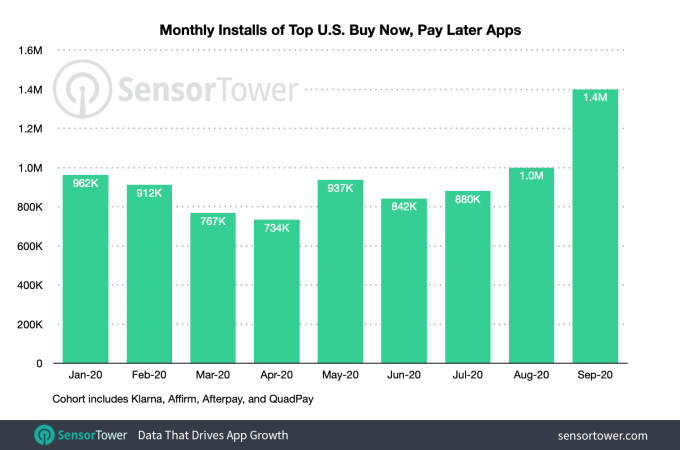
Image Credits: Sensor Tower

  • Buy Now, Pay Later app usage in the U.S. up 186% year-over-year as of Sept. According to Sensor Tower, apps that let consumers make purchases on payment plans have been climbing steadily this year since the COVID-19 pandemic. The report looked at Klarna, Affirm, Afterpay and QuadPay, which together have generated 18 million lifetime installs across the App Store and Google Play. Installs were up 115% YoY in September, while monthly actives were up 186%.
  • U.S. contact-tracing apps are a disjointed wreck. The WSJ examined the state of COVID-19 contact-tracing apps in the U.S. and found that states focusing on their own efforts, due to the lack of a national plan, has left a disjointed patchwork of tools. Only 10 states, plus D.C., have used the framework built by Google and Apple; 11 are piloting or building apps. The EU, meanwhile, switched on cross-border interoperability for its first batch of tracing apps.
  • Gen Z spends 10% more time using top non-game apps than older users, at 4.1+ hours per month. The figure excludes pre-installed apps and was calculated on Android devices in select markets, including the U.S. Gen Z users also engaged with non-game apps more often than older users, at 120 sessions per month per app.
  • U.S. consumers spend $20.78/mo on average on their app subscriptions, according to new data from Adjust. The 25 to 34-year-old age group spends the most on subscription apps at $25.85/mo, while those 55 and over spend the least, at $13.97/mo. In addition, more than a quarter of millennials and Gen Z consumers said they have stopped paying for other services in order to buy subscriptions on mobile app services (e.g. option for fitness apps over going to the gym).
  • Dating apps are on the rise in the U.S., says Apptopia. New users for Hily, Match, BLK, Bumble and Grindr are on pace to grow month-over-month at 32%, 28%, 20%, 18% and 11%, respectively.


Services
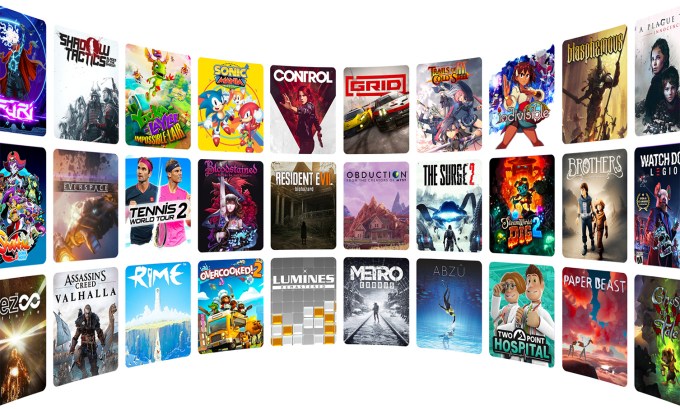
  • Amazon’s Luna game streaming service opens in early access to its first customers. The service offers a library of 50 games and works on Mac, PC, Amazon Fire TV, and iOS devices, courtesy of a web app to work around the App Store rules. Initial reviews describe the service as sometimes struggling with performance over Wi-Fi, but offering a good web app experience. Luna features some big titles but xCloud still has the better lineup. Its real killer feature, however, may be the promised Twitch integration, arriving in the future.
  • SoundCloud launches a $19.99/month DJ plan, SoundCloud DJ, that offers unlimited offline access to its catalog. Users can also stream high-quality audio and mix tracks using select DJ apps, including Virtual DJ, Cross DJ and Denon DJ.
  • Put your five-star reviews on your home screen. IMore spotted a must-have motivational tool for developers: a way to put your app’s five-star reviews as a widget on your home screen; $1.99 for this happiness boost.

Security/Privacy

Deadpool

  • Apple quietly discontinues its Apple TV Remote app. The app was removed from the App Store on Wednesday. Users are now expected to use the Remote feature built into the Control Center since iOS 12 instead.
  • Google will end support for its location-sharing Trusted Contacts app in December, and removes it from the Play Store. Users are directed to use similar features in Google Maps instead for finding friends and family.

Policies and Politics

  • Coalition for App Fairness more than doubles a month after its debut. The Coalition for App Fairness (CAF), a newly formed advocacy group pushing for increased regulation over app stores, has more than doubled in size with this week’s announcement of 20 new partners. The organization, led by top app publishers and critics, including Epic Games, Deezer, Basecamp, Tile, Spotify and others, debuted in late September to fight back against Apple and Google’s control over app stores, and particularly the stores’ rules around in-app purchases and commissions.

App News

  • Facebook to increase investments in WhatsApp for business. The company said it will expand Shopping on WhatsApp and will charge businesses for some of the services it offers on the chat app, in order to grow revenues. This includes offering to manage businesses’ WhatsApp messages via Facebook’s own hosting services. Facebook offered this info as more of a look into its roadmap, but without specifics on new services or pricing.
  • Facebook is cloning Nextdoor. The feature is in testing in Canada and sees Facebook automatically generating neighborhood groups to connect local users with people, activities and items for sale.
  • Court approves Kik’s settlement with SEC. The ruling ends a multi-year court battle by allowing Kik to pay a one-time $5 million fine for its violation of securities law for failing to register its 2017 distribution of its Kin tokens in its ICO.
  • Roblox passes $2B in mobile player spending ahead of its planned IPO. The company’s revenues, accelerated by the pandemic, crossed the $1.5 billion mark in May 2020, then picked up another $500 million in five months, says Sensor Tower.
  • Cameo enters B2B sales. The custom celebrity video app repositions its business of personalized greetings for B2B sales through an integration and rev share agreement with corporate gifting platform Sendoso.
  • Adobe adds a chain of custody tool in the beta release of Photoshop and Behance that will fight misinformation and keep content attributed properly.
  • Stitcher’s podcasts come to Pandora as acquisition completes. The Stitcher app also got a revamp following the deal’s finalization. The move brought several bigger podcast titles in house, thanks to Earwolf, including “Freakonomics Radio,” “My Favorite Murder,” “SuperSoul Conversations from the Oprah Winfrey Network,” “Office Ladies,” “Conan O’Brien Needs a Friend,” “Literally! with Rob Lowe,” “LeVar Burton Reads” and “WTF with Marc Maron.”
  • NYT has an iOS 14 widget now. The new widget will put NYT headlines on your home screen. Note that while the widget can be installed by anyone, if you want to click through to read, you’ll still need to be a subscriber.
  • PicsArt brings its app-based design tools to the web. The creative platform is chasing business users with the launch of its AI tools on picsart.com. The debut suite includes a template editor, background and object remover, video slideshow maker, text editor, and others.

Funding and M&A

  • Chinese tutoring app Yuanfudao has raised $2.2 billion from investors, surpassing Byju’s as the most valuable edtech company in the world, as it’s now worth $15.5 billion.
  • Retool raises $50M in funding, led by Sequoia, for its low-code tools for building internal apps that work on either desktop or mobile. The new round values the business at nearly $1 billion. Other backers include GitHub CEO Nat Friedman, Stripe founders Patrick and John Collison, Brex Inc. founders Henrique Dubugras and Pedro Franceschi and Y Combinator co-founder Paul Graham.
  • Syte raises $40M to bring visual shoppers to e-commerce retailers. Visual search is already popular in apps like Google, Pinterest and eBay, but Syte wants under retailers to have the option. The round was led by return investor Viola Ventures.
  • 98point6 raises $118M for its AI-powered telemedicine platform that works on web and mobile (iOS and Android).

Recommended Downloads

Halide Mark II

Image Credits: Lux

The developers of popular pro iPhone camera apps Halide and Spectre this week launched their latest creation, the Halide Mark II camera app. The new interface has been designed for one-handed operation and includes a range of new features.

These include a new gesture-based automatic and manual switcher; tactile touch for enabling and disabling features like exposure warnings, focus peaking, and loupe as you adjust exposure or focus; an overhauled manual mode; new dynamic labeling of controls and actions to explain features to new users; support for the edge-to-edge interface of the iPhone 12 models; a redesigned reviewer with a full metadata read-out; in-app memberships for photo lessons; and over 40 more changes.

A new “Coverage” feature can take a photo with Smart HDR 2/3 and Deep Fusion for maximum quality and computational processing as well as a RAW file — with only a slight delay between captures.

Image Credits: Lux

Halide Mark II also uses machine learning to process an iPhone RAW file in the app (ProRAW) with 17 steps, including detail enhancement, contrast and color adjustment and more. This feature, called Instant RAW, intelligently develops the file to get the best possible results.

And the app includes top pro tools, like a new waveform and color exposure warnings (zebras) that use XDR (Extended Dynamic Range) 14-bit RAW sampling, for accurate exposure previews and readings.

The app is $36 (currently $30 during a promo period) if you want to only pay once. Otherwise it’s $11.99 per year on subscription (currently $9.99 per year if you lock in the price now during the promo period). Subscribers to the membership plan also get perks, like custom icons. Existing Halide 1 users, unbelievably, are upgraded for free but are asked to support the app with a membership.

ClipDrop — AR Copy Paste

Aaand here it is..!!! ?

After months of hard work with @jblanchefr, @ClipDropApp beta (AR Copy Paste) is now publicly available on #Android, #iOS, #macOS, and #Windows

? https://t.co/52eLMEfXNR ?

Here's a thread of what you can already do with it ? 1/n#ML #AR #AI pic.twitter.com/0fQJQ8KRBv

— Cyril Diagne (@cyrildiagne) October 22, 2020

A new app called ClipDrop launches on iOS, Android, macOS and Windows as a new sort of “copy and paste” experience. The app uses state-of-the-art vision AI to copy images from your desktop with a screenshot to any other app (e.g. Docs, Photoshop, Canva, etc.) and it allows you to extract anything — objects, people, drawings or text.

The mobile app lets you snap photos of real-world items and then digitally transfer them to other apps or websites. In the below demo, the company shows how you could “clip” an image of an article of clothing using the camera, then import the photo into a document.

The company also just released a plugin for Photoshop that lets you drop the image into its app as a new layer with an editable mask.

The app is $39.99 per year (until November 2020, when it ups to $79.99 per year.)

Adobe Illustrator on iPad + Adobe Fresco on iPhone
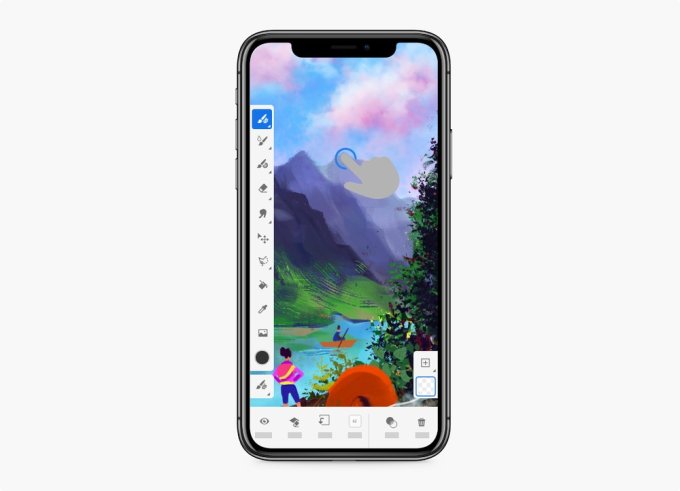
Image Credits: Adobe

As part of Adobe’s virtual MAX 2020 conference this week, the company launched the first public version of its Illustrator vector graphics app on the iPad and brought its Fresco drawing and painting app to the iPhone. In time, the company plans to bring more effects, brushes and AI features to Illustrator. Fresco 2.0, meanwhile, includes new smudge brushes and support for personalized brushes, among other things.

Party Squasher

Designed for landlords, Airbnb owners or other vacation rental property owners, Party Squasher offers a hardware device and paired mobile app that counts the number of people at your house by counting the mobile phones in or around a house. The phones can be counted even if they’re not connected to the home’s Wi-Fi.

Because the device doesn’t include cameras or microphones, it’s ideal for ensuring that renters aren’t hosting large (and these days, potentially illegal) parties without violating privacy.

In the event that a large gathering is present, you’re sent a text or email so you can take action.

The device is $249 and the app charges a $199 per year subscription.

Tweets

? pic.twitter.com/IC5Ey4ONjK

— Jonathan Morrison ????? (@tldtoday) October 22, 2020

Remember App Clips?

— Paul Haddad (@tapbot_paul) October 22, 2020

Quibi made their “episodes” 11 minutes to avoid paying union writers. Everyone should MC Hammer dance on their grave.

— Jawn Wick (@LukeXCunningham) October 21, 2020

Omg I forgot to turn her app time limits back on pic.twitter.com/wrzSTGizWA

— Sarah Perez (@sarahintampa) October 22, 2020


The No. 1 game in the App Store is now Among Us!.

Can you guess why?

The best moments from @AOC's Among Us stream on @Twitch last night. pic.twitter.com/13dGGgeWTF

— The Recount (@therecount) October 21, 2020

Yale may have just turned institutional investing on its head with a new diversity edict

It could be the long-awaited turning point in the world of venture capital and beyond. Yale, whose $32 billion endowment has been led since 1985 by the legendary investor David Swensen, just let its 70 U.S. money managers across a variety of asset classes know that for the school, diversity has now moved front and center.

According to the WSJ, Swensen has told the firms that from here on out, they will be measured annually on their progress in increasing the diversity of their investment staff, from hiring to training to mentoring to their retention of women and minorities.

Those that show little improvement may see the prestigious university pull its money, Swensen tells the outlet.

It’s hard to overstate the move’s significance. Though Yale’s endowment saw atypically poor performance last year, Swensen, at 66, is among the most highly regarded money managers in the world, growing Yale’s endowment from $1 billion when he joined as a 31-year-old former grad student of the school, to the second-largest school endowment in the country after Harvard, which currently manages $40 billion.

Credited for developing the so-called Yale Model, which is short on public equities and long on commitments to venture shops, private equity funds, hedge funds, and international investments, Swensen has inspired legions of other endowment managers, many of whom worked for him previously, including the current endowment heads of Princeton, Stanford, and the University of Pennsylvania.

It isn’t a stretch to imagine these managers and many others will again follow Swensen’s lead, one that was inspired by the growing diversity with Yale itself. Should such metrics become standard, they could dramatically change the stubbornly intractable world of money management, which remains mostly white and mostly male.

Indeed, while the dearth of woman and minorities within the ranks of venture firms may not be news to readers, a 2019 study commissioned by the Knight Foundation and cited by the WSJ underscores how big an issue it remains across asset classes. According to its findings, women- and minority-owned firms held less than 1% of assets managed by mutual funds, hedge funds, private-equity funds and real-estate funds in 2017, even though their performance was on a par with such firms.

As for why Swensen didn’t write this letter much sooner to the universe of fund managers backed by Yale, Swensen tells that WSJ that he has long talked about diversity with them but says he held off on asking for systematic changes owing to a belief, in part, that there were not enough diverse candidates entering into asset management.

Inspired by the Black Lives Matter movement that gained momentum this spring, he decided it was time to take the leap anyway.

As for that perceived pipeline concern, fund managers will have to figure it out. For his part, Swensen reportedly offered a suggestion to those same U.S. managers. He proposed that they forget the same resumes for which they’ve long looked and consider recruiting directly from college campuses.

Facebook and Twitter CEOs to testify before Congress in November on how they handled the election

Shortly after voting to move forward with a pair of subpoenas, the Senate Judiciary Committee has reached an agreement that will see the CEOs of two major social platforms testify voluntarily in November. The hearing will be the second major congressional appearance by tech CEOs arranged this month.

Twitter’s Jack Dorsey and Facebook’s Mark Zuckerberg will answer questions at the hearing, set for November 17 — two weeks after election day. The Republican-led committee is chaired by South Carolina Senator Lindsey Graham, who set the agenda to include the “platforms’ censorship and suppression of New York Post articles.”

According to a new press release from the committee, lawmakers also plan to use the proceedings as a high-profile port-mortem on how Twitter and Facebook fared on and after election day — an issue that lawmakers on both sides will undoubtedly be happy to dig into.

Republicans are eager to press the tech CEOs on how their respective platforms handled a dubious story from the New York Post purporting to report on hacked materials from presidential candidate Joe Biden’s son, Hunter Biden. They view the incident as evidence of their ongoing claims of anti-conservative political bias in platform policy decisions.

While Republicans on the Senate committee led the decision to pressure Zuckerberg and Dorsey into testifying, the committee’s Democrats, who sat out the vote on the subpoenas, will likely bring to the table their own questions about content moderation, as well.

The RIAA is coming for the YouTube downloaders

In ye olden days of piracy, RIAA takedown notices were a common thing — I received a few myself. But that’s mostly fallen off as tracking pirates has gotten more difficult. But the RIAA can still issue nastygrams — to the creators of software that could potentially be used to violate copyright, like YouTube downloaders.

One such popular tool used by many developers, YouTube-DL, has been removed from GitHub for the present after an RIAA threat, as noted by Freedom of the Press Foundation’s Parker Higgins earlier today.

This is a different kind of takedown notice than the ones we all remember from the early 2000s, though. Those were the innumerable DMCA notices that said “your website is hosting such-and-such protected content, please take it down.” And they still exist, of course, but lots of that has become automated, with sites like YouTube removing infringing videos before they even go public.

What the RIAA has done here is demand that YouTube -DL be taken down because it violates Section 1201 of U.S. copyright law, which basically bans stuff that gets around DRM. “No person shall circumvent a technological measure that effectively controls access to a work protected under this title.”

That’s so it’s illegal not just to distribute, say, a bootleg Blu-ray disc, but also to break its protections and duplicate it in the first place.

If you stretch that logic a bit, you end up including things like YouTube-DL, which is a command-line tool that takes in a YouTube URL and points the user to the raw video and audio, which of course have to be stored on a server somewhere. With the location of the file that would normally be streamed in the YouTube web player, the user can download a video for offline use or backup.

But what if someone were to use that tool to download the official music video for Taylor Swift’s “Shake it off”? Shock! Horror! Piracy! YouTube-DL enables this, so it must be taken down, they write.

As usual, it only takes a moment to arrive at analogous (or analog) situations that the RIAA has long given up on. For instance, wouldn’t using a screen and audio capture utility accomplish the same thing? What about a camcorder? Or for that matter, a cassette recorder? They’re all used to “circumvent” the DRM placed on Tay’s video by creating an offline copy without the rights-holder’s permission.

Naturally this takedown will do almost nothing to prevent the software, which was probably downloaded and forked thousands of times already, from being used or updated. There are also dozens of sites and apps that do this — and the RIAA by the logic in this letter may very well take action against them as well.

Of course, the RIAA is bound by duty to protect against infringement, and one can’t expect it to stand by idly as people scrape official YouTube accounts to get high-quality bootlegs of artists’ entire discographies. But going after the basic tools is like the old, ineffective “Home taping is killing the music industry” line. No one’s buying it. And if we’re going to talk about wholesale theft of artists, perhaps the RIAA should get its own house in order first — streaming services are paying out pennies with the Association’s blessing. (Go buy stuff on Bandcamp instead.)

Tools like YouTube-DL, like cassette tapes, cameras and hammers, are tech that can be used legally or illegally. Fair use doctrines allow tools like these for good-faith efforts like archiving content that might be lost because Google stops caring, or for people who for one reason or another want to have a local copy of some widely available, free piece of media for personal use.

YouTube and other platforms, likewise in good faith, do what they can to make obvious and large-scale infringement difficult. There’s no “download” button next to the latest Top 40 hit, but there are links to buy it, and if I used a copy — even one I’d bought — as background for my own video, I wouldn’t even be able to put it on YouTube in the first place.

Temporarily removing YouTube-DL’s code from GitHub is a short-sighted reaction to a problem that can’t possibly amount to more than a rounding error in the scheme of things. They probably lose more money to people sharing logins. It or something very much like it will be back soon, a little smarter and a little better, making the RIAA’s job that much harder, and the cycle will repeat.

Maybe the creators of Whack-a-Mole will sue the RIAA for infringement on their unique IP.

Daily Crunch: Uber and Lyft defeated again in court

A California court weighs in as Prop. 22 looms, Google removes popular apps over data collection practices and the Senate subpoenas Jack Dorsey and Mark Zuckerberg. This is your Daily Crunch for October 23, 2020.

The big story: Uber and Lyft defeated again in court

A California appeals court ruled that yes, a new state law applies to Uber and Lyft drivers, meaning that they must be classified as employees, rather than independent contractors. The judge ruled that contrary to the rideshare companies’ arguments, any financial harm does not “rise to the level of irreparable harm.”

However, the decision will not take effect for 30 days — suggesting that the real determining factor will be Proposition 22, a statewide ballot measure backed by Uber and Lyft that would keep drivers as contractors while guaranteeing things like minimum compensation and healthcare subsidies.

“This ruling makes it more urgent than ever for voters to stand with drivers and vote yes on Prop. 22,” a Lyft spokesperson told TechCrunch.

The tech giants

Google removes 3 Android apps for children, with 20M+ downloads between them, over data collection violations — Researchers at the International Digital Accountability Council found that a trio of popular and seemingly innocent-looking apps aimed at younger users were violating Google’s data collection policies.

Huawei reports slowing growth as its operations ‘face significant challenges’ — The full impact of U.S. trade restrictions hasn’t been realized yet, because the government has granted Huawei several waivers.

Senate subpoenas could force Zuckerberg and Dorsey to testify on New York Post controversy — The Senate Judiciary Committee voted in favor of issuing subpoenas for Facebook’s Mark Zuckerberg and Twitter’s Jack Dorsey.

Startups, funding and venture capital

Quibi says it will shut down in early December — A newly published support page on the Quibi site says streaming will end “on or about December 1, 2020.”

mmhmm, Phil Libin’s new startup, acquires Memix to add enhanced filters to its video presentation toolkit — Memix has built a series of filters you can apply to videos to change the lighting, the details in the background or across the whole screen.

Nordic challenger bank Lunar raises €40M Series C, plans to enter the ‘buy now, pay later’ space — Lunar started out as a personal finance manager app but acquired a full banking license in 2019.

Advice and analysis from Extra Crunch

Here’s how fast a few dozen startups grew in Q3 2020 — This is as close to private company earnings reports as we can manage.

The short, strange life of Quibi — Everything you need to know about the Quibi story, all in one place.

(Reminder: Extra Crunch is our membership program, which aims to democratize information about startups. You can sign up here.)

Everything else

France rebrands contact-tracing app in an effort to boost downloads — France’s contact-tracing app has been updated and is now called TousAntiCovid, which means “everyone against Covid.”

Representatives propose bill limiting presidential internet ‘kill switch’ — The bill would limit the president’s ability to shut down the internet at will.

The Daily Crunch is TechCrunch’s roundup of our biggest and most important stories. If you’d like to get this delivered to your inbox every day at around 3pm Pacific, you can subscribe here.