Launch next-level networking with CrunchMatch at our TC Sessions: Space event

TC Sessions: Space 2020, our first space technology event, launches December 16-17, and you won’t want to miss our virtual conference focused on this fast-emerging startup category. You’ll hear from the space industry’s top movers, shakers and decision makers, including Space Command’s General John W. Raymond, NASA Administrator Jim Bridenstine and Tess Hatch of Bessemer Venture Partners — with plenty more to come.

TC Sessions: Space offers an unparalleled networking opportunity to meet the most important people in the space industry, across public, private and defense. You’ll be able to set up meetings with hundreds of engineers, founders, students, investors, executives and military and government officials from around the world. CrunchMatch, our free, AI-powered platform, connects you with the people who share your specific business interests and goals. It makes networking easier, efficient and more productive.

After you register for TC Sessions: Space 2020, you’ll get invited to the CrunchMatch platform where you’ll answer a few quick questions about who you want to meet. Then CrunchMatch gets to work to find and recommend people who align with your goals. You can send invites and schedule 1:1 video calls. You also have the option to search manually. Connect with investors, founders, engineers, R&D teams, manufacturers, students, potential customers or employees. CrunchMatch makes it faster and easier.

Pro Tip: Buy your pass before early-bird pricing ends on November 13 at 11:59 p.m. (PT). We offer discount passes for students, government, military and nonprofits, and current Extra Crunch subscribers receive a 20% discount on passes.

This may be our first space conference, but it’s not our first rodeo. Read what attendees from other TC Sessions say about networking with CrunchMatch:

“The networking at TC Sessions is terrific. Our company’s building momentum in the U.S. market, and the opportunity to meet and talk with all the players is very important. The CrunchMatch platform made it easy to connect.”— Melika Jahangiri, vice president at Wunder Mobility.

“The CrunchMatch is basically speed-dating for techies, and it was very helpful. I scheduled at least 10 short, precise meetings. I learned about startups in stealth mode, what big corporations were up to — things not yet picked up by the press. It was great, and I followed up on three or four of those connections.” — Jens Lehmann, technical lead and product manager, SAP.

Get ready for a deep dive on topics like 3D-printed rockets, launch services, orbital operations, ground station networks and beyond. Learn about innovative tech, discover emerging trends and potential opportunities.

TC Sessions: Space 2020 lifts off December 16-17. Buy your pass today and start connecting with the space tech community, learn from and partner with the people determined to push deeper into the cosmos.

Is your company interested in sponsoring TC Sessions: Space 2020? Click here to talk with us about available opportunities.

T-Mobile launches new TVision streaming bundles, pricing starts at $10 per month

T-Mobile is launching new skinny bundles of live TV and streaming services to compete with expensive cable subscriptions.

The carrier has already been moving into the TV market with the acquisition of Layer3 and the subsequent launch of TVision Home last year. However, that was closer to traditional cable, with a price tag starting at $100 a month and availability limited to select markets. (T-Mobile also offers free Netflix with some family plans.)

The new TVision lineup is more affordable and more broadly available. The cheapest option is TVision Vibe, which includes more than 30 channels of live and on-demand content including AMC, BET, Discovery, Food Network, Hallmark, HGTV, MTV and TLC, and which costs $10 a month.

A bit more costly, but with live news and sports, is TVision Live. It starts at $40 a month and offers a different lineup of 30-plus channels — ABC, FOX, NBC, Turner, ESPN and more, with $50-a-month (TVision Live+) and $600-a-month (TVision Live Zone) plans that introduce more channels to the bundle. (In contrast, YouTube TV costs $65 a month and Hulu + Live TV costs $55 a month.) And if you sign up for Live+ or Live Zone between November 1 and December 31, you’ll get a free year of Apple TV+ as well.

Lastly, you’ll also be able to purchase individual services like Starz, Showtime and Epix through TVision Channels.

The new TVision services are available on Android and Apple mobile and TV devices, as well as Amazon Fire TV. Plus, T-Mobile is launching a new $50 HDMI streaming device called the TVision Hub.

“With TVision, you can cut the cord, cut the cost and cut the crap,” said Dow Draper, T-Mobile’s executive vice president of emerging products, in a statement.


Microsoft stock flat despite better-than-expected earnings, strong Azure growth

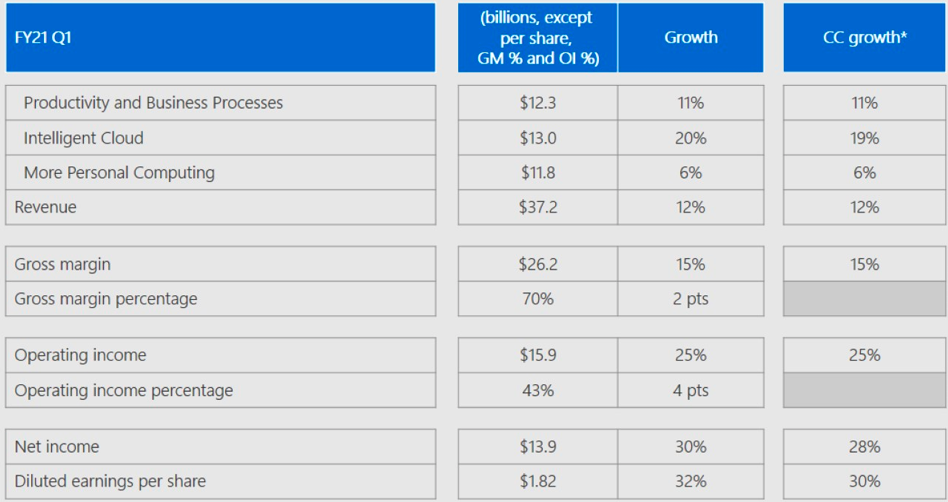
Today after the bell, Microsoft reported its calendar Q3 2020 earnings, the period of time that corresponds to its Q1 fiscal 2021 period. In the three months ending September 30, Microsoft had revenues of $37.2 billion and per-share profit of $1.82.

Analysts had anticipated the company to report $1.54 in earnings per share, generated from $35.72 billion in revenue.

In the aftermath of the beat, shares of the company are effectively flat, gaining only a fraction of a point in after-hours trading. Microsoft was up by nearly 2% in afternoon trading, despite somewhat uneven markets.

Helping drive the movement in Microsoft’s share price was the all-important Azure update. Here’s what Microsoft had to say:

Server products and cloud services revenue increased 22% (up 21% in constant currency) driven by Azure revenue growth of 48% (up 47% in constant currency)

Parsing investor sentiment, it appears that a number closer in the low-40s was anticipated by most, making the Azure result a strong number.

The broader category that Azure sits inside of, called “Intelligent Cloud,” reported $13 billion in revenue, up 20% from the year-ago quarter. That was the best-performing of Microsoft’s three units, which also include the Office-and-LinkedIn heavy “Productivity and Business Processes” group that posted $12.3 billion in revenue — up 11% — and the Windows-and-Xbox heavy “More Personal Computing,” which had revenues of $11.8 billion, up a smaller 6% compared to the year-ago quarter.

For the financial dorks in the audience, I snagged the following for your enjoyment:

Other standouts from a first read of the company’s earnings report include:

  • Strong Surface revenue, rising 37% compared to the year-ago period
  • Bing revenue declines, with the company saying that “[s]earch advertising revenue excluding traffic acquisition costs decreased 10%”
  • Commercial cloud revenues of $15.2 billion, up 31% from the year-ago period
  • LinkedIn managed 16% revenue gains in the quarter
  • Gaming revenue gains of 22% year-over-year
  • Consumer PC demand — seen in PC sales numbers — boosted non-Pro Windows OEM revenues by 31% compared to the year-ago quarter, though Pro-focused Windows OEM top line fell 22%. Those partial results netted out to a -5% OEM figure for the company.

Looking ahead, analysts expect Microsoft to record $1.60 in per-share profit in the current quarter, off $40.4 billion in total revenue. The company will announce its own projections on its earnings call.

Update: Got on the phone with Mike Spencer from Microsoft’s IR team to chat about the results. I was curious about the impact of COVID-related advertising declines impacting the company. Spencer said that both Bing and LinkedIn recovered from earlier lows, and both came in above internal expectations. For LinkedIn, of course, that was a better net result than Bing’s, comparing their year-over-year figures, but beating expectations is still good. You can read as much into what the Bing numbers will mean for Google as you will.

Spencer highlighted the Azure number — ahead of internal and external expectations — and the non-Pro Windows OEM number as notable figures from the report. Agreed. The former shows that Microsoft is holding up against Amazon and Google, while the latter shows that when folks buy computers for their home-bound tots, they aren’t only buying Chromebooks.

Reddit will allow employees to work from anywhere, going forward

Spurred on by the seemingly endless COVID-19 pandemic — and no doubt inspired by similar moves from companies like Twitter — Reddit today announced plans to offer its staff the opportunity to work remotely, going forward. The company announced the move in a blog post today, noting some practical exceptions to the rule, including those working facilities and IT support roles.

“Looking ahead,” Reddit writes, “we want to meet the needs of our employees so they can do their best work, especially in a time of uncertainty. And as we deliver on our mission of creating belonging for everyone in the world, we want Reddit to be positioned as a workforce that’s as diverse as its ecosystem of communities and users.”

The company says it will continue to offer the ability to work from its office (or a combination of remote and office work), though the physical spaces will be “reimagined” — a move that likely will be met with a mixed reception depending on what employees look for in an office space.

“Imagine: casual and coffee shop-style seating, private space for heads-down focusing, larger bookable resources and collaboration spaces for teams to strategically meet IRL,” it writes, “and no more fixed desks—we’ll have neighborhoods for teams to gather and bookable desks for employees working in the office.”

It’s more akin to a co-working space than a traditional office from the sound of it. The move also means Reddit will be rethinking salaries, offering salaries reserved for places with high cost of living like New York and San Francisco, regardless of the employee’s location.

How Jack Dorsey will defend Twitter in tomorrow’s Senate hearing on Section 230

Three of tech’s most prominent CEOs tomorrow will face the Senate Commerce Committee during a virtual hearing tomorrow and their opening statements are beginning to trickle out.

The hearing, scheduled for 10 AM ET Wednesday, will see Twitter’s Jack Dorsey, Facebook’s Mark Zuckerberg and Sundar Pichai of Alphabet in the hot seat for what’s sure to be a long and winding session on how to rein in big tech’s “bad behavior.”

Specifically, the hearing will delve into a law known as Section 230 of the Communications Decency Act, a key legal provision that shields online businesses from content their users create.

With the tide of public opinion turning against social networks in light of algorithmically-amplified societal woes, lawmakers are keen to do something about big tech’s unregulated power — they just can’t quite agree on what yet.

A number of competing pieces of legislation have recently proposed changes to Section 230 but it’s not yet clear what set of changes, if any, will prevail in Congress. While both political parties can agree that big tech needs a check on its power, they arrive at that conclusion from very different paths. Republicans remain occupied with claims of anti-conservative political bias in tech, while Democrats are focused on the failure of platforms to remove misinformation and other dangerous content.

Tech companies see any interest in altering Section 230 as an existential threat — and rightly so. The law is critical to growing any kind of online platform with user-made content (social networks, comments sections, even Amazon reviews) without being sued into oblivion.

In his opening statement, Dorsey calls Section 230 “the Internet’s most important law for free speech and safety” and focuses on the kind of cascading effects that could arise if tech’s key legal shield comes undone.

“We must ensure that all voices can be heard, and we continue to make improvements to our service so that everyone feels safe participating in the public conversation—whether they are speaking or simply listening,” Dorsey writes. “The protections offered by Section 230 help us achieve this important objective.”

Dorsey argues that dismantling Section 230 would result in much more content being removed — a line of reasoning aimed at Republicans’ ongoing accusations of political censorship.

He also makes the timely choice to defend Section 230 from an antitrust perspective, arguing that the law made it possible for small internet companies to establish themselves. Dorsey warns that changes to 230 would leave “only a small number of giant and well-funded technology companies,” resulting in an even more winner-take-all environment.

Dorsey’s full opening statement is embedded below.

Instagram extends time limits on live streams to 4 hours, will soon support archiving

Instagram is adapting to the way creators have been using its service during the coronavirus pandemic. With individuals and businesses now limited from hosting in-person events — like concerts, classes, meetups, and more — users have turned to Instagram to live stream instead. Today, the company says it’s significantly expanding the time limit for these streams, from 1 hour to now 4 hours for all users worldwide.

The change, the company explains, is meant to help those who’ve had to pivot to virtual events, like yoga and fitness instructors, teachers, musicians, artists and activists, among others. During the height of government lockdowns in the U.S., Instagram Live became a place for people to gather as DJ’s hosted live sets, artists played their music for fans, celebs hosted live talk shows, workout enthusiasts joined live classes, and more. Live usage had then jumped 70% over pre-coronavirus numbers in the U.S. as people connected online.

Many of these Instagram Live creators had wanted to extend their sessions beyond the 60 minute time limit without an interruption.

The change puts Instagram on par with the time limits offered by Facebook for live streams from mobile devices, which is also 4 hours. (If live streaming from a desktop computer or via an API, the Facebook time limit expands to 8 hours.)

While the longer time limit is opening up to all creators worldwide starting today, Instagram says the creator’s account has to be “good standing” in order to take advantage. That means the account can’t have a history of either intellectual property or policy violations.

Related to this change, Instagram will also update the “Live Now” section in IGTV and at the end of live streams to help direct users to more live content.

Instagram also today pre-announced another feature which has yet to arrive.

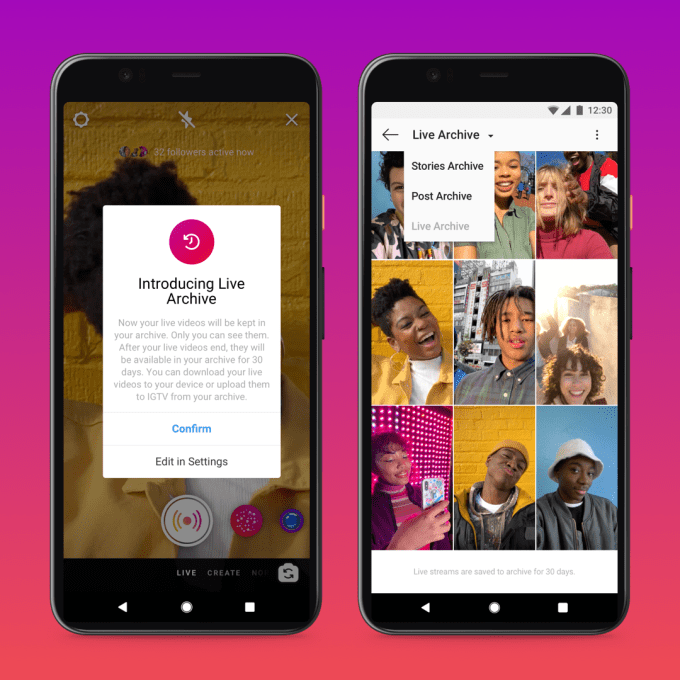
It says that it will “soon” add an option that will allow creators to archive their live streams for up to 30 days.

Image Credits: Instagram

Before, users could archive their Feed posts or their Stories to a private archive, but the only way to save a live stream was to publish it to IGTV immediately after the stream, through a feature introduced in May. 

The company says the new option to archive live broadcasts will mirror the existing archive experience for Stories and Feed Posts.

The difference is that archived live videos will be permanently deleted after 30 days.

But up until that time, the creator has the option to return to the video to save it or download it. This would allow the creator to publish the video on other social platforms, like Facebook or YouTube, or even trim out key parts for short-form video platforms, like TikTok. The Archive feature also means if a creator’s Live stream crashes for some reason — or if the creator forgot to download it in the moment — it can still be downloaded later on.

The news follows another recent Instagram update which introduced a new way for creators to monetize their Live streams.

The company earlier this month began rolling out badges in Instagram Live to an initial group of over 50,000 creators who will test the feature by selling badges at price points of $0.99, $1.99, or $4.99. These badges help fans’ comments stand out in busy streams, allow fans to support a favorite creator, and places the fan’s name on the creator’s list of badge holders.

Let’s move beyond 2020 and start thinking about the 2020s

Seasonality is critical for the media. End-of-year wrap-ups, best books for the summer, things to do this weekend — they’re all methods to note not only the passage of time, but also to begin to set the tone for what is about to come.

Everyone covered the end of the 2010s with aplomb, a decade that, at least in tech, was filled with huge milestones, including some of the largest startup IPOs of all time and also some of the worst lows we’ve ever seen — frauds and product snafus that were larger and grander than ever before.

Those retrospectives though were supposed to be complemented with the prospectives — what’s about to happen in the 2020s? What’s next? Where is progress and innovation going to come from this decade? We barely got this decade going of course before the pandemic hit, the U.S. elections got into full swing, and it has been non-stop debates about school openings, stump speeches, and whether a vaccine will arrive soon, shortly, distantly, or I guess never at all.

Our collective long-term vision has been terrorized by the short-term news that constantly rolls through our feeds. It’s time to change that.

Regardless of the outcome next week (or maybe next month?) in the U.S. or the final vaccine timeline for COVID-19, we still need to define what this next decade is about, particularly in technology, where the list of issues is widening and the number of sectors that have the potential for innovation expands. We need to think beyond the mundane daily operational challenges of startups and fundraises and consider the values we want to empower and inform in the years ahead.

Many of these questions go beyond mere “apps” to encompass areas of law, culture, societies, and ultimately, what we want to leave for the next generations coming behind all of us.

Over on EC, I’ve written a deep dive into five broad “clusters” of change that have the potential to transform our world in the 2020s, in areas like “wellness,” “climate,” “data society,” “creativity,” and “fundamentals” that each hold so many startups ideas that I truly am excited about what’s about to be unleashed this decade.

Yet, whether you like my amorphous groupings or not, I encourage everyone in the startup ecosystem to begin thinking about how to connect the dots between different startups, different sectors, and how our society is organized. The next generation of startup ideas are not going to come from the proverbial whiteboard and some Swift engineering in Xcode. They’re going to come from much more methodical and deeper introspection about what our society and all of us need going forward.

The 2010s were all about executing on the dreams of mobile, cloud, and basic data. Those ideas had historical antecedents going back in some cases decades or more (Vannevar Bush’s description of the internet dates to the 1940s, for instance). But for the first time, we had the infrastructure and the users to actually build these products and make them useful. It was quite possibly the most extensive greenfield opportunity in the history of technology.

Yet, that greenfield is increasingly fallow. Business has cycles and seasonality as much as media reporting does. The easy stuff has been done. Building an app to text people has been done by dozens before. There are a multitude of analytics packages, and payroll providers, and credit card issuers, and more. What’s required this decade is to start to encroach on the harder questions, topics like how we build a better society, make people more empowered to do deep and creative work, and how we can build a more resilient and sustainable planet for all.

None of these topics have pure point solutions — but that is what is going to make this coming decade so damn interesting. It’s going to take intense collaboration, multiple inventions and products, as well as legal and cultural changes, to realize these next improvements. If you have grown sick (as I have) of the latest apps and SaaS products du jour, this decade is going to be an amazing one to experience and build.

It’s a new season to lift our heads up a little and look around. The world, yes, is filled with problems — terrible, horrible, and stultifying problems that can at times feel all but insurmountable. But human ingenuity has always found a way, and we have never had such an extensive toolbox to confront all of them simultaneously. If the 2010s were all about humans learning technology, the 2020s is all about technology learning about humans.

5 startup theses that will transform the 2020s

I wrote a call to action for the tech community to dive deeper into the future of innovation this coming decade. Where are some of the hot spots going to come from though? Below, I have assembled a very loose set of five clusters broadly categorized into “wellness,” “climate,” “data society,” “creativity,” and “fundamentals” that offer some scaffolding for understanding what’s about to come this decade and how and any entrepreneur — really, any citizen — can start to build progress.

Take these ideas as inspirational — they aren’t limits, nor should the borders of these categories be seen as anything but liminal. I know in the daily cavalcade of news, it can be hard to feel inspired by the future. But do be! There is so much more coming this decade, that we may look back at the 2010s as the dark ages of innovation.

“Wellness”

Photo by Ian Forsyth/Getty Images

First, there is a cluster around “wellness.” That sometimes gets elided to just “mental health” and reduced to a prescription bottle, but this area really encompasses so much more than that. How do we build humanistic societies with strong social fabrics that enliven, enrich, and build meaning for our lives?

Yes, we’ve seen strong demand for wellness apps like Calm and Headspace. Exercise hardware like Peloton, Mirror and others along with platforms particularly around group classes have been a huge mainstay during this pandemic era. Mental health treatment itself is getting a makeover as startups reinvigorate the in-person therapist and psychiatrist visit as well as think about new models of delivering mental health services virtually. Even LSD is starting to make headways as a potentially useful tool, and psychedelics are going to be an interesting area to watch in the coming years.

All those areas still are ripe for innovation, yet, how do we go deeper and start to address the root causes of anguish and despair?

Take work, for instance. How do we make workers feel more secure and meaningful in a remote world where gig work makes up an increasing fraction of all employment? The precariousness of labor has a direct effect on wellness, and it’s going to take a much greater leap than a reclassification battle like in California this election cycle to make work “work” for all people. What can we do around stability of pay whether from employment or maybe programs like universal basic income to give people a sense of ownership over their destinies?

How do we start to create the bonds of neighborhoods and communities that hold people together and offer solace in times of despair? Part of this is improving the average town and making it more human-centric (that’s like 20 startups right there), but it also includes constructing more vibrant and expressive virtual worlds where we can find online neighborhoods that are safer than the dumpster fires we find on the web today.

Then there’s the health system in general. While America deservedly receives huge criticism for its overpriced and under-insured system, health systems worldwide face incredible pressures to improve efficiency. How do we make care better, more personalized, and more open? How do we reduce costs while ensuring that care is accurate and delivered expeditiously? There is huge work to be done to make health a key component.

To increase wellness for individuals, we need to increase wellness for our societies, building systems that are designed for the humans that inhabit them. Flexibility with security, engagement with individuality, expression with support. Our existing systems are already antiquated — and we haven’t come up with anything better.

This cluster is about asking “How does the world make us feel?”

“Climate”

Image Credits: Jacobs Stock Photography (opens in a new window) / Getty Images

The second cluster has to do broadly with the Earth, climate, crisis, and resilience. Climate change is real and not going away, and quite literally billions of people are going to feel its effects in the coming decades. Rising tides, massive hurricanes, power outages, wildfires, droughts and more are going to become part of our daily news vernacular.

Resiliency is not something that any one technology can offer, but innovation has huge potential to allow more of our systems to adapt to the changing nature of our world today.

Stark raises $1.5M for a toolkit that helps developers and others create more inclusive design

Diversity and inclusion are slowly, slowly moving away from being an afterthought (or worse, a no-thought) in the tech world. And to underscore the new attention the area is getting — in every aspect of the concept — today a startup that’s building tools to help designers and developers make their end products more accessible to people with visual impairments is announcing some funding.

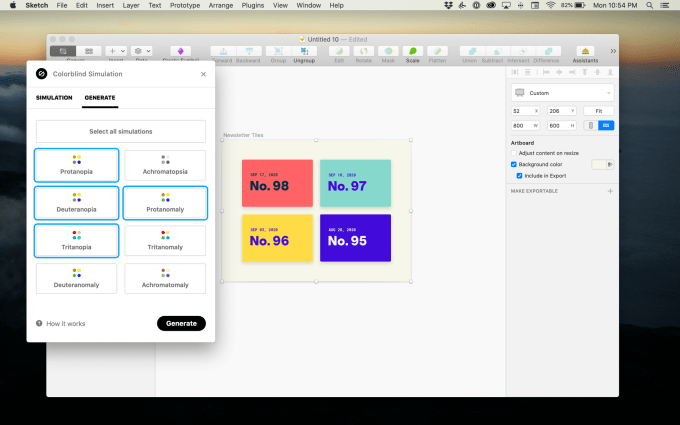
Stark, a New York-based startup that lets designers others building with design software run their files through an integrated tool that checks it and provides color edits and other suggestions to help them meet guidelines for people who see less well, has picked up $1.5 million.

Stark plans to use the funding to continue building integrations into commonly-used design apps and create integrations for developers (where it will read and provide guidance on code: next up is a Github integration), and continue building out its business with expanded pricing and usage tiers.

Currently, users can use plugins of Stark on Figma, Sketch & Adobe XD that let them access a Contrast Checker, Smart Color Suggestions, 8 Colorblind Simulations, a Colorblind Generator, and Rapid Contrast Checking (on Adobe XD).

Longer term, the plan is to build and end-to-end platform and to address inclusivity for other kinds of needs beyond visual impairments, and, since accessibility can come in physical forms, too, to consider more than just software, and to create more ways to automatically correct details.

As Cat Noone — the now-European-based CEO who co-founded the company with Michael Fouquet (the team is working remotely, she said) — describes it, the ambition is to “become the Grammarly for accessibility in software.”

The funding, a pre-seed round, is coming from a wide and interesting group of backers. It was co-led by Daniel Darling and Pascal Unger from Darling Ventures and Indicator Ventures; with participation also from Jason Warner, the CTO of Github; Kleiner Perkins’ Scout Fund; and Basecamp Ventures. Individual backers include the product lead for accessibility at Atlassian, the director of equitable design & impact at Culture Amp, a director of design at DuckDuckGo, a former VP of software development at Oracle, and more.

Part of the reason that Stark has gotten attention from all of these investors is because of its traction.

Early versions of the software have been out for eight months now, in the form of the plugins for Sketch, Adobe XD and Figma, and in that time it’s clocked up 300,000 users, mostly designers, engineers, and product managers across those three design platforms, with current customers including people from Microsoft, Oscar Health, US Bank, Instagram, Pfizer, Volkswagen, Dropbox and more.

It also has 10,000 people in its “community”, which includes people engaging with Stark more directly (rather than just using its plugins), on platforms like Slack, getting its newsletter and more.

Diversity and inclusion have been in the headlines this year, which is good news, even if the reason for it has been not so good — the sorry state of how minorities are treated by law enforcement. Partly because of the profile of those incidents and the subsequent protests, much of the world has associated the concept of D&I very closely with racial inclusion. While that story continues to unfold (and we hopefully continue see more positive and sustained efforts to address it), the kind of diversity and inclusion Stark is addressing is of a different sort.

It’s a logical, if often overlooked area: The Centers for Disease Control and Prevention estimate that (as of 2018) around one in every four adults in the U.S. alone live with some form of disability (a figure that doesn’t count children), with the biggest of these being cognitive disabilities. This essentially means that while a lot of design (and tech in general) is not really built to address this wider group, it’s a very sizable market.

At a time when technology is regularly made out to be the bad guy — and the reasons are many, touching on mental health; physical health; and economic, environmental, civil and legal impacts — designing software and hardware that is more inclusive could go a very long way in bridging some of those gaps that tech has created with (and within) society.

“We’re talking about the largest minority group in the U.S.,” Noone said. “You wouldn’t build a building today without a wheelchair ramp, so why aren’t we accounting for those individuals in our software design?”

Noone said that she and Fouquet originally landed on the idea of Stark when they were doing some work for another firm, building an emergency services app that would get used by the elderly. They built a very early version of the tool for themselves to use in that work. Showing it to others, they found people asking if they could use it, too. “And then it just kind of snowballed,” she said.

She then said that she found herself going down a “rabbit hole into the world of design and accessibility” and realised that not only were there no tools really built to address this out there, but that there was “so much more to the problem than colors.” (Colors was where Stark started, hence the great name.)

There is an interesting stick and carrot in the bigger market with things like inclusive design: for some it might be an issue of having to comply, others simply believe it’s the right thing to do, while yet others may not care but (rather cynically) believe being inclusive is a good look. Whatever the motivation is, the trick with Stark is that it’s making it easy to be inclusive for more people, and lowering the barrier at the end of the day can only be a good thing.

“No software product should exclude a disadvantaged minority of their users. It’s bad for business and bad for society,” said Darling in a statement. “We’re seeing dramatic increasing awareness amongst software designers, developers and executives to ship products that are universally accessible. Stark has quickly earned the trust of the industry and is on a path to become an important part of software infrastructure. We’re thrilled to partner with such a mission driven company that is already improving how software is produced around the world.”?


Wyze launches version 3 of its $20 security camera

Wyze first made a name for itself when it launched its $20 indoor security camera a few years ago. Since then, the company branched out into other smart home products, ranging from doorbells to scales. Today, it’s going back to its origins with the launch of the Wyze Cam V3, the third generation of its flagship camera.

The new version is still $20 (though that’s without shipping unless there’s a free shipping promotion in the Wyze store), but the company redesigned both the outside and a lot of the hardware inside the camera, which is now also IP65 rated, so you can now use it outdoors, too.

Image Credits: Wyze

The Cam V3 now features new sensors that enable color night vision, thanks to an F1.6 aperture lens that captures 40% more light than the previous version. That lens now also covers a 130-degree field of view (up from 110 degrees in V2) and the company pushed up the frames per second from 15 during the day and 10 at night to 20 and 15, respectively.

The company also enhanced the classic black and white night vision mode — which you’ll still need when it’s really dark outside or in the room you are monitoring — by adding a second set of infrared lights to the camera.

Other new features are an 80dB siren to deter unwanted visitors. This feature is triggered by Wyze’s AI-powered person-detection capability, but that’s a feature the company recently moved behind its $2/month CamPlus paywall, after originally offering it for free. That’s not going to break the bank (and you get a generous free trial period), but it’d be nice if the company could’ve kept this relatively standard feature free and instead only charged for extra cloud storage or more advanced features (though you do get free 14-day rolling cloud storage for 12-second clips).

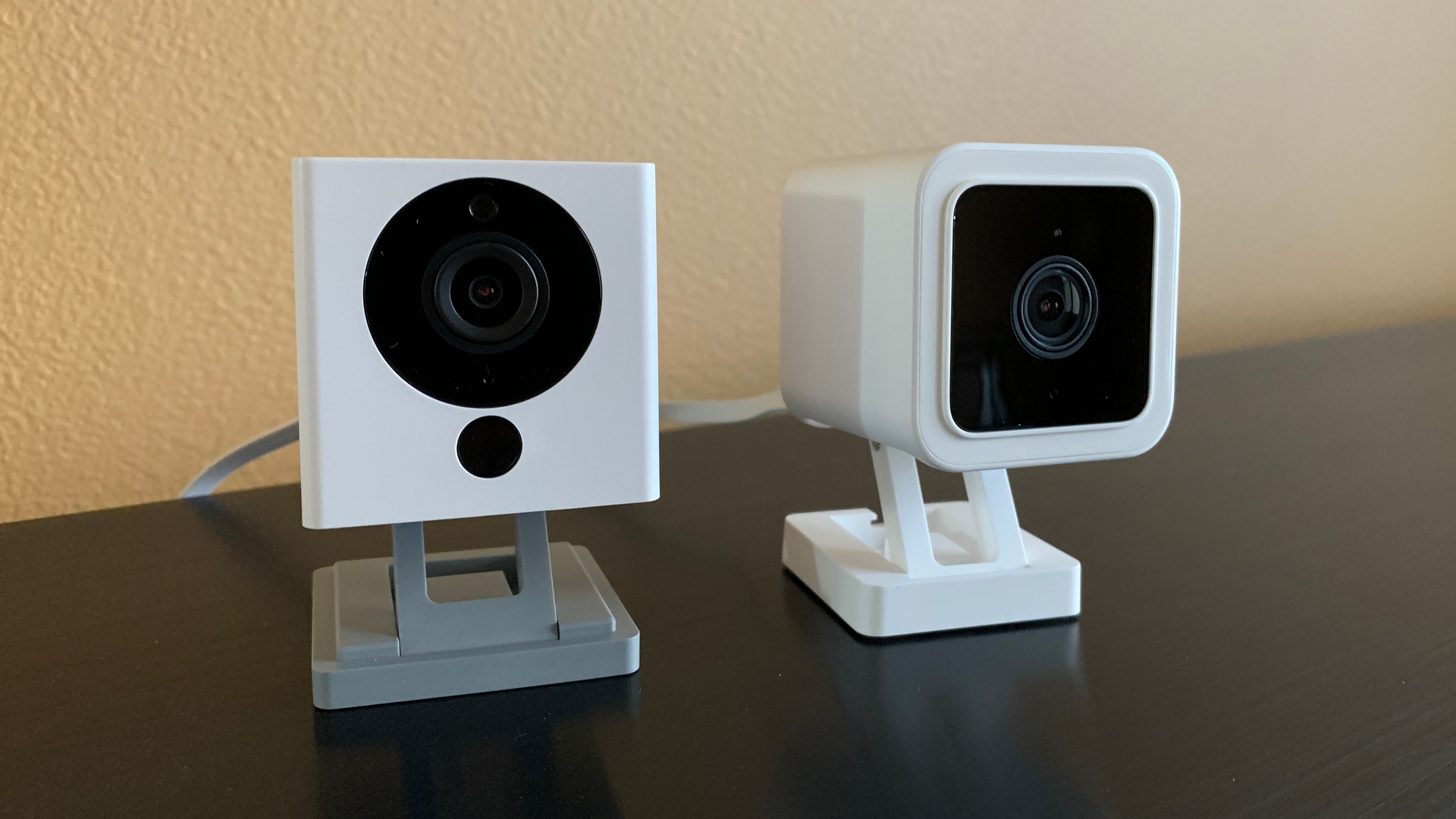
Wyze Cam V2 (left) and V3 (right).

Wyze provided me with a review unit ahead of today’s launch (and a Cam V2 to compare them). The image quality of the new camera is clearly better and the larger field of view makes a difference, even though the distortion at the edges is a bit more noticeable now (but given the use case, that’s not an issue). The new night color vision mode works as promised, and I like that you can set the camera to automatically switch between them based on the lighting conditions.

The person detection has been close to 100% accurate — and unlike some competing cameras that don’t feature this capability, I didn’t get any false alarms during rain or when the wind started blowing leaves across the ground.

If you already have a Wyze Cam V2, you don’t need to upgrade to this new one — the core features haven’t changed all that much, after all. But if you’re in the market for this kind of camera and aren’t locked into a particular security system, it’s hard to beat the new Wyze Cam.

Next-gen skincare, silk without spiders and pollution for lunch: Meet the biotech startups pitching at IndieBio’s Demo Day

Biotech can often, and sometimes literally, fly over our heads. However, the pandemic has shown an increased need for investment and focus on solutions that work on human and planetary health. For IndieBio, a science and biotech accelerator run by VC firm SOSV, this unprecedented year offered high stakes and new challenges.

Today and tomorrow, the biotech accelerator is hosting its twice-annual demo day.

Starting in 2015, IndieBio has provided resources to founders solving complex challenges with biotech, from fake meat to sustainability. Over the years, the accelerator has created a portfolio of biotech companies valued at over $3.2 billion, including companies like Memphis Meats, which develops cultured meat from animal cells; NotCo, a plant-based food brand; and Catalog, which uses organisms for data storage.

As part of the accelerator, each participating company receives $250,000 in capital, numerous other services and access to lab space. In July, the founder and head of IndieBio, Arvind Gupta, left his position to pursue a role at Mayfield. While Gupta remains an adviser, Po Bronson took the role as the new managing director.

Bronson was immediately put to the test. This year, the program expanded from operating solely in San Francisco to also create a cohort based in New York. It also doubled the amount of companies it invested in, bringing this cohort to 20 companies.

As you can imagine, lockdowns ultimately forced founders to delay key lab work in the beginning of the pandemic. Eventually, founders were able to partner with universities, contract research organizations or other biotech accelerators to begin their research, says Julie Wolf, the head of investor relations at SOSV. The NYC class received a “golden ticket” for free lab space come November.

And these dynamics make this cohort all the more fascinating to dive into.

Watch the New York Stream here, which will happen on Tuesday October 27 from 1:00-3:00pm ET.

Watch the San Francisco stream here, which will happen on Wednesday October 28 from 10:00-12:00pm PT.

For those who can’t tune in, here’s a list of all the companies presenting in New York and San Francisco over the next two days.

San Francisco cohort

Reazent: Founded by Sumit Verma, Reazent has discovered and patented a way to manipulate soil bacteria into triggering crops to grow more. It works with 116 strains, from kale to potatoes, and wants to dig into the market of organic agricultural land.

seedlings sprouts plants

Image Credits: Witthaya Prasongsin / Getty Images

Kraken Sense: Founded by Nisha Sarveswaran, Kraken Sense has created an in-line autonomous device to measure the concentration of pathogens in large-scale food and water systems. The product can be deployed in farms and kitchens and uses refillable single-use cartridges.

Advanced Microbubbles: The startup, led by Jameel Feshitan, has created a platform that helps practitioners deliver drugs to complex and difficult tumors. The company collaborated with NIH NIDA and uses proprietary bubbles to deliver chemotherapeutics. Currently, Microbubbles is working to solve two types of cancers: neuroblastoma and pancreatic cancer.

Cybele Microbiome: CEO Nicole Scott has created a direct-to-consumer skincare line with a focus on prebiotics. The line uses ingredients that work in tandem with the skin microbiome, even triggering it to express natural scents.

Ivy Natal: Ivy Natal is developing a process to harvest healthy human egg cells from skin cells. CEO Colin Bortner is working on a treatment for infertility and plans to enable families to have genetic children who can’t otherwise with current solutions.

Microgenesis: Led by Gabriela Gutierrez, Microgenesis has created a proprietary test and nutraceutical regiment (including probiotics) to help women who struggle with infertility get pregnant. The company worked with a cohort of 287 mothers, and with its product over 75% of patients became pregnant.

Image Credits: Westend61 / Getty Images

AsimicA: Led by Nikolai Mushnikov, Asmicia has created a new way to bring stem cells to microbes. The company could lengthen and grow the yields of bio-manufacturing, and is currently working to select the right fermentation partner.

Liberum: CEO Aidan Tinafar is working to disrupt what they think could be a $400 billion market opportunity: recombinant proteins. Liberum has created a protein printer that could cut down the creation of custom recombinant proteins from weeks to a few hours.

Khepra: Led by Julie Kring, Khepra is leveraging fuel production as a way to store extra renewable energy. The company is building a series of reactors that could take your old plastic bottles and cardboard boxes, extract chemicals and fuels, and sell that fuel to refineries.

Carbix: Carbix, led by Quincy Sammy, takes enriched CO2 and converts it into raw material that can then be repurposed into industrial products.

Spintex: CEO Alex Greenhalgh is creating a new, scalable way of making silk. The company mimics spider spinning and uses a natural protein, with an end product that they see as better than premium silk.

New York cohort

Biomage: CEO Adam Kurkiewicz wants to make single-cell sequencing data more accessible for research biologistics. The technology could help scientists explore human cells to enhance medicine and drug discovery.

Diptera.ai: Vic Levitin is creating a scalable, affordable and sustainable way to fight mosquitoes and their diseases.

Cayuga Biotech: Damien Kudela, CEO of Cayuga Biotech, has created a drug that could induce clots and stop severe bleeding situations.

Brightcure: Chiara Heide, CEO of Brightcure, has created a bioactive cream that uses natural bacterium to restore a woman’s natural microbiome.

Multus Media: CEO Cai Linton is producing an ingredient that hopes to make cultivated meat production affordable and accessible.

Image Credits: Getty Images

BioFeyn: The company uses nanotechnologies based on human medicine to deliver nutrients and disease prevention to fish. CEO Timothy Bouley is working to make eating healthy fish a sustainable practice.

Halomine: Ted Eveleth, CEO, wants to turn every surface into an antimicrobial surface. Halomine’s product, Halofilm, can be used in tandem with any household bleach cleaner to enhance disinfection techniques.

Allied Microbiota: Lauralynn Kourtz, CEO of Allied Microbiota, wants to use natural microbes to eliminate toxic waste. The company uses bacteria to clean contaminated soils.

Scindo: Scindo, led by Gustaf Hemberg, uses enzymes to make plastic biodegradable.

Ubisoft’s subscription service comes to Stadia and Luna

Ubisoft originally announced its subscription service back in June. Today, the company is rebranding the service from UPlay+ to Ubisoft+. The service is also on its way to Amazon’s Luna and Google’s Stadia. Ubisoft is betting on a multi-platform subscription, which means that you’ll be able to subscribe once and play Ubisoft+ games on PC, Amazon Luna and Stadia.

Ubisoft+ is already available on PC. For $14.99 a month, you can download and play more than 100 games — the service includes both classics and newly released titles, such as games in the Splinter Cell and Prince of Persia franchises as well as the company’s upcoming releases. Assassin’s Creed Valhalla, Watch Dogs Legion and Immortals Fenyx Rising will be available in the Ubisoft+ library on their respective launch days.

Ubisoft is trying to include premium editions of the games so that you don’t have to pay for game passes to access additional content. For instance, you can play the ultimate editions of Rainbow Six Siege, The Division 2, Assassin’s Creed Odyssey, etc.

On November 10, you’ll be able to access Ubisoft+ games on Amazon Luna is you’re beta testing Amazon’s cloud gaming service. And Google will also let you connect your Ubisoft+ account with Stadia by the end of the year. Interestingly, you don’t need to pay for Stadia Pro to access Ubisoft+ titles.

Ubisoft is working on cross-platform progression, starting with upcoming titles. It’s a subscription focused on content, not platforms.

As you can see, Microsoft and Sony don’t support Ubisoft+. It means that you won’t be able to subscribe and play on your Xbox or PlayStation. Console manufacturers take a cut on game purchases. That’s why negotiations between third-party game studios and console manufacturers are more complicated.

Image Credits: Ubisoft

Samsung chairman dies at age 78

Lee Kun-hee, the long-time chairman of Samsung Group who transformed the conglomerate into one of the world’s largest business empires, died today at the age of 78, according to reports from South Korean leading news agency Yonhap.

The story of Samsung is deeply intertwined with the history of its home country, which is sometimes dubbed “The Republic of Samsung.” Lee, the son of Samsung founder Lee Byung-chul, came to power in the late 1980s just as South Korea transitioned from dictatorship to democracy with the political handover from military strongman Chun Doo-hwan to Roh Tae-woo. Under his management, Samsung spearheaded initiatives across a number of areas in electronics, including semiconductors, memory chips, displays, and other components that are the backbone of today’s digital devices.

Lee navigated the challenging economic troubles of the 1990s, including the 1998 Asian financial crisis, which saw a near collapse of the economies of South Korea and several other so-called Asian Tigers, as well as the Dot-Com bubble, which saw the collapse of internet stocks globally.

Coming out of those challenging years, Lee invested in and is probably most famous today for building up the conglomerate’s Galaxy consumer smartphone line, which evolved Samsung from an industrial powerhouse to a worldwide consumer brand. Samsung Electronics, which is just one of a spider web of Samsung companies, is today worth approximately $350 billion, making it among the most valuable companies in the world.

While his business acumen and strategic insights handling Samsung were lauded, he faced troubles in recent years. He was convicted of tax evasion in the late 2000s, but was ultimately pardoned by the country’s then president Lee Myung-bak (no relation).

Samsung has also been under fire from groups including Elliott Management over chairman Lee’s attempts to secure the financial future of Samsung for his son, Lee Jae-yong, who took over effective leadership of the conglomerate following the elder Lee’s heart attack in 2014. Lee Jae-yong has suffered his own run-ins with the law, having been found guilty of bribery and sentenced to five years in prison, which was ultimately suspended by a judge.

After his heart attack, Lee Kun-hee remained hospitalized in stable condition according to Yonhap. Rumors of his condition have percolated in the six years since.

According to Bloomberg, Lee leaves behind roughly $20 billion in wealth, and he is the wealthiest South Korean citizen. He is survived by his wife as well as four children.

Human Capital: Court ruling could mean trouble for Uber and Lyft as gig workers may finally become employees

Welcome back to Human Capital! As many of you know, Human Capital is a weekly newsletter where I break down the latest in labor, as well as diversity and inclusion in tech. It’s officially available as a newsletter, so if you want this content when it comes in hot Fridays at 1 p.m. PT, subscribe here

Since the election is coming up, this edition focuses heavily on California ballot measure Proposition 22. The TL;DR is that gig companies like Uber, Lyft and DoorDash really want to keep classifying their drivers and delivery folks as independent contractors, so they put millions of dollars into this ballot measure. This week, we saw Prop 22-related complaints and lawsuits filed, and an appeals court judge decide Uber and Lyft must reclassify their drivers. We also heard directly from gig workers on both sides about why they do or do not want to be independent contractors.

But we’ll also look at SoftBank’s first investment from its D&I fund, Pinterest’s addition of a new Black board member and more. Let’s jump in. 


Labor Struggles


Uber and Lyft must classify drivers as employees, court rules

But. And this is a big but. Uber and Lyft will likely appeal this decision and it’s also possible this decision won’t matter depending on how Prop 22 goes. We’re just a couple of weeks out from Election Day and this decision has a thirty day hold on it once the remittitur goes into effect. And that remittitur has not yet been issued.

Throughout the case, Uber and Lyft have argued that reclassifying their drivers as employees would cause irreparable harm to the companies. In the ruling today, the judge said neither company would suffer any “grave or irreparable harm by being prohibited from violating the law” and that their respective financial burdens “do not rise to the level of irreparable harm.”

Additionally, there is nothing in the preliminary injunction, according to the judge, that would prevent Uber and Lyft from offering flexibility and independence to their drivers. Lastly, the judge said Uber and Lyft have had plenty of time to transition their drivers from independent contractors to employees, given that the key case in passing AB 5, the gig worker bill that spurred this lawsuit, was decided in 2018.

Amazon workers protest for time off to vote

Ahead of Election Day, Amazon employees protested at the company’s headquarters in Seattle for paid time off to vote. In a statement to GeekWire, Amazon said employees that don’t have enough time off can request additional, excused time off. 

“The number of hours and pay provided to employees varies by state in line with local laws,” the spokesperson said.

According to GeekWire, Amazon notified managers that they should approve PTO requests for voting. 

Tech companies that are giving employees paid time off for Election Day include Salesforce, Apple (hourly employees get four hours), Facebook, Twitter, Uber and others. 

No on Prop 22 camp files complaint with USPS against Yes on 22

Opponents of California’s Proposition 22  filed a complaint this week with the United States Postal Service. The No on 22 campaign alleges the Yes side is not eligible for a nonprofit postal status and is asking USPS to revoke its permit.

It’s much cheaper to send campaign mailers as a nonprofit organization. For example, sending between 1 – 200,000 small mailers to every door normally costs $0.302 per piece. As a nonprofit, that costs $0.226 per piece, according to USPS. To be clear, the Yes on 22 campaign confirmed it was formed as a nonprofit organization under IRS section 501(c)(4), which pertains to social welfare organizations. But the No on 22 side says USPS erred in approving the Yes on 22 campaign.

In a statement to TC, Yes on 22 spokesperson Geoff Vetter said, “As a 501(c)(4) organization, Yes on 22 is eligible for the appropriate nonprofit postage rates with the USPS, which we applied for and were granted by the U.S. Postmaster.”

Uber faces class-action lawsuit over Prop 22

Uber is facing a class-action lawsuit over Proposition 22 that alleges the company is illegally coercing its drivers to support the ballot measure that seeks to keep workers classified as independent contractors. The suit was brought forth by two Uber drivers, Benjamin Valdez and Hector Castellanos, as well as two California nonprofit organizations, Worksafe and Chinese Progressive Association.

In the suit, the plaintiffs argue Uber has encouraged its drivers and delivery workers to support Prop 22 via the company’s driver-scheduling app.

“This is an absurd lawsuit, without merit, filed solely for press attention and without regard for the facts,” Uber spokesperson Matt Kallman said in a statement to TechCrunch. “It can’t distract from the truth: that the vast majority of drivers support Prop 22, and have for months, because they know it will improve their lives and protect the way they prefer to work.”

Shipt workers protest outside Target and Shipt headquarters

Shipt shoppers followed through with their protest plans this week when they staged actions at Target’s headquarters in Minneapolis and Shipt’s headquarters in Birmingham, Ala. 

Ahead of the protests, Shipt shopper and organizer with Gig Workers Collective told me his goal was to bring attention to the new pay structure Shipt began rolling out and how shoppers “are getting paid less for more effort.”

6 companies, 5 days, 5 states, 6,500+ miles, 3 time zones, 3 direct actions, and 2 podcasts. Gig workers in California, the South, and the Midwest all turned out and turned up to flex that good good worker power. Every cell in my body is steeped in solidarity. ??? pic.twitter.com/zZnrQYaBz9

— Vanessa Bain ??? #BlackLivesMatter #NOonProp22 (@hashtagmolotov) October 20, 2020

Gig workers speak for and against Prop 22

TC relaunched the Mixtape podcast and as part of that, Henry Pickavet and I chatted with Vanessa Bain, an Instacart shopper who opposes Prop 22 and Doug Mead, a gig worker who supports Prop 22. The whole episode is worth listening to, but here are some key nuggets from them. First up, Bain:

“If all it takes is putting the hiring process and the bossing into an app on your phone to rewrite labor laws, every company on the planet is going to be doing that. There’s so much more, unfortunately, at stake here than just Uber and Lyft and ride share and grocery delivery and how you’re going to get your DoorDash orders. Literally the future of labor is at stake.”

Next up, Mead:

“It’s really the government — their intent to remove a person’s control over how they want to be compensated. And that to me just makes no sense whatsoever,” Mead told us. “I should be in control of how I want to be compensated and by who.”

You can check out the full episode here


Stay Woke


SoftBank invests in Vitable Health as part of D&I fund

SoftBank’s $100 million Opportunity Fund, which it formed in June to invest in founders of color, made its first bet on Vitable Health. The company focuses on providing health insurance to underserved and low-income communities. 

SoftBank’s Opportunity Fund led the $1.6 million round, which included participation from Y Combinator, DNA Capital, Commerce Ventures, MSA Capital, Coughdrop Capital and a handful of angel investors. 

Pinterest brings on another Black board member 

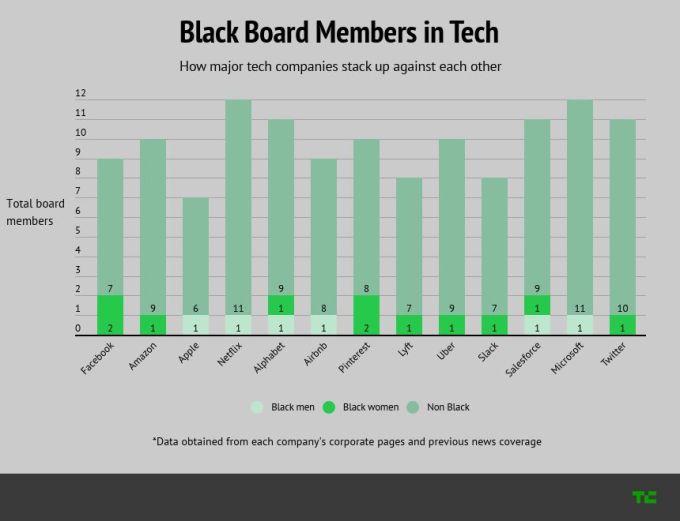
Pinterest brought on its second Black female board member, Salaam Coleman Smith. Smith’s appointment comes a couple of months after Pinterest appointed its first Black board member, Andrea Wishom.

Smith is the former EVP of Programming and Strategy at Disney’s ABC Family and Freeform, as well as former president of Comcast NBCUniversal’s Style Media. 

Here’s an updated look at Black board member representation at major tech companies.
Netflix is launching a tech bootcamp for HBCU students 

Netflix announced a virtual HBCU Boot Camp for students from Norfolk State University, a historically black university in Virginia. Specifically, it’s open for current students and alumni from the classes of 2019 and 2020.

In partnership with online education platform 2U, the boot camp will teach 130 students Java engineering, UX/UI design and data science over the course of 16 weeks beginning in January. A bonus is that members of Netflix’s data science, engineering and design teams will serve as mentors to the students. 

Why you have to pay attention to the Indian startup scene

This is The TechCrunch Exchange, a newsletter that goes out on Saturdays, based on the column of the same name. You can sign up for the email here.

Back in August during Y Combinator’s two-day demo extravaganza, TechCrunch noted a number of startups from India that stood out from the batch. Names like Bikayi (e-commerce tools), Decentro (consumer banking APIs), Farmako Healthcare (digital health records) and MedPiper Technologies (helping hire health professionals) joined our list of favorites from the batch.

Seeing so many India-focused startups in the mix wasn’t a fluke. Data shows that India’s venture capital scene has grown sharply in recent years. 2019 was the country’s biggest ever in terms of venture dollars invested, with Bain counting $10 billion during the year.

In 2020, the third quarter brought the country’s venture capital scene back to form. After a somewhat average start to the year, Indian startups saw their venture capital investment fall to just $1.5 billion in Q2, the lowest quarterly tally since 2016. But data via KPMG and PitchBook make it plain that Q3 was a rebound, with $3.6 billion invested into Indian startups during the three-month period.

That figure was not a historical record, mind; the Q3 total looks to be only the fourth-biggest VC quarter in India’s startup history since at least 2013 and, perhaps, ever. But it was a good bounce-back during a crippling pandemic all the same. The country’s VC deal count also rebounded a bit in the third quarter, with some of that money landing in big chunks, including a $500 million investment into Byju’s this September.

Smaller startups are also seeing strong results. Bikayi is one such startup. TechCrunch caught up with the company via email, digging into its post-Demo Day results. Its monthly recurring revenue (MRR) grew 60% in August from its July results, it said. And in late August the company told TechCrunch that it was on track to reach $1 million annual recurring revenue (ARR) by the end of the year.

Bikayi said more recently that it recorded 100% growth in the number of merchants it supports, and 100% revenue growth in September. So the WhatsApp-focused Shopify-for-India is racing ahead. October results, Bikayi CEO Sonakshi Nathani added, are looking “promising” as well.

To get a better handle on the Indian startup market more broadly, The Exchange got ahold of Accel investors Arun Mathew (based in the United States), and Prayank Swaroop (based in India), for a bit of digging.

Historically, falling bandwidth and smartphone costs along with improved Internet reliability helped lay the foundation for the recent Indian startup wave, according to Swaroop. Mathew added that some high-profile successes like Flipkart made startups a more attractive option, with the ecommerce company’s success helping to “change the tenor” of the conversation around founding tech firms in recent years.

It also helps, Swaroop added, that seasoned folks from existing Indian tech companies are branching out and starting companies of their own, recycling knowledge into new, smaller companies. This is a key method by which Silicon Valley has managed to create an outsized number of hits over time; a concentration of operators who have built big startups are key grist in the unicorn mill. And there’s more money being raised to help power new Indian tech companies.

All told, 2019 was a huge year for the Indian startup market in venture capital terms, and 2020’s recovery is underway. Let’s see what gets built.

Market Notes

The Exchange spent a lot of this week digging into venture capital data and trends, something that we love to do. If you need to catch up, here’s our look at the U.S. venture capital scene in Q3, and here are our notes on the more global picture. And we touched on India above. What more could there be?

Well, some data on healthcare-focused companies is just what we need. Per a new report from CB Insights, there are 41 healthcare-focused unicorns today. More importantly, startups focused on health-related matters (telemedicine, mental health, AI, etc.) just had a record quarter. Even for a pandemic, $21.8 billion went into the space across 1,539 global rounds in the third quarter. That’s far more activity than I would have guessed.

And with that, we’re cutting Market Notes short this week for some important TechCrunch news:

Hey y’all. It’s Megan Rose Dickey busting into Alex’s newsletter for a couple of quick news items. First, I officially launched my newsletter, Human Capital! It covers labor and diversity and inclusion in tech. Also, I relaunched the Mixtape podcast with my colleague Henry Pickavet. You can check out our first episode of Season 3 about California’s gig worker ballot measure Prop 22 here.

Megan is amazing and you should check out her pod and newsletter.

Various and Sundry

As always, there was more good stuff to share here than I can possibly fit, so let’s get right into the data, takes, links and other delicacies.

Wrapping, a survey from Salesforce shows that enterprise cloud CEOs are reporting better-than-anticipated revenue growth and lower-than-anticipated churn, when compared to their March estimates. That is probably why earnings haven’t been a disaster and so many unicorns were able to go public in Q3.

That and valuations in the public sphere are higher than what private investors are dishing up, inverting the market’s last few years.

See you Monday,

Alex