So Why Should You Care About NFC?

If you asked most folks what NFC means they’d probably mumble something about the Giants and wave you off. However, Near Field Communication is here to stay and if Google and Apple’s current and potential implementations are any indication, we’ll be using NFC devices in the next two years, at least in some specific environments.

First, though, what is Near Field Communication (NFC)? At its core it’s a low-power radio system that allows short-range data transfer at distances around 3 inches, or 10 centimeters. There are multiple modes, although the most important is passive mode, in which a device acts as a programmable smart card. For example, an NFC transmitter could pose as any number of RFIDs as well as interact, albeit briefly, with security systems and payment kiosks. In short, an NFC transmitter becomes both a wallet and a personal ID.

Continue reading…


TC Cribs: Take A Doc On The Wild Side At Scribd (With Bonus Go Karts!)

It’s funny. When I tell my ‘normal’ friends that I’ve just come from Facebook’s office or need to head down to Google’s campus in Mountain View, they often give me a strange look, as if I’ve just told them I’m about to make a house call to the Easter Bunny. These companies aren’t places inhabited by actual people — they’re nebulous things coursing through the Internet’s series of tubes.

But I can’t blame them. Most of the startup profiles we see in magazines feature a portrait of the founders solemnly gazing into the distance as they plot to change the world with their revolutionary new sharing widget. Sometimes there’s a snapshot of a few desks, each of which is far too neat for anyone to actually have done any work on. There’s got to be a better way.

Which brings us to today’s episode of TC Cribs, featuring Scribd, the popular document sharing platform. This is something of an experiment for now, but there may well be more episodes coming in the future (leave a comment below if you think your office is a good fit!).

And a big credit goes to TC’s John Murillo for editing the video.

Information provided by CrunchBase


“Let The Hacking Begin” Declares Person Who Hacked Zuckerberg’s Facebook Fan Page

Earlier today, a strange message appeared on Facebook CEO Mark Zuckerberg’s fan page. It read as follows:

Let the hacking begin: If facebook needs money, instead of going to the banks, why doesn’t Facebook let its users invest in Facebook in a social way? Why not transform Facebook into a ‘social business’ the way Nobel Price winner Muhammad Yunus described it? http://bit.ly/fs6rT3 What do you think? #hackercup2011

Who wrote such an odd and seemingly drunken message? Well, if you believe the page, Zuckerberg himself did. Shortly after posting, the post had over 1,800 likes and nearly 500 comments.

Obviously, Zuckerberg didn’t actually write it. Or at least, we’re pretty sure he didn’t. Instead, it would appear that his fan page was hacked. Facebook has now taken down the page — but not before we grabbed a screenshot.

We’ve reached out to them asking what exactly is going on. We’ll update when we hear back.


Keen On… John Borthwick: Why Social Isn’t in Google’s DNA (TCTV)

With billions of dollars flowing into today’s social economy, betaworks CEO John Borthwick sees the social economy radically changing not only media, but all 21st century industries. It’s 1998 all over again, he told me when we met last week in New York City – thus arguing that today’s social boom still has at least a couple of years of innovation left in it.

But while Borthwick – whose betaworks portfolio includes bit.ly, TweetDeck, SocialFlow and Chartbeat – is bullish about the future of social media, he isn’t quite as bullish about Google. Suggesting that social isn’t in Google’s DNA, Borthwick, who used to run technology strategy at Time Warner, believes that the web now not only needs social search but that today’s social media companies – Twitter, Facebook et al – are much more strategically positioned to build a social search engine than Google.

The first half of this interview can be found here.

Borthwick on why 2011 is like 1998

Borthwick on monetization, curation, and real innovation

Borthwick on why social isn’t in Google’s DNA


Facebook’s Focus In 2011: Better Cross-Platform Unification Led By HTML5

Today at the Inside Social Apps conference in San Francisco, Inside Network’s Justin Smith sat down for a discussion with Facebook CTO Bret Taylor. The two talked about a wide range of issues including the company’s 2010 (when they cut spam by 95 percent, Taylor said). But there was a particular focus on 2011 and the ecosystem. So what’s next for Facebook’s Platform?

Taylor made it very clear that mobile was the big area of focus for the Platform in 2011. But at a higher level Taylor talked a bit about “streamlining things” with regard to all the different ways Facebook is used.

When we update something, there are about 7 different versions we have to update,” Taylor said. He rattled off a few: facebook.com, m.facebook.com, touch.facebook.com, the iPhone version, the Android version, etc. “It’s an incredible challenge,” he said. “And there’s feature-skew,” he continued.

Taylor noted that this same issue is a big problem for their third-party developers and partners as well. So how do they combat it? HTML5.

Taylor noted that while HTML5 has gotten a lot of hype in Silicon Valley, he does really believe that it’s the long-term answer. He said that Facebook is a bit ahead of the curve currently with over 125 million of their users accessing Facebook regularly from HTML5-compatible devices. “But we’re putting more in,” he said. “We’re getting to the point where it’s becoming a more mature platform,” he continued.

He noted that Facebook is going to release a lot of developer tools in the coming year so that third-parties can utilize HTML5 better as well.

When Smith asked if it was fair to say that Facebook would re-write or re-work things to make everything more standardized around technologies like HTML5, Taylor said, “At a high level, that’s the direction we’re going.”

Taylor credited both Apple and Google for doing great work in pushing HTML5 forward with their web browsers both on the desktop on on mobile. “It’s big for everyone in this room,” he said.

He did acknowledge that HTML5 was still a bit quirky when compared to native applications. “But the gap is closing,” Taylor concluded.


Yahoo Is Firing Again, While Google is Hiring More Than Ever

As Yahoo announces its second round of layoffs in two months, Google is announcing that it will be embarking on a hiring spree this year. We first heard this morning from soon to be former CEO Eric Schmidt that the company will be adding 1,000 new employees in Europe. And Google’s SVP Engineering and Research Alan Eustace just published a post on the company’s website announcing that the search giant will ramp up hiring to record levels in 2011.

Eustace writes “I love Google because of our people. It’s inspiring to be part of the team. And that’s why I am excited about 2011—because it will be our biggest hiring year in company history. We’re looking for top talent—across the board and around the globe—and we’ll hire as many smart, creative people as we can to tackle some of the toughest challenges in computer science: like building a web-based operating system from scratch, instantly searching an index of more than 100 million gigabytes and even developing cars that drive themselves.”

In terms of staffing up, 2010 was the second largest year in terms of adding employees. Google hired more than 4,500 Googlers, primarily in engineering and sales. And in 2007, Google brought on more than 6,000 people.

Here are a few stats (most of which seem to have been announced that Eustace cited for Google’s growth:

Android now runs on over 100 devices with more than 300,000 activations each day.

Chrome has at least 120 million active users and it’s growing quickly.

Last year more than 1 million businesses switched to Google Apps and embraced its 100% web approach.

Yahoo announced this morning that it would be giving pink slips to 1 percent of its employee base, which amounts to roughly 100 to 150 staff members.


Facebook CTO Bret Taylor: “Mobile Devices Are Inherently Social”

Here at Inside Mobile Apps conference, Facebook CTO Bret Taylor talked about how mobile will be Facebook’s primary focus in 2011, mainly because “mobile devices are inherently social,” he said. Currently Facebook has 1/3 of its almost 600M user base (200M) on mobile devices and Taylor says that Facebook mobile users are 2x as active as Facebook web users.

Taylor thinks of Facebook as a horizontal platform i.e. easily accessible. One big goal for Facebook is reducing friction on mobile and extending Facebook engagement to all devices, and Taylor brought up the PS3, the iPhone and customized devices (but conspicuously not the iPad) as examples.

As an example of a frictionless solution on mobile, Taylor brought up Facebook Single Sign On and mentioned that social movie site Flixster had a 300% increase in usage after it implemented the feature.

As Facebook has already seen with Facebook Places, Taylor emphasized that the convergence of mobile, local and social is the most interesting locus of growth in the space and a trend to watch as it deeply integrates real life with the social graph.

Facebook, which has the extreme competitive advantage of this social graph, is reportedly working on its own foray into to mobile, as a “social layer” on already existing hardware. “Social as a core part of product will have as great an influence on other verticals as it has on gaming,” Taylor said.

Information provided by CrunchBase


Google Buys Voice Messaging Application Developer SayNow

Google has just acquired voice messaging startup SayNow, according to a blog post on SayNow’s homepage.

SayNow’s platform allows voice messaging, one-on-one conversations, and group calls to be integrated into Facebook, Twitter, MySpace, Android, or iPhone applications. The startup has built a number of applications, which have over 15 million users, with this capabilities, including SayNow Phone, SayNow Broadcast, Big Call and Chit Chat.

It appears that SayNow, which has raised $7.5 million in funding from Shasta Ventures, Tugboat Ventures, and Altos Ventures, will be combining forces with the Google Voice team.

Here’s the post announcing the acquisition:

We are thrilled to announce that we have been acquired by Google.

Since 2005, we’ve explored fun and entertaining ways for people to talk with each other. Through the web, smartphones, and even land lines, our products brought communities together through the power of voice. And as Google has some of the best voice products in the world, we believe combining forces with the Google Voice team will let us innovate in new and unexplored areas.

We have no specific product plans to announce at this time, but we’ll have more to say about our roadmap as we integrate with Google, so stay tuned. We couldn’t be more excited about what is yet to come.

Information provided by CrunchBase

UPDATING


Bret Taylor: Facebook Cut Spam By 95% Last Year

Today at the Inside Social Apps conference in San Francisco, Inside Network’s Justin Smith sat down with Facebook CTO Bret Taylor. The two talked about a bunch of things going on with the company. But to kick things off, Taylor offered up a bit of an overview about how 2010 went with regard to the Platform.

In 2010, Facebook’s focus was on user experience, Taylor said. He noted that while everything we growing “like gangbusters”, they had to do some things that weren’t taken as purely positive from a developer perspective. One big thing there is obviously the removal of what Facebook considers to be spam. “There was a lot of spam,” Taylor noted. But this past year they were able to cut spam by 95 percent.

Yes, 95 percent.

How did Facebook do this? Thanks to automated systems that Facebook built and put in place throughout the year. Taylor credits this as being the key factor in spam reduction despite the fact that the social network cut the number of Platform policies in half.

We’re really happy with the 95 percent,” Taylor said noting again that the mixture of helping developers while reducing spam was a key focus for the entire year.

And while he did acknowledge some community push back, he pointed to huge success stories like CityVille, which was able to grow to 100 million users in 40 days despite new systems in place. It took Facebook itself 4 years to get to 100 million users. It took Microsoft 10 years to do that, Taylor noted.


PeopleBrowsr’s ReSearch.ly Lets You Search 1,000 Days Of Past Twitter Conversations

PeopleBrowsr’s recently launched Twitter analytics and search platform ReSearch.ly is debuting a new feature today: the ability to search from 1,000 days of Twitter data.

ReSearch.ly is essentially a high-powered Twitter search and analytics platform that allows users drill down by keyword, demographic, location, and more. ReSearch.ly also sorts Tweets by sentiment, and by community (i.e. Mommy Bloggers, Reporters). For the past four years, PeopleBrowser has indexed Twitter for social search and as mapped social connections, and today is launching the fruit of these efforts.

The startup is opening access to search Twitter conversations from the past 1,000 days free of charge, with options for paid plans to create specialized analysis and customized reports. Of course, the advantage to using ReSearch.ly’s search platform is that Twitter search only goes back 30 days, says the startup’s CEO and founder Jodee Rich. Rich adds that his company has forged a unique agreement with Twitter to access this data.

Of course, Google also offers archived Twitter search but ReSearch.ly’s access to 1,000 days of Twitter data includes extensive capabilities targeted towards marketers and media. Users can filter by keyword, date/time, location and profile information to find highly targeted communities with demographic, psychographic, geo-localized, and time-targeted criteria.

While the search platform is open for free to all users for a limited number of searches, users can pay a yearly $99 fee for unlimited access to 1,000 days of Twitter conversations, in-depth analytics and more.

One important challenge that ReSearch.ly could face is is Twitter starts rolling out a similar powerful analytics platform. Via acquisitions, we know microblogging network definitely considers analytics as a possible monetization opportunity.


A Sneak Peek At Google Offers (Courtesy Of Google Search)

Google’s $6 billion bid for Groupon didn’t work out, but it wasting no time preparing its own competing Google Offers local advertising product. The first hints of Google Offers came out last week. Google confirmed it, calling it a “test of a pre-paid offers/vouchers program,” but offered no further details.

Well, we have further details, courtesy of Google’s very own search engine. (When PR fails, just Google it). There is a very simple way to get a list of active Google Offers coupons. It is kind of a back door, but if you do a search for “coupons site:maps.google.com intitle:Google Offers,” you can see almost 42,000 results, most of which link to individual active coupons. For example, here is one for a free yoga class in Chicago (Groupon’s home turf) or another one for 50 percent off lunch at a vegetarian restaurant in Watertown, Massachusetts. You can also add an Offers gadget to your iGoogle home page which shows offers near you.

Google just started promoting the service recently to small businesses and already has about 42,000 offers (assuming each result is a unique offer). Perhaps Google is waiting to get to 100,000 or 500,000 offers before publicly launching the service, but local merchants are already signing up in droves. If you go to an active coupon page, you see the name and address of the business above the actual offer, which is inside a boxed, dotted line. I guess you are supposed to show the coupon on your phone to a cashier or maybe you are supposed to print it and cut it out. The offer details are in the box, along with a coupon code and expiration date. Next to the coupon is a small map showing where the business is located. The iGoogle gadget suggests what Google Offers might look like as an Android app, showing you offers nearby.

Although it’s been called a Groupon clone, Google Offers does not appear to be a group-buying discount service. And Google won’t be selling these deals or collecting money directly from consumers. Instead, Google Offers is a straightforward, self-serve local advertising service. The deals include $1 off Kombucha at the Whole Foods in Manhattan’s Union Square or $10 off a gutter cleaning in Michigan. Unlike Groupon, they do not require a minimum number of people to buy them before they become effective, and they don’t seem to be as fun or whimsical either.

Neither will they drive a huge amount of new customers to these businesses (the deals appear to be more pedestrian than insane). It is a different business model entirely. Groupon convinces businesses to offer amazing deals specifically because of its one-deal-a-day promotion and the promised surge of new customers. Google Offers seems to be more predicated on showing you deals in your vicinity, and will likely be more tied to your mobile phone and Google Maps. This approach may scale better than Groupon, but the quality of the deals may not be as exciting. Obviously, since this is a work in progress, we’ll have to wait and see what other bells and whistles Google Offers actually launches with.

Update: As some commenters point out, these Google Offers look very similar to Google Coupons that have been available to local businesses as a feature of Google Places for a long time. It is possible that this is a rebranding of that feature in front of a broader Google Offers product launch. The iGoogle gadget is also new.

(Hat tip to Steve St. Germain)


HowTo: RFID Cat Door

rfid_cat.jpg

Sure you can go out and buy an automatic car door that opens when your cat gets near it, but that requires your cat to wear a special collar and you need to keep the batteries in the collar in check. Since most pet owners already have identification RFID chips injected into their cats, why not take advantage of them.

By using an Arduino and some inexpensive parts, Instructables user landmanr put together a cat door that reads the cat’s RFID tag within 4-inches and unlocks the door. The code can distinguish between different RFID tags and can act accordingly. It’s simple, effective and well built. All he is missing is an enclosure to protect the internals.

[Link to RFID Cat Door]

tech.nocr.atHowTo: RFID Cat Door originally appeared on tech.nocr.at on 2011/01/24.

© tech.nocr.at 2011 |
Permalink |
Comments |
Read more in Hacking And Security |
Add to del.icio.us |
Stumble it |
Digg this

Explore more in: , , , ,


Baby, It’s Cold Inside: One Man’s Search for the Perfect Ice Cube

Photo: Jonathan Snyder/Wired

Some say the world will end in fire. Some say it will end in ice. I hope it’s the latter. Finding a good ice cube to chill your cocktail is hell enough as it is.

Being serious about drinking means being serious about ice. And at a good bar, this is rarely a problem, as top bartenders have an easy shortcut: Kold-Draft icemakers. Kold-Draft’s perfect 1¼-inch cubes are legendary in the mixology scene, but the equipment isn’t remotely approachable for the home user: The company’s smallest unit ($2,500 street) produces 321 pounds of ice a day and weighs 174 pounds — and that’s without a bin to collect all the ice.

And so the real ice nuts have turned to hacking. My friend and fellow drinks-writer Camper English is so obsessed with ice that he freezes it at home in cooler-sized blocks in an attempt to create cubes of the perfect clarity for the sophisticate. It took him dozens of experiments, but he finally hit on the right formula, and Wired published it.

I don’t have the patience, time or physical space to generate ice by the cubic foot, so Wired.com asked me to find out how to get the very best cubes at home without resorting to getting rid of my frozen corn and IKEA meatballs.

I started that journey where most of us do: The freezer. I’ve got a modern fridge with an automatic icemaker, and I’ve long enjoyed the ice it creates.

Well, “enjoyed” is a strong word. I’ve tolerated it. The ice it spits out — when that damn metal shut-off bar doesn’t get kicked up by accident — is workerlike and unexceptional. It’s ugly ice. It’s cloudy and shaped like obese crescent moons, and it bobs around in your drink, all sharp edges and ugly aesthetics.

It’s like drinking a beverage made with frozen french fries. To compare this eyesore to a cocktail made with nice, cube-shaped ice is to immediately understand the importance of presentation.

My next stop was another all-too-familiar one: A bag of ice procured from my local Safeway. At $2.39 for a 10-pound bag, retail ice is not a bad deal. It’s cheaper than a lot of bottled water, even.

Your typical store ice does the trick when you’re trying to cool down a keg, but in a cocktail it’s a bad call. The shape works well enough, but it melts awfully fast.

Another big problem is that this ice tends to stick together, requiring an ice pick to free a handful of cubes from the conglomeration inside. And never mind that when I was shopping for the ice, half the bags in the case had been slashed open and were spilling their cubes out.

And that was the good bagged ice. How do I know that? Because my bag of ReddyIce carried the seal of the International Packaged Ice Association, the mark of quality to which all bags of ice aspire. (Suggested motto: “Yes, there is an International Packaged Ice Association.”)

I spoke to Jane McEwen, the IPIA’s executive director, who urged me not to settle for cheap, non-IPIA ice during my quest. She told me that ice is basically a wild no man’s land where few regulations exist, and those that do are not enforced.

“Ice is a food, and I don’t think every consumer understands that,” says McEwen. “Ice can harbor a variety of microorganisms, and some can even populate in the frozen state.” The IPIA is self-regulating, particularly with regard to food safety. But its 350 members represent only a tiny fraction of thousands of commercial ice producers, much of the product being made at the retail level.

McEwen insists that IPIA ice is not just better — colder, better shape, better clarity — it’s also safer. And she says that freezer ice smells bad.

But bagged ice wasn’t working for me the way I wanted it to, and storing 10 pounds of ice in my freezer was problematic.

I then turned my attention to a relatively new concept: Standalone home icemakers. My theory was that my freezer was not really designed to make ice. It was designed to freeze food. Perhaps a device dedicated to one thing and one thing only — icemaking — would prove more effective.

I found the NewAir AI-100SS, which is about the size and heft of a microwave oven, and which promises to turn water into ice in a span of just 15 minutes. My freezer can’t do that!

The excitement was soon dashed, and disappointment set in as I experimented with the NewAir. I loved that I could dial in what size ice cubes the unit would make, but the ice just wasn’t up to snuff.

Even on the largest settings, the cubes were cloudy, merely thimble-sized, and just didn’t get cold enough. In fact, they broke apart so quickly that they could have passed for that newfangled “chewable” ice the kids like so much. This gadget would be fine to keep out in your cabana by the pool, but in a snazzy cocktail, NewAir ice was a bust.

Not ready to call it quits and invest in a deep freeze I could use for ice by the block, I found one more source I thought might be worthwhile. On the Rocks: Bagged ice, but with a twist. On the Rocks is “premium” bagged ice in every sense of the word. The ice is made from spring water, ozonated, and frozen using a “slow freeze” method that eliminates air bubbles.

The resulting 1-3/8-inch-diameter oblique tubes are hard, dense, and exceptionally clear. They are flavorless, fit in any glass, and look pretty good. Even the bag is high-quality, a thick plastic shell with a built-in zip-style closure. And the smaller, 5-pound package is easy to fit into the freezer.

On the Rocks is, to be sure, the best ice I’ve come across for home use. But it’s expensive: $4 for 5 pounds, nearly four times as much as supermarket ice, and it’s impossible to find. In fact, the closest store to San Francisco where it’s sold is in (gulp) Connecticut. The company actually had to ship a sample bag to me … packed in a Styrofoam cooler filled with dry ice.

Until I can pick up On the Rocks at any Cali grocery store, it looks like I’m stuck with what my freezer decides to spit out, and the occasional bag of cheap ice when it’s time to party. Now that’s cold.

Super Mario Bros – Backwards

super_backwards_mario_bros.jpg

As a true gamer you must have already finished the original NES version of Super Mario Bros. You have probably already finished it in a variety of ways like fastest game, collecting all the coins, or killing all the turtles. Why not try beating it in reverse as well.

Much like reading in the western world, the original game was played from left to right. Hacker JJ decided playing Super Mario Bros the traditional was was boring and went about reversing the horizontal deflection coil wires of an old CRT TV which produced a mirror image.

Play the game backwards wasn’t enough, he also swapped the buttons on his NES controller just to get the full experience. I wonder if this is how people play games in the UK
[Link to Backwards Mario]

tech.nocr.atSuper Mario Bros – Backwards originally appeared on tech.nocr.at on 2011/01/23.

© tech.nocr.at 2011 |
Permalink |
Comments |
Read more in Gaming |
Add to del.icio.us |
Stumble it |
Digg this

Explore more in: , ,


Bus Shelter Video Gaming

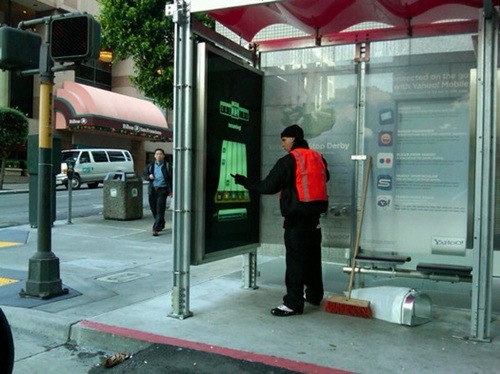
busstopgaming.jpg

Waiting for a bus will never be boring again if you live in San Francisco. Yahoo has just installed giant touchscreen panels at 20 San Francisco bus stops. The giant multi-touch screens not only allow you to play games, but allow you to play against people at other bus shelters.

Top scores for each neighbourhood are kept and the bus shelter that rakes in the most points will will a block party featuring OK Go.

I’m actually surprised that something like this hasn’t happened yet. Living in the age of “always connected” and with interactive media already the norm, something like this should have happened a while ago. Kodos to you Yahoo, great idea.

tech.nocr.atBus Shelter Video Gaming originally appeared on tech.nocr.at on 2011/01/22.

© tech.nocr.at 2011 |
Permalink |
One Comment |
Read more in Gaming |
Add to del.icio.us |
Stumble it |
Digg this

Explore more in: , , , ,