Gillmor Gang 4.03.11 (TCTV)

The Gillmor Gang — Robert Scoble, Kevin Marks, John Taschek, and Steve Gillmor — plus an active set of realtime commenters on Building 43′s realtime Friendfeed chat, added up to an interesting tour of the emerging AirPlay platform. The Apple TV-delivered streaming service hooks content from iTunes and iOS devices up to the big HDTV screen. According to @Scobleizer AirPlay support is growing from other similar services including Hulu et al via something called Sqrrl. With Google TV ineffectual in delivering content from major studios so far, Apple TV’s low price keeps getting lower as new services are integrated.

In cartel news, Time Warner continues to put pressure on the studios to treat the tablet as a first class citizen. The cable company did pull back from a few networks, most notably Comedy Central and DIscovery. Apparently the Viacom suit still has some teeth left in it with YouTube, as @kevinmarks mentions, encouraging transformers like the cable companies to be careful how they approach the home set. The studios have one more shot with those of us who’ve finally finished the MadMen season 4; creator Matthew Weiner has finally signed a deal to produce at least two and preferably 3 final seasons. Season 5 will return in March, 2012, leaving a whole year to get bored with and abandon network fare. There’s a new sheriff in town as the disruption known as the iPad continues to move through the media.


Facebook Comments Epitomizes Everything I Hate About Facebook

So it’s been a month now since we introduced Facebook Comments round these parts, time enough to have given it some serious consideration. And my conclusions are as follows:

…are you kidding me? This is the best a $75 billion company could come up with? Isn’t Facebook supposed to be the new home of software’s best and brightest? Is this some kind of elaborate practical joke?

The whole point of a comment is to make new information or a new opinion available. Good luck with that. As far as I can tell you cannot deep link to Facebook comments, and searching through them is at best a pain and can verge on outright impossible. A memorable comment on my last post included the phrase “I’ve been inside the sarcophagus at Chernobyl”: when I mentioned this on my Twitter feed, I was deluged by “couldn’t-find-it” replies, because it takes three clicks to reveal that sentence… and there is no way to make that comment more visible.

You can’t even sort comments by date – in case, say, you’ve gone back to a previously viewed post, and you want to see what’s new. Facebook’s Simon Cross patronizingly explains why (scroll down – I’d link directly to his comment, except, oh, that’s right, I can’t):

“The plugin automatically sorts the comments based on relevance to the viewing user based on friends, friends of friends and most active posts. We currently feel that a chronological view is not the best view for the viewing user to give them an immediate sense of relevance.”

…which kind of makes me want to burn down his workplace and then salt the charred earth so that nothing ever grows there again. God forbid that they even pay lip service to the notion that users might perhaps be given options—for then they might start to use them, and then where would we be? Sheer anarchy! Far better to reduce everything to a single dumbed-down inescapable standard, relentlessly mediocre and devoid of any color or possibility, like a tapioca straitjacket.

I’ll grudgingly grant that there has been one giant benefit: the army of trolls who used to plague TechCrunch have been reduced to a tiny grunting handful (most of whom log in with fake Yahoo accounts) thanks to Facebook’s insistence on real names. I actually even had mixed emotions about this –

Jon Evans@rezendi
Jon Evans

@tristanwalker @erickschonfeld Objectively, yes, but I actually kind of miss the trolls. They added unintended hilarity.

– but I can’t deny that the overall level of conversation has gone up a notch as a direct result.

Balanced against that, though, is the single most infuriating and baffling thing about Facebook comments: they only allow a single level of replies. The notion of “a comment which is a reply to another comment” is built into the system—but you cannot reply to a reply. This cripples conversation, for no good reason, and it’s clearly a deliberate design decision: an ugly, clumsy, and completely inexplicable misstep. It’s like Facebook developers are literally incapable of thinking outside of the box that is their feed.

And the worst thing of all? Next time I build a site that requires some kind of commenting system, I might wind up using Facebook Comments.

Yes, despite my hate and loathing. Because as frustratingly mediocre as it is, it is easy to plug in, and it does solve the troll problem, and everyone’s already on Facebook, and it helps to spread links. It’s a piece of crap, but it’s just barely good enough and easy enough that it’s not worth wrestling with alternatives. Facebook Comments is basically Facebook writ small: while it’s maddeningly mediocre lowest-common-denominator crap, it’s not quite bad enough not to use.

But just take a moment, please, if you’d be so kind, to scroll down to the bottom of this page, consider the comments section, and reflect on the fact that what you are looking at is the very best product that a $75 billion software company, one famous for allegedly only hiring A-list talent, was able to build. If that doesn’t make you weep for the future just a little bit, then I don’t know what will.

Image credit: Zitona, <a href="http://www.flickr.com/photos/zitona/648586426/Flickr.


Women of Color in Tech: How Can We Encourage Them?

Over the last five years, I have taught more than 300 really smart students. One of the smartest, at the Masters of Engineering Management program at Duke University, was Viva Leigh Miller, a black woman. She had the ambition of moving to Silicon Valley after she graduated last year. I expected she would become a hotshot CEO.

But Viva couldn’t get a job in the Valley—despite introductions that I gave her to leading venture capitalists. I have never understood why. During my tech days, I would have hired Viva in a heartbeat. She had the determination, drive, and education that all tech companies look for.

It raised a red flag in my mind.

You can’t take one anecdote and extrapolate from that. It could just be that Viva didn’t connect with the right companies at the right time.

But the harsh reality is that there is a dearth of women in tech. Just look around Silicon Valley—you don’t see many blacks there, or Hispanics either. Until recently, I didn’t know of even one black woman CEO (though I had heard a rumor that one or two existed). Yes, I know that few women and members of ethnic minorities study engineering; that some women can’t deal with the stress and just want to raise children; and that this is not Mike Arrington’s fault.  It is noteworthy that blacks and Hispanics constitute only 1.5% and 4.7% respectively of the Valley’s tech population—well below national tech-population averages of 7.1% and 5.3%.

At an event I attended this week, called Alley to the Valley, at the overpriced Rosewood Sand Hill Hotel in Menlo Park, I discussed this subject with 50 very successful women. Half of the attendees were from the east coast, and half were from the west coast. We agreed that the best way of supplying this dearth is through recognizing that there is indeed a problem; providing mentoring, encouragement, and assistance to all aspiring women entrepreneurs; and showcasing the successes.

I have already presented hard data that show that there is a problem, and I’ve suggested remedies. Now I’ll showcase some successes—black women CEOs that graduated from Founder Labs, a pre-incubator for emerging entrepreneurs and from a related organization, Women 2.0. I’ll let them tell you their own stories.

Raissa B. Nebie is the CEO of Spoondate, which allows food enthusiasts to meet and connect over a meal (this is currently in private alpha, part of the 500startups incubator and will demo publicly on 4/6).

Raissa was born in Paris, where her father was pursuing a PhD in linguistics. Her family later moved to the Ivory Coast, where she lived most of her life. Her parents have since returned to their home country of Burkina Faso, where her father is a university professor, and her mother, the mayor of her home town. Raissa studied finance in college and started her career at Wall Street at firms including JP Morgan, Lehman Brothers, and ICV Capital.

Raissa’s parents valued academic excellence and wanted her to pursue a traditional career, not entrepreneurship. Her role models were her mother, who dedicated her life to community service, and her grandfather, who was the first black doctor of pre-independence Burkina Faso. Raissa says she gets her drive and tenacity from her mother, whose determined recovery from an illness of more than 10 years’ duration was an inspiration.

Raissa was comfortable working in investment banking, but itched to become an entrepreneur and pursue her passion for food. So she quit her job, attended culinary school, and was training at a high-end restaurant in Paris when she decided take her passion for food to the web. She then packed her suitcase and bought a one-way ticket to San Francisco. While networking her way around the Valley, she heard about Founder Labs and applied to the program in hopes of learning the fundamentals of tech entrepreneurship. Founder Labs helped her validate her idea, find a co-founder, and ultimately secure angel funding.

She says that entrepreneurship has been a great experience. She learned that there is always something to learn. While her co-founder is writing code, she’s out talking to potential users and learning ways to make her products better.

Her advice to others who may want to follow her path:

  1. Identify a problem you want to solve, and talk to potential customers. Be creative, and find ways to validate your idea without building any complex technology. (Before writing any code for Spoondate, she operated a dating concierge that manually matched like-minded eaters and sent them out on food dates.
  2. Get out of your house and become a part of the startup scene. Go to events. Be seen. Attend your local Startup Weekend, hackathons, pitch contests, etc. These are fun learning experiences and also great ways to meet potential co-founders. Take advantage of these events to build your network.
  3. Watch, listen, learn, and understand that anyone who takes the time to give you constructive criticism on your idea is not the enemy, but rather is doing you a favor.
  4. “Be humble. Be polite. Be charming.” It doesn’t matter what gender or race you are, people like to be around nice, pleasant people.
  5. Do it! But do it with passion and commitment.

Kimberly Dillion is the founder of House of Mikko,  a beauty social commerce site that recommends beauty products based on the ratings and reviews of like-typed women.  The site was launched last month and is gaining momentum.

Kimberly was born in California and raised in Colorado, where she has been a competitive figure skater for most of her life. Her father was a prison warden; her mother, an artist.  Kimberly received a scholarship to the University of Pittsburgh because of her skating skills, and completed a degree in marketing and in anthropology before attending business school in Michigan.

Her mother was the most profound influence on her, and taught her to express herself freely and use her talents. When Kimberly was three, she saw a show on TV and decided to become a figure skater.  Skating is an expensive sport, and her mother could only afford an hour or so of practice time weekly. So she skated her routines on a tennis court at night, on special roller blades that were fashioned onto to skating boots. She says that falling on concrete is a lot worse than falling on ice, so it actually made her a better skater. She learned that there wasn’t anything she couldn’t do.

Kimberly says she became an entrepreneur because she found a problem she wanted to solve that no one else was solving. Founder Labs taught her about the tech scene in the Bay area, and she made valuable contacts.  She says that she is glad there were also men in the program; that it is much better that way than being all black or all female.

Kimberly believes that the reason there aren’t more black women in the tech world is that it doesn’t offer them an equitable path to success—because of which most educated African Americans get into law or medicine. Her advice to entrepreneurs: go to as many networking events as you can—particularly the inexpensive ones. Meet others, exchange ideas, and learn to pitch your ideas. And she says that they should get used to rejection: “If you aren’t getting rejected, you aren’t playing the game right.”

Arielle Patrice Scott and her partners, Gleb Podkolzin and Danielle Leslie, recently launched a company called GenJuice, which creates products to help young up-and-comers build followings and audiences on line. GenJuice started as a thesis Arielle was writing on how Gen Y builds personal brands. This led to a national tour connecting 35,000 young influencers together.  She has since built this network of contributors to 300,000. (Inc. called GenJuice one of 2011’s coolest startups.)

Arielle grew up in Vallejo, CA. Her mother was a single parent and worked as a customer-service representative while she raised two children. Arielle says that it was a little difficult growing up, because she and her brother had to spend a portion of their time in foster care. She gained a scholarship to study Information Technology & Media at UC-Berkeley and was determined to make the most of it.

She says her mother was her role model because she is very passionate and independent. Arielle learned early how to make something out of nothing. She learned how to start at the bottom and solve problems through technology. She realized that entrepreneurs could impact affect of people—and that is what motived her to become one.

Arielle was a volunteer with the organization, Women 2.0 which helped herArielle build a network and connect to role models, investors, customers, and partners.  It was through the Women 2.0 network that Arielle met her co-founders, and really felt empowered and supported to be an entrepreneur, even while still in college.

Her advice to entrepreneurs:

  • Solve your problems. If there’s a problem that drives you crazy, there are most likely thousands of other people out there who feel the same way. Build a company upon solving the problems you face every day.
  • Never quit the problem, but don’t worry about quitting the product. Some entrepreneurs are afraid of pivoting if something isn’t working. It becomes more about protecting their own egos and being portrayed as quitters, than about solving the problem. Focus on the problem you’re solving and everything will fall into place.

Being an entrepreneur has helped Arielle build self-confidence and meet amazing people who share her determination to change the world.

All three of these women defied the odds and became entrepreneurs. With a bit of luck, they will achieve big success and help others behind them. It doesn’t take much to fix an entrepreneurial imbalance. We just need to recognize the reality, provide a little bit of mentorship—and a lot of encouragement.

*Photo credit–510 Media

Editor’s note: Vivek Wadhwa is an entrepreneur turned academic. He is a Visiting Scholar at UC-Berkeley, Senior Research Associate at Harvard Law School, Director of Research at the Center for Entrepreneurship and Research Commercialization at Duke University, and Distinguished Visiting Scholar at The Halle Institute for Global Learning at Emory University. You can follow him on Twitter at @vwadhwa and find his research at www.wadhwa.com.


Has The Age Of Totemic Gadgets Passed?

The lads here, mostly Devin and Matt, were talking about Everyday Carry, a website dedicated to the things we carry in our bags, pockets, and purses. Most of the EDC gear looks pretty heavy-duty – many EDCs include guns and long stickin’ knives for, you know, those times when you need to stick stuff (Merlin Mann’s is particularly interesting, for example) – and from the looks of the site it seems lots of people have totemic items, items of power that they carry to get things done. You’ve got Leathermen and diving watches. Little Moleskine notebooks. Pocket cameras and Space Pens.

Read more…


Conduit Acquires Web Application Platform Wibiya For $45 Million: Sources

Exclusive – No, Conduit was not acquired for a billion dollars or more by Google or Microsoft … yet (although one executive suggested to me in a phone call this week that the company should, in fact, be worth about half of Facebook’s valuation on the private market – meaning about $35 billion at present day – because they reach about half of the social network’s audience).

We’ll see about that.

Either way, what’s really happening, according to solid sources close to the company, Conduit is in fact acquiring another Israeli startup in the Web app publishing and distribution space, namely Wibiya, and they added that the deal could close as early as next Monday or Tuesday.

According to those people, who are familiar with the negotiations, the transaction hasn’t been signed off yet and the deal could still fall through, although multiple sources I’ve spoken with are confident the acquisition will close soon.

I hear that the purchase price is roughly $45 million, which means the deal would give a solid return to both Wibiya’s founders and investors, who have pumped about $2.6 million into the company. Backers include Primera Capital, Yossi Vardi, Oded Vardi and Jeff Pulver.

If the acquisition closes, all 17 Wibiya employees are expected to join Conduit.

Wibiya essentially enables publishers to add a social layer to their websites, rendering said sites interactive, free of charge, in order to grow their audience organically.

It is similar to what Conduit does, although Conduit is mostly known for its Web toolbars and web application marketplace. Complementarity seems to be the key word, here.

From what I’ve gathered about the company, Wibiya currently partners with publishers of about 120,000 websites, many of which are small ones, although its customer base also includes the likes of TheStreet.com, Playboy.com and Glam.com. In total, Wibiya is said to reach 200 million unique users, although that is to be taken with a grain of salt in my opinion (even Twitter reportedly boasts less active users than that).

Conduit partners with companies like Zynga, Fox, MLB and Time Warner Cable to reach about 230 million unique users, according to its own count. I should note that the company does seem to do extremely well even though those numbers seem to be inflated: it has raised less than $10 million since its founding in 2005 and boasts about 250 employees today.


Instagram Founders: Instagram Is A “New Entertainment Platform” (TCTV)

Somewhere between yesterday afternoon and last night, Instagram hit 3 million users after only six months of existence. To put that into perspective, that’s like 1% of the population of the US using a service that currently only fully exists on a iPhone.

Instagram’s explosive growth has made them the current go-to success story for pivoting and unleashed a torrent of buzz around the white hot photo-sharing space. But founders Kevin Systrom and Mike Krieger don’t think of the service as just a simple way to share images, but as more of mechanism for users to tell stories and discover the world around them, a “new entertainment platform” the co-founders told me in an interview for TCTV yesterday.

“By no means do we think of Instagram as just a photo-sharing service,” said Systrom. “It’s something that a lot of people lump us into, but we’d like to think of ourselves as a storytelling service. It’s the way you go out in the world and tell a story about your life, and it’s a new entertainment platform. You can open it up and see a story about what your friends are doing, but also [that] ABC World News is posting photos of someone in Japan reporting on the nuclear crisis. It’s really moving to see those things coming together through images.”

During our interview Systrom and Krieger outlined a couple of interesting use cases for the service. Systrom explained how he often goes to demo.instagram.com and observes location-based phenomena like users uploading  pictures of the same sunset in Portland and in Seattle. Brands like Burberry who (has over 13,000 followers) hold man-on-the-street Instagram hashtag campaigns like #TheArtOfTrench to help build brand engagement.  BravoTV, which just joined the service a couple days ago, photographed and uploaded its entire Top Chef finale to #TCFinale.

The founders have a sharp idea of where the service is headed, including how they will eventually handle revenue. Systrom explained, “We’re moving in a very clear direction that will allow us to make money in the future. In the history of advertising the most profitable avenues of advertising have been pushing images to people. As we see outside of the digital world those verticals are struggling in one way or another, money is moving online. We’re going to be one of the largest ways to push images to people, that entertainment platform I was talking to you about. That puts us in a really interesting spot in terms of making money on advertising in the future.”

The co-founders are cool with sacrificing short term profits for long term value. “What is uninteresting to us is charge a user 99 cents and never see them again model. To be a world changing company we need to think bigger than that,” Systrom continues.

And while both co-founders do insist that an Android app and website are both in the works (they’re “thinking really critically about them”), their grander goal for the product goes beyond any particular avenue for distribution, “Our vision for Instagram in the long run is seeing the world as it happens through other people’s eyes.”

Instagram currently has $7.5 million in funding from Benchmark Capital, Baseline Ventures as well as investment from angels Chris Sacca, Jack Dorsey and Quora’s Adam D’Angelo.

Information provided by CrunchBase


Will Social Media Save WrestleMania 27?

Well, maybe not “save” WrestleMania, but help ensure it does better than last year’s edition, WrestleMania 26, which, at well under one million pay-per-view buys worldwide, was considered a bit of a disappointment. What’s different this year is WWE’s use of social media—that is to say they’re actually using it this time around. But even if this year’s edition, WrestleMania 27, which airs from Atlanta tomorrow on pay-per-view, does better than last year’s, how much of that can be attributed to Twitter, Facebook, and YouTube, and how much of that can be attributed to the return of The Rock? Serious business, etc.

Read more…


(Founder Stories) Moot On The Origin Of 4Chan And The Evolution of Memes

When Christopher Poole (aka Moot) was 15 years old, he founded the 4chan image board on an IRC channel with 20 people. Today, the site attracts about 12 million people a month and is the font of many of the Internet’s most pervasive memes, from Lolcats to Rickrolling. Moot doesn’t like to do video interviews, but after much pestering, Chris Dixon got him to come on Founder Stories for a rare video appearance. We’ll be running the entire conversation throughout the week, including a sneak peek at what he’s doing with his latest startup, Canvas. (Disclosure: Dixon is also an investor in Canvas through Founder Collective).

In this first part, Moot explains the origins of 4Chan in the video above. Both the idea and software was borrowed from a Japanese site called Futaba channel, but 4chan took on a life of its own—a completely anonymous site where community members felt free to express themselves in all sorts of ways.

One of the unique characteristics of the site is that there are no archives. The most popular images, gifs, and comments bubble up to the top, and cascade through the site like a waterfall. Every so often, a meme will develop on the site and be picked up elsewhere.

In the video below, Moot talks about the evolution of memes, how they start as one thing and change over time. For instance Rickrolling (which thankfully is a meme in decline), got it’s start on 4chan as a bait and switch where the word eggroll became filtered into duckroll, and then people started linking the word to a picture of a duck on wooden wheels. Somehow this static image of the duck on wheels got posted to YouTube, where duckroll evolved into Rickroll.

Part of the appeal of 4Chan is to watch these memes as they spring up and influence them. Since everything is so ephemeral on the site, it’s hard to go back later and reconstruct what happened. “It’s hard to find a primary source,” says Moot, “the primary source deletes itself every five minutes.” Which is exactly why we need Know Your Meme, which was just purchased by the Cheezburger Network. According to Moot, the life cycle of a meme is that it starts on 4chan, is studied on Know Your Meme, and then is monetized by Cheezburger.


State Department Builds A Panic Button App

Imagine you are a pro-democracy protester on the streets of a repressive government. You’ve got your cellphone and you are messaging your friends. In the crowd near you, the police start making arrests. Fearing the government will confiscate your phone and investigate your contacts, you push a “panic button” on your phone. It deletes the contacts in your address book and sends out an alert. Such an app wasn’t readily available so the U.S. State Department, acting as a venture capitalist, decided to build one.

The State Department tells TechCrunch government funded work is underway to build an Android version of this “panic button” app. No release date has been set. Another version designed to work on low-cost Nokia phones, more common in the developing world, is being considered. No iPhone app is planned for now.

The special app, first reported by Reuters, is part of an initiative to promote new technologies for social activists. So far, the State Department has funded $22 million in “Internet freedom programming.” The money goes to innovators in the form of small grants ranging from a few to tens of thousands of dollars. TechCrunch asked who was getting the money, but due to the sensitive nature of the project, the government won’t disclose names.

An open, competitive bid process was used to award the grants. While the government isn’t looking for more help building these apps, they may have future projects designed to advance “Internet Freedom” in other ways. Keep an eye on www.grants.gov for any additional info. Some of the past program objectives have included developing technology “to enable users in closed societies to get around firewalls and filters in acutely hostile Internet environments” and training bloggers and activists to safely and anonymously participate in online forums.

The effort is another example of how the administration sees the important role social media and technology has played in global politics. In 2009, the U.S. asked Twitter to delay maintenance work so real-time information about the Iranian protests could continue. The White House has also called on Egypt and Libya to restore internet blackouts.

The State Department says it’s not just writing checks. The government is trying to use venture capitalist techniques to produce the best results. No, the goal is not to make 10x on the investment. But, the government is supporting a diverse portfolio of innovation rather than just funding big established technologies. It’s providing knowledge and connections, not just cash. And they are investing to incubate a new community focussed on the intersection of technology and human rights.

Of course with any well intentioned program, there could be negative side effects. What happens if the panic button app gets into the wrong hands, such as drug dealers or terrorists? A State Department spokesperson tells TechCrunch it’s a legitimate concern and they are taking that into account when planning the distribution and publicity of the app. It seems TechCrunch readers won’t be a problem.


True Colors: Bathing Mobile In An Entirely New Light

Editor’s note: Guest author Semil Shah is an entrepreneur interested in digital media, consumer Internet, and social networks.  He is based in Palo Alto and you can follow him on twitter @semilshah

Color Labs is assumed to be the newest combatant in the photo-sharing wars. Many people ripped its floppy launch, interface, crashes, and some are feeling creepy about the Chatroulette aspect. Then there was the backlash to the backlash, where believers applauded the vision, risk-taking, and promise of mining meta-data from phones. Even with the latest update pushed out last night to address some of the initial product’s shortcomings, Color remains the most polarizing Silicon Valley startup since Quora’s rise and, appropriately enough, folks at Color have been answering questions on the company’s Quora topic page. The source of the furor varies from the amount of money raised ($41m) to the team size (27) to the buggy app (despite updates). A good chunk of the backlash is because users perceive it as a photo-sharing service. But, what if Color is more than a photo-sharing service?

Color Labs is on the record stating they are more of a data mining company with technology that, operating in concert on the phone, can paint a detailed mosaic of our mobility. Its patent-pending technologies are said to able to place users in proximity to others based on sounds and images, can capture the angle at which we hold our phones, how fast we move them in gestures, and how bright the environment is. And when users actually have the camera open, that’s when the real show begins, tagging images, setting context, and opening the type of world Christopher Nolan conceived of in The Dark Knight, when Lucius Fox and Bruce Wayne use cell phone triangulation to create a digital reflection of the real world.

At the same time Foursquare and Facebook are clamoring to obtain our location, others already have a much better implicit depiction of our whereabouts and purchasing behaviors, mainly credit card companies and phone companies. For months, Facebook’s mobile apps have gently signaled to users if friends have been spotted nearby. A few weeks ago, Foursquare inked a groundbreaking deal with AMEX to tie the app to a payments system. And, a well-known secret in Silicon Valley is that Facebook is hard at work building its own mobile operating system that will bake “social” into as many mobile devices as possible. In order to get more information than credit card companies have, the phone companies need the user’s assistance and permission. And in the case of Color, the user has to have the app running, preferably with the camera open—at dinner, at a sports game—along with all the other apps competing for attention in a crowded, fragmented mobile apps marketplace. Color could give phone companies the chance to get as much as, or more, information about us than the credit card companies have.

Before any of this can happen, however, the question looms: Will Color be able to withstand this initial backlash, iterate, and keep improving on their app? Some believe the team will find its way. Others believe that in such a competitive environment, it’s not possible to get a second chance. The truth is that nobody knows, but if Color weathers this initial storm and is successful, what could it evolve into?

My sense is that Color Labs is thinking ahead two to three years, by which time users may grow tired of sorting through a constellation of apps and services to share and broadcast their location, purchases, and pictures. Instead, these features will converge in a slightly smaller number of unified apps. We’ll have folks using phones running on Android, iOS, or Facebook variants, among others, and we’ll have a chance to leverage features from Color Labs’s systems.

This is what I believe Color Labs is going after: The augmentation of mobile operating systems. Ultimately, they don’t want their service to run as yet another fragmented app on your phone—they want their system to entirely augment mobile operating systems, using their technologies to document every sound, image, movement, transaction, and message your phone transmits or receives. The folks creating this system are building tools for a world in which our mobile phones and tablets will take the place of many of today’s traditional computing devices. In this world, users will carry around their wallet, books, and other files in their phones and tablets, docking them into monitors and screens as they move from location to location.

This is pure speculation on my part and nothing more than a fun attempt to connect some dots.  But if a seamless mobile operating experience is their ultimate goal, this is the type of undertaking that truly needs venture capital, and lots of it. Part of the reason folks may be lashing out against the concept and launch is that, frankly, we haven’t seen a concept this big emerge for a while. Everyone loves a big concept, but a concept remains just that until the products gets in the hands of enough users to make a real impression.

Color Labs may be on a mission to perfect and harmonize its technologies to dramatically augment the mobile operating experience. Its founders are accomplished, its team is big, its technologies are novel. The brand is polarizing. Its a company that can convince Sequoia Capital to invest about 1.8% of its current fund for the chance to build something fresh from the ground up. It’s a company that’s being built entirely within a mobile world, an attempt to test the lasting power of Facebook’s symmetrical relationships and offer, as Fred Wilson notes, a more “implicit,” or as the company notes, “elastic” network, one that is built with a different set of rules, norms, and permissions that could perhaps more accurately reflect the random ebbs and flows of our social interactions in real life that have yet to be captured fully by any digital network.

Photo credit: Flickr/Pilottage

Information provided by CrunchBase


Apptitude Uses Facebook To Figure Out Which iPhone Apps Your Friends Are Using

Noisetoys, creators of music discovery and promotion App Hitmaker, have come out with another hit this week. In the same App-discovery space as Explor and Chomp, Apptidude is an iPhone App that shows you the iPhone Apps that your friends have most likely downloaded, all based on their posts and Likes on Facebook.

“Quitely” launching in the App Store this week, the App recommendation App is currently number 29 in the App Top Free Apps list, most likely because it incorporates social elements and Facebook Connect as a way of gaging what’s actually hot in the anti-social Apple App Store, where homegrown Top 25 lists leave much to be desired.

When you initially open Apptitude and log onto Facebook you see a scrollbar of your Facebook friends stack-ranked by the number of apps they’re using. When you click on your friends’ profiles you can swipe through a series of chosen apps and you can also to drill down into specific stats about how many Facebook friends use the app, many people have Facebook Liked the app as well as into the ability to download directly to your phone.

Apptitude creator Shalin Mantri hopes to use all this social app data to eventually create a better way of finding relevant iPhone apps, and tells me that an eventual Facebook-powered recommendations list based on what apps are trending in your social graph will be including in v1.1, which Apptitude will be submitting to the App Store next week. Wish I could be a fly on the wall in the iOS review room on that one.
You can download the App here.

Information provided by CrunchBase


Google Increases Lead In Smartphone Market, But Verizon iPhone Wins February

comScore’s February mobile report was released today, and it looks like good news for Google. Android increased its lead as the top mobile platform, growing 7 percentage points since November, and strengthening its top position with 33 percent market share.

Following behind Android is RIM, ranked second with 28.9 percent market share, and Apple with 25.2 percent. Microsoft and Palm rounded out the top five, with 7.7 percent and 2.8 percent, respectively.

In the big picture, the mobile numbers continue to impress. Over the last three months, an average of 234 million Americans (13 and older) used mobile devices. That’s 75 percent of the population. Nearly 67 million of those mobile users were employing smartphones, representing a 13 percent rise from November. Smartphone usage only continues to grow, as you will remember that comScore’s November report showed smartphone usage growing by 10 percent since the summer of ’10.

Of the millions of mobile devices in use this year, Samsung remained the top manufacturer with 24.8 percent of mobile subscribers, followed by LG at 20.9 percent, Motorola at 16.1 percent, and RIM at 8.6 percent. Perhaps unsurprisingly, Apple had the biggest surge since November, gaining a percentage point of market share, though it continues to trail the other manufacturers at 7.5 percent. The principal cause of Apple’s three-month gain? Why the Verizon iPhone, of course. According to comScore, the Verizon iPhone was the most acquired handset in February.

Lastly, comScore’s report shows that the many particular uses of smartphones are, again, on the rise. Text messaging, mobile browser use, app downloading, social networking, games, and music all were on the rise on mobile in early 2011. Accessing social networks represented the largest growth on mobile over the last period.


Color Updates Its iPhone App With More Intelligible Icons, Navigation And Faster Speed

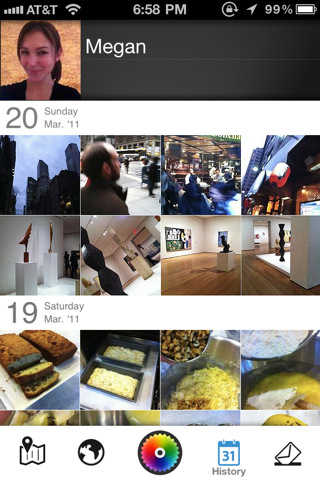
Bye bye 69 symbol! Valley media darling/scapegoat Color has updated its iPhone App to 1.0.2 to address certain um, user interface issues. Color’s launch caused a big splash in the Valley a couple weeks ago, due to what some people viewed as an unfairly allotted and foolish $41 million in funding as well as problems with the usability of the actual app — Namely that it didn’t work if other people weren’t nearby.

Color co-founder Peter Pham tells me the latest update was “crowd-sourced” as in Color listened to user feedback. Already it looks like the largest user complaints have been addressed, at least cursorily.

The homepage icons now have text descriptions and are more intuitive to use, like a Map for “Nearby,” a Globe for “Feed,” a Calendar for “History” and a Letter for “News” (the fade text descriptions also really help).

The bizarre revolving 69 button has been split into two buttons, the Map and Globe. The Heart button, which allowed users to share photos via Facebook and Twitter, has now been replaced by a more reasonable Paper Airplane button. A Home button also brings users back to their homepage, like it should.

Color 1.0.2 also makes it a lot easier to delete a photo, block a user or see more or less of a person (+,-) and view user profiles. In addition you can now choose a Color profile image from your iPhone photo library, which means no more dark, less than ideal profile images. The phone also now comes localized in French, Japanese and Chinese.

Color is like Rebecca Black’s Friday video: People hate on it in public but keep going back to it privately. And while this is an improvement over what existed before, Pham tells me there’s an even larger (“pretty major“) re-vamp to come. “This is just the beginning,” he said.

The Android app is coming tomorrow.

Information provided by CrunchBase


10 Things That Simply Need To Be In iOS 5

WWDC. It’s like Christmas for OS X and iOS developers. Each year, they flock to San Francisco’s Moscone Center, anxiously awaiting the pair of gifts that Apple annually bestows: the new iPhone, and a bundle of new features on which they’ll build their next big thing.

If whispers and hearsay hold true, this year’s WWDC will only feature the latter; the iPhone 5, says the rumor mill, won’t be showing its face until Fall. Instead, this show is purportedly going to be all about iOS and OS X. While Apple doesn’t come right out and say it, it’s pretty safe to assume that by “iOS” they mean “iOS 5″.

Given that we’re writing about iOS on a regular basis and talking about it with readers and friends even more, we’ve got a pretty finely-tuned wishlist for iOS 5. We also happen to know that a heaping handful of Apple folk read TechCrunch regularly — and with the feature lock stage of iOS 5′s development cycle (wherein they absolutely refuse to add anything new and just focus on what they’ve already started) presumably riiiight around the corner, we figured there was no better time than now to put it out there.

Read the rest at MobileCrunch >>