Spotify adds standalone streaming support to its Apple Watch app

Spotify confirmed today it has begun to roll out support for standalone streaming on its Apple Watch app. The feature had been spotted in testing back in September, and arrives roughly two years after Spotify debuted its dedicated Apple Watch app.

With support for standalone streaming, users can listen to Spotify music or podcasts via a Wi-Fi connection or over cellular, without needing to be tethered to their iPhone.

The lack of support for standalone streaming has been a longtime sore subject for a core group of Spotify’s customers. It’s even more of an issue for those who want to leave their iPhone behind when they’re exercising — like when they’re out for a run, for example — as well as any other time when carrying around an iPhone could be cumbersome.

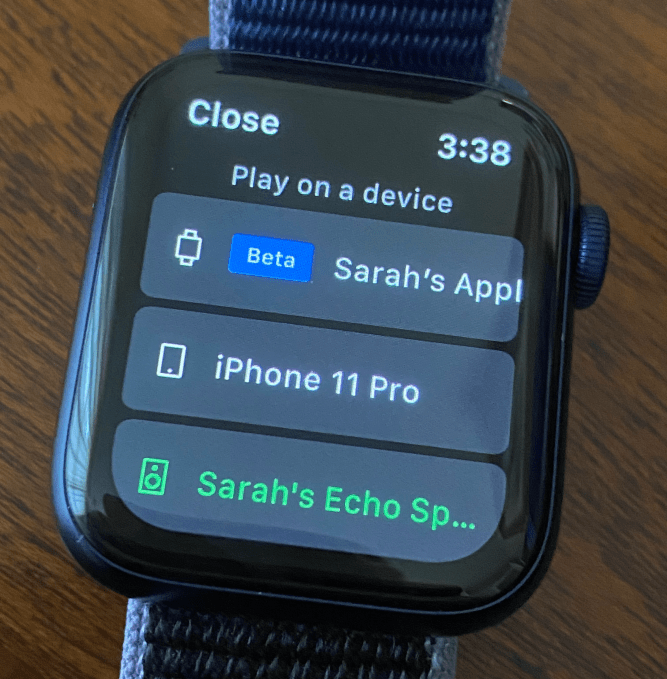
With standalone streaming, however, Spotify users can stream from their wrist directly to their Bluetooth headphones or AirPods.

In the app, the option is still flagged with a beta label for some users, however.

Image Credits: Spotify app, phone via TechCrunch

The update to the Spotify app was spotted in the U.S. by 9to5Mac, which noted more users had started seeing the feature show up for them even though they hadn’t been a part of the September test group.

Spotify is not the first music service to offer a standalone streaming experience on the Apple Watch. In addition to Apple’s own Apple Music service, Pandora rolled out support for standalone streaming back in February 2020.

However, it is ahead of YouTube Music on this front. Although YouTube just launched an Apple Watch version of its streaming music service in mid-October, it works more like a remote control from the YouTube Music app.

Spotify confirmed the launch in a statement to TechCrunch, but it hasn’t made a formal announcement about the update.

“We’re focused on developing experiences that enable users to listen to Spotify wherever and whenever they want – regardless of the device or platform,” a Spotify spokesperson said. “After an initial testing period, we are now rolling out streaming capabilities for Spotify on the Apple Watch,” they added.

The spokesperson also confirmed the rollout is global in nature.

To stream Spotify directly from your wrist, you’ll need an Apple Watch Series 3 or later, with watchOS 6.0+ (recommended 7.1+) and either a cellular connection or Wi-Fi, a Spotify website notes.

Gaming rules the entertainment industry, so why aren’t investors showing up?

As gaming’s popularity reaches epic heights, venture investors’ activity in the industry doesn’t seem to equate with the overall size of the games market. Spurred by an unreal year where traditional entertainment has been upended by the COVID-19 pandemic and consumers find unity in virtual worlds like Animal Crossing and Fortnite, gaming has never been more popular.

Late-stage investors have shown that they have a tremendous appetite for businesses in the gaming industry. They’ve been pouring capital into established gaming companies like Scopely, which on Wednesday announced a $340 million investment round at a $3.3 billion valuation. But venture capital simply hasn’t given the gaming industry and the broader synthetic market the attention it deserves given its place in the entertainment and cultural firmament.

Just ask LeBron “Bronny” James Jr., the son of the NBA’s biggest star, who became a professional athlete this week — as a gamer with one of the most popular teams in online gaming, FaZe Clan. Or look at Unity, the creator of a popular game development engine, whose stock price has nearly doubled since its public offering in mid-September. Since opening trading at $56 per share, the stock has nearly doubled in value and is now trading at $100 per share.

In the first half of the year gamers spent $36.8 billion on games through both the Android and iOS app stores, according to data from SensorTower. New game installs are also up for the year. The app analytics company said that new game installs were up to 28.4 billion over the first half of the year. Annually the 15 billion new game downloads in the second quarter represented a 45.2% year-on-year growth in gaming.

Then there’s Bitkraft, one of the only venture firms to focus on the totality of the gaming industry, which announced the close of its most recent fund, a $165 million investment vehicle. The firm, which added a former Goldman Sachs managing director earlier in the year to capitalize on the opportunity in what the firm calls “synthetic reality” investments, raised $25 million more than its $140 million target. One of these things is not like the others.

“I’ve been in the games industry for 23 years now [and] I’ve always had this huge fundamental conviction of video games not only dominating the entertainment industry but sort of taking up a big part of what society is — where video games create the digital identities that define evermore of what we understand of ourselves,” said Jens Hilgers, Bitkraft’s founding general partner. “We feel that these are times of acceleration … it’s great to see how we’re leapfrogging one or two or three years of the games industry in this crisis and it makes it more exciting to invest in these times.”

The Unity public offering, and its emphasis on markets outside of gaming, seems to prove Hilgers point and show just how much opportunity remains around the notion of synthetic reality in business and entertainment.

“Their thesis around democratizing access to gaming tools by letting hobbyists use the tools for free is smart, if you want to win the market,” said Alice Lloyd George, founder of Rogue Ventures, a new investment firm focused on frontier technologies and gaming investments.

Lloyd George compared Unity’s business to its biggest competitor, Epic Games, and noted that both have broad aspirations. “Both of them want to use their game engines beyond pure gaming,” Lloyd George said of the two big new gaming platform developers. “Unity is really well-positioned because they’re so strong on mobile. That positions them well for AR and VR. And you need onramps for the developers for AR and VR.”

Engagement and the future of entertainment

When Scopely’s co-chief executive Walter Driver talks about the attraction of gaming properties for players — and the reason investors have been willing to value his Los Angeles-based company in the billions of dollars — he talks about the connections between players. “People have found — and investors looking at the space have found also — that people value the connection they’re getting from interactive experiences. It’s not just our relationship with the players, but their relationships with each other,” Driver said. “Inside of most passively consumed media experiences, you don’t have an identity. You don’t have friends.“

iRobot issues warning for select Roomba i7+ docking stations over potential short circuiting

Robotic vacuum giant iRobot this week sent warnings to select owners of the Roomba i7+, noting that the Clean Base docking station has the potential to malfunction and short circuit. According to iRobot, concern stems from “very rare cases,” wherein liquids are deposited into the Clean Base Automatic Dirt Disposal unit.

“We learned that certain Roomba i7+ Clean Base docking stations could malfunction and potentially present a hazard if liquids are collected by the Roomba i7+ robot vacuum and deposited into the Clean Base unit,” the company said in a statement to TechCrunch. “Our vacuums are only designed for cleaning up dirt and debris from dry floors and carpets and should never be used to pick up any liquids.”

The company believes around 222,000 units are potentially impacted by the issue. Of that number, the vast majority (around 210,000) were sold in North America. Emails and app notifications have been sent to users, alerting them of the problem. The company will send a replacement power cord or docking station to those with affected serial numbers.

The  i7+ was released in 2018. The system sports some key advancements in mapping smarts, along with the impacted docking, which automatically cleans the Roomba’s on-board bin.

Pulled Ant Group IPO costs Alibaba nearly $60B in market cap

News today that Ant Group’s IPO is suddenly on hold in both Shanghai and Hong Kong caused a sell-off of Alibaba shares. This afternoon, equity in sister-company Alibaba is off around 8% in the wake of the delayed offering and news that Ant had run into regulatory issues with the Chinese government.

Ant was spun out of Alibaba, which owns a one-third stake in the financial technology powerhouse.

Ant’s IPO was on track to be among the largest in history, perhaps raising as much as $34.5 billion in its dual-listing share sale. The company was going to have little trouble filling that book, with retail demand for its shares at IPO reaching nearly $3 trillion in mainland China alone (it’s not uncommon for popular share issues to have massive oversubscription).

That the IPO was called off is financial news on a scale that is hard to comprehend. Ant would have sported a possible market valuation of more than $300 billion at its IPO price. Such a valuation would rank it amongst the most valuable companies in the world.

Alibaba is worth around $772 billion today after the news, off from a value of around $841 billion yesterday. Ant’s delay has cost its former parent company around $60 billion in market capitalization in a single day.

Ant has its roots in Alipay, an online payment service founded in 2004. The company’s Alibaba spin-out came seven years later in 2011, with its former parent company buying 33% of its value in 2018 ahead of its planned IPO. At the time, Ant was valued around $60 billion.

The company’s IPO prospectus details the company’s work in credit, investing, insurance and other fintech-related areas. Ant’s reach has become staggering over time, with Alipay counting over 1 billion annual active users and over 80 million active merchants on the platform.

Ant competes with Tencent’s WePay, amongst other products and services.

As TechCrunch reported this morning, Ant has a history of regulatory issues with the Chinese Communist Party. Precisely what went wrong this time so close to its debut is still not perfectly clear, but news that Alibaba founder and Ant chairman Jack Ma had dinged China’s financial regulation in recent weeks could be part of the issue.

So long as the IPO remains on hold, and a cloud sits atop Mt. Ant, Alibaba shares could remain depressed.

Hulu tests its social viewing feature, Watch Party, with election news live streams

Hulu is bringing its Watch Party social viewing feature to its livestreamed election news coverage, provided via its existing partnership with ABC News Live. The company announced today it will allow its on-demand customers to test Watch Party while watching ABC’s “Election 2020” coverage via the Hulu.com website. The new co-viewing feature lets Hulu users chat and react to what they’re watching in a chat interface that supports up to eight people per session.

Notably, this will be the first time Watch Party has been enabled for a live event, Hulu says.

The Watch Party feature first debuted in May as a way to give Hulu’s “No Ads” subscribers a way to chat with one another in the Hulu app while watching programs together. At launch, Hulu made thousands of movies and shows available for co-viewing from its on-demand streaming library.

This sort of social viewing experience had become popular during the coronavirus outbreak as families and friends were staying at home, quarantining and social distancing. Today, there are co-viewing services that work with a range of streaming services, including Netflix, HBO, Amazon Prime Video and others. But only some offer native experiences, like Hulu does.

With Watch Party, users can group chat in a sidebar to the right of the screen as their program of choice streams. The feature also allowed users to control the on-demand video playback on their own computer without interrupting the group’s experience, then click a button to get back in sync with the group at a later point.

In September, Hulu expanded Watch Party to its ad-supported viewers, too, and even tested a customized experience for viewers of its original program, “Pen15.”

However, only on-demand customers will have access to Watch Party for use with Election 2020 coverage.

Hulu partnered with ABC News Live in March in response to the COVID-19 pandemic. The company wanted to ensure its cord cutting on-demand customers had access to live news 24/7, even if they didn’t pay for the upgraded version of Hulu with Live TV. The company says that nearly 50% of its ad-supported viewers were cord cutters or even “cord nevers” — meaning they never signed up for cable or satellite TV in the first place.

The company announced earlier in October that it would also offer live election coverage to these viewers through the ABC News Live partnership.

How startups can shake up their first idea and still crush the market

When Quibi announced it was shutting its doors recently after raising $1.75 billion, it begged an obvious question: If the original idea didn’t work, why not adjust its model or do something completely different while it still had capital? It wouldn’t have been the first company to decide to shift gears. Perhaps because of the unusually large amount of money it burned through in just six months of public operation, pivoting wasn’t an option for Quibi, but it has been for countless other successful companies over the years. Sometimes an original idea simply doesn’t pan out, a market gets too crowded or a company’s founders stumble onto something they have built that is actually a better business than the original idea.

There are many such examples:

These examples — and many more — show that when your first approach doesn’t work, pivoting may be the the only logical course, but it takes courage from founders and patience from investors.

We spoke to several founders and VCs who have been through this to find out how pivots happen, and how all the parties involved adjust to shifting priorities.

Sometimes it’s a long and twisting road

A big part of founding a company is having vision. You need to believe in your idea of course, but that doesn’t mean it’s the right way to go. Sometimes it pays to move on. The king of pivots might be the aptly named Pivotal, which changed direction several times and even swapped owners before it went public and got acquired, all in the span of about 20 years. Ed Sim, co-founder at boldstart ventures was part of Dawntreader Ventures in the late 90s when his firm invested in an early version of the company called Metapa. Sim had a front row seat to every twist and turn in the company’s long and intricate history.

“Greenplum, which was sold to EMC and eventually became Pivotal Software, was initially called Metapa. Metapa was in the Akamai space and as the markets cratered in 2001 for funding infrastructure projects, Scott Yara (the company’s founder) and team bought a small company called Didera and turned it into Greenplum, the first petabyte scale data warehouse built on top of open-source technology,” Sim told TechCrunch. It didn’t end there though as Sim continued, “Once again, years later, Scott recruited his replacement CEO, Bill Cook, and they paired together to sell Greenplum to EMC and eventually spin back out and take the company public as Pivotal Software.

It’s worth noting that Pivotal eventually ran into financial problems when its stock tanked last year, but fellow Dell/EMC family member VMware saved the day by acquiring it for $2.7 billion.

Sometimes you stumble onto an idea

Segment, the customer-data platform company that was recently sold to Twilio for $3.2 billion was originally a college lecture sentiment platform, according to CEO and co-founder Peter Reinhardt. “Our first idea was a classroom lecture tool, ClassMetric, which gave students a button they could press in class to let professors know, in real-time, that they were confused. I like to think of it like a pulse monitor for class confusion,” Reinhardt told TechCrunch

That idea quickly failed when professors testing it found that inviting students to open their laptops to test their sentiment just led them to start playing Solitaire or checking Facebook. Professors weren’t thrilled and they moved on. The founders, who were MIT students at the time, decided they wanted to build an analytics tool instead, but it turned out that competition from Google Analytics and Mixpanel at the time proved too steep.

“We spent a year on development, but it was a crowded market and we struggled to carve out our own niche. We were rapidly running out of capital and the pressure was on to find something new,” he said. They were actually considering simply packing it in, but they had developed a tiny open-source tool called analytics.js, which they used to get data into their failed analytics product. At that point, desperate for an idea, one of the founders suggested posting the open-source tool on Hacker News.

NBC News launches an iOS 14 widget that puts election results on your home screen

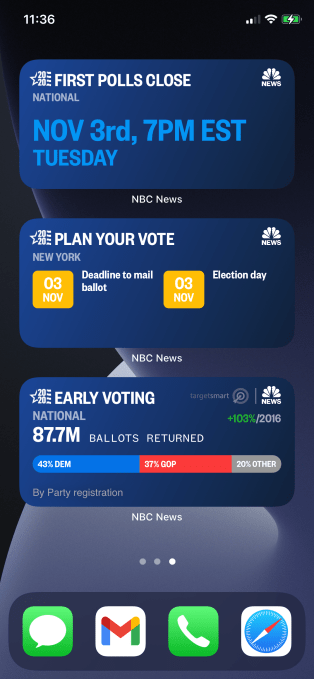
NBC News has updated its iOS app with a new feature that brings election news, data and results directly to your iPhone or iPad home screen. With the app’s new “Decision 2020” iOS 14 widget, you can customize a series of widgets with information related to early voting stats, polls, as well as the current election results, among other things.

Before today, the NBC News app had offered a variety of widgets including small-, medium- and large-sized widgets bringing the latest headlines, a set of widgets showing COVID-19 trends, and even a photo journalism gallery, with its “Week in Pictures” widget set.

But the Decision 2020 widget itself was just made available today.

The added widget is only available as a medium-sized banner, but arrives with a range of customization options. That means you could place several versions of the widget on your home screen, each showing a different set of results.

By default, the widget will auto-rotate through its various modules. But you can also opt to show only one module per widget if you choose by long-pressing on the widget then choosing “Edit Widget” from the menu that appears.

At launch, the available options include Plan Your Vote, National Polling Average, Latest Polls, Early Voting, Election News and Election Results. The latter, of course, is the option most people will be interested in today.

Image Credits: NBC News

You can also add your location to the widget by selecting your state from a list from the widget configuration screen. This will allow you to keep an eye on your local results, if you choose. Otherwise, you can leave it defaulted to national results.

To access the new widget, install the NBC News app then long-press on your home screen, choose “Edit Home Screen,” and tap the plus (+) button at the top-left and scroll to NBC News in the list.

The NBC News app can also send out push notifications, including geo-targeted alerts for state races for users on any mobile phone or device.


Tech stocks rip higher on Election Day

Tech stocks shot higher as American voters went to the polls, the gains coming far ahead of results that could indicate who will win the presidency.

American stocks broadly rose, with the S&P 500 index closing up 1.78% to 3,369.11 — one of the best Election Day closes for the S&P — while the tech-heavy Nasdaq Composite closed up 1.85% to 11,160.57. Every sector except one closed higher today. The sole exception was energy, which was down about 0.75% today. Saas and cloud-computing stocks followed along with the rest of American stocks, closing up 2.28%.

That bump might seem negligible, but consider the past month. The Nasdaq was down just over 8% from all-time highs at the start of trading today. That makes today’s gains worth around a fourth of the gap from its recent declines back to record levels. The Nasdaq fell more than 10% from its recent peak before starting to recover in late-October, making today’s rally part of a developing upward trend.

Depending on how one reads the polling tea leaves, the gains could be read as an endorsement of either candidate’s platform.

Today’s stock market moves come on the back of an uneven technology earnings cycle, with major tech companies swallowing lumps, while some smaller industry players like Five9 rode COVID-19 tailwinds to strong results. Netflix, Intel, Apple and others struggled to impress investors. Indeed, the domestic stock market’s reaction to earnings beats has been muted this cycle, in contrast to other areas; it appears that American equities were priced to surpass expectations.

For tech, today’s rebound is welcome, possibly helping pave the way for a rash of IPO filings that are expected before the year’s end. Airbnb, DoorDash and others are still candidates for flotation this year.

Certain share prices, notably those of Uber and Lyft, were already on the rise Monday on investor confidence that California voters will pass Proposition 22. The ballot measure, if approved, will exempt the ridesharing companies from a new California law that forces gig economy workers to be classified as employees rather than contractors.

Pulling back for a moment, Uber’s share price is still down about 3.87% from one month ago. But it’s been recovering, with a pop in the past two days. Uber’s share price closed 2% higher Monday. Uber shares rose 2.76% to close at $35.77 today. Lyft has experienced an even larger bump over the past few days. Lyft shares closed up 7.06% to $26.23 today.

The stakes are high for Uber and Lyft this Election Day. If Proposition 22 fails, the companies say they will have to change their business models. Both companies have threatened temporary shutdowns in the state if forced to comply with the new California law. For now it seems, investors believe Uber and Lyft will be able to continue to operate as they always have.

Mov gives you a chance to win your favorite athlete’s game day attire — sweat, tears and all

“If it smells, that’s how they’re going to receive it.”

While that claim would likely make most D2C founders cringe, for founder Chris Alston, it’s part of the magic of his company, Mov. The upstart, based in Los Angeles, connects fans to the game-worn apparel of their favorite athletes through a sweepstakes-style model. And in the market of sports memorabilia, authenticity (even if it includes sweat, blood and tears) is everything.

“We send it as is,” he said. “We want to make it a really special experience for the fans.”

Mov, launched just a few weeks ago, is more than a rebranded eBay or NBA auction site. The company, founded by Alston, his brother Brandon and Jacqueline Pounder, uses a sweepstakes-style model to raise money for a game-worn item. With each sale, 70% of money raised goes toward a cause of the athlete’s choice. The remaining 30% goes to Mov employees and operations. Causes currently listed on the website include Milwaukee Freedom Fund, Girls and Boys Club of Portland and With Us Foundation.

Athletes wear these game-worn items, and our platform gives them a way to donate and make an impact without any extra time on them and their busy schedules,” Alston said. All an athlete has to do is ship their item to a Los Angeles warehouse after the game, and Mov will get it into the winner’s hands.

Like any sweepstakes model, there’s no purchase necessary to enter. Everyone gets one free ticket to win an item, whether it’s CJ McCollum’s Li-Ning Yushuai 13 sneakers or Pat Connaughton’s Equality jersey. However, if a fan wants to buy more tickets to increase their chances, they can do so for $1 to $2 a ticket.

“Typically with game-worn gear, it’s whoever has the most money,” Alston said. “For us, we’re allowing anyone to enter to win for one ticket, and so we’re decreasing the barrier to entry.”

Alston grew up surrounded by philanthropy and sports. His grandparents took their own school board to court, and helped lead desegregation efforts in Virginia Schools. His brother is a professional basketball player and Alston himself played college football at Columbia University . Eventually Alston dropped out of Columbia to pursue tech entrepreneurship.

With that background, it would have made sense that Alston landed on creating a product that combines charitable causes with athletes. However, the first iteration of Mov looked far different than it does today. The product started as a video e-commerce platform, basically creating a video version of eBay. After Mov had difficulty scaling its marketplace, he thought of new ways to define his market. He landed on the network of athletes that he and his brother know well — and the fact that a not-so-tiny NBA rule change had recently passed.

In 2018, NBA players were allowed to start wearing any sneaker color of their choice. While it might be a small deal to some, the ability to wear different kinds of sneakers quickly turned into players repping charities or causes on their gear during games. Alston saw Mov as a way to take gear that athletes either throw out or give away and repurpose it for a good cause.

The success of Mov, from both a charity and revenue perspective, depends on how many fans sign up for its service and eventually pay for a chance to win an item. While the founder would not disclose total users just yet, he finds optimism in how much money an item is able to make through Mov. For example, Pat Connaughton’s Jersey made $2,164 on Mov versus $560 on the NBA auction site.

“During this crazy time, crazy year, we’re really trying to maximize how everyone can give back,” he said.


PayPal details its digital wallet plans for 2021, including crypto, Honey integration and more

PayPal this week laid out its vision for the future of its digital wallet platform and its PayPal and Venmo apps. During its third-quarter earnings call on Monday, the company said it plans to roll out substantial changes to its mobile apps over the next year to integrate a range of new features, including enhanced direct deposit, check cashing, budgeting tools, bill pay, crypto support, subscription management, buy now/pay later functionality and all of Honey’s shopping tools.

While PayPal had spoken in the past about bringing Honey’s capabilities into PayPal, CEO Dan Schulman detailed the integrations PayPal has in store for the deal-finding platform it bought last year for $4 billion, as well as a timetable for both this and the other app updates it has in store.

The Honey acquisition had brought 17 million monthly active users to PayPal. These users turned to Honey’s browser extension and mobile app to find the best savings on items they want to buy, track prices and more.

But today, the Honey experience still remains separate from PayPal itself. That’s something the company wants to change next year.

According to Schulman, the company’s apps will be updated to include Honey’s shopping tools, like its Wish List feature that allows you to track items you want to buy, price monitoring tools that alert you to savings and price drops, plus its deals, coupons and rewards. These tools will become part of PayPal’s checkout solution itself.

That means the company will be able to track the customer from the initial deal-hunting phase where they’re indicating their interest in a certain product, target them with savings and offers, then guide them through its checkout experience all in one place.

PayPal will also provide “anonymous demand data” to merchants based on consumer engagement with Honey’s tools to help them drive sales, the company said.

What’s more, PayPal put timeline on the Honey integrations and the other updates it plans to roll out over the course of the next year.

Bill Pay will start to roll out this month, PayPal said, with a large redesign of the digital wallet experience expected for the first half of 2021. Much of the new functionality will be arriving in the second quarter and the second half of the year, with a goal of having the majority of the changes rolled out by the end of next year.

This also includes PayPal’s plans for cryptocurrencies, announced at the end of October. The company aims to support Bitcoin, Ethereum, Bitcoin Cash and Litecoin at first, initially in the U.S.

Speaking to investors during the earnings call, Schulman also noted when PayPal plans to bring crypto to more users and geographies. He said the ability to buy, sell and hold cryptocurrencies will first arrive in the U.S., then will roll out to international markets and the Venmo app in the first half of next year. (Currently, PayPal is offering U.S. users to join a waitlist for the new crypto features in-app).
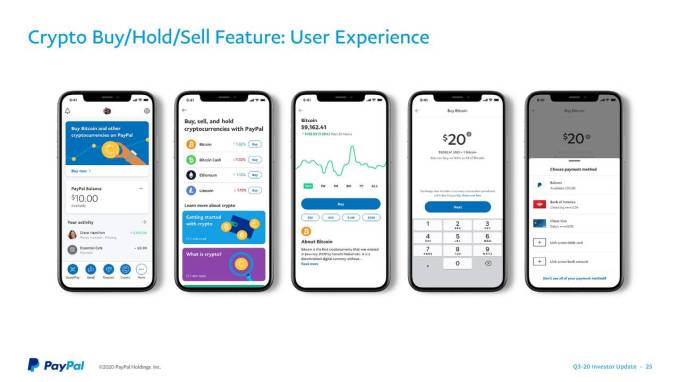
Image Credits: PayPal

This change will allow PayPal’s users to shop using cryptocurrencies across the company’s 28 million merchants without requiring additional integrations on merchants’ part. The company explained this is due to how it will handle the settlement process, where users will be able to instantaneously transfer crypto into fiat currency at a set rate when checking out with PayPal merchants.

“This solution will not involve any additional integrations, volatility risk or incremental transaction fees for either consumers or merchants, and will fundamentally bolster the utility of cryptocurrencies,” said Schulman. “This is just the beginning of the opportunities we see as we work hand in hand with regulators to accept new forms of digital currencies,” he added.

PayPal also recently joined the “buy now, pay later” race with its new “Pay in 4” installment program that lets consumers split purchases into four payments. This debuted in France ahead of its late August U.S. launch and has since rolled out to the U.K. (as Pay in 3). This too, will become more integrated into the company’s apps in the months ahead.

Venmo — which the company expects to reach $900 million in revenues next year — will see the expansion of business profiles, and will gain crypto capabilities, more basic financial tools and shopping tools, as well as a revamp of the “Pay with Venmo” checkout experience.

Schulman referred to the company’s plans to overhaul its Venmo and PayPal apps as a “fundamental transformation,” due to how much new functionality they will include as the changes roll out over the next year as well as the new user experience — basically, a redesign — that will allow people to move easily from one experience to the next instead of having to change apps or use a desktop browser, for example.

PayPal’s earnings hadn’t excited Wall Street investors this week, sending the stock down on its lack of 2021 guidance. But the year ahead for PayPal’s digital wallet apps looks to be an interesting one.

 

Got the right stuff? Exhibit and pitch at TC Sessions: Space 2020

Do you find the expression “the sky’s the limit” well, limiting? Join a global community of brilliant visionaries, makers and investors on December 16-17 for TC Sessions: Space 2020, an online conference dedicated to moving beyond the confines of this world through innovative tech and to creating stellar startup opportunities.

Speaking of a stellar opportunity, this one lets you navigate your startup into the orbit of the space industry’s leading experts and decisions makers. We’re talking folks from NASA, the U.S. military and VCs determined to finance pioneering space startups. Get an Early-Stage Startup Exhibitor Package to showcase your tech and talent — and impress the people who can change your startup’s trajectory. Note: There are only eight spots left, and early-bird pricing ends November 13 at 11:59 p.m. (PT).

The $360 exhibitor pass includes a digital exhibition space, the ability to gather leads who visit your exhibit space and three tickets to the conference for your co-workers. In a classic, “but wait, there’s more” moment, all exhibitors will be able to pitch to conference attendees from around the world. We’re talking founders, engineers, investors, tech journalists, potential customers and collaborators from the public sector and private sectors — not to mention people who hold the purse strings at NASA and the military.

Super Bonus: Exhibitors also get to hear from the following organizations to discuss how to access grant money.

TechCrunch events always feature top-level industry speakers, and you can expect nothing less at TC Sessions: Space. Here’s a sample from the event agenda — and we’ll add a few surprises in the coming weeks:

  • From Space Rock Returns to Financial Returns: An investor panel — with Chris Boshuizen (Data Collective DCVC), Mike Collett (Promus Ventures) and Tess Hatch (Bessemer Venture Partners). Some investors spend a lot of their time looking to the stars for the next venture capital opportunity. It’s a market unlike any other, but does that change the math on equity-based investment?
  • How to Get the Air Force to Buy Your Stuff — We’ll talk with Will Roper, U.S.A.F. Assistant Secretary for Acquisition, Technology & Logistics, about the best ways to understand what the Air Force needs and how to sell it to them.
  • Public-Private Partnerships in the Domain of Space Defense — General Jay Raymond, head of the U.S. Space Force, talks about what it takes to secure an entirely new war-fighting domain, and how the newest branch of the U.S. military will be looking to private industry to make it happen.

Is your startup ready for this stellar opportunity? Secure your Early-Stage Startup Exhibitor Package before the countdown to savings ends and prices go up on November 13 at 11:59 p.m. (PT).

Is your company interested in sponsoring TC Sessions: Space 2020? Click here to talk with us about available opportunities.