Steve Bannon’s show pulled off Twitter and YouTube over calls for violence

Former presidential advisor and right-wing pundit Steve Bannon had his show suspended from Twitter and an episode removed by YouTube after calling for violence against FBI director Christopher Wray and the government’s leading pandemic expert, Dr. Anthony Fauci.

Bannon, speaking with co-host Jack Maxey, was discussing what Trump should do in a hypothetical second term. He suggested firing Wray and Fauci, but then went further, saying “I’d actually like to go back to the old times of Tudor England, I’d put the heads on pikes, right, I’d put them at the two corners of the White House as a warning to federal bureaucrats.”

This may strike one at first as mere hyperbole — one may say “we want his head on a platter” and not really be suggesting they actually behead anyone. But the conversation continued and seemed to be more in earnest than it first appeared:

Maxey: Just yesterday there was the anniversary of the hanging of two Tories in Philadelphia. These were Quaker businessmen who had cohabitated, if you will, with the British while they were occupying Philadelphia. These people were hung. This is what we used to do to traitors.

Bannon: That’s how you won the revolution. No one wants to talk about it. The revolution wasn’t some sort of garden party, right? It was a civil war. It was a civil war.

Whether one considers this only nostalgia for the good old days of mob justice or an actual call to bring those days back, the exchange seems to have been enough for moderators at YouTube and Twitter to come down hard on the pair’s makeshift broadcast.

Twitter confirmed that it has “permanently suspended” (i.e. it can be appealed but won’t be restored automatically) the account for violating the rule against glorifying violence.

YouTube removed the episode from “Steve Bannon’s War Room” channel Wednesday afternoon after it was brought to their attention. A representative for the platform said “We’ve removed this video for violating our policy against inciting violence. We will continue to be vigilant as we enforce our policies in the post-election period.”

Online platforms have struggled with finding the line between under and over-moderation. Facebook, Twitter, YouTube, TikTok, Instagram and others have all taken different measures, from preemptively turning off features to silently banning hashtags. Facebook today took down a group with more than 300,000 members that was acting as an amplifier for misinformation about the election.

While the platforms have been vigorous in at least some ways in the labeling and isolation of misinformation, it’s more difficult for video platforms. Just minutes ago Trump took to YouTube to detail a variety of unfounded conspiracy theories about mail-in voting, but the platform can’t exactly do a live fact-check of the president and shut down his channel. More than with text-based networks, video tends to spread before it is caught and flagged due to the time it takes to review it.


Elon Musk’s Tesla tequila will run you $250 a bottle

Teslaquila, the Tesla -branded liquor that co-starred in CEO Elon Musk’s controversial April Fool’s Day joke about the automaker filing for bankruptcy, has arrived.

The automaker now lists Tesla Tequila (a bit different from the original Teslaquila branding) on its website. The tequila — described as a “small-batch premium 100% de agave tequila añejo made from sustainably sourced highland and lowland agaves,” is housed in a handblown glass bottle shaped in the electric charge symbol. Oh, and it costs $250.

Celeb-produced tequilas are nothing new — and are often lucrative. Casamigos, the tequila brand co-founded by George Clooney, was acquired by Diageo in a deal that valued the company up to $1 billion. Tesla Tequila might be first liquor sold by an automaker. The liquor is produced by Nosotros Tequila, according to the company.

The tequila first popped up in April 2018 when Musk tweeted a photo of himself passed out against a Tesla Model 3 “surrounded by “Teslaquilla” bottles, the tracks of dried tears still visible on his cheeks.” In the photo, Musk is holding a cardboard sign that reads “bankwupt.”

Later that year, Tesla filed an application with the U.S. Patent and Trademark Office to trademark “Teslaquila.”


A QAnon supporter is headed to Congress

Marjorie Taylor Greene’s win in a Georgia House race means that QAnon is headed to Capitol Hill.

Greene openly supports the complex, outlandish conspiracy theory, which posits that President Trump is waging a secret war against a shadowy group of elites who engage in child sex trafficking, among other far-fetched claims. The FBI identified QAnon as a potential inspiration for “conspiracy theory-driven domestic extremists” last year.

Greene’s win is a startling moment of legitimacy for the dangerous conspiracy, though it wasn’t unexpected: her Democratic opponent dropped out of the race for personal reasons in September, clearing her path to the House seat.

Greene’s support for the constellation of conspiracy theories isn’t particularly quiet — nor are her other beliefs. Called a “future Republican star” by President Trump, Greene has been vocal in expressing racist and Islamophobic views. Greene has also espoused September 11 “truther” theories and criticized the use of masks, a scientifically-supported measure that reduces transmission of the novel coronavirus.

QAnon, once a belief only at the far-right fringes of the internet, has inspired followers to engage in real-world criminal acts, including fatally shooting a mob boss in Staten Island and blocking the Hoover Dam bridge in an armed standoff.

The conspiracy’s adherents have also hijacked the hashtag #savethechildren, interfering with legitimate child safety efforts and exporting their extreme ideas into mainstream conversation under the guise of helping children. Facebook, which previously banned QAnon, limited the hashtag’s reach last month in light of the phenomenon.

Other QAnon believers are on the ballot in 2020, including in Oregon, where Jo Rae Perkins is projected to lose her race against incumbent Senate Democrat Jeff Merkley. Perkins was very open about her beliefs and in June tweeted a video pledging her allegiance as a “digital soldier” for QAnon along with a popular hashtag associated with the conspiracy movement.

Intel has acquired Cnvrg.io, a platform to manage, build and automate machine learning

Intel continues to snap up startups to build out its machine learning and AI operations. In the latest move, TechCrunch has learned that the chip giant has acquired Cnvrg.io, an Israeli company that has built and operates a platform for data scientists to build and run machine learning models, which can be used to train and track multiple models and run comparisons on them, build recommendations and more.

Intel confirmed the acquisition to us with a short note. “We can confirm that we have acquired Cnvrg,” a spokesperson said. “Cnvrg will be an independent Intel company and will continue to serve its existing and future customers.” Those customers include Lightricks, ST Unitas and Playtika.

Intel is not disclosing any financial terms of the deal, nor who from the startup will join Intel. Cnvrg, co-founded by Yochay Ettun (CEO) and Leah Forkosh Kolben, had raised $8 million from investors that include Hanaco Venture Capital and Jerusalem Venture Partners, and PitchBook estimates that it was valued at around $17 million in its last round. 

It was only a week ago that Intel made another acquisition to boost its AI business, also in the area of machine learning modeling: it picked up SigOpt, which had developed an optimization platform to run machine learning modeling and simulations.

While SigOpt is based out of the Bay Area, Cnvrg is in Israel, and joins an extensive footprint that Intel has built in the country, specifically in the area of artificial intelligence research and development, banked around its Mobileye autonomous vehicle business (which it acquired for more than $15 billion in 2017) and its acquisition of AI chipmaker Habana (which it acquired for $2 billion at the end of 2019).

Cnvrg.io’s platform works across on-premise, cloud and hybrid environments and it comes in paid and free tiers (we covered the launch of the free service, branded Core, last year). It competes with the likes of Databricks, Sagemaker and Dataiku, as well as smaller operations like H2O.ai that are built on open-source frameworks. Cnvrg’s premise is that it provides a user-friendly platform for data scientists so they can concentrate on devising algorithms and measuring how they work, not building or maintaining the platform they run on.

While Intel is not saying much about the deal, it seems that some of the same logic behind last week’s SigOpt acquisition applies here as well: Intel has been refocusing its business around next-generation chips to better compete against the likes of Nvidia and smaller players like GraphCore. So it makes sense to also provide/invest in AI tools for customers, specifically services to help with the compute loads that they will be running on those chips.

It’s notable that in our article about the Core free tier last year, Frederic noted that those using the platform in the cloud can do so with Nvidia-optimized containers that run on a Kubernetes cluster. It’s not clear if that will continue to be the case, or if containers will be optimized instead for Intel architecture, or both. Cnvrg’s other partners include Red Hat and NetApp.

Intel’s focus on the next generation of computing aims to offset declines in its legacy operations. In the last quarter, Intel reported a 3% decline in its revenues, led by a drop in its data center business. It said that it’s projecting the AI silicon market to be bigger than $25 billion by 2024, with AI silicon in the data center to be greater than $10 billion in that period.

In 2019, Intel reported some $3.8 billion in AI-driven revenue, but it hopes that tools like SigOpt’s will help drive more activity in that business, dovetailing with the push for more AI applications in a wider range of businesses.

Report: US visas granted to students from mainland China have plummeted 99% since April

It’s no secret that the Trump administration has pursued a variety of avenues to keep foreigners out of the U.S., including through a recent overhaul of the H-1B visa program for high-skilled foreign workers that will require employers to pay H-1B workers higher wages and narrow the types of degrees that would qualify an applicant — a move which has ready triggered numerous lawsuits.

Still, it may surprise some to learn that U.S. visas issued to students around the world have fallen as dramatically as they have this year. According to a new report in Nikkei Asia, citing U.S. State Department data, just 808 F-1 student visas were granted to applicants in mainland China between April and September’s end, which is 99% fewer than the 90,410 F-1 student visas granted during the same period last year.

The story is much the same for students of other countries: with 88% fewer F-1 visas granted to students in India, 87% fewer for students in Japan, 75% fewer for students in South Korea and 60% fewer for students from Mexico.

What’s going on? A confluence of factors, seemingly.

Coronavirus is most certainly among them, as families grow more hesitant to send their children to the U.S., which reported 93,581 new cases on Sunday alone, compared with 24 in China, 38,310 in India, 468 in Japan, 97 in South Korea and 3,762 in Mexico.

So is racism, with many Asians and Asian-Americans noting that Donald Trump’s rhetoric around the coronavirus has sharpened the racism they’ve faced throughout their lives, with terms like “kung flu” and “China virus” common in responses, per a recent survey by Washington State University researchers who say that increasing reports of racial discrimination since the start of the COVID-19 pandemic coincide with an increase in reported negative health symptoms. (The Nikkei notes that students already studying in the U.S. have been targets, too, citing a 23-year-old Chinese woman who was yelled at to leave the U.S.)

Yet an aggressive focus on Chinese espionage in Washington has played a bigger role, suggests the outlet, which speculates that the difficulty in obtaining American visas is likely to drive some Chinese students to other countries, including Canada.

Secretary of State Mike Pompeo, for example, said in remarks at the Richard Nixon Presidential Library in July that, “We opened our arms to Chinese citizens, only to see the Chinese Communist Party exploit our free and open society. China sent propagandists into our press conferences, our research centers, our high schools, our colleges and even into our PTA meetings.”

A backlash against Chinese students in particular is not a new one for the Trump administration, even while it’s been accelerated greatly in recent months. In 2018, the State Department began restricting to one year visas for Chinese graduate students studying in certain research fields, after which they need to reapply. The move rolled back a policy established during the Obama administration that allowed Chinese citizens to secure five-year student visas.

Insight Partners, Precursor Ventures join Hustle Fund in raising new fund money

Even as the country is in the final days of a polarizing election, the cogs of VC never stop turning. On this ever-so-quiet, non-election-news Tuesday, venture firms still managed to file paperwork with the SEC indicating newly raised funds. Precursor Ventures and Insight Partners will join Hustle Fund in closing new capital.

The filings are noteworthy because they signal new capital coming into the startup world, which could look dramatically different in the coming weeks. Still, Precursor Ventures and Hustle Fund are both still fundraising, so expect them to (hopefully) add more capital in the coming months.

Precursor Ventures, led by Charles Hudson, has raised a new tranche of capital to invest in pre-seed companies. The firm first filed in March 2020 that it had plans to raise a $40 million fund, and today it appears that it has closed $29 million of that goal. Recent investments from Precursor include The Juggernaut, mmhmm and TeamPay. The fund made headlines recently because it promoted Sydney Thomas, its first hire, to principal. Hudson was unable to comment due to fundraising activity.

We also saw a filing from Insight Partners, which closed a $9.5 billion fund in April for startups and growth-stage investments, indicating that it has raised money for its first-ever Opportunity Fund. The SEC filing shows that Insight Partners has raised $413 million for the opportunity fund. Insight did not return a request for comment.

Earlier today, SEC filings also showed that Hustle Fund has raised $30 million for a second fund, surpassing its previous fund of $11.5 million. Interestingly, paperwork for this new fund was first filed in May 2019 with the intention to raise $50 million. Today’s news, thus, is its first close. While the firm is still fundraising, it’s a long gap between filing and first close. The fund was launched in 2018 by ex-500 Startup partners Eric Bahn and Elizabeth Yin to, similar to Precursor, invest in pre-seed startups. Hustle Fund invests $25,000 checks into 50 startups per year.

Yin declined to comment due to ongoing fundraising activity.

While the spree of funds on Election Day was noteworthy, it was somewhat expected. Generally speaking, funds want to get their paperwork cleared and closed before a potentially chaotic event or time of unrest. We saw closes from OpenView, Canaan, True Ventures and more, while firms including First Round and Khosla filed paperwork for new funds. Time will tell if this is a final exhale of news until January 1, or if the VC world will continue pushing droves of capital, holidays be damned.

‘Stay home’ robocalls on Election Day prompt warnings, investigation

A scourge of robocalls urging Americans to “stay safe and stay home” has gotten the attention of the FBI and the New York attorney general over concerns of voter suppression.

The brief message, which doesn’t specifically mention Election Day, has prompted New York Attorney General Letitia James to launch an investigation into the matter. James announced Tuesday that her office is actively investigating allegations that voters are receiving the robocalls.

“Voting is a cornerstone of our democracy,” James said in a statement Tuesday. “Attempts to hinder voters from exercising their right to cast their ballots are disheartening, disturbing and wrong.”

James added that such calls are illegal and will not be tolerated.

The FBI told TechCrunch that the agency is aware of reports of robocalls. The agency wouldn’t say if it is investigating the robocalls; however, a senior official at the Department of Homeland Security told reporters Tuesday that the FBI was investigating calls that seek to discourage people from voting, according to the AP.

“As a reminder, the FBI encourages the American public to verify any election and voting information they may receive through their local election officials,” the FBI said in a statement sent to TechCrunch.

The announcement from James follows subpoenas issued earlier this week by the New York AG office to investigate the source of these robocalls allegedly spreading disinformation. New York voters who receive concerning disinformation, or face issues at the polls, can contact her office’s Election Protection Hotline at 1-800-771-7755.

“Every voter must be able to exercise their fundamental right to vote without being harassed, coerced, or intimidated. Our nation has a legacy of free and fair elections, and this election will be no different,” James added. “Voters should rest assured that voting is safe and secure, and they should exercise their fundamental right to vote in confidence. We, along with state leaders across the nation, are working hard to protecting your right to vote, and anyone who tries to hinder that right will be held accountable to the fullest extent of the law.”

Last month, the U.S. Department of Justice announced that an interagency working group convened by Attorney General William P. Barr released a report to Congress on efforts to stop illegal robocalls. The report described efforts by the DOJ, including two civil actions filed in January 2020 against U.S.-based Voice over Internet Protocol (VoIP) companies, the Federal Trade Commission and the Federal Communications Commission to combat illegal robocalls. Despite those efforts, and even evidence of some declines in robocalls for a time, the presidential election and the COVID-19 pandemic has fueled a spike in calls. 

Daily Crunch: China postpones Ant Group IPO

Yes, there’s a high-stakes presidential election underway, but tech news doesn’t stop completely: Chinese regulators pull the brakes on Ant Group’s IPO, Spotify adds standalone streaming support on Apple Watch and PayPal outlines its plans for 2021. This is your Daily Crunch for November 3, 2020.

The big story: China postpones Ant Group IPO

The Shanghai stock exchange has postponed Ant Group’s IPO a day after Chinese regulators held a closed-door meeting with Jack Ma and other company executives. The company has also halted plans for its public listing in Hong Kong.

Ant Group, a financial technology giant that spun out of Alibaba, was previously on track to raise $34.5 billion in the world’s largest IPO. It’s not exactly clear why the offering was called off, but Alibaba’s founder Ma recently gave a speech criticizing China’s financial regulation.

“We are sincerely sorry for any inconvenience brought to investors,” the company said in a statement. “We will properly handle follow-up matters following compliance regulations of the two exchanges.”

The tech giants

Spotify adds standalone streaming support to its Apple Watch app — The feature was spotted in testing back in September, and it arrives roughly two years after Spotify first debuted its dedicated Apple Watch app.

Twitter hides Trump tweet attacking Supreme Court’s decision on Pennsylvania ballots — In a preview of what to expect in the coming days, President Trump pushed the limits on Twitter’s election-specific policies Monday night.

PayPal details its digital wallet plans for 2021, including crypto, Honey integration and more — The company said it plans to roll out substantial changes to its mobile apps over the next year, including support for enhanced direct deposit, crypto and all of Honey’s shopping tools.

Startups, funding and venture capital

REEF Technology raises $700M from SoftBank and others to remake parking lots — REEF began its life as Miami-based ParkJockey, providing hardware, software and management services for parking lots.

Udacity raises $75M in debt, says its tech education business is profitable after enterprise pivot — The online learning company is now focused on winning over business customers.

Walmart reportedly ends contract with inventory robotics startup Bossa Nova — Walmart has reportedly pulled the plug on one of its highest-profile partnerships.

Advice and analysis from Extra Crunch

Four takeaways from fintech VC in Q3 2020 — The latest on insurtech, banking, wealth management and payments startups.

Gaming rules the entertainment industry, so why aren’t investors showing up? — Venture activity doesn’t seem to match the size of the games market.

How startups can shake up their first idea and still crush the market — Some thoughts on the ol’ startup pivot.

(Reminder: Extra Crunch is our membership program, which aims to democratize information about startups. You can sign up here.)

Everything else

Tech stocks rip higher on Election Day — The gains came long before any results that would indicate the election’s winner.

NBC News launches an iOS 14 widget that puts election results on your home screen — NBC News allows users to customize a series of widgets with information related to early voting stats, polls, current election results and more.

The Daily Crunch is TechCrunch’s roundup of our biggest and most important stories. If you’d like to get this delivered to your inbox every day at around 3pm Pacific, you can subscribe here.

Waymo pauses operations in San Francisco, stays the course in Phoenix on Election Day

Waymo has taken a dual approach to operations on Election Day.

In San Francisco, where Waymo has been testing its autonomous vehicles, driving operations have been temporarily suspended Tuesday and Wednesday “out of an abundance of caution.” Its fleet of autonomous vehicles was moved Monday to nearby Mountain View, according to an internal email first reported by The Verge. Waymo has continued its testing operations on public roads in Mountain View, according to an email from Transdev, the vendor that Waymo has contracted with to staff its fleet operations. TechCrunch confirmed that Waymo has paused operations in San Francisco.

Over in Phoenix, where Waymo’s on-demand robotaxi service operates and shuttles actual customers, it’s business as usual. Waymo told TechCrunch that in Phoenix it “will continue to serve riders through our autonomous ride hailing service, in order to help facilitate travel to the polls, and will continue to closely monitor the situation in all cities where we operate. The safety of our team, riders and partners is of paramount importance.”

Waymo’s actions in San Francisco follow other businesses in the city, which have closed up shop and even boarded up windows over concern that civil unrest related to the election will boil over this week. Other AV companies such as Cruise and Zoox, which also test in San Francisco, have taken a wait-and-see approach.

Cruise, which has about 200 vehicles in its fleet and uses Aerotek to staff its driver operations, is monitoring events.

“Safety is our number one priority,” according to Cruise spokesperson Milin Mehta. “Our Operations team is monitoring the situation in real time, and has turnkey plans in place to ground the fleet and take all necessary steps to keep our team members safe.”

Cruise also gave all employees, including contract workers, the day off to vote.

Zoox, which has a smaller fleet of about 50 vehicles that are tested in San Francisco and near its Foster City headquarters, continued testing today, although paused operations earlier than usual. The company is also monitoring the situation for the rest of the week.

Uber Advanced Technologies Group has tested in San Francisco in the past, but currently only has test operations in Pittsburgh. The company is not operational today because it has given all employees the day off to volunteer and vote. Testing is expected to resume in Pittsburgh this week, although a company spokesperson noted that they will reassess if the environment changes.

Aurora, which tests in Pittsburgh, the Dallas-Fort Worth area and the Silicon Valley enclaves of Palo Alto and Mountain View, is continuing operations in those locations and will “change course if needed.”

Argo AI wouldn’t provide specifics on whether it was testing today or altering its operations due to Election Day. However, a spokesperson did say that the company “places safety as the No. 1 priority in all respects when it comes to our fleet testing operations and always monitors local environments where we operate and take whatever precautions are appropriate, no matter what day it is.”

Hustle Fund, a pre-seed firm, closes $30M for a new fund

Hustle Fund, a pre-seed fund built by former operators and founders, has raised $30 million for a new fund, per SEC filings. Hustle Fund first filed paperwork for this fund, its second to date, in May 2019 with intention to raise $50 million. Its inaugural investment vehicle closed at $11.5 million.

Hustle Fund was unable to comment because it is still in fundraising mode.

Hustle Fund was created by Elizabeth Yin and Eric Bahn, two former 500 Startups partners, with the goal of investing in pre-seed software startups. The firm has traditionally operated by investing $25,000 in a company, usually with a minimum-viable product, and then works with the team to help them grow. It does around 50 investments per year, according to its website.

It’s a small but focused investing approach, one that has gotten Hustle Fund into deals such as Webflow, NerdWallet and The Pill Club. But, as pre-seed grows and companies raise absurdly high first-check rounds, the need for bigger checks might be necessary for VCs to continue getting into deals. Thus, a bigger fund size for a fund a few years in is both practical and expected.

Still, don’t expect Hustle Fund to be changing up its investment appetite just yet. Yin joined us at Extra Crunch a few months ago to detail her check appetite.

“I think to a certain extent, putting money into faster experiments helps, but it only goes so far,” Yin said. “You can’t drive speed of execution with money; it happens through the speed of learning. And I think that’s something that there’s an upper bound as to how much and how many resources you can put into increasing that speed of learning in the earlier stages.”

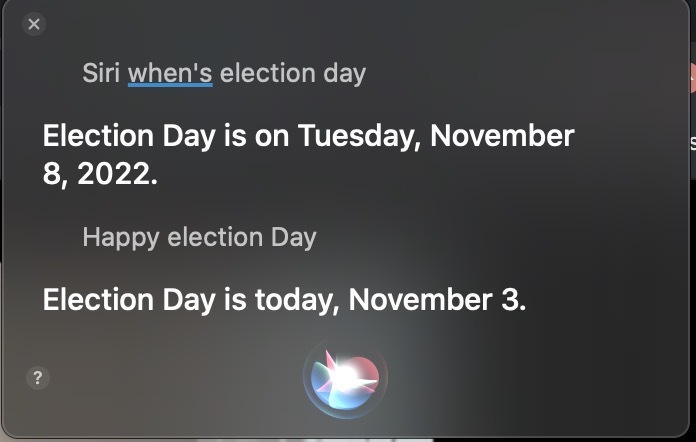
After getting the date wrong earlier, Siri now knows today is Election Day

Listen chief, it’s Election Day in the United States. You know that, I know that. Everyone knows that — and in the off-chance anyone wasn’t clued in to the fact, the last few weeks have offered a non-stop barrage of reminders to vote. Today. Tuesday. November 3. 2020.

It seems the last one to find out, however, was Siri . If you happened to greet Apple’s smart assistant with a “Happy Election Day” earlier today, it may well have answered that the big day isn’t until November 8, as pointed out by noted Twitter enthusiast, Lucas Matney.

Image Credits: Kirsten Korosec

Apple has since fixed the issue, though the problem appears to be that Siri jumped the gun here. November 8 is, in fact, election day. Just not this year. November 8, 2022 marks another major election here in the U.S. — namely the midterms, which will no doubt be all sorts of fun and nerve-racking in their own beautiful way. A never-ending source if anxiety, this beautiful thing the ancient Greeks called “democracy.”

Siri notably wasn’t the only one that mixed up their dates. An Instagram cache issue earlier today caused the social media service to suggest to users that “Tomorrow is Election Day.” Which, it’s not. While it seems likely the presidential race will still be up in the air come tomorrow, showing up at your polling place to vote will likely be frowned upon.