“Data Furnace” Would Heat Homes While Flipping Bits

One byproduct of computing almost everybody has had to deal with at some time or another is the heat. Whether it’s your Xbox 360 overheating due to poor ventilation, your MacBook’s fan roaring like a jet engine, or some other manifestation, the inescapable truth is that computers these days get warm. Whether it’s a processor, hard drive, or video card, it produces waste heat as its processors and moving parts do their thing.

Microsoft Research asks: if these things are so hot, why aren’t we heating our homes with them?

The obvious answer is that while a laptop definitely produces enough heat to make things uncomfortable for your lap, it’s nowhere near the amount necessary to heat the room, much less a whole house. Same for even the most powerful gaming and design desktops.

But server farms all over the world have to crank the A/C to keep their tightly-packed server racks from breaking down from the heat. Since space is at a premium, they put lots of processors and drives as close as possible (check out BackBlaze’s homemade servers) and the heat can get pretty serious. So what if people were to install a rack or two of servers in their home — the bigger the home, the more processors?

The study suggests that there are some serious cost savings involved with selling these “data furnaces” to people, depending on the region, but I’m not convinced. First, the upfront cost to the consumer isn’t appealing: they’re calculating this based on consumers paying the same as they would for a purpose-built furnace. People won’t agree to this unless there’s something in it for them. Then, there is the factor of electricity costs, which is no rounding error: the paper’s estimate puts cost increases at several thousand dollars per furnace. And if the home doesn’t have a fat enough broadband? Cough up an extra couple thousand for a high-speed private line.

Centralizing the power, maintenance, security, access, and administration of datacenters is still way more valuable than the potential gain from “piggybacking” on a low-priority switcheroo like this heating thing. The idea is to provide room for growth in data handling without the adverse consequences of plain linear scaling (i.e. doubling cloud storage capacity without doubling the size and emissions of the datacenters), but I don’t think this method is the way to go about it. There are too many factors that would make the servers’ owners uneasy, and there’s a good chance of upfront hassle for the “host” home. It’s an interesting idea, but I don’t think either infrastructure is ready for it.

[via i-Programmer and Gizmag]


Spotted! Secret Ubers On The Streets Of Seattle

It’s testament to the enthusiasm of the Uber fan base that we’ve gotten multiple tips this afternoon about the service being live in Seattle. Via a quick phone call with Uber CEO Travis Kalanick, I’ve confirmed that Uber has indeed soft-launched in the Pacific Northwest’s largest city, with an initial three black cars in its test fleet.

Perhaps because of general cost of living is lower, Seattle Uber pricing is less than its counterpart in New York or San Francisco — At a $7.00 base fare with a $12 minimum versus a $8.00 base fare and a $15 minimum. Uber costs more than a cab obviously (the company is currently experimenting with pricing) but totally worth it if you need to get somewhere fast, safely or just want to impress someone with your uncanny ability to summon a black car at will.

As having enough drivers to quell car requests is a key issue with Uber, Kalanick tells me that they’re positioning the initial Seattle Ubers as for “adventurous users only” even though the app is live and ostensibly anyone can use it. Kalanick hopes to have dozens of cars available upon full launch, which he jokingly says we should expect at some point in the next two weeks to three months.

While Kalanick couldn’t give out any information about how successful the Uber launches were in San Francisco or New York, or which cities will come after Seattle, he did give me this one stat, “The best metric I can give you is that Uber is killing it in San Francisco and we’re crushing it in New York.”

Sure enough, five minutes after stealth launch, photographer Chase Jarvis – the Seattle equivalent of our own Erick Schonfeld – scooped one up (image below).


Company:
UBER

Uber, a San Francisco based technology startup is innovating at the intersection of mobile technology, car transportation & logistics. The Uber experience captures the elite limo experiences and transforms…

Learn more


Google On The Nortel Loss, Patents As Government-Granted Monopolies, And Plates Of Spaghetti

Back in early April, Kent Walker, Google’s Senior Vice President & General Counsel, wrote a post on the Google blog titled “Patents and innovation“. The reason behind the post was clear: Google was feeling the pressure in the patent space after multiple attacks against them and their partners. And now they were going to do something about it.

In his post, Walker noted that Google had laid down the initial “stalking-horse” bid for over 6,000 patents that were up for sale due to the Nortel bankruptcy. “If successful, we hope this portfolio will not only create a disincentive for others to sue Google, but also help us, our partners and the open source community—which is integrally involved in projects like Android and Chrome—continue to innovate,” Walker wrote.

The only problem was that Google wasn’t successful in the bidding. In fact, you could argue that the worst-case scenario happened to them. Instead of Google winning the patents, most of their chief rivals did, including Apple, Microsoft, RIM, and others. Ouch.

The following day, Walker issued a formal statement on the matter, calling the outcome “disappointing“. It obviously was, but as I noted in my post on the matter, I would have liked to hear more on the matter from Google. They wanted the press to know they were upset, but they didn’t want to speak on-the-record about it. Well, now they are.

I spoke with Walker earlier today about the Nortel case, as well as the patent situation in general.

Walker kicked things off by noting how vital it was that sites like ours cover the patent issues, because startups, entrepreneurs, and venture capitals all stand to lose if things don’t change. “We have the resources to fight,” Walker says of Google, but says that innovation itself is in danger.

“It looks like plates of spaghetti,” Walker says of the current patent situation, noting the everyone is suing everyone else. “This is new in the Valley. This has happened in the past 15 years or so. Now it’s a mess,” he says.

“A patent isn’t innovation. It’s the right to block someone else from innovating,” he continues. This is something Walker brings up again and again in our talk. Clearly, he thinks that patents, at least the way they’re being enforced right now, are a bit of a joke.

Speaking of jokes, I asked Walker about the reports that Google had bid mathematical constants (like “Pi”, for example) during some of the earlier rounds of the Nortel bidding. This led some, including myself, to wonder if Google was actually taking the auction seriously?

“No one bids that kind of money without taking things seriously,” Walker says. “We think of this situation as a very serious one. There have been questions about our bidding strategy. We did have one,” he continues.

“That said, the numbers being talked about were dwarfed by the amount finally bid. It’s all kind of moot,” he says.

“Of all the prior Nortel auctions [there were a few before the patents Google bid on], never had any of those gone for more than twice the stalking-horse bid. This went for five times as much,” Walker says. “It was the biggest patents sale in the history of the world.”

Along those lines, I asked if Google made a strategic blunder when they put down the initial $900 million bid, since many assumed the entire portfolio wouldn’t garner more than $800 million when all was said and done?Perhaps this big bid emboldened Google’s rivals?

“No, I don’t think so,” Walker responds, noting that the rivals likely had their strategies set as well. While he wouldn’t give specific numbers, he said Google had a number in their head for how high they were willing to go to get these patents. This is something that Google CEO Larry Page implied during their earnings call a couple weeks ago as well.

“We buy companies all the time — for both people and interesting technologies. This would have been north of $4 billion for none of those things. We were bidding on the right to stop people from innovating,” Walker says.

“You have to have the discipline not to overbid,” Walker continues. “Are there other opportunities out there? Of course,” he says, noting that Google is looking at all of them, but refusing to name specific opportunities. Rumors have pegged InterDigital as the next Google/Apple patent fight.

Or perhaps even Motorola patents will be on the table, as other reports have suggested. Following the massive Nortel result, unsurprisingly, a lot of opportunities are being put on the market now, Walker notes.

When I ask about the reports that Apple teamed up with Rockstar Bidco in the Nortel auction, effectively staking them, and leading to the win, Walker declines to talk about specifics of the auction itself, citing the NDA all parties had to sign. But at a high level, he says that Google knew there would be opportunities and risks for partnerships as a part of this auction (it has also been reported that Google teamed up with Intel for the final run).

I then ask Walker about the court situation. After the loss, Google seemed to imply that the courts may get involved to change the outcome by adding terms to it. Instead, the deal was approved by the Canadian and a joint U.S./Canadian court in just 10 days.

Walker says that there’s an important difference between court approvals and something like the Department of Justice getting involved. The court approvals essentially just said that the terms were beneficial for Nortel — and at $4 billion+, how could they not rule that, Walker jokes. (The Canadian courts also did more generally approve the deal, saying that it wouldn’t stifle competition.)

“The separate question is whether regulators from an antitrust perspective will engage,” Walker says. He declined to go any further than that, but it seems like a fair assumption that this is still very much a possibility. The deal is not fully closed yet.

“The great news is that there’s lots of interesting options out there. Lots of people with lots of patents out there,” Walker says, moving the conversation beyond the Nortel situation, to the broader issue.

Walker says that several times in history, even in the tech space, we’ve seen patent issues flare up and then settle down. In the microprocessor industry and the OEM industry, for example. “They settle into mutual assured destruction,” he says. “These fights are an arduous and expensive way to do it,” he says, implying that eventually, they’ll get there too.

“Patents are government-granted monopolies,” Walker then says quite matter-of-factly. “We have them to reward innovation, but that’s not happening here,” he says.

When I ask about Microsoft’s pressuring of Android OEM partners to sign licensing agreements, and the notion that Android really isn’t free, you have to pay Microsoft to use their patents, Walker declines to talk about Microsoft specifically.

But generally, he says that “it’s one thing to claim to have patents, it’s another for them to actually be valid patents.” “We have a number of partners. Samsung has 30,000 patents, I believe. Motorola has thousands more,” Walker notes, implying that they can fend for themselves even without Google having a ton of patents to help them.

We then turn to Intellectual Ventures, which has been in the news a lot in recent days as perhaps the best example of patent “trolling”.  Again, Walker doesn’t want to talk about them specifically, but says that generally, “it’s a sign of the challenges with the patent system.”

“When you see a lot of VC money flowing into the acquisition and holding of patents, it’s a problem. These are not companies doing new things, they’re buying them. You see hundreds of millions and billions of dollars flowing in to exploit others,” he says.

“An average patent examiner gets 15 to 20 hours per patent to see if it’s valid. It can take years to go back and correct mistakes,” Walker says more broadly. “It has become a kind of lottery.”

All of the above situations show the problem with the entire system, in Walker’s view. At the highest level, “patents are not encouraging innovation,” he says.

Still, Walker still realizes this is the battle Google must fight right now. So the hunt continues for some nuclear warheads to build towards mutual assured destruction, and eventually détente.

[image: flickr/sikachu]


Company:
GOOGLE
Launch Date:
7/9/1998

Google provides search and advertising services, which together aim to organize and monetize the world’s information. In addition to its dominant search engine, it offers a plethora of…

Learn more


Playstation Vita’s Social And Online Modes Officially Detailed

We heard about the Playstation Vita’s online capabilities long before we even knew its name, but the official details are just now solidifying. We knew it would have a net-connected staging area for each game, and a proximity-based social tool (LiveArea and Near respectively), and although some of the functions there are intact, they’ve been tweaked a bit and the features have changed.

“Near” is now a “gifting” system rather than a social discovery tool; it’s for leaving presents at certain locations, accessible to certain people or everyone and consisting of in-game items, challenges, and so on.

“LiveArea” is an all-purpose update system that will show things like notifications from friends, new DLC and updates for games, and (I’m guessing) promotions like PSN game sales and what have you. There’s actually an actual part called Live, which I think Microsoft might actually take issue with. In this case Playstation Live and Xbox Live might actually create confusion.

“Party” is a cross-game voice chat system, accessible throughout the system. You can override it for team-based games (dividing up into red and blue voice channels in-game, for instance) but otherwise it’s pretty much always there. It’s also a friends list thing, and you can build game-related groups for easy launching with your teammates or buddies. Hopefully they’ll add an exception for this so it doesn’t eat up your 3G bandwidth allowance.

Sounds pretty solid to me, although I’m thinking they kind of gutted Near. There’s a lot to be done with proximity-based gaming, more than they can feasibly launch with perhaps. I’d expect multiple updates to these capabilities, though, and of course developers will find interesting ways to use them, so we’ll continue keep an eye on the Vita.


Technology Is The New Smoking

We’ve all been there; You’re at an outing or a dinner table with friends but itching to check your email or Facebook or Twitter or Instagram or Google+ or Yammer or what ever digital hit of serotonin you prefer. Have you ever “gone to the bathroom” in order to check email or come up with a socially appropriate excuse to pull out your smartphone just so you can check your @ replies on Twitter?

Remember when the critical mass of smokers used to leave the table or meeting in groups to go indulge their habit? I straight up open my laptop at bars and parties, and then feel more guilty about that than drinking.

A new British study released today backs up what we otherwise know intuitively, that Internet usage is increasingly becoming an addiction. Out of 1000 people surveyed after being cut off from the Internet for 24 hours, 53% reported feeling “upset” about being deprived of online access and 40% said that they felt lonely after not being able to connect to the Internet. Participants described the digital detox akin to quitting drinking or smoking and one even said it was like having his hand chopped off (!).

This British survey comes after a University of Maryland study in April that came to pretty much the same conclusion — With one student saying that she was “itching like a crackhead” after abstaining from any form of media for 24 hours. Geez.

Add this insight to the yet un-proven concerns that smartphone usage leads to Cancer and the smoking analogy becomes more and more apt (see image left). But for the moment Googling the name of a movie you can’t remember is hands down a lot healthier than smoking an actual cigarette, at least physically. For the moment.


Netflix: 75 Percent Of New Customers Signing Up For Streaming-Only Plan

In its first quarterly earnings since it announced plans to hike prices for DVD subscribers who also stream videos, Netflix tried to put the best face on its new decision. In a shareholder letter (PDF) accompanying earnings, CEO Reed Hastings and CFO David Wells report that during “the quarter, the streaming only plan continued to gain in popularity, with nearly 75% of our new
subscribers signing up for it.”

Nevertheless, net domestic subscribers increased by only 1.8 million versus 3.8 million new subscribers last quarter. (Netflix now has a total of 24.6 million subscribers in the U.S. and about another 1 million abroad). The big impact of the price change, of course, will come next quarter, when the company expects total subscribers to stay at around 25 million, with 22 million getting streaming video in some fashion, 15 million still getting DVDs, and a overlap of about 12 million getting both.

Many customers are up in arms about the price change, but Netflix’s attitude seems to be love it or leave it. Again, from the letter:

It is expected and unfortunate that our DVD subscribers who also use streaming don’t like our price change, which can be as much as a 60% increase for them from $9.99 to $15.98, when it goes into effect for each subscriber upon their renewal date in September

. . . We hate making our subscribers upset with us, but we feel like we provide a fantastic service and we’re working hard to further improve the quality and range of our streaming content in Q4 and beyond.

Netflix acknowledges that it still needs to improve the quality of its streaming selection, but it would rather encourage customers to abandon its DVD business and take those savings in shipping and other costs to pour into better streaming content. This transition will obviously take more than a couple of quarters, but Netflix’s policies seem to be designed to speed it along.

In the letter, Reed and Wells also make a point to turn up their noses at Hulu, which they don’t want to buy:

Hulu Plus added about 325,000 subs in Q2; we added close to 2 million. We invest much more than Hulu Plus in content, in marketing, and in R&D. Since Hulu is likely to be sold in the near term, it is unknown who will run it and how much they will invest in the subscription part of the Hulu service. We aren’t planning to bid on Hulu because most of its revenue is from providing free ad-supported streaming of current season TV shows, which is not our focus.

Netflix ended the quarter with $788.6 million in revenue, up 52 percent. Net income was up 55 percent to $68.2 million. EPS came in at $1.26 (versus consensus estimates of $1.11, but Wall Street still isn’t happy with the slowdown in store for the third quarter). Total subscribers were up 70 percent from the year before. Full details in the letter and P&L below.


Company:
NETFLIX
Launch Date:
1997

With more than 23.3 million members in the United States and Canada, Netflix, Inc. is the world’s leading Internet subscription service for enjoying movies and TV shows. For $7.99…

Learn more


Boot To Gecko: Mozilla’s Open-Source, Mobile Answer To ChromeOS

Straight from the heart of Mozilla’s developer newsgroup comes news of an ambitious new project: a standalone, web-based operating system. If that concept sounds familiar, I’ve also just described the core of Google’s Chrome OS which we’re beginning to see pop up on netbooks. The big twist?

It’s currently being developed for mobile devices. And it’s partially Android-based.

According to Dr. Andreas Gal, researcher at Mozilla, the impetus behind the Boot to Gecko project is to “make open web technologies a better basis for future applications on mobile and desktop alike”. A lofty goal to be sure, as the core underpinnings would ultimately extend beyond just mobile devices. Should Gal and his colleagues (and really anyone who wants to help) succeed, Boot to Gecko would have the potential to change how we interact with the web, regardless of platform.

Gal breaks the process down into actionable steps. First, the Boot to Gecko project aims to take the primary functions of a mobile device (i.e. “Telephony, SMS, Camera, USB, Bluetooth, NFC”) and create web APIs to handle them. From there, they intend to develop a way for web pages and applications to safely access those components as needed. They hope that by doing this, they (and other intrepid developers) will be able to create native-grade apps that run directly on the web instead of only being available on certain devices.

As I’ve mentioned, the open-source project is based partially off of Android — nothing terribly high-level though, just the kernel and the drivers so as to ensure that whatever progress they make can actually boot. It also doesn’t hurt that Android works (and in many case, has been made to work) on plenty of different hardware configurations, which is exactly what they need to see if the concept pans out. As it stands, development is in such a nascent stage that we have no idea what to expect visually, so no images yet folks.

Personally speaking, this idea has me on the edge of my seat. It will take a lot of work, and a lot of time, and there’s no guarantee that we’ll ever see a complete release. That’s the funny part though: I don’t think it really matters. If all they ever did was finish the API for telephony and SMS messaging, that would still signal a tremendous shift in how we use the web. Boot to Gecko will inevitably draw comparisons to ChromeOS (and I was guilty of this just a few paragraphs ago), but we stand to gain a much richer online experience if B2G comes to be. Only time will tell if these gentlemen succeed, but we’ll be certain to keep you up to date during the ride.


Go FAQ Yourself With Philip Kaplan’s FaqMe

Blippy and FuckedCompany.com founder Philip “Pud” Kaplan is at it again with his whimsical and sometimes useful ADHD Labs experiments, this time launching FaqMe, a FAQing free service that helps people build snazzier FAQ and Contact Us pages. “Many websites have sucky (or non-existent) help pages and customer service,” says Kaplan, who aim to make the whole FAQing experience more FAQing frictionless.

Wanting to be the FAQing WordPress of FAQ forms, FaqMe allows admins to customize their pages, add, edit and delete FAQ entires as well as drag and drop re-order them. Like a lower key Assistly or Zen Desk, customers can contact users through FAQMe and their messages will appear in a FaqMe inbox, allowing them to respond privately to questions or publicly through FaqMe page. “Every customer service email becomes an opportunity to write a new FAQ entry,” Kaplan writes.

FaqMe also provides users with FAQing statistics like unique visits, time spent on page, browser, phone and PC-type, so they can check out who is clicking on what FAQs and when.

“Web developers might say it’s easy to make a FAQ and help page.  It is easy to make a bad one.,” says Kaplan referring to countless FAQ pages that have old information or don’t have a CRM functionality. “Almost no developer in their right mind would put so much work into a FAQ to make it do all the things a FaqMe page does.” Almost.

Kaplan, who is currently angel investing and advising a series of companies including Heartsy, SuperFan and Branchout plans on offering FAQing premium features like custom FAQ designs, domain mapping (right now you have to link to your FaqMe page) and embeddable widgets in later versions of the FaqMe, and possibly charging for them. His own endeavor TinyLetter, which was the impetus for the creation of FaqMe, just hit 400K newsletter subscribers.

Oh, and if you want in to FaqMe the password is “pancakes.” Any more FAQing questions?

FaqMe
FaqMe
FaqMe
FaqMe


With Monetization And The Mainstream In Mind, Twitter Adds To Senior Management Team

While Twitter was busy last week making some quick, but big cuts in an attempt by Jack Dorsey to streamline the product side of things, this week they’re doing the opposite — at least on the sales and marketing side of things.

Twitter has just announced that they’ve made two additions to their senior management team. Joel Lunenfeld is joining Twitter as director of Global Brand Strategy. And Pam Kramer will be the company’s first vice president of Consumer Marketing. In the quote sent by Twitter PR, Twitter CEO Dick Costolo says he’s “thrilled” by the new hires, and the effort to bolster Twitter’s senior management team.

Kramer comes to Twitter from GreenRoad, a startup focused on “greener” driving. Before that, she worked at MarketTools and Lending Club. She was also a longtime executive at E-Trade. Over 9 years there, she served at Chief Product Officer and Chief Marketing Officer, in charge of the Super Bowl ads, among other things. That last role will be key for her new role at Twitter.

Lunenfeld comes from Moxie Interactive, where he was CEO. Twitter touts his 12 years of experience as a digital ad man who has plenty of experience working with major clients. “Joel will guide our efforts to develop custom ad and partnership programs for Twitter’s most valuable advertisers,” Twitter notes.

Clearly, both of these positions are being added to help Twitter in two areas of weakness right now: mainstream audience retention and monetization. While Twitter has been able to sign up north of 200 million users, it has been a bit tricky getting all of them to stick around and continue to use the service. Likewise, while they have a massive reach, convincing brands to advertise (and continue to advertise) with Twitter hasn’t been a walk in the park, by most accounts.


Company:
TWITTER
Launch Date:
21/3/2006

Twitter, founded by Jack Dorsey, Biz Stone, and Evan Williams in March 2006 (launched publicly in July 2006), is a social networking and micro-blogging service that allows users to…

Learn more


Apple Releases Another Security Update With iOS 4.3.5

Apple’s none too fond of nasty security flaws lurking about in iOS, and they’re not above cracking out rapid-fire updates to prove it. Just 10 days after the release of iOS 4.3.4 (which existed almost solely to kill off a potentially nasty PDF exploit), they’re back with another one: iOS 4.3.5.

The main fix in this minor patch? A fix for a security flaw which might allow “attacker with a privileged network position may capture or modify data in sessions protected by SSL/TLS”. In other words, hackers on the same network could store or change traffic that would otherwise be rather intensely encrypted.

Unlike that last patch (which, due to the exploit patched, did away with the one-click-jailbreak site JailbreakMe), this one seems to have no affect on jailbreakers. According to Redmond Pie, the only jailbreak method that still worked with 4.3.4 (tethered redsn0w) still seems to get the job done here.

This one’s pretty hefty for a security patch, coming in at a whopping 666 megabytes. Once iOS 5 and its fancy over-the-air/delta updates (wherein only the stuff that has changed needs to be downloaded), these one-off security updates should be a whole lot less time consuming.

Anyone spot any new gems sneakin’ around in iOS 4.3.5? Be sure to drop a comment and let us know.


Hello! I’m Chris Velazco, and I’m TechCrunch’s New Mobile Writer

Man, this place looks different.

Before I get too lost poking around the new digs, I’d like to introduce myself — my name is Chris Velazco, and I’m joining the TechCrunch staff as your new mobile writer. Longtime readers may remember me as a hapless MobileCrunch intern from the days of yore, a position I only really landed because Greg happened to see me on television right after he read my application. Alas, though I learned tons and met some truly great people, I had scholastic obligations to deal with and stepped away last year.

I like to think my time away from the Crunch family was well spent: I picked up a few degrees in English and Marketing from Rutgers University, embarassed myself on Who Wants to Be a Millionaire, and popped up in a second Best Buy commercial. After all that, I was a bit … puzzled about what my next step would be, but when Greg offered me the chance to come back home I jumped at it. I have to say I’m truly very glad to be here doing what I love, and I’m looking forward to writing for (and learning from) all of you.

Feel free to drop me a line! I’m always available at christopherv [at] techcrunch [dot] com, and as @rocketlad on Twitter.


7 Ways Twitter Could Be Winning Local

Editor’s note: The following guest post is written by Victor Wong, the CEO of PaperG, a local advertising technology company.

Conquering “local” remains one of the largest opportunities on the Internet today, and it seems as
though Twitter’s unique position has gone largely unnoticed. Today, Twitter is an amazing tool for
connecting people to the world, but it hasn’t yet successfully connected people to places they care
about. If Twitter chose to bridge that gap, though, higher user engagement and even monetization
would likely follow.

1. Twitter Places
What happened to Twitter Places? In 2010, Twitter created place pages for local businesses (called Twitter Places), but they were lost in the new redesign. The initial concept, while lacking visibility and utility, provided a good blueprint for how Twitter could better serve its local businesses by differentiating them from regular users.

The first step for Twitter will be in figuring out how to distinguish personal accounts from business accounts. Done right, Twitter Places could become the go-to source for information about any business (after all, businesses are more likely to update their Twitter page over their website). A new Twitter Places could link place pages with corresponding business accounts, as well as aggregate content from other local sources similar to what Google does with its Place Pages.

2. Where To Follow
In addition to “Who to follow,” Twitter should create a “Where to follow” section which would surface suggested Twitter place pages, thereby increasing the visibility of Twitter Places. Not only would it increase user engagement, this feature would also generate possible ad inventory for a “Promoted Places” product which would be the local equivalent of the “Promoted Accounts” already being sold.

3. Place Trends
Twitter should be the ultimate federator of check-ins, both explicit (Foursquare, geo-tagged tweets) and more implicit (Instagram). Most location based services already broadcast information to Twitter, which remains impartial without its own competing service, unlike Facebook. By aggregating broadcasted location data, Twitter can actually organize what’s going on in a given neighborhood or venue and show trending places. This useful tool also creates yet another natural ad opportunity — Promoted Place Trends.

4. Geotargeted Tweets
For big chains, one dilemma is how to use Twitter to run local, store-specific promotions. Twitter
should enable paying advertisers to geo-target tweets to followers in a particular location. By doing so, national-local businesses with multiple locations, such as Whole Foods or Best Buy, can send out weekly specials specific to certain regions without fear of alienating users in other areas.

5. Local Alerts
Anyone who has used Twitter can tell you it’s a goldmine of information about your community — if you know how to search correctly. To help people find local content, Twitter could offer “Google Alerts” whereby users get notified when keywords (places, people, etc.) occurs nearby. People can then be immediately notified when a school, child, or important local issue makes the news.

6. Loyalty Rewards
Any business wants to reward their best customers, and Twitter should make it dead-simple to reward new followers or loyal advocates. Many business owners would love to say: “Thanks for following my restaurant, here’s a voucher for a free appetizer!” 3rd-party efforts, such as PaperG’s Polly.IM, have already begun doing something similar with great success.

7. Promoted Retweets for Local Commerce
Imagine combining the group-buying craze with a platform as fundamentally social as Twitter. Twitter
has a commerce opportunity to enter the local deals space by making its ads truly social and offer a group buying experience. A local deal like this would spread like wildfire: “$25 for 2 Tickets to Kings of Leon. Deal is on at 50 retweets w/ 23 more to go. Spread the word with a retweet to get DM with coupon.” The coupon or actual purchasing experience could be displayed within Twitter to lower friction in transacting.

Although Twitter wasn’t founded to promote local commerce, it’s interesting how many pieces have
fallen in place which could allow them to become a major player in local. For Twitter to win local,
it needs to create more chances to engage users on a local level, increase usage of Twitter by local
businesses, and find natural monetization opportunities.


Lulz? The ‘Murdoch Leaks Project’ Gets A Landing Page

Over the last week, there’s been quite a bit of news swirling around Rupert Murdoch’s empire, including, most recently, the now infamous LulzSec’s pwnage of The Sun, News Corp’s daily tabloid newspaper.

On Monday, the network of merry hacktivists hacked into The Sun, pinned a fake news story about Murdoch’s supposed death on the homepage, redirected the site to its Twitter page, and brought down a number of other News Corp and News International websites — all in one fell swoop.

If that weren’t enough, on Thursday, the hacker known as “Sabu” (who is reportedly affiliated with LulzSec and Anonymous) claimed to have 4GB worth of emails, or “sun mails” that might “explode this entire case” that were lifted during the hacking. Sabu was, of course, referring to the ongoing News Corp/News Of The World scandal, in which top executives have been accused, some arrested (and on trial) for illegal phone tapping of everyone from celebrities to murder victims.

It has since been unclear whether or not LulzSec would be releasing some or any of those emails to the public, though AnonymousIRC, for one, indicated via Twitter they may not. While that assertion remains intact, we’ve just discovered this site: “MurdochLeaks.org“, which appears to be the landing page where Lulzsec and/or Anonymous may dump none, some — or all — of its News International email loot.

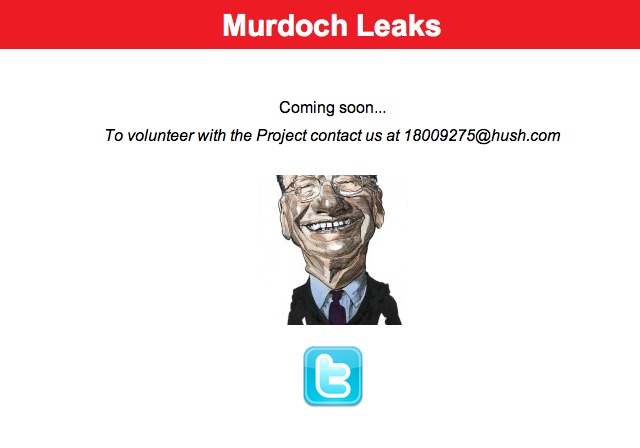
As of right now, the site is blank, with only a “Murdoch Leaks” heading, accompanied by the following text: “Coming soon … To volunteer with the Project contact us at [email protected]. And, of course, a link to a Twitter account, inscribed with: “Launching soon… Making Rupert Murdoch, News Corp and News International accountable.”

These hackers sure love Twitter.

Again, to be clear, at this point it’s not evident who owns the site, but we’re looking into it. (Probably Louise Boat.) And, with “leaks” in the headline, all signs point toward this being a Lulzsec/Anon. production.

Should the site go live, we will of course update with more.


Ouch: The Netflix Price Change Hangover

It’s been pretty fascinating to watch Netflix’s growth from a company that Blockbuster laughed at in 2000 (when Founder and CEO Reed Hastings and former CFO Barry McCarthy proposed to Blockbuster management that they run its online brand) to the single largest source of web traffic in North America in 2011.

There have been quite a few hiccups and ups and downs along the way, as the on-demand video provider has struggled with Hollywood studios, succeeded as leadership has pushed its service onto TVs, game systems, and mobile devices — and more recently, re-focused on its streaming business.

Last week, that tweak to the business model saw a very public revision of the service’s pricing structure, a result of Netflix eagerly dividing its DVD rental and streaming services into two distinct businesses. In addition, Netflix created a whole separate management team for its DVD business, along with announcing that it would be offering its streaming plan for $7.99 and its DVD plan at $7.99, so that customers that want both will now have to pay $16 a month — a 60 percent price increase over its previous plan options. (For those who choose both streaming and physical.)

And, as you may have heard, customers were not happy. No, they were not happy at all. In fact, on the blog post in which Netflix announced said pricing changes, over 12,000 comments were posted (and that’s using Facebook’s commenting system, something TechCrunch readers are unhappily familiar with), most of them angry, and many in turn did their own announcing, saying they would be tendering their resignations, effective immediately.

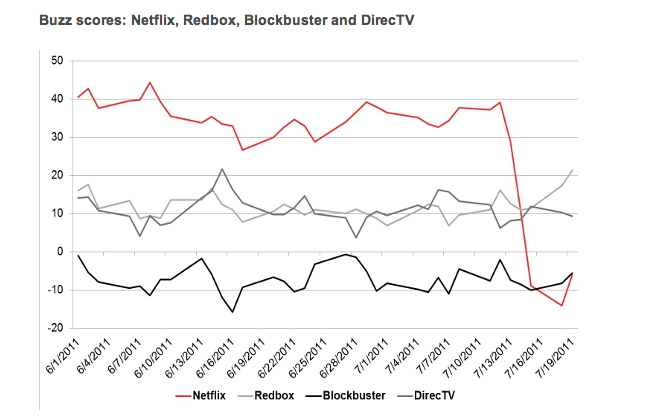
Of course, but, so what? Well, according to YouGov’s BrandIndex, in the ten days since Netflix made its price changes, the national perception of Netflix’s brand among adults dropped precipitously from a 39.1 on July 12th to -14.1 on July 18th, and currently sits at -6, putting Netflix in a virtual tie with Blockbuster. With a margin error of 5, that’s no tiny aberration.

BrandIndex calculated it’s score by asking Netflix, Redbox, DirecTV and Blockbuster customers about their impressions of each brand, and what they’ve heard about the brand via word of mouth, advertising, etc. BrandIndex Global Managing Director Ted Marzili told me that the scores reflect a sample size of about 15,000 respondents. Look out, graph below.

Of course, it wasn’t long before Blockbuster was courting potential Netflix defectors with a 30-day free trial. And though it doesn’t seem that Blockbuster has been reaping rich rewards from Netflix’s change, the company’s stock, which has performed very well over the last two years (and was at a 6-month high before the announcement on July 13th) has since dropped over 20 points. Some of that is natural — the stock was due for a slow-down — and of course some of it’s not.

According to GigaOM, Morgan Stanley has also stepped in with its own Netflix survey, which found that, in fact, 26 percent of Netflix customers would be canceling their subscriptions altogether. These numbers have since been toned down, as the initial emotional angst wears off, but either way it seems likely that Netflix will be suffering in subscription revenue in the near future.

Netflix has now forced many of its customers to make a choice between streaming and DVDs, because, after all, as Reed Hastings himself told Erick Schonfeld back in May, the future is in streaming, not in them plastic discs. I mean who uses CDs anymore, ya know?

There is always a backlash when a major service hikes prices, but it seems that Netflix might have employed a bit more market research beforehand, and perhaps if it had given current users some form of incentive over its new users, whether through discounts on a year long plan or not, might have been smart. (And in turn shown a little consideration for the loyal customers.)

What about a discount on a 2-for-1-type deal? After all, we’re living in the age of the daily deal, when consumers seem to expect a discount. Not to mention the fact that many wallets have undergone a significant squeeze over the last two years. Money is tighter than it was during the company’s early days, and Netflix might benefit from acknowledging that.

We’ll see how this all plays out. I expect Netflix’s brand perception and stock will be right back on track before long, but there’s always the chance that the hangover continues. And, perhaps more importantly — don’t laugh — will Blockbuster truly benefit as a result? How about Redbox? The local library?

Your thoughts?