Airbnb Victim Speaks Again: Homeless, Scared And Angry

Yesterday we wrote about “EJ,” a woman who had her San Francisco apartment burglarized and vandalized by someone who rented her home for a week via Airbnb.

There was some confusion about how Airbnb was and is dealing with the situation. See the updates to that post above, and CEO Brian Chesky’s post here on TechCrunch later yesterday talking about the situation.

The event happened, which is a terrible blow to the company’s reputation. The confusion seems to be around whether or not Airbnb will compensate her for her losses. The company at first said no, then said yes, and clarified that they made the offer last month when it happened, not in response to the PR storm yesterday.

And EJ seemed to confirm that in her initial post on June 29, three days after she returned home, saying:

I would be remiss if I didn’t pause here to emphasize that the customer service team at airbnb.com has been wonderful, giving this crime their full attention. They have called often, expressing empathy, support, and genuine concern for my welfare. They have offered to help me recover emotionally and financially, and are working with SFPD to track down these criminals.

But in a new post late yesterday, EJ says that after June 30 the company was significantly less friendly towards her. More recent communications, she says, were aimed at getting her to remove the post, or write something new with a more positive tone.

On June 29 I posted my story, and June 30 thus marks the last day I heard from the customer service team regarding my situation. In fact, my appointed “liaison” from Airbnb stopped contacting me altogether just three days after I reported the crime, on June 25, for reasons that are unknown to me. I have heard nothing from her since.

I blogged my story, and all these kind and supportive people just … disappeared.

And since June 30? On this same day, I received a personal call from one of the co-founders of Airbnb. We had a lengthy conversation, in which he indicated having knowledge of the (previously mentioned) person who had been apprehended by the police, but that he could not discuss the details or these previous cases with me, as the investigation was ongoing. He then addressed his concerns about my blog post, and the potentially negative impact it could have on his company’s growth and current round of funding. During this call and in messages thereafter, he requested that I shut down the blog altogether or limit its access, and a few weeks later, suggested that I update the blog with a “twist” of good news so as to “complete[s] the story”.

Since June 30, this co-founder has been the only person at Airbnb from whom I have received occasional contact regarding my situation, his messages directed primarily at my blog post and its activity on Twitter. (Note: a second co-founder did email me for the first time around 2am yesterday, suggesting we meet for coffee as he “would enjoy meeting” me. He made no inquiry into my current emotional state, my safety or my well being.)

EJ also says it’s not clear to her that the police have anyone responsible in custody. And worst of all, she talks about how her life continues to be disrupted and she fears for her personal safety since the criminals know just about everything about her after living in her home for a week.

In the meantime, I am still displaced, bouncing between friends’ homes, clutching my pillow and what’s left of my normalcy. I spend my mornings recalling nightmares and breathing through panic attacks, and my afternoons scouring the city’s pawn shops in the vain hope that I might recover some of my stolen treasures. I do not feel anything close to safe. I do not feel anything close to whole. Today I remain broken, but with the firm belief that in time, and with the support of friends, family, and a generally supportive public, this too shall pass and I will be made whole again.

And then there’s the end of her post. Which really says it all.

And for those who have so generously suggested a donation fund be set up to help me recover, I thank you from the bottom of my heart, and suggest that instead, you keep the money and use it to book yourself into a nice, safe hotel room the next time you travel. You’ll be glad you did.

I’ll say this. EJ knows how to write. And it’s hard not to feel for her. As for Airbnb, they need to hire a crisis management expert and hope to God that somehow this all goes away before the mainstream press turns this into a fear parade. Remember paedophiles on Myspace? They love this stuff.

[crunchbase url=”http://www.crunchbase.com/company/Airbnb” name=”Airbnb”]


In The Battle Of The Music Tweets, Turntable.fm Has More Klout Than Spotify Or Pandora

Have you noticed an uptick in the number of Tweets that mention Spotify, Turntable.fm or other music services lately? It’s all part of their diabolical plans. Online music services live or die by word of mouth, which is why most of them have hooks into Twitter and Facebook for users to share invites and the songs they are listening to. But which ones are winning the battle of the music tweets?

Social media analytics company Simply Measured looked at a one week sample of tweets linking to one of three music services: Spotify, Turntable.fm, and Pandora. It found that 51 percent of the Tweets linked to Spotify, 26 percent to Turntable, and 23 percent to Pandora. So at first blush, Spotify seems to dominate. But if you strip out invite tweets, it’s a different picture altogether. Since Spotify launched in the U.S. a couple weeks ago, people have been flooding Twitter with invite links. Take those out, and it’s share of remaining tweets is only 2 percent. Turntable comes out on top with 52 percent of the tweets, followed by Pandora with 46 percent.

What this data suggests is that Turntable.fm is still a very strong early adopter addiction. And it too is still in a limited beta. Yet its users tweet out more than Pandora’s. turntable user share the songs that they DJ, with 40 percent of its tweets falling into that category.

Finally, Turntable users have an average Klout score of 34, compared to 32 for Pandora users and 29 for Spotify, suggesting that its users are more influential on Twitter, at least according to Klout.


Looking To Sink Their Teeth Into Some Tasty Northwest Startups, Google Takes A Bite Of PIE

If you haven’t heard of PIE, it’s probably because you don’t live in the Pacific Northwest. But the Portland Incubator Experiment has already amassed such an impressive roster of startups that everyone may know about them soon enough. Recognizing that, Google is getting out in front and partnering up.

Google joins Coca-Cola, Target, Nike, and Wieden+Kennedy (the largest privately-held advertising and communications company in the world) in helping out PIE. Like many of those companies, they’ll provide 5 mentors (from Google, YouTube, Google Ventures, Android, etc) to the incubator that will help the startups associated with the program.

PIE accepts 8 to 10 startups each class, with each receiving up to $18,000 and three months of office space in Portland. Applications for the newest class close on August 1, and it will begin on September 1. “Where else can startups get the chance to learn from the guy who invented the wiki, the guy who built Twitter’s API, the folks who made Old Spice entertaining, and some of the most easily recognized brands in the world?,” is how co-founder Rick Turoczy pitches it.

So why does Google want a piece of this? Again, the roster they’ve already put out there is impressive. BankSimple, Urban Airship, COLOURlovers, PHP Fog, are the already-funded bigger names. Then there are the quirky players, like Bac’n —a startup to sell bacon on the Internet, which was quickly acquired by Bacon Freaks. You can’t make this stuff up.

As a partner sending several mentors, Google will get to sniff around early for deals. See what I did there? Sniff, PIE, Bac’n.

In the post-Google Labs world, such deals make sense for them.


Toshiba-Fujitsu IS12T: World’s First Windows Mango Cell Phone Up And Close (Video)

Two days ago, Toshiba-Fujtsu in Japan took the wraps of the IS12T, the world’s first world’s first phone running Windows Phone 7.5 (aka Mango). We were quick in giving you the first specs, but we now have a video that shows the 1 Ghz Qualcomm CPU-powered device in action – plus some more detailed specs.

First, here are the main specs (in more detail), as announced [JP] by the provider of the IS12T in Japan, local mobile carrier KDDI:

  • 3.7-inch display has 800×480 resolution
  • 13.2MP camera has CMOS sensor, is powered by Milbeaut Mobile engine, and takes video with 1,280×720 resolution
  • water- and shock-proof body
  • microUSB port
  • 32GB internal memory (no extra card slot)
  • IEEE 802.11b/g/n Wi-Fi (no tethering)
  • Bluetooth 2.1+EDR
  • DLNA support
  • Zune-branded multi-media function
  • Internet Explorer 9 as browser
  • Xbox LIVE connectivity
  • Windows Live SkyDrive access
  • battery life in standby: 280 hours, continuous talk time: 400 minutes
  • size: 118×59×10.6?13.3mm, weight: 113g
  • confirmed: available in three colors (yellow, black, pink)

Second, our friends at Diginfonews in Tokyo have shot this professional video (in English) that shows the IS12T in action:


TechCrunched: News In 90 Seconds

We’ve taken some of the biggest news stories of the week and put them together for you in TechCrunched.

On the heels of recent management changes at Twitter, the company is now changing the way brands interact with users. Follow a brand you like and you’ll see their ads pop up in your Twitter stream. Over in the travel space, Airbnb experienced the best and worst of the business world, while back online the code for Facebook’s iPad app was found in an unlikely place. And finally, lots of people are checking out Android phones—but not necessarily keeping them.

Watch the show and click on the below links for additional details.

And Then There Were Ads: Promoted Tweets Appear In Your Main Stream (If You Follow That Brand) 

Airbnb Bags $112 Million In Series B From Andreessen, DST And General Catalyst 

The Moment Of Truth For Airbnb As User’s Home Is Utterly Trashed 

Facebook’s iPad App Is Hidden Inside Of Their iPhone App

Facebook’s Secret iPad App Exposed [Pictures] 

Android’s Dirty Secret: Shipping Numbers Are Strong But Returns Are 30-40% 

Netflix: 75 Percent Of New Customers Signing Up For Streaming-Only Plan 


Battle Of The Goofy Email Campaigns

The heated battle between two of the biggest email services on the web has taken a decidedly humorous turn.

Yesterday Google unveiled Email Intervention, a site “built by a few folks from the Gmail team” that encourages users to get their friends to switch from draconian email systems and their “embarrassingly outdated addresses” over to Google’s service, which features such niceties as free phone calls and video chat. The site taps into the power of peer pressure, prompting you to send one of three pre-written letters to your friends that are still stuck in the past — and you can include a custom video if you really want to get on their case.

But Microsoft, whose Hotmail service is obviously one of the targets of the site, isn’t keeping quiet. Earlier today someone uploaded a video a spoof featuring ‘Gmail Man’, who digs through people’s email as he tries to find keywords that he can run ads against — with unimpressive results.

According to ZDNet the video was featured at Microsoft’s Global Exchange sales conference last week, and it was subsequently uploaded by a sneaky attendee. The ZDNet report goes on to say Microsoft hasn’t confirmed it’s behind the video, though it sure seems like it is — and the timing seems a little too perfect for it not to be.

Of course, these tongue-in-cheek projects still have plenty of bite to them. Gmail’s Twitter account announced that 100,000 interventions were sent in the site’s first 24 hours, and that ‘Gmail Man’ video could help salespeople rekindle Gmail privacy fears that have largely died down over the last several years.

Update: A Google spokesperson points out that Microsoft’s video is misleading — Google Apps for Business (which is what Microsoft’s Office 365 products compete with most directly) actually lets users turn off ads.


Polaroid’s Z340 Isn’t Quite The Gaga-Inspired Beauty We Saw At CES

Back at CES, we spent a long time waiting for Lady Gaga to show up (again) and introduce her new product line, a collaboration with Polaroid called Grey Label. The camera sunglasses and Bluetooth printer didn’t exactly blow our socks off, but the GL30 camera prototype sure did. It was beautiful. Of course, no matter how much I bugged Polaroid, I never got word one about availability or what have you. And then this thing turns up!

Now, I’m not convinced this is the same product we saw at CES. A relative of that product, perhaps, but not the real thing. I refuse to believe that they’d throw away a perfectly good design like that, one associated with Gaga herself. So what is this?

The Z340, which ePhotozine previews here, has similarities with the prototype GL30, but I’m not digging the differences. Gone is the shiny veneer and bellows motif. Gone are the (slightly impractical, I’m guessing) controls under the LCD. The shots show an interface that isn’t particularly lovable, and although I don’t want to bash it too much without trying it, that forest of buttons doesn’t look like a lot of fun. I down with Zink, but this isn’t something I’d like to carry around with me.

Polaroid hasn’t gotten back to me, and we weren’t invited to the hands-on party (sniff), so until we hear about the fate of the actual GL30, it’s anybody’s guess how this thing fits in. All we know is it costs £229.99 (around $375) and it’ll be available in December.


Stocial Launches In Beta To Blend StockTwits With Yahoo Finance (Invites Herein)

With the recent success of StockTwits, the market seems to be showing that there’s ample demand for a social micro-blogging service that targets stocks, trading, and financial information. Or at least that’s what Stocial is hoping. The Seattle-based startup, which is launching today in public beta, wants to be, in conception, the love child of StockTwits and Yahoo! Finance — or, said another way, Bloomberg for the people, by the people.

Essentially, Stocial wants to give its users access to realtime market data and trending stock sentiment in a virtual and “game-ified” venue. Of course, most tickers are capable of the those first two, and StockTwits has certainly shown that Twitter can be a great resource for realtime financial information. But Stocial Founder and CEO Fahad Kamr says that, with its 140-character limit, Twitter doesn’t embody the full potential for sharing stock information.

Stocial wants to incorporate the Twitter feed, but go a couple of steps further, by giving users access to the top stories from Business Insider, the Wall Street Journal, Fortune, Bloomberg, etc., all curated in a live feed. So users not only have their Twitter feed but a social feed, where they can see information coming in from friends and followers, as well as a “Stock Pick” feed that tracks, you guessed it, which stocks people are picking and sharing on Stocial. More feeds equals more engagement.

Users can also customize their Stocial stock platform to view news and trends for the overall market, or for specific stocks, keep watch on those stocks, or create circles of experts and follow top investors on Twitter and Stocial, as well as experience news and tweets in realtime or by top items. And much of its infrastructure is powered by Echo, so it’s all scalable and realtime.

But, perhaps the best part is that Stocial offers “contests” in which its users can win cash and, eventually, even land a job. In these contests, users get to pick stocks, go long or short, and pick their price. Contests generally last for two days or a week, at which point the winner receives $50 in cash. And, eventually, $100 and more.

Stocial is thus incentivizing its users by offering a carrot at the end of the string. The startup is currently working with investment firms and banks to source top trading jobs. So, as the startup allows its users to collect badges and lift their reputation score on the platform by picking stocks, interacting, and sharing, when one reaches a high enough level of engagement, the user becomes eligible for a nifty prize: An interview at one of those top firms.

While startups like Zecco are taking new approaches to social stock trading by offering users the ability to trade in real markets — on Facebook in the Zecco’s case — Stocial is instead focusing on virtual trading. Rather than be a site where users can trade in real markets (and there are plenty of these), the Seattle startup wants to be a resource for personalized content, a training ground for users looking to jump into real markets.

To make trading stocks less scary, Stocial created a simple virtual stock trading platform. Stocial only focuses on making stock picks, or, in other words, make forecasts over where the stock may be headed, taking portfolios and the risk-laden aspect of speculation out of the equation. At its core, stock trading can really feel like a game, but of course, when you’re playing with real money, it’s anything but. Thus, with its virtual stock market, Stocial seems positioned to take advantage of the inherent game-ification in trading, yet without the risk and plus the rewards.

The Stocial value proposition, at least in comparison to StockTwits, is that the startup offers realtime, personalized financial news curation, and allows users not only participate in stock conversation via Twitter, but also via the platform in threaded comments (that look a lot like Facebook comments). Like StockTwits, Stocial is also going after social discovery, by allowing users to discover new friends and experts based on the stocks they’ve selected. It also incorporates your existing social circles, so that when a friend on Facebook joins Stocial, users will immediately be alerted.

Currently, Stocial’s team of four is in the process of testing the viability of its business in the space, and is fully bootstrapped at this point, though it is looking to begin raising its first round of investment in the coming months.

TechCrunch readers can grab early access to Stocial’s beta here.


Twitter Adds “Possibly Sensitive” Designation To Tweets With NSFW Content

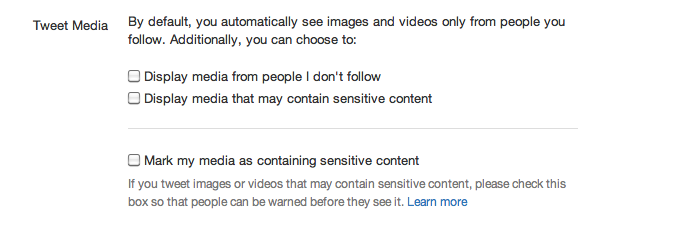
Twitter has just announced to developers that it has added a field for “possibly_sensitive” content in its streaming API, in a test that will eventually result in more granular end-user media settings for Twitter.

Writes Twitter developer Taylor Singletary,

“Beginning today you may notice a new boolean field in API responses & streams containing tweets: “possibly_sensitive”. This new field will only surface when a tweet contains a link. The meaning of the field doesn’t pertain to the tweet content itself, but instead it is an indicator that the URL contained in the tweet may contain content or media identified as sensitive content.

During this initial testing phase, there’s nothing you need to do with this field and the field values cannot be relied on for accuracy. In the future, we’ll have a family of additional API methods & fields for handling end-user “media settings” and possibly sensitive content.”

Twitter representative Carolyn Penner tells me that this API change means that eventually when users flag their own or other users’ content as possibly sensitive, a warning will show up before in the media details pane of the tweet informing other users of the flagged content before they click-through. While the ability to flag content as sensitive has existed since Twitter launched Photos, the “sensitive content” flag on the details pane is new, Penner says.

Penner tells me that the sensitive content field will pertain to all photos and video links in tweets including those from Instagram, Twitpic and Pic.Twitter.com. ”We want to make sure that users are having a good photos experience, while giving them  control over what they’re going to see,” says Penner on the decision to add the new designation.


Softbank Shifts Focus To Early Stage Companies, Renews Focus On New York Startups

Today, Softbank Capital is announcing a series of updates, including the launch of its redesigned website. Some of these changes have been brewing for some time now, but, hey, the redesign of its website is as good a time as any to spread the word. Over the past year and a half, Softbank has been in the process of shifting its investment strategy to one that focuses more heavily on early stage businesses. Rather than investing larger chunks in series B rounds, Softbank will be seeking to invest in seed and early series A rounds, in smaller doses, giving the firm the opportunity to invest in a greater number of companies.

What’s more, since launching its new fund (SoftBank Capital Fund 2010) at the end of 2009, the firm has been more aggressively investing pieces of its $100 million pool in New York City-based startups. Having invested early in New York media companies like Huffington Post and Buddy Media, and with offices downtown, the firm has been investing in New York since its inception, but in the last year especially, interest has been renewed. Softbank has made 22 investments in the U.S. in the last year and a half, ranging from $100,000 to $4 million, which have included startups like MocoSpace, Boxee, Cheezburger, OMGPOP, YouAreTV, betaworks, Paper.li, and SocialFlow. Of these recent investments, 14 companies are based in New York.

Since 1995, Softbank has been investing in early stage, high growth technology businesses. The firm was originally an offshoot of SoftBank Corporation, a Japanese telecommunications and media company founded in 1981 (that, oh by the way, has a market capitalization of around $20 billion) — while Softbank’s venture wing, on the other hand, has a portfolio of companies that is primarily focused on the U.S.

Of course, while the firm’s investments have focused on the U.S., new Softbank Partner Joe Medved said that the firm has been influenced by the evolution of the mobile industry in Japan, and its explosion in Asian markets. As such, Softbank has paid particular attention to early-stage socially-driven mobile businesses. This is where Softbank can be a asset to startups and perhaps has a legup over other VC firms: With Softbank’s establihshed connections in Japan and Asian markets, mobile startups looking to take advantage of these rapidly growing international markets will have a head start.

As part of the activity of its new fund, Softbank promoted Joe Medved to partner, and Nikhil Kalghatgi is joining Softbank as a senior associate. Medved has been at Softbank since 2005 and has led investments in BestVendor, Ohanarama, Opionionaided, and YouAreTV, among others. Kalghatgi is a recent Harvard Business School grad, and a TechStars alum with Localytics.

Though it should not come as a surprise knowing the relationship between the two firms (thanks largely in part to Eric Hippeau), Softbank officially acknowledged its involvement in Lerer Venture’s recent raise of $25 million. While Softbank would not disclose the actual amount, Medved did say that it was a significant player in the investment.

Oh, and for those West Coast startups, Softbank has also opened a west coast office in Palo Alto, which will be run by the head of Softbank’s China & India Funds, Kabir Misra.

For more, check out the new site here.


TC Cribs: Inside Tumblr’s Reblog-Worthy Digs

We’re back with a new episode of TC Cribs, and this one is sure to be a crowd pleaser: red-hot blogging platform Tumblr. The NYC-based startup has been growing like crazy (they’re now up to 11.6 billion page views per month), and they’ve given us a chance to take a peek inside their headquarters.

For a company with over $40 million in funding the Tumblr team is still surprisingly small, and the office is relatively humble. But there’s plenty of charm: handcrafted furniture, board games abound, and robots that look suspiciously like my favorite wizard.

Be sure to watch til the end, when I get to walk Tumblr founder David Karp’s dog. Huh?

As always, credit to Ashley Pagán and John Murillo for the camera work, and to Mr. Murillo for the fantastic editing.

Also be sure to check out our previous episodes of TC Cribs:

Information provided by CrunchBase


Carriers To Obama: Give Us More Spectrum Access!

President Obama announced back in February his support for a Wireless Innovation and Infrastructure Initiative, which he believed would (among other things) “benefit all Americans, bolster public safety, and spur innovation in wireless services, equipment, and applications.” Under his plan, 500 MHz of spectrum would be freed up over the course of the next ten years in order spur on mobile broadband expansion and the development of 4G networks.

Rather than leave things up to fate, today the heads of Verizon, AT&T, T-Mobile, and Sprint have decided to reach out to President Obama and let him know exactly what part of the spectrum they’re gunning for. In a jointly signed letter [PDF], they candidly lay out what they would like to see happen:

…We urge you to direct the National Telecommunications and Information Administration to identify and work to clear broad, paired, internationally-harmonized bands below 3 gigahertz. Access to spectrum in these critical bands will greatly enhance efforts to realize the important goals set forth in your Wireless Initiative and the Federal Communications Commission’s National Broadband Plan.

But what does that mean? In short, the Big 4 carriers believe that freeing up those bands will help drive expansion in mobile broadband coverage into much needed areas, a key focus of the FCC’s National Broadband Plan. A benign, seemingly altruistic request from the looks of things, but make no mistake — they would certainly stand to benefit. Still, if it means that people will be able get access to much-needed internet service where they couldn’t before, I’m willing to look past financial motivations.


Mobile Research Firm Zokem Acquired For Up To $24M

Tearing through a mountain of mobile phone data isn’t much fun, but someone has to do it — and it looks like it pays well enough. Just 4 years after its founding, mobile research firm Zokem has been snatched up for $11.7 million up front, with a potential payout of an additional $12 million through 2014.

Their buyer? Arbitron Inc., a company focused on — hey, whatd’ya know? — consumer research.

Zokem is sort of like a European Flurry. Their main product is an SDK which developers can plug-in into their smartphone (iOS, BlackBerry, Android, and Windows Phone) application to gather up all sorts of anonymous data like usage patterns, signal strength, and creepier stuff like location. Zokem had raised around $2M in funding prior to the acquisition, all from European VCs (specifically, Finland’s Veraventure.)

Up until this point, Arbitron’s primary research beat has been on collecting listener data for the radio industry. They poll a random chunk of the radio-listening population in just shy of 300 regions, then sell that data to broadcasters, networks, and ad agencies.

With the acquisition, Zokem will be changing its name to Arbitron Mobile, with Zokem’s CEO Dr. Hannu Verkasalo leading the mobile division.

Just shy of $12 million with a payout of another $12 million within a few years? Not bad for a company with just 14 employees. Not bad at all.


Motorola CEO: Droid Bionic Will Launch In September

After six… Wait, let’s make that seven months of uncertainty, we might finally have something solid to work with. Motorola CEO Sanjay Jha said in an interview with CNET that the Droid Bionic will land in September. Just so we’re clear, that’s nine months after the phone was announced at CES, five months after rumors circulated of its cancellation, and four months after Motorola promised it would arrive this summer via tweet.

In other words, this thing better pack one helluva punch. And from the looks of its specs, that’s just what it’ll do. The Droid Bionic runs Android 2.3.4 Gingerbread on top of a dual-core TI OMAP 4430 1GHz processor, with a stellar 4.3-inch qHD touchscreen display with 960 x 540 pixels of resolution. Oh, and the 8-megapixel LED flash-equipped rear-camera shouldn’t hurt either.

It’s worth noting that, as most of us already know, the iPhone 5 should launch in September. The fact that Motorola feels comfortable launching the Bionic alongside one of the best selling smartphone lines in history says quite a bit about just how sweet this Android handset could be. Now it’s all about how patient we can be.

Hey September: get here now!


Motorola Mobility Beats The Street, Shipped 440k Xoom Tablets, 4.4M Smartphones In Q2

Motorola Mobility just released its Q2 earnings and it’s loaded with fun stats. First off, the company posted $3.3 billion in net revenue with non-GAAP earnings of nine cents a share. That’s up 28% over last year’s second quarter and beats the Wall Street’s estimate of just six cents a share. The company also realized a GAAP net loss of $56 million compared to a net earnings of $80 million in 2010.

Over that time period Motorola Mobility managed to ship 11 million devices including 4.4 million smartphones and 440,000 Xoom Android tablets. That’s up from 8.3 total devices last year . Part of this growth came from the Latin America and China markets where revenue grew 40% and sales more than doubled from the previous year. Note, the company reported shipments rather than sales to consumers.

Sanjay Jha, chairman and CEO of Motorola Mobility, stated regarding growth “With a focus on profitable growth and delivering differentiated LTE smartphones and tablets, we expect to achieve profitability in Mobile Devices in the fourth quarter and for the full year 2011.”

The company’s wireless division’s net revenue’s grew a whooping 41% over last year to $2.4 billion, partially lead by the Droid product family and International expansion. Motorola made a big push with Sprint during Q2 and announced plans to launch 10 devices on the carrier including the carrier’s first international phone and a new iDEN Android smartphone.

The company also credits part of the growth from new home entertainment devices such as Motorola Televation IPTV and Medios Xperience. That sector of the company grew 2% over last year and end with net revenues at $907 million.

This report also clears the air concerning the much debated Motorola Xoom. Analysts couldn’t agree on a shipment estimate and most simply stated they were disappointing. Motorola is now saying it shipped (read: shipped, not sold) 440k Xooms during the second quarter. Apple previously stated that they sold 4.69 million iPads during the same time period, outselling the original Honeycomb tablet by at least a factor of ten.

Moving to Q3 Motorola Mobility is predicting a non-GAAP earnings of zero to ten cents a share with Wall Street expecting the company to report a 24 cents a share profit on $3.37 billion in revenue. Then for Q4 Motorola Mobility is expecting 47 cents a share on a revenue of $3.84 billion. The market didn’t like what it saw and Motorola Mobility took a hit in after hours trading.