Nintendo Calling Early 3DS Buyers “Ambassadors,” Will Give Them Special Perks

While many would call buyers of the 3DS who picked up their console prior to the $80 price cut expected on August 12 “suckers,” Nintendo is calling them “Ambassadors” and they’e offering them special updates to upcoming downloadable titles. These updates will include multi-player support and improved gameplay.

While no one is quite clear on everything Ambassadors will get, Nintendo has said that early adopters will receive certain perks including updated versions of the games they downloaded after August 12. Which games? Well, in conjunction with the price cut, early adopters would get twenty free NES and GBA games, arguably cold comfort for those who would rather have four Hamiltons in their pocket.

Here’s a quote from the press release:

Once the paid versions of the games are posted to the Nintendo eShop later in the year, the updated versions will be available to Ambassadors for download at no cost.

If this sounds confusing, fear not: even IGN had no idea what was up and they’re paid to write about gaming all day long.


rome2rio Adds Carbon Neutral Travel Feature With Offset Options Partnership


rome2rio, a search engine headed by two ex-Microsoft engineers which lets you literally work out how to get from A to B (not unlike FromAtoB.com) via a Google Map with multi-modal travel options, has now added carbon neutral travel to its offering with a partnership with Offset Options.

This allows users to compare the carbon footprint of every travel option available, thus factoring in the impact on the planet as well as their wallet. They get a real-time calculation of their chosen route’s carbon footprint and a range ofcarbon offset project choices to pay for, and thus make their trip carbon neutral. And buy trees in the Amazon, or whatever these things do.

Read More


Foxconn Planning To Hire 1 Million Robots

Foxconn is planning on replacing many of it’s hard-working human manufacturers with about 1 million robots, a number that, if you think about it, is a very telling comment on the current state of electronics manufacturing.

There are apparently 10,000 robots at the factory now and that number will increase by 300,000 next year. Foxconn CEO Terry Gou plans another million robots by 2014. The company currently employs 1.2 million humans.

The most important thing to note here is that most of the repetitive tasks associated with manufacturing – placing components, closing cases, applying decals and paint, and testing – are all done by hand. Although we imagine that the manufacturing industry is run by huge, Transformer-like robots that plop out fully formed iPads in a wicked silicon satire of human reproduction, there are actual people involved in almost every step of the process. We are literally not far off from the Industrial Revolution here.

Where will those hands who once snapped our plastic geegaws together go once the robots arrive? Probably to the unemployment line, which is another matter entirely. Here’s hoping it doesn’t come to that, but any time serious labor savings have been applied to mass manufacturing it hasn’t ended well. Just ask Detroit.

Image via TheOldRobots


Gadgets Week In Review: Storm Photographer

Here are some of the past week’s stories on TechCrunch Gadgets:

Holga’s TIM 3D Camera Stares Into Your Soul, Takes 3D Photos Of It
Aircounter: Japan Gets Mini Radiation Detector
An “Anomaly” Gives Star Wars Prop Maker The Opportunity To Sell His Original Design
Just As Spotify Settles Into The U.S. Lifestyle It Gets Sued For Patent Infringement
Head-To-Head Review: Canon T3i Vs. Nikon D5100


Best Buy Releases Insignia TV With Built-In TiVo

Insignia, Best Buy’s in-house tech brand, has just released a TV with a TiVo device built-in. Why? I suppose people didn’t want to have a separate DVR on their CE shelves. Two great tastes that taste great together, right?

The 32-inch model sells for $499 while the 42-inch sells for $699. It’s a 1080p/120Hz LED screen with a network features as well as support for something called Rocketboost that works with Best Buy’s own sound peripherals. It’s basically a method of upsell and lock-in.

Big deal? Nah, but a $499 32-incher with DVR built-in isn’t too bad and if you’re hard up for cash you can save a little money by sticking getting a TV and DVR in one. You’ll note that Yahoo! also has something called Connected TV, but they’re Yahoo! so who cares? Available now, presumably in time for Back-To-School.

Product Page


YouTube’s Creator Playbook: Your Guide To Achieving Internet Fame*

Looking to turn yourself (or your show) into a YouTube star but don’t know where to begin? YouTube’s looking to help — the video portal has launched a comprehensive guide outlining how content producers should be approaching the platform and which features they can take advantage of. The 70 page guide has a fitting title: The Creator Playbook.

The new document was discussed today at the VidCon conference in Los Angeles, and is part of YouTube’s broader goal to help creators produce high quality content (YouTube’s recent acquisition Next New Networks is the driving force behind this mission).

Of course, YouTube is quick to clarify that while this should be a useful guide, there isn’t anything that’s guaranteed. It’s really just a well thought-out set of best practices — if your content isn’t any good, optimizing the first five seconds of your video isn’t going to be much help. From the first page:

The Creator Playbook is not a collection of rules or guaranteed ‘tricks’ to get more views. Instead, it presents best practices, optimization tips, and suggested strategies for building audience and engagement on YouTube.”

The document is a hefty 70 pages long but isn’t as daunting as you’d think. YouTube has broken each of its miniguides into three sections: Programming & Producing, Publishing & Optimization, Community & Social Media. And each tip within a section gives an at-a-glance overview of how long it will take to implement (the easy ones are five minutes, the harder ones a day or more), which metrics the tip will impact, and how much of an effect content creators should expect.

Some of the topics will be obvious to TechCrunch readers (use Facebook and Twitter a lot!) but it’s unlikely that you’ll already know everything in there. The sections outlining how video metadata can impact your search result rankings is particularly useful — and there’s a checklist at the end you can run through each time you upload a video.

Note that while there’s an entire section dedicated to thumbnail optimization, there’s nothing in there about using a woman’s cleavage as your thumbnail photo, which seems to be a curiously popular strategy on the site.


Information provided by CrunchBase


BigCommerce Raises $15 Million To Help Retailers Manage E-Commerce

BigCommerce, a company that provides e-commerce software to online retailers and merchants, has raised $15 Million in Series A funding from General Catalyst Partners.

Launched in 2009, BigCommerce provides a comprehensive SaaS for retailers and merchants to manage e-commerce online. BigCommerce helps small businesses power anything and everything related to an online storefront from search to inventory to online payments to marketing and SEO. And the price for the software is affordable for small businesses, with basic plans starting at $25 per month.

Features include multi-channel retailing, automated email marketing, inventory control, an online storefront, and more. The company, which has 20,000 clients and is profitable, also launched an application for merchants to list inventory on Facebook.

The company has $200 million in total transactions via its SaaS and is adding 1,000 clients per month. The new funding would be used to expand the company’s headcount in Sydney and Austin, Texas operations, sales and marketing initiatives and more.


Get Your Disrupt Startup Battlefield Applications In Now

It’s time to bring TechCrunch Disrupt back home to San Francisco. We are accepting applications for startups to launch at the Disrupt Startup Battlefield until midnight tonight. Applications for the Startup Battlefield can be submitted here.

Does your startup have what it takes to be the next GetaroundQwiki, or Soluto—and make it through the judges gauntlet to claim the top prize of $50,000, the “Disrupt Cup” and accolades of the crowd?  If you think so, make sure you apply.

Disrupt is the premiere startup launch competition where the most promising founders and entrepreneurs vie to launch their companies on technology’s biggest stage in front of all-star judges. We will have some of the most influential innovators, angels, and VCs judging in front of an audience of 2,000 investors, technologists, and press.

Applications will be open until midnight PT, tonight. Applications have been reviewed on a rolling basis, so please get yours in now. A video will be required as part of the application process. We will not accept any videos longer than 5 minutes and they should not exceed 50MB. In the video be sure to show us the product, its key features, and what makes it different. If selected, we may use segments of submitted videos during the Startup Battlefield competition at Disrupt SF. Applicants are also expected to attach a file with up to 5 power point slides summarizing and reinforcing the application. Don’t worry—all submissions are confidential.

In order to compete in the Startup Battlefield, preference will be given to stealth startups that will be launching for the first time to the public and press at Disrupt SF.  All startups must be live for fewer than three months at the time of application submission.  The competition will be taking place in San Francisco, but companies from all around the world are welcome to enter and we highly encourage them to do so. Companies that have already presented at other public launch events are not eligible.

Be sure to read through all of the rules and take a peek at the finalists from New York before submitting.

Disrupt SF will be on September 12th – 14th, preceded by our hugely popular Hackathon on September 10th – 11th.

A huge thank you to all of our sponsors who made TechCrunch Disrupt NYC possible:

KAYWEB Angels: a New York City based angel investment group with a twist, providing development services and mentoring to web and mobile startups in exchange for equity.
Watchitoo: a collaboration platform that can be embedded on any site.
iSpeech: gives developers free access to human quality speech recognition and text to speech.
Ambrose : provides an outsourced human resources, payroll and benefits solutions.
Mashery: API management tools and strategic services help companies connect with customers and partners.
CreditLoan: provides financial articles, information graphics, calculators and online applications for bad credit consumers exploring personal loans, credit cards and debt consolidation services.
3Scale Networks: API Management solution enables API providers to open, control, manage and monetize the distribution of their data/content to multiple mobile or web applications.
Launch Pad Ignition: helps hustlers and hackers build great companies in a city where our impact matters, New Orleans.
Twilio: the cloud communications company, reinventing telecom with simple, powerful, pay-as-you-go APIs enabling developers to programmatically make and receive phone calls and text messages.
Shareplow: the first cost-effective PaaS that lets you envision and rapidly deploy integrated, data-centric, web and mobile applications for consumers and businesses.
FireHost: the leader in secure cloud hosting.
Metanga: offers enterprise-class online subscription billing and payments management.
Quixey: a functional search engine for apps that lets you find apps by describing what you want to do
Unison: gives businesspeople simple IM, calling with video and “walls” to share and comment on what’s new.
BrightIdea: the market leader in Cloud-Based Innovation Management Software.
ReImage: takes the sting out of PC Repair by automatically restoring your PC to factory settings while leaving your data intact! No technical knowledge needed.
Lark: Wake your potential. Not your partner. LARK’s Silent Un-Alarm Clock, Sleep Sensor and Coach works with your iPhone to wake only you and improve your sleep.
3taps: a platform for collecting and distributing exchange-related data.


Social Broadcast Network

Every day I try and do the media rounds to see what’s happening. The Journal, the Times, the Techcrunch, and the Twitter. Twitter is consumed via a number of aggregators that I rotate, mostly settling for News.Me and the Media something newsletter that the guy from MySpace produces.

Techmeme gets my votes about once a day, in the following order: upper right hand corner for the latest breaking, lower right hand corner to see what’s falling off the edge, then straight to the middle clump where two or three stories reside if anything’s really jumping. I’ve usually read the top in the other venues by then.

Google+ is not on this list, yet. Mostly because I haven’t got a handle on its core value as a news trigger. If you’re Scoble, the value is obvious as he is now demonstrating by turning it into his blog. But sooner or later the service will have to decide what it wants to be when it grows up — a conversation hub with no tools for rapid synthesis of knowledge, a social graph to challenge Twitter (it’s getting there fast), or some other thing perhaps more substantial than currently appreciated, like a stalking horse for YouTube live streaming aka the social broadcast network.

SBN we’ll call it has all the earmarks of a Gmail beta operation. Launching it on top of Hangouts with their limited reach even if daisy chained will not scare the networks until google flips the bits around and couples live streams with API access to embedded comment streams like the ones we use on Gillmor Gang sessions from the Friendfeed API. 10 Hangouters is more than enough in the context of a live chat of hundreds, and the API can be broadened to allow concentric groups to nominate or be given the microphone from a joint console.

This will put pressure on Google to provide a way in for the Tweet stream, since aggregators like Seesmic and others will have the same API access and an incentive to merge the multiple social networks. Facebook will be in the odd role of having little to offer here, what with YouTube’s huge clout in video marketshare. The Skype deal is a longer term strategy for climbing into a classic 3 or 4 network clump, with Apple/Twitter bargaining access to AirPlay all the more important.

G+ project manager Bradley Horowitz buttonholed me at the TechCrunch August Capital party to say he enjoyed this week’s Gillmor Gang live cast earlier that afternoon. The team’s proactive approach to interacting with field test users is good politics, but it also underlines the need to respond to criticisms such as Scoble’s laments about a buggy and crash prone iPhone client. If SBN is a not so hidden priority for Google (especially in the wake of Google TV’s Wave/Buzz like performance) then the kinds of viral crowds live streaming will invite will make fixing the Scoble-sized instability on iOS mandatory.

The last thing G+ needs is to go directly against Twitter (and Apple) in an Android/iOS shootout. For one, it blows a huge hole in the G+ social graph while it is still forming. For another, given Facebook’s Microsoft-induced stupidity about an iPad client, what part of 90% share of the tablet market do you want to lose. The only thing G+ HTML 5 on the iPad has going for it is that it sucks less that HTML 5 on the iPhone. SBN makes iPad native more likely.

The last few weeks in Washington make it clear that both parties have decided on waging the political campaign in realtime via social. Live casting blends just as well today with party fundraising if not more so than when Obama ran the table starting early with the Iowa caucuses. The Republicans have clearly understood the need to frame their agenda in a way that promotes realtime tracking of what is now a Twitter news cycle. The cable networks may offer round the clock coverage, but even political junkies like myself tune in once Twitter alerts hit the push notification bus.

CNN jumped out ahead last week with the ability to broadcast live to the iPad if users already subscribed to Comcast or several other cable or satellite services. Once iOS 5 hits with its notification hub, we should be able to move from a push notification directly into the cooperating video stream. SBN can take advantage of the same opportunity in September, but they need to convince Horowitz and Gundotra to put some engineering cycles into pulling Twitter alerts not only from iOS but from the other platforms.

Scoble doesn’t like the idea of a Friendfeed-like aggregation of the Twitter stream, but that speaks more to the lack of filtering tools in G+ than anything more fundamental. And the firestorm over businesses not having first class citizenship would be significantly neutralized while we wait if we could push brand stories into our G+ streams to seed the live cast model. Frankly, this is going to happen sooner than later, and I vote for sooner so that the resulting feedback loop will prompt Twitter to accelerate its live streaming and Tracking to feed the push notification network. I’ll call that PNN.


Another Airbnb Victim Tells His Story: “There Were Meth Pipes Everywhere”

This last week we’ve all watched in horror as the story unfolded about an Airbnb user who had her home ransacked a month ago.

Other than the sideshow of us getting dragged into the story, it seemed to be winding down yesterday. The company appears to be bending over backwards to compensate the victim and avoid another of her blog posts where she writes about how scared she is, still homeless and shaken after the ordeal.

Now another victim has come forward.

Troy Dayton first wrote about how his Oakland home was rented by a meth addict with a stolen identity in a comment to one of our posts about the company. I contacted Troy and we spoke by phone today about what happened. His situation is very similar to EJ’s.

Here’s Troy’s original comment:

Something very similar happened to me about 2 months ago.

In addition to valuables stolen, the thieves/addicts did thousands of dollars of bizarre damage to my rented home and left it littered with meth pipes. They were identity thieves, too and all my personal information was strewn about. Further investigation of my own led me to evidence that the people were not just thieves but were also dangerous. I too, feared for my own safety and would not stay at my house for some time.

I had a similar problem with haphazard communication from people at AirBnB. I gave them multiple opportunities to make me a happy customer to which they did but then retracted their offer after their was miscommunication among the team. Sometimes days went by without hearing from anyone, while I was fear-stricken, totally disoriented, and angry. It was almost the most absurd customer service crisis one could ever imagine. But I am one squeaky wheel, and we eventually found an agreeable solution that I was generally pleased with.

I have since both rented my place out and stayed in others’ homes from airbnb.

Here’s what I learned: if you rent out your home, there is a limit to how much AIrbnb can do to protect you. It’s not their fault, but it is their fault that they up-play how much they protect you and downplay what people should do to protect themselves. At the end of the day you are renting to a stranger. You should check there ID’s and phone numbers to make sure they match. I would ask for a link to a social networking site like linkedin, FB, or couchsurfing if there are not credible testimonials on AirBnb. I would chat with them on the phone prior to agreeing to rent to them. Had I done these things, the people that ruined my house would have never made it in.

Also, go with your gut. My gut said something wasn’t right about the people that rented my place, but I didn’t know how to handle that gut feeling and wasn’t sure how airbnb would have treated me or them had I told them I didn’t want them to stay even after they booked it.

Here’s a way Airb’nb can turn this into another revenue stream: Most rental insurance won’t cover this because you are essentially subletting. If major theft and damage is as rare as Air bnb says it is, which I believe is true, then they should be able to get a great insurance policy tailored just for their customers that they can sell for an additional fee to the renters.

Also, as short-term renting like a hotel becomes more common and other websites move in on Airbnb they are going to need more value to justify their very high fees, perhaps insurance and background checks would be a great addition. Of course, if I was the insurance company, I’d require the owners of the property being rented to double check the ID’s of the people checking in to be sure that the background checks are actually for the people checking in.

At the end of the day, I think AirBnb is well-intentioned but I think they are struggling with such fast growth and the management and communication systems have not scaled as fast as their business. Some PR and customer service nightmares are to be expected. My understanding is that they are hiring as fast as they can…but having been a part of teams of 20 somethings that multiply by orders of magnitude in a few months I can attest to the mayhem that surrounds this process. I hope they make dealing with catastrophic problems like the ones EJ and I experienced a top priority.

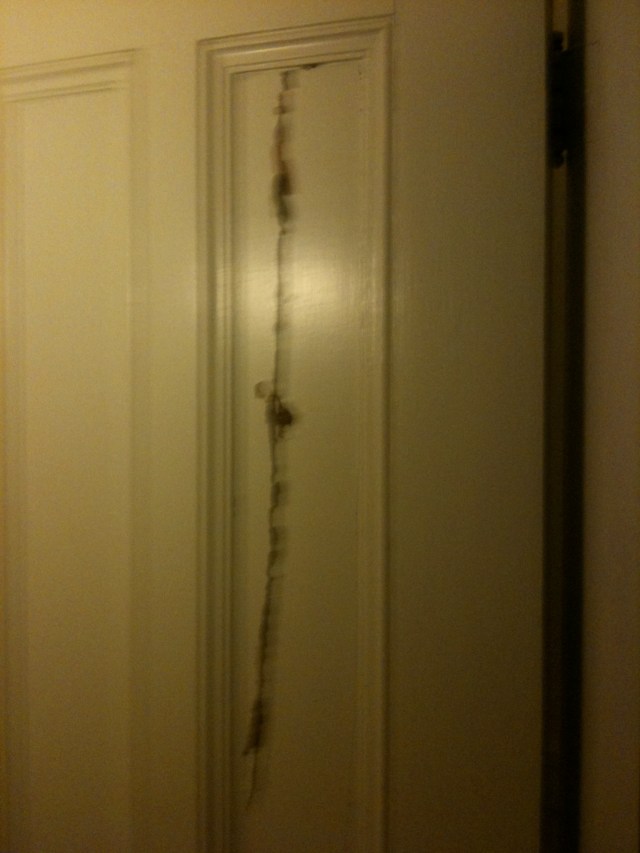
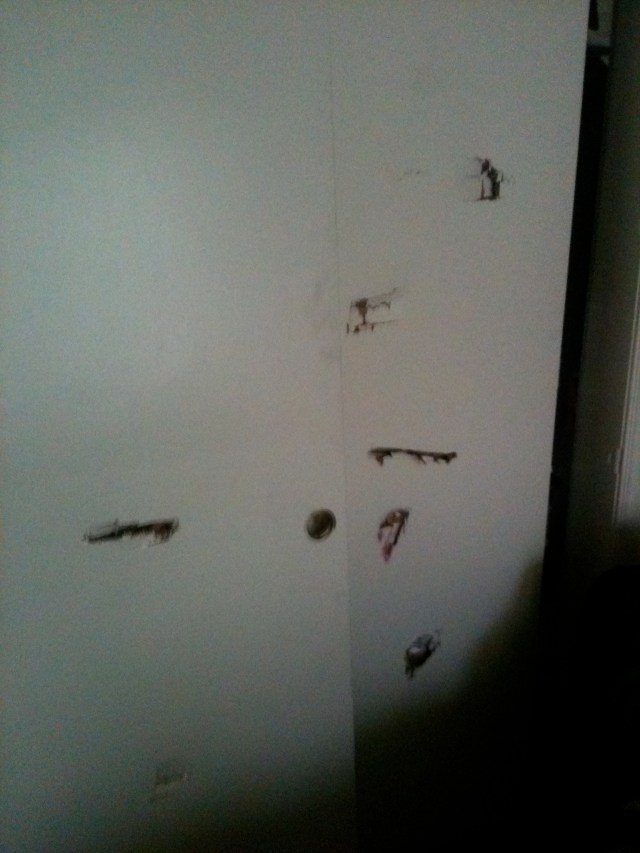
By phone today Troy told me about how the woman brought in friends to his home. They went through everything he owned, he said. “There were meth pipes everywhere,” he says, and damage to the bathroom and closet doors caused by, he guesses, a human foot or head, and probably an axe. They stole a computer from him as well as small amounts of cash that he left in the apartment. Any electronic device with a light they took apart (he guesses they were paranoid about being monitored). They unscrewed everything in his refrigerator and mixed things together. They stole his clothes, or shredded them. He found a sweater in the freezer.

They also stole his birth certificate, and left evidence behind that they were running a identity theft operation.

When they finally left the apartment, they left more than meth pipes behind. “They also left a cat” says Troy. He eventually got the cat back to the original owner

I then traded the cat for the return of my keys. The owner of the cat was a friend of the girl who rented the place’s boyfriend and had no idea about anything or how his cat wound up in a trashed apartment in Oakland.

A knife was left behind with a man’s name written on it in whiteout. The police said he was a known person, and dangerous.

Troy didn’t feel safe returning to his home. He contacted Airbnb as soon as he discovered what happened. There was one surreal moment, he said. He finally tracked down an emergency email address – [email protected], but when he emailed it autoresponded with a message to email the email address he just emailed.

From: Airbnb Community Support
Date: Fri, Apr 22, 2011 at 11:43 PM
Subject: Request received: Emergency Situation: tenants ruined my apartment and stole things
To: Troy Dayton

– Please respond above this line. –
Thanks for contacting Airbnb community support!

Your request (#124683) has been received, and is being reviewed by our support staff. Please note that, due to an overwhelming number of inquiries, our responses may be delayed. Thank you for your patience.

If this is an absolute emergency, please e-mail [email protected] and we’ll get back to you as quickly as possible.

The Airbnb Team
www.airbnb.com/iphone
@JointheAirTeam

———- Forwarded message ———-
From: Troy Dayton
Subject: people ruined my apartment and stole stuff
To: [email protected]

please call me asap [phone number redacted]

He says “This freaked me out when I was frazzled. Hundreds of millions in venture financing, millions of dollars in fees, and no 24-hour help desk for emergencies? What am I paying them the exorbitant fees for?”

He did finally talk to someone at Airbnb. At first he asked for $1,000 and new birth certificates, which were stolen. They never responded to that:

“In the end, $1000 dollars and the return of my birth certificate would make me whole in this situation. Anything you can do to help that be the outcome would be greatly appreciated.” Interestingly no one from AIrBnb ever addressed that request.

He then asked for a month of free nights at Airbnb. They eventually said yes, as long as he kept it to studios and one bedroom places. But they gave him no instructions. He started booking places, but they then told him he could only book places at the same cost as his apartment. They eventually reimbursed him for the places he already stayed at but cancelled future bookings. In the end they allowed him 21 days, and up to $125/night.

They also said they’d cancel future bookings at Troy’s home, but failed to actually do that, he said, causing more confusion.

Remarkably, Troy was happy with that. He doesn’t think the company owed him money for damages because he thinks it’s his own fault for letting the woman in.

Troy also still uses Airbnb. He insists on seeing identification, though, and doesn’t rent to people with new profiles without pictures. He thinks Airbnb should post more suggestions on its site about how to avoid bad renters, and they shouldn’t promise so much. “The reason they’re able to charge these high fees is becuase they lull people into a sense of false security. If they disclosed that, people would just use Craigslist.”

In the last few days Airbnb has suggested that nothing like EJ’s situation has happened before. A typical quote:

With a single booking, one person’s malicious actions victimized our host and undermined what had been – for 2 million nights – a case study demonstrating that people are fundamentally good.

Most of us read that as saying that this is the first time something like this has happened. As I read it again, though I see how it doesn’t say that. It’s carefully worded to suggest these things never happen, but it doesn’t outright say it.

What’s really hurting Airbnb is all this massaging of statements to victims and the press. With both EJ and Troy the company seemed to express lots of empathy, but negotiated hard and delayed on any actual compensation.

I haven’t contacted Airbnb about this new story since they dispute what they told me on record for the last story. If they have anything to say, I’m happy to post it. Just send it to me in writing, please.

Here are pictures Troy sent me of some of the damage. I don’t know why, but what I really want to see is the sweater in the freezer, and the cat.

The first pic is the holes made to the closet doors.

Second pic is the axe slash that split a major portion of the bathroom door

third pic is the kitchen they trashed which show that they had started
packing up all my food, presumably to take with them. It also shows my
personal files strewn about.

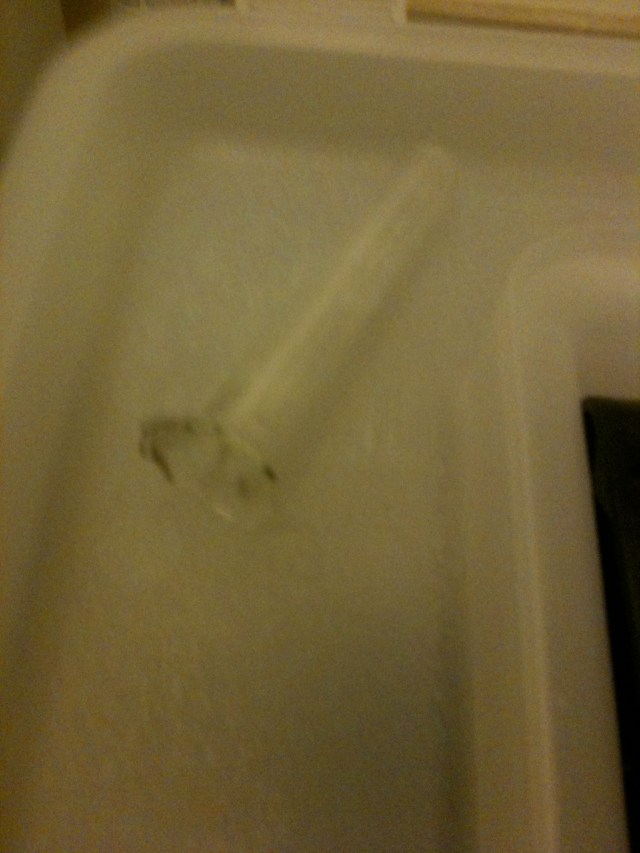
4th pic is of a meth pipe


Information provided by CrunchBase


OMG/JK: The Man In The Yellow Jacket

We’re back for a new episode of OMG/JK — featuring both of your hosts reunited in the TCHQ studio (I was back in SF for our Mobile First CrunchUp). Oh, and this episode also includes a cameo by a man in a large yellow jacket. I won’t spoil it.

We kick off this week’s episode by diving into Twitter’s new ad format, which allows brands to place Promoted Tweets at the top of their followers’ streams. Twitter has long been toying with various ad formats — will this one please users, or just annoy them?

Next up we have Facebook’s secret iPad application, which leaked out as part of an official update to its iPhone application. MG got his hands on the app and tested it before Facebook cut off access, and his first impressions are good — tune in to get the details.

Finally we discuss Airbnb’s recent fiasco, where a host had their home destroyed by guests,and how the startup has responded to the issue. Note that this episode was shot a few days ago, so we don’t discuss our most recent post about the situation.

Here are some posts relevant to this week’s episode:

Subscribe to us on iTunes!


Square Now Processing $4 Million In Mobile Payments Per Day

Flush with $100 million in new funding, Square is continuing to grow like a weed in the mobile payments space. After passing the $3 million mark at the end of May, Square is now processing $4 million in mobile payments daily, and is on track to reach over $100 million in transactions in July. And COO Keith Rabois tells us that he expects the company to double this volume by October.

In late June, Square raised a massive round of funding, which valued the company above $1 billion. At the time of the announcement, it was revealed that Square was processing nearly $4 million in payments per day, but the company has surpassed that mark a month later. Rabois tells us international expansion is part of the next phase of growth. He expects to initial launch payments capabilities outside of the U.S. in 2012.

And iPad usage of Square is on the rise, especially after the company launched a disruptive new iPad app to replace cash registers and loyalty cards. The breakdown in terms of usage are iPad (21%), iPhone (45%), iPod (3%) and Android (31%).

In the past year, Square has shipped more than 500,000 credit card readers, is processing more than a million transactions per month. And Square devices are now sold in Apple Stores.

Basically, if you didn’t take Square seriously, perhaps you should reconsider.


(Founder Stories) Ben Lerer: Thrillist Will Do “$40 Million In Revenue This Year”

In this episode of Founder Stories, Chris Dixon sits down with Thrillist Co-founder and CEO, Ben Lerer (who is also a partner with his father Ken Lerer in Lerer Ventures).  Targeted towards young men, Thrillist is a “platform for guys” that offers “both local and national content and commerce smooshed into one place” says Lerer.

Inspired by Bob Pitman’s Daily Candy (Pitman is an early investor in Thrillist), Lerer founded Thrillist a couple years out of college. Before he figured out that he wanted to create a city guide for guys, he and his co-founder went through a lot of “get rich quick schemes” with the common thread that they knew nothing about any of them. The only thing they really knew about was “frivolous fun and buying stupid shit.” And thus Thrillist was born. A guide for guys with the voice of a national men’s magazine but a local focus.

Today, the site has a loyal following of between 3 and 4 million male subscribers, who are highly attractive to brand advertisers but also very hard to reach. Lerer built the advertising and content business to a respectable 8-figure in annual revenues, but then he looked around at social commerce companies like Groupon and Gilt and thought he could grab a piece of that by setting up parallel commerce businesses and cross-selling to his demographic. So last year he bought JackThreads, a group buying site for men’s threads. In January, he layered on a deals business with Thrillist Rewards.

Revenues shot through the roof. Lerer projects Thrillist will reach “about $40 million in revenue this year, almost tripling from last year.” He now employs 115 people, up from 45 last year. Not bad for a business based on frivolous shit.

Watch previous episodes of Founder Stories here.


Buying An Electric Car

This guest post is by venture capitalist David Cowan. David has recently purchased a Nissan Leaf after going car-less for two year.

After 3.5 years, I’ve finally re-joined the community of car owners.

Between February 2008 and last week, I was car-less. I borrowed and rented cars, took taxis and Zip cars, and occasionally biked. I also bummed a lot of rides (thank you very much – you know who you are). It had started when the warranty on my fancy German gas guzzler expired; I sold the thing, and never really found the time to shop around for a replacement – Who Has Time For This?

I felt a lot more excited about the prospect of driving an electric sedan, which should be greener, potentially faster, simpler to operate, and cheaper to fuel. Most importantly, I’d never have to kill ten minutes stopping for gas – Who Has Time For This? So I put my name down on the lists for a Tesla Model S, Fisker Karma, Nissan Leaf and Chevy Volt, deciding to wait for one to be built. Three years later, I got calls from Fisker, Nissan and Chevy, and it was time to decide.

After examining the options and driving the cars, it was a pretty easy decision to buy the Leaf for these eight reasons:

1. Compared to the others, the Leaf gets twice the range from a battery charge: 100 miles, or 85 miles with the AC cranking. (Plugging the car in and out adds about 15 seconds a day to your daily routine, or 5 minutes a month – about half the time we spend at gas pumps.)

2. With a pure electric motor (not a hybrid gasoline engine) the Leaf is nimbler, less fragile, and legal to drive in California’s carpool lanes so I can bypass the Highway 101 traffic jams – WHTFT?

3. Driving in electric mode (without the help of a hybrid gasoline engine) is wonderfully quiet and smooth (no transmission). Even at 80 miles per hour the acceleration is immediate and impressive.

4. The Leaf steers as smoothly as a Lexus, and the small wheels turn on a dime.

5. Only the Leaf has open, comfortable seats with ample head room in front and leg room in back (a must if you have kids)

6. Only the Leaf carries 5 passengers (a must if you have THREE kids!)

7. The Leaf has the largest trunk, and the back seats fold down for more cargo space.

8. The Leaf costs 3/4 as much as the Volt, and 1/3 as much as the Karma. You get at least $7500 in tax credits, offset by the $2,000 expense of a home 220 volt charging station.

These reasons explain why the Nissan Leaf now the outsells the pack. I can think of only three good reasons why you might wish to buy one of the other cars:

1. The Leaf’s pure electric motor is not a problem for two car families – on that rare day once a month when you drive more than 100 miles, you can always take the gas guzzler instead (Honda Odysseys are awesome). But without that fallback, one-car households will find the Volt more practical (albeit expensive and cramped).

2. If you love driving enormous, heavy sports cars that sit low to the ground and you’ve got $100k to burn (like these guys), then you might prefer the gorgeous design of the Karma. It has the look and feel of a luxury muscle car with a growling engine, bucket seats, and beautiful wood/leather interiors. (The Leaf is all plastic.) Having said that, the Karma performs like a sports car at lower speeds but on the highway I found it downright sluggish compared to the Leaf. The Karma handled highway acceleration nearly as well as the Leaf only when in Stealth Mode which means that the gasoline engine is off. (You may be as disappointed as I was to learn that people can still see you in Stealth Mode.)

3. Stephen Colbert will mock you for driving a Leaf.

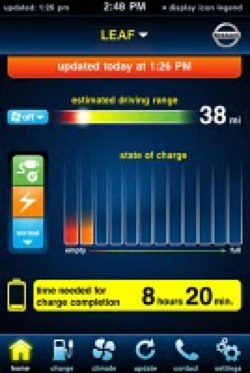
All three cars come chock full of gizmos we all love (rear view camera, navigation, keyless entry, XM radio, Bluetooth, heated seats…) so there’s no reason to stick with gasoline. The Leaf even comes with a cool iPhone app for remote operation of the charger and climate control.

So I’ve been zipping around in my Leaf for a week now and absolutely loving it. Even after three years, it was worth the wait.


Healthcare Disruption: Providers Are Making Newspaper Industry Mistakes (Part III)

Editor’s note: This guest post was written by Dave Chase, the CEO of Avado.com, a health technology company that was a TechCrunch Disrupt finalist. Previously he was a management consultant for Accenture’s healthcare practice consulting to 25 hospitals and was the founder of Microsoft’s Health business. You can follow him on Twitter @chasedave.

Since the latter half of the 90’s, the handwriting has been on the wall for newspaper companies that media’s future was digital. Heck, the newspapers’ own business sections reported on this trend. Despite this, the majority of the industry focused on traditional strategies such as taking on debt to acquire other newspapers or investing in new printing presses, leading to disastrous consequences.

To be fair, there were some digital investments made, including hiring top-drawer talent. However, over time, the digital teams were marginalized and ultimately the talent that had the capability to transform these organizations left for opportunities where their hands weren’t tied. In other words, the commitment wasn’t deep enough to effect a true transformation.

Now consider healthcare in the U.S.: There’s a clear understanding that the industry must shift its focus towards outcomes from “do more, bill more” orientation. If ever there was an industry that should understand that it’s more effective to address underlying conditions than treating the symptom, it should be healthcare. Or, as a famous early newspaper publisher stated, “an ounce of prevention is worth a pound of cure.” Prevention-focused countries such as Denmark have dramatically lowered the need for hospitals. Once at 155 hospitals, they are at less than a third of that today. I find this easily-known fact is news to healthcare providers I speak with.

Whether they don’t know these facts or are ignoring them, the fact is there are incredibly large capital investment projects on the docket for many health systems. Since 62% of hospitals are mission-based, non-profit organizations, it’s astonishing that they are more focused on capital projects than addressing the overall health of their communities. No one has made the case, for instance, that chronic conditions that consume 75% of the $2.6 trillion tab in the U.S. is best addressed by building more buildings. Some make the case that there’s a growing healthcare real estate bubble while costs of chronic conditions continue to expand.

In healthcare, it’s as though we are building better firehouses and investing in more firefighting equipment while we do the equivalent of leaving oily rags around, letting kids play with fireworks on dry hillsides, and building structures with one exit. We may have the best “firefighting” tools and talent in the world but we’d be much better off if we prevented those “fires” from starting in the first place.

Dr. Ted Epperly recently finished his term as the head of the American Academy of Family Physicians and runs the Family Medicine Residency of Idaho program, which includes 80 physicians serving over 20,000 patients. On a tour of his facility, he stopped to comment on the scene in the waiting room of their biggest clinic, something that’s typical of the many doctor’s office waiting rooms we’ve all experienced. He described the scene as a failure compared to the vision of what he’s planning on implementing.

In Epperly’s vision, he describes a dashboard that pulls from the registry of all of their patients. Rather than reactively waiting for someone to present himself or herself in the clinic, he envisions a system that proactively is monitoring the array of conditions his patient population experiences. For example, it will ensure diabetics are having regular foot and eye exams and blood glucose levels are being consistently monitored. If someone hasn’t scheduled an appointment already, it will proactively reach out to him or her rather than waiting for some health crisis.

Epperly has been a leading proponent of a concept in healthcare called the Patient-Centered Medical Home (PCMH), akin to the philosophy that Denmark has adopted so successfully. In many respects, the PCMH is simply an updated version of the Marcus Welby model of medicine with more of a team-based model coupled with technology.

While some may have noticed that there’s several PCMH pilots that were included in the federal health reform law, there’s a little-noticed facet of the law the CTO for the United States, Aneesh Chopra, points out in this video segment. That is, if the payment models that reward positive health outcomes over activity proves out in the eyes of the Actuary for Medicare and Medicaid program to be cost savings, there is carte blanche authority to expand these models broadly to entire Medicare population. This could rapidly expand the deployment of the PCMH concept and accelerate the need for the associated HealthTech. The video below explains this in more detail and explicitly speaks to the opportunity for startups.

Another healthcare provider plans to send home patients with an array of personal biometric devices. The output of these devices will be a more complete view of an individual’s health. There’s an explosion of personal biometric devices ranging from personal blood pressure monitors to some being built into clothing and widely deployed in places such as Denmark.

For the cost of a small wing of one of these new Taj Mahal structures, healthcare providers could have a team of innovators working on scenarios such as those described above and many others. Those that avoid sticking to the old tried and true methods of differentiation that worked in the past will be light years ahead as the transformation of healthcare takes hold. If they don’t, employers who are paying the bulk of healthcare costs are taking matters into their own hands and building their own onsite clinics.

Whether the innovation comes from within or from non-obvious competition such as employers or pharma companies, there’s a distinct advantage in having a blank slate where cost effective systems and models of delivering care can be delivered. For the providers, they’d be well advised to develop their own innovation teams unfettered by the current model so they can develop models that will ensure the provider’s long-term survival.

If you missed the first parts of the series, you can find them at the links below: