For all the myriad ways Amazon has made shopping more convenient, the last-mile delivery can be an issue. The company’s Key service is an attempt to address those issues, offering a way for packages to get delivered even when residents aren’t home or are otherwise unreachable.
Currently the company offers home, car and garage delivery options. The latter, which launched in 2019 with 50 cities, now reaches more than 4,000, according to the company. The cities include New York, Los Angeles, Chicago, Philadelphia, Dallas, Washington, D.C., Houston, Boston, Atlanta and Phoenix. There are thousands of nearby smaller cities and towns on the list, as well. Shout out to Astoria, New York.
The feature is open to Prime members who have a myQ garage door opener, which drivers can access. In addition to the existing delivery features, Amazon is adding in-garage grocery delivers in a handful of cities starting today, including Chicago, Dallas, Los Angeles, San Francisco and Seattle. The feature will be limited to select areas and will be expending to other U.S. cities at some unspecified point in the future.
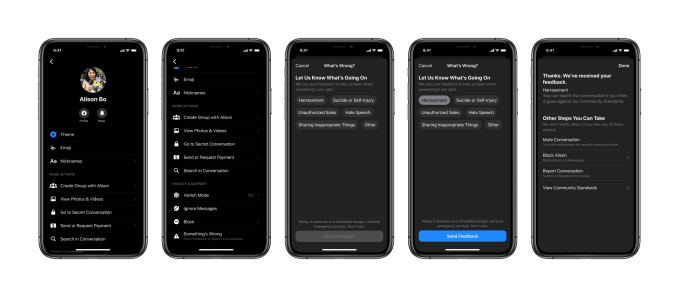
Facebook today announced its new Snapchat-like feature for disappearing messaging, Vanish Mode, is arriving on Messenger and Instagram. The feature, meant for more casual conversations, allows users to set chats to automatically delete after the message is seen and the chat is closed.
In Vanish Mode, Messenger and Instagram users can send text chats, emoji, pictures, GIFs, voice messages and stickers, which will disappear after they’ve been seen and users leave the chat, Facebook explains.
Image Credits: Facebook
However, unlike on Snapchat, Vanish Mode is not a default setting. Instead, users are meant to enable it from within an existing chat by swiping up on their mobile device’s screen while in the chat.
Upon first launch, a screen will appear explaining how Vanish Mode works. It also notes that users will be alerted if someone takes a screenshot of the conversation — as Snapchat does.
For safety purposes, Facebook supports blocking and reporting in Vanish Mode. If a user in the conversation reports a chat, the disappearing messages will be included for up to 1 hour after they disappear, the company explains. This allows Facebook to review the reported conversation and take action, if need be.
Image Credits: Facebook
Vanish Mode is also an opt-in experience — meaning you can can choose whether to enter a Vanish Mode chat. And it only works with people you’re connected to, Facebook says.
Once in Vanish Mode, the screen goes dark to signal the change. To exit Vanish Mode, you tap on the “Turn Off Vanish Mode” button at the top of the screen.
Facebook’s plans for Vanish Mode were announced earlier as part of its overhaul of the Instagram messaging experience in September. This update had included the ability for Instagram and Messenger users to communicate across apps, along with other “fun” features.
As a part of that update, Instagram received many Messenger-inspired additions — like the ability to change the chat color or react with any emoji, for example. But though announced, the Vanish Mode feature was then said to be coming “soon.”
Image Credits: Facebook
To be clear, Vanish Mode is not designed to cater to those looking to secure an entire conversation. Though the feature is end-to-end encrypted, Facebook already offers a fully end-to-end encrypted conversations feature (Secret Conversations). Instead, Vanish Mode’s main focus is to chip away at yet another advantage held by rival Snapchat.
That’s par for the course for Facebook these days. The company already copied the Stories format popularlized by Snapchat, and now that product alone on each of its platforms is used by more people (500+ million than all of Snapchat (249 million).
To get Vanish Mode, and other recent updates to the Instagram messaging experience, users have to opt-in to the upgrade. Essentially, these new features are being used as lures to get Instagram users to agree to the upgrade.
The upgrade then locks them further inside the Facebook universe as they then also receive the ability to communicate cross-platform with users on Facebook. Eventually, WhatsApp may become a part of this cross-platform communication strategy, as well.
Once upgraded, people can use just one messaging app to reach friends and family on two of the largest social networks in the world. And with additions like Vanish Mode, they won’t miss out on things found on competitors’ apps. Meanwhile, with Reels on Instagram, Facebook aims to retain TikTok users, too.
Facebook says Vanish Mode is launching starting today on Messenger in the U.S., Canada, Mexico, Peru and Bangladesh, and on Instagram (soon) in Canada, Argentina, Chile, Peru and a few other countries. It will soon roll out to other countries across both platforms, the company says.
Based in Hong Kong, Coherent helps insurance providers go digital. With their services more relevant than ever during the COVID-19 pandemic, the startup announced it has raised $14 million in new funding. The Series A round, led by Cathay Innovation with participation from Franklin Templeton, will be used to grow Coherent’s client base in Asia, including insurers who want to add more digital services to their usual sales processes because of the pandemic.
Founded in 2018, Coherent’s platform, called Product Factory, allows insurance providers to digitize their backend operations by uploading Excel pricing models, which means their IT departments don’t need to write new code or re-haul their IT infrastructure.
The company also offers three tools for working with customers. Coherent Connect is a social media marketing campaign manager; Coherent Explainer is a sales tool for breaking down quotes; and Coherent Flow allows agents to sell policies to customers remotely with features like video chat and electronic signatures.
While Coherent’s remote tools are a key selling point now, outdated legacy systems have long been a pain point for insurance providers, slowing down backend operations and sales while increasing the cost of premiums.
John Brisco, co-founder and chief executive officer of Coherent, told TechCrunch that the startup has worked with more than 30 insurers in 10 global markets during 2020.
Global premiums initially shrank, but research by Swiss Re predicts the insurance industry will recover by next year, led by demand in China.
Coherent will focus on China and emerging markets in Asia. The startup, which currently has about 120 employees, plans to increase the number of its tech and actuarial talent in Hong Kong, Singapore, Shanghai and Manila, and build new teams for Japan, the United States and Thailand.
Bill Zhang lowered himself into lunges on a squishy mat as he explained to me the benefits of the full-body training suit he was wearing. We were in his small, modest office in Xili, a university area in Shenzhen that’s also home to many hardware makers. The connected muscle stimulator attached to the suit, called Balanx, is designed to bring so-called electronic muscle stimulation, which is said to help improve metabolism and burn fat.
“We are not really aiming at Chinese consumers at this point,” said Zhang, who started Balanx in 2014. “The suit is for the more savvy consumers in the West.”
Prospects for hardware makers were looking bright until two years ago when the Trump administration began setting trade barriers on China. Relations between the two countries have been deteriorating over a series of flashpoint events, from Beijing’s policy on Hong Kong to the coronavirus pandemic.
Chinese entrepreneurs don’t expect relationships between the countries to warm up anytime soon, but many do believe the new office will make “less erratic” and “more rational” policy decisions, according to conversations TechCrunch had with seven Chinese hardware startups. Chinese tech businesses, big or small, are adapting swiftly in the new era of U.S.-China competition as they continue to woo overseas customers.
Designed in China
Zhang is just one of the many entrepreneurs looking to bring state-of-the-art Chinese hardware to the world. This generation of founders no longer hawk cheap electronic copycats, the image attached to the old “Made in China” regime. Decades of knowledge transfer, product development, manufacturing, export practice and policy support have made China a powerhouse for producing new technologies that are both edgy and still widely affordable.
Anker’s power banks, Roborock’s vacuums and Huami’s fitness trackers are just a few items that have gained loyal followings in several overseas markets, not to mention global household names like Huawei, Xiaomi, Oppo and DJI.
Consumer sentiment is also changing. Europeans’ perception of “Made in China” quality and innovation has “improved significantly” over the last 10 to 15 years, said Frank Wang who oversees marketing at Xiaomi -backed Dreame which makes premium home appliances including cheaper alternatives to Dyson hairdryers and vacuums.
The new players are eager to replicate the success of their predecessors. They seek media attention and retail partners at international trade fairs like CES, teach themselves Facebook and Google campaigns, and court gadget lovers on crowdfunding platforms. Investors ranging from GGV Capital to Xiaomi rush to back scrappy startups that are already shipping millions of units around the globe.
For Donny Zhang, a Shenzhen-based electronics parts supplier to hardware companies, businesses have been shrinking as soon as the trade war began. “My clients are taking the brunt because the costs of procurement have increased,” he said of those who directly or indirectly deal with American firms.
While many export-led hardware businesses loathe decreasing profitability, some learn to adapt and look for a silver lining. That has unexpectedly spurred new directions for factory owners in China. Indiegogo, one of the world’s largest crowd-funding platforms, saw the changes first hand.
“Once tariffs increase, there’s not much profit margin left for manufacturers because the middlemen already eat up the bulk of their profit,” Lu Li, general manager for Indiegogo’s global strategy, told TechCrunch.
“A good solution is for factories to skip the middlemen and sell directly to consumers with their own brands. Once the goal of brand building is clear, they often come to us because they need marketing help as a first step to establish themselves as a global consumer brand.”
The trend, dubbed “direct-to-consumers” or D2C, also plays into China’s national plan to encourage manufacturing upgrade and homegrown innovations to compete globally, an initiative that began to take shape around 2015. The development naturally makes China Indiegogo’s fastest-growing region in the last two years: in the first three quarters of 2020, businesses coming from China jumped 50% year-over-year, according to Li.
Localize
Having an appealing product and brand is just the prerequisite. Ever-changing trade policies and geopolitics have forced many Chinese businesses to localize seriously, whether that means setting up a foreign entity or building a local team.
For Tuya, which provides IoT solutions to device makers around the world, the trade war’s effect has been “minimal” since it has operated a U.S. entity since 2015, which employs its local sales and technical support staff. Most of its research and development, however, still lies in the hands of its engineers in India and China, the latter of which can be a potential contention point, as shown by TikTok’s recent backlash in the U.S.
“The key is compliance. We have a dedicated team of security experts to work on compliance issues. For instance, we were one of the first to get GDPR certified in Europe,” said the company’s chief marketing office Eva Na.
The company’s readiness is prompted by practical needs though. Many of its clients are large Western corporations that demand strict legal compliance in vendors, so Tuya began collecting the needed certificates early on. Connecting 200,000 SKUs today, Tuya’s footprint is found in over 190 overseas countries, which account for over 60% of its business.
Well-funded Tuya may have the financial and operational capacity to sustain an overseas team; but for smaller startups, localization can be a costly and tedious learning curve. Many opted to set up a Hong Kong entity to tap the city’s status as a global financial hub and evade trade restrictions on China, an advantage of the territory that began to crumble following Beijing’s implementation of the national security law.
Balanx, the smart training suit maker, has a Hong Kong entity like many of its export-facing hardware peers. To cope with new global headwinds, it registered a virtual company in Nevada but quickly realized the entity is of little use unless it has an on-the-ground operation in the U.S.
“Many local banks would ask for utility bills and etc. if I want to open an account, which we don’t have. We realized we must have a local team,” asserted the founder.
Hope
Zhang is positive that small companies like his own will remain under the radar in spite of U.S. sanctions. “Just avoid having any government connection,” he said.
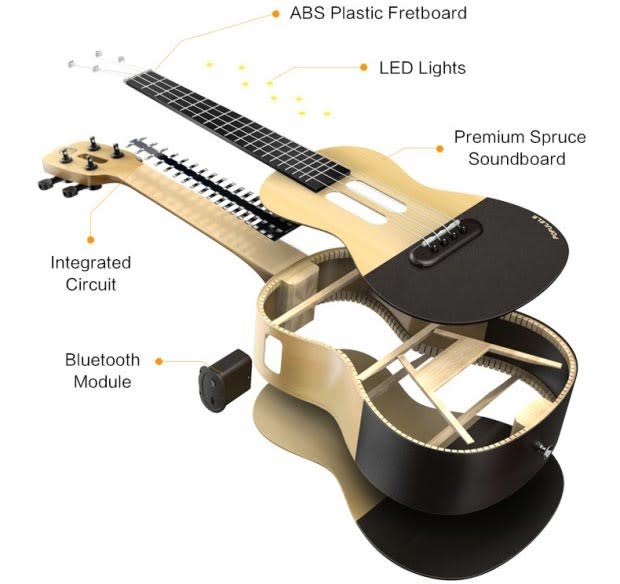
Indeed, some of the more “benign” and niche products are continuing to thrive in their global push. PopuMusic, a Xiaomi-backed startup making smart instruments like ukulele and guitar to teach beginners, is one. “We aren’t affected by the trade war. We are in a business that’s neither threatening nor aggressive,” said Zhang Bohan, founder of PopuMusic, which counts the U.S. as one of its biggest overseas markets.
Chinese brands are also seeing their edge as the coronavirus sweeps across the globe and confines millions at home. Hardware makers like Balanx, Dreame and PopuMusic have long learned to master e-commerce and logistics in a country where online shopping is ubiquitous.
“Consumers in Europe and the U.S. are growing more accustomed to e-commerce, a bit like those in China five to eight years ago,” said Wang of Dreame.
Rather than rethinking the U.S., PopuMusic is forging further ahead by launching a new connected guitar via an Indiegogo campaign. Global expansion is at the core of the startup’s vision, the founder said. “We are global from day one. We had an English name before even coming up with a Chinese one.”
In the process of making big bucks, hardware makers may have to downplay their “Made in China” or “Designed in China” brand, said Li of Indiegogo. This could help them avoid unnecessary geopolitical complications and attention in their international push. But one has to wonder how this new generation of entrepreneurs is reckoning with their national pride. How do they deal with the mission passed down by Beijing to promote Chinese innovation in the global marketplace? It’s a line that Chinese entrepreneurs have to tread carefully in their global journey in the years to come.
It’s somewhat complicated to do this, not least because they are sprawled across a number of Tencent properties and, unlike Ant, don’t go by a single brand or operational structure — at least, not one that is obvious to the outside world.
However, when you tease out Tencent’s fintech activity across its wider footprint — from direct operations like WeChat Pay through to its sizeable strategic investments and third-party marketplaces — you have something comparable in size to Ant, and in some services even bigger.
Hidden business
Ant refuted the comparison with Tencent or anyone else. In a reply to China’s securities regulator in September, the Jack Ma-controlled, Alibaba-backed fintech giant said it is “not comparable” to WeChat Pay, the fintech tool inside WeChat, Tencent’s flagship messenger.
“In the space of digital payments and merchant service, there are many players around the world, including Tencent’s WeChat Pay. But the payments services offered by these companies are different from our digital payments and merchant services. They are not comparable. In terms of digital finance, our way of working with and serving financial institutions, as well as our revenue model, are novel and do not have a counterpart,” the company noted in a somewhat hubristic reply.
There’s no denying that Ant is a pioneer in expanding financial inclusion in China, where millions remain outside the formal banking system. But Tencent has played catch-up in digital finance and made major headway, especially in electronic payments.
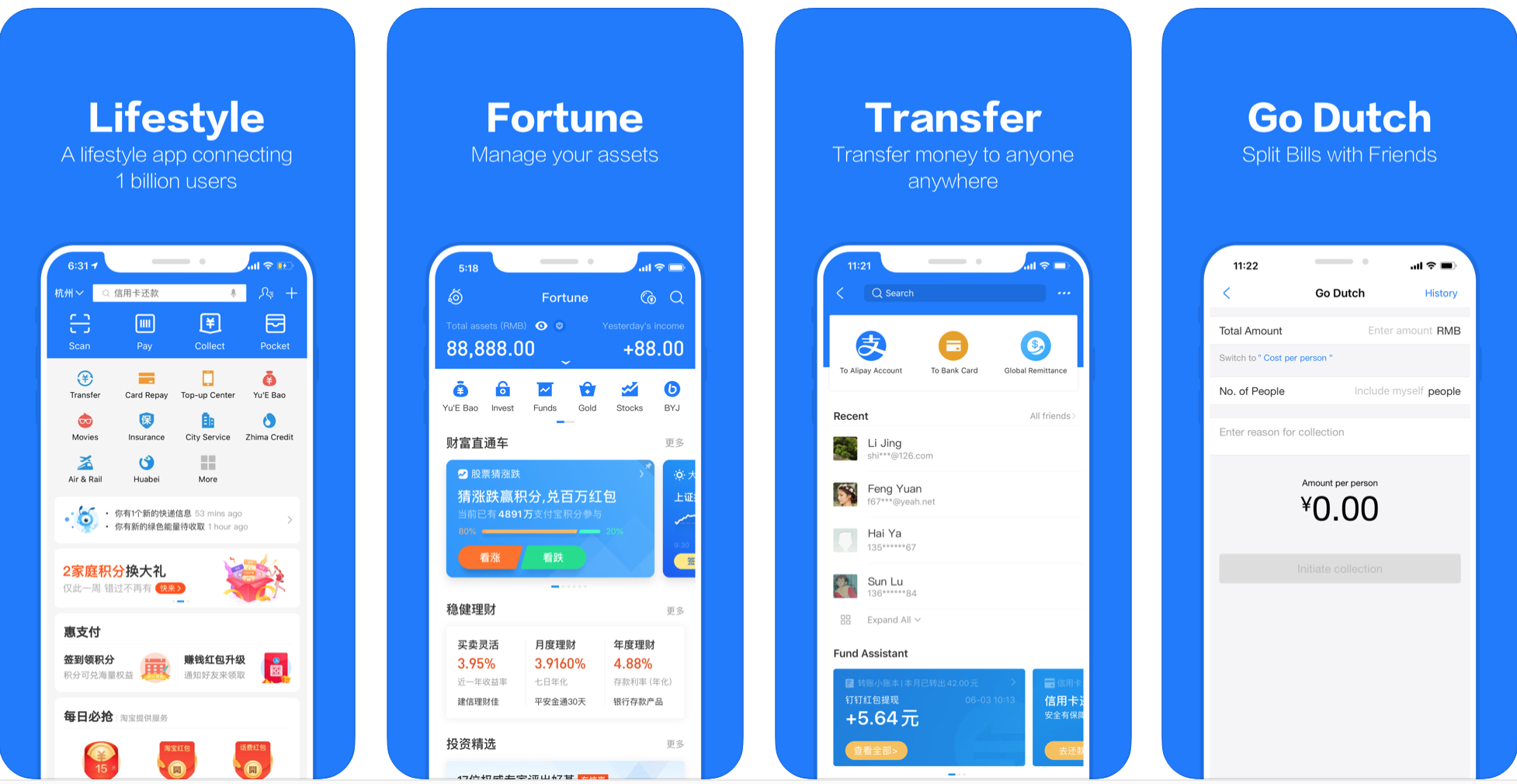
Both companies ventured into fintech by first offering consumers a way to pay digitally, though the brands “Alipay” and “WeChat Pay” fail to reflect the breadth of services touted by the platforms today. Alipay, Ant’s flagship app, is now a comprehensive marketplace selling Ant’s in-house products and myriad third-party ones like micro-loans and insurance. The app, like WeChat Pay, also facilitates a growing list of public services, letting users see their taxes, pay utility bills, book a hospital visit and more.
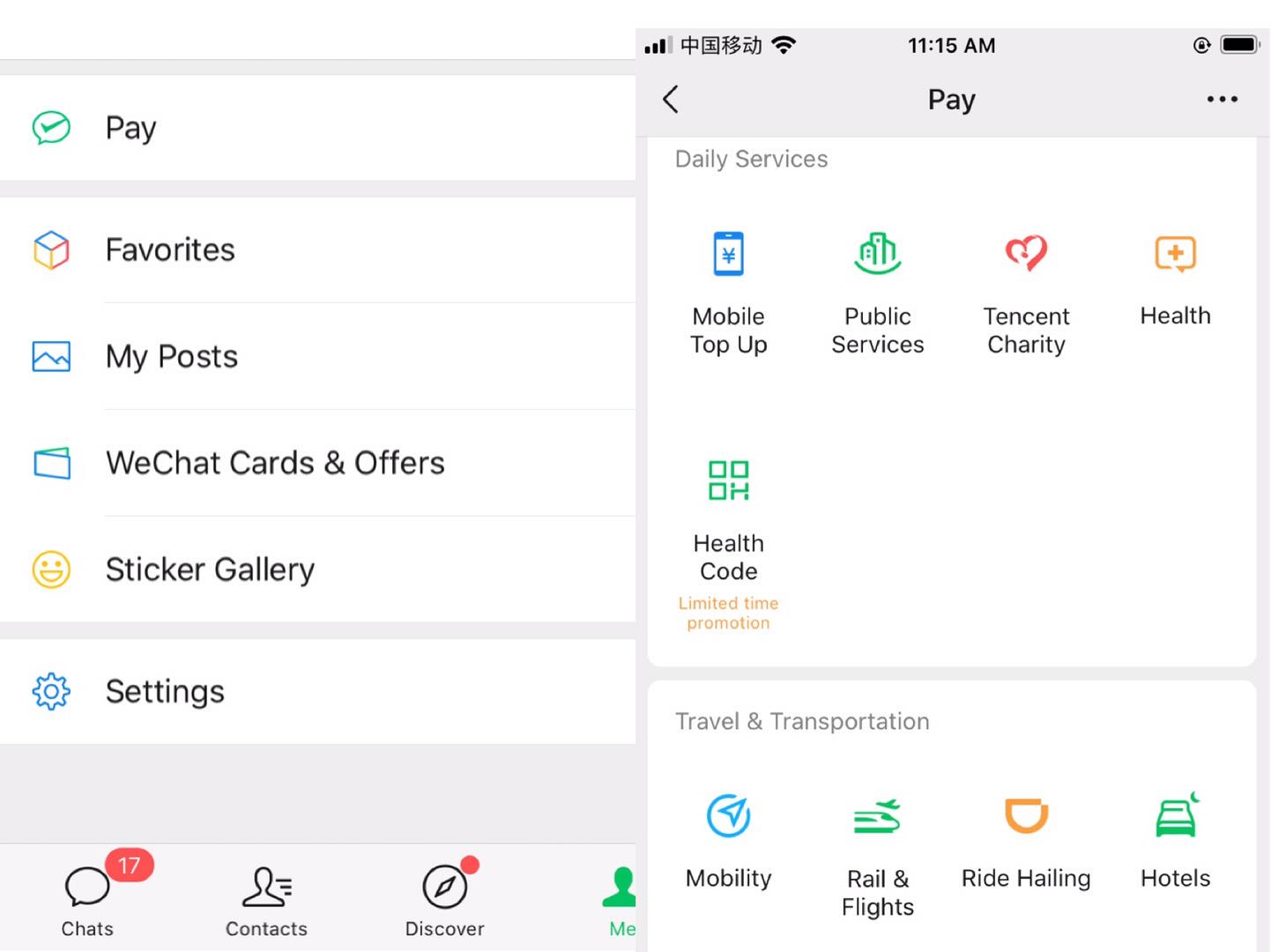
Tencent, on the other hand, embeds its financial services inside the payment features of WeChat (WeChat Pay) and the giant’s other popular chat app, QQ. It has thus been historically difficult to make out how much Tencent earns from fintech, something the giant doesn’t disclose in its earnings reports. This is reflective of Tencent’s “horse racing” internal competition, in which departments and teams often rival fiercely against each other rather than actively collaborate.
Screenshots of WeChat Pay inside Tencent’s WeChat messenger
As such, we have pulled together estimates of Tencent’s fintech businesses ourselves using a mix of quarterly reports and third-party research — a mark of how un-transparent some of this really is — but it begs some interesting questions. Will (should?) Tencent at some point follow in Alibaba’s footsteps to bring its own fintech operations under one umbrella?
User number
In terms of user size, the rivals are going neck and neck.
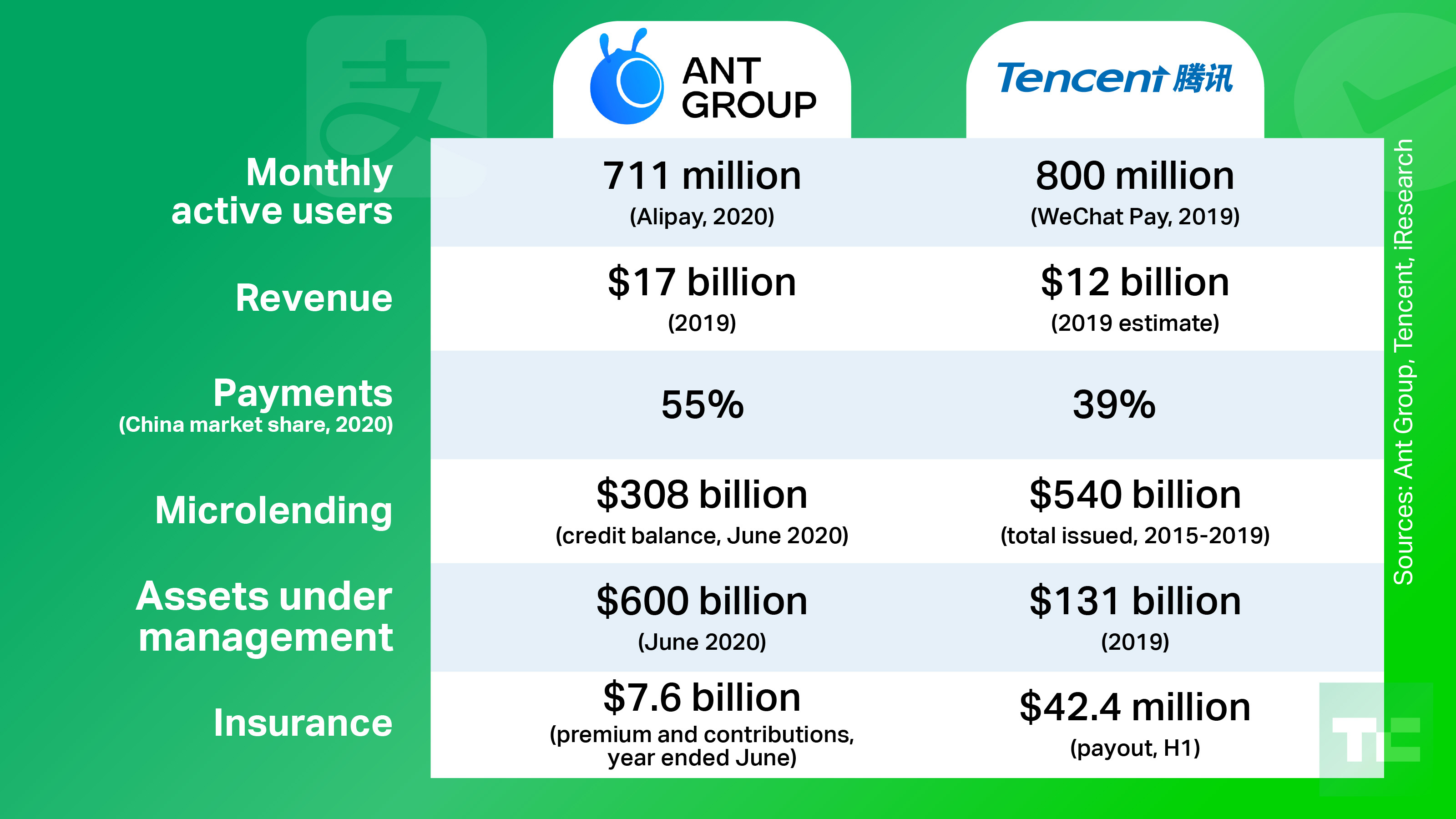
The Alipay app recorded 711 monthly active users and 80 million monthly merchants in June. Among its 1 billion annual users, 729 million had transacted in at least one “financial service” through the platform. As in the PayPal-eBay relationship, Alipay benefits tremendously by being the default payments processor for Alibaba marketplaces like Taobao.
As of 2019, more than 800 million users and 50 million merchants used WeChat to pay monthly, a big chunk of the 1.2 billion active user base of the messenger. It’s unclear how many people tried Tencent’s other fintech products, though the firm did say about 200 million people used its wealth management service in 2019.
Revenue
Ant reported a total of 121 billion yuan or $17 billion in revenue last year, nearly doubling its sum from 2017 and putting it on par with PayPal at $17.8 billion.
In 2019, Tencent generated 101 billion yuan of revenue from its “fintech and business services. The segment mainly consisted of fintech and cloud products, industry analysts told TechCrunch. With its cloud unit finishing the year at 17 billion yuan in revenue, we can venture to estimate that Tencent’s fintech products earned roughly or no more than 84 billion yuan ($12 billion), from the period — paled by Ant’s figure, but not bad for a relative latecomer.
The sheer size of the fintech giants has made them highly attractive targets of regulation. Increasingly, Ant is downplaying its “financial” angle and billing itself as a “technology” ally for traditional institutions rather than a challenger. These days, Alipay relies less on selling proprietary financial products and bills itself as an intermediary helping state banks, wealth managers and insurers to reach customers. In return for facilitating the process, Ant charges administrative fees from transactions on the platform.
Now, let’s turn to the rivals’ four main business focuses: payments, microloans, wealth management and insurance.
Ant vs. Tencent’s fintech businesses. Sources for the figures are companies’ quarterly reports, third-party research and TechCrunch estimates.
Digital payments
In the year ended June, Alipay processed a whopping 118 trillion yuan in payment transactions in China. That’s about $17 trillion and dwarfs the $172 billion that PayPal handled in 2019.
Tencent doesn’t disclose its payments transaction volume, but data from third-party research firms offer a hint of its scale. The industry consensus is that the two collectively control over 90% of China’s trillion-dollar electronic payments market where Alipay enjoys a slight lead.
Alipay processed 55.4% of China’s third-party payments transactions in the first quarter of 2020, according to market research firm iResearch, while another researcher Analysys said the firm’s share was 48.44% in the period. In comparison, Tenpay (the brand assigned to the company-wide infrastructure that powers WeChat Pay and the less-significant QQ Wallet, yet another name to confuse people) trailed behind at 38.8%, per iResearch data, and 34% according to Analysys.
At the end of the day, the two services have distinct user scenarios. The fact that WeChat Pay lies inside a messenger makes it a tool for social, often small, payments, such as splitting bills and exchanging lucky money, a custom in China. Alipay, on the other hand, is associated with online shopping.
That’s changing as Tencent tries to increase its ticket size through alliances. It’s tied WeChat Pay to portfolio e-commerce companies like JD.com, Pinduoduo and Meituan — all Alibaba’s competitors.
Third-party payments were once an incredibly profitable business. Platforms used to be able to hold customer reserve funds from which they generated handsome interests. That lucrative scheme came to a stop when Chinese regulators demanded non-bank payments providers to place 100% of customer deposit funds under a centralized, interest-free account last year. What’s left for payment processors to earn are limited fees charged from merchants.
Payments still account for the bulk of Ant’s revenues — 43%, or a total of 51.9 billion yuan ($7.6 billion) in 2019, but the percentage was down from 55% in 2017, a sign of the giant’s diversifying business.
Microlending
Ant has become the go-to lender for shoppers and small businesses in a country where millions aren’t qualified for bank-issued credit cards. The firm had worked with about 100 banks, doling out 1.7 trillion yuan ($250 billion) of consumer loans and 400 billion yuan ($58 billion) of small business loans in the year ended June. That amounted to 41.9 billion yuan or 34.7% of Ant’s annual revenue.
The size of Tencent’s loan business is harder to gauge. What we do know is that Weilidai, the microloan product sold through WeChat, had issued an aggregate of 3.7 trillion yuan ($540 billion) to 28 million customers between its launch in 2015 and 2019, according to a report from WeBank, the Tencent-backed private bank that provides the WeChat-based loan.
Wealth management
As of June, Ant had 4.1 trillion yuan ($600 billion) assets under management, making it one of the world’s biggest money-market funds. Working with 170 partner asset managers, the segment brought in about 17 billion yuan or 14% of total revenue in 2019.
Tencent said its wealth management platform accumulated assets of over 600 billion yuan in 2018 and grew by 50% year-over-year in 2019. That should put its AUM in 2019 at around 900 billion yuan ($131 billion).
Insurance
Last but not least, both giants have made big pushes into consumer insurance. Besides featuring third-party plans, Alipay introduced a new way to insure customers: mutual aid. The novel scheme, which is not regulated as an insurance product in China, is free to sign up and does not charge any premium or upfront payment. Users pay small monthly fees that are pooled to pay for claims of critical illnesses.
Insurance premiums and mutual aid contributions on Ant’s platform reached 52 billion yuan, or $7.6 billion, in the year ended June. Working with about 90 partner insurers in China, the segment contributed nearly 9 billion yuan, or 7.4%, of the firm’s annual revenue. More than 570 million Alipay users participated in at least one insurance program in the year ended June.
Tencent, on the other hand, taps partners in its relatively uncharted territory. Its insurance strategy includes in-house platform WeSure that works like a middleman between insurers and consumers, and Tencent-backed Waterdrop, which provides both traditional insurances and a rival to Ant’s mutual aid product Xianghubao.
In the first half of 2020, WeSure, Tencent’s main insurance operation that sells through WeChat, paid out a total of 290 million yuan ($42.4 million), it announced. The unit does not disclose its amount of premiums or revenues, but we can find clues in other figures. Twenty-five million people used WeShare services in 2019 and the average premium amount per user was over 1,000 yuan ($151). That is, WeShare generated no more than 25 billion yuan, or $3.78 billion, in premium that year because the user figure also accounts for a good number of premium-free users.
*
Moving forward, it remains unclear whether Tencent will restructure its fintech operations in a more cohesive and collaborative way. As they expand, will investors and regulators demand that? And what opportunities are there for others to compete in a space dominated by two huge players?
One thing is for sure: Tencent will need to tread more carefully on regulatory issues. Ant’s achievement is a win for entrepreneurs looking to “disrupt” China’s financial sector, but its halted IPO, which is tied to regulatory issues and reportedly Jack Ma’s hubris, also sounds an alarm to contenders that policymaking in China can be capricious.
Elon Musk’s tunneling and transportation startup The Boring Company is eyeing Austin for its next project based on several new job postings.
The Boring Company, which last year landed a deal to construct and operate a “people mover” for the Las Vegas Convention Center, tweeted Monday that is was hiring in Austin. Engineering, accountant and business development positions are listed on its website, the type of jobs that suggest that The Boring Company sees enough opportunity in Austin to set up more permanent operations there.
Rumor has it that "Austin Chalk" is geologically one of best soils for tunneling. Want to find out? Austin jobs now available.https://t.co/imlQMDfprJ
Austin is becoming a hotbed of Musk-related activity. Tesla, which Musk leads, picked in July a site near Austin for its next U.S. factory, a four to five-million-square foot $1.1 billion plant that will assemble the automaker’s futuristic Cybertruck, the Tesla Semi and the Model Y and Model 3 for sales to customers on the East Coast.
Musk described the future factory as an “ecological paradise,” with a boardwalk and bike lanes and where the public will be welcome. It’s unclear if the first customer of The Boring Company will be Tesla.
The Boring Company has five product lines, all of which are centered around tunneling. The startup, which raised $120 million in new funding in summer 2019, offers the base tunnel to customers as well as those designed for use by utilities, pedestrians, freight and it’s so-called Loop service.
The company describes the Loop as an underground public transportation system in which passengers are transported via in autonomous vehicles at up to 150 miles per hour through tunnels between stations. The company says the autonomous vehicles are Tesla Model S, 3, and X. (It should be noted that while Tesla vehicles do have robust advanced driver assistance systems, they are not considered by government bodies such as the U.S. DOT as fully autonomous.)
The Loop is what Las Vegas Las Vegas Convention Center officials sprang for. Under its contract, the LVCC Loop is supposed to transport attendees through two 0.8-mile underground tunnels in Tesla vehicles, four or five at a time. Planning files reviewed by TechCrunch seem to show that the Loop system will not be able to move anywhere near the number of people LVCC wants, and that TBC agreed to.
Sony has announced that it is entering the drone market with a new brand called Airpeak, though the specifics of the drone itself are left something of a mystery. It plans to launch the project next spring.
The bare-bones announcement says only that Sony has been inspired by the “recent proliferation” of drones and the changes they have caused in both the industrial and creative sectors.
Airpeak will focus on multiple industries as well, though it has its work cut out for it if it intends to go up against DJI, which has become the first choice in the consumer UAV sector.
Sony describes the drone as being developed within “the field of AI robotics,” which, along with the aim to enable drone use where it was previously difficult to do so, suggests Sony plans to integrate a fair amount of intelligence into the drones’ systems.
Small UAVs have gotten smarter and smarter, able now to avoid obstacles, recognize other flying objects and navigate between buildings without any intervention from their human operators. But many of these capabilities are still essentially theoretical rather than widely deployed.
Beyond the name, general flavor of the project and a render of what is almost certainly a rotor, that is the sum total of what we know about Sony’s new project. Expect more to be posted to the official website in time.
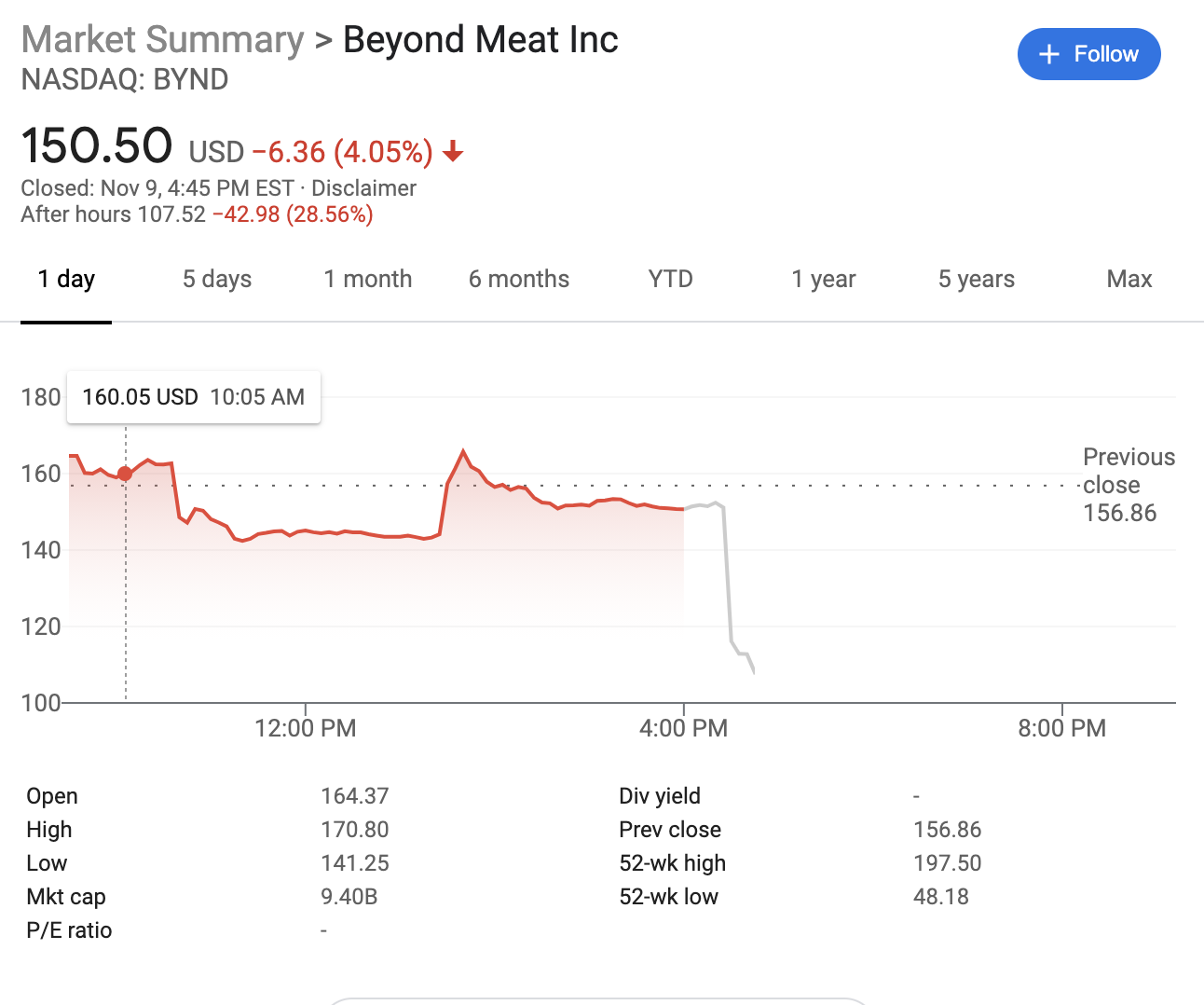
Beyond Meat’s partnership with McDonald’s to develop the McPlant burger wasn’t enough to keep shares from collapsing after the company posted third-quarter earnings that fell far below analysts’ expectations.
The big miss sent shares tumbling nearly 29% in after markets closed Monday after reporting it generated $94.4 million in revenues and a loss of 28 cents per share versus the $132.8 million in revenue and 5 cents per share loss that analysts had expected.
“Our financial results reflect a quarter where for the first time since the pandemic began, we experienced the full brunt and unpredictability of COVID-19 on our net revenues and accordingly, throughout our P&L,” Beyond Meat’s president and chief executive, Ethan Brown, said in a statement. “Unlike the second quarter where record retail buying and freezer loading by consumers offset the deterioration of our foodservice business as COVID-19 stay-at-home and related measures set in, the long tail of retail stockpiling by consumers, coupled with continued challenges across the majority of our foodservice customers, led to Q3 results that were lower than we expected.”
The company reported losses of $19.3 million in the third quarter of 2020 compared to net income of $4.1 million in the year-ago period, according to a statement. Net loss per common share reached 31 cents per-share in the third quarter compared to 6 cents per-share in the year-ago-period.
Despite the poor performance, Beyond Meat is doubling down on its expansion plans by acquiring a new factory in Pennsylvania and its expansion in China and Europe. Brown also pointed to other data that suggests the business is growing.
“Even as the pandemic has created significant disruption, we continue to see strong growth in critically important metrics of household penetration, buyer rates, purchase frequency and repeat rates; our brand’s sales growth continues to outpace the category; and during the quarter we saw our year-over-year velocities rise even as we grew distribution,” he said in a statement.
Beyond Meat’s third-quarter earnings report capped a volatile day for the company that saw its share price seesaw as details of the McDonald’s plant-based burger emerged. Shares of Beyond Meat initially fell after McDonald’s announced that its new plant-based patty and chicken substitute formulation was made in-house. However, McDonald’s overstated its own role in the creation of its McPlant, which was actually developed in conjunction with Beyond Meat, according to a statement provided to CNBC. Beyond Meat shares rebounded only to fall again after the market closed due to its third-quarter earnings.
Brown stuck by McDonald’s despite the restaurant chain’s decision to leave Beyond Meat out of its initial announcement.
“Our relationship with McDonald’s is really good and really strong,” Brown said on an investor call. “I respect their decision to refer to the McPlant platform in the generic sense. We are working with them on a number of matters.”
When we recorded this Gillmor Gang, it was Day Four post-election, or midweek in counting the late incoming mail and other provisional ballots. We were largely convinced of the Biden victory, but that nagging doubt instilled in us by 2016 still pervaded the Zoom session. Saturday’s street party felt more like it, and the sheer joy of Kamala Harris’s historic ascendancy was palpable.
As we sit yet another day later, the perception that Trump will never concede is matched by the equal feeling that we could care less. The air slowly leaking out of the tire doesn’t seem particularly impactful, but the moment when the metal rim connects with the concrete will bring things quickly to the reality. What’s really stark is the network chatter about Trump’s silence, that he has no plan. Is this new? He’s never conceded anything, and his plan is to disrupt any plan.
Still, we are so used to wallowing in this mess that we feel lost in our fatigue and good luck. Even as we recorded, processing the size of the vote on both sides took some effort. We understand the pandemic-mandated mail-in surge, but why the closeness of the numbers? Part of the surprise is how engaged the opposition is given the horror of the death toll, the clarity of the lies and evasions, the totalitarian suppression of information.
The presidency is at its heart an emotional transmitter: here’s what the deal is, here’s what we need to do, here’s what we’re going to do. However chaotic Trump’s message is, he is easy to understand. Biden was successful enough in his pitch to suggest he saw the world in similar ways, replacing fear with collective hope. Two distinct messages, one basic approach: fix the other guy’s mistakes. It’s not a beauty contest, but an ugly contest.
On Saturday Night Live, Dave Chappelle explored this odd coalition. He had a quizzical look that raised and answered the musical question: Can I get away with this? Only occasionally funny in words, he was deep in courage and rigorous in opposition to conventional partisan wisdom. Are we ready to see it both ways, not just one way, our way? Smoking, swearing ugly, he peered out into the moment with that questioning expression: Am I getting away with this? Should I?
As counting continues, we take a break to watch a Netflix series, “The Queen’s Gambit.” Binge chess, with a mesmerizing mix of mid-60s sets and soundtrack, and the hypnotic rhythm of timer competitive chess and the coming of age of a teenaged future Grand Master girl. The counterpoint of Trump’s silence and time travel tracking shots in and through a Vegas hotel chess convention produces a comforting feeling that this transition has room to breathe. Waiting for the consensus to develop in an intricate chess match soothes us as we wait today for political reality to firm up.
The stakes are high, and the outcomes unknown. We may not know how the war with the virus will go, but at least we’ve somehow given ourselves a reasonable chance of resetting the clock. As we recorded the show, we had enough data to guess the result, even if we still don’t know the precise steps to January 20th.
The election data suggests Trump will have leverage to primary Republicans who openly challenge him. How he parlays that to his personal advantage will likely include a run at some version of TrumpTV, though his usual play is to license the brand. He may find that difficult with the prospect of going head to head with Murdoch, Fox News and The Wall Street Journal. That group may require Trump to concede in order to make a deal.
But enough, already. Lame duck is a great place for the Donald to try and blast his way out of the sand trap. Democrats have earned a well-deserved respite for the holidays, thanks to the Biden team’s relentless focus on winning the Electoral College for once. Who knew? They did. And the moment in chess when the loser offers resignation comes not at the bitter end but three or four moves before.
Back before just about every major TV network built a streaming app of their own, watching live TV on your smartphone was tricky.
One of the first relatively simple options was the Slingbox. You’d set it up between your cable box and your TV, plug it into your network, and bam: you’re streaming live TV, from your TV, wherever you might be. You could even control it as if you were actually there, thanks to a spiderweb of IR transmitters you’d wire up in your entertainment center to act as your extra-remote remote control.
In the mid-2000s, it seemed like magic. In 2020… it’s not quite as broadly useful. As a result, the company behind the Slingbox has announced that all Slingbox products are now discontinued, and will become less and less functional leading up to a full shutdown two years from today.
Slingbox servers will be permanently taken offline 24 months after the discontinued announcement date (November 9, 2020), at which point ALL Slingbox devices and services will become inoperable.
Until then, most Slingbox models will continue to work normally, but the number of supported devices for viewing will steadily decrease as versions of the SlingPlayer apps become outdated and/or lose compatibility.
As for anyone who wants to keep using their Slingbox until the servers are shuttered? That’s a bit trickier.
The company says that (for now) they’ll continue to offer the required SlingPlayer app for iPhones, iPads, older versions of macOS, Windows and Amazon Fire TV and tablets — but don’t expect any updates, and even those apps could vanish suddenly. The free Android app seems to still be available, whereas the paid version is gone, as are the Roku and Windows Phone (RIP) apps.
Of course, the writing has been on the wall here for years now. Slingbox was acquired by EchoStar for $380 million in 2007; by 2017, they’d stopped manufacturing new hardware and were mostly focusing on integrating the technology directly into Dish Network boxes. Hell, they haven’t even tweeted in nearly two years. If you’ve still got a Slingbox setup that seems to be working, you’ve got a little less than two years (max) to figure out something else.
We review the iPhone 12 Pro Max and the iPhone 12 mini, Zoom settles with the FTC and Pfizer announces promising results for its COVID-19 vaccine trial. This is your Daily Crunch for November 9, 2020.
The big story: Reviewing the biggest and smallest new iPhones
TechCrunch Editor in Chief Matthew Panzarino tackled both extremes of the new iPhone 12 lineup today, publishing reviews of the Pro Max and the mini.
It sounds like he’s impressed with both of them. The iPhone 12 Pro Max, he writes, has “a really, really great camera” — the question is whether you’re willing to make the ergonomic trade-off, since you’ll probably need to use two hands with the larger phone. At the same time, he suggests that the iPhone 12 mini might be “the most attractive phone in the lineup.”
As if that wasn’t enough, Matthew also checked out the MagSafe Duo charger, a dual magnetic charger that he found underwhelming.
Five UX design research mistakes you can stop making today — Jason Buhle writes that while working with startups and tech companies, he’s seen that even people who understand the importance of user research don’t necessarily know how to conduct it in optimal ways.
The Daily Crunch is TechCrunch’s roundup of our biggest and most important stories. If you’d like to get this delivered to your inbox every day at around 3pm Pacific, you can subscribe here.
Twitter is working to expand the use of its “misinformation” labels on misleading tweets. The company has developed a new feature, not yet live, that would pop up a “misleading information” label when a user tries to “Like” a tweet that’s been labeled as misinformation.
The feature was discovered by reverse engineer Jane Manchun Wong in the Twitter app code. She confirms the addition doesn’t prevent a user from continuing to “Like” the tweet, however — it just slows you down.
A similar warning appears today when users attempt to retweet posts labeled as containing misinformation.
Twitter is working on misinformation warning on Likes, just like the ones for Quote Tweets / Retweets pic.twitter.com/BLlmaw5RZK
This new feature would fall in line with other measures Twitter has been taking to slow the spread of misinformation on its service, including a recent change to how retweets work. On October 20, 2020, Twitter began to prompt anyone who goes to retweet something to share a quote tweet instead.
In addition, Twitter also rolled out a series of new policies ahead of Election Day in the U.S., to further guide its handling of misleading tweets. Beyond just labeling misinformation, it applied more aggressive warnings and restrictions on tweets from U.S. political figures, including candidates and campaign accounts, as well as other U.S.-based accounts that met certain thresholds in terms of followers, or tweet engagements.
Warnings were placed over tweets claiming premature victory, and had been designed largely in response to Trump’s broad hints that he would not easily concede. But use of these aggressive warnings may dwindle in the weeks and months ahead, given that Trump’s legal challenges do not look promising.
Though the election may have highlighted the problem with misinformation to a greater degree than usual, it remains a significant problem for today’s social platforms to address. There are now a number of users who don’t want to deal in facts, resorting to even calling fact-checking organizations biased against them. It’s unclear that any user interface tweaks at this point can help solve this problem.
Twitter says it tries to deamplify misinformation today by not allowing those labeled, misleading tweets to appear in Search or injected into users’ Timelines (if they don’t follow the account). But those tweets can still be replied to, liked and retweeted.
Twitter confirmed the feature spotted by Wong is in development, but did not have a time frame to its rollout.
“Our goal is to give people the context and tools necessary to find credible information on our service — no matter the topic or where they are seeing the Tweet,” a Twitter spokesperson said. “This is an iterative process, and we’re continuing to explore features and policies to help people on Twitter make their own informed decisions.”
Uber shares surged 7.38% to close at $48.18 following news that a vaccine candidate is 90% effective at preventing COVID-19, and could start coming to market in a matter of months.
The announcement by drug makers Pfizer and BioNTech sparked widespread optimism and helped boost shares across industries that have been weakened by the COVID-19 pandemic, including services like ride-hailing.
Uber’s share pop is notable beyond this one-day vaccine-news boost. This is the highest close for Uber since its public market debut in May 2019. This is also the first time since June 2019 that shares closed above its $45 IPO price.
Uber shares have been on an upswing over the past week in response to the passage of Proposition 22, a California ballot measure that allows companies to continue to classify gig workers as independent contractors. Uber, Lyft and other companies that rely on gig workers would have faced an expensive restructuring had voters rejected Prop 22.
Just days later, Uber reported its third-quarter earnings, results that revealed the disparate yet intertwining stories of its two core business segments. Uber’s ride-hailing business shrank, but made money, while its food delivery business expanded while continuing to lose money.
Uber didn’t meet investor expectations on revenue in the third quarter, which put some temporary downward pressure on shares. That drop proved to be short-lived, as investors put more weight on the impact of the Prop 22 passage and today’s vaccine candidate news.
NASA has announced 20 new partnerships with commercial space outfits, among them collaborations with SpaceX, Blue Origin and Rocket Lab. While no money will change hands, NASA will dedicate millions in personnel and other support to these test launches and developing technologies.
The partnerships are NASA’s Announcement of Collaboration Opportunity selections for 2020. These agreements are unlike the SBIR or NIAC programs in that NASA doesn’t just send some money out and say “let us know how you’re getting on in six months or so.”
Instead, the space agency offers open access to its facilities and experts, some of which are the most advanced in the world. It’s a true public-private partnership, for which reason it is still a competitive process to get a project approved — and the list of 17 companies includes several large ones.
SpaceX will be working with Langley to monitor and perform thermal measurements of its Starship launch vehicle and spacecraft during reentry operations over the Pacific.
Rocket Lab, similarly, will partner with Langley, Ames and Armstrong to do analysis of its Electron launch vehicle as it migrates the hardware toward reusability. The company recently moved up the date it would attempt a full booster recovery to just a week from now, but it’s unclear whether this is an operation in which NASA will be involved.
Blue Origin, meanwhile, has two separate partnerships. One is another multi-center effort in which the company will be helping develop a “space robot operating system.” This sounds grand, but is probably more of an integration effort, bringing together multiple open source and NASA-developed frameworks to work together, reducing costs and improving interoperability.
The other is regarding using 3D printing to improve engine designs; perhaps they regret letting Tim Ellis run away and start Relativity Space — he cut his teeth doing just this kind of work at Blue Origin and now it appears the company is going to have to play catch-up.
Workfront was founded back in 2001, making it a bit long in the tooth for a private company that has raised $375 million, according to Crunchbase. (It’s worth noting that $280 million of that was secondary money raised last year.)
The acquisition gives Adobe more online marketing tooling to fit into its Experience Cloud. This one helps companies manage complex projects inside the marketing department (or elsewhere in the company, for that matter).
Suresh Vittal, VP of platform and product for Adobe Experience Cloud, said that the two companies often work together and encounter one another’s sales teams. As the pandemic has played out, it began to make more sense to bring in-house this kind of tooling that works well in a distributed environment, and over the last several months the deal came together.
“The new normal distributed marketing team, distributed experience delivery teams, people having to work remotely — we started to see new use cases emerge around the idea of work management, around the idea of content velocity, around the idea of providing compliance and governance capabilities so no asset escapes the organization, and it goes through this process of passing through creative and the marketing teams and getting out there and really representing your brand in the right way,” Vittal explained.
Workfront CEO Alex Shootman sees the deal as a way to accelerate the roadmap while working with a much larger company. “We are barely scratching the surface of marketing and we could grow tremendously, just by having that great kind of integrated relationship,” he said.
Holger Mueller, an analyst at Constellation Research, says the acquisition will help Adobe customers manage the complexities of marketing project management. “Scheduling and managing work had gotten orders of magnitude more complex for enterprises, and Adobe is accounting for that with the acquisition of Workfront, providing better tool support for the new future of work,” Mueller told TechCrunch.
Workfront’s 960 employees will become part of Adobe and become part of the Adobe Experience Cloud. Shootman will continue to run it and report to Anil Chakravarthy, executive vice president and general manager of the digital experience business at Adobe.
Workfront’s customers include Home Depot, T-Mobile and Deloitte, and the two companies share 1,000 common customers among Workfront’s 3,000 total customer base. In fact, it has APIs that connect to Adobe Creative Cloud and Experience Cloud, two parts of the company’s product family that marketers frequently access.
As Adobe battles Salesforce, SAP and Oracle in the marketing automation space, it’s been using its checkbook to acquire additional fire power in recent years. This acquisition comes after Adobe spent $1.6 billion for Magento and $4.75 billion for Marketo in 2018. That’s almost $8 billion for three companies in less than two years, even as it builds out parts of its Adobe Experience Cloud in-house. Combined, it shows just how serious the company is about making headway in this valuable area.
Customer experience has always been an essential element of online and in-person transactions, making sure the customer feels good about the interactions it has with a brand. It not only keeps them coming back, but it encourages them to act as ambassadors on behalf of a company, something that has incredible value.
Conversely, a bad experience can lead to the opposite impact, causing a prospective or even loyal customer to abandon a brand and speak badly about it to friends online and in person. Adobe hopes that by bringing another marketing tool into the fold, it can help its customers increase the likelihood of a positive online customer experience. This one should allow marketing personnel working at a company to move marketing projects through a workflow from idea to delivery.
The deal is expected to close in the first quarter of Adobe’s fiscal year. Per usual, it will be subject to typical regulatory scrutiny.