Urbandig App Wants To Take You On Expert Local Tours

Screen Shot 2011-08-21 at 1.00.05 PM

The newest addition to the local discovery app space, iPhone app Urbandig aims to help you find novel local experiences. In order to do this the team, which consists of former Myspacers Mike Macadaan, Danielle Lehman and others, has pulled in the domain expertise of local bloggers like LA Weekly assistant music editor Rebecca Haithcoat and Bay Area foodie Darya Pino of Summer Tomato in order to create theme-based tours like where to see amazing live music in LA or grab a taste of local SF food.

Co-founder Macadaan tells me that this expert curation is how the app intends to compete with the crowdsourced tips and recommendation function of apps like Yelp or Foursquare.

“We create original experiences by bundling curated locations and what to do once you’re there,” he says. He also highlights the fact that Urbandig, like the Village Voice’s “Best Of” app, focused on quirky activities like the “Cougar Dens” tour, spotlighting places to find “Cougars” (oh just Google it, and look for the Urban Dictionary definition) on the prowl in SF or “Hangover Heaven,” a run down of where to scoop up the best hangover food in LA. “It’s quality over quantity, in the expert’s uncensored voice,” he says.

Users can open the Urbandig app and browse through place collections for SF, NY, LA and Vancouver, sifting for tours through categories like City Gems, Drink, Film, Food and Music, or by curator and proximity. In addition to a brief tour description and curators notes on each place page, you can see each tour stop on a map, and also check into various spots on the tour via Urbandig.

Because an app would be nothing these days without some kind of social function, Urbandig allows you to save tours and places as well as share them externally on Facebook with friends. Following friends (by going to Profile and clicking on the settings wheel) will allow you to populate your feed with their activity.

Urbandig hopes to eventually support at least 30 locations expanding to Portland, New York, Austin, Minneapolis, Chicago and DC by the end of the year and also plans on coming to the Android in early 2012. The team is bootstrapped and angel funded.


Does Groupon Hope To Challenge Amazon With ‘Groupon Goods’?

groupon

Last week, daily deals giant Groupon registered a bunch of domain names with ‘groupongoods’ in them (.com, .net, .us, .info, .biz and interestingly, .fr). Evidently, securing those domain names doesn’t necessarily mean the company is going to debut a service by the name ‘Groupon Goods’ soon or even in the distant future, but let’s hypothesize for a moment that this is exactly what they’re planning to do.

Imagine if Groupon starts instructing its vast sales forces, which are located all around the world, to start focusing on opportunities other than restaurants, spas, massages and pilates classes.

Better yet: what if they end up seeking mutually beneficial partnerships with companies like Alice.com, Drugstore.com, Pets.com, Overstock.com or Newegg.com in order to branch out into selling discounted groceries, households items, consumer electronics and whatnot.

Theoretically, the fast-growing company could apply its successful ‘local commerce’ model and leverage its enormous international subscriber base (circa 120 million subscribers and counting) to venture into offering deals for groceries, household items and other goods regularly purchased online. Actually, it would make perfect sense in my mind.

For one, it would be a way for Groupon to diversify its revenue streams and accelerate sales growth as the company prepares to go public, without necessarily adding a lot of overhead costs (especially if they go for partnerships rather than building such a service in-house).

Notably, it wouldn’t be the first time Groupon makes such a move. They’ve already partnered with juggernauts Expedia and Livenation to offer online deals on travel (Groupon Getaways) and event tickets (GrouponLive), respectively.

We’ve contacted Groupon – perhaps they’re cool enough to not decline to comment on rumors or speculation. Hope springs eternal, etcetera.

A ‘Groupon Goods’ done right could potentially be a challenger to Amazon, which is not only known for its Amazon.com ecommerce business but also for its grocery shopping site Amazon Fresh and (acquired) niche online stores such as Diapers.com, Soap.com, Wag.com and Zappos.com.

Amazon also owns Woot, which offers daily deals on a range of items (mostly consumer electronics).

On a sidenote: this wouldn’t constitute a one-sided attack. After all, Amazon is after Groupon’s bread and butter too, with a quiet roll-out of AmazonLocal currently underway in the United States.

Groupon recently announced that it took a net loss of $102.7 million in the second quarter of 2011 on $878 million of revenue (and lost roughly $205 million in the first half of the year). Groupon currently employs some 10,000 people all over the globe.

So, Groupon, any cats on hand to fuel or debunk the above Groupon Goods rumors?


Company:
GROUPON
Launch Date:
11/11/2008
Funding:
$1.14B

Groupon features a daily deal on the best stuff to do, see, eat, and buy in more than 565 cities around the world. By promising businesses a minimum…

Learn more


Company:
AMAZON
Launch Date:
1994
IPO:

5/1997, NASDAQ:AMZN

Amazon.com Inc. (AMZN) is a leading global Internet company and one of the
most trafficked Internet retail destinations worldwide. Amazon is one of the first companies to sell products deep…

Learn more


Facebook, Twitter Drew Record Numbers Of U.S. Visitors In July

facebook

comScore’s July traffic numbers are out and similar to June’s findings, Facebook and Twitter both saw record traffic in terms of U.S. unique visitors in the month. In July, Facebook saw a whopping 162 million unique visitors, compared to 160.8 million unique vistors in June, and 157.2 million uniques in May.

Twitter also posted record traffic in its five year history; with 32.8 million unique U.S. visitors in July, up from 30.6 million unique visitors in June, and 27 million unique vistors in May. As we’ve noted in the past, the steady increase in traffic is a big deal for Twitter, which splits traffic between its own mobile clients and the many third-party clients that are used to access the network. And Twitter just completed the switch from the old web interface to its redesigned, feature-rich web app.

LinkedIn, which saw a traffic spike post-IPO, dipped slightly in terms of unique U.S. visitors in July, seeing 32.5 million unique visitors in the month compared to 33.9 million unique visitors in June. MySpace continued to bleed traffic, with 32.8 million unique visitors in July (tied with Twitter), down from 33 million in June.

While we once thought that Facebook and Twitter would duel it out for users and traffic, clearly that’s not the case anymore. Facebook’s U.S. traffic is five-fold to Twitter visitors. Twitter isn’t ‘killing’ Facebook, or vice versa, as Twitter is still growing in terms of traffic.

But with the new kid on the block, Google+ steadily gaining users, it should be interesting to see if the search giant’s social network will reach Twitter’s traffic. Already there are signs that Google+ traffic is slowing, but it’s still early and that could change.


Company:
COMSCORE
IPO:

3/4/2007, SCOR

“comScore is a global Internet information provider to which leading companies turn for consumer behavior insight that drives successful marketing, sales and trading strategies.

comScore’s experienced analysts work closely with…

Learn more


Weekend Wacky Jumble Picture: What’s Wrong With This TouchPad Ad?

scaled.2011-08-20_21-38-08_562 (1)

Hey, Kids! Can you find four things wrong with this advertisement in a 6th Ave Electronics flyer? Turn your screen over for answers!

s??? ?o? ???o u????s ?no? u?n? ?????? no? p?p ?4
??no p?os ??q?qo?d s,?? ?3
??? pu?? u?? no? u??? 66$ s?so? ?? ?2
???o????d p????? ? ‘soq?? sun? ?? ?p?d??no? ? s??? ?1

[Thanks, Evan!]


ItsAlmo.st Time For A Decent Countdown Tool

itsalmost

There are a number of online apps that let you create a timer that counts down to a given date and time, but frankly, most of them suck. Enter itsalmo.st, an appropriately named Web-based tool that lets you quickly and easily create a countdown for essentially anything (e.g. Doomsday) and provides you with you a custom URL to share with your friends.

The app, which was hacked together last week by Type/Code, is squeaky-clean and works as advertised (above is a screenshot of the countdown to TechCrunch Disrupt SF).

You can’t tell from the screenshot, but a bar at the bottom of the screen lets you access all the countdown URLs you’ve created, start a new one or share it on Twitter or Facebook instantly.

A couple of suggestions for the guys who built it to make it even better:

– there’s a whole world outside of the United States and people who live there might be interested in using your handy little tool as well. Perhaps those users could be given an option to change settings somehow, so they can mark the date and time the way they’re used to.

– the bar at the bottom is pretty hard to notice at first glance – consider moving it up top, changing the color scheme to make it stand out and placing default, recognizable Twitter and Facebook sharing buttons under the timer once users have created a countdown.

– let people edit and thus decide what the countdown URL looks like.

– without touch the clean look, consider some themes for people to customize their countdowns.

– consider making countdowns embeddable and/or available as a spiffy widget.

You know you’ve made an app that brings value when users want to see it improved. Nice work.


How Discovery Will Drive Transactions

window shopping

Editor’s note: Guest contributor Semil Shah is an entrepreneur interested in digital media, consumer internet, and social networks. He is based in Palo Alto and you can follow him on twitter @semilshah.

All year, I’ve heard some variation of this phrase: “A big shift, from search to discovery, is underway online.” I’m still figuring out what this means. I’d like to share my thoughts on it, and I’d like to hear what “discovery” on the web means to you.

First, I do not believe that there is a “shift” from search to discovery. “Shift” isn’t the right word, because people will continue to search based on specific intent for years. Second, although discovery won’t replace search outright, discovery can impact it significantly by changing how and/or where we search. Third, there are two types of discovery that matter: (1) discovery that leads to a transaction; and (2) discovery that does not end in a transaction.

With this working definition of online “discovery,” perhaps we can now say: “A big shift underway is that the act of discovery could come online, could impact how we search, and could help drive transactions.

Before social networks solidified, when we bought something online, it was likely the decision process that kicked off that transaction began offline (browsing Amazon and eBay for the fun of it notwithstanding). Discovery largely originated in the real world. Now that more folks are online (and logged into various social networks), the top of the “decision funnel” is starting to originate for many online, not offline. In other words, the origin of a decision to purchase something may be triggered while we’re online, most likely because we are actively interacting with or passively observing someone we know (friend) or someone we’re interested in (follow).

As discovery comes online, it certainly won’t replace search, but it could impact it over time. One of the main challenges is our current online behavior. Google is so effective at helping us find relevant information that skeptics caution that even if a user discovers something online to buy, he or she will likely visit Google to find it. Therefore, in order for discovery to have a meaningful impact, social networks that help users discover things by using data to personalize and target information, will also have to create strong incentives for users not to jump over to Google to satisfy their intent and find a way to make a purchase.

For instance, if the system knew what item we discovered, could it recognize the item and provide pricing options and store destinations, like a targeted advertisement? What if the user who helped another person discover something gets a piece of the search revenue? In this scenario, a user theoretically wouldn’t have to visit Google because the conversion from discovery to search to transaction would happen in-house. The site that ignites discovery would be rewarded with that search revenue, but in order to make a real impact, discovery would need to happen at scale for many people. That could take a while.

If discovery can scale, change behavior, and drive a different type of transaction in the future, could the transactions also be streamlined?

Say you’re on Facebook or Twitter. A friend appears in your feed, excited about a new album he’s purchased. This friend influences your own taste in music. Facebook or Twitter identifies the album and presents three options on the right rail for you to purchase the album from iTunes. You want to buy the album, and what if you could just click one button (like “Apply Facebook Credit”) and let Facebook or Twitter drive the transaction and settle payment through services like Sell Simply or Gumroad while you draw from another site’s inventory? In this scenario, the user discovers and purchases something in one swoop, never really leaving the site and bypassing traditional search.

All this won’t happen overnight, though it is undeniably underway. As someone begins to form a thought about a purchase and discovers something to buy, social networks provide extremely strong signals and filters that could influence and accelerate purchasing decisions. Learning about a new product from the right person at the right time within the right context, such as interests (explicit or implicit) or location (mobile), could bring the entire decision-making process online, from discovery to search to payment entirely within one site. The possibilities are so great, which is why sites like Pinterest, Everlane, and Svpply, among others, have generated so much interest from users and investors.

Ultimately, all of this will come down to what users find more convenient or delightful. While a user may want to hunt Google for the cheapest price for a product, he or she may be willing to pay a bit more if the product is recommended by someone they know and if they have reasonable assurance that they’re getting a fair price from a recommended merchant. Or, a user may prefer to stumble upon something new to purchase or impulse buy without ever going through the entire “normal” online decision process. With so many options for every little item, the noise and offers can be overwhelming, and true discovery can help both sides of the market find better signals.

Beyond this, it’s hard to predict just what will happen, or how long it will take to unfold. This is just one point of view. What does online discovery mean to you, and how do you see it evolving on the web?

Photo credit: Cougar


Company:
GOOGLE
Launch Date:
7/9/1998
IPO:

25/8/2004, NASDAQ:GOOG

Google provides search and advertising services, which together aim to organize and monetize the world’s information. In addition to its dominant search engine, it offers a plethora of…

Learn more


Company:
PINTEREST
Launch Date:
2010

Pinterest is a social catalog service. Think of it as a virtual pinboard — a place where you can post collections of things you love, and “follow” collections created…

Learn more


Company:
SVPPLY
Launch Date:
10/2009
Funding:
$550k

Svpply is a social shopping site. The site allows you to register, start keeping track of products you like. Based on your friends on twitter and facebook you will…

Learn more


(Founder Stories) Kevin O’Connor: Having An “Exit Strategy Is Total Bullshit”

Kevin O'Connor

Chris Dixon wraps up his interview with FindTheBest (and DoubleClick) co-founder, Kevin O’Connor by asking him about his end goal for FindTheBest. O’Connor responds that an “exit strategy is total bullshit,” he is simply doing what he loves doing and notes that if you solve a big problem “you end up with lots of options.”

O’Connor also suggests that people are actually using the social web less intensely as its novelty fades and it becomes a regular part of their web experience.

As the interview concludes in the video below, Dixon inquires about O’Connor’s distribution channel for his “decision-making engine,” FindTheBest. They discuss how all the attempts to game Google makes it harder to be discovered. O’Connor tells Dixon most of his early efforts are directed towards SEO. Recognizing SEO’s flaws (with people trying to manipulate the system) O’Connor notes Google’s attempts to clean up SEO with Panda and says that Panda improved FindTheBest’s results by “25%” the day after Panda launched.

At about 4:25 into the video Dixon notes that the market FindtheBest is in has become flooded with B2C web sites. Dixon asks O’Connor if he worries “that there is so much noise out there that it makes it harder for you to compete?”

O’Connor responds, “our competitors are 10,000 niche sites, we literally do everything from summer camps to fractional aircraft programs to mercury levels in fish.” He goes on to say that their competitive advantage lies in the breadth of categories they compare and the big winner in the space will be “whoever can amortize their R&D expense across the biggest base.” He ends by saying, “for us to enter any one of these individual markets actually turns out to be very inexpensive.”

Make sure to watch episodes III and III of Dixon’s interview with Kevin O’Connor. Prior Founder Stories episodes here.


Company:
FINDTHEBEST
Launch Date:
5/2009
Funding:
$6M

FindTheBest, based in Santa Barbara, CA, and New York City, is an unbiased, curated, decision-making engine that gives users the ability to search through a broad range of topics—from…

Learn more


The Daily Show On How Chain Bookstores Can Compete With The Internet

Borders’ bankruptcy this summer has further underscored a major shift in the way people consume the written word, namely in pixels as opposed to print. As our chain brick and mortar bookstores inevitably go the way of our chain brick and mortar video stores and record stores, the ever-sharp Jon Stewart and author (and PC-dude) John Hodgman mull over various ways bookstores can stay competitive (video, above).

Their verdict: Don’t hold your breath.

John Hodgman: We have to face facts, Jon. The big-box bookstore has passed into history. And that’s something we should embrace and be proud of. By preserving Borders as a popular historical attraction.

Jon Stewart: Like, uh, colonial Williamsburg?

John Hodgman: Well yeah, exactly! Bring the kids down to Ye Olde Borders Towne! Let them see what it felt like to paw through a clearance bin of Word-a-Day calendars. Or sneak a peek at pornography printed on actual paper! Right there on the giant rack of weird magazines you’ve never heard of. Including my personal favorite, Bookstore Magazine Rack Aficionado magazine.

Jon Stewart: You know, I think a bookstore preserve might appeal to a — a very small market.

John Hodgman: Well, it can’t be smaller than the market of people who buy books.

Ba-dum ching.

Via/ Beyond Black Friday


Review: Energizer Dual-Zone Inductive Charging Pad

Energizer

Short Version: Energizer’s Inductive Charging pad gets rid of the wires, looks nice, and just makes getting your charge on easier. Unfortunately, the accessories needed to use the charging pad make your phone fat and ugly.

Features:

  • Qi charging technology
  • Compatible with iPhone 3G/3GS/4 and BlackBerry Curve 8900
  • Dual-zone MSRP: $89.00
  • Single-zone MSRP: $54.99

Pros:

  • Qi: the universal standard for inductive charging (read: your next phone will likely be supported, too)
  • NO WIRES!!! (except the one that plugs in the pad)
  • USB port for additional charging

Cons

  • Takes a bit longer to charge than a wired method
  • The cases are fugly (at least my iPhone 3GS case was)
  • The price isn’t super attractive, but Qi is, so that’s mostly forgiven

Long Version:

Energizer’s Inductive Charger is a top-notch charging accessory, no doubt. It was a piece of cake to get it unboxed and ready to roll, and it looks mighty nice on my book shelf. As far as design goes, it’s light and pretty thin, and it’s got a nice silver lining to mix it up amidst all the black. Then again, I get this feeling every time I set my phone down on the pad that I’m somehow a part of the future, yet the hardware doesn’t really embrace that. It’s not especially sleek or innovative in design, and I could do without those massive Qi symbols.

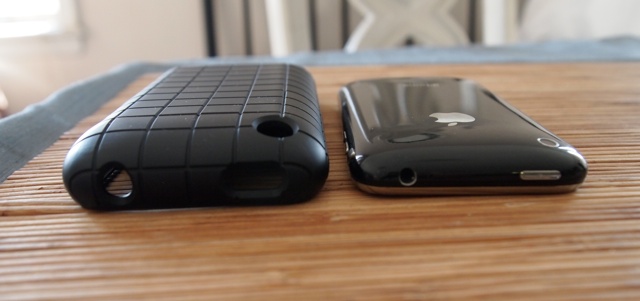
The case is its own beast, with its own pros and cons. Its major +1 would be the fact that you can toss your phone down on a pad and it’s automatically charging. But that’s really just a pro for the system as a whole. The cases, at least my iPhone case, added quite a bit of beef to the size of my phone. If I’ve learned anything about technology in my short 23-year life, it’s that “thin and light” is where the money’s at, while “bulky and heavy” is a serious no-no. Past that, the case really doesn’t provide any protection for your phone, despite the fact that it seems thick enough to stop a bullet. If you drop your phone while it’s in the case, you not only run the risk of busting your phone, but you could also mess up the case. And then where would you be?

All three cases — the iPhone 4, iPhone 3G/3GS and BlackBerry Curve 8900 — cost $34.99.

The charging pad features LED lights above both charging areas to let you know that your phone is in fact connecting to the device and receiving a charge. The Dual-Zone charger even has an extra USB port along the backside to give our gadget-packing friends an extra charging option. The Singe-Zone charger, which will launch later this year, does not have the extra USB port. This is also a magnet-free inductive charger, which means that you don’t have to worry about exact placement when you plop down your phone. As long as it’s in the right general vicinity, it’ll charge.

Now to talk about Qi: First of all, it’s pronounced “Chee,” and it is the new universal standard for inductive charging. Anything that requires 5 watts of power or less (phones, iPods, cameras) can work with Qi technology and that will be our primary method for inductive charging going forward. That means you won’t need a new charger when you upgrade to a new phone. All you’ll need is the proper accessory (unless of course your cool new phone features Qi technology already, which it very well may).

As far as performance is concerned, it took me 3 hours, 23 minutes to get my phone charged using Energizer’s Inductive charging pad. With a wired connection, it usually takes me an hour, maybe a little more if it’s completely dead. Obviously, there’s a big difference there. Time is money and nobody has three hours to wait around for a phone to charge. My fear is that because it takes so long, owners of the Energizer charging pad will resort to charging their phone through the night. This is also a serious no-no. Letting your phone stay plugged in after it’s fully charged only kills your battery, and I’m sure no one needs any extra issues with battery life.

Conclusion: In the end, what you win with this device is also what you lose. You get the added convenience of a wire-free charge but the inconvenient three-hour wait to go from dead to a full battery. It really all depends on what you hate more: wires or waiting.


Company:
ENERGIZER
Launch Date:
4/2000

Energizer is to provide consumers with solutions to their portable power and personal care needs better than anyone else, and in a manner that rewards all stakeholders: consumers,…

Learn more


Revenge Of The Killer Script Kiddies!

minor-threat

They’re out there. Be afraid. They could be anywhere, everywhere, anyone. They are shadowy, deadly, mysterious, guided by intellects vast and cool and unsympathetic. Security consultants and antivirus firms whisper legends of them to their clients to scare them straight. They are the Voldemort of online security, except that everyone is all too eager to say their name: the Advanced Persistent Threat. Hide your children! You cannot stop them!

…well, actually you probably could, and pretty easily too, but apparently most folks can’t be bothered.

Vanity Fair just wrote breathlessly about “Operation Shady RAT”, which featured “a species of malware that had never been seen before: a spear-phishing e-mail containing a link to a Web page that, when clicked, automatically loaded a malicious program—a remote-access tool, or rat—onto the victim’s computer.” Military-industrial standard-bearer Northrop Grumman is “constantly under attack by cyber-gangs.” A few months ago Security firm RSA’s SecurID systems were the victim of “an advanced persistent threat, a slow and consistent attack used by hackers to obtain specific information.” The Pentagon is alive to the APT threat, and says it is beginning to focus more on deterrence than on defence, because “each year, a volume of intellectual property exceeding the size of the Library of Congress is stolen from U.S. government and private-sector networks.” Why, just this week, San Francisco’s government-owned BART system was hacked by—

…waaaaaait a minute.

One can never be sure, particularly in this arena, but it seems that BART’s police database was hacked by … a teenage French girl, who reported: “They had zero security.” Here’s the link she allegedly used to hack them. Don’t worry, it’s no longer active. Take a good look at that URL. Remind you of anything? It should, if you’re an XKCD reader:

Ah, SQL injection, that old canard. But wait, it gets even worse:

@michaelmeehan
Michael Meehan

BART's been hacked and it looks like they stored user passwords as plain text. Looks like they missed the class on Security 101 #opBART

Seriously? Seriously? Plaintext? Who runs security for these jokers, Mr. Bean?

OK, so maybe the BART hack was a script kiddie enabled by morons. But what about “Shady RAT”? So glad you asked. Vanity Fair’s clueless hyperbole makes it sound like no one in the history of the Internet had ever sent an email that linked to a page with a browser exploit before. Earth to their editors: you’re about a decade-and-a-half behind the times. The attacker then used steganography to communicate with the compromised machines. Ooo, steganography, scary and hard to pronounce! Sure, that might have been amazingly sophisticated…ten years ago.

The RSA hack worked in exactly the same way: emails to employees with an enticing-looking attachment, plus a zero-day Flash vulnerability. And the tech media went crazy about the deadly APT attack on a security company. Are you kidding me? That’s an example of an “advanced persistent threat”? Adobe products are legendary for their insecurity. If that’s an APT, so was News Corporation’s kindergarten-tech-level hacking of cell phones.

But don’t just take my word for it: “Is the attack described in Operation Shady RAT a truly advanced persistent threat? I would contend that it isn’t, especially when you consider the errors made in configuring the servers and the relatively non-sophisticated malware and techniques used in this case,” says Symantec security researcher Hon Lau. Or as IT World trenchantly put it, re APT attacks in general: “The striking thing is sophistication of the excuses of victims, not the techniques of crackers … Only 3 percent of attacks were considered too slick for the victims to have been able to stop. That leaves 97 percent of data breach victims trying to find something other than themselves to blame.

There are genuine, sophisticated, brilliant black-hat hackers out there. Some of them work in groups. Some even work for nation-states and militaries, including, very likely, the people who hacked Google eighteen months ago. But most hacks are made possible because the victims allowed them; and we shouldn’t forget that security companies have every incentive to make the dangers seem as deadly and sophisticated as possible.

Organizations everywhere put up full-spectrum firewalls, draft byzantine and Kafkaesque security policies, send delegates to security conferences to talk very seriously in hushed voices about APTs, and make endless pointless and/or disastrously counterproductive demands in the name of security theatre, such as forcing people to use impossible-to-remember passwords

while storing those incomprehensible passwords in plaintext on databases vulnerable to URL SQL injection, as their employees open poisoned attachments sent by strangers. That’s like being so worried about whether an enemy nation-state has fired a cruise missile at your house that you forget you left your car parked overnight with the door open and the keys in the ignition. In Oakland. Worrying about APTs directed by, say, China is very sexy—if blatantly sinophobic—these days, but maybe organizations shouldn’t start worrying about the enmity of the Middle Kingdom until they’ve first established their ability to handle bored teenage French girls with a bone to pick.

Image credit: “Public Enemy / Minor Threat”, believekevin, Flickr.


Third Rail’s Powered iPhone Case Is Shockingly Clever

The high-voltage third rail that runs next to a set of train tracks is, of course, something to be avoided. The Third Rail System for the iPhone 4, however, is to be welcomed.

This friendly breed of Third Rail combines a skin-tight phone case and a surprisingly light battery pack you attach to your phone when you need a recharge.

We’ve seen charging cases before, but most have problems. Powered phone cases usually add too much extra heft and bulk to a cell phone. If you need extra battery life, you have to turn your svelte, five-ounce iPhone 4 into a pocket-stretching doorstop that adds a half inch to the phone’s length and almost doubles the weight.

Third Rail’s system is comprised of two parts — a bantamweight (0.8 ounce) black case that’s slim and comfortable, and a backup battery that snaps onto the case, but only when the phone needs extra juice.

As a bonus, the battery can do more than power up a flagging iPhone. With its pair of mini-USB charging ports (and included cables) it can charge multiple devices simultaneously. The Third Rail battery can also be piggybacked, so you can stack additional batteries on top of the primary battery for more power.

There are trade-offs, of course. For starters, you’re stuck having to sync the phone only with its included USB cable. Also, if you have any iPhone-ready music-playback appliances, you need to remove the case to use them. I ultimately found this to be a minor distraction, since the phone slides in and out of the two-part case pretty easily.

The battery practically glides on to the back of the case. While attaching the battery gave me immediate juice to continue phone calls and use of my apps, with non-use of the phone, the Third Rail topped off 50 percent of the iPhone battery in a couple of hours. After the phone went from 50 percent remaining to 100 percent, the Third Rail was practically drained. The Third Rail has a power gauge, but it’s only five LED lights, so it’s not as precise as I’d like. But I got a good enough estimate at what the auxiliary battery’s juice levels were like at the start and finish of the charging.

Recharging the Third Rail’s battery for its next use took less than two hours. Then, using the included USB cable, I filled my half-depleted iPod Nano with Third Rail juice in 55 minutes.

There’s another popular case out there with a snap-in battery, the myPower case from Tekkeon, but it doesn’t let you charge additional devices or piggyback the batteries. So, I can safely say the Third Rail System is unmatched when it comes to weight, ease of use, and versatility.

But all of this does not come cheaply: The case alone is $40, and each battery is $60. Purchased together, the set is $90. But after using it just a few times, I’d recommend you get one. If you’re short on cash, maybe just, um… charge it?

WIRED Innovative iPhone 4 case that’s protective, but thin and light. Detachable battery recharges the phone as well as other devices via a mini-USB port. Eliminates the need for the large and heavy all-in-one power cases.

TIRED Proprietary case designs requires use of its own USB cable for connected charging and syncing. Convenience comes with a high price tag.

Photos courtesy of Third Rail Mobility

iPhone-Driven Bike Computer Is Data Center for Pedalphiles


Short of bolting a sidecar to your bike, iBike’s Dash CC Deluxe cycling computer is as close as you can get to taking a personal navigator along for a ride.

Actually, its computing brains are supplied by your iPhone, which is sort of like a personal navigator anyway. So let’s just call the device a sidecar for your little Apple buddy.

The Dash CC Deluxe system has a few components: a case that mounts on your bike, various sensors (also included) that attach to your bike and your body, and a free iPhone application that turns your iPhone into a detailed bike computer. It’s compatible with the iPhone 4, 3Gs/3G, and the iPod Touch generations 1, 2 and 3.

The case, called the Phone Booth, is sturdy enough. It bolts to your crossbars with some minor wrenching, and the case itself slides in and out securely. iBike may as well have allowed you to bolt the whole thing on, since the Phone Booth is too bulky to be used as a regular case off of the bike. There’s no way you’re getting that thing into your jeans. On the bike, though, it proved solid — it survived a few laydowns and is completely waterproof, which is great news if you get caught in a downpour.

When your phone is in the case, it’s able to communicate wirelessly with the included sensors. The list of ride data the Dash is able to collect is too long to run through in full, but it covers the basic cycling computer mainstays: cadence, heart rate (included a strap/monitor combo), speed, distance traveled and hours logged.

But your iPhone is much more than a bike computer, so the Dash goes well beyond the basics.

Since your iPhone is rocking GPS, you can use the maps feature to track your location wherever you go. Forget about getting lost. You can map out your route and follow your charted course, keeping an eye on your progress, and even the weather, as you ride.

It’s also easy to stare at the thing for too long. I almost drifted into traffic on more than one occasion when mesmerized by the screen in front of me. Keep those eyes up, cowboy. However, that’s also one of the Dash’s stronger suits: Your iPhone screen is huge compared to most bike computers, and that big color display makes glancing down at your current stats when you’re cranking on your bike a lot easier.

The GPS function drains your battery, though, so iBike did the smart thing and included a rechargeable lithium-ion battery to bolster your phone’s running time. During longer rides, the battery held out for two hours before going to the iPhone’s internal battery.

While you’re riding, your iPhone retains all of its functionality. You can listen to music, check your e-mail, update your Facebook status and make phone calls on a Bluetooth headset. All at your own risk, of course.

Once you get home, you can e-mail the ride’s data to your computer, where you can track your stats — ride time, cadence, speed, heart rate and elevation, including averages and high points — using the matching desktop software. You can mail it to anyone else who has the free desktop app, like your coach or your training buddies.

Speaking of your buddies, you can also plug your data into Google Earth to revisit your ride and rub it in their faces. It was a blast to go back and retrace every switchback of a good, long mountain bike ride.

While the stat-tracking and trip data (and lap tracking and cumulative readings) are meant to appeal to the harder-core cycling geeks, its weight might not — if you’ve just dropped a few grand on a Campagnolo Super Record groupset, the Dash’s 11 ounces (including the iPhone) might be a turn-off.

Since I’m not a gram-counter, I didn’t mind the weight. I did mind that I had to take my iPhone out of my everyday case and put it in the Phone Booth every time I wanted to use it. In a perfect world, the Dash’s Phone Booth would be small enough to take off the bike and put it in your pocket.

Also, it doesn’t have a power sensor, which is another potential turn-off for the hardcore athletes. But it does have the ability to connect to ANT+ DFPM power sensors like PowerTap hubs, as well as any other ANT+ sensor you may have strapped to your steed.

All different types of cyclists can appreciate the Dash’s wealth of data: messengers, mountain bikers, long-haul tourists. Even commuters — if you’re schlepping your iPhone to work anyway, it gives you something to geek out on once you get to the office.

WIRED Easy setup and use. Display on the iPhone is better than any dedicated computer. GPS keeps you from getting lost. Google Earth tracking lets you relive your two-wheeled glory. Dashboard is customizable. Piggyback battery is a nice addition.

TIRED Too heavy for the weight-conscious. Phone Booth too bulky for off-bike use. $300 is a lot of cheese, but simpler, cheaper versions are available.

Photo by Jim Merithew

Earth to Toshiba: Come In, Toshiba

It’s kind of amazing what $880 will get you these days: 15.6 inches of laptop, with a Core i5 CPU, 6GB of RAM, a 750 GB hard drive and high-end Nvidia GeForce GT 540M graphics. Laptop buyers looking for all the basics and beyond couldn’t go wrong with specs like this, and Toshiba aims to give it to them with the new Satellite P755.

Performance is decidedly mixed. While you may spend years filling that monstrous hard drive, the P755 is on the sluggish side when it comes to general application capabilities. It’s good enough for its price class but it pales in comparison to other machines that come equipped with this round of Intel Core CPUs. The exception, however, lies in the P755’s graphics capabilities. While some of its gaming scores were just average (Far Cry 2, Call of Juarez), on one older game (Doom 3) it turned in the all-time highest framerates we’ve seen to date.

Those high-end components and gaming performance, alas, come at a troubling price. Not one of coinage but of quality. Plastic from top to bottom, to call the P755 flimsy would be charitable. The rickety chassis feels like it would shatter into oblivion were it to fall off the desk, a worry uncountered by the iffy fit and finish of things like the power socket, within which the AC adapter’s plug wobbles around like straw in a Coke bottle. The keyboard is also mushy and cheap. Typing on it is about as pleasurable as punching in your PIN at the ATM.

Other hardware issues cropped up in my testing, too. While I love all the lights on the device — the bar of backlight above the trackpad and in the array of touch-sensitive buttons along the top of the keyboard — it’s unclear why the keyboard isn’t backlit as well. Those buttons themselves are a little muddy, too. There’s no indication whether the audio is muted or the Wi-Fi is on; the buttons are always lit up in the same color either way.

Finally there’s a larger complaint to consider. The battery life of 1 hour, 44 minutes is paltry. But when it died, the P755 indicated it had over an hour of running time left. That adds up to a lot of troubling stuff to think about when it comes time to decide whether to invest in this laptop. My hunch is that its issues won’t extend to every Satellite, which means that $880 amounts to a big roll of the dice.

WIRED Big hard-drive. Some amazing gaming performance for a relative budget machine. The price is certainly right.

TIRED Cheap build, with lots of unfinished elements. Horrible keyboard. Extremely dim screen. Major concerns about battery capacity and reliability.

Photo:y Jim Merithew/Wired.com

New Roku Streaming Box Gets Smaller, Angrier

From its humble beginnings as the Netflix box to its current status as one of the pre-eminent media streamers, Roku has come a long way in just two years. And while the new Roku 2 XS doesn’t really move things forward much, it does just enough to retain that title.

If you’re keeping track, the XS usurps the XDS as the new king of the new series, with the XD and HD following in its path. I’ll just go ahead and say it at the outset: Ff you already own a previous gen, 1080p-capable Roku, this is probably not the box for you. Like the XDS, you get ethernet support and a USB port. The UI also remains relatively unchanged, with the standard horizontal scrolling “channels.”

In fact, the only differences I could find was the addition of Bluetooth support, an SD card slot, and — wait for it — a shiny little Wii-like motion controller that doubles as your system remote. Yes, it appears Roku wants to join the casual games party. And its first gift to customers is something everyone’s already sick of: Angry Birds. For free! The company promises to have more games — including Angry Birds Rio and Angry Birds Seasons (sigh) — soon, which presumably explains the SD-card slot. Still, none of this is enough to justify dropping another 100 bones.

The other obvious difference here is the look of these new boxes. This XS, along with the rest of the series, has been sufficiently shrink-rayed so it now beats even the Apple TV in terms of footprint. The tiny box virtually disappears when you place it next to your TV, which was great considering all the other multicolored junk I have attached to mine.

Roku has always done a fine job of offering a satisfying mix of big-name streaming options like Rdio, Pandora, Netflix, Amazon Instant Video and Hulu Plus, with more esoteric choices like, say, Crunchyroll. That trend continues here.

What hasn’t happened is any attempt to make the box useful to media hoarders with separate video libraries. Once again, the XS’s limited media file support casts a great big ol’ bummer cloud over what is otherwise a solid device.

Officially, the XS only supports MP4 (H.264), AAC, MP3, JPG and PNG, which, for me, meant more than half of the videos and music sitting on my external drive were useless — unless I wanted to do some converting, which I didn’t.

It’s a strange deficiency, considering the Roku’s main strength is the hefty helping of internet video it serves up to its customers. Offering a USB port and then throttling what it can play just seems, well, dumb. Still, this isn’t anything new to previous Roku owners. And the fact remains there just aren’t many media streamers out there that can offer all the things the XS does at this price.

WIRED Netflix channel now has 1080p streaming, 5.1 surround and subtitles — if your bandwidth supports it. Big, beautiful HD content on some channels like Vimeo.

TIRED Lengthy setup time. Forget about playing your MKV and other high-bitrate files, unless you convert. RF Bluetooth motion controller feature is limited to playing games, provides no navigation or UI functionality.

Photo courtesy Roku

SoftBank 007SH KT: Hello Kitty-Branded Clamshell Android Phone

hello kitty softbank

The Yahoo Phone isn’t the only unusual handset Japanese mobile carrier SoftBank rolled out yesterday. SoftBank subscribers can soon lay their hands on another one, the 007SH KT, which has two selling points: it’s designed like a clamshell feature phone (even though it runs on Android), and it has Hello Kitty written all over it.

Technically speaking, the 007SH KT is based on a model SoftBank has introduced back in May for the Japanese market. Produced by Sharp, the so-called AQUOS PHONE THE HYBRID 007SH is being marketed as the world’s first flip phone running on Android (2.3).

The Hello Kitty version shares many of the (very impressive specs) of that model: waterproof body, 3.4-inch LCD touchscreen with 854×480 resolution, 0.7-inch OLED sub-display, 16MP CCD camera with 1,280×720 HD video recording, IEEE 802.11b/g/n Wi-Fi, Bluetooth 3.0+EDR, digital TV tuner, e-wallet function, etc. etc.

For fans of the cartoon cat, SoftBank throws in menus and screens in Hello Kitty design, special icons for use in mails, a Hello Kitty calculator app, a Hello Kitty alarm clock, etc.

SoftBank plans to start shipping the 007SH KT in Japan next month.