Pro Tip: Do Not Buy An iPad From A Dude In A McDonald’s Parking Lot

largewoodenipad

Asteroid. The iPad is an awesome device, but it costs money. Even second-hand models often command more than a new Android tablet. They’re just that much in demand. But look, if a guy, moreover a guy with as the police report states has visible gold tooth, says he’s selling iPads he purchased in bulk for $300, takes $180 instead, you better check that product out before you drive home. This is unfortunately the sad story of how Ashley McDowell was scammed into buying a wooden iPad.

The story is rather straight forward. Per a police report, Ms. Ashley McDowell, age 22, was approached by two black males in a McDonald’s parking offering to sell her an iPad for $300. They said they purchased said devices in bulk and were passing the savings onto consumers. How nice. McDowell explained that all she had was $180, which the kind gentlemen accepted anyway.

Up until this point, it’s hard to argue against Ashley’s logic. I’d take an iPad for $180. Hell, I’d take a dozen. But Ms. McDowell ran head first into stupidity by not inspecting the merchandise.

You see, Ashley then exchanges her money for the iPad and drives home where she then opens up the FedEX container, for the first time, to find that *shock* it was a scam. She had purchased nothing more than a rather strange and surprisingly elaborately decorated wooden block, framed with black tape and sporting a replica Apple logo and iOS icons. The police report also describe a sort of “Best Buy sales ticket.” I’m personally more amused that the guys created such an obvious, but complex replica instead of using, you know, a normal piece of wood.

Gawker, in their usual asshole tone, states Ashley doesn’t deserve her money back as a sort of “stupid tax” and the crooks deserve to keep it. That’s clearly the wrong course of action. The money should go to the policemen who are now assigned to finding these bad men driving, as the police report states, “a white Impala with no rims and no tint” who are scamming unsuspecting little girls out of their daddy’s money. Buy those cops a keg and throw ‘em party.

7:10 pm 8/30/2011: Updated the post to clearly state that the descriptions of the crooks are from the police report, not my imagination.


Kno’s Textbooks Is Top Back-To-School iPad App With One Download Every 8 Seconds

Kno downloads map

As students start going back to college, they are downloading Kno’s new Textbooks app for the iPad in droves. It is currently the No. 1 iPad education app, No. 2 grossing iPad app overall, and a top-25 free app (more popular than even the Kindle iPad app). The app is being downloaded once every 8 seconds. The map above depicts downloads over the past 24 hours.

The app itself is free, but then Kno sells digital college textbooks as in-app purchases. Know currently offers more than 100,000 textbooks, which can be annotated, highlighted, and also be read on the Web or Facebook. After abandoning its own oversized textbook tablet, Kno released its digital textbook reader and store on the iPad last June. In recent weeks, Kno added a bunch of new features such as automated quizes, an activity stream of notes, integration with Khan Academy videos online, and 3D models of molecules generated on the fly.

The colleges with the most Kno students so far are ASU and the University of Arizona, Harvard, and UT Austin.

The early numbers suggest a strong start for Kno this semester, it’s first real availability among students. The appeal of downloading textbooks to your iPad instead of lugging around paper copies in your backpack is obvious. It doesn’t cost anything to download the app, and paying for one or two textbooks to try it out is fairly low risk for most students. Kno’s real test, however, will come later in the semester when early users decide whether to download more Kno textbooks or head back the the campus bookstore.

Below are a couple demo videos showing off Kno’s latest features:


Company:
KNO
Website:
http://kno.com/
Launch Date:
5/2009
Funding:
$89M

Kno has developed a digital learning environment for students to read textbooks, take notes, and share materials with friends and teachers. Students can access through multiple platforms and purpose-built…

Learn more


TC Cribs: A Magical Journey Through Box.net (In The Cloud)

boxfeat-1

We’re back for a new episode of TC Cribs, and this time we’re scoping out our first enterprise company: Box.net.

Don’t worry, despite what you may have heard about enterprise software, this office isn’t dull in the slightest. In fact, it’s loaded with lush greenery, oddly placed stuffed animals, and unicorns abound. Even better: one of the cofounders is a magician.

Stay tuned til the end for a trick that will leave you impressed and vaguely grossed out.

Also be sure to check out our previous episodes of TC Cribs:


Native Or Web? Bizness Apps Adds HTML5 Platform To Let SMBs Create Their Own Apps — For Both

Screen shot 2011-08-27 at 8.46.22 PM

Bizness Apps, the startup that gives small businesses the tools to quickly and easily build mobile apps, launched in October 2010 and has been growing like gangbusters, reaching over 1,000 applications, 10 languages, and over 20 countries in less than 9 months. It also recently partnered with WuFoo to give SMBS the ability to create and seamlessly add contact forms, online surveys, and invitations to their apps. The startup also has an interesting founding story that provides some useful lessons for your entrepreneurs. Check out our April coverage here.

Bizness Apps’s value proposition is simple: The startup wants to make mobile apps affordable, customizable, and simple to make for the small business owner. Thus, the startup offers a DIY iPhone, iPad, and Android app platform that enables SMBs to create, edit, and manage mobile apps without any programming experience required. You start with a template, customize them to suit your business, and then Bizness Apps makes them native apps and distributes them on iTunes and the Android Marketplace.

The startup is not without competitors in this space, as iSites, SwebApps and Mobile Roadie are targeting a similar endpoint. But Bizness Apps has a real advantage in the fact that it’s product is easy to use, designed well, yet remains affordable. The price for using either their iOS or Android platform is $39, while those that want to create both Android and iOS apps pay $59. This affordability is very appealing to small businesses looking to take advantage of mobile business without having to fork over thousands of dollars to do so.

Native apps are great and all, you might say, but what about this supposed HTML5 revolution? Where my web apps at? Nothwithstanding the fact that there’s been a hot debate over whether app developers should go for HTML5 or native apps (as evidenced by MG’s post on the subject back in February), Bizness Apps Founder and CEO Andrew Gazdecki said that he thinks the best approach is to make a bet on mobile as a whole — not one or the other.

That’s why the startup is today announcing the launch of an HTML5 version of their DIY mobile app platform for small businesses. With this new web functionality, users of the service are now able to create nearly identical mobile experiences for every mobile platform including iOS, Android, Blackberry, Windows Mobile, and so on — they can go native or HTML5, or both. For an extra $10 a month.

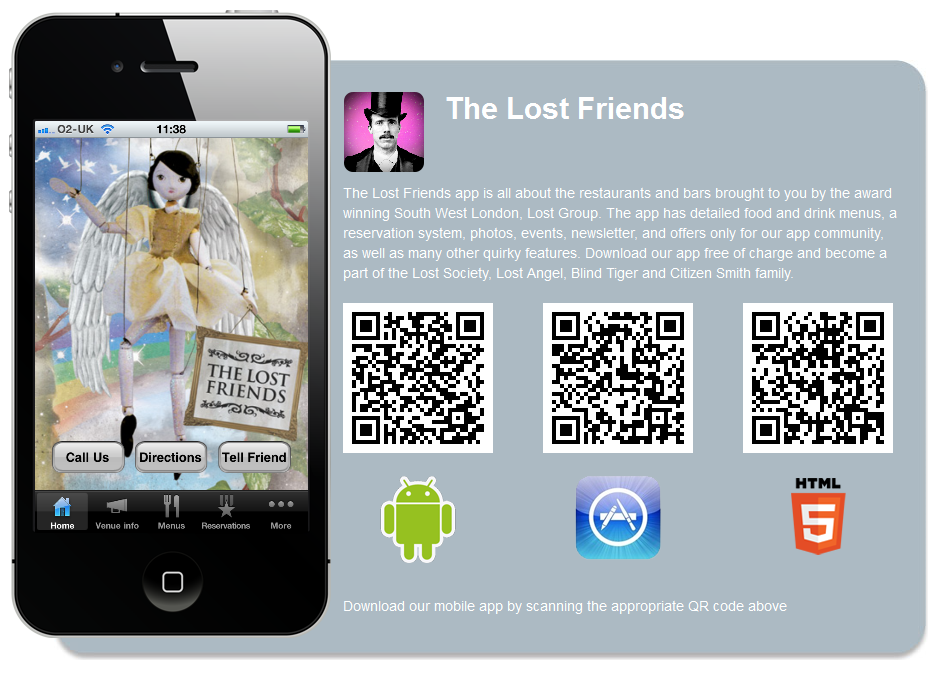
As part of the HTML5 platform launch, Bizness Apps has built a QR code-enabled mobile marketing template to provide SMBs with a simple and affordable way to market their mobile apps to their customers. The template image, as seen above, is automatically created (with the ability to print) with one click from inside the HTML5 platform.

The idea here, Gazdecki says, is to help direct a business’ customers to the appropriate app based on what type of mobile device they’re using. For example, if a user has an Android phone, they would scan the Android themed QR code to be directed to the business’ Android app.

Availability on native and HTML5 is another important piece to the puzzle in building a platform agnostic app development tool for SMBs, and with its affordability, and new mobile marketing capabilities, Bizness Apps has become an exciting platform and looks well-positioned to weather the native vs. web apps debate.

The startup is offering a coupon code for 25 free apps for TC readers, which you can check out by signing up here. The coupon code is “techcrunch”.

For more, check out the video below:


Company:
BIZNESS APPS
Launch Date:
1/7/2010

Bizness Apps makes iPhone and Android apps affordable and simple for small businesses. We’re a do-it-yourself iPhone app platform that allows small businesses to easily create, edit, and manage…

Learn more


Smart Mobile And The Thin Cloud

thin cloud

Editor’s note: Guest author Keith Teare is General Partner at his incubator Archimedes Ventures and CEO of newly funded just.me. He was a co-founder of TechCrunch.

All that is solid melts into air. There will be no web 3.0!

When HP CEO Leo Apotheker announced that the company was seeking options for its consumer PC business and abandoning the hardware mobile business its stock dropped 20%. When Steve Jobs resigned as CEO of Apple, after a 12 hour pullback, the stock rose to go above the previous close within 48 hours.

These two stories of corporate change are widely discussed, often in terms that assume the men at the center of each company are the story. However, something far bigger is in play, and it will transform the entire software ecosystem over the next 5 years. The changes will be so dramatic that the current discussions of a bubble will appear silly. Huge companies will fail and even bigger new companies will be formed.

The fundamentals of the era we are at the birth of have the following characteristics{

  • Desktop computing devices, including laptops, are being reduced to machines that are used to perform serious work tasks. Less people will buy them in future, and those who do will use them less of the time.
  • Software written for the Web 2.0 era, assuming services in the cloud are consumed by people sitting at desks with browsers, will be increasingly less relevant and used less often. Even relatively new projects like Facebook and Google + will become “old fashioned” quickly.
  • Mobile devices, and especially smart phones, will accomplish more and more of the things an individual will want to get done, and will do so more easily and productively. Adoption will be fast and volumes will be huge due in part to the ease of use and convenience of an always on device combined with powerful software and services.
  • Software and services will run on these devices and use the cloud for storage and delivery. Rich clients will use a thin cloud. The cloud will get bigger but simpler. The old web 2.0 web apps and web services paradigm will decline.
  • Apple’s iPhone architecture is best suited to this emerging human experience.
  • Google’s Android, being mainly a thin client to Google’s thick cloud (Docs, Gmail, Calendar, Contacts, Picasa, G+) will please geeks but will need to change to be the mainstream choice of discerning consumers. Its large volumes will be driven less by passion and more by commodity price points, not unlike Symbian in an earlier era.
  • Facebook, the archetypal thick cloud ecosystem, will be very vulnerable during this transition as almost its entire business relies on a cloud based architecture holding a person’s social graph and being the means of acting on that graph. A Facebook mobile app as a thin client onto this will not be as easy or as powerful for users as a real mobile social network.
  • Anybody building almost anything in 2011 should be thinking “mobile first” and possibly “mobile only”. They should be empowering smart phone owners to accomplish complex and simple tasks with the minimum of fuss and the maximum productivity. They should not require a person to go and sit at a desk for anything.

This entire shift is being driven by the ecosystem that started with the iPhone. Android, by contrast, is a backward looking architecture. It is a means of distributing old web services to a mobile audience, but it is not transforming software to meet the opportunities mobile affords or the simpler, new architectures it opens up.

Looked at from this point of view, HP is right to want to get out of the hardware business. It’s game over there for the next few years. Apple has a huge lead.

Google still has a shot at being relevant because of Android, but it needs huge changes to the Android philosophy to accomplish that. HTML5 will not be enough to modernize the web 2.0 ecosystem for a mobile future. A new ecosystem is emerging, driven by user delight with a more decentralized, user-centric mobile application ecosystem.

Facebook will be challenged to retain its lead in social networking unless it can pivot to an entirely different, decentralized, architecture. But as the most centralized of the web 2.0 success stories, that won’t be either obvious or easy until it is too late.

The next 10 years are going to be wonderfully interesting. And the thanks goes to . . . Apple and Steve Jobs. Think different is no longer a choice.

Photo credit: Pedro Szekely


Company:
APPLE
Launch Date:
1/4/1976
IPO:

1980, NASDAQ:AAPL

Started by Steve Jobs, Steve Wozniak, and Ronald Wayne, Apple has expanded from computers to consumer electronics over the last 30 years, officially changing their name from Apple Computer,…

Learn more


Company:
FACEBOOK
Launch Date:
1/2/2004
Funding:
$2.34B

Facebook is the world’s largest social network, with over 500 million users.

Facebook was founded by Mark Zuckerberg in February 2004, initially as an exclusive network for Harvard students. It…

Learn more


Company:
GOOGLE
Launch Date:
7/9/1998
IPO:

25/8/2004, NASDAQ:GOOG

Google provides search and advertising services, which together aim to organize and monetize the world’s information. In addition to its dominant search engine, it offers a plethora of…

Learn more


Hell Hath No Fury Like A SuperPoke Pets Player Scorned

Screen Shot 2011-08-27 at 7.35.05 PM

This past Thursday, Google decided they had had enough of their Slide experiment. Even though it had only been a year since they spent $200 million+ on the social apps startup, they brought the hammer down, killing all but one Slide product (Prizes.org). The casualty list included Slide projects both new and old. And that sucks for apps like Photovine which just launched last week. But one Slide app termination above all others has people really up in arms: SuperPoke! Pets. How do I know? The comment section on TechCrunch.

If you look at our post about the Google killing Slide from Thursday, you’ll find 230+ comments right now. In the Facebook comments era of TechCrunch, this is a ton. In our pre-Facebook comments era this would probably equate to over 1,000 comments. And nearly every single one of these comments is in response to the killing of SuperPoke! Pets.

Google, you just pissed off the wrong group of casual gamers. And yes, nearly every single one of them seems to be a woman. That’s why I have to give the title of best comment (and credit for the headline of this post) to Annette Samford for the following gem:

Hell hath no fury like a SPP player scorned. Shame on you Google. You could have sent that 200 mil to the homeless and left the game alone. It’s not like any new developing was going on anyway. What was it costing you? Lame excuse for ditching a VERY popular and loved game by so many.

Samford’s comment also encapsulates many of the other comments. These players are really pissed off. I’ll paste a selection of the top comments below, because they do deserve a bigger audience — many of them clearly spent a lot of money on this game over the years. And they’re taking to the TechCrunch comment section because the official Slide post has no comment section.

Tonya Surbaugh:

People get to transfer photos but what about the LOYAL superpoke pets players? Not to mention all the $$$ spent on the game to see it go bye bye? GOOGLE + you say? I say hell to the NO!

Barbara Puder:

I started playing SuperPoke Pets because it was different from other games. It’s more social than any of the other games I’d played, and appealed more to to my creative side that the shoot-em-up or compete with other players type of games. Playing SPP is relaxing and fulfilling, without the time-crunch aspects of games like Farmville and Mafia Wars. (Really, Mafia Wars? We don’t have enough violence already?) I think it’s a huge mistake to eliminate this unique method of social and creative interaction. Please think very hard before pulling the plug, and reconsider what you could do with this game given the appropriate development and support.

Kitty Kurburski:

I too play Superpoke Pets and if you are taking it are you going to reimburse those of us who have spent money buying items for the game? This is a very sad day if you take our game. We love it.

Deborah Argerake:

Class action lawsuit requesting reimbursement for $$$ spent. Even after the slide team knew they were getting shut down, the promoted more sales. That seems a bit shady if not totally unethical. Could it be considered illegal? Any law student players out there want to bring this question to your professors?

Brianne Lane Baker:

I am very sad to see Superpoke! Pets go too! It’s the only game I have spent 2 years playing. I made lots of friends and loved how creative people could be with the game… never known another game that allows so much creativity.

Janice Hayes Scullenger:

this is the most hateful thing you could have done. millions of us on on this game. most people have disabilities and this is what they have. we have developed friendships. alot of people have spent tons on money on here. are you going to give them that back? but most of all you are taking away something that we have poured our heart and souls in. I have been on this game for over 3 years. I have some truly awesome people that I look forward to speaking to every day. I will drop all my google emails, change my servers and have over 3000 people on my yahoo account that will be more than happy to help me spread the word that google doesn’t care about the people that put faith in them. does google kick dogs and steal candy from babies too?

Lisa Morris Foster:

To say I am upset is an understatement! We all bought into you VIP for free from now on, after you stopped charging for gold. You knew that we would all spend the $$ to get it! I have invested thousands into this game. I think that I should be able to put that masterpiece I bought into my living room! Sell Slide to someone who might actually want to make some money and run it right, instead of running it into the ground! Google, you have let us all down! Make this right!

Michelle Strong:

WTF! Why did you buy Slide just to shut it down? I only play Superpoke Pets and I am not happy

Michelle Rustray Serrano:

I am so bummed..I must say I knew it was coming..SO my promise to YOU GOOGLE..I will NEVER use or buy a Google product EVER..YOU SUCK!

Jennifer Gyurkovic-Hagmann:

Hey Google! I expect a check in the mail for all of the gold items that I have in the SuperPoke Pets game. You do realize that people paid REAL MONEY for gold items, don’t you? If you do not make this right with all of the SPP players, I will never pay for anything Google ever again. I will also tell all who will listen what has happened here and how you care so little for the consumer!

Cathy Allaire:

IF YOU KILL OFF SUPERPOKE PETS, I WILL NOT EVER USE GOOGLE CHROME, GMAIL……NOT A SINGLE THING THAT YOU OWN…….SUPERPOKE PETS IS A GREAT GAME…..ALLOW US TO DOWNLOAD SUPERPOKE PETS TO OUR COMPUTER, SO THAT WE CAN CONTINUE TO PLAY OUR GAME. WE HAVE SPENT ALOT OF MONEY ON THIS GAME, AND IT IS SO UNFAIR TO TAKE IT AWAY FROM US.

Irene Schleinkofer Pedrogo:

Are you Freakin kidding me! This is BullShit! I’ve spent Alot of MONEY on Superpoke Pets I think YOU should THINK of something else to do so I don’t Loose my GOLD ITEMS!

Lisa T Spp:

I’ve heard of suicide missions but this tops them all! If Google really does shut down SuperPoke Pets they might as well close their own doors at the same time. As for Max Levchin leaving to pursue other opportunities, I don’t think anyone here would ever support any endeavor he undertakes. I, like millions of other players invested a lot of money into Slide through the SPP game and I view this no differently than if I had invested money in any other company or any other commodity. I foresee a major class action suite in the works if this all goes down. So much joy turning into so much sadness.

Clarice’s TeeTee:

spp players……….. who would join together in a lawsuit to get our money back from the items we have purchased?

And, for some levity, Wayne Elgin:

Favorite part of this post? The Farmville moms trolling TC.

Your move, Google. A number of players are now threatening class-action lawsuits due to the money issue. We’ll see if they follow through on those threats, but this situation could be a bad one for Google — especially when you consider that they just launched their own casual games section on Google+.

Here’s a dumb question: why doesn’t Google just move SuperPoke! Pets over to the Google+ Games section? Clearly, it has a rabid fan base. In fact, why not just move all the Slide games over there?


Company:
SLIDE
Launch Date:
1/8/2005
Funding:
$78M

Slide, founded by PayPal co-founder Max Levchin, makes widgets that help people express themselves. The company took a big risk in 2006 when they gave users the ability…

Learn more


Company:
GOOGLE
Launch Date:
7/9/1998
IPO:

25/8/2004, NASDAQ:GOOG

Google provides search and advertising services, which together aim to organize and monetize the world’s information. In addition to its dominant search engine, it offers a plethora of…

Learn more


Disney Inks Deal with Greenbox, Chinese eCommerce Is Taking Off

mail-1

A lot of Americans desperately want to believe that China is full of poor people who can’t innovate, and the only goods they make are cheap, toxic rip-offs our Western brands. They want to believe the only reason the Chinese economy is surging is because the West wants cheap goods and China knows how to make them that way.

These people will hate this post because it’s about a company called Greenbox that flies in the face of those preconceived notions.

Greenbox makes high-end, super-styled kids clothes in and for the Chinese market. It caught the eye of Disney, which reached out to the company to ask if it wanted to manufacture some of their lines. “No thanks,” the company replied. “We’re not interested in just being an OEM.”

Wait, isn’t this China we’re talking about? It’s a country of OEMs.

The mouse house came back with a sweeter offer that’s being announced at a ceremony in China tonight: It has licensed the rights for the princess collection, Mickey Mouse and Minnie Mouse and Winnie the Pooh to Greenbox. The company will design a high-end online collection to be sold online in China, as part of a broad plan to help build hype for the upcoming themepark in Shanghai.

Greenbox was founded more than ten years ago by a designer named Fangfang Wu who started to make clothes for her kids because she was so unhappy with the cheap, boring ones being sold in the country at the time. She obsessed over fabrics, fashion and design and a hobby quickly turned into a business, as she opened a chain of stores, and later closed those stores to sell on Taobao for better margins.

She was one of the top grossing sellers on Taobao as her designs struck a chord as with other young, working women in China who wanted to flaunt their increasingly hip and unique tastes. (I mean, look at that outfit above. It’s like a little Chinese Natalie Wood playing Red Riding Hood. How is that not adorable?) In 2010, DCM’s China office sought her out, investing just over $10 million to help scale the business.

Today Greenbox is bringing in about $50 million in annual revenues on decent margins. She charges between $30-$40 for items— not absurd, but certainly on the higher end for kids’ clothes. “It’s a classic case for venture capital: High gross margins, but takes money to build it to scale,” says Hurst Lin of DCM.

Note I didn’t describe Greenbox as the fill-in-the-blank of China. In fact, I’m hard-pressed to come up with an ecommerce model she’s ripping off from the US. Kids clothes hasn’t been a natural vertical for etailers here, save being an offshoot of a site like Amazon.

The reason Greenbox has worked so well for China is cultural. Because there are so many only children, there are at least six people wanting to lavish them with cute things: The parents, and two sets of grandparents. This was the same insight Tencent tapped into to monetize its virtual goods early on.

So, Greenbox: Not a copy cat, and not the invisible cheap assembly partner for the West either. Welcome to the next stage of Chinese entrepreneurship.

Greenbox is part of a crop of booming ecommerce companies in China. For years, the market has been held back due to the typical challenges of shipping, infrastructure and payment platforms. Jack Ma, of Alibaba, has long said ecommerce would be bigger in China than here, and that’s not just because there are more people. In the US, he calls ecommerce “dessert,” but in China there are so many people underserved by brick-and-mortar retail that ecommerce will be the “main course.”

DCM and other firms have been aggressive backing many new ecommerce players, and they aren’t as simple as just being the Amazon of China. (Although, to be fair, DCM backed one of those too.) Many of these companies, like Greenbox, show a sophistication in appealing to what the Chinese market wants, not simply what’s worked elsewhere.

A surprising vertical Lin seized upon that has never proved lucrative in the US is wine. As incomes soar, many Chinese are developing a taste for Western wine, but have trouble finding interesting vintages and even navigating the language barriers, he says. His bet, YesMyWine, isn’t just an ecommerce play, it’s a content and media play.

He was delighted the PR contact on the call brought up another hot DCM ecommerce company: La Miu, which makes sexy lingerie. I could hear him squirming as he tried to explain– delicately– why Victoria’s Secret failed miserably in China, while more recently La Miu has succeeded.

Victoria’s Secret tried to market to women in their 30s who wanted to be comfortable not sexy. It was a bit too early in China’s consumer revolution and husbands weren’t demanding sexier underwear so ever-practical Chinese women just didn’t see the appeal.

Victoria’s Secret made another mistake that Lin tries to explain as tactfully as possible: Asian women have… different bodies….than Western women.

But La Miu has taken a totally different tact: Marketing underwear designed for the Asian body type to teens. “Born in the late 1990s they are much more a global consumer, they are open-minded and more rebellious,” Lin says. “It’s been a huge success.”

As I’ve written before, China’s ability to be the assembly line to the world wasn’t where its role in the global economy ended; it was where it began. An ability to make products cheaper than anywhere else gave way to an ability to make high end products more nimbly than anywhere else. And increasingly, entrepreneurs like Wu are adding design and brand on top of that to create products the broader world will want.

The first generation of Chinese entrepreneurs was about picking the low-hanging fruit in a massive country just opening up to capitalism. Now the real fun is starting.

(Shameless plug: Join TechCrunch at Disrupt Beijing in October to learn more.)


Financial-organization:
DOLL CAPITAL MANAGEMENT
Website:
http://dcmvc.com
Launch Date:
1996

DCM assists entrepreneurs building world-class companies that will ultimately change how institutions and people use and live with technology.

DCM focuses the size of their team, the money they raise,…

Learn more


Mobile Ad Network Millennial Media Saw Nearly $50 Million In Revenue In 2010

millennial-media-picture

We’ve known that mobile ad network Millennial Media more than tripled revenue in 2010 from 2009 and achieved profitability. But we didn’t know how much the mobile ad network brought in, until now. In the recent 2011 Inc 500 list, Millennial revealed that it saw $47.8 million in 2010 revenue, up over 3,000 percent from 2007 revenue of $1.5 million. And while we don’t know what Millennial’s net income is, we know the company is profitable.

Millennial is one of the largest remaining independent ad networks after AdMob was bought by Google and Apple acquired Quattro. There’s no doubt that many technology companies have eyed Millennial as an acquisition target, but the company has managed to remain independent despite the increased consolidation taking place in the mobile ad space.

In addition to Millennial’s independent ad network, the company also operates and manages private mobile ad networks for large media companies and conglomerates that have multiple apps and sites, essentially powering a self-service ad network for these companies. And Millennial has a deal with a “prominent internet media company” (but declines to name the company) that has completely outsourced its mobile advertising to Millennial.

For basis of comparison, AdMob reportedly had a $100 million revenue run rate when it was acquired in 2009, which could have put its actual revenue at $40 million (AdMob split its revenues 60/40 with publishers). It’s unclear if Millennial’s $47.8 million in 2010 revenue is post-split.

Hopefully we’ll see more details of Millennial’s financials when the company files its S-1 for a public offering in the coming months. CEO and founder Paul Palmieri has had ambitions of taking the company public, and the timing may be right considering this seems to be the year of the tech company IPO. In May, Bloomberg reported that Millennial was talking to bankers about an IPO, which could come in the Fall or in early 2012 and would value the company at a whopping $700 million to $1 billion (AdMob was sold to Google for $750 million).

Considering how most companies refuse to reveal exact financials when they are private, it’s always interesting to see revenue numbers pre-IPO.


Company:
MILLENNIAL MEDIA
Launch Date:
5/2006
Funding:
$64.8M

Millennial Media is the leading independent mobile advertising and data company. Millennial Media commands an impressive share of the mobile display advertising market. The company’s technology, tools and services…

Learn more


Connected

Screen Shot 2011-08-27 at 10.49.50 PM

“They have Internet in Europe?” my friend in the US asked via Facebook Messenger, as I checked into Foursquare from the Athens airport.

Yes Virginia, they do have Internet in Europe, or Greece specifically, provided you buy an expensive worldwide data plan for your iPhone before you leave the US, and then watch it like a hawk so you don’t go over your allotted 340 MB of data. $99 to stay connected.

Upon arrival to my brother’s house in Athens, I was told that I couldn’t call Greek cellphones from our landline, as they were too expensive.

My brother’s advice was to buy a dumbphone for 15 €? ($21), and then use a 10 €? credit to make calls to cells. Another 25 € ($36) to stay connected. One call to my friend’s cell to confirm our travel plans later and that credit was gone.

So until I plunk down another 10 € ($14) to stay connected I’m basically stuck with an iPhone in default airplane mode as my only way of communicating to the outside world. And as I desperately downward swipe my Twitter feed and frantically try to reload Instagrams from the beach, only to meet with the taunting Failed message over and over again, the dumb phone sits unused in my purse. It has a game on it I think.

Mark Zuckerberg said once that he knew that Facebook was successful when his friends told him that they had seen it open in European Internet cafes while traveling. While a lot has changed since then, the gnawing impulse to check Facebook or whatever your social media drug of choice while you’re purportedly trying to escape has only grown stronger.

For many of us with #firstworldproblems, ubiquitous Internet has become a utility, like electricity. Thus it seems odd to visit a household without a wi-fi connection, it’s almost like saying um, “We don’t have lights, and you’re just going to have to make due without them.”

But, as anyone who has traveled is aware, not everyone lives in the #firstworld. And thus I have spent a good part of my Greek island vacation chasing connectivity, using my iPhone as some sort of Internet divining rod, and meeting obstacles at every turn. CONNECTING. CONNECTING. NOT CONNECTED.

A Greek WIND USB data stick? Incompatible with OS X Lion (Really). Something called “Free Internet” that pops up as I drink my morning coffee in the town square? Turns out it’s not so free and not so Internet.

Finally yesterday night I saw some guy at a café working on his laptop at a bar and rushed over in hopes that I had come across some wi-fi hotspring. “How do you have Internet?” I asked him in Greek. “I brought my own.”

Because of this tenuous connection to the outside world I have missed out on all the details of Steve Jobs resigning as CEO of Apple and have no idea about Hurricane Irene. Someone apparently leaked a Greek Wikileak, and I’m too afraid of going over my data plan to load it. Oh and what’s up with Twitter Recent Images?

An iPhone in Greece costs 650 € ($ 936)?, and the unlimited data plan another 50 € ($ 72) a month. The average salary in this time of widespread economic crisis is 1000 € ($ 1441)? but still enough people own pricey smartphones that Foursquare is over-populated with obscure Greek venues. My Greek friend also has a similar dumbphone to my newly purchased one, for when she goes over her iPhone data allotment.

“So,” you say, “Get offline and enjoy your vacation you dork.” Sure, but nowadays if a trip isn’t posted to Twitter, Instagram and Facebook, does it make a sound?

Thus I have started to be jealous of anyone with more online connectivity rations than I, mobile or otherwise. Yesterday as one of my traveling companions fingered her phone under the table I whispered, “Instagram or Twitter?” “Neither,” she said, satisfied. “Neither?!” I said incredulously. “Yeah, I’m on Foursquare, trying to figure out what the name of this taverna is so I can check in.”

Right. I am typing this from a hotel room with no Internet connection, and plan on walking downstairs to something called “Internet Point Prive” in order to post it to TechCrunch. “Internet Point Prive” actually sounds like you should be getting bottle service or champagne with your Internet. It sure costs enough.

Connected.


(Founder Stories) Buddy Media’s Mike Lazerow: “We Are Doubling Every Six Months”

Screen Shot 2011-08-27 at 7.44.34 PM

Mike Lazerow is a serial entrepreneur who is the CEO of Buddy Media and previously founded GOLF.com, which was bought by Time Warner and University Wire and is now a property of CBS.

With a couple of successful startups under his belt, we decided to bring Lazerow into the studio for an episode of Founder Stories with host Chris Dixon. Right off the bat the two discussed Lazerow’s latest venture, Buddy Media, which just raised $54 million. Buddy Media helps brands cohesively manage their social media presence and marketing campaigns on sites like Facebook, Twitter and YouTube.

Once consumers are connected to the social media sites “it is all about giving them relevant content and that is what our platform does” explains Lazerow who describes how Starwood Hotels and Resorts uses the service. Every brand, he says, is now expected to have a Facebook page to connect with consumers, but once they do connect then they become publishers of sorts, pushing what they hope is relevant content to those consumers.

Continuing the conversation in the video below, Lazerow talks about the strategy behind building the company and offers some numbers. He tells Dixon, “It all starts with the product. Whatever you do if you are not the best on the product side the business doesn’t work, there is a reason we have 9 out of the top 10 global marketers using our platform.”

However, Lazerow notes having a great product is just one part of the equation. You have to build a great business. He credits his wife and co-founder with scaling the business.

He says “it is not just about a great product it’s about how you sell it and how you support it and so we invested in that early and what has happened is our early success with clients kind of spread … and we became the go-to player.”

The strategy paid off. Lazerow notes that Buddy Media has raised a total of $90 million, of which $70 million is still in the bank. The company is generating “millions of dollars a month” in revenues, which are doubling every 6 months, and the company has jumped from 40 employees a year ago to 200 today. He goes on to tell Dixon “once you find a business model, that is the time to scale.” It took 20 months to get to the first $1 million of monthly recurring revenues, the second million dollars took only 5 months, and now the business is adding another million dollars in monthly recurring revenues every 3 months.

Check out the video for additional insights and make sure to watch past episodes of Founder Stories, located here.


Company:
BUDDY MEDIA
Launch Date:
1/9/2007
Funding:
$90M

The Buddy Media Platform is the social media management software of choice for eight of the world’s top ten global advertisers. With its scalable, secure architecture and straightforward administrative…

Learn more


Person:
MICHAEL LAZEROW
Website:
Companies

<a href="http://www.crunchbase.com/company/buddymedia" onclick="Buddy Media, <a href="http://www.crunchbase.com/company/savored" onclick="Savored, <a href="http://www.crunchbase.com/company/savingstar" onclick="SavingStar

Michael is a serial entrepreneur who has co-founded four successful internet-based media companies. He has a passion for creating, managing and growing companies from the ground up.

Michael’s first foray…

Learn more


The Long Hard Road To The Edge

SunEdgeLogo

A Year In The Life Of An Entrepeneur

1. July 2010: Ready: Set:  Delaware, the state with the lowest highest point. David Argentar, a biochemist by training and bioinformaticist by trade, has launched a startup. Of sorts. Well – more of a hobby, he’d be the first to admit. He has no business plan, no investors, no employees. All he really has, in fact, is an idea and a pending patent. And as everyone is eager to tell you these days, ideas are a dime a dozen, and patents are practically a scam.

It gets worse. Much. His idea is hardware. A new kind of solar concentrator, to be exact, made mostly of water. His first version was too heavy; but he thinks his redesign could conceivably, in his wildest dreams, drive down the cost of solar power by quite a lot. But—come on, now, really—a hardware startup? With only one founder?

Hardware is hard. It allows for no binary abstractions, no digitized purity to protect you from the real world. It is the real world, in all in its vicious and unforgiving glory, perpetually at the mercy of a hundred unexpected environmental factors. And almost by definition it is incredibly expensive to develop. I should know: I myself have a degree in electrical engineering – but I fled to the warm embrace of software as soon as I graduated. Hardware was much too temperamental for me.

Argentar, fortunately, is made of sterner stuff.

Good thing, too. Over the next year he’s going to need everything he’s got.

2. August 2010: Minions! Go! Argentar acquires two new things:
* a small crew of university undergraduates who have signed on for a work-experience term. They may not be experienced, but they only cost $5K/month.
* A blog. What follows is a selection of its greatest hits over the next roller-coaster year. (No, you can’t go read the whole thing: it’s mostly private. I have some access because I’m a friend of a friend.)

I have a tiny start-up, but I hesitate to call that my job, ’cause it doesn’t pay me anything, and in fact has an impressive burn rate. Since my patent applications will become public soon, I’m slowly lowering the veil of secrecy around my full-time hobby.

He and his minions get to work designing a working prototype of his concentrator. Everything seems to go well for a couple of months, until –

3. Early October 2010: Mo’ Hardware Mo’ Problems. They hit the first of many hardware pitfalls: parts. As Argentar says, “Badly written software often still runs, but badly build hardware usually doesn’t.”

Having now spent a long time on the phone with various prototype outfits, we’ve found that a couple of the ones we wanted to work with are offering very coarse tolerances. Both the rapid CNC-machining place and the one outfit that’ll do “rapid” extrusion (still a six-week lead time (because they have to make a die, then test it, then send us a sample part for approval, then adjust the die because the sample is wrong, then and so on and so forth)) are saying they can manage only ±0.01″/0.2mm on key dimensions. That’s too crude for optics work; ten-fold finer would be better.

and meanwhile

One of the other things we still need is a light source that can simulate full sun. I’m leaning towards LED arrays, and trying to get the overall power in the visible, NIR (meaning wavelengths < 1100nm, the bandgap of silicon solar cells), and far IR bands approximately correct. Problem: finding LEDs with longer wavelengths is difficult, and they’re not very efficient ( ? very expensive) … The IEC is willing to let us use their new full-sun test cell… if we’re willing to wait until december, which, um, we’re not. *sigh* So, we still need to come up with some way of simulating sunlight.

I suspect that if I wasn’t captain of this ship, I’d be running for the lifeboats already. (The students can’t run; since they’re graded on this, they’re effectively chained to the benches.)

4. Late October 2010: The Scramble For Solutions.

The current plan for simulating sunlight is to use quartz-tube radiant heater elements combined with red and green LEDs to build up more or less the right spectrum. While the spectrum will be crudely approximated, this approach has the advantages that the heater bits are already long and thin, the LEDs in question are both cheap and efficient, and unlike using high-intensity IR LEDs to build up the IR spectrum, are unlikely to accidentally blind anybody. (Since I know academic labs are really sloppy about safety, I don’t want my team messing around with gear that can do them serious harm on my orders. I can’t help if they electrocute themselves with high-voltage power supplies, but I can avoid adding to the risk.)

Ah, another charming quirk of hardware: the threats of, say, accidental blinding or death by electrocution. Have I mentioned that I really like software?

The other problem is solved by the simple expedient of throwing his scarce money at it:

I’m going to buy a ~$15k mold, which probably won’t be useful after this prototyping stage. I can’t really afford this, but the other alternative would be to essentially abandon the student prototyping effort. I might be able to take the monetary loss on that, but the time is gone for good, and I’d still need to find a bunch of engineers to build a prototype for me. (That’s been previously estimated at $50-100k, and I certainly can’t afford that without investors, grants, or loans… but the point of having a prototype is to demonstrate that the technology is worth investing in.)

Writing off a $15k mold, but having labor at a fixed $5k/semester isn’t so bad… I could be flailing around while paying professional engineers $200+/hr each to help me learn in a particularly inefficient manner.

5. In Which Our Hero Considers The Lessons He Has Learned The Hard Way So Far

Observations:
* I was even more unprepared for this than I suspected. Specifically, I should have done much more groundwork talking to vendors about tolerances and lead times.
* I’ve learned an expensive lesson about manufacturing tolerances and the difficulties of dealing with them. But I can’t see that there was anything that I could have done to prevent this, since I was too unfamiliar with the problem to grasp its difficulty.

6. November 2010: Plus/Minus

+ ordered optical components for prototype today
– critical path has no slack left
– discovered that bank silently reduced credit limit on company card, necessitating use of personal card for the Part of Unusual Complexity.
– still need to catch up on far too many things from ~9 week push on this project

7. Catastrophe Redux

Oh yes. Another endemic hardware problem: it breaks.

My student engineers and I have run into a little crippling problem with the prototype light concentrator array we’re building: the bare solar cells are too fragile to handle. We’ve broken most of ones we had trying to mount them, even handling them with tweezers. So, I’m looking for ideas on what to try next. I figure somebody who reads this must have some experience working with fragile things. …anybody got other ideas?

8. Into The Melee

And now, on to a milieu perhaps even less forgiving than hardware: business development.

I talked to a new lawyer (at the same law firm) about the contract I want to sign with the current /bus/dev/ folks. It turns out the reason my patent attorney wanted me to talk to him is that he tried to start a company, but was betrayed by one of the hired suits they got to run it, which caused a funding deal to collapse.

So… he had lots of skeptical things to say about /bus/dev/ companies and in fact anybody else who tries to get money out of start-ups. In short: caveat emptor, and keep your laser legal team handy. and now I’ve got a long list of questions to ask the /bus/dev/ guys about the contract and a another measure of circumspection to add to my deep suspicion of the /bus/dev/industry.

iIm also clear that the fundamental relationship I’m entering w/ the /bus/dev/ guys is prospector to over-priced-equipment vendor during a gold rush. While lots of people talk about “long term relationships”, it’s fundamentally true that the /bus/dev/ guys are paid in cash, and if my company flames out, it will at worst just disappoint them.

9. December 2010: Victory Snatched From The Jaws Of Defeat?

It appears the solution to the strengthening and handling question is double-sided tape. It’s cheap, it’s off-the-shelf with no lead time, and it’s relatively strong… The cells we have wired up are working very close to perfectly, which is a big relief.

As expected, our construction schedule has gone *poof*! one vendor — who shall remain nameless so long as they don’t further annoy me — finally shipped parts, only two and a half weeks late. But we now have the parts and test equipment in hand. That sounds lame, but it’s a surprisingly big step: it means everything could be manufactured with very short timelines, and was.

Most importantly, the quality of the optical components is far beyond what I was expecting … this means that an extremely cheap process can produce a difficult part for pennies a square meter. My fantasies involving lopping two-thirds off the price of solar power seem much less fantastic now.

I’ve just signed the contract hiring a business development firm. Because of the way it’s set up, I’m up on the hook for at least $16k over the next two months. Even though I’m fully aware of the cost of doing business as a high-tech start-up, that’s still bracing.

10. Victory!

Q: what is the fully amortized cost of a watt of electricity generated from coal?

A: $2.22

Q: what is the fully amortized cost of a watt of electricity generated by a short production run of my panels?

A: $2.17, according to my student engineers. I have not verified this number, nor do I know what assumptions went into it. I know they haven’t thought too hard about it, because they got the production cost estimates just this morning, so I suspect there may be some error.

However, this is for the existing design, which is just a step up from bear skins and stone knives… and a longer production run gets the cost down to around $1.50/W, according to the students. This is strongly suggestive that with a better design, some cost engineering, and a production run of hundreds of thousands of panels, I’ll be able to reach the mythical $1/W cost, and dominate the world power industry (insert maniacal laughter here).

11. …maybe.

Revised A: $2.58

That’s a very rough cost of manufacturing one of my panels to produce a watt of power at peak rating. It’s not as useful a number as I’d hoped, but still isn’t bad either. It’s deliberately a high estimate, since where we had to fudge extrapolate numbers, we aimed high, so that all the error is against us. For example, we used the retail cost we paid for a single box of 12 solar cells to estimate the cost of silicon in the system. Just accounting for regular wholesale markup should roughly halve that, and bulk orders from solar cell foundries might reduce it to a tenth that.

Since plastic and metal costs were roughly equal to the cost of silicon in our spreadsheet, that knocks the guesstimated peak watt cost to a buck and change, easily enough to undercut the grid. Go us! I’ll eventually have to get a total cost of ownership, but looking at other vendors’ claims suggests that will put me ahead of the game — nobody wants to own up to that.

12. January 2011: The Patent Game

An international patent examiner has looked over the prior art and found a patent he claims makes my work obvious. Which would be a crippling problem except for the similarities ending with the words “light concentrator for solar energy use”. As it is, it’s just a nuisance: I know about this patent, my attorney knows about this patent, and we know how to overcome such claims.

I don’t want to say the differences should be obvious on inspection, but they’re very easy to state, largely involving mechanical complexity and cost of the prior art. Oh, and just some utterly trivial differences in the way it functions. I mean, a diesel engine is just like a steam engine, right? Y’know: pistons, heat, intake, exhaust, motion, blah, blah, blah.

Legally, inventors are expected to know the entire prior art in the field they’re inventing in. Inventors are also expected to cite all relevant prior art in the patent application, although the law punishes only deliberate omission. The main practical effect of having cited it is that we also listed a few reasons it doesn’t apply, so later, binding examinations can see that we were already aware of the prior art, and give our objections more credence.

Apparently, I got off easy. It’s unusual that this round of patent examining finds only a single pre-empting patent. This is a very good sign that my patent application will succeed, and gives me hope that it will issue quickly.

13. The Business Game

The business plan has been declared done. What we ended up with sure looks like a best-seller: even allowing for huge mark-ups and large, unanticipated costs, we think that my solar arrays can undercut the power grid with another year’s worth of engineering, and a year after that the company will turn a profit of a half million dollars. Growth thereafter is limited only by our ability to raise capital to keep up with demand.

Now, everybody who deals with business knows this is genre fiction, but one of the little white lies of the business world is that we treat it as fact.

14. February 2010: Running To Stand Still

My to-do list grows without bound, which is a fancy way of saying I’m overwhelmed. There are simply more things to do than I have time for (at least while preserving what’s left of my sanity). Bringing investment in will help some, but too many of the things seem to require me. While gathering data tomorrow, I’m not — for example — working on my pitch for the upcoming poster session. While the /bus/dev/ guys can do a lot of that stuff for me, I have to polish the result for my speaking style. And I need to chase after a particular business contact who the /bus/dev/ guys don’t know yet. And so on.

15. March 2010: The Rubber Chicken Circuit

15a:

I talked to a local angel/VC fund. Only three guys from the fund there: the head, his lieutenant, and their minion. They seemed very interested, and asked lots of questions. The head even called up another VC that only does energy plays, and gave them my pitch(!). Other VC interested: asked detailed technical questions, wants to see business plan.

Result: their lips said no, but the way the /bus/dev/ guy interprets their answer is that they want the energy VC (or possibly somebody else) to take the lead, and they’ll follow, because they lack the technical background to really evaluate my technology. The /bus/dev/ guy thinks that if the energy VC is interested, the two funds will will come up with all the money I need to get stuff on the market, ~$850k, probably split $600k/$250k. /bus/dev/ thinks this is the sort of deal they want because they asked for our nominal valuation ($3.25 million, by the pneumatic valuation method, ie we pulled a number out of the air), and didn’t balk when we said that the $850k would get them about a quarter of the company. (We don’t think they’ll take that offer, but merely accept that it’s our opening position.)

15b:

This group was a large investor consortium; there were 33 people at the table, and some unknown number watching via video conference at remote sites. They were interested, but asked a bunch of questions I didn’t have answers to, mostly about money. Fast, definitive turn-around, though: they voted while-I-waited. Answer: no. The claimed reason is that they look at later stage companies. We suspect they’re concerned about technical risk.

15c:

An investment fund said no. I knew this pitch wasn’t gonna go well as soon as they said their investors are union pension funds. While they’re looking for risk to drive up returns, they’re not looking for that much risk. The feedback we got was worth the nickel, though. They like the technology, but want to see some operating experience. That’s the same as we’d gotten from the previous bunch who were unimpressed.

16. May 2011: Seeded!

I now have

1) a logo
2) investors
3) a salary

which means this quixotic quest goes from being an expensive hobby to being a job. My salary is charmingly low, but its real point is just to make it possible for me to continue to play tech entrepreneur until Serious Money shows up, which ought to happen after the next prototype has sat on peoples’ roofs for a few months.

17. July 2011: Preparing For Liftoff

Need to round up engineers soon. Way behind on that as a consequence of being way behind on working up my data. To paraphrase an ancient videogame, “startup geek needs staff, badly.”

Today, Sun Edge has $200,000 in seed funding, and a new batch of students is working on the concentrator’s frame and cooling system, while professionals are being brought in to build the next, fully functional prototype, with a target date of early 2012. Argentar has already sunk a year of his life and $100,000 of his own money into the project … but even though the science still seems very promising, there’s no guarantee of market success. An entrepeneur’s life is never easy. When he or she is building hardware, it’s even harder.


Fortune First, Fame Later—Why You Should Aim For The Enterprise

Geoff McQueen

Editors Note: This is a guest post written by Geoff McQueen, the cofounder of AffinityLive, a business management platform for professional services. McQueen recently moved to San Francisco from Australia.

Who doesn’t get excited about the consumer web? Google, Facebook, Twitter, Zynga, Foursquare. Billions in revenue, Hollywood movies, overturning indistries, and curing boredom. So it is natural then as a startup entrepreneur that you’d first think about doing a consumer web product. But as someone who’s been a tech entrepreneur for a decade outside the Valley, the one thing we’re not told is that unless you’re in one of four or five places on the planet, you’re almost certainly doomed to fail in the consumer web.

Why? Because consumer web plays, for all their allure, require two ingredients you’re not going to find in Sydney, Vancouver, London, Johannesburg, or pretty much anywhere else: they need big markets and big money.

Big Markets

In the United States, if you want to reach a million users in a consumer play, you need to convince one in 260 people to use your product. In China, you’ve got to get just under one in 400 people to get on board. But if your startup is pitching to users in the UK, you’ve got to achieve more than 5 times the penetration of the US. The same goes for France—it might be close to the UK, but as a market it might as well be in another galaxy. Germany is only slightly better. And in my homeland, Australia, you’ve got to achieve almost 20 times the penetration as in the US—to get to a million users, you need to be able to convince 5 people on that bus you caught to the city to use your product—profitably, and scalable across the entire market.

Given that the economics of most consumer web plays are based on selling access to an audience, if you’re not in a big market, you’re pretty much screwed. Which is why unless you are in Silicon Valley, New York, Shanghai, Mumbai or perhaps São Paulo the deck is stacked very much against you.

Big Money

If the consumer web requires big scale, achieving scale requires big money. Sure, the cloud and lean startup principles have cut the capital requirements a lot, but to succeed you need to get to millions of users, with dozens or hundreds of staff, with little to no real income (since your users aren’t paying you).

Most venture money isn’t dumb, so if you want to raise consumer web funds, you’ll need to head to one of the handful of places in the world to get it. This isn’t a bad thing—it is just reality. Entrepreneurs all over the world bemoan how hard it is to raise capital, yet we are reading constantly about the bubble.

Of course there’s an exception here if you were to create the next Facebook, Twitter or Foursquare and grow it virally, but that’s really a one in a million shot on its own, and even those companies required serious levels of funding to scale before they were able to pull in revenue.

The Alternative

Of course, the most obvious solution to this problem is to move to one of the few places in the world where you stand a chance of building a consumer web business. But it isn’t possible for every entrepreneur in the world to do that, and places like Silicon Valley have their own pitfalls, like trying to hire an engineering team when Google, Facebook and others are waging a war for talent.

If you’re thinking about what to do for your next venture, my opinion is that you are better off looking to businesses as your users. Here’s why.

Businesses Spend Money

The biggest reason why business customers make a great market for your startup is that they have money, and aren’t afraid to spend it to solve a real problem. There are lots of unsolved problems in business today in areas such as sales, marketing, finance, operations, management and more where technology can be disruptive and highly valuable.

As we all know, consumers have pretty tough expectations of value when it comes to parting with money—one of my favorite consumer services, TripIt, costs less for a year than the price of the cab to the airport for one flight, and still a very small minority of people pay.

On the other hand, businesses have a stronger ‘investment’ mentality when it comes to their decision making. The nexus between money spent and value received is still largely intact, and if a business finds an online product or service valuable and starts to rely on it, not paying for it can make them worry that it is unreliable or going to disappear on them without notice.
A target market with problems that need solving and a willingness to pay doesn’t necessarily mean there’s an opportunity for startups.  Tech giants like Microsoft, Oracle, HP, Adobe and many others have massive advantages of incumbency over new, smaller, emerging players. But changes in the expectations of businesses—thanks ironically to the consumer web—are making it much easier for a startup to take on the big boys.

Innovation Expectations

While the power of incumbency and size might be true for the big corporates, in the small and medium segment—which is a much bigger market—there’s an opportunity to run circles around the big guys. With the possible exception of SalesForce, almost all of the incumbents are hamstrung by bloated and high-cost sales models, monolithic, bureaucratic product development and release cycles, and in many cases the innovators dilemma.

While saying they can’t move as fast as a startup is a truism, what matters is whether their customers want them to move faster. And in my experience, they absolutely do.
Business people are consumers too, and they’re being spoiled by the pace of innovation they’re experiencing in their personal lives. The smartphone wielding-CEO, who adopted Facebook without “training” and “change management”, and who uses Skype to talk to his travelling daughter, is the norm, even if he or she still types with two fingers. Business people like this aren’t happy to wait 18-24 months for the next major release from Microsoft or Oracle to catch up with personal tech they’ve been using for a couple of years already.

These new expectations about the pace of innovation are making it much easier for startups to compete.

New Distribution Platforms

All of this sounds good, but aren’t business web plays expensive too? You’ve got to build sales, marketing and distribution, which surely costs a ton, right? Not necessarily. There are an increasing number of emerging platforms for the business web which are helping startups scale without the traditional enterprise sales and marketing costs.

The Google App Marketplace and Salesforce App Exchange as distribution platforms are making it easier for developers and startups to connect to markets in the same way the mobile markets do. They make going to market at scale more affordable than ever.

Additionally, the disruptive effect of the Cloud technology and SaaS business model has meant value added resellers (VARs) around the world are having to rethink their business models. Smart ones are basing their businesses on consulting, support, and training rather than just selling licenses at a margin; the lower prices and subscription revenue model means VARs can’t survive just by clipping the ticket on a sale.

The smart VARs are actively looking to develop partnerships with startups so they can offer their solutions to clients. For a startup, this provides the opportunity to distribute their services and cultivate the kind of face-to-face sales and support network many businesses want in a very fast, capital efficient way.

What about mobile?

In some ways, mobile apps have more in common with business web plays even though they’re mostly targeted at consumers. Users are conditioned to pay for apps. Often they’re solving a problem, whether it be productive or entertaining. Mobile of course has built-in distribution, which is why we’re seeing so many successful mobile plays from outside the traditional startup hubs; Rovio from Finland, Firemint from Melbourne and dozens more examples bear this out—geography doesn’t have to be as much of a disadvantage in mobile either.

The consumer web, with its bigger markets and consumer appeal will of course continue to get most of the headlines, particularly in the techo chamber of Silicon Valley. But while we’re obsessing about the next social location photo platform, companies like Australia’s Atlassian, Chicago’s 37 Signals, London’s Huddle, New Zealand’s Xero and hundreds of others will keep booking hundreds of million in revenue from business customers all over the world. Which is why I encourage you to look to businesses as your market when you’re doing your next startup.

Photo Credit/Flickr/eleaf


Person:
GEOFF MCQUEEN
Companies

<a href="http://www.crunchbase.com/company/hiive-systems" onclick="Hiive Systems, <a href="http://www.crunchbase.com/company/omnidrive" onclick="Omnidrive, <a href="http://www.crunchbase.com/company/internetrix" onclick="Internetrix, <a href="http://www.crunchbase.com/company/startmate" onclick="StartMate

Geoff McQueen is the Founder and Managing Director of Hiive Systems, the company behind AffinityLive. He is also the founder of Internetrix, a Google partner and successful website performance…

Learn more


Gillmor Gang 8.27.11 (TCTV)

Gillmore Gang test pattern

The Gillmor Gang — Doc Searls, Robert Scoble, John Taschek, Kevin Marks, and Steve Gillmor — explored the legacy and impact of Apple co-founder Steve Jobs. @dsearls called him the Beethoven of Business, and we spent the hour and 15 minutes matching that to what I called Jobs’ ability to listen to the future. In recent years, Jobs has turned his focus on perfecting the microcomputing experience toward inventing a mobile platform that will last for decades to come.

For those of us who saw the tech revolution as a child of the space program and the music of the ’60s, living in the time of Steve Jobs has been the same kind of rare gift, swimming in real time with the giants of our history books. It’s hard to predict what will come next, for Apple or any of us, but something tells us Jobs will be there in spirit as we build on his vision. Imagine…

@stevegillmor, @dsearls, @scobleizer, @kevinmarks, @jtaschek


Person:
STEVE GILLMOR
Companies

<a href="http://www.crunchbase.com/company/gillmor-gang" onclick="Gillmor Gang, <a href="http://www.crunchbase.com/company/techcrunch" onclick="TechCrunch

Steve Gillmor is a technology commentator, editor, and producer in the enterprise technology space. He is Head of Technical Media Strategy at salesforce.com and a TechCrunch contributing editor.

Gillmor previously…

Learn more


Person:
ROBERT SCOBLE
Companies

<a href="http://www.crunchbase.com/company/microsoft" onclick="Microsoft, <a href="http://www.crunchbase.com/company/podtech" onclick="PodTech, <a href="http://www.crunchbase.com/company/building43" onclick="Building43, <a href="http://www.crunchbase.com/company/mylikes" onclick="MyLikes, <a href="http://www.crunchbase.com/company/mansueto-ventures" onclick="Mansueto Ventures

Robert Scoble is an American blogger, technical evangelist, and author. He is best known for his popular blog, Scobleizer, which came to prominence during his tenure as a technical…

Learn more


Person:
KEVIN MARKS
Website:
Companies

<a href="http://www.crunchbase.com/company/google" onclick="Google, <a href="http://www.crunchbase.com/company/technorati" onclick="Technorati, <a href="http://www.crunchbase.com/company/bt-2" onclick="BT, <a href="http://www.crunchbase.com/company/salesforce" onclick="Salesforce

Kevin Marks is a software engineer. Kevin served as an evangelist for OpenSocial and as a software engineer at Google. In June 2009 he announced his resignation….

Learn more


Person:
JOHN TASCHEK
Companies

John Taschek is vice president of strategy at salesforce.com. He is responsible for corporate product strategy, corporate intelligence and market influence. Taschek came to company in 2003, bringing over…

Learn more


Person:
DOC SEARLS
Companies

In The World is Flat, Thomas L. Friedman calls Doc “one of the most respected technology writers in America.” Searches for Doc on Google tend to bring up millions…

Learn more


TechCrunched: The Week’s Top Tech News In 90 Seconds

We’re back with another episode of TechCrunched, a whirlwind recap of the week’s top tech news in 90 seconds (or so).

This week’s stories include HP’s TouchPad liquidation firesale, the latest tweaks to Facebook privacy, and, in sad news, Steve Jobs’ resignation as Apple’s CEO. Tune in for the details.

Here are some articles related to this week’s episode:


Now Can We All Agree That The “High Quality Web Content” Experiment Has Failed?

kittens

It’s hard to imagine anything more perfect than Slate’s decision to lay off its respected media critic Jack Shafer. Not perfect in a good way — I count myself amongst Shafer’s legions of fans — but perfect in the way that Alanis Morissette not understanding the meaning of ‘Ironic’ is perfect, or the way that a safety inspector falling out of a tenth story window would be perfect.

“I tolllldddd yyoooouuu sooooooo…”

I mean, what better illustration could there be of online media’s woes than an ezine laying off its media critic because the economics of web content don’t support a writer of his stature and specialism? At least Shafer can take some satisfaction in the fact that his departure is in and of itself an absolutely perfect piece of media criticism: Jack Shafer as both medium and message.

Slate’s admission that, even with a minuscule staff of 60 and the financial “might” of the Washington Post company, it can’t make money from online content is also perfect. The perfect opportunity, that is, to acknowledge once and for all that the grand experiment in free online content has failed.

Over on Forbes.com, Jeff Bercovici nails the problem thus

“General interest is a pretty good concept for a physical product that gets delivered to your doorstep, where getting all those disparate sections bundled together makes sense. It’s not such a great concept on the web. The web hates artificial bundles. If you’re going to do a general-interest news product online, you have to be prepared to do it on the cheap, as Matt Drudge and Arianna Huffington do (or at least used to do, in the latter case). Conversely, if you want to put out an expensively produced, professionally-edited product, it’s better to stick to a niche, preferably one with a demographic that advertisers want to reach, like technology or business.”

…and he’s right. Up to a point. In fact, many niche publications are feeling the pinch too. It wasn’t long ago that Bercovici’s own employer, Forbes, abandoned its status as a professionally written and edited financial publication and decided to style itself as a kind of HuffPost for finance; embracing cheap guest-posters regardless of what conflicts they might churn up. Meantime, it would be petty of me to name those of our rivals in the technology blogosphere who have embraced bullshit slideshows and top ten lists over their more costly cousins: actual fucking reporting. (So far TechCrunch’s acquisition by AOL hasn’t lead to our editorial arm having to choose between God and Mammon, but a cynic might say it’s only a matter of time until we too are tested.)

The blunt truth is, online advertising is a numbers game. And, even on niche sites, the number of salable page impressions required to even break even is huge. There are just too many pages of content being produced for advertising to remain a viable long-term business model. The New York Times can’t make money online, the Guardian can’t, Slate can’t and Salon barely can. As Bercovici points out, even Slate’s attempts to launch verticals aimed at business readers, and women, were relative failures.

There are maybe two general-interest publications which can reasonably claim to have cracked the free content code: The Daily Mail and the Huffington Post. But in truth the only way those publications can afford to pay their growing armies of real, grown-up editors is by selling millions of pages of animal stories and celebrity fluff, churned out by underpaid hacks. (One day I want to produce a HuffPost slideshow of the best Daily Mail celebrity slideshows — it’ll clean up.)

AND YET. It’s easy to wail and moan about how the Internet is killing journalism, but that dystopian future only exists if we assume that the Internet is the only place that editorial content can possibly live. In fact, over the next five years or so what we’re likely to see is a bifurcation in digital content.

On one side, those content producers who choose to stay on the free-and-open web will be forced into making more and more ethically dubious decisions to stay profitable. Out will go professional writers and church-and-state separation of content and commerce; in will come more Groupon-style “reader offers”, affiliate links behind every keyword and an Idiocracy of dumber and dumber linkbait. Ten ways to make extra income with Lady Gaga Sony Porn — Kittens!

But on the other side? The fact that the Economist’s North American circulation has just reached its highest ever level tells us that the audience for quality content isn’t going away. It also suggests that those of us who prefer our content unsullied by payola, and who appreciate the beauty of a well-crafted headline are turning our backs on the web. Increasingly the best writing and reporting is to be found in books and Kindle Singles, where readers are happy to pay directly for high-quality information and entertainment. As web content continues to get dumber, and more ethically compromised, the market for high quality content away from the web will continue to grow.

Of course, it would be idiotic to suggest that publishers should rush back to print, in the hope of emulating the Economist. But nor should they be wasting money publishing their content on the web. As any wildly profitable app developer will tell you, the web is a great marketing tool, but it’s on dedicated portable devices that the real money, and attention spans, are found. A smart publisher looking to launch a new magazine today — focusing on business, technology, or just about anything else — would be wise to develop it specifically for e-readers rather than wasting more money chasing the dumb eyeballs of the web. Oh, and they should hire Jack Shafer. He’s brilliant.