Garmz Pivots To Become Lookk, Aims To Disrupt Fashion Industry Cycle

77952v5-max-250x250

Like a catwalk model pivoting on the runway, Garmz, a startup which allows upcoming fashion designers to cut out the traditional network of buyers and sell clothes straight to consumers, is today rebranding as Lookk and announcing new Seed investment.

Eden Ventures has taken the lead on the investment. Terms were undisclosed but sources say Eden went in for just over £500,000. Other Angels investors have joined the round including 500 Startups founder Dave McClure, Kima Ventures, and Angel investors Sherry Coutu, Richard Titus, Tom Hulme and Net-a-Porter founder Carmen Busquets. The startup is a former 2010 Seedcamp winner and took the standard £50,000 investment then.

Lookk lets new fashion designers upload designs – these are then voted on by consumers. The winning designs are produced by Lookk own in-house operation with Lookk responsible for the the manufacturing, distribution and disbursement of the pieces, including all associated costs.

As you can imagine there are lots of aspiring fashion designers who would jump at such a chance to leap-frog the relatively slow-moving fashion industry.

Andreas Klinger, co-founder and COO of Lookk, says the name change does not mean a change in business model or direction of the company, but more an attempt to better reflect its appeal to designers. The new site is certainly a lot better looking that the previous incarnation.

He explains that it takes several years to gain a reputation as a fashion designer amongst the buying networks. “Buyers can’t trust new designer’s names to sell so they can’t stock their clothes and consumers can’t buy it LooKK addresses this issue by bribing designers and consumers together,” he said.

However I think the social aspect of Garmz wasn’t going as viral as perhaps it might. The site has 16,000 Facebook fans, so not as many as one might think after a good year of operation. This perhaps explains the re-brand.

The site also faces some competition of sorts. NotJustALabel.com is a marketplace for avant-garde fashion, for instance. However, no other site does the entire end-to end process all the way up to the making of the designs. This creates a barrier to entry against competition, which Lookk can exploit.

McClure says they verbally agreed informal terms a year ago, but documentation took longer than expected. He says the team combines “Great design sensibility, SEO structure – a good combination of tech an visual design skills. It’s rare to find a combination of hacker and hipster skills in the one team at the same time. And I’m psyched about crowd sourcing plays like Lookk.”

The startup is the brainchild of Tamas Locher, Andreas Klinger and Gilbert Wedam.


Company:
LOOKK

LOOKK (formerly Garmz) enables new design talent to reach their customers and start building their brand. As well as empowering customers to discover a previously unseen section of the…

Learn more


Nokia Exec Leaves After 21 Years To Start ‘Vision+’ Fund, Promptly Partners With Nokia

tero_5

Nokia this morning announced that Tero Ojanperä, former CTO and currently Executive Vice President and a member of the company’s ‘Leadership Team’, is leaving the flailing phone manufacturer at the end of this month, after serving Nokia for 21 years.

He will take on a new role as managing partner of a new investment fund called Vision+. Amusingly, Vision+ has already formed a deep partnership with Ojanperä’s former employer.

Vision+ is an investment fund, run independently but with Nokia as an ‘anchor investor’, that will back product development projects, specifically targeting app and games development for Nokia’s ecosystem and even more specifically the Windows Phone platform.

The fund aims to expand into other areas, including cleantech, in the future.

On a sidenote: BT actually sells a digital TV recorder product called the Vision+ box – obviously not related.


Company:
NOKIA
Website:
http://nokia.com
IPO:

31/12/1960, NYSE:NOK

Nokia is a Finnish multinational communications corporation. It is primarily engaged in the manufacturing of mobile devices and in converging Internet and communications industries.

They make a wide range…

Learn more


Sony, Hitachi And Toshiba Make Their LCD Business Merger Official

sochiba

Yesterday, we reported about Sony, Hitachi and Toshiba planning to establish a joint venture for small and mid-size LCD panels in Japan. And today, the three companies, plus major shareholder Innovation Network Corporation of Japan, made the plan official.

As reported, the semi-public organization will control 70% of the venture (to be set up by the end of the year), with the other partners holding a 10% stake each. Tentatively named “Japan Display”, the venture will launch with a cool US$2.6 billion investment and instantly control 21.5% of the world market for small and medium-sized LCDs.

According to Japanese business daily The Nikkei, Sharp will be the second-largest maker of this type of displays with a 20% market share. The same newspaper says the four companies involved in Japan Display are currently trying to figure out where to set up plants in order to start production as quickly as possible.

Apart from LCDs, Japan Display will also invest in OLED-related research and development.


Daily Crunch: Scratch

1410

Here are some of yesterday’s stories on TechCrunch Gadgets:

Help Us Celebrate TC Gadgets And Mobile At Our First San Francisco Meet-Up On 9/15
Wacom’s Inkling Captures What You Draw On Paper Digitally (Amazing Video)
Marvel At Sony’s Microscopic OLED Electronic Viewfinder
Samsung Officially Announces The Galaxy S II For T-Mobile, Sprint, And AT&T
Pro Tip: Do Not Buy An iPad From A Dude In A McDonald’s Parking Lot
Samsung Chromebooks Drop In Price: Deadpool Or New Models?


Sony’s Head-Mounted 3D OLED Display Is World’s First, Produces 750-Inch Virtual Screen

Picture 8

Earlier this year, during CES 2011, Sony showcased a prototype of a wearable 3D display that looked much like those virtual reality helmets we’ve been seeing since the 1990s. And today, the company announced that it’s actually ready to start selling the OLED device, dubbed “Personal 3D Viewer”/ HMZ-T1, on November 11 –  in Japan.

The head-mounted display is the first of its kind, according to Sony. It creates the experience of watching 3D (or 2D) pictures on a “movie theater-like virtual screen” that’s equivalent to a 750-inch display, if big S is to be believed.

Here are the main specs:

  • two 0.7-inch OLED panels with HD resolution (1,280×720)
  • 45-degree horizontal viewing angle / “virtual viewing” distance of 20m for the aforementioned 750-inch virtual screen
  • 5.1 surround sound coming from speakers integrated into the HMD (Sony’s Virtualphones)
  • processor unit with two HDMI interfaces (input and output) for connecting TVs, consoles or Blu-ray players
  • size: 180×168×36mm, weight: 420g

In their press release, Sony isn’t mentioning plans for sales outside Japan, but over here, the HMZ-T1 is expected to carry a $780 price tag.


Speaking Of Dropbox, Here’s My No. 1 Phone Prank

imgres

Everything’s candy and roses for Dropbox today as the company simultaneously breaks out the expensive champagne and whispers “no comment” to anyone asking about the news. No matter, though, I’m right here cheering them on, too. That’s just how I roll. High fives, all alone, but there in spirit.

Anyhow, all this reminiscing about the young days of Dropbox and I kept coming back to this one story. It happened about a year ago, at the Lobby Conference in Hawaii put on by August Capital. I’ve attended the conference each year and it’s a blast. But there’s one big rule – everything is off record – and if I break that rule I’ll get banned from the event. So I spend the weekend somewhat under utilized. I still collect information quietly but don’t say a word until I get back to the real world, and even then I’m hazy on whether or not my sources were drunk on Mai Tais at the time of disclosure. This is all true – just look back at the big stories I’ve broken in the week that follows the Lobby conference each year.

Anyway, back to Dropbox CEO Drew Houston. A bunch of us are out at dinner. I’m sitting between Kevin Rose and Jay Adelson having their first heart to heart after Jay resigned as CEO of Digg. Kevin ate most of the sushi before it got down to me, and Jay drank all the alcohol before it made its way to me. So I was sitting there hungry and thirsty and listening to some of the best content I’ve heard in a long while and I was thinking if a permanent ban from the conference was worth it if I could just sneakily pull out my video camera and get a clip of Jay telling Kevin what he could go do to himself.

It was so tempting that I walked down to the other end of the table to see what was going on down there. Drew Houston had just gotten up to talk to someone, but he left his iPhone sitting on the table behind him. As a blogger that phone is a goldmine. I could grab it and start reading emails and probably gets ten great stories out of it before he could pry it out of my hands.

But overt physical/criminal acts to get information are frowned upon in our industry. So instead I just did what anyone would do. I opened his phone (no password!), calmly set a random password, and put the phone back down and went back to referee the Rose/Adelson “discussion.”

Houston sits down, checks his phone like everyone does. Looks confused because he can’t get past this new password I’ve added. He has that look of panic that says “oh my God I can’t access my own phone, all those emails and voice messages and Twitter replies, etc., until whoever did this undoes it.” He looks straight at me. I look down, not anywhere near him, and he still yells “Arrington you did this! Fix it!”

I have no idea why he just assumed it was me right from the start, but I was offended. So I used the Eddie Murphy It Wasn’t Me defense and denied everything. Luckily someone else jumped in and told him what the password was, leaving Drew in a better mood and me feeling utterly betrayed by my meal mates.

People now know that I do this a lot. Senior execs at AOL are a particularly fun group to add passwords to their phones. And people try to do it back. But one thing I have on my phone is a super awesome passcode, so I’m as safe as can be. Figure out your own trick, suckers.


HP Discovers The Wonderful Power Of Scarcity, And The TouchPad Lives On

Scarcity

Hot damn, I want one of those HP TouchPad tablets. Why? Because they’re sold out!

Perception of scarcity is a fascinating human condition. It’s one of the first things we learn as children – that running towards something is usually a guarantee that you won’t get it. But act like you don’t want something, and it’ll come running to you. The creation of the perception of scarcity is a winning, if shallow, tactic in most human relationships.

And finally HP has its day. In July HP couldn’t sell a TouchPad tablet despite having distribution deals with Best Buy and other major retailers. Apple had sucked all the oxygen out of the tablet market. HP offered its inferior product at the same price as the iPad. But consumers weren’t fooled. No one wants a Dodge at a Cadillac price.

But drop that price down to $100 and let people know that they better move quick to get one of the last TouchPads and the perception of scarcity kicks in. The units fly off the shelves. And I argued that HP should keep on making them and fulfilling that demand, even at a small loss per unit:

I say to HP – KEEP MAKING TOUCHPADS, as fast as you can. See what the demand curve looks like at $200, and watch the app developers suddenly get crazy excited about WebOS again. You may have a huge hit on your hands, and a bunch of lemonade from all those lemons.

Today the company made another smart move – they’re going to do another limited run of TouchPads.

Why? Some people are saying that HP probably has volume commitments and this is cheaper than just not building and selling the units at all. The company certainly may have made volume commitments, but my guess is they could have gotten out of those contracts given how much other business they send the factories. Also, why stoke the PR fire again when the TouchPad embarrassment is almost behind you?

Nope, they’re just messing with us, and taking another hit on the scarcity bong.

It feels so good.

People want us.

They really, really want us!

The company is already hinting that the TouchPad may live again [editor’s note: awesome]. But while they’re figuring that out one way or another, what better way to keep everyone excited than to create just a few more TouchPads (scarcity!) and sell them in “at least a few weeks.” Now everyone is waiting, with breath appropriately bated, for those hard to get new units. The press will try to figure out the date and location when the TouchPads go on sale. Previously unenthusiastic retailers are making anxious calls to try to lock down as many units as they can. I expect Robert Scoble will be waiting out front of Best Buy the day before, along with a few other hard core TouchPad fans.

I can sense the giddiness at HP.

Here’s another interesting data point. TouchPads are going for about $300 on ebay right now. That’s a market clearing price – people who have them need to get rid of them fairly quickly, and they seem to be doing just that at around $300. Which just happens to be about the manufacturing cost of the TouchPad.

So hell yes they’re going to keep making these things. They can dominate the mid market for tablets, the place Android was planning on settling in at after their first prime time push. After Q4 HP will announce another batch of TouchPad’s will be built, just in time for the holidays, to meet more of that pent up consumer demand. Or the PC spinoff of HP will do it. Someone will. Because selling a device at cost and then bringing in the revenue through the app store is a proven and lucrative business model.

This is the best marketing money can buy. HP finally has a hit product and people lining up to buy it. It doesn’t get any better than this.


Company:
HEWLETT-PACKARD
IPO:

NYSE:HPQ

Hewlett-Packard Company (NYSE: HPQ), commonly referred to as HP, is an American multinational information technology corporation headquartered in Palo Alto, California, USA. HP is one of the world’s largest…

Learn more


Product:
HP TOUCHPAD
Company

<a href="http://www.crunchbase.com/company/hewlett-packard" onclick="Hewlett-Packard

TouchPad works like no other tablet. It allows users to move back and forth between apps, see related activities grouped together automatically to stay organized, answer calls and texts…

Learn more


Salesforce Adds Realtime Chat, Screen Sharing, And Groups To Chatter; Debuts HTML5 Mobile App

chatter

Salesforce’s ‘social network for the enterprise’ Chatter has been the company’s first real foray into incorporating social with business functions. Salesforce originally announced Chatter back in November of 2009, and the application launched into public beta in June 2010 after four months in private beta. Salesforce has said publicly that Chatter has been its most successful product launch to date, even spending millions on a Super Bowl ad for Chatter. And recently Salesforce rolled out a new, more Facebook-like version and made the application free for users, with premium features as an optional add-on. And today, in conjunction with the company’s Dreamforce conference (the theme of which is the social enterprise); Salesforce is debuting a brand new Chatter complete with realtime chat, support for customer groups, a new API, and a brand new HTML5 mobile app.

Social Strategy

As Al Falcione, Salesforce’s VP of Product Marketing, tells me there are three main components to a company’s strategy for social enterprise. First, the company has to develop a social customer profile, which captures a company’s likes on Facebook, Twitter communications, connections on LinkedIn and more. Basically, customers want social insight into the web presence of potential company they are working with.

Second, a company needs to develop and employee social network, where a company’s employees can exchange internal, realtime communications and collaborate on work. And third, Salesforce believes that companies need to develop a Customer Social Network and a Product Social Network. Customer social networks allow companies listen to and engage with customers in an entirely on social channels like Facebook and Twitter. And companies can also bring their products into social networks so they can be part of the conversation, allowing consumers to not just “fan” a product, but become its “friend’”

Chatter

And these premises are the basis for what Chatter has become in this iteration of the ‘Facebook for the enterprise.’ Salesforce Chatter is debuting ‘Chatter Now,’ which adds realtime chat into the applications. Chatter users will be able to collaborate with colleagues, directly in Chatter and see when their colleagues are online (similar to the way you can see your Gmail contacts online), chat with them and share their screen without leaving their Chatter feed. In fact, the whole Chatter experience resembles a cross between Facebook and Gmail.

Another new feature that will be added in the next version of Chatter is the ability to create private, social groups for customer interactions. So Chatter users will be able to invite people outside of their organization into their Chatter network to collaborate in these private, secure groups. Within these groups you can share files, comment and more. To invite a client into a group, you can simply send an email invite which will contain a secure link.

Lastly, Salesforce wants to allow Microsoft Sharepoint and others users to leverage their files inside Chatter and bring collaboration to files in Sharepoint. Companies will be able to embed Chatter feeds in a SharepointMySite or TeamSite and share documents from Sharepoint to Chatter. And ‘Chatter Connect’ makes other third-party applications social by extending Chatter into other applications, such as intranets and portals, custom mobile apps and other enterprise apps.

Mobile And HTML5

Similar to many consumer applications like Pandora, Salesforce is leveraging the power of HTML5 to provide a rich mobile experience to users. ‘Touch.salesforce.com’ is a new mobile site that has been built using the latest HTML5 technology, and will allow for cross-platform access for all of Salesforce’s applications in the cloud, including Chatter, the Service Cloud, CRM and more. And all 220,000 custom apps built on Force.com will be mobile with touch.salesforce.com.

As Falcione explained social networking and mobile web use is so prevalent in the consumer everyday experience, it makes sense that these actions will bleed into the work environment. And this is much easier accomplished in the cloud. The newest version of Chatter, with private work groups, realtime chat, screen sharing and more aims to replicate some of the features offered by Skype, Gmail, Facebook and others.

The social enterprise is no longer an afterthought for many companies; and we may be at the cusp of a huge movement (that is worth more than $1 billion in revenue) that is even bigger than creating the ‘Facebook for the enterprise.’

The major question is how many ‘social enterprise’ applications do we need in the enterprise, and will there be a few players who dominate the space, similar to the way Facebook and twitter dominate the social consumer space. Jive just filed for a $100 million IPO, Yammer is growing, and there is some consolidation already taking place. We know Salesforce’s CEO Marc Benioff is extremely bullish on social and will continue to put resources into Chatter and the company’s social strategy. I’m sure we’ll hear more about Salesforce’s social plans tomorrow at Dreamforce, but it should be interesting to see how the space evolves over time.


Robot Vacuums: Roomba, Smarbo, And Now The Smartphone-Controlled RoboKing

head

When did the robot-vacuum world become such a crowded space? It’s starting to sound like a monster movie: RoboKing versus Smarbo II: Electric Vuumaloo. But it makes sense, when you think about it. We already have “robots” that wash the dishes and make our coffee. Cleaning the floor is just a different set of problems for a machine to solve. And after the smash success of the Roomba, everyone wants to be the next big cleaner bot. Just last week Toshiba introduced the Smarbo, yes Smarbo, and now LG is entering the game with the RoboKing Triple Eye. Yes, the RoboKing Triple Eye.

The Roomba does its job by clever but circuitous circumvention of obstacles, but these new devices are a bit more like the Neato XV-11, which actually maps out the area and plans the best route. The Smarbo adds more sensors, and now the RoboKing brings your smartphone into the mix.

It’s come to this: you can now control your robot vacuum with your iPhone. That actually makes it double as a sort of security bot, which makes its 899,000 won (~$750) price a little more palatable. As long as your wi-fi is working, you should be able to log into the robot remotely and drive it around (at 18dB it’s quiet enough to sneak up on your cats with).

It also takes voice commands, which is pretty cool. You can tell it to stop working, go charge, or tell you the current weather. O brave new world, with such vacuums in it.

[via New Launches]


“Respect Explorer’s Heritage”

8816

When photos started circulating yesterday of the new interface for Windows Explorer in Windows 8, I was sure they were a joke. Surely, this was an Onion mock-up. Or maybe they were from some Apple fan making fun of Microsoft’s design aesthetic in which more is quite often… more. I mean, there’s no way that this is something Microsoft could actually release — let alone in 2012, right?

Wrong.

As Windows chief Steven Sinofsky and Windows management team member Alex Simons detail in length on the Building Windows 8 blog, these screenshots are very real. And not only that, the entire Windows team has clearly done exhaustive research and put extensive time into this feature. That’s exactly why they’re crowing on their blog. The entire post screams: “look how much homework we did!”

At the same time, there’s an undertone to the post: Microsoft is nervous. They’re posting these screenshots now so they can get feedback. To me, this suggests that while Microsoft is confident that they did their homework, they’re not actually confident in the product itself. Nor should they be, given the reaction.

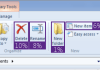
While it should be no surprise that Apple diehards dislike the design of the new Windows Explorer, even plenty of Windows watchers are wary. But in my view, this is worse than your typical “Microsoft has no taste” critique. The design and user interface here is quite simply one of the worst things I’ve ever seen in any software — let alone something that is going to be used by hundreds of millions of users.

It’s not just that it’s extremely cluttered, uneven, and confusing (all of which it is), it’s that it shows that a massive part of Microsoft is heading in the wrong direction when in comes to the future of computing. It’s my belief that simplicity and elegance are increasingly going to win the day as computing continues to be interwoven into our everyday lives. This Windows Explorer disaster shows that Microsoft believes the opposite.

Maybe I’m wrong. Microsoft, after all, is one of the largest companies on the planet that makes billions of dollars in revenue each quarter. But I’ve been saying this stuff for the past several years. In that time, Apple, a company which exudes exactly what I’m talking about, has risen from the ashes to become the most valuable company on the planet — jumping far ahead of you-know-who.

Meanwhile, PC makers, Microsoft’s key partners in their fight for the future, are dropping like flies. HP, the number one PC maker in the world, is trying to sell off their PC business. Acer, the number two PC maker, just posted a quarterly loss for the first time ever.

But again, maybe I’m insane. Maybe I’m out of touch. So I ran a poll yesterday to see what a larger swath of the population thinks about this new Windows Explorer interface. After over 1,300 votes, the results are as follows:

  • 47% voted for “It’s awful”
  • 8% voted for “It’s great”
  • 19% voted for “It’s okay”
  • 26% voted for “It’s the worst thing I’ve ever seen”

That’s 73 percent which had a negative reaction to the feature.

Sure, I suppose you could argue that many of my Twitter followers are likely to be pro-Apple. But I put the poll on Google+ as well, a place decidedly un-friendly towards Apple. And just look at the reaction around the broader Internet. Maybe those vocal on the web have been brainwashed by Apple. Or maybe, just maybe, the design actually stinks.

This morning, an Apple malware blogger took exception to my side-by-side comparison of an iPad homescreen to the new Windows Explorer. Not fair!, he cried — before going on to compare the iPad homescreen to Windows 3.1. Of course, this reaction failed to address two things: 1) That the new Windows Explorer design sucks. 2) The point.

I’ll make it a little more clear for the Apple malware blogger: Apple’s vision of the future is iOS — and more broadly, simplicity and touch. Microsoft’s vision of the future is this Windows Explorer abomination.

Does Apple have their own file system manager? Yes, Finder in OS X. But Apple does not do blog posts touting it in 2011. In fact, they never talk about it. In the last few iterations of OS X, they’ve made it a goal to remove its usefulness for 99 percent of users. Instead, they’ve brought out Stacks and now Launchpad. And if you really need an individual file, why not use Spotlight?

And that’s OS X, Apple’s minority operating system now. In iOS, there is no file explorer — let alone one with 19 toolbar buttons. Why? Because in Apple’s view, the concept of a “file” is changing. The saving of them and the transferring of them is something that a user should never have to think about. That’s what iCloud is all about.

Maybe I’m overplaying Microsoft vision for Windows Explorer going forward, but if that’s true, than so is Microsoft’s own leadership.

“Windows Explorer is a foundation of the user experience of the Windows desktop,” Sinofsky writes. “Explorer is one of the most venerable parts of Windows,” Simons writes. “It’s a bit daunting but also pretty exciting to have the opportunity to revisit and rethink this cornerstone of our product,” he continues.

And both of these statements and the entire Building Windows 8 post itself points to the major problem Microsoft faces here. Twice in the post they use the phrase “Respect Explorer’s heritage”. Microsoft has become a baggage handler.

With each update, no matter how much they intend to change things, they always end up cramming in the baggage of operating systems’ past. This leads to a weird amalgamation that’s neither new nor old. And quite often, worse than both.

“Maintain the power and richness of Explorer and bring back the most relevant and requested features from the Windows XP era when the current architecture and security model of Windows permits.” — the post actually states that as a goal for this new Explorer. This also sounds like a joke. It’s not. Baggage. Baggage. Baggage. Feature creep. Clutter.

Apple famously abhors the idea of design-by-committee and focus groups. Microsoft clearly celebrates both.

They’re two different styles and ways of working, and that’s fine. Again, both companies are doing well right now. It’s just my belief that at some point in the not-too-distant future, Windows will collapse under the weight of this baggage. And I think this new Windows Explorer is the first clear sign of that.

Smartphones and tablets are quickly changing the landscape of computing. The work Microsoft has done with their Metro UI in Windows Phone shows that they’re capable of ditching the baggage and jumping on the train. But unlike Apple, they’re hedging their bet. They’re doubling down on complexity in Windows while playing up simplicity with Metro.

Apple is already making moves to unify their entire ecosystem for this future of computing. They’re re-imagining experiences from the ground-up and destroying old paradigms. If Windows Explorer in Windows 8 is any indication, Microsoft is not anywhere near being ready to do the same.

Sure, Microsoft may have a Metro skin ready for “Windows 8 tablets”, but it now appears it will be a superficial layer on top of heaps of baggage, not a fundamental re-thinking of computing. It will be Microsoft Bob 2.0.

But hey, I’m biased, right? My preference of Apple products over the past seven years clearly has nothing to do with an eye towards the future of computing — I’m just brainwashed. So are millions of others and millions more each year. We should be looking at these screenshots of Windows Explorer in Windows 8 and seeing the future. We should be looking at the iPad and seeing Windows 3.1.


Company:
MICROSOFT
Launch Date:
4/4/1974
IPO:

13/3/1986, NASDAQ:MSFT

Microsoft, founded in 1975 by Bill Gates and Paul Allen, is a veteran software company, best known for its Microsoft Windows operating system and the Microsoft Office suite of…

Learn more


EA Exec: New Playstation And Xbox “Hard For Me To Conceive”

img_2198

While gaming company higher-ups aren’t always the best bellwether for the direction the industry is taking, they do tend to view the sector as an RTS commander views his troops and resources. What they tend to lack in taste and on-the-ground wisdom, they make up in sobriety and larger trends. So it’s no surprise that Frank Gibeau, head of EA Labels, has a relaxed view of the console race.

Here are some of his thoughts, transcribed from an interview with CVG, apparently conducted right after they passed around the peace pipe:

The way the business used to run where you had these big console transitions just isn’t happening anymore. They’re much longer, the online capabilities are making the way customers interact within the audience very different from when we went from PSOne to PS2. I think that [the age of] big, abrupt change in consoles where we all pile in on top of each other and everything changes overnight is just gone.

I don’t see consumers right now banging on the walls for a new platform. They seem to be very happy with their PS3s and 360s. They love the online connectivity, they have great communities and great libraries.

This Mr. Rogers’ Neighborhood version of the console wars is a little detached from the blood-soaked ground of exclusives, franchise whoring, and rampant fanboyism. But really, it’s hard to argue with. The consoles are in more or less their final generation of games, which is to say there isn’t too much more for developers to discover. This is the period in which many standout games are made, and every year the consoles increase in value and decrease in price. Developing a major game is already hugely expensive and time-consuming; the benefits of a Playstation 4 or what have you would likely be offset by the long gestation period and low frequency of games for some time.

We’ve heard that some studios are already developing for the new console, but the truth is usually more complicated. There’s no way Microsoft or Sony has a ready-to-go console prototyped right now, but they’re probably testing parts and sharing some of that information with partners. In the meantime Gibeau is right: the current consoles offer a monstrous value at a ridiculous price, and that’s not going to change for a while.

And if you’re really jonesing for a new console, well, there’s always the Wii U. That might not really be the right follow-up to a few years on the 360, but hey, it’s new.


Hands-On: Samsung’s Galaxy S II For AT&T, T-Mobile, And Sprint

Sprint Epic 4G Touch

Since February, we’ve been waiting for our turn with the Galaxy S II. With the handset floating around Europe and Asia, it’s been hard to remain patient. But today is the day: the U.S. versions of the Samsung Galaxy S II are here and we’re ready to get up close and personal at Samsung’s media event in NYC.

Just how different are the U.S. versions from the international? Has resolution been forfeited for size on that Super AMOLED Plus display? Does it feel as good as it looks? What about that new and improved TouchWiz UI? Is it actually any better? No worries. We’re here to answer all those questions and more.

Sprint’s Galaxy S II Epic 4G Touch:

Aside from that awfully exhaustive name, this thing makes me giddy. I’m still a bit torn between this and AT&T’s GSII, but in terms of design, the GSII Epic 4G Touch is quite the looker. The straight edges and rounded corners (opposed to the entirely rounded out T-Mo iteration) look and feel sharp. It also reminds me of another popular phone you might have heard of, the iPhone 4.

Here’s the issue: Sprint’s iteration, along with T-Mo’s, has a 4.52-inch Super AMOLED Plus display. It sounds awfully clunky at that size, but it’s actually really wonderful. The problem is that both Sprint’s 4.52-inch display and AT&T’s 4.3-inch display tout 800 x 480 pixels of resolution, which means that AT&T’s display comes off looking super rich and smooth while Sprint’s is a bit pixelated in comparison.

In the hand, the Epic 4G Touch isn’t as attractive as it is on the eyes. It feels a bit… cheap – almost like it’s too light for how big it is. I know light is supposed to be a good thing, but something about the weight here felt off.

I guess that’s your call, but for me it was lacking that nice, solid feel.


AT&T’s Galaxy S II:

I hate to play favorites, but AT&T’s version takes the cake. Why? Because a bigger screen doesn’t always mean a better screen. Like I said earlier, since AT&T has remained true to the 4.3-inch screen on the Galaxy S II, and the 800 x 480 resolution on this puppy is absolutely gorgeous.

You’d think the variation would be rather minimal between models, but it becomes blatant when shooting pictures and video. The added pixel density makes a difference, especially when the phones are side-by-side.

We’re usually not too fond of these custom UIs the manufacturers love to slap on their Android devices, but the new and improved TouchWiz isn’t all that bad. It’s notably faster, and bit cleaner than the previous versions we’ve seen. It’s certainly not our favorite feature of the phone, but at least Samsung is improving in the UI department.

Though it’s a hair smaller, the AT&T variant design is more angular than T-Mobile’s. In fact, it is nearly identical to the international Galaxy S II — which is completely okay with us. I mean, that model did sell 3 million in its first 55 days on the market. If it ain’t broke, right?


T-Mobile Galaxy S II:

Once known as the Hercules, T-Mo’s GSII is still somewhat shrouded in mystery. They kept this one hidden behind glass, so we didn’t actually get touchy-feely with it. However, I can honestly say this isn’t my favorite form factor for the S II; those curves and that 4.5-inch screen size make it somewhat of a hybrid between the Infuse and the Nexus S, and it just seems less sleek than the other two variants.

The screen is nice, but again, has the same pixelated resolution as the Sprint Epic 4G Touch. Since Samsung wouldn’t let pink’s version out of the box, it’s hard to say whether or not it’ll have that “too light” feel like Sprint’s. Either way, this will certainly be one of the best-sellers at T-Mo.


Interested in the full specs run down? Check out our early-bird coverage of the official announcements.


Help Us Celebrate TC Gadgets And Mobile At Our First San Francisco Meet-Up On 9/15

tc-meetup2011-09-lg

San Franciscans, start your thrusters. On September 15 at 6:30pm TechCrunch Mobile and Gadgets will host our first meet-up at Roe @ 651 Howard St. in sunny SF. Sponsored by Samsung, this meet-up will be the first chance for our readers to get ahold of some of Samsung’s latest products including the just-announced Galaxy S II. It is an event not to be missed.

We’ll have some finger food, a little dancing, maybe some networking and (sadly, as this is an approximately all ages show) a cash bar an open bar. We invite you to meet the entire TCG/M team and chill with some of Samsung’s newest gear and the chance to win a new Samsung Infuse 4G.

Specs:
Date: Thursday, 9/15/11
Time: 6:30-9:30pm
Location: Roe

To RSVP pop over to this Eventbrite link and sign up. We’ll be releasing six hundred tickets over the next two weeks so there will be plenty of chances to sign up.

Special thanks to Samsung for the sponsorship and we hope to see you in SF on September 15.

Samsung Telecommunications America, LLC, a Dallas-based subsidiary of Samsung Electronics Co., Ltd., researches, develops and markets wireless handsets, wireless infrastructure and other telecommunications products throughout North America. For more information, please visit www.samsung.com.


Marvel At Sony’s Microscopic OLED Electronic Viewfinder

Exif_JPEG_PICTURE

One of the marquee features of Sony’s new Alpha and NEX cameras, which by the way look excellent, is the new electronic viewfinder. I’ve never been particularly attracted to these things, preferring the mirror-based optical viewfinder on DSLRs or simply the large, bright LCDs on the back of most cameras. But Fujifilm’s X100 (despite its flaws) changed my mind about the usefulness of the EVF, and I’m ready to accept a camera that’s all EVF, all the time. And it helps that Sony’s new screen is a miracle of miniaturization.

Tech-On has obtained some information about the bite-sized OLED panel being used in the new cameras, and seeing the device itself in its tiny glory is a reminder of how advanced our imaging devices have become:

Sony’s previous EVF was 800×600 (I believe) and a traditional LCD. The new one is not only more high-resolution at 1024×768, but it’s an OLED panel instead of backlit LCD, giving it ten times the contrast of its predecessor, according to Sony. The ~2.4 million dots making up the panel are all white diodes with red, green, or blue filters; color diodes are not quite ready for prime time yet.

The display is wholly owned and manufactured by Sony Mobile Display Corp, and it confirms that Sony is deeply into the whole OLED thing. And by combining their display business with Toshiba’s and Hitachi’s, they’re looking like the company to beat for next-generation displays. Right now the world’s most famous displays are probably the iPhone 4 and iPad displays, and if the high-res iPad 3 rumors are correct, that could continue. But the charms of OLEDs are many and various, and Sony knows it. Hopefully we’ll be seeing more impressive tech like this amazing little EVF over the next year or two.


Samsung Officially Announces The Galaxy S II For T-Mobile, Sprint, And AT&T

Sprint Epic Touch

It’s coming! It’s finally coming!

After months of gallivanting around the world with launches everywhere from South Korea to Canada since May (plus a one day delay thanks to Hurricane Irene) Samsung’s Galaxy S II Android superphone is finally heading to the US.

As expected, Samsung used their press gathering in New York today to announce aesthetically unique Galaxy S II variants for three major US carriers: T-Mobile, Sprint, and AT&T. Verizon, meanwhile, is holding out for something else.

News of these devices is coming in as we speak, and this post will be updated as the information is made available.

Sprint

First off the block with an announcement was Sprint, who confirmed the prior leaks that their variant would be dubbed the oh-so-wordy “Samsung Galaxy S II Epic Touch 4G”. Sprint’s device will ship on September 16th (they claim they’ll be the first to launch it), at $199.99 on a 2 year contract.

Sprint’s Galaxy S II Epic 4G Touch Specs:

  • Android 2.3 (Gingerbread) with Samsung’s UI overhaul, TouchWiz 4.0
  • 4.52″ Super AMOLED Plus display
  • 1.2 Ghz dual-core CPU (Samsung Exynos)
  • WiMax 4G
  • 8 Megapixel rear camera with LED Flash
  • 2 Megapixel front camera
  • 1080p video recording
  • Preloaded apps: Nova 2 HD, Swype, Polaris Office
  • Bluetooth 3.0
  • Sprint ID
  • 802.11b/g/n WiFi
  • WiFi Hotspot for up to 8 devices

AT&T

AT&T simply says their variant will launch “in the coming weeks”, but have released the specs below. Interestingly, the 4.3″ display on AT&T’s variant is smaller than the 4.52 incher found on both Sprint and T-Mobile, but AT&T’s model is also the slimmest of the lot (at 8.89mm)

AT&T Galaxy S II Specs:
AT&T Samsung Galaxy S II Specifications

  • Support for AT&T’s not-quite-4G HSPA+ network
  • Android 2.3 (Gingerbread) with Samsung’s UI overhaul, TouchWiz 4.0
  • Screen: 4.3” Super AMOLED Plus
  • 1.2 Ghz dual-core CPU (Samsung Exynos)
  • 8 Megapixel rear camera with LED Flash
  • 2 Megapixel front camera
  • 1080p video recording
  • HDMI Out: HDMI via HDTV Smart Adapter with HDCP
  • Connectivity: Wi-Fi 802.11 a/b/g/n, Bluetooth 3.0
  • Battery: 1650mAh
  • Sensor: Motion UX, 6-axis gyroscope, proximity, light, noise (Audience A2220)

T-Mobile

T-Mobile has just issued their press release — so far, they’re simply calling it the “T-Mobile Galaxy S II” rather than its previous “Hercules” codename or any other fancy title. No specs besides a 4.52″ inch screen have thus far been mentioned, though it’s almost certainly nearly identical to Sprint/AT&T’s model’s (save for obvious differences, like no WiMax or Sprint ID)


Company:
SPRINT NEXTEL
Website:
Launch Date:
1999
IPO:

NYSE:S

Sprint Nextel offers a comprehensive range of wireless and wireline communications services bringing the freedom of mobility to consumers, businesses and government users.

Sprint Nextel is widely recognized for developing,…

Learn more


Company:
AT&T
IPO:

26/11/1999, NYSE:T

AT&T is the largest provider of both local and long distance telephone services, and DSL Internet access in the United States and the second largest wireless service provider in…

Learn more


Company:
T-MOBILE
IPO:

DT

T-Mobile is a mobile telephone operator headquartered in Bonn, Germany. It is a subsidiary of Deutsche Telekom. T-Mobile has 101 million subscribers making it the worlds sixth largest mobile…

Learn more