Daily Crunch: Apple releases macOS Big Sur

The latest Mac operating system arrives, Amazon faces a lawsuit over PPE and Disney+ turns one. This is your Daily Crunch for November 12, 2020.

The big story: Apple releases macOS Big Sur

This update, which was first announced five months ago at WWDC, includes a number of design changes that continue to blur the line between macOS and iOS.

One of the big additions is the Control Center, an iOS/iPadOS feature that presents a translucent pane down the right side of the screen. Meanwhile, Safari added features like built-in translation. And app icons and sounds have been updated throughout.

Brian Heater has been using the beta since June, and he concluded that Big Sur “boasts some key upgrades to apps and the system at large, but more importantly from Apple’s perspective, it lays the groundwork for the first round of Arm-powered Macs and continues its march toward a uniformity between the company’s two primary operating systems.”

The tech giants

Facebook’s Snapchat-like ‘Vanish Mode’ feature arrives on Messenger and Instagram — The feature, meant for more casual conversations, allows users to set chats to automatically delete after the message is seen and the chat is closed.

Amazon faces lawsuit alleging failure to provide PPE to workers during pandemic — The class action suit alleges Amazon failed to properly protect its warehouse workers and violated elements of New York City’s human rights law.

Apple HomePod Mini review: Remarkably big sound — A smart speaker for the masses.

Startups, funding and venture capital

Menlo Security announces $100M Series E on $800M valuation — CEO and co-founder Amir Ben-Efraim told us the startup remains focused on web and email as major attack vectors.

Livestorm raises $30M for its browser-based meeting and webinar platform — It’s purely browser based, without requiring presenters or attendees to install any software.

Nana nabs $6M for an online academy and marketplace dedicated to appliance repair — Nana runs a free academy to teach people how to fix appliances, then gives them the option to become a part of its repair marketplace.

Advice and analysis from Extra Crunch

Are subscription services the future of fintech? — As subscriptions become an increasingly alluring business model, fintechs will have to consider whether this strategy is worth the risk.

Conflicts in California’s trade secret laws on customer lists create uncertainty — Read this before you jump ship or hire a salesperson who already has.

As public investors reprice edtech bets, what’s ahead for the hot startup sector? — Selling edtech on the vaccine news (as investors did) was a bet that growth in the sector would be constrained by a return to normalcy.

(Reminder: Extra Crunch is our membership program, which aims to democratize information about startups. You can sign up here.)

Everything else

Disney+ has more than 73M subscribers — The streaming service launched one year ago today.

L’Oréal rolls out a line of ‘virtual makeup’ — This builds on L’Oréal’s 2018 acquisition of an augmented reality filter company called Modiface.

The Daily Crunch is TechCrunch’s roundup of our biggest and most important stories. If you’d like to get this delivered to your inbox every day at around 3pm Pacific, you can subscribe here.


Twitter labeled 300,000 US election tweets — around 0.2%

Just over a week after the U.S. elections, Twitter has offered a breakdown of some of its efforts to label misleading tweets. The site says that from October 27 to November 11, it labeled some 300,000 tweets as part of its Civic Integrity Policy. That amounts to around 0.2% of the total number of election-related tweets sent during that two-week period.

Of course, not all Twitter warnings are created equal. Only 456 of those included a warning that covered the text and limited user engagement, disabling retweets, replies and likes. That specific warning did go a ways toward limited engagement, with around three-fourths of those who encountered the tweets seeing the obscured texts (by clicking through the warning). Quote tweets for those so labeled decreased by around 29%, according to Twitter’s figures.

The president of the United States received a disproportionate number of those labels, as The New York Times notes that just over a third of Trump’s tweets between November 3 and 6 were hit with such a warning. The end of the election (insofar as the election has actually ended, I suppose) appears to have slowed the site’s response time somewhat, though Trump continues to get flagged, as he continues to devote a majority of his feed to disputing the election results confirmed by nearly every major news outlet.

His latest tweet as of this writing has been labeled disputed, but not hidden, as Trump repeats claims against voting machine maker, Dominion. “We also want to be very clear that we do not see our job as done,” Legal, Policy and Trust & Safety Lead Vijaya Gadde and Product Lead Kayvon Beykpour wrote. “Our work here continues and our teams are learning and improving how we address these challenges.”

Twitter and other social media sites were subject to intense scrutiny following the 2016 election for the roles the platforms played in the spread of misinformation. Twitter sought to address the issue by tweaking recommendations and retweets, as well as individually labeling tweets that violate its policies.

Earlier today, YouTube defended its decision to keep controversial election-related videos, noting, “Like other companies, we’re allowing these videos because discussion of election results & the process of counting votes is allowed on YT. These videos are not being surfaced or recommended in any prominent way.”

Personal finance startup Truebill raises $17M

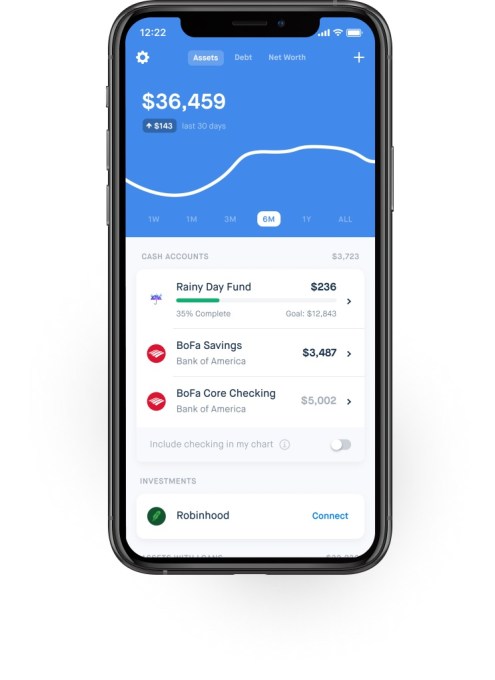
Truebill, a startup offering a variety of tools to help users take control of their finances, announced today that it has raised $17 million in Series C funding.

When I first wrote about the startup in 2016, it was focused on helping users track and cancel unwanted subscriptions. Since then, it’s expanded into other financial products, like reports on your personal expenses and the ability to negotiate lower bills.

This week, Chief Revenue Officer Yahya Mokhtarzada told me that with the pandemic leading to a dramatic reduction in ad costs, Truebill was able to make TV advertising a key channel for reaching new users.

And of course, the financial uncertainty has made the product more appealing too — particularly its smart savings tool, where users can automatically set aside money for their goals.

“People became aware of the need to have some cushion,” Mokhtarzada said. “You should start saving when things are going well, before you need it, but [saving during the pandemic] is better than not doing it at all. We’ve seen a big bump in smart savings adoption, which is at an all-time high.”

Truebill Net worth

Image Credits: Truebill

The new round brings Truebill’s total funding to $40 million. It was led by Bessemer Venture Partners, with participation from Eldridge Capital, Cota Capital, Firebolt Ventures and Day One Ventures.

The startup says the round will allow it to develop new products and features, including net worth tracking, automated debt payments and shared accounts.

Mokhtarzada added that the company will be making big investments in data science to help follow its “north star” of financial health, where he said, “The data challenge is significant.”

Sure, it’s pretty straightforward to recognize whether someone’s doing well or poorly financially, but the real goal is to “recognize trends and shortfalls before they happen.”

For example, instead of simply alerting users when they’ve been charged an overdraft fee on their account, Mokhtarzada said, “What is helpful is to have predictive models analyze data to anticipate a cashflow shortage and have the right tools in place that prevent it.”

Netflix’s latest experiment is a TikTok-like feed of funny videos

Netflix already borrowed the concept of short-form video “Stories” from social apps like Snapchat and Instagram for its Previews feature back in 2018. Now, the company is looking to the full-screen vertical video feed, popularized by TikTok, for further inspiration. With its latest experiment, Fast Laughs, Netflix is offering a new feed of short-form comedy clips drawn from its full catalog.

The feed includes clips from both originals and licensed programming, Netflix says. It also includes video clips from the existing Netflix social channel, “Netflix Is A Joke,” which today runs clips, longer videos and other social content across YouTube, Twitter, Facebook and Instagram.

Fast Laughs resembles TikTok in the sense that it’s swiped through vertically, offers full-screen videos and places its engagement buttons on the right side. But it’s not trying to become a place to waste time while being entertained.

Like many of Netflix’s experiments, the goal with the Fast Laughs feed is to help users discover something new to watch.

Instead of liking and commenting on videos, as you would in a social video app, the feed is designed to encourage users to add shows to their Netflix watch list for later viewing. In this sense, it’s serving a similar purpose to Netflix’s “Previews” feature, which helps users discover shows by watching clips and trailers from popular and newly released programming.

As users scroll through the new Fast Laughs feed, they’ll encounter a wide range of comedy clips — like a clip from a Kevin Hart stand-up special or a funny bit from “The Office,” for example. The clips will also range in length anywhere from 15 to 45 seconds.

In addition to adding clips to Netflix’s “My List” feature, users can also react to clips with a laughing emoji button, share the clip with friends across social media, or tap a “More” button to see other titles related to the clip you’re viewing.

Here’s the full intro explaining this new Netflix feature… pic.twitter.com/T7OriLUHd8

— Matt Navarra (@MattNavarra) November 12, 2020

The feature was first spotted by social media consultant Matt Navarra, based in the U.K. In his app, Fast Laughs appeared in front of the row of Previews, where it was introduced with text that said “New!”

Netflix confirmed to TechCrunch the experiment had been tested with a small number of users earlier this year, but has recently started rolling out to a wider group this month — including users in the U.K., the U.S. and other select markets.

It’s currently available to a subset of Netflix users with adult profiles or other profiles without parental controls on iOS devices only. However, users don’t need to be opted in to experiments nor do they need to be on a beta version of the Netflix app to see the feature. It’s more of a standard A/B test, Netflix says.

And because it’s a test, users may see slightly different versions of the same feature. The product may also evolve over time, in response to user feedback.

Netflix is hardly the first to “borrow” the TikTok format for its own app. Social media platforms, like Instagram and Snapchat, have also launched their own TikTok rivals in recent months.

But Netflix isn’t a direct competitor with TikTok — except to the extent that any mobile app competes for users’ time and attention, as there are only so many hours in a day.

Instead, the new feed is more of an acknowledgment that the TikTok format of a full-screen vertical video feed with quick engagement buttons on the side is becoming a default style of sorts for presenting entertaining content.

“We’re always looking for new ways to improve the Netflix experience,” a Netflix spokesperson said, confirming the experiment. “A lot of our members love comedy so we thought this would be an exciting new way to help them discover new shows and enjoy classic scenes. We experiment with these types of tests in different countries and for different periods of time — and only make them broadly available if people find them useful,” they added.

Th O’s r ptinal, th dllrs r mndtry

Hello and welcome back to Equity, TechCrunch’s venture capital-focused podcast (now on Twitter!), where we unpack the numbers behind the headlines.

The full Equity crew was on hand to debate the current venture capital market, curious about how risk-on, or risk-off things really are today. Danny, Natasha and I framed the conversation around a number of news items from the week, including:

  • Wrkfrce has launched, and we wanted to chat more about the future of niche media, bringing The Juggernaut’s own recent round and the Quartz shakeup into the conversation.
  • And on the media front — always a risky venture capital investing domain — Spotify has snapped up another podcasting company, this time paying $235 for Megaphone. Our take? A string of small exits probably won’t encourage VCs to take on more risk in the space (Hunter Walk said the same thing here.)
  • Turning to risk more generally, I asked Natasha to weigh in on the earlier stages of the venture market, and Danny on its later tranches. There’s still lots of money, but it appears more focused on chasing winners than bolstering or supporting less-obvious startups.
  • That market is not slowing a risk-on move toward more venture capital players, as the Spearhead news showed a new focus for the firm to invest in emerging fund managers.
  • And there’s still plenty of risk tolerance in remote-work solutions like Hopin, which just raised $125 million at a $2+ billion valuation. We’re torn on the round, but Danny likes it and he’s a former VC.
  • And we wrapped with a chat about upcoming IPOs, and the recent SoftBank results. If DoorDash, Airbnb and others are going to go this year, they need to go soon. So far, no dice.

It was a busy week, despite the month. Expect more of the same next week.

Finally, don’t forget that our own Chris Gates is cutting Equity videos out of every episode that you can find over on YouTube. He does a great job and it’s great to be on video, as well as audio platforms.

Equity drops every Monday at 7:00 a.m. PDT and Thursday afternoon as fast as we can get it out, so subscribe to us on Apple PodcastsOvercastSpotify and all the casts.

Gifting a gadget? Check its creep factor on Mozilla’s ‘Privacy not included’ list of shame

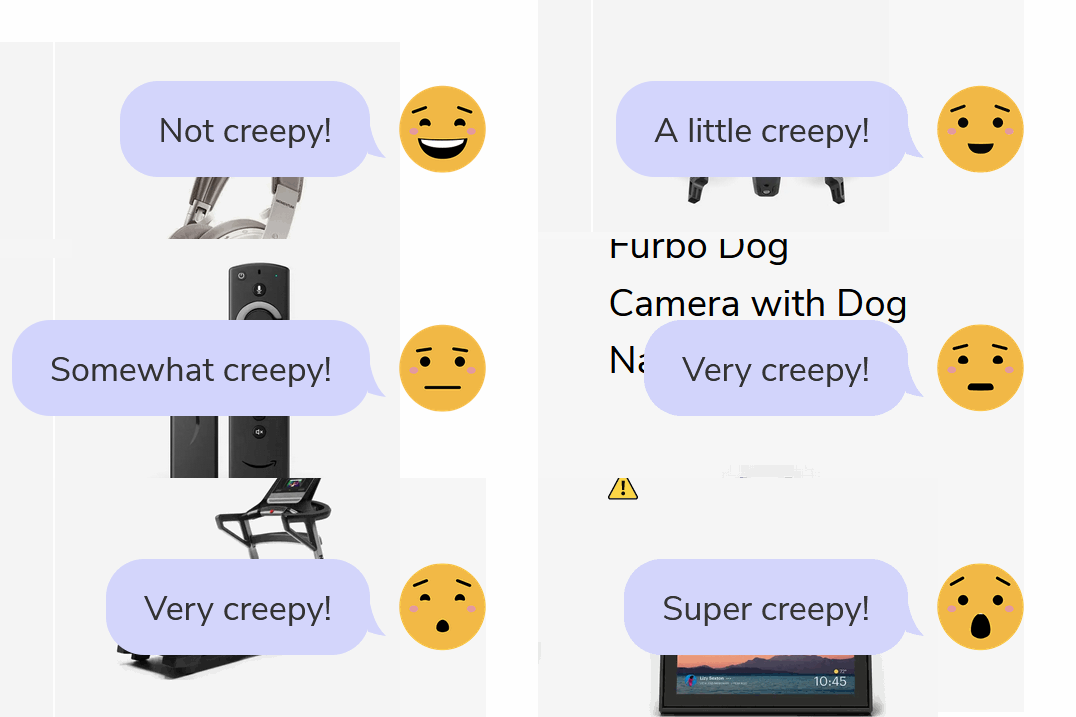
Buying someone a gadget is a time-honored tradition, but these days it can be particularly fraught, considering you may buy them a fitness tracker that also monitors emotions, or a doorbell that snitches to the cops. Mozilla has put together a helpful list of popular gadgets with ratings on just how creepy they are.

“Privacy not included” has become an annual tradition for the internet rights advocate, and this year has an especially solid crop of creepy devices, given the uptick in smart speakers, smart security cameras and smart litterboxes.

On the “creepy” end of the spectrum is… pretty much everything by Amazon except the Kindle. The devices in question send tons of data to Amazon by design, of course, but Mozilla feels the company hasn’t yet earned the trust to make that sort of thing acceptable. Facebook’s Portal earns a creepy spot for a similar reason.

Image Credits: Mozilla

Some random gadgets like a smart coffee maker and Moleskine smart notebook get creepy ratings because they don’t give the kinds of assurances about data and security that any company collecting that information should give. That sort of thing is common in smart gadgets — they may not be fundamentally creepy, but the company that makes them reserves the right to make it creepy at any time.

On the other end of the spectrum, Withings earns points for its smart devices with reasonable privacy policies and security. Non-Ring smart doorbells get good marks, and Garmin’s smart watches too.

These are informal rankings based on the potential for abuse or exposure of your data, and it doesn’t mean that they’re perfectly safe or private. If you’re buying one of these things, it’s best to immediately go through the settings and preferences and disable anything that smells invasive or creepy. You can always enable features again, but once you’ve put your data out there, it’s hard to get it back.

Check out the rest of the list here.

PSA: macOS is a little broken this morning, with many non-Apple apps hanging at launch

If you’re on a Mac running a relatively new version of macOS (Catalina or Big Sur, seemingly) and it’s having all sorts of weird issues right now: you’re not alone.

We’re seeing a flood of reports from both users and developers of an issue preventing apps — particularly those not made by Apple — from properly launching. Most are reporting that apps they already had open are fine, but attempts to open any new apps will result in it just bouncing around in the dock for minutes at a time.

The issue first popped up this morning (curiously coinciding with the launch of macOS Big Sur) and seems to be improving for some… but for the time being, be aware your apps might not work as expected.

It’s unclear exactly what’s happening, but the most popular theory is that there’s a server-side issue with Gatekeeper, the security feature that verifies the authenticity of macOS apps at launch.

Update: As of a bit after 2pm Pacific, Apple’s Developer System Status page says this problem should now be fixed.

? Looks like, when apps are launched, Gatekeeper is unable to check their validity over the internet, due to overwhelmed Apple servers. So, uh, let’s all hang in there! You got this, Apple devops!
— Panic (@panic) November 12, 2020


Disney+ has more than 73M subscribers

Disney+, the streaming service that launched one year ago today, grew to 73.7 million paid subscribers as of early October.

That’s according to The Walt Disney Company’s fourth-quarter earnings report, which covers the company’s finances through October 3. The company previously said Disney+ had 60.5 million subscribers as of August 3.

The release also includes subscriber numbers for Disney’s other streaming services — Hulu had 36.6 million (including 4.1 million subscribers to Hulu + Live TV), while ESPN had 10.3 million (more than doubling from 3.5 million a year earlier).

Overall, Disney’s direct-to-consumer segment saw revenue grow 41% year-over-year to $4.9 billion, while its operating loss fell from $751 million in Q4 2019 to $580 million this year. Disney attributed the shrinking losses to “improved results at Hulu and ESPN+, partially offset by higher costs at Disney+, driven by the ongoing rollout.”

It was a tough quarter for Disney overall, with the pandemic forcing the company to keep some parks closed and the rest operating at reduced capacity. Disney’s revenue fell to $14.7 billion (compared to $19.1 billion during Q4 2019), with a loss of $0.39 per share.

“The real bright spot has been our direct-to-consumer business, which is key to the future of our company, and on this anniversary of the launch of Disney+ we’re pleased to report that, as of the end of the fourth quarter, the service had more than 73 million paid subscribers – far surpassing our expectations in just its first year,” said CEO Bob Chapek in a statement.

During the investor call, Chapek also noted that Disney+ is currently available in more than 20 countries worldwide, with plans to launch in Latin America on Tuesday.

Meanwhile, earlier today, Disney+ pushed the premiere date of its first Marvel series, “Wandavision,” from December until January 15.

Conflicts in California’s trade secret laws on customer lists create uncertainty

Nick Saenz
Contributor

Nick Saenz is a partner at Lewis & Llewellyn LLP, who focuses on employment and trade secret issues.

When salespeople in California’s dynamic tech economy transition between jobs, the value they bring to their new company is often their customer relationships. Startup founders and salespeople considering joining competitors often assume continuing to maintain these customer relationships is noncontroversial given California’s well-known policy favoring employment mobility and outlawing non-competition agreements.

Yet California trade secret law regarding the ability of salespeople to solicit these customers once they jump to a competitor is increasingly confused and fails to provide meaningful guidance on what type of conduct is permissible. Thus, a salesperson’s move from their current company to a competitor is risky given it is unclear whether and to what extent they can continue servicing clients or contacts they previously worked with.

A salesperson working for a value-added reseller (VAR), for instance, should understand what they are getting into before moving to a competitor — they may risk longstanding relationships with original equipment manufacturers (OEMs) and end users. This article explains the conflicting law on this issue so that salespeople planning on jumping ship, and the companies considering hiring them, can be informed regarding the current legal landscape.

California law invalidates non-competition agreements

In the vast majority of states, employers can, and do, require employees to enter into some form of non-competition agreement in exchange for continued employment.1 In contrast, California has a long-standing policy of favoring employment mobility over an employer’s concerns. California’s policy is embodied in Business and Professions Code section 16600, which provides: “Except as provided in this chapter, every contract by which anyone is restrained from engaging in a lawful profession, trade, or business of any kind is to that extent void.”

California courts “have consistently affirmed that section 16600 evinces a settled legislative policy in favor of open competition and employee mobility” that is intended to “ensure that every citizen shall retain the right to pursue any lawful employment and enterprise of their choice.”2 The policy also allows California employers to “compete effectively for the most talented, skilled employees in their industries, wherever they may reside.”3 Accordingly, unlike in most states, the “interests of the employee in [their] own mobility and betterment” generally outweigh the “competitive business interests of the employers.”4

Courts have broadly applied section 16600, invalidating non-competition agreements, which would prohibit or restrict an employee from leaving to work for a competitor.5 Importantly, courts have also invalidated contractual provisions purporting to restrict an employee’s ability to leave and then solicit the company’s customers.6 In other words, a salesperson cannot be contractually precluded from leaving their company, joining a competitor and continuing to solicit, service and communicate with their former company’s clients. Furthermore, with limited exceptions, California courts will disregard a “choice of law” provision purporting to mandate that the court follow the law from a state that enforces noncompetes.7

As public investors reprice edtech bets, what’s ahead for the hot startup sector?

Reports on November 9 that a COVID-19 vaccine looks incredibly effective moved the market. Software stocks sold off and long-suffering industries hammered by the pandemic saw their fortunes rise. It was odd to see airlines soaring and 2020 high-fliers like Zoom taking blows.

But amidst all that noise, another sector that has great import for startups was also taking lumps: edtech.

Looking at how a number of edtech companies traded in the aftermath of the vaccine news helps us understand how public investors view the companies and assess their long-term growth prospects.

Simply put, selling edtech on the vaccine news — as investors did — was a bet that growth in the sector would be constrained by a return to normalcy, something a solid vaccine could hasten. This is a related concept to what TechCrunch discussed regarding software’s own November 9 selloff — that investors were betting that future growth for those companies, boosted in 2020 by the pandemic shaking up how and where people worked, would be limited by a quick return to regular life.

The vaccine’s reported efficacy changed how investors see the future. But how much did it change investor expectations for the future of edtech? Let’s examine the public market results before asking our own edtech expert Natasha Mascarenhas on what she’s seeing in the numbers and hearing from investors.

Edtech companies in the public markets

There aren’t many public edtech companies, but TechCrunch surveyed those that we knew about. Here’s where three stood after the closing bell rang on Friday, November 3:

  • 2U closed at $39.55 per share. It closed Monday after the vaccine news at $31.46. That price decline was worth about 20%. The company’s equity has been roughly flat since.
  • Chegg closed Friday the 6th at $77.23 per share. It closed Monday, after the vaccine news, at $69.51. That price decline was worth around 10%. The company’s equity has fallen further since.
  • Kahoot closed Friday the 6th at 64.60 Norwegian kroner (kr) per share. It closed Monday, after the vaccine news, at 59.00 kr. That price decline was worth around 9%. The company’s equity has fallen further since.

Sote wants to be Africa’s shipping logistics gateway

The twenty-first century could be a period of unprecedented economic growth and social change for the African continent, which is poised for explosive change — but much of that change is predicated on an outmoded trade infrastructure that hasn’t changed much since the beginnings of the last century.

That’s the problem that Sote wants to target. The company just raised $3 million in seed funding to support its Nairobi and San Francisco operations designed to transform the logistics infrastructure for African shipping — starting with customs clearing and forwarding.

The goal is no less than becoming the digital logistics gateway to the African continent.

“They are trying to transform an industry that hasn’t seen any innovation in a century. That’s the case with receiving and forwarding on the continent,” said Marlon Nichols, a co-founder and managing director of MaC Venture Capital and an investor in Sote’s seed round. “It’s so dense and there’s limited open waterways. The only way to move things is by vehicle. There’s a lack of infrastructure inside the continent and limited ways to get things into the continent. The traditional method was just taxing… the difficulty of clearing something through customs.”

Sote “creates transparency and will open up Africa for business,” Nichols said. 

Initially, Sote’s pitching a software service enabling customs clearing and forwarding to give industrial cargo owners a central dashboard for all of the parties involved in the process.

While logistics startups like Flexport have managed to amass a $22 billion valuation for logistics services, the African continent has been underserved by tech developers, Nichols said. And Sote is hoping to change that.

The company’s software can serve as a workflow tool to manage freight clearing and forwarding as well as a dashboard to track shipment status, payment history and the estimated arrival time for containers.

Sote was founded by the Kenyan native Felix Orwa and co-founders Meka Este-McDonald, a former product manager at Verizon and Gigster, and Scott Yacko a former director of software engineering at Amazon and director of architecture at Walmart.

MaC Venture Capital puts the total addressable market that Sote could tap at roughly $20 billion, given the company’s vertical integration.

It can work with companies like Kobo Networks and Lori Systems, which have both built large, venture-backed businesses handling the land-locked logistics problems of finding truck transport to bring goods to local markets.

There are roughly 20 million containers that move through Africa annually, and over 1 million containers move through Sote’s initial home market of Kenya. Kenya actually accounts for one-sixth of Africa’s shipping market, and is the fifth-busiest port on the continent, as well as the gateway to Eastern African nations like Tanzania, Uganda, Somalia, Rwanda and South Sudan.

The company charges approximately $1,000 per container handled, and if it were to handle transport of a fraction of a percent of the total number of containers shipped, it could hit $100 million in annualized revenue in the next 10 years, according to MaC Venture Capital’s predictions.

Este-McDonald and Orwa have been working on the business for the past three years.

“Our foundational product is actually like Flexport,” Orwa said. “What we do for customers is what Flexport does in the U.S., we help manufacturers move cargo across … they don’t get into having to get into a license and all that. Flexport does because you have to clear the cargo and pay the taxes. We are licensing with the government agency and helping to pay the taxes.”

Ultimately, Sote expects to handle warehousing services and book transportation on trucks. “That process — to move one container — requires 60 back and forth messages of calls and texts and emails flying back and forth between all of these players,” said Orwa.

Additional backers who put up cash for the company’s seed round, which closed last month, include Acceleprise, Backstage Capital, Future Africa and Rob Solomon — the chairman at GoFundMe. Nichols is taking a seat on the company’s board. 

Amazon faces lawsuit alleging failure to provide PPE to workers during pandemic

Christian Smalls, a former Amazon warehouse employee, filed a lawsuit against the company today alleging Amazon failed to provide personal protective equipment to Black and Latinx workers during the COVID-19 pandemic.

The class action suit alleges Amazon failed to properly protect its warehouse workers and violated elements of New York City’s human rights law, as well as federal and state laws.

“I was a loyal worker and gave my all to Amazon until I was unceremoniously terminated and tossed aside like yesterday’s trash because I insisted that Amazon protect its dedicated workers from COVID-19,” Smalls said in a statement. “I just wanted Amazon to provide basic protective gear to the workers and sanitize the workplace.”

Today I filed a Class Action lawsuit in the state of NY on behalf of all @Amazon employees and all essential workers that was unprotected all across the world during this pandemic. as I said in the beginning it’s not Amazon vs Chris Smalls it’s Amazon vs the People @JeffBezos

— Christian Smalls (@Shut_downAmazon) November 12, 2020

Amazon did not specifically comment on the lawsuit but said it stands in solidarity with Black employees, customers and its partners.

“Amazon’s mission is to be the earth’s most customer-centric company, and this mission is central to our work in diversity and inclusion,” Amazon spokesperson Lisa Levandowski told TechCrunch. “Diverse teams help us think bigger, and differently, about the products and services that we build for our customers and the day-to-day nature of our workplace – this is reinforced within our 14 Leadership Principles, which remind team members to seek diverse perspectives, learn and be curious, and constantly earn others’ trust.”

The lawsuit has support from Rev. Jesse Jackson, who said he stands in solidarity with Smalls and other Amazon warehouse workers.

“COVID-19 has disproportionately impacted Black and Brown communities on so many levels, from warehouses to jailhouses,” Rev. Jackson said in a statement. “It’s an invisible enemy that is killing our communities. Chris’ case is a classic example of how corporate greed and insensitivity can literally expose communities to untold and unnecessary risks.”

Smalls was fired from Amazon in March after organizing a walkout at one of the company’s fulfillment centers in Staten Island. As a result, New York’s attorney general is investigating if Amazon violated federal worker safety laws and New York state’s whistleblower protections laws by firing Smalls.

Smalls’ termination helped galvanize other warehouse workers who later formed an international organization to demand change inside Amazon’s warehouses. Organizers pointed to worker retaliation as one of the driving factors for the formation of Amazon Workers International. Meanwhile, Amazon executives reportedly discussed discrediting Smalls and making him the face of the organizing movement.

An Amazon spokesperson previously told TechCrunch the company did not fire Smalls for organizing a protest. Instead, Amazon said it fired him for “putting the health and safety of others at risk and violations of his terms of employment.”

“Mr. Smalls received multiple warnings for violating social distancing guidelines,” the spokesperson said. “He was also found to have had close contact with a diagnosed associate with a confirmed case of COVID-19 and was asked to remain home with pay for 14-days, which is a measure we’re taking at sites around the world. Despite that instruction to stay home with pay, he came onsite, further putting the teams at risk.”

InFeedo raises $3.2M led by Bling Capital, delivers $1.1M exit to early employees and investors

A Y Combinator-backed startup that is helping major companies efficiently listen to how happy — or unhappy — their employees are and resolve their issues on time to retain talent just raised a new financing round from several high-profile executives.

InFeedo, a four-year-old people analytics SaaS startup with headquarters in Gurgaon, said on Thursday it has raised $3.2 million in its Series A funding round. Bling Capital led the round and its founder, Benjamin Ling, who previously served as a general partner at Khosla Ventures and executive roles at Google and Facebook, has assumed a board seat at InFeedo.

Simon Yoo of Green Visor Capital, Maninder Gulati, chief strategy officer at budget lodging startup Oyo, Munish Varma, managing director for EMEA region at SoftBank and Girish Mathrubootham, founder of SaaS giant Freshworks, are among those who participated in the round.

As a business grows up and the headcount balloons over thousand, ten thousand, and tens of thousands, it becomes impossible for the chief executive to engage meaningfully with employees to gauge their morale and understand if there is anything they wish the company changed.

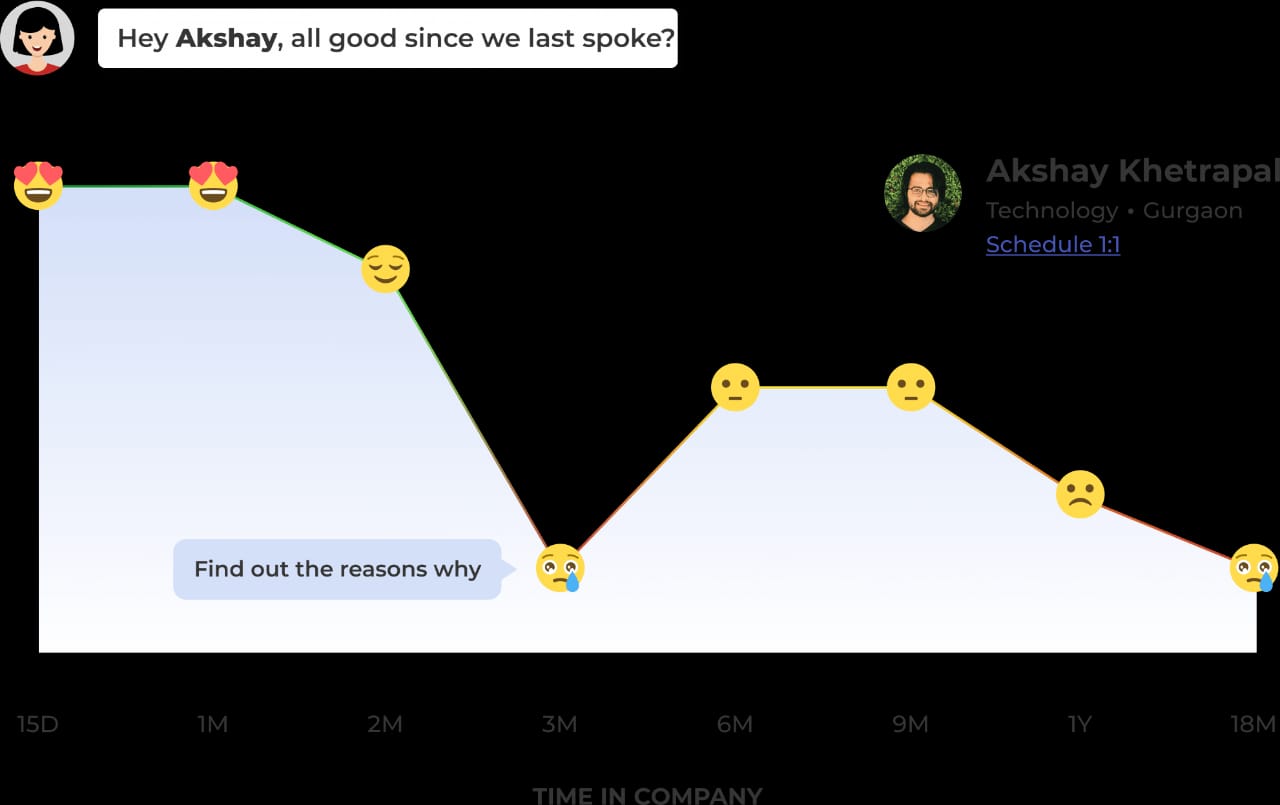
InFeedo is tackling this challenge through Amber, a chatbot it has built that touches base with employees periodically to quickly check how things are going, explained Tanmaya Jain, founder and chief executive of the four-year-old startup.

On the backend, executives can check the status of their employees across the company and how likely some individuals — especially the top talent — are at leaving the firm. They can check exactly what issues these employees have raised in the past, and whether their concerns were resolved.

Amber is able to track the progress because it remembers what an employee has previously shared. So each future conversation begins with it asking whether anything has meaningfully changed since the last time it spoke to the employee.

“Almost three years ago, we started using Amber at OYO and I was amazed by the product. We were using this for executive decision-making, to get an accurate pulse of our employees across geographies, functions as we were expanding across the world. I actually reached out to Tanmaya and am excited to be part of this journey,” said Oyo’s Gulati in a statement.

InFeedo has amassed more than 100 customers — including GE Healthcare, Puma, steel-to-salt conglomerate Tata Group, telecom firm Airtel, computer vendor Lenovo, Oyo, Indian internet conglomerate Times Internet and edtech giant Byju’s — across over 50 countries. More than 300,000 users today use InFeedo’s service. The startup today is clocking an annual revenue run rate of $1.6 million, something Jain said he is working to get to $10 million.

For Jain, 26, InFeedo’s current avatar is the third pivot he has made at the startup. InFeedo started as an edtech platform to create a feedback loop between students and their teachers. The startup then explored building a social network for companies. Neither of those ideas gained much traction, he explained. During the third attempt, Jain said he spent days at his early customers to understand exactly what features they needed.

As part of the new financing round, InFeedo, which has raised $4 million to date, said it has delivered partial exits of $1.1 million to early investors and early employees or those who left. “Helping people around me make so much money has been one of the most fulfilling things for me,” he said, adding that this liquidity at the time of a pandemic has been immensely useful to many.

The startup plans to deploy the new funding to make Amber understand multiple languages, a key aspect that Jain said would help the startup better serve clients in adjacent markets to India. InFeedo also wants to expand the use cases of Amber and experiment with new technologies such as GPT-3. It is also hiring for product, engineering and marketing leadership roles.

OthersideAI raises $2.6M to let GPT-3 write your emails for you

When I send an email, it’s special. A crafted, beautiful thing that — who am I kidding, it’s mostly automatic. So why not automate it? OthersideAI is taking this idea (with a $2.6 million seed round) beyond the auto-responders and smart replies, using OpenAI’s GPT-3 language generation engine to turn bullet points into full, personalized messages.

GPT-3, or Generative Pre-trained Transformer 3, is of course the latest version of the AI model that writes such convincing copy that everyone under the sun has let it write their column about it, and then attempted to surprise readers by revealing the fact at the end. (There are usually a few tells, though.)

Access is carefully limited, though, and the team at OthersideAI has a cozy but uncharacterized relationship with OpenAI . It began when the team was working on their previous project, and found they had more emails than they could handle. At the time, GPT-3’s predecessor GPT-2 was in vogue.

“We built a cold email thing with it, but then we thought — that might be the business we should be pursuing,” said CEO Matt Shumer. “So we decided to go all in.”

He and his colleagues Jason Kuperberg and Miles Feldstein built a demo that got a bit of attention when they posted it to Twitter, and soon obtained access to the new version of the GPT engine.

OpenAI arguably already did the hard part by building this astonishing language engine, but it’s not as simple as letting it run wild in someone’s inbox. Unrestrained, GPT-3 will chase its own tail down a rabbit hole, producing truly strange stuff, as any player of AI Dungeon can attest.

“GPT-3 makes an amazing demo, but putting it in a product is another story,” said Shumer. “Our job is in a sense to tame its creativity.”

The resulting product turns a summary or bullet points into a complete email, and looks like this in action:

Image Credits: OthersideAI

If you don’t like the result, or there’s an error, or you just like torturing AIs, you can hit the button and it’ll generate it again, differently. Tweak it a bit first and the system will understand that in the future you’d prefer the new way.

The GPT systems are trained on millions of words and phrases, and then generate text inspired by that corpus after being given an input to work from. In this case the system takes as input not just your bullet points, but other information from the email chain and the user’s past preferences.

That way it picks up not just context: it may say “It was great to sit down for coffee with you” if coffee is referenced even if you only wrote “good to meet” in the bullet. And it also learns your style, preferring certain words or phrases or learning that you like to sign off a certain way.

It can make good guesses at technical and financial details, such as in making a job offer:

Of course, for something so important, you may wonder: why bother letting an AI do it at all?

It’s sort of like how a car can go 120 MPH, but you never drive it faster than 80 (okay… 90). You want to know the thing isn’t going to fall apart as soon as it leaves its most obvious use case. For OthersideAI’s model, this means being robust enough to handle “serious” emails even if it’s most likely to spend its time replacing rote messages.

Kuperberg said the company, which has almost 10,000 people waiting to get into its test version, has seen interest from engineers and developers as well as sales and support people. One instantly sees the application in a support or sales scenario where a handful of scripted questions or replies can be re-generated to be different every time, or slightly adjusted for the person or situation. That avoids the feeling of receiving a “form email” even though it amounts to the same thing.

I mentioned the possibility of helping people who have trouble typing — someone who must write emails letter by letter using gaze detection might find this extremely compelling. Shumer said this hadn’t been on their radars to begin with but that in the last few weeks they’ve seen interest from this direction.

Shumer was careful to assure that security comes first and this isn’t a data-sucking operation — obviously no one would want to use a tool that reads your email and uses that info for nefarious purposes, with the notable exception of Gmail.

They feel secure in their approach, noting that Google seems more interested in selecting the right reply for the context, and text generation tools aren’t robust enough to handle the inputs OthersideAI’s GPT-3-based system handles with ease.

“If you want to make an email in the tone of the user, it can’t guess about the details. It needs a human. This isn’t a generated response, it’s taking direction,” Shumer said.

The $2.6 million seed round was led by Madrona Venture Group, with Active Capital, Hustle Fund, Chapter One and more participating. It’s all going toward building the team so the company can build a full-scale product.

Ultimately, they envision this as a small-scale test for a larger system of interlocking AIs that can safely and securely connect with one another, answering questions and providing information in a human-like way but with only the minimum human involvement. Obviously that’s somewhat of a long-term goal, but given all the talk for a decade or so about replacing email has come to nothing, perhaps it’s time to embrace it but let someone (or something) else take on a bit of the load.

L’Oréal rolls out a line of ‘virtual makeup’

Selfie filters have improved immensely over the past several years, but companies on the forefront of the tech see plenty of room to grow.

The cosmetics world has also seen some rapid change in the past several years as makeup has proven particularly ripe for up-and-coming direct-to-consumer and influencer-endorsed brands to take hold. Plenty of legacy brands have seen their revenues decimated, while others have proven resilient by leaning into new tech and sales channel trends.

Back in 2018, L’Oréal made the interesting decision to buy an augmented reality filter company called Modiface. Fast-forward to 2020 and they’ve opted to roll out a line of “virtual makeup” selfie filters. The “Signature Face” filters show off eye makeup, lipsticks and hair products from the company.

They’ve gone fairly wide, with the rollout supporting Instagram, Snapchat, Snap Camera and Google Duo. Snap Camera support in particular enables the selfies to be used across plenty of video chat services like Houseparty and Zoom; L’Oréal is marketing these selfies as a way to spice up your look on video calls specifically. You can check our more details on where you can use the filters on their site.

In terms of the filters themselves, there’s nothing terribly more advanced about them than the makeup-centric selfie filters that have been floating around Snapchat for years, but it is interesting to see such a substantial brand leaning in so heavily and pitching this idea where people use selfie filters during video calls in a non-gimmicky way. It’s not clear whether the technology or consumer habits are there yet but it’s certainly plausible that things could move in that direction, especially as social media apps begin a more focused drive toward becoming commerce platforms.