Google Does A Full House Cleaning: Sunsets Desktop, Notebook, Fast Flip And More

GoogleAxe

Well, it looks like the brooms and axes are out at Google today, for a little late-summer cleaning. The company announced via its blog today that some of its products and features will be riding into the sunset in the very near future. This news was previewed by CEO Larry Page on Google’s quarterly earnings call in July, who said at the time that the search giant would be doing a wee bit of spring, er, early fall cleaning.

Okay, so some of Google’s products (that were growing sluggishly or not at all) are being put out to pasture, but what does that mean for Google employees? According its blog, these products will be killed off over the next few months, and some products will be merging into others to become complementary features. For Googlers, all those working on those products will either go with the merge or be reassigned to other “higher impact” projects.

Google’s reason for this spring cleaning is really just to use this as why-the-heck-not opportunity to streamline, shed a little weight, and continue to focus on making the user experience simple for its users. Just hope they don’t overdo it.

As for users, Google says it will reach out to them directly as they make changes.

Google started off by killing off nearly all of its Slide products, and today MG covered the sunsetting of Aardvark, which Google had bought back in February 2010 for $50 milion. Co-founder Max Ventilla said that Aardvark will be kaput by the end of the month.

Also hitting the road are:Google Desktop (or the quick search box), which will be discontinued September 14, “including all the associated APIs, services, plugins, gadgets, and support; Fast Flip, the service designed to innovate in the news content browsing space for the web and mobile; Google Maps API for Flash (nooooooooo), which Sarah covered earlier here; Google Pack (a.k.a. Google Fannypack); Google Web Security; Image Labeler; Notebook (which we haven’t exactly loved since the beginning), all of the data from which will be exported automatically to Google Docs; Sidewiki; and Subscribed Links (developers will be able to access data in Subscribed Links until September 14).

For more, check out MG’s post here and Google’s blog post here.

Excerpt image courtesy of SEO-Social Media.


Company:
GOOGLE
Launch Date:
7/9/1998
IPO:

25/8/2004, NASDAQ:GOOG

Google provides search and advertising services, which together aim to organize and monetize the world’s information. In addition to its dominant search engine, it offers a plethora of…

Learn more


Amazon’s Kindle Tablet Is Very Real. I’ve Seen It, Played With It.

Amazon-android-580x356

It’s called simply the “Amazon Kindle”. But it’s not like any Kindle you’ve seen before. It displays content in full color. It has a 7-inch capacitive touch screen. And it runs Android.

Rumors of Amazon making a full-fledged tablet device have persisted for a while. I believe we were one of the first to report on the possibility from a credible source — the same person who accurately called Amazon’s Android Appstore. That source was dead-on again, it just took Amazon longer than anticipated to get the device ready to go. They’re now close.

How do I know all of this? Well, not only have I heard about the device, I’ve seen it and used it. And I’m happy to report that it’s going to be a big deal. Huge, potentially.

First of all, before every commenter asks, no, sadly, I don’t have any pictures to share. That was the one condition of me getting this information. So instead you’ll have to rely on my prose to draw a picture of the device in your head. Or you can just look at a BlackBerry PlayBook — because it looks very similar in terms of form-factor.

So here’s what I know and what I saw:

Again, the device is a 7-inch tablet with a capacitive touch screen. It is multi-touch, but from what I saw, I believe the reports that it relies on a two-finger multi-touch (instead of 10-finger, like the iPad uses) are accurate. This will be the first Kindle with a full-color screen. And yes, it is back-lit. There is no e-ink to be found anywhere on this device.

Earlier this week, reports suggested that a 7-inch Amazon tablet could be released in October, with a larger, 10-inch version to follow next year. That’s somewhat accurate. As of right now, Amazon’s only definitive plan is to release this 7-inch Kindle tablet and they’re targeting the end of November to do that. The version I saw was a DVT (Design Verification Testing) unit. These have started floating around the company. It’s ready, they’re just tweaking the software now. If it’s not in production yet, it will be very soon.

Originally, Amazon had planned to launch a 7-inch and a 10-inch tablet at the same time. But that plan changed this summer. Now they’re betting everything on the 7-inch. If it’s a hit, they will release the more expensive 10-inch tablet in Q1 2012.

So how much will the 7-inch Kindle cost? $250.

Yes, Amazon has been able to trim the cost of the device to half of the entry-level iPad. And it will be the same price as Barnes & Noble’s Nook Color, which this will very obviously compete with directly. Both have 7-inch color touch screens. Both run Android.

And this is where things get really interesting. As anticipated, Amazon has forked Android to build their own version for the Kindle. Simply put: it looks nothing like the Android you’re used to seeing.

The interface is all Amazon and Kindle. It’s black, dark blue, and a bunch of orange. The main screen is a carousel that looks like Cover Flow in iTunes which displays all the content you have on the device. This includes books, apps, movies, etc. Below the main carousel is a dock to pin your favorite items in one easy-to-access place. When you turn the device horizontally, the dock disappears below the fold.

Above the dock is the status bar (time, battery, etc) and this doubles as a notification tray. When apps have updates, or when new subscriptions are ready for you to view, they appear here. The top bar shows “YOUR NAME’s Kindle” and then the number of notifications you have in bright orange. It looks quite nice.

There are no physical buttons on the surface of the device. You bring up a lower navigation menu by tapping the screen once. This can take you back home, etc.

But the key for Amazon is just how deeply integrated all of their services are. Amazon’s content store is always just one click away. The book reader is a Kindle app (which looks similar to how it does on Android and iOS now). The music player is Amazon’s Cloud Player. The movie player is Amazon’s Instant Video player. The app store is Amazon’s Android Appstore.

Google’s Android Market is nowhere to be found. In fact, no Google app is anywhere to be found. This is Android fully forked. My understanding is that the Kindle OS was built on top of some version of Android prior to 2.2. And Amazon will keep building on top of that of that over time. In other words, this won’t be getting “Honeycomb” or “Ice Cream Sandwich” — or if it does, users will never know it because that will only be the underpinnings of the OS. Any visual changes will be all Amazon.

They are not working with Google on this. At all.

There is a web browser (of course), and while it’s styled a bit to match the Kindle UI, it looks pretty much the same as the Android’s WebKit browser. Yes, it has tabs! And yes, Google Search is still the default (the Kindle also has its own search tool to find content on your device).

Overall, the UI of this Kindle felt very responsive. You can flick through the carousel seamlessly. This is something Amazon has apparently been working on quite a bit, I’m told. And they continue to. Some of the page-turning touch mechanics still needed a bit of work in the version I used.

I believe the visual web reading app Pulse will be bundled with the Kindle. A game like Angry Birds may be as well. Again, it uses Amazon’s Android Appstore, so all of the content accepted into that store will play well on this device. Apps, games, content, you name it. Amazon creating their own app store is starting to make a lot more sense, and looks potentially very smart (as anticipated).

A few more bits about the hardware:

I believe it is running on a single-core chip (though I’m not 100 percent sure). My understanding is that the 10-inch version, if it comes, will have a dual-core chip.

I also believe the device only has 6 GB of internal storage. The idea is that this will be more of a “cloud device” for things like music and movies. The storage is meant for storing books and apps There were a few references to an SD card expansion, but I couldn’t find a slot on the hardware itself.

This initial version of the device will be WiFi-only. Amazon is supposedly working with carriers to possibly product 3G-enabled versions (as they have with their other Kindles), but that won’t be the case at launch.

I’m not sure what the battery life is like (I only played with it for about an hour), but I imagine it is very good and in line with other tablets — 10 hours or so.

The back of the device is rubbery — again, it’s very similar to the PlayBook (it’s black as well). The power button is underneath if you’re holding it vertically (which is a bit odd — but it’s obviously to the side if you’re holding it horizontally). There’s a micro-USB port (presumably for powering the device as well). The speakers are of the top of the device (again, if it’s being held vertically).

There is no camera.

So why will people buy this device instead of a Nook Color? Well, beyond the deep Amazon services integration, there will be two other reasons, I believe. First, Amazon is going to promote the hell out of this thing on Amazon.com. Second, the plan right now is to give buyers a free subscription to Amazon Prime.

The service, which Amazon currently sells for $79 a year, gives users access things like free unlimited two-day shipping, and no minimum purchases for free shipping. More importantly for this product, Prime users get access to Amazon’s Instant Video service. There will be more Kindle-related perks, I imagine.

As far as the existing e-ink-based Kindles, all I’ve heard is that they’ll continue to co-exist with this new tablet (though the DX may or may not stick around). They’ll simply be the low-end, low-cost Kindles, whereas this new one will be the high-end one (at least until the 10-inch version comes out, if it does). One source said it doesn’t seem likely that Amazon is going to release a touch-screen e-ink Kindle, like the new Nook, anytime soon. But none of that is confirmed, it’s simply speculation based on the emphasis on getting this new tablet to market.

Oh and one more thing: Amazon has been working on a multi-touch screen/e-ink hybrid tablet device. But that’s nowhere near completion, I’m told. So for now, this new Kindle will have to do.

That’s all for now. I suspect even more information (and pictures) will start leaking out soon — again, the new Kindle is very close to being done. Not only is the device real, from what I’ve seen, it’s solid. I suspect it will be on many people’s holiday wish-list this year.


Company:
AMAZON
Launch Date:
1994
IPO:

5/1997, NASDAQ:AMZN

Amazon.com Inc. (AMZN) is a leading global Internet company and one of the
most trafficked Internet retail destinations worldwide. Amazon is one of the first companies to sell products deep…

Learn more


Company:
ANDROID

In July 2005, Google acquired Android, a small startup company based in Palo Alto, CA. Android’s co-founders who went to work at Google included Andy Rubin (co-founder of…

Learn more


Samsung’s New Android UI Is Ambitious But Flawed

292900_176466582424542_175674769170390_423152_120874_n

One of the beautiful things about Android is how extensively you can customize things. A quick peek in the Android Market reveals tons of widgets, skins, and launcher replacements, all ready to give the Android device in your life a fresh new look. Shockingly, Samsung has decided to throw their hat into the customization ring with its own launcher replacement called Pure Breeze, developed by their San Jose Mobile Lab.

For the uninitiated, launcher replacements are applications that essentially redo an Android device’s UI, with some doing the job better than others. Samsung’s freshman effort, unfortunately, falls mostly into the latter category.

Samsung says Pure Breeze is all about easy navigation between apps, and it does its best to streamline everything with that thought in mind (for better or worse).

Pure Breeze’s homescreen equivalent is something the San Jose Lab calls “The Kite.” It’s much like your standard homescreen setup, save for a few crucial differences: it’s translucent (which is important), and there’s only one, very long page to scroll. That proved to be a bit of a roadblock for me in the early stages of use; I’d have to resist the temptation to swipe left and right to access other things because there was nothing there.

The app drawer button is centered along the bottom of the screen, and does what it always has before. The difference here is that it comes with preloaded groups for apps, which can be accessed by swiping left and right. Apps can be easily moved in and out of these groups by holding and dragging them around. When pressing and holding an app’s icon, it can also be sent to the trash or to The Kite. Fair enough.

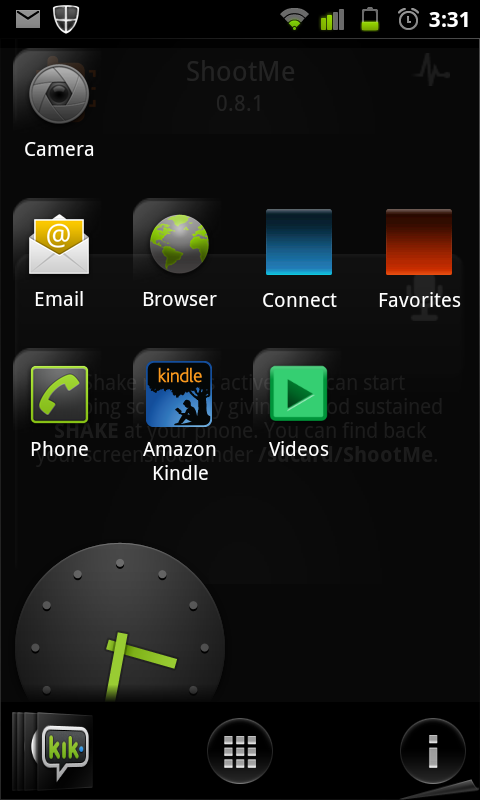
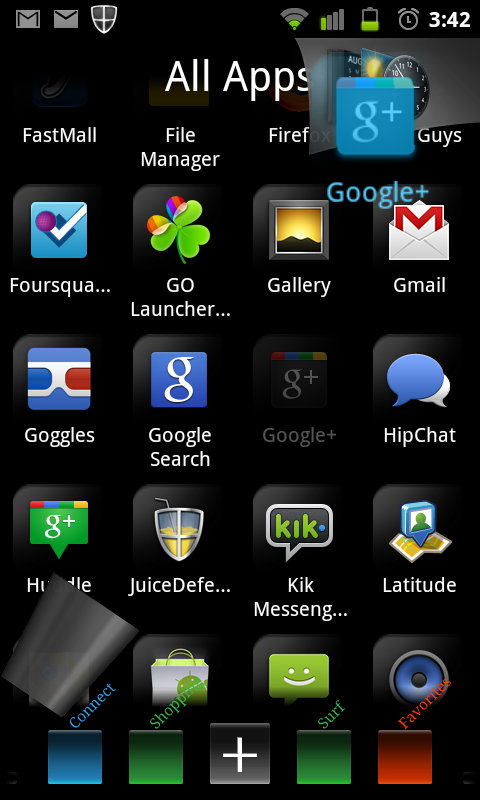
When an app is opening, and the Home button is used to exit it, the translucent homescreen comes into play. It swoops in from a corner and covers it, leaving the app partially visible. This is what Pure Breeze is really about: hitting the Back key makes The Kite fly away again, leaving the user exactly where they were before. Hit the Back key again, and it will take you to the app opened just prior to that. Pure Breeze effectively creates a chain of apps that theoretically allows users to follow a trail back to wherever they left off.

It sounds great, and for the most part, it works really nicely, but there are a couple issues.

Chains can get long enough to overwhelm some less powerful devices, and the translucent homescreen can be awfully distracting when trying to find an app you placed on The Kite. Pure Breeze is just different enough that many users who pick it up will try to do their usual thing and wind up lost. There’s only one homescreen page, so be judicious in deciding what widgets to use. The Menu button, when pressed on the homescreen, brings up the Pure Breeze settings instead of the device menu.

Perhaps I’m being a bit harsh, but it seems like a too drastic a shift for so little payoff. The app chaining concept is a novel idea and works surprisingly well, but all the little missteps drag everything down. This is the San Jose Mobile Lab’s first release, and it’s certainly an ambitious one, but here’s hoping future versions will be better thought out.

The app went live in the Android Market a few days ago, and is available in both free and paid versions.


Instagram Adds 50 Million Photos In August, Now Over 200 Million Total

Instagram-Logo

Instagram is growing like crazy. In June, we noted when the service hit the 5 million user milestone, with 95 million photos uploaded. At the beginning of August, Instagram reached 150 million photos. And now the service has surpassed yet another milestone: 200 million photos.

Given that our last measurement was at the beginning of August, and the site is now well beyond 200M, that means that Instagram added some 50 million photos in August alone.

In keeping with our previous Flickr comparisons, that’s 200 million photos for the 10-month old Instagram, when it took Flickr almost 2 years to reach 100 million photos. Still, that’s a bit of an apples and oranges comparison, isn’t it? After all, Flickr reached its 100 millionth photo back in February 2006. The iPhone itself wasn’t unveiled until June 2007. And even then, it was nowhere near as ubiquitous a device as it is today.

And as we noted before, Flickr is now well past 5 billion photos, an increase that has also been impacted by the iPhone’s existence.

Still, 200 million photos is another nice milestone for Instagram to reach. And it’s impressive how quickly it got there.

By the way, if you’re curious how to keep track of Instagram’s numbers for yourself, Hans Kullin posted a hack on his blog, which involves using the third-party service Inkstagram. The URL’s found there are in sequential order. For example, this is the first ever published Instagram photo: http://inkstagram.com/#/photos/2. (Photo #1 is missing). This is the 150 millionth: http://inkstagram.com/#/photos/150000003, as previously confirmed. In that case, this would be the 200 millionth, but the photo is private, so, sadly, you can’t view it.

As for Instagram, it didn’t even notice the milestone until we pointed it out to them. They must be too busy working on their Android app over there.


Company:
INSTAGRAM
Launch Date:
2010
Funding:
$7.5M

Instagram is a photo sharing application for the iPhone. It allows you to quickly take pictures, apply a filter, and share it on the service or with a number…

Learn more


Terrahawk’s M.U.S.T. Is A Mobile Guard Tower In A Shady-Looking Van

545_Terrahawk_-_CS_Burnt_1280x720__2_w_no_logo_1_

National Security isn’t always about the flashy solutions. Not everything can be rail guns and one-winged drones. Sometimes you just need a sort of seedy-looking van that slowly, slowly turns into a climate-controlled guard tower.

That, at least, is the goal of defense researcher Terrahawk’s M.U.S.T. platform. That’s Mobile Utility Surveillance Tower if you must know. Check out this video of its deployment.

I have to say, it’s different in the movies and such where these things tend to exist. But I suppose in the interest of stability and durability they can’t have big feet that fire out like jackhammers, and a tower that pops up like a jack in the box.

Although it looks like something you can shoot out of, I don’t think that’s really recommended. It’s a fairly vulnerable target — a speeding car or RPG could easily topple it. Terrahawk recommends it for “emergency response, public event crowd control, [and] general surveillance.” It’s got lights, thermal cameras, and ground radar for monitoring borders, so drug runners beware.

They’re doing a big demonstration of the MUST for the House and Senate next Thursday, at which many Representatives will be overheard to say “couldn’t it go a little faster?” And Terrahawk will respond “well, right now your options are taking two days to build a guard tower, or two minutes to put one of our things up.” The Representative will nod and check his phone.


The Killings Continue At Google: Aardvark Put Down

Aardvark

Google is working fast and furious to streamline their product offerings. Just a couple weeks after killing off all but one of the projects in their Slide division, today comes another death: Aardvark.

Co-founder Max Ventilla says the service will shut down at the end of this month. We broke the news of Google and Aardvark talking in late 2009. By February 2010, they had a deal: Google bought Aardvark for $50 million.

But Google never really did anything interesting with Aardvark, despite the big time potential. It was a type of social search that paved the way for services like Quora and now Jig. Instead of having them focus on Search, Google put most of the Aardvark team on the Google+ project.

Here’s Ventilla’s full letter to users:

As part of the shutdown of GoogleLabs, Aardvark will be shutting down at the end of September.

Aardvark began as a small experiment in a new kind of social search, and over a few years blossomed into a service that made millions of connections between people to answer each other’s questions. It was a great experience in seeking to combine a broad vision for the future of technology with a rigorous user-centered design process. Over this time, we learned a lot about creating and maintaining online communities, and how to facilitate sharing of knowledge between people.

We’ve been excited to share these lessons within Google over the past year, especially as part of the effort behind Google+. It has been gratifying to see how well this project is doing — even in these early stages, Google+ has already become a great place to share knowledge online, eclipsing the original vark.com! — and there is much more to come very soon. In this and other projects at Google, the Aardvark team remains committed to developing powerful tools for connecting people and improving access to information.

Of course, we’re also sad to say goodbye to the original Aardvark here at vark.com. Who would have thought that a digital version of a nocturnal burrowing mammal would have engendered so much affection! We’re very grateful to the whole Aardvark community for your support along the way.

Onwards,

Max and Damon

p.s. In the spirit of data liberation, we want to make sure that any of you Aardvark users who would like to retrieve your past data from the service can do so. Right now of course you can log in and manually copy anything you’d like to keep. Or if you prefer, you can email us at [email protected] and we’ll send you a bulk dump of your data (please allow time for us to process these). After September 30, there will be no way to retrieve your data, as shortly after that we will delete everything permanently.


Company:
AARDVARK
Website:
http://vark.com/
Launch Date:
7/2007
Funding:
$6M

Aardvark (formerly Mechanical Zoo) is a social search engine, founded by a group of former Google employees. Aardvark that lets users ask questions that are distributed to the social…

Learn more


Google+ To Roll Out A Twitter-Like Suggested User List

Twitter-1

Google’s Bradley Horowitz just Tweeted out a note indicating that Google is about to add a Twitter-like Suggested User list to Google+. From the Tweet: We’re about to pilot a ‘suggested user’-like mechanism on Google+. If you’ve got more than 100k followers on Twitter, DM me – lets talk! As stated in the message, Horowitz is looking for users who have more than a 100,000 followers on Twitter.

Besides what Horowitz wrote, there aren’t too many details on how Google+ will decide who will be on the list. Twitter’s suggested user list has been controversial because those on it were assured to gain thousands of followers a day, and those who are left off thought this was unfair. Twitter then revamped the list last year, and now also allows users to create personalized suggested user lists.

Google has become more brand friendly with verification for profiles of celebrities, public figures, and people who have been added to an (undefined) ‘large’ number of Circles. It’s unclear yet if the suggested user list will include only verified profiles.

How Google decides who makes it on the list will be very interesting. Clearly Twitter followers are playing a factor of sorts, which is interesting. You have to wonder whether Facebook or other followings on networks will also be used. Horowitz did add that Google has some ‘amazing ideas around context-specific relevance’ for recommendations.


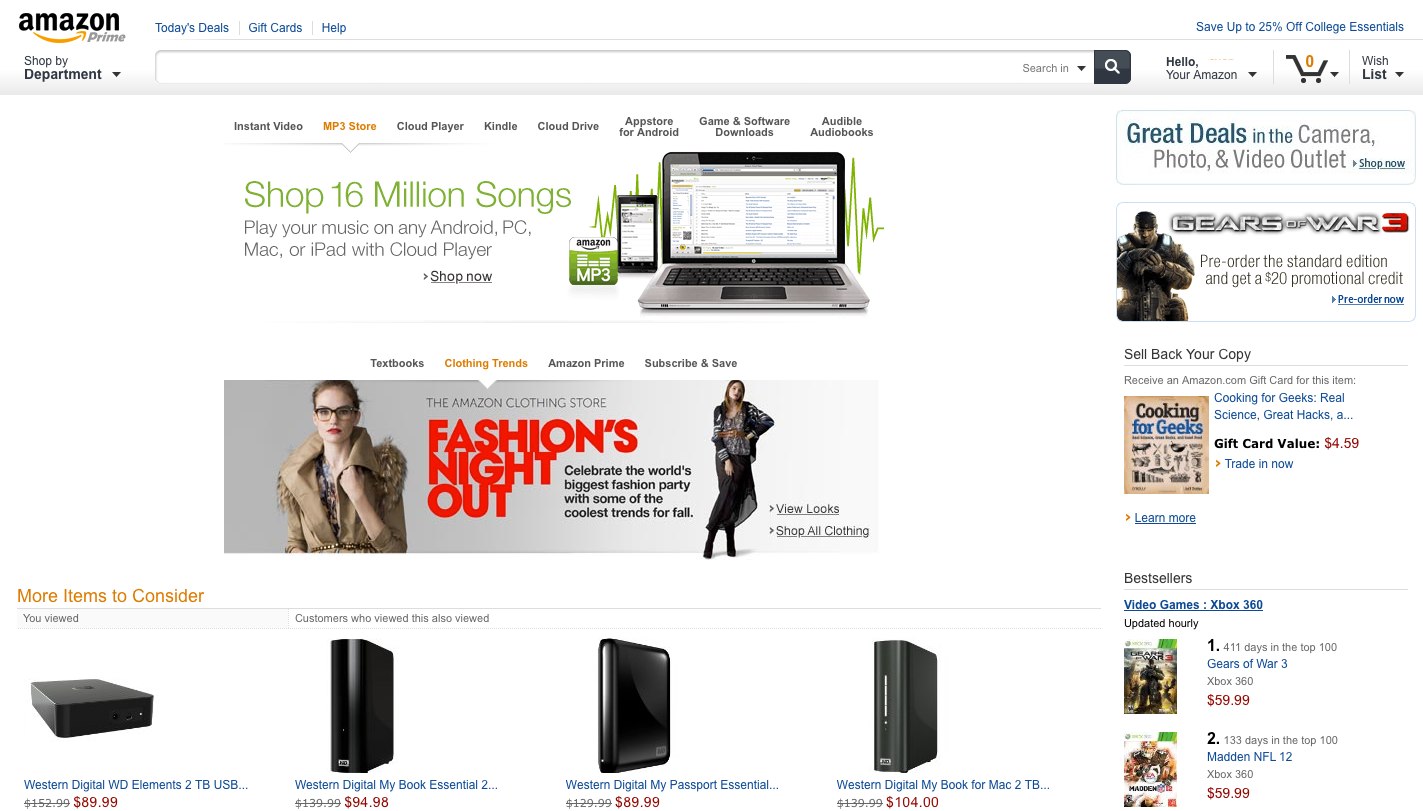
Amazon.com’s Big Redesign Is Arriving Soon For All

Amazon Picture

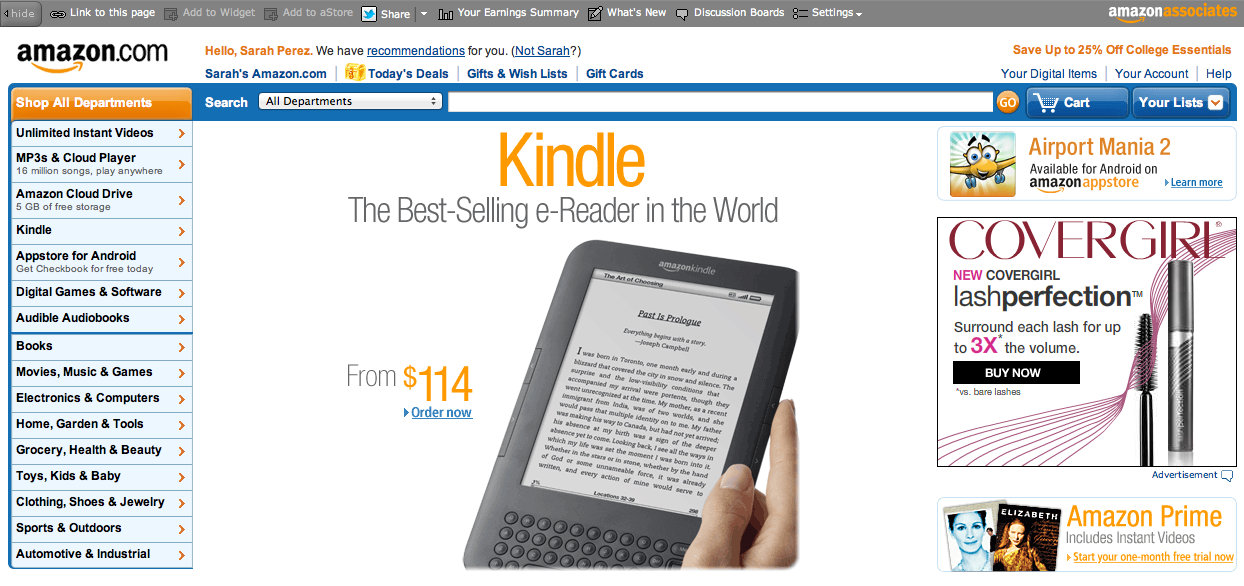
For days, our inboxes have been filled with tips and screenshots about Amazon.com’s redesign, which offers a cleaned up Amazon homepage, without the old site’s iconic blue and orange navigation. Instead, the new site features a much bigger search bar, bigger buttons, and less clutter – all changes that practically scream “tablet-optimized!”

The changes, of course, hint that Amazon’s long-rumored Android tablet is right around the corner. The site overhaul is being rolled out just prior to the tablet’s launch, or goes the current speculation.

Well, at least we now know when the redesign’s rollout will be complete: this month.

(Update: we were subsequently informed that “end of the month” is incorrect, which is what Amazon told us initially. The complete rollout is “TBD,” it says now). 

Amazon has been testing the new design since late August and is now prepared to have it go live to all customers later this fall. This not only includes U.S. visitors, but international customers, as well. It will not disclose the percentage of users who have already received the update, however.

The company believes the updated look will make searching for and discovering items easier. But in particular, Amazon notes that the design is meant to better highlight products like MP3′s, Kindle eBooks, digital games and apps from the Amazon Appstore for Android.

Now, what customers would be looking for those sorts of items, again? Hmm.

In addition, we’re told that the redesigned site will be the default homepage for both tablet and PC visitors, only those browsing from a smartphone would see something different – a mobile-optimized site. Hmm.

If you haven’t seen the redesign yet, check out the old (top) and new (bottom) screenshots below.

Image credit: new site – Stuart Lawder


Company:
AMAZON
Launch Date:
1994
IPO:

5/1997, NASDAQ:AMZN

Amazon.com Inc. (AMZN) is a leading global Internet company and one of the
most trafficked Internet retail destinations worldwide. Amazon is one of the first companies to sell products deep…

Learn more


Keen On… It Will Be Really, Really Difficult for Tim Cook to Screw Up Apple (TCTV)

Screen shot 2011-09-02 at 10.34.07 AM

If you are sick of Steve Jobs stories, then this interview isn’t for you. But, of course, you probably aren’t. On one hand, even though Jobs resigned from Apple more than a week ago, there appears to be no let up in the flood of anecdotes about The Great Leader. On the other, we are now seeing the first significant executive reshuffles reshuffles in the Tim Cook era.

But now that the dust is beginning to settle just a little on the Jobs epoch, what exactly is his legacy and what are the principle challenges and opportunities facing Tim Cook? To answer these questions and more, I went to one of the most reliable sources of Apple intelligence, TUAW.com editor-in-chief Victor Agreda, Jr., a guy who spends his whole day making sense of Cupertino’s alternative reality.

So, I asked Victor when I caught up with him yesterday, will the authoritarianism, abrasiveness and paranoia of the Jobs regime be normalized under Cook?


Person:
ANDREW KEEN
Website:
Companies

<a href="http://www.crunchbase.com/company/now-tv" onclick="Now.tv, <a href="http://www.crunchbase.com/company/techcrunch" onclick="TechCrunch

Andrew Keen is an Anglo-American entrepreneur, writer, broadcaster and public speaker. He is the author of the international hit “Cult of the Amateur: How the Internet is Killing our…

Learn more


Person:
VICTOR AGREDA
Companies

<a href="http://www.crunchbase.com/company/tuaw" onclick="TUAW

Victor’s introduction to technology was the Apple ][ his dad bought in late 1978. Since then he’s used Amiga’s, Commodore’s, Tandy’s, even a PC and a Mac or two….

Learn more


Will The Next iPhone Be Thinner And Wider? A Gazillion Leaked Cases Say Yes

iphone5casewide

The Internet is awash in purported iPhone 5 cases. Like most iPhone related rumors, it’s hard to decipher fact from fantasy, but the sheer amount of nearly identical cases seem to state that at least several manufacturing houses have the same iPhone dimensions. The image here is a iPhone 4 in one of these many cases. Look different? Yep, this case, and the many like it, are clearly for a phone that’s both thinner and wider.

This isn’t the first whiff of this rumor either. A rather official looking iPhone 5 clone popped up a month ago that was just 7mm thick, 2.3mm less than the iPhone 4. It also shared the same design cues with a rounded edge, slightly convex back and a wider design.

Now, not that any of us in the West truly understand the seedy underworld of Chinese gadget cloning, but it’s entirely possible that, at least from where I sit, these cases and clones are sourcing the same set of unofficial dimensions. Makers are betting that they have the right specs and so they are building out a massive supply ahead of the next iPhone’s launch. But leaked cases have been a major source of leaks for years, properly foretelling even the iPad 2′s existence.

A wider but thinner iPhone would match the current trend of smartphones slightly larger than the traditional form factor. This is something might be something even Apple, who is generally a trend setter instead of follower, might not be able to avoid. But what about MG? He stated over and over again that the EVO 4G’s 4.3-inch screen made the device too big. Would he actually pass on the next iPhone if it’s wider? Shock!


Company:
APPLE
Launch Date:
1/4/1976
IPO:

1980, NASDAQ:AAPL

Started by Steve Jobs, Steve Wozniak, and Ronald Wayne, Apple has expanded from computers to consumer electronics over the last 30 years, officially changing their name from Apple Computer,…

Learn more


Google Abandons “Maps API For Flash”

google-maps

In more news of Flash’s impending decline, Google is announcing that it’s “deprecating” the Google Maps API (application programming interface) for Flash. This API previously allowed developers to add Google Maps functionality within their Flash-based applications.

However, as of today, use of the API is limited, says Google, with only a small number of applications taking advantage of features unique to the Google Maps API for Flash alone.

The API, which originally launched in May 2008, is similar to the JavaScript version, but designed for use within Flash apps. Developers could use the API for manipulating and adding content to maps through a variety of services, which enabled them to embed interactive maps applications on websites.

The Maps for Flash API isn’t actually being killed off entirely – it’s being deprecated. That means that it will continue to function according to the Maps API Terms of Service, but no new features will be developed, and only “critical bugs, regressions and security issues” will be fixed.

In other words, the API is basically being abandoned.

Flash developers are instead encouraged to migrate applications over the Maps API v3, which offers other benefits like Street ViewFusion Tables integrationPlaces search, and full support for mobile browsers, says Google. And help is being made available on the Google Maps JavaScript API v3 forum.

The move is not surprising, given the limited interest in the API’s unique features, as noted above. However, in some way, the decision seemingly stands in contradiction to other moves Google has made in recent months in support of Flash. For example, last summer, Adobe and Google jointly announced that the Flash Player would soon be built into the Chrome Web browser going forward, thus eliminating users’ need to download, install and update the plugin separately.

Plus, Google’s mobile operating system is known for its support for Adobe Flash, and Flash-based apps.

In today’s blog post, Google also adds that it continues to support Flash as a development platform in Chrome, too, but the link for more details goes to a dead URL.

Maybe that page got deprecated too?

Update: Google fixed the link. The correct URL is http://www.google.com/support/chrome/bin/answer.py?answer=108086.


TechCrunch Giveaway: Tickets To BoxWorks Featuring Third Eye Blind #TechCrunch

89-atlg

Want to attend an enterprise software conference after party with Third Eye Blind?

Cloud content management startup Box.net is holding its first-ever customer conference, BoxWorks, on September 28th in San Francisco. To celebrate, they’re throwing a big after party featuring Third Eye Blind. The party gets started at 6pm at the Bently Reserve, and runs until 11pm. There will be an open bar, heavy appetizers, and lots of dance floor action.

Want to win tickets to the party for you and a friend? We’re giving away 20 tickets in total, so to be one of 10 lucky people to win a pair, just follow the steps below.

1) Become a fan of our TechCrunch Facebook Page:


2) Then do one of the following:

– Retweet this post (making sure to include the #TechCrunch hashtag)
– Leave us a comment below telling us what your favorite song is

The contest starts now and ends September 4th at 7:30pm PST.

And if you love the cloud as much as you love to party with a live band, consider registering for BoxWorks. Speakers include Box CEO Aaron Levie, Marc Andreessen of Andreessen Horowtiz, author Geoffrey Moore and Tony Hsieh of Zappos.

Anyone in the U.S. is eligible, and Box.net will pay for your airfare to and from San Francisco.


Office Depot Now Fulfilling At Least Some 32GB TouchPad Backorders

348037_sk_lg

TouchPads are in hot demand right now and it seems as if Office Depot just is ready to ship out another round. This comes from an email set to us that indicates at least some 32GB TouchPad orders were canceled, which the retailer is ready to use to fulfill the backorders.

Chances are that if you’re part of this group, there’s an email waiting for you from Office Depot right now. If you don’t have said email, you’re probably going to be waiting a little longer if not indefinitely — unless the retailer you entrusted receives part of the last run of TouchPads.


Great news, we now have inventory available to fill your recent order for the 32GB HP Touchpad Tablet. We have received some cancellations of confirmed orders, making a limited quantity of 32 GB Touchpad Tablets available to fill backorders.

Orders will be filled in the order that they were placed, while supplies last, and subject to approval from your credit card provider. We want to be able to fill as many orders as possible so we are not accepting any new orders for this product.

If you still want to receive your order, please reply to this email to confirm your interest. We must receive your reply no later than 11:59pm on Tuesday, September 6th.

We expect to ship orders the week of September 12th and you will receive an updated email notification at that time.

If you no longer want us to fill this order please reply to let us know and we’ll be happy to cancel it immediately.

Thank you for choosing Office Depot.


[Thanks for the tip, Dan!]


Full Video: Salesforce’s Marc Benioff Interviews Google Chairman Eric Schmidt

Salesforce CEO and founder Marc Benioff sat down for an hour-long interview with Google’s Chairman and former CEO Eric Schmidt last night at Dreamforce, and here’s the full video of the interview. We’ve embedded it into the post as well.

As we covered last night, Schmidt and Benioff went down memory lane through his days at Novell and Sun Microsystems, and chatted about Google Apps, which he says has 40 million users with 5,000 firms are joining per day, as well as the success of the Android platform.

Schmidt also said that Apple’s Steve Jobs gave the best performance by a CEO in 50 years, maybe 100 years. He not only built Apple once, but twice. And he weighed in on Google’s Motorola acquisition as well as the troubled U.S. patent market.

The interview is actually very insightful, especially regarding Schmidt’s views on Apple and Steve Jobs and his suggestions on how to reform patents. It’s worth a watch if you find an hour of spare time over the holiday weekend.


TV Ad Pegs The Droid Bionic For September 8 Release

Screen shot 2011-09-02 at 1.41.24 PM

The Droid Bionic has been a long time coming. It was originally announced back in January at CES and it’s now September, but we’re willing to forgive the incredibly annoying wait for that dual-core LTE magic. Especially since it’s been all but officially confirmed that we’ll be seeing the Bionic on shelves on September 8.

To start, Motorola CEO Sanjay Jha said the phone will launch in September. That’s not super specific, and we know this handset is all about being fashionably late, so it’s understandable if you’re still not convinced. But there’s more.

A Verizon roadmap was leaked back in August that also verified that September 8 launch date, along with a Korean TV ad which didn’t necessarily show off the phone (at all), but did happen to flash a “September 8, 2011″ around the 21-second mark.

Even though the Droid Bionic will be one of the most powerful handsets on the market, nine months is a really long time to keep people excited. Thus, Verizon has launched an augmented reality app-based scavenger hunt giving peeps the chance to win a long-awaited Droid Bionic.

Six days, people. Six more days.

[via PCMag]


Company:
MOTOROLA SOLUTIONS, INC.
Launch Date:
1928

Motorola Solutions, Inc. (NYSE: MSI) is a data communications and telecommunications equipment provider that succeeded Motorola Inc. following the spin-off of the mobile phones division into Motorola Mobility Holdings,…

Learn more


Company:
VERIZON
IPO:

VZ

Verizon Communications Inc. delivers broadband and other wireline and wireless communication innovations to mass market, business, government and wholesale customers. Verizon Wireless operates America’s largest wireless network that…

Learn more