Disrupt Beijing: We’re Bringing Steve Chen, Peter Vesterbacka, Phil Libin and More

disrupt_beijing_photo

As we announced last week, we’ve been busy securing some of the most exciting names in China for our Disrupt Beijing conference this October including Tencent Founder and CEO Pony Ma and Chinese entrepreneur and angel investor Lei Jun. But it wouldn’t be a TechCrunch event without bringing a little of that Silicon Valley magic too.

In selecting people to bring to China we wanted a mix of some people who are new to the country and others who have a long experience doing business there; people who are existing successes and those who have a fast-growing, tiger-by-the-tail right now. We also wanted a few people who could speak to the culture and whimsy that makes the Valley so unique.

We’ll start things off with Peter Vesterbacka the mighty eagle of Rovio, maker of Angry Birds. Vesterbacka is no stranger to China, where he says Rovio is busy building a $100 million business by the end of the year. That business spans everything from games to desserts to plush toys. I last saw Vesterbacka at the Next11 Conference in Berlin and the more he told me of his strategy for China, the more I insisted he be at Disrupt. He may even have some news to announce…

Steve Chen, co-founder of YouTube, will also be joining us on stage. Chen is an expert in a good problem to have: A company growing so fast it could bankrupt you. YouTube is one of the biggest phenomena the Web 2.0 world has ever seen. It’s played a pivotal role in everything from US presidential races to the rise of Justin Bieber. And it was the first Web 2.0 to have a $1 billion-plus exit.

The Valley isn’t all about fun ways to waste time. Phil Libin of Evernote calls his company “the anti-Zynga” because it seeks to make you smarter during the little holes in your day. Evernote has a rabid following among its users and is one of the hottest companies in Silicon Valley right now, fresh off raising a recent funding round. Evernote rivals Foursquare in downloads, and unlike Foursquare it has no monetization problems, as Libin explains in this video.

These are just a few of the Valley names joining us in Beijing this October. Stay tuned for more speaker announcements and remember to buy your tickets and apply for the Startup Battlefield today. As a reminder, we’ll have translation headsets for all attendees so all speakers and startups competing can do so in their native language, and our global audience won’t miss a thing. Battlefield applications are available in English and Chinese as well.


Company:
EVERNOTE
Launch Date:
2007
Funding:
$95.5M

Evernote allows users to capture, organize, and find information across multiple platforms. Users can take notes, clip webpages, snap photos using their mobile phones, create to-dos, and record audio….

Learn more


Person:
PETER VESTERBACKA
Website:
Companies

<a href="http://www.crunchbase.com/company/rovio-mobile" onclick="Rovio Mobile, <a href="http://www.crunchbase.com/company/connectedday" onclick="ConnectedDay, <a href="http://www.crunchbase.com/company/hewlett-packard" onclick="Hewlett-Packard

Peter Vesterbacka is currently the CEO of Rovio Mobile.

Learn more


Person:
STEVE CHEN
Website:
Companies

<a href="http://www.crunchbase.com/company/youtube" onclick="YouTube

Steve Chen is the co-founder and CTO of YouTube.

Learn more


Company:
YOUTUBE
Launch Date:
11/9/2005
Funding:
$11.5M

YouTube was founded in 2005 by Chad Hurley, Steve Chen and Jawed Karim, who were all early employees of PayPal. YouTube is the leader in online video, sharing original…

Learn more


Person:
PHIL LIBIN
Website:
Companies

<a href="http://www.crunchbase.com/company/evernote" onclick="Evernote, <a href="http://www.crunchbase.com/company/corestreet" onclick="CoreStreet, <a href="http://www.crunchbase.com/company/engine-5" onclick="Engine 5

Phil Libin the CEO of Evernote. He is an entrepreneur and executive who has led two Internet companies from the very beginning to proven commercial success, and helped three…

Learn more


Person:
PONY MA
Website:
Companies

<a href="http://www.crunchbase.com/company/tencent" onclick="Tencent

Pony Ma is one of the Core Founders, Executive Director, Chairman of the Board and Chief Executive Officer of Tencent. Pony oversees the strategic development, overall direction and business…

Learn more


Person:
LEI JUN
Website:
Companies

<a href="http://www.crunchbase.com/company/ucweb" onclick="UCWeb, <a href="http://www.crunchbase.com/company/kingsoft" onclick="Kingsoft, <a href="http://www.crunchbase.com/company/joyo-com" onclick="Joyo.com

Lei Jun is an angel investor in the Chinese economy, who has been likened to Ron Conway of Silicon Valley. Lei founded Joyo.com in 2000, which was later acquired…


Learn more


Attn Entrepreneurs: How to Attend Disrupt Beijing for Less Cash

disrupt_beijing_photo

Hopefully, anyone who has attended our Disrupt San Francisco and Disrupt New York conferences knows why we charge $2,995 for tickets: Between the Hackathon, Startup Alley, the big names on stage and the Startup Battlefield, we essentially cram four conferences into one.

Our challenge in bringing Disrupt to Beijing was to find a way not to skimp on the conference, but produce an event that more than just expats with expense accounts could afford. As usual with our conferences, it’s all about the entrepreneurs and we want as many of them in attendance as possible.

So we’re happy to announce a special entrepreneur package for Disrupt Beijing that brings the price down from the already discounted $1,995.00 to $997.50. You can find all the details here. While less than some other international tech conferences in China, we realize that’s still a hefty sum for some startups. So we’re giving you more than just a conference ticket. You’ll have the option to display your company in Startup Alley and be invited to an exclusive VC and angel networking event. With any luck, you’ll leave Disrupt richer than you came.

Of course, if you have a great startup about to launch, want to come to the conference for free, and get the chance to get money from us, we encourage you to apply for the Startup Battlefield. There’s more information here. Applications are available in English and Chinese, and you can present in either language during the competition.

Still not sure if you should attend? Check out the videos below to see if the event is a fit for you or your company.

Steve Martocci of GroupMe explains why developers should come to the Hackathon:

Our most recent Disrupt winners Sam Zaid and Jessica Scorpio of GetAround tell you what to expect from the Startup Battlefield:

Lastly, Gang Lu, the editor of popular Chinese blog TechNode, came over to the Valley to grill our own CEO Heather Harde on TechCrunch’s China plans. Read his post in Chinese here. (I’m hoping it says nice things…)


Company:
GROUPME
Launch Date:
5/2010
Funding:
$11.5M

GroupMe is a group messaging and conference calling service that lets you stay in touch with groups of people via mobile phones. It’s a free service that allows users…

Learn more


Company:
GETAROUND
Launch Date:
10/9/2009

Getaround provides a peer-to-peer carsharing marketplace that enables car owners to rent their cars – from Priuses to Teslas – to a community of trusted drivers by hour, day,…

Learn more


Netrobe Is A Virtual Closet For Your iPhone

lightbox_2

One glance at my closet after coming back from vacation this morning and I realized that I owned A LOT of clothes, many of which I had forgotten about while purchasing presumably complimentary accessories like shoes and bracelets on my travels. If only there was a way to access my entire wardrobe via iPhone …

Inspired by the now infamous virtual closet in Clueless, Netrobe, an iPhone app out of Athens, Greece, attempts exactly this, helping you remember the individual items from your wardrobe by giving you a tool to catalog them. Netrobe allows iPhone users to mix and match individual items of clothing or accessories on a Styleboard, create outfits for events, pack entire suitcases or add inspirational images to a Lookbook.

“You always forget what you own and you keep buying the same thing over and over again,” says founder Christina Plakopita, “[With Netrobe] women can utilize their wardrobes … Now you can log in to your closet any time or any where.”

While the app already comes with some preloaded items from Shopstyle and Empora, you can add your own personal items of clothing to Netrobe by selecting the hanger icon in the middle of the app and clicking on the Add An Item button (the plus sign).

Plakopita tells me that what makes Netrobe different from similar apps like Stylebook, TouchCloset is the fidelity of its image background removal tool, which she describes as “Photoshop level,” its streamlined design and its Suitcase feature which allows users to virtually pack for trips.

Plakopita tells me that she plans to make Netrobe more social and interactive in the future as well as develop a web component which will include the same, but further fleshed out, features as the app — eventually allowing you to share your closet with friends or ask for opinions about what to wear.

In addition to its $1.99 cost in the app store, the bootstrapped company intends to monetize through affiliate fees from suggested clothing items. Plakopita estimates that the web component should be ready in about a month’s time and that an Netrobe Android app should be available in about two to three months.


Microsoft’s Surface Garage: A Cross-Department Development Team, With Pizza And Beer

dots1

Despite being the only TechCrunch writer in Seattle, I don’t get out to Microsoft nearly as much as one might expect. The fact is it’s on the other side of a big lake and getting there usually involves a lot of traffic. But when I get an invite like I did recently, to join a sort of unofficial Surface developers’ club for a meeting, it’s hard to say no. The promise of free pizza had nothing to do with my enthusiasm. I like the Surface.

So it was that I got to join a group of developers from all around Microsoft as they spitballed ideas, compared new projects, and developed a new feature as I watched. They didn’t initiate me into the mysteries of the device or swear me to secrecy regarding plans of world domination, but I got to see some cool new Surface apps and contribute to the development of a new feature. Also, they had Alaskan Amber.

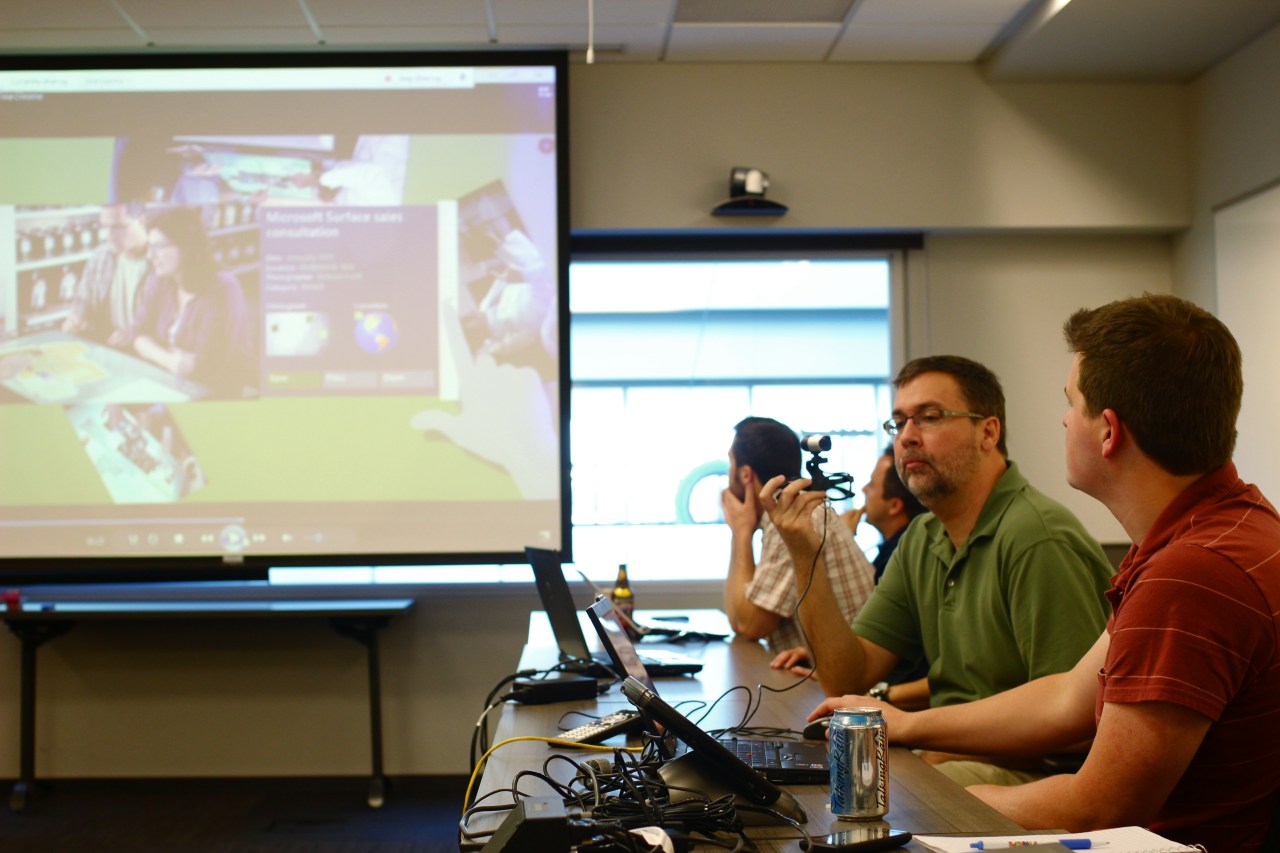
I arrived at the Microsoft campus (one of them, anyway) around 6, and after wandering fruitlessly for a short time (navigating corporate architecture isn’t my strong suit) I was captured and conducted to a conference room where a dozen people or so were arrayed around tables as if for a weekly meeting. After some introductions, the purpose of this secret society was explained.

It turns out that some people really just love working with the Surface. So much so that they can’t get enough during working hours! So this recurring event was created, with pizza and refreshments, to make it worth the extra time being put in. There were people from gaming, Windows, Kinect, marketing, a real cross section of Microsoft life.

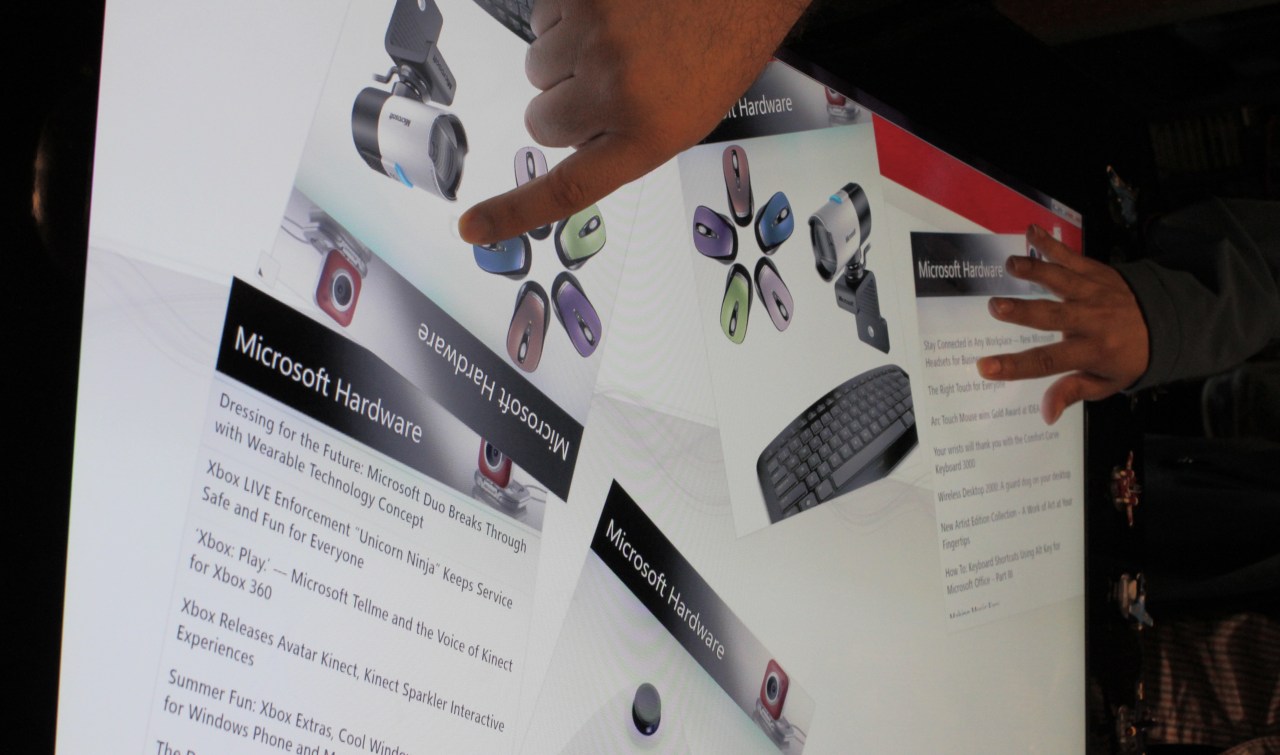
I was then given a short tour of some things that people in the group had developed in their spare time, for the most part on their own. A simple but versatile pamphlet presentation app, a sort of paperless coffee table, spoke to the Surface’s tragically commercial-only availability:

But one developer, like myself a fan of “shmups,” had put together a rudimentary but promising shooter using real-life tokens to control your ships. You might remember some time back when we went to see a Dungeons and Dragons game for the Surface, complete with figurines, spells, and kobolds. As you can see below and at the top of this article, this game is a bit more frenetic.

The dots emanate from various locations and it’s your job to navigate them. You move your ship around, point it where you want to shoot, and so on. Having a physical item to play with helps address the lack of tactility that occasionally makes touchscreen games so unsatisfying.

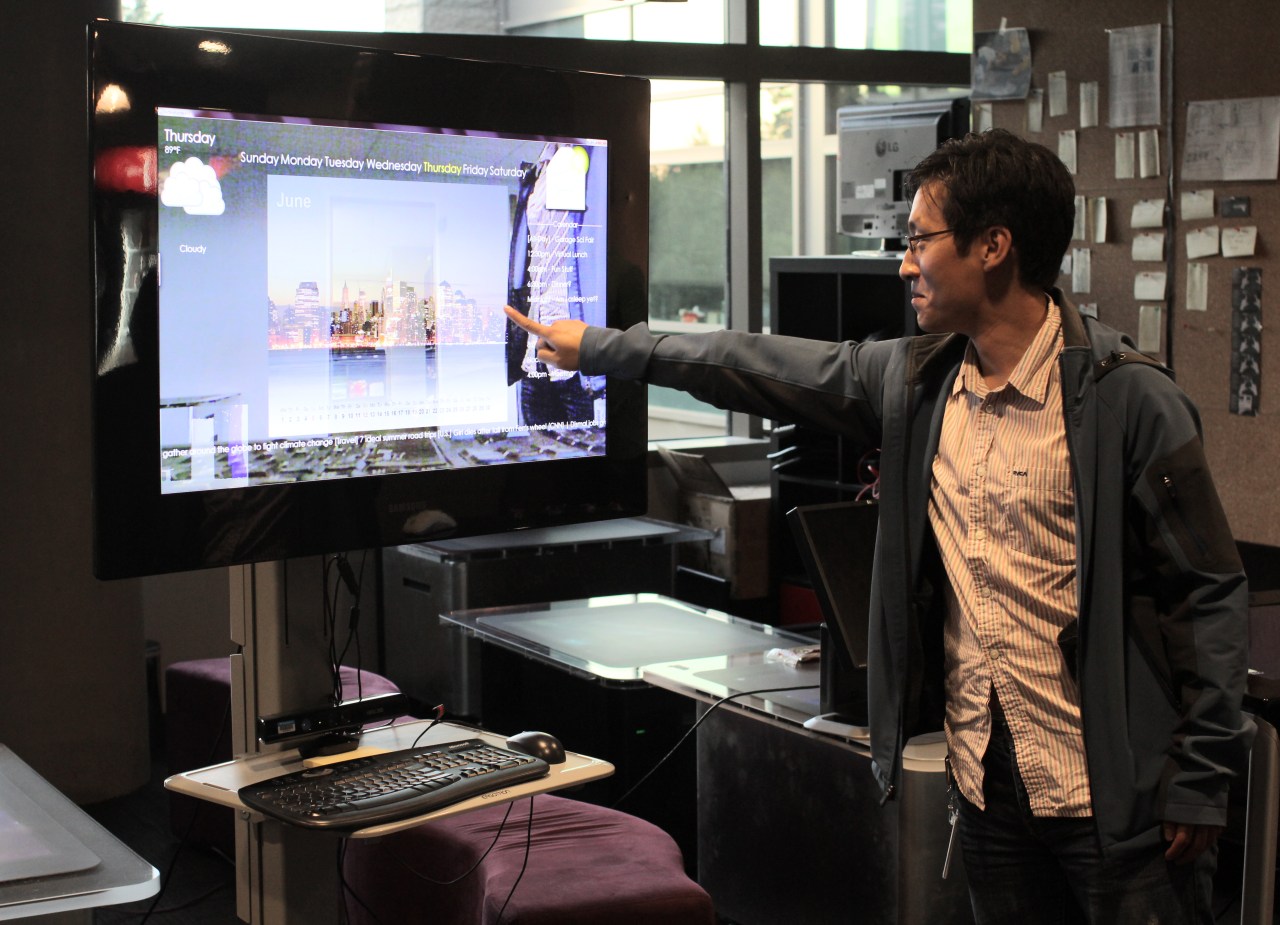
Last was an interesting fusion of two innovative Microsoft products: the Surface and the Kinect. This is a sort of “morning briefing” app that is meant to run on your living room’s idle TV, which one can imagine may some day have a touch panel and depth sensing camera built in. Today it was an upright Surface 2.0 and a stock Kinect:

You always see people in movies set in the future talking to their computers, controlling them with a gesture, and so on. This is a small-scale attempt at something like that that people might actually use. When you’re at a distance, it displays large-granularity info like the weather, upcoming appointments, and so on. You can say “mail” and it’ll switch to email, or “calendar Wednesday” and it’ll switch to that. And when you approach, it senses your proximity with the Kinect and switches to a touchscreen mode where you can touch the news and email items and read them.

All put together by one guy, admittedly using APIs developed by hundreds, but a fun demonstration of what’s possible with the project right now.


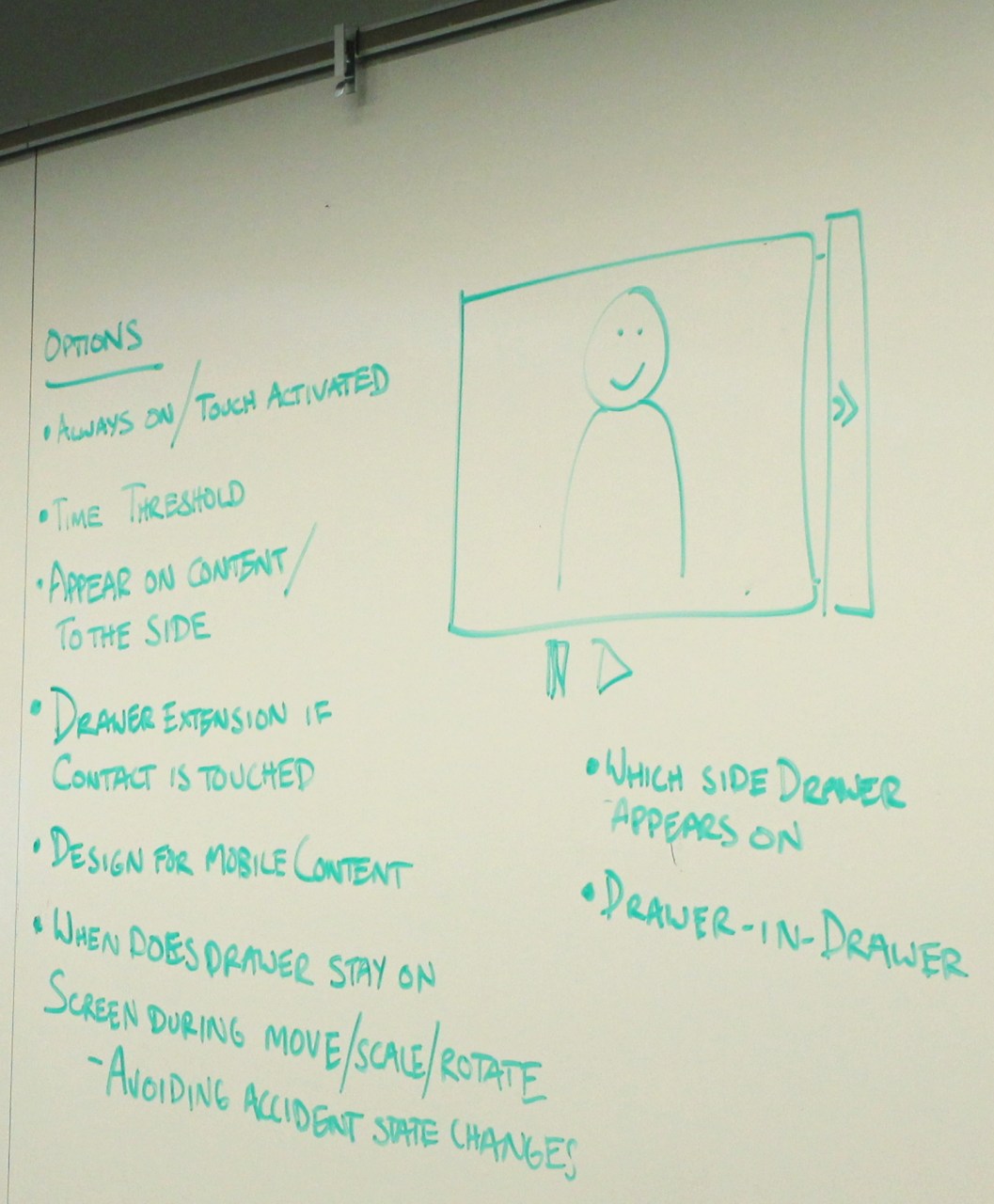
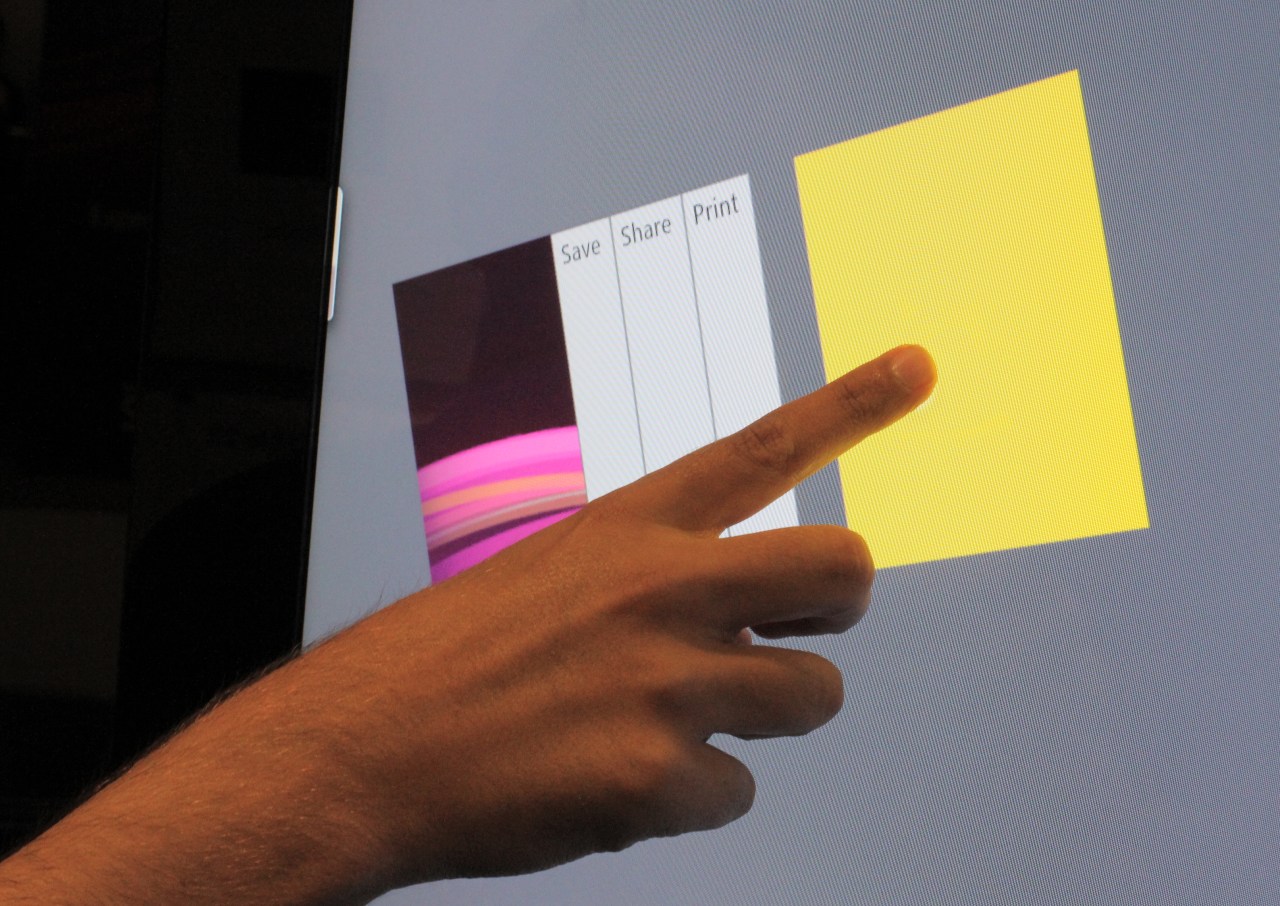
We then selected a proposed UI element to be coded tonight more or less from scratch. In this case, a sort of drawer menu was desired, something that could display metadata or properties for an item on screen like a photo. It would need some kind of UI cue to let people know it was there, a gesture to activate it and deactivate it, and some basic parameters to make it play well with other elements.

For something as simple as this, there are still tons of design decisions. Right off the bat, there was the “just in time” question. Should the drawer’s “handle” be visible at all times? Should it show up when you tap, drag, or hold the object? How long after should it disappear? I asked if we could use the Surface 2.0′s ability to see things before they touched the screen and “magically” make the handle appear, but there wasn’t enough time to create the brightness-based blob creation I had in mind.

And then there was the question of how far we wanted to dictate how the item was used. We shouldn’t make it right-side-only in case developers wanted to make it ambidextrous, for instance, and it was decided that handle visibility could be made flexible and left up to the software designers. It’s in situations like this that you can see some fundamental differences between how Microsoft and Apple work. A small sample size, admittedly, but it falls in line with the philosophies I observed at work last week in the Explorer ribbon debacle.

First we discussed, then we whiteboarded, then we started coding. And by “we” I mean “they,” because I don’t know anything about it. I did make some suggestions regarding how to monitor certain types of touches, and I thought I had a rather clever idea regarding how to combine the gestures for opening and closing the drawer (we didn’t implement it, despite its brilliance). And piece by piece, with a few hilarious setbacks (including a not-so-hilarious pizza-related one), our UI element took form.

By the end of the night, we could boast that we’d created a box that you could slide out from underneath another box. But its simple operation belied the many details that went into its construction: it was aligned with and moved along with the other UI element, it only pulled out to a certain distance, and it could potentially be filled with content very easily. We’d left ways for it to be configured one way or another, and despite a few bugs it was a working element — from concept to execution in two hours.

And this is why Surface Garage exists. Because it’s fun to create things like this, to see the results of some collaboration and work after a short interval, and know that it was created that way because everyone wanted it that way. After this, someone will pick up the code for the drawer, clean it up, give it a few parameters, and who knows, maybe the next time you see a Surface, our drawer will be lying dormant under the virtual photos scattered in virtual piles on the screen. Maybe you’ll even see something like it in Windows 8.

I’ve often written about how Microsoft tends to smother good ideas in the cradle, or else strangle them with internal conflict. It’s good that groups like this one (surely one of many) exist, as a blowoff valve for developers just interested in creating. They may not be building billion-dollar ideas, but beer, pizza, and time with like-minded colleagues is its own reward.


Will Windows Phone Apps Run On Windows 8?

windows8screen

When you look at the combined 70 percent smartphone market share of Android and Apple in the U.S. compared to Microsoft’s measly and shrinking 6 percent, it seems like it’s game over before it really began for Windows Phone. Windows Phone is a decent mobile OS, even promising, but so far it has failed to capture the hearts and minds of developers or consumers. Can Microsoft do anything to change that and will it involve tying Windows Phone more tightly to its next desktop operating system, Windows 8?

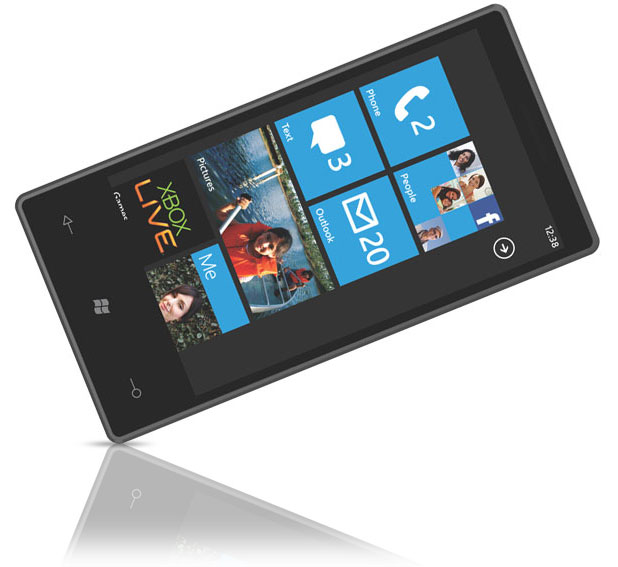
There are some clues that this is exactly what Microsoft is planning to do. When we first saw the preview videos of Windows 8, with its touch and tile-based interface, people thought immediately of Windows Phone, which has a very similar looking interface. Instead of app icons, both use tiles which can display data and images from the underlying apps without opening them. The tiles themselves become a dashboard displaying the realtime data behind every app.

Windows Phone and Windows 8 are two separate operating systems. But what if Microsoft made it really easy for Windows Phone apps to run on Windows 8 PCs? Right now, most mobile apps on Android or Apple’s iOS devices live in their own separate world from the desktop (porting apps from iOS to OS X is possible, but doesn’t seem to be a very popular practice). The link to the desktop today is usually done via the web. If Windows mobile apps had counterparts on the desktop that synced up and presented themselves as a Windows 8 app tile, that could give Windows phone an advantage currently lacking in its rivals. It also would be in line with Microsoft’s classic embrace and extend strategy, whereby it uses its dominance of the desktop to extend to other areas. That strategy may no longer work in the post-PC era, but it is still worth a try.

We will probably see all of this come together with Windows Phone 8 and Microsoft’s upcoming developer framework for Windows 8 called “Jupiter.” Just as the god Apollo was the sun of Jupiter, so too is Windows Phone 8 (codenamed Apollo) related to Windows 8. As our own Sarah Perez wrote about Jupiter:

Jupiter may end up being the “one framework” to rule them all. That means it might be possible to port the thousands of Windows Phone apps already written with Silverlight to Windows 8 simply by reusing existing code and making small tweaks. Or maybe even no tweaks. (That part is still unclear). If so, this would be a technical advantage for developers building for Windows Phone 8 (code-named “Apollo” by the way, the son of “Jupiter”) or Windows 8.

As I noted above, even if this strategy is successful in creating a ton of cool cross-platform mobile-PC apps, it is not clear that will be enough to make a difference for Windows Phone. But it definitely points to the mobile and desktop worlds converging in the not too distant future, and not just on Windows. All your mobile apps should also be available in some form on your desktop. Not the exact same apps, of course, because mobile apps are built for touch interfaces, location, and to take advantage of your phone’s hardware such as cameras and accelerometers. Desktop apps, in contrast, still need to be designed for the mouse and keyboard. But the underlying data can feed native apps on both platforms.

Over the past decade, desktop apps have given way to the web. Wouldn’t it be ironic if their popularity makes a comeback thanks to mobile apps?


Company:
MICROSOFT
Launch Date:
4/4/1974
IPO:

13/3/1986, NASDAQ:MSFT

Microsoft, founded in 1975 by Bill Gates and Paul Allen, is a veteran software company, best known for its Microsoft Windows operating system and the Microsoft Office suite of…

Learn more


Product:
WINDOWS PHONE 7
Company

<a href="http://www.crunchbase.com/company/microsoft" onclick="Microsoft

Windows Phone 7 is the successor of the Windows Mobile 6.5 mobile operating system in development by Microsoft, scheduled for release by October 2010. Microsoft’s goal is to create…

Learn more


Chicago-Based Bidmyway Launches Hyperlocal Mobile Deals App

bidmyway-icon

Bidmyway is a newly launched local deals app operating in the Chicago market. As opposed to being a deals aggregator for more popular brands like Groupon or Living Social, the app offers exclusive deals made with local merchants.

What’s unique about Bidmyway is its interface and how the deals are presented to end users. Consumers “dial up” local deals using a click wheel reminiscent of the one found on old-style iPods.

The wheel is used to select the budget you have available for deals. Spin to select the amount, lock it in and Bidmyway shows you the best deals within a specified radius, ranked and listed on a map. You can then purchase the deal right from the mobile app itself.

It’s an interesting take on how mobile deals should work – instead of being presented with a single deal for a given geographic region, like a city, you filter a larger list of hyperlocal deals for those that are both within your budget and your vicinity. It’s a concept that could easily help users to better sort through the ever-growing number of deals available, so it’s actually somewhat of a shame (for the rest of us, at least) that Bidmyway launched as an independent deals broker, instead of an aggregator.

Bidmyway CEO John T. Shave says he believes that “hyperlocal mobile” is the future of the deals industry. It’s not a surprise, then, that he felt the need to build a new system from the ground-up, right down to the new deal-filtering mechanism.

He also notes that Bidmyway is the better option for merchants who need to launch a mobile deal immediately – for example, a restaurant having a slow night. Through the app, a retailer or small business owner can instantly offer a deal and post it, allowing them to attract customers right away, and most importantly, while those customers are out and about looking for something to do.

Although Bidmyway is available for download on iPhone and Android right now, as noted above, the only deals available are in the Chicago area (incidentally, also the birthplace of Groupon.) In the future, the company hopes to expand to other markets.

Bidmyway is owned and operated by local commerce company Elite Media Worx, which also runs the daily deals site EliteCityDeals. Elite Media Worx previously raised $1.35 million in funding back in April.


Insurance Technology Company Guidewire Software Files For $100M IPO

Guidewire

Joining recent tech companies MobiTV, Angie’s List, Brightcove, and Jive; Guidewire Software, a company that develops technologies for the insurance industry, has filed its S-1. The company aims to raise as much as $100 million in a public offering under the symbol “GWRE.”

Founded in 2001, Guidewire Software provides technology software to the property, casualty, and workers compensation insurance industry. The company offers a web-based claims system that supports various lines of personal, commercial, and workers’ compensation insurance; an enterprise application for coordinating, executing, and recording transactions; and a Web-based underwriting and policy administration system for personal and commercial insurance carriers. Basically, Guidewire, which is backed by U.S. Venture Partners, Bay Partners and Battery Ventures, automates the insurance industry.

While Guidewire’s product may not be as sexy as Pandora’s music radio service or LinkedIn’s professional social network, the enterprise company is actually making major revenue and profits. Guidewire brought in a healthy $144.7 million in revenue in 2010 and $121.5 million for the nine months ended April 30, 2011. Guidewire’s net income was $15.5 million in fiscal year 2010 and $33.5 million for the nine months ended April 30, 2011. And revenue and profit has grown consecutively over the past three years.

As of July, Guidewire had 101 customers, including big brands such as Nationwide Mutual Insurance Company. According to Gartner, insurance carriers spent $4 billion on software and $10.5 billion on IT services in 2010, so Guidewire is confident that they are part of a pretty fast-growing (and revenue-rich) industry.

For the most part, this year’s IPOs have been involving companies who offer consumer-focused products and services as opposed to enterprise companies. Fusion-IO, the developer of flash- memory technology for companies, started trading in June. And Jive, which develops a social network and collaborative platform for the enterprise, just filed its S-1, and could begin trading at the end of the year at the earliest.


Blu Cigs Smart Pack Alerts You When Other e-Smokers Are Nearby

Screen shot 2011-09-05 at 2.10.32 PM

So it looks like people are ready to slap the word “social” onto just about anything. Case in point: Blu Cigs Smart Pack. It’s a new offering from electronic cigarette maker Blu Cigs that comes with a homing device to find nearby e-cig smokers and Blu Cigs retail locations. Despite the fact that it sounds pretty ridiculous, I find this to be a rather clever move.

Here’s why:

Smoking is a social activity by nature. Total strangers will share their lighters, their cigarettes, and their stories all over the course of a ten minute cigarette break. Even when you start to hate the actual act of smoking, it’s difficult to give up because you get extra breaks during work where you can mingle with co-workers or strangers, and inevitably make friendships. When you’re toking on an e-cig, you’re more or less not welcome.

Thus, the Blu Cigs Smart Pack. Its homing beacon will tell you when there’s another Blu Cigs smoker within a 50-ft radius, or if there’s a nearby retail location. Along with the “social integration,” Blu Cigs also added a few other fun enhancements to the product.

There are a few battery enhancements to make changing batteries easier and extend battery life, along with an “Instant Inventory” feature. This lets you predetermine settings which automatically order you new cigs when your supply is low. Blu Cigs also included the “Convenient Cartomizer,” which gives the user control over nicotine strength and flavor.

The Blu Cigs Smart Pack starter kit is available online for $79.95.


T-Mobile’s Next Big Android Phone Gets Caught On Camera

HTC Amaze

If you recognize the phone up top, ye ol’ hypothalamus is probably already hard at work churnin’ out the “Do Want” signals. If you don’t, here’s all you need to know: it’s called the HTC Amaze 4G (or the HTC “Ruby”, if we’re goin’ by its internal codename), it’s T-Mobile’s next flagship Android smartphone, and it’s a beast.

While this is by no means the first time Ruby has found its way behind a lens, it’s the first time we’ve seen it in any state of operation — in other words, it’s the first time we’ve really seen it turned on.

As you may note, this specific unit lacks T-Mobile branding — that’s because it was snapped by Thai Android site DroidSans at an event over in their home turf, where HTC is seemingly a bit less worried about keeping this device under wraps. With that said, this is very much the same device as what’s been floating the rumor mil around as T-Mobile’s Amaze 4G.

So, why is this one worth firing up the ol’ dopamine production center?

Check out the specs, as confirmed by the rather blurry shot #4 below:

  • 1.5 Ghz Dual-Core CPU
  • 4.3″ qHD (960×540) display
  • 1GB Ram
  • 8 megapixel rear camera
  • 2 megapixel front camera
  • 802.11b/g/n WiFi

Now, the only question that remains: why the heck hasn’t T-Mobile made this thing official yet? Sure, they need to give their Galaxy S II some breathing room — but come on, guys, get this thing on the shelves.


Company:
T-MOBILE
IPO:

DT

T-Mobile is a mobile telephone operator headquartered in Bonn, Germany. It is a subsidiary of Deutsche Telekom. T-Mobile has 101 million subscribers making it the worlds sixth largest mobile…

Learn more


Company:
HTC
Launch Date:
1997

HTC Corp, (TAIEX: 2498) produces smartphones running the Android and Windows Mobile operating systems for themselves and as an OEM to other manufacturers. Since launching its own brand in…

Learn more


On Pseudonyms: Transparency And Free Expression Are Not Mutually Exclusive

David Cowan Picture

Editor’s note:  Guest contributor David Cowan is a partner at Bessemer Venture Partners, the co-Founder of Verisign, a lead venture investor of LinkedIn, Reputation.com and Lifelock, and a blogger at Who Has Time For This?

The debate on pseudonyms persists in the NY Times, as Google continues to eject pseudonymous accounts from Google Plus. Google crafted its Common Names Policy in order to promote trust and transparency, hoping to mitigate spam and flame wars. But the backlash has been strong from the Electronic Frontier Foundation (in this eloquent statement) and others as they advocate for those who need pseudonyms to express themselves without fear of being ostracized, fired, arrested or physically targeted.

Google has promised to review its policy and develop new ways of addressing these concerns. Until then, Google Plus remains irrelevant not only to Arab Spring revolutionaries but to anyone whose life is not completely an open book. Google’s policy stifles gay teens, victims of workplace harassment, medical patients seeking information and compassion, and anyone who challenges the politics or religion around them.

However, the debate need not dwell on the relative importances of transparency and free expression. We must have both, and I believe we can. If Google seizes the opportunity to get this right, it will further distinguish Google Plus from Facebook as the safe, intelligent platform for sharing.

So Brad and Vic, if you’re listening, here’s how you can enable free, transparent expression on the Internet: establish Google as the source of authenticity with an ID Rank for every profile. Pseudonyms get a zero and your verified celebrities get a 10. Every other Google Plus profile falls in between, based on that profile’s usage and reputation, and Google’s other algorithms for sniffing out pseudonyms.

Once Google does that, I can decide how to interact with profiles of varying ID Rank. Any community that reaches out to the disenfranchised can be liberal in their policy of expression, while others can exclude, or at least moderate, content from pseudonymous users. Any statement or request from a pseudonymous profile can be considered in light of the person’s anonymity.

I expect that Google’s “ID Plus” would quickly leapfrog Facebook Connect and Twitter 0Auth as the preferred Login replacement if you allowed web sites to discriminate based on ID Rank. Commercial standards would develop around escalated levels of authentication, such as whether a profile is linked to an active credit card account. Commerce sites can demand an ID Rank of 7+, and even Bank of America should defer to Google Plus for ID Ranks of 9+.

Having cracked the code on how to share intelligently among my different Circles, Google Plus is the perfect platform for bridging transparency and free expression. Let me craft a different profile for each Circle, so I can use my ID7 profile at work, and my ID0 profile as I publicly criticize scary fundamentalists.

There is nothing dishonest about a pseudonym, so long as it’s presented as one. Rather than fight anonymity, Google should simply help us recognize it—not only on Google Plus, but across the web.


Person:
DAVID COWAN
Website:
Companies

<a href="http://www.crunchbase.com/company/lifelock" onclick="LifeLock, <a href="http://www.crunchbase.com/company/billshrink" onclick="BillShrink, <a href="http://www.crunchbase.com/company/bessemer-venture-partners" onclick="Bessemer Venture Partners, <a href="http://www.crunchbase.com/company/mashlogic" onclick="MashLogic

David joined Bessemer Venture Partners in 1992. He has since made 45 early-stage investments for Bessemer, including 19 that have gone public, and 18 that have been acquired by…

Learn more


Product:
GOOGLE+
Company

<a href="http://www.crunchbase.com/company/google" onclick="Google

A Google project headed by Vic Gundotra and Bradley Horowitz, Google+ is designed to be the social extension of Google.

Its features focus on making online sharing easy for…

Learn more


Parrot’s AR.FreeFlight Quadricopter Piloting App Is Now Free On Android

Screen shot 2011-09-05 at 1.08.53 PM

If you keep up with the TC/Gadgets crew you know we can’t resist a good R/C anything. We’ve reviewed AR remote control cars, and just recently a Syma S107 R/C chopper, but those are toys compared to what launched today: AR.FreeFlight for Android. AR.FreeFlight is a free augmented reality piloting application you can use with the Parrot AR.Drone quadricopter, which will basically make you the coolest kid on the block. And probably the coolest grown-up too.

The AR.Drone first took to the sky back in 2010 at CES, and since, iOS users have been the only ones lucky enough to get in on the fun. But today an Android version found its way onto the market, along with a free SDK for developers to make their own AR.Drone games. FreeFlight is the primary piloting app for Parrot’s AR.Drone platform, but there are a few other games already available on iOS like AR.Race, AR.FlyingAce, and AR.Pursuit.

What makes AR.Drone so much more badass than your average flight simulator or R/C helicopter is that the connects to your phone via WiFi and relays images from the quadricopter itself. So, in other words, you’re flying this little chopper around not only by inputting directions into your iOS/Android device, but you’re actually seeing what the quadricopter sees on the screen of your phone/tablet.

Like this:

The app is supported by any iOS device or Android 2.2 Froyo-powered device with a multi-touch screen at least three inches in size. As proven by multiple videos, the quadricopter works just fine outdoors and comes with not one, but two cameras. One faces forward and can pan around under the control of just one finger, while the other faces the ground. A small button on the interface lets you switch back and forth between forward facing view and ground view.

But there’s just one catch: Even though the app itself is a free download, the Parrot AR.Drone Quadricopter costs a pretty penny. The chopper is availble from Parrot for $300, and a full list of resellers can be found here (brick-and-mortar) and here (online).

Check out the video after the break.


Keen On… Is Apple About to Enter the Space Race? (TCTV)

Screen shot 2011-09-02 at 10.33.59 AM

Last week, TUAW.com editor in chief Victor Agreda talked to me about the post Steve Jobs epoch at Apple. Today, he talks product – iPad 3 & 4, Macbook Pros and Airs, Apple TV, iOS 5, the death of the iPod and the optical drive and much, much more. Where, I asked Victor, will the Apple product line be in September 2012? Will there still be an iPod? Will the Macbook Air and Pro lines have merged? Will Apple have acquired Autodesk or a major Hollywood studio? Will there be a 50” Apple tv? Will we have an iPad 4?

As always with Apple, there’s one more thing. And that last thing is the game changer, the thing that alters the world forever. So is Apple about to enter the space race, I asked Victor. You may be surprised by his response.


Person:
ANDREW KEEN
Website:
Companies

<a href="http://www.crunchbase.com/company/now-tv" onclick="Now.tv, <a href="http://www.crunchbase.com/company/techcrunch" onclick="TechCrunch

Andrew Keen is an Anglo-American entrepreneur, writer, broadcaster and public speaker. He is the author of the international hit “Cult of the Amateur: How the Internet is Killing our…

Learn more


Person:
VICTOR AGREDA
Companies

<a href="http://www.crunchbase.com/company/tuaw" onclick="TUAW

Victor’s introduction to technology was the Apple ][ his dad bought in late 1978. Since then he’s used Amiga’s, Commodore’s, Tandy’s, even a PC and a Mac or two….

Learn more


The Wicked Lasers Krypton S3 Will Fry Passing Satellites

391-600x450

For a little under $300 you, too, can ruin passing satellites with what is purported to be the brightest legal laser available. The Krypton S3 goes up to 1000mW for an output of 86 million lux – “8,000 times brighter than looking directly at the sun.” That kind of power will cost you, though: the 1000mW unit costs $999 compared to the $300 300mW laser.

How dangerous is it? Well, Wicked Lasers advises:

Warning: This laser’s brightness is potentially hazardous to pilots’ vision and satellite sensors. NEVER point it at an aircraft or a satellite. The S3 Krypton is too powerful to be used as a laser pointer or a gunsight. Never point it at another person, an animal or a vehicle.

Why would you need something like this? Well, it’s fun for astronomy and experiments but – trust me on this – don’t give it to your kids. I’ve used some of their lighter lasers and found myself temporarily blinded just by glancing at a laser reflection off of a matte balloon I was trying to pop. This is not a toy.

Sharks and shark-mounted laser hardware sold separately.

Product Page


Deutsche Telekom Is Offering Pre-Orders For A Nebulous, Unnamed Apple Phone

deutsche-telekom

In, according to Bloomberg, “anticipation of supply bottlenecks,” Deutsche Telekom aka T-Mobile is offering pre-order coupons to folks who call in asking for the next iPhone, whatever it may be.

The move is quite clever: customers won’t have to stand in line, DT is promised a huge rush of sales during the post summer holiday slump, and it allows anti-fanboys to crow about the iSchafe on this gloriously slow federal holiday. Win-win-win.

Stunt or actual effort to prevent “bottlenecks?” You decide.


One Medical Raises $20 Million For The Modern Doctor’s Office

One medical

It’s 2011, but most doctor’s offices are still stuck in the 1990s when it comes to patient-facing technology.  The receptionist probably has a computer to manage appointments, but typically you still sign in on paper, fill out forms on a clipboard, and your doctor relies on a loosely-bound sheaf of papers to check your medical records.  Tom Lee is trying to change that from the ground up with One Medical Group, the venture-backed primary care practice he founded a few years ago where he is CEO.

On Friday, he closed a $20 million series E, led by Maverick Capital, with Benchmark, Oak Investment, and DAG Ventures participating.  The new round brings the total capital raised since 2007 to $46.5 million.

One Medical operates 9 doctor’s offices in San Francisco and New York, and will open 5 more this year, expanding to Silicon Valley and Washington, D.C. Patients can schedule appointments online, request prescriptions, get lab results digitally, and see their personal health summary online. Doctors can access medical records electronically (One Medical designed its own electronic medical record with doctors and patients in mind, not administrators). One benefit of having digital medical records is that patients can visit any office since every doctor has access to their records.


New patients can join online, and pay online.  It even has its own iPhone app for scheduling appointments.  Simple questions which can be addressed via email or the iPhone app are done digitally instead of requiring an in-person visit.  And when patients do go in, the offices are bright, airy and modern.

All of this technology, which is a combination of off-the-shelf and proprietary systems, is aimed at reducing administrative costs, and improving the experience for both doctors and patients.  Lee contrasts his approach to the physician practice management movement of the 1990s, an investment fad which saw hundreds of doctor’s offices rolled up into larger operating companies.  ”The PPM movement in the 90s didn’t fundamentally reengineer the workflow of the doctor’s office or improve the experience,” says Lee.  PPMs were driven by administrators.  One  Medical is driven by doctors.  Its approach is to “reengineer the doctor’s office to be more patient-centered with less administrative overhead.”

Whereas most primary care doctor’s offices employ 3.5 to 4.5 support staff per doctor, One Medical offices make do with 1.5 support staff or less.  What does it do with these efficiency gains?  ”We invest that back into the doctor-patient relationship,” explains Lee, “so they have more time to answer questions and have a thoutghful discussion abouit healthcare choices.”  One Medical accepts most insurance, but also charges an annual membership fee of $149 to $199 for all the extra bells and whistles.

Lee himself was trained as a medical doctor before he got fed up with the healthcare system and went to Stanford business school.  He then became a co-founder of Epocrates, a popular mobile app used by doctors to look up drug interactions and care for patients.  Lee led the design of the mobile and web products at Epocrates.  Now he is using technology to redesign the entire primary care experience.


Company:
ONE MEDICAL GROUP
Funding:
$46.5M

One Medical Group is a member-supported primary care medical practice that is redefining modern medical care by leveraging technology and innovative best practices to provide patients with affordable, high-quality…

Learn more