Assets Of Struggling CityDeals.com Acquired By Water Parks Owner. Wait, What?

citydeals

CityDeals.com, one of probably far too many online daily deal sites, has been acquired by Seven Peaks, which owns and operates a number of water parks in the United States.

Turns out CityDeals.com recently decided to call it quits, leaving merchants and customers alike hanging.

Seven Peaks was one of the company’s creditors, and decided that the business should live to die another day. They recently stepped up to the plate and acquired CityDeals’ assets – but not its liabilities – for an undisclosed sum.

Seven Peaks says it was a longtime CityDeals customer, and a satisfied one at that. The company plans to continue to operate the daily deals site going forward.

Furthermore, Seven Peaks says it is currently working with merchants to ensure all deals sold online to date through CityDeals will be honored, and also working out arrangements to take care of any merchants that have been awaiting payment from CityDeals.

Dear Seven Peaks, there’s an expression in Dutch that goes like this: schoenmaker, blijf bij je leest. I have no idea what the closest equivalent expression in English sounds like, but it’s probably something like this: stick with what you know.


Company:
CityDeals
Website:
citydeals.com

CityDeals (www.citydeals.com) is an online resource to shop for hundreds of local and national gift cards and certificates. CityDeals offers hundreds of deals daily to restaurants, spas, entertainment, hotels, clothing, movie tickets, and more.

Discounts on CityDeals range from 20 – 80% off the everyday retail prices. CityDeals does not require a membership or fee to shop for deals. Just shop for discounts and save! Currently, once a consumer purchases a deal(s) CityDeals will mail a professional designed certificate….

Learn more


FriendFinder Networks Buys Daily Deals Business JigoCity For Up To $65M

jigo

FriendFinder Networks this morning announced the acquisition of BDM Global Ventures, the company behind daily deals business JigoCity, for a combination of stock and warrants, in a deal worth up to $65 million.

JigoCity is a social commerce company that employs approximately 150 employees and powers daily deals in cities like Hong Kong and across countries like Singapore, Malaysia, Taiwan, China and South Korea but also Australia, Brazil and the United States.

JigoCity is said to have generated revenue of approximately $600,000 in July 2011, and approximately $1.1 million last month. Its user base is currently over 1 million members strong.

Following the acquisition, JigoCity will retain its brand identity. The company will also remain based in Los Angeles, California with its Asia headquarters in Shanghai, China.

Last June, FriendFinder, which bills itself as an social networking and video sharing technology company but is basically a porn and dating site network operator, reported a $3.7 million loss for the first quarter since its (not so hot) May IPO (which raised $50 million).

The company hopes JigoCity will benefit from its social networking platform, affiliate network and global reach, and FriendFinder posits that it could become an additional way for the company to monetize its foreign markets.


Sequoia Leads $20 Million Round In MongoDB Big Data Database Provider 10gen

10gen

10gen, a company which offers enterprises a big data database built off of MongoDB, has raised $20 million in financing, led by Sequoia Capital and with participation from 10gen’s other existing investors Flybridge Capital and Union Square Ventures. This brings the company’s total funding to over $30 million.

Similar to the way Cloudera commercializes Apache Hadoop, 10gen offers a commercialized version of, and training and support for the open source database hosting NoSQL platform MongoDB. MongoDB is an open source, document-oriented database designed with both scalability and developer agility in mind.

Instead of storing your data in tables and rows as you would with a relational database, in MongoDB you store JSON-like documents with dynamic schemas. The goal of MongoDB is to bridge the gap between key-value stores (which are fast and scalable) and relational databases (which have rich functionality).

10gen allows companies to scale databases that store and process massive amounts of data. As Merriman puts it, 10Gen allows companies to be ‘nimble and get things done quickly.” For background, 10gen was founded by DoubleClick Founder and CTO Dwight Merriman and former DoubleClick engineer and ShopWiki Founder and CTO Eliot Horowitz

As Merriman tells me, many companies that are dealing with large amounts of data use legacy systems like Oracle. But the problem comes when you need to scale, and buying more servers can be expensive and a challenging task.

And as big data and the cloud continue to infiltrate the enterprise, 10gen and MongoDB have experienced major growth. The company now powers major projects more than 400 customers including Disney, Foursquare, Ericsson, Viacom, Telefonica and SAP. In fact, 10gen’s customer base has increased over 150% from the previous year. Developer support for MongoDB continues to grow with more than 100,000 downloads monthly.

The new funding will be used to hiring as well as for international expansion. 10gen is opening new offices in Ireland and the United Kingdom, and expanding its presence, customer service and research and development in Europe and Asia.


Mobile Interactive Group Scoops Up Mobile Payments Startup Zaypay

zaypay

Mobile Interactive Group (MIG) this morning announced that it has acquired global mobile payments business Zaypay, a startup based in Amsterdam, The Netherlands. MIG says it will continue to operate Zaypay as a standalone business, but declined to disclose financial terms of the agreement, other than to reveal that it was an all-cash deal.

Zaypay enables third-party developers to process international micropayments through SMS, phone calls, in-app and other alternative payment methods. ZayPay was founded by Dutch entrepreneur Adriaan Mol (27) in 2006 and is currently operational in 44 countries.


Company:
Zaypay.com
Website:
zaypay.com
Launch Date:
January 6, 2007

Zaypay offers gaming companies a unique portfolio of billing methods
including: premium sms, premium rate numbers and content
billing.

Using Zaypay avoids the complexity of dealing with different
mobile operators, technologies, and transaction management
methods. Merchants receive extensive financial and technical
data on their platform, leaving the hassle of processing,
checking and collecting to Zaypay.

With our innovative payment gateway, merchants can bill
customers worldwide directly on their mobile or fixed line
phone.

Learn more

Mobile Interactive Group (MIG) is an integrated mobile and digital communications business. Comprising a unique combination of businesses, MIG specialist disciplines include mobile advertising, mobile marketing, mobile billing, mobile messaging, mobile technology and services provision, multi channel digital solutions, mobile internet publishing, experiential design and application development.

There are five companies within MIG, see products, and each has its own areas of expertise

Learn more


LaVie Touch: NEC’s Windows Tablet Comes With DVD-Drive, Other Add-Ons

LaVie Touch LT550_FS

NEC announced [JP] the so-called LaVie Touch for the Japanese market today, a tablet with two rather special features: it’s powered by Windows 7 Home Premium, and it comes with a total of three hardware add-ons out of the box: a mix between stand and DVD-drive (dubbed “Multistation”), a wireless mouse, and a wireless keyboard.

In other words, it won’t be possible to purchase the tablet by itself.

Here are its main specs:

  • 10.1-inch IPS LCD panel with 1,280×800 resolution
  • Windows 7 Home Premium OS (SP1, 32bit)
  • Office Home and Business 2010
  • ExTouch UI
  • Atom Z670 (1.50GHz) CPU
  • Intel SM35 Express chip set
  • 2GB memory
  • 64GB SSD
  • IEEE 802.11b/g/n Wi-Fi
  • Bluetooth 2.1+EDR
  • 1.3MP camera
  • ports: 2xUSB, HDMI, SDHC
  • 10.6 hours battery life
  • size: 263×183×15.8mm, weight: 729g

NEC plans to roll out the LaVie Touch in Japan next month (price including the add-ons: US$1,230).


Nurun Acquires San Francisco Digital Agency Odopod

odopod

Nurun, a global digital marketing agency owned by Quebecor Media, has acquired Odopod, a San Francisco-based fellow digital agency.

I realize this isn’t our typical field of coverage, but I thought the acquisition was noteworthy because of Odopod’s many clients in the tech space.

The agency has delivered work for the likes of Google, Microsoft (Zune), Tesla Motors, EA, YouTube, Sony (PlayStation), Adobe, HP, Sling Media, Nvidia, Yahoo and Ideo, among many others.

Founded in 2000, the company employs roughly 60 people.

Terms of the acquisition were not disclosed.


Company:
Odopod
Website:
odopod.com

We’re Odopod, a digital agency based in San Francisco. We help bold, forward-looking brands build meaningful connections with their audiences — in all the places digital touches people’s lives.

We work with bold clients like The UFC, Tesla Motors, Sony, PlayStation, Goodby, Silverstein & Partners, Museum of Science & Industry, and Sling Media.

We’re designers, developers and strategists, refugees from the worlds of advertising, product design, branding, gaming and beyond. What do we share in common? Endless curiosity and a deep…

Learn more


Watch This: Former Nokia Exec Acquires Meta Watch’s Connected Watch Business

megawatch

A group of investors led by Juha Pinomaa, former President of Suunto and a former Nokia exec, has acquired the connected watch business of a company called Meta Watch, as well as related IP assets.

Joining Pinomaa as investors and key managers are Bill Geiser and David Rosales, who previously led the Watch Technology Division of Fossil, the now-former owner of Meta Watch.

Connected watches are nothing new, but Meta Watch has made a name for itself with its developer-friendly approach. Aiming to reinvent the wrist watch as a simple but powerful mobile accessory, the company’s platforms enable developers to extend the interfaces of a range of mobile devices and applications to their products.


Mindjet Buys Cohuman, To Debut Cloud-Based Collaboration Tool Mindjet Connect

mindjet

Lots of announcements today from Mindjet, which aims to help people work together more efficiently. The company this morning announced an upcoming cloud-based service dubbed Mindjet Connect, work management software that helps groups work together towards common goals by visualizing ideas and plans, manage and share files and provide a centralized hub for information, accessible at any time.

Mindjet Connect, which will be free of charge for a relatively limited edition (more on this below), will be available on September 22, 2011.

Mindjet is also announcing the acquisition of Cohuman, a social task-based Web service that gives people the ability to better coordinate with colleagues on projects and tasks.

Terms of the acquisition were not disclosed.

According to CrunchBase, Cohuman was backed by nearly $1.5 million in early-stage funding from Jupiter Partners, Diamond II Investments and Stage One Capital. The company says Cohuman will continue to be actively developed as a standalone product.

Later this year, a full Mindjet Connect integration will follow.

Reading earlier blog posts, it seems to me like Cohuman’s only option that was left was to be acquired after failing to raise more funding.

Back to Mindjet Connect, which will come in the form of a complete online service and as an add-on to Mindjet desktop and mobile mapping clients.

The service will provide a web-based visual framework for capturing and organizing ideas and information as well as cloud-based document management and multi-user collaboration capabilities so teams can work together in real-time.

Mindjet Connect will be offered in three editions: Free, Business and SP (more on their availability, features and pricing later).

Mindjet has a booth at our Disrupt conference held this week, where the company will be using information mapping to capture and display the Startup Battlefield in real-time to record all of this year’s best startup pitches. Go check it out if you’re attending!

Finally, Mindjet has also announced the release of MindManager 2012 Professional for Windows, the latest version of its visual information software. Features include real-time co-editing, enhanced information maps and a new desktop interface, in addition to fresh brainstorming features.

MindManager 2012 will integrate with Mindjet Connect to provide open sharing of MindManager maps with “anyone, anywhere, on any device”.

MindManager 2012 will be available on September 22nd for the upgrade price of $129 and $399 for new customers. We’ll revisit once the product becomes available.


Company:
Cohuman
Website:
cohuman.com
Launch Date:
September 10, 2009
Funding:
$1.4M

The intelligent workspace for coordinating team tasks
Cohuman is for teams of any kind that need a simple and powerful way to coordinate the actions of their members. Unlike traditional collaboration solutions that are project or document-centric, Cohuman is people-centric. Yes, we share documents with each other and we collaborate on projects, but when it comes down to it, we are each responsible for our own specific set of tasks.

That’s what Cohuman is: a Task Network, where people create and…

Learn more

Company:
Mindjet
Website:
mindjet.com
Launch Date:
September 12, 1995
Funding:
$15M

Mindjet provides collaboration and professional and team productivity solutions that visually connect ideas, information and people. Mindjet’s approach to solving common business problems combines a visual productivity application (mind mapping) with a comprehensive collaboration platform.

Users harness Mindjet to make meetings, common communications and project management tasks more efficient and effective. Mindjet’s software and web-based solutions include a leading visual productivity application, document and file sharing, secure workspaces, and web conferencing.

Learn more


Are You Building The Right Product?

Sun pod

Editor’s note: Guest contributor Eric Ries is a consultant and the author of The Lean Startup, which he will be launching at Disrupt SF on Tuesday.  Follow him @ericries.

I was recently asked to spend some time with an early stage startup that has a revolutionary new product. I asked them if they thought they were making their product better. As with every other startup I’ve asked, they said yes.

Then I asked them, “How do you know?” Their answer was also pretty standard: they explained that they were adding new features, improving quality, and generally executing against the product roadmap. The features are a combination of requests from their early customers and vision-inspired guesses from the founders. Each month, their gross numbers—the total number of customers, total revenue, and total usage—move up and to the right. So, they said, they must be on the right track.

Then I asked them this question: what would happen to the company if the entire product development team took a month off and went on vacation? The sales staff would keep signing up new customers. The website would continue to get new traffic from word of mouth. Could they be sure that they wouldn’t—as a business—be making just as much “progress” as they claim to be making now?

In one scenario, they’ve been working overtime, putting in crazy hours, and in the other, they’d be on vacation. If both scenarios lead to the same result, how can the product development team claim to be making progress? To be doing effective work?

Most product teams don’t know if they are making their product better or worse; that’s why customers feel a twinge of fear every time they have to update or upgrade. Despite this, those same companies may be having extremely fast growth because even though the product is getting worse, other things are going right: network effects are kicking in, the company is being lauded in the press, or they are surfing on a general wave of growth in their industry.

In one of the startups I founded, we had an extended period where we were really focused on the conversion rate of new customers into paying customers (it was a freemium business model). Our vanity metrics were looking good—up and to the right. The graphs even had the shape of the classic hockey stick. But cohort analysis revealed that something was wrong.

We divided our customers into cohorts, looking at the new customers who joined each day as a distinct group. Then we could ask, “How did today’s customers compare to yesterday’s?” And, much to our frustration, the conversion rates were almost exactly the same. It was easy to get conspiratorial. It felt like each group had set up a conference call with the previous group. “How many of you bought the product? One out of a hundred? OK, good, we’ll do that, too.”

The frustrating part was this pattern stayed constant for months, even though we were making the product “better” almost every day. The fact that customer behavior wasn’t changing revealed that we were wrong. We weren’t making the product better, we were making it worse.

The antidote to this problem is to stop using vanity metrics and start measuring progress more rigorously.

Most of us think of A/B testing (sometimes called split-testing) as a technique out of direct marketing, where it was pioneered. But it’s even more powerful when used directly in product development.

In my new book, I tell many stories of companies who have made the switch away from vanity metrics. One such company is Grockit, the online education company that rocked TC50. When they switched to routinely split-testing new features, they made a shocking discovery: most of their new features did not change customer behavior at all.

Because new features add overhead to products (generally making them more complicated), a new feature has to provide so much benefit to customers that it’s worth incurring this overhead. There is no such thing as a “neutral” new feature. “The same” means worse.

When our product changes fail to actually improve business metrics—customer retention, usage, or sales, we should have the courage to admit it. In fact, failing to make the product better is an extremely powerful moment, one in which we have the opportunity to learn something important about ourselves and our customers. If we think a feature makes the product better but our customers disagree (not by what they say but by how they behave), then something about our mental model is flawed. It’s time for a new experiment to figure out what.

If this is sounding to you “just like” the scientific method, you’re right, it is. Most of us are currently doing product development astrology, not science. But it doesn’t have to be that way. We can do much, much better.

Products are really experiments

Visionaries are right. Customers don’t know what they want. There’s plenty of good psychology research that shows that people are not able to accurately predict how they would behave in the future. So asking them, “Would you buy my product if it had these three features?” or “How would you react if we changed our product this way?” is a waste of time. They don’t know.

But imagine a physicist who told you science was impossible because you can’t ask electrons what they want. You’d laugh in his or her face. Science works by conducting experiments that reveal how the world actually works. A scientific approach to product development works the same way.

Experimentation does not mean shipping something to see what happens. If we do that, we’re guaranteed to succeed—at seeing what happens. Something will always happen. You can always make up a good story about something you think you’ve learned, and no matter how bad things are going, you can always find at least one chart in Google Analytics that is up and to the right. And, as I mentioned before, it’s possible for your vanity metrics to be going up even while you’re ruining your product.

Science requires having a prediction, a hypothesis, about what will happen—based on theory, a set of assumptions. We need that prediction so that we can compare it to the actual results of our experiment. That’s one of the reasons why vision is so critical to startups. We need to be able to predict what customers are supposed to do when they encounter our product.

We can even use that vision to make quantitative predictions. Do we believe that the product will go viral? Then product/market fit means something very specific: that the viral coefficient will be greater than one. Do we believe our product is extremely sticky, either because of strong network effects, addictive gameplay, or other forms of lock-in? Then product/market fit means something different: customer retention and engagement should be very high. A similar pattern holds if we think we can grow through paid advertising. Product/market fit means that the cost of acquiring a new customer is less than the marginal profit we make from that customer. Each of these is a hypothesis we need to test our early product against. If product improvements aren’t moving the numbers in the direction of that hypothesis, they are waste.

Science and vision are not opposites or even at odds. They need each other. I sometimes hear other startup folks say something along the lines of: “If entrepreneurship was a science, then anyone could do it.” I’d like to point out that even science is a science, and still very few people can do it, let alone do it well. Science requires vision, just as startups require vision. Building the right product requires systematically and relentlessly testing that vision to discover which elements of it are brilliant, and which are crazy.


Eric Ries is the author of the forthcoming book, [The Lean Startup] (http://theleanstartup.com). Previously, he co-founded and served as Chief Technology Officer of IMVU. He is the co-author of several books including The Black Art of Java Game Programming (Waite Group Press, 1996).

While an undergraduate at Yale Unviersity, he co-founded Catalyst Recruiting. Although Catalyst folded with the dot-com crash, Ries continued his entrepreneurial career as a Senior Software Engineer at There.com, leading efforts in agile software development and…

Learn more


Report: Groupon Grew Its Revenues 13% In August, Gained 2% Marketshare

Screen Shot 2011-09-11 at 10.55.44 PM

In light of reports that the company was canceling its investor roadshow and postponing its IPO, daily deals aggregator Yipit has some positive information about Groupon’s trajectory in August, namely that it had a banner month revenue-wise.

The daily deals frontrunner grew 13% during the last month of summer, increasing its revenue to $120.7 million from $106 million in July.

This growth broken down symbolizes a 10% increase in the number of Groupons sold per deal and a 5% increase in the average Groupon price, both increases compensating for a decline in the number of deals ran by Groupon.

Groupon Getaways, Groupon’s nascent travel deals product, bolstered the company’s sales, accounting for $9.6 million in revenue in August, compared to $5.7 million in July. The $3.9 million Groupon Getaways difference represented 27% of Groupon’s overall growth for the month.

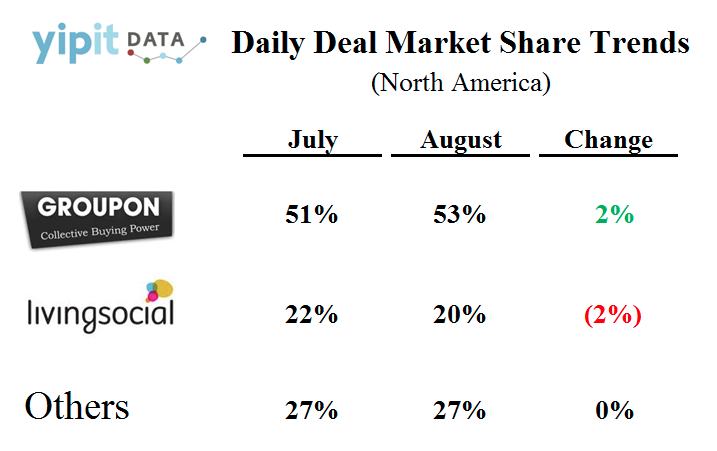
According to the Yipit data, which is derived from tracking over 30K daily deal offers in August, Groupon’s double-digit revenue growth was in stark contrast to competitor LivingSocial, whose revenues declined for the second month in a row.

LivingSocial’s revenue in August was $45.1 million, representing a 3% decline from $46.4 million in July. This decline could be broken down into a 6% decrease in the number of vouchers sold per deal and a 1% decrease in the average price per voucher. LivingSocial did however increase the number of deals it ran by 4%.

Revenue for the daily deals industry as a whole grew 9% in August, from an estimated $209 million in July to $228 million.

The Yipit report holds that Groupon’s overall market share during the past month grew to 53% while LivingSocial’s estimated market share declined to 20%, with Groupon gaining 2% from its 51% share in July while LivingSocial declined the same amount from its 22% share during the same month.


You can read the entire report below.


Company:
LivingSocial
Website:
livingsocial.com
Launch Date:
September 12, 2011
Funding:
$632M

LivingSocial is the social commerce leader behind LivingSocial Deals, a group buying program that invites people and their friends to save up to 90 percent each day at their favorite restaurants, spas, sporting events, hotels and other local attractions in major cities.

LivingSocial has an extensive user base of more than 85 million, and is headquartered in Washington, D.C.

Learn more

Company:
Groupon
Website:
groupon.com
Launch Date:
November 11, 2008
Funding:
$1.14B

Groupon features a daily deal on the best stuff to do, see, eat, and buy in more than 565 cities around the world. By promising businesses a minimum number of customers, Groupon can offer deals that aren’t available elsewhere.

Groupon brings buyers and sellers together in a fun and collaborative way that offers the consumer an unbeatable deal, and businesses a large number of new customers. To date, it has saved consumers more than $300 million and claims it…

Learn more


Let’s Drink Tonight Helps You Find People To Drink With

Team Let’s Drink Tonight, consisting of developers Zephyr Pellerin, Allen Romero, Jeremia Kimelman and Hunter Hastings, took advantage of its opportunity at the TechCrunch Disrupt Hackathon and attempted to solve the age old conundrum of not having anybody to drink with.

Users who desire company while they imbibe can sign into Lets Drink Tonight and answer four hard-hitting profile questions along the lines of “Coolest person I’ve shared a drink with?” and “Favorite drink?…” They can then select their location and whether they want to drink with Facebook Friends or whether they’re feeling like meeting new people.

The app will then text you if there’s someone around you ready to drink. Not a recipe for disaster, at all. Nope.

So thus far I’ve put in my info and let the world know that I’m available for drinks, but the app’s suggestion — a Mr. Vinodh Kumar — doesn’t seem to be available (as in the link to his profile isn’t working). Guess I’m going to have go home and write about startups launching at TechCrunch Disrupt instead.

Let’s Drink Tonight backstage interview above, and Hackathon presentation below.


OMG/JK: Amazon Tablets, Carol Bartz, And Friendship Bracelets

And we’re here for a new episode of OMG JK. I’m Jason Kincaid.

And I’m MG Siegler.

The first thing we’re gonna talk about is a big scoop that we had, you had, that I had last week. It’s the Amazon Kindle tablet, so there have been rumors about this thing for a while, but I actually saw it and I used it for a while, for like an hour, so I know basically everything about it. I don’t know all the shift details inside it because…

So, why don’t I lob some of the rumors at you. We’ll talk about which ones are true. Sure.

All right. So, first off, how big it is? There has been a speculation that it’s 10.1 or seven inches.

Yeah. So, it’s seven inches. It’s the same size as the BlackBerry Playbook that was out there right now. So…

I don’t think anyone would want to draw a comparison.

No, I don’t think. I think that they hate that. And every time I say that probably, but yes. So, it’s small. It’s much longer than the iPad. Any other. There has a talk about the tenant’s version as well. People said they were going to come out concurrently. From what I heared or from what I was told, the ten inch version is delayed a bit.

It’s going to be Q1 if they do it at all. But it’s all riding on the success of the seven inch one at first. Okay and the other rumor is that this is going to be powered by Android, but it’s not gonna.

Yes.

It’s a fork of Android.

Yes, it’s definitely powered by Android and, but the UI and everything looks nothing like any Android you’ve ever seen. From my understanding this was built on top of, I think it’s Android 2.1, it’s something before Android 2.2.

Which is so…

Yeah, it’s old. But it doesn’t even – you can’t tell, because the UI is totally different so like it’s hard to know if it would be faster if it running on 2 3 or something like that.

Well the importance of the version number has more to do with third party applications.

Yes, right.

So the power of these, of these splinter Android platforms is that they’ll still run all these Android apps, it won’t have access to the Android market Right.

But Obviously, this is going to introduce Amazon’s own app store.

Yes, and this, that’s key.

You and I have talked about this before and that’s so keyed to everything and this all makes sense now and of course, you know, there’s a lot of speculation. We thought this might be happening and this really brings it together because they have their own app source. So now, they can be in control of like which apps are in there, so they could say, like, “Well,we can’t accept this app because it requires 2.3 or something like that and we don’t actually have the underlying architecture to run this.” So, they should have a nice seamless, a seamless market where all the apps in there actually run on the device itself.

Well, I mean, to be fair actually, on Android Market if you try accessing market from an older device it will only show you applications that your phone can run.

Oh, so that’s good, too.

Okay.

Of course, sometimes they’re buggy as hell.

Right.

But hey, go Android. Anyway, so, let’s talk a little bit more about the experience because it looks visually very different, right?

Yes, it looks like, if you’ve used, and of course you have, iTunes Carousel, you know, the Carousel view.

Cover flow, right?

Cover flow, yeah, yeah. I call it a carousel. I think that’s how they’re referring to it actually internally.

I’m sure, I’m sure you know every exact, like little term for every Apple.

Yes, it’s the cover flow view where basically you can swipe through, and it’s not just, it’s your books, it’s your apps, it’s your movies.They even have like a text document as they have on the Kindle right now. I saw the nice little note from Jeff Bezos, you know, saying welcome to the Kindle, you know this is our latest version, or whatever, so that’s like in there in PDF form or whatever.

But, yes, so you can do that, and you can also underneath there they have a little tray Greg Kumparak, our colleague, actually did a great job mocking this up. They have a little tray where you can hold your favorite apps or your favorite, you know, book or whatever. And those always stay in one place.

Sort of like a dock basically.

Yeah, it’s a dock, yeah.

Ok, so, given the fact that it’s got the Kindle name which is synonymous with reading at this point, is the screen – is the pixel density – this is something I can’t read on an iPad, because my eyes get distracted by the pixels – maybe I’ve got superhuman vision or something, which is an impossibility.

Did you try reading text on this?

Yeah, I read a few things, I read the basis, there was a few books on there that I got to skim through quickly, I would say, you know, I don’t know, I didn’t get the specs exactly of what the screen resolution was, but I’d say it’s on par with the iPad, the current iPad, or…

Better?

I would say it’s about the same. It’s the same in terms of a pixel density I think.

Okay.

You know, it may be a little bit better because it’s a smaller screen.

But it didn’t look like, say the retina display on the iPhone?

No, it’s definitely not a retina display. I would say, yeah. Because it’s a smaller screen I wouldn’t be surprised if it’s a little better than the current iPad screen and the current bigger Android tablets out there but, you know, it’s not great. And the other key point of that is that it’s back-lit, it’s not E-Ink and all.

So you know Amazon has had this whole campaign for a long time to say, you know, “Oh, you can read this on the beach and you can’t do that with the iPad.” Which is totally true. But now it’ll be the same thing with this Kindle tablet, right?

But, there are other forms of media that you can consume on this. So Amazon is going to build, my understanding is that they’re going to have a video store, which they have, they have their video store, they have their music store, their cloud player stuff. So yes, all of that will be built in and the one really nice thing that I heard – I’m not 100% sure this is true, but this is what I believe to be true, is that when you buy this Kindle tablet, which is going to be $250 by the way and we’ll cover that in a second.

Yeah, so that’s like probably the key thing.

You also get a subscription to Amazon Amazon Prime, which is normally a $79 a year thing, which also gives you access to their movie streaming service.

Right.

And as well as, you know, free shipping and stuff like that.

It gives you access to the movies that are not prime time blockbusters, you know, it’s not the best.

It’s somewhat comparable to Netflix I think.

Right.

I think they have a lot of similar overlap in content. But, yeah. I mean its still, it’s a good deal, especially if this thing is going to be $250, which of course is half the price of the low-end iPad and I really do think – obviously this competes directly with Nook with what Barnes and Noble has built also on top of Android.

The Nook Color, sorry. But, I really do think this thing is going to be a hit if for no other reason Then Amazon will be promoting it on their home page. It’ll be a $250 tablet. It runs Android apps. They’re going to ship it probably, you know, with Angry Birds and you know to just be like the all-in-one thing if you don’t want to buy an iPad, kind of.

I think it’ll be a very interesting experiment.

I can’t wait to see what Google makes.

Because I mean, I still have the theory that you know, people love the iPad because it’s the computer for people who get a little…

Yeah.

…who don’t like computers so much, they get a little confused by…

Right.

Which is understandable because computers can be confusing.

Right.

And this Amazon tablet, I’m curious to see if people are really looking for an alternative way to watch movies and even to read books…

That’s a good point.

I mean, I’d much rather read on an e-ink display.

Yeah.

So it’s sort of like, which need are they filling? So I’ve written this before, I wrote this before I actually saw the device itself, but I actually don’t think that this will have any negative impact on the iPad itself. I think that this really does go after the people who are maybe Android users right now haven’t found that good Android tablet, and this is like kind of a cheap alternative to be able to get one and you can run your apps on it that you already have.

You know, it’s kind of an interesting play in that market.

Well, no, I don’t know if you can run the apps here.

Sorry, you can’t run the actual apps that you actually have. Though, I bet there will be a way to do that. Kind of hack into it. But you can download the same apps.

As far as productivity apps, I know that a lot of people who like browsing the web Does this have a browser built in?

Yes, it has a browser built in. As far as I can tell, it’s the same one that comes pretty standard. It’s a web kit-based one from Android. It has tabs and everything. They look pretty nice.

What about, say, email for example?

Email is one thing I didn’t see. I would assume there are some email apps in the Amazon App Store that you could download to be able to use. I would be surprised if they didn’t launch or didn’t come with one, I just didn’t see one on there. This wasn’t a production model yet. So it’s possible that they’ll add other things.

Well I do think the $250 price point is definitely the best thing this has going for it, because if they can get it lower than – I mean looking at the Palm tablet, that HP has on sale – the TouchPad – it flew off the shelves at $100.

Well, yeah.

I mean, 250 is obviously a lot higher than that but it’s still…

It’s a good price.

It’s, exactly.

It’s a good price and it’s also, I just think that it’s – It’s gonna be positioned well. It’s coming in at the holiday season. A lot of people are gonna want tablets.

Yeah.

And it’s just like, you know it’s an obvious thing to go out there and buy. And it will be right in your face when you’re browsing on Definitely On Amazon.com.

Definitely OK, so let’s talk about the second topic. We’re going to talk about Windows 8. I know you’ve had some strong criticism as far as what Microsoft is doing.

Yes what Microsoft is doing, or what they appear to be doing – so this is all, I think, going to be unveiled next week at their build conference. We unfortunaltely disrupt that, unfortunately, but none of us will be there, so we won’t be able to see it, I guess, in person. But it’s going to be unveiled, supposedly, next week at their conference.

And what they’ve been showing off – the Windows chief, Steven Sinofsky, has been doing these posts on the Windows blog, kind of showing off little bits here and there about what their idea is. And it seems like their idea is really a split model, where you have the old school Windows users who are happy and placated by this kind of old system that’s still in place, and we’ll be familiar with them.

At the same time, they’re trying to also embrace the new style, and they’re using their Metro UI, which is on Windows phone. Right.

And so it’s like there’s these two distinct things, but they’re all in one operating system. And you’ll supposedly be able to switch between them. I’m a little skeptical on how well that will work. It sounds like a recipe for disaster. Although, Microsoft has a lot riding on this thing.

Yes.

And I suppose it can work sort of like the way in OS 10, you have full screen apps, right? So maybe…

Yeah, you could. Yes. So they’re going to have to work with developers, and I’m sure they are right now, I’m sure they have been for a few months already, in order to create apps that can work in this Metro style and in this other style. Like the regular style. So yeah, I think that that’s a good way to think about it.

I think it’s still going to be a hard sell. like trying to do both at the same time. Why don’t you just do one or the other?

I think that the fact that you can run both I think the goal is that the Metro style is going to appeal to those people who want the easier-to-use computer that isn’t like the Windows of yore. And they risk giving the switching option because it’ll sort of, it’ll relax, make people less freaked out about giving up what they know all ready.

I guess, but it’s such a cop out, you know.

No, no. I actually think this is one of the reasons why the Mac took off so quickly over the last few years. When it changed to the x86 processor, the fact that you could boot into boot camp.

Yeah, how many people do know actually how to do that?

Exactly, that’s the point.

I know, they don’t do it. Big selling point, right?

But it’s a nice safety net.

I totally agree with that, it’s a nice safety net.

So the goal might be, push everyone to Metro for the next couple year, and then if they have to they can fall back on that, but the goal is that they won’t have to. That’s my guess.

And that’s not a bad guess. I think the funniest thing about all this, though, I don’t know if you saw any of the screen shots of Windows explore what it looks like.

Only a couple.

It’s almost comical how bad it looks. It looks like a total disaster. Like, you take what Windows looks like now, Windows 7, you know, some people don’t like the UI, you know, it’s a certain style that some people don’t like. But it’s, you know, I would say it’s overall pretty clean. This thing looks like a nightmare!

Right.

It’s like an analytical thing. They tried to put up the numbers of 8% click here, 12% click here so let’s make this button this big. And let’s make this button this big.

And they’re trying to take all those menu options that are historically buried…

Buried, yeah.

…in the right click menu…

And now they’re in this ribbon the interface, which, to be fair, you can hide the ribbon and it can be up, but when it’s down, it just looks like a smorgasbord of bad button design. So, I guess the argument is over whether you’re worried that people are going to get confused by the fact that there are so many buttons, or whether they be more confused they can’t find the button they want, right?

So which is worse? I mean.

I’ve seen some screenshots and they definitely do look kind of cluttered.

I don’t think there’s any way justify the way that it looks. I don’t care what you have to do, just get those damn buttons off that screen. It looks so, so bad right now. And the other thing we should talk about here is the different device strategies. That’s what this is really all about. It’s not so much that they want this Metro UI for, like a desktop PC, they obviously want it for tablets, so they’re going to try and do a Windows 8 for everything.

Windows 8 runs a PC but it also runs on tablets.

Which is smart.

It’s smart. But again, does one operating system that rules them all. Does that work? Does that scale? It’s like Well, isn’t Apple trying to do the exact same thing?

Well, Apple has OS10 and then they have iOS. They’re distinct things, and you know they’re.

The lion is definitely, I mean they’re converging.

They’re converging, I think, slowly over time. Microsoft is trying to accelerate that obviously and squeeze it all into one.

Well, I mean, given the fact that you can switch between the two. I don’t know if they’re…

I would say this. I think that Apple’s stance on this is more or less that they realize…they think at least that everything is eventually going to move towards mobile, whether it’s the iPhone or the iPad, you know. I’ll lump that into that. Everything will move towards these iOS devices. And slowly over time…I know people don’t want to hear this, but slowly over time, you know, the OS 10 devices, the traditional PCs, will just continue to go down in value.

I mean, they’re already being outsold by far by the IOS devices.

Right.

I think Microsoft’s stance is that the PC is alive and well. It’s just, you know, a different part of this whole environment. And so they want it to do everything. Whereas Apple is kind of pushing towards iOS. I think Microsoft is still trying to, you know, hold on to what their stronghold is.

Well, I still think there are certain…there is a market for computer users who don’t want the simple touch base…

Sure. Of course, of course there is and so, this will dwindle over time.

We’ll see.

Alright so let’s talk about the final topic for today.

Yes.

Carol Bartz is no longer the CEO of Yahoo.

No longer the fucking CEO of Yahoo.

No longer the fucking CEO. Carol and I, we should connect over our ability to drop the f-bomb.

See, so yes. This is another thing that people have expected for awhile. Though, it was surprising the way that it happened and the timing of it because it was like a random, you know. It seemed like a random day, a random time to do it, and especially the board had given her, you know, their full backing and kinda said like no, we’re gonna stick with her and see how this, this plays out.

Obviously things haven’t been going well.

Right.

I mean we actually reported several months ago that Yahoo was quietly looking for someone to replace her.

Yes. And they of course denied it and, you know, they’ve which meant, you know, nothing.

So I can’t say it came as a huge surprise. Bartz was brought in to turn the company around. And in her defence, she was brought in to cure a company that was in really bad shape. I don’t know if it’s really, I mean a lot of people have left since then, but I don’t think she buried in the hole too much.

deeper? They just haven’t done anything.

Yes, that’s one thing. They haven’t done anything because her strategy it seemed like, and you know, to some effect I guess it worked a little bit ’cause, you know, while their numbers are still bad. She probably helped stem the tide or cut off the losses a little bit. Because her idea was basically to cut off things, you know.

Right.

Instead of release new things.

It’s basically And they outsourced search, which is.

Yeah, they outsourced search. They did all kinds of things to just try and get them back into the black and make them a a profitable company.

Right.

That hasn’t worked, but they probably did slow down the loss a little bit by doing that. But, at the same time, you can’t do that and, like, expect, you know, all the public to rally behind you, I mean.

Right. Well, it killed off everything. I think the key issue here is, I can’t remember, I was trying really hard to think of the last time Yahoo launched a product that I was like, “Oh that’s really neat or I’d use this on a daily basis.”

Right.

And I couldn’t do that, and I think that’s really the issue here. They’ve done some stuff, I mean, when they had the search deal with Microsoft, their whole point was that well, now they don’t have to do the heavy lifting as far as the search options.

Right.

And then they can build on top of it. And they actually had an event a few months ago where they showed off something that was very similar to Google Instant. As far as helping you surface information as you type it in. And it was kinda cool, but it wasn’t like, “Oh, I don’t want to use Google anymore.

I really want to use this day-to-day.” And there’s…there hasn’t been like a new…a new product launch or…it wouldn’t even have to necessarily have the Yahoo name involved. Just something. It just hasn’t happened.

And they also, you know, for a long time they were actually very early on in the mobile search space and they, you know, especially like in Asia and other markets.

Right.

And they just totally screwed the pooch there. I mean, they could have really taken and run with that and not worried so much about what Google was doing when it already looked like it was very clear that they were going to take over the search…the broader PC, you know, desktop search market. They could have done some cool stuff in mobile and they tried to do a little bit of things, but I think they were way to slow innovating there.

Right, and I still…I think my favorite example… I don’t know if favorite is the right word for this. So about a year ago, Yahoo had this event down in their campus and it was supposed to be like a roadmap, a look to the future. And I remember sitting there and I was just sort of like my eyes were almost gonna glaze over just because they kept talking about Yahoo’s server infrastructure and these vague ways that their various…

Yes. What’s really funny is that I think we didn’t go to the same meeting and I think I was at the same meeting two years ago. It was the exact same thing.

And I remember sitting there and I was like, wait are they watching anything interesting? And I think their most tangible improvements had to do with Yahoo mail.

Right.

Which is nice, but it’s not, I mean none of these things have, they really need either a really interesting acquisition that’ll change their social strategy or something that’s gonna [xx].

They bought, you know, one company I liked, IntoNow which basically you know is kind like Shazam for TV shows and movies. And you know, it was like okay, well what are they going to do with that? So far, they haven’t done much. The team is still working on it, but you know, they haven’t like integrated it, greatly into Yahoo, yes.

So I don’t know. They tried to buy Foursquare; obviously, that didn’t happen; they got rejected.

And I think they’re in talks with Hulu at this point.

Yup, they’re in talks with Hulu, so who knows what, whats actually gonna happen.

Yeah, so I don’t want to do too much Bart[sp] hashing because I mean really she had a tough challenge and I don’t think she really got it. [xx], but I don’t Yeah, you know, we have a little bit of a soft spot I think in our hearts from her Disrupt appearance a year and a half ago.

It was, for those who don’t remember, we were looking at if I send a video clip or something.

Yeah. Maybe we can put it in here.

She said, “Eff you, Mike Arrington.”

Yeah. It was pretty…in front of dozens of people, yeah. We’re a small company, you know.

I can’t believe I just said “Eff you.” Someone’s going to give me a hard time about that.

But her…I loved her, the way that this all went down. How she…so she resign…or she was fired over the phone, which is such a dick move by Yahoo’ s board.

Right.

And then she basically sent an email to all of Yahoo’s employees, you know, saying she was fired that way. And she sent it from her iPad, which is awesome.

And now she came out today and I think there was an interview with Fortune…

Yes.

…where she’s basically bashing all the other board members, and I believe she’s still on Yahoo’s board…

Oh, it’s good fun.

…and there may have been a clause in her contract…

Yeah, that might have negated her ten million dollar severance package, which is just awesome. But yeah.

Well, she’s definitely got guts.

Yes. All right, so I think that does it for this episode of OMG/JK. Make sure to tune in next week and check out the subscription using the link in iTunes below.

Thank you.

Check out this clip.

The iPod came out four years later. Four years later. Three years after that is the first time his market cap grew at all. Seven years. I’ve been at this company fifteen…sixteen months.

Okay.

And so I’m supposed to have an iPad, an iPod, an i…I mean, come on. You know, you don’t – you are involved in a very tiny company.

Very tiny, yeah. You got a point there.

And it probably takes a long time to even convince yourself what the hell to do. I bet the…

So I don’t want to hear any crap.

You’re just getting on a roll here. Yeah.

I don’t want to hear any crap about something magical that the fine people of Yahoo are supposed to do in this short time. So fuck off! And that one I meant.

I show 4:42.

Lunchtime! We’re way over, OK?

We’re way over.

We’re back for a new episode of OMG/JK, featuring your hosts reunited at TCHQ as we prepare for TechCrunch Disrupt SF.

This week, we talk about Amazon’s upcoming secret tablet (which MG recently tried out), and how it might or might not take on the iPad. We also discuss the complexity of the Windows 8 UI and its growing number of buttons. And we take a look at the recent firing of Yahoo CEO Carol Bartz.

Oh, and yes — I am wearing an orange thread friendship bracelet. Consider it a preview of an upcoming episode of TC Cribs (I forgot to take it off).

Here are some recent posts relevant to this week’s episode:


And The 2011 TechCrunch Disrupt SF Hackathon Winners Are …

Disrupt Hackathon SF 2011

Over 700 hackers signed up and over 400 stayed the night in order to come up with over 130 hacks at this year’s TechCrunch Disrupt Hackathon SF. Fueled by Doritos and RedBull among other things, many ambitious developers coded at the SF Design Center Concourse Exhibition Center until 10:00 am this morning, taking to the stage bleary-eyed  at 11:00 am in order to present their accomplishments in 60 second spurts.

The top six Hackathon teams chosen by our select panel of judges will have the opportunity to present at TechCrunch Disrupt on Wednesday. In addition there were a plethora of sponsored prizes given away, from TechCrunch Disrupt API sponsors Ford, Mashery, DOAT, Face.com and Eventbrite and others. Most notably, CrowdStar and Sibblingz teamed up to each offer $250K in funding for exceptional attempts at creating mobile social games.

Salesforce’s VP of Open Cloud Standards Kevin Marks, Google’s Rohit Khare, Betfair’s Vice President of Mobile Engineering Raj Vemulapalli, OneTrueFan founder Eric Marcoullier and Ask.com’s Director of Engineering, Mobile and Platforms Vishal Shah mulled over the merits of everyone’s 24 hour efforts and came up with the six most worthy.

The official winners below (you can check out our staff picks here).

FlickMunk — A “Hipmunk for movies,” the FlickMunk app helps you rate and track movies.

Gainify — Gainify is a plugin that lets you turn any Shopify store into a daily deals site.

Weather Checker — Google Calendar plugin that allows you to check the weather of a planned event in advance.

ECCube — A HTML5 3D color matching game.

Ex-Rated — A system that allows users to rate their exes.

U4Them — A way to connect people who need help with healthcare payments with people who have the ability to donate cash.


Hackathon Highlights: Staff Favorites From The Disrupt SF Hackathon

scaled.IMG_2533

It’s been nearly 24 hours since the start of the Hackathon and the hax0rs have hax3d. We’ve seen 130 projects pitched in just 60 seconds each, all created in under 24 hours.

While all of the projects were wonderful (really — this was perhaps our best Hackathon yet), some of them really struck the right key with the TechCrunch writers in the audience. In no particular order (and with no indication as to who might walk away a winner), some of the staff favorites:

ClubReport – Gives you a live audio stream of clubs around the city, helping you figure out which one you want to hop to.

Justabout – An About.me for business. Easy, 30-second websites for businesses, primarily meant to group their social network accounts together in one easy to find place.

Weather Checker – A mashup of Weather Underground and Google Calendar. Automatically scans your calendar for upcoming events, and alerts you if the weather forecast for those days has turned for the worse.

SportBot: Monitors and analyzes tweets about sporting events, and generates a live blog-esque text summary of the event based off popular tweets.

Ex-Rated: Lets you rate your exes and peruse the ratings of potential suitors.

Let’s Drink Tonight: Punch in your cell phone, answer a few questions, and it’ll alert you when others nearby are looking for strangers to drink with

@shopr – matches buyers and sellers on Twitter. It’s sort of like a Craigslist for Twitter. Basically, @shopr uses Gnip to mine the Twitter firehose for people selling things and looking to buy items.

SharedRoll.com: Lets you create group-managed photo albums on the fly.

Packmule – Another easy-to-use group photo sharing tool.

Where Is Waldy? – “Wheres Waldo” for real photos. Automatically picks a face in a photo and tasks the user with finding it.

PassMyWill: “Your Will For Online Assets”. Distributes your social networks passwords to your trusted loved ones after you die. Whether or not you’re dead is determined by social network activity, followed by a Dead Man’s Switch e-mail.

Diskly: Direct feedback to the DJ at a real-world venue. Searches your iPod library for songs similar to the one currently playing at the venue, and lets you suggest those to the DJ.

Sergeant Shame: You create tasks for yourself, then give Sergeant Shame access to post on your Facebook wall. Fail to finish your task (determined by whether or not you’ve checked into your task the pre-set number of times)? Sergeant Shame calls you out in public.


SlideJoin.com – A service that lets you follow along with slide presentations right on your phone.

Karpool: “The easiest way to organize carpools with your friends.” Sign in with your number, add your riders, and start a trip. Karpool will show your rider’s current locations, and whether or not they’re ready to leave.

MilkMe.co: Uh oh — you’re almost out of milk! Text “add milk” to a provided phone number, and milk will arrive the next day. UK only as it relies on Tesco’s API.

Facefuse: Uses iOS 5′s face detection system in combination with Face.com’s facial recognition API. Once a face is detected, it returns a Wiki-esque publicly editable page corresponding to that person.

AirCart: Grocery store self-checkout through your phone, rather than the standard dedicated checkout stand. Scan an item’s UPC to add it to your “AirCart”.

Thirsty.com – Billed as “AirBnB for humans,” Thirsty lets you hire folks for short periods of time. Sellers announce what they can do in one day (Wax a car? Clean 3 rooms worth of carpet?) and their daily rate.

BuddyCall: Reminds you to call a contact (like your mom) regularly by automatically starting the call and ringing all parties on a pre-determined schedule (say, every sunday).

Music Combat: A real-time, player-vs-player music battle. Each player site reads music, playing the notes on the nearest instrument. Their mobile device detects which notes they’re playing. The better you do, the more damage you do to your opponent.

Zom-Beat Defense: Zombie defense game. Move with the arrow keys, aim with the mouse. Waves of zombies are generated based on the beat of the music.

SocialBee: Finds people in areas that you’re traveling to that your friends may be able to introduce you to. Going to Paris? SocialBee scans your social networks for friends who have contacts in Paris, and generates an introduction request.