Road Warrior: Tricked-Out Travel Bag Makes the Skies Friendlier

<< Previous
|
Next >>


Timbuk1

<< Previous
|
Next >>

A good travel bag has to meet a few key prerequisites: It must be light, but still be able to take abuse. It must large enough to hold your laptop, electronics and a few days worth of stuff, but not so large that you can’t carry it on the plane. It also needs to afford some level of security-friendliness.

Plenty of bags fit that bill, but few are as versatile or as comfortable to carry fully loaded as Timbuk2’s latest traveler, the Wingman.

I discovered those final points as I ran to the last gate at San Francisco International Airport (why does my flight always board at the last gate?) with the bag Timbuk2 loaned me. It has a messenger bag strap, but when you need to hoof it fast and hard, it has backpack straps that can be untucked from inside the bag and clipped into place. The Wingman conformed to my body as I cinched the shoulder straps down, making that dash to the last gate a sprint instead of a schlep.

The Wingman is further enhanced by handles on both the sides and on the top, making it easier to get the bag in and out of overhead storage bins. The handles also let you carry the bag in multiple suitcase-style configurations on public transit.

Timbuk2 already has a good rep for its hip-looking messenger and laptop bags. They’re colorful, comfortable and nearly indestructible. Unlike the Timbuk2 Command, the messenger-style travel bag we reviewed last year, the Wingman is technically a duffel, though it doesn’t wear like one. It’s also made from a lighter-weight weaved ballistic nylon, but it takes all the cramming and squishing of air travel as well as the rest.

On first surveillance of its main compartment, you might think the Wingman is only big enough to serve as a weekend bag. After all, it’s a travel bag, so it has to be small enough that you can use it as a carry-on. But appearances are deceiving. I crammed it with a sport coat and enough clothes for five days. Unpacking was like seeing the multiple circus clowns exiting the Volkswagen Bug. It also has a zippered pocket on the main flap that’s a convenient place to store things you need to retrieve quickly or remove for security checks: travel documents, phone charger, snacks, reading material.

When carrying the Wingman as a backpack, a capacious wet/dry compartment on the bottom gave me a place to stash my dirty clothes during my trip. It’s also good for extra shoes, bathing suits, bananas, or anything else you don’t mind getting squished.

Finally, there’s a pocket meant for toiletries located on the side to enable quick removal in case the TSA agent wanted to check out my shave kit.

Speaking of airport security, the Wingman’s padded exterior compartment can fit a laptop up to 17 inches. But because of its location on the rear, closest to your back, the padded compartment proved not-fully-TSA-compliant. I still had to take the laptop out of the bag to go through security. If you don’t want people scoping out your hardware, I’d recommend adding Timbuk2’s $25 computer Zip Sleeve. The padded TSA-approved sleeve slides easily in the rear compartment. I just pulled the sleeve from the Wingman (no need to open it) and then slid it back in after the trip through the X-ray box, an exercise equal to most other TSA-compliant laptop cases.

WIRED All those pockets are a traveler’s dream. Just over three pounds of ballistic nylon construction makes for a lightweight but durable bag. Holds a surprising amount of stuff. Trio of carry methods — messenger strap, backpack straps and multiple handles. Fits all but the largest laptops.

TIRED When carrying the bag as a backpack, a 17-inch laptop may be a tad uncomfortable since it’s pressed against your back. Laptop compartment is padded, but storing your computer anywhere else in the bag necessitates an extra padded sleeve. It’s not a rolly, so if you want wheels, this isn’t for you.

Photos by Jon Snyder/Wired

Cash Advanced: Google Wallet Is Tomorrow’s Billfold

It’s becoming clear that in Google’s vision of the future, every human tool since the wheel is destined to be folded into the smartphone, that digital Swiss Army Knife around which our lives are increasingly centered.

Google’s newest offering replaces an accessory we’ve carried since man first stripped hide from beasts: Our wallet. Google Wallet is a service that eliminates the traditional notion of the leather carrying case, allowing you to store digital versions of your credit cards on your smartphone.

Basically, Wallet lets you use your phone to pay for purchases at physical point-of-sale machines. For example, when you’re standing at the grocery store checkout counter, instead of swiping a card or handing over cash, you open the Wallet app, enter a PIN, and wave your phone next to the reader in front of you. The amount you owe is instantly transferred from your bank account.

The app rests entirely on a special chip inside the phone called a Near-Field Communication chip. Essentially, any device with an embedded NFC chip can exchange data with a receiving terminal once they come within a few inches of each other. NFC technology is Google’s big hardware bet for the future, and it’s arguably the company’s most ambitious mobile project since Android was first launched.

After stopping by the Whole Foods up the street for a quick bite, it only took thumbing in my PIN and gently tapping the back of my phone to the store’s electronic reader to pay for lunch.

True to the company’s form, Wallet upsets many vying for the lead in the mobile payments space. PayPal, Intuit, and ISIS (a wireless carrier-backed venture which initially aimed to take on the credit industry) are all companies with toes in the water, toting their own visions of phone-based payment systems. Even Apple is rumored to be working on its own version of NFC-based mobile payments for the iPhone.

Wallet is simple, stripped-down and straightforward, providing a low barrier of entry for those who may be intimidated at the thought of ditching their physical credit cards. Opening the app brings you to a four-digit PIN entry screen, which is required every time you want to access the card menu (though this can be adjusted). Making digital copies of your plastic is as simple as typing your card info into the prompts.

At the moment, unfortunately, Google’s Wallet is running a little light. At launch, Wallet only supports MasterCards issued by Citibank. To get around that limitation, Google stocks the Wallet with a prepaid card which can be loaded up with cash from your other non-Citibank credit cards. Think of it as a prepaid gift card that you add funds to periodically. Google says it has Visa, American Express and Discover partnerships on the horizon, though there’s no clear ETA on when they’ll be ready for customer use. Once new cards are added, they’ll show up in the app’s main interface, called the “card carousel,” where you can thumb through your cards and decide which one you want to use.

Despite not being able to use my Visa, Wallet entranced me. After stopping by the Whole Foods up the street for a quick bite, it only took thumbing in my PIN and gently tapping the back of my phone to the store’s electronic reader to pay for lunch. My phone notified me that my payment was sent, and the cashier gave me the thumbs up to say he received it. No loose change, no sweaty wads of cash to be handled — simple, painless and super fast.

I’m usually good at keeping an eye on my battery, but if your phone runs out of juice, consider it the end to your cash flow. Short of finding a nearby extension cord or a back-up $20 in your sock, you won’t be able to pay for much of anything.

Google says this is a feature of Wallet, not a drawback. One major part of the phone’s overall security involves having to keep the screen powered on while making a purchase. Therefore, if a would-be thief picks up your dead phone, they won’t be able to start jacking up your credit card bills. And after a set amount of time — anywhere from one minute to two hours — you’re required to re-enter your PIN number to use Wallet at all. So even if said thief charged your dead battery, he still couldn’t access your cards.

As I see it, security isn’t Wallet’s biggest hurdle — it’s convincing the entire world to catch up. Deploying the infrastructure required to accept NFC-enabled payments is a gargantuan task, even for Google. The technology currently works with MasterCard’s PayPass network — a system that launched in the early aughts but failed to reach critical mass — which is already deployed in over 140,000 locations. Still, that’s a drop in the global retail bucket, and like everyone else, I shop at a lot of that aren’t included in the PayPass domain (sorry, Petco).

And there’s another hump: training legions of unwitting employees how to accept the thing. Try explaining that you want to split the cost of your Slurpee — half on the phone, the other in cash — to the confused broseph at the 7-11. It is not, by any means, a frictionless exchange.

That’s to say nothing of the dearth of devices actually capable of utilizing the technology. The app will initially launch on exactly one phone: The Sprint-carried Samsung Nexus S 4G.

But this is Google’s modus operandi. Oddball, outlandish, far-fetched — these words are compliments to Google, a company long accustomed to leaving naysayers and hand-wringers in its wake. Products like Wallet are its forte, and will continue to push us towards Google’s fantastical idea of what the future should be.

Can they do something with my damn car keys next?

WIRED Layered security system on NFC devices cripples would-be thieves before they can do any damage. Ditching your leather wallet means no more bulging, lopsided ass-pocket. Eventual tie-in with loyalty cards means saying goodbye to myriad stamp cards.

TIRED Currently only works with one out of the 15 major banks that issue MasterCards. Try and use it, and cashiers will look at you like you’re crazy. Infrastructure in its infancy, and there’s no guarantee it won’t die on the vine.

Photo by Jon Snyder/Wired

Great Ape

There is a problem with reviewing guitar amplifiers, and that problem is this: Your mileage may vary. A properly built guitar amp is as much a living instrument as an old violin or the human voice, and a great deal of its character comes from outside variables — things like speaker choice, room acoustics, and playing style, to say nothing of the guitar you have slung around your neck.

Still, it’s possible to make objective calls. And right now, our objective call is this: The 3 Monkeys Orangutan 1×12 combo is one of the most versatile, most satisfying and flat-out coolest guitar amplifiers ever built.

It starts with the looks. First off, there’s a screen-printed, crushed-glass switchplate on top, but you barely notice that, because the screen-printed, crushed-glass nameplate on the front of the amp is much, much bigger. And it says “3 Monkeys” on it, in the kind of no-nonsense serif font that lets you know some serious rock-out weirdness lives in here, and it is going to get loud, and if you aren’t interested in that sort of thing, you are probably the kind of person who watches C-Span for fun and kicks puppies. (Seriously, kicking puppies? You suck. Also, your guitar solos are cliched and sound like what Kip Winger would play if he were a drunken Nazi zombie writing soap-opera theme songs. Get a life.)

You want big and throaty clean? The Orangutan will do it. You want popping, bouncing chicken pickin’? It can do that, too, as well as meaty, distorted 1970s thunder.

Back to the amp. The cabinet is tightly wrapped in tolex — or, if you specify it, gorgeous suede — in any one of a number of colors. There are five chicken-head-shaped knobs on top, just like a vintage Fender tweed amp. Stick your head underneath the rear panel, you can see a handful of glass tubes.

About that: The 35-watt Orangutan is a vacuum-tube amplifier, which means its output is governed by a handful of old-school thermionic valves. Their design and performance limitations typically offer a warm, analog sound, with gentle clipping and a nice, funky vibe.

This is how amplifiers — and radios, TVs, and computers — were once built, before transistors made such technology obsolete. If you are a tone freak, you likely play or listen to musical equipment built around vacuum tubes. There are downsides (unlike transistors, vacuum tubes get hot, wear out and don’t like physical abuse), but in the right environment, they sound like God. Yelling.

The Orangutan is no different. The 3 Monkeys name refers to the three men who created it: technicians Greg Howard and Ossie Ahsen, and Aerosmith guitarist Brad Whitford. Ahsen and Howard have worked with bands like Green Day, Hall & Oates, and the Black Crowes; Whitford is Whitford.

These guys know a thing or two about tone. Their amps are used by players as diverse as Steely Dan’s Walter Becker, My Morning Jacket’s Jim James, Wilco’s Jeff Tweedy, and Elvis Costello.

The Orangutan was launched as a head — a standalone amplifier meant to be paired with an external speaker cabinet — in 2008. The model we tested is the same amp fitted into a cabinet paired with a 12-inch speaker. The speaker is a 3 Monkeys piece rated at 8 ohms; our cabinet was trimmed out in seafoam vinyl and popped out of the box looking something like the Holy Grail. This is the kind of amp you take home to mom.

Like all 3 Monkeys products, the Orangutan is hand-wired and completely hand-built, with custom-wound transformers, a powder-coated aircraft aluminum chassis, military-spec components and a solid ply cabinet. Four 6V6 power tubes and three ECC83 preamps are mounted on the bottom of the chassis.

I tested the amp in a large, open, concrete-floored warehouse, with a couple of rugs on the floor to cut room glare. Guitars were a Fender ‘62 Vintage Reissue Stratocaster with Callaham single-coil pickups, a Paul Reed Smith double-cut with Seymour Duncan humbuckers, and a $400 Gretsch 5120 with dime-store humbuckers that barely worked.

Lordy. This sucker pounds. I’ve played a lot of amps in my day, but few were as fluid, dynamic or versatile, or looked as good doing it. You want big and throaty clean? The Orangutan will do it. You want popping, bouncing chicken pickin’? It can do that, too, as well as meaty, distorted 1970s thunder.

But the amp’s strength is how it achieves this stuff with any number of guitars. Each of the axes took a bit of tone tweaking to get the best out of them — the Gretsch in particular wanted lots of treble, mostly because its pickups are hugely muddy — but it was ferociously easy to land on a sound worth using, one you could stick with all night.

That’s the brilliance here. Amps typically have just one voice at which they really excel, one setting you stumble onto and from which you never stray. With the Orangutan, you get five, six, maybe seven for each guitar you use. It’s a Fender tweed amp with a bit of Silvertone tossed in one minute, a Marshall crunch with Vox sparkle the next.

This would be impressive if it came from a solid-state amp, one built of processors and programs, but the Orangutan is just a handful of capacitors and resistors and not much else. The circuit isn’t much more complicated than what lives inside a Tickle Me Elmo doll. Amazing.

So you marvel at this, you mess with the six-position rotary “voice” switch, the footswitchable “lift” control (6 decibels of boost, bypasses the bass knob while leaving the treble one active). And then you turn it up, and you play something that sounds like a cross between “Sleepwalk” and Buddy Holly and “Train Kept a Rollin’” and “November Rain” and the last Fleet Foxes album. And the roof falls on your head and your kidneys rattle to the tune of Rock. And you go home to your regular amp, the one you have loved for years, and it is suddenly less impressive.

In the end, the Orangutan does what all good amps and instruments do — it makes you believe that you cannot live without it. Grain of salt or no, that sounds awfully rock and roll to us.

WIRED Tone, tone, tone. Fashionista exterior. Star power. Ability to work with any guitar you throw at it. Makes the $2,500 price tag seem totally worth it.

TIRED Fancy trim and high cost might deter you from using it on the road. The best sound comes when you crank it through the roof, which will probably hack off your landlord. But really, who needs a roof when you’ve got tone?

Photos by Jon Snyder/Wired

Back To Our Regularly Scheduled Program: Posterous Raises $5 Million

Screen Shot 2011-09-16 at 4.19.04 PM

Um, oh hey guys, what’s up? Nothing much over on my side, except that I’d really like a Diet Coke. Also, I’m hearing that nascent photo sharing app née blogging platform Posterous is raising some money. So yeah that’s what’s up over here in my neck of TC HQ.

Chew on this if you’re in the mood for some actual tech news; the simple blogging service and Tumblr competitor has just raised $5 million in Series B according to multiple sources. Taking part in the round will be Redpoint Ventures, newcomer Jafco Ventures and existing angels.

On Monday Posterous revamped its entire product and focus around Posterous Spaces, which — in the same vein as Google Circles — allows users to pick and choose whom they share specific content with. Thus far the product has received mixed response from users.

I’m just going to assume that Posterous will be using the cash to increase its engineering team, because that’s what I usually write everyday in these things. This new funding comes in addition to another $5.14 million in seed, angel and Series A financing from Y Combinator, SV AngelLowercase Capital, Brian Pokorny and others, making the company’s total funding to date $10.14 million.

I think I just might go get that Diet Coke now.


Company:
Posterous
Website:
posterous.com
Funding:
$5.14M

Posterous emerged from Y Combinator in the summer of 2008 as an innovative company focused on making blogging simple – as simple as sending an email – and now has more than 15 million monthly users.

With the launch of Posterous Spaces, the company is bringing its trademark simplicity to help people share smarter with intuitive privacy controls to share selectively across multiple platforms.

Learn more


Seven States Oppose AT&T/T-Mobile Merger, AT&T Isn’t Worried

attmo

“This proposed merger would stifle competition in markets that are crucial to New York’s consumers and businesses, while reducing access to low-cost options and the newest broadband-based technologies.”

So sayeth New York Attorney General Eric Schneiderman, who is joined by the attorneys general of six other states in support of the Department of Justice suit that sought to halt the pending AT&T/T-Mobile merger.

And so the AT&T/T-Mobile craziness continues.

The states that have come out in favor of the DoJ suit are New York, California, Illinois, Massachusetts, Ohio, Pennsylvania and Washington. Even when facing mounting opposition, AT&T seems rather nonplussed about the whole situation. AT&T spokesperson Michael Balmoris has stated that “it is not unusual for state attorneys general to participate in DOJ merger review proceedings or court filings.” Translation: it’s not a big deal.

It certainly doesn’t hurt that AT&T can count on the support of 11 states who have publicly endorsed the deal. Alabama, Arkansas, Georgia, Kentucky, Michigan, Mississippi, North Dakota, South Dakota, Utah, West Virginia and Wyoming have all thrown their support behind AT&T and T-Mobile, presumably because they stand to benefit from increased wireless build-out and more jobs.

The merger also received a spirited defense yesterday by a small contingent of 15 House Democrats (11 of whom received campaign contributions from AT&T), who encouraged President Obama to settle in favor of the deal. For the truly curious, only Arkansas, Georgia, and Kentucky overlap between the list of states that support the merger, and the states whom those 15 Democrats represent.

After all this, AT&T has a only few more obstacles to face when the case goes to trial. Not an impossible task, according to Reuters: it just means AT&T needs to convince a few more people before a settlement can be reached.


I’m Leaving TechCrunch. Here’s Why.

image008

So now, less than five years later, you can go up on a steep hill in Las Vegas and look West, and with the right kind of eyes you can almost see the high-water mark —that place where the wave finally broke and rolled back.Hunter S. Thompson, Fear and Loathing in Las Vegas

I’ll get right to the point: this is my last post on TechCrunch. And it’s my resignation letter. The first resignation letter I’ve ever written, in fact. Usually I get fired.

To those who have been following the recent TechCrunch drama, this post won’t come as much of a surprise. A little over a week ago I wrote that, unless Mike Arrington was allowed to choose his own successor as editor of TechCrunch, I would no longer write for the site. Sure enough, this past Monday, a statement from AOL announced Erick Schonfeld as the new editor.

A lot of outside observers assume that Schonfeld, who has been with TechCrunch since 2007, was Mike’s choice to take over. But, in the interests of transparency, it’s important to clarify what really happened. The truth is, Erick was Arianna Huffington’s choice, not TechCrunch’s.

What I knew last week, but can only write now, is that while Heather, Mike and other senior editorial staffers were making a stand for the site’s editorial independence from The Huffington Post, Erick cut a side deal with Huffington to guarantee him the top job once Mike was gone.

The irony is that had Erick stayed strong for just a few days, he’d would have been appointed interim editor anyway, with Mike’s blessing. Mike and Heather were even considering Erick for the permanent position but had concerns about his ability to retain (in Fred Wilson’s words) TechCrunch’s “swagger“. Mike felt that current Senior Editor Sarah Lacy might be a better choice: she has the right personality — and sources — for the job and she actually lives in Silicon Valley (Erick is based in New York). Unfortunately she’s also away for four months, on maternity leave.

The curious thing is that Erick knew everyone at TechCrunch supported him, at least for the interim role. And yet when Arianna called, he answered. Mike and I spoke at the time and he gave me his take on the deal: “at the point Erick began negotiating with Arianna instead of standing firm with the rest of us, he became nothing more that Arianna’s pet. All hope for independence with him at the lead became lost”. (Mike asked me to keep our conversations confidential until the situation was resolved.)

Not three days after his appointment, Erick made his first ethics disclosure as TC’s new editor — insisting that Mike had played no part in the selection of TechCrunch Disrupt finalists. Bluntly put, that was not true — as Mike had to clarify in the comments…

“Erick… Please be careful making statements on my behalf. And remember that reader trust is what matters. You shouldn’t say “he was not involved in the final selection of these companies” just because it sounds nice. Since it isn’t true, you shouldn’t say it at all.”

One of these two men is your new ethical champion, Arianna. The other one is the guy you fired.

For what it’s worth — and this is the point in this post where I suspect Mike and I will part company — I still have a lot of time for Arianna Huffington. I was the first TechCrunch writer to celebrate her appointment as Editor in Chief of AOL and I still stand by much of what I wrote in my post welcoming Our Huffington Overlord. In this situation, though, I think she screwed up badly by allowing her growing personal animosity towards Mike — and, let’s be clear, this fight was almost entirely personal — to rule her head, ejecting Mike completely from the company he founded and installing his polar opposite as a puppet editor. As Barry Diller put it on Wednesday: “So now, he’s gone, and now they own this thing, which has no voice. Congratulations. What a good piece of business.”

Putting aside my professional feelings towards Erick — and I’ve been writing about those for a long time — the notion that a Silicon Valley blog should be run by a guy in New York is just ludicrous. As such, Huffington’s short-term victory is likely to prove a medium and long term disaster.

Still, even as I was writing the words above, I found my anger towards Erick fading. Despite the fact that he fucked over Mike and Heather — and, by extension, the whole of TechCrunch — I don’t think he’s a bad guy. There are times, in fact, when I positively like him: he works hard, crosses the t’s and is a fine, and experienced, analytical reporter. He’s just — what’s the word? — hapless. He is a man utterly devoid of ‘hap’. Hating him for being expertly played by Arianna Huffington is like hating a baby for crying on a long-haul flight. He doesn’t understand why people are mad at him, he just wants to be fed.

Towards the end of my last book I wrote about the importance of having loyalty to one’s friends and of knowing when to quit. The former principle literally saved my life while the latter I’ve never quite got the hang of — dragging out relationships, jobs, a drinking problem… sentences… to beyond snapping point. This time, though, I think I’ve learned my lesson. This past TechCrunch Disrupt was the best yet — a fitting tribute to Mike, and a lasting reminder of why he and Heather made (make) such a perfect team. Under Heather’s guidance the business of TechCrunch will continue to grow; and thanks to the site’s amazing editorial staff, the scoops and page views will keep on flowing both at home and abroad. But with Mike’s departure, the gonzo spirit that first drew me to TechCrunch — that desire to not just report the story, but to be part of it — has gone. And with it my confidence that if the shit starts flying, my editor will be there holding an umbrella. I really can’t over-emphasize how much Mike, as an editor, made writers feel like he had their back.

(Amusingly, I just looked back at my first ever column for TechCrunch and it contains this paragraph…

The Editorial independence thing was particularly important to me. TechCrunch is a publication that never shies away from a good story, which sometimes means it makes embarrassing or amusing mistakes. I called out these mistakes with glee when I was at the Guardian, and I see no reason why I should stop now. Or to put it another way, the next time Erick asks the question “Did Last.fm just hand over listening data to the RIAA?” I need to be able to say “no, you idiot” without fear of reprisals.

)

Back in February, when Paul Miller quit AOL-owned Engadget, I smugly schooled him on the five rules of effective stunt resignation. Revisiting that list today, I think I pretty much nailed rules one through three (Go Out In A Blaze Of Glory, Have A Specific Grievance, Timing Is Everything). Which just leaves numbers four and five.

Rule Four: “There’s No One Else Involved”

Since the Wall Street Journal reported my imminent resignation earlier in the week, plenty of folks have asked what I plan do next. Do I have another job already lined up? The answer is no. Once I hit “publish”, I’ll be without a regular writing gig for the first time in five years. This is both terrifying and exciting in equal measure. Sometimes you just have to hurl yourself off the cliff and see if anyone tries to catch you.

Rule Five: Find Someone Else Within A Week

For all of my pseudo-martyrdom, though, the hard fact is that TechCrunch was my regular gig, but not my only one. My “real” job is writing books, usually about myself — and believe me, the last few weeks have offered enough material for an epic — and tragicomic — tale. Don’t be surprised if you hear more on that subject soon. (You do follow me on Twitter, right?)

In addition to book ideas, there are two other potentially very exciting things floating around in my head — either one of which might make for an exciting next chapter of my career. According to my own rules, though, I’ve got seven days of due diligence left before I need to say more. So I won’t.

Except this: thank you Mike. Thank you for always having my back, and please know I’ll always have yours. The worst days working for you were still more interesting and fun than the best days working for anyone else. I hope we’ll get the opportunity to do it again soon.

Thank you to Heather for setting the inspiration bar so high that no future boss will ever quite measure up. Thank you (not for the first time) to Sarah Lacy for being my eternal voice of reason, and to Jon Orlin for the unflagging support — you guys made my days in the office more fun than is healthy. Thank you, in fact, to the entire TechCrunch team for being wonderful colleagues, and great friends; I’m going to miss the shit out of working with all of you. (Except for Jack McKenna: fuck that guy.)

And thanks finally to all of the TechCrunch readers who made it through my columns these past two-plus years. I genuinely appreciate your eyeballs and your brains, and I’ll miss the vast majority of you very much indeed.

And yet. And yet.

*Click*

*Publish*


Paul Carr is, by process of elimination, a writer. He writes a weekly column for TechCrunch, loosely focussing on media and technology.

For the first part of what he laughingly calls his ‘career’, he edited various publications and founded numerous businesses with varying degrees of abysmal failure. After getting fired from every job he’d ever had – including at least two where he was his own boss – he realised it was easier to write about other people’s success than…

Learn more

Company:
TechCrunch
Website:
techcrunch.com
Launch Date:
November 6, 2005

TechCrunch, founded on June 11, 2005 by Michael Arrington, is a network of technology-oriented blogs and other web properties.

Learn more


George Costanza’s Infamous Wallet Is The Star Of New Google Wallet Commercial

While Google Wallet didn’t come out this summer as expected, Google has just unveiled first Google Wallet commercial, starring none other than Seinfeld’s George Costanza and his overstuffed wallet.

For those of you who aren’t familiar, the George Costanza wallet was made famous in the Seinfeld episode “The Reverse Peephole” where George carries around a wallet so fat that it interferes with him sitting and makes his back hurt. It looks like Google has remastered the explosion scene from that episode to promote its NFC product, directing people to http://www.google.com/wallet for more info.

I’ve emailed Google for specific Wallet launch dates and will update this post when they get back to me, in the meantime, here is some dialogue and scenes from the original episode.

Jerry Seinfeld/strong>: Your back hurts because of your wallet. It’s huge.
George Costanza: This isn’t just my wallet. It’s an organizer, a memory and an old friend.
Jerry Seinfeld: Well, your friend is morbidly obese.
George Costanza: Well, at least I don’t carry a purse.
Jerry Seinfeld: It’s not a purse, it’s European.


Company:
Google
Website:
google.com
Launch Date:
July 9, 1998
IPO:

NASDAQ:GOOG

Google provides search and advertising services, which together aim to organize and monetize the world’s information. In addition to its dominant search engine, it offers a plethora of online tools and platforms including: Gmail, Maps and YouTube. Most of its Web-based products are free, funded by Google’s highly integrated online advertising platforms AdWords and AdSense. Google promotes the idea that advertising should be highly targeted and relevant to users thus providing them with a rich source of information….

Learn more

:
Website:

Learn more


Y Combinator-Backed SellStage Wants To Help You Better Showcase Your Products — With Video

logo

If you’re advertising a product, would you rather simply have an image of that product, or have your consumers be able to watch a video of that product in action? Unless you’re sarcastic like myself, you probably answered with the latter, because the truth is that videos help products sell online. This is true even for those vendors that sell products that one wouldn’t necessarily assume would be made more attractive with video. Consider Zappos, for example, which currently offers over 50,000 product videos. Zappos also happens to do a pretty good business.

For SellStage, a startup from this summer’s batch of Y Combinator companies that is launching today, Zappos is the standard. But most big eTailers are far behind the shoe seller in terms of video content. So SellStage is launching a platform that is designed to make it easy for both big and small businesses to add video content to their websites to showcase their products.

Product videos tend to be different enough from other video content that it needs a specific, if not niche, solution. Videos also tend to be a pain in the ass to integrate with product pages, as you can’t just take your normal embed approach, because it will take up too much space, and may even displace the product images.

So, SellStage wants not only host and stream your product videos, but also play them in a lightbox. So after your product video plays, you want a call to action, not simply a replay link. Of course, SEO is critical eCommerce sites, and that most product videos don’t take this into account, so SellStage automatically generates sitemaps optimized for video search crawlers.

On the merchant side, SellStage offers great value proposition in that all you have to do is add one line of Javascript to the product page, and the startup handles the rest, the players, the hosting, and the streaming. You can then drag and drop your videos where you want them, all with a few clicks.

What’s more, SellStage videos work on iOS devices, which a lot of product videos don’t because they use Flash. The startup is also working on tools to make video production easier, including this forthcoming iOS app, and some “you shoot, SellStage edits”-type features.

The startup, while still in its early form, is going to be very useful to marketing departments who want to manage video on their eCommerce platforms, especially for those who have a large product catalog and want to add 500+ videos and not have those turn into 500 IT requests.

“Retailers who consider their expertise a competitive advantage need to find a way to use their greatest asset – their knowledgeable sales staff”, SellStage Co-founder Tom Saffell said. “To differentiate their online stores from everyone else. Video lets them do that”.

Retailars already have everything they need to make great video: The store is set, the sales staff are the actors, and the script is whatever you say to the customers in store — your sales pitch, says Co-founder Thomas Escourrou.

But how is SellStage going to monetize? The Co-founders told me that they are going to establish a tiered pricing structure that takes into account how many videos the company wants to make, host, and stream, and whether or not they want production assistance from SellStage itself. As the startup moves forward, it also will begin giving its customers more customization options.

SellStage is launching in private alpha today, but is making 50 priority invites available to readers. Simply visit the startup’s homepage and enter “concorde” for a sneak peek.


RIM’s BBM Service Suffers Partial Outage In Canada, Latin America

bbm

RIM, to put it mildly, has been having it rough these past few days. Among other things, they’ve failed to hit their quarterly revenue goal, sold far fewer PlayBooks than they had hoped, and potentially let their market share slip into the single digits.

After all that, RIM didn’t need any more problems, but another one has popped up anyway: it seems that their BBM and email service is partially down in a handful of countries.

A quick Twitter search shows that subscribers in Canada and Latin America seem to be the most stricken by the partial outages, with the Financial Post reporting that pockets of users on three of Canada’s carriers (Rogers, Bell, and WIND) have been affected. Meanwhile on the southern front, NTN24 states that the partial outage has affected people in Venezuela, Colombia, Panamá, Chile, México and Argentina. The outage may even be more widespread, as the Huffington Post reports that sporadic tweets from the UK and Egypt indicate similar service issues.

@BlackBerryHelp
Research In Motion

Some Canada & LatAm customers report BBM issues. Our support teams are investigating. We apologize for any inconvenience. ^HF

RIM has acknowledged the outage on their official BlackBerryHelp account, but the feed has yet to offer any salient details. In fairness, this may not be an end-of-the-world scenario for BlackBerry users, but the timing for RIM is atrocious. While I’m sure they have teams fighting to find a fix, consumer confidence in the Waterloo-based company may dip even more as a result of today’s issues.

This is a developing story, and will update as we hear more.


Wrap It Up: Photos From Our First TC Gadgets/Mobile Meet-Up

meetup-3165-11

It’s been a long while since we had a formal Gadgets/Mobile meet-up and I’m proud to say that this one, sponsored by Samsung, was a roaring success. We had people who drank far too much, people who ate far too many Cheez-Its (there were, sadly, no hors d’oeuvres so we made do with Hackathon grub), and people who won excellent prizes including Samsung Galaxy S II phones, Samsung tablets, and other goodies.

We hope to have more of these things in the future where you guys can meet and greet TC G/M writers in your own home town and in your own special way. Thanks for making this one a roaring success, San Francisco, and we’ll see you soon.

Here are a few highlights from the shots we took; we’ll update this post with Samsung’s own photos as soon as we hear back from them. The full-size pictures can be found in this set at the TechCrunch Flickr page.


Track Your Dog With Retrieva, The Compact GPS Dog Collar

Screen Shot 2011-09-16 at 12.45.35 PM

One of the cooler gadgets we saw at Disrupt this year was the new Retrieva GPS dog tracker. Completely redesigned, this device lets you track Fido wherever he does roam and will let people know where to take him or her if lost.

The device lasts about a week on one charge and will go into sleep mode if it hasn’t been activated in a while. I sat down with the company founders and their stuffed dog to discuss the technology.

guys I was walking through Startup Alley. John Biggs here, and I met Gibby here, who’s the dog, and Ryan and Sinet [sp?]that and they have a new product called Retriever which I was actually facinated by so this allows this creates a live animal out of inanimate objects. Is that right?

Yeah, exactly.

Is that how you do that?

So you just wait a few minutes.

retriever. So it’s like Pet Cemetery, you bury the thing and it comes In back.

Kind of.

That’s excellent. Alright. Well, thanks for. So, it is a GPS tracking advice for pets? So, the way it works is you buy the device. You put it on the dog’s collar, it attaches to most collars, and then on the web or on your iPhone or Android device, you can say hey, where’s my dog now? And it updates, by default, every fifteen minutes.

And you can also have virtual fences. You can say, if my dog leaves my house text message me. If the battery is low, text message me. And then on top of that we’ll have you know location based deals, services, or. You know checking in, or you know, where my friends who also have this device. So there’s a lot of opportunity.

Sort of like Foursquare for pets?

But they don’t have the mental capacitySo, they can do Foursquare themselves. You do it.

No.

They do it with the collar around their neck.

Yes.

I see what you’re trying to say. Are you trying to say dogs are stupid?

Dogs don’t have an opposable thumbs so, it’s hard to use an iPhone.

So this thing, this is a prototype?

Yeah, this is basically one print out of a three model. We have a couple of Alfro types that we’re testing right now.

Okay.

So this is basically, this is the right size and form factor so we can test to make sure it fits and works.

All right, the obvious question here is why? Why do I need thison my dog all the time? Unless I have a runner and he’s crazy and he likes to run around. Why would I need something like this on my dog?

So, one in three pets are lost and four million are euthanized every year because they can not match the owners with the pets.

And there’s other solutions, like RFID, dog tags and tattoos, but those solutions do not find your pet. And in the case of RFID or microchips you you have to find the pet and hopefully you have the right, the shelter or the veterinarian has the right scanner. So in our scenario, the dog’s location or the cat’s location is sent to our app and you can.

It’s shown on a Google map and you have turn-by turn-directions.

So, what if Fido runs away and this thing runs out of power?

That’s a good point.

Can you disable the dog like LoJack?

Not really, but we do text message you if the battery’s low, and we do have some our firmware and hardware will do some smart things. The battery is getting low and we know you’re not charging when you go put it to sleep. And then only when you need to know when your dog, where your dog is. You can say, where is my dog right now?

What you do is put a little mini USB thing on there, so the person who finds it, can charge it. Like say hey.

Yeah.

You found my dog.

Yeah. And we’re gonna put a sticker on the back and it says, “If you find this, call this number. You know, here’s the ID number.” And we know we can figure out

Now presumably right now this is for bigger dogs cause this is a huge thing.

Yeah so this is pretty small compared to our competitors and you know in the future we will be doing more revisions and improvements to make it smaller and lighter. It’s actually quite light. It’s under 1.5ounces.

Okay.

And you were talking about batteries. So our battery life on average is about seven days.

Okay.

We actually did a nationwide study, and people are so familiar or used to charging their cell phones every night, most everyone said, “Oh, now worries. We’ll just plug it in every night.”

All right. Super. So when is this ready to go? December 2011? That’s what we’re planning.

Yeah, we’re planning to do some pre-sales starting in October and then we will be able to deliver product end of December.

I wish you could sell this on like Sky Mall right next to that, like, the cat toilet.

Sure.

People love cat toilets. That’s your next project, the cat toilet.

That tweets.

You heard it here first. Retriever’s next project is the cat toilet. This is called Retriever. What’s the website?

Getretriever.com.

Getretriever.com

Product Page


The New Social Network: Who’s Nearby, Not Who You Know

mingle-intro

There’s a new concept for social networking services taking root, and it’s not about re-creating your offline social graph on the Web, like Facebook does today. It’s about discovering the people who are nearby you now – the ones you probably would like to meet.

This type of discovery mechanism is already being made possible by a number of services, including the checkin apps like Foursquare and Gowalla, the automated discovery of nearby folks via Sonar and Banjo, the group chatting in Yobongo, and the micro-networks that emerge through LoKast. All of these companies are playing with the idea of location-based social networks, attempting to connect you to others around you through varying means.

At this week’s TechCrunch Disrupt conference in San Francisco, even more services emerged to compete in this space, too.

The powerful capabilities of today’s mobile smartphones are allowing for a new kind of networking: social discovery services, not social networking services. Discovery services are focused primarily on highlighting the users within close proximity to you and connecting you to those who you might want to meet.

Facebook, meanwhile, aims to connect you to people you already know. “Discovery” on Facebook is limited to searching for names or networks (e.g., schools, workplaces) where the introductions themselves previously took place.

But there are ephemeral, ever-changing social networks that we participate in daily. These have been left largely untapped by Facebook: the people working out at the gym, shopping for groceries, playing basketball, taking their dog to the park, watching their children on the playground, and so on. They’re the networks you stumble into and out of every day, and they aren’t composed of your close friends, Facebook friends or otherwise. They’re just people who share your interests at that same moment in time. The guy ready for a pick-up game of b-ball. The coupon-clipper finding deals at the grocery store. A new puppy’s owners hoping for a doggie play date.

A couple of standout apps from Disrupt hope to better highlight these types of networks by introducing you to the people you want to know.

One, an app called Holler (iTunes), is based around interests and activities. You join a group (surfers, for example) and the app pushes notifications to you when others nearby are interested in the same thing. For now, the groups are pre-built by Holler itself, but it’s in the process of rolling out a system where users can build their own groups. However, there will be some level of filtering and control, so duplicate groups are not created.

Holler is well-designed, with a clean and minimalist layout, which makes it easy to use from first launch. Unfortunately, it suffers from the same problem many other “social” apps do at first – not enough people are using it. To address the issue, Holler’s creators are thinking of exposing all the groups to the app’s users, not just those nearby, which would still allow for socializing around interests. While that may increase engagement, it takes away from the app’s core promise of proximity-based socializing – its mobile meetups on the fly.

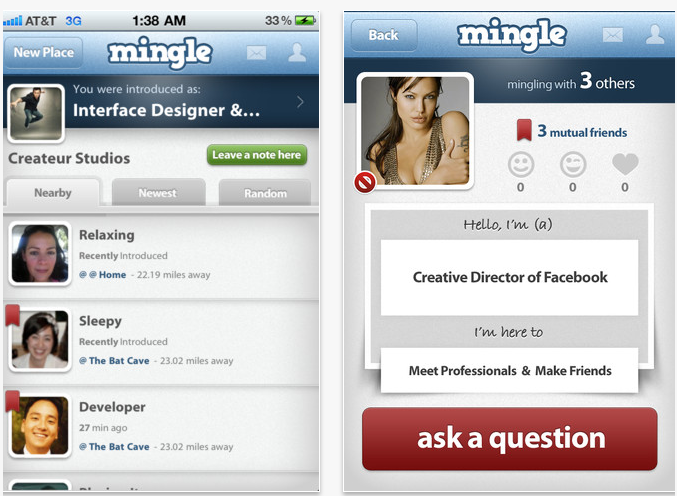
In a similar vein, another TechCrunch Disrupt Startup Alley company, Mingle, has built a mobile app that also aims to connect users based on interests. But in Mingle’s case, it’s about introducing yourself to others nearby, in the hopes that you two share an interest, instead of connecting around a commonly held interest like “shopping” or “exercise,” for example.

Mingle users fill out an introduction card and post it to their current location. Others “mingling” at that location can see one another, and take the conversation offline, if desired. It’s what Foursquare could do, if it wasn’t so stuck on listing the “others here” with only an avatar and a first name, last initial (arguably useless information, unless those people are already real-life friends).

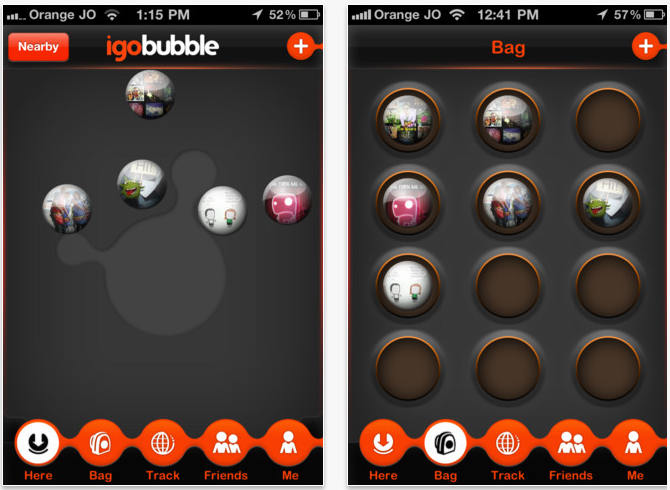
A third app from the Startup Alley is a little more out there, but interesting. Called igobubble, this mobile app lets you leave virtual “bubbles” containing text, photos, videos, music and more at a given location. Others can come along later and find your bubble and interact with it, or even change it. You’ll see who has “touched” your bubble and can then chat with them in real-time. There’s more too it than that, but those are the basics.

igobubble feels more art project than the next big hit in mobile socializing, but at least they’re thinking out of the box. Instead of just re-creating the structure of a traditional social networking site (with profiles, listed interests, avatars), it’s thinking that tying content to a location is the first step in enabling mobile social discovery. That’s certainly a different take. It’s not about who you are, it’s about what you did at that location.

Other intriguing ideas in the location-based social space included Disrupt Startup Alley participant Evertale, makers of a mobile app that will map photos to locations for the purpose of instant scrapbooking and remembering old friends, and Audience Choice winner CardFlick, a contact-sharing app for nearby users.

But have any of the new apps (or old ones, for that matter), really hit the nail on the head when it comes to social discovery? Banjo and Sonar are great, but feel more like tools than networks of their own. Yobongo’s chat seems a bit lacking without context. Holler’s mobile meetups can’t work if it can’t gather enough participants. Mingle feels more business-networking driven than social. igobubble is an interesting idea, but doesn’t have the execution down.

It seems like each service could be a part of a bigger whole – a new proximity-based social network that puts location first, people and content second. A new network no one has yet been ambitious enough to attempt to design, so focused on a single niche or feature instead.

Foursquare, at least, has the critical mass to get there, but is stagnating with its continued emphasis on the manual check-in. The company should be increasing automation for regular check-ins, building out user profiles and letting users connect via common interests surfaced by their regular activities. It should suggest new friends based on behaviors combined with “friend-of-a-friend connections.” At the very least, when a big group of friends check-in together, it should alert the users in the group who aren’t connected to each other of the missed opportunity. It should even consider letting users pick and choose add-on services to run within the app. Yobongo’s chat, CardFlick or Mingle’s introductions, and igobubble’s content sharing could all be Foursquare features one day, and not standalone applications, if Foursquare had a wider vision for its future.

In the meantime, it’s fun to experiment with the latest and greatest in proximity-based social networking, thanks to the new TechCrunch Disrupt Alley startups mentioned here and others. Whether any of them will become breakout hits, however, will have to be left for the market to decide.

Credit: Top image via Mingle


Company:
Mingle

Mingle is a mobile product that surfaces human relevance within a proximity. Leveraging location, Mingle allows users to make introductions anywhere they go with hopes that it allows users to interact. Mingle goes beyond sharing interests, usernames or even checking in and provides a relevance graph to provide context in which users use to help them find interesting people.

Learn more

Company:
Holler
Website:
holler.com

Learn more

Company:
CardFlick
Website:
cardflick.co

CardFlick helps you create and share online business cards using your iPhone in one flick.

1 Click login with services like Facebook and then your card is prefilled with your contact using one of our beautiful themes

Share your card with multiple people at a time just by flicking your phone or even email.

New themes can be purchased in app.

Customers are anyone who has a business to promote and wants to network without the hassle.

Learn more

Company:
Evertale
Website:
evertale.com
Launch Date:
January 3, 2011

Evertale is the self-writing scrapbook of your life.

Relive your favorite memories in their completeness. Evertale automatically generates a scrapbook of the experiences you never want to forget, allowing you to turn back time and do it all over again.

Learn more

Company:
Banjo
Website:
ban.jo

Banjo is a social discovery service that helps people explore social updates across multiple social networks. Connecting real people in real time, Banjo harnesses publicly-available information and delivers it to mobile phones in one integrated view.

Learn more

:
Website:

Learn more

Company:
Foursquare
Website:
foursquare.com
Launch Date:
November 3, 2009
Funding:
$71.4M

Foursquare is a geographical location based social network that incorporates gaming elements.

Users share their location with friends by “checking in” via a smartphone app or by text message. Points are awarded for checking in at various venues. Users can connect their Foursquare accounts to their Twitter and Facebook accounts, which can update when a check in is registered. By checking in a certain number of times, or in different locations, users can collect virtual badges. In addition, users…

Learn more

Company:
Yobongo
Website:
yobongo.com
Funding:
$1.35M

Yobongo is a mobile communication startup currently in private beta testing. They keys to the service are location, realtime, and identity.

Learn more

Company:
igobubble
Website:
igobubble.com
Launch Date:
January 7, 2010

Igobubble is a mobile app that integrates location-aware social networking with continuously evolving digital content.

Users use their smartphone’s to leave digital content like photos, videos, messages and more inside bubbles at any location. After users leave, their bubbles stay behind for others to discover. These bubbles are invisible to the naked eye but they can be found and viewed using the igobubble app. In addition, these bubbles evolve in real time and can be modified, moved and cloned. Bubbles…

Learn more

Company:
Sonar.me
Website:
sonar.me
Launch Date:
September 16, 2011
Funding:
$200k

Sonar is a a mobile application that shows you how you are connected to the other people in the room.

Sonar combines publicly available profile and location information to help you discover business contacts, colleagues, old friends and new ones at conferences, cafes, and bars.

Sonar enables you take your online identity offline, to help you meet real people, in the real world.

Learn more


Who Spends The Most In Freemium Games? Battle Of The Sexes Edition

Make it rain

Just last week, I wrote about a data dive by mobile research firm Flurry (who, thanks to their mobile analytics SDK, has a sample group of about 20 million users across 110,000 iOS/Android apps) on which age group was shelling out the most cash in freemium mobile games.

Almost immediately, the top rated comment was something along the lines of “That’s cool and all — but where’s the breakdown by gender?”

Here it is.

Flurry looked at this topic from a number of ways. First up: who spends the most time in freemium games? Which sex is most dedicated to tending their virtual farms for carrots they can never eat?

Looks like it’s juuuust about equal. Guys spend more time in-game almost across the board (especially in the 25-34 age range), but the difference is consistently ever-so-slight. This data also suggests last week’s findings that the vast majority of people spending time in-game (regardless of sex) are under 35.

Now, what about the money?

Anecdotal evidence would have lead me to guess that females would be the big spenders here — turns out, gents take the lead. Dudes are spending around 16% more in freemium games than their dudette counterparts, at 58% vs 42%. Folks in the 25-34 age range (especially males) prove to be the most valuable, with the 35-54 age group swooping in for a surprising second.

So, what can we gather from this? While that 16% cumulative difference between sexes certainly isn’t trivial, it’s not quite as monumental as it may seem. The female kind still accounts for a staggering 42% of money spent overall — so if you’re looking to maximize the money hittin’ your pocket, it seems like a good idea to really toe the line between which audience your game focuses on. To get all KINDS of gender-stereotypey here for a second: Too much cute-and-fuzziness, and you’ll scare away the largest money spending group; too guns-and-ammo, and you might be spooking off just shy off half of the folks who would consider shelling out. It’s not a shocking concept: when you’re banking on the idea that some small percentage of your audience will spend money in a game you gave away for free, you want your app’s focus to be friendly to as big of an audience as possible.

And for one last bit of data: if you’re wondering which group is spending the most per transaction (these folks will, after all, only come back to the checkout stand so many times), the answer is once again males between 25-34. You can find Flurry’s full data dive here.


Company:
Flurry
Website:
flurry.com
Launch Date:
September 16, 2011
Funding:
$25.5M

Flurry increases the size and value of mobile application audiences, already helping more than 50,000 companies in over 100,000 applications across iOS, Android, BlackBerry, Windows Phone and J2ME platforms. Flurry has built the world’s leading mobile application analytics and data-powered advertising platform, with more ground breaking services in development.

Flurry is venture backed by Draper Fisher Jurvetson, InterWest Partners, Union Square Ventures, Menlo Ventures, First Round Capital and Draper Richards.

Learn more


TenMarks Raises $3 Million For Personalized Math Learning SaaS

ten

Education technology startup TenMarks has raised $3 million in new funding led by Catamount Ventures with Birchmere Ventures participating. James Joaquin, new partner at Catamount Ventures, is joining TenMarks’ board.

TenMarks offers a cloud-based service that provides a personalized practice and learning software to help teach students of varying skill levels math concepts. TenMarks aims to supplement classroom instruction, and assign work to students on the topics they cover in class, based on their abilities. Students use hints and short video lessons to refresh what they know and learn what they don’t.

Another version of TenMarks gives teachers the ability create personalized curriculums for each student (called playlists), which contain math concepts from various grade levels. TenMarks Math is free for teachers to use with their students and more than 15,000 classrooms and 250,000 students across all 50 states have used TenMarks Math over the past 6 months.

And the startup says that its software is seeing meaningful results. A study conducted at the Everest Public High School in Redwood City, California showed that students using TenMarks Math made as much as a 36% improvement in their math scores over a 6 week period, with the average student showing a 10% increase. Another elementary School in Novato, California used TenMarks over the summer for students, and saw more than 80% of their students who used TenMarks score higher after the summer break, versus an expected decline.

Technology is no doubt changing the way we are learning and education in general, and startups like TenMarks should see additional growth as more and more teachers and instiutions catch on to this trend.


Website:
tenmarks.com
Launch Date:
September 16, 2011
Funding:
$1.59M

TenMarks is a new education initiative which aims to change the way kids learn. The company was founded by parents who believe that is a better way to help their (and all) kids build a strong foundation in math. The TenMarks approach enables kids to practice at their own pace, and learn as they practice, with hints and video lessons building confidence. The curriculum and the lessons are crafted and reviewed by experienced educators.

Learn more


Keen On… How To Make Movies and Money (TCTV)

Shlain

“Artists need to be business people too,” filmmaker Tiffany Shlain told me when she came into San Francisco’s TechCrunchTV studio. Shlain, whose movie Connected launched earlier this week, is a pioneering movie maker not only because of her award-winning films but also because this innovative businesswoman has figured out a way to make money in today’s digital economy.

“The gates are open right now,” Shlain told me about a 21st century movie business that is, she says, “completely different” from the 20th century studio model. And that’s because, she explained, filmmakers now have the technology to directly connect with their viewers. Put 50% of your energy into the making of the movie, she thus told me, and the other 50% into promoting it on networks like Twitter and Facebook.

Tiffany Shlain proves that creativity and entrepreneurial innovation not only can but must coexist in today’s digital economy. Filmmakers, writers and musicians should listen carefully to her advice about leveraging the power of their audience.

Watch the first part of my interview with Tiffany Shlain here.


Person:
Tiffany Shlain
Companies:

Honored by Newsweek as one of the “Women Shaping the 21st Century,” Tiffany Shlain is a filmmaker, artist, founder of The Webby Awards, co-founder of the International Academy of Digital Arts & Sciences and a Henry Crown Fellow of The Aspen Institute. Tiffany’s work with film, technology and activism has received 44 awards and distinctions and her last four films have premiered at Sundance. Her films include “Life, Liberty & The Pursuit of Happiness,” about reproductive rights in…

Learn more

Person:
Andrew Keen
Website:
Companies:
Now.tv, TechCrunch

Andrew Keen is an Anglo-American entrepreneur, writer, broadcaster and public speaker. He is the author of the international hit “Cult of the Amateur: How the Internet is Killing our Culture” which has been published in 17 different languages and was short-listed for the Higham’s Business Technology Book of the Year award. As a pioneering Silicon Valley based Internet entrepreneur, Andrew founded Audiocafe.com in 1995 and built it into a popular first generation Internet music company. He is currently the…

Learn more