The Monster From Munich

<< Previous
|
Next >>


Burn!

<< Previous
|
Next >>

“It’s just more M5,” an executive from Munich explains over tapas in the sun-drenched region of Andalusia, Spain, where a coterie of journalists have gathered to flog BMW’s latest supersports sedan on both road and track.

Our German host has every reason to sound defensive. He’s been endlessly grilled on the big idea behind BMW’s latest performance flagship, a touchy subject among Bimmer cognoscenti. Past generations of the famously fast sedan have run the gamut of sportiness, inspiring die-hards to wax poetic about body codes that delineate epochal eras in the car’s history.

For instance, the boxy E28 generation (1984-1987) was characterized by a mechanically satisfying inline six cylinder engine. Would-be hot-rodders waxed poetic over the burble produced by the V8 under the E39’s hood (1998-2003), while the previous-gen E60 (2004-2010) inspired shock, awe, and a certain amount of frustration from its herky-jerky automated manual gearbox and high-strung, Formula 1-inspired V10.

We’re entering a new era of M5, with a palatably penned body based on a bigger, more 7-series-like platform.

We’re entering a new era of M5, with a palatably penned body based on a bigger, more 7-series-like platform. The porkier proportions are rife for dissent from the peanut gallery, as is the way the new V8 derives its power: turbocharging.

To ditch bulk, more aluminum was used and heavy bits like axle bushings removed. The 86′d bushings offer the silver lining of a stiffer chassis, since the M5’s axles are now bolted directly onto the body. The resulting vehicle is still 200 pounds heavier than its predecessor and 40 pounds heftier than the current 550i, but the gap is closer than in previous M sedans.

Despite the diet, the turbo remains controversial. Though forced induction has become de rigueur among supertuners like McLaren and Mercedes-Benz’s AMG division, that particular manner of power boosting is a prickly subject among BMW fanatics, as the haus of M once proclaimed they’d never endow their track-focused cars with a turbo. Say what you will about the first unnaturally aspirated engine in an M5, but the twin-scroll, twin turbos nestled within the “Vee” of the 4.4 liter eight-banger yield unheralded output (560 horsepower, 500 lb-ft of torque) and a 30 percent improvement in fuel economy — though that particular stat is about as relevant to this car’s target audience as Amish quilting patterns.

And so I’m on a deserted road in sunny Spain, hands gripped around the thick, leather-swathed steering wheel, ready to lay down some serious rubber without attracting the advances of the country’s notoriously cranky police force. Throttle and steering response, shock stiffness and shift patterns can be adjusted via small buttons on the center console. But at this moment, I’m most concerned with switching off stability control, which enables launch control to be activated with a forward tip of the shift lever. Tilting the stick for a few seconds triggers a “Launch Control active!” message on the dash, which holds revs at 3,000 rpm, well above the 1,500 rpm spot where a thundering 500 ft-lbs of torque starts to plateau. Drop the shifter, and a shock of power transfers through the electronic rear differential to the tires, punching the car forward and laying down a thick trail of vaporized Michelin Pilot Super Sport rubber. Allowing revs to drop to roughly 2,000 rpm is the optimum way to shoot this 4,000+ pound sedan to 62 mph in a rather conservatively estimated 4.4 seconds. But I’m trying to manage my angry right foot on public roads, since rumor has it that exceeding these unnaturally low speed limits by only 40 km/h will land you a night in a rustic Iberian penitentiary.

Thankfully, we’re rocketing towards the Ascari Race Resort, a 3.37-mile track that rambles through the idyllic Spanish countryside. And whereas the highway offered a teasing glimpse of how this BMW tames public tarmac with a disarming amount of civility, the track’s 26 turns are a far more stringent place for this sedan to prove its mettle.

Shifts are smooth during normal driving and shotgun quick under aggressive upshifts, while downshifts are rapid, fluid, and perfectly rev-matched — everything that helps the average Joe look like a rock star on the track.

The M5 lurches out of Ascari’s pits with a surprisingly muffled roar that belies its neck-bending acceleration. Snap the car into the first sharp left-hander, and it obeys like a Seal Team 6-trained canine; any subtle hint of understeer is easily corrected with a slightly sharper dab of the right pedal. But while it’s tempting to allow the understated V8 to wind up to its horsepower peak just above 5,500 rpm (after which it wheezes its way to a 7,200 rpm redline), the engine is so torquey that medium-radius turns are better managed with an upshift, in order to keep the tail from kicking out. Steering is a hydraulic setup which replaces the standard 550i’s fuel-saving electric arrangement, and the added feel offers a vital part of the go-fast equation.

Though the six-piston brakes aren’t particularly sensitive to pedal input, their huge 400 mm front rotors still manage to claw the car down effectively. Carbon ceramic stoppers are expected to be optional when the M5 reaches U.S. shores in summer 2012, as is a six-speed manual transmission; both were spotted by spy photographers on specimens bound for the states. But here at Ascari, the dual-clutch seven-speed is performing so admirably it will likely satisfy the fanboys who swear by row, row, row your boat manual transmissions. Shifts are smooth during normal driving and shotgun quick under aggressive upshifts, while downshifts are rapid, fluid, and perfectly rev-matched — everything that helps the average Joe look like a rock star on the track.

And speaking of presentation, the M5 has a way of maximizing the driver’s neuromuscular reflexes, as long as that right pedal is treated with respect. After all, 560 horses have a nasty way of unexpectedly unhooking the rear end. When traction is gradually lost in the least intrusive “M Dynamic Mode,” yaw angles become so deliciously sideways they’d make Keiichi Tsuchiya proud. But jam the gas suddenly, and the computer keeps you in check faster than you can make yourself a track-day jackass — fine by me, especially since I know there’s the option of switching all electronic aids off and letting the cards fall where they may.

The 2013 BMW M5 is the most capable sports sedan to emerge from Munich: It goes, turns, and brakes like hell, all with casual, unflappable composure.

Experiencing those stratospheric abilities prove that the 2013 BMW M5 is the most capable sports sedan to emerge from Munich: It goes, turns, and brakes like hell, all with casual, unflappable composure.

It’s muscular, but is it dramatic?

To preemptively address that question, BMW engineered a so-called “Active Sound Design” into this five-passenger sedan, routing a digital interpretation of the V8 engine’s roar through the car’s six-speaker stereo upon request. The feature is so peculiarly obsessive, it’s almost Japanese in nature. But try as it may to simulate edginess, the M5 is still a remarkably well-mannered road warrior, in spite of its brutal performance capabilities.

So while the M5’s disarmingly mighty, smooth, and acoustically understated turbocharged engine may not make it the most viscerally expressive M5 in history — digital sound processors be damned — this is the closest BMW has come to building a supercar with four doors. Though the lunatic enthusiast fringe will undoubtedly bitch that this über sedan’s character departs too far from its howling, screaming, naturally aspirated forbears, this newest offering — especially within the context of ever-tightening global emissions and fuel economy rules — proves that “more M5″ sometimes translates to a “better, faster, but different M5.”

WIRED Gut-wrenching performance belies luxobarge look. Quiet cocoon makes 10/10ths powerslides surprisingly soothing.

TIRED Perhaps too well-mannered for an M-car flagship. Cheapo faux chrome engine vents belong on Ford Taurus SHOs, not six-figure German supersedans.

Photos by Basem Wasef/Wired

The Timelines Facebook Doesn’t Have…

article_graphics_28

Editor’s note: Facebook timelines are only the beginning. In this guest post, Jim Pitkow and Adrian Aoun sketch out what timelines could look like if they applied to everything. Auon is the CEO of stealth startup Wavii, which is working on a subset of the problems outlined below, and Pitkow is an advisor.

Last week Facebook made history. After collecting data about its users for years, Facebook turned to designer Nicholas Felton who decided it was time to take that data to the next level and visualize it — and the Timeline was born. But what about what’s going on with the rest of the world, and not just my friends… why doesn’t Facebook have timelines for that?

We’ll answer that in a minute, but first, why does it even matter?  For the same reason you are reading this article, people like to stay up to date on a wide spectrum of information—social, topical, local, national, global—and we all hate to miss an important new story. With information so readily accessible we feel obligated to process more information than ever before. Facebook is pioneering the way we get information about our friends, but unfortunately, the tools for the rest of the world’s news haven’t yet caught up.

But we’re not telling you anything you don’t already know.  The billion-dollar question is what to do about it?  We believe that information consumption today is poised for an upheaval—the technology is evolving to match our behavior. So how will this transformation occur?

Battling Information Overload

What was once a simple exercise of scanning one or two newspapers a day for interesting headlines and articles has escalated into repetitive scans throughout the day of multiple online news sources (Facebook feed, tweets, RSS feeds, online newspapers and blogs). And in many cases, different sources merely repeat the same story over and over again, making the apparent abundance of options misleading. So while more choice is often better, here it is simply overloading us.

For example, when Kate Middleton married Prince William, you could read a thousand articles about it. Oddly enough, reading traditional print media is actually more efficient than this, because the story is mentioned only once per paper. In the current state of “overload”, you see the same article tweeted, shared on Facebook, pushed to your RSS feed, etc. And in many cases publishers bend to the perverse incentive of sensationalized headlines to differentiate their cookie-cutter content and drive more clicks. This makes it difficult to avoid bias and understand what’s actually happening, or even know if you’ve already read the story before clicking the headline: e.g., Kate Middleton gets coat of arms, It’s Official, Their Perfect Day.

Studies show that people increasingly just scan headlines to keep up to date, and only occasionally read articles to get more depth. They prefer the atomization of content — smaller bites of useful information. If we decompose today’s headlines and articles to see “What’s Happening?” we get down to the building blocks — the events, details, opinions, interactions, analysis, context, and discussions that matter. This decomposition organizes everything for faster consumption and unparalleled visualizations and analysis. Thus, we believe that news will be more easily consumed via timelines arranged by actors and verbs. For example:

In this case, the headline was distilled down to just the event, categorizing what’s happening into the actors (i.e., Prince William, Kate Middleton) and the verbs (i.e., married), displayed with a universal icon.

But wait, there’s more… the event is merely an anchor. You can use it to kick-start social discussion, discover related events, and even organize the details (i.e., where was the wedding, who attended, etc.). Over time, all of this information leads to engaging timelines for just about anything you pay attention to in the world.

Implementing the Revolution

Timelines fundamentally change the nature of information consumption by taking it to next level of efficiency. Facebook is pioneering this revolution in our everyday lives by automatically structuring the events of “What’s Happening?” for many types of status updates.

Wouldn’t it be great if the rest of the world’s events were just as easy to scan as the events pertaining to your friends?

So why can Facebook do this, and the rest of the world can’t? Simple — users. Every feed item on Facebook is generated by users, whether they realize it or not. Users definitely post their thoughts, locations, etc., but they don’t often write, “I broke up with my boyfriend.” Instead, Facebook elegantly reports this changed profile setting as an update on their feed. Facebook has this data for your friends, but they don’t have it for all the celebrities you care about, the movies, cities, sports teams, politicians, products, and companies.

Many startups have tried in the past to get this data via natural language processing (NLP) or crowdsourcing. Whether it was because the technology wasn’t ready or the approaches weren’t pragmatic, nobody has been able to realize the vision to date. Fortunately, using big data machine learning approaches coupled with today’s news and discussion around the web, the technology is on the cusp of being realized.

What does it all mean?

Facebook’s feed keeps you returning daily to find out what’s new, start up a conversation, give your opinion, and more. You would benefit just as much from this being applied to the rest of the web, so let’s do it.

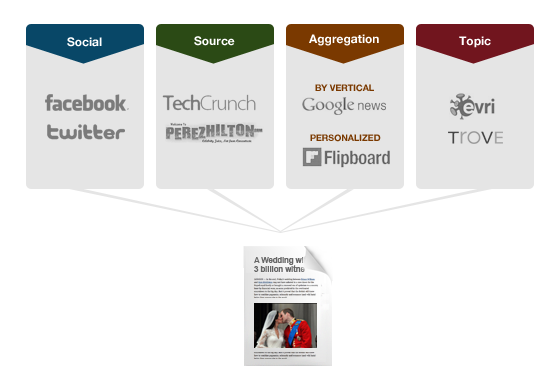
But what happens to everyone else when this revolution occurs?  Do newspapers die tomorrow? Do services like Flipboard or Google News become irrelevant? Absolutely not. Users will always want variety of sources and interfaces to understand the world around them. Instead of focusing on aggregating and consuming individual articles, these algorithms will create a new personalization layer that weaves together the context and elements of each event. Being able to rapidly understand the world’s news and its context changes the game… aside from merely creating opportunities for existing players, new entrants will analyze the data for prediction, forecasting, and the like.

Facebook is reordering your timeline, but what about the world’s timelines?


Company:
Facebook
Website:
facebook.com
Launch Date:
January 2, 2004
Funding:
$2.34B

Facebook is the world’s largest social network, with over 500 million users.

Facebook was founded by Mark Zuckerberg in February 2004, initially as an exclusive network for Harvard students. It was a huge hit: in 2 weeks, half of the schools in the Boston area began demanding a Facebook network. Zuckerberg immediately recruited his friends Dustin Moskowitz and Chris Hughes to help build Facebook, and within four months, Facebook added 30 more college networks.

The original idea for the term…

Learn more

Jim is the CEO and co-founder of Attributor, a company focused on helping reshape the publishing industry. He is also the Chair of the Demi and Ashton DNA Foundation Technical Task Force and an adviser to SV Angels. In 2006, Jim advised Facebook on their ad targeting systems and helped found Anchor Intelligence (acq. Comscore) with Ron Conway. Before that, he was the CEO of Moreover Technologies, the pioneering real-time news search company that was acquired…

Learn more

Person:
Adrian Aoun
Website:

At an early age, Adrian Aoun founded two companies, one developing online business-to-business software, and another, a consulting company specializing in helping companies incorporate the latest in university research in their businesses. After college, in search of a new challenge, Adrian sold both of his companies privately and was quickly recruited by Microsoft. Working on Microsoft Office, Adrian specialized in working to bring Microsoft Office to the web. Thereafter, Adrian was hired out by Fox Interactive Media as a…

Learn more


Driving on the left

abbeyroad

Driving on the left side stretches the muscles, especially including the one in your head. When Larry Page named Google as Google’s biggest problem, he was talking as a leader not just of the search giant but of the whole industry. Anticipating the first Apple event since Steve Jobs stepped down as CEO, it feels good to see others step up to the task.

It’s not that any one of these leaders will fill that intuitive role. Jeff Bezos did it this week with his stunning price point, cloud browser, and clicks and mortar media streaming business. He’s not the only one, and neither is Marc Zuckerberg. But each in their own way are together shaping not just the technology business but the way we work together. And the answers are not easy or obvious.

I work for one of these leaders. Marc Benioff has always had the leader gene in him, in ways that I recognize from my days in the record business. It’s like those baby pictures of a child. At the time you’re taken with the innocent smile, the wide-eyed wonder and something that looks fragile but is only waiting for the information. Sometimes the information is delightful, sometimes a loud startling noise, but always the signature of what some call the soul. Years later, you look back at these pictures and you see that now-grown up teen or adult staring right out at you. In some way it’s not that they grow up, but we do.

I’ve seen the look in musicians in the studio, the purposeful relaxation that comes from working in the now. Listening yet knowing they are somehow born to get to that room at that time with those people who can play together. Collaboration is not an art, but getting there is. And once there, staying there. It’s a supple balance, living in that sharing space. Zuckerberg seems to understand what it should look like. Bezos seems to understand how the world can have an Apple and have room for more. Benioff understands the rhythm of the place, the surging of the business instantiating the resources for the next round of validating inspiration.

On the ground next to these guys, it’s exhilarating in a way that gives way to an appreciation for how difficult it is to harness the minds and souls necessary to do big things. Like a fractal fragment, you can see in your own role the same structures, blockers, ideas, and moments of humor that carry you and the team forward. These social media tools can be understood for their value to our enterprise, but they also can provide the musical constructs that keep us coming back for more. These leaders, in differing ways and amounts, are writing the score of this time we’re in. Songs with no chorus, songs with codas and shifts in rhythm, the magic of the bridge that never returns.

We don’t get confused by more than one leader in the business that used to be called music. Coltrane stood next to Miles, and Dylan and Harrison and Lenny and Winehouse. Some survived and some didn’t, but who they were and are is timeless. Hendrix sounds like a live stream, like the notes can be the same and the intervals the same and the blues the same and yet it keeps growing like it’s busy being born.

Driving on the left is complicated by the lack of context; you aren’t yet comfortable with the intuition you’ve grown used to, the sense of danger and limits, of detaching from the road with the illusion that you’re the only mind you need to tend. The signs are the hardest part, crossing over from right to left brain or whichever it is, from the rhythm of the road to the logic of the structure, the mission of the directions, the choices that loom and then are replaced by recalculation and another rush to that same decision point. But as you collide with not enough time and not enough listening, you begin to learn how to distinguish the underlying rhythm of decisions, immutable in their logic and Darwinian in their implications.

And then, suddenly and without any real announcement, you get it. You get the dance of the roundabouts, the coursing flow of living in the stream. It’s as though you were there all along but waiting for the hindsight to see it for what it is. And when you come back to the right side, it’s so familiar that you don’t lose what you’ve gained from finding that magical land, the one where you learn to hope for rain so that you can find the rainbows.


Amazon “Punches Apple Hard” With Kindle Fire’s $199 Price

Kindle fire $199

With the Kindle Fire, Amazon is making its first foray into tablet computers, a market where Apple dominates with its iPad and nothing else has even made a dent.  The Android-based Kindle Fire is an impressive media tablet, and Jeff Bezos understands that the device itself is only part of the equation. It is merely the front-end of a set of end-to-end services which will deliver digital media from Amazon’s servers to people’s hands.

But the Kindle Fire is no iPad, and Bezos knows that too. So he is using something else to differentiate the Fire from the iPad: price. The $199 price of the fire surprised almost everyone. It is $300 lower than the cheapest iPad 2. So even if it is not as fully featured, doesn’t work as smoothly and will launch with a laughably small number of apps (less than 1 percent of the number of apps available on the iPad, which is currently over 100,000), all of that may not matter. Because if it is good enough, millions of people will decide to buy it for $199 instead of spending $499 for an iPad.

One of Amazon’s advantages as a retailer with scale has always been price. And it is using it effectively with the Kindle Fire, which is already the second-best selling Kindle on Amazon (the first is the new $79 Kindle). There is a reason the Kindle Fire is not launching with 3G service, and only WiFi. Amazon had to do everything to get it down to that $199 price point.

Bezos knows he can’t take on Apple head on. Instead, he is doing everything he can to carve out a new space in the tablet market for Amazon, and price is a big part of it. In a letter to customers that is currently on the homepage of Amazon, he “punches Apple hard,” in the words of investor John Borthwick. The letter starts:

There are two types of companies: those that work hard to charge customers more, and those that work hard to charge customers less. Both approaches can work. We are firmly in the second camp.

Bezos made the same point during the launch announcement of the new Kindle line last week. “We are building premium products at non-premium prices,” he said. Apple, of course, builds premium products at premium prices. Will it have to respond by lowering the price of the iPad even lower, or can it stick to the high road?

@Borthwick
John Borthwick

Amazon punches Apple hard in advance of nxt week. There are two kinds of companies … bit.ly/pHel4B


(Founder Stories) Meetup’s Heiferman: Working At McDonald’s & The Future Of Social Networks

Sequence 1 Backgroun#5987FA.mov

Meetup co-founder and CEO, Scott Heiferman is Chris Dixon’s guest in this episode of Founder Stories. A serial entrenepenur, Heiferman tells Dixon he started “the first online ad agency in ’94″ after corporate America left him unsatisfied. Called i-traffic, “the idea was to be an online media buying agency even though there wasn’t any media to buy at the time.” Five years later Heiferman sold i-traffic to Agency.com.

Following the exit, Heiferman was unsettled and says he “went a little bit crazy not knowing what I wanted to do with my life.” Heiferman took a job at McDonald’s—a move he credits to the company he was keeping. “I was hanging around with too many lawyers and accountants and at the time I just wanted to see what it was like to be a part of an actual real business.”

After flipping burgers Heiferman jumped back into the startup scene with RocketBoard, a project he describes as “a colossal failure and actually we blew through about $20 million dollars of AOL money.” The silver lining? Heiferman received advice that sticks with him to this day—create products to help the greater good of society.

Resuming their conversation below, Heiferman discusses Fotolog, a company he launched just prior to founding Meetup. Heiferman started the photo sharing site in 2002 and says “it became the number one social network” in several countries. It eventually sold for millions of dollars. However, Heiferman notes Fotolog’s top status eroded when Flickr hit the web and it made Heiferman realize that no company is totally secure against competition.

Lesson learned, Heiferman tells Dixon “I don’t think you can take for granted that any social network is going to be here 10 years from now.”

Make sure to listen to both clips for additional insights, including what Dixon observed while delivering pizza.

Past episodes of Founder Stories are here.


:
Website:

Learn more

:
Website:

Learn more

Scott Heiferman is a Co-Founder and CEO of Meetup, the world’s largest network of local community groups. Over 50,000 Meetups (self-organized community events) happen each week. Millions of people in over more than 100 countries “use the internet to get off the internet” using Meetup, which is built on the idea that every town needs support groups, playgroups, bookclubs, business circles, running groups, community action groups, etc. Previously, Heiferman co-founded Fotolog, a photo sharing network where over 30…

Learn more

Chris Dixon currently works as the CEO and Co-founder of Hunch. He is also a contributing writer for TechCrunch.

He previously was the CEO and Co-founder of SiteAdvisor, which was acquired by McAfee. Chris is a personal investor in early-stage technology companies, including Skype, TrialPay, DocVerse, Invite Media, Gerson Lehrman Group, ScanScout, OMGPOP, BillShrink, Oddcast, Panjiva, Knewton, and a handful of other startups that are still in stealth mode. In addition to his personal investments, Chris is also a…

Learn more


Weekly Watch Round Up

Dedgumo-watches-12

Every weekend, we run a quick round-up of the major watch news. Why? Because watches are pretty darn cool.

The Dievas Vortex Professional watch gets reviewed. Durable titanium case and easy to read dial for people who just need a serious timepiece (for serious work and play).

Looking at a modern classic, a very unique classic. The Gerald Genta Gefica Bi-Retro Safari watch get’s remembered and recommended as a collectible.

Love that Japanese deconstructionist steampunk look? Dedegumo watches are custom made by hand and not too expensive.

For a bit more commentary, check out the Hourtime Watch Podcast.

Click to view slideshow.


Chamath Palihapitiya To Airbnb CEO: “If You Want Liquidity,… Make It Available To Everyone”

chamath-palihapitiya-1

Should founders take money off the table in later venture rounds, and if so under what circumstances? An extraordinary private email to Airbnb CEO Brian Chesky from investor and former Facebook exec Chamath Palihapitiya which was leaked to Kara Swisher at AllThingsD brings this question into sharp focus once again. The email is reprinted below, you should read it in it’s entirety.

Palihapitiya doesn’t take issue so much with the founders collecting $21 million of the $112 million round for themselves, but rather with the way that they did it. “My basic principle on this stuff is that if you want liquidity, that’s fine, but you should make it available to everyone. Otherwise, no one should get it,” he writes. They took it as a straight dividend which, notes Palihapitiya, “allows you guys to take money out of the business and not dilute yourself.”

Airbnb isn’t the first hot startup to take money off the table during a big venture round. Groupon insiders famously took $345 million from a $950 million round back in December, 2010, before things started getting hairy. And half of Twitter’s recent $800 million round went specifically to buy out employees shares. But there is a difference between how Airbnb and Groupon founders rewarded themselves and how Twitter did it. Twitter spread the money more evenly to employees and early shareholders instead of funneling almost all of it to the founders.

A new class of investors is stepping in to provide liquidity to founders, employees, and early shareholders. With the rise of what I call mezzanine venture capital (DST-type deals that function as a bridge between late stage growth deals and an IPO) it has become increasingly common for startup founders and employees to cash out before an IPO or acquisition. In general this is a good thing as it rewards those who take the risk to build successful startups, but if the rewards are not spread equitably it can backfire. Palihapitiya warns, “If you are viewed as self-dealing and shady, it will only hurt your long term prospects.” Read his entire email below and weigh in with your thoughts in comments:

From: Chamath Palihapitiya
Date: Sat, 1 Oct 2011 11:16:05 -0700
To: Brian Chesky
Subject: Airbnb financing…
Brian,
Cc Marc, Reid, my deal team

Thanks again for giving me the chance to participate in your latest financing. I had a chance to review the docs at length yesterday and I wanted to follow up as, quite honestly, I’ve never seen a deal like this over ~60 investments I’ve done and I’m pretty concerned.

I’m all for getting the best valuation you can, minimizing dilution and maximizing control. We did this brilliantly at Facebook…all of our financings (except our first $$$ from Peter Thiel) were done not out of necessity but opportunity. As such, our investors had virtually no control and it resulted in a much better outcome. As we’ve discussed, I generally don’t believe investors add much to a success story and so minimizing their impact is a great strategy when you are onto something that is working.

This said, while several of these concepts are reflected in the current deal, there is one big thing that I am fundamentally against and violates my principles and will prevent me from participating in your round. When I saw that you guys were taking $31M out of the company, I didn’t think much of it as I just assumed it would entirely be via a secondary sale.

But as I understand the deal, it seems that you are doing only $9.6M in secondary and $22.5M as a dividend to common (of which $21M goes to you and your co-founders). I am really uncomfortable with this and don’t think its in the spirit of building a good, long term business. Effectively, it is a strategy that allows you guys to take money out of the business and not dilute yourself — I’m not sure why this is such a big deal when you guys are almost 90% vested and the financing is at $1.2B where your dilution is marginal. Further, it excludes many of the employees that probably have helped you and your co–founders get the company to this place as most of these folks probably don’t have any stock but have unexercised stock options and thus won’t get a dividend.
My basic principle on this stuff is that if you want liquidity, that’s fine, but you should make it available to everyone. Otherwise, no one should get it. Your current deal is the farthest away from this principle that I’ve seen in a while…this strategy has been done once before — at Groupon. We can see how “well” they are doing and how short term the investor community is now viewing their motives. I really think you can do better than this…and that you are better than this.

Separately, when you look at successful tech companies, it seems that dividends are an approach used by cash rich operations to distribute excess earnings — in fact, the most successful, cash rich tech company in the world, Apple, hasn’t issued a dividend and they have more than $75B in cash! Again, while I think Airbnb will be a good company, this is nowhere near the truth now — you guys still need to scale and build this thing for the future.

I really think you are onto something but I would implore you to not take the easy way out. Treat your employees the same as you’d treat yourself. Do things that you will be proud of and can defend to anyone including your Board, employees, prospective hires etc. In such a competitive hiring market, you are competing with not just your obvious competitors, but also any successful tech company who is also looking for great talent. A principle that treats your employees as well as you’d treat yourself is a huge strategy for differentiation, retention and long term happiness of the exact types of people you will need to be successful. In contrast, if you are viewed as self-dealing and shady, it will only hurt your long term prospects…

In summary, I’m passing on this financing because I strongly disagree with what’s going on. I’m not sure who advocated this approach but I did mention this to Reid [Hoffman, another Airbnb investor via Greylock Partners] last night and he was of a similar mind to myself and surprised this was the approach being taken. If you want some good advice — I would ask that you consider pinging him about different ways to think about going about the liquidity portion.

If you change your mind on how to close this financing, let me know and I’d love to reconsider. Otherwise, good luck and lets keep in touch.

Take care,

Chamath


Company:
Airbnb
Website:
airbnb.com
Launch Date:
November 8, 2008
Funding:
$120M

Founded in August 2008 and based in San Francisco, California, Airbnb is a community marketplace for people to list, discover, and book unique spaces around the world online or from an iPhone device. Whether the available space is a castle for a night, a sailboat for a week, or an apartment for a month, Airbnb is the easiest way for people to showcase these distinctive spaces to an audience of millions. By facilitating bookings and financial transactions, Airbnb makes…

Learn more

Chamath Palihapitiya is the founder of The Social+Capital Partnership.

Previously, Chamath was the executive responsible for overseeing Facebook Platform as well as launching Facebook’s online advertising channel. He vacated his most recent role as Vice President of User Growth, Mobile and International Expansion at Facebook in June, 2011.

Chamath joined Facebook from The Mayfield Fund, a leading venture capital firm in Silicon Valley where he was focused on consumer Internet, advertising and technology investments.

Prior to Mayfield, Chamath spent five…

Learn more


One Up: Gamers Help Scientists Solve Molecular Puzzle That Could Lead To AIDS Vaccine

fat_gamer_kid1

So, this isn’t exactly breaking news, but it’s so awesome that it’s worth sharing again in case you missed it. HIV/AIDS has killed some 25 million people worldwide and scientists have been working diligently since the virus was discovered in 1981 to find a cure. While a cure still eludes researchers, several protease inhibitors have been developed to slow its progress. But last week, HIV/AIDS research took a huge leap forward, thanks to the work of gamers. Yes, gamers.

About three years ago, a team of researchers at the University of Washington created a game called FoldIt to allow gamers to contribute to scientific research by playing with the shape and structure of proteins. Why proteins? Well, there are more than 100,000 kinds of protein in the human body, and understanding the structure and makeup of these proteins is key to understanding how they work and as well as to designing drugs that target them.

As proteins are found in the majority of diseases we suffer from, they are also key to developing cures, and so FoldIt enables gamers to design new proteins and fold known proteins into their most workable forms in an effort to contribute to disease prevention.

According to FoldIt’s website, “Foldit attempts to predict the structure of a protein by taking advantage of humans’ puzzle-solving intuitions and having people play competitively to fold the best proteins”.

And last week, FoldIt became more than just a cool idea, or an exercise for scientifically-minded gamers. Scientists have been attempting to decipher a protein called “retroviral protease” for over 15 years, as the protease is one of the key proteins that allows HIV to multiply and replicate itself in living cells. Using FoldIt, gamers were able to identify the structure of the protein — within a matter of 10 days.

With the structure of retroviral protease unlocked, scientists can now begin taking the necessary steps to build a drug that could significantly slow the speed at which HIV develops. The findings were initially published in a Nature article, which readers can find here.

“Following the failure of a wide range of attempts to solve the crystal structure of M-PMV retroviral protease by molecular replacement, we challenged players of the protein folding game Foldit to produce accurate models of the protein”, the University of Washington research team said in its findings. “Remarkably, Foldit players were able to generate models of sufficient quality for successful molecular replacement and subsequent structure determination. The refined structure provides new insights for the design of antiretroviral drugs”.

In this MSNBC report, the gamers describe the way in which they were able to work together cooperatively to solve a puzzle that has confounded scientists for more than a decade. And what’s so cool is that, while some of the most important progress in the game was made by those with biomedical academic backgrounds, the majority of active players playing with FoldIt did not have this kind of scientific background. Many of them were just average gamers like you and I.

“The monkey-virus puzzle solution demonstrates that Foldit and other science-oriented video games could be used to address a wide range of other scientific challenges — ranging from drug development to genetic engineering for future biofuels”, Firas Khatib, a biochemist at the University of Washington told MSNBC. “My hope is that scientists will see this research and give us more of those cases”.

What a remarkable win for the non-shallow end of gamification. We hear so much about how game layers are being added to consumer tech products to encourage engagement and interaction with products and apps, but with FoldIt, we have a real example of how gamification can help solve some of the trickiest of scientific problems and help make the world a better place.

Way to go, gamers.


Hack Your Culture

Justin Kan

Editor’s note: This guest post is by Justin Kan, cofounder of Justin.tv and TwitchTV. You can follow him on Twitter here and read his blog here.

Behavior is a virus. We spread our behavior to those around us, whether passively or on purpose.

Pop quiz: what factor most highly correlates with obesity? It isn’t income, race, religion, or genetics. It turns out that the best indicator of obesity is your friend group: if you have overweight friends, you are more likely to be overweight yourself. This makes sense, because you develop your behavior set from interactions with those around you. If your friends are physically active and eat well, you’ll have more opportunities to be physically active yourself, and spend more time over healthy meals. Alternatively, if your friends are living a real-life version of Super Size Me, you’re likely on the express train to type II diabetes.

Given enough exposure to a behavior, that behavior will become normative. This is true for both positive and negative behaviors. One simple behavior I’ve seen spread through my own friend group is riding motorcycles. I first started riding a few years ago after two of my friends came by on their bikes (having wanted to start for years, but never having a catalyst until that moment). Fast forward four years and both my brothers, two roommates and many other friends are riding, with many more in various stages of taking the rider’s test and joining the organ donor’s club.

Over the past several years I’ve been surprised to learn that this is also the case for entrepreneurship. For most people, startups are a risky endeavor and something to be avoided. Many are hesitant to quit their secure jobs and try to start a company from scratch. From an expected value perspective, when factoring in some risk adversity attributable to basic human nature, they are correctly maximizing outcomes. However, for a growing group, I’ve noticed that startups are a normalized behavior, and that this generally spreads through personal connections.

My brother Daniel is the perfect example of this. When Daniel graduated from college in 2009, the economy was in a horrible recession, and it was extremely difficult for new grads to find jobs. Initially having very little interest in startups, he started doing sales and business development at Uservoice after finding no options in consulting and banking, where the few friends of his fortunate enough to find work were headed. After a couple years of being friends with founders and early employees of startups, hearing about startups everyday and rooming with startup founders, he made the jump himself and recruited a team to launch Appetizely.

An example of culture-hacking at scale is Y Combinator. One of the reasons I think Y Combinator is so powerful is because it creates a new social norm, especially for those who come from outside Silicon Valley. When you start at YC, your friends and family think you’re crazy. By the end, you have another friend cohort: other YC entrepreneurs and alumni. These new friends will provide support and advice, but the most important thing that they give you is implicit assurance that you are not crazy.

The lesson here is that through some clever social engineering you can hack your own life to put yourself in the position to accomplish goals you don’t even know how to begin. This is also also  how ZeroCater started. Over three years ago I was interviewing candidates for a community manager postition at Justin.tv. One interviewee particularly stood out. Arram didn’t have any experience or really any qualifications; in fact, at the time he had been working as a security guard and had never been to college. But, unlike most of the other candidates, he had thought extensively about what he would do as the community manager and had written down his many ideas in preparation for our interview. He was also passionate about creating his own startup eventually, and his excitement was inspiring. We ended up hiring someone else who had more community management experience for the job, but I was so impressed with Arram’s preparation that we hired him anyways to do random office projects.

One of Arram’s minor responsibilities ended up being ordering meals for the company. It ended up being such a time saver for the team that one evening I suggested that he offer ordering as a service to a few other YC startups in the neighborhood. That was the last I thought about it, but a month later I was shocked when Arram came back to me and told me he was quitting to grow it as a startup. Two years later, and he’s recruited a technical team, built out software to manage the entire workflow and serve companies like MTV, CBS and Verizon.

Arram didn’t have the programming or product background that you would expect from someone who would later go on to raise over $1 million in venture capital for a technology startup. He got in the game by doing whatever it took to get into a startup and surrounded himself with startups, making it impossible for him to not think about startups. Just being in the community creates opportunities: how else would you come up with the idea for a food subscription service that solves a very specific company problem?

You can hack your own culture. Surround yourself with people who do what you want to do, and eventually you’ll wake up to find yourself doing the same.


Person:
Justin Kan
Website:
Companies:
Justin.TV, Kiko, Socialcam

Justin Kan is an entrepreneur, Web developer, and the ‘Justin’ of Justin.tv.

Justin.tv started when Justin Kan and Emmett Shear took on the challenge of broadcasting one person’s life 24/7. Being web developers, they recruited co-founders Michael Seibel and Kyle Vogt to run the business and build a live streaming video camera. For investment, they spoke with Paul Graham of Y-Combinator (an investor in their previous start-up) and raised seed capital.

The Justin.tv website launched in March of 2007….

Learn more

Company:
Y Combinator
Website:
ycombinator.com
Launch Date:
January 4, 2005
Funding:
$10.3M

Y Combinator is a venture fund which focuses on seed investments to startup companies. It offers financing as well as business consulting along with other opportunities to 2-4 person companies looking to take an idea to a product. Y Combinator looks for companies with “good” ideas over companies with experience and a business model. The company made its first investments in Summer 2005.

Y Combinator selects companies to finance and consult with twice a year. They are located in…

Learn more


“For Those Who Don’t Want To Believe”

anonymous

I feel uncomfortably like a prophet. In January, and again last week, I wrote about the prospect of UAVs used as weapons by terrorists; yesterday a man was arrested who “planned to attack the Pentagon using ‘small drone airplanes’ filled with explosives and guided by GPS.” In August I wrote about omnipresent mobile phones turning the world into a panopticon; today’s NYT has an article about ordinary Koreans paid by the government to snitch on scofflaws with photo evidence. Last year I wrote a piece for The Walrus about the crucial importance of online pseudonymity for bloggers reporting on the Mexican drug war, now that the traditional media there has been terrified into utter silence; yesterday the headless corpse of one such journalist, a woman named Marisol Macias Castaneda, was found next to a scrawled message warning people not to write about the drug cartels on social media sites.

These are not three separate subjects. Cheap and/or ubiquitous cameras and facial recognition make surveillance ever more omnipresent; the dangers and uncertainties of other new technologies, like hobbyist UAVs, lead to calls for even greater scrutiny; and eventually online anonymity/pseudonymity will be the only kind there is. That isn’t entirely a bad thing. It’s because of crowdsourced surveillance that New York police lieutenant Anthony Bologna faces two investigations after apparently gratuitously pepper-spraying protestors. But it means the ability to remain pseudonymous online will only become more and more important in the years to come.

Do the services that connect people online seem to realize this? Sadly, the answer mostly ranges between “No” and “Hell, no.” Twitter is the only major social network that doesn’t have a real-names policy, and the only one with a history of going to bat for its users’ privacy. But while the online journalists in Mexico who dare to report on its brutal drug wars are beheaded after their real identities are connected to their online bylines, while Syrians are detained and interrogated because of their Facebook accounts, Vic Gundotra has idiotically compared Google Plus’s real-name policy to “wearing a shirt to a restaurant,” and both Eric Schmidt and Mark Zuckerberg’s sister Randi have called for real identities to be attached to all online activity.

There’s really not much one can do about that level of monstrous cluelessness. There are downsides to online pseudonymity, yes, but those are massively outweighed by the advantages. Unfortunately, the kind of people who head major online services live such incredibly cosseted existences that most of them seem basically incapable of understanding — or caring — that “even though you have nothing to hide and live your life like an open book, pseudonyms are really important to people who do not lead the cozy existence that you do,” to quote legendary hacker Jamie Zawinski. (To say nothing of the fact that defining what a real name even is is a whole lot more challenging than most Westerners appreciate.)

So I’m not hopeful that Google Plus’s Gundotra or Bradley Horowitz, much less Facebook’s Zuckerberg and Sandberg, will see the light and change their policies anytime soon. And that’s bad news for everyone. True, nobody has to use either service, but it’s incredibly disingenuous to claim that they aren’t increasingly important. Social media are how people organize into movements, these days, and they’re how both truth and falsehood spread when the traditional media fail. The sign next to Castaneda’s headless body was addressed, “For Those Who Don’t Want To Believe.” That’s a pretty good description of anyone who thinks that online pseudonymity is no big deal.

Image credit: “liryon”, Flickr


Gillmor Gang 10.1.11 (TCTV)

Gillmore Gang test pattern

The Gillmor Gang — Robert Scoble, Danny Sullivan, John Taschek, Kevin Marks, and Steve Gillmor — lauded Amazon’s entry into the mobile media universe with the Fire. We were unanimous in our praise for the impact the device will have on the tablet scene, with a price within reach of a whole new audience that has found the iPad resistable and Android tablets even less or more, whichever is less.

Whether the move proves a win or a challenge to Google depends on your perspective about Android. For some (@dannysullivan, @jtaschek, @scobleizer, @kevinmarks) it augurs good times for Android. For others (@stevegillmor) it puts significant pressure on Google to minimize the difference between Android open source and Android +. For all of us, it means significant challenge to a number of different strategies and market force pressure to make streaming the new Web OS.

@dannysullivan, @jtaschek, @scobleizer, @kevinmarks, @stevegillmor


Widely considered a leading “search engine guru,” Danny Sullivan has been helping webmasters, marketers and everyday web users understand how search engines work for over a decade.

Danny’s expertise about search engines is often sought by the media, and he has been quoted in places like The Wall St. Journal, USA Today, The Los Angeles Times, Forbes, The New Yorker and Newsweek and ABC’s Nightline.

Danny began covering search engines in late 1995, when he undertook a study of how they…

Learn more

Robert Scoble is an American blogger, technical evangelist, and author. He is best known for his popular blog, Scobleizer, which came to prominence during his tenure as a technical evangelist at Microsoft.

Scoble joined Microsoft in 2003, and although he often promoted Microsoft products like Tablet PCs and Windows Vista, he also frequently criticized his own employer and praised its competitors like Apple and Google.

Scoble is the author of Naked Conversations, a book on how blogs are changing…

Learn more

Person:
Kevin Marks
Website:

Kevin Marks is a software engineer. Kevin served as an evangelist for OpenSocial and as a software engineer at Google. In June 2009 he announced his resignation.

From September 2003 to January 2007 he was Principal Engineer at Technorati responsible for the spiders that make sense of the web and track millions of blogs daily. He has been inventing and innovating for over 17 years in emerging technologies where people, media and computers meet.
Before joining Technorati,…

Learn more

Person:
John Taschek
Companies:

John Taschek is vice president of strategy at salesforce.com. He is responsible for corporate product strategy, corporate intelligence and market influence. Taschek came to company in 2003, bringing over 20 years of technology evaluation experience.

Taschek currently is also the editorial director for CloudBlog – an independent blog run as an adjunct to salesforce.com’s web properties. He occasionally is on Steve Gillmor’s The Gillmor Gang enterprise web video-cast.

Previously, Taschek ran the testing labs at eWEEK (formerly PC Week) magazine….

Learn more

Steve Gillmor is a technology commentator, editor, and producer in the enterprise technology space. He is Head of Technical Media Strategy at salesforce.com and a TechCrunch contributing editor.

Gillmor previously worked with leading musical artists including Paul Butterfield, David Sanborn, and members of The Band after an early career as a record producer and filmmaker with Columbia Records’ Firesign Theatre. As personal computers emerged in video and music production tools, Gillmor started contributing to various publications, most notably Byte Magazine,…

Learn more


Buy This Movie Or Legally Download It For Free: Your Call

PressPausePlay

PressPausePlay, an award-winning documentary about our new digital culture, premiered at SXSW earlier this year. It is playing at film festivals and you can buy it on iTunes, Amazon, and other digital pay sites. If you don’t want to pay for it, you can now download it via a torrent for free. This free option was essential to the filmmakers. As Seth Godin says in the film, ideas that are free spread faster.

The movie examines the impact of today’s technology advances on our culture and the digital artists, musicians, and filmmakers who create it. In the film, Godin says “there has never been a better time to be an artist.” Taking a completely different view, technology pessimist, Andrew Keen, host of TechCrunch TV’s “Keen On“, says “we may well be on the verge of a new dark age… where the creative world is destroyed.”

Watching parts of the movie, I thought I was watching an Apple promotional video, showing the power of what a Mac can do. The music and videos that can be produced on computers, almost exclusively Apple computers in this film, is simply amazing. As the musician Moby says, because of software, “now any kid … in about 5 minutes can do what took 6 months or years, 20 years ago.”

But that doesn’t mean it’s any good. See Rebecca Black. Moby adds “If everyone is a musician and everyone is making mediocre music, eventually the world is just covered with mediocracy.”

As the filmmakers say, “the digital revolution of the last decade has unleashed creativity and talent of people in an unprecedented way, unleashing unlimited creative opportunities.” But, Keen questions whether a young Hitchcock or Scorsese would make it today, as they “slap up their early stuff on Facebook, on YouTube, it would get lost in the ocean of garbage.”

The movie also addresses the troubling dichotomy that the same technology artists use to create their work also allows for easy pirating and destroys existing business models. The documentary doesn’t provide any easy answers, but it raises important questions about the impact to our culture.

You can find the free download options at presspauseplay.com, including an interactive Adobe Air version with deleted scenes and additional and longer interview clips. For the standard downloads, you get a .torrent file and use a free software like BitTorrent to get the movie file. So far, there have been 4,000 downloads.

Why have both a free version (with even more interactive content) and paid version at the same time, with links just inches away from each other? When the filmmakers signed their distribution deal, they say it was always their intention to eventually give the film away for free online. The goal was never to make money, but instead make a film people would share and think about.

Andrew Keen was interviewed for the film, but he got to turn the cameras around on the filmmakers in Austin. Here’s the interview Keen did with the Swedish co-directors David Dworsky and Victor Kohler, at SXSW:

Here’s a movie trailer:


Person:
Andrew Keen
Website:
Companies:
Now.tv, TechCrunch

Andrew Keen is an Anglo-American entrepreneur, writer, broadcaster and public speaker. He is the author of the international hit “Cult of the Amateur: How the Internet is Killing our Culture” which has been published in 17 different languages and was short-listed for the Higham’s Business Technology Book of the Year award. As a pioneering Silicon Valley based Internet entrepreneur, Andrew founded Audiocafe.com in 1995 and built it into a popular first generation Internet music company. He is currently the…

Learn more

SETH GODIN has written twelve books that have been translated into more than thirty languages. Every one has been a bestseller. He writes about the post-industrial revolution, the way ideas spread, marketing, quitting, leadership and most of all, changing everything.

American Way Magazine calls him, “America’s Greatest Marketer,” and his blog is perhaps the most popular in the world written by a single individual. His latest book, LINCHPIN, hit the Amazon top 10 on the first day it was published…

Learn more

Company:
Apple
Website:
apple.com
Launch Date:
January 4, 1976
IPO:

October 2, 1980, NASDAQ:AAPL

Started by Steve Jobs, Steve Wozniak, and Ronald Wayne, Apple has expanded from computers to consumer electronics over the last 30 years, officially changing their name from Apple Computer, Inc. to Apple, Inc. in January 2007.

Among the key offerings from Apple’s product line are: Pro line laptops (MacBook Pro) and desktops (Mac Pro), consumer line laptops (MacBook) and desktops (iMac), servers (Xserve), Apple TV, the Mac OS X and Mac OS X Server operating systems, the iPod (offered with…

Learn more


Fly Or Die: The Compex Sport Elite

Screen Shot 2011-10-01 at 9.41.37 AM

With Halloween around the corner, what better way to celebrate than to watch us animate my desiccated, lifeless limbs with jolts of fiery electricity? In this episode of Fly or Die, Erick and I look at the Compex Sport Elite. It zaps muscles to improve fitness, recovery, and general strength and it can, in a pinch, stand in for a massage. It also looks wildly freaky when turned on.

At $849 it’s a pretty hard sell but I found that it did help my shin splints and, when set to strength training mode, I noticed a definite improvement in tone. I figured the TC audience tries to stay in shape and had I had this device back when I was training for a marathon (long story), I wonder how much better my recovery would have been? Regardless, it looks hilarious when turned up to about 50.

Erick doesn’t agree with my assessment but does love watching me jump around like frog muscles sprinkled with salt.


The Internet Isn’t Just Another TV Pipe

TVs shot

Editor’s Note: Guest contributor Ben Decker works in corporate strategy at NBCU and does research on new media at NYU. Ben has recently begun an open dialogue around these issues and the future of traditional media. If you’d like to be involved, contact him @BDecker19

As everyone knows, Facebook schooled the web last week, and expanded its territorial ambitions to the world of media.  Launching with partners in print, music, and video, Facebook’s latest update pushes toward a world where consumption’s default has been switched to sharing, and social discovery sits not on the periphery of the media experience, but permeates it.

Zuckerberg presents this as a new model for media industries, one where you “discover so many songs (or movies, or articles) that you end up buying even more content than you ever would have otherwise.” Indeed, bringing users into the media discovery process is an important step. Ultimately though, it’s just a beginning, for it touches only the marketing component of the traditional model (consumers still passively consume content; they just get to tell people about it now).  The media revolution that’s coming will go further, fundamentally restructuring the relationship between media producers and consumers and often blurring the line between the two.

In my industry, television, everyone is scrambling to figure out the impact of Internet distribution.  How will it impact broadcast, for first-run airs and repeats?  What’s online’s relation to DVR and VOD?  How do its CPMs and sellout rates compare to other channels?   Questions like these, however, fail to capture the full opportunity inherent in the new medium.

The Internet isn’t just another pipe.  The Internet is an open distribution platform available to anyone, a fundamental change to the business landscape in which we operate.  And the Internet is bidirectional, which should fundamentally change the product we offer.  This first characteristic opens our business inevitably to the chaos and disintermediation that has plagued the print and music industries.  It this second characteristic, however, that I believe gives the TV industry a ladder out, and provides the opportunity for a dynamic, more sustainable, and ultimately more profitable business model.

In the past, a small number of companies held exclusive control over the TV distribution infrastructure. Today though, the Internet has opened up distribution to anyone, with production and marketing tools following suit, breeding an entirely new class of potential creators.  The Internet meanwhile is also making it easier to find and work with these creators, which is making the traditional model of publishing unsustainable.  It is no longer possible, competitively or practically, to keep our grip over everything, controlling the full production and distribution process internally, to push a monolithic product on a passive consumer we have no relationship with.

The problem of the web’s openness is fragmentation.  On the web, instead of a couple companies trying to assemble full packages of finished content, everybody throws everything out there, from individuals with camcorders to well-financed independent studios.  Most of it’s of course crap.  But the best can be quite great, even better than ‘professional’ content.  And more importantly, individual pieces tend often to be better, at least for a particular person, at a particular point in time.  The aggregate of the network—the best, most personally relevant piece of content from anyone, anywhere on the planet—becomes difficult to compete with.  There will always be a market for high-end, quality-assured content.  But as low-end tools move ever up market, as professional input resources become ever less exclusive, and as discovery mechanisms become ever better, that premium pie the big guys fight over will become ever smaller.  It’s the basic innovator’s dilemma.

You see it in the obvious trends plaguing television’s business model.  Monetization has always been about control . . . about setting up checkpoints, sites where people have to come to us if they want the services we provide.  In the broadcast era, we had no way to ask this of consumers, so we turned to advertisers, for whom we could gate and sell access to our audiences.  In the cable era, we found a way to establish a retail model, controlling the flow of content through pipes and selling access to consumers directly.

With the Internet though, these models break.  As we lose control over distribution, consumers gain the option of alternate content paths, both legal and illegal, rather than waiting at our checkpoints.  And as the world fragments, we lose our ability to aggregate audiences.  Of course, this latter point matters less and less, as businesses gain the ability to speak to consumers directly (first through web sites and now more effectively through social networks), and then even they get disintermediated, with consumers shifting their reliance from ‘push’ brand messaging toward ‘pull’ recommendations from their peers and reputation systems (think Amazon star ratings, and now Facebook).

I believe there’s a solution, one which doesn’t run from, but instead embraces the openness and interactivity of the web.  I believe television, and all traditional media industries, must shift to a collaborative model, where we use our premium resources as a vacuum to suck in value creation from partners and users, the way digital firms like Apple, Google, and Facebook do.  We should take advantage of external capabilities where they’re preferable to our own (eg distribution), and release our own differentiated resources to open innovation (eg content and ad sales capabilities).  The job of the media company will shift from producing and distributing content alone to orchestrating production and distribution ecosystems.

In all our interactions—with suppliers, but most critically with the audience—we must also shift from one-off transactions to ongoing relationships.  No longer can we simply push our products to people and call it a day—sell them a DVD and that’s that.  Me must shift to a services model, where we build ongoing communities of interest around our content and the service we sell becomes access to that content.  To this end, we must work harder to foster user contributions and user-curation around our shows; create second screen and social experiences that deepen the engagement of our viewers; offer games, gamification and, other forms of interactivity.  We must personalize media experiences and offer recommendations.

The opportunity here is extensive: continual subscription revenue streams, a secure distribution model (services are harder to steal than goods), a sustainable advertising model (based on deep user knowledge and a recurrent opportunity for persuasion), customized and continually evolving products, and the chance to capture free labor, knowledge, and creativity from our customers.  It’s what Blizzard and Zynga did with games, Netflix with video, Zipcar with vehicles, and down the line as all business gradually join ‘the mesh.’

As Netflix has demonstrated, disrupting one’s own business is perilous work.  But it’s been done.  Facing crises, companies like Cisco, IBM, and P&G have taken tens of billions of dollar restructuring paths to come out fundamentally different, vastly more successful companies.  Firms like AOL and Best Buy are in the midst of trying.  Of course, the alternative is the long slow fade to irrelevancy of a Yahoo, Borders, EMI, Tribune, or Blockbuster.

At television networks, digital divisions are creating innovative interactive experiences that take the audience beyond mere consumption into active participation.  But all of us in traditional media companies must realize that these digital products aren’t just dinky marketing vehicles for their on-air counterparts.  They aren’t cannibalistic substitutes, replacing analog dollars with digital pennies.  They are our gateway to a new world.


European Pirates Declare War On Cloners. Arrrrrr!! (TCTV)

pirate

I recently attended the European Pirate Summit in Cologne, Germany. Held in a sort of art-house scrapyard where artists sculpt out of old cars, and ravers dance into the night, the venue itself was a fitting place for what many began to feel was a sort of re-birth of the tech startup scene in Europe. Suddenly we all realised what was happening: Europeans are as mad as hell that they’ve been branded cloners and ‘copycats’, and they’re not going to take it any more.

In fact, the event featured the literal burning of a effigy of a startup clone. This was a gathering of Pirates, the kind of startup Pirates who ascribed to the philosophy laid down by Mike Arrington only last year.