BlackBerry Internet Outage Strikes Again While Investors Get Antsy

sadberry

Oh boy. As if yesterday’s BIS outage wasn’t bad enough for RIM, it looks like whatever solution they managed to cook up isn’t quite doing the trick. Reports of yet another outage have begun to make the rounds, and users in Europe, Africa, and the Middle East are once again unable to browse the web, send emails, or fire off BBM messages.

RIM has acknowledged the issue via their official BlackBerryHelp Twitter account by saying that “some areas have messaging delays and impaired browsing.” Their tweet doesn’t make it sound too bad, but representatives from T-Mobile UK, Vodafone Egypt, Bahraini carrier Batelco, and Kenyan operator Safaricom have all confirmed that their customers are being affected.

While RIM scrambles for a fix, they may also be facing some issues a bit closer to home. Activist investor Jaguar Financial has been calling on RIM to enact some drastic changes for about a month now, but Reuters reports that the company has managed to gain the support of other BlackBerry shareholders. As it stands, Jaguar claims to have the backing of enough investors to account for 8% of RIM’s total stock.

Jaguar Chief Exec Vic Alboini has mentioned that with the support of those shareholders, Jaguar will be able to demand a shareholder meeting to gain more traction for their vision for RIM. And what exactly is that vision? Jaguar wants RIM to undergo a “value maximization” process that could involve selling RIM’s patents, or even the entire company. What’s more, Jaguar is calling for a shake-up in RIM management that would begin with ousting co-CEOs Mike Lazaridis and Jim Balsillie.

At this point, it’s beyond crucial for RIM to get their affairs in order, because things are starting to look grim. It certainly wouldn’t be impossible for RIM to turn things around, but these days their road just seems to be getting rougher and rougher.


Samsung Galaxy Tab 7.0 Plus Gets Listed For Pre-Order

samsung-galaxy-tab-7-plus

When Samsung first announced the Galaxy Tab 7.0 Plus WiFi-only tablet, they failed to mention anything about pricing or availability. We assumed that meant that there would be a bit of a wait before we got the chance to get up close and personal with the slate, but maybe we were wrong. J&R electronics retailer has listed the device for pre-order in both the 32GB and 16GB flavors.

At J&R you can pre-order the 16GB model for $399.99, while the 32GB Galaxy Tab 7.0 Plus will cost you $499.99, reports Unwired View. The 32GB model is listed as “out of stock” at the moment, while the 16GB model seems to still be listed as available. Either way, the “Add To Cart” button for the 32GB version is still functional, and seems to just be another way of placing your pre-order.

As a refresher, the Galaxy Tab 7.0 Plus sports a 1024×600 WSVGA touchscreen, Android 3.2 Honeycomb, a dual-core 1.2 GHz processor, a 3-megapixel rear camera and a 2-megapixel front-facing shooter for video chat. It features support for a microSD card and packs the Netflix app straight out of the box.

Unfortunately, J&R offers up no time frame for shipments, but simply states that they are waiting on shipments from the manufacturer. Still, if you’ve had your heart set on a 7-inch Honeycomb tablet from Samsung, a pre-order at J&R’s will surely put one of the very first Galaxy Tab 7-inchers in your hands.


:
Website:

Learn more


Zenprise Raises $30 Million In New Funding

zenprise_logo

Mobile device management company Zenprise, Inc. today announced it has raised $30 million in new financing. The round was led by Silicon Valley-based Greylock Partners, with participation from all of Zenprise’s existing investors.

The investment will be used to support the company’s growth, and accelerate product development, sales and marketing efforts.

As part of this new funding round, Zenprise also announced that Asheem Chandna has joined the company’s board of directors. Asheem, a partner at Greylock Partners since 2003, was previously VP of business development and product management at Check Point Software.

Current and prior company investments and board seats include: AppDynamicsAruba Networks (ARUN)CipherTrust (Intel),DelphixImpervaPalo Alto NetworksPort Authority (Websense)Securent (Cisco), Sourcefire (FIRE) and Xsigo Systems.

Last month, Zenprise debuted a new product to lockdown iPhones and iPads in the enterprise, and plans to extend that solution to Android in the near future.

Earlier this year, it was one of the vendors selected by analyst firm Gartner as a “visionary” in its Magic Quadrant ranking. Companies designated as visionaries demonstrate “long-term strategies that point to the product and service approaches that will be most competitive in the future,” Gartner said.

The company was also named as a top new security vendor by HP at HP Protect 2011, a top 50 startup winner by TiE Global and has expanded its U.S. HQ with a new 24,000 square foot facility in Redwood City, CA. It also has a new European HQ in Paris, and new sales offices in Florida, Georgia, Illinois, New Jersey, New York, Texas, Washington, Germany, the Netherlands and The United Kingdom.


Company:
Zenprise
Website:
zenprise.com
Launch Date:
October 11, 2011
Funding:
$34.5M

Zenprise, provider of award winning mobile device management and security solutions, enables enterprises to confidently secure, manage and grow their mobile deployments as they mobilize their workforce. Zenprise protects the enterprise at more points against more threats than any other vendor in the market. Supported smartphone platforms include BlackBerry®, iPhone, iPad, Android, Palm, Symbian, webOS and Windows Mobile devices.

Zenprise was founded in 2003 and is headquartered in Redwood City, California.

Learn more


News Reader Pulse Debuts Cross-Platform Syncing

pulse

Pulse, an innovative news reading app for mobile devices, is debuting a new cross-platform syncing feature that allows users to access their accounts and saved sources across devices.

Pulse, which is developed by Alphonso Labs, launched last year via an iPad app as a more seamless (and visually appealing) way to read your RSS feeds. But Pulse ditched RSS in favor of hooking up with APIs to access content. Pulse’s home screen renders stories from your feeds on a dynamic mosaic interface and via a touch interface, allows you to swipe up and down to see headlines from various sources, and right and left to browse stories from a particular source. Pulse users can also bring in their news from 60 sources.

Recently, Pulse debuted the ability to create a personal account where you can save stories for reading later. Once you’re signed up, you can bookmark a story on your Android phone or the Web using a bookmarklet feature, and read it later on your another device. With this release, Pulse allows you to sync your sources across devices as well.

Basically the update allows a more unified reading experience across devices. Each source added will sync to all the devices you have Pulse on, including the service’s iPhone, iPad, Android and Android tablets apps.


Company:
Pulse
Website:
pulse.me
Funding:
$9M

Pulse is an elegant news reading application for iPhone, iPad and Android devices. It incorporates colorful panning story bars and fills them with content from your favorite sources. Pulse redefines news, giving you the opportunity to experience the news you desire from traditional sources, your favorite blogs and social networks – all in one beautiful interface.

Learn more


First Look At ImageSocial, The Photo-Sharing Network That Just Scored $15 Million In Funding

imagesocial-iphone

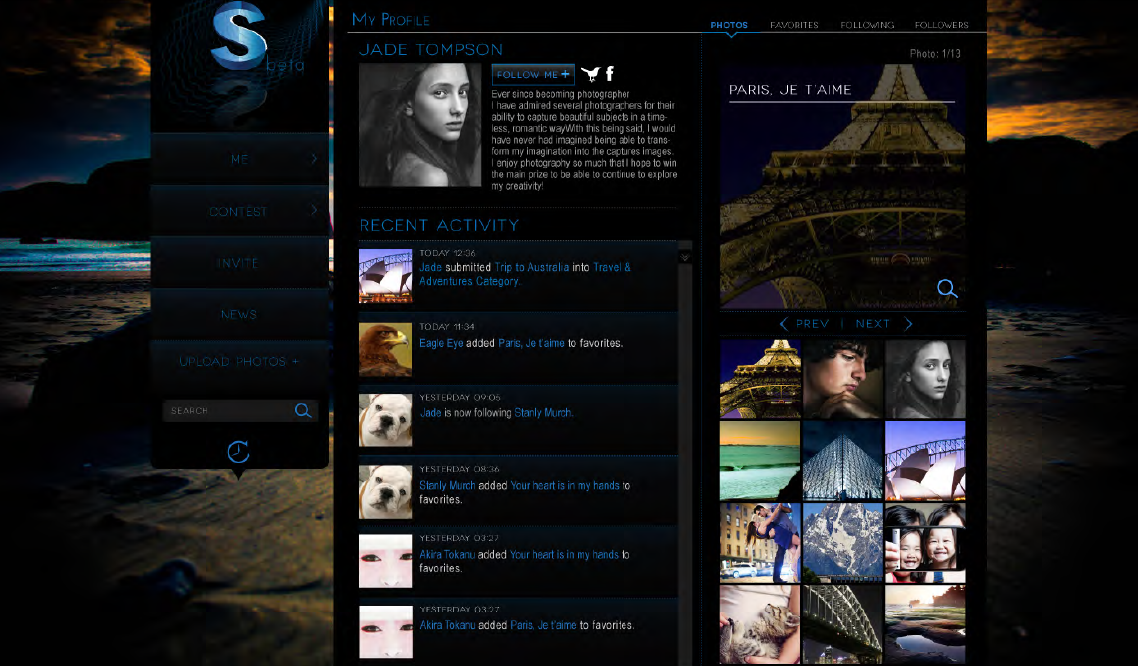
Earlier this month, Australian-based Mooter Media took in $15 million from San Francisco investment firm La Jolla Cove Investors, Inc. in order to launch a new social photography platform. The platform, called ImageSocial, will be built with technical development partner Hot Shot Media and, unlike traditional photo-sharing networks, will also include a gaming element.

Instead of just friending users and uploading photos, at launch, ImageSocial users will be able to participate in what Mooter says is the “largest online photo contest ever conceived.” The contest will involve a search for the most defining moments of our generation, and will award “big” prizes.

The investment in ImageSocial is one of the largest in Australian tech companies in recent history. Australia is more often a geographic region that’s under-represented in the tech startup world in relation to its vast size. In the agreement with La Jolla, Mooter will receive five committed, sequential and non-renounceable convertible notes of $3 million each to provide the company with capital injections. The initial drawdown will be $200,000 per month, with the ability to increase to $1 million per month as the share price increases. (Mooter Media is a publicly traded company).

Clearly, the company plans for this new photo-sharing platform to be huge.

The funding is also being used to build out the company’s San Francisco-based development and marketing arm, plus rapidly develop and commercialize the ImageSocial platform.

When it launches in Q1 2012, ImageSocial will encourage users to share photos on the network via desktop, tablet or mobile devices and will encourage them to vote on others’ images.

The photo-sharing contest is being positioned as an “American Idol” style reality contest, explains Chris Jermyn, CEO of Hot Shot Media:

“Nearly 10 years ago, ‘American Idol’ captured the hearts, minds, imaginations and voting hysteria of television viewers from around the world, compelling a generation to compete, to dream and to become involved. As a concept, ‘Idol’ has stood the test of time, defining a genre in which there have been many imitators but few conquerors…Our similarities to Idol run deep, harnessing the power of social media to allow interactive competition on a massive, global scale – but those who were once just viewers can now become direct participants – to create, to compete and to win on their own accord.”

We’re a little concerned about the “Idol” reference – don’t they know we’re all tired of that show?

OK, I kid (well, sort of). But while there’s still plenty of room for more photo-sharing startups, apps and platforms given the ubiquity of digital cameras and camera phones, the idea of a photo-sharing network where gaming is the primary draw is still a bit of a risk, at least on this scale. And ImageSocial isn’t the first to “gamify” the photo-sharing experience, newly launched Piictu, Snapr’s Capture the Flag, Where Am I?, Kept, and dozens of others are experimenting with making photo-sharing more game-like.

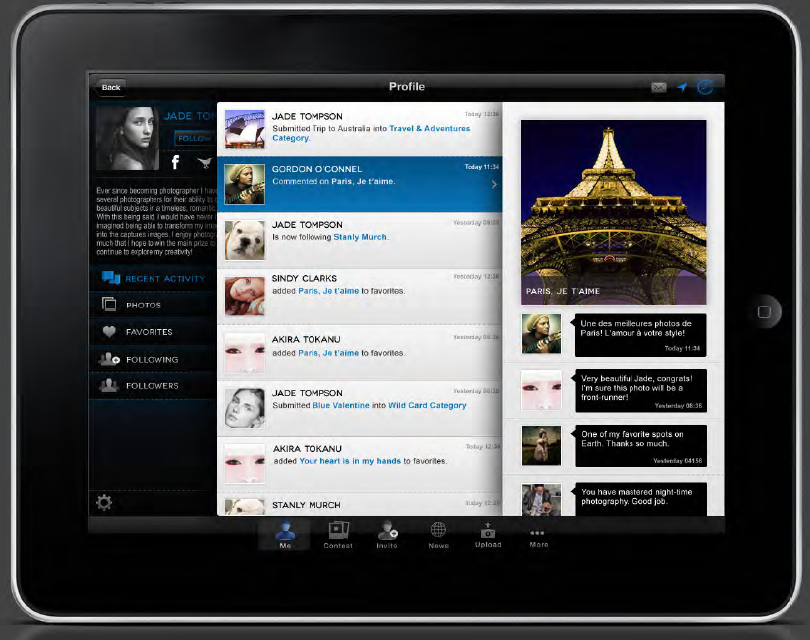
Below, we’ve got the first few screenshots of what ImageSocial has in the works as it will appear on desktop and iPad.


Fab.com Is Growing Like Crazy, Debuts Android And iOS Apps

fabmobile

Fab.com, which started out as Fabulis, a social networking site for gay men, has not only recently changed its name but also started from scratch with an entirely new business centered around online flash sales of design items. After raising a $1 million seed round, and another $8 million in Series A funding, back in July, the company has seen absolutely stunning growth after the pivot.

The startup’s CEO, Jason Goldberg, says the site now boasts over 750,000 members, of which 40,000 signed up over the course of last weekend alone. And with 18% of its traffic (and 12% of its revenue) currently coming from mobile devices, the time was ripe for Fab.com to launch some apps.

Today, the company is doing just that, debuting applications for Android, iPhone and iPad.

Fab.com is already generating about $100,000 in sales on a daily basis, and Goldberg expects this number to shoot up quickly after the launch of the mobile apps, which are evidently free of charge.

The app enables users to receive daily notifications when new sales go live, browse and purchase items, and share products on Twitter and Facebook, among other features.

Screenshots galore:


Company:
Fab
Website:
fab.com
Funding:
$11.3M

Fab.com features daily design inspirations and sales at up to 70% off retail.

Fab.com was started by Jason Goldberg, who founded SocialMedian and Jobster, with design industry veteran Bradford Shellhammer, contributor to Dwell and formerly of Blu Dot and Design Within Reach in New York, NY, along with Deepa and Nishith Shah in Pune, India and Veerle Pieters in Deinze, Belgium. Fab.com’s headquarters are in New York, NY.

The Fab.com website offers daily design inspirations and sales of up to…

Learn more


AT&T Adds Five New Android Phones To Their Lineup

android_portfolio_right_rail

If you thought that AT&T’s Android lineup was a bit lacking, then today’s announcement just may change your mind. AT&T has pulled back the curtains on a fleet of five new Android-powered smartphones that should hit wireless retailers just in time for all that holiday commotion.

The new Samsung Captivate Glide may bear a resemblance to its distant cousins the Stratosphere and the Epic 4G, but the similarities are purely cosmetic. While this Gingerbread handset packs a similar 4-inch Super AMOLED display, it also has a dual-core 1GHz Nvidia Tegra 2 processor under the hood and 1GB of RAM to help keep things running smoothly.

As you can tell, it also sports a comfortable-looking four row keyboard, but perhaps less obvious are the HSPA+ radio, an 8-megapixel rear camera, and a 1.3-megapixel frontfacer.

Motorola’s Atrix 2 actually seems like a mixed bag as far as upgrades go. It rocks a sleeker body than its predecessor, not to mention an new HSPA+ radio so users can finally push the limits of AT&T’s Faux-G network.

An unnamed 1GHz dual-core processor is calling the shots, which is a bit odd considering how proud they were of the original’s Tegra 2 chipset, and the display has been bumped up to 4.3 inches without a similar bump in resolution. That bit of stretching means that the Atrix 2 is working with a slightly lower pixel density than the original model, which may be a disappointment for current Atrix fans. It indeed runs Gingerbread, and an 8-megapixel camera capable of shooting 1080p video rounds out the package.

These two are the new heavyweight additions to AT&T’s portfolio, but let’s not forget the company’s new mid-and-low-range options.

Pantech joins the fray here with their Gingerbread-powered Pocket. It follows some of the design language used in some of Pantech’s other phones, which is my polite way of saying that it’s awfully squarish.

It’s got a 4-inch SVGA display, a 2GB microSD card, and a 5 megapixel rear camera. The Pocket lives up to its namesake by squeezing everything into a slim frame that’s only 11.3mm thick, so even the skinny jeans fans among you shouldn’t have too much trouble toting this thing around.

The Samsung DoubleTime gains the dubious distinction of being the only phone here to be stuck with Android 2.2/FroYo. Really? Even the ZTE gets Gingerbread?

In any case, the DoubleTime’s big gimmicks are its flip-open design and the internal and external touchscreens mounted on either side of the top half. It rocks a 600MHz Qualcomm processor, comes with a 2 GB microSD card, and will only be available in white with pink trim.

The AT&T Avail, made by ZTE, is the company’s second prepaid Android device. It’s pretty blase as far as smartphones go: it features a 3.5-inch touchscreen, and a 5 megapixel camera. That’s it. It seems like even AT&T is having trouble getting excited over this thing but in fairness, it’s probably meant to sell at a low off-contract price.


Subscription Service For Kids Activities Kiwi Crate Raises $2 Million

Kiwi Crate

Kiwi Crate, a new subscription service for kids activities, has raised $2 million in funding led by First Round Capital. Additional investors in the company include the Mayfield Fund, Comcast Ventures, Felicis Ventures, Forerunner Ventures, Consigliere Brand Capital, UJ Ventures and 500 Startups. Individual angel investors include Raymond Tonsing and Seth Goldstein.

The company, which launched today, has developed a subscription-based service that produces and delivers hands-on activities boxes for kids. The products are science activities, and arts and crafts projects that are designed to be educational but also entertaining for kids. And Kiwi Crate provides all the necessary materials, ideas and instructions for themed activities.

Kiwi Crate’s monthly subscriptions are $19.95 per month, or $220 for an annual subscription. Gift subscriptions for 3, 6 or 12 months are also available. The startup says each crate is designed by a community of parents, reviewed by team of experts, and tested by kids.

Kiwi Crate’s founding team comes with extensive experience in e-commerce and children’s services. Founder Sandra Oh Lin was GM of eBay Fashion and prior to that, launched PayPal Mobile and led product marketing for PayPal’s Merchant Services business. Other co-founders include Yu Pan, a PayPal co-founder and early employee at You Tube, and Yael Pasternak Valek, an ex-Yahoo! product manager who was on the founding team at Maya’s Mom, which was later acquired by BabyCenter.

Kiwi Crate faces competition from BabbaCo.


Pearltrees Brings Visual Content Curation And Discovery Platform To The iPad

Pearltrees

Content curation and mapping service Pearltrees is launching a dedicated iPad app today to allow users to cultivate and share their interests from the web on the tablet device. For background, Pearltrees is a visual social bookmarking service that allows users to organize, discover and share everything they like on the web.

Content can be dragged and dropped into Pearltrees and the service will organize this via a string of ‘pearls,’ which can then be moved around, organized and shared. Launched in December 2009, Pearltrees has gathered more than 10 million pearls. The company has says it has been growing at average rate of 15% month over month, with over half a million visits in September.

Considering the visual nature of the iPad, Pearltrees founder Patrice Lamothe says that the device is a natural home for Pearltrees. Via the apps, users can collect and retrrieve their favorite content from the web.

The app also includes a real-time collaborative curation feature that let users spontaneously team-up with others on their favorite topics. And you can access the curation of Pearltrees’ community of over 200,000 active curators.

Pearltrees faces competition from Pinterest.


Company:
Pearltrees
Website:
pearltrees.com
Launch Date:
January 3, 2009
Funding:
€3.8M

Pearltrees is the best way to organize, discover and share the stuff you like on the web.

Learn more


Zen and the Art of Scooter Testing


The sun is blanketing San Francisco in a toasty glow, and for once, people are wearing t-shirts outside.

But all that’s on my mind is why in the world I’m spending an entire morning test-riding a Yamaha Zuma scooter to write this Wired review. I have a red-eye to catch to New York in 12 hours, and a speech to give for my book tour right after I hop off the plane. In six days I co-launch a new website. In two weeks I have to file the second draft of a documentary screenplay before the filmmakers fly to Egypt.

I’m cutting it close, and to make matters worse, this bike is so slow.

“40 miles per hour max, who would ever buy one?”

I open the throttle all the way. I hear the engine moan as the bike crawls up a hill on Geary Boulevard.

Anybody who’s ridden a bicycle could probably figure out the Zuma in a few minutes. To top that off, it gets an estimated 132 miles per gallon.

Yamaha’s marketing team has handed each motorcycle journalist an Olympus camera to sling around our necks, and each of our scooters is equipped with a Garmin GPS on the right handlebar. The company has asked us to participate in a scavenger hunt, where we ride to each location programmed into the GPS and snap a photo.

“Bonus points if you include the scooter in the photos,” says Tim, Yamaha’s public relations head.

I smile during the press briefing, but I can feel my internal stress bomb ticking impatiently. I need to be 2,600 miles across the country soon, and I haven’t even finished writing my talk yet, so I just have to zip through this scavenger hunt as fast as possible.

But this bike is so damn slow.

Riding along with me is David, a Yamaha marketing manager who looks to be in his 40s, with short, dark hair and black-rimmed glasses. We chat casually as we pull up in front of stoplights about how long we’ve been doing our jobs and what motorcycles we ride (turns out David, who’s been in the auto-marketing industry for over a decade, doesn’t own one, but borrows bikes occasionally from the company to ride with his son). I ask him who the target audience for the Zuma is, because I can’t personally understand why anyone would want such an under-powered vehicle.

“It’s really broad, actually,” he says. “Lots of kids ages 16 to 21, who can’t afford a really fast bike. And lots of people 55 and up who are retired. Plus, in some states you don’t need to get a motorcycle license for a 49cc bike.”

I understand David’s points about price and motorcycle licenses right away. But as I sluggishly ride up a hill on Gough Street, the realization strikes me like a hammer hitting the chime of a grandfather clock. The retired people who buy this bike want it because it can’t go fast. They want their lives to slow down. They’re done zooming down the roads. They’re content with everything they’ve accomplished with their lives.

So I concede. As slow as it may be, this Zuma is fine for casual touring, especially in urban towns. It’s got huge storage under the seat — big enough to stuff a loaded laptop bag inside — and a collapsible hook on the glove compartment for holding grocery bags and a spare helmet. Its four-stroke engine accelerates from zero to 40 smoothly, though it struggles on steep hills, as you would expect a 49cc scooter to do.

The bike handles fine and operates easily; anybody who’s ridden a bicycle could probably figure out the Zuma in a few minutes. To top that off, it gets an estimated 132 miles per gallon, enough for at least two weeks of riding before you need to fill up. Not a bad investment for $2,500.

I reach the second destination programmed into the GPS — Dolores Park in the Mission District — and park the bike to snap a photo. I glance at my watch, and it’s already 12:30 in the afternoon. David tells me the scavenger hunt is expected to last another four hours before all the journalists meet Yamaha for dinner. I apologize and tell him I have to ditch the scavenger hunt early to finish up my work before I fly to New York.

I scramble back to the Wired office to wrap up my speech, then take a cab home to do a load of laundry, pack my bags and hurry to the airport. The plane takes flight, and I gaze out the window at the city lights, my eyes strained from a daylong adrenaline rush. A single thought echoes in my head: I need to slow down.

Photos of Brian courtesy of Yamaha Motor Corp.


Socialcam Crosses 2M Downloads, Adds (Wait For It…) Video Filters!

Screenshot 3

Socialcam, the ‘Instagram for Video’ that launched shortly before this year’s SXSW, has crossed a major milestone this week: it’s now been downloaded 2 million times across iOS and Android devices since it launched six months ago.

It’s also launching the 3.0 version of its app, which adds a feature that makes the comparison to Instagram even more apt: you can now add video filters.

Yes, starting with Socialcam 3.0 you can choose to give your videos a “70′s” or “Bohemian” or vibe, or you can use experimental filters like “Electronica”. You can see the effects rendered in the viewfinder before you start recording, so you have a sense of what each looks like beforehand. Another nifty trick: you can upload a photo and convert it into a video filter, allowing you to create custom filters.

The service has added several other features since we last wrote about it. For one, it’s now possible to create private accounts, where you specify who has access to your videos (before now everything was technically public, though it was hard to find videos of people you didn’t know). And you can now set the app to launch directly to the camera rather than the Socialcam UI — which is key if you’re planning to use it as your default camera.

Socialcam was originally created as a side project at Justin.tv — it spun off as an independent startup in August (Justin.tv’s then-CEO Michael Seibel became Socialcam’s CEO, and Justin.tv cofounder Emmett Shear took his place).


Company:
Socialcam
Website:
socialcam.com
Launch Date:
October 5, 2011

Socialcam is a new mobile video application coming to both iPhone and Android. Socialcam makes it fast, easy and fun to capture, share and view high quality movies of life’s moments with friends and family.

Learn more


Buckyballs? So Passé

ea9b_buckycubes

Just in time for the Ides of October, ThinkGeek brings us magnetic BuckyCubes, small, 4mm cubes that slide and slip together to create unique shapes. The kit comes with 125 rare earth magnets that can be combined and organized into various shapes.

ThinkGeek already sells BuckyBalls but coupled with these cubes you can be truly a God among Buckyfans. The come with a small carrying case and cost $24.99.

Note: Do not eat or snort BuckyCubes. BuckyCubes are not alive. BuckyCubes cannot replace human contact.

Product Page


Michael Robertson Gets A Cease & Desist From Univision For DAR.fm, His “TiVo For Radio”

michael-robertson

Michael Robertson is no stranger to legal threats from the music industry. The founder of MP3.com fought a landmark case against Universal Music Group in the 1990s over digital music copyrights, which MP3.com ultimately lost. He was taken to court again by the music labels a couple years ago as the CEO of MP3Tunes, and now he is raising the ire of the radio industry with his latest startup, DAR.fm. He just received a cease and desist letter from Univision (embedded below) for making it possible to record 26 of its radio stations.

Dar.fm, which stands for Digital Audio Recorder), allows consumers to record Internet radio streams and listen to them later. “It’s a TiVo for radio,” argues Robertson. There are 16,000 radio shows from 5,000 different AM and FM radio stations listed on DAR.fm—everything from NPR’s Fresh Air to Rush Limbaugh. Users can find radio shows on DAR.fm and record them for later playback.

But isn’t that the same as rebroadcasting copyrighted content? Contacted for comment, Robertson writes in an email: “We don’t believe people recording broadcasts is a copyright infringement—even if done via a cloud service… . It is not rebroadcasting just like your VCR is not rebroadcasting. It is personal recording. Courts have consistently ruled that personal recording of broadcasts is not a copyright infringement and does not require a license. This is why consumers can have and use a Tivo/DVR. DAR.fm is simply the identical service for radio.”

Univision’s lawyers don’t see it that way. In its letter, they write: “we disagree with your characterization that your website allows users to record audio content in the same way that a DVR allows recording of audiovisual content for purposes of time-shifting.’ What Univision takes particular issue with is a new feature DAR.fm launched about a month ago, which lets users download their recordings from Dar.fm to their mobile devices, including iPhones, iPads, Android phones, and Blackberries. “Clearly, you should know that by enabling subscribers to download their recordings as MP3 files, your website is essentially opening the door for users to engage in copyright infringement, since unlimited copies can be made from downloaded MP3 files and then distributed to others.” Univision is demanding that all of its radio stations be removed from DAR.fm’s listings and blocked from being added to user’s personalized station playlists.

Just as with MP3.com, which got in trouble for copying songs on its servers, the issue here seems to be the ability for user’s to copy and download recordings of the broadcasts to their own devices. But this is a murky legal area because if it is legal for people to record radio shows to their own devices, why shouldn’t that protection extend to the cloud? And vice versa, if they keep a personal recording in the cloud, why shouldn’t they be able to download that to a device as an MP3. If they then go ahead and rebroadcast that recording, then the copyright laws would kick in, but DAR.fm does not allow for rebroadcast via its service.

“DAR.fm is bringing radio into the 21st century, by giving it the same capabilities that TV broadcasting has: time shifting, interactivity and portability,” argues Robertson. “The last decade is proof that time shifting TV was a great boon to the TV
industry. People watch 40% more TV now than 10 years ago and much of that credit is due to the DVR. Would anyone even know or watch Pawn Stars on the History Channel without a DVR?” Well, he does have a point about Pawn Stars.


:
Website:

Learn more

In his 18-year career, high-tech entrepreneur Michael Robertson has spearheaded a cache of diverse, high-profile companies ranging from digital music to operating systems to VoIP to entertainment. Not one to shy from controversy, his quest to offer competing products and innovative technologies has brought him face to face with corporate giants – and corporate lawsuits. But his madness always has a method – producing relevant technology and products that bring choice and freedom back to the consumer. Be it…

Learn more


Microsoft Doubles Down On Media, Reveals New Xbox Content Partners

xboxpartners

You already know about Verizon bringing live TV to the Xbox 360, but it turns out that was just the tip of Microsoft’s great big television-related iceberg.

In an effort to transform the television experience, Microsoft has struck deals with nearly 40 entertainment providers to start injecting more media into their gaming platform.

The full list of companies that Microsoft has forged alliances with is a veritable Who’s Who of the entertainment industry. Here’s a quick breakdown of Microsoft’s new stateside “entertainment partners,” and what we know about their new Xbox offerings.

  • Comcast: Sorry live TV buffs, Comcast is only bringing access to Xfinity On Demand this year.
  • Clear Channel: iHeartRadio will be the only digital radio service on Xbox Live, complete with Kinect support.
  • HBO: A new version of the HBO GO application and its associated content catalog should soon make an appearance on the Xbox.
  • NBC Universal: Content from a handful of NBCU properties will end up on the Xbox, including Bravo and SyFy shows. Oh, and who could forget The Today Show?
  • Manga Entertainment: Still unknown, but you otaku can probably expect a catalog of streaming anime in the near future.
  • Crackle: Expect to get access to Crackle’s backlog of movies distributed by parent company Sony Pictures Entertainment.
  • EPIX: Unknown, but I’d expect the MGM/Lionsgate/Paramount company to provide on-demand access to their catalog a la Comcast.
  • TMZ: No details yet, but episode of the eponymous show will likely be made available for streaming.
  • UFC: Fans got a sneak peek of UFC video on the Xbox back in June — in addition to streaming fights, it’s also expected to bring some degree of interactivity to the mix.
  • Verizon: 26 channels from the Verizon FiOS lineup will begin to air live to the Xbox 360 in time for the holidays.

These companies join Microsoft’s existing line up of partners, like AT&T, ESPN, Netflix, and Hulu Plus. International readers shouldn’t fret at the sight of all this US content, because Microsoft has also struck agreements with more worldly sources of entertainment like the BBC (UK), Canal+ (France/Spain), MediaSet (Italy), and SBS On Demand (Australia). Check out the full list here to see if your favorite international media outlet made the cut.

In truth, a lot of the particulars are still up in the air at this point, but one thing is clear: Microsoft is dead serious about making the Xbox 360 the platform to beat.


Keen On… Why We Are All Going to Live to 100 Years Old (TCTV)

sonia-thumbnail

Sonya Arrison, author, futurist, a woman who’s never far from controversy. Sonya has just come out with a very provocative new book entitled “The 100 plus – How the coming age of longevity will change everything in careers and relationships, to family and faith” Sonya, welcome to Techcrunch TV.

Thanks Andrew.

Sonya, at some point in this interview I am going to ask you how old you are, so you can think about that for a moment. Not yet, though. What are you arguing in this book? Are you really saying that we’re all going to be able to live to a hundred plus this century?

Oh yes. Absolutely. I think we’ll be able to live to a hundred plus during my lifetime, which is shorter than a century at the moment.

I mean is this it’s a scientific revolution? Is it a biological one? A genetic one? I mean how is all this happened?

Its really, I think of it as a technology revolution So I think it is something your viewers will be really interested in, and you can think of it in this way, just like a computer program has ones and zeros? We now know that the human body is made up of code as well. It has the A, C, T, and G of DNA.

And we’ve sequenced the human genome, now we’re working on reverse engineering it, and there is an entirely new field of do it yourself biologists and the open science people and just sort of like there’s a home brew club in early days of the computer, there was now that type of hobbyist culture, hackers of biology if you will, that’s really getting interested in being able to engineer the human body so biology has become an engineering project and because of that, biology is moving so much faster these days.

There’s an entirely new field called tissue engineering, which is very exciting and has had some really powerful affects for humans already, not lab animals because, you know, so so often we hear about great things happening for mice and that’s wonderful for the mice, but not so great for humans, but when it comes to tissue engineering, scientists and bio-engineers have been able to grow brand new human organs for real humans who needed them.

So for instance, a windpipe was grown for a man who had cancer. They took out his cancerous windpipe, put in the new one that was created with his own adult stem cells and now he’s cured of cancer.

He was only thirty-six years old too. So it means he has his whole life ahead of him now and that’s only one example. Other organs have been grown like bladders and, blood vessels and scientists are working, bio-scientists are working on creating other organs like hearts and lungs and of course heart disease is the number one killer in America, so if we we’re able to engineer a new heart to be able to replace that one when it breaks down for people who get heart disease, that would go a long way towards allowing people to live longer and healthier lives.

This is kind of Tim Ferris on steroids, to excuse the pun, right? This is This is a decentralized world in which we’re all hacking our own body. Its not a top down industrial model.

That’s right, that’s right. Its sort of the personalized medicine model, where everybody has a slightly different way of repairing themselves because everybody has a slightly different code.

And how will it work in economic terms? How will it reflect changes in the healthcare economy and the ecosystem?

That’s a good question, actually. I mean because you can look at it from two different perspectives. You can say, “Oh wow, well if we’re constantly replacing body parts, I mean, health care will become really expensive, even more expensive than it is now.” But that might not quite be the case because if you think about how things work today, when somebody has heart problems they tend to go the hospital multiple times for many different problems and we fix them a little bit, but we don’t quite fix them and they keep coming back and that’s very expensive to have the ambulance and all the people who are caring for them every single time, and so in the future if we know that somebody has heart disease and it’s a really big problem that requires fixing the entire heart, we grow them a new heart, replace it, and that’s one trip to the hospital, not 10, or fifteen.

It could be cheaper.

Would it mean that we would have perpetual open-ended insurance? Won’t insurance be so prohibitively expensive that no one will be able to afford it?

No, I don’t think so at all. In fact, I think it may be the case that technology, it may become cheaper to repair humans than it is now because we don’t really repair people. We just fix them up a little bit until they break down even more. And when we get to the point where we’re actually repairing people, then they’re healthier longer.

And there is less risk involved with that.

Well, I need a lot of repairs, so I am very enthusiastic about the revolution that you’re describing. How will it change everything? You said that it’ll impact on our careers, our relationships, our family and our faith, or perhaps our lack of faith. What are the most fundamental changes to the human condition that the revolution you’re describing will change?

Right. So, in the book I take the premise that we’ll be able to extend our health expectancy to 150 years. And by that I mean not just our lifespan. We won’t just be living to 150 and have this huge period at the end of our life where we’re very ill. Health expectancy will be extended too. We’ll be healthier for longer periods of time.

And because of that, things will look a lot different. We’ll be working longer, we’ll be healthier longer, we’ll be energetic longer. That means we’ll be doing all sorts of things longer, things that we do now. So for instance, getting married, right? I mean, can you imagine, you get married at 30, and you have a life expectancy–health expectancy–of 150 years, that marriage is gonna be much longer than you would expect today, of course.

Are you married, Sonya?

I am, yes. How long have you been married?

Five years.

Can you imagine being married fifty years? Wouldn’t that be a bit much?

Well, I have a great husband. So I’d be okay being married that long.

Great after five year, but would it be great after fifty.

I’m sorry.

I mean, I’m sure it’s great after five years. But after fifty, I’m sure you’ll be sick to death of him. Well, maybe so, and I think in that case, society would have to come up with various ways of dealing with that. I mean, maybe there would be sunset clauses on marriage. Maybe we come with an entirely different definition of what marriage means.

How long does a marriage typically last? Maybe, those kinds of things will have to change, I think. I know you have an interesting take on whether or not one hundred fifty year old man will be marrying twenty year old women. What’s your position on that?

Right. So I consider that in the Family chapter of the book, because you could imagine in a world where people live to be 150. You could have a 130-year-old man marrying a 20-year-old woman, and that would be a pretty big age gap.

Not that big from the male point of view, right?

Well, how I try to answer that question, the question is, will we see more of those kind of pairings in the future? And I dug through the literature, both in terms of what happened the last time we doubled our life expectancy, because life expectancy in 1850 was forty-three years. Now it’s 80. We’ve already doubled life expectancy.

So I went back and said, OK, well what happened last time we roughly doubled life expectancy? And it turns out that you didn’t see more pairings with large age gaps. Then I dug into the psychological literature, and it was like, how come? Why not? Why don’t we see big age gaps? And from the sociological point of view and psychological point of view, the explanation is that we tend to want to pair up with people who are more like us.

And one of the things that makes somebody more like us is that they’re in the same age cohort. So they grew up with the same kind of music, and they grew up in a certain cohort. So they share those many different things with us that somebody in another age group wouldn’t. That’s the explanation for, one of the explanations for why you wouldn’t see large age gaps.

The other reason because of course, sometimes those marriages are motivated by youth and beauty. So, the other explanation is, that in the future not only we’ll be healthier and more energetic, but I think we’ll also look better.

Well, how old are you, Sonia? Let me guess. Twenty-one?

Oh, no! I’m one hundred and fifty! Just joking. I’m thirty-nine.

And so, well you don’t look it, though we’re on Skype. So, maybe Skype makes you look better than you actually are. What will this mean though for you in this revolution? When you’re one hundred and twenty, will you still look the same? Will you still have blond hair and sexy skin?

Well, the hair is easy to do, of course first anyone can have one hair. The skin, I think, that technology surrounding cosmetic issues in skin will get better and better over time. We’ve already seen DARPA develop something called re-cell which is for burn victims at the moment. Where they can take some of your own skin cells, clone them, and literally spray them back on you.

And that’s in use right now. I can only imagine that’s only going to get better. So you can buy that spray? Can I go to my local Wallgreens to get that?

Not yet, but I don’t think it will be long before it’ll be in use in the cosmetic industry.

I hope I haven’t been making too much light of this because it’s very entertaining. At the turn of the twentieth century all those Huxley, English writer, wrote a book called, Brave New World, in which he imagined the world that you are laying out. But I think Huxley had a much more much darker version of what this would like.

You seem to be unrelentingly optimistic. Is there anything about this world that we should be worrying about? Could it turn into a brave new world, where we, where life is extended for so long that we become incredibly bored and boring? Well, I suppose that’s always a possibility, but then there’s always a way out, isn’t there?

Most people, I find don’t tend to have enough time. There’s never enough time in the day. There’s never enough time to do everything you want to do, and I think that just as we’ve filled up our time when we extended our our life expectancy from forty-three to eighty years, I mean, we’re much busier now, actually, than we probably were back then, or at least we have more things to do, and there’s more entertainment and so there’s much more variety in our lives now than there was back in eighteen fifty when we had less time.

So I think that it won’t only be technologies to extend our health span that continue to grow of course. It’s going to be other technologies as well, like virtual environments, and other things that you can’t even predict right now

Futurist Sonia Arrison says that we are all going to live to at least a hundred years old this century. In her provocative new book 100 Plus, Arrison argues that this technological revolution will change everything from careers and relationships to family and faith.

This is a revolution about hacking into the body, Arrison told me last week when she came into the San Francisco TechCrunchTV studio. “Biology,” she explained, “has become an engineering project”. The new code is ourselves, she told me. We are, therefore, inventing technology that will enable us to design our own body parts and tweak ourselves so that we can live to a 100 or 150 years-old.

The consequences of this revolution are profound, Arrison told me. From “sunset clauses” on marriages to working longer to engineering our own organs to perpetually youthful skin to 150 year-old men marrying 20 year-old women, it is going to change everything.

Are you reading to live to 100 +?


Person:
Sonia Arrison
Website:
soniaarrison.com
Companies:

Sonia Arrison is a futurist and policy analyst who has studied the impact of new technologies on society for more than a decade. A Senior Fellow at the California-based Pacific Research Institute (PRI) and a columnist for TechNewsWorld, she is author of two previous books as well as numerous PRI studies on technology issues. A frequent media contributor and guest, her work has appeared in many publications including CBS MarketWatch, CNN, Los Angeles Times, New York Times, Wall Street…

Learn more