Steve Wozniak Is “A Little Afraid” About The Future Of Apple (TCTV)

woz

Apple co-founder Steve Wozniak says he is “a little afraid about the future of Apple” even though “it could go positive.” Some of his concerns are based on Apple’s iPhone 4S product demo. He says the company talked about its dual-core processor, but “Steve (Jobs) doesn’t want us to think about dual-core processors, all we need to know is how do we get our answer, how do we connect to the internet… Human things, not technical things.” He also says he doesn’t want Apple to go the way Sony went in its products.

Woz is living up to his twitter bio, “Engineers First!“. He is first in line to buy the iPhone 4S outside the Los Gatos, California Apple store. He was holding court, taking questions and signing autographs.

In this video, shot with an iPhone, Woz shared his reaction to the recent death of Steve Jobs and the last phone call they had together. Woz also talked about the Apple’s planned spaceship campus and its connection to Apple history.

In another video in an earlier post, Woz talks about why he is excited about getting the iPhone 4S.


Person:
Steve Wozniak
Website:
woz.org

A Silicon Valley icon and philanthropist for the past three decades, Steve Wozniak helped shape the computing industry with his design of Apple’s first line of products the Apple I and II and influenced the popular Macintosh. In 1976, Wozniak and Steve Jobs founded Apple Computer Inc. with Wozniak’s Apple I personal computer. The following year, he introduced his Apple II personal computer, featuring a central processing unit, a keyboard, color graphics, and a floppy disk drive. The Apple…

Learn more

Person:
Steve Jobs
Website:
Companies:
Pixar, NeXT, Apple

Steve Jobs was the co-founder and CEO of Apple and formerly Pixar.

Steve Jobs was born in San Francisco, California to Joanne Simpson and a Syrian father. Paul and Clara Jobs of Mountain View, California then adopted him. In 1972, Jobs graduated from Homestead High School in Cupertino, California and enrolled in Reed College in Portland, Oregon. One semester later, he had dropped out, later taking up the study of philosophy and foreign cultures.

Steve Jobs had a deep-seated interest in…

Learn more


Zoopla To Merge With FindaProperty Creating A UK Giant Killer

34364v5-max-250x250

The Daily Mail and General Trust which owns The Daily Mail and other media interests is to planning to merge the online property business of its Digital Property Group consisting of FindaProperty.com and Primelocation.com, with venture-backed property startup Zoopla. Under the proposed merger, A&N Media (the consumer arm of DMGT) will retain a 55% interest in the newly merged entity. Shares in DMGT were up following the proposal. The dominant player in the UK online property market is Rightmove, but this merger creates a powerful competitor. The Rightmove market cap is £1.3Bn.


Sheer Magnetism, Darling: You Can Own James Bond’s Buzzsaw Rolex

tok

Live And Let Die was one of the most gadget-filled Bond movies, featuring a Rolex watch with built-in high intensity magnetic bullet shield and buzzsaw as well as robotic voodoo figures and a taxi that enclosed the rider in a cage of bulletproof glass. Although the figures and taxi aren’t for sale, you can own that rocking Rolex.

The watch, found by our buddies at Hodinkee has been completely gutted and still contains the original motor and “buzzsaw.” It’s signed “Roger Moore 007″ on the back and there’s a tiny hole where the special effects folks connected Miss Caruso’s dress to the watch using invisible string so that old dog James could unzip it with magnets.

Christies will sell the watch at auction in November and it’s expected to reach $200,000 to $450,000. Want to see what else 007 wore? Check out this obsessive site. And you thought you were serious about your hobby.


Look, But Don’t Touch

For the legions of fans still devoted to the e-ink reading experience — easier on the eyes, the batteries and the biceps — the big news to come out of Amazon’s recent high-profile product launch wasn’t its fancy new Android tablet with a backlit 7-inch screen. It was the line of new e-ink Kindles.

Amazon’s new Kindles bring an updated hardware design to its family of popular black and white e-readers. There are different configurations — touch and non-touch, Wi-Fi-only, and 3G cellular data-enabled — all being sold at different prices, and all of them cheaper than the $200 Kindle Fire tablet. They’re made for people who don’t want the tablet; those who just want to read comfortably in a way they’ve grown familiar with, thank you very much.

The Kindle’s new form factor is noticeably smaller than the previous versions. It’s been shrunk down to about the size of its closest competitor, Barnes & Noble’s Nook e-reader. The keyboard is gone, shaved from the device’s chin like the beard of a reformed hipster. In its place are four buttons: “back,” “menu,” “home,” and a button that brings up an on-screen virtual keyboard, plus the Kindle’s familiar five-way controller situated in the middle.

Amazon loaned me the cheapest one, which sells for as little as $80 (subsidized with advertising, $110 otherwise) and doesn’t have a touch screen. There are also two versions of the Kindle Touch arriving next month, one with only Wi-Fi connectivity for $100 ($140 without ads), and one with both Wi-Fi and free 3G for $150 ($190 without ads). The Fire, a full-color, $200 tablet that runs Android, also arrives in November.

I’ve been testing it for five days, and I can tell you that as an e-book reader, it’s better than the old Kindle in almost every way. It’s about 20 percent lighter, weighing six ounces to the older Kindle’s eight and a half ounces. It’s also about 30 percent smaller, though the screen is exactly the same size. The new Kindle’s screen does look slightly larger when you place it next to an older one, but that’s only an optical illusion caused by the new beveled edge around the screen. Other improvements include a slight boost in page-turning speed, as well as new page-turning buttons that are not only more satisfying to click, but more attractively integrated into the bevel that runs around the entire edge of the device.

But the real win here is the smaller size. It slips into jacket pockets and pants pockets the older Kindle couldn’t. It’s also easier to hold while reading, and the absence of the keyboard results in fewer unintentional button presses.

So. No keyboard? I’m not going to lie — typing anything is a chore. To enter text, you click the keyboard button to bring the keyboard up on the screen, then navigate from key to key using the five-way controller. It’s about as painful as it sounds. Entering Wi-Fi passwords or buying books require extreme fortitude — Over, over, down, “M.” Over, over, over, “i.” Down, over, over, “t,” and so on. It’s like trying to master the most complex special move ever on Street Fighter.

Thankfully, you won’t need to do this very often. Buying books can be accomplished primarily on your desktop or your tablet, and you don’t need to type a word to sync the book to the device. In theory, you’re only required to type when joining a Wi-Fi network, and since you only have to do that once or twice, it’s not a big deal. There’s also the option of password-protecting your Kindle, which is probably just there to please masochists. Actually, you could easily set up a one- or two-letter password and leave it at that, since any petty thief confronted with such a terrible text-input scheme would probably rather just huck the thing than try to hack into it.

Whether or not the non-touch version is for you comes down to how you want to use your Kindle. Whereas the older, keyboard-bearing Kindle (which you can still buy for $100) could be leveraged in a pinch to answer an e-mail or call up a web page, that’s not really an attractive option here. If you like to annotate your books, this isn’t the Kindle for you. You’d probably be better off with the $100 Kindle Touch, which, except for the touch screen and the absence of a few buttons, is just like this version. However, I haven’t tested the Touch yet, so I can’t tell you if the technological advantage of a touchscreen is worth the $20 price bump (though I imagine it is).

However, as an e-book reader, this new Kindle has everything else you’d want. It’s lighter, faster, cheaper, and easier to carry around.

The T-Mobile Amaze 4G Review: A Nice Camera In A Big Phone

scaledwm.IMG_3412

Short Version: Shutterbugs will love this well-built and powerful Android phone, but folks looking for thin and light may want to look elsewhere.

Features:

  • 8 megapixel camera
  • 4G Support
  • Android 2.3
  • 16 GB on board memory/MicroSD card support
  • $259 with contract

Pros:

  • Great camera
  • Fast processor
  • Great interface

Cons:

  • Big and heavy
  • Some issues with low-light shots
  • Casing and screen take fingerprints and dirt


The Phone

The Amaze 4G is by all rights a bog-standard Gingerbread phone with a very specific purpose. It was built to take great pictures and little else although it does run on T-Mobile’s “4G” network with theoretical speeds of 42 Mbps on HSPA+. I saw 1161 kbps down and 1238 kbps up in a known 4G area in Brooklyn, which isn’t exactly hitting 4G speeds but where I am it’s pretty fast. Speed results naturally vary based on tower position and location.

The phone is running a 1.5GHz dual-core Qualcomm Snapdragon S3 Processor with Gingerbread 2.3.4 on board. HTC has added Sense 3.0, a UI improvement to the standard Android experience that adds detailed widgets and improved icon menus to the experience. Going from Sense to a phone running stock Android is fairly jarring and its one of the best aspects of this phone.

Otherwise, we’re talking about a big and bulky beast. The phone weighs 6 ounces and it feels like it weighs more. The rear panels are made of matte plastic and metal and the case is sturdy, though a bit sensitive to dirt and fingerprints. Battery life is good – about 48 hours of use on one charge, 24 hours with a day of heavy use. It has 16GB of storage space on board and supports MicroSD cards for expansion.

The Amaze as a few other bells and whistles including SRS simulated surround sound and an FM radio. However, the real draw here is the camera.

The Camera

The camera is the centerpiece of this phone. It has an 8-megapixel sensor and can shoot 1080p video. It supports a number of interesting shooting modes including SmartShot, a multiple exposure method of grabbing the best shot, and ClearShot HDR, an “HDR” mode that allows for clear shooting in low and odd light. There is also BurstShot, a 5 frame sports mode that grabs action, and a panoramic SweepShot. Finally, there is Perfect Pics for crowds of subjects. It has smile and blink sensing so you can grab the right photo of the whole family.

There is also a terrible “portrait” mode that adds a blurred vignette around the subject. Stay away. The camera also has a manual mode for handling white balance, sharpness, saturation, contrast, and exposure. It adds a bit of control to the image that some folks may enjoy.

Most are reporting zero shutter lag although I did find some issues with image handling after the shot. You can take a great photo quickly, but it takes a few seconds of processing to modify and store it, at least in some of the more imaging intensive modes.

The camera has F/2.2 wide angle optics (bright for a camera phone) and a backside illuminated sensor for greater light sensitivity. The camera is, in short, fantastic in most light. I took some excellent shots on a trip to the beach last weekend including a sunset shot of the beach in the late afternoon. It starts to break down near dusk night and HDR mode allowed for some clever fixes. Once the sun goes down, however, it’s another story.

Unfortunately, in the end, Amaze needs lots of light to produce great shots. Evening shots, even in night mode, are often blurry and fuzzy even in HDR mode. The flash is adequate but definitely washes out the subjects and, provided you’re shooting a still object like a sunset. Consider this:

Versus:

If you’re taking photos of your friends in a big, fancy nightclub in the dark, the dual flash LEDs can do quite a job. Want something a little less emphatically lit? You might be out of luck.

In full sunlight, however, the camera is as good or better than most point and shoots I’ve used. The front-facing camera works well, although not as well as the rear sensor. The phone supports video messaging through Qik and Skype.

The Bottom Line
I’m a big fan of the Amaze’s impressive camera but I came away wondering if the size and weight of this behemoth won’t bog folks down. It’s a massive phone with a big, hefty screen and it definitely has all of the tools necessary to be a great phone. However, compared to thinner and lighter phones like the Galaxy S II, this is a boat anchor.

If you’re an avid photographer, however, and you don’t want to lug around a point and shoot, this phone will definitely do the trick. Whereas previous Android iterations depended on gimmicks (the 3D phone, the huge screen phone), this one excels at picture taking in a way that will impress friends and family. This isn’t a camera for “in a pinch” situations. This is a standalone camera replacement.

Is the Amaze 4G worth the $249 price tag? Potentially, although I’d be hard-pressed to recommend it as a “phone” and not as a cameraphone. Sure it has all the right pieces in all the right places but it’s a bit too big, even in an era of huge phones. If you like the camera features, this is the phone for you. If you’re looking for a more well-rounded – and thinner – package, perhaps the Amaze will not amaze.

Product Page

Click to view slideshow.


Keen On… How Yahoo Screwed Up And Lessons For Other Silicon Valley Giants (TCTV)

salim-ismail-keen

Salim Ismail has one of the liveliest minds and most eclectic resumes in the Valley. The founding Executive Director of Singularity University and the founder of a number of interesting start-ups including Angstro and PubSub Concepts, he was also a VP at Yahoo! where he launched and ran Brickhouse, their internal incubator.

So, borrowing a familiar work from ex-Yahoo CEO Carol Bartz, I asked Ismail if Yahoo! was now fucked. Yes, he confirmed, it was. And so, he added, was AOL and most other companies struggling to reinvent themselves in today’s increasingly brutal competitive landscape.

Vulgarity aside, Ismail’s message is incredibly important for every technology company struggling to maintain their innovation. Today’s Facebook or Twitter, he told me, is tomorrow’s Yahoo! So how, exactly, can a company build innovation into its DNA? What Salim Ismail says may seem, in some ways, obvious – but it’s actually the difference between Yahoo! and Google – the multi billion dollar difference between glittering success and abject failure in today’s creatively destructive economy.

For more on Salim Ismail’s interview, watch the video in this post from yesterday on the future of university education.


Salim is a successful angel investor and entrepreneur. He has operated seven early-stage companies and is a frequent speaker on internet technologies, private equity and entrepreneurship. From February 2007 until February 2008, Salim was a Vice President at Yahoo and the Head of Brickhouse, Yahooís internal ëideas factoryí where game-changing ideas were brought in, built and launched. The unit analyzed thousands of ideas and launched four products during that year, the latest being Fire Eagle. He also serves as…

Learn more

Company:
Yahoo!
Website:
yahoo.com
Launch Date:
January 1, 1994
IPO:

December 4, 1996, Nasdaq:YHOO

Yahoo was founded in 1994 by Stanford Ph.D. students David Filo and Jerry Yang. It has since evolved into a major internet brand with search, content verticals, and other web services.

Yahoo! Inc. (Yahoo!), incorporated in 1995, is a global Internet brand. To users, the Company provides owned and operated online properties and services (Yahoo! Properties, Offerings, or Owned and Operated sites). Yahoo! also extends its marketing platform and access to Internet users beyond Yahoo! Properties through its distribution network…

Learn more


WildTangent Rolls Out Android Game Rentals For T-Mobile Customers

wildtangentdroid

It’s no surprise that WildTangent and T-Mobile have been working on a way to let Android customers rent apps on the cheap, and today we get to see the fruits of their labor. WildTangent has announced that their Android app has already gone online and is ready to rent to games to the magenta-clad masses.

At time of writing, WildTangent’s game catalog currently offers users access to nearly 40 games from fan-favorite timewasters like Burn The Rope and Doodle Jump to licensed fare like Guitar Hero and Call Of Duty. For better or worse their game selection also includes 10 different slot machine games, so I suppose that’s a win for all you gambling addicts out there.

All transactions are conducted using WildTangent’s proprietary WildCoins currency, with game rentals starting as low as the virtual equivalent of $.25. The rental period lasts 24 hours, which should be plenty of time for even the pickiest of gamers to decide if Fruit Ninja is a worthwhile addition to their collection.

You won’t find the WildTangent application in the Android Market as one may expect. It’s essentially a parallel app store specifically for games, so cheap app lovers will have to go through T-Mobile to get access. Current customers can download the app straight from the T-Mobile Mall, or text ‘GetWild’ to 6255.


Want To Be Ready for iOS 5 Tomorrow? Get iTunes 10.5 Now

itunes

If you’re not already running on the developer build of iOS 5 (whether you’re an actual developer, or a cough-cough-yeah-for-sure-I’m-totally-a-”developer”-shut-up-and-give-me-iOS-5), tomorrow’s the big day. After roughly 4 months of Beta builds, iOS 5 is finally launching to everybody.

Before you can dive in, though, you’ll need iTunes 10.5 — anything less just won’t do the trick. Look to ensure that their servers don’t eat it too hard with tomorrow’s launch, Apple has opted to make the iTunes bit of the equation available this morning.

It’s been a while since 10.5 began rolling out in Beta capacity, so here’s a quick recap of the big new features:

  • iTunes Match: For $25 a year, iTunes Match will give you legal digital access to any songs you own (be it through legal means or not). Match won’t actually launch until late October, but support is built into 10.5.
  • Patches a number of Windows-specific security issues
  • WiFi syncing support (when paired with iOS 5)
  • Purchase history (for books, apps, etc) through iCloud

If you’ve got a beta build of iTunes 10.5 already up and running, you’ll need to delete and reinstall to move to the final release. Otherwise, you can update iTunes through the usual means, or by downloading it manually here.


Company:
Apple
Website:
apple.com
Launch Date:
January 4, 1976
IPO:

October 11, 1980, NASDAQ:AAPL

Started by Steve Jobs, Steve Wozniak, and Ronald Wayne, Apple has expanded from computers to consumer electronics over the last 30 years, officially changing their name from Apple Computer, Inc. to Apple, Inc. in January 2007.

Among the key offerings from Apple’s product line are: Pro line laptops (MacBook Pro) and desktops (Mac Pro), consumer line laptops (MacBook) and desktops (iMac), servers (Xserve), Apple TV, the Mac OS X and Mac OS X Server operating systems, the iPod (offered with…

Learn more


Ron Conway Is SV Angel’s Brain Surgeon (But He’s Not A GP, So Stop Calling Him For Bandaids)

11128v4-max-250x250

A few minutes ago TechCrunch founder Michael Arrington wrote a post on his blog Uncrunched discussing a question that VCs (particularly new VCs, I’d imagine), are frequently asked: how Venture Capitalists can differentiate themselves from the rest of the bunch.

The post dives into the things that VCs can do to actually add value (beyond their checkbooks), and outlines what really makes for the perfect investor.

The key thing, he says, is for investors to keep their hands off when they’re not needed, and to swoop in with guidance, key connections, and to help land major recruits when a company really needs their help. That’s easier said than done, of course — which is why excellent investors are both rare and very valuable.

One of the most helpful investors in the valley is Ron Conway, who founded SV Angel and has famously invested in many of the industry’s most popular startups, and is well-known for really going to bat for young startups — sometimes against much larger corporations and other VCs. As Mike writes, Ron has played an instrumental role in helping many companies escape “the jaws of defeat”, but we rarely hear the full tales because of their sensitive nature and the people involved.

But, as it turns out, SV Angel’s large portfolio may be looking to Conway’s help a bit too often. As part of the post Mike included an email sent yesterday by SV Angel Managing Member David Lee to the firm’s portfolio companies, explaining that while Conway is indeed a key member of the team, it is not his full-time job. Rather, he’s a limited parter that the SV Angel team calls on whenever there’s an especially important deal to be done, or hire to be made.

He’s their brain surgeon — but if people keep asking him to help out with their stomach-aches, he’s going to be overwhelmed.

Here’s the email:

From: David Lee
Sent: Monday, October 10, 2011 9:10 PM
Cc: SVA Partners
Subject: Understanding Ron’s Role at SV Angel

CONFIDENTIAL – DO NOT FORWARD

Friends and Colleagues,

I want to clarify Ron’s role at SV Angel and how he works with us. This is very important because many of you still email Ron on most business matters, which is causing unnecessary bottlenecks.

Ron is not involved with day-to-day operations of SV Angel. He is not a General Partner in SV Angel. He is the (largest) limited partner in the fund. He directs all of his deal flow to us and we have access to him and his resources. The team and I are responsible for all day-to-day activities such as evaluating deal flow, making investment decisions, meeting business partners and helping portfolio companies at inflection points such as financings and M&A.

Ron focuses on highly-sensitive inflection points – special projects for portfolio companies that have unusually high impact. The SV Angel team and I focus on all other inflection points. We use the following analogy: Ron is the “brain surgeon” and we are the “primary care physicians.” The physician is the point person for all matters and can handle 95% of them. The brain surgeon handles the ‘delicate’ stuff.

We have been using this approach for the last few years and it’s been successful in leveraging Ron’s strengths. I am writing this email because many don’t understand our system and still email Ron only.

Please understand that Ron forwards EVERY SINGLE EMAIL HE RECEIVES to me and the SV Angel team. The only exceptions are those that are highly confidential or sensitive.

If you think it’s urgent, please feel free to cc Ron but keep in mind that we will bring it up to him anyway so ccing him won’t necessarily expedite things.

Also, please keep in mind that he is also very active in philanthropy so he is at full capacity all the time.

To be clear, this email doesn’t mean we are changing a thing. Ron is still as active as ever – as the brain surgeon. But I want to clarify our approach to you so we can continue to provide responsive follow-up and service, which has been Ron’s trademark over his 15 year career as an angel investor.

CONFIDENTIAL – DO NOT FORWARD

-David


Zynga Announces Newest Game In The “Ville” Franchise, Castleville — And Nine Other Products!

Screen Shot 2011-10-11 at 10.56.00 AM

On track to announce 10 products today, Zynga CEO Mark Pincus just announced the newest game in its “Ville” franchise, Castleville. Castleville will be joining mainstays Farmville, Frontierville, and Cityville, the number one game on Facebook. From what we’re hearing the game play is basically like Farmville, except building a medieval castle instead of a farm. You can craft art and armour and trade, as well as defend your castle from “beasties” according to Zynga Dallas director Bill Jackson.

Jackson also reveals that Castleville will have an original orchestral score.

At first glance Castleville looks a little like Shrek, with a character called “Antonio the ‘Playboy woodsman’” who is vaguely reminiscent of Antonio Banderas, who also had a role in Shrek.

It’s been in development for over a year, Pincus says.

So far we’ve got Castleville, Hidden Chronicles, Mafia Wars 2 on Google+, Zynga Casino (and Zynga Bingo) and five new mobile games including three on Facebook’s HTML5 platform (Words With Friends, Zynga Poker and Farmville Express) and Mafia Wars ShakeDown and DreamZoo a “zoo with no cages.”

I’m sitting here at Zynga HQ writing this, so will update this post with more details as they come in.

Image via: Matija Grguric
Updating.


“Project Z,” Zynga’s Independent Gaming Network, Announced Today

Screen Shot 2011-10-11 at 10.21.06 AM

We’re here at the Zynga Unleashed event in San Francisco this morning and one product we hear they’re launching, among others – is “Zynga Live” their long-awaited platform where people can play games without going through Facebook or another social network partner. The name may have been changed since then, but the concept, an independent gaming network, is still the same.

Details are still sparse, but I’m assuming that the difference between this and something like Farmville.com is that this would be access to multiple gaming titles, though it’s still unclear what the exclusivity arrangements are around Zynga’s various titles.

We wrote about Zynga Live in 2010 when Zynga’s relationship with Facebook over Facebook’s demands for a 30% cut of all Zynga game revenue from games on Facebook, nearly reached a boiling point.

The question remains as to just how much Zynga’s gaming network will rely on Facebook social graph. I’m sure we’ll hear more at the event, stay tuned.

Update: Zynga CEO Mark Pincus confirms. It’s called Project Z and its a part of Zynga “Direct to consumer” strategy — it’s the first to direct to consumer product.  From what I’m hearing it will be its own website separate from Facebook, but you will still need Facebook to play the games and it’s interoperable so that you can start a game a Facebook and resume play in the same place somewhere else.

While the service is not yet available on a browser, Zynga did let players reserve their Project Z “ZTags,” or their universal avatars across all Zynga games at Zynga.com.

@zynga
Zynga

Mark: We're going to show Zynga Direct for the first time today. A platform for a direct relationship with consumers. #unleashed

Image via: Rafe


#OccupyWallSt Twitter Analysis Shows Tweets Peaking On Weekends

Occupy Boston  Site #2

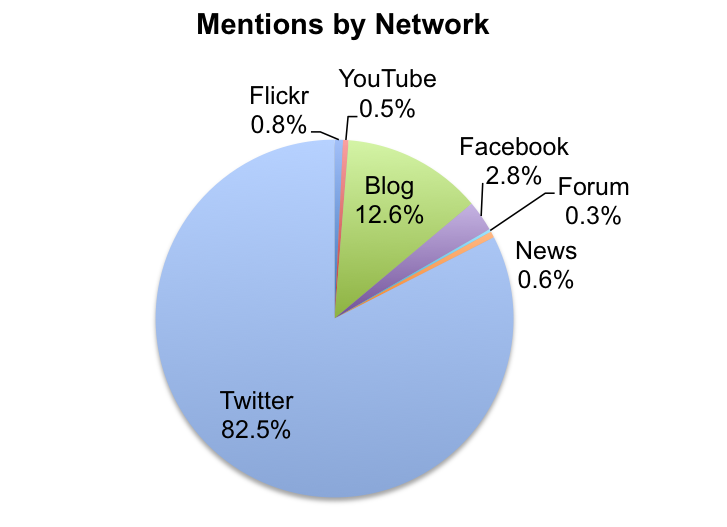
Social media marketing agency Attention has turned its attention (groan) to the U.S. protest movement known as Occupy Wall Street, aka #OccupyWallSt on Twitter. According to data revealed today, Twitter is the network of choice for sharing information related to the protests, with 82.5% of the mentions, compared with just 2.8% on Facebook, 0.5% on YouTube and 12.5% on personal blogs.

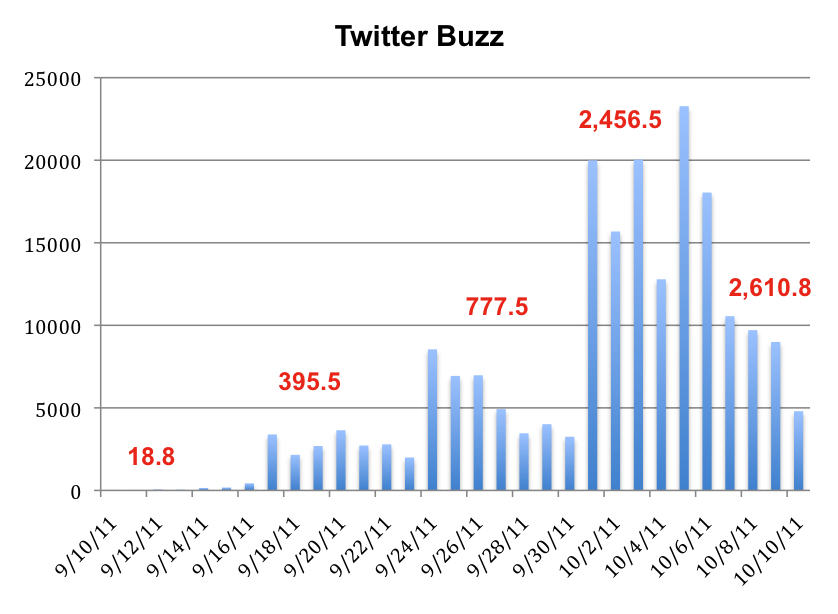
The data analysis also shows that Twitter activity increases on weekends, a unique trend that’s atypical of most Twitter-based social media patterns, the firm says.

Usually, Twitter trends peak during workdays, often mid-week, as people tweet from their desks instead of working, Attention notes. But with #OccupyWallSt, the trend is the opposite: tweets spike over weekends, indicating that people are actually using their free time to support the cause and raise awareness.

The analysts gathered data from September 10th through October 10th in their analysis. The mass arrest of protestors on the Brooklyn Bridge caused the highest spike in activity on October 1st and activity remained high through October 6th.

In tracking the average mentions per day, the firm found there were very few in the first week – just 18.8 per day. After the occupation start on 9/17, average mentions for the week went up by 2,004%. The following week saw an increase of 97% and after the Brooklyn Bridge arrests, the mentions increased again by 216%. (See below chart for details).

Since the arrests, mentions dropped (no tweeting from jail?), and last weekend didn’t show a spike in activity as per usual. That said, the movement itself rages on. (See Erick’s earlier post detailing the social media efforts surrounding the protests).

The protests themselves, a remarkable example of a disruptive force seemingly sprung directly from the ashes of our fallen economy, has become a growing movement where outraged citizens demand…well, what do they demand? That is the question. The movements’ participants each have their own reasons for joining in, whether it’s anger over unemployment and lacking job prospects, the greediness of corporate fat cats, the mistakes made by Washington leadership, the downfall of the American dream, or dozens of other complaints as indicated by their homemade placards and signs.

At least some of the group has drafted a list of actionable demands, but that news doesn’t appear to be getting as much press as does news of, oh gee, Twitter trends (yep, guilty here) or the participation by Hollywood celebs and artists like Kanye West, Russel Simmons, Lil Wayne, Hank Williams Jr., Susan Sarandon, Mark Ruffalo, Roseanne Barr, Yoko Ono, Alec Baldwin, Tim Robbins and Michael Moore (no doubt already filming his next documentary).

In case you’re wondering about the accuracy of the above data, Attention represents high-profile brands like Mattel, Verizon and Pepperidge Farm and has 125 people spread out across New York, London and L.A. In other words, a fairly reputable firm, as far as social media monitoring goes.

Girl about to tweet on her smartphone? Photo via http://occupyweb.org


Cloud Storage Platform Box.net Raises $81M From Salesforce, SAP At $600M-Plus Valuation

box-net

Cloud storage platform Box.net has raised $81 million in Series D funding from strategic investors Salesforce.com and SAP Ventures with Bessemer Venture Partners, NEA, and prior investors including Andreessen Horowitz and Draper Fisher Jurvetson Growth participating in the round. The new investment brings Box’s total capital raised to $162 million (the $50 million round we reported on a few weeks ago is part of this D round). We’ve heard from sources close to the company that the Box’s valuation was above $600 million.

Box, which has 7 million users and stores over 300 million documents, is a cloud storage platform for the enterprise that comes with collaboration, social and mobile functionality. Box has evolved into more than just a fils storage platform, and has become a full-fledged collaborative application where businesses can actually communicate about document updates, sync files remotely, and even add features from Salesforce, Google Apps, NetSuite, Yammer and others.

The company was founded in 2005 by Aaron Levie and Dylan Smith out of their dorm rooms in 2005 with the goal of making it easy for people to access and share all their content, from anywhere. Today, the company provides storage solutions for 77% of the Fortune 500. Currently, 100,000 businesses are using Box’s service with 250,000 new users joining each month. This year, Box landed its biggest enterprise deal yet (and one of the largest cloud SaaS deals ever) with 18,000 seats with P&G.

Josh Stein, managing director of Draper Fisher Jurvetson, was an early believer of Box back in 2006. He says that two things stood out then that showed that the idea born out of Levie and Smith’s dorm room had potential. First, he explains Smith and Levie had one of the best work ethics he’d seen.

He recalled that when the firm would ask Levie and Smith questions about the product and business, the two fledgling entrepreneurs at the time would respond with thoughtful several page emails at all hours of the day. And second, the quality of the early product, which at that point was aimed at the consumer as well as businesses, was intuitive, well-designed and had a valuable functionality.

So why has Box been able to scale from an idea in a dorm room to a nearly billion dollar business? Stein says that Box’s cloud storage platform is a ‘terrific product’ that meets needs for variety of industries. He says that in the past few years, Box has created a new category in enterprise products of what the company intranet could have become.

NEA partner Kittu Kolluri agrees with Stein that Box has become an extension of the intranet, but adds that Box has also become a next generation extranet, as Box allows companies to share files and communicate with clients outside of the company.

Kolluri also highlights the growing trend of the consumerization of IT. He said that NEA looked at a few other companies in the enterprise storage and collaboration space but Box had the most compelling solution that offered enterprises both security as well as ease of use.

And because of its compelling product, growing revenue and strong user base, the company has even become a pricey acquisition target, receiving acquisition offers of $500 million. Kolluri says it was a smart decision for Box to turn these acquisitions down (NEA invested after these acquisitions were rejected). And Kolluri wholeheartedly believes that Box can and will be a public company.

Stein also believes in Box’s potential strength in the public markets. “Box absolutely should be a public company,” he says and confirms that an offering is in the company’s future plans. Stein says that as an SaaS company, Box’s recurring revenue model makes it an ideal public company. Of course, raising this growth round gives Box the flexibility of when they want to enter the public markets, adds Stein.

Levie hasn’t planned on raising additional funds this year after picking up $48 million from Andreessen Horowitz and others earlier this year but because of the strong venture market, the company’s strong performance, and the growth in the cloud, an expansion round made sense.

“There’s so much change taking place in the enterprise, and we’re trying to build out go-to platform for how people use data, work, and collaborate,” Levie explains. Part of this is taking on more established enterpruse players like Microsoft. “We’re redefining how enterprises share and manage content on Box, while also building a powerful, open ecosystem of partners and developers to help our customers get more value and flexibility from their information than ever before possible.”

Part of this is creating an ecosystem around the platform. ?In November, Box plans to launch the Box Innovation Network, which will provide funding, consulting and other resources to developers building off of Box. Today, Box integrates with 120 applications, including leading cloud solutions including Salesforce, SAP StreamWork, Google Apps and NetSuite.

Box plans to use the new funding for product development, international expansion, and to further build out its infrastructure in the U.S., opening a third data center in 2012. ?

Of course, with this expansion will come challenges, says Stein. Growing fast can put strain on an organization. Box has rapidly scaled its team from 125 to nearly 300 employees in 2011 to date, including key senior hires from companies such as Cisco, EMC, Microsoft, NetSuite, and Oracle. Of course these executives has experience with high-growth companies and can help the company innovate while continuing to grow.

As far as strategic partners go, Salesforce and SAP are interesting choices. Salesforce, in particular, as a partner makes sense says Levie considering both of the company’s bets in the cloud. Box will be debuting integrations with Salesforce’s social network for the enterprise Chatter, and will continue to roll out deeper integrations in the future. And Levie says that most of Box’s customers user Salesforce as well.

“Box is helping organizations make better decisions faster by bringing new innovation to business information,” said Jai Das, managing director, SAP Ventures. “As an investor and partner, we’re excited about how Box is reinventing content management and collaboration, and look forward to working with them to make customers more productive.”

In the end, we want no more limits for businesses, says Levie. But he knows that to do this Box needs to innovate fast. “Steve Jobs reminded us of challenges of time,” he explains. “We’re trying to make the best use of our time and do a large amount of things rapidly. The ability to capitalize on this growth in the cloud is dependent on how quickly we can go to market.”

We can definitely expect more products and features coming out of Box in the next few months. And clearly, we could also see a public offering as soon as next year. 2012 should be an interesting year for the cloud storage company.

Checkout our recent video with Levie below.


Grooveshark Signs Deals With DashGo & NuGroove Records

Image (1) grooveshark.jpg for post 161910

Streaming music service Grooveshark is today announcing it has signed new licensing deals with worldwide distribution network DashGo and indie label NuGroove Records. DashGo is the larger deal, representing 115 labels, more than 4,5000 banks and over 50,000 tracks. NuGroove, meanwhile, is a small label with just over two dozen signed artists.

DashGo’s top labels include Delicious Vinyl and Time Records, and its top bands are Coconut Records and Rock Mafia. NuGroove is more jazz-focused, with acts like Michael Lington and Bob Baldwin.

Grooveshark now has a library of over 15 million songs and sees over 35 million unique visitors monthly. However, its questionably legal service has resulted in its app getting rejected by Apple and even banned by the Android Market in the past. It’s now available as an app for jailbroken iPhones and via the mobile Web at m.grooveshark.com.

Full mobile access is available for $9/month, which is an increasingly hard sell when for just a buck more you can get still large, but legal, catalogs from MOG (12M), Rdio (12M) or Rhapsody (13M), for example.

That said, Grooveshark’s fans love the selection, the app’s design and offline access the service provides via its apps and websites. And considering its issues, growing to 35 million uniques per month is rather impressive.


Company:
Grooveshark
Website:
grooveshark.com
Launch Date:
January 3, 2006
Funding:
$1M

Grooveshark is a web-based music application built for anyone on the internet to listen to music on-demand at no charge.

Users have the ability to listen to single songs from over 15 million songs, save playlists, and embed both on other websites, blogs, and social media profiles via the Grooveshark Widget. Grooveshark offers users the option to access their Grooveshark accounts remotely with mobile applications for Android, jailbroken iOS, BlackBerry, and HP Palm WebOS devices.

Grooveshark also allows artists and record…

Learn more


Topsy Launches Realtime Search Engine For Public Google+ Posts

topsy

Realtime search and analytics platform company Topsy Labs this morning announced that it has added Google+ as a source in its index.

A dedicated search engine for public Google+ posts, available here in beta, lets users search and access realtime and historical conversations occurring within the social network.

Topsy emphasizes that posts are ranked by the startup’s proprietary relevance and influence-ranking technology. You can find some screenshots below or give it a whirl right now.

Topsy’s algorithms calculate who the experts are for specific keywords, terms and links, updating influence graphs based upon the attention generated from Google+ and Twitter posts.

Says Vipul Ved Prakash, cofounder and CEO of Topsy Labs:

“We are proud to be the first search engine to provide comprehensive search over public Google+ posts. Beyond the 220 million daily tweets we are currently indexing, with the addition of Google+, we’ve extended our search technology to deeply index and rank long-form social conversations.

On Topsy, people can now search Google+ and Twitter for realtime, relevance-ranked results, and businesses can be better informed about what¹s important by using our APIs to mine the collective intelligence of posters on both Twitter and Google+.”

Headquartered in San Francisco and founded in 2006, Topsy has raised about $30 million from BlueRun Ventures, Ignition Partners, Founders Fund and Scott Banister.


Product:
Google+
Website:
plus.google.com
Company
Google

A Google project headed by Vic Gundotra and Bradley Horowitz, Google+ is designed to be the social extension of Google.

Its features focus on making online sharing easy for users.

“Circles,” think social circles, akin to Facebook’s lists

“Sandbar,” a user-unifying toolbar

“Sparks,” a search engine for sharing content between users

“Huddle,” a group messaging app that allows users to share with certain “Circles”

“Hangouts,” group video chatting designed to allow up to 10 users video chat at once

Each Google+ user can replace his…

Learn more

Company:
Topsy
Website:
topsy.com
Funding:
$29.9M

Topsy, which launched on May 26, 2009, is a real-time search engine, with a focus on social media sites like Twitter. The site’s underlying technology examines popular links as well as the influence of each person citing a link. Topsy augments traditional search engines by finding information that people are talking about.

Learn more