Apple To School The World’s Developers On iOS 5 With “Tech Talk World Tour”

Worldwide

Apple’s Worldwide Developer Conference (WWDC) is a pretty great event for developers — but, contrary to the implications of the “Worldwide” name, it’s not quite as great for folks who can’t make their way to San Francisco.

Looking to sing the word of iOS 5 to developers who just can’t justify the trip, Apple is once again setting out on what they call the “Tech Talk World Tour”. They held similar events in 2008 and 2009, with an unexplained hiatus in 2010.

Also unlike WWDC: the Tech Talks are free. You’ll need to be a registered iOS developer (and they’ll give priority to folks who already have apps in the store), but it’s otherwise on the mothership house.

The Dates

  • November 2nd: Berlin, Germany
  • November 7th: London, UK
  • November 9th: Rome, Italy
  • December 5th: Beijing, China
  • December 8th: Seoul, South Korea
  • January 9th: São Paolo, Brazil
  • January 13th: New York City, NY
  • January 18th: Seattle, Washington
  • January 23rd: Austin, Texas

Looking at the agenda, it’s clear what the focus of the talks will be: iOS 5 and iCloud. If you’ve never been to one of these events and have a serious interest in development, it’s well worth the (non-existent) entry fee. Apple brings out some of their finest engineers, and you get actual face time with the guys who know this stuff better than anyone. You can sign-up or find more info here.

Don’t expect to hear much in the way of secret new details at these events — but hey, if you do… you know who to call.


Company:
Apple
Website:
apple.com
Launch Date:
January 4, 1976
IPO:

October 21, 1980, NASDAQ:AAPL

Started by Steve Jobs, Steve Wozniak, and Ronald Wayne, Apple has expanded from computers to consumer electronics over the last 30 years, officially changing their name from Apple Computer, Inc. to Apple, Inc. in January 2007.

Among the key offerings from Apple’s product line are: Pro line laptops (MacBook Pro) and desktops (Mac Pro), consumer line laptops (MacBook) and desktops (iMac), servers (Xserve), Apple TV, the Mac OS X and Mac OS X Server operating systems, the iPod (offered with…

Learn more


Might As Well Jump

Let’s face it, cardio is a chore. Unless you’re a die-hard marathon runner, you’re probably not having any fun slaving away on the treadmill or circling the neighborhood for a few hours a week.

So when I learned out about the Bellicon Mini Trampoline, I was intrigued. Bouncing on a trampoline to work out? Heck yes. And it doesn’t have any springs: It eschews metal coils and instead uses individual super-elastic bungee cables to attach the trampoline platform to its frame.

The result is a pleasant, cushioned bounce that provides a surprising amount of air time. It’s fun, and if you actually take the time to use it regularly, you can work up a sweat and tone some muscles in the process. But if you’re expecting Jared-like weight-loss results, I’m afraid you won’t be able to ditch your gym membership just yet.

The Bellicon (which is technically called a “rebounder”) comes in three different sizes ranging from a 39- to a 49-inch diameter. Having tested the middle, the 44-inch model, I would definitely say bigger is better, as there’s not much room for error. If you get a bit over-exuberant (or just lose your balance a little), one big step and you’re off the trampoline. It’s not a big drop-off — you’re only 6 inches or so above the ground — but it’s enough that you could twist an ankle or crash into surrounding furniture if you fell off. Pro tip: Set it up away from furniture.

Bellicon teamed up with the New York studio Pilates On Fifth to produce a series of exercise videos that are available on Vimeo. Using these as a guide, you can develop a structured routine that works a variety of muscle groups in your legs and your core. If you’ve got dance or aerobics experience, you may be able to improvise your own workouts, but the online videos are a good place to start. (There’s also a workout DVD that comes with the trampoline.)

About five minutes into my first workout, my calves and glutes were already screaming for mercy — and I used to be a ballet dancer. You can also just do old standbys like walking, jogging, jumping jacks or just plain jumping, or add 3-5 lb arm weights to the mix for some upper-body action.

After a few weeks of regular use, I generally felt more energized. I didn’t lose any significant amount of weight (I didn’t really change my Mexican food- and beer-filled diet, though), but I did notice that my legs and abs in particular looked and felt stronger and more toned. My ankles also felt stronger from maintaining my balance on the supple jumping surface.

If you position the Bellicon near your desk at work or the home office, it’s a great way to burn a few calories and get an energy boost with short bouncing sessions throughout the day. And if you work out on the Bellicon Mini Trampoline for 30-plus minutes at a time, you will get a decent cardio workout. Whether that equates to weight loss or a trimmed waistline depends on the length and intensity of your sessions, and your current fitness level.

Overall, the Bellicon is a good at-home exercise option if you’re looking for something relatively low impact that won’t hog up half your living room space. Unfortunately, it doesn’t come cheap — the price is an alarming $630 for the smallest 39-inch version and a whopping $730 for the largest version. My loaner, the 44-incher, sells for $680. That’s about the same as a year’s worth of gym membership dues. Also a year’s worth of Ben & Jerry’s pints.

WIRED Easy to assemble. Super quiet. Bungee cords stretch up to three times their original length, and you can choose their strength depending on your weight and the type of exercises you plan to do most. Makes you actually look forward to working out.

TIRED Price, price, price. You can get a comparable 40-inch metal spring trampoline for an entire order of magnitude less.

Photo by Michael Lennon/Wired

Acer’s Ultrabook Aspires to Be a MacBook Air

Let’s cut to the chase here. If you’re pondering buying the Acer Aspire S3, it’s because you desperately want an Apple MacBook Air but are too freaking cheap to pony up the $1,300 (minimum) for the 13-inch model.

The Aspire S3 is a glorious knock-off of the Air — stripped down to the basics and slashed to just $900. Is a 30 percent price cut a compelling enough reason to buy it over its inspiration? That’s debatable, but it’s at least worth a look.

The tale of the tape tells the story the best: The Acer Aspire S3 is almost dead-on the same size as the Air in every dimension — just a fraction of an inch less deep (front to back) — right down to the weight, just a shade under three pounds. The design also closely mimics the Air, including the upturned-saucer-shaped lower chassis, spacious clickpad, and silvery-gray color scheme. Slap an Apple sticker over the Acer logo on the back and unless someone touches it (it’s plastic, not metal like the Air), or closely examines the profile (it’s flatter and untapered), no one will be the wiser that you went the budget route.

But the tradeoffs, they are a-plenty — a necessity to get the price down, of course. The resolution on the 13.3-inch display is lower, 1366 x 768 pixels versus 1440 x 900 on the Air. Also, the brightness of the Aspire’s display leaves much to be desired, especially if you’re not viewing the screen absolutely head-on.

Performance is another key issue. Despite the 1.6GHz Core i5 CPU and 4GB of RAM, benchmarks were just average on general apps and on par with most netbooks I see when graphics (there’s only Intel’s integrated GPU) got involved. I’m not sure what to make of the hard drive solution: There’s a 320GB standard hard drive plus a 20GB SSD (non-user-accessible) that Acer says it uses to store various system files as part of a quick-boot scheme. Acer makes a bigger deal out of this than I would; while it’s faster to wake from sleep most laptops, it’s not fast enough to be a deal-maker or -breaker.

I also didn’t love the somewhat creepy, rubbery keyboard, its white-on-gray buttons difficult to make out in low light (keyboard backlighting is also axed here), and featuring arrow keys smaller than the tip of my pinky. It doesn’t help that Page Up and Down keys are wedged in that box too, making it near impossible to use any of them to navigate efficiently. You might have better luck with the clickpad, but I found its utility to be only average compared to most others. I’d prefer discrete buttons, but the multitouch pad at least worked well enough most of the time.

The bottom line is that with this ultrabook, Acer is at least sending a message that real price competition can exist in this rarefied category of notebooks. Whether that will actually amount to a real price war is still an open question, but if nothing else, this category has at least become one worth watching now.

WIRED A rather inexpensive and decent way to play dress up and fit in and Starbucks. A nice feat of engineering at a respectable price. Fair enough battery life (four and half hours under load).

TIRED Two USB ports may mimic the MacBook Air, but it’s still not enough. Performance is average at best. Surprisingly loud and aggressive fan. Stuffed to the gills with shovelware (When’s the last time you saw an eBay icon on the desktop?).

Photos by Jim Merithew/Wired

Moog Debuts an iPad Synth From the Outer Limits

Not content to stop at creating some of the world’s best synthesizer keyboards, the big brains at Moog Music have built an iPad app.

The Animoog takes the familiar, spaced-out sound profile Moog is famous for and warps it, using the iPad’s multi-touch interface and some very cool animated visualizations to create a unique instrument. It’s simple enough for anyone to play, but also deep enough to encourage extended experimentation. On top of that accomplishment, the Animoog is just about the trippiest sound-thing available for the iPad.

The app debuts in the App Store this week for an introductory price of $1. After a short while, it will go up to $30. If you’re at all interested in making music on your iPad, you should download this and start playing with it.

Ask a musician who’s into vintage synthesizers and he’ll tell you: There’s something about a Moog synth’s analog design that’s difficult to replicate. The musical instruments company, founded by electronics pioneer Bob Moog in the 1950s, makes keyboards that sell for thousands of dollars and are used in studios and on stages by the biggest names in rock and pop. Radiohead, Rush, Air, Stevie Wonder — they’re all Moog devotees.

The Animoog not only treads upon the same sonic territory as other Moog creations — if you’ve played a Moog, the interface will feel familiar — but it also takes the aesthetic into totally new directions.

The app’s main screen is dominated by a big X-Y pad. It looks very ’70s-analog-esque, sort of like an oscilloscope. Under that is a keyboard. As you key the notes (it’s polyphonic, so you can play more than one note at a time), small, multicolored sprites begin orbiting a node on the X-Y grid. When you drag this node around the grid, the sound modulates. Adding other nodes changes the path of the blippy sprites — they begin to flit around the various nodes, hopping from orbit to orbit like electrons swooshing around the nuclei inside a molecule.

The controls on the right are classic Moog. They dictate the speed and intensity of the filter modulations, and there are delay, detune, overdrive and bitcrusher effects. There’s also a bank of preset configurations. If you stumble on something of your own creation that you really like (which happens often), you can save it as a new preset. You can adjust the keyboard, too — adjust its range, make it glide between notes like a theremin, or change the scale modes to play microtones or Middle-Eastern-sounding things.

This isn’t Moog’s first sound app — there’s also the $8 Filtatron, a miniature oscillator and sample-tweaker — but it is the company’s first attempt at building an entirely iPad-based instrument.

“The obvious thing we could have done was to emulate Moog synthesizers,” Moog Music chief engineer Cyril Lance tells me, “but we decided instead to focus on the technology of the iPad and create a new musical instrument that fully embraced the iPad’s touch interface and rich graphics.”

Lance says it was important to his team that they create something equally capable of being both static, one-dimensional and very musical, as well as multi-dimensional and really wild. Here, they’ve succeeded — setting the orbits to a very slow pulse around a single node creates very pure, bell-like tones that have a dreamy quality. Add complexities to the orbit, twist a few knobs, and you’re headed straight toward Ursa Major at full warp speed.

There are dozens of presets to play with, from percussive sounds to soothing string sounds to ominous drones. I tried dialing up some of my own creations and spent a few hours plucking out pleasant, meditative melodies. But I spent an equal amount of time serving up some deliciously flavorful facemelts with extra hot sauce.

All this space cadet talk — orbits, travel, cosmic vibrations — is a conscious part of the design, Lance says.

“The inspiration came from working with the vast soundscapes of modular synths, where the only limitation is how many arms you have to play the keys, move the knobs and patch cables,” he says. Stretching those limits required building a new language.

“The X-Y pad creates a different paradigm of traveling visually through a sonic universe with orbiting voices that live, breathe, and evolve as they’re played. Animoog also allows you to configure that universe.”

WIRED A varied instrument capable of both subtle and wild sounds. Excellent sound quality. Plenty of presets to explore. Hours of fun, even if you’re not very musical. This is what the iPad was made for. On sale for $1 — which is a steal, people — for a limited time.

TIRED Advanced features are quite complex, and you’ll need to RTFM. Keys are tiny — you can make them bigger, but that reduces the range of notes. And you thought it was tough to wrestle the iPad away from the kids before.


Timelines: Why We’re Suing Facebook (And Please Join Our Facebook Page)

timelines

You may remember that we recently broke a story about a small company called Timelines Inc, which filed a trademark infringement lawsuit against Facebook. According to the lawsuit documents, Timelines claims that Facebook’s recently announced Timeline feature could “quite possibly eliminate” its entire business.

The Chicago company operates a website called Timelines.com, which allows people to record and share personal or historic events, and contribute descriptions, links, photos and videos related to those events, people, companies, bands and whatnot. Understandably, they’re not too happy.

The lawsuit is still ongoing – although the U.S. District Court in Chicago recently rejected a temporary restraining order request from Timelines – so there isn’t all that much news to report.

Timelines, however, felt that the coverage the lawsuit has enjoyed so far has created some confusion, so now the company wants to set the record straight with an open letter.

In it, Timelines asserts that Facebook should have contacted the company before launching their Timeline feature, and subtly mocks the social networking giant for “[applying] for or [trademarking] the terms ‘Face’, ‘Wall’, and ‘Like’ as well as [suing] others for using ‘Book’ in their names”.

The company also says that it will defend its trademark ‘vigorously’.

We’ve received a copy of Timelines’ plea for support, and have pasted it here below.

Ironically, they’d like you to follow and support their case on Facebook.

Why we are suing Facebook and a request for help

Much has been written and said about our suit against Facebook for infringing upon our registered trademark “Timelines”, and we’ve heard from people who are understandably confused by the whole issue.

We’d like to let you know our reasons for doing this and ask for your help.

Why we are doing this

Our company owns a valid trademark on the term “Timelines” that is for a particular application, specifically for “providing a web site that gives users the ability to create customized web pages featuring user-defined information about historical, current and upcoming events.” We’ve spent years building this brand and using it in the above stated way on our site Timelines.com.

Facebook, a company that has applied for or trademarked the terms “Face”, “Wall”, and “Like” as well as sued others for using “Book” in their names, is using the name “Timeline” for a new product that is focused on how people express and share events and history online.

Facebook either knew (or should have known given their rigorous defense of their own intellectual property) that the US Patent and Trademark Office granted us this trademark. People at Facebook could have at least contacted us for permission to use or license the name. They did not.

We’re not trying to shut down innovation at Facebook

Let’s be clear: we aren’t against Facebook launching this new service. Our issue is that they’ve named and branded the service “Timeline”.

We are hoping that Facebook will realize that it made a mistake and that it needs to make things right. We’re very proud of the products and services we’ve built and cannot sit idly by and watch Facebook eliminate the goodwill we’ve developed.

We will vigorously defend our trademark.

How you can help

If you believe a small company has as much right as a big company to defend its intellectual property, then we are asking for your help in spreading the word about our cause:

* Please spread the word and post a link to this page on your site, blog, Facebook and Google+
* Tweet it out
* Follow this case on our Facebook page

Thank you for your support as we defend our trademark – we really appreciate it!

—The Timelines Team


Company:
Timelines
Website:
timelines.com
Funding:
$3M

Timelines, Inc. provides services that enable people and entities to discover, record and share history using the web. The company’s platform is uniquely built to chronicle events (using descriptions, photos, videos, and locations contributed by multiple users), and then enables people to relate these events to each other based on time, place or topic.

Timelines offers three services:

Timelines.com, for individuals and entities that want to reach and interact with a broad audience about publicly shared events;
Timelines…

Learn more

Company:
Facebook
Website:
facebook.com
Launch Date:
January 2, 2004
Funding:
$2.34B

Facebook is the world’s largest social network, with over 500 million users.

Facebook was founded by Mark Zuckerberg in February 2004, initially as an exclusive network for Harvard students. It was a huge hit: in 2 weeks, half of the schools in the Boston area began demanding a Facebook network. Zuckerberg immediately recruited his friends Dustin Moskowitz and Chris Hughes to help build Facebook, and within four months, Facebook added 30 more college networks.

The original idea for the term…

Learn more


Verizon Officially Unveils The World’s Thinnest Smartphone: The Motorola Droid RAZR

razr4-(1)

If you remember from a teaser video posted a few days ago, today is a big day. Verizon and Motorola have finally announced the much-anticipated Droid RAZR, the next LTE beast to grace big red’s shelves. Here at the launch event in New York City, we’re hearing four words over and over again: faster, thinner, smarter, and stronger. And that’s exactly how we’d describe the new Droid RAZR.

The latest in Motorola’s line of Android smartphones takes heavily from its Droid brethren in terms of design, looking a lot like the Droid X/X2. It has that same “hump” along the upper back edge, likely making room for the camera and other goodies, but has dropped some weight with an even thinner waist line than its Bionic cousin. It’s also stronger, as promised in that teaser video, with a Kevlar fiber casing which, Motorola promises, will “withstand the back pocket test.”

Ready for specs? Of course you are.

The Droid RAZR touts a solid 4.3-inch qHD Super AMOLED display, a 1.2GHz dual-core processor, Android 2.3 Gingerbread, 1GB of RAM, and of course, support for Verizon’s 4G LTE network. In fact, Verizon is claiming that this is its thinnest LTE-capable device to date, with a 7.1mm waist line.

That Kevlar fiber casing isn’t the only “rugged” quality on this phone — it also comes with Motorola’s new Splash Guard technology and a stainless steel core.

The new flagship also boasts an 8-megapixel rear-facing camera with dual-LED flash and autofocus (capable of video capture in 1080p). Sanjay Jha claims the phone will offer 12.5 hours of talk time and 8.9 hours of video playback. It’ll also come with Moto’s web top desktop app, if you go ahead and grab a Motorola Lap Dock. The RAZR also packs a microUSB port for charging along with HDMI out, naturally.

Motorola has included support for its MotoCast application, which streams content (whether it be pictures, movies, or music) between the PC and the smartphone. Business users will also have corporate access to email, the ability to view/edit Word documents, Citrix Receiver for remote access to desktop, along with added password enforcement.

Another awesome software feature would be the ability to sync your new MotoACTV watch with the Droid RAZR. In other words, you’ll be able to check text messages and see phone calls while you’re out jogging or hitting the gym.

Pre-orders will start on October 27, and in-store/online availability begins in “November”. The Droid RAZR will cost $299 on-contract.


Motorola is known around the world for innovation in communications and is focused on advancing the way the world connects. From broadband communications infrastructure, enterprise mobility and public safety solutions to mobile and wireline digital communication devices that provide compelling experiences, Motorola is leading the next wave of innovations that enable people, enterprises and governments to be more connected and more mobile. Motorola (NYSE: MOT) had sales of US $22 billion in 2009

Learn more

Company:
Verizon
Website:
verizon.com
IPO:

VZ

Verizon Communications Inc. delivers broadband and other wireline and wireless communication innovations to mass market, business, government and wholesale customers. Verizon Wireless operates America’s largest wireless network that serves nearly 102 million customers nationwide. Verizon’s Wireline operations include Verizon Business and Verizon Telecom, which brings customers converged communications, information and entertainment services over Verizon’s fiber-optic network.

Learn more


Motorola Challenges The iPod Nano With MotoACTV Smart Watch

motoactv

In a plot twist not many of us were expecting, Motorola took an opportunity at its NYC press event this morning (where we expect to see the Droid Spyder unveiling) to announce MotoACTV, a new smart watch.

CEO Sanjay Jha announced it has a 600MHz processor, and weighs in at just 35 grams. MotoACTV combines a GPS-enabled watch with a smart music player, which learns songs that make you work harder and plays them more often. The new watch also offers a built-in heart rate monitor (sans the chest strap), and relays every performance stat (including duration, distance, avg. pace, calories burned, and avg. heart rate) back to you through a bluetooth headphone set.

The MotoACTV watch tracks your running, walking and cycling stats outside, with treadmill and step machine stats recorded while you’re indoors. The watch also has an FM radio.

The watch also syncs with your PC, letting you access a dashboard of your performance stats at MotoACTV.com.

MotoACTV will be available nationwide on November 6, with an 8GB version going for $249.99, and a 16GB model going for $299.99.


Motorola is known around the world for innovation in communications and is focused on advancing the way the world connects. From broadband communications infrastructure, enterprise mobility and public safety solutions to mobile and wireline digital communication devices that provide compelling experiences, Motorola is leading the next wave of innovations that enable people, enterprises and governments to be more connected and more mobile. Motorola (NYSE: MOT) had sales of US $22 billion in 2009

Learn more


RIM Announces The BBX Platform, The Future Of BlackBerry

1

Mike Lazaridis, CEO of Research in Motion, “The whole company is aligning behind this single vision. It combines the best of QNX and Blackberry.” Meet BBX.

BBX is the future of RIM. Dan Dodge, president of QNX, joined Mike Lazaridis and proudly co-announced BBX. This platform incorporates enterprise, NOC and cloud services into one system that can run on smartphones, tablets and embedded systems. As Lazaridis stated, BBX is about bringing together “people, devices, content, and services.”

RIM and QNX built BBX to be secure. The platform is IEEE POSIX certified and conforms to EAL4+ and IEC 61508 Safety (SIL3) standards. The POSIX cert should allow for easy porting of Linux/Unix apps while providing a good deal of security.

HTML 5 is a big part of BBX. RIM sees the protocol as a bridge to older BB OS systems. Since BB 5 and BB 6 runs HTML 5, developers can code in HTML 5 for future and older devices.

Details are still a bit light despite the company spending a good deal of time during the DEVCOM keynote. More info will come from the Tech Keynote address at a later time.


Website:
rim.com
Launch Date:
October 18, 1984
IPO:

NASDAQ:RIMM

Research In Motion (RIM) is a Canadian designer, manufacturer and marketer of wireless devices and solutions for the worldwide mobile communications market. The company is best known as the developer of the BlackBerry smart phone.

RIM technology also enables a broad array of third party developers and manufacturers to enhance their products and services with wireless connectivity to data.

RIM was founded in 1984. Based in Waterloo, Ontario, the company has offices in North America, Europe and Asia Pacific.

Learn more


RIM Announces 1 Billion App World Downloads

Screen Shot 2011-10-18 at 12.02.57 PM

Mike Lazaridis, the belegaured co-head of RIM, took the stage at DevCon Americas to announce some strong numbers. First, RIM has just announced 1 billion App World downloads, which amounts to about 5 million downloads per day. The service is on pace to hit 2 billion this year. Mike went on to proudly state that on average, a BlackBerry app is downloaded 43% more than its iOS or Android counterpart. Part of this success is thanks to the smaller library amount but also because the BlackBerry App World is now available in 130 counties and supports 26 currencies with carrier billing in 10 countries.

The platform is still going strong with 165 million RIM smartphones in current circulation and there has been an 80% increase in BBM users this year, up to 50 million.

Lazaridis apologized for the recent outage and reiterated his promise to supply $100 in apps and services to every Blackberry user, thanking partners for their largesse. The initial statistics were fairly slim and RIM didn’t break out sales of phones vs. Playbook tablets.


Advise.me Team To Launch Its Own Startup, A Social App Called Chirpr

chirpr-logo

Advise.me, the new and rapidly expanding startup accelerator and incubator, is working on its first startup. The company is still in stealth mode, and all we know about it is that it’s a social communication service of some sort, but definitely not another social network. It will, however, use existing social networks. And given the name and the landing page (chirping? mobile? the color blue?), our guess is that the new app has something to do with Twitter.

What’s perhaps more interesting than speculating on the app itself, is looking at the team behind it and the process by which it’s being built. Although normally Advise.me will be working with companies that apply to its accelerator program, in this case, the team decided to pass some ideas around and build something on their own. I guess that’s just what happens when you get this many successful entrepreneurs to come together.

Explains Advise.me CEO Solomon Engel, this is something that makes his group different from other programs out there. “Some folks on the team will act in an advisory capacity, others will act more operational and sometimes they could act as both,” he says. “So alongside working with companies that apply to our program, we’ll occasionally build something ourselves.”

Hence, Chirpr.

Specifically, the Advise.me team members working on the Chirpr app incude Advise.me Co-Founder and CEO Engel, Chief Scientist at Proximic (and previously Founder of AltaVista and Co-Founder at Qwiki) Louis Monier, VP of Product at SimpleGeo Jeffrey Kalmikoff, GM and Head of Product at Plaxo Preston Smalley, Principal at Galpin Industries Tyler Galpin, Senior iOS Lead Developer at Apple Geppy Parziale and Senior Cocoa Architect at Apple Eva Diaz-Santana. The only non-Advise.me team member on Chirpr is CEO at Audiobox.fm Claudio Poli.

Poli will serve as a lead engineer for Chirpr, while Apple’s Parziale and Diaz-Santana have the titles of Head of iOS Engineering and iOS Engineer, respectively. Galpin is Head of Design, Monier is the Data Scientist Advisor and Kalmikoff and Smalley are Product Advisors.


Company:
Advise.me
Website:
advise.me

Advise.me’s program is offering a slightly different take on startup advising than some of the others in the space. Instead of a classroom approach, each startup receives one-on-one support from a team of 2 to 7 industry experts who have experience that’s relevant to the startup they’re paired with. That not only improves the quality of the advice the team can give, but the advisors can also help startups by connecting founders to the appropriate industry contracts.

Learn more


The Era Of Attachment Is Over: SugarSync Adds “Share By Email”

As a fan of kitten videos, I’m often embarrassed by my inability to attach said videos to emails I’m trying to send the rest of my local chapter of American Society Of Kitten Video Lovers (ASKVL). While 50MB may seem small to some (and it’s a file barely big enough to hold a kitten video let alone a video of a kitten and and a baby monkey), it’s enormous for some mail systems. In the end, I have to use Dropbox or SugarSync to share the video with my intended recipient, adding an unwanted step in my kitten video sharing experience. It’s enough to make me cry uncontrollably into my Lemon Zinger tea mug!

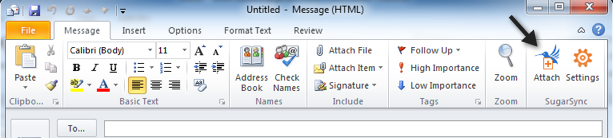
SugarSync has heard my citrus-tinged cry and now allows you to share files within email messages, adding them just as you would add a regular attachment. However, once you add them, SugarSync takes over and adds a link directly to the attachment instead of embedding and sending the entire file. From the PR:

SugarSync, the Cloud storage, sync and share company, today introduced SugarSync for Outlook, the easiest way for both individuals and businesses to share large files using the Cloud from within an email. With SugarSync for Outlook, users can easily:
Share files via links from within an email, eliminating large attachments and saving email storage space
Generate and share links to files from remote computers that are synced to SugarSync
Backup all shared files to SugarSync from within Outlook
Easily track the number of times a file you’ve shared is downloaded, and control shared files with the ability to disable SugarSync links anytime
Rely on SugarSync to automatically share all files via links every time you try to send an attachment, or just when the files are too big

The plugin will upload your attached files to the SugarSync cloud and allows you to track the files and shut the links down as necessary. The system works with Outlooks 2007 and 2010 for Windows and it’s a free download. You can check it out on the SugarSync site. Most important, however, your Kitten Lover’s Saturday Morning Wine And Hugs Group will love you for it. I know mine will.


Archos 80 G9 Tablet Review: Fun But Ugly

Archos 80 G9

Short Version: The Archos 80 G9 tablet isn’t necessarily something I’d recommend for the hardcore tablet enthusiast, but it certainly gets the job done. Powered by pure Android 3.2 Honeycomb, the tab offers everything you’d expect out of Android and a nice variety of ports, albeit with a somewhat rough build-quality.

Features:

  • 8-inch 1024×768 capacitive touchscreen
  • 8GB, 16GB and 250GB (hard drive) storage options
  • Android 3.2 Honeycomb
  • 1GHz dual-core processor
  • Front-facing web cam for 720p video chat

Pros:

  • Stock Android install works fine
  • Battery life exceeded the amount advertised, which is unheard of/lovely
  • HD 1080p video via HDMI-out was an unexpected treat

Cons:

  • Really poor build quality
  • To put it nicely, it’s not the most gorgeous tablet I’ve seen
  • Wi-Fi only, yet it teases you with a slot for a 3G dongle which will only work in Europe

Long Version:

Body

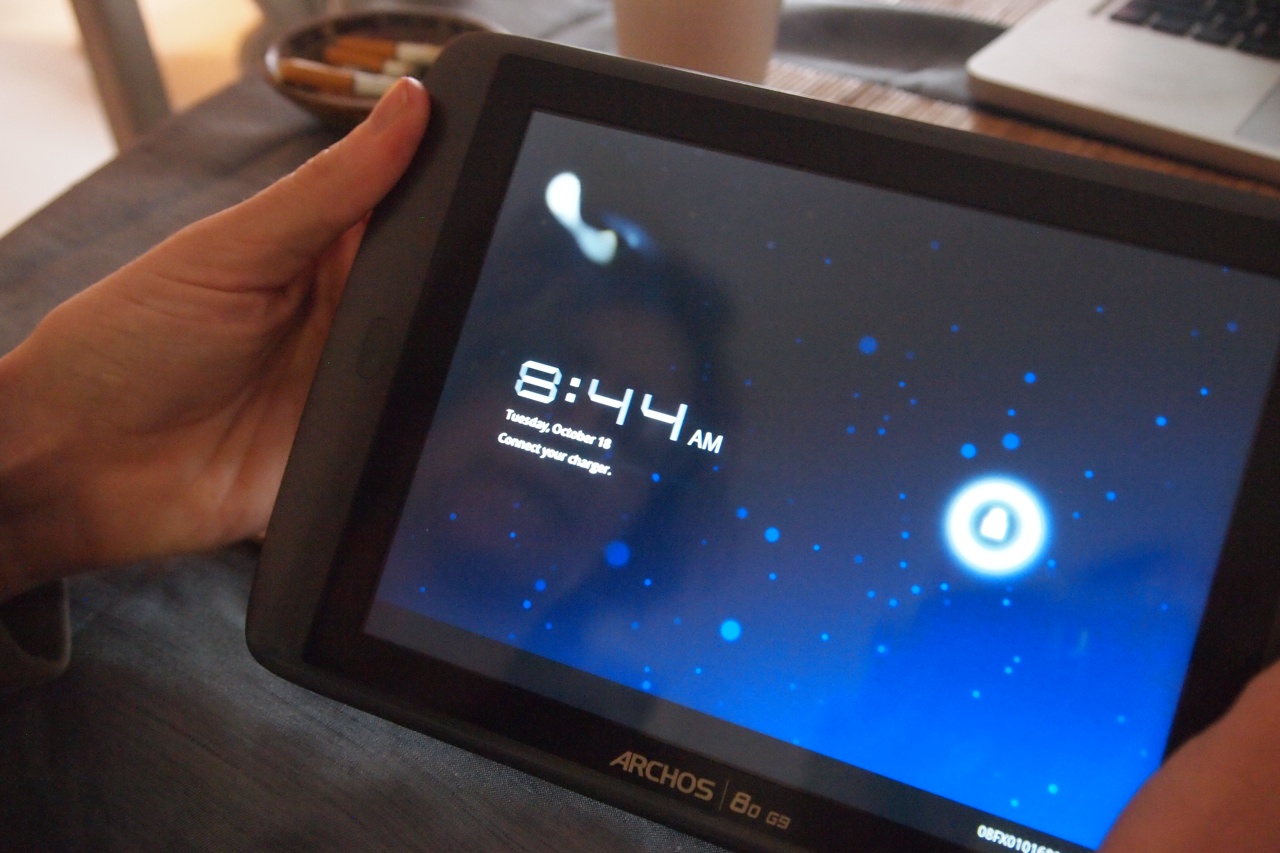
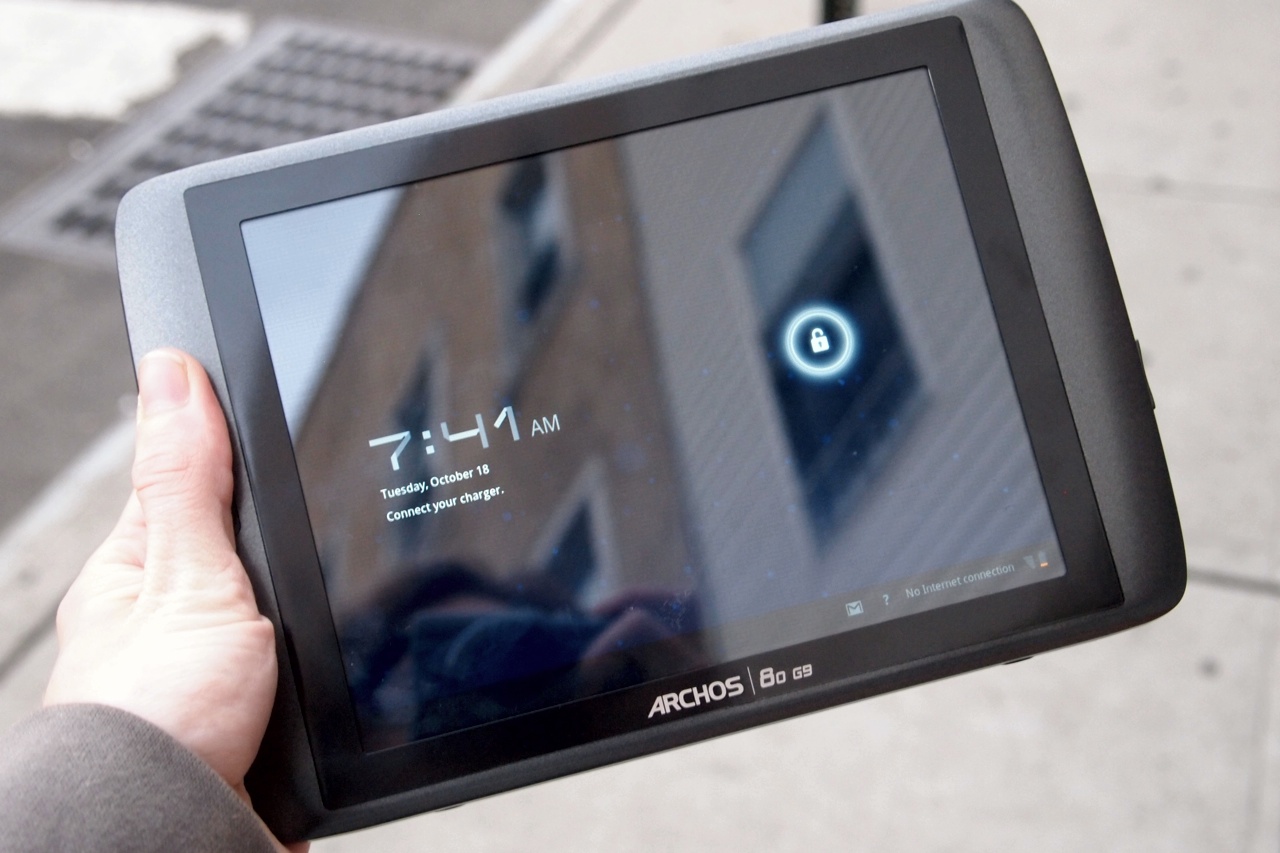
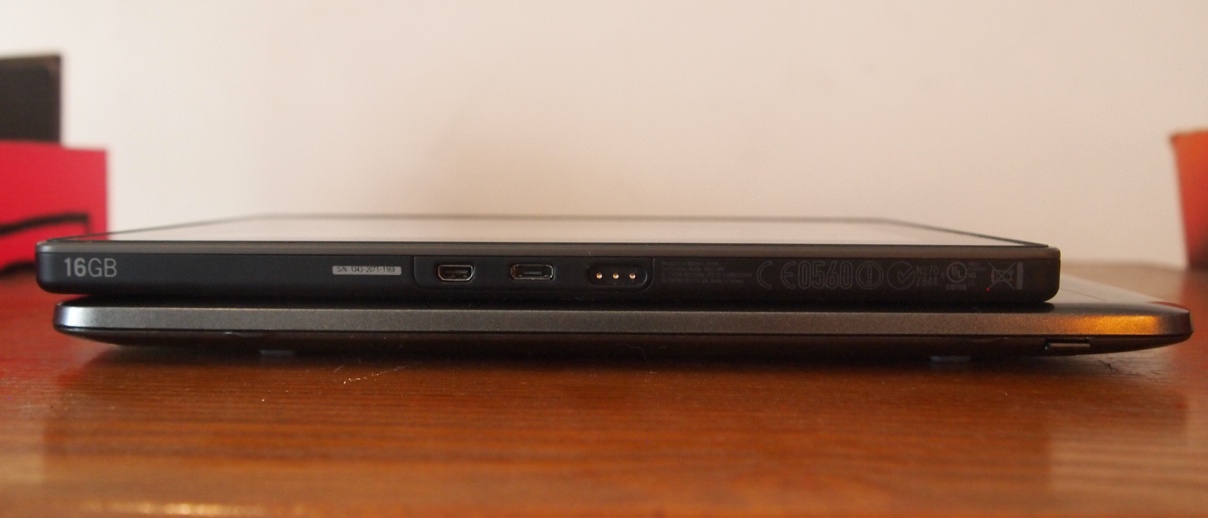
While it’s not exactly fitting with my tastes, I wouldn’t say the Archos G9 is ugly. The slate deviates from your more minimalist designs like the iPad and the Galaxy Tab, and instead adds a little flare. The G9 sports a dark grey bezel, along with a lighter grey plastic casing that has rounded edges. Along the side you’ll find a microUSB port for charging, HDMI out, and the lock button. There’s also a full-sized USB port that’s meant to hold a 3G dongle, but unfortunately that’ll only work in Europe. To those of us in the States, it’ll merely act as a full-sized USB slot.

The build of the Archos 80 G9 tablet is probably what I have the most beef with. Granted, it comes with a totally sturdy little kickstand, which is a useful addition, but on the whole you can tell that is isn’t a top-quality build. If you press just slightly against the smooth plastic back panel, either on the 3G USB port or the kickstand area, the plastic depresses and makes a bit of a cracking noise. Worse, the plastic depresses enough to affect the display, making it look like you’ve been pressing way too hard on the touchscreen.

In terms of size, the G9 is just right. I’ve played around with plenty of 10- and 7-inch tabs, but the 8-inch segment seems to be somewhat untouched. I found that its a great size for gaming, as you aren’t sacrificing too much screen real estate for a better grip.

Processor/Battery

The processing power on this little guy had me impressed. Android 3.2 Honeycomb ran like a dream powered by the G9′s dual-core OMAP 4 SoC chip. Even with a little stress test — me zipping my finger across the interface/web pages as fast as possible — the tab had no trouble keeping up. However, once I had a few things going at once (a few apps, a movie, and the browser), the processor certainly lost pace. I started to feel the lag when I tried to add a few more tasks to the list and the next app I launched abruptly crashed.

Battery life, on the other hand, was a pleasant surprise. Archos promises 7 hours of video playback, which the G9 stood up to brilliantly. I spent an entire day conducting work from the G9 last week, and though it wasn’t the most efficiently I’ve ever worked, the G9 stuck with me throughout the day. It’s worth noting, however, that the tablet gets slower and slower as battery life decreases. With a full charge, hitting the lock button wakes the G9 up almost immediately. Once battery life gets low, it takes a few seconds to wake up and perceive gestures.

Display

The 1024×768 LCD display on the G9 was better than expected, showing very minimal differentiation from pixel to pixel. This becomes most clear while watching HD movies, which I did plenty of. Even better, this is the kind of tablet that many people can enjoy viewing content on at once. Even at a 45 degree angle off to the side, the screen still displays great quality and color. Thanks to the kickstand, I guestimate you can have up to five or six people watching a movie at once. However, the screen becomes increasingly difficult to see from lower or higher angles.

Taking it outdoors isn’t necessarily ideal, but with screen brightness turned all the way up I was still able to use it as an e-reader. Viewing video and pictures was more difficult, though.

Sound

Audio, on the other hand, may make it difficult for you and your friends to enjoy the movie. Before I turned on my air conditioner, my roommates and I were comfortably watching a few music videos. After the AC went on, we had to turn the volume all the way up to the max just to hear it. In the same vein, audio sounded a bit fuzzy, especially when pushed to the max. As far as tablets go, audio quality was adequate but nothing to get excited about.

Camera

Unfortunately, the G9′s front-facing web cam was not all that pleasurable to use. At first, it didn’t work at all until I downloaded a firmware update. Ever since it’s worked, but been super buggy. At times, the viewfinder simply goes black. If you happen to take a picture during the “black periods,” the picture is also a large rectangle of black. When it does work it’s unsurprisingly grainy, but at least gets the job done where it counts: video chat.

Conclusion

At just under $300, the Archos G9 is a fine slate. It comes packed with all the essentials, and has a battery life that should last around as long as you do. But if you’re looking for a high-quality tablet, this probably isn’t it. I’d recommend it as a Christmas gift for a tween, or perhaps a mobile computing device for someone older (who does mostly simple tasks like browsing the web and answering email). Size-wise it’s a great fit for someone who enjoys gaming, and it’s certainly light enough to travel with you.

This is not a tech geek’s tablet, and if high-quality is what you’re expecting out of it, you’ll be sorely disappointed.

Configuration options:

  • Archos 80 G9 8GB: $299.99
  • Archos 80 G9 16GB Turbo (processor boost to 1.2GHz): $319.99
  • Archos 80 G9 250GB Turbo: $369.99
  • Archos 101 G9 8GB: $369.99
  • Archos 101 G9 16GB Turbo: $399.99
  • Archos 101 G9 250GB Turbo: $449.99


Clear Channel And LivingSocial Team Up To Bring Daily Deals To Radio

livingsocial

Media company Clear Channel Radio and daily deals service LivingSocial are today announcing an agreement that names LivingSocial as the sole daily deal provider for over 500 Clear Channel-owned radio stations across 90 cities in the U.S. The agreement marks LivingSocial’s expansion from an online and mobile platform to one that now serves listeners, specifically the 80 million listeners per week that Clear Channel can provide.

Throughout the day, local radio station personalities and DJ’s will describe the current LivingSocial deal to their audience, based on the market the station serves. The deal will also be posted to Clear Channel Radio station websites.

In addition, the companies state that other LivingSocial offerings, including LivingSocial Escapes and Adventures (its travel and events arms, respectively), will be featured across other Clear Channel platforms. LivingSocial also offers family friendly activities via LivingSocial Families and time-limited LivingSocial Instant Deals. These too, will likely be spread via Clear Channel’s support, although there were no specifics as to where or how the various deals would be promoted.

LivingSocial now has over 46 million members in over 603 daily deal markets. Clear Channel Radio, meanwhile, serves 237 million monthly listeners in 150 cities through 850 owned radio stations. Clear Channel content can be heard on virtually any platform, including AM/FM, HD digital radio, Sirius/XM and even online via its new venture iHeartRadio.com, a streaming radio service. iHeartRadio is also available in app format for iPad, iPhone, Android, Windows Phone and BlackBerry.


Company:
LivingSocial
Website:
livingsocial.com
Launch Date:
October 18, 2011
Funding:
$632M

LivingSocial is the social commerce leader behind LivingSocial Deals, a group buying program that invites people and their friends to save up to 90 percent each day at their favorite restaurants, spas, sporting events, hotels and other local attractions in major cities.

LivingSocial has an extensive user base of more than 85 million, and is headquartered in Washington, D.C.

Learn more


Verizon Officially Unveils The World’s Thinnest Smartphone: The Motorola Droid RAZR

droidrazr

If you remember from a teaser video posted a few days ago, today is a big day. Verizon and Motorola have finally announced the much-anticipated Droid RAZR, the next LTE beast to grace big red’s shelves. Here at the launch event in New York City, we’re hearing four words over and over again: faster, thinner, smarter, and stronger. And that’s exactly how we’d describe the new Droid RAZR.

The latest in Motorola’s line of Android smartphones takes heavily from its Droid brethren in terms of design, looking a lot like the Droid X/X2. It has that same “hump” along the upper back edge, likely making room for the camera and other goodies, but has dropped some weight with an even thinner waist line than its Bionic cousin. It’s also stronger, as promised in that teaser video, with a Kevlar fiber casing which, Motorola promises, will “withstand the back pocket test.”

Ready for specs? Of course you are.

The Droid RAZR touts a solid 4.3-inch qHD Super AMOLED display, a 1.2GHz dual-core processor, Android 2.3 Gingerbread, 1GB of RAM, and of course, support for Verizon’s 4G LTE network. In fact, Verizon is claiming that this is its thinnest LTE-capable device to date, with a 7.1mm waist line.

The new flagship also boasts an 8-megapixel rear-facing camera with dual-LED flash and autofocus (capable of video capture and playback in 1080p). Sanjay Jha claims the phone will offer 12.5 hours of talk time and 8.9 hours of video playback. It’ll also come with Moto’s web top desktop app, if you go ahead and grab a Motorola Lap Dock. The RAZR also packs a microUSB port for charging along with HDMI out, naturally.


Motorola is known around the world for innovation in communications and is focused on advancing the way the world connects. From broadband communications infrastructure, enterprise mobility and public safety solutions to mobile and wireline digital communication devices that provide compelling experiences, Motorola is leading the next wave of innovations that enable people, enterprises and governments to be more connected and more mobile. Motorola (NYSE: MOT) had sales of US $22 billion in 2009

Learn more

Company:
Verizon
Website:
verizon.com
IPO:

VZ

Verizon Communications Inc. delivers broadband and other wireline and wireless communication innovations to mass market, business, government and wholesale customers. Verizon Wireless operates America’s largest wireless network that serves nearly 102 million customers nationwide. Verizon’s Wireline operations include Verizon Business and Verizon Telecom, which brings customers converged communications, information and entertainment services over Verizon’s fiber-optic network.

Learn more


Actroid-F: Japan’s Super-Realistic Humanoid Gets A Brother (Video)

Picture 1

Do you remember Actroid-F, the super-realistic humanoid that we’ve shown you last year? Her makers, robot venture Kokoro and Japan’s National Institute of Advanced Industrial Science and Technology (AIST), have apparently been working hard since then to create a “brother” for her.

According to AIST, people kept asking the institute why it only manufactured a female robot, and they not only did that, but also built cameras into the new robot’s eyes to make him look at people (or other robots) while communicating.

Here’s a video showing the male humanoid interacting with his sister (in English, shot by Diginfo TV):