Zingaya Secures $1.15m To Take On Russian Click-to-call Market

92202v2-max-250x250

Zingaya, a Russian VOIP startup HQ-in London has raised $1.15 million in a Series A funding. Investors include Esther Dyson and Russian private investors. . I one “Untitled Venture Capital Company”. I kid not. Zingaya, founded in 2009 by the three young Russian geeks who previously developed flap hone, a web-based VOIP app, is effectively a click-to-call service aimed at support calls for e-commerce sites. They are by no means the only player in this market but are getting traction with customer at a reasonable click with over 100 paying customers including the largest Russian payment system – Qiwi, and major Russian airline S7 Airlines.


LG’s Dual-Screen DoublePlay Smartphone Lands At T-Mobile For $99 On-Contract

LG-DoublePlay

If you are of the opinion that two screens are better than one, I come bearing good news. LG’s new DoublePlay smartphone has today been made available at T-Mobile.

We first got a peek at the device back in June, though we were pretty uncertain on details at that point. Then a leaked T-Mo roadmap shed some light, which leads us to today’s official launch. The LG DoublePlay’s claim to fame are its dual screens — one 3.5-inch primary screen, with a 2-inch secondary screen landing square in the middle of its split QWERTY keyboard.

The screens can work in tandem on a single task, or can be used separately to, say, update your Facebook and send a text at the same time. The DoublePlay touts a 1GHz Snapdragon processor and runs Android 2.3 Gingerbread. You’ll find a 5-megapixel camera on the back, equipped with LED flash, auto focus, and the ability to capture 720p video. Unfortunately, there’s no front-facing cam for the DoublePlay, so hopefully multi-tasking is more important to potential buyers than video chat.

LG understands that not everyone enjoys QWERTY keyboards, and has preloaded the Swype application along with T-Mobile’s Group Text and Cloud Text services.

We originally thought the DoublePlay would go for $149 on-contract (courtesy of that leaked roadmap), but it would seem that the phone gods are in a good mood today. The LG DoublePlay will retail for $99 on a new two-year contract, and is ready to be picked up at a T-Mobile store today.


Company:
T-Mobile
Website:
t-mobile.com
IPO:

DT

T-Mobile is a mobile telephone operator headquartered in Bonn, Germany. It is a subsidiary of Deutsche Telekom. T-Mobile has 101 million subscribers making it the worlds sixth largest mobile phone service provider globally.

Learn more

Company:
LG
Website:
lg.com
Launch Date:
October 26, 2011

The LG Group is South Korea’s third largest conglomerate that produces electronics, chemicals, and telecommunications products and operates subsidiaries like LG Electronics, LG Telecom, Zenith Electronics and LG Chem in over 80 countries.

Learn more


Social Gaming Network PapayaMobile Coming To iOS

papayamobile-ios-android

The popular social gaming network for Android, PapayaMobile, is announcing today that it’s now expanding its gaming platform to iOS. The company is making its social development toolkits available to iOS developers as a beta release, allowing them to connect users on both platforms (iOS and Android) for in-game features including challenges, game invites, leaderboards and more.

In addition, developers who have built their social games using Papaya’s Social Game Engine can now export both iOS and Android versions of their game from a single code base, the company says.

To kick off the iOS support, several third-party game developers will bring their new games to the Papaya network in the coming weeks as iOS releases. The current list of expected games includes X-City by Aidi Game, Contagion by 2Clams and Burger Joint by Arctic Empire. All developers will also have access to PapayaMobile’s recently launched Gateway to China program, which localizes, distributes and promotes Western games in the Chinese market.

Earlier this summer, Papaya announced it had reached 25 million users – 940% growth since the beginning of last year. The growth was attributed to the ever-increasing size of the Android market. Now, the company says it has over 30 million users. And all this before it hits the iPhone.

PapayaMobile raised $18 million in a Series B round led by Chinese venture firm Keytone Ventures and DCM this April, bringing Papaya’s total funding to $22 million. Last week, the company announced, too, that it will be one of the first startups to receive an investment from DCM’s A-Fund.

The $100 million Asian A-Fund is intended to support early-stage startups focused on Android. DCM partnered with gaming giant Tencent, Japan’s largest mobile gaming social network GREE and Japan’s second largest mobile operator KDDI, to fund the startups, each which will receive anywhere from $250,000 to $5 million.


Company:
PapayaMobile
Website:
papayamobile.com
Launch Date:
October 26, 2011
Funding:
$22M

PapayaMobile is Android’s leading social gaming network, offering a full suite of social gaming features, Android’s most diverse set of monetization tools, and the fastest 2D OpenGL engine. Our products allow developers to maximize the return on investment of their games, while virally marketing to the 10 million active Papayans to instantly increase user acquisition. All of PapayaMobile’s SDKs and Game Engine products are open and free to use, serving as a one-stop-shop for all game developer…

Learn more


Justin.TV Brings Live-Streamed Video Gaming Portal TwitchTV To The iPhone

twitc

In June Justin.tv launched one of its first verticals, TwitchTV, a live-streamed video game portal and community for gamers. The platform has since taken off in terms of usage, and today, TwitchTV is expanding to the iPhone.

For background, TwitchTV features competitions of a variety of games and platforms with top gamers, tournaments and commentary. The platform aims to be a one-stop-shop for live video for ‘eSports,’ which Justin.tv says is synonymous with competitive video gaming. TwitchTV features live video game battles and commentary from titles like Halo:Reach, Starcraft II, World Of Warcraft, Call Of Duty: Black Ops and others.

With the new free iOS app, you can watch all of the content on the site. Users can watch videos in High Definition in full landscape mode; and browse by game, featured and more. You can also follow your favorite channels directly from the video stream, and see a list of the channels you follow that are broadcasting live. Plus, you can chat with your friends on the video stream via in-app chat.

Considering the success of TwitchTV on web platforms, it should be interesting to see if the gaming site can build a base of users on mobile.


Company:
Justin.TV
Website:
justin.tv
Launch Date:
January 10, 2006

Founded in October 2006, Justin.tv is the largest online community for people to broadcast, watch and interact around live video. Using only a laptop, you can share your event, class, party or thoughts, live, to anyone in over 250 countries while they chat in real-time with you and with other viewers. With more than 41 million unique visitors per month and 428,000 channels broadcasting live video, Justin.tv is the leading live video site on the Web, enabling users to…

Learn more


Hitpost’s Sports+ iPad App Allows Fans To Follow Crowd-Powered Sports Coverage

sports

Sports+ (formerly Hitpost) has launched a new iPad app for sports fans that features socially-powered feeds for every league, team and player you care to follow. These feeds include latest news, crowd-generated stories, and polls.

Hitpost’s apps allow you to follow your teams, players and leagues to get a comprehensive view into photos, Tweets, user-uploaded reports and news coming out of an organization. Currently Sports+ has 250,000 mobile users on its iPhone and Android apps.

The iPad app’s Feeds are updated 24-7 by these users, and the feed also includes crowd-curated news and blog posts from sports writers, and tweets from professional athletes. The iPhone and Android apps also allow users to make and share their own sports poll using a live professional sideline photo.

Sports+’s apps have seen a high rate of growth recently. The app’s usage grew 300% last month, and 2 out of 3 new mobile users use the app again the next day. Hitpost is backed by a number of high-profile angels and investors including Keith Rabois, Shervin Pishevar, Naval Ravikant, Khosla Ventures and RRE Ventures.


Steve Jobs: “I Admire Mark Zuckerberg For Not Selling Out”

Steve Jobs 60 Minutes

The 60 Minutes interview with Steve Jobs biographer Walter Isaacson is up on the web, but one of the most interesting parts is an outtake that didn’t make it into the televised segment.  In it, we hear Steve Jobs talking about his rivals directly from some of Isaacson’s taped interviews.  While Jobs was withering in his assessment of Google and Microsoft, he expressed respect for Facebook and founder Mark Zuckerberg.

“We talk about social networks in the plural,” Jobs told Isaacson, “but I don’t see anybody other than Facebook out there. Just Facebook, They are dominating this.  I admire Mark Zuckerberg . . . for not selling out, for wanting to make a company.  I admire that a lot.”

He doesn’t have such nice things to say about Google or Microsoft.  He was angry at Google for what he saw as its attempt to copy the iPhone with Android.  But when Larry Page became CEO Jobs agreed to meet with him to give him some advice: Don’t be like Microsoft with products all over the map, focus.  And don’t try to be too nice as a CEO.

Jobs’ relationship with Bill Gates goes back the furthest and is the most complicated.  But the two pioneers of the PC era met one last time near the end of Jobs’ life and talked for several hours.  Gates told Jobs that he proved his model—of controlling computer products from end to end—works.  And Jobs said that Microsoft’s model of licensing out the OS to other manufacturers worked as well.

Only later did Gates relate to Isaacson: “What I didn’t tell Steve is that it only works when you have a Steve Jobs.”  When Isaacson asked Jobs if he really thought the Microsoft model works, Jobs replied: “Yeah, it works, but only if you don’t mind making crappy products.”


Person:
Steve Jobs
Website:
Companies:
Pixar, NeXT, Apple

Steve Jobs was the co-founder and CEO of Apple and formerly Pixar.

Steve Jobs was born in San Francisco, California to Joanne Simpson and a Syrian father. Paul and Clara Jobs of Mountain View, California then adopted him. In 1972, Jobs graduated from Homestead High School in Cupertino, California and enrolled in Reed College in Portland, Oregon. One semester later, he had dropped out, later taking up the study of philosophy and foreign cultures.

Steve Jobs had a deep-seated interest in…

Learn more

Person:
Mark Zuckerberg
Website:
Companies:
Facebook

Mark Zuckerberg is the founder and CEO of Facebook, which he started in his college dorm room in 2004 with roomates Dustin Moskovitz and Chris Hughes.

Zuckerberg is responsible for setting the overall direction and product strategy for Facebook. He leads the design of Facebook’s service and development of its core technology and infrastructure.

Earlier in life, Zuckerberg developed a music recommendation system called Synapse and a peer-to-peer client called Wirehog. However, he abandoned both to pursue new projects.

Zuckerberg…

Learn more


GoPro Releases The HD Hero2 Action Camera, All-New Imaging In The Same Rugged Housing

GoPro HD Hero2 with handlebar mount

GoPro is ready to take action cameras to a whole new level. Again. The Half Moon Bay-based company just released the HD Hero2 Professional, a major refresh over the original (and much loved) HD Hero. Chief among the updates is a new video sensor that has twice the performance as the original including better low light capture. This new sensor is paired with a different lens that not only improves the overall clarity, but also features a 170 degree field of view rather than the 127 found in the older HD Hero. Yep, your extreme tomfoolery will look that much more awesome.


The HD Hero2 looks very similar to the original. It’s the same square form factor, which allows it to fit into the existing housings. However, GoPro improved the user experience markedly. A bonifide user interface now occupies the tiny LCD rather than a cryptic single character menu system (the original is horrible). Plus, the camera now has LED status lights on four sides rather than just the front.

The big improvement involves the internal systems. The new sensor and processor allows for incredible burst modes: 10 photos per second or one every .5 seconds. The faster sensor allows for 960p at 48 frames per second, 720p at 60 fps or WVGA at 120 fps. Plus, the sensor is capable of still photos at 11 megapixels, a huge upgrade from the 5MP sensor in the HD Hero. The new model also has an mini-HDMI port, and 3.5mm external stereo mic input along with a 3.5mm composite video port. Like the HD Hero, the HD Hero2 is also compatible with the BacPac add-ons including the upcoming WiFi BacPac that will add remote management through a small wireless remote and a smartphone.

GoPro dispatched the $299 HD Hero2 to Best Buy last week should the should be hitting your local store within the week. The model is also available on GoPro.com.

My buddy Dan strapped on the new HD Hero2 and braved a cold northern Michigan afternoon at Hartwick Pines State Park to capture the sample footage above. True to GoPro’s word, the new model’s video quality is definitely an improvement but the updated user interface is even more appreciated. The UI on the orignal is so obscure that I constantly have to refere to the instructional booklet. Plus, the multiple recording status lights allows users to see the recording status without sticking their head in front of the lens (all my videos started with a pic of my face looking oddly into the camera). There simply isn’t a more versatile and capable extreme recording system than the $299 GoPro HD Hero2.


Company:
GoPro
Website:
gopro.com
Launch Date:
October 24, 2011

GoPro is the world’s leading activity image capture company.

GoPro produces the HD HERO® line of wearable and gear-mountable cameras and accessories, making it easy for people to capture and share their lives’ most exciting moments in high definition. GoPro’s products are sold through specialty retailers in more than 50 countries and online at http://www.gopro.com.

Learn more


Steve Jobs Bio Now Available On The Kindle And In iBooks

Screen Shot 2011-10-23 at 8.01.52 PM

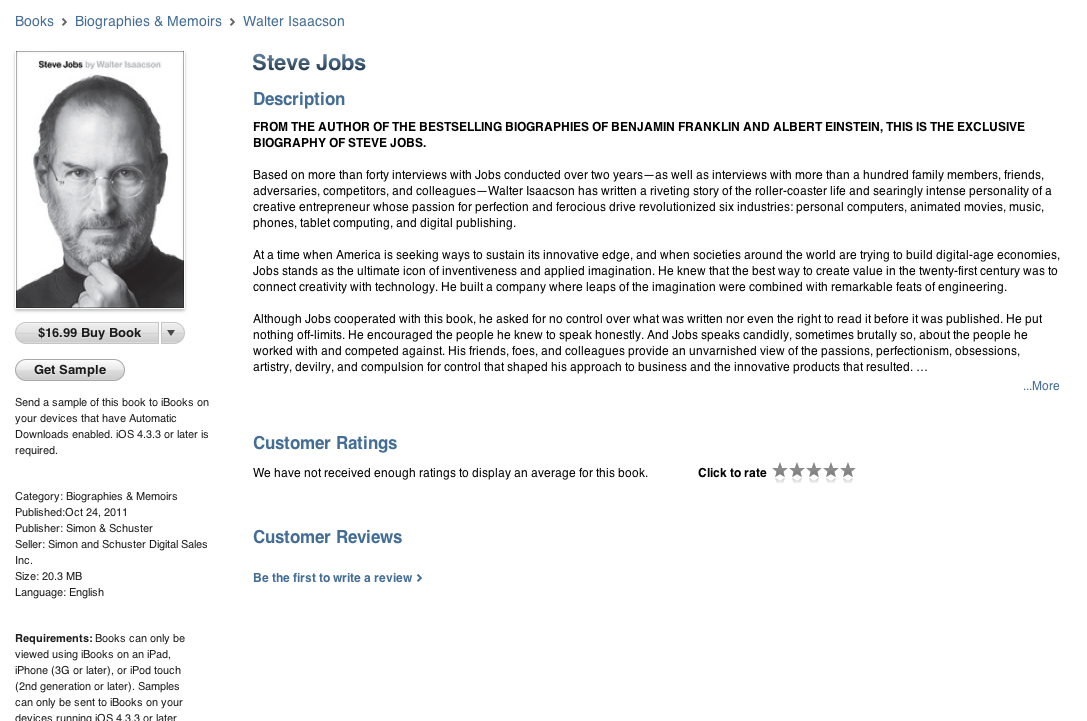
As if this whole “Steve Jobs” biography thing couldn’t get more drawn out and dramatic, users — including Jeff Jarvis and Jason Kottke – are reporting early deliveries of Walter Isaacson’s highly anticipated book, oddly enough through pre-orders on the Amazon Kindle. This leaves Apple fans with quite a conundrum; Watch the “60 Minutes” Issaacon interview now or read his book first?

Before you get too Amazon trigger happy, I just tried to order one via Kindle and it has not yet shown up — so maybe it’s first come first served?

Update: My copy on the Kindle just arrived, 15 minutes after I ordered it. And, as is fitting, the book — including a free sample — is now available for the iPhone and iPad in iBooks, with zero wait.

The analog version of the 656 page book should be officially available in bookstores across the US tomorrow.

Image via/ Johnnie Manzari


Company:
Apple
Website:
apple.com
Launch Date:
January 4, 1976
IPO:

October 24, 1980, NASDAQ:AAPL

Started by Steve Jobs, Steve Wozniak, and Ronald Wayne, Apple has expanded from computers to consumer electronics over the last 30 years, officially changing their name from Apple Computer, Inc. to Apple, Inc. in January 2007.

Among the key offerings from Apple’s product line are: Pro line laptops (MacBook Pro) and desktops (Mac Pro), consumer line laptops (MacBook) and desktops (iMac), servers (Xserve), Apple TV, the Mac OS X and Mac OS X Server operating systems, the iPod (offered with…

Learn more

Person:
Steve Jobs
Website:
Companies:
Pixar, NeXT, Apple

Steve Jobs was the co-founder and CEO of Apple and formerly Pixar.

Steve Jobs was born in San Francisco, California to Joanne Simpson and a Syrian father. Paul and Clara Jobs of Mountain View, California then adopted him. In 1972, Jobs graduated from Homestead High School in Cupertino, California and enrolled in Reed College in Portland, Oregon. One semester later, he had dropped out, later taking up the study of philosophy and foreign cultures.

Steve Jobs had a deep-seated interest in…

Learn more


Kleiner Perkins Leads $20M Round In Chinese Digital Ad Measurement Company Moment Systems

moment-1

Moment Systems, China-based digital marketing measurement company, has raised $20 million in funding led by Kleiner Perkins Caufield & Byers with China Broadband Capital, Redpoint Ventures and WPP Digital participating in the round. Kleiner partner Wei Zhou will join Moment Systems’ board.

Founded in 2006, Moment Systems specializes in the measurement and optimization of digital advertising through reach/frequency, demographics and more. Advertisers, agencies and online media companies use Moment Systems to track reach, frequency and demographics of a target audience, evaluate return on investment, optimize investment and improve advertisement impact.

Moment Systems clients include P&G, Microsoft, KFC, L’Oreal, Volkswagen, IBM and others. As of 2010, Moment Systems had a database of around 250 million Chinese internet users.


Apple Remembers: Video of ‘Celebrating Steve’ Memorial Now Available To The Public

sjshot

Last week Apple held a special event at its Cupertino campus for employees to come together and remember Steve Jobs, who passed away on October 5. The event was closed to the public, but Apple has just posted an 80 minute recording online. You can find it here.

It’s sad, but it’s very much worth watching.

The event, called Celebrating Steve, was attended by many thousands of Apple employees — both at Apple’s campus, and worldwide. Every retail store around the world closed its doors to the public for the duration of the event as the employees inside watched a live feed.

The video includes talks from many of Apple’s most prominent figures (and Jobs’s closest friends), including CEO Tim Cook, board members Al Gore and Bill Campbell, and the company’s SVP of industrial design, Jonathan Ive. The event also includes performances by Norah Jones, Coldplay, and Randy Newman.

One thing to note: the video plays in Safari for me, but in Chrome I see a message that it will be available soon (in other words, use Safari).


Company:
Apple
Website:
apple.com
Launch Date:
January 4, 1976
IPO:

October 24, 1980, NASDAQ:AAPL

Started by Steve Jobs, Steve Wozniak, and Ronald Wayne, Apple has expanded from computers to consumer electronics over the last 30 years, officially changing their name from Apple Computer, Inc. to Apple, Inc. in January 2007.

Among the key offerings from Apple’s product line are: Pro line laptops (MacBook Pro) and desktops (Mac Pro), consumer line laptops (MacBook) and desktops (iMac), servers (Xserve), Apple TV, the Mac OS X and Mac OS X Server operating systems, the iPod (offered with…

Learn more


Super-Powered Launch App Quicksilver Adds Support For OS X Lion

quicksilverlogo

If you’re on a Mac and haven’t expanded your horizons beyond Spotlight, you owe it to yourself to check out Quicksilver, a free, open sourced launchbar app that can prove very handy once you’ve gotten over the learning curve. The app has just been updated with a slew of new features including automatic Plugin updates (see their blog for a full rundown), and has also been optimized for Mac OS X Lion.

Quicksilver has an interesting history. The app was originally developed by Blacktree Software, which ceased active development several years ago — but not before open-sourcing their code. Since then it’s seen periodic updates, but they’ve been few and far between, to the point that some longtime fans gave up and looked elsewhere. But in the last six months the app has seen a resurgence of sorts, as updates and blog updates from the team at QSApp have been much more frequent. The site’s tagline? “Quicksilver Lives”.

Of course, Quicksilver isn’t the only game in town when it comes to super-powered launch apps — alternatives include Alfred (which is free, with an optional feature-pack available for £12) and LaunchBar, which runs $35 for a new single license. Quicksilver offers its full functionality for free, but it can be more complex to use than some of these alternatives.

Ultimately it’ll come down to personal preference — in any case, learning how to effectively use one of these apps can be a major time saver in the long run.

Update: Quicksilver lead developer Patrick Robertson reached out to let us know that the LoveQuicksilver site is actually their blog — the app itself is at QSApp.com.


:
Website:

Learn more


Swords and Shields in the Merchant Economy

Photo Credit: Atomic Jeep, via Creative Commons

“The American Dream,” loosely defined, is made up of a few building blocks. The right to life, liberty, and to pursue happiness. The opportunity to advance, whether through education, sport, entertainment, or enterprise. Perhaps have a family, live in a house, run your own business.

Over the past ten years, for a variety of factors, the pursuit of the American dream got significantly harder. Home values have depreciated. It’s more competitive to get into schools. Pinks slips are flying off the copying machine. For many, the dream currently seems elusive.

I’d like to focus on one slice of the dream: The ability to run one’s own business. Let’s leave aside venture-style businesses for a minute to focus on local merchants. Enterprising individuals and families across the country typically raise funds from friends, family members, and local banks to open their own local businesses, in part motivated by the opportunity to hold equity, reap profits, and exert more control over their lives. Perhaps household income takes a little hit, but the family can vacation when they want to and make more of the kids’ soccer games.

I don’t mean to suggest this all happened smoothly. The local bookstore got squashed by the mega-bookstores, which in turn got served by the endless reach of web retail, which is now currently under threat by social and interest networks. We all know what happened to the small, medium, and large merchants here. No matter how many gimmicks each type of store could experiment with, the fact is that many of them couldn’t compete against the scale and price sensitivity of the Internet. They didn’t have tools to learn more about their customers. And, as a result of these external forces, the transformation of the economy, and the emergence of the “daily deals economy,” many merchants were put on the defensive, scurrying to survive.

Mercifully, within the last few years, networks and tools have emerged that offer great hope to small, medium and large physical businesses alike. This is often referred to the as online-to-offline redemption loop, broadly speaking, the idea that networks, new media, and targeted offers can motivate customers surfing the web or playing with their phones to visit a store nearby. The race to grab and close valuable parts of this loop has been staggering, with Groupon finally set to go public in November, with LivingSocial gaining more and more steam, and services like Square and Foursquare focusing on very narrow yet valuable, strategic pieces of the loop.

It’s infamously debatable whether or not the daily deals craze is worth it for local merchants, but we’ll have to sit tight and just see what happens. What is not in dispute, however, is that the consumer web, social media, and mobile devices evolved at a rate faster than most local merchants could keep up with. The majority of local businesses are not typically very high margin ones and, therefore, have smaller appetites for risk, so the day-to-day focus in large part is on maintaining inventory and increasing foot traffic through advertising. Therefore, today, even though running a daily deal may place acute stress on a business not prepared for it, new media companies can simply drive foot traffic, and that prospect alone will likely make any merchant in a competitive situation seriously consider it.

In a local context, we are smack dab in the middle of a “daily deals economy” that’s here to stay, whether we like it or not. And, offers are going to get more and more targeted, based on a variety of customer and merchant inputs, such as time of day, inventory, and repetition.

Now that we are beginning to understand this world a bit better, I’ve noticed an interesting class of new products and services from startups nationwide have emerged to help local merchants better manage their businesses. This is what I refer to as the “merchant-side economy,” where new companies are developing suites of offensive and defensive solutions to help merchants capture more information, optimize traffic, and manage inventory.

In this “merchant-side economy,” entrepreneurs are building products and services as “shields” and “swords” to help arm merchants to defend against fights from competition and their customers and get stronger by using new tools. New companies such as Local Response, BizeeBee, RushRez, and ZapHour provide software solutions to help merchants manage inventory, CRM systems, and targeted offers. Startups like E la Carte offer a hardware solution, LocBox allows merchants to create and manage deals, Skipola offers digital ordering, Onepager helps businesses build dead simple websites, and Merchant Button helps merchants manage the deals they want, inverting the model entirely. (There are so many companies sprouting up, it’s impossible to list them all, but please add to the list here.)

Larger companies are, of course, keenly aware of the importance of this trend. Google attempted to buy Groupon last year, Facebook dropped into and then out of the daily deals space, LivingSocial has been catching up quickly, eBay acquired Milo, Square built Card Case, and even one of the biggest retail chains in the world, Walmart, got into the game by acquiring Kosmix. As media attention shifts from television tubes to new media and mobile channels, retailers have more options to grab online traffic and convert it into real foot traffic, and once they are in the store, startups like Prism Skylabs and Shopkick can help create new in-store experiences.

These are the swords and shields in the new merchant-side economy, products and services that help store owners handle the daily deals economy, compete for foot traffic, capture more information about existing and potential customers, and leverage the scale and precision of new media companies to provide better consumer experiences and, hopefully, to keep that one very important slice of the American dream from fading forever into the darkest shadows cast by the growth of new Internet media, advancements in technologies, and the harsh realities of globalization.


Company:
Groupon
Website:
groupon.com
Launch Date:
November 11, 2008
Funding:
$1.14B

Groupon features a daily deal on the best stuff to do, see, eat, and buy in more than 565 cities around the world. By promising businesses a minimum number of customers, Groupon can offer deals that aren’t available elsewhere.

Groupon brings buyers and sellers together in a fun and collaborative way that offers the consumer an unbeatable deal, and businesses a large number of new customers. To date, it has saved consumers more than $300 million and claims it…

Learn more

Company:
LivingSocial
Website:
livingsocial.com
Launch Date:
October 24, 2011
Funding:
$632M

LivingSocial is the social commerce leader behind LivingSocial Deals, a group buying program that invites people and their friends to save up to 90 percent each day at their favorite restaurants, spas, sporting events, hotels and other local attractions in major cities.

LivingSocial has an extensive user base of more than 85 million, and is headquartered in Washington, D.C.

Learn more

Company:
Square
Website:
squareup.com
Funding:
$169M

Square is a revolutionary service that enables anyone to accept credit cards anywhere. Square offers an easy to use, free credit card reader that plugs into a phone or iPad. It’s simple to sign up. There is no extra equipment, complicated contracts, monthly fees or merchant account required.

Co-founded by Jim McKelvey and Jack Dorsey in 2009, the company is headquartered in San Francisco with additional offices in Saint Louis and New York City.

Learn more


10 Years Of The iPod

ipod-first-gen-5gb

On October 23rd, 2001, Steve Jobs introduced the iPod at a special event, showing off a design destined to become iconic. Ten years later, the brand is as strong as ever, though sadly, we have lost its inventor.

Take a few minutes to watch the original product announcement and take a short trip through the evolution of the device that is arguably the most important in Apple’s history.

I say the most important because while the Mac Classic, iMac, and later, the iPhone, are equally as prestigious to some, I think that the iPod was a watershed moment. If the iPod failed, Apple would have remained a boutique computer maker prized by designers and schools but able to be safely ignored by the tech world at large. Instead, the iPod proved to be a powerful wedge, the de facto standard for listening to music for many years; indeed, it still has years to go until it finally gives way to more integrative devices like smartphones. And even then, the brand will endure.

This wedge of Apple’s gave them mass-market credibility, boosted sales enormously, and established iTunes as a market force that would disrupt an entire industry.

The iPod itself has changed over the years. But anyone could look at today’s 160GB iPod Classic and recognize the original as its predecessor. Some say that the current model (available in more or less its current form since late 2008) is due for replacement. It has already been replaced, though, by a number of devices. Apple seems to offer the Classic as a sort of public service, declining to have those sales transfer over to the newer devices, perhaps out of respect for its legacy.

There were missteps: the line of touch buttons from the third-generation iPod didn’t last long, and the puny color screen of the first color models wasn’t particularly compelling. The “fat nano” was, let’s be honest, an object of ridicule. The whole battery debacle was poorly handled. But these problems were corrected and every time, consumers thought “Ah – now it’s complete.” And then, of course, along came the iPhone.

Ten years is a hell of a long time for a consumer electronics brand to endure, much less a form factor or look and feel. I’m betting nearly everyone reading this has owned an iPod of one kind or another, and probably has an iPod memory stashed away somewhere. Personally, I remember receiving a 5th-gen iPod at Christmas of 2005, and whining until we could go to the store the next day and exchange my white one for a black one. Not a proud moment for me, but perhaps it is one for Apple.

So here’s a salute to one of the most important pieces of consumer electronics of all time. Feel free to share your thoughts and memories below.


Microbridges

microbridge

Google + still looks more like a science fair exhibit than anything else. I say that because I continue to feed it by skimming Circle notifications, only rarely finding anybody I recognize or forgot to block already. Facebook taught me the value of making distinctions at the invitation stage, not by separating into family and friends but by accepting anyone who I either recognized or who made an attempt to signal some interest in what I wrote or communicated on the network. Twitter I constrained to a very small set of follows and a counter-intuitive best practice.

That consisted of frequently breaking the “rules” by getting really verbose in realtime, imagining that Twitter was in reality a worldwide message bus and not a celebrity honey pot. The early Twitter featured Track, which allowed us to ping someone with their @handle and immediately get a response. That back and forth style was exhilarating, but it also pissed off the larger volume of folks who followed based on a strategy of creating a comprehensive stream of updates from people who wanted to reach as many people as possible.

The trouble was, and is, that I was, and am, more interested in establishing a strongly-typed follow cloud where such communications chatter contained value as a measure of not just its content but the context surrounding the messages. That is, the @mentions, the retweets, the timing of the interactions, and the sense of how these individual interactions scaled outward in a cascading series of overlapping circles. By establishing rules for myself based on such context, those who weren’t interested soon fell away. What was left has grown slowly over time, but not based on suggested user lists (I’m not suggested) or popularity.

Those interior rules are simple: anything goes, as long as I feel I’m adding something to the conversation, preferably either unique or supportive of something I deem valuable. I’m not opposed to being promotional about what I post; I retweet every column and Gillmor Gang from the TechCrunch feed, adding @mentions of the Gang members and a few others that may be referenced. But the @mentions are designed to establish a taxonomy of interest, a map of the fluctuations and authority that flows around the participants and themes of the material.

It’s my sense that these maps exist in the wild, whether or not they are being curated or simply observed and harvested. Similarly, the work we are beginning to do with Siri is creating the outlines of a similar layer of context based on how we alter our behavior in order to optimize the current state of Siri’s capabilities. Over time, Siri will extend itself to built in and third party apps, and over time those services will talk not just to us but on our behalf to each other. While it may not be immediately discoverable, I believe these two layers, the @mention cloud and Siri routing, are already connected and operating in tandem.

If that is true, then our immediate opportunity is to establish these communities of interest regardless of the underlying service. In doing so, we imbue these notification layers with IP that neither depends on or is locked into any one service. Instead, the messages may be more easily housed in one or another service, but the overarching context only survives by being consistent and coherent across services. The same dynamics that for me first emerged from Twitter — Track, @mentions, and direct messages — are reliably available on Chatter and other services. I @mention Chatter not because it’s the only one that supports context (it’s not) but because it’s important that it does. Anybody who’s serious about context must follow these rules.

Much is made of the distinction between the consumer and commercial, though that is more a matter of products and economic model and strategy. But across these models is the unifying structure of time and opportunity, and the context that bridges them. Take the action of setting an alarm in Siri, or sending a direct message over Twitter. These are the most personal of events, signals to and from ourselves that we think of as private and necessarily secure.

But the context in which these messages operate is public, at least to the extent that the actions they trigger impact outside of our own view. An alarm triggers a quick shower and then a walk to a dinner meeting. A DM is received by another person and processed based on the symmetrical mutual follow relationship. In turn they might send a private message to someone else, but in aggregate the @mention cloud derives information based on a collaborative map of consensus. Expand it slightly with a public message with @mentions but without key details, and you bring in serendipitous rendezvouses unanticipated but desired.

Each of these broader attributes of the @mention layers survive and prosper regardless of service but in aggregate because of the strengths of each of these individual services. We all can feel the familial pull of Facebook, the sense that the landmarks of our lives — birthdays, reunions, memorials, life events that we formerly only tracked by design — are now part of the fabric of our daily lives. It’s not just family but a sense of family in our friendships, schoolmates, even the famous and semi-famous, all bound together by the basic immutable rhythm of our lives.

You can fill in the blanks for the other services, Twitter and the realtime drumbeat of what used to be called the news, Chatter with the heartbeat of the company and increasingly the uber companies that act in concert, and in some as yet unformed way Google +. It doesn’t matter what Google is doing with the service, though it clearly represents an orchestration of services that may or may not survive being absorbed. It does matter that what does work will add to the aggregate strength of the context service bridge.

Already we’re seeing microbridges being set up, like the one that puts Twitter into your Contacts list as an SMS address so you can ask Siri to Tweet out a message. As these hacks accelerate, it will be incumbent upon Apple to expand API access to the routing layer so that third parties and especially users themselves can construct these macros. The more they’re used, the more the business process layer can be extrapolated across multiple services. How many days did it take to come up with these early tools? This will happen fast. Can’t wait. Don’t have to.


Confessions Of A Tunisian Hacktivist

Tunisian blackhat

Editor’s note: Contributor Mouna El Mokhtari is a French journalist and editor in chief of Webdorado.  Below is her translation of an exclusive interview she conducted with Tunisian hacktivist K3vin MitchnikYou can follow her @mooouna

Today, Tunisia is holding its first free elections. K3vin Mitchnik, whose pseudonym is a tribute to the great American hacker turned computer consultant, Kevin Mitnick, is a 25 year old Tunisian cyber activist who has played a crucial role in the recent Jasmine Revolution in his country, which helped overthrow the previous regime and sparked the Arab Spring across the Middle East.. He is a member of the Anonymous collective and the co-founder of Tunisian Blackhats. With his group, he has led the attacks against Ammar 404  (the nickname given to the state’s Internet censorship) and more generally against censorship in his country. After several email conversations, I persuaded him to give us an insight into the mind of an e-resistor from Tunis. Here is his story.

How did you become a hacker?
K3vin Mitchnik : I was only 12 when I first laid my hands on a keyboard. At the time, there was no internet and, for me, the computer was merely a machine on which I could play 2D video games.  When I turned 17, I got interested in the online hacking forums and I joined several of them. I didn’t understand much of their content as the administrators and the hackers of the time did not provide full information or tutorials or even explanations on how to use certain software. That’s when I wrote my first hacker article but the entire forum gave me flack and accused me of being a lamer. So I challenged the administrators and the members of this forum to crack a secured system. I won the challenge and convinced them of my abilities. And so I became a hacker.

What attracted you to hacking?
Initially, it was a hobby. I liked the challenge.

And so you went on to create Tunisian Black Hats?
Yes, I co- founded the group in 2007,  along with my friend ‘webterrorist’ and two other pals who were very interested in the issue of digital and online security. At the time, broadband connections were just starting to be available in Tunisia and as a consequence the country was opening up. That’s how we decided to model ourselves on existing groups in Europe, Russia and China.

Why did you choose to name yourselves the Tunisian Black Hats ? In computing lingo, “black hats” refer to destructive and often money-seeking hackers. Do you view yourselves as renegades?
The whole point was to impress people and thus to empower ourselves. But really, we are “good hackers”, white hats. Since Ben Ali’s fall, we have ceased to hack into the Tunisian State computer system and have actually pointed to over 200 critical vulnerabilities in systems or websites belonging to the National Agency for Computer Security.

How do you start a hackers’ group in a country where censorship is so severe?
We indeed have had to bear the brunt of police online surveillance and censorship. Since the start, I have been writing about the tips and tricks to defy this censorship, which was one of the toughest in the world. To give you an idea, YouTube and other video sharing platforms were blocked. Even Facebook was sometimes being shut, but the Tunisian government had to reinstate it because of pressures from the US government.

At that time, hackers were scared to attack governmental or presidential websites. We, the Tunisian Blackhats, dared pirate two pro-government newspapers, LExpression and Le Temps, so as to get our discontent across to Ben Ali. Our purpose was to ask for freedom of expression and more generally freedom for the people. We also exposed the government’s methods used to capture the password private messages of citizens.

Censorship and control must have increased as soon as the situation started to sour for the authorities, in December 2010 after the self-immolation of Mohammed Bouazizi.
Yes, the regime tried to hack into everybody’s Gmail, Facebook and Twitter accounts by getting their passwords. Its computer engineering team, which employs about 600 techies, tried to shut fan pages and Facebook group pages. They used all imaginable means to reinforce their control and prevent the revolution. They even paid European hackers to attack nawaart.org and websites belonging to TV channels and then laid the blame on Anonymous.

Resisting the regime must have required quite a bit of courage…
Yes, but I had always been against Ben Ali. I became even more opposed to his regime after the Wikileaks revelations. These cables were about the president’s family, its corruption, its amassed wealth. Besides, freedom of speech is fundamental in life, one cannot live without it, pretty much like water actually.

What concrete steps did you take in order to hasten Ben Ali’s overthrow?
When I co-founded Tunisian Black Hats, I also started to take an occasional part in the activities of Anonymous. In January 2011, I contacted them directly, via the IRC chat rooms [online chatrooms where hundreds of users can gather simultaneously] and via Twitter.

For security reasons, we agreed that no denials of service would be done from Tunisia itself. Hackers from Anonymous, based outside the country, launched the attacks.

Our role was to provide them with information, particularly concerning the network infrastructure. We also told fellow Tunisians how to hide their identity and evade censorship. We used IRC chatrooms, Facebook and Twitter to get our message accross. For example, I published on those platforms a script that disabled the scripts used by Ben Ali’s cyberpolice for accessing Gmail, Facebook and Twitter passwords. This disenabling script had been developed by the Anonymous team. I also published Anonymous’s latest news, their videos and the official publications that had come up during our IRC conversations.

How does Anonymous choose its targets and the sites it will attack?
They conduct polls and everybody can voice his opinion on this, or suggest something. Everyting happens in IRC chatroms or on the Piratenpad. The pads are used to craft attacks. Nobody can erase the texts published there but anyone can add a comment and save the contents even without registering online. This is the strength of Anonymous: anybody can join, you just need a pseudonym. If somebody is convinced by your idea, he will talk about it to other people, till enough of them are convinced about the merits of the proposed operation. Then you can launch it, with the help of the IRC chat administrators since they control the servers that are being used for attacks through  LOIC (volontary botnet). The administrators can take part in several attacks at the same time. It is a very democratic system.

Does Anonymous have leaders?
No, not really. But for instance, in the chatrooms that the group uses, my pseudonym is preceded by a star. This star lets participants know that I, unlike the ‘ordinary’ members, moderate the discussions, that the others can trust me, that I am aware of the ongoing attacks and that I am one of the people who have information and who spread it. Another hacker, who goes by the name of Sabu and belongs to the Lulzsec group, also has a star before his name. He is credited for hacking the CIA’s website and Sony’s databases.

How did you become a star ?
Well, as soon as I started collaborating with the group, I started giving reliable information, I corrected mistakes that had seeped in the online discussions… One day, Anonymous published a document about proxy servers that enabled users to retain their anonymity while attacking Tunisian servers. I checked it out and I discovered that the officials could still identify the users’ IP address. I told Anonymous about it and they withdrew the document. Since then, the administrators have been sending me the applications they plan to use for their attacks so that I can test them beforehand.

Were the Tunisian authorities always unable to identify you? What was the instructions to follow in case one of you got arrested?
‘Webterrorist’ was arrested once because the police suspected him of having launched denial of service attacks against a website showcasing Ben Ali’s presendential initiatives. They were unable to find proof to sustain their accusations and so they released him after two or three days.

If you get arrested, your first thoughts has to be for the information still present on your machine because the police will seize your computers and cellphones. You have to do your utmost to convince the cops that your hardware (wifi router, etc) is not secure and has been used by another person. Proving anything becomes next to impossible.

What have you been doing after Ben Ali’s overthrow?
Ben Ali’s fall has not meant the end of the system for internet control and surveillance in Tunisia.  A former director of Tunisie Telecom, the company in charge of granting access in the country, stated that a gateway node still existed between the National Internet Agency and Europe.  This node could enable whoever controls it to actually watch over the entire network here. A few questions nag me : where are Ben Ali’s engineers? Where is the data that was stolen all these years? We are still on the lookout for these systems of control and this data. We intend to answer these questions. This is the dream of every hacker and every blogger in Tunisia.

My day job is for a company that hired me as a computer systems administrator after it saw how I detected digital security breaches. I think about digital security all the time: at night, a project can very well keep me awake. I keep thinking about security even when I am with my girlfriend. I think about my own safety and that of my dear ones who use PCs, iPhones, etc.

Will you take part in the attack against Facebook scheduled for November, 5?
This planned attack is a hoax. All trustworthy administrators confirm it. Anonymous doesn’t want to carry out this operation for the simple reason that Facebook is one of the tools the group uses most to spread its information.  The media only rushed to create a buzz around this announcement.