Social Ad Tech Provider BLiNQ Media Acqhires Looxii Analytics Founders

BLiNQ Looxii

Poaching talent through the “acqhire” model isn’t just for giant consumer-facing web services. BLiNQ Media, provider of social ads tech to agencies including Havas and Starcom, tells us that yesterday it acqhired the founders of social media data and analytics firm Looxii. Daniel Upton and Adam Rice’s company provided search, monitoring, and sentiment analysis of big social media data sources, while BLiNQ licenses white-labeled tools to ad agencies for buying ads through the Facebook Ads API and other social services. As advertising on social services incorporates more social context and brand mentions, the ability to pick out and amplify positive mentions will become crucial to BLiNQ, and Upton and Rice will help. Looxi will continue to operate.

A few years ago, successful social advertising meant developing high quality targeting and creative combinations, then A/B testing them. But Facebook is now moving more towards Sponsored Stories that amplify word of mouth, and Twitter’s ad products are centering around trending topics. Knowing what ad targets are saying is becoming just as important as who they are. BLiNQ needs talent that can make sense of the conversational firehoses, and these new hires have a background that will allow them to deliver.

On the specific role of the new hires, BLiNQ Media co-founder and CEO Dave Williams says Daniel and Adam will be “developing simple-to-use user interfaces and rich data visualizations that filter social media KPI’s (key performance indicators), such as demographic information, interests information, online influence, and sentiment. These measurements will help the brands we work with gain better intelligence, so they can more effectively measure what is working in their social campaigns — and what needs adjusting.”

[Image Credit: Samdobrow Photography via Examiner]


Y Combinator-Backed Vimessa Launches To Bring Free Video Voicemail To Every Device

Screen shot 2011-11-17 at 5.21.38 AM

Back in August, Y Combinator debuted its largest (and I’d say most stellar) class of startups to date. One of those companies is now ready to fully peel back the curtain and launch its app into the public fray. Vimessa is a free video voicemail app for the iPhone that allows consumers to send high-definition video messages to any mobile phone number or email address. And, unlike FaceTime, iMessage, MMS, and other video messaging services, the app works on all mobile devices and desktops, including feature phones, smartphones, and tablets.

What’s more, users don’t need to have Vimessa installed or even own an iPhone to receive these free high res messages, they can access them through a simple link. However, because it’s faster to send, receive, and view messages for those who have the app installed on their phones, iPad, Android, and Windows Phone apps are on their way.

Vimessa CEO and Co-founder Peter Clark said that he thinks the value proposition of his startup is that it offers a fast and convenient user experience — one that’s similar to texting — but holds more visual and emotional power thanks to video. Vimessa users can share an experience, show a place, invite others to join them at an event, or just talk about what they’re doing over cellular or WiFi connections. Vimessa also shows which users have Vimessa installed and stores videos securely in the cloud and synchronizes them with users’ mobile devices.

Of course, thanks to MMS, sending video messages via mobile devices doesn’t seem like a new idea, but current solutions have been predominantly focused on video calling. Vimessa thinks that in spite of apps like FaceTime, this live video functionality isn’t really what customers want. Instead, users want to replay and reply to video messages at their own pace. Going slightly against the grain, Vimessa believes, for most synchronous conversations, audio will do quite nicely, thank you.

What’s more, Clark said that coordinating Skype video calls is difficult for people trying to reach international recipients (something that many heavy Skype users know all too well) and traditional voicemails aren’t personal enough. Vimessa takes advantage of the ubiquity of front-facing cameras on smartphones, which has made it exceedingly easy to for anyone to create insta-videos from any location, and hurdles this pain point.

Thus, Vimessa’s ability to send a video message to anyone, regardless of whether or not they have the app installed, solves a major mobile communication headache and gives the app a big leg-up on MMS. It’s also a nice bonus that there is no limit to the amount of video messages one can send through the app. Though it’s important to point out that video messages will “self destruct” after two months; however, users can choose to store their videos “forever” for an affordable $19 per year.

But for Vimessa to really kick ass, it will need to add some key features, like sharing conversation threads on Facebook and Twitter, send pre-recorded video stored on smartphones, group messaging, and video transcriptions.

In the big picture, considering text messages look about the same today as they did ten years ago and the ease of video recording only continues to improve, these kinds of easy, device and platform agnostic video messaging solutions are sure to be a big part of the global communication infrastructure going forward.

For more on Vimessa, check ‘em out at home here.


Gametel Gaming Controller Turns Any Android Phone Into An Xperia Play (But Better)

Gametel Gaming Controller

For many of us, the Xperia Play just wasn’t quite tempting enough to throw out your PSP or 3DS, but there’s no doubt that mobile gaming is on its way to the big leagues. The dedicated D-Pad was an excellent idea, but there simply weren’t enough games supported to make it a worthwhile investment. But what if you could slap a game controller onto your phone and play to your hearts’ desire, only to remove the controller when it’s time to make a call or head out of the house? That would be lovely wouldn’t it?

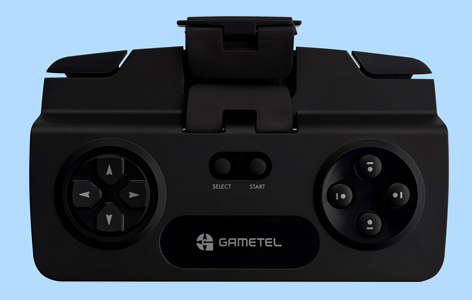
Meet Fluctel’s Gametel Gaming Controller — a bluetooth controller that latches on to any Android phone that runs Android 2.1 or higher. Oh, and did I mention that it’ll support over 50 games straight out of the box, including Cordy, Asphalt 5 HD, Reckless Getaway, Guns’n’Glory, MotoX Mayhem, Happy Vikings and Zenonia.

According to PocketGamer, the Gametel Gaming Controller offers about nine hours of battery life and automatically shuts down after six minutes of inactivity. The controller connects to the phone via Bluetooth, which means that you can also disconnect the controller and play from afar. A handful of powerful Android devices sport kickstands these days so that’s an option, but if your phone supports HDMI out then you’re in for a real treat. No console, no expensive games — just you, your phone, and the gaming controller duking it out on the big screen.

The controller sports spring-loaded clamps and rubberized grips to lock your phone into place, but that surely can’t protect against gamer rage, so no throwing this controller across the room, OK?

The truth is, no matter how excellent your phone’s graphics are or how fast your processor is, some games are just annoying using on-screen controls. That’s why the Xperia Play was such a brilliant idea, and why the Gametel Gaming Controller is an even better one.

The controller isn’t available yet, but the company has an email notification sign-up on its website. The controller will retail for around £49.95 (US $67), and should show its D-Padded face in December.


Capital One Co-Founder Invests In Online Payments Company Braintree

brain

Braintree, an online payments provider, is announcing that Capital One co-founder Nigel Morris has joined the company’s board of directors and invested in the company following a $34 million investment from Accel Partners earlier this year.

Braintree essentially powers and automates online payments for merchants and companies online. The company provides a merchant account, payment gateway, recurring billing, credit card storage, support for mobile and international payments, and PCI Compliance solutions.

Morris, who is currently the managing partner of QED Investors, is best known as the co-founder of Capital One Financial Services. The amount of his investment in BrainTree has not been disclosed.

BrainTree has become a one-stop-shop for all the services a business needs to receive payments from anywhere in the world. The company’s clients include Airbnb, LivingSocial, OpenTable, Animoto, Lookout, Shopify, Brightcove, Hotel Tonight, GoMobo, 37Signals, and GitHub. The company is now processing more than $4 billion in annual credit card volume. Braintree also recently brought on payments exec and former Accel EIR Bill Ready as CEO.


AdMob Dominates Android Ad Network Market Share

Xyologic-Admob-Android-Ad-Networks

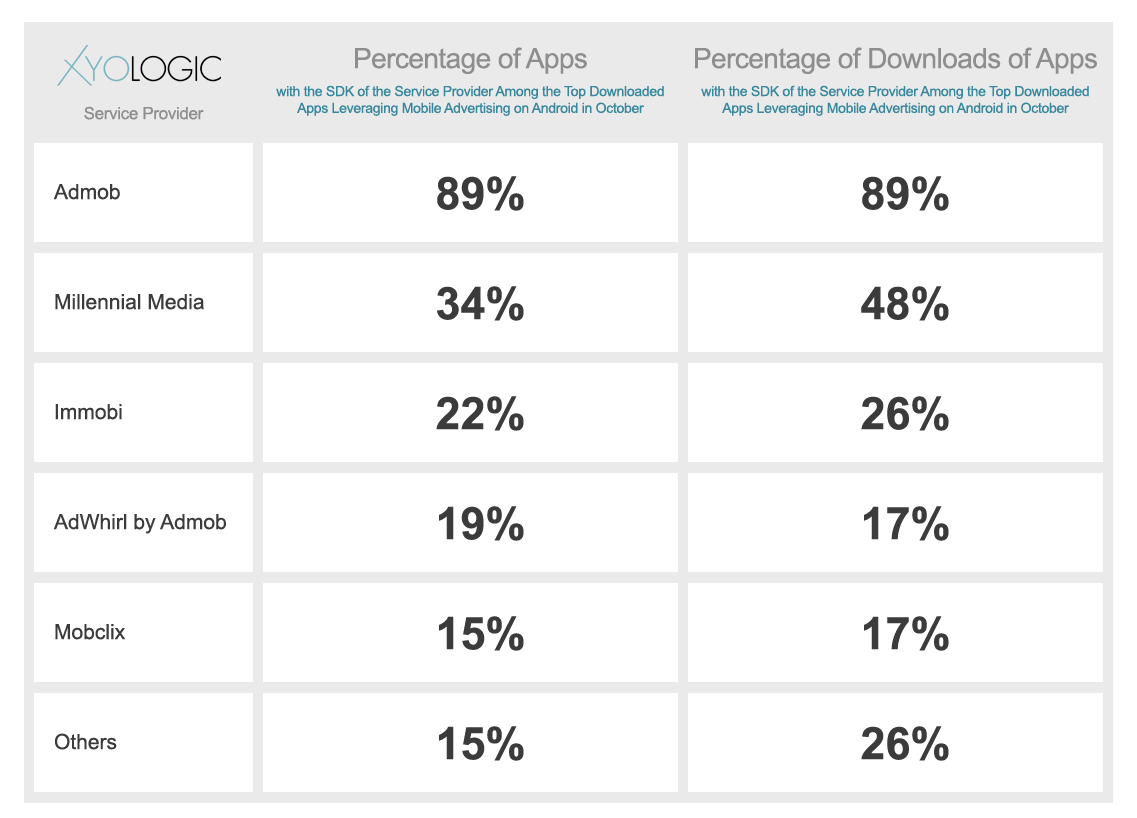
Mobile analytics firm Xyologic has released a market share breakdown that estimates the mobile ad and ad exchange network breakdowns on Android. According to its research, AdMob was found to be the dominant player on the Android platform, with an 89% market share, based on an analysis of all the downloaded ad-supported Android apps in the month of October.

Millennial Media, Inmobi, AdMob acquisition AdWhirl and Mobclix trailed further behind.

Although the IDC releases a report on the mobile advertising ecosystem each year, it is often disputed, explains Xyologic Co-founder Matthaus Krzykowski. In addition, the IDC research doesn’t drill down into either operating system or app level data.  Xyologic’s study does.

According to its findings, 50% of the top 1,000 downloaded apps on Android in October had at least one mobile ad network or mobile ad exchange SDK. And 22% of these had two or more mobile ad network SDKs.

In the group containing just the top 1,000 ad-supported apps, 89% used AdMob’s SDK, 34% used Millennial Media’s SDK, 22% used Inmobi, 19% used AdWhirl and 15% used Mobclix.

Out of all the ad-supported Android apps, 89% used AdMob, 48% used Millennial Media, 26% used Inmobi, 17% used AdWhirl and 17% used Mobclix.

To be clear, ad exchanges like AdWhirl maintain the inventory of other ad networks including AdMob, Millennial and Inmobi.

The remaining 15% of the top ad-supported apps is made up of other ad exchanges with much smaller traction. These include AdMarvel, Smaato, Burstly, Mopub, Nexage, Fiksu and Jumptap. Each of these individually accounts for less than 3% of the overall market share, but combined, they represent 26% of all ad-supported apps in October.

Xyologic collects its data uses proprietary technology in combination with reliable third-party sources, it says. The company also produces comprehensive reports on global app downloads, releasing 220 reports per month which cover the top 4 mobile platforms and 29 countries. Recently, Xyologic began releasing these reports for free.

Additional information about today’s research is available on Xyologic’s blog here.


PC Hardware Makers Pulling Back On Tablet Manufacturing

shutterstock_67382527

Digitimes, quoting “sources from upstream supply chains,” is stating that PC manufacturers like Dell, Acer, and HP are building fewer tablet products in direct reaction to devices like the iPad, Kindle Fire, and Nook Tablet. Citing an inability to gain traction against devices with rich content to back them up, the manufacturers are looking elsewhere to regain a foothold in the mobile market.

In truth, manufacturers know they won’t get far building vehicles for Android, Google Music notwithstanding. Building and marketing a tablet like the Xoom or the Asus Transformer is a perilous process and is buffeted by the whims of a price-conscious consumer. It doesn’t make economic sense to build and try to sell a few hundred thousand slates that will be considered obsolete in a few months.

It seems that only Samsung, with their Galaxy Tabs, has gained any brand recognition. The rest of the players are, at best, also-rans.

Amazon and, to an extent, Barnes & Noble, have the right idea: they sell the device to sell the content. There is no reason, for example, that the eink versions of the Kindle and Nook shouldn’t be free with Amazon Prime or content subscription services other than to prevent the perception that the devices are cheap. I can understand charging a bit for the color devices like the Tablet and the Fire, but if (to murder a metaphor) Amazon is selling the razor cheap and the blades at a premium, then it makes little sense for folks like HP to sell the arguably superior straight razors they’ve been trying to ship.

The pattern of boom and bust in tablets closely follows the rise and fall of the netbook. The netbook was supposed to save the PC industry – and it did – until people started competing on price. Now the concept of a netbook is laughable in the face of the ultrabook and the more popular tablets and it took far too long for PC manufacturers to realize this. By reacting swiftly to reduced interest in their wares and focusing on consumer experience in higher margin items – namely Windows 8 devices in a laptop form factor, it just makes sense for most of these guys to pull the plug on their misguided slate dreams.


Bag Week Review: Crumpler Pinnacle of Horror

IMG_4755

This is my new go-to bag. That’s saying something, too. Despite reviewing dozens of computers bags during my tenure at TechCrunch, I’ve stuck with the Ogio HipHop for years. It’s made four CES trips, three to CEDIA, a few E3s and countless random flights around the country. I love it. But now it’s just hanging in my closest. The Crumpler Pinnacle of Horror now hangs on the hook by my door, always ready to hit the road.

The Crumpler Pinnacle of Horror

Type: Sleeve/Shoulder Bag

Dimensions: 15? MacBook Pro, 13″ MacBook Pro, 11? MacBook Air

Pockets: Padded main compartment, back sleeve, one small zippered pockets up front and a one on the inside

Features: Weather resistant nylon construction, roll-top main compartment, adjustable strap with removable pad, soft-to-touch lined interior

MSRP: $135

Product Page


Crumpler started transition from just a camera bag maker to a full fledge bag provider a few years ago and that transformation is seemingly complete. They now offer a large range of bags including their staple photography line. The Pinnacle of Horror is part of the Laptop Bags line that also includes sleeves, backpacks and laptop briefcases. At $135, this particular bag is a little on the pricey side but makes up for it with solid construction.

The Pinnacle of Horror is only currently available in gunmetal and red. The exterior is a brownish grey with a contrasting bold red interior. A single, small side pocket occupies the front while a document holder is around back. Just a single strap secures the top but the clever fold-over flap allows it to function, at least temporarily, without it. For added protection, a zipper spans the top flap but I never felt the need to use it. Inside is a padded notebook divider and a large pocket across the width of the bag. Normally I despise bags that lack internal organizational pockets but the overall simplicity of this bag won me over.

The bag’s opening is just wide enough for a 15-inch MacBook Pro while the roominess allows for all sorts of additional things. The surprisingly big bag can even hold a DLSR in a pinch but, since there isn’t a dedicated padded pocket, it might not be the best idea. Still, it lends to this bag’s versital nature.

Who is it for?

Just looking at the bag you wouldn’t think anything of it. It looks rather mundane but it’s the perfect size for a notebook, a tablet, and anything else you’ll need while out an about like a camera or text book. It lacks a water bottle holder, a multitude of pockets and silly things like a dedicated cell phone holder. But don’t let that turn you off. It’s not really meant for the traveling salesman that needs to have an array of items available at an instant. But for an around-the-town bag (or a basic flight bag), it’s nearly perfect.

Do I want it?

Yes, I really think you do.

But as previously mentioned, it’s not the biggest bag available. Don’t expect to tout a gaming notebook outside of the Alienware M11x. The bag is super easy on the shoulder and the fold-over design of the main compartment makes for an accessible, but still secure, top flap. The bag is handsome in a way. You wouldn’t see Alan Shore carrying it to court, but Jim Halpert would totally rock the Pinnacle of Horror to the office. The Crumpler Pinnacle of Horror is an solid bag. A more appropriate name is Pinnacle of Awesomeness.

Product Page

Click to view slideshow.


Security Risk Intelligence Company Rapid7 Raises $50 Million

rapid7

Rapid7, a company that develops security risk intelligence products, has raised $50 million in a series C funding from Technology Crossover Ventures (TCV). This brings the company’s total funding to $60 million.

Rapid7 provides the enterprise with an offering that identifies any security risks in a company’s IT infrastructure, and prioritize their remediation based on the probability of an attack. Nexpose, the company’s flagship product, scans for security risks across entire IT environments, including Web, network, applications and databases.

The company, which has 1,700 customers, says that revenue has increased more than 900% over the past four years and reported its tenth quarter of record revenue in Q3 2011.

The new funding will be used towards hiring, product development, strategic acquisitions and international expansion.


WildChords Arrives On The iPad With Fun Guitar Lessons In Tow

wildchords

As a long-time rhythm game junkie, Ovelin’s new WildChords app strikes very close to home for me. Part Guitar Hero and part instructional aid, WildChords aims to take players though the basics of playing guitar without all the theory that often scares beginners away.

The story — to the extent that it matters — puts you in the shoes of an afro’d guitar player who needs to tame a city full of ornery animals with the power of music. Players progress through the game by doing two things: learning to play chords, and learning to play note patterns on the fretboard.

Gameplay is conceptually similar to Guitar Hero, with players strumming chords and hitting notes as they scroll horizontally across the screen. WildChords starts off deceptively easy (you begin by just strumming your guitar), but it isn’t long before the difficulty starts to ramp up at a steady pace. After a few levels, players will be stringing chords together while accompanied by some vaguely familiar sounding background music.

Playing WildChords is meant to be a learning experience, and one of it’s biggest draws is its ability to gauge how well you’re playing a chord or note. It’s easy to be skeptical, but the app’s sound recognition is surprisingly accurate. Early stages have players strumming E minor, and while the game wouldn’t protest when I played an E major, it was savvy enough to reject the C chord I’d occasionally try and sneak past it. If you’re already an iPad-toting guitarist, you’ll also be glad to know that the tuner works very well — I couldn’t figure out why I would completely bomb a note-playing level until I discovered how out of tune my guitar was.

As impressive as WildChords can be, it’s not without a few sore spots. Every once in a while, the game will suddenly lock up after completing a level, which can be a bit jarring after a hard-earned victory. It’s fairly rare, and I haven’t been able to consistently reproduce it, but be on the look-out regardless.

The thing to remember about WildChords is that it’s not meant to be a comprehensive guitar teacher — people looking for music theory lessons should look elsewhere. By sidestepping the instrument’s more classical trappings, WildChords gets new players up and running with the basics and (more importantly) makes practicing fun.

After beating a few levels for example, players will have a better feel for moving around the fretboard and jumping between chords, both things that tend to elude guitar novices like myself. While the kid-friendly graphics will probably make WildChords a must-have for the tiny musician in your life, the app’s great tuner alone should net it a place in a guitarist’s toolkit.

WildChords is available now in the iOS App Store for free.


Links Posted By Big Facebook Pages Have A 0.14% CTR, 1 Click Per 1000 Fans

Facebook Page Post Clicks Done

The click through rate for links posted to the news feed by Facebook Pages with over 100,000 fans is 0.14%, or 1 click per 715 impressions according to a new study shared with us by analytics provider EdgeRank Checker. Pages receive 0.00093 clicks per fan, or roughly 1 click per 1000 fans. These figures should give marketers an idea of how many Facebook fans they’ll need to accumulate to drive significant traffic to external websites, a core way of deriving return on investment from the social network.

Facebook only started providing link click metrics to Page admins at the beginning of October. Until then, marketers had to use links with tracking tags or URL shorteners that can reduce CTR in order to determine the referral traffic their Page posts were driving.

For comparison, links posted by Pages have nearly 3x the CTR of Facebook ads which average 0.05% CTR, and they top online display ads which average a 0.1% CTR according to Webtrends.

Facebook Pages can be a useful marketing channel for brands, especially those that organically accrue Likes from passionate customers such as entertainment, consumer packaged goods, fashion, and automotive companies. To drive significant referral traffic, though, most brands have to invest in advertising in order to beef up the fan counts of their Pages.

Most major brands have at least 100,000 fans, and Posts by Pages with few fans have a much higher CTR as you can see in the graph below. Therefore, I excluded them to avoid skewing the data. For all Pages with over 1,000 fans, including those with few fans, link posts still only have a 0.35% CTR, 1 click per 280 impressions, 0.00236 clicks per per fan, and 1 click per 424 fans.

EdgeRank Checker’s data is based on 84,000 link posts by over 5,500 Pages in October. The study also looked at which days of the week were the best for Pages to post on. It found that posts on Wednesday receive the most clicks and shares, while posts on Friday receive the fewest.

If they spend the time and money, brands like Porche, Netflix, and Old Navy can drive around 2,000 qualified clicks a day for free. Facebook Pages can’t completely replace the need for paid advertising, but they can become an important component of a savvy online marketing strategy.


The Rise Of The Health Startup? A Peek At The 13 Companies In Rock Health’s Inaugural Batch

138424v2-max-250x2501

There’s been a bit of a debate going on of late among venture capitalists and investors over whether or not web startups are currently experiencing a cash crunch when it comes to early-stage and series A financing. (You can read Alexia’s recent breakdown here.) As per usual, the answer depends on whom you ask. This recent debate contrasts with the data seen in Column Five Media’s infographic from June, which showed venture funding and investment levels picking back up in the first half of 2011, poised to storm back to pre-2008-collapse levels.

Of course, the data showed that not all tech sectors were experiencing the boom times: Health and medical-related investment, for example, was on the low end, receiving only 3 percent of venture funding over the last year. Yet, there may be some evidence that investment in the digital health space may in fact be heating up. Looking at this data compiled by new healthtech startup incubator Rock Health, we see a list of 41 healthtech startups have been funded in 2011. CrunchBase’s data, which uses slightly more generous paramaters for defining “health tech”, puts that number over 120 or so.

Of those startups that were founded this year, Aza Raskin’s Massive Health raised $2.25 million in seed funding from Andreessen Horowitz, Charles River Ventures, and more. (Well, Massive Health was actually founded in December 2010, but close enough.) And Azumio, which was founded this year, raised $2.5 million in seed funding from Founders Fund and Accel in July.

What’s more, we just covered 100Plus’ $500K seed raise from Founders Fund earlier this week. The personalized health prediction startup was not mentioned in Rock Health’s list, I assume because it is still in private beta.

But the point is, as we’ve seen in Dave Chase’s series of guest posts, the healthcare industry is ripe for disruption. Sure, the industry has a long way to go, but we’re seeing some great progress from startups like Practice Fusion, for example, which is busy becoming the largest provider of electronic medical records in the industry.

There’s also plenty of room for help in the way of incubators. On Friday, Rock Health, the startup accelerator for health-focused startups, hosted its Demo Day at UCSF Mission Bay, where the 13 startups in its latest class introduced their businesses to 250 attendees, among them investors from Accel, NEA, Khosla Ventures, True Ventures, Benchmark, Kapor Capital, SV Angel, The Social+Capital Partnership, Founders Fund and more.

For those unfamiliar, Rock Health provides seed funding ($20K grants, without taking equity), office space, and mentorship to entrepreneurs that want to break into healthcare. We covered their debut here.

The thirteen startups that demo-ed range from BitGym, which makes motion-sensitive iOS video games for working out; to IDEO-spinoff Omada, an online support group to reverse diabetes; to CellScope, a smartphone plugin designed to remotely diagnose ear infections.

It was also great to see that these teams included entrepreneurs that have previously worked in other areas of tech and media and are now bringing their talents to health: For example, Gabe Vanrenen, the former Founder and CTO of Flurry, Jackson Wilkinson, the former head of UX for Posterous and LinkedIn, to Jeff Lieberman, the host of Discovery Channel’s Time Warp.

Again, we covered the initial eight Rock Health startups that were ready to introduce their wares back in June, and you can read about them here. However, five of the startups were not yet ready for the limelight, so we’re providing brief introductions to those below:

Bigevidence provides clinicians focused access to the universe of medical evidence at the point of care and within electronic health records, improving quality of care, while reducing costs and risks.

BitGym thinks you should be using video games to exercise. Their patent pending technology uses an iPad to turn any cardiovascular machine into an interactive
gaming experience.

Cake Health is the best free way to manage your healthcare expenses online. The startup was a finalist at TechCrunch Disrupt San Francisco in September. You can read our initial profile here.

Crohnology is a social health network for people with chronic medical conditions to share and learn what treatments work, meet others near them, and track and share their health.

Heartbeat is a salesforce.com-like enterprise solution for wellness professionals that aims to empower people to be successful doing what they love.

Applications for Rock Health’s next class beginning in January 2012 are open until Wednesday, November 16th.


Generation Make

Justin Kan

Editor’s note: This guest post is by Justin Kan, cofounder of Justin.tv and TwitchTV. He is 28 years old. You can follow him on Twitter and read his blog.

In his New York Times opinion piece yesterday, William Deresiewicz calls the Millennial generation, those born roughly between the end of the 70s and the mid-90s, a generation of salesmen. Emotionless, aspiring to be liked by all, because that is what will attract the most customers. “No anger, no edge, no ego.”

He got some things right. We have a distrust of large organizations. We don’t look down on people creating small businesses. But we’re not emotionless, that couldn’t be further from the truth. We have anger, which flares up to become the Arab Spring and OccupyWallStreet movements. We have ego, which I see in every entrepreneur who thinks their tech startup is the best thing since sliced bread. We have passion, and an intense drive to follow our passions through, immediately.

Our generation is autonomous. It is impatient. We refuse to pay our dues; if we start an entry level job then 6 months later we want to be running the department. We hop from job to job; the average tenure at any job for an American 25 to 34-years-old is just 3 years. We think we can do anything we can imagine, whether it is rise to fame like Deadmau5 for our music or launch a new product on Kickstarter, and hate the idea that we should ever be beholden to someone else.

We do this because we have been abandoned by the institutions that should have embraced us. The past decade has shown us a massively inefficient government that has spent millions in foreign wars, incapacitated by partisan dogma. Politics are controlled by the old, people who don’t understand technology, a situation which seems immutable. Corporations have turned their backs on us: many of us came to age in the 2008 financial crisis, and even though we were promised that a college education was the key to a blessed life we couldn’t find a job post graduation.

So we’re making our own way and making our own jobs. We create our own tech startups, we’re making a living producing videos on Youtube. We’re starting our own non-profits instead of joining stagnant, bureaucratic NGOs. We’re growing and selling our own organic food. We don’t need your jobs, your advice, your instruction. Pretty soon we won’t need your music labels or publishing houses; we’ll be doing it ourselves on iTunes and Amazon. We don’t need you at all, except perhaps as a customer.

We’re not salesmen, as Deresiewicz states. Selling is just one part of running a functional enterprise, and not the most important part at that. Our hero Steve Jobs knew that without a great product, selling is useless, and that’s why he cared about the products above all else. His showmanship around them was just a reflection of his passion. Before we’re ever selling anything, we have an idea for it, and that is where our love and emotion is revealed. Unlike previous generations, if we’re on the web or at a store and something we want doesn’t exist, our first thought is not “why?” but simply that maybe we should create it ourselves.

This isn’t the first time the Millennial generation has been criticized for what is perceived as shallowness, a lack of connection with others, or just a materialistic nature. David Fincher spent an entire 121 minutes trying to pillory Mark Zuckerberg with a made-up fable, and all he did was inspire another generation of would-be entrepreneurs.

We are a generation of makers. A generation of creators. Maybe we don’t have the global idealism of the hippies. Our idealism is more individual: that every person should be able to live their own life, working on what they choose, creating what they choose. If you want to build a company to change the world, go for it. If you want to be an independent knife maker, what is stopping you?

We follow our passions. If we do it as a business, then we can create the ability to support ourselves doing what we love, and with some measure of security and autonomy that no institution is going to grant us. The Millenial path to self-actualization is the individual path, each man to create it for himself.

Is that selling out? We’re just doing what you regret not having the balls to do.


“Xoom” To Give Way To “XYBoard”?

xyyy

The Xoom hasn’t been the big hit everyone was hoping for. After an inauspicious debut marked by bugs, a lack of Honeycomb apps, and a non-functioning SD card slot, the big debut tablet from Motorola was quickly superseded by other devices, in some cases cheaper or better Honeycomb tablets, and in others more use-specific devices like the Nook Color.

It’s no surprise, then, that the Xoom brand might be getting a revamp. But what happens when the cure is worse than the disease? XYBoard happens.

Yes, it seems that Verizon may be rebranding their Droid-related line of tablets with this recently-trademarked moniker, a mishmash of “cyborg” and “board,” with the already questionable X/Z switcheroo of the Xoom. It’s a case of being too clever by half, and I don’t think customers are going to like it.

The tablets themselves look stylish and powerful, not that those things guarantee sales, and were announced a couple weeks ago as the Xoom 2 and Xoom 2 Media Edition, but it wouldn’t be the first time a device was completely rebranded for certain markets. It’s actually a fairly common practice for some reason.

This is all speculation, of course, but hopefully it’s not true. The Xoom may not have been a blockbuster device, but people at least know the name and associate it with tablets and Android. XYBoard is a groaner — let’s hope this report is mistaken.


Virtual Goods Gaming Marketplace Live Gamer Raises $8.5M

live-gamer-picture

Live Gamer, an online marketplace for players to trade and buy video game virtual goods, has raised $8.5 million in new funding from Charles River Ventures and Kodiak Venture Partners. This brings Live Gamer’s total funding to nearly $30 million.

Live Gamer’s e-commerce platform powers virtual goods merchandising, analytics, virtual item gifting, support for earned in-game currencies, item storefronts, catalog management, payments gateways, cash-in flows, and more for publishers. Live Gamer has scored a number of other notable partnerships to power micropayments for gaming companies, including a deal with gaming giant EA, THQ Sony, and Real Networks.

The company recently bought video game ad network GamerDNA and engagement advertising platform BrandPort to add advertising capabilities for game publishers. In 2009, the company acquired microtransaction platform Twofish, and Korean startup N-Cash, a global microtransaction company.


Why The Collaborative Consumption Revolution Might Be As Significant As The Industrial Revolution (TCTV)

lauren-anderson

Everything, it seems, is becoming collaborative. From Airbnb to RentCycle to Zipcar, we are swapping our cars, our homes, even our clothes with each other. According to Lauren Anderson from Collaborative Consumption, this change might be as profound as the industrial revolution. It will result, she told me when we met at Fast Company’s Innovative Uncensored event, in a world driven by “reputational capital” in which the “We” of the our collaborative age will replace the “Me” of the industrial age.

While Anderson might be right, I’m not sure it’s such a great thing for people like myself who aren’t naturally participatory. Indeed, I find the whole idea of an always-on reputational economy a little creepy – especially since this may not be a world that is able to either forgot or forgive. But Anderson isn’t bothered by oddities like myself, insisting that “everybody benefits” in this networked, sharing economy.

So is Anderson right – is this shift from the Me to the We as significant as the industrial revolution? And should we welcome this revolution with, so to speak, open arms?