Mac-optimized TensorFlow flexes new M1 and GPU muscles

A new Mac-optimized fork of machine learning environment TensorFlow posts some major performance increases. Although a big part of that is that until now the GPU wasn’t used for training tasks (!), M1-based devices see even further gains, suggesting a spate of popular workflow optimizations like this one are incoming.

Announced on both TensorFlow and Apple’s blogs, the improved Mac version shows in the best case more than a 10x improvement in speed for common training tasks.

That’s worth celebrating on its own for anyone who works in ML and finds themselves constantly waiting for their models to bake. But the fact that previous versions of TF only utilized the CPU on Macs and not the powerful parallel processors in the GPU probably limited the pool of people who inflict that problem on themselves in the first place. (Most large-scale ML training is done using cloud computing.)

The change from CPU-only to CPU+GPU could account for a great deal of the improvement, as the benchmarks on an Intel-based Mac Pro show huge gains on the same hardware. Training times once in the 6-8 second range are now measured in fractions of a second.

That’s not to say the M1 isn’t capable, but the new M1 Macs also have new GPUs, meaning the jump from nearly 10 seconds for a task on a 2019 MacBook Pro to less than 2 on a new M1 machine can only be partly attributed to Apple’s fancy first-party silicon.

I contacted Apple for more information, such as a number for an M1 device running non-optimized code (which would elucidate the improvements nicely) but a representative said it does not have those numbers.

At any rate perhaps more important for developers will be the improved battery life and heat management of the M1 devices. Performance bumps are all well and good, but if it made your machine into a hot plate, blasted your fan and made you run for the outlet in under an hour — not so good. Fortunately the M1 seems to be demonstrating remarkable efficiency under load, neither draining its reserves or heating up too much.

You can probably expect a lot of these “now works better on M1” stories now that the new Macs are out and all the major companies can ship the updates they’ve been sitting on for the last few months.

‘A Charlie Brown Christmas’ will air on PBS, in spite of Apple TV+ rights exclusive

Call it a holiday miracle. Apple today announced that animated holiday classics “A Charlie Brown Thanksgiving” and “A Charlie Brown Christmas” will, indeed, be appearing on television this year. The news comes after some pushback against an Apple TV+ exclusive that found the Peanuts cartoons being pulled from TV broadcast.

As we noted last month, the deal would mark the first time in 55 years the beloved Christmas special wouldn’t be broadcast on network television. Both holiday specials appeared to be resolved to a similar fate as the 1966 Halloween special, “It’s the Great Pumpkin, Charlie Brown.”

While Apple’s rights had a clause that involved a window for free broadcast, it was hard to shake the feeling that relegating a holiday tradition to a premium subscription service flew in the face of the original special’s staunch, anti-consumer message.

Thankfully, in addition to appearing on TV+, “A Charlie Brown Thanksgiving” will appear on PBS and PBS on November 22, 2020 at 7:30 pm local time/6:30 pm CT, while “A Charlie Brown Christmas” will air on December 13, 2020 at 7:30 pm local time/6:30 pm CT.

It’s a small victory, perhaps, but these days we’ll take them where we can get them. And this time without ads.

This $99 gadget helps you make music, no skill required

At CES back in January, I met with a handful of founders who were/are crowdfunding musical instruments. It’s a fascinating category and one to watch if you have a passing interest in either music or technology. Like a vast majority of hardware startups, most companies in the space will build one product if they’re lucky — and even that can feel like something of a long shot.

Coupling the Hail Mary pursuits of hardware development with an earnest attempt to reinvent the musical wheel feels like an act of futility. And honestly, it is. But every so often, something breaks through in an exciting way. Roli is probably one of the best examples of the phenomenon in recent years. The company’s Seaboard was a clever take on the synth — and the U.K. company has continued to release clever music products.

Nashville-based Artiphon managed to capture the imagination of online music lovers as well, with the simply named Instrument 1. The hybrid guitar/piano-style device pulled in a wildly impressive $1.3 million on Kickstarter back in 2015. I spoke to the company’s founders about the project at CES this year, but it was their second device that really interested me.

Image Credits: Brian Heater

Last year’s Kickstarter campaign for the Orba bested its predecessor, raising $1.4 million. And it’s easy to see why. The company describes it thusly on its campaign page:

Hold out your hands and meet Orba, a new kind of musical instrument. It’s a synth, looper, and MIDI controller that lets anyone make music immediately. Orba’s minimalist design resembles a cross between a gaming controller and a half a grapefruit, and its feather-touch sensitivity translates gestures from your fingers and hands directly into sound. Orba introduces a new and fun way to make music anywhere, even if you’ve never played an instrument before.

It’s that last bit in particularl that caught my attention. The thing that united most of the devices I looked at in January is some kind of base-level requirement of musical skill. Which, understandable. But as an overzealous music fan with — let’s just say limited — ability, I’ve been looking for something that might scratch that musical itch. Honestly, I was pretty hopeful for Roli’s Blocks, but ultimately found their appeal for novices to be overstated.

I’ve been asking after the Orba since January. I doubled down in March/April when the COVID-19 shutdown really hit us in earnest here in New York, thinking it would be a good way to pass some of the time that didn’t involve rewatching Tiger King. Initially planned for an April delivery, founder/CEO Mike Butera notes that things like COVID-19 and the ongoing trade war put a damper on those plans.

“Despite that, we started shipping to our 12,000+ Kickstarter backers first this summer, and we’re now 95% shipped globally (100% in the countries where we’ve opened sales),” he says. “All remaining backers are already in logistics.”

Image Credits: Brian Heater

It took a while for the device to finally come through, but I finally got my hands (well, hand, really) on it — and so far I’m pretty into the thing. I can’t promise my attention span is going to hold up beyond a week or two, but I’m really digging it right now. As you’d expect, having some musical skill is certainly helpful, but it’s not a prerequisite. The learning curve is surprisingly small, and the thing, quite literally, works out of the box. Hooking it up to a computer (via USB-C) or smartphone (Bluetooth) enhances the experience, sure, but it’s not necessary.

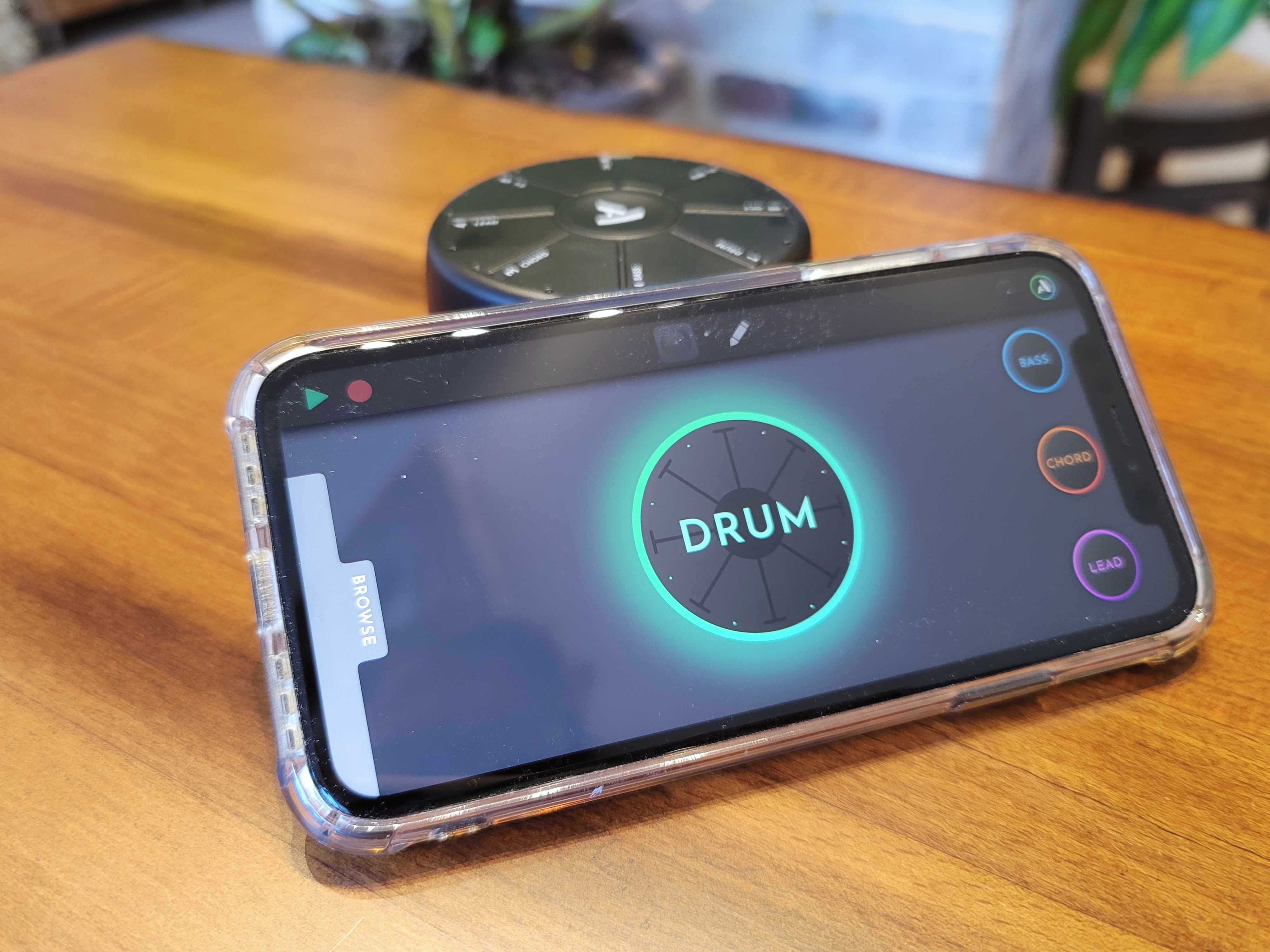
The easiest way to think about the peculiar little object is as a kind of compact, pre-programmed MIDI controller you can use to build songs by layering loops on the fly. The “grapefruit” comparison is pretty apt (especially if you get the citrusy silicon cover), with each of the “slices” representing a different element of an instrument. In “lead” or “chord” mode, they generally represent different notes. With “drums” they’re different pieces in a kit or other percussion instruments.

Holding down the big “A” lets you switch between instruments, adjust the BPM (tempo), record a track or play it back. I’ve found the easiest way to approach it is laying down a rhythm track with the drums (to the built-in metronome) and then layering chords over that. Here’s a Day One attempt. It’s not Bach or Wendy Carlos, but you get the picture:


I should add the software doesn’t currently support saving/exporting songs, which is a big bummer. The above recording was jury rigged in a very lo-fi way by holding the instrument up to a mic during playback. There are other methods, including using the headphone jack as audio out, but the above was honestly just the easiest method at the time. The feature is included in the instructions, but not the app. Butera has since confirmed with me recording/sharing is, indeed, coming soon.

For the time being, the app is mostly good for switching sounds. There are about 10 sound packs per instrument (with considerable overlap between them). It’s a pretty good start, though most tend toward the electronic and ambient, with drum sounds that more closely approximate an 808 than a proper analog drum kit. It makes sense. Again, this thing is a MIDI controller at its heart and will never be able to sufficiently approximate a chamber orchestra.

Image Credits: Brian Heater

The chords/leads are in a scale, so it’s impossible — or at least difficult — to hit a wrong note. Artiphon is working to expand the library of sounds. There are no plans to let users contribute to the library, though they can alter the sounds themselves by using the system as a MIDI controller.

The current level of customization leaves a little to be desired. Though that’s certainly to be expected from a first-gen product from a small startup. And, honestly, there’s something to be said for keeping things relatively simple when it comes to appealing to beginnings. It also warrants mention that the little hunk of plastic is surprisingly versatile when it comes physical interaction. The “keys” don’t have give, but the company has added a number of clever ways to alter the input. It takes some getting used to and can sometimes lead you to trigger an accidental result, but over all, it’s a nice feature.

Stealing the graphic from the Kickstarter page:

Image Credits: Artiphon

I’m not ready to classify the Orba as a serious musical instrument — and honestly, I don’t think that’s really the point. I have no illusions of becoming the next Flying Lotus or Dan Deacon here, but damn if the $99 gadget isn’t fun to have lying around to blow off steam, kill some time and keep myself occupied during boring conference calls — on mute, of course.

Virtual HQs race to win over a remote-work-fatigued market

In retrospect, 2019 feels like the working world’s last dance with spontaneity. The pre-pandemic past is rife with conferences, running into co-workers and post-work happy hours. Now, as companies such as Microsoft and Twitter declare remote work as the future, the very existence of physical offices is unclear for the long-term.

Yet, to a growing number of entrepreneurs in the Valley, when one physical door closes, a virtual one opens. With the goal of making remote work more spontaneous, there are dozens of new startups working to create virtual HQs for distributed teams. The three that have risen to the top include Branch, built by Gen Z gamers; Gather, created by engineers building a gamified Zoom; and Huddle, which is still in stealth.

The platforms are all racing to prove that the world is ready to be a part of virtual workspaces. By drawing on multiplayer gaming culture, the startups are using spatial technology, animations and productivity tools to create a metaverse dedicated to work.

The biggest challenge ahead? The startups need to convince venture capitalists and users alike that they’re more than Sims for Enterprise or an always-on Zoom call. The potential success could signal how the future of work will blend gaming and socialization for distributed teams.

Succulents and spatial technology

Companies within the virtual HQ world sit on a spectrum. On one end, there are the productivity companies, and on the other end, there are the video game companies. In the middle sits a mix between work and play, which is where Branch hopes to live.

There are more than 500 companies on Branch’s waitlist, and of current users, the retention has been 60% after a month of using the platform. So far, it has raised $1.5 million from investors including Homebrew, Naval Ravikant, Sahil Lavingia and Cindy Bi.

Walk through Branch’s virtual HQ and there are all the normal details you’d find in an office on Market Street: There are meeting rooms, lunch tables, a literal watercooler and, yes, succulents on your co-worker’s desk. Most employees log on for 12 hours, and for Election Day, they all had a watch party with a projected live stream in one area of the office.

The founder tells me that he’s hired people — and fired people — all in the virtual offices. Doors, he says, make a big difference.

The platform wasn’t built as a pandemic phenomenon, but in fact, was the result of years of experimentation by the founders, Dayton Mills and Kai Micah Mills. Both founders, since the age of 15, have spent time building Minecraft servers to sell to gamers, netting each thousands of dollars a month. In fact, Kai dropped out of high school to run Minecraft servers full-time, while Dayton tried at 13 to create his own game studio, even hiring an artist to do the illustrations. The game studio failed due to the fact that he was a “kid, 13, and had no money.”

“I spent the majority of my time online playing games with people. So my whole day was playing video games and having people to talk to in the background because I was on constant calls with people,” co-founder Dayton Mills said. “So for me, it’s not hard at all to use it. The question is can I get other people to think the same way?”

For now, Dayton Mills remains confident that his team’s platform will do well. After all, work is a non-negotiable place that you have to show up every day. And why not make that a little more fun?

“You can build a space where everyone comes to work,” he said. “Then after that, you can start building the spaces where they go after work. And it kind of spirals from there.”

Branch, like other virtual HQ platforms, is forced into an interesting spot of being both relevant enough to be used, but passive enough of an app to not feel like a burden. Dayton Mills says that this dynamic has made the team add features like no mandatory video or audio, and a talking icon per user to give the appearance of live interaction. The focus is to keep it casual so people can actually be online for six hours a day.

“People use Slack to work remotely but you go into a physical office and people are still using Slack, he said. The co-founder hopes the same for Branch, and has started measuring how many times people talk to each other in a given day. He says there are hundreds of chats per day, even if some are only for a few seconds.

The key technology that Branch and others are using to create spontaneity is spatial gaming infrastructure. At its core, the technology allows users to only hear people within their nearby proximity, and get quieter as they “walk” away. It gives the feeling of a hallway bump-in.

Dayton Mills thinks that the winning company in this crowded space is the one that can create a space that cultivates and sparks spontaneity.

“You can’t create the serendipity itself directly,” he said. “So create that environment.”

Gather, likely the largest virtual HQ platform out there, has embedded features to do what Mills is suggesting, such as “shoulder taps” to prompt a co-worker to chat, or pool tables where employees can circle around and start a virtual game of pool. The office tour included seeing a corgi on the desk, jack-o-lanterns and this reporter even added some floor plants to the set-up.

Gather’s main floor.

“You don’t need to worry about constantly worrying about if you’re being seen or not, but you will hear anyone who tries to come and talk to you,” said Phillip Wang, the founder of Gather.

The office design includes whiteboards and floating Google Docs to promote announcements and conversations.

Gather has been in the works for more than 18 months, since Wang and his friends graduated college. The team first tried to create custom wearables that would show you which of your friends were able to talk so you can tap into a conversation. When that didn’t work, they pivoted into apps, VR and full-body robotics. Then COVID-19 hit, and they saw an opening in the workplace.

Trillions, billions or none of the above?

Gather raised some money from angel investors, but has largely stayed away from institutional investors due to the potential of their cap table “biasing” the growth and direction of the company.

“You could easily end up in situations where the only options are ones you’re not happy with,” Wang said, of bringing VCs on at this stage. “We always want the way we make money to be aligned and incentivized to do good for our users.”

Angel investor Josh Elman tells me that many VCs are interested in the product, given traction and team, but also because virtual HQs have the potential to be more than just, well, virtual HQs. While offices are one space that the technology can occupy, the same base can be applied to schools, events, weddings and more.

To show potential, Elman nodded at Hopin, an online events platform that recently raised $125 million at a $2.1 billion valuation. It seems that most VCs agree there will be a number of winners in the events space, but it just comes down to the stickiness of the platform.

With the right value proposition, it’s not hard for people to understand multiplayer online gaming. For example, Epic Games’ Fortnite threw a psychedelic Travis Scott concert and more than 12.3 million people watched.

Thus, people are smart enough to understand gaming — but what about wanting to do it every single day with their colleagues, sans music and flashing lights? The total addressable market for professional, social gaming is murky. What if these platforms are a little bit more palatable as healthy businesses, instead of betting that the upstarts are a venture-backable business that could one day become a $100 billion business?

Image Credits: Bryce Durbin

Huddle’s Florent Crivello disagrees. He thinks the market opportunity for his company, an in-stealth remote HQ, is in the trillions because it has the potential to disrupt real estate, transportation and, in a macro sense, urban cities.

“I tell my former colleagues at Uber that I’m still working on transportation,” he said. “It’s just that the future of transportation is no transportation.”

Huddle has been in private beta for six months and is used by teams at Apple and Uber. There have been tens of thousands of hours of meeting on the platform, and Crivello says that some customers have stopped using Slack or Zoom altogether.

“The mistake they’re making at Slack is that there’s a difference between seeing a list of names on the screen and clicking on a name. And there’s a difference between seeing someone in the office and saying hi,” he said. “I think there’s something very human about the latter.”

Sahil Lavingia, the founder of Gumroad, got rid of Gumroad’s office in 2016, and says that they’re never going back.

“Offices are just too expensive and not necessary 40 hours a week,” he said. “I don’t think physical offices will go away, but they’ll be vastly diminished now that people know work can happen quite effectively, remotely. It’s also much cheaper.” Lavingia invested in Branch’s seed round.

Megan Zengerle, a partner at Sweat Equity who previously had a career in HR, said that companies considering virtual HQs should think about how long-term the solution is.

“Is that truly the culture you want to build for the company? Is that something that will serve the company long term? Is it logical sense to set up that way?” Zengerle said. “Culture is living and breathing, it’s not a static thing that you set and is done.”

Zengerle thinks that virtual HQs depend largely on the scope and product of the team. Most definitely, she does not think the solution is one size fits all.

“There’re a lot of playbooks coming out of the pandemic,” she said. “But the way you vary happens across each employee in the organization, much less organization by organization.”

These are the hurdles that have limited startups in the past, including 2011 TechCrunch Disrupt winner Shaker, from attracting a large customer base.

Before the pandemic, the world was not culturally ready for widespread remote work. Then, COVID-19 forced offices closed and employees adapted. These startups are betting that with the mass adaptation will come another cultural shift, one that could bring the metaverse into mainstream.


Apple embraces iOS 14 home screen customization by fixing how app shortcuts work

Apple is making a change to how app shortcuts work in the next release of the iOS 14 operating system. In iOS 14.3 beta 2, the Shortcuts app will now no longer open when you tap on an app shortcut on your iPhone’s home screen. That means users who have created custom icons for their favorite apps as part of their iOS 14 home screen makeover will no longer be annoyed with this intermediate step where the Shortcuts app opens before the actual app does.

The change was first spotted by MacStories’ founder Federico Viticci.

A tweet from Apple Terminal shows the update in action. (You’ll notice a small pop-up still displays when the app opens, but the full launch of the Shortcuts app has been bypassed.)

#iOS 14.3 Beta New Feature:

On iOS 14.3 beta 2, the Shortcuts app will no longer open if you click on a shortcut on the homescreen, meaning you can setup alternative icons without Shortcuts opening first before going to the app.#iOS143 #iPhone pic.twitter.com/kuAAymgipn

— Apple Terminal (@AppleTerminal) November 18, 2020

Though only a slight tweak, the change will be welcomed by those who have customized their home screen following the release of iOS 14.

The launch of iOS 14 in September had introduced one of the biggest updates to the iPhone user’s interface in years. Users were finally able to customize their home screen to their liking by offloading less-used apps to their App Library as well as by adding customizable widgets to their home screen. Though widgets were originally designed to allow important information — like your next calendar appointment, to-do’s or today’s weather, for example — to sit directly on the home screen, they soon began to be used for much more.

Widget makers — like Widgetsmith and Color Widgets, for example — launched tools that let users design their own widgets, by picking the font, the size, the color and more. Users could even choose a particular photo to pin to their home screen using these tools.

The next step in the customization process relied on a previously available but little used trick: Creating alternative app icons using Apple’s Shortcuts app. This somewhat cumbersome process was detailed and demonstrated by users on TikTok, which helped make the home screen customization craze go viral. Simply put, the process let you assign your own icon to any app using a particular function within Shortcuts.

This allowed you to create icons that matched your home screen aesthetic, which now consisted of a wallpaper, custom widgets and only the handful of icons that earned home screen (instead of App Library) placement.

However, one of users’ biggest complaints with their custom icons is that, when tapped, the Shortcuts app would briefly open to run the process that then opens the app in question. It was an annoyance of sorts.

Apple, it seems, is addressing the Shortcuts issue. In the beta version of iOS 14.3, the app will open directly.

Now, if only Apple would allow users to hide their widgets’ labels, we’d be all set. Unfortunately, that change doesn’t seem to be in the works.

Charge, please: Apple will pay $113M to settle 34-state ‘batterygate’ lawsuit

Apple has agreed to pay $113 million to 34 states and the District of Columbia to settle allegations that it broke consumer protection laws when it systematically downplayed widespread iPhone battery problems in 2016. This is in addition to the half billion the company already paid to consumers over the issue earlier this year and numerous other fines around the world.

The issue, as we’ve reported over the years, was that a new version of iOS was causing older (but not that old) iPhones to shut down unexpectedly, and that an update “fixing” this issue surreptitiously throttled the performance of those devices.

Conspiracy-minded people, which we now know are quite numerous, suspected this was a deliberate degradation of performance in order to spur the purchase of a new phone. This was not the case, but Arizona Attorney General Mark Brnovich, who led the multistate investigation, showed that Apple was quite aware of the scale of the issue and the shortcomings of its solution.

Brnovich and his fellow AGs alleged that Apple violated various consumer protection laws, such as Arizona’s Consumer Fraud Act, by “misrepresenting and concealing information” regarding the iPhone battery problems and the irreversible negative consequences of the update it issued to fix them.

Apple agreed to a $113 million settlement that admits no wrongdoing, to be split among the states however they choose. This is not a fine, like the €25 million one from French authorities; if Apple had been liable for statutory penalties those might have reached much, much higher than the amount agreed to today. Arizona’s CFA provides for up to $10,000 per willful violation, and even a fraction of that would have added up very quickly given the amount of people affected.

In addition to the cash settlement, Apple must “provide truthful information to consumers about iPhone battery health, performance and power management” in various ways. The company already made changes to this effect years ago, but in settlements like this such requirements are included so they can’t just turn around and do it again, though some companies, like Facebook, do it anyway.

Interlocking AIs let robots pick and place faster than ever

One of the jobs for which robots are best suited is the tedious, repetitive “pick and place” task common in warehouses — but humans are still much better at it. UC Berkeley researchers are picking up the pace with a pair of machine learning models that work together to let a robot arm plan its grasp and path in just milliseconds.

People don’t have to think hard about how to pick up an object and put it down somewhere else — it’s not only something we’ve had years of practice doing every day, but our senses and brains are well adapted for the task. No one thinks, “what if I picked up the cup, then jerked it really far up and then sideways, then really slowly down onto the table” — the paths we might move an object along are limited and usually pretty efficient.

Robots, however, don’t have common sense or intuition. Lacking an “obvious” solution, they need to evaluate thousands of potential paths for picking up an object and moving it, and that involves calculating the forces involved, potential collisions, whether it affects the type of grip that should be used, and so on.

Once the robot decides what to do it can execute quickly, but that decision takes time — several seconds at best, and possibly much more depending on the situation. Fortunately, roboticists at UC Berkeley have come up with a solution that cuts the time needed to do it by about 99 percent.

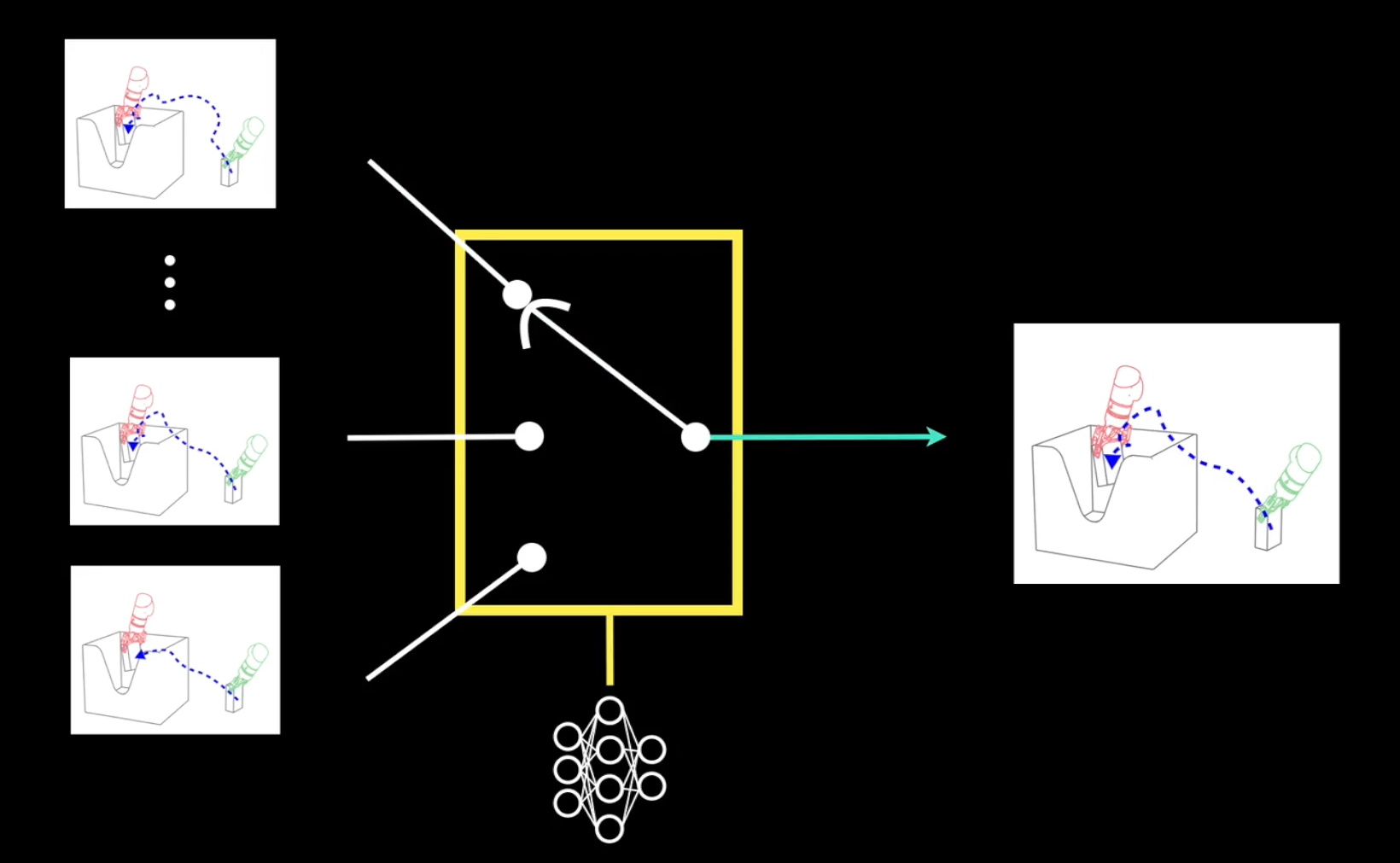
The system uses two machine learning models working in relay. The first is a rapid-fire generator of potential paths for the robot arm to take based on tons of example movements. It creates a bunch of options, and a second ML model, trained to pick the best, chooses from among them. This path tends to be a bit rough, however, and needs fine-tuning by a dedicated motion planner — but since the motion planner is given a “warm start” with the general shape of the path that needs to be taken, its finishing touch is only a moment’s work.

Diagram showing the decision process – the first agent creates potential paths and the second selects the best. A third system optimizes the selected path.

If the motion planner was working on its own, it tended to take between 10 and 40 seconds to finish. With the warm start, however, it rarely took more than a tenth of a second.

That’s a benchtop calculation, however, and not what you’d see in an actual warehouse floor situation. The robot in the real world also has to actually accomplish the task, which can only be done so fast. But even if the motion planning period in a real world environment was only two or three seconds, reducing that to near zero adds up extremely fast.

“Every second counts. Current systems spend up to half their cycle time on motion planning, so this method has potential to dramatically speed up picks per hour,” said lab director and senior author Ken Goldberg. Sensing the environment properly is also time-consuming but being sped up by improved computer vision capabilities, he added.

Right now robots doing pick and place are nowhere near the efficiency of humans, but small improvements will combine to make them competitive and, eventually, more than competitive. The work when done by humans is dangerous and tiring, yet millions do it worldwide because there’s no other way to fill the demand created by the growing online retail economy.

The team’s research is published this week in the journal Science Robotics.

Just three days to save on passes to TC Sessions: Space 2020

It takes a bold vision and nerves of steel to venture into outer space. The same holds true for the pioneering startups forging the future of space technology. Connect with other bold visionaries at TC Sessions: Space 2020 to go farther and faster together.

If you want to go farther and faster for less, you have only three more days to take advantage of early-bird pricing. Purchase your ticket ($125) before the early-bird launch window closes on 11.13.20 at 11:59 p.m. PST and keep $100 in your wallet.

Looking for more ways to save? We offer discounts for groups, students and current employees in government, the military and nonprofits. Want to increase your brand recognition on a global scale? Exhibit in the expo with a Space Startup Exhibitor Package. The package includes three passes, and exhibitors get to pitch live to attendees around the world. Pro Tip: Hit record right before you pitch — it makes a great learning or marketing tool.

Wondering whether a virtual conference measures up? Here’s what Katia Paramonova, founder and CEO of Centrly, says about the real benefits she found by going virtual with TechCrunch:

“I really enjoyed the virtual experience. I didn’t have to be there 24/7 or spend money on a flight, and I still could get work done in the afternoon. The platform was convenient and flexible. If wanted to attend simultaneous sessions, I could easily toggle between them.”

Your ticket to TC Sessions: Space also includes video on demand, which means you won’t have to miss a minute of expert insight, tips and trend spotting from the top founders, investors, technologists, government officials and military minds across public, private and defense sectors.

You’ll find panel discussions, interviews, fireside chats and interactive Q&As on range of topics: mineral exploration, global mapping of the Earth from space, deep tech software, defense capabilities, 3D-printed rockets and the future of agriculture and food technology. Don’t miss the breakout sessions dedicated to accessing grant money. Explore the event agenda now and get a jump on organizing your schedule.

Nothing moves faster than tech, and keeping pace won’t chart a flightpath to success. It requires a prescience that comes from a deep understanding of the industry, the players and the possibilities. Or as Jeff Johnson, vice president of enterprise sales and solutions at FlashParking, puts it:

“Attending TC Sessions helps us keep an eye on what’s coming around the corner. It uncovers crucial trends so we can identify what we should be thinking about before anyone else.”

TC Sessions: Space 2020 takes flight December 16-17, but you have just three days left to take advantage of the early bird special. Be a bold visionary and go farther together — for less. Buy your pass before the deadline hits on 11.13.20 at 11:59 p.m. PST).

Is your company interested in sponsoring TC Sessions: Space 2020? Click here to talk with us about available opportunities.


Epic Games founder Tim Sweeney likens fight against Apple to fight for civil rights

Earlier today, Apple announced it will reduce the App Store commissions for smaller businesses so that developers earning less than $1 million per year pay a 15% commission on in-app purchases, rather than the standard 30% commission.

Tim Sweeney, founder of Epic Games, says the move — an apparent reaction to current investigations into Apple by Congress, the European Union, the Justice Department and the Federal Trade Commission on antitrust grounds — doesn’t go nearly far enough. This morning, he told the Wall Street Journal that Apple is merely “hoping to remove enough critics that they can get away with their blockade on competition and 30% tax on most in-app purchases. But consumers will still pay inflated prices marked up by the Apple tax.”

Sweeney — whose company has been embroiled in a battle since launched a direct-payment system in its popular “Fortnite” game to bypass Apple’s fees — went even further today in conversation with Dealbook during a two-day event.

Asked about Epic’s fight with the tech giant — which began in August with its payment system, which led to Apple kicking Fortnite off the App Store, which led to Epic filing a civil lawsuit against Apple in the U.S. and more newly to begin legal proceedings against Apple in Australia using the same argument that Apple is acting monopolistically — Sweeney didn’t mince words. He even likened Epic’s ongoing campaign to the fight for civil rights in the U.S.

Said Sweeney: “It’s everybody’s duty to fight. It’s not just an option that somebody’s lawyers might decide, but it’s actually our duty to fight that. If we had adhered to all of Apple’s terms and, you know, taken their 30% payment processing fees and passed the cost along to our customers, then that would be Epic colluding with Apple to restrain competition on iOS and to inflate prices for consumers. So going along with Apple’s agreement is what is wrong. And that’s why Epic mounted a challenge to this, and you know you can hear of any, and [inaudible] to civil rights fights, where there were actual laws on the books, and the laws were wrong. And people disobeyed them, and it was not wrong to disobey them because to go along with them would be collusion to make them status quo.”

While the analogy undoubtedly prompted some eye rolls by attendees, Apple’s announcement today suggests that Epic, which has itself evolving into a powerful and lucrative platform — one valued at $17.3 billion during in August following a $1.78 billion funding deal — is moving the needle.

The question is where it all ends. Interviewer Andrew Ross Sorkin noted that Epic has a price in its own app store, asking if there is any “fair price” in Sweeney’s mind that Apple could charge.

Sweeney noted that Epic itself pays 2% to 3% in transaction costs in developing countries, another 1% for payments support and “maybe 1%” of revenue to cover its bandwidth costs and suggested that an 8% Apple tax, as it has come to be called, might be acceptable in exchange for the service it provides to developers.

In fairness to Apple, Sorkin also observed that similar to Apple, Sweeney talks about “Fortnite” as a platform, one that is “right now not open; there’s not a competitive marketplace where others can effectively develop on top of [the] platform [to] create their own in-app purchases right now.” Sorkin asked if that might be changing.

Sweeney said the company is “moving in that direction.” Pointing to Fortnite Creative, a mode in Fortnite allows users to freely create content,  he said that “tens of millions of creators are sharing their content with their friends and with the general public, and there’s a little bit of a business model there. But it’s in the very early stages of development.”


Will Zoom Apps be the next hot startup platform?

When Zoom announced Zapps last month — the name has since been wisely changed to Zoom Apps — VC Twitter immediately began speculating that Zoom could make the leap from successful video conferencing service to becoming a launching pad for startup innovation. It certainly caught the attention of former TechCrunch writer and current investor at Signal Fire Josh Constine, who tweeted that “Zoom’s new ‘Zapps’ app platform will crush or king-make lots of startups.”

Zoom's new "Zapps" app platform will crush or king-make lots of startups. https://t.co/HYtxmaO91R

Dark day for virtual event ticketing apps, since Zoom is doing that itself

Big day for whiteboards & task managers, since it's leaving those to platform partners pic.twitter.com/KCYRDteDIi

— Josh Constine -SignalFire (@JoshConstine) October 14, 2020

As Zoom usage exploded during the pandemic and it became a key tool for business and education, the idea of using a video conferencing platform to build a set of adjacent tooling makes a lot of sense. While the pandemic will come to an end, we have learned enough about remote work that the need for tools like Zoom will remain long after we get the all-clear to return to schools and offices.

We are already seeing promising startups like Mmhmm, Docket and ClassEdu built with Zoom in mind, and these companies are garnering investor attention. In fact, some investors believe Zoom could be the next great startup ecosystem.

Moving beyond video conferencing

Salesforce paved the way for Zoom more than a decade ago when it opened up its platform to developers and later launched the AppExchange as a distribution channel. Both were revolutionary ideas at the time. Today we are seeing Zoom building on that.

Jim Scheinman, founding managing partner at Maven Ventures and an early Zoom investor (who is credited with naming the company) says he always saw the service as potentially a platform play. “I’ve been saying publicly, before anyone realized it, that Zoom is the next great open platform on which to build billion-dollar businesses,” Scheinman told me.

He says he talked with Zoom leadership about opening up the platform to external developers several years ago before the IPO. It wasn’t really a priority at that point, but COVID-19 pushed the idea to the forefront. “Post-IPO and COVID, with the massive growth of Zoom on both the enterprise and consumer side, it became very clear that an app marketplace is now a critical growth area for Zoom, which creates a huge opportunity for nascent startups to scale,” he said.

Jason Green, founder and managing director at Emergence Capital (another early investor in Zoom and Salesforce) agreed: “Zoom believes that adding capabilities to the core Zoom platform to make it more functional for specific use cases is an opportunity to build an ecosystem of partners similar to what Salesforce did with AppExchange in the past.”

Building the platform

Before a platform can succeed with developers, it requires a critical mass of users, a bar that Zoom has clearly passed. It also needs a set of developer tools to connect to the various services on the platform. Then the substantial user base acts as a ready market for the startup. Finally, it requires a way to distribute those creations in a marketplace.

Zoom has been working on the developer components and brought in industry veteran Ross Mayfield, who has been part of two collaboration startups in his career, to run the developer program. He says that the Zoom Apps development toolset has been designed with flexibility to allow developers to build applications the way that they want.

For starters, Zoom has created WebViews, a way to embed functionality into an application like Zoom. To build WebViews in Zoom, the company created a JS Kit, which in combination with existing Zoom APIs enables developers to build functionality inside the Zoom experience. “So we’re giving developers a lot of flexibility in what experience they create with WebViews plus using our very rich set of API’s that are part of the existing platform and creating some new API’s to create the experience,” he said.

IBM is acquiring APM startup Instana as it continues to expand hybrid cloud vision

As IBM transitions from software and services to a company fully focussed on hybrid cloud management, it announced  its intention to buy Instana, an applications performance management startup with a cloud native approach that fits firmly within that strategy.

The companies did not reveal the purchase price.

With Instana, IBM can build on its internal management tools, giving it a way to monitor containerized environments running Kubernetes. It hopes by adding the startup to the fold it can give customers a way to manage complex hybrid and multi-cloud environments.

“Our clients today are faced with managing a complex technology landscape filled with mission-critical applications and data that are running across a variety of hybrid cloud environments – from public clouds, private clouds and on-premises,” Rob Thomas, senior vice president for cloud and data platform said in a statement. He believes Instana will help ease that load, while using machine learning to provide deeper insights.

At the time of the company’s $30 million Series C in 2018, TechCrunch’s Frederic Lardinois described the company this way. “What really makes Instana stand out is its ability to automatically discover and monitor the ever-changing infrastructure that makes up a modern application, especially when it comes to running containerized microservices.” That would seem to be precisely the type of solution that IBM would be looking for.

As for Instana, the founders see a good fit for the two companies, especially in light of the Red Hat acquisition in 2018 that is core to IBM’s hybrid approach. “The combination of Instana’s next generation APM and Observability platform with IBM’s Hybrid Cloud and AI technologies excited me from the day IBM approached us with the idea of joining forces and combining our technologies,” CEO Mirko Novakovic wrote in a blog post announcing the deal.

Indeed, in a recent interview IBM CEO Arvind Krishna told CNBC’s Jon Fortt, that they are betting the farm on hybrid cloud management with Red Hat at the center. When you combine that with the decision to spin out the company’s managed infrastructure services business, this purchase shows that they intend to pursue every angle

“The Red Hat acquisition gave us the technology base on which to build a hybrid cloud technology platform based on open-source, and based on giving choice to our clients as they embark on this journey. With the success of that acquisition now giving us the fuel, we can then take the next step, and the larger step, of taking the managed infrastructure services out. So the rest of the company can be absolutely focused on hybrid cloud and artificial intelligence,” Krishna told CNBC.

Instana, which is based in Chicago with offices in Munich, was founded in 2015 in the early days of Kubernetes and the startup’s APM solution has evolved to focus more on the needs of monitoring in a cloud native environment. The company raised $57 million along the way with the most recent round being that Series C in 2018.

The deal per usual is subject to regulatory approvals, but the company believes it should close in the next few months.

Trump will lose protected Twitter status after his presidency

Twitter has at various times acknowledged that Donald Trump isn’t bound by the same rules that govern the rest of us. This executive privilege has allowed him to continue posting comments that could have long ago gotten any normal person banned from the platform.

More recently, the service has sought to balance misinformation/disinformation with warning labels that alternately sit below or obscure the text. Twitter was adding these at a frenetic pace in the lead-up to the November 3 election. Labeling has slowed somewhat since then, but moderators have continued flagging a number of Trump’s tweets as his feed has pivoted into a barrage of false or misleading claims around election results.

At yesterday’s Congressional hearing, Twitter head Jack Dorsey reiterated that — once he has vacated the office — Trump will no longer be subject to the same manner of protections. “If an account suddenly is not a world leader anymore, that particular policy goes away,” the executive said.

What, precisely, that means remains to be seen of course — and, according to Republican Party leaders, at least, the timing of Trump’s transition to civilian life isn’t entirely certain. But it seems possible, at the very least, that Trump could be suspect to a suspension or ban once Twitter no longer considers his account a matter of public record in the same way.

Twitter offered TechCrunch the following statement regarding Trump’s post-presidency account a few weeks back: “A critical function of our service is providing a place where people can openly and publicly respond to their leaders and hold them accountable. With this in mind, there are certain cases where it may be in the public’s interest to have access to certain Tweets, even if they would otherwise be in violation of our rules.”

The exceptions that get a sitting world leader banned or tweets deleted are decidedly more extreme than most, including:

  • Promotion of terrorism.

  • Clear and direct threats of violence against an individual. (Context matters: As noted above, direct interactions with fellow public figures and/or commentary on political and foreign policy issues would likely not result in enforcement.)

  • Posting private information, such as a home address or nonpublic personal phone number.

  • Posting or sharing intimate photos or videos of someone that were produced or distributed without their consent.

  • Engaging in behaviors relating to child sexual exploitation.

  • Encouraging or promoting self-harm.

As Dorsey noted during the hearing, Trump will (theoretically) lose those protections when he leaves office.

Facebook content moderators demand safer working conditions

A group of more than 200 Facebook content moderators, as well as some full-time employees,* are demanding the tech company “stop needlessly risking moderators’ lives,” they wrote in an open letter to Facebook and the company’s contractors that manage content moderators, Accenture and Covalen. This comes after The Intercept reported how some Facebook content moderators — who deal with things like sexual abuse and graphic violence — were required to come back into the office during the pandemic. Shortly after they returned to the office, a Facebook content moderator reportedly tested positive for COVID-19.

“After months of allowing content moderators to work from home, faced with intense pressure to keep Facebook free of hate and disinformation, you have forced us back to the office,” the group wrote. “Moderators who secure a doctors’ note about a personal COVID risk have been excused from attending in person.[1] Moderators with vulnerable relatives, who might die were they to contract COVID from us, have not.”

Moderators are now demanding Facebook allow those who are high-risk or live with someone who is high-risk for having a severe case of COVID-19 to be able to work from home indefinitely. Additionally, moderators generally want Facebook to maximize the amount of work people can do from home.

“You have previously said content moderation cannot be performed remotely for security reasons,” they wrote. “If that is so, it is time to fundamentally change the way that the work is organized. There is a pervasive and needlessly secretive culture at Facebook. Some content, such as content that is criminal, may need to be moderated in Facebook offices. The rest should be done at home.”

They also want Facebook to offer hazard pay, offer healthcare and psychiatric care and employ moderators rather than outsource them.

“We appreciate the valuable work content reviewers do and we prioritize their health and safety,” a Facebook spokesperson told TechCrunch in a statement. “While we believe in having an open internal dialogue, these discussions need to be honest. The majority of these 15,000 global content reviewers have been working from home and will continue to do so for the duration of the pandemic. All of them have access to health care and confidential wellbeing resources from their first day of employment, and Facebook has exceeded health guidance on keeping facilities safe for any in-office work.”

In the letter, moderators argue that Facebook’s algorithms are nowhere near where they need to be in order to successfully moderate content. They argue they’re “the heart” of Facebook.

“Without our work, Facebook is unusable,” the moderators wrote. “Its empire collapses. Your algorithms cannot spot satire. They cannot sift journalism from disinformation. They cannot respond quickly enough to self-harm or child abuse. We can.”

The group represents content moderators in throughout the U.S. and Europe and has support from legal advocacy firm Foxglove. Foxglove said in a tweet that it’s the “biggest joint international effort of Facebook content moderators yet.”

This post has been updated to reflect that full-time Facebook employees are also demanding these changes in solidarity with content moderators.

Weather forecasts get an AI update with Atmo as businesses grapple with climate-related catastrophes

“Almost every business on earth is affected by weather,” says Alexander Levy, an investor serial entrepreneur whose latest company is the new weather prediction startup Atmo.

The company, which graduated from Y Combinator earlier this year, has recently raised $2 million from Signia Venture Partners and Sound Ventures for its predictive software, because sometimes businesses do need a weatherman to know which way the wind blows.

Atmo was founded by Johan Mathe, a former Google X employee who worked on Project Loon, the business unit focused on providing internet connectivity via floating balloons that would create a network of wireless coverage in emerging markets.

“I spent a lot of time working on weather,” said Mathe. It was his job to find ways for the balloons to navigate different areas and much of that navigation was complicated by weather patterns, he said.

“As I needed to build that there was so much complexity from the sheer amount of data with the weather,” Mathe said. “I thought I have to build something to make the intersection of weather and AI much more available for everyone.”

That was the beginning of a four year journey, which culminated in Atmo (formerly known as Froglabs.ai), the Berkeley, Calif.-based startup that’s providing predictive weather analysis for businesses ranging from renewable energy to ice cream shops.

Levy, who had co-founded the drug discovery company Atomwise, knew Mathe socially and initially invested in his company when it was just an idea. But  as he saw the value in weather data and made the jump from investor and advisor to co-founder.

Now Mathe, Levy, and chief technology officer Jeremy Lequeux all work from Levy’s Berkeley house as they develop their software and take their company to the next level.

And recent events make the need for the company’s services abundantly transparent. Since 2019, climate-related events have cost the US roughly $89 billion, according to data compiled by the National Oceanic and Atmospheric Administration.

“Every business is on this weather spectrum,” said Levy. “Let’s say you just are an ice cream location. Degree to which it’s hot or cold will affect your sales 10%. We’ve worked towards creating a general purpose predictive system and takes weather data on one hand and all the historical weather collected around the world. It compares the two and analyzes how are all of your key business metrics affected by the weather.”

The company already has a half dozen customers including two billion-dollar businesses in the renewable energy and eCommerce and logistics industries, Levy said.

“One of the areas that we work on is risk and extreme weather, like how do you predict these fluke events that you have very little intervention around,” said Levy. “We make that kind of prediction separate and apart from how you can best optimize when things are in a relatively normal state.”

Demand is only going to increase as these extreme events become more common, because governments and businesses will be looking at ways to improve their ability to withstand or adapt to these catastrophic conditions. “There’s a need because everybody is talking about resilience these days,” said Levy. “I see Atmo as the company that’s going to provide these insights for the big companies that are concerned about this problem now.”

Google Pay gets a major redesign with a new emphasis on personal finance

Google is launching a major redesign of its Google Pay app on both Android and iOS today. Like similar phone-based contactless payment services, Google Pay — or Android Pay as it was known then — started out as a basic replacement for your credit card. Over time, the company added a few more features on top of that but the overall focus never really changed. After about five years in the market, Google Pay now has about 150 million users in 30 countries. With today’s update and redesign, Google is keeping all the core features intact but also taking the service in a new direction with a strong emphasis on helping you manage your personal finances (and maybe get a deal here and there as well).

Google is also partnering with 11 banks to launch a new kind of bank account in 2021. Called Plex, these mobile-first bank accounts will have no monthly fees, overdraft charges or minimum balances. The banks will own the accounts but the Google Pay app will be the main conduit for managing these accounts. The launch partners for this are Citi and Stanford Federal Credit Union.

Image Credits: Google

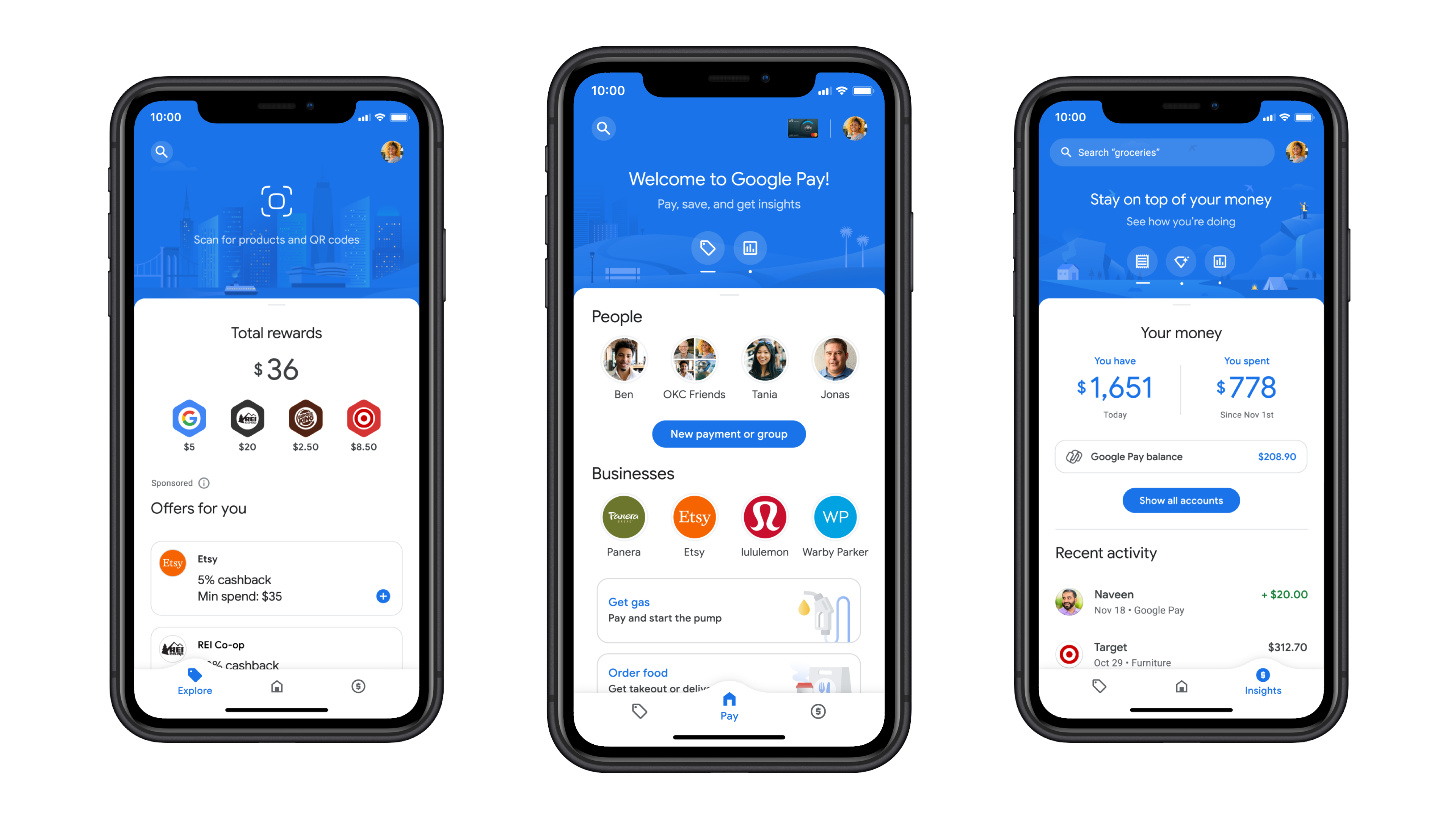
“What we’re doing in this new Google Pay app, think of it is combining three things into one,” Google director of product management Josh Woodward said as he walked me through a demo of the new app. “The three things are three tabs in the app. One is the ability to pay friends and businesses really fast. The second is to explore offers and rewards, so you can save money at shops. And the third is getting insights about your spending so you can stay on top of your money.”

Paying friends and businesses was obviously always at the core of Google Pay — but the emphasis here has shifted a bit. “You’ll notice that everything in the product is built around your relationships,” Caesar Sengupta, Google’s lead for Payments and Next Billion Users, told me. “It’s not about long lists of transactions or weird numbers. All your engagements pivot around people, groups, and businesses.”

It’s maybe no surprise then that the feature that’s now front and center in the app is P2P payments. You can also still pay and request money through the app as usual, but as part of this overhaul, Google is now making it easier to split restaurant bills with friends, for example, or your rent and utilities with your roommates — and to see who already paid and who is still delinquent. Woodward tells me that Google built this feature after its user research showed that splitting bills remains a major pain point for its users.

In this same view, you can also find a list of companies you have recently transacted with — either by using the Google Pay tap-and-pay feature or because you’ve linked your credit card or bank account with the service. From there, you can see all of your recent transactions with those companies.

Image Credits: Google

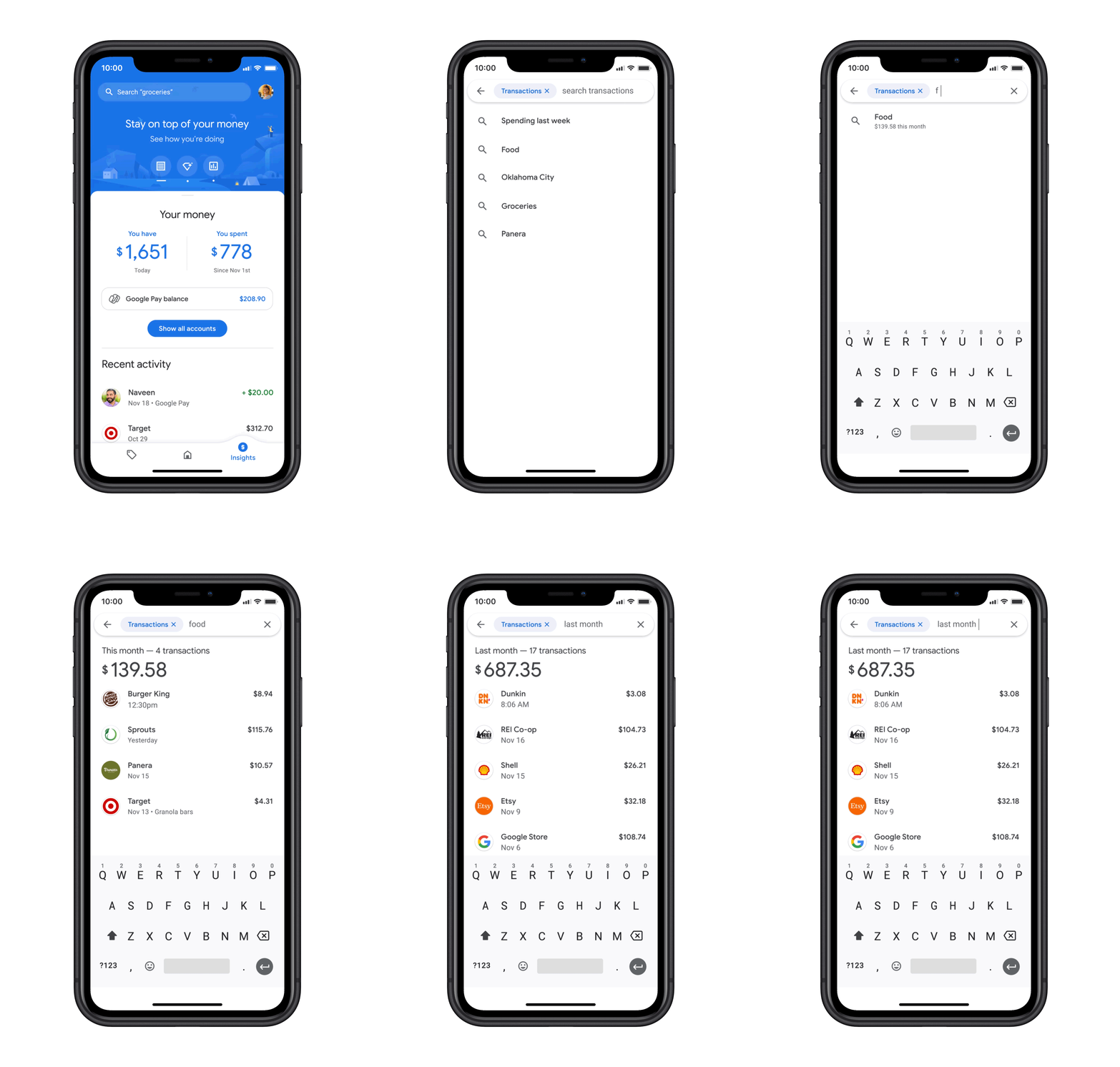
Maybe the most important new feature Google is enabling with this update is indeed the ability to connect your bank accounts and credit cards to Google Pay so that it can pull in information about your spending. It’s basically Mint-light inside the Google Pay app. This is what enables the company to offer a lot of the other new features in the app. Google says it is working with “a few different aggregators” to enable this feature, though it didn’t go into details about who its partners are. It’s worth stressing that this, like all of the new features here, is off by default and opt-in.

Image Credits: Google

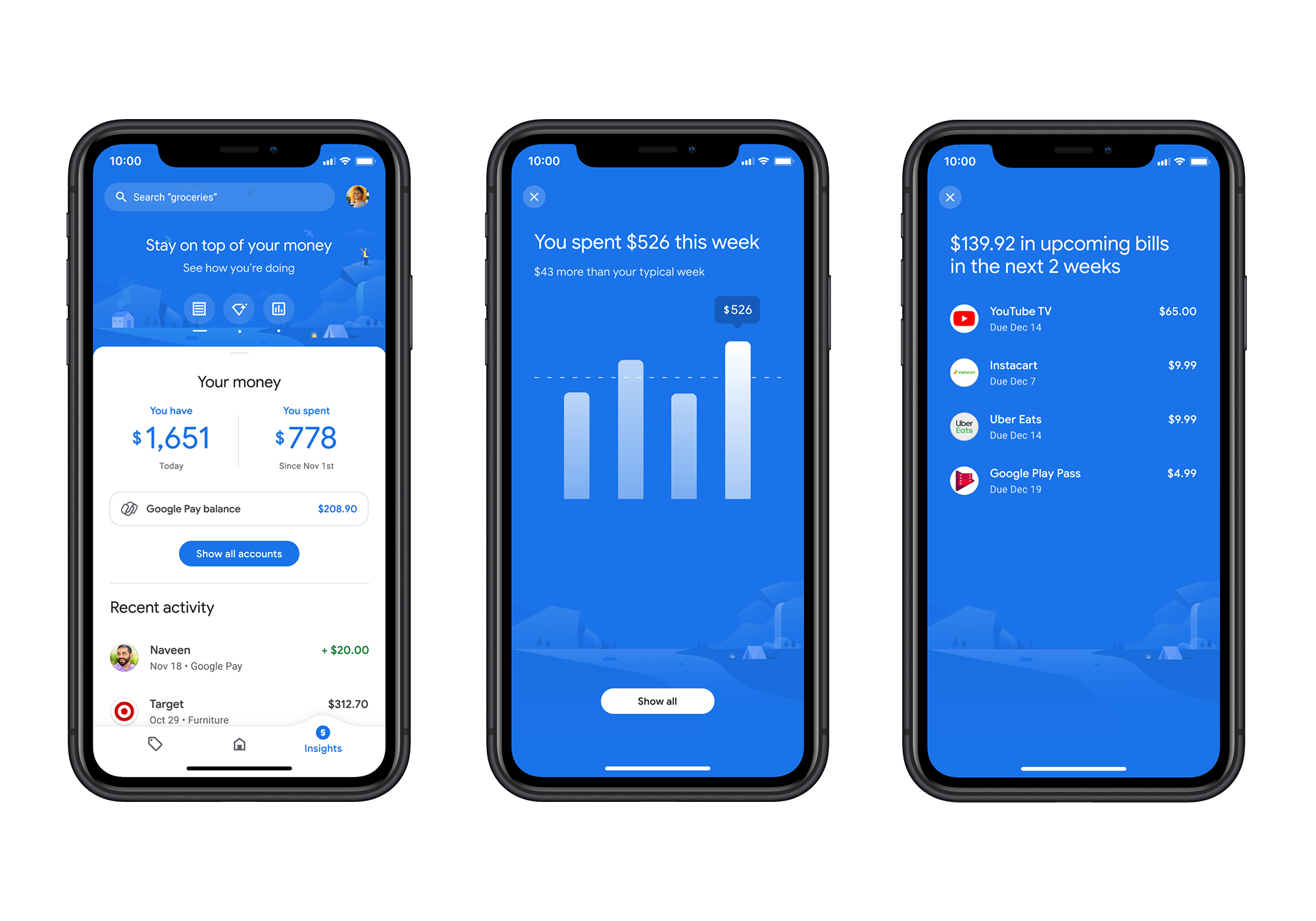
The basic idea here is similar to that of other personal finance aggregators. At its most basic, it lets you see how much money you spent and how much you still have. But Google is also using its smarts to show you some interesting insights into your spending habits. On Monday, it’ll show you how much you spent on the weekend, for example.

“Think of these almost as like stories in a way,” Woodward said. “You can swipe through them so you can see your large transactions. You can see how much you spent this week compared to a typical week. You can look at how much money you’ve sent to friends and which friends and where you’ve spent money in the month of November, for example.”

This also then enables you to easily search for a given transaction using Google’s search capabilities. Since this is Google, that search should work pretty well and in a demo, the team showed me how a search for ‘Turkish’ brought up a transaction at a kebab restaurant, for example, even though it didn’t have ‘Turkish’ in its name. If you regularly take photos of your receipts, you can also now search through these from Google Pay and drill down to specific things you bought — as well as receipts and bills you receive in your Gmail inbox.

Also new inside of Google Pay is the ability to see and virtually clip coupons that are then linked to your credit card, so you don’t need to do anything else beyond using that linked credit card to get extra cashback on a given transaction, for example. If you opt in, these offers can also be personalized.

Image Credits: Google

The team also worked with the Google Lens team to now let you scan products and QR codes to look for potential discounts.

As for the core payments function, Google is also enabling a new capability that will let you use contactless payments at 30,000 gas stations now (often with a discount). The partners for this are Shell, ExxonMobil, Phillips 66, 76 and Conoco.

In addition, you’ll also soon be able to pay for parking in over 400 cities inside the app. Not every city is Portland, after all, and has a Parking Kitty. The first cities to get this feature are Austin, Boston, Minneapolis, and Washington, D.C., with others to follow soon.

It’s one thing to let Google handle your credit card transaction but it’s another to give it all of this — often highly personal — data. As the team emphasized throughout my conversation with them, Google Pay will not sell your data to third parties or even the rest of Google for ad targeting, for example. All of the personalized features are also off by default and the team is doing something new here by letting you turn them on for a three-month trial period. After those three months, you can then decide to keep them on or off.

In the end, whether you want to use the optional features and have Google store all of this data is probably a personal choice and not everybody will be comfortable with it. The rest of the core Google Pay features aren’t changing, after all, so you can still make your NFC payments at the supermarket with your phone just like before.