‘The Millionaire Matchmaker’ Meets Silicon Valley: WePay CEO Looks For Love On Reality TV

Screen Shot 2011-11-25 at 4.07.39 AM

Dude I know this happened a month ago but I’ve been staying at my parents’ now for three days and we’ve already had the “You should start thinking seriously about your relationships” conversation because I will soon be no longer in my twenties and if I don’t get married asap I will be sent to the glue factory. So it’s still relevant.

Ugh, society totally pressures you to find a life partner, even if you’re a dorky/crazy workaholic and can’t ever see yourself settling down BECAUSE what if when you did, the kid came out all Asperger’s? Because you are clearly on the spectrum and whoever your partner is would totally be on that level too, hypothetically.

Which is why I give mad props to WePay’s Bill Clerico, for stepping outside our tech nerd echo chamber and heading to Hollywood to find love, as a guest on Patti Stanger’s reality TV show, “The Millionaire Matchmaker.“ Deemed “better looking than Mark Zuckerberg,” Clerico tries out “fishing in a different pond,” telling Stanger, “My life and work are very closely intertwined” — Used that exact quote earlier tonight, no kidding.

Stanger drops some wisdom, namely “Nerds with sex appeal = husband,” which, coupled with Jenny McCarthy’s line (yes she’s in there too), “If they’re not overweight then there’s hope,” pretty much should be your dating philosophy, single ladies. In high school my favorite joke was, “Q: What do you call a nerd in ten years? A: Boss.” Also, Honey.

The whole thing is worth watching, for how achingly human everybody is and how much of a sport Clerico (who I’ve loved ever since he gave me a ride home from Startup Soccer) proves to be — especially when artificially surrounded by a bunch of millionaire-seeking missiles in bikinis.

Also: WePay is also trying to buy Yahoo, or raise money for clean water — You can help them out here. 

Via: WESLEY ZHAO


The Roundabout Tapes – RjDj Plans To Game Reality With Sound [TCTV]

photo_1_264d4bdf1ec2fea01083395f1f439544

RjDj’s Michael Breidenbruecker, also a Founder last.fm, has certainly opened up the avenues for sound apps on mobile platforms. The startup’s apps have become platforms for musicians, but are gradually evolving into augmented reality mobile apps.

Most recently the company partnered with screenwriter Christopher Nolan on Inception: The App, which reached 4 million downloads. The amount of “dreamtime” (time spent listening to the app ) was over 94 years. The average listening time per session is over 30 minutes. This was not your average app!


Apple’s Black Friday Deals Go Live: Up To $61 Off On iPad 2, $101 Off On Macs

applepromo

I’m not convinced these are discounts you’ve really been ‘waiting 364 days for’, but Apple’s Black Friday deals have gone live this morning. The prices leaked earlier, but hey.

If you were looking at buying a new Mac, iPod or the latest iPad, now’s the time, even if the discounts aren’t really that big in terms of percentages. You can also save some cash on a bunch of accessories, ranging from peripherals to iPad Smart Covers and even iTunes Gift Cards.

The iPhone gets no Black Friday love.

No worries: there are other gadgets that we think you should look for on Black Friday.

Third-party offerings are also on display on Apple’s site, with some interesting deals: Jawbone’s JAMBOX can be bought for $148 instead of $199.95 (a $51.95 discount) and the lovely Parrot AR.Drone is available for purchase at a price of $248 instead of $299.95 (also a $51.95 cut).

Here’s a limited list of promotions Apple is running today (and today only):

iPad 2

Store link

$41 off on 16GB — ($458 instead of $499)
$51 off on 32GB — ($548 instead of $599)
$61 off on 64GB — ($638 instead of $699)

iPod touch

Store link

$21 off on 8GB — ($178 instead of $199)
$31 off on 32GB — ($268 instead of $299)
$41 off on 64GB — ($358 instead of $399)

MacBook Air

Store link

$101 off on all models:

11-inch, 64GB — ($898 instead of $999)
11-inch, 128GB — ($1,098 instead of $1,199)
13-inch, 128GB — ($1,198 instead of $1,299)
13-inch, 256GB — ($1,498 instead of $1,599)

MacBook Pro

Store link

$101 off on all models:

13-inch, 2.4 GHz — ($1,098 instead of $1,199)
13-inch, 2.8 GHz — ($1,398 instead of $1,499)
15-inch, 2.2 GHz — ($1,698 instead of $1,799)
15-inch, 2.4 GHz — ($2,098 instead of $2,199)
17-inch, 2.4 GHz — ($2,398 instead of $2,499)


LuvBook S: Japan Gets Super-Cute “Hello Kitty” Laptop

hk feat

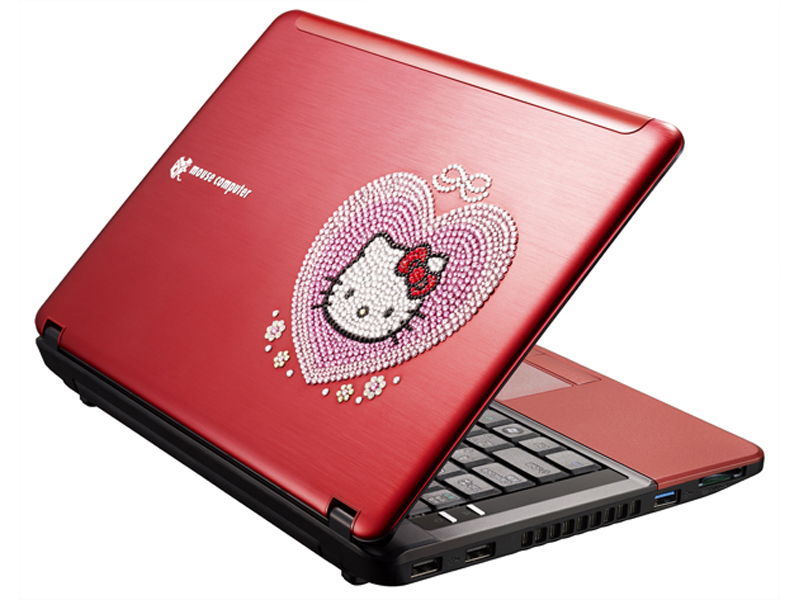
We have covered the one or the other Hello Kitty gadget in the past, but it’s been a while since the last notebook featuring the popular cartoon cat. But now Japan’s Mouse Computer is selling the so-called LuvBook S, [JP], an 11.6-inch laptop with Hello Kitty all over it. It has been co-developed with Hello Kitty maker Sanrio and luxury goods maker Swarovski.

Swarovski designed the body of the laptop (the Hello Kitty face and heart you see below is made of about 1,100 Swarovski stones):

These are the three different wall papers buyers can expect:

Screensaver and box:

Spec-wise, the LuvBook S features an 11.6-inch LCD with 1,366×768, an Intel Core i3-2330M CPU (2.20GHz), a 500GB HDD, 4GB memory, Wi-Fi IEEE 802.11b/g/n, Bluetooth 3.0+HS, a 1.3MP web cam, a USB 3.0 slot, two USB 2.0 slots, an SD card interface, and an HDMI port. The LuvBook S runs on Windows 7 Home Premium (64bit/SP1).

Mouse Computer has already started selling the device in Japan (price: US$900). Visit specialized sites like the Japan Trend Shop or Flutterscape if you really want to get one shipped outside Japan.


Tired Of Facebook? Try Facedrink Energy Shot Before Zuck Sues

facedrink1

“It gives you social energy. It gives you taste of friendship.” It’s Facedrink! And you better go buy some because it will be sued out of existence any minute now. Following in the footsteps of the unofficial Mark Zuckerberg action figure, some dude named Barry Moustapha (ROFLCOPTER) has created a lawyer-magnet energy drink. It’s themed with Facebook colors and proudly displays an “Add as Friend” button on the label. I’d be suspicious this was a hoax, but there’s a photo of a real bottle and reviewers confirm it leave a worse taste in your mouth than getting Poked by your dad.

The gloriously named Barry Moustapha trumpets “Facedrink achieves the goal that I set out for by providing you with the extra energy needed to be social or to deal with your boss.” Reviewers on Amazon seem to disagree, though:

“All my friends drank it up, and it starting to feel odd being the only person in line (besides my friend Tom) who was buying MyDrink anymore…Over time, I think I got too comfortable with it. I started drinking it with my parents, my boss, people I hadn’t seen since high school. Being too casual with FaceDrink eventually lead me to make some comments regarding my cousin possibly being gay, and my boss being a dick and since then I’ve cut back on who I drink it with. I should just quit it all together, but I might have a mild addiction at this point.”

Facedrink will make a great holiday gift, and an even better collectors item as there’s no way Moustapha’s getting away with this. Facebook successfully trademarked the word “face” specifically to prevent this kind of exploitation of its name. But I think there might be an amicable way to settle this. Facebook, acquire Facedrink, and promptly move their operations into the cafeteria of your swanky new Menlo Park headquarters.

After all, “Whether it is work, school, sports or just getting through the daily routine, Facedrink provides you with a boost of energy to manage it all.”


AAXA’s P4 Pico Projector Puts 80 Lumens In Your Palm

p4_pico_projector_tripod

I’ve gotten to review a few pico projectors, but haven’t had the opportunity to test one from AAXA. This new one, the P4, looks like it could stand up to my favorite so far, the 3M MP160. As 3M did with that device, AAXA sacrifices smallness for brightness, and ends up beating the competition by some margin.

At 80 lumens, the P4 is more than twice as bright as the MP160. That’s still nothing compared to normal stationary projectors, which can produce thousands of lumens, but 80 is more than enough for a nice big screen in a reasonably dim room.

Battery life is a reasonable 75 minutes, which is enough for a presentation or a TV show or two, but no good if you want to watch a movie with your sweetheart out in the woods (or something, I don’t know). The resolution is 1280×800, though, which is better than any other pico projector I know of, and the 750MHz processor should chew through most SD video files, though I doubt it can handle highly compressed 720p; you should probably use an external source for that.

Interestingly, it runs Windows CE apps, not that those are especially common, but it may make a laptop unnecessary if you’re just showing a few graphs or slides.

Hopefully we’ll get our hands on one of these to review. At $399 (on sale for $339 at the moment) it’s not quite an impulse buy, but it is probably the best one of these devices, spec-wise, on the market right now.

[via SlashGear]


Streaming Music Companies: If The Artists Are Starving, Look To The Labels

Chuck_Berry_-_New_Juke-Box_Hits

The distributive potential of the internet has done its part in disrupting the music industry, most visibly via iTunes. But iTunes was always a sort of simulacrum of a record store. Its icon was even a CD. They were providing, like Amazon, a digital abstraction of a physical store.

Where would we be if computers were just digital abstractions of desks full of paper? They were, of course, for a short time, but since then the potential of the home PC has pushed it further and further from the simple desk analogy. Why shouldn’t it be the same in music?

Many readers of this site are already happily signing up for the new music-streaming services of the net, but much of the world, including the music industry, is lagging far behind and blaming the new services when monetization doesn’t work how they expect. The streamers have responded: Hey, don’t look at us.

There are two simple misunderstandings, it seems. One is why the labels are getting any sympathy at all. They agreed to a licensing agreement, after all. And a proportionate amount of income is diverted to each label. That seems like a reasonable proposition, and it must have seemed so to the labels, which not only own part of the streaming companies but must have negotiated the terms. Why is it they get to cry about it now? Did they not understand the concept of streaming music?

It’s possible, actually, that the streaming music services are simply priced too low. $10, $15, $20 per month for unlimited music is a great deal. Should a service like this be a great deal, or should it be “fair”? After all, $0.99 per song wasn’t that revolutionary. Albums cost $12-18 and pricing ended up comparable. The fact that you could buy things song by song changed a lot, but as far as pricing went, it wasn’t actually a bargain. The improvement was in convenience.

But the streamers can’t just start jacking up prices. They’ve set a precedent with this $10 level, and the market likes it. Why wouldn’t they? But it doesn’t strike me as price-equivalent to what we’ve been paying, more or less, for years and years. Sure, prices change. But why they change is a complicated question with many moving parts, and I’m not entirely convinced that $10 for unlimited streaming is a price point that can be maintained.

Relevant to this is the second misunderstanding, which is the value of non-unit sales. Comparisons between income from album sales and income from streaming just don’t make sense. In a way, people are paying for nothing, because at the end of the month, if their subscription lapses, they have nothing to show for it. The labels and Spotify have something to show for it, though, and haven’t in fact given anything away. And people pay again and again for the same content. If I listen to a song this month and then again next month, I’ve paid twice, haven’t I? Or have I? The economics and philosophy of providing streams needs to be settled at an open table so everybody knows what they’re talking about, and things like Lady Gaga’s ridiculous allegations of microscopic payouts can be avoided.

But at the same time, it’s hard to deny that smaller bands, whose sales came largely from iTunes and low-overhead small-scale record sales, are going to be left out in the cold. Should they just tour more? Or should they be pushing for a different, more lucrative licensing agreement? Good luck without major-label clout.

The entire cost of producing music, in fact, needs to be reassessed honestly and openly. The basic price of goods has to do with the cost of producing those goods, and we’re using old numbers. How much would bananas cost if you didn’t have to pay for transport? A lot less, I’m guessing. How much less should music cost now that the costs involved in production have gone down enormously, and the costs of manufacturing and distribution have been, theoretically, almost totally eliminated? Again, probably a lot less.

Getting an honest assessment isn’t going to be easy. The RIAA isn’t exactly forthright on these matters, and naturally has an interest in keeping the perceived value of their product high. In the end, progress always ends up being a net opportunity, which is a nice way of saying that losses in ability or value may occur. The improvement caused by the internet has put thousands of retail and factory employees in the music industry out of work. The RIAA isn’t immune to the same action, the contraction of part of its market, and the sooner it acknowledges this and plans for the future, the better.


50% Of Ecommerce Site Visitors Are Logged In To Facebook

Facebook Ecommerce Shoppers Stay Logged In

Ecommerce sites should consider how they can personalize their sites using Facebook data, as a new study shows 50% of visitors to ecommerce sites are currently logged in to Facebook. Using Facebook social plugins and Connect integrations, sites can leverage Facebook data to show visitors what friends bought or shared, what products relate to their Likes, and which friends they might want to invite. The study was conducted by Sociable Labs, which helps websites implement social functionality, and looked at 456 million visits to over a dozen ecommerce sites catering to different demographics.

A Facebook spokesperson confirmed that ecommerce sites are increasingly adding social features. She shared with us a new statistic: 88% of Internet Retailer Top 200 retail sites are integrated with Facebook.

Sociable Labs’ founder and CEO Nisan Gabbay explained that the target age market for an ecommerce site has surprisingly little influence on the percentage of visitors that were logged in to Facebook. Those aimed at college students were closer to 60%, but even those with middle aged saw at least 40% of visitors logged in.

The data was collected using the FB.getLoginStatus() API call from sites of Sociable Labs’ analytics and ecommerce integration customers. Gabbay tells me that while some of the studied sites attract early adopters, he has discussed the data with Facebook and the company validated it. Also, despite the fact that his company could benefit from more sites adopting social, the sample size is large enough to decrease the likelihood of bias.

“People look at Facebook’s active user count but don’t quite get how pervasive the service is in people’s lives. It’s there all the time in any activity they do online”, Gabbay says. The stats indicate that there may be less risk of sites offending non-Facebook users by adding social functionality than one might expect, because there just aren’t that many hold-outs any more. There’s also technical ways to detect if a user is logged in, and hide those big blue social plugins if they’re not.

As we enter the holiday season, there will be a critical mass of shoppers taking actions on ecommerce sites. Those willing to develop or license Facebook integrations can use social data to point visitors to the products most relevant to them. This can produce a lot more sales than leaving visitors them to browse aimlessly.


CrunchBase Reveals: Figuring Out Pricing Formulas For Talent Acquisitions With Opani

Screen Shot 2011-11-22 at 2.22.02 PM

Following my post last night about our effort to use CrunchBase in more ways on TechCrunch, some readers have shared how they’re already using it. One was Dirk Neumann from “social supercomputer” startup Opani, which provides tools to help people more easily analyze large data sets.

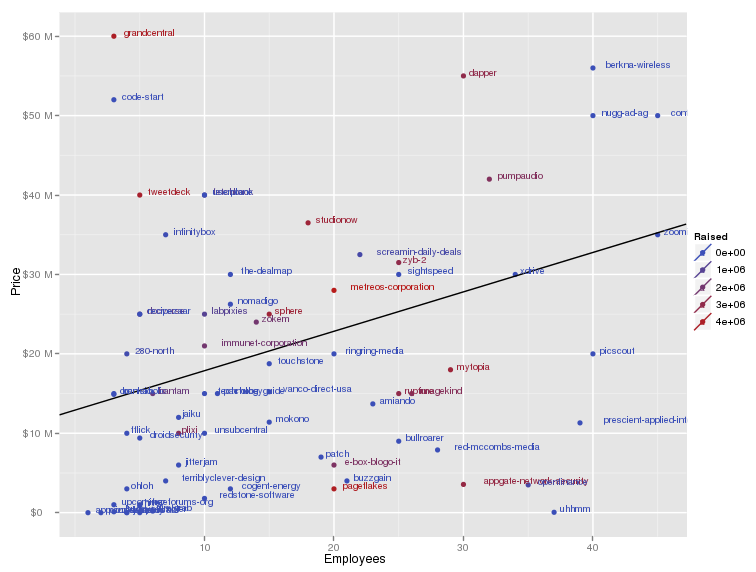
He’s used CrunchBase data to try to come up with a formula for pricing talent in startup acquisitions. His analysis, below, is in response to a recent panel at law firm Orrick, where a number of acquisition heads at major tech companies had noted that there was “no general formula” for doing so.

He identified 71 early-stage acquisitions and 84 late-stage acquisitions in CrunchBase, then further defined the early stage group as startups purchased for below $66 million, with fewer than 50 employees, and investments of less than $5 million. Later-stage companies were defined as having acquisition prices above $66 million and between 50 and 500 employees. The findings are a bit rough, but here they are:

An early-stage startup costs $8.5 million plus $0.5 million per employee. But, you can see that the graph above shows all sorts of outliers, like Grand Central’s giant deal, that confuse the picture. The variation isn’t too surprising when you consider that many early-stage acquisitions are done based on the acquirer having very high hopes for the team and the product being bought.

He also found that the average late-stage startup costs $135 million plus $0.5 million per employee. The graph is far more normal looking. And the big payout beyond employees makes sense when you consider the additional capital and product value that the acquirer believes they’re getting.

Do you have more CrunchBase analysis to share? Let me know: eldon (at) techrunch (dot) com.


Pinterest Is Now Pulling In More Pageviews Than Etsy; Grew 2,000% Since June

Pinterest Vs. Etsy chart

Online pinboard Pinterest is the new hotness. VCs are piling in because it is growing like crazy. How crazy? According to comScore, Pinterest generated 421 million pageviews in the U.S. in October, up 2,000 percent since June when it was at an estimated 20 million. Pinterest, which is still in an invite-only beta, has already surpassed the U.S. pageviews of much more established sites such as Etsy (which grew a healthy 47 percent since June to 348 million pageviews in October).

I am comparing Pinterest to Etsy because, while one is an ecommerce marketplace and the other is more of a crowdsourced catalog, they both seem to appeal to the same types of people—mostly women interested in design, fashion, and quality products that are not mainstream. Also, from what I can tell anecdotally, Etsy items are very popular on Pinterest.

All of those pageviews are coming from a relatively small number of users. In October, Pinterest had an estimated 3.3 million unique visitors in the U.S., up more than fourfold since June when it was at 608,000. On average, each person on Pinterest generates 128 pageviews a month (a number which will no doubt come down). It doesn’t yet have many users, but they are addicted to the service, which encourages you to “repin” other people’s image-heavy Web clippings (which is like reblogging on Tumblr and similarly generates a ton of internal pageviews as people jump from pinned image to pinned image).

Since so much of what people organize and pin on Pinterest are products, the site is essentially collecting a lot of commercial intent and is in a position to know what types of products to recommend users or what types of ads/deals to show them in the future. But people don’t search on Pinterest. It is a place to discover new products.

My wife is one of those addicts. She is on Pinterest every day, which tells me something. The early adopters are not your typical tech-obsessed early adopters. Investors see the same trends, which is why they think Pinterest is only at the early stages of its growth.


Rate Beautiful Images For Bursts Of Inspiration with DailyModi

DailyModi Screen

We crave inspiration. When energy is low or there’s a pause in our day, we turn to Facebook, Twitter, or Instagram. But there, stimulation is drowned in exhausting, endless streams of content. DailyModi is a brand new free iPhone app committed to structuring inspiration into bursts of discovery. With addictive finger swipes, you rate your way through 3 daily slideshows of paintings, shoes, typography, and more. Compare preferences with friends, and buy or learn about what you like. Leave feeling satisfied, and return tomorrow for more.

DailyModi’s co-creator Gregor Hochmuth believes “It’s about creating a daily ritual. You know there’s content waiting for you. And it’s very quick and simple, you can play in two minutes.” Hochmuth explained that sites like Pinterest and FFFOUND are beautiful and different each time you visit, but there’s no prescriptive way to use them. By giving DailyModi more direction — there’s just 3 sets of 20 images to rate each day — the app pairs inspiration discovery with a sense of accomplishment when you complete the available sets.

Modi, Inc  was founded after Hochmuth, a product manager on Chrome, and the eponymous Shaun Modi, an interaction designer who created the G+ circle editor, both left Google. They first released PlayModi last month, a website that lets you create your own image or text sets, and browse those of others. AirBnB now uses a PlayModi Facebook Page app to let fans rate its top 40 destinations with their arrow keys. However, Hochmuth says “People really like the swipe gesture for rating things” and with the backend in place set out to built their mobile app.

With DailyModi, you login through Facebook so it knows your gender and can tailor the fashion sets accordingly. You’re then shown the day’s 3 sets. They’re like slideshows, but you have to swipe up to like or down to dislike in order to proceed. When you complete a set you can share it as well as see the percentage, count, and Facebook friends who liked each image. If enabled, Push notifications improve retention by informing users when new sets have been added.

You can then click through to buy the fashion products on sites like Zappos, learn about art and culture images through Pinterest, or just save any of the images to your photo library. This last feature makes DailyModi a killer way to find cool phone wallpapers, especially since all your liked images are collected in a shoebox on the app’s home screen. There’s still some rough edges. Set results take a few seconds to load, and there’s currently no way to share individual images, but these seem easily remedied. Its biggest challenge will be getting users actually make it a ritual, because since it lacks direct communication channels there’s less urgency to open it than a social network.

In addition to monetizing through affiliate fees on products bought through the app, Modi has had a lot of interest from brands. They want to use it as a distribution and feedback channel for product promotion and market research. They could pay to offer a branded set, and then use the like and dislike data collected to refine their marketing or design strategies. I can foresee brands being eager to create sets and replace their slideshows with Modi embeds that can collect this valuable data.

DailyModi is a breath of fresh air in so many ways. The finite set size keep you from feeling overwhelmed, and the daily turnover prevents guilt. There’s no overt prompts to share or produce content, so there’s no shame in spectating. What’s most innovative is that with DailyModi, inspiration isn’t a side effect of content consumption, it’s the explicit purpose.


RIM Shows Off PlayBook Email And Calendar Apps

IMG_00000057-600x451

One of the primary criticisms of the BlackBerry PlayBook, and rightly so, was the omission of native email, contacts, and calendar applications. It was troubling then that they hadn’t considered these primary activities as important to address natively, and it’s troubling that it has taken then so very long deliver these elementary functions.

RIM originally said these reviews weren’t “fair,” but regardless of the quality of the OS and the device itself (both of which seem perfectly fine), it’s criminal to subject your loyal users to such a long wait for an email client competitive with Apple and Google. But at least the apps are being finalized, and were just showed off at the BlackBerry Innovation Forum.

BlackBerryCool has posted some quick shots of the apps. They look clean and more or less as you’d expect, and much better in my opinion than the early versions they showed at BlackBerry World. I have no trouble believing they’re as polished as the rest of the OS, and I look forward to seeing how they have integrated off-screen gestures and the like. Ideally, the PlayBook should be as much of an email and messaging powerhouse as its handset brethren.

Unfortunately the apps won’t be arriving until February 17th, and there won’t be a native BBM client by then either. But there’s a good chance they’ll be included as part of a major update that makes the Playbook, which is in some ways ahead of its time, a more realistic competitor.

The PlayBook’s keyboard accessory should be hitting around the same time as well, which should aid in productivity.

[via CrackBerry]


2011 Holiday Gift Guide: Five Phones To Take Into 2012

giftguide11-bug

The holiday season is upon us, and no gift keeps on giving quite like a smartphone. Think about it — there’s probably nothing in your dear friend or family member’s life that he or she will use on a regular basis more than their trusty new smartphone. And if you happen to be a super controlling boyfriend or girlfriend, just think of this spent cash as the best possible way to keep dibs on your sweetie pie. Prices range from $50 to a whopping $300 so there should be something here for everyone. If not, check out the BlackBerry lineup at your nearest retailer because you surely won’t see it anywhere here.

Motorola Droid RAZR

The Droid RAZR currently takes the cake as the thinnest smartphone in the world. If appearances matter to your loved one, this is the phone you should be looking at. It’s super thin at just 7.1mm thick, with heavy-duty Kevlar fiber back casing and a unique shape with squared off corners. I have yet to see any Android-powered hardware differentiate itself as much as the RAZR, but under the hood things get even more impressive.

The phone is powered by a dual-core 1.2GHz processor, runs Android 2.3 Gingerbread and packs support for Verizon’s 4G LTE network. On the back you’ll find an 8-megapixel shooter capable of video capture in 1080p along with a 1.3-megapixel front-facing cam for video chat. Up front you can’t help but notice that 4.3-inch 540×960 Super AMOLED display and you’ll also find a number of pretty sweet pre-loaded apps out of the box too, such as Netflix HD and Motorola’s MOTOCast app.

The Droid RAZR will go for $299 on-contract from Verizon.

Samsung Galaxy S II

The Galaxy S II isn’t quite as new as some of the others you’ll find here (launched in late September), but it’s probably one of the most solid Android handsets I’ve used to date. Much like the RAZR, the GS II is pretty thin itself, with a 8.89mm waist line and rounded corners not unlike the iPhone 4. It sports a Super AMOLED Plus screen (4.3-inch at AT&T, 4.52-inch at Sprint/T-Mobile), runs Android 2.3 Gingerbread and features a 1.2GHz dual-core processor under the hood.

The GS II also has its photography bases covered, with an 8-megapixel flash-equipped rear camera (capable of video capture in 1080p) and a 2-megapixel front-facing shooter for video chat. You’ll also find support for HDMI out in case you want to relive the Holiday memories on a big screen.

The beauty of the GS II as a gift is that it’s available on three of the four major networks, including Sprint, AT&T and T-Mobile. If for whatever reason you’re able to start your loved one on a fresh contract with a new carrier, I’d suggest nabbing AT&T’s version of the Galaxy S II. T-Mobile’s model doesn’t keep the same killer design dress as the others, and at 4.3-inches the AT&T model’s screen has a greater pixel density than Sprint’s.

You’ll be able to nab the Samsung Galaxy S II for $199 on-contract from both Sprint and AT&T, though T-Mobile’s Qualcomm processor-packin’ version will go for a tad more at $229.99.

Samsung Stratosphere

The Samsung Stratosphere is stuck in the middle (with you). Not only does it have the median price point of all of our gift guide options, but it also seems stuck somewhere in between the future and the past. By that I mean, it has all the specs of any solid mid-to-high-end handset, but throws it back a bit in the keyboard department with a physical sliding five-row QWERTY. In fact, this is the only phone running on Verizon’s 4G LTE network to have a real-life keyboard so if your puddin’ pop simply can’t stand using your touchscreen keyboard, this may be what you’re looking for.

Past the whole keyboard thing, you’ll also find a 4-inch 480×800 Super AMOLED display, a 5-megapixel rear-facing camera with flash, a 1.3-megapixel front-facing shooter for video chat, and a 1GHz processor under the hood. Unfortunately, there’s no 1080p video capture on this bad boy, but the trade-off for keyboard-packing LTE speeds is worthwhile for anyone who’s still hooked on real buttons.

You can find the Samsung Stratosphere at Verizon for $149.99 on-contract.

Apple iPhone 4

This year, if you’d prefer to get a stunned gleeful expression instead of the usual “you really shouldn’t have,” I’d suggest the affordably priced iPhone 4. I don’t want to sound like some Apple evangelist or anything, but there are plenty of closeted fanbois out there just waiting for the right excuse to go buy an iPhone. It’s only a matter of time. So why not just nudge the process along with one of the most popular smartphones of all time.

Specs wise we’re looking at a 3.5-inch 960×640 Retina display, a 1GHz A4 processor, a 5-megapixel rear-facing camera capable of 720p video capture, and a VGA front-facing camera for video chat. But we all know it’s about much more than that. Along with some of the most expensive and high-quality hardware on the market, the iPhone 4 will ship with iOS 5 which comes with all kinds of awesome features like iMessage, a super slick Notfications Center, and iTunes Wi-Fi Sync. Plus, no one will be able to tell whether it’s the brand new 4S or the 4, which is a bit shallow but aren’t we all?

The iPhone 4 would be a great gift at its original price, but for $99 you’re pretty much out of excuses.

Samsung Focus Flash

Android and iOS are wonderful, sure, but if you’re anything like me you’re ready for a change. Luckily, there’s a new kid in town and he’s actually much cooler than you’d think. Windows Phone 7.5 is a welcome disruption in the mobile OS landscape, with threaded conversations across almost all messaging platforms, Xbox Live integration, and a tempting live-tile UI. But the Samsung Focus Flash is more than a mere vessel.

Even though it’s made of mostly plastic, a few hints of metal and a brushed dark grey finish give it a much more expensive feel, especially given the fact that the phone is a bit heftier than you’d expect. It sports a 3.7-inch Super AMOLED display, a 1.4GHz single-core processor, a 5-megapixel rear camera with LED flash and a front-facing camera for video chat. Plus, the IE9 browser in Mango is super snappy, and beat out my iPhone 4S just about every time in testing.

It sure doesn’t feel like it, but the Samsung Focus Flash costs $49.99 on-contract at AT&T.


Google Announces Plans To Shutter Knol, Friend Connect, Wave, And More

largeNewGoogleLogoFinalFlat-a

Since Google CEO Larry Page took the helm this past spring, one of the company’s most visible initiatives has been to trim and shut down its products that haven’t taken off. These have included Aardvark, Google Desktop, Fast Flip, Code Search, Buzz, Jaiku, and even Google Labs — and today, it’s announcing a new batch of products that will be shut down in the coming months.

Among the casualties (some of which had previously been announced): Google’s Wikipedia challenger, Google Knol, Google Friend Connect (which is being supplanted by Google+), and Google Wave — which Google ended development on a year ago and will soon close down entirely.

Knol, in particular, comes as something of a surprise to me — because I figured Google had already shut it down. The site first launched back in 2008 to much fanfare, as Google introduced a potential Wikipedia challenger that would allow article contributors to monetize their content (the idea being that if you wrote content worth reading, you could make some money off of it). But the product languished, and back in July 2010 some extended downtime made us wonder if Google had forgotten about it.

Google didn’t seem to allocate many resources to the project, and it certainly didn’t put much emphasis behind it from a press standpoint — I can’t remember the last time I was pitched on a new Knol feature or milestone. Knol will live on at Annotum.org, which is powered by WordPress and was built in collaboration with Solvitor and Crowd Favorite.

Here’s the full list of products being shuttered, from Google’s blog post:

  • Google Bookmarks Lists—This is an experimental feature for sharing bookmarks and collaborating with friends, which we’re going to end on December 19, 2011. All bookmarks within Lists will be retained and labeled for easier identification, while the rest of Google Bookmarks will function as usual. As Lists was an English-only feature, non-English languages will be unaffected.
  • Google Friend Connect—Friend Connect allows webmasters to add social features to their sites by embedding a few snippets of code. We’re retiring the service for all non-Blogger sites on March 1, 2012. We encourage affected sites to create a Google+ page and place a Google+ badge on their site so they can bring their community of followers to Google+ and use new features like Circles and Hangouts to keep in touch.
  • Google Gears—In March we said goodbye to the Gears browser extension for creating offline web applications and stopped supporting new browsers. On December 1, 2011, Gears-based Gmail and Calendar offline will stop working across all browsers, and later in December Gears will no longer be available for download. This is part of our effort to help incorporate offline capabilities into HTML5, and we’ve made a lot of progress. For example, you can access Gmail, Calendar and Docs offline in Chrome.
  • Google Search Timeline—We’re removing this graph of historical results for a query. Users will be able to restrict any search to particular time periods using the refinement tools on the left-hand side of the search page. Additionally, users who wish to see graphs with historical trends for a web search can use google.com/trends or google.com/insights/search/ for data since 2004. For more historical data, the “ngram viewer” in Google Books offers similar information.
    Google Wave—We announced that we’d stopped development on Google Wave over a year ago. But as of January 31, 2012, Wave will become read-only and you won’t be able to create new ones. On April 30 we will turn it off completely. You’ll be able to continue exporting individual waves using the existing PDF export feature until the Google Wave service is turned off. If you’d like to continue using this technology, there are a number of open-source projects, including Apache Wave and Walkaround.
  • Knol—We launched Knol in 2007 to help improve web content by enabling experts to collaborate on in-depth articles. In order to continue this work, we’ve been working with Solvitor and Crowd Favorite to create Annotum, an open-source scholarly authoring and publishing platform based on WordPress. Knol will work as usual until April 30, 2012, and you can download your knols to a file and/or migrate them to WordPress.com. From May 1 through October 1, 2012, knols will no longer be viewable, but can be downloaded and exported. After that time, Knol content will no longer be accessible.
  • Renewable Energy Cheaper than Coal (RE<C)—This initiative was developed as an effort to drive down the cost of renewable energy, with an RE<C engineering team focused on researching improvements to solar power technology. At this point, other institutions are better positioned than Google to take this research to the next level. So we’ve published our results to help others in the field continue to advance the state of power tower technology, and we’ve closed our efforts. We will continue our work to generate cleaner, more efficient energy—including our on-campus efforts, procuring renewable energy for our data centers, making our data centers even more efficient and investing more than $850 million in renewable energy technologies.


New Kinect For Windows Adds Motion Control To The Common PC

Folks who want to connect their Kinect to their PCs can now use specially-designed hardware to add real-time, 3D tracking to programs, games, and research projects. Using the Kintect SDK hackers can add the Kinect to nearly any hardware.

Improvements include a new “Near Mode” that allows for objects at about 50 centimeters away from the sensor to register in 3D space, the first step to adding Kinect functionality to a desktop computer.

Microsoft also announced the Kinect Accelerator, a software startup incubator that will give 10 companies $20,000 each and the chance to pitch their idea to investors.

No pricing or availability yet, but I’m definitely intrigued. You can read more here.