eBay: PayPal Mobile Payment Volume Up Over 500 Percent On Thanksgiving Day

ebay

As we heard earlier today, Thanksgiving proved to be a lucrative day for online retailers. IBM reported online Thanksgiving 2011 sales were up 39 percent over Thanksgiving 2010, with mobile shopping on the rise. eBay and PayPal are seeing similar trends. PayPal Mobile just announced a 511 percent increase in global mobile payment volume when compared to Thanksgiving 2010.

On Thanksgiving in the U.S., consumers shopped on mobile most frequently between 6:00 p.m. and 7:00 p.m. PST. Around the world, consumers shopped on mobile most frequently between 1:00 p.m. and 2:00 p.m. PST.

There was a more than three-fold (350%) increase in the number of global customers shopping through PayPal mobile on Thanksgiving 2011 compared to last year. These shoppers were mainly located in New York, Houston, Los Angeles, Miami and Chicago.

eBay says that the amount shoppers in the U.S. that bought and spent via eBay Mobile more than doubled this Thanksgiving over last year. GSI Commerce saw a more than three-fold (345%) increase in U.S. mobile sales this Thanksgiving compared to 2010. And Searches through the local product listings platform Milo increased 557% percent over Thanksgiving Day 2010.

For eBay, the busiest eBay Mobile shopping hour on Thanksgiving was between 6 and 7 p.m. PST. The five most popular categories shopped via eBay Mobile, excluding vehicles (by number of sold items) were Clothing, Shoes & Accessories; Cell Phones & PDAs; Jewelry & Watches; Collectibles and Toys & Hobbies.

In electronics, the top purchases items yesterday were iPhone Accessories, the black Apple iPhone 4 (16GB), and the Apple iPod Touch 4th Generation (8GB).

The dramatic rise in payment volume via mobile phones isn’t particularly surprising considering all the hype around mobile shopping this holiday season. But a 500 percent increase in payment volume for PayPal is still impressive for mobile shopping and we haven’t even seen Black Friday or Cyber Monday numbers yet. Stay tuned.


Walmart’s Black Friday Disaster: Website Crippled, Violence In Stores

Walmart Black Friday Website

Fire sales turned into a firestorm for Walmart this morning as the company’s web servers buckled under Black Friday traffic. Shoppers from around the country waited until the middle of the night for sales only to experience broken checkout pages, emptied shopping carts, and login errors. This caused their desired items to go out of stock before they could buy them, leading to mass frustration and ill will towards the discount store chain. Meanwhile at its physical stores, 20 people were pepper sprayed by a fellow customer, and 2 people were shot outside separate locations. Walmart will need to sort out its servers in preparation for the upcoming Cybermonday blitz or it risks losing customers to Amazon.

We’ll let traditional news outlets cover the offline violence and focus here on Walmart’s web fiasco. Disgruntled online shoppers flocked to the GottaDeal.com forums to voice complaints about Walmart’s website problems. It’s unclear exactly how widespread the issues were, but the forums had complaints coming in every minute at one point last night from customers in Florida, Mississippi,  New York and many other places.

Many expected deals to go live at Midnight local time only to have to wait up until 3am EST. Visitors then feverishly filled shopping carts but suddenly found them empty when they went to checkout. Others were confronted with the error message “We’re having temporary difficulties arriving at the destination you requested”. Login problems also arose, with users being asked to enter their credentials when already signed in. One customer reported that they complained about the checkout disruption on Walmart’s Facebook Page but later found their post deleted.

The entire Walmart site does not appear to have crashed. By keeping the site up despite the issues, Walmart may have sought to conceal the errors and avoid press coverage of the discontent. Loyal customers said they hadn’t had such problems since 2006 when Walmart experienced a similar breakdown of its site. The company pulled in $418 billion in revenue during the 2011 fiscal year, so today’s disruption could have cost it a lot of money.

While it might be too late to save Black Friday, Walmart better be scrambling to fix its website for Cybermonday, the biggest online shopping day of the year, just 36 hours away. The corporation acquired two startups Kosmix and OneRiot this year and formed its Silicon Valley-based @WalmartLabs in an effort to improve its ecommerce offering. However, it’s competing with powerhouse Amazon, whose cloud hosting division may protect it from the outages that plagued Walmart today.

If the errors persist on Cybermonday, shoppers may seek out a more reliable ecommerce solution. When customers post “I’m so frustrated I’m going to cry” and “an hour and a half of nonsense. shame on you Walmart!”, something has to change.

Update 3:3o pm PST: We’ve learned that Amazon online ordering also experienced an outage this morning as well. Both Amazon and Walmart should expect record traffic this weekend through Cybermonday.


(Founder Stories) Bump’s David Lieb On Getting To 60 Million Downloads

Founder Stories Lieb

If you find traditional methods of exchanging contact information a bit lacking, Bump offers an updated alternative. Bump is an app that allows users to automatically exchange contact information—along with photos and other items—after bumping fists with smartphones in hand. Although it seems like the information passes between the phones, the trick is that it actually goes up to the cloud after being triggered by the phone’s accelerometer.

In his first Founder Stories interview with host Chris Dixon, Bump co-founder and CEO, David Lieb relates how he conceived the idea for Bump one week into business school at the University of Chicago. He met co-founder, Jake Mintz at the same time and along with their third co-founder, Andy Huibers began building on “nights and weekends” during ”the fall of 2008.” By spring of 2009 Bump launched, and has since been downloaded more than 60-million times, he says, with 10 to 12 million active users in the last 30 days.

Lieb admits his team caught a lucky break during Bump’s early days of attracting users. “We were the billionth app [downloaded] and that got us kind of promoted by Apple.” It “started this word of mouth distribution engine that just won’t stop.” He goes on to say that “70% of our downloads come from direct word of mouth.” The company has “spent a total of $42 on marketing.”

Make sure to watch the entire video to hear additional insights, including Lieb’s pointed views on viral marketing and why he fled corporate America.

Past interviews of Founder Stories featuring David Karp, Fred Wilson, Mike McCue, Laren Leto and many other leaders are here.

Episode II of this interview is coming up.


They’re Rioting Over BlackBerrys In Indonesia (And Other Black Friday Insanity That’ll Make You Fear For The Future)

rim

Black Friday often makes people act absolutely crazy. This is well-documented. Still, you don’t expect to see consumer-driven insanity go down in countries that don’t celebrate Turkey day and its accompanying shopfest. And that’s not where the surprises ended this morning in Indonesia.

A crowd of 3,000 people waited in line today in Jakarta, Indonesia for a new smartphone. In fact, the group got so out of control that riot police had to be brought in to calm the masses.

They weren’t waiting on the new iPhone 4S. Nope, not a random early Indonesian release of the Galaxy Nexus (which would be a surprise in itself), either. These people were waiting on none other than the BlackBerry Bold 9790, RIM’s latest attempt at being competitive in the smartphone arena. Actually, since RIM’s been sucking some fierce wind over here in the States we often forget that BlackBerrys are still one of the most popular brands in other countries.

In any case, RIM may have bitten off more than it could chew this morning promising a 50 percent discount on the handset for the first 1,000 buyers. Turns out, about 3,000 people wanted to be one of those lucky thousand, and when the announcement came that the phone had sold out… Well, things got ugly. According to the Press Association, the masses were “rattling the gates” and later “went crazy” after hearing they would not only miss out on the discount, but the phone entirely.

Here in the said-to-be civilized U.S. of A., things got even more ridiculous. Perhaps taking a cue from the police forces dealing with OccupyWallStreet (or casually pepper spraying cop), a woman in a Walmart took Black Friday shopping to an entirely different level last night in Los Angeles. At 10:20pm, the massive line was let inside the store at which point madness ensued. “People started screaming, pulling and pushing each other, and then the whole area filled up with pepper spray,” Alejandra Seminario told the Daily News.

Yep, pepper spray. Some lady, who we shall henceforth refer to as “casually pepper spraying consumer,” whipped out a pepper spray can and let it rip to keep other (probably crazy) consumers away from the half-off electronics she’d been eyeing.

Seriously. I really don’t even know what to say other than I’m scared, and I’m not having children.


Why Quad-Core?

quadcore

We are entering into a new era, ladies and gentlemen. Well, “era” may not be the right word considering how quickly things change in these here mobile parts, but the fact remains the same: Quad-core mobile processors are here. And the ones that aren’t quite here yet are coming.

While many of our brilliantly geeky readers need no tutorial on the advantages of four processing cores, some of you may be thinking “Uh… OK, why do I care?” So I took it upon myself to place a few calls and get some of the big guns — Qualcomm, Nvidia, and TI — to explain why exactly you should care (or shouldn’t), and what kind of differences technology like this can make in the average user’s daily phone usage.

Right off the bat, there are a few myths we need to squash, the most prominent being the misguided belief that doubling cores automatically doubles processing performance. That’s not so true. Upgrading from a single-core CPU to a dual-core processor yields 50 percent better performance, while upgrading from dual-core to quad-core increases performance by just 25 percent. The second commonly held but utterly untrue belief is that all mobile processors are created equally. These companies actually work extra hard to differentiate themselves, which is difficult when the end-user has little say over which processors get stuck in which devices.

Generally speaking (as in, with no particular brand or model in mind), a quad-core CPU should most noticeably do two things. The first is to improve performance during multi-tasking or use of multi-threaded applications. Web browsing, for example, is a multi-threaded process, as are many advanced gaming applications. Android is also natively multi-threaded. The second noticeable improvement quad-core should yield is an increase in battery life. Now, your average CPU usually only consumes about 15 percent of your battery life during regularly daily usage, so the improvements won’t usually be that staggering. Still, battery life is a big problem right now in mobile and any improvement is a worthwhile one.

Nvidia has been the first to bring quad-core processing to mobile, in the form of its Tegra 3 Kal-El SoC. Aside from the general benefits afforded by four cores, Nvidia specifically differentiates itself with what it calls a Companion core. The Companion core is a patented fifth core that maxes out at speeds of 500MHz. It uses patented technology known as variable symmetry multiprocessing (vSMP), which allows the processor to power cores on and off based on the device’s workload.

The Companion core handles just about everything during low performance tasks and in stand-by mode, like email and monitoring the network for incoming calls. When you start on something more performance-intensive, like web browsing, facial recognition or photo stitching, other cores are powered on to handle the task. This is Nvidia’s way of improving performance while saving battery life, while others have found different ways to make quad-core stand out.

Qualcomm, for example, is about to release its APQ8064 SoC, which has a special trick. Most multicore processors clock up and down at the same time. Qualcomm’s processor, on the other hand, is able to clock one core at the max while clocking the second needed core only to the speed it needs to complete the task.

In other words, since Qualcomm’s processor cores can be clocked individually, a task that overflows on the first core may only need the second core spinning at 60 percent of its max speed. So just like Nvidia’s Companion core hooks you up on the battery life front, so will Qualcomm’s individual clocking technology.

Texas Instruments, however, has yet to outline plans for their quad-core offerings and seems to be sticking with dual-core OMAP SoCs for the time being. That said, TI maintains that its OMAP 5 SoC equipped with a dual-core Cortex A15 processor (and two Cortex M4 cores) is a mature system that is more efficient at handling instructions. Some even refer to it as a quad-core system, though TI itself still calls this a dual-core SoC. And they believe it’ll compete. The company went so far as to say that its smart multi-core architecture actually takes 30 percent more instructions than the Cortex-A9 MPCore’s four processing cores as seen in Nvidia’s Tegra 3.

The truth is this is just the beginning when it comes to the migration toward four cores, and there’ll be plenty more to learn in the coming months.


In Look’s iOS Geo-Tagging App, You Can Put A Bird (Or Pepper Spray Cop) On Something And Just Call It Art

photo (4)

Banksy fans, this one’s for you.

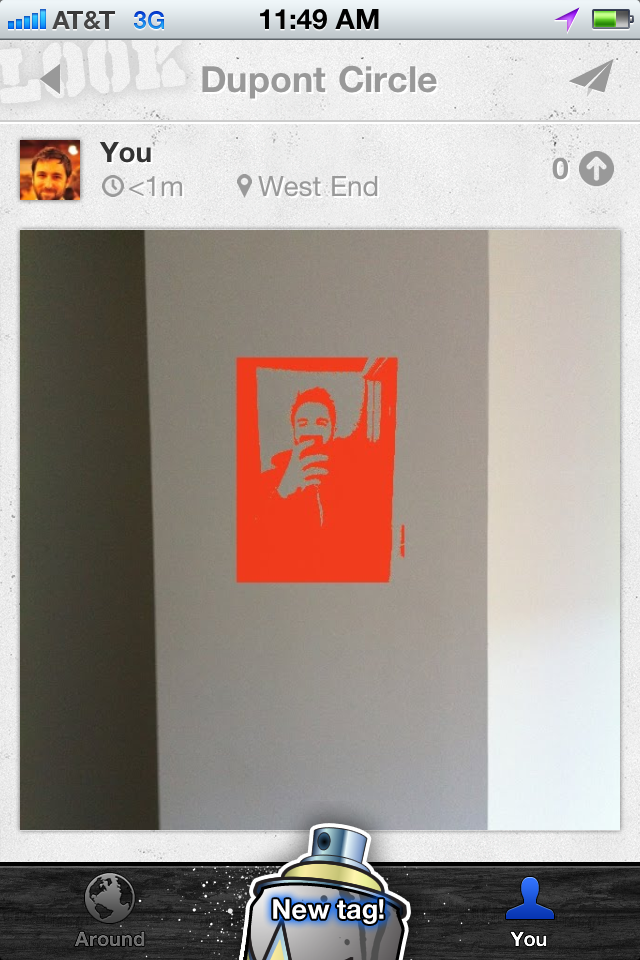
Imagine an iOS photo app that swaps out Instagram filters for stencils from your favorite meme or art piece, then add a little augmented reality, and you’ll get Look.

Built by a couple of the developers behind Sports+ as a side project earlier this month, it’s the latest mobile app to use simple photo-editing and social features to make the world around you more interesting.

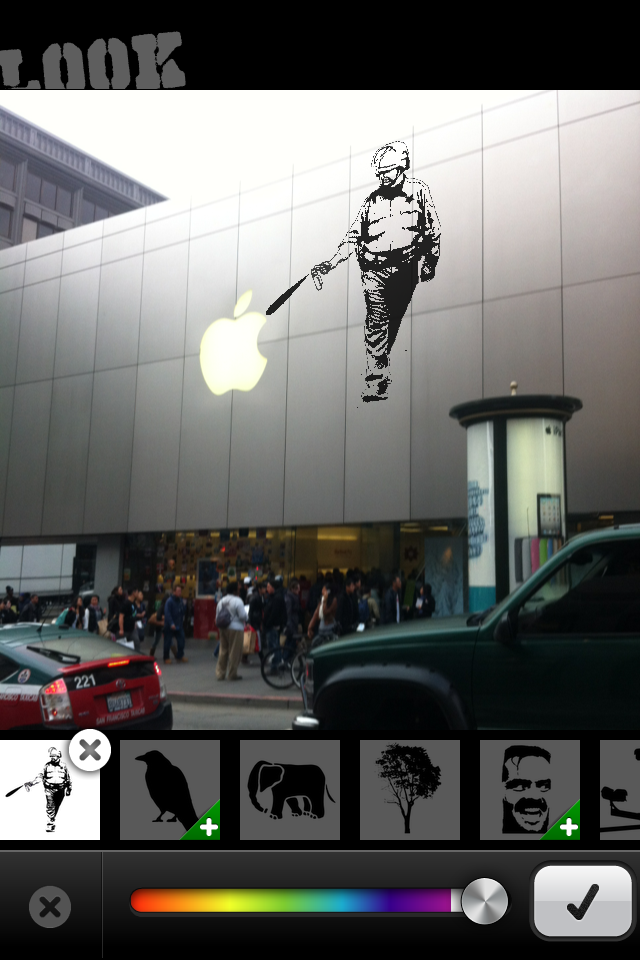
After downloading Look for the first time, you log in with Facebook, then see a camera view with the “Look” stencil overlayed on it. You can then switch to new stencils, available in the first folder at the bottom of the screen, that include the Pepper Spraying Cop, Charlie Sheen’s “Winning!” and a moustache for enhancing photos of your friends.

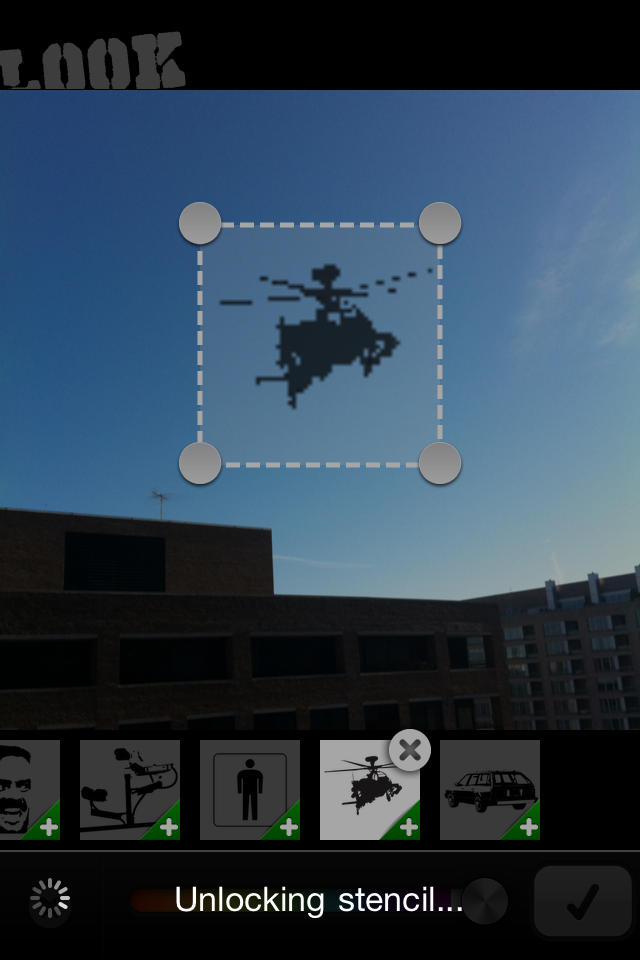
If you want to unlock more stencils (at the price of $0.99 a pop), you can choose from sets of categories like birds based on Portlandia’s “put a bird on it” sketch, various wildlife, movie stars, vehicles, etc…. Or you can make your own: take a photo in its stencil creation view, touch it up, then set it as your stencil and shoot away.

Once you take a photo, you can adjust the color of the stencil and decide if you want to share it on Facebook or with friends or nearby users on the service. Shared photos appear in a reverse-chronological stream like in Instagram, and include location and time information, as well as the option to vote up the ones you like most.

Although Look has begun as a fun side project to leverage existing code, it could have a lot of features in store: a gallery for the images that get the top votes, other sign-on and sharing services besides Facebook, and ways to share and sell your stencils to other users. They’re also planning an augmented reality view, moving beyond the current photo stream to show you other user’s stencils as you walk around. The stencil marketplace, combined with augmented reality, could be an especially powerful way for people to discover great new photos and make some money. And yes, Android users, a version is coming for you, too.

Here are a few images from when I got carried away testing it:

Don’t Think Different.

Black Helicopter Spotted Over DC.

Hi Honey, I Painted A Stencil Of Me Taking A Phone Photo Of Myself For You. Do You Like It?


TechCrunch Cribs: Iovox Is Rocking The Voice World, Literally [TCTV]

Screen Shot 2011-11-25 at 17.39.46

Iovox is a startup specialising in something known as VaaS (Voice as a Service). Their telephony platform allows companies to build services on the telephone network that do real-world, heavy-lifting style jobs which normally require call centres. Companies which have taken on the service include News International and many others.

I went over to their West London offices (yes, not all startups in London are in the East, incredibly), to check out the legendary guitar playing skills of CEO Ryan Gallagher in our TechCrunch Europe version of TC Cribs. Maybe next time we should do a duet.


AT&T To Press: We Withdrew Our Merger Application First

attmo

This morning, AT&T issued a formal statement on the withdrawal of its application from the FCC regarding its merger with T-Mobile. The company had previously agreed to pay a $4 billion pre-tax charge in the case that its $39 billion takeover of T-Mobile failed to go through, $3 billion of which would go to Deutsche Telekom’s T-Mobile and another $1 billion going to the book value of spectrum access. Yesterday, on Thanksgiving Day here in the U.S., AT&T released a statement announcing its intention to withdraw its request from the FCC.

Today’s statement is meant to clear up misconceptions around its withdrawal request, namely that the FCC must approve it.

According to Wayne Watts, AT&T Senior Executive VP and General Counsel:

“Yesterday AT&T withdrew its application with the FCC for approval of our merger with T-Mobile.  We took the required actions, announced this publicly, and filed securities disclosures accordingly.  We believe the record will show that we withdrew our merger application before the FCC voted on the chairman’s proposed hearing designation order.  It has since been reported that the FCC must approve this withdrawal.  This is not accurate.  The FCC’s own rules give us this right and provide that the FCC ‘will’ grant any such withdrawal.  Further, this has been the FCC’s own consistent interpretation of its rules.   We have every right to withdraw our merger from the FCC, and the FCC has no right to stop us. Any suggestion the agency might do otherwise would be an abuse of procedure which we would immediately challenge in court.”

In its previous statement, AT&T said that it still intends to seek the necessary FCC approval, so today’s clarification on whether or not the FCC needs to approve this request seems to be a message directly to the media.

The press had reported that when the FCC said it would begin further investigation of the merger application, AT&T pulled its request. Now, AT&T is making it clear that it withdrew its request before the FCC made the ruling that would have sent it over to an administrative law judge for review.

It seems that AT&T doesn’t want to see its request reviewed by the administrative law judge, so it was better for them to pull the request, regroup and resubmit the request instead of getting this one denied.


Boots to Asses—WWE Social Media Strategy Leaves Others In The Dust

WWE social media

@TheRock
Dwayne Johnson

Seconds from electrifying RAW. Time to feed the beast and make 3 words trend worldwide.. #BootsToAsses

Editor’s note: Guest contributor Joseph Puopolo is an entrepreneur and start-up enthusiast, who blogs on a variety of topics including green initiatives, technology and marketing.

Over the past year the WWE has continued to push the social media envelope by integrating Twitter and Facebook further into its regular broadcasts. Dwayne “The Rock” Johnson, now a cross-over star in both the WWE and Hollywood, cut a promo on WWE Raw to hype the upcoming pay-per-view “Survivor Series”. During that promo, the Rock quickly coined a new catchphrase “Boots to Asses” and said it was now trending worldwide. Before he mentioned it there was no mention of it on Twitter. Shortly after he said it, not only did it start a new chant throughout the arena, but it proved that Mr. Johnson was prophetic as minutes later the term “Boots to Asses” was trending worldwide. One might say this is a one off, but for anyone observing what the WWE has been up to this can be seen as only a small part of a much larger social media strategy.

In the last year, the WWE has bolstered it’s already strong web presence with a very savvy social media offensive. Now every performer who appears on WWE TV has their own Twitter handle which they use to build a fan following and actually continue storylines started from the show. During the broadcast, whenever a wrestler heads to the ring, their Twitter handle is prominently featured next to their name on the screen graphics. Their strategy is obvious and effective, providing a method to allow their show to be more interactive and leverage casual fans to tune in more regularly especially when something eventful is on the screen. Throughout the show, it is quite common to hear announcers talking about whether something is trending worldwide.

Some wrestlers who are trying to increase their standing in the company have actually taken to social media to build an audience. Zack Ryder and his self-styled ”Jersey Shore” persona created a series of YouTube videos to drive interest. To his credit, not only has he been successful driving nearly 100,000 people to become subscribers on Youtube, but he also has 300,000 followers on Twitter. He essentially went out and built a new fanbase for himself and received more airtime and interest as a result.

Wrestlemania is by far the biggest event held by the WWE. To hype the main event, they have already launched a separate site to highlight their main fight, John Cena vs. Dwanye “The Rock” Johnson, and to encourage fans to choose whose side they’re on. The site is integrated with both Twitter and Facebook pages. On each side they have attracted huge audiences. Here is the tale of the tape so far, and it is pretty impressive.

Dwayne “The Rock” Johnson John Cena
Twitter Followers 1.6m followers 1.1m Followers
Facebook Likes 4.4m Likes 9.2 Million Likes

It begs the question why aren’t other sporting or entertainment broadcasts integrating social media as aggressively into their broadcasts or event marketing. WWE uses social media to increase controversy and drive further interest while others shy away from it. It’s obvious that WWE is Sports Entertainment with more of a scripted product, but why can’t other entertainment channels adopt some of these social media strategies to drive interest and live involvement in their product. Why isn’t Monday Night Football doing the same when a big game is coming up?  They could use this strategy to hype, drive interest and attract new viewership or followers. I would offer two rationales, either they are afraid of the spontaneity of social media or don’t feel like they need to adopt it.

Aaron Rodgers, who is having the season of his life for the Green Bay Packers, only has 385,000 Twitter followers and the defending Superbowl champions only have 160,000 followers. Surely there is a bit of a disconnect here if someone in the NFL in charge of marketing hasn’t been able to better connect and market this budding superstar and his team with fans in realtime. It seems like a missed opportunity, and while Aaron Rodgers is a huge WWE fan and loves to sport his “World Title” belt he does not have the social media presence of a World Champion.

On the other side of the spectrum, the NHL has banned players from using Facebook and Twitter on game days. Several traditional entertainment channels including the major 4 professional sports leagues (NFL, NBA, MLB, NHL) have all instituted stiff penalties . Chad Ochocinco in 2010 was fined $25,000 for Tweeting during a NFL gam. Not only do the Big 4 lag behind, but they haven’t understood yet how to really leverage social media effectively for their product or audience, which is a bit of a shame when you think about it.

The UFC, like the WWE, on the other hand, is another example of a sport with real personalities that is leveraging Twitter to drive interest. They have adopted some savvy social media strategies including showing the Twitter handle of a fighter as they approach the octagon. UFC events often drive trending topics throughout their events. The UFC president Dana White is out in front tweeting his live reaction to the fights like other fans out there. And it’s a two-way conversation. He actually takes feedback from the fans directly and learns how to make his product better. By letting fans interact closely with the fighters, the UFC has been able to humanize, grow interest and significantly increase buy-rates for their pay-per-view shows.

Any entertainment brand that fails to interact with its fans is missing a huge opportunity. Especially in sports, it is really up to the brand or league to provide a proper outlet to hype and get their fans excited about upcoming events or games. The WWE, while an unconventional example, is easily leading the pack of this strategy to drive interest in their product and interact with their fan base. If you take a look at what the WWE is doing on social media compared to their counterparts in other sports, they are truly putting Boots to Asses.

@TheRock
Dwayne Johnson

"Boots To Asses" aint just a way of life. It also means: "Would U kindly get the hell outta my way" #BlackFriday.


Divorce in the Age of Twitter

shutterstock_67550296

Editor’s note: Guest contributor Miles Beckett is the CEO and and co-Founder f EQAL, the media company that builds influencer networks around celebrities and brands. He was the co-creator of the original web video series lonelygirl15, and was previously a medical doctor.

Divorce.  It happens to the best of us.  As emotionally heart wrenching as it can be, it’s even worse now that we’re living out our lives on the public stages of Facebook, Twitter and the like.  If the recent very public separation of Ashton and Demi is any indication, it’s only going to get worse.  As a former physician, current internet entrepreneur, and ever-curious observer of the human condition, I’m fascinated by how the internet is broadly shaping our culture, and the day-to-day implications this has on our interpersonal relationships.

It used to be simple, our public lives and private lives were distinctly separated by physical boundaries.  It was really hard to bring public attention to our relationship status in the days before iPhones, Twitter, Instagram, and Facebook, and most of us didn’t need to think about our “public image”, nor did many people care.  The closest historical analogues to Facebook and Twitter were the society pages in newspapers around the country, but those were only available to an elite class more comfortable with the concept of maintaining a carefully constructed public image.  Now we all have the ability to broadcast our lives, but many of us aren’t equipped with the tools to handle it.

It’s no surprise that there is a national fascination with celebrity relationships.  Just as with every other aspect of their lives, their marriages and divorces are a reflection of ours, and now more than ever we can learn from their successes and failures.  Like a giant tripping and falling with a massive BOOM!, when a celebrity makes a mistake on Twitter they crash and burn harder than us “regular people.”  Ashton and Demi provide a lesson for all of us, both their successes as early adopters of the medium, and their more recent breakdowns.

I’ve learned a lot of lessons about how to navigate a celebrity brand through both positive and negative PR.  I’ve also spent some time talking to everyday, non-famous people about how they managed their personal brand during their divorce.  There used to be another layer of privacy, but now relationships can become very public very quickly.  I found that everyone from my next door neighbor to a veteran entertainment publicist agree that we must now control our urges to make the private public unless we are prepared to live with the consequences.

With this in mind, here are my “Do’s” and “Don’ts” for managing your relationship, separation or divorce while living in the public eye:

Do

  1. Be open about your relationship status once it’s formalized and all loose ends are handled (it will become public whether you like it or not)
  2. “Hide” your ex from your Facebook feed and move them to “Limited Profile” (you need a little separation and privacy!)
  3. Show public civility between you and your ex (tagging them in photos or @replying them when appropriate is okay)
  4. Continue Tweeting and Facebooking once the divorce has happened (it’s important to confidently move forward with “business as usual”)
  5. Try to move on, have fun and share that with your friends and followers (everyone likes a winner)

Don’t

  1. Tweet, Facebook, ‘Booth, Batch, or ‘Gram scantily clad photos of yourself to anyone (they will be used against you…)
  2. Use a Twitter handle that incorporates your spouse’s name (@mrskutcher has a dilemma on her hands)
  3. Sell your ring on Craigslist (can we say, “tacky”?)
  4. Post nasty updates about your ex on Facebook and Twitter (no one likes a sore loser)
  5. Confide in your Twitter and Facebook audience before you confide in your significant other (no one likes a surprise)
  6. Un-friend or un-follow your ex (it’s public and nasty, just ask Kim or, um, Kris)

Bottom line:  Pause and think before you Tweet.

Image credit: Shutterstock/Teerasak


Thanksgiving Day Online Holiday Sales Up 39 Percent; Mobile Shopping On The Rise

holiday

As we heard a few weeks ago, retailers were expecting Thanksgiving Day to be a major online shopping day as more and more consumers are hitting their laptops, tablets and more to get a head start on sales in between Turkey time. It looks like early results point to the day being a profitable one for retailers. According to IBM’s Coremetrics retail data, online Thanksgiving 2011 sales were up 39 percent over Thanksgiving 2010.

Mobile shopping also had a break out day on Turkey Day. The number of consumers using a mobile device to visit a retailer’s site reached a high of 15.2 percent, up from 6.45 percent in 2010. The number of consumers using their mobile device to make a purchase increased to 11.09 percent, up from 4.25 percent in 2010.

The success of online and mobile sales on Thanksgiving is a good signs for Black Friday and Cyber Monday sales as well. As eBay predicts, ‘couch commerce,’ will be huge this year. Basically, consumers will be using their tablets and mobile phones from the comfort of their couches to shop this holiday shopping season.

It looks like eBay may have been on to an important trend this season. comScore is expecting a 15 percent increase in overall online spending during the November-December season; and already online sales are up 14 percent.


Engagor: Yet Another Social Media Management Tool, Or A Better One?

engagor

There’s certainly no shortage of social media monitoring and analytics service providers out there, with companies like Radian6, Visible Technologies, Sysomos, Socialbakers and Buddy Media among those who get most of the attention. But the market remains young, and there are lots of opportunities for small startups still.

This morning, I sat down with Folke Lemaitre, co-founder and CEO of Engagor, to see how their offering stacks up against that of its competitors. A bootstrapped startup, Engagor has managed to deliver a product that can definitely compete on features, pricing and overall user experience.

In essence, Engagor enables organizations to monitor and analyze what’s being said about their company, brand(s), competitors and whatnot on social networks, news sites, blogs and forums. Apart from tracking what’s being said across social media services, the Engagor platform also enables individuals and teams to respond to and engage with the people who are saying it.

The product is designed to cater to multiple people within an organization handling consumer outreach and support, enabling them to assign tasks, tag conversations, perform sentiment analysis and identify influencers across demographics, and publish across multiple networks and profiles.

Engagor serves companies of all sizes, but currently its pricing suits medium-sized and large enterprises best. Lemaitre tells me there will be more options for small businesses to make use of Engagor’s platform at a reasonable price in the near future.

Also in the works: platform enhancements that will enable companies to identify and proactively reach out to potential customers using a wide variety of social media services.

All in all, Engagor is a very powerful, well-designed online software suite for monitoring conversations across social networks, and a useful tool for companies to take part in online conversations.

Lemaitre says they’re already cashflow profitable and looking for seed funding to accelerate growth.

There’s a 10-day free trial if you’d like to try out the service, but if you sign up here and put “TECHCRUNCH” in the ‘message’ field you’ll get a full month free of charge.


Verizon Teases The Internet With $199 Galaxy Nexus

verizongn

No, this isn’t a turkey-induced hallucination: ads for Verizon’s LTE-capable Galaxy Nexus have begun to pop up on a number of Android fan sites, and they clearly state that Samsung and Google’s latest joint effort will retail for $199.

AndroidPolice notes that the ads are being run by a company called NetShelter, an ad network who coordinates these sorts of marketing efforts directly with carriers and manufacturers. The ad certainly looks legitimate, but it may not have been ready for prime time: clicking the Learn More button takes users to Verizon’s holiday landing page where the Galaxy Nexus is conspicuously absent. Also absent is any solid information on a release date: part of the ad’s URL hints at a November 29 launch, but a recently leaked Verizon document points to a December 8 release alongside the Droid 4.

Nearly all of Verizon’s recent 4G-friendly heavyweights have hit store shelves at $299 (barring a few great promos), so seeing the Galaxy Nexus undercut the competition by $100 is a bit of a shock. That price tag could be part of a holiday promotion meant to drive units into people’s hands, but I certainly hope not. Discounting a long-awaited device after it launches is one thing, but potentially launching a device with a lower price tag only to raise it later may not sit well with people.

Even so, my wallet just let out a sigh of relief. If that price tag holds true (and my fingers are crossed as I write this), then Apple’s line of iPhones may see some strong competition in the next few weeks.


Amazon Reveals Cyber Monday Deals: Xbox 360 For $199, Nokia N8 For $299

amazondeals

It’s Black Friday in the United States, but Amazon this morning revealed a couple of deals that it will be running from Cyber Monday and/or the next few days (specifically, starting at midnight on Sunday, November 27, through the end of next week).

The company is selling a $79 Kindle, a $99 Kindle Touch, a $149 Kindle Touch 3G and a $199 Kindle Fire – and reiterates that the latter device is “currently the best-selling item across all of Amazon”. Good thing they’re prepared for the rush.

Also see: Apple’s Black Friday Deals Go Live: Up To $61 Off On iPad 2, $101 Off On Macs

On Cyber Monday, Amazon says it will also introduce new deals on other popular products, and the company was kind enough to offer a ‘sneak peek’ at some of the deals you can expect. Those that I assume will interest you the most are listed below:

– Sony Cybershot DSC-HX5V 10.2 MP Digital Camera: $199 (save $150)
– Pentax K-5 Digital SLR (Body Only): $999 (save $200)
– Xbox 360 250GB Holiday Bundle (includes Fable III and Halo Reach): $199 (save $100)
– Nokia N8 (Unlocked): $299.99 (save $249)
– Monster Diddybeats Headphones: $59.99 (save $89)
– Save up to 50% off select VTech electronic toys

Amazon says last year’s Cyber Monday was its absolute peak day last year, with more than 13.7 million items ordered worldwide (or 158 items per second).

Note that there are other gadgets that we think you should look for on Black Friday.


Walgreens Launches Scannable Mobile Coupons Today

walgreeens-iphone

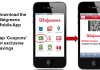
Starting today, on the retail shopping holiday known as Black Friday here in the U.S., Walgreens will begin rolling out its new scannable mobile coupons which work at its over 7,700 stores nationwide. The coupons are being made available in the Walgreens mobile applications and to use them, you simply show your phone at checkout where it will be scanned by the cashier.

You’ll find the coupons in a special section within the mobile application where you’re also able to sign up for SMS-based alerts.
Coupons will only be offered one at a time every two to three days, and will range in value from $0.50 to $5.00. The discounts will be targeted towards a wide variety of products, including beauty items, gifts, consumables and everyday essentials, like diapers.

Shoppers can also use the mobile app to view the weekly ad and sales, shop directly from their phone, browse products, check availability, scan barcodes, manage prescriptions and receive text alerts about Walgreens’ offers and exclusive deals.

Walgreens says the coupons will be available through December 24th, but details regarding its post-holiday mobile couponing plans are not yet available.

The Deerfield, Ill.-based company has 7,786 locations across all 50 U.S. states, the District of Columbia and Puerto Rico, making this initiative one of the largest retail mobile couponing programs in the country.

The Walgreens mobile app is available for iPhone, Android and BlackBerry.