A New Deal Flow: Startup Raps For Angel Funding, Venture Firm Responds In Kind

Screen shot 2011-11-28 at 2.58.41 AM

Last week, Erick posted a video in which the founders of a stealth, San Francisco-based startup called Undrip spit some rhymes in an effort to raise seed funding for their new venture. Undrip, which is building a service to better filter your social networking streams (like Twitter) and let people consume media content without the noise, hoped to use their creative plea as a way to attract attention from top investors. They even created custom videos that they sent to individual investors, like Ron Conway. (See the video here.)

Of course, as Erick pointed out, in an overfunded environment, startups are looking for ways to set themselves apart from the pack. I would say that their video, which includes a sexy red car (and also happens to be Getaround’s Tesla) and a catchy chorus to the tune of, “We need a angel, We need a ride”, is pretty spectacular. You have to hand it to the guys for being willing to stick their necks out. Not only that, but in a world of boring pitches (trust me, we’ve seen a few), this is music to the ears of the media and VCs.

How do we know? Well, we’ve been pointed to a video response created by Detroit-based venture capital firm, Ludlow Ventures, which seems to prove that some investors are not only listening, they may just want in. You may (or may not) know the Detroit firm as an investor in startups like Hipster, Graphic.ly, Fundly, and FLUD, to name a few. (Here’s their portfolio for reference.)

Jonathon Triest, who is the Co-founder of Ludlow Ventures and the moonwalking, rhyme-dropping emcee in the video above, said that he loves seeing entrepreneurs take creative approaches to pitching investors, and Undrip’s video spurred he and his team to respond in kind.

Knowing that Mick Hagen, the co-founder of Undrip, also happened to be a founder of Zinch, a college admissions matching service which blew up and sold to Chegg, Triest told me that he knew the team had chops — but it was, of course, the video prompted them to make a call. The entrepreneur-VC and friendly version of playing the dozens, clearly.

Triest said that his firm is looking to invest in startups with great founding teams; Ludlow is trying to focus on picking and choosing entrepreneurs who, as he says, “they know they could have a beer with.” He said that he expects early-stage startups to pivot several times early on, but if the founders seem like good people, who are passionate, have chops, and are willing to stick it out, then that startup may just have what it takes to get the stamp of approval.

“The money-side plays an important role in seeding startups with the kind of capital that can enable early growth”, he said, “but that’s only half of it. We have to start treating entrepreneurs with respect, because they’re the ones out there going for it”. To that end, Ludlow Ventures wants to work closely with entrepreneurs and be a part of their development all the way along the line (in other words, founder friendly); and sharing office space with Quicken Loans Founder and Cleveland Cavaliers Owner Dan Gilbert’s Detroit Venture Partners, with a roof-top view overlooking Comerica Park, being part of Ludlow’s brood has some perks.

Triest said that he has been in talks with Undrip, which he hopes will lead to some future investment. Nothing has been signed at this point, but Undrip’s video certainly seems to have captured some attention. Of course, every early-stage VC firm claims they want to be “founder friendly”, but not every VC is willing to respond with the same kind of creative energy their startups try to exhibit on a daily basis. So props to this VC for getting into the studio and laying down some flow.

A full list of the lyrics as well as Undrip’s original video follow below:

Verse 1:
Yo undrip is bumpin’
Pumpin the volume like a tech Christian Slater
And we hear ya loud and clear
Ya need an angel we got them wings
Like our skulls full of red bull on private planes
Lets fly hands up to the sky like we scored the goal
With a Hockey stick projection of Gretzky proportions
And we’ve done our due diligence we’re ready to close
There’s just one thing we need to know
Is undrip bout to go to the top
So preferred with the stock
If ya ain’t heard ludlow we ready to rock
So it’s ready or not here we come
And the mission is gettin’ that acquisition son
From the elevator pitchin to the elevator hittin’ the top floor
And openin’ to penthouse parties with horres devourers
And scores of angel investors, prepared for bidding wars
Unlockin’ that flow and so much more

Chorus:
We need a angel, We need a ride
We need a bump, a bump so we fly
We’re gonna make that money off of social steam
But we need your help to reach the dream
We need a angel, We need a ride
We need a bump a bump so we fly
Undrip is about to go
We just need an angel to unlock the flow

Verse 2:
Comin’ straight out of detroit, so our wings are red
But they’ll fly just the same, and your dreams in bed
Will be reality instead because we livin’ it up
Droppin that cold hard currency on companies
They bout to start callin’ us green gravity
You write code, we write checks that let your grand story unfold
And when it’s all said and told from the premoney valuation
To the exit strategy the numbers look amazin
Only thing missin is chapter 11 but trust that’s all by design
As long as you can design and program well put grands in yo hands
Plant seeds in this round and we’ll watch them grow
Oh to big money trees so check the equity now
And you’ll see how ludlow gets down
Ludlow, Ludlow
Baddest angels around




Russian Search Giant Yandex Acquires Mobile Software Developer SPB For $38 Million

18947v6-max-250x250

Last week, Yandex, one of biggest search and advertising companies in Russia, announced that it would be teaming up with Microsoft, Nokia, HTC and Samsung to become the default search engine on both new and upcoming Windows Phones in Russia. This followed the news last month that Yandex is also set to become the search provider for bada-powered smartphones in Russia and the CIS. It’s been a good last few months for Yandex, as Robin pointed out last week, the company has steadily grown its share of the Russian search market to a point where it now owns 62.7 percent of the market in Q3 2011 — ahead of Google.

Today, the Russian search giant has announced another strategic move in its mobile strategy, as it has acquired SPB Software, a developer of mobile software that makes its home in Russia, Taiwan, and Thailand. As for the price, sources close to the deal say that it was set at approximately $38 million.

SPB was founded in 1999 and was originally focused on making applications and software for Android and Windows mobile devices, from games to productivity apps, but has since become cross-platform, and today offers a more robust suite of mobile solutions. These products include a mobile wallet, data traffic analytics, games, web TV integration, a mobile UI builder, etc.

But, according to Yandex Spokesman Ochir Mandzhikov, what was particularly of interest was the company’s new mobile UI engine for both smartphones and tablets, especially SPB’s “Shell 3D” product, which will be used to integrate Yandex’s cloud services and technologies. This is an important play for Yandex because it allows the company to integrate their search and ad services into a UI which can then be distributed across a multitude of mobile platforms. What’s more, using SPB’s mobile UI builder and toolset, OEMS and brands can customize skins, layout, widgets and 3D animation.

For more on SPB, visit them at home, and for more on SPB Shell 3D, check out the video below:


Panasonic To Start Selling Android Phones In Europe (And Possibly The US)

panasonic-android

In the post-iPhone era, a lot of things changed in Japan, once the most admired country in the mobile world. The number of cell phone manufacturers, for example, has fallen from 13 to five after massive consolidation and re-organization, and all of the remaining players fight with a shrinking and rapidly greying domestic market.

That’s one of the reasons why Nippon’s cell phone makers have been talking about going international for a long time (years after basically all of them gave up on the world market), but now Panasonic seems to be ready to get serious.

Japan’s biggest business publication, The Nikkei, is reporting that the company is currently trying to strike a deal with a major telco in Europe to bring smartphones (Android handsets) to the continent. Apparently, Panasonic is thinking about whether to build the phones in one its own plants in South East Asia or outsource production to another company.

If all goes well, Panasonic also plans to eventually offer Android handsets in Asia and North America. The company has sold 4.4 million phones last year, but it wants to sell 7.5 million units internationally (per year) by 2015.

The picture above shows the Panasonic LUMIX Phone 101P that’s currently on sale in Japan and features Android 2.3, a 4-inch QHD LCD screen with 960×540 resolution, a 13.2MP CMOS Lumix sensor, a waterproof body (IPX5/7), Wi-fi, infrared connection, e-wallet function, and a digital TV tuner.


YFrog Deletes Photo Account Of UK Celebrity Twitterer @GraceDent

Screen Shot 2011-11-28 at 09.33.05

Twitter photo sharing service YFrog has deleted the account of Grace Dent, an influential UK Twitterer and writer with over 94,000 followers. There appears to be no explanation for the blunder at the moment but we’ve reached out to YFrog for comment.

Twitter recently became the number one photo sharing service on its platform, handling 36% of shares, and YFrog is down to 21% from 29.3% five months ago, indicating a slow death.

So it seems a massive blunder for YFrog to lose such an influential user. She has now switched to European startup MobyPicture.


Gadgets Week in Review: Shopping Bag

1483

Here are some of the past week’s stories on TechCrunch Gadgets:

Review: Super Mario 3D Land For The 3DS

ScottEVest Introduces The Puffer Jacket

Penguin Shuts Down Libraries’ Access To New E-Titles On Amazon’s Kindle

SmartPal VII: A Humanoid That Can Be Remote-Controlled Via Kinect (Video)

Google Drops The Price Of Chromebooks to $299 And Polishes The Interface


Apple Sucks At Social

Screen Shot 2011-11-27 at 7.45.26 PM

Displayed in the Dieter Rams exhibit at SF MOMA is a hand-held Braun television. Yes, an old-fashioned television with a handle on it that never saw the light of day because the Braun marketing team determined there wasn’t a market for hand-held televisions. IN THE SIXTIES.

Inspired by the work of Rams and Braun, Apple’s Steve Jobs went on to build hardware that incorporated many of the elements of Rams’ philosophy. In fact, today’s iPad seems like a streamlined descendant of that handheld television. But, unlike what happened at Braun, it doesn’t seem like many Apple products are held back from production by the Apple marketing team, at least if you look at how many Apple products are total failures initially.

@AntDeRosa
Anthony De Rosa

Anyone who thinks Steve Jobs was a perfectionist never used Apple earbuds.

The easiest example of this, and the one that everyone uses as the “Apple sucks at social” whipping boy is the iTunes-powered Ping. It seems like out of the 25 people I follow, only MC Hammer is actually engaging with the product. Hard core Apple fanboys defend Ping’s failure (and it is an uncontested failure) on its lack of Facebook integration, which Facebook pulled because of negotiation issues.

Because Apple’s best attempts at social have been integrations with other services, Facebook in iPhoto, and Twitter in iOS 5, let’s leave Ping alone for now. Who knows, maybe it would have worked out if Facebook had been involved?

Instead, let’s talk about “Find My Friends,” an app that came out of iOS 5 in October. Quite honestly this should be called “Find My Kids,” as most of the people reviewing it in the App Store are people describing this use case.

In almost two months since its launch, I’ve only had one friend ask to follow me on it, and I think that was a joke – I’m too embarrassed to ask any of my friends to follow them on it, and I can’t even think any reason to, actually.

I’m even hearing that people at Apple have been making fun of it internally. — Turns out no one really wants to Find Their Friends. Kids maybe, but you can just text your friends to find out where they are if they and you are an adult.  Reminds me of another useless social product from another company that doesn’t get it, Google Latitude.

Pro tip: If your friends are lying to you about where they are, then they’re not your friends.

It strikes me that everyone picks on Google’s social awkwardness, but not Apple’s. Sure you can argue that Apple makes social hardware not software, but iOS 5 features like iMessage (which has some user experience issues of its own) imply the grand possibilities of what happens if Apple somehow gets this kind of stuff right – namely no more $30 monthly SMS fees or endless launches of social photo sharing apps.

(Apple should just suck it up and buy Instagram, much like Google should just buy Twitter.)

The reason this is important now more than ever, is that Apple’s social stumbles are giving companies like Facebook the confidence and chutzpah to get into the mobile space, efforts that will inevitably chip away at Apple market share if executed correctly.

Proto-type FMF images via Technorotic


Now You’re Just Messing With Us Wikipedia

Screen Shot 2011-11-27 at 4.47.41 PM

The good news is that Wikipedia has finally switched up that image of Jimmy Wales begging for money on its homepage. The bad news is that they’ve replaced it with another unfortunately left-aligned image of some random guy (Wikipedia programmer Brandon Harris to be precise) who, according to my email inbox, looks like everything from Jesus, to Nickelback lead singer Chad Kroeger to a member of the Hell’s Angels.

And because Harris’ image is left aligned, the weird article title/image juxtaposition thing still stands; The last straw was when I was Wikipedia-ing actress Diane Keaton last night and up he came, inadvertently wearing the same outfit and in the same pose as the Annie Hall star.

Here is a particularly hilarious conversation I had about it with somebody on IM.

Person: damn some idiot biker is screaming at me to give me money today http://en.wikipedia.org/wiki/Chakra
Person: refresh the page
Person: he should ride in on a harley
Person: and then jack me with a switchblade
Me: Snort
Person: cut my face if i don’t drop some funds on wikipedia
Me: Should I do another post?
Person: I’ve heard Jesus
Me: seems necessary
Person: Is wikipedia run by a biker gang?
Person: Will they slit your tires if you don’t donate?
Person: i like how he has two different pics
Person: there’s the soft outside guy silently judging you and the intimidating dude who will jack your ass

“I donated to get Brandon Harris’ picture off the top. I didn’t mind Jimmy Wales’ piercing gaze but Brandon was just disturbing,” notes interaction designer Xianhang Zhang on Quora. Until Wikipedia finally figures it out, Jimmy Wales himself offers an alternative to donating (and complaining) for those of you still creeped out,”You can also just click the little ‘x’.”

To donate money to Wikipedia, WHICH YOU TOTALLY SHOULD IN CASE IT’S NOT CLEAR, follow this link.


Black Friday E-Commerce Spending Up 26 Percent To A Record $816M; Amazon Most Visited Retailer

Black Friday

As we heard on Saturday, IBM reported a 24 percent increase in online sales for Black Friday this year. ComScore is announcing even stronger results for e-commerce, with Black Friday seeing $816 million in online sales, making it the heaviest online spending day to date in 2011 and representing a 26 percent increase versus Black Friday 2010 ($648 million spent).

That’s an impressive jump considering the 2009 to 2010 increase in Black Friday spending was only 9 percent. Thanksgiving Day saw an 18 percent increase in online spending to $479 million. U.S. consumers have spent $12.7 billion already in the first 25 days of the November to December 2011 holiday season, up 15 percent from the corresponding days last year.

comScore says fifty million Americans visited online retail sites on Black Friday, which is an increase of 35 percent versus year ago. Each of the top five retail sites achieved double-digit gains in visitors vs. last year, led by Amazon. Walmart ranked second, followed by Best Buy, Target and Apple.

Experian Hitwise also reported similar traffic results, revealing that US total visits to the top 500 retail sites increased 2% on Black Friday 2011 compared to 2010. Amazon was the top retail site receiving traffic on Black Friday for the 7th year in a row, followed by Wal-mart and Best Buy, respectively.

Consumers were also increasingly looking online for information about offline and web-based Black Friday deals. For example, Black Friday deals site bfads.net saw 3.9 million unique visitors, up 51 percent versus last year. TheBlackFriday.com followed with 3.2 million visitors, up 137 percent from last year.

Of course, Cyber Monday is tomorrow and it could be the peak day for the entire holiday shopping season. Last year, Cyber Monday was the heaviest day of online spending ever, with sales exceeding $1 billion. Considering the peaks we are already seeing with online spending this season, tomorrow could bring record sales for e-retailers.


Return Visit-Aware: The Future Of Content Streams That Know What You’ve Consumed

Return Vist Aware Content Streams

When someone you haven’t seen in a while asks you “What’s up?” or “How are you?”, you probably give them a high-level summary of the major life events from the months since you last spoke. When you speak to someone you see frequently, you probably respond to the same questions with close-up, specific descriptions of your activities over past few days. Humans are aware of when and what we last communicated with someone, and we dynamically alter what information we provide to avoid repetition.

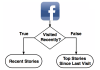
While most of the discussion about Facebook’s latest changes has centered around the real-time Ticker, the switch to a news feed that displays different content depending on when you last visited will also profoundly change how we use the social network. Eventually, I think the “return visit-aware” concept will also change how we consume content across the web.

Before the switch, Facebook was struggling with repetitive content and a user base that engages with the site in very different ways. Frequent visitors — those returning multiple times a day — would often see the same stories first on the default Top News feed. Some wouldn’t go to the trouble, while others didn’t even realize they could switch to the Most Recent tab to see what had just been published. This led them to feel that Facebook was stale and caused them to quickly navigate away.

Meanwhile, those who visited once or twice a week would only see the the most Liked, commented on, and clicked stories of the last few hours or day, leading them to miss highly relevant stories that happened a few days ago. This made it seem like nothing really interesting was happening on Facebook and that there was no reason to stop by more frequently. These interactions didn’t mimic the tradition of human communication. With the single-tabbed return visit-aware news feed, Facebook has solved all these problems by aligning its interface with natural human habits.

The Top News and Most Recent tabs have been combined into a single one, shifting the initial burden of choice from the user to Facebook. This works because a human typically doesn’t ask someone “Tell me what’s happened to you in the last [78 hours or 35 minutes]?” The respondent simply knows when they last spoke and tailors their transmission appropriately.

When you vist, the news feed surfaces the most relevant stories from between then and your last visit. If it’s been a week since your last visit, it shows only the biggest stories from that timespan, making sure you don’t miss anything important. This mimics how friends who’ve been out of touch for months communicate when reunited.

If you visited a few hours ago, it will show you the most relevant stories from those hours, but also a “25 more recent stories” link at the top. Similarly, if you’ve spent a day apart from someone, you might tell them the most significant news of the day, but also about your current mood.

If you’ve visited the Facebook home page multiple times that day, it shows you the latest updates so there’s something fresh to see. Similarly, after working together all day and discussing bigger news, but then taking a lunch break apart, two coworkers might discuss in person who they had lunch with. Otherwise, this information might seem inconsequential like the minutiae the news feed shows if you constantly check it. But since all other information has already been discussed, the very recent becomes relevant.

By marking and unmarking stories as “highlighted” using the blue corners in the interface, you can teach Facebook’s EdgeRank news feed ordering algorithm your preferences. This mirrors how you can interrupt a friend’s boring story and ask about something else, or ask follow up questions about a topic such that they bring up that topic more in the future.

The end result is a news feed that usually shows interesting content. This inspires longer session times; more return visits; and more Likes, comments, and shares on news feed stories that trigger notifications or create content that pulls in other users.

Return Visit-Aware Content Streams For The Rest Of The Web

Sites and services around the web are seeking these same benefits, and therefore I believe they’ll look to develop their own versions of consumption-sensitive content streams. Right now, most news sites try to approximate this by featuring the most important content of the last day or so, and rearranging and demoting top stories as they grow older. Techmeme is probably the best example of this, but still they all essentially operate on the premise that you visit every 12 to 18 hours. Vist less frequently than that, and a must-read piece of news may have slipped down and off the home page.

Last week I reviewed an iOS app called the Riversip Tech Reader. It tackles the problem by letting users toggle between viewing the latest news, top news of the day, or the biggest stories of the week. This is probably the easiest solution and it doesn’t depend on tracking a user’s previous actions. It also works for streams which don’t require click-throughs to expand individual pieces of content. However, it does place the burden of choice on the user. Twitter or some Twitter app could try this, surfacing the stories with the most retweets from a given time period.

An approach for when users must take an action such as clicking through to consume content is to remove, demote, or set aside content a user has already viewed. Imagine if the CNN home page replaced tiles or headlines of any story you’ve already read with something you haven’t. This could possibly be done through cookies or another tracking scheme, but it would presumably be more accurate if a user was logged in.

Sites services, and apps with login functionality or another way to tie actions to identity should be considering how they can make their content displays truly sensitive to when a user last visited without explicit input. Using its login and other social plugins, Facebook may even seek to power this shift of other sites. In either case, the content relevancy arms race is on. The same way newspapers look hopelessly static next to Techmeme will be the way the sites of today will look next to the personalized, return visit-aware sites of tomorrow.


Going shopping

goingshopping

With all these amazing tools we have, it’s not a little surprising how much we take the traditional forms of media as the way things are and should be done. The iPad exposes the mediocrity of our expectations, with its Reader button in the address field stripping the comments and jingle jangle out and letting us focus on the simple post as form. Get in, state the premise, survive the middle, get out.

I remember the days of Hunter S. Thompson, the free range lunatic who stepped up where Kurt Vonnegut and Tom Wolfe had not feared to tread. It was always a mystery he uncorked, starting with the possibility that he wouldn’t even file a story at all. The rhythm was in the gasps between paragraphs, those stolen breaths taken that functioned as cymbals compressed in high hat swirls.

How grateful we were for the next issue of Rolling Stone, with the crazy drawings, the ridiculous dashes on the open road, the fearless unmasking of the hypocrisy of the time. Exhilarating doesn’t even come close to the feeling he commandeered in a string of features that defined the turbulence of the times as something funnier, darker, elastic, and even perhaps ultimately pointless. Even that last was part of the rush.

I don’t pretend to understand how he got there or how brave and foolish he was to try. The shimmer of that arc has never been something you could package or survive, it seems. But what is sure is that we live surrounded and enveloped in the existence of those gasps of fresh air, and that it is a choice we make to ignore them.

Thinking ahead to what I look forward to, I remind myself that even in the language of the times, the poetry of the words always meant more than the ideals. Freedom was a rallying cry, but the actual cry took freedom for granted and went further. Freedom to do what? It wasn’t about the right to do something, it was about what the something was to do. Escaping gravity to do what?

There’s a moment in East-West, the seminal Paul Butterfield Blues Band record, where an early crescendo releases into a stunning guitar exploration by Mike Bloomfield. It’s like you’re suddenly propelled floating into space, on a journey you thought you might be in for but had no way of being sure of. And as it again builds into a frenzy and pulls that same trigger yet again, you realize how this place exists right there in front of you, waiting for that moment to reappear ever so slightly different.

The next song, can you believe there even is a next song? “I got a mind to give up living/ Yes and go shopping instead.” The blues with a steely glint of comedy, you say? What kind of alchemy is possible that springs from the celebration of loss, destruction, death — and that’s just before the opening credits. And remember: it’s sitting right there next to you with that insane grin on its face.

Something about the juxtaposition of things reminds me of the politics of disruption, the emotional spring of the social generation. By themselves, interesting, intellectual perhaps, but not of the parallel land of hope and acceptance. I read an interview with Noel Gallagher, the supposedly sane one of the Oasis brothers. Something about Oasis being in the Top 10 of bands. He ducked the statement briefly, attributing it to alcohol and passing it off as Top 20 straight.

But then he owned it anyway and listed the groups: “(T)he Beatles, the Sex Pistols, the Rolling Stones, the Who. I can never remember 5. Maybe the Kinks. I can’t remember 6, then Oasis.” Well, allright. It’s a stretch for me, but I can’t remember 5 or 6 either. The strange part is, I can see where the guy is coming from. And it doesn’t matter whether he’s right or not, just that he sees something just over there.

I don’t care how noisy the stream is. The more the better, actually. Until it gets so useless someone comes along and hops alongside it and surfs it, like a wave building as it nears the shore. It’s not that there’s necessarily some huge revelation just around the next tweet. It’s that there are wonderful souls and achingly precious children and silly love songs and the best breakfast place around and a roar of ideas and jockeying for position and routine power grabs and whatnot.

So here are my Top Ten predictions. the iPad, push notification, Chatter external groups, the Cloud, AirPlay Mirroring, Spotify, @mentions, and I can’t remember 5 or 6 either. Gillmor Gang is 7.


Kindle DX Gets Temporary Price Cut – But How Long Can This Jumbo E-Reader Last?

kindxx

Amazon’s extra-large Kindle DX is available this weekend (which is to say for the next few hours) for the low, low price of $259, down from its normal $379. It’s telling that even the lowered price still seems ridiculously high, considering that smaller but more advanced models are selling for under $100. How long can this outlier live in a world dominated by cheap, pocketable, touchscreen e-readers?

In its current form, the fact is it’s likely on its way out. The Kindle Keyboard and indeed the graphite look in general are on their way out, to be replaced by the lighter, thinner, more touchable new generation. But there’s a problem: the DX is one of the very few e-readers that doesn’t use the same 6″ E-Ink screen as everyone else. Amazon probably knows there’s demand there, but perhaps the time is not yet right to strike.

As you no doubt remember, the Fire was rumored even before its release to be the first of two or more tablets; the next one is supposed to have a larger screen. Makes sense. Amazon wanted to test the waters, and the 7″ tablet was a much easier way to do that. The popularity of the tablet (despite a lukewarm critical reception) doesn’t guarantee a larger version, but I think Amazon would be fools not to do it.

What does this have to do with the DX? As long as they’re unveiling one big e-reader, why not two? Okay, that’s not very convincing. But the DX is a fish out of water right now, and it needs to be either replaced or put out to pasture. I think Amazon is going to keep the large e-reader as a premium option, but it needs more time to engineer it. Who knows, maybe they’re waiting on the next set of screens from E-Ink.

If I had to prophesy, I’d expect a late-summer event with a bigger Fire (the “Flame” maybe?) and a bigger, improved DX, and depending on E-Ink, perhaps an improved screen. By that time, remember, the high-res iPad 3 will supposedly be out, as will a few other high-res tablets that will offer a superior reading experience owing to their superior displays, LCD as they may be.

Personally, I can’t wait for a decent large-screen e-reader. These little ones are frustrating and it saddens me to see the leaders of the e-reader industry putting out products that are scarcely distinguishable from one another.

[via The Digital Reader]


“Promising Unlock” For The iPhone 4S Discovered

4s unlock

Most folks spent their Thanksgiving weekend ensuring that every inch of their intestinal track was thoroughly covered in gravy. Others spent it trying to get just drunk enough that their relative’s worst habits were bearable.

A select few, however, spent the weekend doing something pretty much only they can do: hacking the heck out of the iPhone. As a result, everyone waitin’ and wishin’ for an iPhone 4S carrier unlock has something to be thankful for.

It’s not quite a done deal just yet, but iPhone Dev-Team star MuscleNerd tweeted out that a “promising 4S unlock” had been discovered after a bit of Turkey-fueled hacking.

Oddly, his tweet goes on to confirm that this unlock works only with the 4S (and not the iPhone 4), suggesting that it relies on a hardware-level exploit that went overlooked during the 4S’ creation. While such exploits are increasingly rare, they’re also considerably more challenging for Apple to patch post-manufacturing.


Social Proof Is The New Marketing

velvet rope line

Editor’s note:  This guest post is written by Aileen Lee, Partner at venture firm Kleiner Perkins Caufield & Byers, where she focuses on investing in consumer internet ventures.  Full disclosure: some of the companies mentioned below are KPCB-backed companies, including One Kings Lane and Plum District (both of which count Lee as a board member). You can read more about Lee at KPCB.com and follow her on twitter at @aileenlee.

As I’ve written about before, we’re in an amazing period of the consumer Internet.  Despite a shaky economy, many web companies are in hypergrowth.  This is reminiscent of the five-year period over a decade ago when companies like Amazon, Netscape, eBay, Yahoo, Google and PayPal were built.

One challenge, which isn’t new, is the battle for consumer attention.  If you’re looking to grow your user base, is there a best way to cost-effectively attract valuable users?  I’m increasingly convinced the best way is by harnessing a concept called social proof, a relatively untapped gold mine in the age of the social web.

What is social proof?  Put simply, it’s the positive influence created when someone finds out that others are doing something.  It’s also known as informational social influence.

Wikipedia describes social proof as “a psychological phenomenon where people assume the actions of others reflect the correct behavior for a given situation… driven by the assumption that the surrounding people possess more information about the situation.” In other words, people are wired to learn from the actions of others, and this can be a huge driver of consumer behavior.

Consider the social proof of a line of people standing behind a velvet rope, waiting to get into a club.  The line makes most people walking by want to find out what’s worth the wait.  The digital equivalent of the velvet rope helped build viral growth for initially invite-only launches like Gmail, Gilt Groupe, Spotify, and Turntable.fm.

Professor Robert Cialdini, a thought leader in social psychology, has many examples. In one study, his team tested messages to influence reusing towels in hotel rooms.  The social proof message – Almost 75% of other guests help by using their towels more than once” had 25% better results than all other messages.  And adding the words “of other guests that stayed in this room” had even more impact (also an example of how A/B testing of small details matters). 

In another study, a restaurant increased sales of specific dishes by 13-20% just by highlighting them as “our most popular items”.  SP also works on your subconscious – it’s the reason why comedy shows often use a laugh track or audience; people actually laugh more when they can hear other people laughing.

Five Types of Social Proof

If you’re a digital startup, building and highlighting your social proof is the best way for new users to learn about you.  And engineering your product to generate social proof, and to be shared through social networks like Facebook, Twitter, Google+, Tumblr, YouTube, Pinterest and others, can multiply the discovery of your product and its influence.  Think of it as building the foundation for massively scalable word-of-mouth.  Here’s a “teardown” on various forms of social proof, and how some savvy digital companies are starting to measure its impact.

1) Expert social proof – Approval from a credible expert, like a magazine or blogger, can have incredible digital influence.  Examples:

  • Visitors referred by a fashion magazine or blogger to designer fashion rentals online at Rent the Runway drive a 200% higher conversion rate than visitors driven by paid search.
  • Klout identifies people who are topical experts on the social web. Klout invited 217 influencers with high Klout scores in design, luxury, tech and autos to test-drive the new Audi A8.  These influencers sparked 3,500 tweets, reaching over 3.1 million people in less than 30 days – a multiplier effect of over 14,000x.
  • Mom-commerce daily offer site Plum District also reached mom influencers thru Klout, and found customers referred by influential digital moms shop at 2x the rate of customers from all other marketing channels.

2) Celebrity social proof – Up to 25% of U.S. TV commercials have used celebrities to great effect, but only a handful of web startups have to date.  Some results:

  • In 1997, Priceline.com was one of the first web startups to use a celebrity endorser – William Shatner – not a travel expert, but seemingly obsessed with saving consumers money.  It has been a huge win; Priceline now has a $23 billion market cap, and the fee Shatner took in shares is estimated to be worth $600 million.
  • Trendyol, the fastest-growing fashion ecommerce company in Turkey, regularly launches merchandise campaigns with the endorsement of celebrities. This practice increases site traffic by 2.5x and product sell-through by 30%.
  • ShoeDazzle launched with celebrity Kim Kardashian as chief stylist. Her involvement helped leapfrog the company to an estimated $25m in 2010 and $70 million in 2011 sales, plus a recent $40m financing.  Celebrity endorsement by Jessica Simpson and aesthetician Nerida Joy recently helped Beautymint attract 500,000 visitors in the first 24 hours of its launch.
  • The most authentic (and cost-effective) celebrity social proof is unpaid. For home décor site One Kings Lane, a 2010 unpaid mention in Gwyneth Paltrow’s influential blog GOOP provided a 90% lift in daily sign-ups vs. the previous 4 days’ average.  Celebrity use on Turntable.fm by Sir Mix-A-Lot and producer Diplo generated viral buzz, helping the company skyrocket to 140,000 active users in just 4 weeks.

3) User social proof  – Direct TV marketers are masters at sharing user success stories. (fascination with this was actually the inspiration for this blog post).  Companies mastering this digitally include:

  • More than 61 million people visit Yelp (working on an upcoming IPO) each month to read user reviews.  And reviews drive revenue; a recent HBS study showed that a 1-star increase in Yelp rating leads to 5-9% growth in sales.
  • User-generated videos (UGVs) are a growing and important social proof phenomenon.  Early visitors to Shoedazzle watched more than 9 UGVs on average, helping catapult sales; and user testimonials on YouTube drove a 3x conversion rate vs. organic visitors for Beachbody, the makers of P90x fitness.
  • Negative user social proof is also important to track. The first negative user review on eBay has been shown to reverse a seller’s weekly growth rate from 5% to -8%. It also hurts pricing; a 1% increase in negative feedback has been shown to lead to a 7.5% decrease in sale price realized.

4) Wisdom of the crowds social proof – Ray Kroc started using social proof in 1955 by hanging an “Over 1 Million Served” sign at the first McDonald’s.  Highlighting popularity or large numbers of users implies “a million people can’t be wrong.”  Some digital examples:

  • Fashion e-tailer Modcloth enables its community to “Be the Buyer” by voting on which styles they think Modcloth should sell in the future.  Shoppers take strong cues from the community; styles with the “Be the Buyer” badge sell at 2x the velocity of un-badged styles.
  • Callaway Digital Arts finds that when any of their kids’ iPad apps is listed as a top 10 most popular app in the iTunes App Store “Top Charts,” daily downloads vault 10x over the prior week – but being the No. 1 most popular app drives 30-50% more daily downloads than being No. 2.
  • Greentech company Opower uses social proof to help reduce electricity consumption. It works: Opower sees an 80% response rate to e-mails citing how a household’s use compares with the neighborhood, which has driven more than 500 million kilowatt hours of savings so far.

5) Wisdom of your friends social proof – Learning from friends thru the social web is likely the killer app of social proof in terms of 1:1 impact, and the potential to grow virally.  Some examples:

  • Friends inviting friends to play through Facebook and other social networks helped Zynga grow from 3 million to 41 million average daily users in just one year, from 2008 to 2009.
  • Moms, arguably the most valuable demographic on the social web, rely heavily on friends and family recommendations.  A recent Babycenter study showed moms rely on the wisdom of their friends 67% more than average shoppers; and they rely on social media 243% more than the general population.
  • Friends referred by friends make better customers.  They spend more (a 2x higher estimated lifetime value than customers from all other channels at One Kings Lane); convert better (75% higher conversion than renters from other marketing channels at Rent the Runway); and shop faster (they make their first purchase after joining twice as quickly than referrals from other channels at Trendyol)
  • They also make better contributors.  People who see content from their friends on TripAdvisor contribute personal content to the site at 2x the rate of others, and are 20% more engaged than other users.

Building Your Social Proof

Will one form of social proof work best for your company? Maybe, but companies like LegalZoom have found that a “mixed salad” of various types of social proof is most effective.  The beauty of the web is you can test, learn and iterate quickly to find what works best.

To note, I don’t think a social proof strategy will be effective if you don’t start with a great product that delights customers, and that people like well enough to recommend.  How do you know if you have a great product?  Track organic traffic growth, reviews, ratings and repeat rates.  And measure your viral coefficient – if your site includes the ability to share, what percentage of your daily visitors and users share with others? How is the good word about your product being shared outside your site on the social web?  Do you know your Net Promoter Score, and your Klout score?

In the age of the social web, social proof is the new marketing.  If you have a great product waiting to be discovered, figure out how to build social proof around it by putting it in front of the right early influencers.  And, engineer your product to share the love.  Social proof is the best way for new users to learn why your product is great, and to remind existing users why they made a smart choice.

P.S.  FOMO, or the psychological phenomenon known as “Fear Of Missing Out,” is also a form of social proof.  As people are wired to learn from others, they are also wired to want things in short supply.  FOMO is a great forcing function on decision-making, as evidenced by the incredible growth of ecommerce flash sales. A friend at another venture firm has posted on his office wall “Is it FOMO, or is it real?” because it also happens in venture financings.  Maybe a topic for a future post.

Photo credit: Flickr/anasolinap.


Zynga Builds Its CastleVille Walls, As Its Facebook Traffic Flattens And Falls

Screen Shot 2011-11-27 at 12.29.07 PM

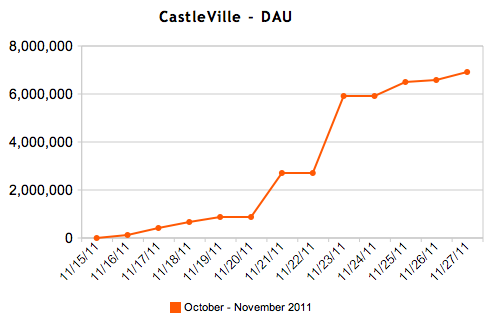
New Facebook game CastleVille is one of Zynga’s fastest-growing titles ever, as it announced a few days ago. That’s good news for the company, but maybe not good enough when you consider the trajectory of most of its other games on Facebook — and its plans for an initial public offering as soon as this coming week.

After launching in the middle of November, the medieval role-playing simulation title has grown to 6.9 million daily active users today, currently the third-highest out of any Zynga game on Facebook.

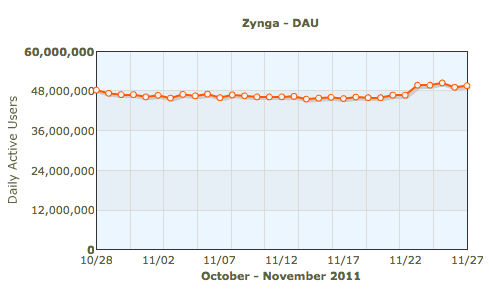
Overall, the developer has a total of 49.5 million daily actives on Facebook, according to Inside Network’s AppData application tracking service. It’s still by far the largest of any Facebook developer, but it has been falling from its peaks in previous months and years. Up until CastleVille launched, its games had been drifting down over the last 30 days from 48.2 million DAU.

And bigger picture, the company’s Facebook DAU had been 59 million in the second quarter, and had already fallen to 54 million in the third. In previous amendments to its filing, Zynga had said these changes were due “to a decline in players of our more mature games and a limited number of new game launches in the first nine months of 2011.”

DAU is crucial because it indicates how addicted players are. This daily addiction is what leads some fraction of the players to buy virtual goods — the model that drives the social gaming business.

So, CastleVille has a lot of growing left to do if it’s going to bring back or replace all these former users. It’s certainly off to a good start.

But by picking through the other 30-day AppData sets for Zynga’s other largest Facebook titles, you can see that most of its other games are declining. Zynga has had exceptional success at keeping its games popular with users over the months and years, but it is not immune from natural churn, nor from unsuccessful launches.

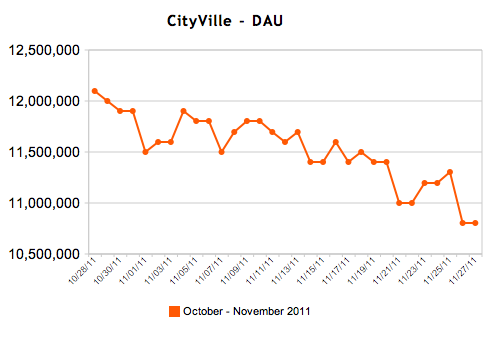
CityVille, its year-old city builder title and biggest game by DAU, has gone from 12.1 million to 10.8 million in the past four weeks.

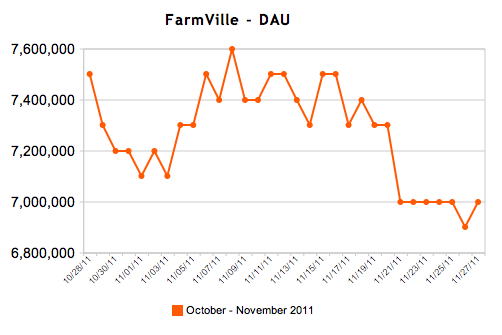
Its farming sim from 2009, FarmVille, is down by half a million, to 7 million today.

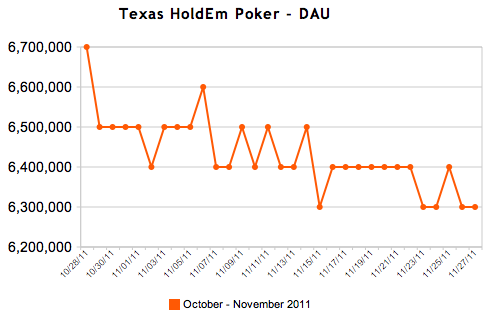
Texas Hold’Em, Zynga’s first hit (and an amazingly perennial one at that), has fallen below CastleVille, to 6.3 million DAU.

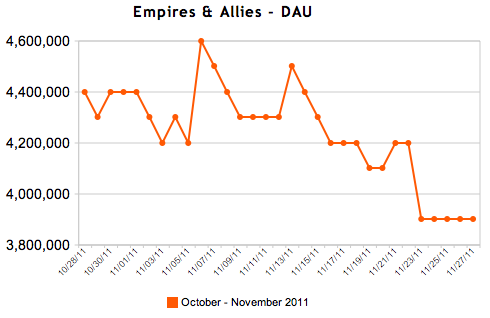
Empires & Allies, launched in June, has also fallen by half a million.

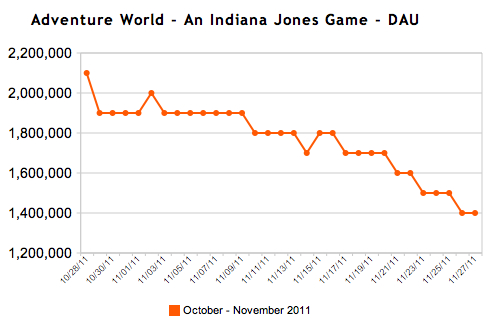
Other new titles are also not looking too healthy. Adventure World, which launched in September, is down by almost one million DAU.

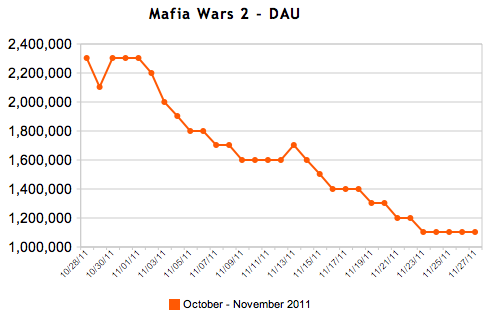
And Mafia Wars 2, the big new version of its long-standing RPG hit launched just last month, is now down by half.

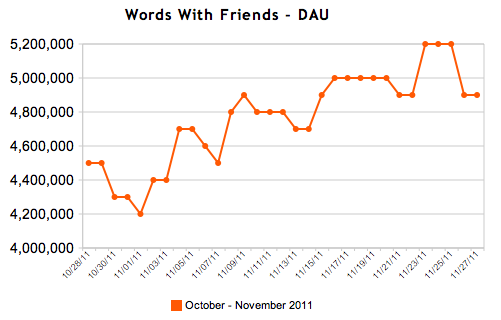
CastleVille isn’t Zynga’s only success story now. The developer has been making big gains on mobile in the past year, culminating with an increase of more than a million DAU in October for an average total of 11.1 million DAU across iOS, Android and mobile web apps, as Inside Mobile Apps spotted in the filings. That success has been led by Words With Friends, which has continued to grow this month.

CastleVille appears to be getting at least some resources that had been supporting other recent launches. Zynga has traditionally grown traffic through clever combinations of tactics including many smaller iterations within games, large-scale advertising on Facebook, aggressive use of Facebook’s social channels, and launches of new games and expansions that it can direct players to when they get tired of older games.

Regarding Mafia Wars and Adventure World’s especially distinct falls, Zynga has cut off recent launches before — like for Poker Blitz, which you’ve probably never heard of.

There’s also a more specific issue that Zynga faces with cross-promotion, that has mattered more and more as its players — mostly people who don’t consider themselves “gamers” — get more sophisticated. As my former colleague AJ Glasser observes in a great analysis piece over on Inside Social Games, when people playing one game eventually get bored, they might not find a suitable replacement in Zynga’s stable.

The company’s stakes are higher than ever, with ongoing rumors of its initial public offering pegging the date for as early as this coming week. Investors want a growth story. Zynga does have that in terms of revenue, as its recent filings show. It has been figuring out how to steadily make more money per user over the years.

But it also needs to show that it can keep gaining new users without losing too many old ones. CastleVille will need to show a strong growth streak over the next few months if it’s going to head into CityVille territory, and address its larger traffic concerns.


The Kindle Fire, What Is It Good For?

Kindle fire

When the Kindle Fire first shipped a couple weeks ago, the reviews were mixed. Uncle Walt calls it good, but not great. David Pogue at the NYT thinks it is “sluggish,” lacking “polish or speed.” But the Kindle Fire is still selling like hotcakes. Some reviewers are disappointed that it is not an iPad, but that is the wrong way to look at it. The Fire is a standout media tablet that does a few things very well and I am going to tell you what they are.

I’ve been using a Kindle Fire for the past two weeks (that is, when my kids or wife haven’t absconded to another room with it). The device passes my first test: my family fights over it. The Fire is kid-tested, and mother-approved. Fruit Ninja is the new obsession with my young children. Even my two-year-old, who loves the iPad, is increasingly eyeing the Kindle Fire and scheming ways to get her Mom out of the room so she can play with it. My wife will have none of that, she’s reading Joan Didion’s latest book on the Fire. I sneak it away from the bedside table when everyone is asleep at night to watch old episodes of Arrested Development.

The Kindle Fire is purpose-built to find and consume digital media: books, movies and TV shows, music, magazines, apps, and the web. It is more limited in its capabilities than an iPad, but in these areas it holds its own. Let me address each of these areas individually:

Reading

A better comparison than the iPad is to other Kindles. I’ve been playing with a Kindle Touch as well, and the responsiveness of the screen is so temperamental that it is frustrating for me to use. The flicker of the E Ink screen also gives me a headache. No, if you are going to buy a Kindle buy the Kindle Fire. It is much better, even for reading digital books and magazines. The New Yorker magazine looks great on it.

Yes, I know backlit screens are not as good for your eyes as E Ink, but who are we kidding? Many of us are staring at screens for 8 to 12 hours a day. I, for one, am used to it and find backlit screens more readable than E Ink. It also is much easier to highlight passages or look something up on the web straight from the text.

The Kindle Fire also blows away the iPad as a digital book reader (as you would hope it would, coming from Amazon). Mostly, that is because of its smaller form factor. It is about the size of a large paperback. You can hold it in one hand and flick through the pages with your thumb. It is a much more pleasurable reading experience than the larger iPad, which is a little unwieldy by comparison for extended reading periods. Although, the Kindle app on the iPad is otherwise perfectly fine.

Watching

Despite its smaller screen size, the Fire is an excellent video viewing device. It ties in directly to Amazon’s Instant Video store, where you can either buy or rent video downloads. The selection is pretty decent, with a mix of old and more recent movies and TV shows. You can either stream the movies directly or download them for later viewing. I’ve had no issues with streaming. The pictures are sharp and I’ve watched entire episodes without any hiccups over a strong WiFi connection.

You can also watch movies through Netflix or Hulu Plus, which both have apps available on the Fire. But if you are an Amazon Prime member (all-you-can-eat shipping for $79 a year), you get Instant Video thrown in. That’s a good deal, considering that the Netflix streaming-only plan costs $96 a year, and you don’t get free shipping of any Christmas gifts with that.

The one drawback of watching video on the Fire is that it is a solitary experience. The small screen size does not detract from the viewing experience when you are holding it in your lap and watching alone, but it’s not great for watching a show or movie with someone else. It is the video equivalent of reading over someone’s shoulder. And there is no easy way that I can tell of projecting the video on a bigger screen like you can with Airplay on the iPad.

Listening

Quite frankly, I barely notice the music store on the Kindle Fire. There is nothing wrong with the selection, and I applaud the way it distributes MP3 tunes that are compatible with any player. But when it comes to digital music that I purchase, I am just too locked into iTunes (or streaming music services) to want to bother with the Amazon Music Store. It is too much of a hassle to figure out how to get the music into iTunes, where I can listen to it on my iPhone or through my stereo.

Maybe it’s just me, but I don’t want to walk around listening to an album on the Fire with my headphones plugged in. It’s not like you can go on a run with it. And listening through the Fire’s external speakers, while perfectly fine for a movie, is not the ideal listening experience. The one use-case where music does make sense is if you want to listen to something while you are reading or browsing the web on the Fire.

Browsing

The Fire’s Silk browser is supposed to accelerate browsing on the device by pre-caching pages in the cloud and delivering them more intelligently. The browser is fast and functional, but from what I can tell it is no faster than the browser on an iPad. I tested about half a dozen web pages. If there is a difference in page-loading speeds, it is not noticeable.

In the Web browsing department, the iPad bigger screen size gives it the advantage. You are not squinting as much as you do on a mobile phone’s browser, but you squint nonetheless. I find myself pinching and zooming a lot to read webpages. The tabbed browsing on the Fire, however, is a plus.

Playing

Finally, there are the apps. The Fire only ships with a few thousand apps available for download, compared to more than 200,000 for the iPad. But Amazon has done an excellent job to make sure that many of these first apps are excellent. Games like Fruit Ninja and Angry Birds, while not unique to the Fire, are addictive and show off its graphics capabilities. Media apps like Netflix, Hulu Plus, and Pandora expand its entertainment capabilities. Some “apps” like Facebook and Twitter merely redirect to their HTML5 mobile websites through the browser, but I suspect they will get full-fledged apps in time.

More importantly, the store, is much better organized and easier to browse than the official Android Market. If the Kindle Fire becomes the most popular Android tablet, as I suspect it will, then it could also become the biggest distributor of Android apps. Amazon’s app store finally brings a shopping and discovery experience to Android in much the same way that iTunes did for iOS apps.

The best apps are still on the iPad and will continue to appear there first, but you are not giving up apps by going with a Kindle Fire. And they are just going to keep getting better the more people flock to the Fire, a device where buying media, including apps, is encouraged.

People are not going to buy the Kindle Fire because of any of its specs. They are going to buy it because it eases them into the still-strange realm of digital books, movies, magazines, and apps. These are all media. The Fire makes it easy to find them and, more importantly, easy to pay for them. You hardly think twice about it.

The ability to pack all your media into one little 7-inch device is still an incredible thing. But it is not just your media that makes it compelling. It is the access to Amazon’s vast and growing digital library of millions of books, movies, apps, and songs, all at your fingertips and one click away from your consuming eyes. If you do end up buying a Kindle Fire, I guarantee that you will end up spending a lot more than the subsidized $200 price of the device on media. And once you start buying digital media for the Fire, you won’t be going anywhere. Amazon will have you as a customer for life, if it doesn’t already.

Watch the Fly or Die I did with John Biggs below for a look at the Kindle Fire in action.