Walmart Launches Shopycat, A Social Gift Finder Built On Top Of Facebook

Shopycat

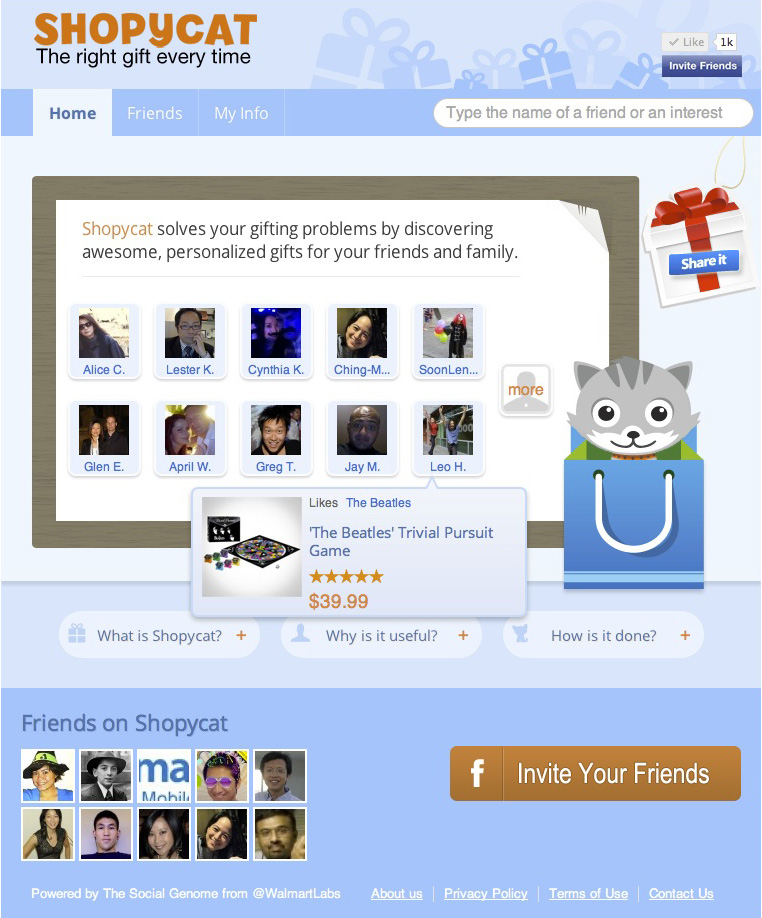
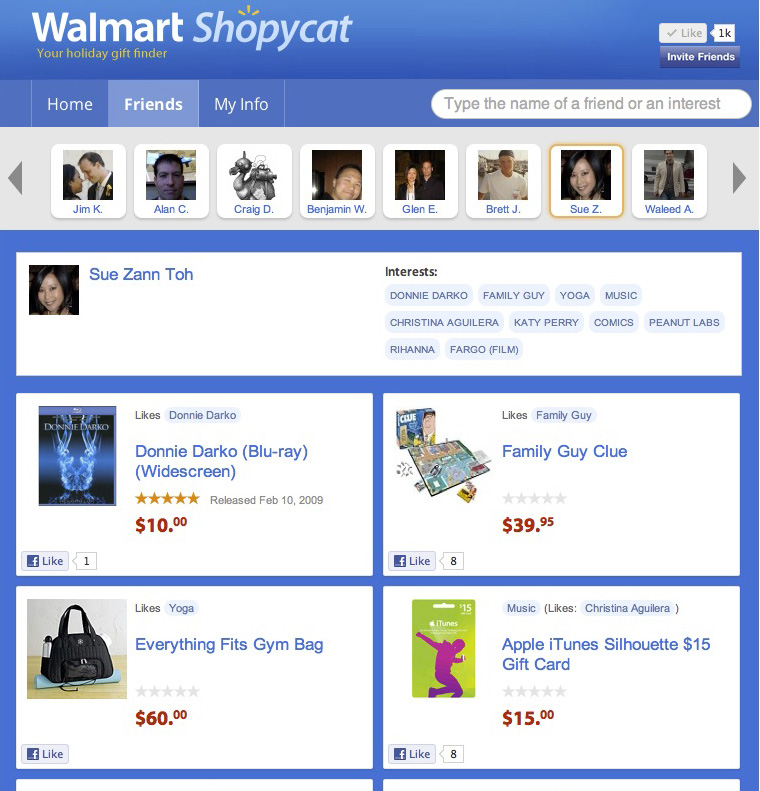
Retailing giant Walmart is launching its first-ever social gifting platform tonight, dubbed “Shopycat.” The service, previously in beta, is initially available as a Facebook application where it will also be promoted to the nearly 11 million Facebook users who have “liked” Walmart’s fan page. The app, which suggests gifts for friends based on their Facebook use, was built with technology Walmart acquired from social media startup Kosmix (now @WalmartLabs) earlier this year.

And here’s the interesting part: the new app won’t just point you to pages on Walmart.com for its gift recommendations. It also recommends products from nearly two dozen other retailers, including Barnes & Noble, ThinkGeek, RedEnvelope, NBC Universal, Hot Topic and more. (Just not, of course, Amazon).

The technology behind Walmart’s gift recommendations grew out of Kosmix’s Social Genome, a semantic technology platform that was originally used to power social media discovery services built primarily on top of Twitter. Now that Kosmix’s platform is a part of Walmart, those same algorithms are used to analyze people’s interests based on their Facebook posts, profile updates and “likes.”

The system is smart enough to understand the sentiment behind a Facebook status update, too, not just the keywords involved. So, for example, if you posted “I hate Twilight!” as a Facebook status update, Shopycat won’t recommend that your friends buy you the “Breaking Dawn” Blu-Ray. It also knows what items are more “giftable” than others, using algorithms that examine a number of signals, including recency, uniqueness (e.g., a collector’s edition over a standard edition) and the aggregate buying behavior of shoppers on Walmart.com.

While the obvious goal is to encourage traffic and purchases via Walmart’s e-commerce website, the company has taken a unique approach by not making it a Walmart-only application. That is, if Walmart doesn’t have the perfect gift in stock, either online or at your local store, it will point you to another retailer who does. For starters, this includes a list of around 20 third parties, but the company plans to increase that number next year. This effort also includes gift cards for things like iTunes, Starbucks and Zynga.

These outside recommendations serve as a clever tactic to boost the viral nature of the Facebook app itself (i.e., it’s not Walmart only, so it’s actually kind of cool). But the design also helps Walmart take on its main online retailer: the virtually infinite online warehouse that is Amazon. Whether Walmart will then use these referrals (to which it receives no affiliate income, we’re told ), to later inform its own buying decisions has yet to be determined.

We do know that the company does plan on integrating Facebook Connect within its own e-commerce site at some point in the future, allowing users to authenticate with Facebook to see social recommendations from friends. This, of course, could serve the even more valuable purpose of associating a Facebook user’s online identity with their actual transaction data, but whether or not (or to what extent) this will occur is still unknown.

In the nearer future, the plan is to instead bring the Walmart.com online store to Facebook. The app currently shuffles users out of Facebook when it’s time to buy, but by mid-2012, Shopycat will function as an online store itself, allowing users to buy from Walmart without every having to leave Facebook.

Walmart isn’t the first to use Facebook’s social signals to make gift recommendations, of course. The homemade goods outlet Etsy launched its Gift Finder recently, also on top of Facebook data, and eBay’s latest acquisition, Hunch, which is known for building a “taste graph” of recommendations by asking questions, released its own Facebook app back in 2010. However, as the world’s largest brick-and-mortar retailer, Walmart’s foray into social commerce can’t be overlooked.

For what it’s worth, Amazon has had similar technology in place since July 2010, and had experimented with Facebook apps for social gifting as far back as 2008. But Amazon’s focus lately has been more on mobile, with a plethora apps and its Kindle devices, and less on developing its Facebook recommendation technology. Its Facebook-enabled recommendations, in fact, are still listed as being in “beta” on the Amazon homepage. And frankly, their accuracy hasn’t improved much since last year’s launch. In early tests, Walmart’s Shopycat app seemed at least on par with Amazon’s recommendations, which is to say, only fair. (Do not buy me Star Wars Jedi Bath Robes, for example.) But Shopycat doesn’t let you customize the recommendations beyond “unliking” a Facebook page to adjust the signals the app uses.

Even though technology like this has existed for years, it’s still the early days for social e-commerce. Many of the kinks and problems with leveraging Facebook for recommendations, gifting and otherwise, will be overcome in time. To give Shopycat a go for yourself, visit the Facebook app here.



The First Ice Cream Sandwich Android Tablet Surfaces In China

ics tab

Right now the only way to officially taste Ice Cream Sandwich on a device is on the Galaxy Nexus. Google stated that it would eventually hit tablets. Well, the wait is over. Somewhere in the bowels of China the first ICS tablet has appeared. It’s a Xoom clone powered by slightly-dated hardware but it’s running 4.0.1. That’s all that counts.

The story goes that the tab shown here (and in the video after the jump) is the first 4.0.1 tablet. As Shanzhaiben and GizChina notes, the 10.1-inch tablet is a bit of a Xoom knockoff but sports respectable internal components. 1GB of RAM and a Tegra 2 chip powers the device. There’s 16GB of storage, dual cams, GPS, HDMI, a 7000mAh battery, and a 3G SIM card slot.

Looks good, right? Well, you can’t buy it yet. The company has yet to release pricing or a release date. But prepare yourself. The onslaught of Ice Cream Sandwich tablets is almost upon us. CES will be here in less than 45 days and you’re going to get fat from all the Ice Cream Sandwich’s pouring out of the Las Vegas Convention Center.

??????flash???,???????


Source: Zynga Lowering IPO Valuation To $10 Billion Range, Due To Larger Economic Fears

zynga-party-shirt

Social game developer Zynga will start talking to potential public investors this Monday ahead of a mid-December IPO, according to reports earlier this week. The question is: how much will it be selling its stock for? That information has been expected to surface in an amended filing on Monday, but Reuters has some early details, that we’ve confirmed with a source close to the company.

Zynga is seeking to raise around $900 million by selling 10% of its stock at a range between $8 and $10 per share, for a valuation of around $10 billion, according to the report. Speculation had previously been that it would go for between $15 billion and $20 billion, and a third-party valuation analysis that Zynga had provided in a recent filing amendment indicated it was worth $14.05 billion.

Our source says Reuter’s range is correct, and attributes the decrease to Zynga’s concerns over larger economic issues, like any fallout out from Europe’s financial crisis, and the poor reception that other tech IPOs have had recently. The example everyone’s looking at is deals site group Groupon, which went public at $17.8 billion, but has dropped towards $10 billion recently (although it’s been climbing back up in the last couple days).

The lower price, of course, could also be aimed at addressing specific investor concerns about Zynga, the company — like declines in its Facebook traffic numbers, and reports about its intense company culture.

Zynga’s bankers, some of whom apparently didn’t wait for the roadshow to begin talking to the press, could also still adjust the amount it seeks to above $900 million. The company had said it was looking to raise $1 billion when it had first filed in June.

After Zynga’s wild ride to success over the past several years, the conservative pricing could also help set a new tone for it on the public stage.

[Image via BetaBeat.]


TechCrunch Giveaway: Last Chance To Win A Ticket To LeWeb’11

leweb

LeWeb’11 is right around the corner. For those who do not know what LeWeb is — it is Europe’s number one tech event. This year they already have some amazing speakers lined up. Some of those include ones we’ve even seen at our very own Disrupt events. Those speaking at LeWeb’11 include: Eric Schmidt, Sean Parker, Kevin Rose, Marissa Mayer, Brian Chesky, and Dave Morin just to name a few. You can view the full list of speakers here.

Also, Karl Lagerfeld has just been added as a speaker. Many of you may know him as the head designer and creative director for Chanel. Très fantaisie, vous ne pensez pas?

They have a number of other surprises in store for those attending as well. I can promise you that it is going to be a great event. Already over 3,000 participants from 60 different countries have registered and that number is continuing to grow, but not for long. I was just informed that tickets are almost sold out. Lucky for all of you, we have one of the last tickets to give away and we’re giving it away for free.

If you are feeling lucky and want to go to LeWeb’11 from December 7th – 9th in Paris, all you have to do is follow the steps below.

1) Become a fan of our TechCrunch Facebook Page:

2) Then do one of the following:

– Retweet this post (making sure to include the #TechCrunch hashtag)
– Leave us a comment below telling us why you want to go

The contest starts now and ends Friday, December 2nd, at 7:30pm PT.

Please only tweet the message once or you will be disqualified. We will choose at random and contact the winner on Friday with more details. Anyone in the world is eligible. Please understand this giveaway is for the ticket only and does not include airfare or hotel.

Bonne chance à tous!


More Than One Million Listings A Week Are Now Made Through eBay Mobile

ebay

It’s no secret that eBay is pushing mobile in a big way. Especially during this holiday shopping season, the e-commerce giant is seeing record mobile engagement. And today, eBay is announcing that more than 1 million listings are now made every week through eBay mobile.

That means that now more than ever, eBay’s marketplace sellers are uploading items they want to sell via mobile devices. Last year, eBay consolidated its buying and selling iPhone apps, allowing seller to quickly take photos of items and post them on eBay from the same app that buyers browser items on.

eBay is also publishing a new video series, called eBay MoneyMakers, which will feature families who turned to eBay to make money in tough economic situations.


Examination Of Privacy Policies Shows A Few Troubling Trends

trusthead

A superficial comparison of privacy policies around the web by privacy service company TRUSTe has produced a few interesting statistics. Of course the most interesting bits are usually buried deep in the agreements and authorize things like the use of your child’s likeness for doll faces. Nothing sinister like that was discovered, but the standout stats should cause a bit of head-shaking.

Only 2% of sites have a mobile-optimized privacy policy, for instance. There are surely separate considerations to be made when, say, location data can be determined from your access point or IP, or separate protections that need to be acknowledged because your data may not be as secured. Granted, many of these sites will be making such changes through native apps instead of mobile web apps, but still, 2% is probably a number that should be raised.

7% of sites explain how long they store your data for (and presumably what data is stored), and 32% tell you how to go about deleting your account and data for good. This information is probably available on request, but it seems to be a natural fit for entry into the privacy policy. Just as apps must declare what data they need access to (Carrier IQ excepted, of course) on Android, shouldn’t websites declare what data they’ll access, record, store locally, and so on?

And of course there’s the length of the policies, which like the average EULA exceeds the attention span of the average internet-goer by orders of magnitude. TRUSTe found the average length was 2464 words. That’s 200 words longer than my rant against SOPA, though to be fair the privacy policies are probably a lot more fun to read.

It’s not a new or original suggestion, but we really do need to take these enormous documents and reduce them to something intelligible to the average user. An analogous real-world situation, say a building that had a 2500-word behavior policy posted in small type near the door, wouldn’t stand up in court, though of course people are expected to adhere to simple posted regulations like “No Smoking” or “Employees must wash hands before leaving restroom.”

Can a privacy policy or EULA really be boiled down to that size? Some do already, of course. I’ve seen policies as short as a few sentences. Hopefully we will see some precedents set over the next few years that discourage the impenetrable documents we sign so frequently and ensure a standard level of legibility.

You can download the full infographic here (PDF).


Academia.edu Raises $4.5 Million To Help Researchers Share Their Scholarly Papers

academiashot1

Academia.edu, a social network for researchers, is having a good year. In 2011 it’s tripled its total registered userbase to 800,000, and today it’s announcing some major news that ensures the site will be expanding well into the future: it’s just raised $4.5 million in a funding round led by Spark Capital, with participation from True Ventures. This is the company’s second round of funding, after a $2.2 million round in late 2009 (the investors from that round participated in this one as well).

Academia.edu can be thought of as a social network for academics, in that it allows them to forge connections and follow updates around their field, but it has another benefit: it gives them a powerful, efficient way to distribute their research. Unlike, say, a personal website, which probably won’t have much in the way of analytics or search engine optimization, Academia.edu will let researchers keep tabs on how many people are reading their articles with specialized analytics tools, and it also does very well in Google search results. Academics are uploading 2,500 articles to the site each day, and, as a result, the site is now drawing some 3 million unique visitors, many of whom are arriving at the site’s articles via Google.

Founder Richard Price (whose Academia profile you can check out here) says that aside from getting an increasing amount of traction with researchers, the site is also benefitting from a recent movement among universities and researchers that’s referred to as ‘Open Science‘. If you’ve ever tried looking up scholarly papers online, you’ve likely encountered one of the many paywalls put up by the journals those papers were published in. Access to these papers can be very expensive, depending on the journal — in some cases prohibitively so. In short, the information is fragmented and doesn’t flow freely.

Recently some scientists have begun to combat this by deeming their papers ‘open access’, thereby making them publicly accessible for free. Princeton now requires researchers to get a waiver if they want to assign all copyright to a journal; MIT and Harvard have both enacted open access policies as well. Many researchers believe that this open access will help streamline the research itself, allowing for faster innovation.

Academia.edu benefits from this movement because it means that researchers are free to share papers amongst themselves on the site. Price says that Academia.edu is already the largest platform for sharing these research articles, and the company looks to help foster this trend going forward.


Classic Gaming Mag And Site GamePro Buys The Farm

MarioGameOver

Gamers of the 8- and 16-bit generation will fondly remember GamePro, one of the leading publications covering and reviewing the growing games market during the console salad days of the 90s. But like so many publications before it, and surely many to come, the modern age was too much for it. Even after shifting to quarterly publication and focusing on an online presence, the venerable magazine is finally being shelved for good.

Owner IDG has confirmed that ad revenue wasn’t enough and the whole operation is being rolled up, complete with layoffs. The brand will remain, both as a games-focused subsite at PCWorld and as a custom content publisher for events and such, known as GamePro Custom Solutions. So they may yet have a modest future as a trade show and private print producer.

They put up a valiant fight and tried to change with the times, which is more than can be said of some “legacy” publications, but times are tough and that’s that. As a former GamePro reader and colleague in the business, I wish the company and employees all the best.


YouTube Analytics Slakes Your Thirst For Your Channel’s Viewing Stats

analytics-infographic-r3-1500px

YouTube has upgraded its viewer demographics and video tracking tools and changed the name from Insight to Analytics. The changes should be rolling out to “everyone with a modern browser” today, though you can still access Insight if you want to do a little comparison of capabilities.

The changes are non-destructive; some existing features have been tweaked and expanded, and there are a few new tools that could help the struggling YouTube-jockey pull in more views and better understand their viewers.

The look has been overhauled to give the stats a little more space around them, and the amount of simple clickable text is removed. The layout has been mixed up somewhat and some crucial social stats (likes, comments, net subscriber change) are front and center. Search has also been made more obvious and some drilldown controls are placed prominently.

All the usual reports supposedly now have more detailed information, perhaps only of interest to stat hounds, but appreciated nonetheless. The audience retention measure looks like a handy tool:

Comparing to other videos of the same length seems ridiculous (this was the retention tool from Insight), but seeing the points of the video at which people stopped watching, or had their attention grabbed, is certainly handy. Is the intro sequence too long? Did that lull in the conversation kill viewship? Good info here for people looking to tweak their content.

A few more details and links are available at the YouTube blog, and if you’re logged in this link should take you to the new stats page.


Facebook Ups Character Limit to 60,000, Google+’s Is Still Bigger

Facebook 60,000 Character Status Updates Done 2

There’s a pissing contest going on. Google+ launched saying it has no character limit, though my tests show it stops publishing at 100,000. Surely unrelated, Facebook upped its limit from 500 to 5,000 in September, and today announced its limit is now over 60,000. That’s 1/9th the length of a novel. This gives users the flexibility to write full-fledged blog posts or even longer content. However, I suspect that Facebook was also trying to neutralize one more selling point of its competitor.

I tested the character limits of both Facebook and Google+ today. If you try to publish any more than 63,206 characters on Facebook, it tells you “Status Update Too Long” and asks if you want to publish that text as a Note instead. That’s a pretty graceful move, actually. Wanna guess how it chose 63,206? Facebook engineer Bob Baldwin wrote, “I set the exact limit to something nerdy. Facebook … Face Boo K … hex(FACE) – K … 64206 – 1000 = 63206 “, in response to VP of Engineering Mike Schroepfer’s post of the announcement.

Google+ was less transparent. It wouldn’t publish anything over 100,000 characters, giving me the excuse that “There was a problem saving your post. Please try again.” So much for an infinite limit.

Facebook’s enormous user base means people are using it in all sorts of ways. Maybe someone out there wanted to publish wordy blog posts or whole chapters of their book in installments. Both Google+ and Facebook thankfully curtail epic status updates with “Expand this post” and “Continue reading” links respectively. Still, a 60,000 character Facebook post is probably never going to be read in the tiny width of the news feed, and Notes are better place for them.

That’s why I think this is another move by Facebook to whittle away Google+’s quantitative advantages. Facebook has been aggressively launching features found in Google+ since its competitor launched. In-line privacy controls, asymmetrical subscribe, better public posting capabilities, improved Friend Lists, and video chat are just a few examples. Facebook wants people comparing the user counts, time-on-site, and social graph density of the two services — things where it’s the clear front-runner. It doesn’t want people citing things Facebook doesn’t have, even if they’re unnecessary. Like 60,000 character status updates.


Android Smartphone Round-Up: November Edition

lead

Changing Leaves. Black Friday. And Macy’s Thanksgiving Day Parade. These are the cornerstones of the month of November. Releasing new phones, however, is not. Unfortunately, this means that our Android Smartphone Round-Up for November is a bit lean, but we’ve still managed to pick out a few handsets worth your valuable consideration.

Without further ado, these are our favorite November releases of the Gingerbread (2.3) persuasion: The Samsung Galaxy S II Skyrocket (AT&T), the HTC Rezound (Verizon), and the Samsung Captivate Glide (AT&T). They range between a solid $300 to a cool $149 (all with a two-year agreement, of course), and each has its claim to fame.

Onward!

HTC Rezound:

Features:

  • 4.3-inch 720×1280 S-LCD display
  • 1.5GHz dual-core processor
  • 8MP rear camera (1080p video capture), 2MP front camera
  • Sense 3.5
  • $299.99

Pros:

  • That 720p display is no joke, and one of the first of its kind
  • Beats Audio integration, and accompanying Beats earbuds
  • 4G LTE support from Verizon

Cons:

  • It’s a fat little guy — steer clear, Razr fans
  • 4.3-inch is admittedly a pretty large screen, but we also have a few 4.5-inchers on the market that provide an advantage in gaming
  • Sense 3.5

The HTC Rezound is certainly a powerful little beast, but you can tell it’s already started packing on the pounds for winter (that joke was reaching at best, forgive me). It’s more than half an inch thick, and it feels that way at 6oz. It does have a nice textured finish on the back for extra grip, and seems to pull from the Droid Incredible 2 design style.

Under the hood, things get way more impressive: the combination of that dual-core 1.5GHz processor and Verizon’s LTE is pretty unbeatable. It’s super responsive, and you can’t help but fall in love with its 4.3-inch 720p display. Beats integration doesn’t change my entire perspective on audio or anything, but the included set of Beats ear buds is definitely a plus.

The Rezound is available now from Verizon for $299 on-contract.


Samsung Galaxy S II Skyrocket

Features:

  • 4.5-inch 480×800 Super AMOLED Plus display
  • 1.5GHz dual-core processor
  • 8MP rear camera (1080p video capture), 1.3MP front camrea
  • 4G LTE support from AT&T
  • $249.99

Pros:

  • The Samsung Galaxy S II is one of the best-selling Android phones out there, and the Skyrocket just adds AT&T 4G LTE
  • Thin, light, elegant design
  • Beautiful Super AMOLED Plus display

Cons:

  • TouchWiz, TouchWiz, TouchWiz…
  • Not everyone lives in one of AT&T’s 14 LTE-supported markets
  • Feels a bit plasticky

I won’t be shy about how much I like the Samsung Galaxy S II, and the Skyrocket merely adds faster speeds. It packs everything you can ask for out of an Android device, and at a relatively reasonable price. The screen is beautiful, the phone itself is super snappy, and it looks and feels pretty slick.

What’s better, AT&T’s 4G support isn’t the only advantage the Skyrocket has over the other Galaxy S II variants. It also upgrades to a 1.5GHz dual-core processor instead of its original 1.2GHz CPU.

The Galaxy S II Skyrocket is available now at AT&T for $249 on-contract.


Samsung Captivate Glide:

Features:

  • 4-inch 800×480 Super AMOLEDdisplay
  • 1GHz dual-core Tegra 2 processor
  • 8MP rear camera (with 1080p video capture), 1.3MP rear camera
  • Full four-row sliding QWERTY keyboard
  • $149.99

Pros:

  • Super responsive
  • Strong battery life
  • It’s a comfortable size for a QWERTY

Cons:

  • Somewhat chintzy build quality
  • Keyboard is super flat, makes typing tough to get used to
  • Too much plastic (again, Samsung)

The Captivate Glide is a nice marriage between the Samsung Galaxy S II and a full QWERTY keyboard, however the keyboard itself seems to be “irritatingly flat.” That said, the specs on this guy are pretty great considering its $149 price point, so if you can deal with a somewhat cheap feeling phone (re: plastic), the Glide certainly performs well. It’s what’s on the inside that counts, right?

The Samsung Captivate Glide is available now at AT&T for $149 on-contract.


Nexus One Gets A Taste Of Ice Cream Sandwich Thanks To CM9

n1ics

Google may have run out of love for the Nexus One as far as Ice Cream Sandwich is concerned, but that doesn’t mean the legions of loyal Android developers have. An intrepid dev named TexasIce on the XDA forums has managed to get an early build of CyanogenMod 9 up and running on Google’s first Nexus device, and it looks mighty impressive for a work-in-progress.

Most of the basics seem to run without a hitch: text input and phone dialing work with a minimum of lag, as does web browsing and poking around in the Android Market. Nearly all of Ice Cream Sandwich’s functionality is present and accounted for, though it isn’t all sunshine and roses. Neither the camera nor USB mass storage work yet, and the lack of hardware acceleration means the build has a tendency to chug when it comes to some of Ice Cream Sandwich’s more impressive animations.

Fortunately, TexasIce is working to address the ROM’s issues at a respectable clip: the project only went live a few days ago, and already the 9th alpha build went online earlier today.

It’s certainly a work in progress, but I’ve got high hopes for a smooth ride by the time a stable CM9 release sees the light of day. If I may indulge in a little bit of nostalgia, CyanogenMod was one of the first custom ROMs I ever flashed onto a device, and it made my G1 run like butter. Nexus One users who want to join in the fun now can head over to the thread in question, but newbies (as always) should proceed with caution.


Another Study Shows Data Caps Are Likely Ineffective, Address Wrong Problem

routers02

Data caps on your broadband, while in principle sound troublesome, are at least understandable. Bandwidth is a limited resource and we all have to share it, and presumably if we all were maxing our connections out all the time, we’d tax the system beyond its capacity. But who uses the most bandwidth and when is a more practical thing to investigate, as knowing that could prevent congestion at peak hours and so on.

Some studies and theories have suggested that so-called bandwidth or data hogs, in other words people who use the entirety of the product they paid for, aren’t really a great source of congestion, and the data caps intended to prevent such users from maxing out all the time aren’t an effective countermeasure.

The guys at Diffraction Analysis examined data from “a mid-size company from North America” that was interested in understanding its consumers’ use patterns. Good for them, by the way. The data they submitted was bandwidth consumption throughout the day, with five-minute granularity. The study’s aim was to determine whether a small subset of users (the hogs) could indeed affect the quality of others’ service, and whether caps were an effective deterrent.

The conclusions, briefly stated, were that while heavy users do in fact consume far more data in aggregate than the average (288GB vs. 9.6GB in this study), their contribution to congestion during peak hours, and when the network is at 75% of its capacity or above, is in fact not much greater than the average user.

What the statistics bear out is this: during peak hours when service is most likely to be affected by overcrowding, heavy users only make up a small percentage of those consuming bandwidth – 14.3%, to be precise. And of the heavy users, only half of them were on the fastest connection, further driving home the fact that while they may consume more in total, they are not contributing more than anyone else to the actual problem, which is slowdown in peak hours.

So why the data caps? Clearly a limit of, say, 300GB a month (or lower) won’t prevent peak usage from affecting service quality. In fact, if people are limited by draconian data caps, they are likely to limit their usage to peak hours: streaming a movie in the evening, or browsing YouTube when they get home from work. This would in fact contribute even more to the problem of peak crowding.

What’s the solution? Bandwidth caps seem more important, and advertising a range of values instead of a maximum would be both more honest and indemnify the ISP against slowdowns. If a dynamic bandwidth cap let you download at 30Mbps in the middle of the night but limited you to 5Mbps during peak hours, it’s the best of both worlds and nobody has to worry about overage charges.

And how would you make money to replace those overages, not that they amount to much? Sell a limited number of premium accounts that aren’t limited during peak hours. Since the ISPs control the number and width of the pipes, they can calculate how many premium and how many standard they can offer. This seems much more logical than imposing a total data limit that’s a pain for some and immaterial to others, though both contribute equally to the problem ostensibly being addressed.

The whole report is available for purchase here for the sum of €750, though the executive summary provided by the author is illuminating as well.


Familiar Turns Your Screensaver Into A Social Picture Frame

Screen Shot 2011-11-30 at 1.35.29 PM

Familiar, the artist formerly known as Picadee, launches in beta today. Familiar has an incredibly simple yet compelling value proposition, namely that billions of screens worth of untapped real estate are worth taking advantage of …

Familiar is basically a socially programmed screensaver (yes, screensaver) which allows you to share and display photos with contacts you select through Facebook and via email. In the beta version, all photos you upload to Familiar will turn into a collective screensaver for the people you’ve connected with, combining with photos that other users have shared in Familiar’s ‘The Shuffle’ function.

To share photos, you can either drag and drop selected images into Familar’s downloadble desktop app or use the web interface to sync from Facebook Albums (via Facebook Connect), Flickr and Picasa. Familiar co-founder Marcus Womack tells me that they plan on supporting mobile services like Instagram and possibly others.

“The [photosharing] fragmentation is great for us – people receive photos from their friends in email, on Facebook, or via links to a dozen different websites,” says Womack, “With Familiar, we make it simple: your family and closest friends send photos directly to each others’ screen, even if everybody is using a totally different app to take, manage, or share photos.”

After Familiar users have built up a palatable collection of photos, they can go to Familiar ‘Preferences’ and decide whether to use ‘The Shuffle’ as their screensaver and/or ‘Photos I Love’ (which they can designate by clicking the ‘<3′ button on each photo) as their desktop background. They can also adjust the volume on various friends by using a Less/More slider.

Womack explains that his vision for Familiar extends way beyond photos, but that the company wanted to launch their pared-down beta in time for the holiday season, which is typically a photosharing extravaganza.

In addition to granular contact sharing options, Womack eventually wants to develop a version of Familiar for all screens including iOS and Android. He also wants users to be able to share updates and other content like local news, stocks, sports and weather via their screensavers. Womack hopes that people will think of Familiar on the mobile phone as a mobile photo wallet and Familiar on the iPad as a mobile photo magazine,”Your usecase will depend on the device.”

Familiar is an interesting endeavor as no one has done anything ambitious with the screensaver since Pointcast in the dotcom era. There are infinitely more screens and infinitely more people who want to share in today’s startup environment; “Every time we see a digital screen we think it’s an opportunity to make you more informed and connect you to world around you,” Womack says.


Seattle Meets Scandinavia

The Lumia 800 is the first lovechild birthed from the union of Microsoft and Nokia. The two companies entered into a happy alliance in February 2011, with Nokia saying it would ship the bulk of its forthcoming handsets loaded with the Windows Phone mobile operating system.

So it’s no surprise that Nokia’s Lumia 800 runs Microsoft’s new Windows Phone Mango OS with aplomb. But the device lacks a few comforts you’ve come to expect from a smartphone in 2011. For one, there’s no front-facing camera for video chatting. The screen is a little smaller as well, only 3.7-inches.

Oh, and another thing — you can’t buy it yet in the United States. The full Nokia Windows Phone lineup won’t be available outside Europe until early 2012.

More on that later. First, the hardware.

Aside from the smaller screen and a few other points, the Lumia is nearly identical to the Meego-powered Nokia N9 we saw last month. It shares the N9’s flattened cylindrical polycarbonate shell and 8-megapixel f/2.2 rear-facing, Carl Zeiss-fitted camera.

It fits nicely in the hand and even nicer in the pocket, with no additional doodads, rubberized backings or textured plastic to detract from the smoothness.

I’m a huge fan of the slim, minimalist industrial design. It fits nicely in the hand and even nicer in the pocket, with no additional doodads, rubberized backings or textured plastic to detract from the smoothness. It’s almost Jobsian in that way. On the bottom of the device is a discreet speaker grill. On the top, my only design quibble: Next to the headphone jack, the microUSB port is hidden beneath a push-to-open plastic slot that’s just begging to get ripped off like a hangnail. When the slot lid is shut, though, it leaves the 800 nearly hole-less.

The Lumia’s screen is a little smaller than the smartphone standard, but the 480×800 resolution, 3.7-inch AMOLED display is impressive nonetheless. Colors are very bright and lines are sharp. Pixels seem to float on the surface of the screen rather than muted beneath a layer of glass. White pixels or light-colored pixels, though, are unfortunately visible individually to the human eye. This is a con for me when compared to something like Apple’s Retina Display, where it’s very difficult to make out the pixels no matter the color.

The 8-megapixel camera is wonderful in most settings, but I found it ill-suited for flash photography. I left the flash on auto, and the phone often fired the flash when there really wasn’t a need, resulting in overly harsh photos with dark backgrounds. The lesson here is simple: Don’t use the flash. But most people leave the flash on and use it more often than you or I do. Their pictures will suffer. There’s an Auto-Fix software tweak for photos that mitigates that harshness (among other things), and like other smartphones on the market, the Lumia has a number of camera settings you can adjust to better suit your environment. 720p HD video recording is generally pretty good, with audio recorded in stereo.

App-wise, Microsoft is working on filling its Windows Phone Marketplace with high-quality, desirable applications, and it’s coming along. Choices are still rather slim, but the staples are there. Besides Facebook and Twitter (which are actually tightly integrated into the phone’s OS), you’ve got Netflix, Google Search and YouTube, streaming services like Rdio and Spotify, and games like Burn the Rope, Angry Birds, Fruit Ninja and Plants vs. Zombies. Though it’s surely not meant to be a check in the “pro” column, app discovery is easier since search results are narrower.

Inside, the Lumia 800 has a battery-sipping 1.4GHz Qualcomm processor. This is a step up from most handsets on the market, and it makes Live Tile updates, button taps, and typing on the onscreen keyboard crisp and appropriately responsive. There’s only 512 MB of RAM, but both apps and script-heavy websites like Gmail load swiftly. Mango’s multi-tasking functionality makes swapping between various apps a snap, and even with extensive app switching, the minimal RAM doesn’t seem to be an issue. There’s also a flat 16 GB of on-board storage with no option to expand that via microSD, something we’ve come to expect on competing Android handsets these days.

So it’s a solid phone, and an exemplar of how Windows Phone OS is supposed to look and act. Unfortunately, the Lumia 800 may be a “too little, too late” player in the fast-paced smartphone game — the phone hasn’t actually landed stateside yet. It’s currently only available across the pond. The handset should arrive in the U.S., reportedly as an LTE model, at some point in 2012.

But seeing as this is a decidedly 2011 phone, it will seem obsolete when the calendar turns and the new wave of 2012 smartphones arrives. In the meantime, many could end up shunning this belated Windows Phone offering for a 4G Android phone or the iPhone 4S.

Nokia and Microsoft are going to have to drop that premium price point down a few notches if they hope to entice new buyers and early adopters. It’s a solid phone, but we need to see a US version now.

WIRED The best Windows Phone we’ve seen yet. The AMOLED display really pops, and onscreen interactions are snappy and smoothly executed.

TIRED No front-facing camera, and the 8 MP rear-facing camera is subpar compared to peers like the Samsung Galaxy S II and iPhone 4S. Not actually available in the U.S. yet.

Photos by Ariel Zambelich/Wired