Twitter Gets Google And Facebook Connect

Screen Shot 2011-12-03 at 1.12.07 AM

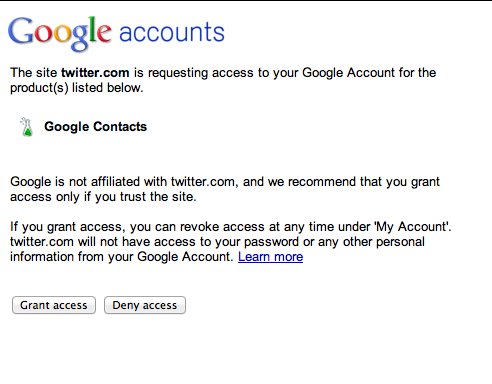
Correct me if I’m wrong here but you weren’t always immediately prompted and guided through to finding your Gmail contacts on Twitter upon login, just like you weren’t always able to sync your tweets to Facebook.

Some switch just got turned on after midnight on Friday I swear because, yeah now this stuff is possible. It’s crazy. Log into your Twitter account, go to Settings, click on your profile pic and it’s there, I promise. Unless I’m hallucinating or part of some strange private beta.

If it is true, this tripartite partnership is super interesting as all three of these companies don’t really, um, get along. So I’m all like, “Look who decided to play all nice all of a sudden.”

Heh.


Don’t Blame The IQ, Blame The Carrier

eyevo

You couldn’t swing a cat this week without hitting a story about Carrier IQ, which (if you have somehow avoided this information) is a bit of software installed on millions of phones that has access to a huge amount of user data. As developers hinted for months and eventually proved on camera, the software is aware of SMS content, secure web traffic, contacts, key presses, and more.

Naturally there has been an outcry. Who are these people? What phones is the software on? How do you remove it? What can’t it do?

The surprising thing is that the ire has been directed at Carrier IQ themselves. Why? If someone runs you over in their car, you don’t write a stern letter to Ford. Carrier IQ made and sold an invasive piece of software, certainly. But they didn’t install it on your phone. Sprint did.

No doubt that part of the problem is simply yet to be addressed, but I have to say I genuinely sympathize with Carrier IQ, a company that sells a legitimate and potentially useful product, and is now facing the rage of the entire internet, and what’s worse, Al Franken.

Who wrote the contracts the users signed? The carriers. Who handled the phones? The carriers. Who added bloatware and special services and skins and branding to the OS? The carriers, the carriers, the carriers. And who called Carrier IQ in the first place and said “Hi, we’d like a surreptitious method of peeking at certain user habits”? That’s right, the carriers.

Who should have informed their customers of this tracking software and its capabilities, regardless of what information they intended to collect, or what was turned on or off by default? The carriers. Who would own the information scraped from the millions of phones being monitored? The carriers. And who should be the object of the internet’s rage right now? You’re damn right it’s the carriers.

What makes the whole thing even worse is that it wasn’t just some marketing deal Sprint had where they would collect stats from, say, Samsung phones running Android. T-Mobile and AT&T have used the software as well, and it’s not much of a leap of faith to suggest that Verizon and smaller carriers have something similar in place. Hell, Apple had a (mostly harmless) version of it, though understandably RIM was careful to note it avoided the software entirely.

If it was a misguided scheme by an isolated individual company, that would make it stupid. But it’s not — it’s an industry-wide collaboration that shows how incredibly little the carriers value their customers’ needs and privacy. If it was as integral to maintaining quality service as they seem to think it is, you’d think at least one of them might have mentioned it sometime in the last couple years. Do you remember anything like that?

There’s not a lot we can do, but if Senator Franken and the FTC and others can roll this ball of deceit uphill (as they indeed are attempting), they might be able to force carriers into having some basic standards for privacy and disclosure. It’ll take time, but the fact is that the damage is already done and these jokers have been caught in the act. Carrier IQ isn’t blameless, of course, and their handling of the situation has been bad, but they’re just the dealer. Sprint and the rest are the ones behind the wheel.

Are you mad? You should be. Go tell them so.


With New Funding And Microsoft Partnership, AboutOne Looks To Help Moms Stay Organized

96903v1-max-250x250

We first covered AboutOne as part of a round-up of some of the more interesting startups to present their wares onstage at DEMO Spring 2011. The startup is building eManagement system that makes it easy for busy families to organize their lives and households. And today AboutOne has announced that it has closed $1.6 million in series A financing, led by Golden Seeds, a network of early-stage investing angels who focus on companies founded and led by women.

The Philadelpha-based startup was founded by CEO Joanne Lang, who is a former SAP Labs exec, cloud computing specialist, and mother of four children. The idea for AboutOne came out of an experience she had when one of her young sons had a medical emergency: Away from home, she was unable to provide a current list of his medications to paramedics.

Leveraging the evolution of cloud platforms to bring efficiency and organization to enterprises, businesses, and the consumer Web, she set out to develop a technology that could help in emergencies like the one she experienced, and simplify the lives of moms (and parents) trying to organize their households.

AboutOne was created from my direct experiences as a mother of four children,” said Lang. A former SAP Labs executive specializing in cloud technology, Lang developed AboutOne after one of her sons had a medical emergency. She was away from home, with only her keys and phone, and unable to provide a list of his medications to the paramedics. She’d seen how cloud computing helps businesses gain new levels of efficiency and wanted to use her technical training and personal experiences to develop technology that simplifies a mom’s life.

The ambitious goal for AboutOne, according to the founder is to become the standard for family management systems, and tap into the sizable 82.8 million-strong mom market. To help achieve its goal, AboutOne has forged partnerships with Microsoft and Suze Orman of IDSafe, launching an updated version of the platform based on feedback it’s received from its current customers as well as its partners.

The startup will use its latest round of funding to increasing its marketing efforts in conjunction with expanding its engineering staff to help push out product updates scheduled for the next six months.

One of these, which has been designed based on feedback from customers and partners, will be the AcornPoints rewards program launching in January. This new feature will be a great enhancement for the platform, as it will provide points-based, financial incentive to parents who complete their organization goals and checkpoints.

The upgrades will add to AboutOne’s patent-pending technology platform, which as it currently stands, offers moms the ability to store digitized photos, video, and text, create photo albums, store insurance contracts, keep track of anniversaries, birthday, etc. in calendars, keep contact lists, and post instructions to baby sitters, for example. Information is backed up hourly.

The platform looks to make data entry smooth whether it’s from a smartphone, scanner, or any other web-enabled device. And once families have it set up, it can enable automation of these processes, including creation of hard copy memory books, family newsletters, online health summaries, greeting cards, etc. — all of which can mail themselves to intended recipients.

It’s a pretty robust system for $30/year. For more check out the video below:


“LivingSocial Plus”: A Monthly Subscription Model That Could Improve Deal Site Retention

LivingSocial Plus Beta

In an effort to get customers buying pre-paid deals more regularly, LivingSocial has launched a new subscription service called “LivingSocial Plus”. For $20 a month, members get $25 in “Deal Bucks” credits that are automatically applied to their next purchase as well as access to closed deals. LivingSocial is cleverly pitching buyers on Plus with a checkout graphic that shows the price of the currently viewed deal instantly reduced by the $5 in bonus Deal Bucks. Subscription services like this could solve a fundamental problem of deal providers where users only stop by to purchase especially lucrative or relevant deals. If these program gain traction, providers could establish a consistent revenue stream, get users buying more frequently, and score free cash if credits are never redeemed. Expect rampant copying if competitors see the subscription model working.

LivingSocial Plus is only in beta now, so its URL redirects to the general site if you’re not in the test base. A Help center article confirms its existence. though. The pre-paid deal provider started offering membership to deal buyers around Black Friday. Previously the only way to earn Deal Bucks was to invite friends to the service. The deal provider has been aggressively innovating in search of new models that could save it from the decline impacting Groupon. It just launched LivingSocial Instant and Room Service last month that lets people get discounted food delivered on demand.

While the $20 that buyers actually paid for with Plus are good for 5 years, the $5 in bonus bucks expire at the end of each monthly billing period. This create a sense of urgency where members rush to buy deals just to get that extra $5 off. The whole daily deals model is built on this notion of perceived value exceeding what users have to pay, even if they’re paying for things they don’t need. Meanwhile, it’s really the deal providers that could win since most purchases net them far more than $5.

In this way, the subscription model fits perfectly with LivingSocial and any other deal provider’s business. By clustering lower quality, higher margin deals at the end of the billing period when users are desperate to spend their fleeting bonus credits, providers could coerce members into buying deals that make them more money. Access to closed deals is a great addition to the subscription package, since buyers may be willing to pay for it but it doesn’t cost providers anything. LivingSocial may have figured out the next big thing in daily deals. Now it just has to watch out for copy cats offering even bigger bonuses.


Airbnb To Partner With Vayable To Upsell Travel Experiences To Renters

airbnb

Back when we first wrote about Vayable (the site that lets just about anyone offer to host paid tours/activities for travelers) Alexia said it was “like an Airbnb for Travel Experiences.”

Airbnb would agree, it seems. We’ve learned tonight that Airbnb is prepping to launch a partnership to upsell travelers with Vayable’s tour experiences.

The partnership will be limited to e-mail at first (a “Oh, you’re going here? Check out these Vayable tours!” type thing), though the partnership may find deeper roots if it proves successful. It will initially be limited to e-mails sent to Airbnb customers headed for New York. We were initially clued in on the partnership by an anonymous tipster, and have since backed up the report with an independent source.

This will be Airbnb’s first partnership of the sort, though it’s probably safe to assume that it won’t be the last. The world is quickly filling up with myriad “Airbnb of X”, so Airbnb might as well find a way to tap into them.


Facebook Has Acquired Gowalla

gowallashot

Facebook has acquired location-based startup Gowalla, according to a report this evening by Laurie Segall on CNN Money. The terms of the deal haven’t been reported, and Gowalla declined to comment. Facebook says it doesn’t comment on rumor and speculation. Update: We’ve heard from an independent source that Facebook is indeed acquiring Gowalla.

According to CNN’s report, the Gowalla team will be working on Facebook Timeline, with most of the team moving to Facebook’s Palo Alto headquarters and some remaining in Gowalla’s hometown of Austin, where Facebook has an office as well.

Gowalla, which has raised $10.4 million to date, first launched at SXSW 2009 — going head-to-head against Foursquare, with a stronger emphasis on virtual goods (and nicer icons) than their competitor. But Foursquare overtook Gowalla in popularity by a large margin, prompting the startup to reinvent itself earlier this year.

The new product moves away from displaying a time-based feed of your friends’ recent check-ins, and focuses instead on creating Stories around the places you and your friends have visited, clustering together photos that show off your adventures (there is also a Guides section that lays out where you should visit in a given city).

In other words, it’s not too dissimilar to Facebook’s Timeline feature, which is also designed to group clusters of activity into more cohesive stories, as opposed to just a reverse-chronological feed. And it would make perfect sense for Facebook to start featuring location checkins and photos tagged with GPS coordinates into Timeline stories.

According to CNN, the fate of Gowalla’s existing app is as of yet undecided. It’s also unclear whether this is an ‘acqui-hire’, or if Facebook is also interested in any of Gowalla’s technology. My hunch is that it’s the former.


Western Digital Fires Up First Flooded Factory In Thailand As Recovery Continues

OLYMPUS DIGITAL CAMERA

The recent floods in Thailand have wreaked devastation on the factories in the area; some were under a dozen feet or more of water, and all manner of companies were affected by the damage. Nikon and Samsung delayed cameras and a shortage of hard drives has caused a spike in prices.

The recovery effort is progressing apace, and the affected areas are being pumped or drained clear of water. Power was restored in the last week in some areas and Western Digital has just turned the lights back on at one of its factories there.

It’s not as simply as just sweeping out the seaweed and waiting for the conveyor belts to dry, though. The production of hard drives is an incredibly high-precision business, and the slightest amount of warping or the slightest contamination of an instrument could do a huge amount of damage.

Western Digital expects to resume production of the mechanisms made there in March, though previous estimates suggested that it will still be many months more before they reach pre-flood levels of production.

The loss of these factories for such a long time guarantees a huge deficit in the number of drives on the market — the early effects of which we’ve already seen in higher prices. The market will likely settle down a bit once inventories are confirmed and long-term plans made, but Western Digital alone says they’ll be short at least 50 million units this year.

If you like, you can donate to the Thai Red Cross here.


Science Exchange’s Marketplace For Research Facilities Gets A $1.5 Million Boost

research-facility2

Science Exchange, a Y Combinator-backed company that’s helping to streamline the way scientific research is conducted, has raised $1.5 million from an elite group of investors. The round was led by Andreessen Horowitz, with participation from Yuri Milner, Crosslink Capital, Morado Venture Partners (Ash Patel), Lerer Ventures, Webb Investment Network (Maynard Webb), Start Fund, SV Angel, Sam Altman, XG Ventures, Jack Jia and Joe Eandi.

I really like Science Exchange, largely because it could actually speed up the pace of scientific research. It launched in August, offering scientists a centralized platform for accessing experimental service providers worldwide (or, if you’re more comfortable trafficking in Silicon Valley cliches, it’s an Airbnb for prohibitively expensive scientific equipment).

Here’s the gist.

Many universities across the country have what are called Core Facilities, where expensive equipment necessary for research experiments is housed. Instead of trying to juggling access to these machines between dozens or hundreds of researchers, the Core Facilities have a more efficient system: researchers submit their experiments, where they are carried out by the facility’s dedicated Resource Scientists, who in turn give the researchers the results once they’re ready.

Thing is, the system has some major inefficiencies. If a researcher wants to run an experiment on a machine that isn’t at their Core Facility, then they have to find a way to get access to another facility. But there’s no central database listing which schools have which equipment, nor is there a straightforward way to coordinate payment for the services. And, on the other side of the market, there are plenty of machines that sit unused for extended periods of time.

That’s where Science Exchange comes in. It gives researchers a way to find and outsource their experiments to experimental facilities around the world (and beyond — more on that in a moment). And it also handles payments, so the entire process is much easier on both the researchers and the experimental facilities they’re working with.

Cofounder Dan Knox says that when the service first launched, the team expected most of the experiments would be standard and common jobs, like DNA sequencing, bioinformatics, and microarray analysis. And they turned out to be right. But there are also some facilities that have signed on that are more unique — he likens them to the castles and private islands you’ll find listed on Airbnb.

So what sort of novel facilities are popping up on Science Exchange? For one, it’s possible to conduct microgravity research experiments on the International Space Station (really), which is handled by a company called Nanoracks.

Science Exchange isn’t the only academia-related startup that’s raised funding recently. Kaggle, a platform for big-data competitions, recently raised $11 million, and Academia.edu just raised $4.5 million.


RIM To Miss Earnings Goals After Half A Billion In PlayBook And Outage Charges

sadberry

RIM has announced that it will be taking over half a billion dollars in charges related to two major failures this fiscal year. First is the immense overproduction of the Playbook tablet, the writedown of which inventory amounted to $485M on its own, or $360M after tax. The second charge is related to the prolonged network outage in early October, though it’s unclear whether that money is directly related or being reserved for dealing with ongoing costs like lawsuits.

Sales of handsets and services were as forecasted, but a lack of growth must be inferred by their waning market share, and at any rate the sales weren’t enough to put RIM at their expected revenue of $5.3 billion for the upcoming quarter. Quarterly earnings are at a level with (low) predictions of around $1.20 per share, but yearly earnings will miss the expected $5.25 per share, and analysts are calling for as little as $3.50.

That enormous PlayBook charge really indicates how serious a misstep the device was. While there are plenty of happy PlayBook owners out there (especially after recent markdowns), the numbers are nowhere near what RIM must have expected, and sales have been less than half what they shipped. A bit of napkin math has the hundreds of thousands of unsold devices adding up to hundreds of millions in lost revenue, and then of course there are the many thousands of devices that sold at less than the expected price by hundreds of dollars each. Acer recently faced a glut of inventory and admitted its entire strategy needed to be revised. RIM has not shown much contrition despite serious reservations by shareholders analysts.

RIM co-CEO Mike Lazaridis demonstrated this lack of forthrightness in the earnings report:

RIM is committed to the BlackBerry PlayBook and believes the tablet market is still in its infancy… Early results from recent PlayBook promotions indicate a significant increase in demand across most channels.

October’s outage also affected RIM’s credibility. While even the best services can’t guarantee 100% uptime, the length and seriousness of the outage eroded RIM’s reputation as a reliable business solution. The PlayBook’s lack of enterprise chops and familiar BlackBerry services further contributed to a loss of faith.

RIM has had a bad year, and that’s putting it lightly. But they’re still nearly in line with their predicted earnings and they are, in fact, on the verge up a major product refresh with the new line of QNX/BBX-based BlackBerry devices and a major PlayBook update. A company that stumbles isn’t necessarily a company that falls, but RIM is running out of chances.

The full earnings report can be found here, and some extra commentary by investors and analysts has been collected by Reuters.


The Kindle Fire Is On Fire; Amazon Expected To Ship 3.9 Million This Quarter

Tablet pie chart

The Kindle Fire looks like a bona fide hit right out of the gate. New estimates from IHS iSuppli have Amazon shipping 3.9 million Kindle Fires this quarter, which would make it the No. 2 tablet after the iPad 2 (with an estimated 18.6 million shipments). The Kindle Fire will become the No. 1 Android tablet by a wide margin (the Samsung Galaxy Tab is the next biggest, with an estimated 1.4 million shipments).

To put this 3.9 million number in context, just remember that the very first quarter Apple sold the iPad back in the September quarter of 2010, it sold 3.3 million. So the Kindle Fire sold more in its first quarter than the iPad did in its first quarter on the market. Of course, Apple sold 7.3 million iPads the second quarter it was on the market, which was the 2010 holiday quarter.

However you slice it, this is a good start for the Kindle Fire. It looks like Jeff Bezos was on the money when he predicted at the launch event Amazon would sell “millions” of Kindle Fires.

I can see why people are flocking to the Kindle Fire. Personally, I am a big fan. It’s a great stocking stuffer that will actually fit in a stocking. It’s smaller size is an advantage for certain applications such as ebooks. I just took it with me on a trip to Japan instead of my iPad precisely because of its smaller footprint. The price is right too, at $200.

Will the Kindle Fire ever outsell the iPad? Nobody is predicting that just yet, but it is certainly in the realm of possibility.


Helioid’s Search Engine Provides Category Sorting To Aid Research, Targets Students And Professionals

Screen Shot 2011-12-02 at 3.07.22 PM

The floor of Silicon Valley is littered with the carcasses of failed search startups. Without billions of dollars in resources like Microsoft or a tight vertical focus like travel site Kayak to help attract users, would-be competitors haven’t been able to pull people away from Google.

Helioid is a small startup out of New York that’s trying to change that, by delivering results tied to categories of information. It’s aiming at students, professionals and others who are trying to do exploratory research across a topic, and aren’t just looking for a specific answer to a question.

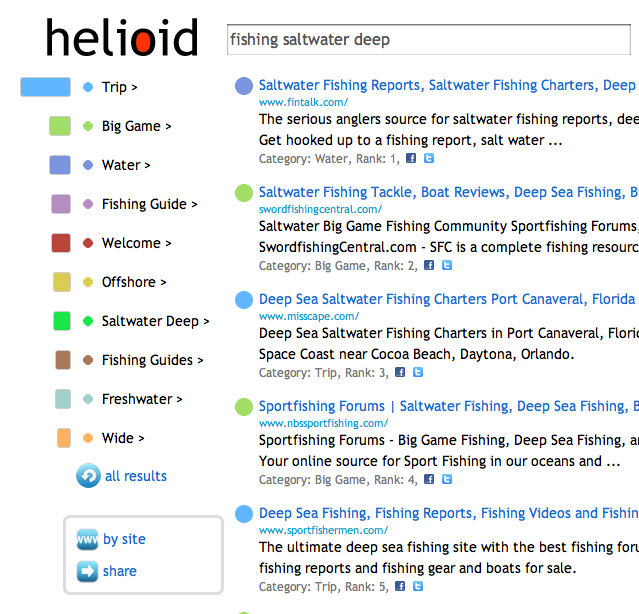
Its search results page shows a color-coded section on the left-hand side for the categories that it determines are most related to the search term. Each result has a dot next to it matching one of these categories, and a label showing the relative size of that category, with the most relevant ones at the top of the section.

If you click on any of the categories, you’ll add the category term as keywords to the search and generate a new, more focused set of results and related categories. You can keep doing this to generate increasingly focused results.

The overall advantage to the interface is that the categories reveal related areas to explore, that you might not easily identify on your own within the keyword-driven paradigm seen on the main pages of Google and Bing.

For example, let’s say I want to study up on popular types of fishing. A search for “fishing” shows me a set of relevant categories including “fly,” “salmon,” “saltwater,” etc. I click on “saltwater” and “deep is a top result. Adding that term then shows me a range of results about deep sea fishing.

Founder and chief executive Kenny Hamilton intends for Helioid to be a complement to general search engines, by helping specific types of professionals — journalists and bloggers (some of whom have started talking about it already), financial analysts, lawyers, etc. — get up to speed quickly on new topics. The business model is aimed in this direction, too. Beyond targeted search ads, he tells me that the company is looking at premium services for professionals, including private indexing for data that a particular user or organization is trying to analyze.

Helioid’s challenge in providing a general search tool is both to avoid making its product so complex that it cuts out potential users, and at the same time differentiate itself from Google in a way that users care about. Existing startups that are aiming to provide a better layer of organization to searches, like Blekko and its slashtags, face the same sorts of problems. Googles’ “Related searches” page is stiff competition.

But, while I’m not sure how well Helioid will be able to penetrate its target market, the interface is intuitive, and I found it useful for topic exploration in testing.

Hamilton and his cofounder, Peter Lubell-Doughtie, met while getting undergraduate degrees at Stanford (physics and symbolic systems, respectively). Hamilton has been building Helioid for the last few years, while Lubell-Doughtie has been working on it part-time while he finished a graduate degree in artificial intelligence at the University of Amsterdam. They haven’t taken funding.


The 4S And Thanksgiving Help Instagram Add Two Million Users In A Month

Screen Shot 2011-12-02 at 3.13.55 PM

Instagram co-founder Mike Krieger is on stage right now, talking about innovative mobile design at the Warm Gun conference in San Francisco.

If anybody has some thing to say about mobile design it’s the founders of the popular – startup which has had a great year, adding twelve million users in twelve months according to Krieger, and another two million in November (when we checked in at the beginning of November it was at 12 million downloads, and Krieger just confirmed to me that it is now at 14 million).

“I often think about mobile experience as filling in the gaps while you wait. And no one wants to wait while they wait,” Krieger said, emphasizing that design should be a speed feature. Krieger held that there were three factors that have to go into consideration when making an app that users love: speed, beauty and communication.

With regards to the speed aspect of the equation, Krieger encouraged developers to …

1. Perform actions optimistically

2. adaptively pre-load content

3. move bits when no one’s watching speed beauty and communication

Krieger said that the iPhone 4S launch had a lot to do with the impressive downloads stats, in addition to the Thanksgiving holiday, where the app was seeing engagement levels of 50 photos a second. “My friend was telling me that he got to experience all of his family’s various Thanksgivings through Instagram, Krieger said enthusiastically.

What makes this rapid scale even more impressive is that Instagram currently has a staff of six, with only three focused on engineering. Krieger has written a blog post about the infrastructure issues involved in scaling here.

You can download Instagram in the App Store here. An Android version is currently in the works.

Image: @mikey 


Metamarkets Debuts Analytics For Mobile Platforms And Publishers

metamarkets

Realtime data startup Metamarkets is announcing the launch of its analytics offering for mobile platforms and publishers.

Metamarkets provides price data and predictive analytics to publishers and web companies. Launched in late 2009, the company aims to solve the problem of ad price discovery on web platforms for media companies. Metamarkets aggregates billions of electronic media transactions to deliver dynamic price data, proprietary price and volume aggregations, and analytic media market views.

The startup serves ad server data, order insertion data, targeting data, audience data, conversion data, and more, enabling media companies and publishers to shift strategy in realtime based on how web and mobile formats are monetizing. All of this helps publishers determine hot to price ad inventory.

Metamarkets Mobile Analytics basically applies this technology to mobile platforms and sites. The product includes real-time operational analytics and large-scale historical reporting for mobile publishers, application developers, and others. The new service can process, store, and analyze daily volumes of billions of mobile events such as auctions and in-game actions.

For example, Metamarkets Mobile Analytics helps optimize the MoPub Marketplace, a real-time bidding platform for mobile advertising aimed at publishers. The company also plans to use its technology to monetize event streams in video RTB, in-game event sets, and social networks.

Founded by David Soloff, the former lead architect at ad startup Rapt (which was acquired by Microsoft in 2008), and Michael Driscoll, the startup has raised $8.5 million from IA Ventures, Village Ventures, True Ventures Founder Collective, AOL Ventures, Dennis Crowley, FLOODGATE and others.


Goody Two-Shoes

The minimalist running-shoe market has exploded over the past year or two, with almost every footwear manufacturer rushing out a line of barefoot-inspired running shoes to feed the public’s interest.

Brooks Running, by contrast, has taken its sweet time. The company has only recently introduced a line of minimalist shoes for runners.

Actually, minimalist is a bit of a misnomer here. The shoes in Brooks’ PureProject line provide a noticeable amount of cushioning when compared to other more bare-bones examples on the market. But the PureConnect road running shoe isn’t necessarily supposed to approximate the feel of running barefoot. Instead, the shoe encourages you to run more naturally by tweaking the barefoot model in various, practical ways.

Brooks shifted the PureConnect’s heel forward by 3 millimeters, allowing runners to footstrike closer to the body’s midline. And the split-toed sole makes the forefoot more flexible, particularly the first metatarsal.

The benefit from features was apparent within the first mile of my first run. It usually takes time for me to fall into a more forefoot-centric strike, but these guys make it happen right away. I stood tall during the run, landing slightly more forward on my heel and rolling smoothly to the toe-off. The split-toed sole added flexibility to the shoe and cut weight. The shoe felt soft, yet responsive, a duality that I chalked up to the PureConnect’s DNA midsole material, which is designed to get firmer during faster running and softer when the pace slows down.

The shoe’s upper sports an elastic band that cuts across the topline of the foot, which is designed to provide a snug fit for a wide range of foot volumes. I found it a bit too snug for my foot initially — I had to loosen up the laces a bit, but once I did, the shoes fit much better. The upper material is made up of lightweight mesh that was pliable enough to lend the shoe a slipper-like feel and open enough to keep feet cool and dry during runs when the thermometer hit the triple digits.

All of this materials technology leads to a shoe that feels good whether you’re pushing your pace or just trying to trudge your way through an endurance run.

With most minimalist shoes, I cap my pavement runs at around five miles to prevent injury — the lack of cushioning in most barefoot-inspired shoes means my feet take a pounding. But the PureConnects have that extra bit of cushioning, making them better for longer runs. My feet felt just as good at mile 15 as they did at mile two. Hardcore barefooters may balk at the added cushioning the PureConnects provide, but it’s a nice change of pace to have a shoe that gently encourages a natural footstrike, rather than bludgeon you into it with a lack of cushioning.

That said, they are still minimalist shoes — if you’re looking for a fully cushioned running shoe, look somewhere else, like something from Vibram FiveFingers. But if you’re looking for way to transition to barefoot running, or you need a minimalist shoe with enough cushioning for longer hauls on pavement, the PureConnect is the way to go.

WIRED Comfortable on long runs. Facilitates a natural footstrike. Midsole foam adjusts firmness to runner’s stride. Sock liner is comfortable.

TIRED Midfoot may be too narrow for wide feet.

Photo by Jim Merithew/Wired