Amazon’s LOVEFiLM Hits The Xbox 360 Tomorrow Complete With Magical Kinect Controls

lovefilm_logo

Amazon took full control of Europe’s largest movie and TV subscription service earlier this year and now, starting tomorrow, LOVEFiLM will hit LIVE-enabled Xbox 360 systems. This brings thousands of streaming movies to Xbox LIVE subscribers including, wait for it, The Twilight Saga: Eclipse. Take that, Netflix! But alas, members of Team whatshisface need to be located within LOVEFiLM’s European service area to access any content including its exclusive titles that also includes The Dark Knight and The Hangover.

The service should be available starting tomorrow for Xbox LIVE subs. Those that also own a Kinect will be able to interface with the streaming app through voice commands and gestures. “It’s very exciting to see the launch of Amazon’s LOVEFiLM on Xbox LIVE,” said Stephen McGill, Director of Xbox & Entertainment for Microsoft UK. “Xbox owners will be eager to get started, using their Kinect-enabled consoles to interact with LOVEFiLM’s extensive catalogue of movies in ways that will only be available on Xbox 360.”

The Xbox Live integration is just the latest platform embraced by LOVEFiLM. The service is already available on iOS devices, set-top boxes, smart TVs and the Playstation 3. Plus, like Netflix in the states, LOVEFiLM also has a mail-order DVD service that pre-dates the streaming service.

This latest addition to the Xbox’s streaming portfolio further advances Microsoft’s ultimate goal of converting the gaming system into an entertainment powerhouse.


MyHealthTeams Launches Social Network For Parents Of Children With Autism

MyAutismTeam

MyHealthTeams, which develops social and local networks for communities of people living with or caring for those living with chronic health conditions, is launching MyAutismTeam, an online community for parents of children on the autism spectrum.

MyHealthTeams says that MyAutismTeam is the first social network catered specifically for parents of children with autism, with the aim of helping parents connect with other who have had similar experiences.

Parents can share recommendations of local providers, openly discuss issues, share tips, and gain access to local services. Since debuting over the summer, the site has grown from 30 to over 12,500 members. On the MyAutismTeam site, parents create a team of autism doctors and specialists, restaurants, schools, piano teachers, babysitters and more.

Parents can then communicate and post status updates around daily activities like dentist or doctor’s visits. Members can also post on each other’s walls and use the site’s searchable database to find autism-friendly providers near them. And organization Autism Speaks helped seed MyAutismTeam’s database of local autism providers with data from its own family resource database.

MyHealthTeams is also currently developing MyBreastCancerTeam, a network for cancer patients and survivors.


Citing Market Conditions, GlassHouse Technologies Pulls IPO (Again)

glass

GlassHouse Technologies, a provider of cloud, virtualization, data center infrastructure and security consulting and managed services, this morning announced that it will not proceed with its planned IPO, citing ‘current market conditions’ as the primary reason.

The company said it intends to withdraw its registration statement on Form S-1 as filed with the SEC.

GlassHouse originally filed to go public to raise $75 million in early 2010. In fact, they filed for a $100 million IPO back in 2007, too, but withdrew that filing in March of 2009. They cited ‘current public market conditions’ back then as well. Perhaps third time’s the charm?

“Obviously the economic climate continues to be volatile, and we feel these are not the optimal conditions for GlassHouse to move forward with an IPO,” said Patrick J. Scannell, Jr., who was very recently named CEO of GlassHouse Technologies.

According to our data, GlassHouse has raised close to $90 million in funding to date, from investment firms and strategic backers like Cisco Systems and Citrix.

Will they ever hit the public markets and provide their shareholders with a decent return?


ZINK Raises $35 Million, Aims To Popularize Ink-Free Printing

zink

ZINK (short for ‘zero ink’) this morning announced that it has scored $35 million in Series B funding in a round led by Genii Capital. The company also announced the hiring of former board members Mary Jeffries (as chairman and co-CEO) and Ira Parker (as president and co-CEO).

Jeffries was once the CEO of Polaroid, where Parker also served as VP and General Counsel before moving on to a similar role at AOL.

ZINK is behind the ‘Zero Ink Printing Technology’ and its sibling, ZINK Paper, with which the company aims to ruffle some established feathers in the global printing industry.

The company has invented technology and a full-color printing system that essentially eradicates the need for ink cartridges or ribbons when used with its proprietary ZINK Paper. I’m not sure how they pull this off, exactly, but the company pitches its technology thusly:

Based on advances in chemistry, engineering, physics, image science, and manufacturing, the development of ZINK has generated an IP portfolio that includes over 180 patents and patents pending.

At the heart of the technology is ZINK Paper which looks like regular white photo paper before printing. Heat from a ZINK-enabled device activates the color-forming chemistry within the ZINK Paper, forming all the colors of the rainbow.

ZINK’s technology already powers a limited range of home photo printers, digital cameras with built-in ZINK printers, as well as logging printers, with more coming. Partners include Dell and Polaroid.

Founded in 2005, ZINK’s R&D labs and headquarters are based in Bedford, Massachusetts, with a manufacturing plant located in Whitsett, North Carolina.


Do You Hear What I Hear? Yes, It’s Paypal Stealing Money From Kids

OLYMPUS DIGITAL CAMERA

It’s the holiday season, when a webmaster’s mind turns to thoughts of love and charity. Take Regretsy, for example. The site collected a bit of money and began buying and sending gifts to the kids in the Regretsy community whose parents were having financial problems. In this economy, that could be just about anybody and, the Internet being the Internet, there was an outpouring of affection and donations. It warms, as they say, the cockles of the heart.

Unfortunately, Regretsy used Paypal.

As of yesterday, Paypal shut down the account and put a hold on Regretsy founder April Winchell’s account. They also forced her to refund the money she collected, less the fees Paypal took out – twice.

I’ll let you read the post yourself. It’s a gem of horrible customer support. But this part is classic:

PAYPAL: Only a nonprofit can use the Donate button.
ME: That’s false. It says right in the PDF of instructions for the Donate button that it can be used for “worthy causes.”
PAYPAL: I haven’t seen that PDF. And what you’re doing is not a worthy cause, it’s charity.
ME: What’s the difference?
PAYPAL: You can use the donate button to raise money for a sick cat, but not poor people.

A sick cat, eh?

Now April is a repeat offender. She’s raised money for needy people before and I suspect she’ll do it again. Clearly this sort of largesse is far too suspect to be ignored, especially in the cesspool of iniquity and scam-artists that is the dark binary star of Ebay and Paypal.

What’s Paypal’s problem? April used the “Donate” button instead of the “Buy Now” button on Paypal, a mistake that many make when, you know, soliciting donations. Donations, it seems, require pages of documentation citing non-profit status, something not mentioned directly on Paypal’s website. Instead, anyone can make a donate button – heck, I just did it – and then suffer the consequences when the Paypal militia figures it out. Why not lock the “Donate” button down and make the homeless shelter hire a lawyer in order to file for the ability to accept donations? That seems like it would be effective, non?

Paypal is historically histrionic when it comes to fraud. Either you’re getting screwed on a massive scale or your entire account is shut down on spurious charges. I understand that Paypal has to face scammers and fraudsters every day, but seriously? You hear more about folks like Merlin Mann and now Regretsy getting dinged than the scammers who tried to rent us a place in the Catskills that didn’t belong to them last winter. We trusted them, after all, because they took Paypal.

Paypal no longer seems like the service of choice for things like this and I’d recommend companies start looking into alternate ways to collect money including Amazon (Kickstarter uses this quite effectively) and Google Check-Out or, barring that, hosting their own merchant accounts. An envelope full of money passed by hand through a throng of drunken revelers seems like it would get to it intended recipient faster and more effectively than Paypal.


Zynga, Vostu Settle Copyright Lawsuit; Brazilian Gaming Company To Pay Up

vostu-picture

Zynga and Vostu has settled their copyright lawsuits, according to a representative for Vostu. Vostu has paid Zynga an undisclosed sum as part of the settlement and made changes to its games.

Here is the joint statement the companies issued: “Zynga and Vostu have settled the copyright lawsuits and counterclaims against each other in the United States and Brazil. As part of the settlement, Vostu made a monetary payment to Zynga and made some changes to four of its games. The parties are pleased to have settled their disputes and to now put these matters behind them.”

For background, Zynga hit Brazilian gaming startup Vostu with a massive lawsuit in June, alleging that the company was copying Zynga’s games. In fact, Zynga alleged that Vostu was copying Zynga’s games so closely that they even inadvertently included the bugs.

In return, Vostu claimed that Zynga has copied other games repeatedly over the years, including Zynga’s hit game Cityville.

Zynga then sued shareholder Google over the Vostu dispute, because Orkut, which is popular in Brazil, was hosting the Vostu games that Zynga says are ripoffs.

Lawsuits were filed in California and in Brazil. Vostu has a fairly large userbase in the Latin American country. In fact, 25% of internet users in Brazil play Vostu games.

Clearly this is ugly, but Zynga won this battle. And it’s not surprising that the companies reached an agreement at this time. As Zynga is about to go public, the social gaming giant is surely trying to get some of these legal issues resolved in the next few weeks. Vostu has raised a total of $46 million from Intel Capital, Accel Partners, General Catalyst, and Tiger Technology Global Management.


Android Apps On Your PC: BlueStacks’ App Player Blows Past Half A Million Downloads

136354v1-max-250x250

Back in May, BlueStacks, the startup that has developed software to let Android users run their apps on all Windows PC, tablets, and laptops, raised a $7.6 million series A, pre-launch. In October, the startup followed up with a $6.4 million series B from AMD, Citrix Systems, with participation from existing investors like Andreessen Horowitz, Ignition Ventures, and more.

Its series B round followed closely on the heels of the alpha launch of its App Player for Windows, which is basically a free software download that will give users one-click access to Android apps on any Windows PC, tablet, or laptop. (And the ability to view these apps in full-screen.) Complementing the App Player, BlueStacks also released “Cloud Connect”, a cloud-based service that allows PCs to become a veritable extension of any Android-based mobile device — and vice versa.

While $14 million in funding seemed a bit bubble-ish for a startup with an alpha product (especially considering half of the investment was raised prior to to launch), we’ve learned from BlueStacks that the early adoption has been significant. Since launching six weeks ago, the startup’s App Player has been downloaded over half a million times, 550K+, to be more precise.

Of course startups are happy for all of us to fawn over vanity metrics, but the BlueStacks team did admit that this early adoption caught it by surprise. Especially the extent to which downloads are taking place outside of the U.S. The Americas account for 32 percent of the App Player’s downloads, with Europe and Asia both seeing over 31 percent of downloads as well. The startup recently expanded to support XP and Vista a couple weeks ago, as many Chinese users are still using XP, for example.

The App Player launched in October with several “app partners” pre-loaded, including Bloomberg, LivingSocial and Drag Racing. And we here more are on their way. In conjunction, there are over 250,000 apps available on BlueStacks’ Cloud Connect mobile app, which allows users to push apps from their phone into the startup’s player.

The early signs show that this is definitely a startup to watch, but chime in to tell us what you think. Is this a valuable technology?


MarkaVIP Raises $5M For Middle East-Focused Flash Sales Website

markavip

MarkaVIP, an ecommerce company that operates an eponymous private sales club in the Middle East, has landed $5 million in Series A funding led by Lumia Capital with participation from NYC-based Invus Financial Advisors. The capital will be used to boost sales and marketing efforts and to support regional expansion throughout the Gulf Cooperation Council (GCC).

MarkaVIP was founded in Jordan by CEO Ahmed Alkhatib and CTO Amer Abulaila in November 2010. Early investors include former Yahoo VP Usama Fayyad and former US ambassador Karim Kawar, along with Hummingbird Ventures and Turkish serial entrepreneur Ça?lar Erol.

MarkaVIP, which has adapted the flash sales model popularized by companies like Vente Privée and Gilt, has attracted 700,000 registered users to date, with up to 5,000 more joining per day.

MarkaVIP is currently available in the GCC, Jordan and Lebanon and employs 120 people across six offices in Beirut, Dubai, Amman, Istanbul, Antwerp and San Francisco.


Eric Schmidt, Mayfield Fund Put $11.5M In Online Medical Community HealthTap

HealthTap-1

HealthTap, an interactive medical community, has raised $11.5 million in Series A Funding led by Mayfield Fund, Mohr Davidow Ventures, and Eric Schmidt’s Innovation Endeavors. This brings HealthTap’s total funding to $14 million.

Founded by Ron Gutman, who previously founded health information portal Wellsphere, HealthTap is an online medical community where anyone can ask any health question online or via a mobile app and quickly receive answers from top U.S. physicians across 100 specialties, for free.

All physicians who participate on HealthTap undergo rigorous background checks verifying their medical licenses and good standing. Gutman explains that this process helps the credibility of content on the site, especially in an age where there is plenty of false and unsubstantiated medical information on the web.

Approved physicians receive a free Virtual Practice from which they can lead the online health conversation, and the creation of quality health content. Through their Virtual Practices, physicians answer user questions, endorse answers written by other physicians, and help people find the best health information, while creating connections for in-person care.

Already HealthTap, which launched its new mobile and online services just two months ago, has attracted 6,000 physicians and 500 healthcare institutions currently to participate in the service. Participants include renown medical institutions such as Cleveland Clinic and The Mount Sinai Hospital.

HealthTap’s new funding will be used for growth, hiring and to engage more physicians and patients in the community.

Previous angel investors in HealthTap include Esther Dyson, Stanford professor and former CEO of Veritas Software Mark Leslie and Aaron Patzer, founder and former CEO of Mint.com.


Surveillance

SONY DSC

Your phone might be spying on you. The many cameras you pass every day can recognize your face. Facebook, despite its grudging concessions, still wants you to broadcast your personal life. “Eye in the sky” drones are already watching over borders; next, they’ll patrol the Olympics. It won’t be long before police drones are omnipresent in the skies over every major city, and then every town. Welcome to the 21st century. Smile! You’re probably on TV.

Especially if you live in the kind of repressive state that imprisons its citizens without trial. (You know, like America, if the US Senate has its way.) According to both Wikileaks and that well-known bastion of the left wing The Wall Street Journal, such regimes have been buying up Western-made high-tech surveillance systems like business travellers on unlimited expense accounts. To quote the former, “companies are making billions selling sophisticated tracking tools to government buyers, flouting export rules, and turning a blind eye to dictatorial regimes that abuse human rights.”

Which kind of puts Facebook privacy violations in perspective, so I’m not going to bash Mark Zuckerberg, for once. The guy probably genuinely believes in the merits of a transparency society where everybody’s life is essentially on display all the time. Or even if he doesn’t, he figures that our ever-doubling tech level means we’re inevitably heading there anyways, so he may as well make a few dozen billion dollars from that sea change while he’s at it. Fair enough.

But a transparent society can’t work if it’s built out of one-way glass. The powers that be are thrilled by the prospect of using all this new surveillance tech to keep an eye on the unruly masses, but they seem much less excited about its effect their own privacy. The Occupy movement (which, you may recall, I have mixed emotions about) can cite a whole bunch of examples of protestors arrested or shot with rubber bullets for the sin of photographing police, and of the police expelling and restricting media from the evictions in NYC and LA.

@wilw
Wil Wheaton

Dear Media: When the police tell you to leave IS WHEN YOU STAY. You're supposed to be a check on this kind of power!

Earlier this year the chief minister of India’s Kerala state had a webcam installed in his office. A cheap gimmick, yes, but a powerful symbol. If we’re headed into a world where everything becomes public, so be it–but shouldn’t the first people to surrender their privacy be those in authority?

This is partly an economic issue: if Greece hadn’t lied about its finances for many years, the euro wouldn’t be in quite as parlous a state right now. But mostly it’s a moral one. Why aren’t police, border guards, and the TSA required to carry always-on shoulder cameras while on duty, so that the data recorded can be used in court and subjected to Freedom Of Information requests? Why are vague, unsubstantiated “security reasons” always enough to close doors, shut events, squelch protests, fence off areas from the public, and harass photographers and the media, when more surveillance is supposed to make us more secure?

The answer, of course, is that security is only rarely the real issue. Two-way surveillance, the much-touted transparent society, is about the complex dynamic between the relative merits of privacy and public information–and they do both have their merits. But one-way surveillance is all about raw naked power. It worries me that the powers that be all seem to be touting the former while actually trying to implement the latter.

Image credit: zigazou76, Flickr.


Gillmor Gang 12.3.11 (TCTV)

Gillmore Gang test pattern

The Gillmor Gang — Robert Scoble, John Borthwick, John Taschek, Kevin Marks, and Steve Gillmor — gears up for a rough and tumble Social Shakedown. Facebook, Path (?), Gmail filters, News.me, Media Redefined — we’re swimming in signal without a paddle. But some of us (@scobleizer) are happy to see the big get personal and the little get better.

Whether you live to serve the social beast, or prefer to stand back and see how big this is going to get, it really doesn’t matter whether this is early innings as @jtaschek and @borthwick suggest or reaching an @mention moment as @stevegillmor expects. The culture of business and the politics of the personal have swapped personalities, and work and play are meeting up in the middle.

@stevegillmor, @borthwick, @scoblizer, @kevinmarks, @jtaschek

Produced and directed by Tina Chase Gillmor. recorded live Friday, December 2, 2011.


The Web Is Rewarding Greed and Bad Behavior (Business As Usual)

greed

Editor’s note: Contributor Ashkan Karbasfrooshan is the founder and CEO of WatchMojo.  Follow him @ashkan.

The world wide web prospered and is what it is today because its inventor Tim Berners-Lee didn’t give into temptation and greed and chose not to patent his invention.  But 20 years later, it’s evident that the only thing that most online leaders lead in is plain bad behavior and greed.

Business as Usual

Right off the bat, I’ll admit that this means that the web is no different than business in general, where corporations aren’t exactly boy scouts.  But given the openness of the web, rise of social media, and the expectation of the democratization of society and economy through the web, it’s surprising that we find ourselves in the situation that we do.

The Web has Always Spawned Evil

We’ve seen nasty operators before: WhenU and Gator Corp. (then GAIN, subsequently Claria Corporation) were the poster children for bad behavior.  Critics of these companies accused them of peddling adware and spyware, allegedly hijacking computers and serving ads to unsuspecting and unwilling viewers.  Worse even, oftentimes the adware would “take over” a publisher’s own ads and cover them with ads being served – and enriching – WhenU and Gator.

I recall having one exchange with a WhenU executive when I ran sales for an online publisher and wondering how on earth their practice was allowed.  But the fact that the practice was allowed made it inevitable that someone would seek to profit from it.

Meanwhile, despite their unpopular reputation, Claria Corporation actually received backing from major Venture Capital firms such as Greylock, Technology Crossover Ventures, and U.S. Venture Partners. Claria even filed for a $150 million IPO in April 2004 but withdrew the filing in August 2004.  It shut down in 2008 after exiting the adware business at the end of the second quarter of 2006.  Good riddance.  For what it’s worth, many of Claria’s executives have gone on to other companies including DemandMedia, Dotomi, eHarmony, LifeStreet, and Turn according to the company’s Wikipedia page.

WhenU seems to be around to this day, with the totally disingenuous tagline: “Advertising You Want”.  Really?

I’m actually not attacking either Claria or WhenU, though. As they say: “Don’t hate the player, hate the game”, and the game is obvious:

Build something fast and sell it to a greater fool, and then let them worry about cleaning up the mess once they realize the insane lengths the previous management went to boost revenues that were probably not all that sustainable.

The Web’s downward spiral

It’s easy to cast Claria and WhenU as vestiges of an era when online advertising was rising from the ashes of the dotcom meltdown and forced companies to push the limits for survival.

Bull-effin-shit.  We are seeing more questionable practices today than ever before, but I would argue that users are largely desensitized or don’t care, apart from a vocal minority that makes a big deal out of everything. Most web companies today aren’t as evil as WhenU or Claria, but some of the same greed propels them.

And the Award for poster child for bad behavior goes to…

These days, the poster child for aggressive tactics is Zynga CEO Mark Pincus.  Yes, what he said in front of an audience regarding Zynga’s early sales practices is dubious, and his effort to get early employees to give up unvested stock is questionable (to put it mildly), the fact is, with an expected  valuation of $10 billion in the upcoming IPO, and backers including Fred Wilson, John Doerr and Bing Gordon, it’s kinda hard to knock Pincus.  In fact, while I certainly don’t want to make any excuses for him, even simply reading his LinkedIn profile (read his description of his experience at FreeLoader) suggests a certain naiveté and idealism that was crushed by earlier episodes at Tribe and lord-knows-where-else that pushed him to basically use the rules of “the game” to his advantage.

At the end of the day, Zynga is a company that makes products that millions love and willingly pay (how many consumer web companies can say that?) and no one is forced to actually work there.

Facebook: All of Your Privacy Are Belong To Us

In fact, everywhere you look it seems that it’s easier to “ask for forgiveness than permission”.  The master at that, is none other than Facebook founder Mark Zuckerberg.

Facebook is being rewarded by investors, who have pushed the company’s private stock to roughly $70 billion.  With a rumored IPO set for April 2012 valuing the company at $100 billion, that would be a revenue-to-sales multiple far larger than what Google got in 2003.  Google was generating $6 billion in revenues and went public at approximately $25 billion; Facebook boasts the same $6 billion but is fetching $100 billion.

Google’s Do No Evil (?)

And speaking of Google, I will admit that the company does plenty of good.  Its products have made life simpler for billions, but cynics accuse Google of being the 21st century equivalent of Standard Oil and Microsoft.  With 45% of the online advertising pie, that is not an unfair accusation considering that its strength in search, mobile and video will only amplify in years to come.

Nothing Ventured, Nothing Gained

When someone like Max Levchin says that there are “too many incubators” and implies that investors are shunning risk and chasing me-too companies, I agree.  But the problem is: his previous company Slide exemplified what I consider to be half of the largest problem facing the community: smart and driven entrepreneurs who chase small trivial markets and products instead of tackling the large problems that previous generations did.

Of course, the other half of the problem is that the bulk of today’s generation of VCs, by and large, lack the testicular fortitude and vision that the previous generation did.  With the new mindset of “failing fast” and focus on “the art of the pivot”, the reality is that many would-be promising companies are being sacrificed and prematurely killed in order to chase the latest fad that could be flipped to the next sucker.

When it’s said and done, the web isn’t all that different from the rest of the business world, but I guess I expected more.

Image: Shutterstock/docent


Weekly Wrist Watch Round Up

Omega-Seamaster-Planet-Ocean-Co-Axial-Chronometer-26

For the 2011 holiday season aBlogtoRead.com is giving away a total of ten watches. Winners will be chosen randomly and selected to win one of the available timepieces. Up for grabs are some desirable mechanical watches and cool gadget pieces.

While we tend to prefer “new” versus “old,” there is a certain charm in some vintage watches. A great brand to look at is Swiss Omega, and here is a very definitive guide to collecting the best timepieces from their past.

It is one of the most popular high-end wrist watches in the world, and for 2011 the Omega Seamaster Planet Ocean watch has never been better. The review details both the titanium and steel version with Omega’s in-house made automatic caliber 8500 Co-Axial mechanical movement.

German watch brand Muhle Glashutte offers up a new version of their Terranaut (the Terranaut III Trail) watch with a vintage aviator look and four style options.

Designed in partnership with rally race driver Sebastian Loeb, Swiss Marvin watches released a new collection of Loeb Rally timepieces with handsome dark sporty looks and mechanical movements. Still cool if you don’t like or care about rally car racing.

A new column series called “Watch What-If” experiments with new colors styles for the world’s most popular wrist watch designs. See these artistic variations on the Rolex Submariner.

Limited to just a handful of pieces, the already high-end MB&F HM4 Thunderbolt gets a retro restyling to honor riveted World War II aircraft. The titanium and sapphire crystal case comes complete with pinup art on the MB&F HM4 Razzle Dazzle & Double Trouble watches.

This week we also talk holiday gifts on the Hourtime Podcast.
Click to view slideshow.


How Entrepreneurs Can Increase Productivity by 500%

productivity

Editor’s noteJames Altucher is an investor, programmer, author, and entrepreneur. He is Managing Director of Formula Capital and has written 6 books on investing. His latest book is I Was Blind But Now I See. You can follow him@jaltucher.

When I got separated from my ex-wife in November, 2008 I put an ad on Craigslist pretending to be a psychic and spent the day answering all the emails I got in return. I had various tricks to prove I was a psychic. For instance, if a woman wrote me and asked: prove you’re a psychic I would write back: when you were younger you had beautiful long hair. Then it was cut and you were horribly sad, all that beautiful hair lost. They would all respond, HOW DID YOU KNOW?

Then I had Thanksgiving dinner in the Red Flame diner on 44th Street by myself and had a Turkey sandwich.

It was the financial crisis, I was all alone, I spent the nights in cheap hotels, and the world was falling apart. I shut down a business I had been starting. It was a year and a half after I sold stockpickr.com and I felt I was ready to begin the next one. I started a business crowdsourcing ads. My partners were the guys who did Freakonomics. It was going well. Why did I shut the new business down? No reason at all. It’s probably still a good idea. I was just mired in my own negativity.

Meanwhile Andrew Mason spent that month, the worst month in financial history since the Great Depression, starting Groupon and became a billionaire.

Through the years I missed investing in Google. I missed investing in Foursquare. I missed, I lost, I suffered, I cried. I could’ve started other businesses instead of the ones I did. I could’ve accepted job offers instead of lying in my hammock crying about failures. We all have stuff to complain about. What a waste! It’s hard not to spend most of the day angry or scared or anxious. Particularly when running a startup.

I want to be productive, healthy, and happy. Better to avoid having 80% of my thoughts (or more on some days!) be “not useful”. In my worst days I easily could’ve spent a good chunk of my day wasting it by thinking thoughts that aren’t useful. That’s just as much a waste of time as playing dumb games or watching the Kardashians on reality TV.

Pretend your brain is a giant Gmail inbox. You can use filters to immediately label thoughts to get them out of your priority inbox and not have them bog down your productivity (or happiness). As soon as you see one of the below types of thoughts pop up, label it, filter it, and file it (thoughts have a way of racing past us). Many times, this has been the only way I’ve been able to pick myself up and get moving again.

Here are nine filters you can use to get rid of such negative thoughts:

1)      Pessimistic thoughts:  For instance, judging myself too harshly. Or assuming I’m no good at something so I shouldn’t even try. Or assuming I’m destined to be an unhealthy old man. These are all negative thoughts. If you can’t try something, then you won’t try something. You think Larry Page wanders around his bedroom late at night thinking, “man, I can’t do this!”

How do I know I can label them as “negative thoughts”? As opposed to negative reality? Because they have no basis in fact. I don’t know how I will be as an old man. And if I judge someone too harshly before I even know them—what’s the point? It’s one thing if they reach into my pocket and try to take my wallet. Then I can judge them: “This person steals things.” But until then, why judge? And yet I do. What a waste!

Or, before I give a talk, thinking that I’m going to do horribly despite the fact that I’ve prepared well and it’s a friendly crowd. All the evidence suggests that my negative thought is not based in reality and yet I’ll still think it. Not useful.

2)      Vice – My vice thoughts start when I wake up. Who made me angry the day before? Do I look good in the mirror? Or when I look at the above picture of Larry Page (referred to as “human being #1” in my house) I get envious. Or am I constantly thinking of the waffles I’m going to eat at breakfast in the city later? That might be a fun thought (just like constantly thinking about sex) but it’s not necessarily one that will bring me closer to happiness or success. I can enjoy the waffle when I eat it. I don’t have to think of it every second of the  day.

3) Perfectionism/Shame– I want to make more money. I want my kids to love me. I want a big house. I want, I want, I want. We spend our first few years of life being programmed by commercialism into thinking that some things are important: getting a college degree, owning a home, having as many people as possible love you (fame), getting attached to certain things (like the Dr. McCoy doll I have sitting right next to my computer that nobody better mess with), getting a private plane, having sex with as many people as possible. These thoughts of what a perfect life would be like are harmful.

What if you don’t get the college degree, or own the home, or get the yacht in the Mediterranean?

Perfectionism is a form of bondage. We want things to be “just right” or else we are unhappy. We become ashamed. Why, when I had $10mm, did I want $100mm? I had enough to live forever. And yet, some feeling inside of me thought I was imperfect, unloved, not good enough, unless I had that $100mm. And then, of course, I lost it all. And I really did feel shame. For years! Perfectionist thoughts are not only not useful, they are damaging.

4) Jealousy. – there’s that Sting song, “if you love someone, set them free.” A lot of people love others but don’t want the other to be free. They say, “I love you” but the love is tainted with need, with desire, with jealousy. How do you catch yourself when you feel this less pure form of love. Jealousy is like this also. Why did this friend sell his business for $80 million and I’m still working 29 hours a day. Or why did this other friend cash out when he was just a low-level employee of Facebook? It’s hard. But it’s still a type of thought that will bring you down, force you to live a lesser life than the person you were meant to be. When you think you have the purest motives, take a second to check yourself – what are your ulterior motives. What would happen if you don’t get what you want?

You might think that jealousy can be a motivating thought: If he can do it, why can’t I? But it’s not. It takes away from the thoughts of creativity, ingenuitiy, innovation, invention.

5) Painful – We just had the Thanksgiving holidays. This gives rise to a lot of pleasurable thoughts. But also painful ones. Often we’re put together with family and friends that bring back memories. Historical is often hysterical.

We remember the past, we remember the things that were done to us. Everyone shouts hysterically, confusing it with historically. I went to a Thanksgiving once where one sister threw coffee on another sister. What started out as pleasurable thoughts (“MMm, Thanksgiving!”) quickly turned painful. This Thanksgiving I spent the entire day on a plane. It was my best Thanksgiving ever!

It’s too much to say: I’m not going to think these painful thoughts. We’re not Jesus. But for me, just being aware that I’m about to go into a situation where painful thoughts might occur, helps me to label them and filter them when they come up. Or even stay away from the situation altogether (hence the plane ride on Thanksgiving).

6) Fear. Everything changes. I’m going to get older. I’m going to fail at some of the things I start. Heck, I have proof of that. Maybe some day my wife Claudia will hate me (I hope not.) Maybe some day my kids will. (One of them yesterday said to me, “I hate you”, and it made me afraid for a second that her words weren’t the senseless provoking of a nine year old but I suddenly pictured  her as a twenty-nine year old saying it.)

But these fears of the  future are just as useless as the painful thoughts of the past. They have nothing to do with how we can be happy and productive right now. Today. So they deserve to be labeled and put in the mental spam box. Some people live life as if today is your last day. Better to do the opposite, live each day as if it’s the first. A fresh start. Time for newness and confidence.

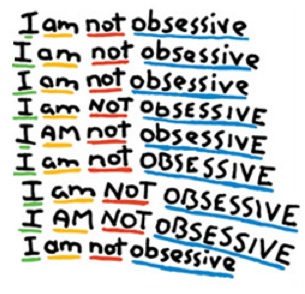
7) Obsessive. Perhaps the biggest time and life waster.  One time I was so obsessed with another woman that I’d go to sleep with my phone right next to me wishing she’d call. I’d wake up disappointed she didn’t call and wondering what she was doing all night. I’d wait until I thought she was awake and then I would call and ask her to breakfast. If she couldn’t, I’d go to her area and wait around until she was available. I’d keep circling the block to see the light was on in her window. My entire day revolved around her. Of course she got sick of me. In which case I became more obsessive. What does this have to do with being an entrepreneur? It has everything to do with it. That valuable energy I was wasting could’ve been spent developing Groupon or heck, even Lycos.

Or sometimes when someone is angry with me, I can’t just give it up. I have to prove myself right. I have to make sure he or she knows how wrong he is. I play the argument over and over again. I can’t understand how they can think I’m wrong. Or what I did to deserve such harsh treatment. I’m RIGHT! So get with the program.

Sadness.  I don’t want to suggest that it’s “bad” to feel sad. If someone close to you dies, you’ll feel sad. But often people stretch out the sadness until it becomes an addiction, an excuse to be pessimistic.” I’m “never going to be happy” because…X, Y, and Z.”

Our mind likes to be sad. It likes the barriers to happiness. Happiness is too wide open and scary. Sadness keeps us confined inside our boundaries. Those boundaries become the walls that pessimism lives inside of. It’s easy to be pessimistic because then we fool ourselves into thinking we don’t need to do too much. What if in 2004, some kid at Harvard didn’t say, “I’m going to make a little website that everyone on the planet is going to put all of their personal details on.” What if he said, instead, “Ahh, I don’t feel like it. Some girl who looks like the girl with the dragon tattoo just broke up with me and can I really compete against myspace.com anyway? Don’t be an idiot, Mark.” And he just went under his covers and cried. No good!

9) Unimprovement. We know exactly when we are thinking of things that are not good for us. Am I going to eat chocolate until 1 in the morning while watching the Real Housewives of Atlanta? Most likely this is not good for me (although “Real Houswives of Beverly Hills” is a completely different issue).

The mind is like a giant Gmail box. Emails are constantly coming in. Most of them are junk emails and are instantly filtered into the spam box. But many other emails come in that we don’t know what to do with.

In Gmail you can create filters. For instance, when someone sends me a receipt for my latest book “I Was Blind But Now I See” I am able to label the email “Bad Behavior” because when my next self-published book comes out (working title, “Bad Behavior”) I can easily filter every email with that label and send it to them.

It’s the same in our mind. If we use the above nine labels above, and then filter anything (or most things) with those labels into the “not useful” box as per this post, then here’s what happens:

A)     Our brain gets quicker at noticing when we are thinking not-useful thoughts.

B)     Your negativity is like a rock constantly being doused with water. Eventually the rock withers to nothing, although it takes time. It’s persistent practice.

C)      We have more time for the useful thoughts – the thoughts that lead to productivity, minimalism, happiness, freedom.

D)     We can identify which labels are occurring the most and develop problem-solving techniques to directly deal with them. Not every “not useful” thought should be treated the same.

Don’t believe me. Don’t pay any attention to this advice. Like everybody else, I’ve got 6,000 things to do today. And I know if any of the nine things above drag me down, I won’t get things done. I’m already feeling anxious about it. And I’m not helped by the 12 cups of coffee I’ve already consumed. In fact, I could be slipping into an obsessive panic.

Not useful.

Read “The Power of Negative Thinking”

And Follow ME on Twitter

Top image via Shutterstock/Villers Steyn


Bus/Tram Combo Charges Battery As It Picks Up Passengers

AutoTram

German researchers are testing a unique form of public transportation that borrows the best from busses, electric cars, trains and trams without contributing emissions. The vehicle, named AutoTram, is fully electric, but instead of running on a single charge, it charges when it stops, gaining enough power in 30 seconds to move another mile.

The project comes from the Fraunhofer Institute for Transportation and Infrastructure Systems IVI in Dresden and aims to offer the convenience, routing flexibility and affordability of a bus, minus the noise and exhaust. It also addresses the problem of lengthy battery charging cycles. While most cars are only in use for a few hours per day, public transportation vehicles can be in action around the clock, offering nearly no battery charging opportunities.

The streetcar is partly inspired by light rail systems, but doesn’t require rails or overhead lines, making it less expensive to implement. Instead, AutoTram’s tires follow white lines painted on the road and a multi-axle steering system gives it the maneuverability of a regular bus.

AutoTram stops would jolt supercapacitors in the vehicle with 700 volts during its brief stops. The team decided against using lithium-ion batteries, which are heavier and require more time to charge. A diesel generator also rides on board to serve as a back-up in case the next charging station is too far.

According to the team, AutoTram’s costs would be 30 to 50 times less than those of light rail systems, although still pricier than diesel-powered busses. The project is supported by 34.5 million euros from the German Government’s Economic Policy Program.