Night Stand HD

The customizable clock faces alone make this a better option than your built-in clock app, not to mention alarm options ranging from birdsong to blood-curdling screams or whatever’s in your iTunes library. For inveterate oversleepers, the app can force you to solve a math puzzle before the alarm shuts off.

Night Stand HD

WIRED Virtually snooze-proof. Add local weather to any clock face.

TIRED Susceptible to digital hiccups, like all software timekeepers.

Cocktail Flow

You don’t need to go to bartending school to whip up a perfect old-fashioned. This app gives you the ingredients, instructions, and whistle-wetting photos of the finished product. Search for a specific cocktail, browse by spirit, or tell the app what’s in your cabinet and get recipes based on what you have on hand.

Cocktail Flow

WIRED Downloadable themed drink packs for St. Patrick’s Day and New Year’s Eve.

TIRED Can be as laggy and unresponsive as some real bartenders. Only 114 recipes preinstalled.

5-0 Radio Pro

If we were making an app guide for Nancy Grace, 5-0 Radio Pro would be our top pick. It lets you listen to more than 35,000 live police and fire department radio feeds from around the world. Check your city’s channels for breaking news, or pick one from the Top 100 guide just for kicks.

WIRED Includes definitions of common police codes in each city. You can record the juicy bits as MP3s.

TIRED Feeds are organized by county — tedious for browsing.

Ringdroid

This is the simplest way for Android users to create custom ringtones for their phones. Pick a song from a list of audio files on your device. Then, using the waveform as a guide, just drag markers to your desired starting and ending points and hit Save. Set the new clip as your default ringtone or assign it to a particular contact.

Ringdroid

WIRED Makes ringtones out of voice recordings, too. Can search through your music library from within the app.

TIRED No way to fade in or fade out clips.

Boost Mobile Gives Customers A New Way To Add Credit: Facebook

Screen shot 2011-12-06 at 11.56.06 AM

In the few months I lived across the pond (where prepaid phone plans are more popular than contracts, go figure), I learned something important about adding credit to your plan, or “topping up” as the Brits would say: it’s a pain in the arse.

Some carriers let you add credit by sending a text, which is pretty awesome, but the more options customers have the better. That said, Boost Mobile is launching a new Facebook app called Re-Boost which will let customers add credit straight from the social network.

The ability to refill your account from Facebook is actually quite awesome, but then the app gets a little strange. Since it’s on Facebook and thus intertwined in your digital relationship playground, you can elicit the help of friends to fill up your mobile account. That’s more of a blast, shooting out a request for more credit to the entirety of your Facebook network.

If that sounds as embarrassing to you as it does to me (but you still happen to need a friend’s help topping up), the Re-Boost app also lets you send a request to specific friends to help you add credit. Of course, with all the various methods of taking from your friends, Boost found it necessary to add some form of giving functionality. That way you can pay back all the friends that have been supporting your mobile lifestyle.

All in all this sounds like a great idea, though all the networking throws me for a loop a bit. You can check out the app now by logging into Facebook, searching “Boost,” and choosing the Re-Boost application.


DROID XYBOARD Tablets Get Official, Hitting Verizon Stores This Month

Pasteur_front 005

Verizon’s been teasing us with them for weeks now, but today the company has finally made things official: Motorola’s LTE-capable DROID XYBOARD tablets will be hitting Verizon stores this month.

For those of you who have managed to miss all the news about Motorola’s latest tablet venture, here are a few of the salient details.

Better known as the XOOM 2 in Europe, the XYBOARD comes in two flavors: one with an 8.2-inch IPS display and another with larger 10.1-inch IPS display. Don’t worry about missing out on performance if you go for one version over the other, as both XYBOARDs share the same 1.2GHz processor and 1GB of RAM under the hood. Both tabs also sport 5-megapixel rear cameras, along with a 1.3-megapixel front-facer, and an IR transmitter for controlling your home theater.

On the application side, the XYBOARDs come Motorola’s MOTOCAST media streaming software, QuickOffice HD, Citrix GoToMeeting, and the usual suite of Google appa. Handwriting input buffs may also want to take note of the 10.1-inch XYBOARD, as it ships with a stylus meant to make doodling cats on the screen even easier than before.

But how much will all that cost you? The 10.1-inch XYBOARD comes in three memory variants: you can score a 16GB model for $529.99, a 32GB model for $629.99 and the king-sized 64 GB for $729.99. If you prefer the smaller 8.2-inch model, prices are a little more reasonable. There are only two models to choose from: 16GB for $429.99 and 32GB for $529.99. All of these prices are with a two-year contract, so think long and hard about whether or not the XYBOARDs are right for you.

You’ll need to pony up an extra monthly charge if you want to take advantage of the XYBOARD’s speedy LTE connection, too: prices for Verizon’s data plans start at $30 for 2GB of bandwidth.

Verizon also snuck in an announcement confirming the existence of a white Droid RAZR. I’m sure that news won’t be as exciting to some of you as it is to me, but fans of chromatically pure devices have one more to add to the list. Motorola has also pledged that all three of the newly-announced devices will get access to Android 4.0 (a.k.a Ice Cream Sandwich), so here’s hoping they get access to the code sooner rather than later.


Overstock.com Teams With Barnes & Noble For eBook Storefront

wonder_twins3

Overstock.com is looking to expand its brand into the realm of ebooks. But the online retailer is doing it a tad differently. Instead of signing partnerships with publishers, building a vertical retail platform and establishing a presence in the marketplace, the company briefly known as O.co simply inked a deal with ebook giant Barnes & Noble. Easy peasy ebook squeezy.

The partnership is only skin deep, though. Overstock.com/ebooks, the site’s new ebook subsite, is simply a portal to B&N. Clicking on a book directs buyers to the book’s B&N product page where the purchase can be completed. Even the genre pages redirects to the appropriate page at BN.com.

To go alone with the new ebook offering, Overstock.com is hawking a refurbished Nook Color for $149.00. “As the number one seller of refurbished NOOK® devices we are pleased to partner with Barnes & Noble to expand our product offering so that our customers have fast, easy access to the breadth of digital content that Barnes & Noble offers,” said Overstock.com President Jonathan Johnson said in a released statement today.

Terms of the partnership were not released.


Need Tunes For An Indie Film? Audiosocket Launches A Fully Hosted Music Storefront

IndieFlix - License

Audiosocket, the Music-as-a-Service platform provider, is today launching its own Music-as-a-Service Storefront. (Yep, in acronym lingo, that’s a “MaaS.”) The company already powers the backend of the Vimeo’s Music Store, allowing for the integration of appropriately licensed tunes into online videos. Now, with the new hosted service, Audiosocket aims to connect indie musicians and digital media companies, including launch partners IndieFlixThe National Festival for Talented Youth (NFFTY) and a new e-learning company LearnCreate.

The MaaS Storefront will offer AudioSocket’s catalog of over 33,000 pre-cleared songs from emerging artists in need of discovery and distribution to others in content creation communities, specifically those who are also focused on supporting indie artists themselves. (Well, those are the most likely partners for this service, that is.) The Storefront will be provided as white label offering which partners can customize, brand, and have up in running within 24 hours.

For example, IndieFlix, which likes to call itself the “Netflix for indie films,” says it gets a lot of submissions where the music hasn’t been properly licensed. Until now, it has had to spend its own time and money to resolve these problems, the company reports. With the Audiosocket Storefront, though, IndieFlix will be able to simplify this process. With the IndieFlix Storefront, available here, filmmakers can now browse and search for music by genre, mood, tempo, vocal, themes or instruments.

This isn’t the first deployment for Audiosocket’s “MaaS” – Vimeo’s Music Store was. But where that was a custom integration designed just for the Vimeo website, you can think of this one as “Vimeo Lite.” Instead of a full-on integration, this is a hosted product, a plug-and-play music storefront that anyone could use.

More details on the Audiosocket Storefront will be available from the company website: audiosocket.com.


Red Hat releases Red Hat Enterprise Linux 6.2

redhat-logo

Today Red Hat announces the availability of Red Hat Enterprise Linux 6.2, the latest iteration of their flagship Linux distribution. I don’t usually cover every point release of every Linux distribution, but since I’ve covered recent releases from Canonical and SUSE I thought I’d give Red Hat some coverage, too.

RHEL 6.2 is in some ways a remarkable release, and in other ways completely uninteresting. It’s uninteresting in that there are no real surprises: this is a regularly scheduled update to the RHEL 6 product line, and it was released right on time. Red Hat customers have driven most of what’s included in this release, in the form of bug reports and feature requests.

RHEL 6.2 is uninteresting, too, because Red Hat’s promise to their enterprise customers is API and ABI compatibility for the life of the product. But this is also a reason why this release is so interesting.

Maintaining API and ABI compatibility on a complex suite of inter-related free software projects is no small task even on a short term basis. To manage it over a couple of years requires careful planning, attention to detail, and impressive staff talent. After all, companies are using Red Hat Enterprise Linux with the expectation that their servers will work exactly the same way for nearly a decade.

But the technology driving Linux development doesn’t stay the same for that same period of time. In addition to continuous kernel improvements, there’s whole swathes of new technologies rapidly evolving — KVM and Xen virtualization, filesystem advancements, and more — as well as the regular feature updates to the ecosystem of free software that go into a modern distribution: web servers, programming languages, support libraries, and more. Red Hat’s customers want to use these whiz-bang new features, but still enjoy long-term support offerings. It’s a delicate balancing act, and in that regard the release of RHEL 6.2 is utterly fascinating.

According to Tim Burke, VP of Linux Engineering at Red Hat, more changes (updates, bug fixes, etc) went into RHEL 6.2 than the entirety of what went into Red Hat Enterprise Linux version 4, which was released in February, 2005. The list of RHEL 6.2 enhancements (PDF) is impressive, and includes a host of physical and virtual guest performance enhancements, improved management controls, and more. Also included are a variety technology previews of essentially beta software that people want to play with and that Red Hat wants to evaluate, like Parallel NFS and Linux containers.

“Red Hat is the leading innovator in Linux development,” claimed Burke. Certainly Red Hat is doing something right, as they’ve enjoyed 38 sequential quarters of successful growth all the while making predictable, sustainable releases for their customers.


A New Twist On Gift Cards: Dropost.it Lets You Leave Money For Friends At Any Location

phone

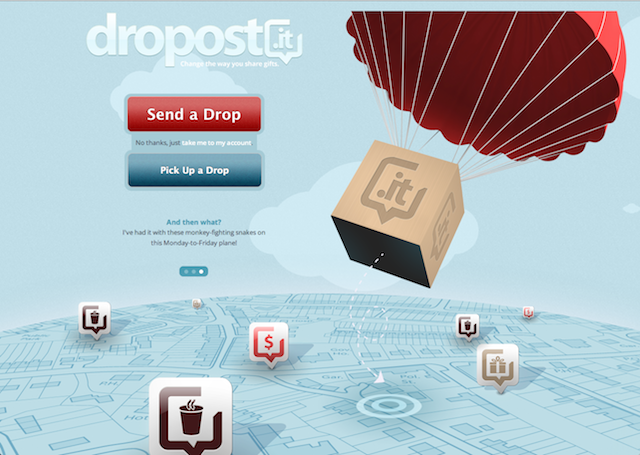
Dropost.it is a clever little service that allows you to drop gifts for friends which are geo-tagged to specific locations. These gifts, which you can think of as virtual gift cards purchased via the Dropost.it service, can only be accessed when the recipient visits a specific location. Initially, the service works over PayPal, but the company is working towards deeper integration with mobile wallets, including NFC-based wallet systems, like Google Wallet.

Beyond facilitating the gift-giving process, Dropost.it is also working on a feature that will help you figure out what gifts to buy your friends (this piece hasn’t yet launched). To do so, Dropost.it will pull in data from Facebook, including friends’ likes and interests, but it will also work with social data from Foursquare and Twitter in the future. (And yes, haters, you will need a Facebook account to log in today).

The idea is that you’ll be able to use the service to figure out what places your friends typically visit – that is, the restaurants, bars, coffee shops, retail stores, etc. that they favorite. This is especially helpful when you’re buying for acquaintances whose personal interests you may not know too well, or when you’re buying for friends who live out of town.

After the gift is purchased (with a small fee), the recipient is emailed a message that includes an optional video greeting from the gift-giver, for a more personalized experience. The email also includes a link to download the accompanying Dropost.it mobile application (HTML5 first, then iOS and Android). To claim the gifted funds, the recipient just launches the app upon arrival at the given venue. As a service that works over PayPal, of course, this isn’t ideal, since the money isn’t instantly available in the recipient’s bank account unless they use the PayPal Debit Card. But further down the road, when mobile wallet usage is more prevalent, something like Dropost.it could be a useful way to surprise friends with instant gifts that are available immediately.

In addition to the consumer-facing angle, merchants can also participate in Dropost.it to set up their own promotions (aka “drops”) wherever they choose. They could allocate $1,000 in $5 increments to encourage foot traffic, for example, or they could use a series of drops to create a scavenger hunt-style game.

While the idea of a geo-tagged gifting platform may be a bit ahead of its time, the idea of parsing friends’ social networking profiles for recommendations is right on schedule. Even the world’s largest retailer, Walmart, is just now figuring out how to use Facebook profile data to personalize offers to individual consumers. With Dropost.it’s insights into your friends real-world behavior, you have a better shot at something they’d actually like than you do when standing at the large, impersonal gift card aisle at the drug store. Even though geo-tagged gifts are a neat trick, it’s these social recommendations (when launched) that may end up being the service’s killer feature.

Dropost.it, however, doesn’t have the resources of a Walmart behind it, just a bit of  seed funding from Tampa’s TechStars Network member, Gazelle Lab, and two high-energy founders Orrett Davis and  Ty Mathen. Prior to today’s launch, Dropost.it lined up Bob Schwartz, President of Magento and Jim Bennette, CEO of VisiStat, as advisors along with a local business leader, Tampa Bay’s John Walsh, President of Walsh Solutions.

The Dropost.it site went live this morning. Considering the startup’s early stage, here’s hoping it stay up-and-running.


Is HTC’s 20% Revenue Dip Last Month A Sign Of Things To Come?

htc-slipping

Even though HTC has just come off of a record-breaking third quarter, it seems like some of the company’s mobile momentum is evaporating. The Taiwanese company recently cut their Q4 sales forecasts by more than 20%, and thanks to HTC’s unaudited November financials, it’s clear that the move was a wise one.

The financial report reveals a considerable drop in revenue when compared to HTC’s performance this time in 2010. Last month HTC had revenues of NT$30.9 billion (or $1.02 billion), while last year they managed to pull in nearly NT$38.5 billion ($1.27 billion). That’s almost a 20% dip in revenues year-over-year, which could put an end to HTC’s continuous growth streak.

Before this rough patch, HTC enjoyed six consecutive quarters of growth. It’s an impressive feat, considering competitors like LG’s mobile division has spent that same amount of time in a free fall.

So what gives? Was it just a bad month, or is it a sign of bigger, more dire days to come? It’s tough to say: when HTC slashed their sales forecast, they pegged it partially on the “global macroeconomic downturn,” but they also admitted that increased market competition made their forecast inaccurate. I sincerely doubt that increasing market competition is going to diminish any time soon, and that leaves HTC in something of a tough spot.

Apple has tremendous brand power and Samsung has design and production expertise. What does HTC have to lean on? Sense? Beats Audio? These are potentially great additions to a device, but it’s been a while since HTC has designed an entire package that took someone’s breath away.

Though I went through a phase of spec-geek lust for the HTC Rezound, nothing that HTC has put out in recent months seems terribly new or groundbreaking. That in and of itself isn’t a bad thing — they’ve found a formula for touchscreen smartphones that has clearly been working for them — but maybe it’s time for HTC to mix things up a bit. Giving Sense the boot would be a welcome change, if I may be be so bold. I’m sure it has its fans, but all of Sense’s eye-candy always made whatever HTC device I was using feel just slow enough to be unsettling.

Really, what I think HTC needs is a flagship device a la the Galaxy S II: something the represents the pinnacle of HTC’s design and technical abilities. If they could design, produce, and throw their weight behind a device like that, HTC could potentially get back on the growth track.

Depressing though the November results may be, HTC can still take solace in the fact that they took the mantle of number one smartphone vendor in the United States, just barely pulling ahead of Apple in Q3. Still, it’s going to take some bold moves from HTC in coming months if they want to keep their mobile mojo intact. With any luck, their 2012 portfolio will further cement HTC’s position in the major leagues.


Cooking.com Grabs $13.5 Million

cooking

E-commerce company Cooking.com has landed $13.5 million in growth capital financing in a combined debt and equity round led by private investment firm BIA Digital Partners, with San Francisco-based VC firm Azure Capital Partners participating.

The capital will be used to grow the company’s flagship site – unsurprisingly, that would be Cooking.com – and to accelerate the build-out of its “Powered By Cooking.com” e-commerce solution for branded partner stores looking to sell cookware and kitchenware products online.

Cooking.com says it offers its customers access to over 60,000 products for the kitchen as well as recipes, menus, collections and a growing library of crowd-sourced cooking content.

The company was founded in 1998 (dotcom survivor alert) and is based in Marina del Rey, CA.


Urban Airship Says Its Push Notifications Work On Kindle Fire (Which It Found Out By Accident)

gunbros-kindle

Here’s a funny story: Urban Airship, a backend service provider for mobile developers, recently discovered that its push notifications offering works on Amazon’s new Kindle Fire…by accident. Although the company makes an Android push client called Helium, it had no clue that those notifications would also work on Amazon’s Kindle Fire out of the box. The company only found out after some developers started integrating the push mechanism into their own apps. Surprise!

Well, maybe that’s not entirely unexpected news. After all, the Kindle Fire is an Android-based device. However, the version of Android it runs has been extensively customized. Amazon removed Google’s services, including the Android Market, C2DM (Android Cloud to Device Messaging framework), Google in-app payments support and more. The Fire also doesn’t support any apps that require the camera, gyroscope, GPS, Bluetooth, a microphone or a micro-SD card.

So yes, it was kind of a surprise for the folks at Urban Airship to discover that their code worked just fine on the Fire without any further customizations.

One of the first developers to use UA’s push notifications feature is Glu, the Android games publisher behind dozens of titles, including Bug Village, Eternity Warriors and Contract Killer. Says Glu VP of Sales & Marketing Mike DeLaet, their team just integrated the Urban Airship SDK into all their apps on day one of the Fire’s release and notifications began working immediately.

It seems like Urban Airship is riding a wave of good news these days, with last month’s acquisition of SimpleGeo and its $15M Series C. Now it finds out that Kindle push works, too, without any code changes, opening up the service to what’s shaping up to be the number two tablet computer behind the iPad. Nice.

To support developers trying to add push to their Kindle apps, Urban Airship has added this section to its developer FAQ. The company will make an official announcement later today.


BBC’s Global iPlayer Heads To The iPhone, iPod touch

bbciPlayer

While not everyone would agree, I’m firmly of the belief that news (and most everything) sounds much better delivered in a British accent.

The BBC’s new global iPlayer app, which has launched in more than 11 western European countries, offers up much more than just your daily news, but is chock-full of fun words like “arse,” “blimey,” and one of my personal favorites, “daft.” If you’re into that kinda thing (like myself), you likely want to know that the BBC will launch its iPlayer app on the iPhone and iPod touch on Thursday.

The service works a bit differently for the Brits than it does for us international users, reports TNW. In the UK, the iPlayer is more of a back-up type service, allowing you to watch broadcasted content for up to 30 days after it airs. In Europe and now Canada, the app is a much broader subscription service, letting users choose from a wide library of current and former British programming.

But according to the BBC, the growth and expansion of its iPlayer app is about much more than having a mobile presence. It’s about the migration of TV to mobile devices in general, and the BBC sees this platform as a way to further British culture as a whole.

Jana Bennett, president of worldwide networks and Global BBC iPlayer, had this to say:

This platform extension shows how Global iPlayer isn’t just about moving TV to tablet devices, it’s also about a mobile strategy – about truly getting TV everywhere in a way that it hasn’t been before. We also want the global BBC iPlayer to be truly representative of the whole gamut of British creative output, to represent everything that is great about British content – not just the Best of British TV but the Best of British Culture.


Funding, Grants & Book Deals: Thiel Fellows Are Making The Grade (With More Classes To Follow)

20under20

It’s no secret that Peter Thiel thinks that the next big bubble facing our economy is not inflating the housing or tech markets, but that of higher education. The former PayPal CEO and early backer of Facebook is well-known for his contrarian views and has more than once publicly criticized higher education for being an overhyped and bloated industry. The entrepreneur-turned-investor has been on a mission to find alternative (and better) ways to motivate, foster, and support young people who want to make a difference.

In May, Thiel, along with his Foundation, put their money where their mouth is, announcing the “20 Under 20 Thiel Fellowship”, a program that offers talented independent thinkers under the age of 20 $100,000 and two years free of school to pursue their entrepreneurial endeavors. The program launched with 24 Thiel Fellows, each of these wiz kids pursuing their own inspiring scientific and technical projects. (You can meet the class here.)

Originally, the Thiel Foundation planned to award only twenty fellowships, but James O’Neill, who heads the Thiel Foundation, said there were so many outstanding candidates among the 400 applications they received that they were compelled to add four more spots.

Six months into the program, and already the progress has been impressive. O’Neill tells us that more than ten of the Fellows have founded companies, and at least one has already launched a product on the market. The progress of the program has been so good, in fact, that the Thiel Foundation has decided to launch a second class in 2012. The program is now accepting applications, with a deadline of December 31st. Candidates must be under 20 years of age until that date.

In preparation for next year’s class, O’Neill also peeled back the curtain a bit more on how the current class of young innovators have been faring in their first year. Andrew Hsu, who founded a company called Airy Labs (after dropping out of Stanford University as a fourth-year neuroscience Ph.D. candidate — at the age of 19) to build the next generation of social learning games for kids, launched with $1.5 million in venture funding. The round led by Foundation Capital with participation from Google Ventures, Rick Thompson, as well as other prominent angel investors and micro-cap venture capital firms.

Eden Full, who founded Roseicollis Technologies to take her solar panel tracking invention called the SunSaluter to developing communities, won the Staples-Ashoka Youth Social Entrepreneurship award, snagging $300K from the Postcode Green Challenge for her contributions to the solar industry.

Dale Stephens recently signed a deal with Penguin Press to publish his forthcoming book, Hacking Your Education.

And today, The Fellowship announced that Grand Challenges Explorations, an initiative that enables researchers to test unorthodox ideas that address persistent health and development challenges (created by the Bill & Melinda Gates Foundation) has rewarded Thiel Fellow Darren Zhu with a $100,000 grant.

Zhu founded Synbiosys, LLC, a synthetic biology company focused on building foundational tools to make biological systems easier to engineer and to commercialize their downstream applications. Specifically, Zhu and Synbiosys will be pursuing a global research project that aims to produce a low-cost diagnostic platform to diagnose Leishmaniasis, an understudied infectious disease that affects over 14 million people.

According to the Foundation, current diagnosis of the disease relies on expensive and invasive screening techniques, so Synbiosys is using synthetic biology to build a more rapid, inexpensive, and sensitive diagnostic tool that can be extended to diagnose other infectious diseases as well.

The early success of these impressive youngsters is certainly inspiring, and O’Neill said that he thinks the Fellows can become exemplars for other intelligent young people looking to get involved in technology. That’s why, he says, that the Thiel Fellowship makes picks participants based on who they are as people, rather than the particular project they’re pursuing. The program encourages Fellows to iterate and change course during their two years.

And they’re getting some serious guidance along the way. O’Neill says that they organize a retreat every quarter, in which they bring in experts to give talks and seminars on topics including IP tax, how to hire and motivate employees, develop products, pitch investors, and so on. Fellows also have the benefit of three “handpicked” mentors, chosen by the Thiel Foundation based on their interests.

It’s an awesome program for up-and-coming entrepreneurs and, with the way it’s being structured, O’Neill says that they’ve been surprised to find that the criticism from higher education has been a lot milder than they expected. Some professors and teachers are even encouraging their students to stop out and apply.

What’s more, “anyone under 20 is eligible” to apply. Lucky kids.