SurveyMonkey Acquires MarketTools’ Zoomerang, ZoomPanel, and TrueSample via TPG Capital

SurveyMonkey and TPG Acquire MarketTools Done 3

Question: How do you acquire your biggest rival if you don’t have the cash? Answer: Partner with a private equity firm. SurveyMonkey has done just that, buying MarketTools’ products Zoomerang, ZoomPanel, and TrueSample through a partnership with TPG Capital.

The deal gives MarketTools’ other businesses and a minority stake in SurveyMonkey to TPG, while SurveyMonkey gets the 3 products and their 1.7 million survey users, 2.5 million panel respondents, and technology to weed out false responses. The playfully named SurveyMonkey will gain legitimacy from the acquisition, as 80% of the Fortune 500 are MarketTools clients.

The TPG Capital – SurveyMonkey deal was quite complicated. First, TPG acquired MarketTools, but then transferred its 3 relevant products to SurveyMonkey. TPG will keep and expand MarketTools’ Research Solutions and CustomerSat businesses. In exchange for the products, DealBook’s Evelyn Rusli reports TPG receives a 10% stake in SurveyMonkey valuing it at $1 billion.

SurveyMonkey closed a $100 million round of senior debt financing in November 2010 to reduce interest rates and prep for acquisitions. Some of that went towards buying a 49.9% stake in Salesforce.com AppExchange survey provider Clicktools in January 2011. At the time, SurveyMonkey said it was actively evaluating additional opportunities to partner and invest in “complementary businesses and geographies”. MarketTools fits that bill perfectly, allowing SurveyMonkey to roll users and technology directly into its existing product line.

Online survey business Zoomerang’s 1.7 million users will be added to the 9 million already utilizing SurveyMonkey’s core product that allows for easy, highly customizable online survey creation and distribution. SurveyMonkey promises that Zoomerang service won’t be interrupted, as “all existing surveys should remain fully functional, including those embedded in websites or housed on third-party platforms such as Facebook.”

The ZoomPanel acquisition will grow SurveyMonkey’s fledgling online panel service from 500,000 panelists to a total of 2.5 million, making it significantly more valuable to businesses looking to conduct deep market research. TrueSample will help improve the quality of SurveyMonkey’s research by removing fake and duplicate responses, terminating disengaged respondents, and verifying survey accuracy through SurveyScore’s technology.

SurveyMonkey will now be able to better leverage its free or cheap survey product to generate leads for its expanded B2B market research business. The MarketTools acquisition will help it convert college kids using free SurveyMonkey surveys for class into serious paying customers when they join big companies.


Credit Sesame Brings Your Credit Score To The iPhone. For Free.

IMG_0009

Personal finance service (and TechCrunch Disrupt alum) Credit Sesame is launching its first mobile application today which gives users instant access to their current financial standing and their credit score. For free. And I don’t mean “free” as in free, but if you don’t read the fine print we’ll sign you up for our monthly service.

I mean free as in free.

For those of you unfamiliar with Credit Sesame, the young startup helps users better understand their personal finances. But unlike Mint, which looks at a person’s bank accounts, investments, budget, goals and loans, Credit Sesame is primarily focused on credit and loans. Using the same technology as banks, the company is able to analyze a user’s complete debt situation and then recommend various loan and credit options that can save them money .

However, Credit Sesame isn’t paid for lead generation, so it doesn’t just hand over customers’ information to banks and lenders in order to generate revenue. Instead, it only receives payment when a customer signs up for one of its recommendations.

With the new mobile application, customers will be able to do much of what you could previously do only via the website, including sign up for an account, access your financial information, check your credit score, view your available credit and debt payments and more. It’s important to note that when you check your credit score via the app, it doesn’t ding your credit, as it would when a company runs a credit check for you to determine whether you qualify for a new credit card, store card or loan, for example. The score comes from Experian.

For now, consumers can use this information to get a general idea as to their financial health, but in the future, Credit Sesame will provide more specific guidance. (“Can I get a Macy’s card?”, “Can I buy this car?” are some example that come to mind).

Credit Sesame secures your information using bank-grade security approved by VeriSign and McAfee, protects mobile users’ data behind a PIN and enables you to switch off mobile access if your phone is lost or stolen. In addition, although the service requires your Social Security Number upon sign-up, this information is not stored on the phone.

According to founder Adrian Nazari, the startup helps two out of three people find “substantial” savings, even if not everyone chooses to act on its recommendations. He won’t disclose the size of the user base yet, but hints that it’s now in the six digits. The company raised $6.15 million from Menlo Ventures this March, and has been growing steadily since.

The mobile app is first available for the iPhone, but an Android app will follow shortly. You can download the new app from here on iTunes.


Netflix 2.0 For iOS Sports Awesome Revamped Interface

iPad_redesign_en_us_approved

Android tablet owners have been rocking the new Netflix app design for nearly a month now, and with today’s update, iPad users can finally join in on the fun.

The 2.0 update squeezes more movies onto a single page by trimming out most of the excess white space that made the original version feel a tad ill-suited for such a large screen. It’s a huge improvement over the original if only because you don’t have to squint to see a movie’s image anymore — they’ve blown up the images and folded most of the text and ratings info into a movie or show’s individual entry.

The new update isn’t all about revamped visuals: it also packs a few stability fixes, and it marks the first time Netflix for iOS has been made available in Latin America. ¡Fantástico!

Itching to see the new app in action? That’s where things may get a little dicey. The update is live in the App Store, but it may take a few tries to get things going — it took a handful of reinstalls and restarts before the new UI finally kicked in for me. At least one other reviewer mentioned the same problem, but hopefully not too many of you are running into issues (and if you are, I’m sure you’ll let us know).


The Price For ReadWriteWeb Was Around $5 Million

rww

Tech blog ReadWriteWeb was acquired today by SAY Media, as was previously reported. I’ve found out a few more details. The price SAY paid out was under $5 million, after the assumption of ReadWriteWeb’s liabilities, according to a source privy to the details. The company’s liabilities weren’t huge, so the total acquisition price was somewhere around $5 million.

Staff are being asked to sign new contracts with SAY Media today, with contracts going through March, 2012. And a redesign will probably roll out sometime in the first quarter.

SAY Media is itself a result of a merger last year between video ad network VideoEgg and blogging platform Six Apart. ReadWriteWeb is the third online media property acquired by SAY this year after Dogster and Remodelista. (It also acquired digital agency Sideshow).

Why is an ad network buying up media properties? SAY Media is not alone in this strategy. Look at how Glam Media started out as an ad network and then aded on owned-and-operated properties or, for that matter, AOL (which bought TechCrunch and the Huffington Post, but also runs a huge ad network).

It used to be that publishers sold ads in their own media (magazines, newspapers, TV). When ads moved online, ad networks emerged to provide scale across the Web so that advertisers could reach mass audiences. But the price for an ad on a publisher’s site with a highly-focussed audience like ReadWriteWeb is much higher than a run-of-network ad that could run basically anywhere.

Online, you need both an ad network and owned-and-operated sites. The ad network gives SAY Media the scale to attract advertisers in the first place, and the owned sites will juice the average CPMs it can charge. (Here is RWW’s post on the deal).


@louisck Reports His Content Experiment Sold $500,000 Worth Of Downloads

shutterstock_42686767

It’s always heartening to see an experiment in disintermediated content succeed and it could have happened to a better guy. Louis CK began selling his one-hour comedy special on his own website for $5 a pop last Sunday and, as of today, he’s reporting he’s made over $500,000 from 110,000 downloads. This is a profit of over $200,000 on a concert that cost him about $170,000 to film and edit (most of that paid with ticket sales) and a website that cost $32,000 to build (which suggests that I’m in the wrong line of work. Carlos Mencia: Call me. I know HTML).

He breaks down the finance below:

The show went on sale at noon on Saturday, December 10th. 12 hours later, we had over 50,000 purchases and had earned $250,000, breaking even on the cost of production and website. As of Today, we’ve sold over 110,000 copies for a total of over $500,000. Minus some money for PayPal charges etc, I have a profit around $200,000 (after taxes $75.58). This is less than I would have been paid by a large company to simply perform the show and let them sell it to you, but they would have charged you about $20 for the video. They would have given you an encrypted and regionally restricted video of limited value, and they would have owned your private information for their own use. They would have withheld international availability indefinitely. This way, you only paid $5, you can use the video any way you want, and you can watch it in Dublin, whatever the city is in Belgium, or Dubai. I got paid nice, and I still own the video (as do you). You never have to join anything, and you never have to hear from us again.

Basically he’s proven that someone with a dedicated fan base (arguably a huge one) can make his or her own way in the world without the studio model. This should make a large number of folks who “curate” content for sale very, very nervous but it also points to the need for modern entertainers to understand every little thing about their industry. You can’t just be “talent” anymore unless you really want to be. However, by lying back and waiting for a “producer” to make things happen you’re risking a loss of financial opportunity and artistic control. You often can’t have it two ways but, to be fair, not everyone can be Louis CK.

To his credit, Louis learned quite a bit from the experience. He spouts philosophical below.

I learned that money can be a lot of things. It can be something that is hoarded, fought over, protected, stolen and withheld. Or it can be like an energy, fueled by the desire, will, creative interest, need to laugh, of large groups of people. And it can be shuffled and pushed around and pooled together to fuel a common interest, jokes about garbage, penises and parenthood.

Amen, Mr. CK.


What Will Happen If Verizon Fails To Launch The Galaxy Nexus Tomorrow?

8-buttons

It seems as though Verizon and Google have really screwed the pooch when it comes to the Galaxy Nexus launch. As of this very moment, we’re on our eighth rumored release date: tomorrow, December 15. The first was all the way back on November 3. In fact, these delays and the vague availability information provided by Verizon has led some to create a site entirely dedicated to whether or not Verizon has released the Galaxy Nexus.

It’s ridiculous.

But will all these delays make a huge difference in the popularity of the device? After a chat with Forrester Research’s Charles Golvin, I’m comfortable saying probably not. But even with the blogosphere’s extensive coverage of the device, it probably won’t be a blow-out success, either.

Here’s why:

To start, the Nexus line has never made a huge splash upon launch. The Nexus One, released on January 5, 2010, only sold about 20,000 units in its first week of availability. For some perspective, the iPhone 3GS sold more than 1 million units in its first three days on the market after launching on June 19, 2009.

The Nexus S did better, though official sales numbers are hard to find (not really a great sign). Based on Android 2.3 Gingerbread market share statistics, some speculate that as of February 2, 2010 (about 6 weeks after launch), the Nexus S had sold around 500,000 units. On June 24, 2010, Apple released the iPhone 4 which sold 1.7 million units in its first weekend.

While half a million units sold in the first few weeks shouldn’t be considered a flop, the Nexus S wasn’t a runaway success by any means. And many of the users most excited about it, Nexus One owners, seemed disappointed by the new features in Gingerbread.

If we learn from history, and common sense, the Nexus line is for geeks, not a mainstream audience.

Let me put it this way. Since I work with phones every day, I often ask people what phone they own. About half the time they tell me their carrier: “Oh, I have a T-Mobile.” If I’m lucky, they know the brand. In fact, I’d venture to say that 98 percent of the people I come into contact with (who don’t own an iPhone or work in my industry) don’t know the name of their phone. Trying to talk about the OS version is a waste of time.

Which brings me to my next point: Most of the world doesn’t give a damn about Ice Cream Sandwich. To the blogosphere, current Nexus owners, and all-around gadget geeks, Ice Cream Sandwich is one of the most exciting things to happen since… well, Gingerbread. But the rest of the human race doesn’t care. In other words, the Galaxy Nexus will appeal to the same market that was excited about Android 2.3, but the excitement won’t extend beyond that in terms of pulling in new customers.

But there were some core features that might have made a dent in consumer enthusiasm. Even though NFC ubiquity is still months (if not years) away, Google Wallet is still a feature that in-store shoppers would at least want to learn more about. But now it looks like Google and Verizon are duking it out over whether or not Google Wallet functionality will even be included in the device.

Golvin chimed in on this matter, explaining that Google Wallet isn’t a deal-making feature. “Consumers don’t have trouble paying today. [Google] isn’t satisfying some unmet need of the consumer,” he said. “How often does it happen where you think what a pain in the butt it is that you have to pull out your wallet? Payment isn’t a problem for anyone today.”

Then, of course, there’s the issue of carrier support. Golvin explained that typically there is only one (sometimes two) devices that get a primary slot from operators to support their launch. According to Golvin, Verizon is betting heavily on the HTC Rezound. This is because, like I mentioned before, the Galaxy Nexus is a niche device. Phone geeks will learn about the phone they want from us, or other various tech sites, whereas the mainstream consumer will decide on a phone based on TV commercials and massive ad campaigns. Right now, the Galaxy Nexus is lacking in that department.

But it goes further than that, with regards to the carrier. Operators invest heavy marketing dollars into devices like, say the HTC Rezound, because they want differentiations that drive their own experience. Google products are not led by the carrier. “By definition, [Google phones] are intended to be the sine qua non of what the Android platform can do at that particular moment,” explains Golvin. In that way, Verizon (or any other carrier) doesn’t have reason to put a ton of money behind the Nexus launch.

“Anything that is more Google-centric than it is Verizon-centric in that device is somewhat problematic,” said Golvin.

And even if Verizon were 100 percent committed to the Galaxy Nexus launch, the whole thing has been a complete mess. We’ve gone through seven launch dates thus far, and I assume that tomorrow’s rumored launch won’t become a reality either. I put it to Golvin to see whether or not repeated delays on a phone dwindle consumer interest, bringing the Droid Bionic and the iPhone 4S in as examples.

The iPhone 4S was expected this summer, but didn’t make its way to shelves until October 14. Still, Apple managed to break records topping 1 million pre-orders in the first day. The Bionic, on the other hand, took nine months to make its way from the podium to shelves and certainly didn’t make the splash everyone originally expected. I asked Golvin whether or not pushing back the Galaxy Nexus (over and over again) would have the iPhone effect, or the Bionic effect.

According to Golvin the Nexus won’t do either. The Bionic was exciting to people because it was supposed to be one of the first LTE-capable handsets on the market. It got beat by the Thunderbolt, and subsequently launched as the first dual-core LTE handset on Verizon’s network. Unfortunately, that wasn’t enough to get the ball rolling. The Galaxy Nexus will still be the first phone with Ice Cream Sandwich, and thus, not run into the same trouble that plagued the Bionic.

“All these geeks and phone watchers out there who are eagerly anticipating this first Ice Cream Sandwich device will buy it,” said Golvin. “People who would’ve bought it six weeks ago will buy it. If it comes out in January and is still the first ICS device, those people will buy it.”

He went on to say that the Galaxy Nexus will “lose sales it might have picked up with late shoppers looking for Christmas gifts, but I don’t think it was going to be that big of a hit beyond that early geek crowd anyways.”

“It won’t be a competitor to a Samsung Galaxy S II or the iPhone.”


Keen On… Walter Isaacson: No, Steve Jobs Wasn’t A Tweaker (TCTV)

stevejobs

Who, exactly, was Steve Jobs? Walter Isaacson’s Steve Jobs has sparked an intriguing debate about the identity of the real Jobs. According to The New Yorker’s Malcolm Gladwell, Isaacson’s biography proved that Jobs was a “tweaker” – somebody who took other people’s ideas and perfected them. But Apple watchers like Daring Fireball’s John Gruber strongly disagreed, arguing that Jobs was anything but a tweaker and taking Isaacson to task for not telling us what Jobs “actually did” and who he was.

Who better to resolve this row than Isaacson himself, who came into our San Francisco TechCrunchTV studio yesterday to talk about his best-selling book and to answer his critics. No, Isaacson explained, Gladwell is wrong – Jobs wasn’t primarily a tweaker. But Gruber is wrong too, Isaacson added for good measure, in saying that Steve Jobs failed to explain who Steve Jobs really was. Steve was essentially “an artist”, Issaacson told me; that’s the key to unraveling Apple’s enigmatic icon.

This is the first piece of a four part interview with Isaacson. Tomorrow, Jobs’ biographer explains to me Steve Jobs’ historic influence on our culture.


Google+ Expands ’On Air’ Hangouts — And Celebrities May Take Notice

onairshot

When Google+ first launched this past summer, one of its biggest differentiating features was a free video chat service called Hangouts. At first glance, it looks like something that’s been done before: video chat, between up to ten people. But it’s free, and unlike most video chat services that require friends to invite each other, Hangouts are more like those late-night college study lounge discussions, which people can enter and leave as they like. There’s also some nifty face switching technology that focuses the camera on whomever is speaking.

Today, Google’s announcing some major improvements to the way Hangouts work — and how they’re being more deeply integrated into your Google+ stream.

The first change you’re likely to notice is the addition of a ‘Hangout’ button beneath the various status and photo updates that you and your friends post. Click it, and the site will launch a Hangout specific to that status update — so you can chat live over video about the link, story, or photo that was just posted. Other users can join the Hangout by clicking on a link that appears in the post’s comment section.

The other major launch — and the one that is more important for the growth of the service, at least in the short-term — is the expansion of Google+’s ‘On Air’ functionality. ‘On Air’ essentially takes a standard Hangout (which can include up to ten people), and lets the host broadcast it publicly to an unlimited number of viewers. There’s still a limit on the number of people who can participate in the hangout — but millions of people can potentially tune in live. Google has used this feature to broadcast several high-profile events over the last few months, including a conversation with the Dalai Lama, but it hasn’t been available to users. Today, Google says it’s starting to roll out the functionality to ‘hundreds’ of the site’s high-profile users, and it will eventually make it available to everyone.

Now, it’s certainly possible to coordinate publicly-broadcast video chats through other services, but it also tends to be more painful to do this than it should be (the TCTV crew was actually looking for an easy way to do this last weekend without much luck). Which is why ‘On Air’ could have a lot of appeal — it’s self-serve so you can set something up at a moment’s notice, and Google will automatically archive the stream in the host’s YouTube account (which is private by default, but can be changed to public).

Because of this ease-of-use, ‘On Air’ could get the attention of celebrities or political candidates who might, say, want to stream an impromptu live interview. And each of these events would have the potential to draw in many thousands of new users to Google+ for the first time (whether they’d come back is a different matter, of course).

Some other tweaks: Google is going to surface Hangouts more prominently as you browse Google+ (they’ll appear listed in a widget in the sidebar). Google is also making Hangouts more useful for the many people who don’t have a computer with a camera (or high-speed internet): it’ll let you call into a hangout using a phone. And, finally, Hangouts users overlay reindeer antlers on themselves (this is actually a showcase of a recently-launched Hangouts API feature — Google did something similar with mustaches for Movember).

Image by Katielips


RadiumOne Buys Mobile Photo Sharing App Developer Focal Labs

Focal Lab

RadiumOne, an online ad network that aims to combine social and intent data to serve ads, has acquired Focal Labs, the developer of the photo sharing and geo location apps Clixtr and PicBounce, according to sources familiar with the matter.

Clixtr, which launched at TechCrunch50, aims to turn smartphones into ‘social cameras’. The basic idea behind the service is that when you’re at an event, be it a birthday party at your home or at a massive rock concert, photos from multiple people attending could be turned into one single, centralized photo album.

To make this work, even when pictures are taken by people you do not know, Clixtr uses location as the tying factor. The app essentially combines the capabilities of the iPhone’s camera and built-in GPS to geo-tag photos and determine when photos are being taken at the same location.

Picbounce allows you to upload a photo from your iPhone to Facebook or Twitter and has been downloaded more than a million times.

For background, RadiumOne mines social data and use this information to identify relevant consumers for brands. Through what founder Gurbaksh Chahal calls “social retargeting,” RadiumOne analyzes how users interact with one another on social networks to find the consumers that identify with a brand’s current customer base, and then serves advertisements to this audience across the company’s network of publishers. The company just raised $21 million in new funding at a $200 million valuation.

It’s unclear how RadiumOne plans to use Focal Labs, Clixtr and PicBounce (another photo sharing app), but the company has been expanding to social, consumer-focused products as well. RadiumOne recently launched PingMe, a group messaging app.

Clearly as Chahal has told us in the past, social sharing is a focal point (no pun intended) for the company and Focal Labs, which has an expertise in photo sharing apps, could help further this agenda.


Pogoplug Launches New Hardware, Brings Unlimited Storage To Your PC

Series4 Hero

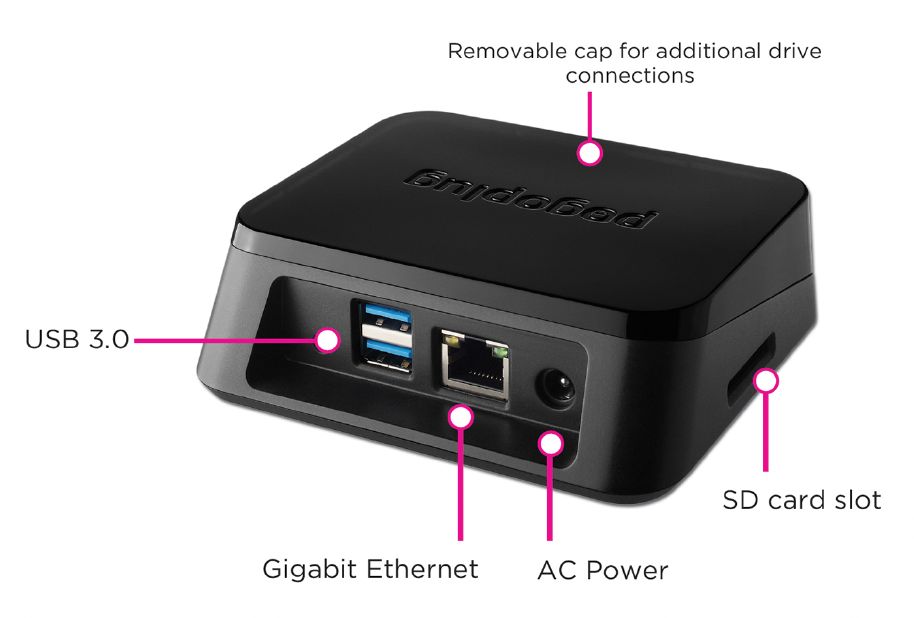
Pogoplug is launching the fourth generation of its flagship product today, the Pogoplug Series 4. As with all Pogoplug hardware, the new device lets you attach your hard drives and plugs into your router in order to instantly give you your own personal cloud of online storage.

The service also comes with 5 GB of free online storage optimized for mobile users, and allows you to purchase additional cloud storage, if need be. However, all users of the Pogoplug device who host their own storage, can do so for free.

The pricing for the updated Pogoplug hardware remains the same as before: $99.99. It offers four different types of connections, including USB 3.0 (x2), USB 2.0 (x1), SATA/USM (x1) and SD Card (x1).

The hardware is designed to work with Pogoplug’s accompanying software suite, a freemium offering that allows you to stream your storage photos, music and movies to any PC or Mac via the web, or to your smartphone or tablet. The premium version ($29) includes the the ability to stream to any connected device, not just home computers. And for those not interested in buying any hardware, the software can function on its own to turn your computer into a software-based version of Pogoplug.

The company also offers a cheaper Pogoplug Mobile device for $79 which works with iOS and Android via mobile apps, offering mobile-specific features like automatic backup of mobile photos and videos, which, for Android users, offers something similar to Apple’s iCloud for their platform. The mobile product also works to convert your media into streamable bite-sized formats that are better for mobile viewing and sharing.

The bigger question with Pogoplug, and its now almost dizzying (and, yeah, I’m gonna say it: confusing) array of choices is why someone would choice this option over those from cloud storage and services companies including Google, Amazon, Microsoft, Dropbox, Box.net and others?

While it’s true that those using the software only (no device) and those who want mobile-optimized content and backup, will have to pay for additional storage beyond the 5 GB, no-frills Pogoplug users get everything for free, save for the one-time purchase price involved with buying the hardware. And that is a bargain, even if Pogoplug’s cloud is not.

And Pogoplug is especially helpful for those of you who, like me, have about 5 old USB hard drives laying around the house, all with content you would like access to from anywhere, but no easy way to just get them online.

The new Pogoplug is available at www.pogoplug.com/expansion.


Microsoft And Nokia Team Up To Take Back The Low End

nokia7110

Say a prayer for Android. Nokia’s new Lumia 710 Windows Phone, a $49 smartphone aimed at the feature-phone set, is about to change the way carriers sell – and customers see – cellphones. Forget LTE, dual cores, and all that flummery. Microsoft and Nokia are essentially buying a few million people stuck in the 20th century a new cellphone and they’re doing it in a way only the world’s two finest proprietors of technology to the masses could.

On the surface, the Lumia 710 is redolent of the bargain basement. The amateurish (but rugged) protruding buttons and a rubberized back are a direct attack against the carbon-fiber power slabs that most carriers are flogging while the OS is all animation and pop, aimed at a market that’s used to constantly moving images associated with ad-clogged web pages and Xbox dashboards. It is, to quote Ren and Stimpy, a jolly candy phone, priced to move and ready for the anything but iPhone crowd who, whether by dint of economics or aesthetics, don’t go much for Nexii or RAZRii either.

If you’re thinking that I’m suggesting the Lumia 710 is in any way bad or too “mainstream,” think again. Nokia and Microsoft were – and, to an extent, still are – on the ropes. Convinced for too long that their vaunted N-series was still lounging in high Olympus while it was really playing-second fiddle. It took Elop and his “sell-out” to Microsoft – whose money is helping subsidize this handset – to remake the brand.

The 710 is what Nokia does best: solid, acceptably-specced hardware at a price that’s approaching free. I would equate these phones with the long-dead Wing and Shadow, two “feature-smartphones” Microsoft belatedly tried to foist on a public salivating for the iPhone and the Nokia 5310, a music phone that circulated for a few years in the wake of the app phone revolution. Those were phones aimed at the low end at a time when the low end was looking up.

These past few years have changed the way we think about phones and, although there are cheap Android and iOS phones to be had for under $100, Nokia is really aiming at parents who may be buying their kids a new cellphone (the Xbox Live app is a huge deal) and out-of-work folks who are looking for a real smartphone experience for not a lot of money. Microsoft and Nokia excel at this.

I won’t estimate sales in the millions for this model, but I wouldn’t be surprised to see a slow and steady trickle of phones like the 710 in the next few years. If Microsoft knows anything it’s that low-end, commodity hardware is just fine to showcase their software and if Nokia knows anything it’s low-end, commodity hardware is a great base on which to build a business. Nokia didn’t get huge by selling the Nokia N810. They got rich selling Neo’s 7110.

That said I also feel that this is a real and credible threat to Android. A single OS provider the size of Microsoft sending out updates to an entire line, from low to high, is increasingly seeming more credible than newcomer Google pumping out Ice Cream Sandwiches and other updates to the older phones that they clearly consider dross. Microsoft, through the execrable Windows Mobile platform, learned how to code to the lowest common denominator.

Claim chowder or not, 2012 is the year of WinPho.


Nokia’s First U.S. Windows Phone Is The $50 Lumia 710 On T-Mobile

Nokia-Lumia-710-T-Mobile

Nokia will be officially pulling back the curtains later on tonight, but the cat’s out of the bag: the company’s first U.S. Windows Phone is the Lumia 710, which will debut on T-Mobile with a $50 price tag on January 11.

Sure, it isn’t as svelte or as colorful as its brother the Lumia 800, but the Mango-powered 710 does share the same internals. The Lumia 710 sports a 1.4 GHz Snapdragon processor, 512MB of RAM, and 8GB of internal storage — nothing that sounds super-impressive, but we’ve seen before that Mango doesn’t need the latest and greatest hardware in order to run like butter.

The Lumia’s 3.7-inch ClearBack LCD display and the 5-megapixel rear-mounted camera aren’t too shabby either, and the customers can pick up the entire package in black or white. We’ve seen the 710 sport some funky-colored backplates in the past too, so I wouldn’t expect the chromatically choosy to suffer without some color for long.

With the 710, Nokia and T-Mobile have set their sights on first-time smartphone owners (a Nokia data sheet calls them “smartphone intenders”), and T-Mobile customers could do far worse for $50. Going after beginner smartphone users is a solid strategy for Nokia (and Microsoft by extension) — if they can get first-timers hooked on the simple, elegant functionality that Windows Phone is known for, they may be able to lock down those users for the long haul.


Google Map Maker Gets A Makeover, Is Now Easier To Use

Screen shot 2011-12-13 at 10.42.28 AM

Google Map Maker, the still somewhat undiscovered gem of Google Maps which allows users to create and edit maps, is getting its new Google makeover today. Following the redesigns of other top Google properties including Gmail, Docs, YouTube and Reader, Map Maker’s updated user interface is meant to be easier on the eyes, while also increasing the service’s usability.

Map Maker, which launched in the U.S. in April of this year, is largely meant to extend the Google Maps service into countries where there isn’t much data, namely, emerging markets. In these regions, users can hand-edit Google Maps using an online tool, submitting details about roads, points of interest, features near a point and even geographic boundaries. These edits are moderated by Google, and, after approval, go live for all users of Google Maps, Google Earth and Google Maps for Mobile.

In the U.S., however, the feature was limited to map edits, not creation, allowing users to add greater detail to an area for things like bike paths, walking trails, campus maps, and other areas and features that aren’t traditionally found on maps.

With today’s update, the service has been improved, with a particular focus on first-time users. There’s now a new pop-up box that appears on the screen when you first visit the website, walking you through the tool’s use. In five screens, Google explains the icons used, how you add and edit places, add roads, and review edits by others. And it’s all so darned pretty. (Google is getting pretty – this still seems weird.)

Google Map Maker is now live in over 180 countries, including the U.S. and Canada.


Zendesk Ramps Up Social In Customer Support Platform With Facebook Integration

zen

Customer support startup Zendesk is debuting Zendesk for Facebook, which allows customer service teams to engage with Facebook users from within the startup’s popular help-desk platform. Launched in 2008, Zendesk offers a web-based, SaaS-delivered help desk and support ticketing application that gives companies a simple way to manage incoming support requests from end customers.

There’s no doubt that social media is a large part of customer service, and brands and companies need to keep a close eye on what customers are talking on services like Facebook and Twitter about so they can be part of the conversation.

With Zendesk for Facebook, support teams can respond to Facebook wall posts from within the customer support system. Facebook has been a long-awaited integration for the support SaaS; Zendesk added Twitter data and functionality in 2010.

Zendesk now has than 10,000 customers (including Adobe, MSNBC, Sony, OpenTable and Groupon) and offers both plans for small businesses and enterprise companies. To date, Zendesk has raised $26 million to date from Matrix Partners, Benchmark Capital and Charles River Ventures.


Samsung, Please Don’t Ruin Ice Cream Sandwich With TouchWiz

ics-touchwiz

If you’re anything like me and you’ve fallen in love with Ice Cream Sandwich’s looks, then seeing what Samsung has done to it may be a bit of a heartbreaker. SamMobile managed to get their hands on what seems to be an developer build of Android 4.0 with Samsung’s TouchWiz UI running on top of it, and have loaded it up on a Galaxy S II to play with.

Frankly, I think TouchWiz just ruined everything.

On the one hand, I can’t blame Samsung for wanting to bring TouchWiz to Ice Cream Sandwich. The UI has, for better or worse, appeared on nearly all of the company’s flagship smartphones and one could argue that it has become part of a Samsung device’s identity.

But here’s the problem: Ice Cream Sandwich doesn’t really look anything like the Android versions of the past, and that’s part of what makes it so appealing. It oozes a sense of freshness that I as a long-time Android user find reinvigorating, and Samsung wants to cover it up with an updated version of the same UI we’ve seen for years.

Let it breathe, guys! I’m not saying that TouchWiz needs to die, but Samsung should poke a few holes in it and let some of Ice Cream Sandwich’s style show through.

Now in fairness, TouchWiz doesn’t seem to rid the device of ICS’s design flair entirely. The Roboto typeface is still there, as are a few tinges of neon blue scattered throughout the device. And yes, all of ICS’s lauded improvements haven’t been messed with — the fast app switcher and Face Unlock are present and accounted for.

For all I know, I could be in the minority. Maybe most people would rather have bright friendly icons rather than a vaguely Tron-inspired design. But visually, Ice Cream Sandwich is a pretty bold step for Google — why not add to it instead of just covering it up wholesale?

SamMobile notes that the build that they played with is dated December 7 — there’s really no way to tell how far along Samsung is in the process, although a few force close issues means it’s not quite ready for primetime yet. Motorola and Sony Ericsson have outlined the amount of sheer work that goes into preparing an Ice Cream Sandwich update for their devices, and it’s likely that some things will change before Samsung’s update is pushed out. I’m not holding my breath for a massive redesign, but nevertheless, a nerd like me can dream.

If you’ve got a Galaxy S II and nothing to lose, SamMobile has made the ROM available for you adventurous users to download and install. Be careful though: it’s not meant to be a daily driver, and not everything works the way it should.