Sprint Exults After AT&T Abandons T-Mobile Bid

sprint-logo

With the AT&T-T-Mobile merger officially dead, Sprint is taking a moment to reflect on their own wisdom in opposing it from the beginning.

A press release lauds the retraction of the bid as “the right decision,” says that success would have meant “an undeniable duopoly,” and commends the DoJ and FCC for a job well done. Very effusive, as they have every reason to be.

After all, what they have have indeed been saying since the beginning — the duopoly, job losses, and so on — was in all likelihood true. And while it would have been bad for consumers, it might have been fatal to Sprint. Competing against one hundred-million-subscriber carrier is hard enough; competing against two would have made things intolerable. A couple years in such harsh environment might have relegated them to the dungeon occupied by local and specialty carriers.

Now, not only do they not have to deal with that duopoly, but AT&T will be shelling out billions and their long-term plans will be interrupted. Sprint, on the other hand, has been positioning itself based on the assumption that the merger would not go through, and they will emerge from this with their reputation as a customer-driven company intact and shinier than ever.


How RockMelt Will Battle Chrome In 2012: Identity, Apps, Communication

RockMelt Too New done

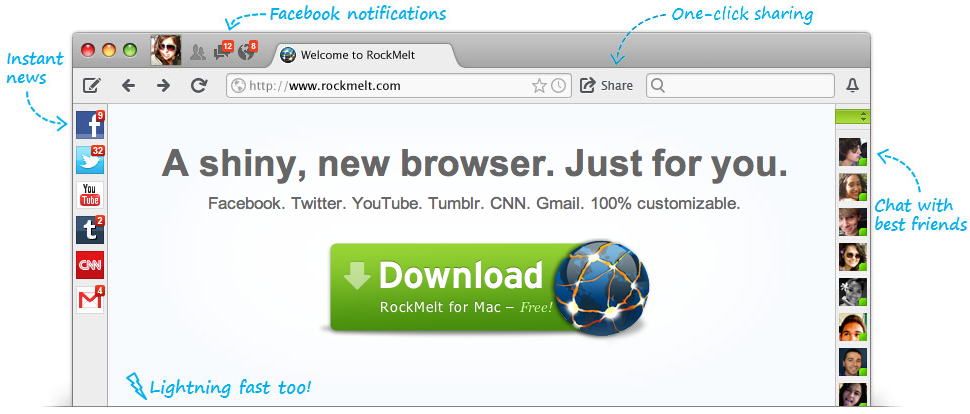
6 months after its public launch, the RockMelt social web browser now has 1.4 million registered users and several hundred thousand weekly active users, CEO and co-founder Eric Vishria told me this morning. With Internet Explorer and Firefox on the decline, RockMelt’s 2012 will be defined by competition with Chrome. Google’s browser is moving in the direction of RockMelt, adding login for personalization and an app store. To stay unique, Vishria says “I think we should push further ahead”, building radical new features “everyone will ultimately want”. But will RockMelt arrive too early to the browser revolution?

Finding the right design to make deep functionality easily accessible is the goal of RockMelt 5 beta, which will be released on Wednesday. The team is aiming for Apple-esque intuitive design. “We haven’t gotten gotten to the ‘iPhone of the browser space’, but that’s where the future lies,” says Vishria

Fortunately, RockMelt’s user base is young and highly adaptive, with 60% under age 25. They have the highest retention, use its special features the most, and invite friends to download RockMelt the most. Vishria seemed very excited about this, “If you’re building a browser for the next generation, it’s good to see the next generation using it.”

The average RockMelt user has the browser installed on 1.3 machines, and uses it for 7 hours a day. They have 12 apps installed, use them 26 times a day, and have 7 chat conversations a day up, from 3 just six months ago. These engagement stats are nice, but user acquisition and retention is where the service has had trouble. I’ve used all the iterations and haven’t been convinced to stick with it yet.

To leapfrog Chrome and accelerate the shift to more personalized, social browser, Vishria says RockMelt is focusing on 3 key areas:

  • Identity – Personalizing the home page with pictures of friends, most visited sites, and more
  • Content and Apps – Working with third-party content providers to create apps that offer a rapid consumption experience, an evolution of RSS
  • Communication – Using enhanced type-ahead people search to make it easier to view, message, chat, wall post, or otherwise stay in touch with friends

RockMelt has also started to monetize its users, though this depends on its competitor Google. When people search through the RockMelt address bar, Google search results are shown generating a few dollars per user a year. Thanks to its $40 million in funding, monetization doesn’t have to be a priority right now. Instead, Vishria tells me the agenda is “Product. Distribution. Monetization. The big opportunity is in getting to hundreds of millions of users.”

I have reservations about RockMelt reaching this goal, though. Pioneering the future of the browser and attaining a mainstream audience may be fundamentally at odds. Chrome doubled its market share to 25% this year through speed and simplicity, not features.


Stanford Law Review: SOPA Unconstitutional, Would Break The Internet

protect_ip_21

The Stanford Law Review has posted a concise and informed takedown of SOPA and PROTECT-IP, the bills currently creeping their way towards votes in their respective legislative bodies. They make many of the same objections I brought up in my article Kill Switch, but with fewer words and more authority.

The piece was authored by Mark Lemley, David S. Levine, and David G. Post — from Stanford, Elon, and Temple Universities respectively — and touches on a few finer legal matters, such as the acts’ nullification of due process and the questionable constitutionality of the whole thing.

It’s brief and worth a read, but here are a couple highlights:

Directing the remedial power of the courts towards the Internet’s core technical infrastructure in this sledgehammer fashion has impact far beyond intellectual property rights enforcement—it threatens the fundamental principle of interconnectivity that is at the very heart of the Internet.

The Supreme Court has made it abundantly clear that governmental action suppressing speech, if taken prior to an adversary proceeding and subsequent judicial determination that the speech in question is unlawful, is a presumptively unconstitutional “prior restraint.” In other words, it is the “most serious and the least tolerable infringement on First Amendment rights,” permissible only in the narrowest range of circumstances. The Constitution requires a court “to make a final determination” that the material in question is unlawful “after an adversary hearing before the material is completely removed from circulation.”

The procedures outlined in both bills fail this fundamental constitutional test.

At a time when many foreign governments have dramatically stepped up their efforts to censor Internet communications, these bills would incorporate into U.S. law a principle more closely associated with those repressive regimes: a right to insist on the removal of content from the global Internet, regardless of where it may have originated or be located, in service of the exigencies of domestic law.

Strong words, but this bill is strong medicine. The New York Times and Reuters both posted some commentary related to lask week’s discussions and some choice excerpts from the bills’ proponents. I like Fox Filmed Entertainment’s Tom Rothman’s chestnut that “Our mistake was allowing this romantic word — piracy — to take hold.” While I agree that sometimes the lexicon can affect social trends, I don’t think that people really conflate illegal online activities with adventure on the high seas.

As you may know, SOPA was recently in the House Judiciary Committee and delayed on account of dozens of objections and amendments, almost none of which were accepted. But instead of being delayed until January, which would give time for both sides to further entrench themselves, another session was scheduled for Wednesday, at which time it is expected to be approved for reading and vote in the House.

Once there, it could still fail to pass, and then there is the threat of veto, but Obama has been quiet on the issue. It’s odd, considering the administration was very clear about its position on net neutrality.

As in some other debates, all the experts and those with no financial involvement are lining up on one side, and threatened business interests are lining up on the other. It may be too late to affect the vote of your representative, but it can’t hurt to forward articles like the Stanford Law Review one, which could make for powerful ammo in a floor debate.


The AT&T/T-Mobile Merger Is Dead

deaddeal

We heard earlier today that AT&T and T-Mobile couldn’t find buyers for assets that could help make their merger a reality, but now there’s no need to worry about it: AT&T has just announced that the deal is officially dead.

In a recent release (reproduced in full below), AT&T lays the blame on the FCC and the U.S. Department of Justice and states that the actions of two governmental bodies “do not change the realities of the U.S. wireless industry.”

They go on to say the the merger would have been an interim solution to the spectrum allocation issue that plagues the industry, and that without the merger, “customers will be harmed and needed investment will be stifled.” Harsh words from AT&T, and ones that may not be true if the contents of an FCC staff report are to be believed.

Released shortly after AT&T and T-Mobile withdrew their merger application, the staff report called into question the claims that the merger “would serve the public interest, convenience, and necessity.” In their investigation, the FCC determined among other things that approving the merger would drastically reduce competition and investment in the wireless space, contrary to AT&T’s claims of jobs and mobile broadband for all.

As far as the FCC is concerned, today’s is a big win for consumers and a big blow to AT&T. And I mean a big blow — with the merger in ruins, AT&T must shell out $4 billion to T-Mobile USA parent company Deutsche Telekom in the form of money and spectrum access. What’s more, the death of the merger will also see AT&T and T-Mobile entering into a roaming agreement, the fruits of which we may have already started to see.

So, after all those months of legal maneuvering, the case has finally come to a close. While AT&T couldn’t close the deal, other companies are already looking to get cozy with T-Mobile: satellite television provider Dish was eyeing up smaller carrier recently, and company CEO Joseph Clayton mentioned he was open to a network partnership with the magenta-hued carrier.


AT&T Ends Bid To Add Network Capacity Through T-Mobile USA Purchase

Company Reaffirms Its Commitment to Mobile Broadband Leadership
Dallas, Texas, December 19, 2011

AT&T Inc. (NYSE: T) said today that after a thorough review of options it has agreed with Deutsche Telekom AG to end its bid to acquire T-Mobile USA, which began in March of this year.

The actions by the Federal Communications Commission and the Department of Justice to block this transaction do not change the realities of the U.S. wireless industry. It is one of the most fiercely competitive industries in the world, with a mounting need for more spectrum that has not diminished and must be addressed immediately. The AT&T and T-Mobile USA combination would have offered an interim solution to this spectrum shortage. In the absence of such steps, customers will be harmed and needed investment will be stifled.

“AT&T will continue to be aggressive in leading the mobile Internet revolution,” said Randall Stephenson, AT&T chairman and CEO. “Over the past four years we have invested more in our networks than any other U.S. company. As a result, today we deliver best-in-class mobile broadband speeds – connecting smartphones, tablets and emerging devices at a record pace – and we are well under way with our nationwide 4G LTE deployment.

“To meet the needs of our customers, we will continue to invest,” Stephenson said. “However, adding capacity to meet these needs will require policymakers to do two things. First, in the near term, they should allow the free markets to work so that additional spectrum is available to meet the immediate needs of the U.S. wireless industry, including expeditiously approving our acquisition of unused Qualcomm spectrum currently pending before the FCC. Second, policymakers should enact legislation to meet our nation’s longer-term spectrum needs.

“The mobile Internet is a dynamic industry that can be a critical driver in restoring American economic growth and job creation, but only if companies are allowed to react quickly to customer needs and market forces,” Stephenson said.

To reflect the break-up considerations due Deutsche Telekom, AT&T will recognize a pretax accounting charge of $4 billion in the 4th quarter of 2011. Additionally, AT&T will enter a mutually beneficial roaming agreement with Deutsche Telekom.

Developing…


Silicon Island: What Cornell’s New York City Tech Campus Will Look Like [Images]

1319500926-cornells-proposed-nyc-tech-campus-sunarcdiagram-004-w1280-h1280-1000x692

New York City refers to its tech scene as “Silicon Alley,” but now it’s getting a giant new Cornell tech campus… on an island, between Manhattan and Queens. I’m going to leave the naming issue for the locals and share some images from the new campus — which is going to be quite impressive, judging by the few details available in an October article from architecture web site Arch Daily.

Beyond the larger goal of making the city more of a tech hub, the focus will be creating a “sustainable landmark” on the 2 mile by .15 mile landmass on the East River, the article explains. A quarter of the 2 million square foot campus will be green space available to the public, while the sun-oriented layout will include the largest solar panel array in the city. That’s not all on the environmental front. There’ll be four acres of geothermal wells, and a 150,000 square foot main academic building with a net-zero energy footprint.

In terms of transportation, the island is also going to be getting some upgrades, with the city already providing $100 million for improvements. Ferries, a tram line, a one-way bridge exit, and a single subway stop are the main ways to get on and off of it now. As The Atlantic explores today, maybe could even be a pedestrian and bicycle bridge to Manhattan?

With that, on to the renderings of the new campus by the prestigious architecture firm that Cornell has hired, Skidmore, Owings and Merrill LLP.

And the dreamed-of bike bridge:


Dave McClure And Blumberg Capital Drop $1 Million Into mygola For Easy, Personalized Travel Planning

mygola_self_w

India and U.S.-based mygola is announcing today that it has received $1 million in seed funding from Dave McClure of 500 Startups, Blumberg Capital, and several other angel investors.

With social travel startups popping up every other day, and a bevy of travel resources already firmly planted in a crowded space, what is it about mygola that’s getting McClure and others excited? For starters, the service’s value proposition starts with the fact that it’s built for users who already have specific trip-planning questions in mind. Essentially, it’s a pay-as-you go travel concierge, so you bring your proposed trip to mygola, with specific targeted questions in mind, and the service handles all the logistics (research and bookings) for you.

Mygola is going for the 90 percent tech, 10 percent human curation approach, as the startup is in the process of bringing on thousands of travel enthusiasts to make them travel researchers. The startup combines human curation and customer service with a technology platform that aggregates the “entire travel web”, auto-categorizing that wealth of information into deals, events, hotels, sublets, and tips from locals through Foursquare and other social platforms.

The paid “mygola Guides” currently numbers in the hundreds, according to Founder and ex-Googler Anshyman Bapna, who are distributed globally and are increasing at a rate of 80 a week. These guides are there help users plan their trips based on the crowdsourced data aggregated from travel sites all over the Web.

The service allows users to ask their first question for free, and if you like the answer that mygola gives you, users can tip accordingly. Users will then pay $30 to ask additional questions or have their entire trip planned for them, or they can pay $100 for a year long subscription.

Interested in trying out the service? Mygola is providing the first 100 TechCrunch readers with a 50 percent discount for the $30 and $100 plans, using the code “TCLOVE”.

Bapna and team have been referring to their model as the “Robocop for travel”, which gives you a sense of the somewhat quirky approach they’re taking. Relying on real human beings to help you plan your trip, leveraging the best of travel information on the Web, is certainly a refreshing alternative to the many user-generated and crowdsourced travel sites out there, but the startup has an enormous amount of competition, and has a long way to go before it can convince users that paying $30 for their recommendations and bookings is easier and more valuable than doing it themselves.

The startup plans to use its new capital to continue hiring its “mygola Guides” and build out its current product. For more, check out the startup at home here.


Bonnes Nouvelle! Word Lens Parle Français

word-lens

Remember Word Lens? That crazy, awesome mobile application that translated words inside of images, like road signs, posters, menus, and the like, from Spanish to English (and vice versa)? Well, now the app has added a third language to its repertoire: French. With the most recent app update, Word Lens can translate from English to French and back again, but not between French and Spanish.

A year ago, Word Lens was all the rage, after its long-awaited release – the result of two and half years’ worth of work from founders Otavio Good and John DeWeese. The app blew our collective minds. The thing was magic. Using OCR technology to “see” the words in front of the smartphone’s camera, Word Lens takes advantage of augmented reality to superimpose the translated words on top of the foreign text. All background images that aren’t text are removed, too. (See, augmented reality isn’t totally useless!). And even better, the app works offline thanks to its downloadable dictionaries.

The app itself is free, but each dictionary costs $4.99 correction: each dictionary is $9.99. (French-English and Spanish-English). Translations in Word Lens aren’t perfect, but then, few digital translators ever are. But it’s usually good enough to get the point across…and maybe save you from ordering the wrong item on the menu or finding your way around town.

You can grab the updated Word Lens from iTunes here.


CrunchDeal: Jetpack Joyride For iOS Goes Free For A Day

Jetpack 1

While we couldn’t possibly cover every app that does the whole free-for-a-day thing, this one is particularly good. Jetpack Joyride, the stupidly addictive side-scrolling action game from Halfbrick (the folks behind Fruit Ninja), is free on the App Store until the clock strikes midnight tonight.

So, what makes this one particularly worthwhile? For one, it’s just a damned good game. Heck, it’s one of our Top 20 iOS games for 2011.

Beyond that, Halfbrick’s tendency to flood their users with constant content updates (as a means of ensuring people come back for more when they’ve got many hundreds of thousands of other options at their finger tips) makes the game absolutely worth its normal 99c pricetag — but at free? It’s pretty much stealing.

You can find Jetpack Joyride in the app store here.


Quora Expands Beyond Q&A, Launches ‘Boards’ — A Way To Personally Curate Information

Screen Shot 2011-12-19 at 3.45.54 PM

Quora is taking a step beyond Q&A this morning with its latest product launch, boards. Users can now set up their own personal-themed bookmarking boards, sort of like a Pinterest for text-based information.

Writes Quora CEO  Adam D’Angelo in a blog post, “As Quora has grown, we’ve learned that people want to read the most interesting content regardless of whether it happens to be in question and answer format or not.” D’Angelo tells me that this shift fits in better with Quora’s new goal, “to connect you with everything you want to know about.” Its old goal was described as “a continuously improving collection of questions and answers.”

Board onboarding (heh) is easy. Users who want to create a board will now see a “Create a board” option at the top right of Quora and on their header dashboard. Anything can be posted to a board, whether it be links to web content like news and video, images, stuff on Quora like Questions and answers or text commentary.

Board Owners can add Authors and Followers to a board, as well as pay to add Topics. They can also set up the board in a grid or list format. The most interesting feature of boards, from a utility aspect, is that Authors can set up following granularity to public — i.e. everyone who follows the board Author will see content or limited only board followers. Boards will also now show up on Topics pages, as well as on your personal Quora profile page.

Relevant boards will now show up in Quora’s search bar, and boards you are following will show up in your top navigation bar. As Quora has been dogfooding the feature, some robust boards have already been set up, including “The Fourth Wave” (a feminism related board), “All Things J” (A board for Japan-ophiles), “The Quora Blog” (self-explanatory). I’ve also set up my first board,“Epic Internet Content.”

Boards will, D’Angelo and Charlie Cheever hope, cut down on Quora newsfeed clutter, and make it easier for people to curate their Quora experience. But it’s not a pivot says D’Angelo, “We see this as expanding what Quora is. People have their favorite answers. There’s also people who write a lot of stuff and a number of masterpieces. This is a way to bookmark the things that people want to reference a bunch of times.”

Cheever tells me that the Board way of bookmarking is one of the most often requested Quora features, “[Think of this as} a response to that feature request, but on steroids.”


Backed By Collaborative Fund, Quarterly Launches A Subscription Service “For Wonderful Things”

Quarterly_Logo-Negative_Container

What if you could subscribe to your favorite bloggers, writers, and designers, and they would send you a heartfelt gift every three months? You probably wouldn’t enjoy my packages, because I would just send you those small M&Ms packets, and there’s nothing fun about fun-sized candy. But, in most cases, it would be appealing. This, coupled with the fact that monetizing content has been a slog for digital content producers over the past few years, is why Quarterly has chosen an alternative path: “A subscription service for wonderful things”.

Quarterly is a young startup from LA, founded by Zach Frechette, the former Editor-in-Chief of GOOD Magazine. Basically, Frechette is betting that his startup will be able to leverage that part of us that loves to be part of a community — and loves to receive something in the mail — for good. It goes back to when we, as younguns, used to write letters to our favorite baseball players, checking the mail every day for their response, or waiting for parents or loved ones to send us care packages at summer camp. (Read Zach’s blog post explaining the genesis for Quarterly here.)

As Frechette’s background is in design and (editoral) curation, he’s chosen designers and writers to be Quarterly’s initial contributors. The initial list is impressive, including the likes of “Moonwalking with Einstein” author Joshua Foer, The Atlantic Senior Editor Alexis Madrigal, President of the Rhode Island School of Design John Maeda, hilarious tweeter and Mule Design Founder Mike Monteiro, author of The Happiness Project Gretchen Rubin, to name a few. (Check out the full list here.)

Each of these authors and designers have been chosen by the Quarterly team, yet as the site grows, Frechette says, subscribers will be able to suggest contributors. Subscribers will pay $25 every quarter (hence the site’s name) to enter the subscription service, and the price of entry will entitle users to receive a package every quarter that wil range from consumer products, be they interesting books chosen by your favorite authors to a tube of earth-shattering toothpaste. Shipping is included.

Frechette says, however, that Quarterly is about more than just finding a different pay-for system. It’s not intended to be a one-for-one exchange, it’s about supporting the process of writers and designers, inspiring real connections between package recipients and their creators. We spend an inordinate amount of time connecting with people online, and Quarterly is attempting to find an alternative (and complementary) way for people to connect offline, through curated and unique packages that “while uniquely brilliant in [their] function, will also have a story, and through that story take on new meaning”. Thus, the intent is to tie real world In each package, there will be a letter from the contributor, describing the item inside and the thought process that led to them choosing it.

To help Quarterly in its mission, the startup is today officially announcing that it has receive a round of seed funding from Craig Shapiro and Collaborative Fund, Behance Co-founder and Pinterest investor Scott Belsky (who is also a Quarterly contributor), CEO of Sugar Inc Brian Sugar, and Co-Head of IDEO NY Ryan Jacoby, along with several other entrepreneurs and angel investors.

Shapiro said that his interest in Quarterly results from the fact that he sees the potential for a really strong brand, which blends great design with a great user experience, in the same vein as similarly-focused companies, like Kickstarter, Pinterest, Fab.com, and Skillshare.

I, personally, am inclined to see Quarterly as a suped-up, design-centric Secret Santa service that builds upon old magazine subscription model. The value proposition extends beyond design, and as Quarterly moves forward, it will be moving beyond design to focus more broadly on other consumer verticals. Quality control could be a bit tricky, but with an impressive list of contributors who are known entities in their own right, and with a staff that will expand thanks to this infusion of capital, scaling the business will hopefully become more manageable.

As to how the business is going to make money? For now, Frechette says, Quarterly is operating somewhat like a typical wholesaler, in that they are essentially buying products at a low price and marking them up at sale. Because many designers and authors see this as a unique marketing opportunity and a great way to connect directly with their audience, they are offering their service (and products) for free. And with Quarterly adding a new subscription every 5 minutes, the value certainly seems to be there for contributors — the audience is arriving, and they’re willing to pay.

Having only been operating in beta for about three months, the service is still incipient, but it will be interesting to see how it grows as it scales. The more opportunities that Quarterly can provide for consumers and fans to connect with their favorite authors and designers, whether that be through Facebook and Twitter, and learn more about them, the more successful this model will be.

For more, check out Quarterly at home here.


Nokia Hates Christmas: Phone Giant Bans Santa Game From Chinese Event

Screen Shot 2011-12-19 at 2.44.27 PM

Nokia played Grinch this year by barring a small, Lapland-based maker of iOS games from a Santa Claus Foundation delegation at Wanda Plaza in Beijing, China. The delegation, consisting of a number of Finnish tech companies, including Nokia, was to show off the best tech Lapland had to offer.

The smaller company, Lapland Studio Ltd, created a game called Elf Rescue in honor of the studio’s nearest neighbor, Old St. Nick. The Santa Claus Foundation invited founder Ilkka Immonen to the event where he would be able to show the game to Chinese press.

Immonen bought his ticket and booked a hotel in China. A few days before his trip, he found that his presentation had been cancelled. Why? Because his game only ran on iOS and Nokia didn’t want it to be shown.

“I was excited, because as a small company I was told that I had the possibility to be present in press event, talk about our game and also show a video,” says Immonen.

“The Santa Claus Foundation told me that everything is cancelled for me. That was after we had produced all the material, planned and booked everything. I asked these people that what is the problem and they said that I cannot show any of my material, nor talk about my game nor speak to any press, even if I came by myself just to see the presentations. They said ‘You should understand that Nokia will definitely not allow that an iOS game would have a slot.’”

Considering Lapland studio is right by the Arctic Circle, it would have been a hoot to have them on the delegation. Lest anyone think he’s joking about living next to Santa, Immonen reported that it is currently -5 degrees Celsius outside his office, which he deemed “not too cold.”

Immonen isn’t upset, just bemused that Nokia pulled his presentation. He suspects that the Foundation was paid handsomely by Nokia and a few other major sponsors and that keeping the big guys happy was a priority over supporting a small games studio. The story even got some coverage in Finland.

“This is Finland,” he said. “It is almighty Nokia for some people here, still.”


Circles Volume Slider Differentiates Google+ As The Social MacroNetwork

Google+ Volume Slider

Google+ has found its place in the social network ecosystem: Twitter is the interest network, Facebook is the social network, Path is the micronetwork, and now Google+ is the macronetwork. With the new Circles volume slider, you categorize people and then adjust the presence of those entire sets of people in your main stream. This lets you efficiently consume updates from across relationship types in whatever balance you choose through a single feed. No other service offers this way to maximize content stream relevancy.

Without the Circles volume slider, the macronetwork model didn’t work. Managing relationships individually was tedious at that scale, and Google didn’t know which Circles you wanted to see most of. This allowed noisy acquaintances or public figures to drown out quieter close friends, making it difficult to consume their content in the same stream.

With the addition of the Circles volume slider, here’s how I see the differentiation between the 4 main social network models shaking out:

  • Twitter – Specializes in connections with strangers who share your interests, you follow or you don’t, and there’s no volume control
  • Path – Specializes in connections with your closest friends, you add someone as a friend or you don’t, there’s no volume control
  • Facebook – Specializes in connections with people you’ve met, and for each individual connection you  select what type and volume of content you see
  • Google+ – Supports a diverse array of relationship types, you Circle connections with similar types together, and you  select the volume of entire sets of individuals

Previously, Google+ didn’t enable the macronetwork model any better than Facebook. Both provided dedicated streams for Circles or friend lists, and Facebook offered volume control at the individual level. But this individual-centered approach doesn’t scale to having  many thousands of connections.

Through its Subscribe feature, Facebook is trying to snatch Twitter’s crown and encroach on Google+’s runway in the interest network space. However, it’s too deeply entrenched around the individual after years of binary friendship to reorganize curation around friend lists. This creates an opportunity for Google+ to own mass curation.

Rather than worrying about who to friend or follow and who not to, Google+ lets you add hundreds or thousands of people to a Circle, but then opt to only see a low volume of that Circle’s content. Google’s algorithms can then surface only the best content from that Circle. I could effectively subscribe to all the experts on certain topic that I’m mildly interested in, but only hear about the most important developments in that area.

There’s no way to do this on Twitter, and on Facebook it would take too much work. Everyone might not need such capabilities today, but some do and more will with time.

Some believe in the “niche to win” model. Really, it’s about differentiating and being the best at what you do. Google could make curation of the widest variety of signals its “niche”. The content stream business is about sorting out the most relevant content. It will need to get users sharing more, but with the Circle volume slider, Google+ has created the biggest sieve.


More On That $300 Million Saudi Investment In Twitter: It’s Not New

twitter

The blogosphere and tech press is all atwitter about the news that Saudi Prince Alwaleed Bin Talal invested $300 million in Twitter. While the identity of the Saudi prince as an investor was not officially confirmed before, the investment itself is not new. The investment was part of the previously announced $800 million financing Twitter closed last September, according to a source with direct knowledge of the deal.

Fortune’s Dan Primack reports that the Saudi shares were a purchase of secondary shares. Indeed, half of that $800 million didn’t even go to Twitter. They were secondary shares purchased directly from employees and other existing investors. It appears that the Saudi prince took three quarters of the $400 million tranche set aside for secondary sales.

Twitter still had to approve these secondary sales, which provided a necessary release valve for employees with vested options. You could even argue that Twitter should allow employees to sell even more shares, given that some of them are leaving in order to do just that.


Social Music Community Beatrobo Makes Sharing And Listening To Songs With Friends Easy, Asynchronous

beatrobo-logo-black-bg

Most online music services have a common problem: it takes too much time and effort to get started and engage with other people. Users usually need to create playlists after registration, look for existing friends using the service or invite new ones, hope that friends really add the songs and bands they like, etc.

If this has been done, sites like Turntable.fm, for example, only work well when a sufficient number of friends are online at the same time and new ones keep joining.

Enter Beatrobo, a new social music community, which tries to simplify online group listening by automating the process and making the experience asynchronous, not real-time. The way it works is that after signing up with your Facebook account, Beatrobo sets up a robot avatar and room, automatically creates a playlist from your FB “likes” and populates the room with avatars representing your FB friends. (In other words, you are never alone and can interact even with friends who haven’t signed up for Beatrobo).

What happens then is that Beatrobo will automatically start playing music – in the form of YouTube videos – endlessly, based on your own playlist and the playlists it pulled from your friends’ Facebook “likes” (on Spotify, for example, you need to actively go listen to friends’ playlists). The robot avatars take turns playing music in the “virtual space”, which you can see below:

Again, one major bullet point is that Beatrobo doesn’t require your friends to be online when you are to make the experience social. Just one example: when you ask for a recommendation for a song from another user (“Do you know a good Christmas song?”), they can choose to take action or not when they get online (your avatar will appear in your friend’s room upon log-in):

Beatrobo CEO Hiroshi Asaeda is likening this experience to social games, which also work asynchronously and make engagement with other people possible whenever users have time. (In that scenario, Turntable.fm would probably be like real-time MMOs such as World of Warcraft).

Beatrobo users can “love” certain songs (users get “love points” in that case), send their robot to other rooms (i.e. to discover new music), comment on songs, customize their avatars to stand out in the group, etc. etc.

What’s interesting is that Beatrobo has created some major buzz on Facebook before launch without major marketing activities, apparently thanks to the cool design of the robots. The site’s Facebook page racked up over 68,000 fans in less than two weeks (by way of comparison: turntable.fm’s Facebook page shows about 30,000 likes currently).

Beatrobo launched today in beta. It’s super-easy to use, but here’s a video showing how the service works:


Cornell Wins NYC Tech Campus Bid (How Serious Had Stanford Been?)

6277143119_7df01cf4d0_o

New York City Mayor Michael Bloomberg will announce today that Cornell University has been selected to build a new tech campus on Roosevelt Island, the two organizations say. It’s not that surprising, considering how the negotiations had gone at the end of last week. Cornell’s top contender, Stanford University, dropped out on Friday — then Cornell followed up an hour later by announcing that it had already raised $350 million for the project.

[Update: “The city is also still negotiating with NYU, Columbia and Carnegie Mellon, to help them realize their proposals in some way,” BetaBeat reports live from the press conference today.]

The goal of the campus is to further develop New York City as a key destination for technical talent, in the hopes of building a university-oriented innovation ecosystem along the lines of what Stanford and Berkeley have in Silicon Valley, and what MIT has in Cambridge. Cornell, an Ivy League school located far out in Ithaca, New York (state), already has a large medical center near the island in Upper East Side of Manhattan. And the city is full of Cornell alumni who want to see their alma mater become a more vital part of the emerging local tech scene.

Check out images of the new campus here.

And really, looking back, you have to wonder how serious Stanford had been lately. The timing of the Stanford pull-out and the Cornell donation was a little too good. Based on a couple recent conversations with some well-connected Stanford alums, my understanding is that it had already become clear that Stanford and the city were not going to work things out, so the city had Stanford go ahead and say it was out as a more gracious alternative to simply losing the bid. Another wrinkle here is that Cornell is being named this quickly. City officials had previously said not to expect a decision until next month.

Stanford had been frustrated by, among other issues, the back-and-forth negotiating that the city did once the university had submitted its bid in October, according to an earlier report by The New York Times. That sort of thing doesn’t happen so much in Palo Alto. Stanford had also not shown the same sort of financial or emotional support. I’ve also heard that some at Stanford preferred a serious campus investment to happen elsewhere, such as China (I’m seeing what else I can dig up about that).

Pleased that Stanford withdrew from NYC. Stanford students belong in Palo Alto.


Keith Rabois (@rabois) December 16, 2011

The new campus, a partnership with Israel’s Technion-Israel Institute of Technology, will cost more than $2 billion, and will be comprised of 2.1 million square feet dedicated to classrooms, labs, conference centers, housing and more for 2,000 graduate students. The university intends to build quickly, and start classes by next September.

Be sure to check out our further coverage:

Silicon Island: What Cornell’s New York City Tech Campus Will Look Like [Images]

Interview: Cornell’s Dean Huttenlocher, On Expanding Into NYC And Building A Tech Ecosystem

[Campus visualization via Cornell University.]