A Christmas Miracle! Facebook Chat (Kind Of) Supports Extended Rage Faces

00yQj

First, if you want to get right down to it, here are the codes you type into Facebook chat to get various faces:

Poker face [[129627277060203]]
Forever Alone [[227644903931785]]
OK guy [[100002752520227]]
Me Gusta [[164413893600463]]
Lol guy [[189637151067601]]
Fuck Yeah [[105387672833401]]
Problem? [[171108522930776]]
[[218595638164996]]
[[100002727365206]]

Huzzah! We are truly living in an age of wonder!

Second, why does this work?

There are various ways to bring Facebook content into chats. For example, you use Facebook Pages like a little TC by typing [[techcrunch]]. The numbers above are actually the IDs for pages that someone, for some terrible reason, made featuring all of those rage faces (https://www.facebook.com/pages/Poker-Face/129627277060203, for example). There are more to be found here thanks to Reddit so I’ll leave further discovery as an exercise for the reader.

All I can say is I’m glad there’s an Internet because the long minutes between sips of whiskey on Christmas Eve, spent staring malevolently at the fire, fingering my ratty smoking jacket, drawing from an unlit cheroot that had gone out hours before, and plotting the destruction of my many enemies would be a lot darker without the MeGusta face keeping me going. Happy holidays!

via Reddit [upvote Sky_Prodigy]


Watch Out Yammer And Jive, Google Is About To Enter The Social Enterprise Space

Google Apps

The social enterprise has been growing as more and more companies look to incorporate Facebook-like communications among workers. Jive (which just debuted on the Nasdaq), Yammer, and Salesforce are all betting on the social as an integral part of productivity and business processes in the future. And it looks like Google will be entering the space soon. Google’s Vice President of Enterprise Amit Singh tells us that Google will soon bring a more in-depth Google+ social experience to businesses and institutions using Google Apps.

In October, Google announced that Google Apps users could sign up for Google+, allowing businesses and educational institutions to share posts directly to other users within their workgroups and/or universities.

But Google has further ambitions for Google+ in the enterprise, says Singh, and that involves creating a collaborative environment for businesses. Internally at Google, Singh says that the company is already using Google+ as a collaboration platform and it’s going well. “This can become a new social platform for collaboration across Docs, Gmail, video and other apps,” he explains.

Singh explains that there’s a shift towards moving from individual productivity based applications to more social applications, and this is only going to accelerate. Part of 2012 will entail bringing the Google+ social experience to businesses.

“Google+ is the next big thing for the enterprise,” he says.” “We are going to do the same thing with Google+ that we’ve done with Gmail, and other consumer-facing apps so that Google+ can be adopted in more of enterprise setting.”

While Singh says the specifics of how this is going work for businesses with Google Apps is still being developed, he says that in 2012 Google will offer “some good choices for businesses to take advantage of both internal and external communication capabilities.”

Google entering the social enterprise market isn’t particularly surprising considering the search giant’s ambitions when it comes to social. In terms of usage, Google Apps is a major product for the company (Apps now has 40 million users, and 5,000 firms are joining per day, as per Eric Schmidt). What should be interesting is how Google’s communications and collaboration platform for Apps will affect the current leaders in the market such as Jive and Yammer. Stay tuned.


Lies Entrepreneurs Tell

lying nose

Editor’s note: Contributor Ashkan Karbasfrooshan is the founder and CEO of WatchMojo.  Follow him @ashkan.

Entrepreneurs are always in “sell mode”, but that doesn’t mean they need to be BS-artists.  Most entrepreneurs aren’t born liars, but we’re brought up in a system that rewards bad behavior and taking the easy way out by lying instead of being truthful, something that eventually catches up with you.

If you’re an entrepreneur, here are 5 common lies you’ve probably told.

Lie No. 1: “I have no regrets” or “If I had to do it again, I wouldn’t do it any differently”.

Conventional wisdom suggests that you should not regret anything.  Highly unlikely if you ask me; the key is how you manage the things you regret and what you do about them: do you let them affect you and cloud your judgment in the future?  Do you dwell on the mistakes you have made or have you learned from your errors and ensure to avoid them in the future?

Human beings are more Velcro than Teflon, but we are raised to think that having regrets or regretting something makes us feel inferior.

I regret the color of socks I decided to wear today.  I also regret not starting a company sooner.  I regret that last shot of tequila at our office party last Friday.  I could go on.  The point is, it’s what you do about the mistakes and missed opportunities that you regret that matter, not pretending that you ever did anything wrong.  Don’t live a lie, be honest about your past to live a better future.

Lie No. 2: “It’s not personal, it’s business”

You’ve certainly heard the line “it’s business, not personal” from The Godfather.

I had a boss who used to live by this motto.  After I helped make him millions, I left to start WatchMojo; he sued me in a frivolous lawsuit (which I won despite representing myself).  He had no case and lost any shred of integrity he had left.  It was personal.

In other words, just because you hear a cool line in a movie doesn’t make it true, and certainly doesn’t mean you should live by it.  It’s Hollywood, it’s make-believe.  In real life, everything is personal, especially in business—and in particular at startups, where emotions run high and personalities spill over into the workplace.

Of course, without a doubt, anyone who can manage their feelings and not let personal emotions affect business decisions has an upper hand in business dealings, but that doesn’t make business any less personal.  In sports, it’s great to remain cool—think Joe Montana.  But those who take losing personally and play to win tend to win more often than they lose.

Success boils down to vision, ambition, determination, execution, luck and timing.  Luck and timing are the most important externalities and determination is arguably the biggest variable you can control.  As such, success or failure boils down to emotions and how determined you are to win, take your victories and setbacks personally, but act professionally about it.

In my experience, anyone who says this lie is probably most likely to take things personally, even if they don’t realize it.  I tell my colleagues that I expect them to take their work personally (so that they are passionate) but that they should remain professional about how they show their reactions.

Lie No. 3: “We’re not raising money”

It’s practically the American dream to spend other people’s money.  Yet publicly, entrepreneurs oftentimes play charades and pretend that they’re not raising money.  Why?  Building companies takes time and money.  Telling an investor who is taking the time to meet you that you’re not interested in raising money isn’t playing hard to get, it’s wasting their time.

Lie No. 4: “We’re not looking to sell”

When the Google guys were willing to sell their search engine early on to Yahoo! for a couple of million dollars, then you know that all entrepreneurs would sell if the price was right.  If there’s one thing I can’t stand, it’s when entrepreneurs try to convince anyone who will listen that they’re going to IPO.  A fraction of startups go on to survive, let alone succeed.  A fraction of those will have liquidity events, and—you guessed it—a small portion of those will come from IPOs.  This year we saw the return of tech IPOs, and most of them fizzled after the offering.  Call me a cynic, but as an investor, I like to know that an entrepreneur is thinking of who might buy his company.

Lie No. 5: “I’m your biggest fan”

People who say “I’m your biggest fan” probably have already stabbed you in the back or will throw you under when you’re not around.  Whenever someone has said this to me in the past, it’s been akin to the kiss of death.  Be honest with people: if you are actually their biggest fan, don’t just say it—act on it.  And if you don’t like someone, then don’t be a hypocrite.

I’ve found that people who use this line like to use it a lot. They are everyone’s biggest fan. When it’s said and done, the truth always comes out.  And when it comes to clichés, eventually people see through them and you look hollow.  All you have is your integrity and your word; don’t waste your credibility by trying to curry favor.

Image by Arena Creative/Shutterstock.


The Decline And Fall Of The Appian Empires

roman-forum

A couple weeks ago, MG wrote: Android development itself remains a huge pain in the ass. I hear this again, and again, and again. Which took me a bit aback. I’ve developed numerous Android and iOS apps (though not games, so I can’t speak to the differences there) over the last few years, and neither set of developer tools seems to me to be hugely superior: both have their strengths and their really irritating failings.

But then I realized–if you’re an iOS developer moving to Android, then yes, Android would initially seem a million times worse, just as the converse would. It’s just that the converse has been far less common. The platform you don’t know always seems unbearably clumsy, whereas the platform you do know generally feels easy and comfortable: you’ve already gone through the setup nightmares, figured out its quirks and idiosyncracies, and learned what not to do or try.

This, I think, is a big factor in the reign of apps.

Ever since the App Store came out, people have been prophesying that apps are a passing fad, soon to be replaced by HTML5. For years now, PhoneGap and Sencha, Mono, etc., have offered cross-platform app development, ie the ability to write a single app that works on both iOS and Android. If the transition between the two is such a giant pain, then why wouldn’t everyone do that?

Well, there are a whole bunch of reasons. Cross-platform apps are still slower and clumsier. They don’t feel as polished as native apps; also, they generally don’t look like native apps. It’s a pain to get them to work with the many hardware and software services provided by the device’s OS, which native apps do very easily. Generated code is almost always much inferior to written code. To get real estate on the phone’s screen, and presence in the app store/market, you have to package your HTML5 in a native-app wrapper, which can quickly begin to feel like the worst of both worlds.

Also, cross-platform development in and of itself means learning Yet Another Set Of Tools And Languages. For some time Apple ruled the only app platform that mattered, so writing apps meant Objective-C, XCode, and iOS libraries. Then Android began to boom. App developers who wanted to expand to it as well had a choice: either learn how to develop native Android apps, or expend a comparable amount of time and energy learning how to write cross-platform apps that would be mediocre on the iOS environment where they already excelled. No wonder the latter never took off.

But the story is far from over. More and more developers are becoming fluent in HTML5 (which is really very powerful; in particular, it’s easy to write apps which are fully functional even while offline) for web app development, and more and more “apps” are really becoming “mobile portals to web services”. It would be much easier for such services to have a single HTML5 interface, tweaked slightly depending on whether the client is a phone, tablet, or desktop, than to have to support an Android app written in Java, an iOS app written in Objective-C, and an HTML5 desktop web client. This is doubtless one of the motivations for Facebook’s long-mooted “Project Spartan“.

Unless Apple and Google take the drastic step of crippling HTML5 in Android/iOS, it’s really hard to see this not happening over the medium term. (For the short term, see Ben Savage’s excellent “14 HTML5 Predictions For 2012” post.) If Windows Phone starts to take any significant bite out of the marketplace, and a third app platform arises, it will happen even faster; developers will throw up their hands and head to HTML5 en masse. But even if the Android/iOS duopoly continues to reign, the HTML5 is on the wall for native apps. They’ll continue to reign through 2012, and maybe even 2013; but make no mistake, their days are numbered.

Image credit: Wikipedia


Siri, What Were Your Top 5 Hacks And Mods Of 2011?

siri

2011 saw the rise and fall of Siri. What was initially hailed as something just short of the savior of mankind turned out to be a limited voice control system. Apple insists Siri is still a beta product. They say it will get better.

But some out there couldn’t wait for Apple. And so, with a little imagineering, people made Siri do all sorts of unconventional tasks in 2011. These hacks led to her opening beer, playing the piano, and even warning owners about what’s on a specific TV station. Yeah, the official feature set of Siri is a bit underwhelming, but hackers and modders managed to roll out an impressive set of avant-garde use cases to keep owners occupied until Apple rolls out the next Siri revision. Read on for the top 5 Siri hacks and mods of 2011.

Beeri. Siri-controlled beer bot

Using an Arduino, R/C truck and a metal spike, this hack is more about the triumph of man over machine than actually pouring a proper glass of beer. But who cares! It’s awesome. And as one of the very first Siri hacks, beeri occupies a special place in the history books.

Start Your Car With Siri

“Start my car.” It’s just that easy. Developer Brandon Fiquett used an open source Siri Proxy server and coded a PHP script that interacts with the Viper SmartStart system installed in his Acura. Then, with just a quick conversation with Siri, this guy can start and stop his car from afar. Like a boss.

Siri Proxy & ioBridge Home Automation

Using the same Siri Proxy has the previous hack, this mod interacts with an X10 home automation system. “Siri, turn off everything.” “Your house has been powered down. Good bye.” Eat your electronic heart out, HAL 9000.

Play it again, Siri

Never mind the Yamaha marketing nonsense, the video still fun to watch. However, when you dig into the so-called mod, Siri is simply initiating the playback of a specific file. In this case, Siri is telling the iPhone to start playing a Midi file which is streamed using Airplay to the Yamaha piano through an AirPort Express. I think. It could be magic.

Siri Universal Remote

The Siri Universal Remote leans on SiriProxy and an Arduino IR box. But it’s a lot more than that. As the video shows above, when Siri is asked to change the channel, she announces the program currently playing on the station. Think of it as a Pawn Stars/Jersey Shore early warning system.


Shaker Is Going To Have A Rockin’ New Year’s Eve

Shaker New Year's eve

TechCrunch Disrupt winner Shaker is already getting ready for New Year’s Eve. The Facebook app creates 3D virtual rooms where you can party with your friends and meet new people. The startup is partnering with Dick Clark Productions to create a virtual loft where a pre-party will take place right before the “Dick Clark’s New Year’s Rockin Eve with Ryan Seacrest 2012″ show begins.

The New Year’s Eve loft will be a place where people can virtually hang out between 4PM and 8PM ET on New Year’s Eve before the live show begins. You will be able to dance, mingle, buy virtual drinks and watch exclusive interviews with some of the performers who will be on the ABC television show, including Will.i.am, Taio Cruz, LMFAO, Gym Class Heroes, Fergie, Blink 182, and The Band Perry. (RSVP for the event here, or just show up on New Year’s Eve—there are no fire codes for virtual lofts so there is no limit to how many people can be packed inside).

Hanging out in virtual spaces to meet new people is still a fairly new concept. Big partnership’s like this one will expose Shaker to a mainstream audience. But the experience will have to be compelling enough for them to come back on their own. Ultimately, that will depend on who shows up for the party.


Facebook Subscriber # > Twitter Follower # ?

Twitter Extinct done

Where do you publish first if you have more Facebook subscribers than Twitter followers?  That’s a question more and more journalists are going to be asking themselves. This is just 3.5 months after the launch of Facebook’s late entry into asymmetrical following (I follow you, you don’t have to follow me back). Many individual content producers including TechCrunch / CrunchFund’s MG Siegler, The New York Times’ Nick Bilton, and myself have have seen our subscriber counts surpass our follower tallies. How? Because Facebook’s larger user count makes it easier to amass subscribers.

This is why I think Facebook has a real chance to beat, or at least severely reduce the value of Twitter. For the mainstream internet user, the barrier to following someone on Twitter is high because, well, they have to sign up for Twitter. Most people already have Facebook, so subscribing to someone doesn’t require additional work. They’re just rolled into your existing news feed. You don’t have to make any conscious entry into interest graph networking.

Over time, the sheer popularity of Facebook could lead many to have a larger public audience there. If publishers prioritize by audience size, the shift could jeopardize Twitter’s prowess as the source for breaking news.

Some caveats. Facebook may have taken the lead so quickly for some journalists because they appear more often on its dynamic suggested subscribe list. However, people are gaining lots of subscribers through links on the comments they leave through Facebook’s Comments Box widget for websites.

Yes, the big influencers are on Twitter, and reaching them is important. And yes, Twitter is more reliable for breaking news because the unpredictable nature of the news feed and EdgeRank mean updates aren’t always delivered immediately. But for publishers, reaching the long tail is important too, especially from a money-making perspective.

All Facebook has to do is expose subscribe links to its huge user base. Eventually publishers will gain enough subscribers that they consistently post publicly there. Then, people on the fence about whether to join or invest time in Twitter may not bother. Facebook will be good enough.

There’s still a big problem with Subscribe in that you can’t post separately to subscribers vs friends. And there’ll always be unique use cases for the rapid consumption, 140-character format. Not enough to win over the mainstream, though. Turns out it’s not easy for a little bird to fight an 800 million user gorilla.


Ron Paul Is The Second Most Popular Republican Candidate On Facebook (And He’s Gaining)

Screen Shot 2011-12-23 at 3.57.00 PM

I know there are lots of people out there who have passionate feelings about Ron Paul. He’s a principled and independent fighter for old-time American values, or a conspiracy theorist loon, or someone who let idiotic racist stuff get published in his newsletters decades ago… or whatever else it is that you see about him that makes you react.

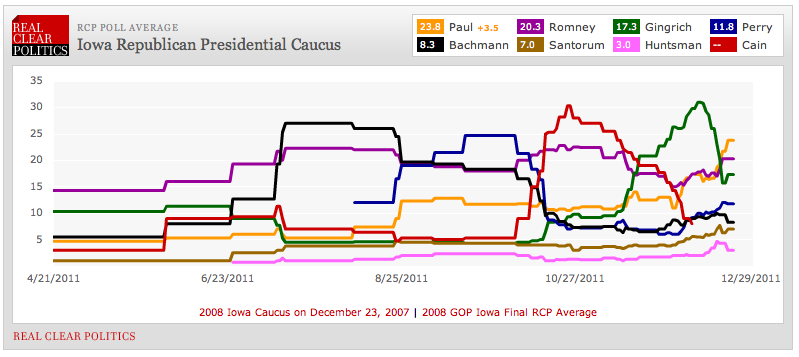
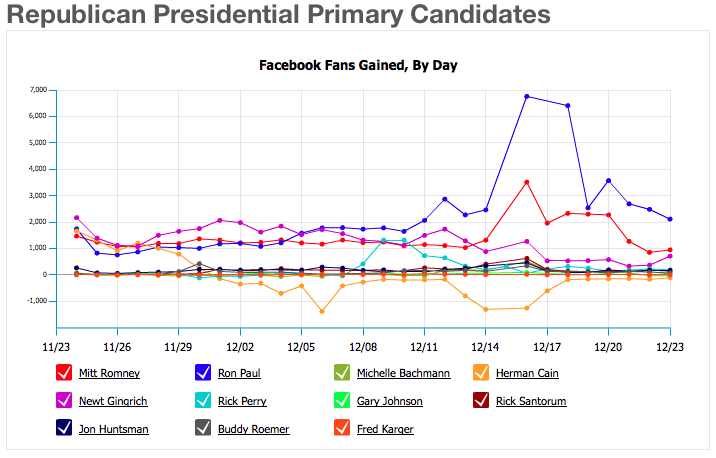
I’m not here to take sides and tell you how to vote, I’m just writing this article to point out that he’s been gaining the most new Facebook fans every day for most of the past month. He’s now the second-most popular candidate behind Mitt Romney (and Democratic incumbent Barack Obama, of course), according to the Inside Facebook Election Tracker.

Paul currently has 655,000 fans, half of Romney’s 1.23 million, and a fraction of Obama’s 24.3 million, but he’s well ahead of third-place primary candidate Michele Bachmann. Meanwhile, Newt Gingrich, who has appeared at many points in recent weeks to be Romney’s main Republican challenger, has had pretty minimal growth.

Fan counts are not a perfect proxy for real-world popularity because candidates can do things like buy lots of ads on Facebook, run contests on their Pages to bring in more people, or promote their Like buttons on their campaign web sites. Also worth noting: the fan counts here are far lower than the active voters out there, so this is a subpopulation of politically involved people. Facebook has around two-thirds of the US online population, and anyone in the world can like Facebook Pages. It’s just that most people don’t.

But the trends do seem to reflect many of the voter shifts in the primary over the last month.

By numerical gains, Paul has had the most new fans every day since December 5th, the election tracker shows. The rise began around when previous top outsider candidate Herman Cain announced he would drop out. It leveled off for a bit during a short Rick Perry resurgence, right around the 8th of the month, when Perry released his widely hated “Strong” video against gays in the military. So maybe Perry gained some Facebook fans even though he created the most disliked video on YouTube? But as Perry’s blip tapered down towards zero, both Gingrich and Paul grew.

It’s true that Romney has surged over the past week or two as Cain, Perry and Gingrich have faded down. But Paul has gained even more every day, with monthly growth highs among all candidates at nearly 7,000 new fans per day at some points last week. Maybe it’s because of how people are receiving his debate performance.

What does it all mean? Until a few months ago, online success for Paul might have been chalked up to the relatively small but very earnest group of online supporters, who have helped him win online polls for years. But now he’s also winning real-world polls, like in the Iowa primaries. His Facebook fan growth is looking more and more like a proxy for his overall trajectory.


Flurry: Largest Addressable Markets For Mobile Developers In 2012 Include India, China, Japan & U.S.

12-23-2011 7-07-00 AM-resized-600

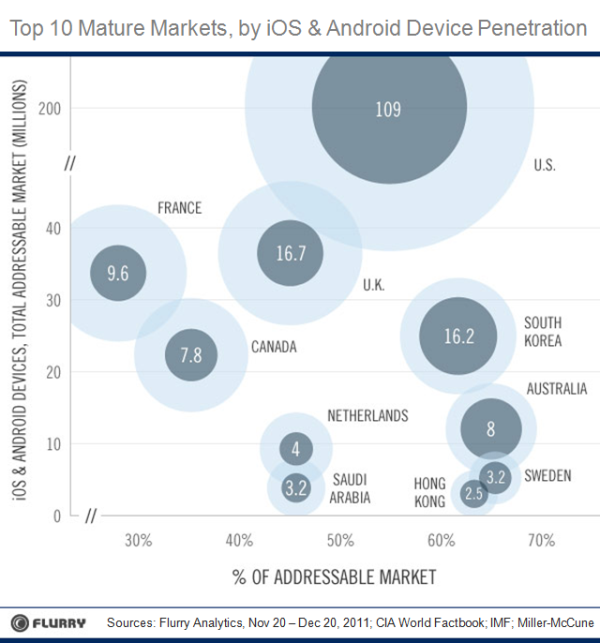
Mobile analytics firm Flurry is closing out the year with a look into the forthcoming shift in mobile installed bases expected in 2012. Using data from the firm’s dataset of over 140,000 apps running worldwide, it was able to calculate smartphone penetration in established markets like U.S. and Europe. Then, using additional data from the IMF in combination with Flurry’s own data, the firm was able to then determine which countries represented the top market opportunities for mobile app developers.

Not surprisingly, China and India made the list. But so did the U.S.

To start, Flurry looked at a snapshot of apps running across its user base over the past 30 days in order to rank the current addressable market. The U.S. led the way, with an installed base of 109 million out of 264 million (41%). Flurry notes that 264 million is about half of what Apple and Google say they’ve activated – something that can be accounted for by old device replacement.

China (#2) and South Korea (#4) appeared in the top five, ranking above Japan (#5), France (#6) and Germany (#7). The U.K. is #2.

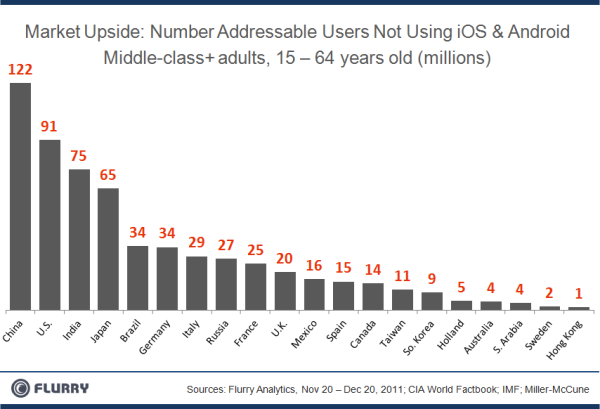
Next, Flurry wanted to determine which markets hold the most future promise. It used the adult population counts from the IMF, then adjusted the numbers based on the size of the middle class in each country using a study by Miller-McCune. Flurry then estimated the size of the upper class for each country, as those folks could also afford a smartphone. This way, China, India and Brazil would not be over-represented in the estimations just because they have large populations.

And yet, they did make a showing. China has 122 million users who could afford an iPhone or Android. The U.S. has 91 million, India 75 million, Japan 65 million and Brazil 34 million.

In the final bit of analysis, Flurry wanted to determine the world’s largest addressable markets, regardless of penetration. For starters, it looked at current market maturity (the measure of how penetrated smartphone devices are among a country’s addressable audience.)  The U.S., with the largest light blue circle in the graph below, has the largest total addressable audience (TAM) at 200 million. Sweden is the most mature country with 3.2 million of 5 million (66%) addressable consumers already using iOS and Android devices.  France, 10th in maturity, has 9.6 million of 34 million (28%) consumers using iOS and Android devices.

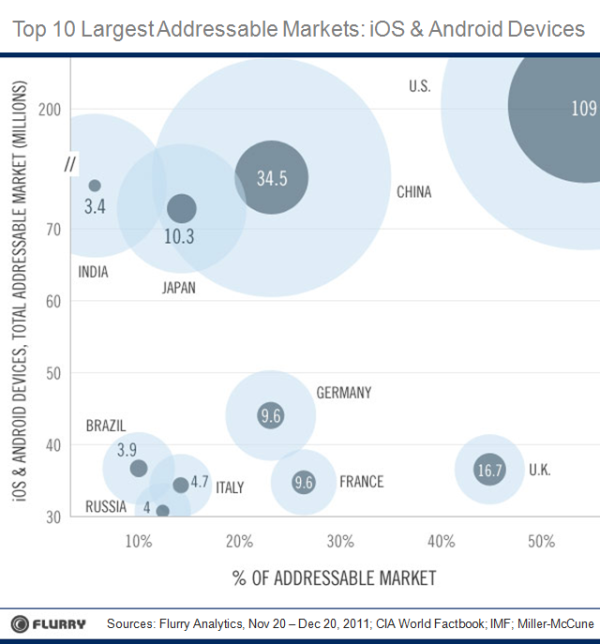
In looking at the future addressable markets, Flurry found that even though India’s total population is not far behind China’s, its total addressable market is. Meanwhile Japan, the world’s fourth largest market, has a lot of upside given light penetration of iOS and Android devices against its large, addressable market, says Flurry.

Using this method, the top 10 addressable markets are the U.S., China, Japan, India, Germany, Brazil, Italy, France, the U.K. and Russia.

More analysis can be found on Flurry’s blog post.


The Year in Tablets

<< Previous
|
Next >>


Annus Swipis

When tablets first showed up, they were met with head-scratching, furrowed brows, the chirping of crickets. The form factor just didn’t click, the software wasn’t right. The earliest tablets ended up being the pet rocks of the digital age.

But Apple turned everything around with the introduction of the first iPad, a success born equally of a smart design centered around a touchscreen, a operating system built to best utilize its unique characteristics, and a content portal to fill it with a wide range of inexpensive software (OK, and lots of savvy marketing).

Now, the tablet has truly came of age. We have several competing mobile operating systems, a wealth of apps, and long lists of successes and failures. And with every stumble, a lesson learned — not just by the companies making these devices, but by us, the buying public, who continue to ask what purpose tablets serve, what holes they fill in our lives, and the type of world they’re leading us toward.

Photo by Jim Merithew/Wired

<< Previous
|
Next >>

Fold Up and Roll Out

The iPad is a conundrum. On one hand, its main selling point is that it’s not a laptop, that it’s done away with old-fashioned, creaky technology like keyboards. On the other hand, every iPad user, no matter how proud, sometimes wishes the device were just a bit more, well, laptoppy.

It’s like dating an outlaw biker — you might be thrilled by his freedom from society’s rules and constraints, but you still wish he’d replace the toilet paper when he uses the last of it.

Luckily, you have any number of options if you want to type on real, actual keys with bumps on the F and J. Any Bluetooth keyboard will happily fill in, but the Logitech Fold-Up Keyboard is custom-made to make the iPad 2 a little less visionary and a little more practical.

The tablet — iPad 2 only, tough luck, early adopters — slips into the fold-up keyboard’s form-fitting frame. It’s easy to lock your iPad into place, but it takes a bit of patient effort to pull it out again. The frame is cleverly designed to not only allow access to all the buttons and jacks on the iPad, but to accommodate the Smart Cover as well.

At this point, you have a thicker-than-usual iPad case in basic black. But with the touch of a button on the back — and a bit of coaxing — the screen tilts up, and two sides of a full-sized keyboard slide in from the rear and fit themselves together jigsaw-style. It’s such a clever bit of engineering, you want to make a Transformers “whooch-whooch-whooch” noise the first few times you do it.

The keyboard itself is Bluetooth and uses its own internal battery. The charge lasts for hundreds of hours of active use, and you can recharge it with a standard micro-USB cable. The case and keyboard seem pretty rugged. I haven’t launched it from a catapult or anything, but I emptied most of a glass of water on it — on purpose, thank you very much — and it didn’t complain in the least.

Downsides? It’s landscape-only. The volume and orientation switches are difficult to reach when the keyboard is out, which is a pain if you had it locked in portrait mode. And fresh out of the box, the keys had a tendency to bounce and type the same letter twice, though that grew increasingly rare as I broke it in.

The big issue though, is that an iPad in a thick black case that folds out is no longer a tablet computer; it’s a notebook with a corporate-controlled software selection and no USB data ports. If you want to slide your tablet into an exoskeleton for work during the day and pry it out at night to watch Netflix in bed, this might be just the solution for you. At $130, it’s a lot cheaper than a laptop.

As someone who types for a living and who hasn’t taken his MacBook on the road in months, I prefer to pair my iPad 2 with the now-defunct iGo Stowaway folding keyboard. I can leave the keyboard in my satchel, so it’s there when I hit Peet’s for caffeinated inspiration, and the iPad remains sleek and light so I can switch from writing columns to reading supernatural romance novels without skipping a beat.

Alternately, you can save at least 50 bucks by picking up a basic folder-style case with a built-in keyboard. The keyboard won’t be as spacious as the Fold-Up, but it won’t be tiny, either.

Still, if you want a hard case, a bit of wow factor and a full-sized keyboard when you force your iPad 2 into double duty as a plain old boring netbook, Logitech has something that will make you smile to yourself every time you hit the magic button and unfold your gadget like Grad Student Batman.

WIRED Mechanism to flip out the keyboard is brilliantly engineered. No need to remove and stash your Smart Cover. Rugged enough to survive the terrors of backpacks and briefcases. USB-rechargeable battery lasts and lasts.

TIRED Landscape-only. iPad’s volume rocker and rotation lock switches are tough to reach when tablet is mounted in typing mode. Bulky as a case.

Cheezburger’s Ben Huh: If GoDaddy Supports SOPA, We’re Taking Our 1000+ Domains Elsewhere

cheezburger

And the anti-SOPA rallying of the tech world’s best continues.

Just minutes after Ycombinator’s Paul Graham disclosed that SOPA-friendly companies would be blacklisted from the YC Demo Day, Cheezburger (as in I Can Has Cheeseburger, FAIL Blog, Know Your Meme, etc.) CEO Ben Huh has announced that they will be moving their array of over 1,000 domains away from GoDaddy unless the registrar recants their support of the act.

Will Huh’s threat be enough to make GoDaddy back down? Probably not: GoDaddy is a company with plenty of controversies under its belt, so they’re more than used to taking a bit of heat. With that said, it will raise awareness to the fact that taking your domains (and thus your money) elsewhere is a totally legitimate form of protest — in fact, Huh’s tweet just reminded me that I have (make that had) 2 domains sitting in GoDaddy’s yard. Thanks, Ben!

You can find our full coverage of SOPA here, and find out more about why it’s such a terrible, terrible idea here, here, and here.


In A Reversal, Intuit Will Make Quicken 2007 For Mac Work With Lion

quicken2007mac

Intuit has just released some good news for  ”Quicken for Mac” users.  The accounting software company says they will have a solution that makes Quicken 2007 for Mac “Lion-compatible” by early spring 2012. Yes, irony alert. Back in July, I wrote about the dilemma facing those users, because Apple Lion OS was dropping support for Rosetta.  Without Rosetta, Quicken 2007 wouldn’t run on the Mac with Lion.  And I wrote each of the three options Intuit proposed (Quicken Essentials for Mac, Mint.com, Quicken for Windows) had their own flaws.

Aaron Forth, Intuit’s General Manager of its Personal Finance Group which includes Quicken and Mint.com, wrote a note to existing customers saying “I am committed to creating products to help you reach your financial goals.  I recognize, however, that we have not always delivered on this promise to Quicken Mac customers.”

Forth adds “I understand the frustration this may have caused you and have put a team in place to address the issue.”

The details have not been worked out yet, but Intuit says they have a team in place to solve the problem and they ask for their customers patience.

Back in July, Cult of Mac reported one solution might be Intuit bakes some Rosetta libraries into Quicken.  It’s unclear if that’s the solution now being worked on.

After calling them out for this problem earlier, its only fair to give them credit for doing this now.  Forth says “working toward a … solution is just a first step in winning back your confidence.”  I agree. Ok, I realize it is about to become 2012 and we are talking about a 2007 product, but it’s still a widely used product.


ComScore: Google+ Grows Worldwide Users From 65 Million In October To 67 Million In November

oasis.12.21.11

There are lots of third-party guesstimates floating around about Google+ traffic. Are users losing interest like search trends seem to show? Has the service grown to 150 million active users like this research firm thinks? I’ve gotten new numbers from comScore, which is arguably the best third-party measurement firm for web traffic in the world.

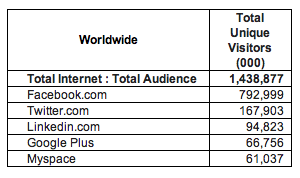
It shows that Google+ grew from 65 million unique visitors in October to nearly 67 million in November. This is purely based on traffic to the plus.google.com subdomain, comScore’s Andrew Lipsman tells me today. So it doesn’t include the many Google+ feature injections that the search company has administered to its other properties over the last months. Some people have suggested that Google+ is as barren as a desert — this is at least an oasis.

Here’s how the service stacked up against competitors last month.

The depressing significance for those people out there wishing for Google+ to either die off or kill their rivals is that neither appears to be happening. Just some slow and steady growth, which is overall good for Google considering the vast resources and focus that it’s bringing to bear on the effort. Ultimately, Google+ doesn’t have to dominate now, it just needs to keep growing and getting better over the coming years in order to be a real alternative to Facebook and everyone else.

And now, the usual data caveat: Obviously comScore, like any other third-party, doesn’t have the same access to data as Google itself, so don’t assume these numbers are 100% right. But still they’re worth paying attention to, since Google doesn’t share much about how it’s doing. The last time the company released anything, it said it had 40 million registered users during its earnings call in October. That’s not directly comparable to this, but could indicate that there’s been more significant growth over the fall. Also, for more on worldwide social networking trends, check out our coverage of comScore’s 2011 social report from yesterday.

[Oasis image via Freshpics]