When “Find My iPhone” Becomes An Adventure

Screen Shot 2012-01-06 at 5.07.44 PM

TechCrunch reader Nikos Kakavoulis sent us the following amazing story earlier this week … The Daily Secret founder used “Find My iPhone” to catch an naive iPhone “thief” — turning on the Play Sound feature in Starbucks in order to locate his lost phone inside the person who had found (and kept) his phone’s pockets.

Writes Kakavoulis (yeah, I know, us Greeks and our “names”):

So I’m sitting in Starbucks in Athens, Greece, meeting with Daily
Secret developers. After taking a quick break, I realize I’ve left my
iPhone on the bathroom sink. It’s gone. The barista says no one’s
handed in a phone but suggests I check the ‘Find my iPhone’ app. Our
head designer, Spiro, is already on the case—by the time I get back to
the table, he’s got the app on iCloud. The good news? My iPhone’s
still in Starbucks. The bad news—it’s on silent (probably turned on silent).

There’s a small button on the iCloud interface, which I’d never
noticed before—Play Sound. In an instant, we can all hear my iPhone
beeping. I’m looking around Starbucks and the noise is coming from a
couple with a baby two tables away. “Have you seen my iPhone?” I ask.
The guy pretends not to hear, which is insane because the beeping is
now incredibly loud. “Maybe the baby took it?” I say, even though
their kid’s about a year old. The beeping stops.

I go back to our table, click the same button and this time, when the
beeping starts up, the guy takes my phone out of his pocket all
contrite—“Oh is this your phone? I found it on the floor.” I’m almost
speechless by now, then his wife jumps in—“You’ve got it back, what’s
your problem?”

By the time we call the police, the couple has disappeared. No apology, nothing. Do I want
to file charges? No. Facebook? Hell yes. We post the guy’s pic on
Facebook. Ten minutes later, the kicker. His wife comes back into
Starbucks, presumably to apologize. She comes up to our table. “I’ve
lost my sunglasses. Have you seen them?”

While Kakavoulis’ story had a happy ending, “Find My iPhone” didn’t have the same results for Prism SkyLabs founder Steve Russell, who live-Facebooked tracking down the iPad he lost on a flight to the Carriage Green Apartments in Aurora, CO (United/Continental’s Lost and Found Facility is down the street).  While he updated the thread with every step of the process and at times was so close, Russell never did end up with his iPad.

Russell later wrote me with this suggestion for the makers of “Find My iPhone,”

“Wouldn’t it be neat if an option on the “Find my iPhone” App was to automatically submit your device serial number to police and and various lost and found registries…as it was for me…I couldn’t find my serial number and it was logged by “Find My iPhone” so it made talking to the airline and police about my device much more difficult …

Airlines, like pawn shops are required to do today, should be required to submit the serial numbers of found high end electronics to the police and possibly set up an online registry.  In the Pawn shop case, this is actually how MOST stolen iPads are found and returned, according the police person I talked to.  They Cops wait until the thief tries to sell the device…and then pick it up from the pawn shop. “

I too have had a “Find My iPhone” adventure, rifling through anything and everything backstage for hours last month at Le Web, to find my iPhone that supposedly was right there according to “Find My iPhone” but actually wasn’t. I also didn’t get mine back. Maybe that guy’s wife was right?


Review: AAXA P4 Pico Projector

IMG_3251

Short version:

A powerful little device, significantly brighter than others of its size, with decent battery life and a good picture. Too bad it’s so damn loud, and not the most user-friendly thing of all time either.

Features:

  • 80 lumens, 2000:1 contrast ratio
  • 854×480 native resolution, 1280×768 max resolution
  • 5

  • 2GB onboard storage, microSD slot
  • Composite and mini-VGA inputs, 3.5mm audio out, USB ports
  • MSRP: $399 (sells for $339)

Pros:

  • Very bright, sharp image for its size
  • Onboard storage and SD useful for photos, presentations
  • Full-on Windows CE environment in there if you like that kind of thing

Cons:

  • Constantly running, quite loud fan
  • Needs better file support
  • Interface can be unresponsive or break

Full review:

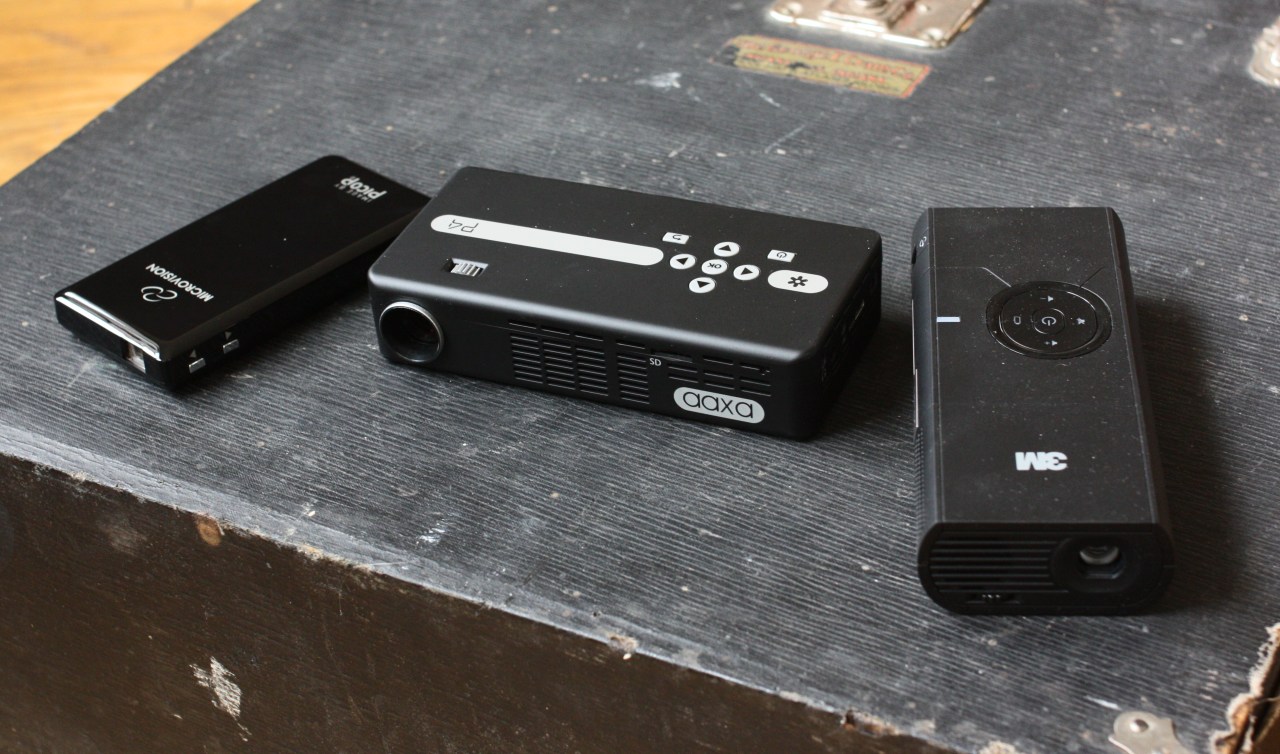
The line between “pico” projector and simply small projectors is increasingly blurry as we see large-ish but still not large products like 3M’s MP160 and the upcoming Shine. They won’t fit in your front pocket, but they’re sure more portable than traditional projectors. AAXA’s P4 is of a type with these: portable, but not micro.

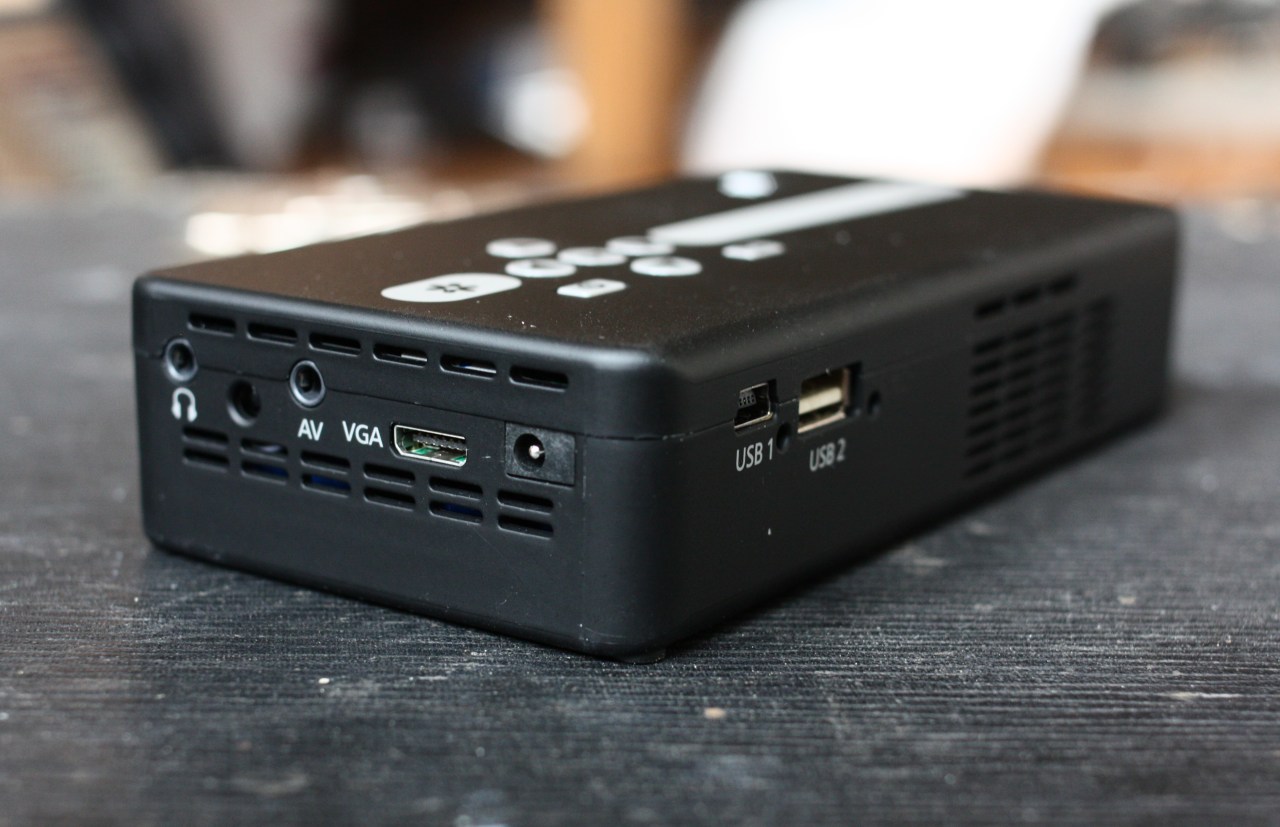
It’s a boxy, gadgety-looking little device, with the controls on the top, inputs and outputs on the side, and USB stuff on the back. It comes with a controller of dubious quality — instead of arrows, the buttons are labeled “up,” “right,” and “Sour” (source), that kind of thing.

Don’t expect a very short throw on the image – but at the same time, it’s not as long as others I’ve used. At 6 feet away, I got about a 35″ image. They claim 80″ is possible in low light, and I don’t doubt it – but you’d need quite a bit of space. For small environments like offices and apartments, you’re probably going to be getting 35-50″. Battery life is somewhat more than an hour, but less than an hour and a half. This is par for pico projectors, though notably the P4 is brighter than its brethren.

Upon starting the device up, you can choose between playing on-device videos, pictures, and music (music, really?), going to a connected source, or entering a full-on Windows CE desktop. The only one I didn’t have trouble with was the plain pass-through source; my SNES and laptop signals were clear, sharp, and bright, with solid color, no visible artifacts or optical effects, and no lag.

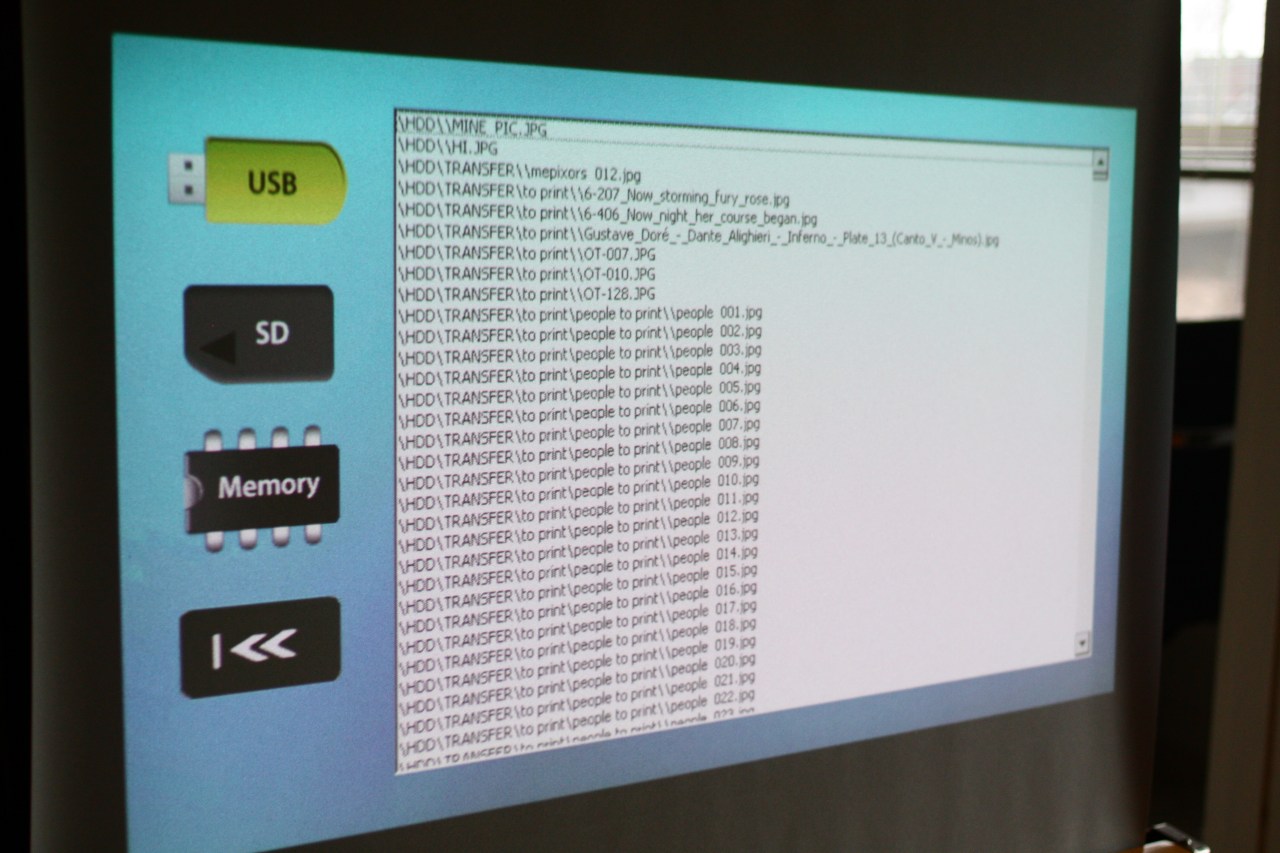
Getting to media you have on the device or an attached microSD card or USB drive is easy if you don’t have much on there – but if you tend to keep lots of photos or shows on a drive, be ready for a long wait as the P4 indexes the media. I managed to fully crash it several times as it attempted to index all the images on a drive I’d plugged in:

That said, a card with a couple dozen pictures and movies on it loaded very quickly.

Unfortunately, media playback wasn’t the best. Anything larger than VGA tended to choke and stutter, whether I had download it or made it myself (AAXA tells me this is not a problem via the mini USB port, and may be fixed by firmware). So don’t expect to be watching HD movies on this thing, despite its relatively high-res image. And when it didn’t stutter, sometimes it would not respond to controls or fail to hide the on-screen display, resulting in much of the image being obscured by buttons and a filename right in the middle of the video. Note that this does not apply to videos played through another device, like an iPod or laptop.

Photos looked all right, but large ones (~4MB, 3000x2000px) took around five seconds to load. It supports JPG, GIF, and BMP, but not PNG. PDF files are not opened natively; you have to go open them in WinCE mode via Foxit Reader.

And throughout all of this, there is a white Windows cursor in the middle of the screen. Why?!

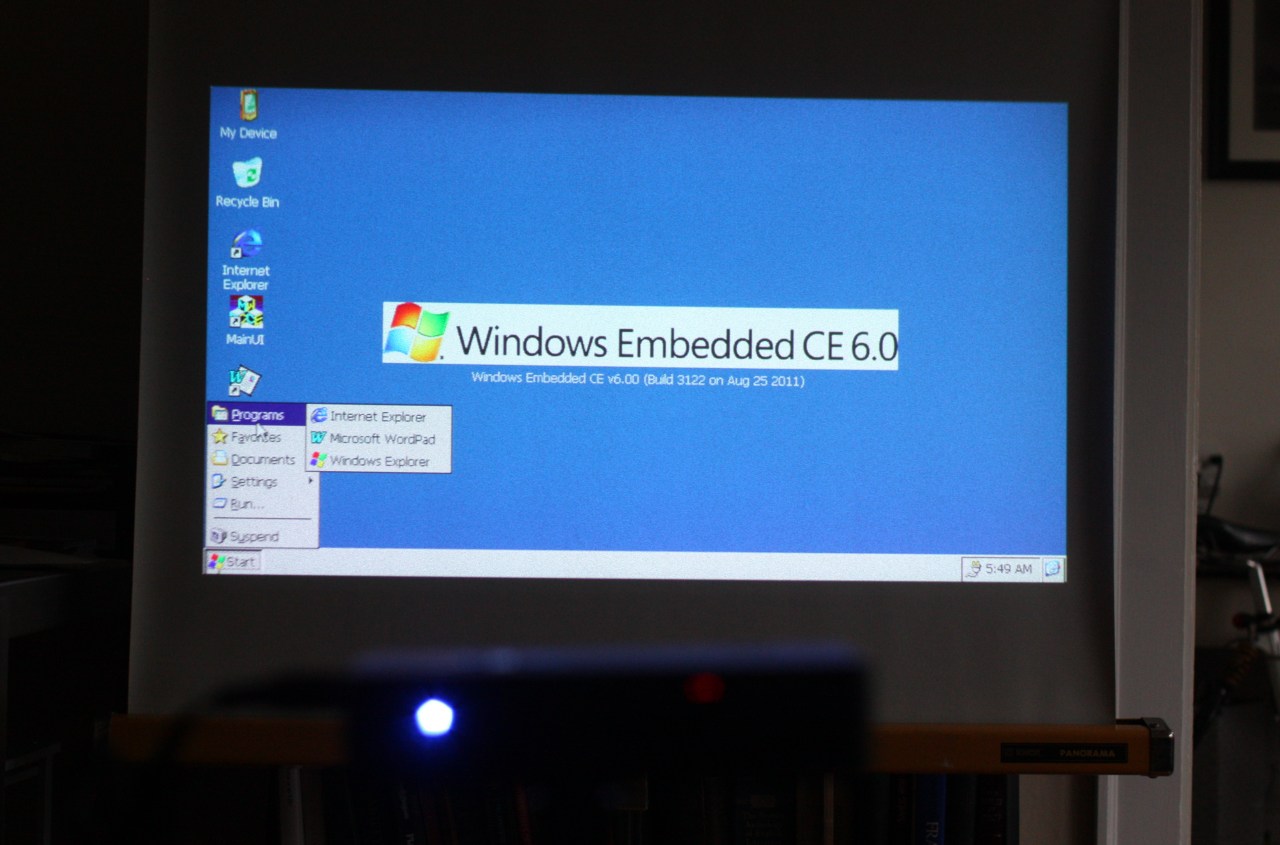
Probably because it’s all running on top of Windows CE, which you can switch into by going to “Desktop” mode. It’s actually pretty cool, although without wireless capability it’s quite limited; if you want to add programs you have to transfer them over USB or figure out a way to share your net from your PC. It’s kind of great that there’s a whole little Windows computer in there, but unless you really want to spend some time configuring it, there’s not much it can add to the bargain. Especially since it’s very difficult to navigate with the clicker.


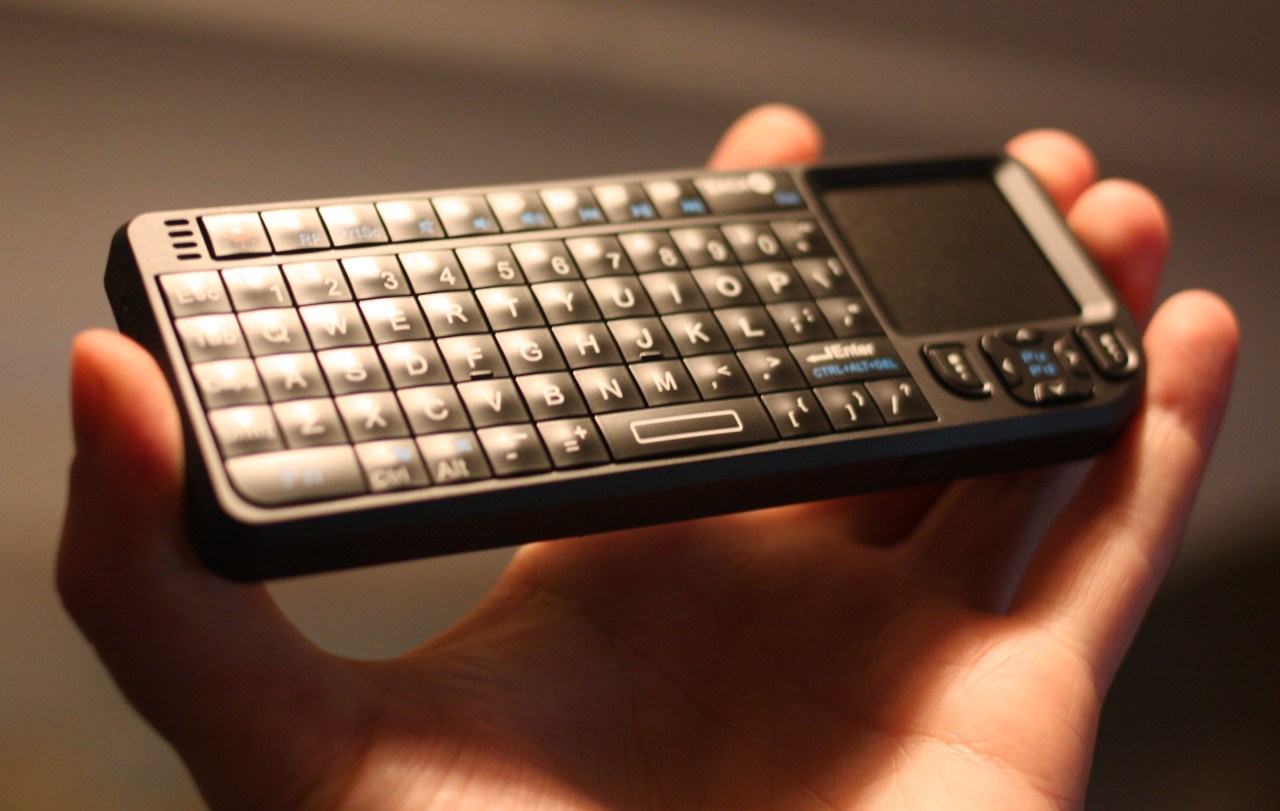
AAXA was nice enough to pack a tiny keyboard/touchpad combo thing, which works perfectly with the projector and is cute as hell. I like this little thing. If the Windows portion of this projector were more practical, this would be very handy indeed.

Lastly, the thing makes a racket. These larger pico projectors aren’t generally too quiet to begin with, but this thing starts whirring from the moment you turn it on, and there is a high pitched noise that’s added when an image is being produced. It also doesn’t have much in the way of volume so you’ll have to pack speakers if you want to hear what’s being said in videos over the din of the fans.

Conclusion

While the P4 is well-built, compact, and produces a really bright and solid picture, its other features are just not very usable. To be fair, the others in the space are often just as poor performers: I haven’t met a pico projector yet that provides a satisfactory movie-viewing experience or is actually easy or fun to navigate. If you want a multimedia device, the P4 isn’t for you. If you don’t mind the noise and plan on doing mostly pass-through stuff from other sources, it could be just fine. They do have a smaller, slightly less bright version coming out (the P3) which might be a little more practical, but that doesn’t come out for a few months.

Product page: AAXA P4 Pico Projector


Spotify Has Gotten Big In The US Via Facebook, But Serious Free Users Will Have To Start Paying Soon

Screen Shot 2012-01-06 at 3.18.00 PM

Many of you who have been using streaming music service Spotify for free in the US from when it launched last July are now going to have to start paying, as Business Insider points out today.

The reason is the company’s policy of limiting free usage to ten hours and/or five plays per track every month, after the first six months of the trial. Full access, if you haven’t paid for it yet, will cost you $9.99 per month, with partial access (no mobile, no offline, etc. but also no ads and no streaming limits) at $4.99.

What we’re really looking at here is two parts of a conversion funnel — the traffic growth part, then the paywall part — for what appears to be a legitimate contender to iTunes (and any other music service out there). Presumably, that was the plan.

When I say “you,” I specifically mean all the people who joined because of the special integration with Facebook that Spotify has had going since September. Those people won’t be hitting the six month limit quite yet, but there’ll be a lot of them, judging by all the growth Spotify has been enjoying on Facebook lately.

Today it has 5.4 million daily active users (although the numbers fluctuate) and 12.3 million monthly active users, according to the AppData app tracking service. Engagement of nearly 50% is impressively high for any Facebook app, especially one that’s grown this much this quickly. Before the launch in late September, Spotify had 3.4 million monthly actives, with daily active numbers that averaged around half that.

Meanwhile, basically no other music service is even close to Spotify on Facebook — the other ones that launched on Facebook in September have gone nowhere (on Facebook). That’s partially because Facebook seems to have given Spotify special prominence in users news feeds and the ticker for months. Spotify’s Facebook growth is also because Facebook forced Spotify to require all of its users to only log in using their Facebook accounts.

The only other company that has any sort of serious traction on Facebook is internet radio company Pandora, which has 1.2 million daily actives and 9.5 million monthly actives, despite not being involved in the September launch. It’s not clear where that growth is coming from, other than purely organic growth.


Facebook Says Privacy Advocates Should Applaud Timeline, EPIC FTC Probe Unnecessary

EPIC Vs Facebook

TechCrunch has received a response from Facebook to the Electronic Privacy Information Center’s letter urging the US Federal Trade Commission to investigate Timeline for privacy violations. Facebook says it has not violated user privacy or its November settlement with the FTC. That’s because Timeline simply makes historic content more accessible, not visible to anyone who couldn’t already see it. Also, Timeline provides Activity Log for managing the visibility of this content. I agree. Facebook may be bending the rules of privacy, but it hasn’t broken them.

In response to EPIC’s call for an FTC investigation, as reported by Identity Matters, Facebook’s Director of Public Policy Andrew Noyes tells TechCrunch:

“As we explained when we announced timeline in September, and we reiterated last month when it became available worldwide, timeline doesn’t change the privacy of any content. Everything is accessible to the same people who could or likely had seen it already in their News Feed sometime in the past. In addition, timeline offers a number of new, simpler, and more effective ways for people to control their information, including activity log, the most comprehensive control tool we’ve ever developed. We think these innovations are things privacy advocates should be applauding.”

Maybe ‘applauding’ goes a bit far, but privacy critics should be satisfied that Facebook has paired easier access to content with better ways to manage it. Before Timeline launched, to reach years old content one had to click the “older posts” button over and over. Profile owners were unlikely to go to this trouble, but someone intent on running a background check or defaming them might do so. In this way, the “privacy by obscurity” that EPIC says Facebook has violated may have been more dangerous than helpful to users.

The critical clause of Facebook’s FTC settlement is that it agreed to “obtaining consumers’ express consent before their information is shared beyond the privacy settings they have established.” The fact is that migrating to Timeline does not change one’s privacy settings. Anything set to friends, friends of friends, public, or a custom setting stays that way. Therefore, EPIC’s claim that “Facebook is changing the privacy settings of its users in a way that gives the company far greater ability to disclose their personal information than in the past” is simply false.

I’m a big advocate for users combing their Timeline for embarrassing content they might wish to remove. If the FTC wants to make a recommendation about Timeline, it should ask Facebook to more actively encourage use of Activity Log. But ultimately, it should see past EPIC’s sensational claims and conclude that Timeline does not violate user privacy.


Beats Go Bluetooth

Beats by Dre is one of the biggest names in headphones.

If you don’t know this, you probably don’t follow pro basketball, you don’t shop for HTC phones and you don’t frequent Best Buy, commute in a big city or hang out in suburban shopping malls.

No matter. Know this: Beats are big business.

They’re a huge hit, and the kids continue to gobble them up even though they’re shamelessly overpriced — the over-the-ears go for between $180 and $400 a pair, and the earbuds start at $100 (Monster Cable, the corporate parent behind the Beats curtain, has taken heat for marking up its cables into the realm of ridiculousness).

Even at those prices, Beats don’t sound very good. I’ve been testing the different Beats models for a few years — the folding portables and the beefier “Studio” and “Pro” sets — and found every pair I’ve worn to be substandard. There are scads of headphones offering vastly better sound for the same money or less. Deepening the mystery, Beats have historically relied on construction so shoddy, you’d be lucky to squeeze a year out of them.

And yet they’re everywhere. People love them. My failure to grasp the logic here is why I don’t work in marketing. Still, as cynical as I am about Beats — and celebrity headphones in general — I was curious about the new Bluetooth models. I try to welcome every opportunity to be wowed, to see the light and be converted, so when a pair of the new wireless Beats crossed my desk, I gave them a solid shake.

While these $280 headphones are instantly recognizable as Beats, there are a few key differences. First, no wires — these are Bluetooth headphones, so they rely entirely on a Bluetooth connection to a smartphone, tablet or a PC to transmit sound. (There isn’t even the option to plug in a mini cable, which is odd.) There’s also an array of buttons underneath a ring on the right earcup. By pressing different points around the ring, you can adjust the volume, advance through tracks, toggle the power, and handle the Bluetooth pairing. In the center of the ring is a silver play/pause button emblazoned with that big red “b.”

Just like other Beats cans, the frame’s tooling is almost entirely plastic, except for the hinges where the headphones fold up to fit into the carrying case. The hinges are metal, but they are rather flimsy and do not inspire confidence.

I charged them, paired them (super easy), and let them rip.

I wasn’t pleased with the sound. The bass is like a blow to the chest. The lows are brutally upfront, booming and flabby. The rest of the soundfield has been pumped up to compete with the wall of low end, but all this does is gunk things up. The highs are rendered dull and the mids lack any liveliness, making vocals sound hollow and making acoustic instruments sound muddy, processed and not at all natural. Delicate sounds lack the room to breathe, and even the less modest details like hi-hats and snare hits are all splat and thud.

Now there’s a big caveat to consider: These are Bluetooth headphones, so the audio is compressed to make the wireless jump from the source to the speaker. But when comparing them to other similarly priced Bluetooth headphones — Sennheiser MM 400s ($260) and AKG K830s ($250) — it’s obvious the Beats have a great deal of flavoring going on. While those other models are able to reproduce sound naturally, the Beats needlessly embellish the lows and roll off the highs much more aggressively.

To test, I chose a suite of albums ranging from old to new, intimate to raucous: John Coltrane’s Giant Steps, Meddle and Animals from the latest batch of Pink Floyd remasters, AFX’s Chosen Lords, some Black Mountain, some White Hills, some Black Star, some White Rainbow.

If you’re into big and loud sound, the Beats will probably impress you when you very first put them on. But after 20 or 30 minutes, I just wanted it to end. I endured an hours-long listening session every day for a couple of weeks, and at the end of each, I had to slip back into my trusty ATH-M50 headphones and realign my chi before moving on with my day.

One thing I didn’t have to do was recharge them often. The battery life is very impressive — the Beats soldiered through several days of regular use between charges. Also, the Bluetooth connection held up in a variety of environments. Around the office and around the house, I only experienced a few signal drops, and only when I walked about 20 feet from my source.

I did have some issues with the design. The headband is tight like a clamp, and since these are on-the-ear headphones, the leather cups pinch the ears uncomfortably. Also, that ring of controls is inscrutable. When I thought my fingertips had found the correct bump for raising the volume, I’d press it and — whoops — we’ve jumped to the next track. This happened again and again, to the point where I’d have to take them off and look to remind myself where each control was.

Lastly, I placed a few phone calls. The audio quality was only so-so on both ends of the line, but I suppose they’d function in a squeeze.

Weighing the convenience of Bluetooth and the folding, travel-friendly design against the poor quality of the sound and the odd ergonomics, these Beats would be my second or third choice among Bluetooth models in the $150 to $200 price range.

But they cost $280 because that’s what the market will bear. That’s way too much, and I recommend you look elsewhere.

WIRED Great battery life. Nice folding design keeps things compact. They look pretty cool. Your friends will just assume you and LeBron James are BFFs.

TIRED Sound is needlessly overbearing and lacks subtlety, the audio equivalent of an MMA fighter with two pit bulls in an F-350 Super Duty who wants to know where the party’s at. Hinges feel flimsy. Pricier than an ounce of chronic.

Photos by Ariel Zambelich/Wired

Mini Kitchen Torch Throws a Maxi Flame


Every juvenile troublemaker wants a flamethrower. The luckiest troublemakers grow up and become professionals who get paid to wield massive oxy acetylene torches.

The rest of us stick with the butane or propane varieties and experiment in our home kitchens, whipping up impressive crème brulees, platters of roasted peppers and ramekins of queso fundido.

I tested one such tool, a $45 Wall Lenk butane kitchen torch from the company’s Bella Tavola line. The polished stainless steel torch has different settings for singeing different epicurean delights — it can throw a 1.5-inch flame on the maximum setting or a short, half-inch flame on low.

The flame measures up to 2,400 degrees Fahrenheit when it comes out the nozzle, but the body of the cone-shaped torch remains surprisingly cold to the touch. That’s good, because I needed to use both hands to operate it comfortably and aim it well. Also, learning the correct distance to get a perfect sear takes a bit of practice: too close and you’ll burn a hole through your casserole in a split second; too far, and you won’t even scar it.

There are three switches — a red safety lever, an ignition button and a lock switch. You set the ignition to either pulse on and off when you push and release the firing button, or to click down for a continuous flame. Choose the continuous flame option, and the lock switch on the side must be released to shut it off — the flame continues to blast until you give the switch a nudge with your thumb.

I was a bit confused by the placement of the switches, and that there are two safety switches that do opposing things — one to keep the flame from firing, and one to keep it locked in the on position. When I first found myself fumbling for the correct combination of switches while a searing blue flame shot out the end of this thing, it didn’t exactly stoke my confidence.

Nevertheless, the butane kitchen torch does its singular job well. I was able to produce a slick, caramelized shell on top of crème brulee time and time again. The slightly upward tilt of the heating element on the top adds an ergonomic boost for aiming the flame, and its wide, no-tip base is a nice safety addition.

No doubt, we amateurs don’t use a kitchen torch for everyday cooking. But when one is called for — to caramelize a dessert, scorch a sliver of albacore nigiri, or to dress the skin of some vegetables — the Bella Tavola’s modest price and sturdy construction offers a tidy and cheap solution.

WIRED Lightweight kitchen torch handles caramelizing, browning, and melting chores well. Adjustable flame gets up to 2,400 degrees Fahrenheit. Butane fuel burns efficiency and refuels easily.

TIRED Adjusting the three switches and levers should be easier. A trial-by-fire learning curve is required. Adjusting the flame is also tricky, as finding just the right distance between flame and food is essential for success.

Reinventing the Rear-Engined Wheel

The Porsche 911 is an odd duck. Here we have one of history’s great sports cars, a strong-selling, fast, good-looking machine that reeks of sex and history.

It is a marker of success: “Timmy bought a Porsche! He must have gotten that banking job.” High resale value makes it a good investment. It is also a technological triumph — despite their capability, Porsches are almost always reliable, long-lived things. And yet the model has always been something of an acquired taste.

The new 911 shares basic proportions — but no significant parts — with its predecessor. It is longer, wider, faster, and more fuel-efficient than the car that came before it.

There are a handful of reasons for this. At the moment, the 911 is the only mass-produced, rear-engined car sold in America. The subsequent rear weight bias has traditionally made the car difficult to drive at the limit and slightly unstable at high speed. Cane a 911 on the autobahn and you’ll notice the steering going light and the nose wandering — Dancing! Flitting about the highway! Manly stuff! — above 160 mph. Porsche people find this charming. Detractors think it’s obnoxious and anachronistic.

Porsche engineers being German, they simply saw this as a problem to be solved. The first 911 rolled off the line in the mid-1960s. Careful evolution has seen the car grow ever more docile and controllable, and yet faster. The Germans — again, being German — were apparently not satisfied, and so we now have the 2012 Porsche 911.

All that stuff we just mentioned? Let’s just call it fixed.

Hold on. Fixed isn’t the right word. More like blown to oblivion.

This is a landmark, and in more ways than one. The ‘12 911, known internally as the 991, is a ground-up revamp of the brand’s most hallowed product. It is also just the third such redo in the model’s history. From 1964 to 1998 (34 years!) the 911 used the same basic platform and an air-cooled, six-cylinder engine. From 1999 to 2011, it used a water-cooled six and a new platform, albeit one with a similar profile.

The new 911 shares basic proportions — but no significant parts — with its predecessor. It is longer, wider, faster, and more fuel-efficient than the car that came before it. The 911’s body is a combination of steel and aluminum — the doors, roof, and several other key panels (about 45 percent of the car’s mass) are made from the latter, cutting weight and lowering the car’s center of gravity. Wheelbase is up by 3.9 inches, and the engine is now slightly farther forward in the car relative to the driver and rear axle. Porsche claims this bumps up body rigidity by 20 to 25 percent.

Here’s the kicker: Amazingly, Stuttgart claims the new, larger car is lighter than the last 911. On top of that, the base 911’s engine shrinks, from 3.6 to 3.4 liters, yet gains 5 hp and puts out the same 288 pound-feet of torque. Fuel economy is said to rise a bit, though EPA numbers haven’t been released. All this without an efficiency-boosting turbocharger.

This is what makes Porsche special, and why its engineers are widely viewed as the best in the world — they specialize in surprises. Cars aren’t supposed to get lighter when they grow. Engines aren’t supposed to shrink and become more powerful. Heck, if you really get down to it, from a laws-of-physics standpoint, rear-engined cars aren’t supposed to be a good idea, period.

NumberFire Pockets $750K To Help You Rule Your Fantasy Sports Leagues

logo-1

Back in September, we wrote about numberFire, a New York City-based startup that’s attempting to bring a deep, scientific approach to your fantasy football picks. At the time, the startup was preparing to graduate (along with ten other stalwart companies) from the Entrepreneurs Roundtable Accelerator, a seed-funding, mentor-providing NYC-based startup accelerator, and we also reported that NumberFire was also on the way to closing a solid round of seed funding.

Last night, numberFire officially closed its first round of funding, nabbing a $750,000 seed investment, led by RRE Ventures, with contributions from private investment firm, Penny Black, and TechStars Managing Director David Tisch, among others. As a result of the funding, Eliot Durbin, the Managing Director of Penny Black, will be joining the startup’s board of directors.

NumberFire Founder and CEO Nik Bonaddio (who also won $100,000 from Regis Philbin on the one-and-only “Who Wants To Be A Millionaire” back in 2010) tells us that, specifically, the startup closed a total of $650K yesterday, but the final $100K has been signed, and will be in-pocket once that pesky holiday paperwork clears. It’s not as easy as cashing a check from Regis Philbin, okay?

And to that point, that’s something that you have to admire about Bonaddio. Most people probably would have taken the money they won on a gameshow and bought a new Porsche, but Bonaddio used it as capital to start numberFire in true entrepreneurial fashion. (Though he’s probably tired of hearing about the show by this point.)

The founder first tested numberFire at TechCrunch Disrupt in NYC 2010, and since then the Pittsburgh native has graduated from ER Accelerator, relaunched numberFire, has seen traffic steadily grow, and a number of big-name partners come calling. NumberFire is currently at about 20K registered users and has partnered with ESPN, Bleacher Report, and SB Nation, and has contributed to blog posts for Sports Illustrated.

But what does numberFire do, you ask? You can read our most recent, in depth profile here, but, simply put, the team has created custom, proprietary algorithms that take all stat-crunching out of your hands when it comes to making predictions about your fantasy sports teams. This means that, as fantasy sports fans, you can import your existing teams from Yahoo or ESPN’s fantasy websites and quickly get started — or customize updates and activity feeds, following teams and players that they are interested in to receive news, updated projections, etc.

And, as mentioned, beyond operating as a tool for fans and fantasy gamers, numberFire works with writers and bloggers from sports content sites like ESPN and Sports Illustrated to enable them to embed widgets and take advantage of their stat machine to create season long projections and more. The startup initially targeted football, but they’ve since expanded to basketball, and, in turn, recently launched their own statistical NERD category that measures NBA players’ efficiency and value. It seems they’re trying to bring Bill James-style Sabermetrics to the NBA and beyond.

The startup will be going after some partnerships ahead of March Madness, so stay tuned for that. And while the mention of Bill James and stats might lead you to believe that baseball, the mother of all stat-driven sports, would be easy fodder for numberFire. But there’s also a lot more competition in baseball number crunching at this level, from FanGraphs and Baseball Prospectus, etc., so numberFire is (for now) keeping to the sports where the demand is high and the market isn’t as saturated. Hopefully hockey is on the way, but I’m not crossing my fingers.

Of course, the big question is, how well does it work? Well, take this snapshot of some of the Web’s predictions for Week 15 of the NFL season, for example. NumberFire is at the top of the list. What’s more, as BetaBeat reported yesterday, a couple of months ago, the site took some bad flack from the blogosphere for predicting that three teams from the AFC North would make the playoffs. Well, contrary to popular belief, they did. How ’bout dem apples?

And the best part? NumberFire is free.

For more, check out numberFire at home here.


Apple Settles Patent Suit From Elan Out Of Court, Coughs Up $5 Million

elan

Elan Microelectronics, a Taiwanese chip and touch screen maker, says it has received $5 million from Apple in a patent infringement lawsuit settlement arranged out of court. This was first reported by Taiwanese media and later by Reuters.

In addition, Apple and Elan agreed to “exchange authorizations” to use each other’s patents, according to a statement from the Taiwanese chip designer.

Elan sued Apple over two of its touch-screen patents in April 2009, after reportedly trying to work out a licensing agreement with Apple for two years.

Also read: Italy Fines Apple $1.2 Million Over AppleCare Sales


The Not-So-Crazy Rumors About Microsoft Taking Over Nokia’s Smartphone Division Resurface

nokia

Mobile industry watcher Eldar Murtazin took to Twitter today, claiming that Microsoft and Nokia executives will be meeting each other shortly to discuss the possibility and terms of a deal involving the sale of the Finnish phone maker’s smartphone division (including “one or two” manufacturing plants).

Such an agreement between the two tech giants, which Murtazin says could be finalized in the second half of 2012, would leave Nokia with nothing but its ‘dumbphone’ or feature phone business, mapping services subsidiary Navteq and Nokia Siemens Networks, the flailing networking and telecom equipment company (a joint-venture with Siemens).

Murtazin also asserts that current Nokia head honcho Stephen Elop will resign from his chief executive role in the course of this year (possibly to return to Microsoft, where he used to run the Business Division?). Furthermore, Windows smartphones would no longer be branded ‘Nokia’.

Finally, Murtazin says the decision to make the move is entirely Microsoft’s to make at this point, and that they’re particularly interested in purchasing Nokia’s valuable mobile patent trove.

Let’s back up for a second.

First, we should note that Murtazin has been telling everyone who would listen that this deal was in the works since May 2011, mere months after Microsoft formed an alliance with Nokia to make Windows Phone the primary platform for Nokia-made smartphones.

Nokia vehemently denied that such a sale of its smartphone division to Microsoft was ever on the table, but I’m increasingly leaning towards believing that it was – and that it still very much is.

Murtazin isn’t always right, but some of his predictions about everything related to Nokia’s business have been pretty spot on in the past, and the man has had some massive scoops, often breaking major news before any official announcements were made, as a result.

We should also note that Murtazin is not the only one whispering about a potential sale of Nokia’s smartphone unit. Such a move would make sense, after all; Nokia certainly hasn’t exactly been heading in the right direction in recent years.

On that note, it’s worth reminding you that Microsoft and Nokia were also rumored (see WSJ report) to make a joint bid for troubled Blackberry maker Research In Motion just two weeks ago.

If Microsoft were to buy out Nokia’s smartphone division, the deal would be reminiscent of Google’s (pending) acquisition of Motorola Mobility, and put the Redmond software giant in a slightly better position to compete with Apple, ‘Googorola’ and other Android handset vendors.

Rumor today, reality later this year? I wouldn’t be too surprised.

Also read: Chart: How Google And Apple Won The Smartphone Wars


The Logitech Cube Attempts To Redefine The Humble Mouse

logitech-cube2

Somewhere deep in the bowels of Logitech, a committee, attempting to think outside of the box, created a box. It’s called the Cube (even though it’s clearly not a cube) and it’s a mouse. And a presenter. I think.

The tiny mouse is designed with portability in mind. The top portion houses two hidden mouse buttons and also a portion for scrolling. To scroll “swipe your finger along the main panel,” says the press release. Then if you lift the mouse up, it turns into a presenter allowing the user to advance slides by just click the top of the device. The Cube connects to a computer though Logitech’s tiny Unifying 2.4 GHz receiver. Or, if you wish, the mouse can also connect via MicroUSB.

Look for the Logitech Cube this month at a suggested retail price of $69.99. Hopefully the device is a bit more comfy than the geometric shape suggests. It looks like arthritis to me.


Lenovo Debuts A Pair Of Ultrabooks, The $1599 ThinkPad X1 Hybrid And $849 ThinkPad T430u

thinkpad-x1-hybrid

Lenovo is serious about ultrabooks. The company just introduced two new ultrabooks that will live alongside the company’s existing model, the ThinkPad X1. These three models put Lenovo in a unique position in the ultrabook game. While other companies are releasing their first ultrabooks, here’s Lenovo, with a relatively large product offering including a high-end model and an attractive entry-level model.

The ThinkPad X1 Hybrid will sit atop Lenovo’s ultrabook product line. As the Hybrid moniker suggests its a variation of the ThinkPad X1. Like original, the ThinkPad X1 Hybrid is available with three Intel Core CPU options (i3, i5, & i7) along with a 13.1-inch Gorilla Glass screen. The main difference between the two models is that the new model features a supplementary Qualcomm dual-core CPU and up to 16GB of memory that runs a custom Linux-based operating system.

Lenovo states this back-up OS is perfect for browsing the Internet, watching movies and other mundane tasks. In this mode the battery is said to last ten hours where it’s only five using the traditional Windows/Intel platform.


The ThinkPad T430u approaches ultrabooks in a slightly different manner than the X1. This is a budget ultrabook. But an good lookin’ one at that. The T430u rocks a 14-inch screen but is still less than .8-inches thick. There’s a choice of Intel Core CPUs and optional Nvidia graphics. Buyers can opt for an SSD instead of a traditional spinning disk drive. The larger ultrabook also has a large battery with a stated life of six hours.

Look for the X1 Hybrid in the second quarter with a starting price of $1,599 (that’s currently $200 more than the standard X1). The T430u will ship in the third quarter for only $849.


Fujifilm Reveals 19 New Cameras For CES – Here Are Some Of Them

header

The compulsion in camera makers to release a dozen or more cameras at a time is understandable, I guess. Get ‘em all out of the way so the PR company isn’t always worrying about this or that release date, embargo time, or what have you. But for your humble blogger, it is something of a trial.

In this case Fujifilm has revealed their CES lineup of point-and-shoots, and there are no less than 19 of them. And that’s not counting the rumored X1 interchangeable-lens camera we are also expecting. Let’s take a little sample of Fuji’s offering. There’s nothing groundbreaking, just so you know, but if you’re in the market for a point and shoot, take a quick look.

If you’d like more complete specs and the whole lineup, go to Fuji’s CES page; these are just our highlights.


X-S1

The X-S1 will be making its debut, though as we suspected, it’s a strange device to bear the “premium” X-series moniker we see on the X100 and X10. It’s a DSLR-lookalike that’s actually a superzoom, with 26x (24-624mm equivalent) F/2.8-5.6 zoom and a 2/3″ 12-megapixel sensor. I have a hard time recommending superzooms, and a ton of today’s new cameras are that type of camera. I’m sure it’ll produce great pictures, decent video, and so on, but at $800 you have so many options that this one doesn’t really pop.


F series

The F series is their premium point and shoot line. These cameras pack monsters zooms (20x on the F770 and F750, 15x on the F660) and Fuji’s more powerful EXR sensors, which offer a number of specialized shooting modes for low light, multiple exposure, and other situations. The F660 is the cheapest at $280. The F750 gets you the longer zoom, and the F770 adds RAW shooting and GPS features. Of these I’d say the F660 is your best bargain – the extra zoom and GPS don’t strike me as adding $100 worth of value, and at that point you’re getting up to the price of super-nice pocket shooters from Canon and Olympus.


T series

If you don’t feel the need for Fuji’s special EXR sensors, the T series is where you want to look. The T-400 and T-350 (which differ only in megapixels, 16 and 14 respectively) are your basic better-than-budget cameras, with face recognition, 720p shooting, 10x zooms, and 3″ LCDs. Perfectly good choices for a vacation cam or gift for a non-techie who just wants a camera. At $180 and $160, I’d recommend the cheaper T-350 – you’re not going to miss those 2 megapixels, and you can use the extra cash to get a case or tripod.


XP series

I have to admit that I wasn’t very impressed with the XP10 I reviewed, but that was over a year ago, and the new ones look significantly nicer. Basically you have your $280 XP150 and $250 XP100, both of which are rated for 33ft of water, 6.5ft drops, 14F-degree weather, and are dust- and dirt- resistant. The 150 has GPS, but not the 100. Then there’s the $200 XP50, which is the same camera on the inside but not rated so highly for ruggedness. I wouldn’t presume to recommend one of these over the other without testing, but usually with “rugged” you get what you pay for up to a point, and who wants to worry about whether they’re going to hit their camera’s depth limit when they’re on vacation?


There you have it. There are more coming out, mainly superzooms, and you can find them here. We’ll be dropping by Fuji’s booth at CES to give these a feel and see any interesting prototypes they might have. Last year they had an X100 sitting around and didn’t even tell anyone. I mean come on! So we’re definitely going to be heading their way.


Apple Reportedly Butting Heads With Content Producers Over iTV

itv

There’s a problem with the idea of an iTV, rumors of which have been sloshing about for a long time, but with greater intensity since Steve Jobs’ biography hinted at one. Unlike an Apple TV, an iPhone, an iPad, or other devices, an Apple TV wouldn’t be tied to a Mac, and it wouldn’t take advantage of iTunes the way those devices do. It’ll be related, of course, but it doesn’t promote the “hub” idea that drives iPhone owners to buy Macs, Mac owners to buy iPhones, and all the other crossover purchases that interweave the Apple ecosystem.

Instead, it would be an Apple-designed window into content that Apple has very little control over. And while you can bring a new idea to the TV space, as set-top boxes and Google TV have, you can’t make the TV space play nice. Google learned that the hard way. And it looks like Apple may be facing a similar challenge.

USA Today has a story on the so-called iTV, with a few juicy nuggets hidden amongst a bedding of fluff. They say that Jonathan Ive has a big, beautiful 50-inch television in his studio. And several sources describe difficulties on Apple’s part securing the content that would be necessary to make their device worthwhile. After all, people using a next-generation content consumption device don’t want to be told that Fox shows are available but not Universal ones. We’re supposed to be leaving all that 20th-century dross behind.

The thing is that guys meeting with Apple over show licenses aren’t stupid. They’ve seen what Apple has done to the music industry over ten years, and they have no intention of entering the lion’s mouth, as their friends at the labels did. In the early 2000s, of course, the labels had no idea that Apple was a lion, and really, neither did Apple. But things are different now, and the guys at Warner and HBO and Turner and so on are happy to make a power play. After all, until someone revolutionizes the channel by which people at large get their TV shows, they’re still king. And Apple can’t revolutionize without their express permission.

That’s not to say they don’t recognize an opportunity. They smell money, but they’re not willing to bite until they can be sure they aren’t falling into a trap. Some of them went along with Google for a lark, but as we saw, they didn’t like the way Google did business (they tend to want to give things away). Apple may be happy to charge, but they also tend to take quite a bit of the sale, and it’s likely that the content producers aren’t willing to let their prize possession, new TV shows, be used as a money-printing machine by Apple. And Apple doesn’t want to leave anything to the discretion of the content producers, who could deep-six the iTV at the drop of a hat and get into bed with Google purely out of spite. And believe me, the TV industry isn’t short on spite.

Difficulties, however, are not failures. They are made to be overcome, and Apple, if it indeed has its sights set on the living room and the burgeoning net-broadcast TV sector (for which people can be made to pay handsomely), will do what it needs to in order to seal the deal. Time, in the end, is on their side: they are sitting on enough money to choke the entirety of the TV business, and they know that their device will be a moneymaker for all involved (not the users, naturally). “Softly, softly, catchy monkey” is their motto. Google’s was a bit more “Leeroy Jenkins”.

Note that there is plenty of time for this to pan out, and the devices we’ll be seeing at CES next week will have a long, full life (which is to say, about six months) before we start seeing the inevitable reports from Digitimes of Apple ordering five million 50-inch LCD panels.