When You Have To Buy Their Love, You’ve Lost

Screen Shot 2012-01-07 at 3.57.59 PM

Over at WindowsITPro, Paul Thurott outlines some details of Microsoft/Nokia’s (purported) marketing plans for Windows Phone in 2012. Amongst them: a $10 to $15 commission for retail sales people who sell Windows Phone handsets over Android or iOS.

In turn, John Gruber asks: “If this strategy was on the table, why didn’t Microsoft start this a year ago?

Here’s why: because it’s an admission of failure.

Microsoft’s obstacle isn’t an easy one. When people walk into a phone store in search of a new smartphone, the sales dude generally offers up two choices: iPhone or Android. Meanwhile, the only people being handed Windows Phones are the ones who asked for them right off the bat.

Now, why is this? Is it because Apple and Google are coughing up piles of cash to get the sales reps to push their phones? Nope — while carriers and specific OEMs might offer spiffs for the sales of certain handsets, I can’t find evidence that Apple or Google themselves ever have. (I’ve been asking sales folks and carrier reps if they ever got a cut from either company all morning, and the only answer I got besides a bunch of “No way”s was a “Hah! If Apple paid me a special commission, I’d be rich.”)

It’s because, for the time being, Windows Phone just isn’t good enough.

That’s not to say that Windows Phone isn’t good, period — it is! But it also came out incredibly late in the game. When you’re the last one off the line, you have to do something so amazing, something so much better than what the folks leading the pack are doing, that you change the race entirely.

iOS did this by making smartphones simple, embracing the concept of “Apps” better than anyone else had before, and by riding that massive wave of momentum that comes from being Apple’s next shiny thing.

Android did it by becoming the anti-iPhone. One handset? “Heck no! Put it on all of them!” said Google. A tightly monitored, “walled garden” for an App Store? “Nope! Do what you want!” Google did everything that Apple would not (for better or worse), for the consumer and everyone else in the industry.

Windows Phone, meanwhile, has very few tricks that anyone could inarguably say that it does better. Oh, it does plenty of things — and it does them all differently. But different isn’t better; it’s just different.

When phone guys sell phones, they’re selling whatever they think will be the easiest sale and make their customer (and their managers) happiest. They do this not necessarily because they’re wonderful people who have deep compassion for everyone who sets foot in their store — but because dealing with angry people (and their returns) sucks. For now, this means iPhone or Android. Both do all of the snazzy things people see in the commercials. Both have a bazillion apps. Both have such massive user bases that few would ever look out into a crowd of people all with smartphones in hand and think “Crap. Did I pick the wrong phone?”

By offering up a chunk of change for each sale — especially when it seems that no one else is — Microsoft is essentially saying “Yeah, we know you don’t really want to sell this. We know that we don’t really have any killer features yet. How about some cash?”

Find your killer feature, Microsoft. Don’t just buy love.


SolarKindle Cover Is Walking On Sunshine (Whoaaa!)

SolarKindle

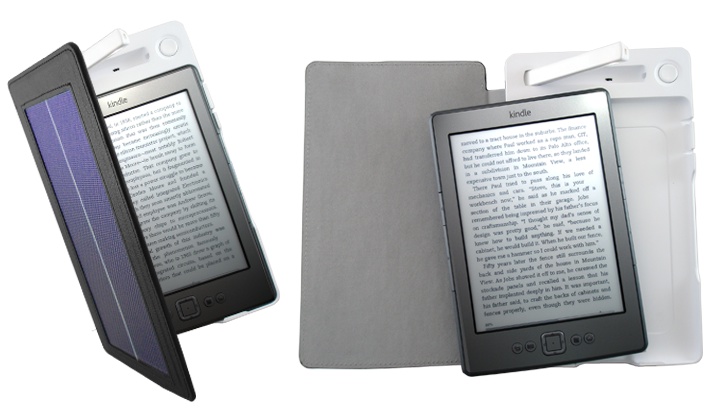
I’ve done my fair share of Kindle cover research, and to tell you the truth I wish this new cover from SolarFocus was around when I did. It’s the world’s first solar cover for the Kindle, with a solar panel built right in.

The SolarKindle promises “up to three months of unplugged Kindle use under normal sunlight environment.” In my experience that means near a window, which should be easy enough.

The cover also packs a reserve battery, which can either power an LED reading lamp (built right in) or offer extra reading time by feeding energy into the Kindle’s main battery. The LED lamp will run for 50 hours continuously before using the Kindle battery. Solar focus says that an hour under direct sunlight can offer 3 days of reading time.

It’s a bit rough on the eyes, but doesn’t seem to be bulky or obtrusive. I guess it’ll all come down to how you prioritize appearance and utility.

The SolarKindle goes on sale next week on January 15, and can be had for $79.99.


Just A Friendly Reminder: If You Sold Your Apple Stock In October, You Were, In Fact, An Idiot

Screen Shot 2012-01-07 at 3.18.16 PM

On October 19 of last year I wrote a post entitled: If You Sold Your Apple Stock Today, You’re An Idiot. Because their Q4 numbers missed Wall Street expectations, Apple’s stock dropped over 5 percent on that day, to close below $400-a-share after hitting an all-time high just days before. My argument was that it was the Wall Street expectations that were horribly flawed, not Apple’s actual performance. And the stock would recover quickly as a result leading up to their Q1 earnings, which even Apple was predicting would be a blow out.

Reading the comments on that post — which I love to do — you’d think I was saying something insane. When the stock fell to $363 right after Thanksgiving, a few remembered the post and once again pointed out the irrational insanity of this fanboy.  But then a funny thing happened yesterday. Apple’s stock closed at a new all-time high.

So yes, if you sold your stock on October 19, you were, in fact, a moron. We’re now two and a half weeks away from Apple’s Q1 earnings — and again, all indications are that they’re going to be massive. Apple CEO Tim Cook is already on record predicting record iPhone and iPad sales, and those prediction both seem solid right now. The real question is by how much will they be records?

Apple’s previous record for iPhone sales was 20.24 million in Q3 2011. If Verizon’s numbers are any indication, it looks like Q1 could see total iPhone sales north of 30 million — and possibly well north. Given that the iPhone is by far the most important product to Apple’s bottom line these days, that could mean not only the first $30 billion quarter in company history — but the first $40 billion quarter as well.

Do those sound like numbers for a stock you should have sold because analysts failed to do their homework? No they do not.

Of course, hindsight is 20-20 — except that we wrote about all of this on October 18, the day before the sell-off.

For a great explantion of why professional Wall Street analysts are so often off the mark when it comes to quarterly predictions, be sure to read this post by Asymco’s Horace Dediu. Here’s the main point:

Analysts have an incentive to put forth a version of the future that supports their call on the stock. Bloggers have an incentive to put forth the most accurate version of the future. By taking the prediction out of the picture, accuracy in describing the future improves.

Analysts often lower their own numbers to ensure their calls are not only right, but pleasantly surprise investors. That explains the past decade of Wall Street being wildly inaccurate with regard to Apple. Apple has been killing it, so when analysts think they’re being cutely conservative to make their calls look good, they’re actually being way too conservative. Except for last quarter (Q4 2011), where they simply missed what was happening due to the shift of the iPhone introduction from Q3 to Q4 (in other words, instead of Q4 sales exploding as was the case in the past, Q1 sales were going to). They got lazy and screwed the pooch.

But this quarter should be a return to form. Burned by last quarter, some analysts may even be a bit more conservative than usual. But Apple’s numbers will not be. And that’s exactly why it was the wrong call to sell your Apple stock in October. But on the flip side, if you bought the stock at the $360 price, you’re really happy right now.

I would have been in that boat were in not for this column preventing me from being conflicted in such a way. The things I do for TechCrunch…


The Road To CES: A Peek Inside Our Gadget Bags

header

When you’re a small team going to cover the biggest electronics show in the world, every person has to act as a Swiss Army knife, able to fill any role at any time. This generally produces an incredibly heavy bag, packed with spare cameras, lenses, batteries, cords, and of course a laptop. Luckily for us, our live-camera approach to covering the show takes a bit of that burden off of our sagging shoulders now, but old habits die hard and it’s good to be prepared just in case.

Aren’t you curious what’s filling your favorite bloggers’ bags to bursting? We’ve rounded up the items we’ll be taking to CES, arrayed them, and described them for your benefit. Take a look.

Matt Burns

If computer bags were living things, I would entrust the Ogio Hip Hop messenger bag with my kids and Netflix password. It’s that good and has been my loyal partner to countless tradeshows and events. It’s not a very large bag so it takes a bit of finagling to fit everything including a Late 2010 15-inch MacBook Pro and a Canon 60D that I rarely use. The Canon S95 is my go-to walkaround camera. However, I lug the 60D around for its telephoto lens and 1080p video mode. A Zoom H1 mic (and hot shoe mount) assists the 60D and also works great for impromptu interviews.

More often than not batteries die throughout the day. I use a Verizon iPad for web browsing and Twitter rather than firing up the Core i7 MBP for those simple tasks. Also, my grandmother-in-law gave me a solar powered USB battery pack last year. I think she got it from QVC. I never use the solar part, but I still love it. It features selectable voltage, a little flashlight and two USB ports for recharging gadgets. Best of all, it has a huge capacity and recharges over USB.

New this year is a Verizon SCH-LC11 4G Hotspot that will hopefully work deep within the Las Vegas Convention Center. I’ll also be sporting a WiMM One watch. This watch was clearly inspired by the iPad Nano. The screen is fantastic and designed to function as a watch first rather than a media device with a clock app. It’s also slightly smaller than an iPad nano, allowing it to fit a lot better on my girly wrists. Plus, it connects to your phone via Bluetooth for updates and features several apps including a pre-paid Starbucks card. It’s perfect for CES.

Lastly, lip balm and gum. Spending a week in Vegas without lip balm is akin to the Amazon with only one pair of socks.

Jordan Crook

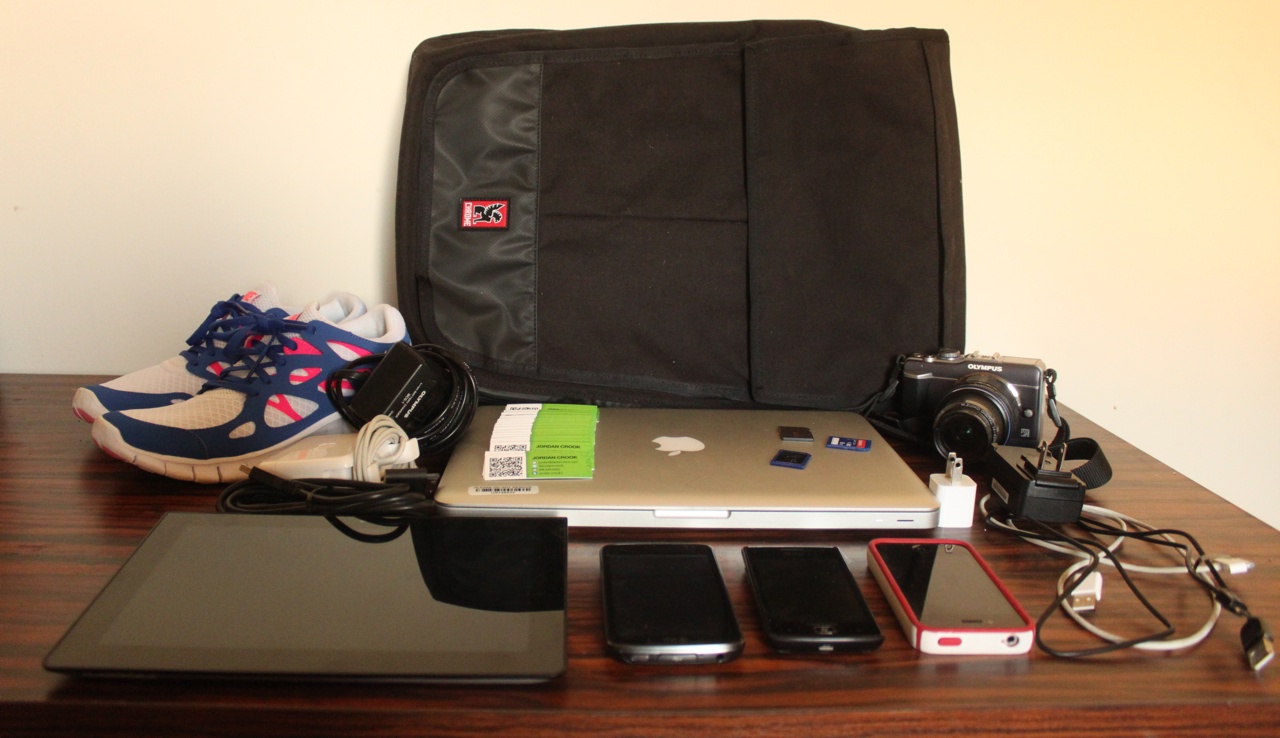
Even though I’m the only female in the TechCrunch Gadgets crew, I’ll still likely be packing lighter than most of my male counterparts. This is partially because I don’t actually have that much stuff, and partially because I will be stealing their stuff throughout the course of the show.

What I do bring, however, will be coddled sweetly by the Chrome Krakow bag which I reviewed just a few months ago. It’s easy to get stuff in and out of this bag, which is pretty crucial at a place where you’re just walking.. and walking.. and walking..

Contents will include my trusty 13-inch MacBook Pro, a hand-me-down Olympus PEN EPL-1 micro four-thirds that was given to me by Biggs, a Sony Tablet S (review unit) for taking notes in any situation where I’ll be standing, and a bunch of phones.

My new iPhone 4S will, of course, be in my pocket where it belongs, but since mobile is predominantly my beat I like to have at least one model for each of our big three operating systems. That said, I’ll probably bring the LG Nitro HD to represent Android since I can use it as a hotspot and it’s quick like lightning (read: AT&T 4G LTE). On the Windows front, I’ll be sporting a Samsung Focus Flash because it’s small and comfortable.

The usual bevy of chargers and USB cords will of course be in tow, and I’ll likely be jacking Matt’s connection from his new Verizon SCH-LC11 4G Hotspot if the Nitro HD lets me down.

Last but certainly not least (and possibly most important) are my new Nike kicks, which will be just as crucial as the Krakow while I’m walking… and walking… and walking…

John Biggs

I try to carry a different bag every time I travel. This one is called the Powerbag Instant Messenger and it has a little battery in it for charging gadgets. There is an iPhone cable and a USB jack. I always run out of juice half way through the day at these shows so I’m bringing this bag, another external battery that I usually connect to my phone and carry in my pocket during the second half of the day, and a huge laptop back-up battery, not shown.

I also have a 60D there with a 50mm lens, a macro zoom, and a huge lens we rented from LensRentals.com. It’s a 28-300mm f/3.5-5.6L IS and it weighs 3 pounds.

Those cables are a collection I’ve gathered over the years. I always bring an external Ethernet jack for the MacBook Air (also not pictured) and an Ethernet cable. I have two Micro USB cables, an iPad/iPhone cable, and a few small chargers. I also have a nice mic in that little black bag there as well as a lav mic for recording in a pinch. Those batteries are in there for no good reason – I have nothing that uses them, but I bought them once and they transfer from bag to bag with me.

I’ve also got my Bose headphones there. I know there are better ones out there but these last a long time, are very comfortable over long periods, and I’m just used to them. I have a Droid Global in there, a Google Nexus, and a Lumia 710. I also have a paper magazine because I hate not having anything to do during take-off and landing. I always make sure to have “No Surprises” by Radiohead on my phone. It’s a talismanic song I that I play when we cross the Rockies and it gets turbulent.

Chris Velazco

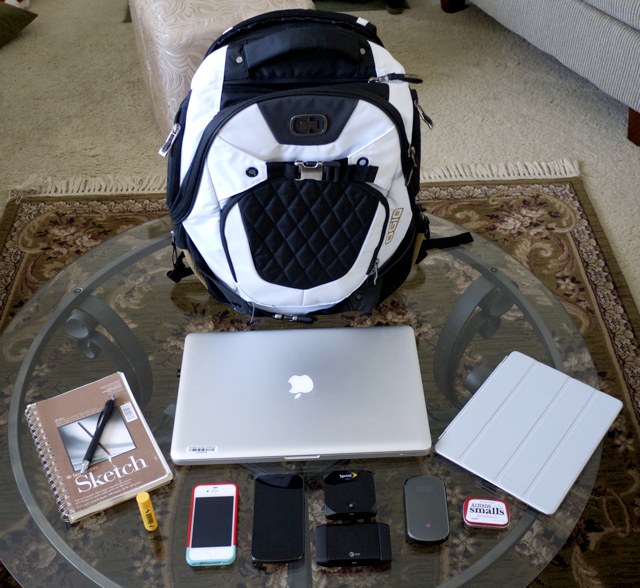
I always make it a point to travel light, but considering this is my first CES, I wanted to make sure all of my bases were covered.

These days I use the Ogio Squadron RSS backpack, which I first starting playing with during Bag Week. I’m still not entirely sold on the white/gold color scheme, but my inner pack rat loves all the space it affords me.

I’ll be carrying my usual load, which consists of my work-issue 15-inch MacBook Pro for all the heavy lifting and my AT&T iPad 2 for everything else. As one of the team’s resident mobile nerds, I bring my iPhone 4S and Galaxy Nexus everywhere, but that’s not all I’ve got for connectivity. I’ve also got mobile hotspots from AT&T, T-Mobile and Sprint, just to be safe.

Of course since I’m an idiot, I forgot to take a few things out ofthe bag before I took the picture. You’ll just have to take me at my word when I say there’s a Ziploc bag full of USB cables and AC adapters tucked away in there, along with a Logitech M705 Marathon Mouse. Also not pictured is my go-to camera, the Panasonic GF2, for possibly obvious reasons.

And of course, who could forget the miscellaneous bits: a tin of Altoids (for the inevitable coffee breath), a tube of Burt’s Bees for my fragile lips, and a sketchbook for quick notes. Now all I need is to remember to bring the bag with me as I walk out the door, and I should be all set.

Devin Coldewey

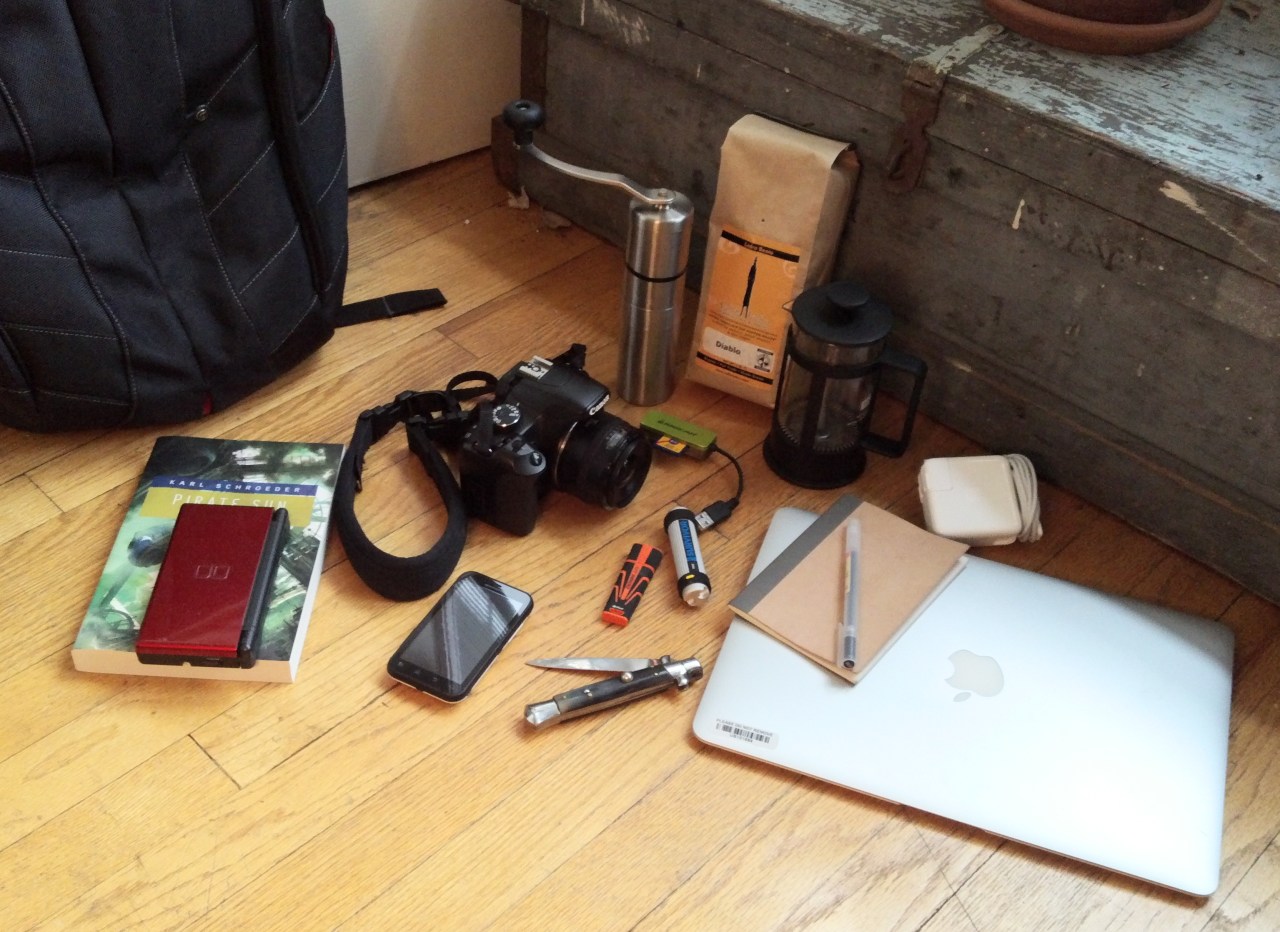
I’m traveling light this year. Normally I’d bring a spare camera, two other lenses, and probably at least two video cameras just in case, plus a hard drive for photo storage. But with our focus on live video (which we’ll also be recording and snipping up), all that stuff isn’t quite as necessary.

So I’ve got my old Canon XSi (due for replacement, either with a T3i or X-Pro1) with the excellent 35mm f/2 on there, great for product shots though a little narrow for environments. We rented a nice fat zoom for press conferences, but I’m not carrying that thing around unless absolutely necessary. I’ll also be testing out a Panasonic GX-1 at the show (review afterwards), which will serve as a spare video device.

There’s a MacBook Air fully loaded, with plenty of space on its SSD for photos, so an external drive wasn’t necessary. Besides, that orange USB stick is 64 gigs. The silver one is waterproof, and so is my phone, in case I fall into the canals at the Venetian. I’m bringing a DS with the latest Layton in it and a nice light SF novel for the plane and down times. Then a pen a notebook from Muji for the occasional scribble. And a switchblade for the snitches. All this will go in the spacious and gadget-oriented Booq Mamba Shift.

Clearing up luggage space means I can also bring a little Seattle to Vegas, in the form of some decent coffee. I know it sounds ridiculous, but the truth is that the coffee in Vegas isn’t very good, and a damn fine cup in the morning is a great way to start the day. So I’m bringing my Porlex hand burr grinder, a single-serving french press, and a freshly-roasted batch of Cafe Ladro’s darkest. You can come to my room and have some, but the only payment I take is trade secrets.


How To Create An Early-Stage Pitch Deck For Investors

ryan_dogpatch_reasonably_small

This is a guest post by Ryan Spoon (@ryanspoon), a principal at Polaris Ventures. Read more about Ryan on his blog at ryanspoon.com.

When raising capital, a combination of your company’s product, vision, team and execution are what ultimately attract investment. And while the pitch deck is ultimately less important than vision and product, it exists to convey both elements and get investors hungry for more.

Like other investors, I come across hundreds of pitches each month — some in person, others in email; some as PowerPoints, and others as full-fledged business plans. Your goal is to craft a deck that is both:

crisp: succinct enough that it is easily digestible (in person, email, etc)

– and complete: thorough enough that it conveys the big vision and current traction

I looked back on many of the pitches I reviewed over the last couple years (good and bad) and compared it to public pitch decks of familiar, successful companies like Airbnb, Foursquare, and Mint. The output is this guide to creating an early-stage pitch deck. It’s intended for companies seeking seed and series A investments.

There are five core themes followed by a suggested structure:

1. Have a great one-liner
2. Know your audience
3. Keep it to 10-15 slides
4. Beware of the demo
5. Expect the deck to be shared

And remember: it’s the story and the conversation that is important – not the imagery and colors. If you can convey the passion that drives you (and your users / customers!), you will have created a powerful pitch deck.


(Founder Stories) ZocDoc’s Massoumi: A Bad Flight & Terrible Customer Service Created ZocDoc

Founder Stories Zoc1.mov

In 2007 Cyrus Massoumi ruptured his eardrum on a flight to New York and turned his distasteful experience of trying to track down a physician into ZocDoc – a service that enables customers to quickly book appointments with doctors and dentists online. In a relatively short time, his streamlined offering has attracted considerable interest from both consumers and investors. Supported by doctors who pay a fee to be listed on the site, ZocDoc is now available in more than a dozen United States markets, claims 200+ employees and has tallied $95 million in funding.

In this episode of Founder Stories, ZocDoc’s CEO and co-founder Cyrus Massoumi tells host, Chris Dixon how ZocDoc was built.

Rewinding to ZocDoc’s origins, Massoumi says after landing in Manhattan with one healthy ear, it took him four days to secure the services of a medical professional. He search was hindered by the substandard list of doctors compiled by his insurance company – so inadequate were the choices that “one doctor was actually deceased” he says.

Disgusted with the status quo, Massoumi rounded up two co-founders and went to work building something better, but tells Dixon those early days weren’t easy. ”We had no website, I was literally taking a power point page and walking into these doctors offices and trying to convince them that online booking was the future of healthcare.” He continues, ”in one case I literally sat in a waiting room of an office for six hours and then I got three dentists to sign on.”

After shaking hands and iterating for “two-and-a-half years” Massoumi says “everything clicked and we have been expanding ever since.”  He tells Dixon patients now have access to “40 different specialties” and “probably north of 6-million maybe even approaching 7-million available [doctor] appointments over the next 90-days.”

Massoumi shares plenty more insights in this video, so be sure to watch the entire episode to hear them all.

Past Founder Stories episodes featuring leaders of TripAdvisor, Charity: Water, Bump, Redditt, TurnTable.fm and may other start-ups are here.

Episode II of this interview is coming up.


First Pictures Of OLPC’s XO-3 Tablet Break Cover

olpc3_11

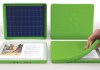
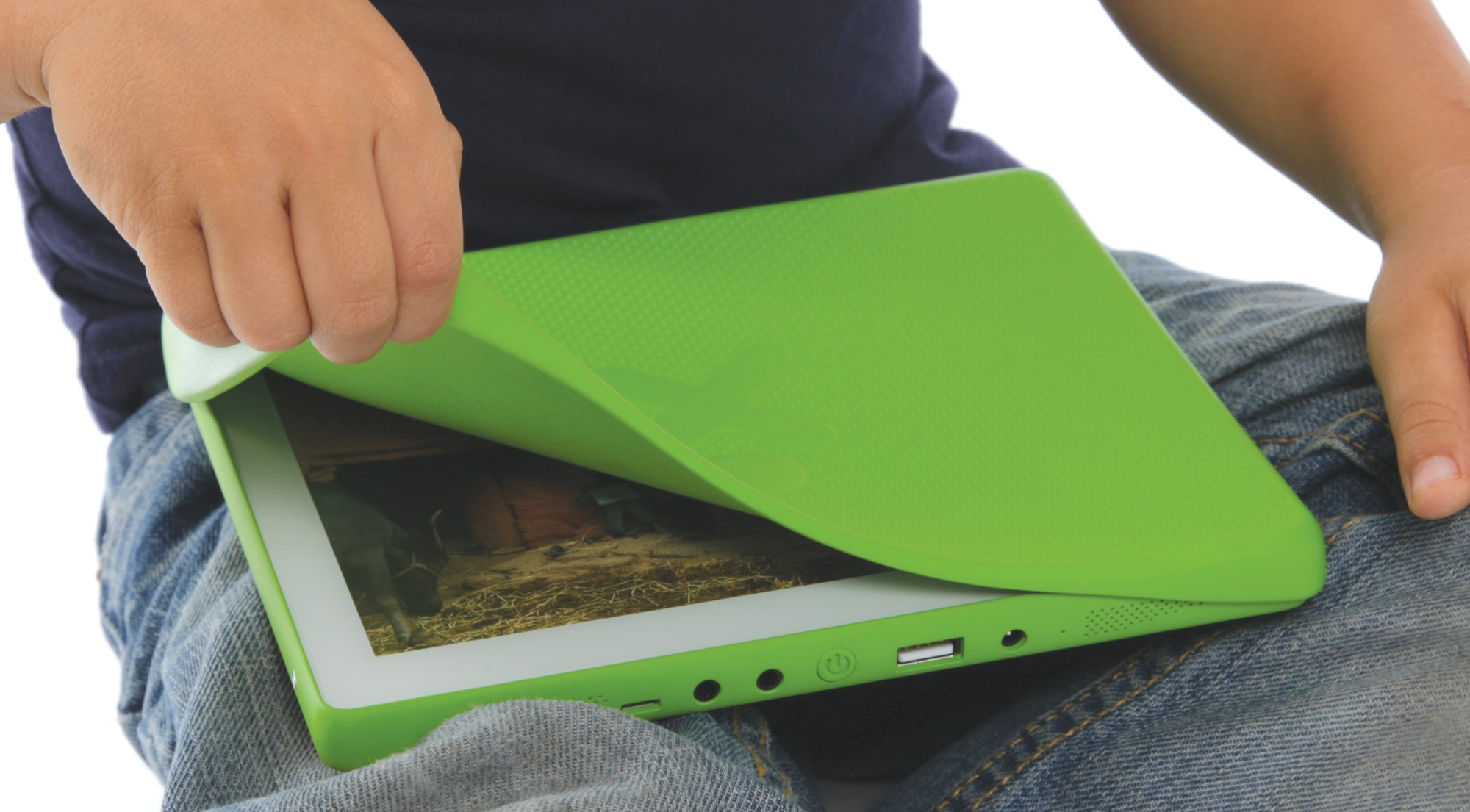
Last night we heard that the One Laptop Per Child program would be showing off its long-awaited XO-3 tablet at CES. We’ll be getting a hands-on then, but they were kind enough to send out a couple pictures of the device this morning, and they seem worth sharing.

As you may recall, the tablet has an 8″ screen, so with that for scale, it looks to be about three quarters of an inch thick. The bright green material appears to be silicone, and the rest of the construction will be plastic. The project’s founder, Nicholas Negroponte, wanted the device to be “indestructible,” and it certainly doesn’t look dainty, but it also doesn’t appear to be waterproof — though the front part could certainly be water-resistant.

The silicone case is nice, and likely produces the indestructibility Negroponte covets. It’s not simply a box-top; you can see in the picture above (high resolution versions below) that one side has a curved cut in it; this will allow the user to choose whether the ports on the top are exposed or protected. Useful for all manner of things, I’m sure. The pattern on it looks like a solar cell, but it seems unlikely that an array of any efficiency could be shipped for as low a price as they’d want.

Lastly there are the ports themselves: power, full-size USB (good for accessories), two ports which are likely audio out and in (or possibly both out, I can see that being a requested feature), and something that looks like a MicroSD slot, though I can’t be sure. There also appears to be a front-facing camera at the top.

We’ll have more info at CES or as OLPC sends it our way.


Scheming Intentions

hell-road

From Vannevar Bush to PageRank, the World Wide Web was built on hypertext, the notion that any morsel of information can link to any other. But that was always only a dream, and a rapidly-dissipating one of late.

Nowadays even Web links are likely to terminate at warnings, paywalls or registration screens. Anil Dash rages that “Facebook is gaslighting the Web” with its treatment of content outside Facebook. Jon Mitchell and Jamie Zawinski complain that Google Plus will “mess up the Internet” for its treatment of content outside Google+ff (and Zawinski adds “they just ripped off this model from Tumblr.”) Google’s Tim Bray, in turn, is irate about single-page “hash-bang” JavaScript sites breaking the web.

Meanwhile, six months ago, according to Flurry, time spent using mobile apps surpassed web consumption. You can link out of apps easily enough — clicking on a phone number to open a dialer, or a hyperlink to open a Web page — but it’s hard to reliably link in to an app.

Oh, the infrastructure is there, as Sarah Perez pointed out last week in “A Web Of Apps.” In theory, Android’s Intents, and Apple’s Custom URL Schemes allow apps to open each other and pass information to one another. But it’s still very difficult and frustrating to use them for inter-app communication.

The main reason for this is that neither Apple or Google publishes the URL schemes / intent filters used by any given app. I find this totally bewildering. They already have all the information: it’s bundled with every App Store / Android Market app submission, in their Info.plist and AndroidManifest.xml files, respectively. All they would need to do is provide a searchable web interface, or add that info in a “For Developers” tab within the App Store or Android Market.

There’s really no reason for them not to do this. Both already maintain app namespaces. Both could easily add “private/public” flags for app developers who don’t want their information published. But they can’t be bothered — so instead we have to rely on haphazard, incomplete, out-of-date third-party sites like Akosma and OneMillionAppSchemes for iOS and OpenIntents for Android. (Bizarrely, Google actually chose OpenIntents for their Summer of Code program last year, rather than just publishing the information they already have.)

If we actually had a reliable source of app intent/scheme bindings, then a whole lot of interesting possibilities would arise. Instead of silently failing when an app tries to call up a recipient app that isn’t installed, the OS could request to download and install it. You could have apps rely on each other, so that downloading and installing one implies automatically downloading and installing its prerequisite building-block sub-apps.

Most of all, you’d be able to reliably link to and from other apps, almost as if they were web sites. It would be so easy to do — yet Apple and Google have both let this possibility languish untouched for years. I’m on record as predicting that HTML5 apps will take over from native apps in a couple years’ time. The ability to link to and from them — in other words, to partially restore the hypertext dream — isn’t the main reason why, but it’s definitely a contributing factor.

Image credit: Sébastien Gelé, Flickr.


WindRiver Brings Overlapping App Windows To Android

windriver2

Android users may soon be able to work with multiple app windows if an Intel-owned company called Wind River has anything to say about it. The company has recently announced they have worked up a way to implement overlapping application windows in Android, and the results look pretty slick.

The multi-window UI is slightly reminiscent of Motorola’s Webtop concept, except without the need to purchase additional hardware to make it work. The revamped app display system is part of what Wind River calls their “User Experience” module, which also include tweaks for super-fast booting. Other software modules in the series include the Connectivity (DLNA and SyncML support) and Medical (support for Bluetooth-enabled medical equipment), and Wind River ultimately hopes to sell them to device vendors for inclusion in their set of Android tweaks.

Quick application switchers like the one baked into Ice Cream Sandwich work well enough for basic multitasking, but I’d love to see this sort of functionality pop up on a tablet sooner rather than later. With tablets quickly taking over certain market niches, a more familiar usage experience could help Android tabs pick up steam among consumers considering ditching full-blown PCs and notebooks for light daily use.

The wait could take a while though — as you could probably tell from the image Wind River provided, the UI looks fine on Cupcake (or whatever version that is), though it’s unknown how much work it’ll take to get it running on more modern Android versions.


Gillmor Gang 01.07.12 (TCTV)

Gillmore Gang test pattern

The Gillmor Gang — Danny Sullivan, Robert Scoble, John Taschek, Kevin Marks, and Steve Gillmor — kicked off the New Year in CES style. That’s CES as in Apple-Free, last Microsoft keynote, All TV all the time, Super Cab Lines Vegas stays in Vegas. Both @dannysullivan and @scobleizer spent a great deal of time handicapping the race for control of what used to be called the TV set.

These days I’m not so sure, as Apple’s AirPlay could just as easily come in a controller-sized package (read iPhone) as a 100-inch box. The real battle is over how to find something decent to watch, and the big question is whether Google will figure out how to get network shows onto its service or if Amazon will embrace and extend Apple TV.

@stevegillmor, @dannysullivan, @scobleizer, @jtaschek, @kevinmarks

Produced and directed by Tina CHase Gillmor @tinagillmor


My Failed Attempt At Making An Appeal For The Wikimedia Foundation

brainwouldntdie

Editor’s note: James Altucher is an investor, programmer, author, and entrepreneur. He is Managing Director of Formula Capital and has written 6 books on investing. His latest book is I Was Blind But Now I See. You can follow him @jaltucher.

I wanted to write an appeal for the Wikimedia foundation. I’m going to be completely honest with you: the only reason I wanted to write it was for completely self-promotional and ego purposes. On almost every Google search, Wikipedia is the #1 or #2 result. It’s almost like Google is just a middleman to Wikipedia.

In my ideal world, for instance, you might search on “head transplants” and then click on the Wikipedia page and see my face on the left hand side with something like, “Click here to donate $5 to my favorite cause”.

Who is that? One would wonder. Why is he now talking to the entire world?  You might forget all about “head transplants” and realize that far more valuable information was a click away if you would just listen to my appeal to humanity for the benefit of the Wikimedia foundation.

How amazing would that promotion be? All for me.  When you are promoting yourself you can’t think of just, “how many SEO impressions can I get?” When the aliens invade 700 years after our apocalypse they won’t care about SEO impressions. They will care about my very personal appeal at the top of 700 million Wikipedia pages. What was this civilization like at it’s peak. Don’t worry, “James Altucher” will tell you. He has an appeal.

Why did I want to promote myself? No reason. Just ego. Ask my therapist. I lacked loved as a child, blah blah blah.

And I figured: they had Jimmy Wales up there. They had some programmer for Wikimedia. They had some random editor. They had the inventor of wikis. So why not me? My daughters use Wikipedia to cheat on their homework every day. And if I ever get sick and they figure out how to hook up the spinal cords to the head I might very well end up with one of these head transplants thanks to what I learned on Wikipedia (search on “Head Transplants”) Although, seriously, I use Wikipedia all day long. Just did a vanity search on my name there, for instance.

So I started with the idea: get massive self-promotion. And then I took the next step: go straight to the top: I wrote Jimmy Wales with the subject: I can help.

I needed to stand out. I came up with the most outlandish way in which $1 contributed to the Wikimedia foundation could help the planet. I imagined a future with Insta-Fi and no separation between our superficial consciousness (“the brain”) and the Internet. And what would Wikipedia look like then? Then I pitched it straight to Jimmy Wales.

(Branson, Wales, Tony Blair, and maybe….me? In the future?)

To my surprise, he wrote back write away. He was either being nice or just wanted to get rid of me. Probably both. But I like that he wrote back. I probably would not have done that if I were him. At the moment I have 146,355 unread emails in my inbox. On April 22, I wrote how I had 105,633 unread emails in my inbox. I’m such a bad responder. Once Wales wrote back, I had a fantasy about hanging out with him and Larry Page on Richard Branson’s yacht. That’s what we all do when we’re not writing emails to each other. (See, “Why are Larry Page and I So Different (or…why didn’t he buy my company”).

Wales wrote back that I should contact Zack Exley who is in charge of the foundation. I kept pushing. I wrote Zack:

“Zack, I’d very much like to make an appeal for the Wikimedia foundation.

[description of who I was – its not important to include here]

I’m aiming eventually for “the wiki-chip” in our brains. We can
already use EEGs to identify letters we are thinking of, to diagnose
depressions, and to give basic commands. I envision a day when we can
“ask” the wiki-chip for information, it will use wimax to look it up
on wikipedia and return the info through the optic nerves connected to
our brain.

All of this will be possible because of every dollar put into the
foundation right now. I spend half my day on Wikipedia and would love
to participate in these appeals. Jimmy Wales suggested I write you.”

Again, to my suprise: he wrote back right away and was very kind about it:

We wrote back and forth a few times after that. He asked what I had in mind.  I suggested that since he had all these editors, inventors, etc make an appeal, why not have an appeal from his biggest user. ME!

Finally, he called me out right on the spot (very politely) and narrowed down to the two issues that were really at stake here: who the hell am I, and, perhaps more crucially from his perspective, was I a seriously mentally ill patient or future patient.

He wrote:

“James –

I’ll definitely consider it if you send us an appeal! But I think it might just be too random — in the sense that a lot of people would ask: Why him? Are they trying to promote him?

We did do a reader/donor appeal this year — a software developer from a small city in India who left us a nice note when she donated.

I’m afriad that most people would read it like wacky science fiction — and the Wikimedia fundraiser just isn’t the forum for changing people’s minds about what the future’s going to look like.

Have you written about this sort of thing in your columns? Point me there and I’ll be able to see what language you’re using and think about whether it might fit in an appeal.

Best,

Zack

Clearly, he is pushing me off further. But I can’t stop. Woody Allen says the key to success is “showing up”. I wanted to show up to a manned space  mission to Mars but I have glasses so they will never send me there. But here was something within my grasp. I pushed back again and actually wrote the appeal and sent to him. Here’s what I wrote:

“Two years ago there was the argument that Wikipedia was not as accurate as more traditional (text-based with editors) encyclopedias. That argument is over and Wikipedia won.

One year ago there was the argument that the Internet was making us more stupid. The other day my nine year old daughter was explaining the evolution of different sea-based species that eventually evolved into humans. I asked her where she learned this information since I had no idea. She said, “I read it on Wikipedia”. So my nine year old made me smarter. Wikipedia made her smarter. And will continue to do so for the rest of her life.

Let’s engage in a small fantasy that’s not so far-fetched. What will the argument be ten years from now? Perhaps twenty years from now? Science can already do non-invasive brain scans to determine what letter you are thinking. Science can already do non-invasive brain scans to allow quadriplegics to command exo-skeleton structures that allow them to perform basic functions they could not otherwise perform. That’s today. What’s tomorrow? A non-invasive way to make a thought query into Wikipedia via some wimax network. A response that gets communicated back to the brain. A way to receive through sight or sound or memory the answer to your request.

Will $5 get there? Will $1 million? Of course not. This is the future. This is the future of our intelligence. This is the future of our evolution as ideas continue to mate rapidly, as generation after generation of humans seek to improve themselves. I may not be alive to see the results of this fantasy. But I bet my nine year old will be. And her eventual descendants. Will $5 get there? No.

But it’s a start.

Who Am I?

I’m not an editor of 1000s of wikipedia articles. I’m not the inventor of the wiki. I’m not a programmer of it. But I’ve been a reader of 10,000+ Wikipedia articles. I’ve plagiarized hundreds of articles straight from Wikipedia. And I’m better for it. And so are the readers of my articles. And so are my children. “

Damn, I thought for sure that would get me in the door. And note: I’m not fooling anyone. I believe what I wrote.  But I was 100% doing it for self-promotional and ego purposes.

But then today I arrived at Wikipedia and there was a note at the top from Sue Gardner, Executive Director of the Wikimedia foundation, thanking everyone on the planet because Wikimedia made their financial goals. So my dreams are dashed.

I missed out on getting my appeal in there. This year. I failed. But a failure is only a failure if you don’t learn anything from it.

Lessons learned:

  1. Failure is ok. I tried. I learned something new in the process.
  2. Go direct for the decision makers so you don’t waste any time.
  3. Use your brain. I had to come up with an idea to make me stand out. Maybe it didn’t work this time but if I try 30 times in a row, something will stand out.
  4. Use your brain, part II. The idea muscle is like any other muscle. It needs exercise or it atrophies. Take out a waiter pad and a pen, go to your closest cafe, and come up with ten ideas that will make the world better one year from now. Even better: ten ideas you can do. Even better: ten ideas you can do with the tools available to you today, at your business, on your computer, whatever.
  5. Use your brain, part III. Like any exercise, you don’t get the “burn” unless you sweat. Sweat a little. You just made the list above. Now what are the ten next steps. List them.
  6. Now do it. Make sure you can execute on your ideas. Else they are bad ideas. Then do them TODAY. Then tomorrow, repeat. I’m onto my next thing. No harm. No foul.
  7. It didn’t take that much time. It forced me to exercise my brain in unusual ways. It forced me to exercise my networking muscle. And if my devious, world-dominating plan had worked, it would have had great results. For me. if not for the Wikimedia Foundation. If not the entire planet! Why do I want to promote myself? For no reason at all. Just for fun. But who can argue with that?
  8. Repurpose. I made a TechCrunch article out of it. BAM!

Some sources from Wikipedia used in this article:

See Also: “The ONE way to achieve your New Year’s Resolutions”)

And “How to Have a Big Idea”


Engineering Serendipity

serendipity_001

Editor’s note: Guest contributor Catherine Cook is the co-founder of MyYearbook, a social network for meeting new people.

When John Cusack and Kate Beckinsale reach for the same pair of black gloves in the movie Serendipity, they meet and fall in love.  The goal of social discovery applications is to engineer this kind of serendipity. By leveraging demographic and interest data, and by providing good reasons to interact with strangers, this emerging category seeks to make meeting people feel fun and natural.

And it’s not just about dating.  Most people I know I met through serendipitous encounters.  Whether it’s the friend I bumped into at the college bookstore as a confused freshman or the boyfriend I met at the coffee shop, most human relationships start the same way – in a serendipitous moment.

But not a random moment. I wasn’t waiting in a random line in a random store in a random city; I was waiting in my college bookstore, surrounded by people in close proximity with shared ambitions and life stages. Even at the coffee shop, it’s not a random cross-section of society that caffeinates there each day, but a group of people particular to the location and environment of Georgetown. Social discovery apps spend much of their time focused on this problem: how to infuse apparently “random” online interactions with the sort of affinity that leads to connection—not unlike a good mutual friend who enjoys playing matchmaker.

Yet there has traditionally been a distinction between meeting people online and doing so offline: intention. We tend not to wake up one morning and say, “I’m going to meet a friend today.” Sure, you need to be open to friendship to find it, and it helps to be in places where you might meet someone (malls, bars, casual sports, and so on), but you don’t start every conversation with “Do you want to be my friend?” The key for social discovery apps is to mirror those offline meeting places by providing an experience that’s still fun on the days when the serendipity part just isn’t happening.

Let’s face it: picking someone out of a list feels less than magical, yet that’s where online social discovery has traditionally been stuck. Whoever can make it feel as natural as grabbing a coffee, hanging out at the bar, or wasting time in the mall is going to win the race for leadership of what I believe will be a very big category. And there’s no shortage of contenders, from more established players like Badoo and Tagged to extremely interesting venture-backed services like Banjo and Shaker. My own company, MyYearbook, is also competing for the same prize (so I am completely biased, but I am also a complete believer in these trends).

How big could this prize be? Everyone in the world has a desire for friendship, especially as teens and young adults when so many long-lasting relationships begin. It is inconceivable to me that there will not be the mobile equivalent of the mall or the coffeehouse, that there won’t be a dominant meeting place that will intelligently take into account location, interests, and every other available cue to make serendipity happen.

What is at stake is nothing less than the future of meeting new people—of how people discover one another and make relationships in a world where mobile devices behave like extensions of the human body. How do you create a social graph not of the people you know, but of the people you want to know? How do you make meeting people fun, at scale, for everyone? How do you make all that serendipity stuff just happen? These are the challenges we face, because as friendships themselves increasingly migrate online, we think it’s only natural that friendship-making will too.


4SquareAnd7YearsAgo Becomes Timehop, Takes You A Year Back In Time Through Online Content

Screen Shot 2012-01-06 at 7.49.40 PM

4SquareAnd7YearsAgo, that emailed you your Foursquare checkins from exactly a year ago, has branched out beyond Foursquare. Now the service, newly re-monikered Timehop, includes your Facebook status updates, photos you updated, photos you were tagged in, as well as Twitter and Instagram posts from 365 days past.

The tech industry is starting to see a resurgence of products that play into social media nostalgia; Facebook Timeline, Memento and Memolane for example. “Everybody is starting to realize that there’s value in the past,” Timehop co-founder Jonathan Wegener tells me. He hopes that the startup will one day be the “ultimate” way people experience their content history online, despite the tight constraint of only showing anniversary content — which Wegener likens to Twitter’s “140 characters.”

In fact, when I covered 4SquareAnd SevenYearsAgo last year, I specifically told Wegener that he should let people search through all their past content. “Sometimes less is more,” he says about limiting the product, which expanded to including Facebook at the TC Disrupt Hackathon in May.

Wegener’s future plans for Timehop include expanding to other services, allowing people to share content more easily and supporting collaborative “history writing,” which would also include simultaneous content shared by friends.

“Its oftentimes the things that we don’t think twice about that are very powerful in retrospect,” says Wegener, “Everything is more emotional when it’s in the past.”


OLPC XO-3 Tablet To Be Shown At CES

xo3

After years in the making, the One Laptop Per Child program’s XO-3 tablet will be shown in more or less final form next week at CES, according to the project’s founder, Nicholas Negroponte. The latest image of the tablet is shown here, though it is from some time back and may no longer be representative.

The price of the tablet will in fact be under $100, he said, though various options will put it over that. It has an 8-inch screen — traditional LCD, though it may be upgraded to a Pixel Qi display for power savings and e-paper-like capability. If they stuck to their original specifications, it will also be waterproof, durable, and about a quarter of an inch thick. The version they’re showing will run Android, though what version was not specified.

Solar panels, hand cranks, a bigger battery, and other accessories will be available, though no pricing has been given. It’s also unclear whether the device will be offered a la carte via retail, or will be limited to bulk purchases.

The tablet comes on the heels of the news that India’s own mass-market tablet, the Aakash, has garnered serious interest, selling thousands and producing interest potentially in the millions of units. The OLPC device will be more expensive, but I feel justified in saying it will likely be of a higher quality as well, though the future of the Aakash and tablets like it is in flux and both are totally incomparable to commercial tablets like the iPad.

Negroponte also said that they would be conducting a long-term experiment using the devices, collecting reading data from youths age 3-8 in India, Tanzania, and Sierra Leone. Apparently the tablets come with a reading platform that records audio and video and adapts its lessons to the needs of the children. Negroponte described it as possibly “the most important thing I have ever done… if it works.” Whether this is related to his plan to airdrop the devices onto remote regions was not made clear.

Needless to say, our team at CES will be seeking out the device and Negroponte himself if he is present. Watch our CES 2012 page for more information next week.