Patent Troll Buys ADAPTIX (And Its 4G Technology Patents) For $160M

adaptix

The 4G wireless technology space is heating up, so expect vultures.

Acacia Research Corporation, a massive patent holding group with dozens of subsidiaries in the business of exploiting intellectual property by means of lawsuits and aggressive patent licensing schemes, this morning announced that it has acquired ADAPTIX, a 4G wireless technology company that originally started out in 2000 under the name Broadstorm and was owned by PE firm Baker Capital.

Acacia Research is paying $160 million for the company, which has $10 million in cash, primarily to obtain ADAPTIX’ portfolio of 230 issued and pending patents in 13 countries.

The patents in question are said to cover a broad range of 4G technologies, including OFDMA and MIMO.

Guess what’s going to happen next.


Cupidtino, The Dating Site For Apple Fans, Releases iPhone App

ifangirl

It was with a strange mix of amusement and horror that I learned about the existence of an online dating service specifically for Apple fanboys and girls almost two years ago.

But, Cupidtino is still around, and last night they quietly debuted an iPhone application to complement their dating website. You have to wonder what took them so long, but at least they’re in time for next Valentine’s Day.

The application, which you can download here, is free and pitched as a “Mac-inspired dating app designed exclusively for fans of Apple products”. It lets users search and browse profiles, send ‘heartbeats’ to members that intrigue them, and more.

Users can upgrade their membership via in-app purchase for $4.99 per month, to read unlimited messages and chat with other Apple fans.

According to the FAQ on its website, Cupidtino has attracted some 30,000 members interested in dating another Apple fan so far (provided they regularly update this number).

From the app description on iTunes:

Why?

Diehard Mac & Apple fans often have a lot in common – personalities, creative professions, a similar sense of style and aesthetics, taste, and a love for technology. We believe these are enough fundamental reasons for two people to meet and fall in love, and so we created the first Mac-inspired dating app to help you find other Machearts around you.

Cupidtino is like a neighborhood café where the people are hip, decor is classy, conversation is intelligent and prices are reasonable. But it’s open at your convenience, folks are from around the world, and it’s less awkward to talk to someone.

You’ll forgive me for cringing a little when I read that.


Facing Another PR Disaster: Google Accused Of Fraudulently Undermining A Kenyan Startup

moca

Google, what were you thinking?, asks Kenyan startup Mocality, which operates the country’s largest online business directory. Mocality is accusing Google of knowingly engaging in fraudulent behavior to undermine their business and grow theirs, after careful monitoring of Internet traffic and a successful sting operation turned up some very interesting results.

You should read Mocality’s blog post about the situation in full, but here’s the gist. Basically, Mocality built up a sizeable directory of roughly 100,000 Kenyan businesses over the years, by crowdsourcing information and helping organizations advertise themselves on the Web.

Not long after Google helped kickstart a program to get Kenyan businesses online, the startup suddenly started fielding calls from Kenyan business owners with questions about a supposed partnership / joint-venture Mocality had set up with the Internet search and advertising giant.

The number of calls steadily rose, Mocality got suspicious, and the company decided to set up a traffic monitoring system, combined with a smart sting operation, to see where they were coming from. Turns out it was apparently Google doing the exact opposite of “no evil”.

At the start of December we analysed our server logs to look for a common pattern for the businesses that had contacted us with these confused calls. We found a single IP/ User-Agent combination that had accessed all these businesses.

So a person or (judging by the access rate) team of people were systematically accessing our database, during office hours, and it looked like they moved into a new office over the weekend at the start of November. But who were they, and what were they doing?

We decided to find out. We made some changes to the site:

– For visitors from the 41.203.221.138 address, we changed the code to serve slightly different content 10% of the time.

– Instead of the real business phone number, we served a number that fed through to our call centre team, where the incoming calls would also be recorded. Our team were briefed to act like the business owners for the calls.

We switched the new code on December 21st. When we listened to the calls, we were beyond astonished.

Google Kenya employees were apparently calling up businesses they found on Mocality, trying to get them to sign up for a competing product by lying about a partnership with Mocality that was supposedly in place, and spreading misinformation about Mocality’s business model.

Serious stuff.

On all calls, the same script is followed – A Google Kenya employee calls a Mocality business and tries to deceive them into signing up for their competing product, by claiming that we are working together.

It gets worse: Here’s a complete transcript ( with translation of the kiSwahili portions) of a another call, in which the caller goes further, claiming that Mocality engages in bait-and-switch practices to try and charge businesses upto Ksh. 20,000 ($200) for their listings. Mocality has never and will never charge for listings.

Links to the redacted calls and transcripts can be found in Mocality’s blog post.

According to the startup, about 30 percent of businesses in its database had been contacted by Google Kenya employees (and even by Indian call centre employees working for Google).

When we started this investigation, I thought that we’d catch a rogue call-centre employee, point out to Google that they were violating our Terms and conditions (sections 9.12 and 9.17, amongst others), someone would get a slap on the wrist, and life would continue.

I did not expect to find a human-powered, systematic, months-long, fraudulent (falsely claiming to be collaborating with us, and worse) attempt to undermine our business, being perpetrated from call centres on 2 continents.

And once again, Google has quite some explaining to do. We’ve contacted the company and are anxiously awaiting their response to Mocality’s grave accusations.

Update: Google says it is currently investigating the allegations and will respond ASAP.


Hate When Companies Don’t Provide Feedback On Job Applications? StartWire Is For You.

Screen shot 2012-01-12 at 9.45.04 PM

If you’ve ever been on the job search, you know how frustrating and time consuming it is to manage the process. (If not, just ask one of the more than 13 million people in the U.S. currently there.) You spend untold hours filling out the right forms and fields, adding more action verbs to your resume, etc., and you fire off the application. Then comes the infuriation: Your prospective employer doesn’t respond, so you send a follow-up. Nothing. And another follow-up. Still nothing.

Job searchers absolutely hate this — the so-called resume (or application) black hole. While larger companies may be able to afford a few bruised egos, in the end, this deficiency frustrates potential employees — an customers. It can damage your company’s reputation and make you an enemy. It’s not as if job searchers expect the red carpet to be rolled out after every application submitted, all people want is a response or an update. “Thanks, we’re reviewing now. May take a few days,” or “Thanks, but we hired your wife.” Fair enough. People move on.

This is the primary pain point a young startup called StartWire is trying to solve. There are plenty of job search engines, recruitment vehicles and so on out there on the Web. So, while the startup does assist in job discovery by allowing you to connect your social network accounts (like LinkedIn, Facebook) and serves you targeted recommendations based on who you know, what companies you’ve applied to, etc., that’s just part of the story.

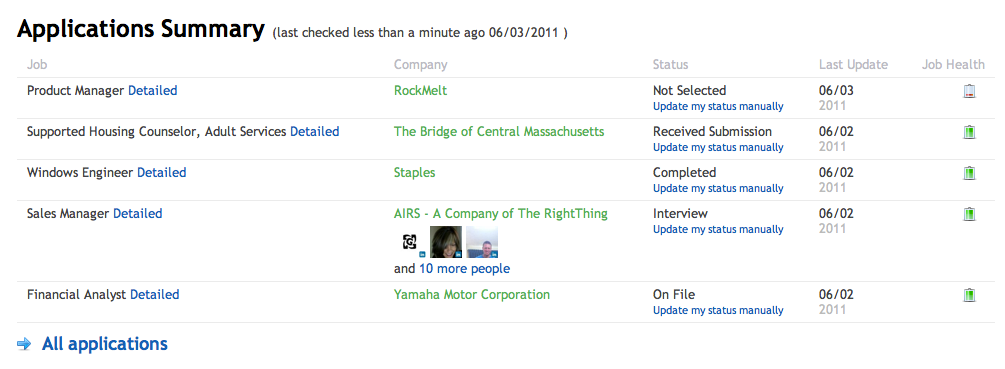
The real value proposition of StartWire lies in its being a project management tool for the job search process. You can use the service without ever actually applying to a job through the site. While most job search sites focus on discovery, StartWire wants to keep you organized and make sure that you’re receiving automatic updates on all of your applications.

The startup provides users with these status updates from over 5,400+ companies, automating the connection between the company’s site and StartWire, so that any change made by the company automatically populates in the user’s account. Users’ updates are private and never shared.

For companies, the service is free and they don’t have to do anything differently than what they’re doing right now, so it’s a no brainer. For job seekers, they can either automate status updates by tracking the application through StartWire, or they can forward the confirmation email to [email protected].

This too is free, and works with any company job searchers apply to, even if you applied through other websites — all you have to do is give permission for the service to track your applications. If companies don’t provide online status updates, searchers can do so manually on the site. StartWire then organizes all of your applications in one place, labeling each as “active”, “stalled”, or “no longer in the running”, sending you updates in daily emails or texts.

StartWire Founder Chris Forman tells us that companies are encouraged to give more feedback to applicants than just “job no longer available”, but that it’s not mandated. This brings up the recent study StartWire released on what most irks job searchers about the process. Unsurprisingly, not responding to a job candidate has serious potential harm for companies’ reputations. The study found that 77 percent of job seekers think less of a company that doesn’t respond to a job application, while 72 percent of respondents said they would be less likely to recommend companies’ products or services or write a positive review online.

Obviously, this is one of the biggest causes of anxiety when searching for jobs. Of those polled, 90 percent said that getting feedback on their applications would make the overall process less frustrating. And certainly, it’s not for lack of trying, as the study found that 90 percent of job seekers follow up with potential employers on their status, while only 33 percent of Fortune 500 companies provide feedback through their application system.

It’s difficult to stress enough how big of a problem this is, and how companies are potentially doing irreperable damage to their reputation by not doing something that should be very easy to do, just by automating.

As for StartWire, the startup launched in early 2011 and had attracted 50,000+ registered users by January 1st of this year. Foreman says that the company is currently on pace to double that number by the end of the month.

As it’s operating as a free service, you might be wondering how StartWire is making money. Like many travel and job sites before it, StartWire is a lead generator for job boards and consumer advertisers. Based on a user’s profile, resume, and job search activity, StartWire recommends job sites and offers that it deems relevant to its users, taking a cut if visitors turn into paying customers.

It also doesn’t hurt that the New Hampsire(!)-based company is backed by $4 million in venture capital, from a $750K round of seed in late 2010, and a $3.25 million series A round led by Baird Venture Parnters in October of last year.

For more, check out the startup’s webinars here.


Fujitsu Japan Rolls Out 2 “Girls-Only” Cell Phones

fujitsu featured

Do women need special cell phones? Certain companies, such as Deutsche Telekom or Samsung, seem to think so. Now Fujitsu Japan is ready to roll out [JP] not one but two handsets specifically designed “for girls”, a feature phone and an Android model.

The Android phone, the so-called F-03D Girls’, has been developed in cooperation with popular teenage fashion magazine Popteen:

It comes with a waterproof body, special lights at the bottom and around the camera (see below), pre-installed (and extra-cute) photo frames, and pre-installed apps specifically designed for a female user base.

Technically, the F-03D Girls’ features Android 2.3, a 3.7-inch LCD with 480×800 resolution, 1GB ROM, 512MB RAM, an MSM8255 1.4GHz processor, an 8MP CMOS camera, Wi-Fi IEEE802.11b/g/n, 2.1+EDR Bluetooth, a TV tuner, an e-wallet function, and a microSDHC card slot.

The F-06D Girls’ is one of the very few new feature phones that are coming out in Japan. Fujitsu designed the handset with nicola, another teenage fashion magazine:

Buyers get an original tote bag, a stylus pen (the phone has a 3.3-inch touch display) to decorate pictures (see above), an 8MP camera, various nicola wallpapers, 39 different photo frames, and a total of 3,010 pre-installed emoji for cuter emails. Like its Android counterpart, the F-06D Girls’ is waterproof.

Japanese mobile carrier NTT Docomo plans to start offering both Fujitsu phones on January 20.


Ron Conway, Mayor Lee And Heather Harde Launch sfCITI, Want To Keep SF At The Forefront Of Tech

Screen Shot 2012-01-12 at 9.21.30 PM

At a press conference tomorrow at San Francisco’s Founders Den, newly elected Mayor Ed Lee will be announcing sfCITI (San Francisco Citizens Initiative for Technology & Innovation), a set of tech initiatives spearheaded by investor Ron Conway, Mayor Ed Lee and TechCrunch’s beloved Heather Harde and contributed to by a series of tech industry partners, including TechCrunch.

Harde will be taking on the (voluntary) role of Executive Vice Chairman of sfCITI and newly hired SF Chief Innovation officer Jay Nath will serve as a liaison between tech companies, the committee and the SF city government. Alongside its mission of tech community support, sfCITI will be working with Code for America to build a civic-minded startup accelerator, funded by Google and the Kaufman foundation.

So why all the love San Francisco? One word, jobs. Okay, also, money.

“Last year with our Mid-Market payroll tax and stock option exemptions, as well as during my campaign and our administration’s priorities, we have worked hard to attract and recruit high-tech companies and jobs to San Francisco,” said Lee in a statement, understating the tens of thousands of jobs the tech boom will inevitably bring to whichever cities choose to embrace it, “Technology companies are key to our city’s economic future and a critical part of making San Francisco the innovation capital of the world.”

Conway told me earlier today that while sfCITI hopes to serve as civic leader in all things tech (including issues like payroll taxes and zoning laws), the committee’s main priority right now is hiring. Towards this goal, sfCITI wants to both place and train competent programmers in addition to further utilizing and streamlining the HireSF website, allowing partner companies who want to hire to easily find people looking for jobs.

According to sfCITI’s stats, San Francisco currently houses over 1,500 tech companies and the industry employs more than 30,000 people.  That’s a formidable chunk of the workforce in a city with an 800K population.

Perhaps this explains why throughout his campaign and even when he served as interim mayor, Lee has always been unabashedly pro-tech sector, “Job training and placement initiatives, helping bring innovation into government and of course, job-friendly policies like payroll tax reform and building more housing, this is an agenda I support,” Lee said.

sfCITI is the most recent spark of mayoral love for the technology industry, on par with Bloomberg pledging to learn to code and Gilbert Wong letting Steve Jobs park a spaceship in Cupertino’s backyard.

sf.citi partner companies include:

6waves, Lolapps, Academy of Art University, Adku, AdRoll, Airbnb, Airtime, Beautylish, Benchmark, Bebo, Boku Blissmo, Branchout.com, Chomp, Climate, Corp Code For America, Daily Booth, Dropbox, Eventbrite, Federated Media Publishing, Inc., Fliptop, Founder’s Den, Foursquare, Getaround, Github, Google, Greplin, Headsets.com, Inc., Hipmunk, Jawbone, Justin.tv/Twitch.tv, Kiip, KiISSmetrics, Marin Software, Milk, MonkeyInferno.com, MoPub, Oracle, Pac 12 Enterprises, Pago, Path.com, Pontiflex, Portal-A, Posterous, Inc., Ready for Zero, Relevvant, Rentcycle, Retargeter, Riverbed, Salesforce, ShareThrough, Snapfish, Soundcloud, Spool, Square, Sugar Media, Tagged, TechCrunch, Thumbtack, Trigger.io, Trulia, TurnHere, Inc., Twitter, Udemy, Weebly, Wide Orbit, Xobni, Zecco Zendesk, and Zynga.


Anthony Ha Joins TechCrunch

Anthony Ha

Blogging is still a relatively young part of the media industry. But already there are a cadre of professional reporters who cut their teeth blogging, who are used to the pace and get an adrenaline rush from covering events as they unfold. Anthony Ha is one of them, and I am very pleased to announce that he will be joining the TechCrunch writing staff next week in San Francisco.

Anthony (pictured here writing furiously at a conference) comes to us from AdWeek, where he is currently a staff technology writer. Before that was one of the most prolific bloggers at VentureBeat, which is where I first noticed him. (Another one of our recent hires, Eric Eldon, also hails from there).

Anthony will be covering media in its many forms, and particularly the transformation of traditional media by new technologies. He’ll bring more stories to TechCrunch about both media startups broadly defined and the media industry, as well as online advertising (one of the great engines of the internet). And like the rest of the TechCrunch writing crew, he will cover general news and write about whatever the hell he wants. Please give him a hearty TechCrunch welcome.

(And, yes, we are still hiring more great writers).


Pitch Now: Intel Awarding Young Entrepreneurs With $100K For Whizbang Business Ideas

Screen shot 2012-01-12 at 7.16.35 PM

Intel knows a thing or two about technology and innovation. Hey, that’s why they hired Will.i.am as “director of creative innovation”. (Wink.) Really, in the same way that it’s catalyzed change in the computing industry (and helped bring modern microprocessing to life), in December Intel launched a platform designed to give young entrepreneurs the opportunity to bring their own innovative ideas to life.

Thus, the company launched “Intel Innovators” to be two things: First, it’s a platform built on top of Intel’s Facebook community that allows young entrepreneurs (specifically, 18 to 24-year-olds) in the U.S. to share their business ideas, grow a fanbase, and receive realtime feedback. Second, it’s essentially a pop-up accelerator — a program that offers $100,000 each month to the best ideas to come out of its Facebook community.

Finalists each month receive some cool Intel schwag (like Ultrabooks, etc.), and winners get Venture Lab training from the National Collegiate Inventors and Innovators Alliance (NCIIA). Not bad.

The program began taking submissions in November, launched its platform on December 1st, and Intel plans to run the program for three months, with rounds of judging and prizes at the end of each month. (The deadline for submitting ideas for the third round is January 16.) If Intel Innovators gets enough traction, it will likely be rolled out internationally later this year. And thus far the activity on its platform has been impressive, as the team told us that they’ve received hundreds of “high-quality” ideas for each round and have seen “hundreds of thousands of visits” to its Facebook platform over the last month.

So how does it works? Basically, young entrepreneurs can head over to the Facebook app, where they can submit their ideas for startups. Once approved, they enter the big pool. A selection committee (made up of professors, executives, and entrepreneurs) selects the 20 best ideas. Fans and entrepreneurs are given social capital (points) that they can invest in their favorite ideas.

The five that receive the most capital move onto the final round, where they do a live pitch to a panel of four judges (Chief Financial Officer of betaworks Joshua D. Auerbach, Managing Director Intel Capital’s Consumer Internet Sector Mike Buckley, SV Angel’s Topher Conway, and Collaborative Fund’s Craig Shapiro), who award their favorite idea with $50K. The top fan then gets to give the other $50K to their favorite finalist.

Interested in what kind of ideas the crowd favors? December’s winners included Alex Adelman, a 22 year-old from North Carolina for “Cosmic Cart”, a product tagging system that allows users to buy merchandise from any video online. And the second winner (chosen by the panelists) was 24-year-old Virgil Hare from Detroit for LoginWill, a social networking website where people can designate beneficiaries to receive all of their online login information in the event that they pass away. (More here.)

It’s a great program, although it does seem like they didn’t have to include the 18 to 24 age restriction. What about the rest of us? According to Intel, it’s illegal to award financial prizes to people under 18, so there’s that, and, really, they want to tap into tap into college-aged entrepreneurs — to help the young Mark Zuckerbergs of the world take a step forward. (And, hey, Mike would probably agree with the age cap, too.)

While I might balk at that suggestion, it’s hard to argue against giving young entrepreneurs a resource to bounce their ideas off each other and cash to jumpstart their business. Intel has always claimed it’s all about fueling innovation, and programs like this, its Global Challenge at UC Berkeley, and the AppUp Fund show Intel wants to put its money where its mouth is.

Entrepreneurs and their startups are, really, the engine of job creation. In the U.S., companies less than five years old created 44 million jobs over the last three decades and, over that time, accounted for all net new jobs created in the U.S. — this according to the White House.

What’s more, for a stagnant economy, keeping technology and manufacturing jobs in the U.S. is a must, and Intel is doing its part to help create them, and keep them here.

But now I want to see them turn Intel Innovators into a full-blown accelerator. The more, the better.

And for the young entrepreneurs reading, now is the time to submit your idea for a shot at $100K, as the program is currently accepting submissions for the next round — and is doing so until 12 p.m. EST on January 16. Check it out here.


MySpace Isn’t Dead In The US, It’s Just Getting Closer To Zero Users… As Twitter, G+ Grow

Screen Shot 2012-01-12 at 6.05.19 PM

If you look at just one month of data, you’ll see that Myspace still has users. That’s the good news for the aging social network. The bad news is that it has kept losing them through its many executive changes, redesigns and the recent acquisition by Specific Media and Justin Timberlake. Maybe that new plan to do something with TV will turn things around?

Anyway, the latest US numbers from comScore are out now, for December, and here’s how MySpace stacks up against its many rivals.

Facebook is continuing to lead, by far, as it has for a long time. It has 162 million monthly unique visitors, which is down from 166 million in November. Yes, that’s a drop. But don’t freak out and try to equate this with “Facebook dying.” It has had seasonal fluctuations over the years that it has kept on growing through. Also, it’s hard to keep growing when you already have most of the online population on your site. If anything, expect Facebook to have slower or flattish monthly numbers from now on in the US and other mature markets. The graph above excludes Facebook because it’s so much bigger than everyone else that it hides the other details; the one below includes it.

Twitter, meanwhile, grew by about 2 million new people to 37.5 million uniques, keeping rough pace with what it has been doing over most months since April. LinkedIn is on a bit of a decline after plateauing sometime in August, down a little under 1.5 million from November to 33.5 million uniques.

Back to MySpace. It dropped by almost a million users between November and December, to around 24 million uniques. This is less than half of the 50 million it had a year ago, and part of an even longer term decline. Reminds me of the sketch from Monty Python’s Holy Grail. “I’m not dead yet!”

What about Google’s big new, heavily promoted social network, G+? It has gone from 15.9 million uniques in November to 20.6 million last month. ComScore’s December worldwide numbers aren’t out yet, but going by the November ones, G+ seems to be on the up and up everywhere.

Finally, as always, here’s your caveat that even though comScore is generally considered to be the most reliable third-party measurement service out there, it’s not perfect. So these numbers may not be 100% right. Okay, now for some Monty Python.


Survey: 80% Say Social Networks Had No Influence On Holiday Shopping Decisions

Dislike Ecommerce

Social networks could one day revolutionize how we get shopping recommendations, but not yet. Instead, tablets are causing the biggest shakeup in ecommerce. 80.2% of 1000 holiday shoppers said no, personal connections on Facebook or another social networking site did not influence their shopping decisions. Other findings of Baynote‘s annual study include that 48.6% of tablet owners made a purchase through their big mobile device, and that email was the channel with the most useful promotions.

Baynote’s entire 2011 holiday shopping survey of 1,000 shoppers between Cyber Monday and Christmas Eve (2.9% margin of error) is available in exchange for an email address. Baynote provides ecommerce personalization services to companies including Dell, AT&T, and StubHub. It’s technology compares a site visitor’s browsing patterns to those of other shoppers to power recommendations of relevant products to view next.

[Update: I’d bet most people are at least subtly swayed by social networks in terms of what products they’re aware of and trust. Humans are not entirely accurate when reporting their own behavior in surveys. Respondents may have been subconsciously influenced when making product decisions.

Even so, this survey illustrates that the majority of shoppers are not yet overtly influenced by social networks.The survey could also be interpreted to mean that already 20% of shoppers are directly influenced to make a purchase because of sites like Facebook. That is a significant number and indicates that a strong social media presence that drives positive word of mouth can help a retailer’s business.]

Amazon’s Price Check app recently stoked fears about “show rooming” — the practice of trying out a product in a brick & mortar store but then purchasing it online, which can hurt local merchants. However, Baynote found the opposite is usually the case with 93% of surveyed consumers having researched a product online and then purchased in a physical store.

Retailers on and offline that want to reach consumers with promotions should focus on email. 62.5% of respondents said email was the most useful way to receive promotions, trouncing direct mail (16.7%), search engine results (11.8%), and daily deals (4.9%). Only 2.5% said Facebook was the most useful promotion channel. This indicates there is plenty of room for innovation in social network delivery systems for promotions, such as Facebook Page tab apps, ads, and Sponsored Stories.

The breakout success of this year’s holiday shopping season was the tablet. Half of tablet owners purchased using them, meaning 8% of all consumers are now tablet-based shoppers. Retailers should therefore be thinking about how to optimize for that screen size.


Urban Airship To Shutter SimpleGeo Services In March, With Factual Picking Up The Slack

47529v7-max-250x250 (1)

Yesterday, we wrote about Urban Airship, the startup that gives developers a simple way to build in-app purchases and push notifications into their mobile apps, and how the company has been on a tear of late. They recently hired Skype’s former strategy czar and yesterday hit 10 billion notifications pushed. Not bad for a two-year-old.

On top of that, Urban Airship acquired SimpleGeo at the end of October for approximately $3.5 million. Considering that the two startups had some months before struck a strategic partnership, and both provide location-based services for mobile developers, the acquisition made sense, even if the price was lower than many had hoped. (And SimpleGeo Co-founder Joe Stump left the company post-acquisition, following Co-founder Matt Galligan.)

At the time, it was unclear what Urban Airship would be doing with the terabyte-plus of SimpleGeo location data. Today, that became clear. Simply put, it looks like it’s curtains for SimpleGeo’s services. Urban Airship said this afternoon, after the requisite internal discussions, talks with customers, and hand-wringing, that it will “wind down the availability of the current versions of [SimpleGeo’s] Places, Context, and Storage over the next few months”.

The target date for pulling the plug officially will be March 31st. Obviously, this is not good news for SimpleGeo’s customers, so in order to make sure its customers aren’t left out in the cold, the company said that Factual will be picking up the slack. The LA-based startup will be migrating developers over to its service, as the company offers its own API with location information, similar to that which was provided by SimpleGeo. A loss for SimpleGeo means a win for Factual.

Factual has been providing SimpleGeo with their Places data since June 2011, so Urban Airship hopes that it will be able to facilitate a smooth transition to Factual’s API to continue with access to that data. Urban Airship is also offering customers an additional list of replacement services here.

Furthermore, the startup will not be charging for use of Places, Context, or Storage services through March 31st, and will be offering existing SimpleGeo customers up to six months of its Pro Plan for no monthly charge. (More here.) Smacks of a bit of guilt, doesn’t it?

Urban Airship said that it is basically determined to focus on its product development efforts, which means that it will be taking the best parts of SimpleGeo to beef up the location and context capabilities of its push notifications, while the rest is for all intents and purposes kaput. This wasn’t unforeseen considering the departures from the company post-acquisition, but it’s probably not what the SimpleGeo founders had in mind a year ago.

For more, here’s Urban Airship’s blog post.


CES: A Wonderful Example Of Not Knowing When To Stop

CES

From a great distance, a massive waterfall is a beautiful thing. From a lesser distance, it’s deafening. Directly beneath it, it’ll crush your bones to salt.

Each year, we make our voyage through the waterfall that is CES. Each year, the noise gets a bit louder, the water a bit more torrential. This year is the first in which I’ve felt my bones begin to give.

Enough metaphor? Fine: CES, which has long been the biggest consumer tech show in the world, has gotten too big for its own (or anyone else’s) good.

For sake of context, let me step back a bit: while some are quick to dismiss it, I really dig the core concept behind CES. How could I not? The biggest companies in the world (minus one) all bringing their shiniest new toys to one spot at the same time? For anyone who even wonders if they’ve got a bit of geek blood in them, that sounds like heaven.

And it is! Or it was, to a point. While anyone who ever attends the same conference many years in a row — be it CES, CTIA, or the Tokyo Electronic Automobile And Games By Southwest World Congress — tends to eventually say “Conference X has really gone downhill”, it often really just boils down to the conference not living up to the impossible hype established by reminiscing on the collective good times of years prior. That’s not at all the problem with CES.

The problem is that the conference has grown to the point that there’s just too much everything. Too many booths. Too many products. Too many friggin’ people. It’s a signal-to-noise issue — and it’s only going to get worse.

I fully understand how curmudgeon-y this sounds, as if I’m complaining about having too much of a good thing. In a sense, I am. When you’re dealing with something so large, with so many people, with so many companies, there has to be a point where the people in charge say “Hey, maybe we should.. you know, stop growing.” Where, if it were to grow bigger, everyone’s job and experience would actually be made worse. Diminishing returns and all that.

CES is well past that point.

Take, for example, the pre-CES press event, Unveiled. Meant as a means of connecting the press with a limited crop of companies away from the chaos of the show floor, it’s become the epitome of everything that it was started to combat. There were so many people and so many exhibitors crammed into a hotel ballroom that, even a few hours in, simply trying to navigate from one side of the room to the other meant elbows to the face, spilled drinks, and a mountain of frustration. And to actually fight your way up to chat with one of the exhibitors? Heh. Good luck with that.

How is this good for anyone?

Meanwhile, the show floor itself has evolved (or, really, devolved) into something so mammoth that it would be literally impossible to see all (or even most) of it. It takes up not one, not two, but three separate multi-million square foot halls… and even then, it spills out into ballrooms and side venues all over Vegas. CEA (the company behind CES) boasts that CES has more exhibitors this year (3100+) than any year prior, going so far as to say that they’re searching for alternative venues outside of Vegas with more room for more exhibitors — as if that’s a good thing. Seriously, guys: signal. to. noise.

More companies means more news. Again, a great thing… to a point. Eventually, the news flow grows so rapid that even the stand-out products have trouble standing out. That’s not to say there’s a shortage of really, really cool stuff at CES this year — in fact, it’s quite the opposite. There’s so much cool stuff that no one — be they press, analysts, or the consumers back at home — can really give any of it the attention it deserves.

Making things worse, many companies have come to see CES as something of a competition. This is, admittedly, largely the fault of the tech press and the way we collectively choose to report; we argue who “won” CES, leading companies to both hold products they’ve had ready for months (seriously) and to announce things that won’t be ready for months in an effort to buff up their overall offering. The problem: everyone else had that very same idea.

Imagine a room full of scholars (or famed poets, dead celebrities, whatever). They all have something interesting to say, and that you’re just dying to hear. Alas, they all have to talk at the exact same time. While you may be able to pick up what some of the louder voices in the room are saying, the vast majority of it (regardless of how intelligent, wonderful, or news-worthy) blurs together into a mish-mash of nonsense. And yet, we just keep cramming them in.

Now, consider how all of these things affect the show down the line. More companies and more space requires more man power. At a point, more man-power means hiring people you otherwise wouldn’t have, thus lowering the overall quality of the staff. When the talent pool grows so dry that you’ve got people working the front desk who don’t think to make an exception for Leo Laporte and his missing paperwork at a press event, you’ve hit that point.

I hate to sound as if I dislike CES, but to act as if the show can just grow and grow without degradation is to spit in the face of simple logic. I love the idea, I’ve loved shows prior, and I hope to keep loving it (and plan to keep attending) in years to come — but if they continue this trend of quantity over quality, it just won’t happen.

(And for the sake of offering up constructive ideas rather than just criticizing: CES, split your show into two [One in January, one mid-year], thereby negating the urge companies get to front-load their news year. Meanwhile: Companies, stop mucking up the rest of the year by putting so many of your eggs in the CES basket.)


The Last TechCrunch Gadgets Live CES Podcast Is Going Live At 4PM

Our coverage of CES is coming to a close, and we’re finishing it off with a third and final video podcast from the show floor. We’ve got some really great stuff to give away, both for viewers and our audience here at the booth. After this, our live CES coverage is concluded and we’ll be focusing on posting some of the highlights from it, as well as our lists and editorials relating to the show. Then, sadly, it’s back to business as usual.

The show starts at 4PM sharp! Read on for details on the giveaways. We’re talking cameras and helicopters here.

For everything but a Blue Mics Yeti that we just got dropped off, there are two of everything, one to give away to the audience and one for our followers on Twitter. We’ve got a pair of Parrot AR Drones here, the new ones with the camera in the nose. Or maybe if you already have a quad-rotor, maybe you could use a GoPro camera to stick on it. We’re giving away those too. Then Ooma has generously volunteered to give two lucky winners Telo VoIP systems. Then, for our audience, we’ve got a handful of Jot capacitive styli, some sweet Schick razors (yes), and the Yeti.

How to win? If you’re at CES, come by the booth. If not, you’ll need to tweet @techcrunch with hashtag #ces2012, using the name of the product you want to win in a sentence. So if we were giving away a puppy, you’d say “@techcrunch love that puppy! gimme! #ces2012″ and a winner will be selected from among you beautiful people.

On a related note, we’d like to thank all our many viewers and readers, many of whom we’ve met and high-fived here at the show. We do it all for you.


Eyes On: The Nokia Lumia 900

Ah, so close yet so far. Nokia’s new flagship Lumia 900 handset was on display here at CES 2012, and though we couldn’t quite get our hands on it, we did the next best thing — we shot some video.

While the Nokia Lumia 710 technically led Nokia’s U.S. Windows Phone charge, the newly-announced Lumia 900 for AT&T is likely to be the one that gets phone fans’ hearts fluttering. With its 4.3-inch AMOLED display, 1-megapixel front-facing camera, stylish polycarbonate design and support for AT&T’s fledging 4G LTE network, it could soon be the Windows Phone to beat in the United States. For a while, anyway.

That being said, Nokia could face some stiff competition from devices like the HTC Titan 2, a whopper of a new Windows phone from HTC that sports (among other things) a 1.5GHz processor and a 16-megapixel camera. Even so, while some customers will end up choosing one over the other if they decide to buy a Windows Phone, either purchase would help grow the Windows Phone platform as a whole.

Personally, I’d be inclined to go for a 900 thanks to the fact that it will be available in the same cyan hue as its little brother that Lumia 800 does. There’s no official release date or price as of yet, but Nokia’s representatives assure us that it will hit store shelves within a few months.