A Tale Of Two Cities: Silicon Valley And Hollywood

Image (1) hollywoodsign.jpg for post 102542

Editor’s note: This post was written by guest contributor Aaron Levie, CEO and co-founder of Box.net. You can read his previous posts here.

Silicon Valley and Hollywood: so close geographically, yet so distant digitally and philosophically. You would think we’d understand each other better. In the Valley, we circulate pitch decks. In Hollywood, they shop around scripts. We strive for exits, while they sell distribution rights. They have record labels, we have venture capitalists. They have agents, we have recruiters. People on Sunset Blvd. obsess over the next “hit” that will draw viewers, ears, or butts in seats. On Sand Hill Road, we toast to market disruptions and business model innovations.  Ultimately, both are working towards bringing transformative experiences (content and apps) to market.

Yet for all the apparent ecosystem similarities, our two worlds are surprisingly at odds. I know first hand. When I was in college at USC, up-and-coming actors, directors, and musicians were just a dorm room away generating art while I was glued to my laptop building sites. And I’ve found myself at the intersection yet again with my company, Box, as a large number Hollywood studios and labels are now moving their information and collaboration to the cloud.

Hollywood’s creators and the Valley’s innovators could achieve so much together.  Instead, we’re clashing, and neither viewpoint is wrong. Of course content creators should be able to get paid for their works, and of course those works should be free to move across any device, platform, or service. When Steve Jobs was here to mediate – or rather monetize – we were somewhat pacified because the experience was so robust for the producers and so great for the consumers. Even then, though, we only got so far: iTunes was continually blocked out of important content deals, and lawsuits came up frequently. But now, within just a few months of Jobs’s passing, we’re back to our early 2000’s ways: a wild west, pre-iPod world, where no one quite knows what equilibrium looks like, and justice is pursued through legislation and lawsuits that only widen the divide.

Where did we go wrong?

In his usual zen-like manner, Jobs explained the dichotomy of the Valley and Hollywood: “…people from technology don’t understand the creative process that these companies go through to make their products, and they don’t appreciate how hard it is. And the creative companies don’t appreciate how creative technology is.”

Hollywood is a special kind of beast: it’s as insular as the Valley, but success relies far more on the connections between individuals than the decisions of markets, making it more complicated, slow, and inflexible. In a world where middle-men have their own middle-men, the Valley’s egalitarian, direct-to-customer, democracy-rules-all ethos does not apply. In Silicon Valley, we don’t think to ask for permission or support before introducing hopefully world-changing products. That simply doesn’t happen in entertainment. You fundamentally need support from others, many others in fact, and paradoxically that collaboration tends to be hard in LA.

These differences have created a digital divide. In the Valley, we demand more from our southern neighbors, wondering why content is priced at uncompetitive rates, why it’s so hard to get a deal done, and why lobbyists are hired to block innovation.

Paul Graham’s answer to Hollywood’s modus operandi and slow pace is just to disrupt the entire business model. How? By usurping the power of ‘entertainment’ from those in 90210 altogether. Basically, what Atari and EA kicked off in the 70’s and 80’s, but modernized: moving far beyond traditional forms of entertainment, where the Valley builds the creation and consumption platforms, and owns the rights to the content. This future state, where people entertain themselves (either through shared status messages, photos, or virtual worlds) is far easier to grok, “simpler” to monetize, and seemingly more in our control.

It’s an aggressive response to Hollywood’s perceived unwillingness to participate in the new environments technology is creating and powering. But as Sarah Lacy points out, “disposable content isn’t bad, it’s just not everything. And as long as that’s all that the Valley is putting out, we won’t kill Hollywood.”

Can we create a better future together?

Can there exist a world in which Hollywood leverages more efficient channels to reach a broader audience? Where they reduce the release windows to reach more consumers, faster? Where the Valley can introduce more seamless monetization platforms, helping artists make more money? Where content quality is enriched through different mediums or interactive experiences, and the creative and cultural influences of LA are amplified by the innovations of SF?

I actually don’t think we’re as far off as we think, or as recent legislation proposals would suggest.  In fact, there are plenty of people and examples that have made this work, however painstakingly, in recent years.

On both sides of the fence, Daniel Ek, Steve Jobs, Jason Kilar, Jeff Bezos, Reed Hastings, Jeffrey Katzenberg and others have brokered adequate and attractive solutions to these challenges.  If you compare the world today to the world of 10 years ago, it’s obvious that we’ve come pretty damn far: I can stream nearly any song instantly from my iPhone; I can watch a growing number of movies and TV shows on demand from my computer or TV; and I can read almost any book from a Kindle or Android device after waiting just a few seconds.  Entrepreneurs, lawyers, venture capitalists, and entertainers climbed mountains to make this happen; none of this was possible, or even legal, in the 90’s.  Cars, finance, education, healthcare, and even enterprise software have all changed considerably more slowly than the entertainment world in response to this technology revolution known as the internet.

But we want more speed and openness, and without an easy “API” into Hollywood, the rest of the Valley remains dumbfounded. The opaque and murky process of getting things done isn’t in our nature; we don’t like worlds that require connections, contracts, or consent. We like elastic consumables, whether it’s computing resources or maps data, that are easy to understand and priced fairly.

The primary methods the entertainment industry uses to protect its value include locking it behind closed doors or aggressively penalizing those that take it. This is magnified in part by the fact that the digital files holding Hollywood’s value are already so free-flowing, no one knows how much they should be monetizing, and most contracts are so convoluted you wouldn’t even know who to pay if you could. But, just to put this environment in context, Google won’t let you freely build a search engine with unfettered access to its information, nor does Facebook allow data to flow freely out of its service. The Silicon Valley approach is different, but the motivation is the same.

I’m going to choose to believe that Hollywood wants to change, and they’ve clearly shown they can and have. Responding to disruption at the same pace that we cause it is no small feat, and failure to do so does not necessarily signal distrust of technology. Most people simply don’t respond well to their industry turning upside down every five years.

Yes, SOPA sucked. Like, it was a really bad idea. When people think their backs are up against a wall, sometimes they do weird things.  But consumers, the Valley, even many in Hollywood took a stance, and the proprietors backed down. In the aftermath of this ‘victory’, we should try harder than ever to fuse these two worlds, particularly before SOPA II is attempted. We need more cooperation, less antagonism.

Perhaps I’m just empathizing with my former film school roommates, or maybe I’ve just read one too many books on the film business. But it could also be that there’s something so powerful – magical, even – about clicking a button and instantly watching The Dark Knight. We need far more of this, not less.

Hollywood needs to understand that every hour Americans spend tending to a virtual farm is an hour they’re not watching Family Guy. Now is the time for reinvention and innovation, on both sides. Some things might be painful at first, some margins will decrease, and powers may shift a little. But the responsibility for creating a viable resolution belongs to both industries.

Oh, and one last thing.  Hollywood, Please stop making Jersey Shore. It’s ruining America.


5 Things RIM’s New CEO Absolutely Must Not Do

man-with-stop-sign-in-front-of-his-face

Whenever a company appoints new leadership here in the tech world, the blogosphere seems to unanimously post about what the new top dog needs to do to make his or her company better. I promise, you’ll see dozens of headlines today talking about what Thorsten Heins must do in order to save BlackBerry.

In many cases, I agree with what’s being said. RIM’s in trouble, and without a new vision the company risks slipping even further behind the competition. You know… “the other fruit company.”

So rather than list out all of the things Heins needs to do to save the company (which, we can all agree, would take a really long time), I’m going to tell you guys the five things that Mr. Heins absolutely must not, without a doubt, under no circumstances… do.

That is, if RIM wants to keep selling smartphones.

Be Complacent

In less than a day at the post, Heins has proven himself to be quite the quote machine. My favorite: “I don’t think there is a drastic change needed.”

Alright, Mr. Heins. In that case we have a problem.

First, let’s just take a look at RIM’s numbers over the course of 2011. According to comScore, RIM slid from an 8.6 percent market share in January (as far as mobile phone OEMs go) to a 6.5 percent share in November. Where smartphone OSes are concerned, the dip was much more pronounced. RIM’s 30.4 percent share in January fell to almost half that, 16.6 percent, by November.

If these numbers can tell us anything, it’s that a drastic change is in fact needed. Yes, the BlackBerry brand did make a huge impact on the mobile landscape, and sure, there are still plenty of people in the Middle East and Europe (and even here) that heart their little BBM-machine. But whatever mind share the brand used to have is dwindling, just as the numbers are.

Sure, a superphone with killer specs would be great. A solid operating system? Yep, the company needs that too. But until leadership over in Waterloo realizes that enterprise-level security on messaging and a physical keyboard are no longer bringing in the “ooohs” and “aaahs”, nothing will change.

Lose Track Of Time

Anticipation can be deadly, as can forced urgency. RIM has struggled with both in the past year.

The company first announced it would be transitioning over to the QNX OS in April of 2010. It’s now 2012. Granted, the BlackBerry PlayBook is enjoying its QNX status (although the PlayBook has its own problems), but when we focus on smartphones the company has yet to offer or even announce a QNX-powered (BBX, or more formally BB 10) BlackBerry.

A big part of the mobile realm has to do with timing. If you know Apple’s about to release a new iPhone or that Google is about to pop out a new version of Android, you aren’t going to run out and pick up a new phone. No, you wait. It’s a fact these companies need to embrace.

If I’m a BlackBerry owner in April of 2010, and I hear that an entirely revamped, much more powerful OS is in the works, I want to wait to upgrade my hardware. But over the course of the year, Google launches Ice Cream Sandwich and Apple releases Siri and the iPhone 4S. And what do you know? RIM’s market share tanks to half of what it was. Obviously QNX wasn’t worth the wait for many.

I’m not saying the move to QNX is a bad decision. The opposite, in fact. But if you’re going to bet the company on a brand new OS, get yourself in gear and make it happen. And in the meantime, shut your lips about when it’ll be available and how awesome it is. You’re only frustrating your loyalists and asking potential Android/Apple defectors to come and check out… well, nothing.

But rushing is just as fatal, which is the story of the PlayBook. No need to relive that nightmare, but you know the important parts: no email, no contacts, no calendar, no PlayBook owners. It’s quite simple: If it’s not ready, we don’t want it.

Neglect Developers

RIM is more than just your basic OEM. The company provides services and, to an extent, builds out its own software. It’s an ecosystem, which is what every electronics company strives to be. But RIM’s ecosystem is one with a serious lack of wildlife — a tundra, if you will. Especially compared to the jungle of iOS and Android.

Developers take what is usually a very fundamental system and make it do everything and anything. Without the App Store, my iPhone is actually quite limited. That’s what owning a BlackBerry is like.

Compared to two app stores with well over half a million apps each, RIM’s BlackBerry App World boasts just 38,363. Unfortunately, at least 5,000 of them are visual themes. RIM’s own services like BBM are great but compared to other platforms, such a small selection (even with BBM) is a tough sell.

The good news is that any app built for PlayBook 2.0 will also run on BB 10, so in that way, RIM can double up on developers. Still, you need developers to build before you can run their app on both tablets and smartphones, and if I were a developer I’d already have lost interest. RIM needs to take note of this and create some incentives quickly.

If you have an iPhone or Android device, there’s probably an app for that.

Ignore Employees

Perhaps the greatest mistake that former RIM leadership made was to ignore the folks that comprise the company. I say it may be the biggest because who knows what kind of mind-blowing ideas and game-changing opportunities RIM has passed up under old leadership. In the past year, numerous open letters from both curernt and ex-employees have pointed to the same thing, over and over again: Mike and Jim didn’t listen to the lower level.

RIM has plenty of young guns, I’m sure, who are much more in tune with what today’s consumer wants from their smartphone. In fact, many of them probably grew up in a world where mobile phones were ubiquitous and smartphones are the growing norm, which can’t be said for Mike, Jim, or Thorsten.

But that’s not really the point. The point is that every single one of his new employees will be looking to see if he’s Mike/Jim’s new puppet (especially after this morning’s comments). They’re all waiting, likely pregnant with ideas on how to better the company, to see if he’ll turn an ear to them or not.

Hopefully he’s got his listening ears on.

Follow

It’s easy to follow when you’re already behind, but Mr. Heins must resist. It would be easy to follow Apple and Android because that’s largely what the company has been doing since 2009, when it launched a competing app storefront a year after Apple launched the App Store. But I’m less worried about that.

After the comments he made earlier today, namely that no change is needed, it would seem that Heins is already on Lazaridis and Balsillie’s team. The problem is that they refused to look forward, instead focusing on their glorious past. By saying that no change is needed, Heins is basically agreeing with them and telling the board, investors, and BlackBerry owners that the company has no real plans to compete in this landscape.

While the spec is dead (and megapixels don’t really mean that much in terms of picture quality), I remember the names Titan 2 and Xperia S because HTC and Sony hooked up these phones with 16- and 12-megapixel sensors. In the past year every flagship has had an 8-megapixel camera, and while I don’t think that either of these phones are a huge upgrade, they’re still the first of their kind.

It wouldn’t hurt RIM to try to be first at something. The company has likely forgotten the feeling of being first, which means they’ve likely also forgotten the value of it.

But everyone, most importantly the consumer, loves to be first.


Gobbler Grabs $1.75 Million To Help Musicians Keep Track Of Their Files

Screen Shot 2012-01-23 at 2.42.47 PM

In the same digital asset management space as ResourceSpace and Northplains, Gobbler – sort of like a fancy Dropbox built specifically for backing up, transferring and organizing high bandwidth media files like music, videos and photos (Mike writes a lot about why it’s cool here) — has raised another $1.75 million in financing. Investors include ff Venture Capital, Black Ocean Group, Mindjolt CTO Aber Whitcomb, Facebook VP Dan Rose, Former Googler Jermey Wenokur, Science’s Mike Jones, and LowerMyBills founder Matt Coffin among others. This new money brings the LA-based startup’s total funding to just over $3 million.

In addition to the new cash, ff Venture’s John Frankel will be joining the Gobbler Board of Directors.

When asked what set his company apart from already existing file backup and organization software options, CEO Chris Kantrowitz — who designs sets for large-scale music concerts like Coachella on the side — wrote, “What makes us different is our experience as media creators. This is a product designed by media creators for media creators so as a result we have built a lot of technology into our system others typically don’t do or wouldn’t think about.” Doubt him? Again, read Mike’s post.

“All in all this is a really useful and tidy product that may become indispensable to the 6 million music makers, 12 million pro and prosumer photographers and 3 million videographers out there in the world. We’ll almost certainly be using Gobbler as soon as the video product comes out, and I may use it personally for photo management,” Arrington wrote back in the day.

Kantrowitz says that by focusing on heavy-duty consumers rather than broad enterprise, Gobbler can fine tune its file compression options and reduce upload times and storage costs, “We are focused on a different type of media creator. The person who works from a home environment or mobile environment. We are making tools that can be used in an enterprise environment but our conversations are with the individuals.”

Gobbler is presently free for file sizes under 5GB, with a TBD monthly fee for anything beyond that. Kantrowitz has both a photo and video version of Gobbler in the works.


The TechFellow Awards: Nominate Innovators To Win $100K Angel Funds

2011 TechFellow Awards

The TechFellow Awards is different. Rather than just recognizing outstanding innovators, each of its 20 winners receives $100,000 to invest in startups of their choice. Its purpose? To fund the next generation of high-tech entrepreneurship.

Today, Founders Fund, TechCrunch, and New Enterprise Associates (NEA) announce the opening of nominations for the third annual TechFellows Awards. From now until February 17th, visit the new TechFellows website and click “Nominate a TechFellow”. There you can submit the name of a born leader, disruptive visionary, product genius, or engineering wizard who deserves a greater chance to shape the future.

This year’s 2011 TechFellow Awards selection committee includes Peter Thiel, Ron Conway, Mark Zuckerberg, Sean Parker, Michael Arrington, and more tech industry moguls (full list below). They’ll vet the submissions and select 5 winners from each of the four categories: Engineering Leadership, Product Design and Marketing, General Management, and Disruptive Innovation.

On February 22nd the winners will be announced at an awards ceremony at the San Francisco Museum of Modern Art. Each winner will allocate the $100,000 as they see fit, whether that means funding an idea that could change the world or supporting a business plan they’re sure could be successful. Thanks to the structure of the TechFellow funds, each winner gets to share in the success of all 2011 TechFellow companies.

TechFellows winners have gone on to found Quora and Flipboard, while Trigger.io, Mixel, Captricity, and Woven Systems have all been beneficiaries of TechFellow investments. 2010 TechFellow winners included Jack Dorsey, Dave Morin, Paul Graham, and Aaron Sittig, while the 2009 class featured Michael Birch and Adam D’Angelo.

So go nominate your picks for the 2011 TechFellow Awards, and check back here for coverage of the awards ceremony and the companies that receive funding.

Here’s the full list of confirmed 2011 TechFellow Awards selection committee members, with more on the way:

  • Michael Arrington (Founder, TechCrunch)
  • John Battelle (Founder/Chairman/CEO, Federated Media)
  • Ron Conway (Managing Partner, SV Angel)
  • Esther Dyson (Chairman, EDventure)
  • Shawn Fanning (Founder, Napster, SNOCAP, Rupture, Airtime)
  • Sean Parker (Co-Founder, Napster, Plaxo, Causes, Airtime; Founding President, Facebook; Managing Partner, Founders Fund)
  • Peter Thiel (Managing Partner, Founders Fund; Chairman & Co-Founder, Palantir Technologies; Former Chairman, CEO and Co-Founder, PayPal)
  • John McKinley (Founder/CEO, OurParents)
  • Geoff Ralston (Former Chief Product Officer, Yahoo!; Former CEO, Lala)
  • Jonathan Miller (CEO Digital Media, News Corp)
  • Terry Semel (Chariman/CEO, Windsor Media; Former Chairman/CEO, Yahoo!)
  • Michael Yanover (Business Development, Creative Artists Agency)
  • Max Levchin (Founder/CEO, Slide; Co-Founder, PayPal)
  • Caterina Fake (Co-Founder, Flickr, Hunch)
  • Joi Ito (Director, MIT Media Lab; Chairman of the board, Creative Commons)
  • Tim O’Reilly (Founder, O’Reilly Media)
  • Danny Sullivan (Founder, Search Engine Land)
  • Mark Zuckerberg (Founder/CEO, Facebook)
  • Chris DeWolfe (Co-founder, Myspace)
  • Jeff Weiner (CEO, LinkedIN
  • Marc Andreessen (Co-founder, Andreeseen Horowitz, Netscape)
  • Reid Hoffman (Co-founder, LinkedIn)


RIM: Balsille And Lazaridis Out; Heins In

Thorsten heins large

After almost a year of investor backlash, Research In Motion is shaking up the top of their food chain. Jim Balsille and Mike Lazaridis, co-founders and co-CEO’s will be stepping down while the current COO, Thorsten Heins will be stepping in.

RIM has been battered and bruised while trying to keep up with the top dog, Apple, and the plethora of Android devices that are littering the smart phone world. The once mighty and powerful Research In Motion has been dragged to third place in the phone wars. Severe backlash from investors who have been trying to force the co-CEO’s out, or at the very least produce something to catch up with Apple and Google, has finally caught up with the co-founders.

First order of business for the new CEO, hire a Chief Marketing Office to polish up the damaged brand. Heins isn’t ruling out licensing out the new Blackberry 10 OS in hopes of bringing honour back to the once top brand. As for the outgoing CEOs? Balsille will become “vice-chair of the board with special duties to examine innovation.” and Lazaridis will become a traditional director.

I sure hope it’s not too late for our Canadian sweetheart.

tech.nocr.atRIM: Balsille And Lazaridis Out; Heins In originally appeared on tech.nocr.at on 2012/01/23. Reproduction of content not allowed without consent.

© tech.nocr.at 2012 | Permalink | Comments |
Read more in Tech News | Explore more in: , | Add to del.icio.us | Stumble it | Reddit


Behringer iPad Mixers

Behringer

Just more proof that vinyl and compact discs are going the way of the dodo bird. Behringer’s newest offering? Three new mixers that leverage the power of the beloved iPad. These units interface with the iPad via a built in dock and dedicated app.

The innovative feature set included in the new XENYX iX Series USB mixers makes it possible to record and mix on a professional level thanks to the built-in, stereo USB audio interface. Connect these mixers directly to a PC or Mac computer via a single USB cable to record any signal source connected to the mixer.

All iX mixers include the new dual-engine KLARK-TEKNIK FX processor with 32 editable, studio-grade presets such as reverb, chorus, flange, delay, pitch shifter and multi-effects. In addition to literally thousands of apps, the iX mixers use the iPad to control the new KLARK-TEKNIK FX Processor App, enhancing the mix by allowing the user deep control of EQ’s, compressors and reverbs and a full spectrum analyzer.

The iX series mixers also feature high performance XENYX mic pre amps, which represent a major step in the evolution of audio technology. Comparable to far more expensive, stand-alone mic preamps, XENYX preamps offer a staggering 130 dB of dynamic range, with a bandwidth that extends from below 10 Hz to 200 kHz for transparent, crystal-clear performance.

XENYX mixers’ 3-band channel EQ is based on the same circuitry used in British consoles that allows users to create signals with incredible warmth and detailed musical character. Additionally, “one-knob” compression is available on all mono channels. Dial in the perfect amount of compression for instruments and vocals, creating powerful mixes with punch and clarity.

tech.nocr.atBehringer iPad Mixers originally appeared on tech.nocr.at on 2012/01/22. Reproduction of content not allowed without consent.

© tech.nocr.at 2012 | Permalink | Comments |
Read more in Gadgets | Explore more in: , | Add to del.icio.us | Stumble it | Reddit


What Happened To Kodak’s Moment?

kodak-graph

A Kodak Moment: a rare, one-time moment that is captured by a picture, or should have been captured by a picture

Click.

We all had them: times you reached for a camera to stop life for a second, to grab a memory. For decades, Kodak was the rock solid standard in photography and as the 131-year old company files for Chapter 11 bankruptcy, “Kodak moments” may be all that’s left of what was once one of the most powerful companies in the world. Kodak can’t compete let alone survive in this new world. The only thing keeping them alive is a trove of 11,000 patents, and even those don’t seem to be piquing anyone’s interest.

Click.

From household name to also-ran in a few years. This isn’t a story of a stubborn buggy-whip manufacturer going out of business for refusing to change. This is a carriage maker making a seemingly successful transition to the automobile and then, just as quickly, failing catastrophically.

So what happened?

Click.

A Digital Decline

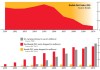
Digital photography took off and Kodak wasn’t ready for it. From the late 90s until about 2008 (which is also when camera phones became mainstream), the digital still camera market in the U.S. grew from 4.5 million units shipped in 2000 to 28.3 million units in 2007, according to PMA.

What’s interesting is that Kodak actually invented the first digital camera in 1975, but it was Sony who first introduced a digital camera to the people in the form of the Sony Mavica in 1981. Kodak, on the other hand, focused its digital technology on high-end, niche markets. They came to bat with a hybrid approach of sorts — offering sensors to other companies rather than building their own consumer products (Leica used their sensors for years and don’t even ask how that turned out) — because many of them couldn’t imagine a world in which selling one digital camera to a few power users would be more profitable than selling one-time-use film cameras to the masses… over and over again. A classic case of a disruptive technology coming in right under the incumbent’s nose.

Under CEO George Fisher, Kodak had been planning its digital strategy for most of the 90s. The problem was that the estimates for growth in the digital imaging sector were rather low anywhere outside of Japan during the late 90s. According to a study out of the University of Michigan business school, “the total volume of digital cameras sold outside Japan in 1997 was estimated to be only 400,000 units,” and many of them were believed to be for power users, not the general public.

Plus, Kodak’s presence in Japan was weak, at best, with Fuji absolutely dominating the Japanese film and camera market during the 90s.

That left Kodak leadership with a big decision. Should Kodak make a huge push into digital and risk cannibalizing its still-strong core business? That was the question, and the answers varied.

Here are two quotes from Kodak corporate literature from the UM study:

The keys to Eastman’s success in making photography a popular leisure-time activity for the masses were his development of roll film and the inexpensive box camera. Although film and cameras are far more sophisticated and versatile today, the fundamental principles behind his inventions have not changed.

Four years ago, when we talked about the possibilities of digital photography, people laughed. Today, the high-tech world is stampeding to get a piece of the action, calling digital imaging perhaps the greatest growth opportunity in the computer world. And, it may be.

Obviously, there was not a consensus and why would there be? Fuji dominated in Japan, and right at the moment that Kodak should have been pushing hard into the digital realm, estimates for anywhere outside of Japan remained low.

Clearly those estimates were wrong and Kodak was inevitably late to the game. Their first digital imaging offering was not a camera, but what they were calling the “Photo CD” in 1991. In 1996, Kodak made another small push with its pocket-sized DC20. At the time, digital was in its infancy and Kodak failed to see the possibilities, instead focusing on other digital products like scanners. In fact, Reuters reports that Kodak spent $5 billion on digital imaging research in 1993, only to delegate it to 23 separate scanner projects.

Five years after the DC20, however, Kodak made its biggest push into digital cameras with its EasyShare line. Dan Carp had taken control of the company and knew to a degree that if they didn’t at least try in digital, it would be a mistake. But by 2001, the market was crowded. Canon and Sony had already made huge leaps in the sector, and Kodak had some major ground to cover.

Fear of change is understandable, to an extent, but it’s also the kind of backwards, old-fashioned thinking we’re seeing today out of the RIM playbook (pun intended).

A big part of the issue there was talent. The same employees that may be geniuses in film and film cameras aren’t necessarily as advanced in electronics. This, of course, did nothing for company solidarity as Kodak’s digital and film branches were at odds. Kodak had plenty of great people and great photographers, but they couldn’t keep them on the payroll as other major players dropped into the digital game after 2000.

The company spread itself too thin in the mid-90s and on into the next millennium, spending millions on research only to release incrementally updated products in a number of different fields. Already behind, this only made matters worse.

Then in 2007, the company made a huge mistake in selling off its health imaging business for $2.35 billion, which was meant to go toward its consumer camera business. Unfortunately, health imaging had been good to Kodak and the firm sold off the business just in time to miss out on baby boomer retirement. Reuters recounts that Kodak didn’t want to spend the money required to migrate the health industry from analog to digital.

By 2008, the digital camera market was already starting its decline. A new technology had emerged: 120 million camera phones were in use in 2008, just in the U.S. alone, according to PMA. Also in the U.S., 2008 brought about the first drop in digital still camera sales, down from 28.3 million in 2007 to 27.7 million. The sector would experience a slow but steady decline from then on.

But what slowed Kodak down so much between the 90′s and now?

Already Broken

To start, the retail landscape here in the U.S. changed dramatically over the 80s and 90s. Walmart, for one, saw a huge growth spurt in the 80s and opened its first superstore in 1988. And while Kodak was happy to be sold in big box chains, others were just as pleased to put their products in stores like Walmart.

You see, in the 70s and 80s, every little town had a tiny film store. Kodak owned the market wholesale, with between 80 and 90 percent share. Then Walmart, along with Sears, Costco, and other big box retailers, swallowed these little mom and pop stores up. Retailers learned that diversity, scrambled marketing, and one-stop shopping were important to consumers, and the only way to keep costs low was to squeeze the manufacturers into providing high-quality products at lower prices.

That’s where Fuji comes into play, and it seemed as though Kodak never saw it coming.

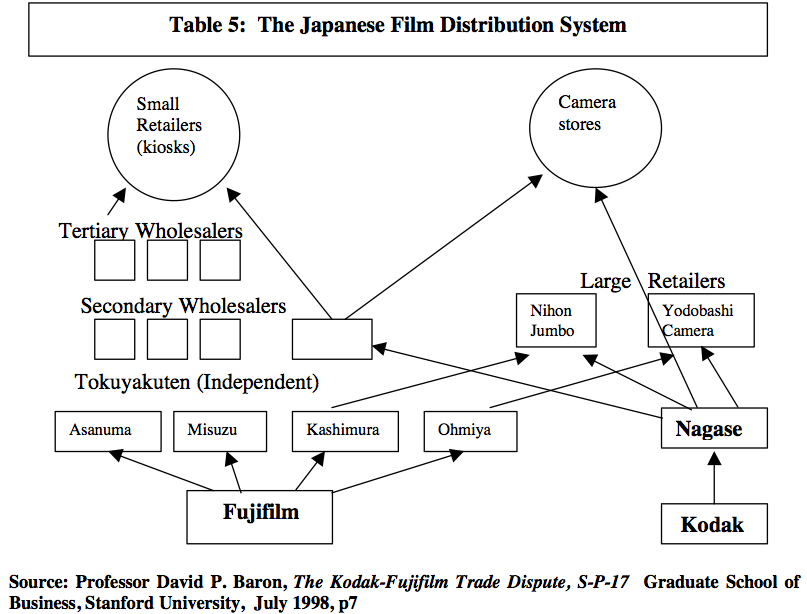
Kodak held between 7 and 10 percent of the Japanese market in the mid-90s, while Fuji had a dominant position. In fact, each of the companies held a rather dominant market share on their home turf, with Fuji representing 17 percent of the U.S. market. But distribution channels in the two countries were very different. While Kodak and Fuji were selling their products directly to retailers here in the States, distributors played middle-man over in Japan. Fuji, not surprisingly, had strong ties with the four major distributors in Japan, and Kodak… well, they didn’t like it.

In 1995, Kodak filed with the United States Trade Representative (USTR) for an investigation under Section 301 over whether or not the Japanese government had allowed anti-competitive practices. After two and a half years of litigation, the World Trade Organization in Geneva issued a “sweeping rejection of Kodak’s complaints” regarding Japan’s film market.

By dominating their own market and steadily making inroads in the U.S., Fuji had quite a bit of cash lying around to buy itself into new markets. And that’s exactly what it did. According to a case study [PDF] out of Pace University, “while the U.S. based Eastman Kodak Company was sleeping, the Japanese firm Fuji Photo Film opened its first film-production plant in the U.S., cut prices, marketed aggressively and stole valuable market share.”

This was between 1996 and 1997, when Kodak still held approximately 80 percent of the U.S. market and was focused primarily on roll film and film cameras. But Fuji was now prepared to duke it out in price wars, and though both companies denied actively engaging in such a thing, Kodak fired back hard each time Fuji cut prices. But it was too little, too late. In the years leading up to this, Kodak refused to cut prices for fear of profit erosion.

In 1996, however, Kodak signed an exclusive agreement with Costco that left Fuji with 2.5 million rolls of excess film. To avoid expiration, the company offered a 10 to 15 percent price cut. Kodak resisted engaging, and rightfully so (perhaps), as Salomon Smith Barney analyst Jonathan Rosenzweig figured that “for every 1 percent cut in Kodak film prices, a 1 percent drop in earnings per share results.”

Meanwhile, the American consumer was changing. While people still felt pride when they were “buying American,” imports became more and more attractive. A few years later, in January of 1999, the United States would record its single largest trade deficit month to date at $17 billion. To put it bluntly imports outweighed exports, and Fuji with its low-priced film fit into the U.S. market swimmingly.

By 1998, however, the competition between Fuji and Kodak seemed to slow down. Most of the price wars happened in the form of promotional deals rather than every day prices, but something even more fatal than Fuji was creeping up on Kodak: the digital revolution.

The Only Hope

Kodak’s market share had already been eroded by Fuji, but the company, over a century old, had too much pride to change. When all is said and done, pride and nostalgia brought Kodak to its knees. But today there is (or was, rather) one saving grace.

Kodak holds 11,000 patents which analysts value around $1 billion. Since Kodak invented the first digital camera, and research was one of the four pillars of Kodak’s business strategy, it only makes sense that where digital imaging is concerned they own the technology.

But it’s too late to act like the technology in those patents is groundbreaking. It’s everywhere, and thus Kodak is suing everyone: RIM, Apple, HTC, Fujifilm, and Samsung. The company knows that its patents are its only solid source of revenue, whether it’s by selling them or licensing them.

Unfortunately, litigation takes years, and no one seems all that interested in buying Kodak’s patents. Which brings us to today.

After filing for Chapter 11 bankruptcy on January 19, 2012, Bloomberg is reporting that the company intends to shift its business toward printers and its ink. Selling off its camera unit and perhaps its patents should allow for more cash which can be invested in further patent litigation and licensing.

But this is a far cry from the Kodak of yesteryear. Once dominant, the 131-year old company is now fighting for survival and without a massive leap forward in terms of innovation, this may be the end.

There will still be kodak moments, but there may no longer be a Kodak.


The Dawn of Social Lobbying

Money

Editor’s note: TechCrunch contributor Semil Shah is an entrepreneur interested in digital media, consumer Internet, and social networks. Shah currently works at Votizen and is based in Palo Alto; you can follow him on twitter @semil

The word “lobbyist” surely doesn’t have the best connotation in the world. Depending on your reading of the definition, it generally signifies an attempt to influence government decisions, traditionally by targeting legislators or regulators. What isn’t often taken into consideration, however, is that while there are lobbyists in dark suits roaming the halls of Congress funded by entities such as big oil and pharmaceutical companies, “lobbying” is also conducted by nonprofit groups funded by different kinds of special interests. We think of efforts, however, as “activism,” but at the end of the day, they’re just another form of lobbying.

Now, a new form of “lobbying” has emerged, but instead corporate checks or individuals donations, the currency has shifted from cash to social connections, where financial power will be trumped by network power: “social lobbying.”

To understand why lobbyists get such a bad rap, look no further than Jack Abramoff, one America’s most notorious “suits” who served over three years for all forms of corruption up and down Washington D.C.

To briefly oversimplify his intricate web of deception, clients would hire Abramoff for handsome fees to lobby on their behalf and push or protect special interests, typically by working with Congressional staffers to shape, trim, bend, and massage the language contained in official bills of law too dense for any normal human to read. Abramoff’s trick was to “buy” the loyalties of current Congressional staffers with the carrot of potentially hiring them on his dole for two to three times their current salaries. That incentive alone was enough to buy Abramoff (and by proxy, his clients) choice phrases inserted into bills that eventually became law. (I’d recommend watching this recent 60 Minutes interview with Abramoff, who explains his system in greater detail.)

These “suits,” funded by private, corporate dollars gave rise to “activists” who — in another oversimplification — rallied around causes to combat special interests. These entities typically form as nonprofit or nongovernmental organizations and raise money through foundation grants (which are often funded by wealthy families/individuals or corporations) and individual donations, typically from individuals wealthy enough to let go of the disposable income yet savvy enough to understand the implications of the corresponding tax write-offs. Activist-funded lobbying exerts its influence in different ways, and depending on where you sit, embody just as much of a dark art as their “suit” counterparts.

Two sides of the same coin, right? Probably. But now a new form of lobbying is emerging, one where lobbyists aren’t necessarily hired for money, but rather organized and recruited through the social graph of connections we’ve mapped out while we’re busy sharing and liking pictures and honoring our friends’ requests to retweet this or that piece of content. And, instead of lobbying that’s fueled entirely by cash (yes, cash is still involved), the new form of currency is tied closely to social networks.

While recent events have demonstrated, at least in one case, the advantage of networks over cash in a lobbying sense, it still remains to be seen whether this new form of lobbying — social lobbying — will deliver results across a broader range issues that cut into the mainstream or reside out on the long-tail of retail politics. It’s impossible to predict where and when this kind of lobbying will pop up again, but this much is sure — whatever issues social lobbying sets its targets on, there’s a greater chance that those interests could theoretically advance positions that benefit a greater majority of people relative to those who could be affected: not a perfect democracy, but inching closer, if ever so slightly, and given recent abysmal U.S. Congressional approval ratings, perhaps a small step in the right direction.

Photo Credit: Creative Commons Flickr / Images of Money


Analyst: All These Concerns Over EA And Star Wars Are “Overdone”

EA-Logo

So, there’s been some hubbub around Electronic Arts over the last few days, as the company ramps up for the release of its third quarter earnings on February 1st. Yesterday, EA’s stock closed at $17.54 per share, which, in context, meant that the gaming goliath’s stock was down 30 percent since hitting its 52-week high in early November. This drop was mostly due to the collective shock relating to the news concerning its recently released title, Star Wars: The Old Republic, which now has a ridiculous price tag attached to it — as Wall Street is estimating the cost to be between $150 and $200 million.

EA’s studio responsible for creating the much-touted online game, BioWare, spent some six-odd years developing Star Wars, and obviously there are concerns over whether or not the game will be able to satisfy the geeky desires and high expectations of both Star Wars fans and the avid World of Warcraft-playing, MMO gaming fans — especially as they’ll need to sell millions. Not always an easy audience to satisfy, but an eager and quick-to-spend audience if the game meets expectations — as the LA Times points out. (Though Trion has been having some serious success in this arena — see our post from yesterday.)

Some are saying that it could be the most expensive online game in history, and at $60 a pop, obviously there are those concerned that the deficit will be too great. However, analysts at Macquerie Equities Research today said that they believe initial sales of Star Wars will still be relatively good, and are still on track to hit their target of 1.5 million. It also helps that the costs were already absorbed into EAs financials.

Macquerie said that how the stock will perform will be largely affected by Star Wars’ sales, but if sales get close to their projection of 1.5 million, the firm expects the stock to make a bounce-back. While some are saying that, because EA hasn’t announced sales numbers yet, the likelihood is that sales have been not-so-good. Instead, EA has only said that it’s in a “quiet period” and will not be commenting as a result. Fair enough.

Others have said that the analysis of the game’s server loads show that there isn’t as much activity, but Macquerie would like to remind those people that it’s not easy to make accurate estimates of the numbers of users based on server loads — especially without knowledge of how they’re allocating server loads.

Glitches and mechanical problems have also been mentioned as influencing poor sales and low excitement, but, again, Macquerie defends EA, saying that, while this could affect the long-term outlook for the game, these kinds of problems are expected at initial release, and may not have as big of an affect as some might believe.

Thus, Macquerie isn’t having any of this nay-saying, and is expecting EA’s stock to outperform — and be on the rise. The game will need about 500,000 subscribers to get close to even, and, of course, the other side is that, they could be way ahead of the ball, and if they were to get several million, well than what one analyst called “the single largest bet” of the EA CEO’s career might just turn out to be an enormous, money-raining win.

What do you think?


If The Tech Industry Had Its Way, Hollywood Would Be Zynga

Screen Shot 2012-01-20 at 8.27.20 PM

Like all of y’all I just read Paul Graham’s SOPA-soaked call for a tech startup that would kill Hollywood.  You would have to be a complete idiot to think Hollywood (or at least some part of Hollywood) isn’t ripe for disruption BUT …

“The people who run it are so mean and so politically connected that they could do a lot of damage to civil liberties and the world economy on the way down. It would therefore be a good thing if competitors hastened their demise.”

Damn. What I’m getting from this post is that Hollywood should die, because people are mean. I don’t know about you, but I’ve met plenty of mean people right here in SF Silicon Valley.

Graham recommends, “The best way to approach this problem is to ask yourself: what are people going to do for fun in 20 years instead of what they do now?”  After asking a bunch of smart people in the tech industry where they thought the industry would be in 20 years and hearing the same answer from most of them (“Something like Zynga …”) I finally asked Graham and YCombinator partner Harjeet Taggar what they thought people would be doing in 20 years, for fun.

Their answer:

“I’d guess a lot more games. Zynga type games are likely only the start. Console video games are already essentially interactive movies.  Smartphones and tablets are making games more accessible than ever, in the future it’ll be bizarre to think that people ever purchased devices with the single function of loading games from a disc.

It’s probably impossible to predict *what* exactly people will be doing in 20 years but it’s likely a safe bet to say that the current model of going to a physical place where the only content available has been selected for me by a group of money men somewhere, won’t be around.”*

What I’ve never understood is this, it is some function of Hollywood, Silicon Valley and the New York media industry to tell human stories and distribute them — they are all symbiotic. If this is the case then why can’t we all just get along?

At the end of the day all three industries feed each other, one provides the content, one (increasingly) provides the distribution and the other covers it all, with some interchange of roles between all three. What is happening now (and what Graham might be conflating) is that there is a conflict between who controls the platform, and therefore distribution, versus who controls production. And the only reason Hollywood has more power here is that it’s been around the longest — the tech industry’s got nothing, so it’s got nothing to lose.

Sure there are some people in the content industry who refuse to admit that their old models don’t work (just like how there are people in the tech industry who work on Bing). But to kill the whole thing off would get rid of a wealth of creative talent skilled in the cinematic portrayal of the human narrative, and replace it with what? A souped up Farmville?

The truth is that both Hollywood and Silicon Valley have valid arguments with regards to digital rights and neither can put itself in the other’s shoes.  If Hollywood spends $50 million dollars on a film, it can’t pivot while YCombinator can invest $50K in startups and have 2/3rds of them fail. And even if they do succeed it doesn’t matter, as the tech industry reinvents itself every five years! Hollywood on the other hand …

The real moral to this story is we all should dream, and we should dream like Hollywood but we should invent the future build like Silicon Valley. There’s no YCombinator for film because that kind of business behavior doesn’t work  in traditional media. And even the most genius tech people haven’t yet solved the problem of privacy. (If someone has the answer please raise your hand, because you’re going to be the richest person on the planet.)

Please, raise your hand. Anyone? Bueller?

* For the record, I’d rather watch my Instagram feed than watch a movie.


Google Trims The Fat

Google Thin Logo

Google has more than 40 core products, and hundreds of products depending on how you count them. Even with over 30,000 employees, that’s a lot to support. In the name of refocusing, today the company announced that Picnik, Sky Map, Urchin, Needlebase, Google Message Continuity, and the Social Graph API are all headed for the deadpool, open source, or absorption into more central divisions.

Today’s culling follows this summer’s shut downs of Google Labs and most of the products internally developed by former acquisition Slide. While Google has long encouraged experimentation, its found itself overextended. The company needs all hands on deck fighting the wars for social, mobile, and the cloud.

Google typically reassigns employees from scrapped projects rather than fire them. The teams from Picnik and Sky Map could increase the concentration of product leaders working on Google+. With any luck they can give Google’s social network a more human feel.

Now, the fate  of the forsaken:

Picnik – The browser-based photo editor Picnik will be shut down on April 19th and its team likely integrated in to Google+ and Picasa. Premium customers will receive refunds. Google+ already offer Creative Kit, which includes basic editing, filters, and decorations. Picnik uses almost an identical interface, but includes advanced editing , frames, and seasonal effects that could soon show up in Google’s other photo products soon.

Google Sky Map – The augmented reality star gazing Android app will become open source. Google appears to be moving away from standalone apps, given the recent deaths of Disco, Photovine, and Pool Party. This will make it easier for the iOS developers of Starmap and Star Walk to develop Android versions.

Social Graph API – Google’s graph of public interconnections between people on services like Twitter and Flickr will be deprecated on April 20th. The API allowed developers to pull in information about their users to improve their products, but Google says “The API isn’t experiencing the kind of adoption we’d like”. Google will instead be working on catching up to Facebook by developing its own social graph with Google+.

Google Message Continuity – No more resources will be wasted on a cloud backup system for on-premise enterprise email. Google will dedicate itself to support for its fully cloud-based enterprise system Apps, which has proven much more popular.

Urchin and Needlebase – The acquired client-based predecessor to Google analytics and its data management platform are being formally shut down. The Urchin team is now work on browser-based analytics, while Google is still considering whether to integrate or simply eliminate Needlebase.

A firm handshake and hearty pat on the back to all those working on these projects. Remember, you don’t have to toil away on more small features. Consider this your opportunity to go Do Great Things.


Delicious Adds Collaboration and One-Ups Pinterest With Privacy

Delicious Collaborative Stacks

Delicious has just announced 4 new features to make its stacks, or collections of links, more social. Because the only thing better than a bundle of your favorite kitten websites is bundle co-created by you and your friends. You can now collaboratively build stacks, comment on whole stacks, respond to a stack with a stack similar to a YouTube response, and create private stacks. The features will permit new use cases like stealth cooperation and give Delicious an advantage over Pinterest which doesn’t offer private boards yet.

Private stacks make Delicious more than just a broadcast channel for your taste. You can stealthily hoard links and keep them to yourself forever, including sites you wouldn’t want your boss or mom to see.

In conjunction with the new collaboration feature, you can also silently assemble and discuss links with others, and later decide to present them to the world. Delicious offers a perfect example of how you could “share favorite engagement rings with your yet-to-be-announced fiancee.”

Pinterest doesn’t offer private boards yet. It told one Quora user that feature might one day be offered as a premium service, but that it wasn’t a priority because the site focuses on sharing. This gives Delicious an opening to exploit.

The collaboration feature lets you invite friends to edit your stacks. This could help teams cooperate on research, or let friends compile a set of favorite links around a topic.

Commenting on entire stacks lets you have conversations about the interconnections between links. You can also suggest links you think would enhance someone else’s stack.

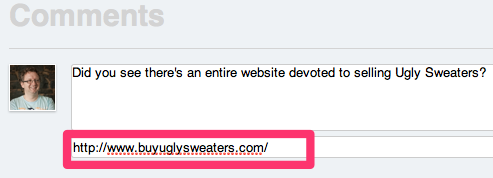
Stack responses lets you battle over who can find the best content around a topic, or offer a contrasting collection. For example, if you’re worried your friends might actually buy something from their Atrocious Sweaters stack, persuade them not to ruin their image in the name of irony by responding with a stack of stylish sweaters.

Delicious is still less flexible than some group sharing platforms such as Facebook Groups, and doesn’t have the momentum of Pinterest. To stay relevant it needs to nail its core purpose — stable presentation of curated links, which isn’t as well supported by feed-based and photo-centric services.


Watch This Delightful Crowdsourced Star Wars Fan Film Immediately

shots

You can’t always count on the wisdom of crowds. But this particular project turned out not merely good, but amazing. Star Wars Uncut is a project by filmmaker Casey Pugh (and edited by Aaron Valdez and Michael Pugh), in which Star Wars: A New Hope was divided into 15-second segments, each of which was replicated by fans in whatever way they chose. Connect the new segments and voila! Crowdsourced magic.

You can watch the whole thing, with each component hand-picked for your viewing pleasure, here:

It’s stuff like this that reassures me that the Internet is, in the end, a collaborative and positive force. Not that all it is for is silly videos, but think about the fact that just a few years ago, this project would literally be impossible for a number of reasons. Not only now has the ability to produce and share video become mainstream, a trivial task even, but also the ability to collaborate globally, with no regard for distance, language, or other factors.

To see something as light and fun as this produced using these powerful tools of ours is not, as some might expect, depressing, as if we are incapable of anything better. I think it is representative of the versatility of those tools and the willingness of people to use them. That’s a heartening though. Today, a Star Wars reshoot. Tomorrow, an independent film by dissenters in Iran. It’s really not such a great leap between these two things.

At any rate, enjoy the film. It’s ridiculous all the way through, and apparently Adam Savage is in there somewhere. It’s also available on Vimeo if you prefer that.


Investors Bet On Social Gambling, $ZNGA Closes Up 6.57%, Now At $9.09 A Share

featured-games-380-226-zp-game-board-02

The social gaming industry has been getting more and more interested in a potentially big new way to make money: online gambling. And investors, who are now able to buy stock in market leader Zynga, are following suit.

Today, Zynga told All Things D that it was considering how to approach the new opportunity: “We build games and experiences that our players want and love. Zynga Poker is the world’s largest online poker game with more than 7 million people playing every day and over 30 million each month. We know from listening to our players that there’s an interest in the real money gambling market. We’re in active conversations with potential partners to better understand and explore this new opportunity.”

The market, which has not been sure what to make of Zynga’s virtual goods revenue model since the company went public at $10 a share last month, reacted by driving its stock up by $0.56, or 6.57%, to close at $9.09 today.

Zynga’s move follows a potential loosening up on the issue by the two platforms it relies on most: Facebook, and the United States government. Recent statements by the US Department of Justice suggested that online gambling might be legal in many states. And Facebook is reportedly looking at allowing gambling in countries where the pasttime/vice is already allowed.

Beyond Zynga Poker, which has dominated the winnings-free gambling category of games on Facebook since it launched in 2007, a few other companies have been building hit games (and getting acquired). Playtika, which owns slot-machine game Slotomania, was bought by gambling empire Caesars Entertainment Corporation for more than $90 million back in May. Meanwhile, Double Down Interactive, creator of mult-game app Double Down Casino, was just bought by International Game Technologies in a deal worth up to $500 million.