Verbling Raises $1M To Link Up Language Learners Through Video Chat

verb

Y Combinator-backed Verbling, a site that aims to connect language leaners with native speakers via live video chat, has raised $1 million from DFJ, Learn Capital, Start Fund, Inspovation Ventures, SV Angel, Meck Investments, Ace & Company and others. The new funding will be used towards hiring.

Here’s how Verbling works. The site allows you to sign up and choose the language you want to learn. Once you join the site, you are automatically paired with a language speaker who is fluent in the language you wish to learn. The site encourages users to talk to a number of different speakers within each session.

So if you speak French and want to learn English, you’ll be paired up with a native English speaker who wants to learn French. You start in one language and halfway through the video session, a timer tells you when to switch to the other. Speakers are also matched by their language levels, and to aid in the conversation, Verbling will suggest topics according to the ability of the participants, such as “What chores are you responsible for in your home” or “what kind of music do you listen to?”

The chats are conducted via video chat, but the startup doesn’t seem to be too worried about any Chatroulette-like issues because everyone has to register with their name and other personal info to use the service. Currently, Verbling is using Flash for the video streaming itself, but the startup has built significant infrastructure around the player to ensure that the audio video quality is as good as possible, even when faced with varying internet connection quality.

Currently, Verbling only offers English-Spanish learning but is seeing a large demand for other language combinations. And the startup adds that the majority of Verbling users say they are learning a foreign language because it will give them an advantage in the job market

Today, Verbling is also debuting Verbling Flashcards to provide content for beginners. Users can easily memorize words from different categories (Travel, Eating Out and more) and then test themselves. Since launched a few days ago, 74% of Verbling’s visitors have used the Flashcards feature.



TCTV: In the Studio with Danny Trinh, Path’s 21-Year Old Product Designer

Screen shot 2012-01-21 at 12.18.36 AM

Editor’s note: TechCrunch contributor Semil Shah is an entrepreneur interested in digital media, consumer Internet, and social networks. Shah currently works at Votizen and is based in Palo Alto; you can follow him on twitter @semil

“In the Studio” at TechCrunch TV kicks off today with a guest who deferred college, and eventually dropped out, and moved out west to pursue his dream of building products in San Francisco.

Danny Trinh, a product designer at Path, is perhaps one of the most talented, up-and-coming product designers in the social and mobile space today. At all of 21 years old, Trinh has already built quite an impressive resume of experience designing web products. A few years ago, Trinh graduated high school and took an internship with Digg, supposedly for the summer, but he loved it so much he ended up deferring college to work full-time at Digg for a year. He then went back to UNC for his freshman year (while still working on Digg remotely), but the pull of San Francisco was too strong  – Trinh left after his freshman year to rejoined Digg.

In this short video clip, I chat with Danny about the personal choices he made to learn design, to come out to San Francisco after high school, to defer college and then dropout after freshman year, and what it’s like to be a young adult in one of the most dynamic technology scenes in the world. He approaches his work as if he’s a kind of a college student at a rock festival, such seeking out mentors like Path cofounders Dave Morin and Dustin Mierau, as well as Daniel Burka, who recruited Trinh to Digg.

Trinh refers to himself a “fan,” constantly in joyous disbelief that he gets to help build products with people he idolizes. What I find so interesting about Trinh is his attitude toward building and designing products, as well as his views on some of the challenges he faces as being, as he explains, a “young kid” in San Francisco as a teenager with a real job, while all the people he knew were at college doing “normal” things. For someone so young, he already made a name for himself and is one to watch closely.


Keen On… Caleb Melby: The Zen of Steve Jobs (TCTV)

Screen Shot 2012-01-23 at 9.59.44 PM

Walter Isaacson has unleashed a torrent of new books about Steve Jobs and Apple. But nobody has written anything quite like Caleb Melby’s The Zen of Steve Jobs, a graphic novel that charts Jobs’ relationship with a Buddhist priest called Koby Chino Otogawa. The book is a both a visual and textual delight and I couldn’t resist inviting Melby, who also writes for Forbes, into our New York City studio to talk about Zen and the art of Steve Jobs.

So was Jobs a buddhist before he was a Buddhist, I asked Melby. And was Steve as obnoxious with Buddhist priests as he was with Apple employees and business rivals? Yes and yes, Melby explained. More importantly, however, Melby insisted, what Jobs derived from Otogawa and the Buddhist tradition was his strictly minimalist design aesthetic which “threw dogma out of the window.”

To balance all Melby’s ying, you might also check out my conversation last week with Adam Lashinsky, the yang-like author of How Apple Really Works.


Jeff Clavier’s SoftTech VC Raises $55 Million For Fund III

softtech-vc

The micro-VCs are growing up. Case in point: Jeff Clavier, who started out as an angel investor backing Web 2.0 companies and then transitioned his portfolio into a more formal venture firm, SoftTech VC. Clavier just finished raising a total of $55 million for SoftTech’s third fund. SoftTech’s main focus is on three areas: mobile, next-generation e-commerce, and cloud-based services.

He launched SoftTech III a year ago with $15 million, with the intention to raise a total of $35 million. When he started raising money this summer, though, he was able to increase that target to $55 million. He also added a partner, Charles Hudson, and a senior associate, Steph Palmeri.

“We raised more because we wanted to invest more in companies we are already invested in,” says Clavier, who came by our New York City offices yesterday to shoot an episode of Founder Stories, where he also speaks about his new fund. SoftTech has already backed 100 startups over the years, including Mint, Eventbrite, Get Satisfaction, FitBit, Fab, and SendGrid.

As a seed-round investor he found it difficult to keep his ownership stake in later rounds, and so like many successful early-stage VCs, he decided to raise a larger round so that he could keep investing in follow-on rounds for the winners in his portfolio. When he started out on his own, he was making $25,000 to $50,000 investments. Then in Fund II, he was making $100,000 investments. Now with Fund III, his average initial investment is $400,000 with the goal to buy at least 5 percent of a company, and keep that stake as long as he can. His largest investment to date is FitBit, which recently raised $12 million (SoftTech has put in “north of $1.5 million” over the past three rounds).

With Fund III, he has already done 23 investments, and plans on doing a total of 60 (which comes to about $25 million for the initial investments). He figures that 50 percent of those SoftTech will do follow-on investments, and that is what the remaining $30 million will be used for. Below is an infographic (from SoftTech portfolio company Visua.ly) breaking down SoftTech’s progression and how its investment activity has changed over time.


Zynga Brings Social Gaming To The Bingo Hall With Newest Title

Zynga Bingo4

There’s been one trend we’ve been noticing over the past few years when it comes to Zynga’s game development strategy. The social gaming giant likes to re-create classic games like Hangman or hidden puzzles and add social elements for gameplay. We saw this with the release of Hanging With Friends, Scramble With Friends, Hidden Chronicles. And As Zynga revealed in October, next up is Bingo. Today, the company is revealing its social take on Bingo via a Facebook game, which will be joining Zynga Poker in Zynga’s newest franchise, Zynga Casino. Currently, the game is in private beta but will be launching to the public soon.

In terms of actual gameplay, Zynga Bingo works similarly to the way an ordinary bingo game works. And if you’ve played Zynga Poker before, the game mechanics and nuances will feel familiar to you as well. As numbers are called out in the game, you cross off those that match on your card, with the winner being the first person who reaches a consecutive pattern on the card from the drawn numbers.

The main difference is the social aspect of Zynga Bingo. When you start the game, you’ll be promoted to enter themed bingo rooms and compete against friends or other random players on Facebook simultaneously, challenging buddies in a race to get B-I-N-G-O faster. Similar to Zynga Poker, players can chat and see which rooms their friends are in.

Each room has a theme. There’s Vegas Lights, which has a Las Vegas Casino theme; Pirate’s Paradise; and a FarmVille-themed Bounty room. And as you collect more tickets from wins, you’ll be able to unlock secret rooms as well.

As you are considering which room to enter, you can also choose how many Bingo cards you’d like to play. Players can compete with up to six cards at once, and you use your tickets to purchase more cards.

Within the game, you can also use what Zynga calls “power-ups” to progress faster, get coins and win collectibles to level-up. One type of power-up relates to friend help, which enabled a friend to automatically daubs a free square on each of your cards and complete your cards faster.

Nicole Opas, Senior Producer for Zynga Bingo, says the gaming company will be considering extending Zynga Bingo to mobile platforms in the future. Zynga Bingo was created by Zynga’s Austin, Texas gaming studio in collaboration with the Zynga Casino team in San Francisco.

It should be interesting to see how the slew of games released in the fourth quarter helped boost both Zynga’s revenue and usership numbers. The company is expected to deliver Q4 earnings on February 14, and Zynga’s stock rating just got a boost, and could see a traffic boost from some of the newly launches game titles.


It’s About Time: HTC To Refocus Smartphone Efforts Around “Hero” Devices

htcvivid

HTC has gotten to be remarkably good at churning out phone after phone these days, but it’s gotten to feel like each new release is too little too soon. Thankfully, the godfather of Android hardware has come to its senses, as revealed by Mobile Today.

According to HTC UK head Phil Roberson, 2012 is going to be all about giving their customers “something special.” To that end, HTC plans to focus on a smaller number of “hero” smartphones and dial back their presence in the tablet market.

“We have to get back to focusing on what made us great – amazing hardware and a great customer experience,” Roberson said. “We ended 2011 with far more products than we started out with. We tried to do too much.”

Couldn’t have said it better myself. HTC’s philosophy as of late seems to have been about continually chasing the bleeding edge by pushing out new hardware before its predecessors have gotten the chance to breathe. It’s refreshing to hear (err, read) that someone at HTC feels the same way, because the glut of options ultimately becomes a big problem for consumers.

Chris Ziegler at The Verge noted that the here in the States, T-Mobile’s high-end HTC Amaze 4G debuted only 120 days after the carrier’s previous flagship Android phone hit sales channels. It’s no secret that technological advances come at a blistering pace, but to push out a new flagship device in four months could easily come as a kick in the gut for customers who splurged on the previous model in an attempt to future-proof themselves a bit.

Being on the bleeding edge is great, except for when your customers are the ones who get hurt. HTC isn’t exactly alone when it comes to this sort of behavior — Samsung’s LTE-packing Skyrocket overshadowed their original Galaxy S II model, and Motorola’s Droid RAZR Maxx trades a few millimeters for some outstanding battery life while leaving original Droid RAZR owners lamenting their luck. Still, while Samsung’s market saturating plans are doing them well, Motorola has already announced their intention to trim down their smartphone offerings for 2012.

Meanwhile, the revelation of their tablet plans (or lack thereof) doesn’t come as a huge shock. The Taiwanese company released two actual tablets in 2011, with a handful of carrier-specific variants thrown in for good measure. Alas, the tablet market has become an ever tougher nut to crack, and while HTC won’t be abandoning it completely, they’ll be spending more time and resources on their main moneymaker: smartphones.

HTC has been on shakier financial ground than it’s used to recently, and at the time they cited “increased competition” in the mobile space as one of the reasons their most recent quarterly earnings ended their six-quarter growth streak. This new move is a drastic one, but it’s worth a shot considering that their once-solid approach doesn’t seem so solid anymore. With Mobile World Congress right around the corner it shouldn’t be long before we get a better glimpse at HTC’s new strategy, though whether it actually works is another story entirely.


Google+ Now Open To Teens 13 And Up

GooglePlus-red

Google is opening up its social networking service Google+ to teens as of today, according to a post from Google’s VP, Product Management, Bradley Horowitz. The move puts the network in closer competition with Facebook, which also requires that individuals be at least 13 year old before creating an account.

Says Horowitz, everyone who’s old enough for a Google account (13+ in most countries), can now create a Google+ account too.

The announcement was made alongside news of a few new safety enhancements to the service specifically for teens, including those that focus on sharing content, hangouts (video chat) and notifications.

One of these is a message that appears when a teen tries to share outside of their circle of friends. The message reads: “When you share publicly, people you haven’t added to your circles will be able to view your post and may be able to comment.”

This seems a little obvious, but given Facebook’s ever-shifting levels of post visibility, it can’t hurt to bang people over the head with the definition of “public.”

Google will also place limits on its video chatting feature called Google+ Hangouts when used by teens. If a stranger (someone outside the teens’ circle) joins a hangout, Google will temporarily remove the teen from the hangout by muting the mic and video feed. It’s interesting that it wouldn’t just remove the stranger, or perhaps remove strangers ability to even join hangouts in progress, when posted by teens. But I suppose this move is targeted towards those teens who inadvertently (or naively) make their hangout public instead of private, which could invite in an unwanted element.

Notifications are also being restricted, so that only those in teens’ circles can contact them via IM, and blocking is easily accessible. This feature is not all that different than how chat operates by default for adults, to be fair. Any Google+ user can configure which circles are chat-enabled, for example.

It should be noted that not all countries have the same age restrictions. In Spain and South Korea, the age limit is 14 and up, while in the Netherlands, it’s 16 and up.

Google recently announced that it has now reached 90 million users worldwide. By opening up to teens, it clearly hopes to quickly grow once more. However, we have to point out that, unlike Facebook’s growth back in the day, Google+’s growth is more manufactured than organic. The company has carefully timed its feature releases and integrations with other Google services to provide ongoing boosts to user count numbers which it can then, in turn, proclaim to be “growth.” But in some cases, Google is forcing Google+ upon users – e.g., when a user creates a Google account, they’re given a Plus account, too. No doubt a few weeks after the teen surge, we’ll hear more about how much Google has “grown” yet again.

In case you’re wondering, Twitter used to require its users to be 13 and up, too. The current Terms of Service make no mention of an age requirement. 


(Founder Stories) SoftTech VC’s Clavier: An Investor’s Role Isn’t To Give Orders

Clavier Founder Stories 1

SoftTech VC’sJeff Clavier has edged his way from a true Silicon Valley outsider (born and raised in France) to the ultimate insider. Since moving to the valley a decade ago, Clavier has launched three funds and invested in more than 100 companies, the likes of which include Mint, FitBit, and Fab.

Not bad for a guy who claims to have jumped “into venture by accident.”

Having just raised $55 million for his third fund, which will invest on average “$400,000″ per startup, Clavier sat down with Founder Stories host, Chris Dixon to discuss how he built his business.

Clavier tells Dixon by 2004 it had become financially feasible to back “customer internet companies.” He says what used to cost $5-million had been reduced to half-a-million. So, “for three-and-a-half-years I sort of built my dealflow, and sort of my footprint in Silicon Valley by doing angel investments.”

While not a major player at the time, he notes, “I was still a VC and I could help entrepreneurs with the financing and figure out how to structure an investment, how to look at term sheets, how to pitch and so on and so forth, and so slowly but surely I sort of built that initial presence in the valley.”

Having helped guide the growth of scores companies and learning just as many lessons along the way, Clavier tells Dixon “you can’t have any pride as an investor because you need to be able to help in anything you can.” He concludes, “you are not running the company, you are just supporting it, the point of view is you don’t give orders.”

Episode II of this interview is coming up. Past Founder Stories episodes featuring leaders of ZocDoc, TripAdvisor, Charity: Water, Turntable.fm, Bump and many other startups are here.


Distimo: Being Featured In The Android Market Can Boost Apps’ Rank By 172%

android

Earlier this morning, we looked at the findings from analytics provider Distimo‘s latest report, which examined what happens when mobile apps go on sale. (Spoiler: when priced correctly, revenue goes way up). The second part of the report looked at the ranking gains that occur when an app achieves “featured” status in a mobile app store like iTunes or the Android Market.

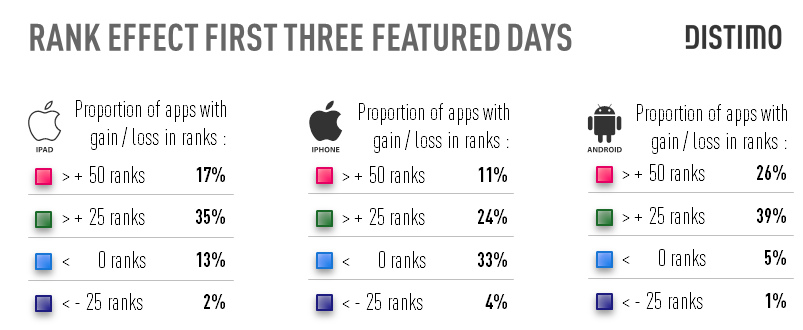
Developers often don’t know their app is being featured until they see the large, unexplained jumps in download numbers in their preferred app analytics service. The effect can be remarkable. In the iPhone App Store, for example, a featured app sees an average jump in its ranking of some 15 spots or so, during the first three days. Some apps gain significantly more, while others see much less action. (Distimo looked at Q4 data for the top 100 most popular apps to determine these findings).

In the iPad App Store and Android Market, featured apps see even higher gains than on iPhone. iPad apps’ average gain was +27 during the first three days, while featured Android apps (i.e., “Staff Picks”) were boosted up +42 spots.

Below, the chart shows the proportion of apps that gained more than 50 ranks, more than 25 ranks and those that lost ranks after being featured (oddly, that can happen), again, during the first three days.

But not all apps immediately feel the effects of their featured status. In fact, one-third of the featured iPhone apps Distimo examined did not gain in the first three days of being featured. Given that apps are, in general, only featured for seven days in all three major app stores, these first few days are critical.

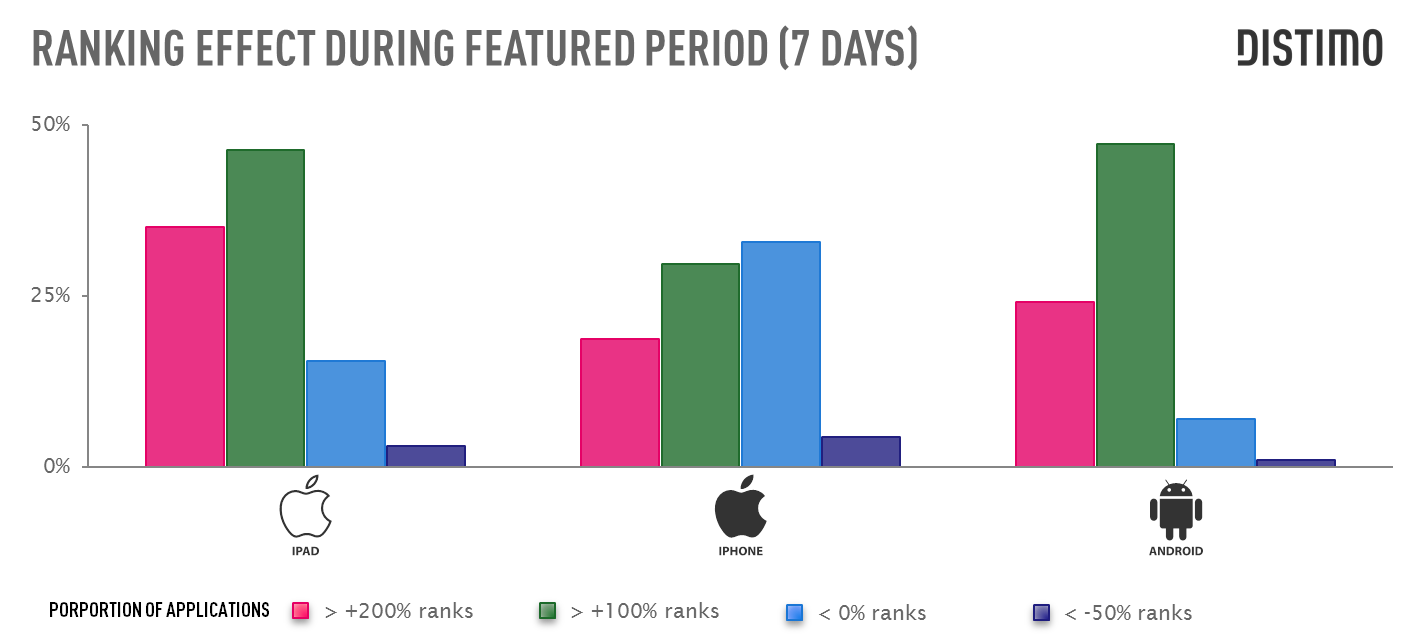
During the full seven days that apps are featured, the average gains are +65 spots for Android, +15 for iPhone and +28 for iPad apps.

Distimo cautions that even though the differences between platforms seem spectacular, the app’s overall position matters, too. For example, a jump from 10 to 5 would means a substantial uptake in downloads, but going from 50 to 45 wouldn’t matter as much.

To depict this visually, the graph below shows the relative rank gains. (A rank change from 3 to 2 is an increase of 50%, while the change from 50 to 25 is 100%. All figures are 7-day averages).

The chart shows that approximately half the apps that have been featured in the Android Market have an increase over 100% while one-third of featured iPad apps gained more than 200%. (Ranks were as follows: iPad up 252%, iPhone up 137%, and Android up 172%).

Also interesting is what happens when the featured period ends. Using an average from the following five days after being featured, Distimo found that the boost was still having an overall positive effect. On average, iPad apps were up +145%, iPhone apps were up +75% and Android apps were up +828% during this “post-featured” time period.

Note that this report only looked at the top 100 most popular apps in any category – the gains in less popular apps could be quite different.


SiriToggles: Enhance What Siri Can Do

SiriTweaks

Now that we have a untethered jailbreak solution for iOS 5, we can actually make Siri somewhat useful.

SiriToggles is a Siri enhancer for jailbroken iPhones running iOS5. SiriToggles allows you to launch applications, toggle some system settings and check how much battery power you have remaining. A simple command like “Launch Plex” will launch the Plex app for example, but it can also handle non-linear commands like “Turn of my Bluetooth” or “Set brightness to 30%”. If only it could also handle driving directions for us Canadians, not that i’m bitter or anything.

If you want to run SiriToggles you need a jailbroken iPhone. You can pick it up from Cydia.

tech.nocr.atSiriToggles: Enhance What Siri Can Do originally appeared on tech.nocr.at on 2012/01/25. Reproduction of content not allowed without consent.

© tech.nocr.at 2012 | Permalink | Comments |
Read more in Mac | Explore more in: , , | Add to del.icio.us | Stumble it | Reddit


AirBeam: Security Cam For Your iPhone/iPad

Airbeam

If you have an iPhone or iPad and a Mac then you already have the making of a great security camera surveillance system. Enter AirBean; an app for your iPad or iPhone which turns them into a spy camera which can be viewed on your Mac desktop or laptop.

Setup is super easy — install the AirBeam app on your iOS device and the desktop version on your Mac. The desktop app automatically finds the streams and acts as your viewer allowing you to view each feed separately or view multiple streams at the same time. If you have an older iPad without a camera or an older iPod touch then you will only be able to listen to the audio, but it will still work. What if you don’t have a Mac? Don’t fret, you can use any iOS device to view the feed from another iOS device. The only catch is that all the devices must be on the same WiFi network.

This is some pretty sophisticated software. You can set it up as a motion alarm or trigger it off any audio alert. You can even set it up to notify you remotely so you always know what’s going on even when you are away from the house. The applications for this are virtually endless, like a modern day baby monitor (an expensive one albeit, but a cool one at that) or a surveillance device to see who might be snooping around your office when your not around.

You can pick up the iOS app for $3.99 from the app store and the desktop version is free. Definitely worth the money

[Link to AirBeam]

tech.nocr.atAirBeam: Security Cam For Your iPhone/iPad originally appeared on tech.nocr.at on 2012/01/24. Reproduction of content not allowed without consent.

© tech.nocr.at 2012 | Permalink | Comments |
Read more in Mac | Explore more in: , , , | Add to del.icio.us | Stumble it | Reddit


Unchained Reaction: Reality TV For Hackers

Jamie adam

Jamie Hyneman and Adam Savage of Mythbusters fame will star in a new reality TV show on the Discovery Network titled: Unchained Reaction. Adam and Jamie will team up as judges for the six part series which pits two teams against each other to build Rude Goldberg style contraptions. From the press release:

Discovery Channel announces UNCHAINED REACTION, a new series executive produced by Adam Savage and Jamie Hyneman of MYTHBUSTERS. The duo also serve as judges for the six-part series, which pits two teams of varying backgrounds against each other to build an elaborate chain reaction contraption. But they’re not creating a mere string of dominoes – teams must utilize ingenuity, innovation and know-how to build contraptions on a massive scale. UNCHAINED REACTION is set to premiere on Discovery Channel in March 2012.

Each week, two teams made up of artists, rocket scientists, animatronic specialists, engineers and even your average Joe, are provided with identical sets of tools and materials and given five days to complete a series of mechanisms based on a specific theme. It’s the ultimate build-off pressure cooker, where refined mechanical movements, pyrotechnics and large-scale destruction are encouraged. Making a refrigerator a pendulum? Totally possible on UNCHAINED REACTION. Catapults? Flying saucers? Guillotines? Anything goes as long as they trigger the next link in the chain.

Teamwork and outside-the-box thinking are what it will take to be the UNCHAINED REACTION winner, as teams compete to see who can achieve the most impressive build in such a short time. Each week, Jamie and Adam are joined by a new guest judge to decide which team impressed them the most with their innovation, energy and how much spectacle they can create.”

Sounds like it will be a hit with modders and hardware hackers. About time we geeks get some decent reality TV to watch

tech.nocr.atUnchained Reaction: Reality TV For Hackers originally appeared on tech.nocr.at on 2012/01/24. Reproduction of content not allowed without consent.

© tech.nocr.at 2012 | Permalink | Comments |
Read more in Tech News | Explore more in: , , | Add to del.icio.us | Stumble it | Reddit


Jam A USB Hub Into Your Keyboard

Keyboard usb

Here’s a hack that isn’t only simple to do, but extremely practicle; Adding a USB hub to your USB keyboard.

Most people’s desks are already crowded and having a USB hub laying around can only add to that clutter. Michael decided to take apart a USB keyboard and a USB hub. He wired the USB cable from the keyboard into the hub and then wired one of the hub ports back to his keyboard. What he was left with was three free ports that he could place anywhere in the keyboard.

All that was left was finding a spot in the keyboard housing to cut to accommodate the three new ports. This is an unpowered hub, so you won’t be able to charge your iPhone or smartphone, but adding a powered hub is just as easy!

[Via Hack-a-Day: Adding A USB Hub To A Keyboard]

tech.nocr.atJam A USB Hub Into Your Keyboard originally appeared on tech.nocr.at on 2012/01/23. Reproduction of content not allowed without consent.

© tech.nocr.at 2012 | Permalink | Comments |
Read more in Hacking And Security | Explore more in: , , | Add to del.icio.us | Stumble it | Reddit


Raspberry Pi: Cheap XBMC HTPC

Ras pi

XBMC has to be one of the best open source media centre projects around. It runs on everything from Windows, Linux and OSX to the Apple TV and even the original Xbox. Building your own PC to use for XBMC can be expensive, but now you can have a cheap (and by cheap I mean $25-$35) system on a chip to run XBMC at 1080p.

The Raspberry Pi in an inexpensive programmable computer that can output 1080p video via HDMI. The device also supports AirPlay, which makes this a great device for streaming video from your iPhone or iPad as you can see from the video below.

Currently you will have to build XBMC from source to run on the Pi, but from the sounds of it, they will be offering binaries real soon. In the meantime, drool over the following video of XBMC running on the Pi. Soon, you can have 3 or 4 of these awesome HTPC devices running all over the house for less than $100.

[Link to the Raspberry Pi]

tech.nocr.atRaspberry Pi: Cheap XBMC HTPC originally appeared on tech.nocr.at on 2012/01/23. Reproduction of content not allowed without consent.

© tech.nocr.at 2012 | Permalink | Comments |
Read more in Gadgets | Explore more in: , | Add to del.icio.us | Stumble it | Reddit


The Nikkei: Sony Interested In Buying A 20%-30% Stake In Olympus

6_sony_logo_w

More news on the SonyOlympus alliance that’s supposed to be announced soon: Japan’s biggest business daily The Nikkei is reporting today that big S is interested in purchasing a stake as large as “20%-30%” in its potential, scandalhit partner (that would be up from the 0.03% Sony currently owns).

The capital and business alliance would be mainly aimed at bringing together Sony’s strength in imaging sensor technology with Olympus’ expertise in endoscopes and other medical equipment.

According to the Nikkei, Sony plans to expand investments in the health care field, as the company has been reporting weak financial numbers for their core consumer electronics business for quite a while now.

The paper also says it learned that Fujifilm and medical equipment maker Terumo are two other companies interested in Olympus.

On January 18, Olympus said it will hold an extraordinary shareholders meeting in April. During the announcement, the company also said it will sell a part of its shares to a strategic partner to help get it out of its crisis – it looks more and more like that partner will be Sony.