What Recession? Razer’s $2800 Blade Gaming Laptop Sells Out In 30 Minutes

rzr_blade_v12_cmyk_wbg

For months we’ve been waiting on Razer’s Blade notebook, a $2800, 17-inch beast that we weren’t sure whether to laud or mock. It’s just that it’s kind of a strange thing to see making a big debut when people are more cautious than usual with their money, and PC gaming (as ever) is being declared dead. But after our hands-on at CES, we were convinced that it was at the very least impressive and well-built, and apparently enough other people thought so that Razer sold out almost immediately.

Now, the actual number sold isn’t mentioned, but Razer isn’t a small company and they were going all-out with this thing at CES. But we’ve seen devices launch to sales of dozens, so a strong response to a launch like this is definitely good news.

The company shared the news on their Facebook page, and urges prospective buyers to sign up for a notification email list. Hopefully that $2800 won’t burn a hole in your pocket in the meantime.

Personally, I’m more excited about their plans to disconnect the touchscreen and LCD keys from the laptop, making a customizable piece of hardware you can use with your existing PC. I’m not really down with the small-screen gaming and I like my keyboards a little meatier, so the Blade isn’t for me — but I do have gear envy when I see all those future toys on the side.


CFO Defends Amazon From Analyst Skepticism

amazon logo

Investors seem pretty disappointed with Amazon’s fourth quarter results (as of 3pm Pacific, the company’s stock is down 8.6 percent in after-hours training), yet for most of this afternoon’s analyst conference call, that disappointment was largely hidden in the normal stream of numbers and financial terminology. Finally, a few minutes before the call ended, one analyst asked CFO Tom Szkutak to directly address the concern that earlier questions had hinted at — namely, that the company seems to be seeing “diminishing return” on its spending.

Szutak’s initial response? “I’m not sure how to answer that.” Yes, he said Amazon is investing heavily (for example, he said Amazon had opened 17 fulfillment centers during the quarter, bringing the total to 69), but that’s because the company is seeing so much growth — in its own retail business, in fulfillment for third-party retailers, in Amazon Web Services, and so on. As evidence, he pointed to Amazon’s 46 percent growth in overall unit sales. (He talked in more detail about media sales earlier in the call.)

At the same time, he acknowledged that there have been some challenges this quarter, including the economic crisis in Europe and supply issues caused by flooding in Thailand.

“We’re incredibly excited about the opportunity that we have and that’s why we have invested as we have and why we’re continuing to invest,” Szutak said. Asked if Amazon will be changing its strategy at all, he said, “We’re continuing to look as we always do. We learn every week and every month and every quarter.”


Years After Being Dropped, ZFS Finds Its Way Back To The Mac

zevo

Two weeks ago, the excellent Building Windows 8 blog posted an in-depth look at the upcoming operating system’s new file system, ReFS. It reminded me of the promise of so many years ago that OS X would be changing its file system from HFS+ to ZFS. Not a promise many remember or even cared about at the time, but it was, in fact, important.

ZFS support was dropped amid development and legal problems, but Don Brady, who was heading up the file system transition team at Apple, left to pursue it independently. And now he’s releasing a piece of software, Zevo, which finally adds ZFS support to any Intel Mac running 10.6.6 or later.

Most of you are probably wondering why you should even bother about something as invisible to the average user as the file system. It’s a fair question, and the short version is that HFS+ has its roots in very old computing practices (think PowerPC processors running OS 9) and is missing some features that are becoming more critical every year. The long version is here in John Siracusa’s 10.7 review on Ars Technica, where he breaks down feature by feature where HFS+ falls short.

Zevo comes in four flavors: Silver ($20), Gold ($40), and Platinum (no price yet), plus a Developer edition that isn’t fully detailed yet. Each adds more features, but many basic benefits of ZFS are there to begin with, like bit-level error detection. Unfortunately, you can’t boot from a ZFS volume right now, so you’ll need to create a ZFS partition and keep your data there. This isn’t surprising, but it is a little disappointing. It’s not the full conversion people were hoping for, but only Apple can provide that, and they don’t seem to want to.

Should you buy it? You should probably at least ask your IT guys. But it’s nice to see this little gem of geekery resurface after so many years in limbo. If I get a new MacBook Pro this year (a high-res one, naturally), I might just stick this on there for kicks. At this price, it’s really not much of a hit, and it’ll be great for my cred.

[via MacRumors]


Amazon: Video Game Revenue Down, Physical Book Sales Up

nintendo amazon

Amazon CFO Tom Szkutak offered more details this afternoon during an analyst earnings call about the company’s disappointing fourth quarter

When it comes to physical media, Szkutak said the biggest hit to revenue came in the area of video game sales, which includes both console and game sales (but not games sold digitally, say from Amazon’s app store). Even though he didn’t offer specific numbers on that front, he noted that video games sales are seasonal and normally take a big leap in the last quarter of the year — and that happened this year, but it wasn’t enough to match 2010 revenue. In part, that’s because more of those sales are going to Amazon’s third-party sellers, rather than Amazon itself. So video game sales, as measured in units, were up, while revenue was down.

As far as the Kindle goes, Szkutak would only repeat Amazon’s previous statement that Kindle sales (including the Kindle Fire tablet) grew 177 percent compared to the same period last year. When asked if the Fire might be cannibalizing sales of  Kindle e-readers, Szkutak said, “Both devices, meaning the readers and Fire, did very well.” And if you’re curious about Amazon’s original staple, physical books, those sales saw double digital growth too. As Szkutak noted, that’s “impressive given the shift to Kindle.”

Meanwhile, digital content sales were up across-the-board, he said.


Self-Guided Bullet Could Strike Laser-Designated Targets From A Mile Away

sandia_bullet_large

You might remember the scene in The Hurt Locker where some soldiers are ambushed by a sniper and must do a little return sniping. That process of spotting, adjusting the sights, and altering the bullet’s ballistic trajectory bit by bit and degree by degree may soon no longer be necessary: Sandia Labs has developed a bullet with a built-in processor that guides its own flight via tiny adjustable fins.

The idea is that the bullet would go exactly where it was meant to go, and not deviate from the target because of wind, gravity, or other factors. They say that at the range of a kilometer, a normal bullet might be off by almost 10 yards, while this guided bullet would get within 8 inches.

It’s a similar principle to that used in guided missiles, but the small mass and relatively short path of a bullet necessitate a different approach. They moved the center of gravity forward, put an optical sensor in the nose, and added fins to prevent the bullet from spinning — normally a stabilizing motion, but in this case it would make flight path adjustment difficult. And because the fins stabilize the bullet only after its initial wobbles, a gun firing these would actually be more accurate at longer ranges.

Inside the bullet is a tiny 8-bit processor that can adjust the position of the fins up to 30 times per second, keeping a lased target in front of it. Check out this night shot of one of the bullets, with an LED attached to the back, firing down a range:

Fascinating, and at the same time slightly disturbing. More accurate bullets means higher lethality — but a researcher speaking to the BBC said that improved ground munitions would be extremely useful to troops, allowing them them not just to hit the bad guys better, but to avoid civilians. If you can be sure your bullet will go exactly where you’re aiming it, you can take the shot and not worry about a pocket of turbulent air nudging your bullet into the house next door.

There are still engineering challenges, and Sandia is looking to partner with another company to continue development. So these won’t be coming to an ammo shop near you any time soon.

It’s strange to think that every bullet fired might one day be intelligent, in a way. In the meantime, these four-inch bullets would likely be very expensive and require special hardware to fire, so they’ll be a specialty item for some time.

More information can be found at Sandia Labs’ press release.


Apple Is Totally Serious About That Stuff They Put At The End Of Their Emails

Spinquisition

Welcome, kids, to TIL – Today I Learned. Today’s TIL is “Don’t post your correspondence with AppleCare representatives or Apple will totally tell the government on you.”

David Boles had a nice Apple monitor that died on him. He had a little trouble transferring AppleCare coverage to his new monitor after it pooped out and so he posted some advice on his blog. Nothing major, just “don’t forget to connect your AppleCare accounts.” Very innocuous.

But then, from out of the inky shadows, comes Apple like the Spanish Inquisition, informing him he’s breaking the law worse than Josey Wales:

Hello,

I am one of the policy representatives here at Apple. It came to our concern that our policy was broken. It is illegal to transmit information from voicemails, e-mails, transactions, etc, into public or private blogs and forums, vlogs, as well as documentation onto the internet, except for the proper authorities.
We have been informed that a conversation with a member of our Agreement Administration team has been posted on a blogging website.
We do view all e-mails that are sent to our departments for security reasons. “This transmission may be privileged and may contain confidential information intended only for the person(s) named above.
Any other distribution, retransmission, copying, or disclosure is strictly prohibited. If you have received this transmission in error, please delete this message from your system.” This is a very strict policy that we enforce, and that the government is under watch of. We do ask that you take down the posting of the conversation that you had which was posted on
“http://goinside.com/2012/01/26/warning-check-your-applecare-support-profile/” . If no compliance is made, further action will have to be forced upon.
You will have 24 hours to take the post down.

Thank you.

?Apple Policy Restrictions

I suspect that this email didn’t come from a native English-speaker (“If no compliance is made, further action will have to be forced upon”) and it’s laughable that anyone would hold that “This transmission” garbage up as proof that you can’t post an email. Heck, I just reposted it so now Apple will have to sic the government on me, too.

Anyway, it’s a fun situation that I’m sure will be cleared up by nobody caring about it in a few days.


Massive Selector: SmithsonMartin’s 42-Inch Touchscreen DJ System

Photo: Greg Broom

Photo: Greg Broom

SmithsonMartin Emulator DVS DJ System

DJs are pretty boring to watch. (Editor’s note: Reviewer is a DJ, so back off, trolls.) The Emulator DVS changes that. Looking like something lifted from the nightclub in Tron: Legacy, it’s a giant dashboard for selecting and mixing tracks. Position the included 2,300-lumen projector on the shelf beneath the 42-inch infrared touchscreen and hook up a laptop: The glass bursts to life with throbbing neon buttons, sliders, and knobs. And because the screen is transparent, the audience can watch as you swipe, twist, and tap to keep the beats bumping.

WIRED As capable as pro DJ units with physical controls. Tuned for Traktor Pro but works with other DJ apps. Graphics optimized for ultraquick response.

TIRED Schlepping the 53-pound rig to gigs. Drunks can’t resist touching it. Windows only.


Skora’s Barefoot Shoes Swaddle Your Dogs in Skin

Skora’s Form running shoe for men ($195) will hit stores mid-February.

Now that barefoot running is a full-on craze — bolstered by a growing body of research suggesting the best way to run is the way our forebears did, sans shoes — retail shelves are stacked with minimalist running gear. Any company entering the market at this point will have to do something pretty darn different to stand out.

Portland, Oregon-based footwear company Skora is giving things a shot with its Form running shoe, which will be released mid-February. All the features required to qualify as a minimalist, barefoot-inspired shoe are present here: zero heel drop, light weight (7 ounces for a size 10) and an anatomically correct footbed.

Nothing new there — until you get to the Forms’ upper, which is crafted from goat leather then lined with sheep leather on the inside, making this one of the only minimalist running shoes with a fully leather upper. There’s a reason we don’t see it too much: leather and barefoot running, often performed sockless, don’t mix well. A mile or two and you’re a clammy mess, forefoot-striking your way to blisterville.

But Skora’s leather is tanned using Pittards Textile’s WRX100 treatment, which the company says adds permanent water resistance and allows sweat to breathe outside the leather. The treatment is also meant to prevent the leather from taking on that crunchiness that leather gets.

Barefooters rejoice, this is no “transition” shoe.

I’d say it works — the soft leather felt terrific as soon as the shoes went on, and the contoured footbed did a good job of hugging the sole. The wide toe box kept the shoe from encroaching on my toes. The midfoot was a bit snug for my D-with feet, though, and the leather took some time to break in and accommodate my wide dogs. Once they did, the fit was great.

My first few runs with the Forms were tentative, as the shoes’ lack of cushioning and zero heel drop were immediately apparent. Barefooters rejoice, this is no “transition” shoe. It takes you right to barefoot town, where you’re forced to adjust your stride or hate your life. The pod-style outsole provides solid grip and traction on wet concrete sidewalks, and the asymmetrical lacing prevents any wrinkling at the toebox.

Skora claims the Forms can be run sockless. This is a terrible thing for a shoe reviewer to hear, because it means we have to test the claim. While a seamless, no-tongue, wraparound upper and perforated leather sounded promising, I’ve earned many a blister debunking over-eager, loose-lipped PR reps.

Luckily, the Skoras came up aces. My feet did end up sweating in the shoe, but the perforated leather did a great job of managing the interior moisture, keeping things from getting overly clammy as I ran. The Forms’ dialed-in fit kept interior movement to a minimum, and multiple sockless five and six-mile runs led to zero blisters, a new experience for this tester.

Regarding exterior moisture, the shoes were surprisingly stubborn when running in wet conditions. It took a few miles of running through wet grass to get the shoes suitably wet. After soaking them on that morning run, I hung them up to dry in the garage. That afternoon, they were dry and the leather was as soft as ever.

If you’re looking for the Bentley of barefoot running shoes, Skora’s got you covered. The Forms feel like a luxury version of the barefoot shoe, with their lush leather adding some class to the barefoot game.

WIRED Leather feels great and gets softer the more it’s worn. Zero heel drop, a shoe for the serious runner.

TIRED Pricey at $195. Low-profile tread gets slippery on wet trails. Leather takes time to adjust to wider feet.

Skora will bring out a women’s version of the Form in the fall of 2012.

Photos courtesy of Skora, Inc.

(Founder Stories) Jeff Clavier: On Getting Your Product In Front Of A VC (And Keeping It There)

JC FS Video 4 Advice.mov-1

Because every VC’s inbox is overflowing with pitches, and because VC’s don’t take meetings with just anyone, SoftTech VC’s Jeff Clavier, (who just raised $55 million for his third fund) offers advice to founders who hope to cut through the clutter, schedule a meeting, and score some financing from prominent investors.

In his final Founder Stories interview with host Chris Dixon, Clavier says when trying to get a VC’s attention, “figuring out in the ecosystem, who is the right sort of referral point is super important. It is the difference between being at the top of the funnel and being sort of close to deletion.”

He continues, if you are lucky enough to get through the door, “the goal of the first meeting is to get to the second meeting, right, and so pitch the idea. We like to hear stories… we like founders to tell us how they came up with the idea, what they have done before, why this is a passion of theirs and the passion for us is something that we need to feel.”

Clavier also advises founders keep a sharp focus on the benchmarks they are trying to nail during seed stage so they are teed up for their A Round. If not, he says you “will discover three months before you are about to raise money that you are not ready, and you might have actually been able to fix that six months prior, if you sort of knew you were taking the wrong trajectory.”

To help avoid the issue he adds, “sync up with your investors or people who have an outside view who can tell you, look dude you are just veering off, this is not relevant.”

Before the interview ends, Claver offers suggestions on building the best team and above all else, creating the best customer experience.

Make sure to watch the entire interview to hear all his insights and make sure to watch episodes I, II and III Clavier’s Founder Stories videos.

Past episodes of Founder Stories featuring the leaders of ZocDoc, MeetUp, Tumblr, Reddit, TripAdvisor and many more startups are here.


Games Decreasing In Popularity On Android, Entertainment Apps On The Rise

games-ios-android2

The mobile app ecosystem is growing so quickly – exponentially, even – that sometimes it’s hard to see the larger trends occurring in the space. To really gain insight, it helps to look back over a longer period of time, like a year for example, in order to take stock of the changes taking place.

To that end, I reached out to mobile app search company Chomp, who kindly obligated my curiousity by packaging together its first ever annual app search analytics report. The report digs into the data from Chomp’s 1 million app searches per month, to reveal trends in app prices, category share, top apps and more.

Note: The data below is conclusive for 2011, but Chomp’s Android app was only released in February. Chomp felt the graphs looked better starting from May, when data stabilized on both platforms. 

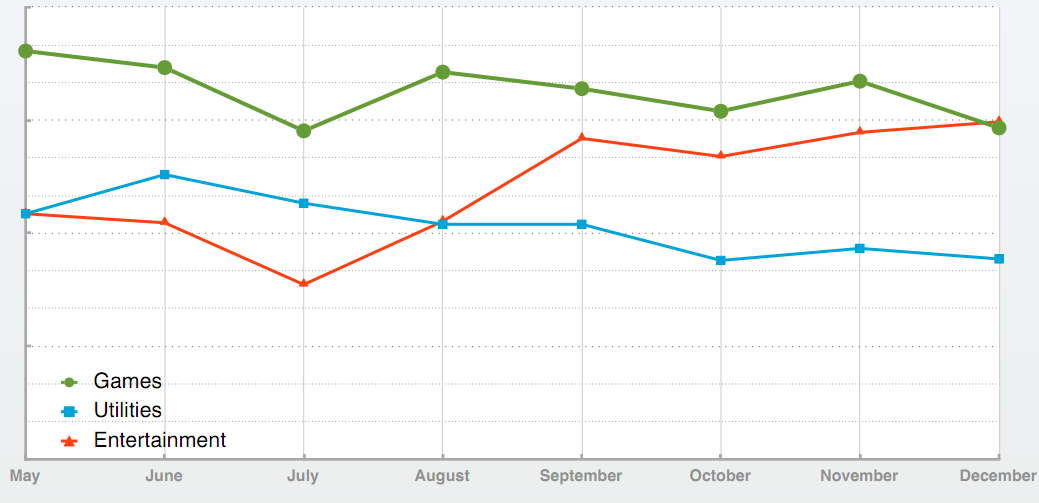
To begin, Chomp took a deep dive in category share trends. The very first finding was a bit surprising. Chomp found that games are now seeing a decreasing number of downloads on Android. That’s interesting because we’ve come to think of the mobile gaming market as this booming space, which is defining itself as the top category driving mobile app download growth. But, based on Chomp’s data at least, this is only true for iOS. Over the course of the year, games became an increasingly large percentage of iTunes downloads, but have been decreasing on Android.

In December, for example, games were 36.1% of iTunes downloads and 22% of Android downloads.

So if not games, what’s growing in popularity on Android? I would have guessed Utilities but would have been wrong. It’s Entertainment apps. This includes apps like Netflix, Talking Tom, Crackle and Flixster, to give you an idea.

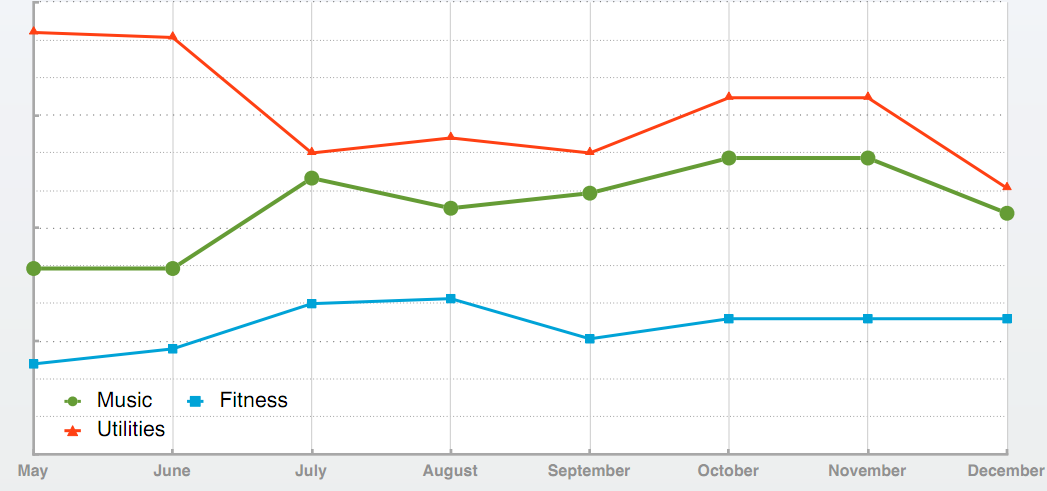
Meanwhile, on iTunes, music and fitness apps have been seeing increased popularity, and utilities are decreasing. Again, this goes contrary to popular belief that normal users (the non-technical/non-early adopters) are looking for more mobile tools – things that help them get a specific task done. Clearly, they’re also enjoying apps Spotify, Mog, RunKeeper and Nike Fitness, too.

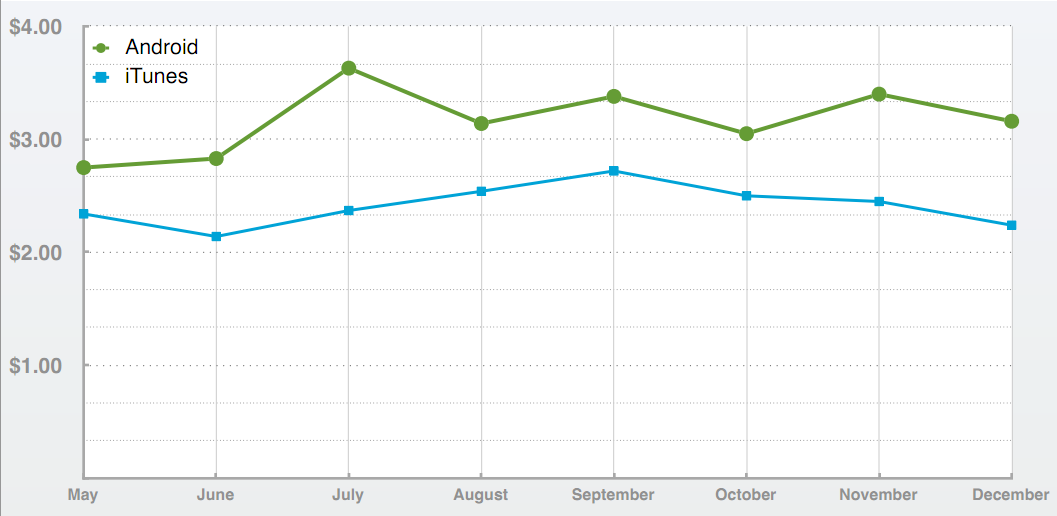
In terms of app pricing, iTunes has seen purchase prices rise by 50% while Android prices have dropped. During December, the average iTunes app purchase price was $0.67 while the average Android app purchase price was only $0.09.

But here’s another interesting twist: the average purchase price for just paid apps is higher on Android ($3.17) than on iTunes ($2.41). This is due to iTunes’ large number of $0.99 downloads, however, which throw off the average.

It also has to be noted that Android sees a really low number of paid downloads (5%) compared with iTunes (22%), according to Chomp.

Finally, Chomp revealed its top 10 iTunes and Android apps of the year. These are different lists than what the app store itself would show, as they’re based on Chomp’s searches, not raw download numbers.

On Android, the top apps were:

  1. Pandora
  2. Facebook
  3. Lookout Mobile Security
  4. Zedge Ringtones
  5. Advanced Task Killer
  6. Handcent SMS
  7. Dolphin Browser
  8. The Weather Channel
  9. TuneIn
  10. GasBuddy

On iOS, they were:

  1. Angry Birds
  2. Facebook
  3. Dropbox
  4. IMDb
  5. Pandora
  6. Angry Birds Seasons
  7. SoundHound
  8. Netflix
  9. Angry Birds Rio
  10. Instagram (also Apple’s pick for “app of the year”)

These lists really help to showcase the differences between the two mobile platforms. Although Entertainment apps may be on the rise, Android users are still focused on tools and utilities, from mobile anti-virus programs and task killers, to things that will enhance or replace stock apps, like Handcent SMS or the Dolphin web browser. It will be interesting to see if, by next year, these trends will have changed at all, allowing the increasingly popular Entertainment-focused apps to emerge on the top Android apps list.

On iOS, there’s definitely more focus on having fun, with three versions of Angry Birds, music and photo apps, and Netflix, making the cut. The only remotely “utility-like” app on iOS’s like would be Dropbox.

Overall, the most interesting thing about this report was how it helped reframe some common misconceptions – that Android users only like utilities, for instance, or how cheap the paid Android apps are. They may be few and far between, but they’re not necessarily cheap.

Chomp’s full report includes its own Staff Picks section and a look into Chomp’s traffic search trends, too. (Contact the company if you’re in need of a copy). And may I just say: more data like this, please.


10 Ways to Leverage Facebook for Startups: Part II, On-Site

ryan_dogpatch_reasonably_small-121

This is a guest post by Ryan Spoon (@ryanspoon), a principal at Polaris Ventures. Read more about Ryan on his blog at ryanspoon.com.

Yesterday I discussed how to improve user acquisition, activation and activity by building Facebook directly into your web experience. There is of course another half to the equation: leveraging Facebook.com to expand your reach and engage your users.

On-Facebook success is less product-heavy than success off-Facebook, although they both ultimately aim for the same outcome: engagement. While it is as much an art as a science, if you optimize for engagement and continually test your way across Facebook’s myriad of products – you may well find yourself sitting alongside The Rock (Facebook’s best personality?) and Spotify (terrific example of being a platform first-mover).

As a startup, you may not reach the scale Spotify or the brand / reach of Starbucks (27 million fans) – but this guide will help you think about strengthening relationships with your fans, expanding your fanbase and unifying your off-Facebook experience with your on-Facebook presence.


The Ecommerce Revolution Is All About You

Amazon

Personal recommendations have always been a part of ecommerce, but there has been little innovation since Amazon introduced retail and product personalization 10 years ago. But with the increasing mountains of data at digital retailers’ fingertips, ecommerce is about to get even more personal.

The fact is that right now there is little iteration from personalized ecommerce beyond what is taking place on Amazon. So you’ll see suggestions of what other shoppers who bought a certain item also purchased, or recommendations to similar items to what you have purchased, but there is a whole world of social data, and even more-in-depth purchase data that can be mined by retailers to help increase sales.

Kleiner Perkins partner Aileen Lee agrees with me, “In the future, the best  retail sites will know you much better and show you things that are much more relevant.” Lee has helped lead investments in a number of e-commerce companies including Offermatic, One Kings Lane, Plum District, Rent the Runway, and Trendyol and held operating roles at The Gap and North Face.

“We are just at the beginning of a revolution of e-commerce, and existing retailers are going to have to get better at personalizing the experience for consumers,” Lee says.

“Personalization was really important in enabling Amazon to differentiate itself and grow in past ten years,” David Selinger, CEO and co-founder of RichRelevance. Selinger also was Amazon’s Manager, Consumer Behavior Research and helped build some of the site’s personalization features a number of years ago. “Personalization will be the differentiating factor in e-commerce and digital commerce going forward, especially for multichannel retailers and new entrants online.”

Amazon and Netflix represent the first wave of personalization. I believe that we are going to enter into the next wave of a more personalized e-commerce experience as retailers and e-commerce sites move towards mining data to improve sales and conversions.

It’s highly likely that you have helped boost Amazon and Netflix’s conversion rates on movies, books, or other products thanks to personalized suggestions of items that you may like based on your previous purchase data, other consumers’ purchase history and more. In fact, it’s so seamlessly baked into the user experience for both companies, that I tend to not even notice how impactful personalization is on what I purchase.

That’s not to say that Amazon is the only retailer experimenting with personalization. eBay has also been personalizing the marketplace experience with recommendations of similarly viewed or bought items for some time, and is looking to expand personalization efforts with PayPal. And with the recent acquisition of Hunch, we know eBay is going to ramp up data mining.

Recently, I started to receive emails from Gilt Groupe that suggested similar earring to like those those I had added to my wait-list on the e-commerce site. The company also sends personalized email notifications on sales that are tailored to each customer. Gilt, who declined to comment for this piece, seems to realize that personalization is going to be a key product driver for the site in the future. And brick and mortar retailers like Saks Fifth Avenue, and many others are also starting to jump on the personalized email bandwagon.

The Challenges

The best way begin understanding the opportunity of personalization in the future is to realize the immense challenge that retailers face when approaching personalization. As DJ Patil, Data Scientist in Residence at Greylock Partners, explains, “When you go to Nordstrom you have a shopping assistant helps direct you, basically says ‘I’m here to help, what do you need and here’s where to find this.’ No online retailer has quite nailed that,” he explains.

For most retailers, the toughest hurdle is to have enough data on an individual to actually help personalize the experience. For the majority of buyers who purchase from a specific site once every few months, or even less frequently, a retailer may have no real sense of direction on how to present similar products.

Getting these data points is the biggest challenge that retailers face. But retailers do have significant data for the small amount of regular, routine customers for an e-commerce site, including clicks, purchase history, shopping cart information, shares and Likes, and more. Retailers face challenges on how to store and organize this data, and then turn this into personal recommendations

And data comes in various forms. There’s implicit data (which is gained from your everyday actions on a retailer’s site) and explicit data (which you offer to sites via surveys or quizzes). While retailers are doing more with the implicit data (i.e. reminding you when you left items in your shopping cart); no one has yet mastered the art of capturing that precious explicit data.

Google’s Boutiques.com tried its hand at this, as a search engine and fashion site which allowed users to receive personalized clothes and accessory recommendations based on preferences and actions. But Google subsequently shut the portal down last September.

Asking for users to fill out surveys of what they love or like perhaps isn’t the ticket to drawing explicit data, such as brands you love, colors, styles and more. As Patil explains, retailers who ask for this information need to present this as more of a conversation as opposed to replicating the feel of a doctor’s appointment where you are filling out your life history via forms.

Getting these signals from consumers is very difficult from a UI and user experience stand point, he says. His advice to retailers is to find a way to replicate how a store owner or shop keeper would engage you in a conversation when walking into a store and looking for something open-ended, such as a birthday gift. One way to do this is to present a personalized item suggestion but ask the consumer (in a Pandora-like fashion) if the recommendation sucks and how they can make the shopper’s life better “People want to help the system and love to correct things,” Patil says.

And similar to Pandora, people become more invested in a platform that knows their preferences and will be more likely to return.

There’s also the issue of finding the balance between providing serendipity in terms of discovery and personalization. Retailers still want their sites to be this Pandora’s box of discovering items, literally, but personalization can cut down on this discovery process. So retailers need to both anticipate what consumers may want to purchase on the site but also provide items that consumers will be able to feel like they ‘discovered’ on the site.

Patil draws an interesting comparison with how grocery stores have been able to structure their layouts to provide serendipity and useful discovery. “When you go to the supermarket, the stores know you are definitely going to milk aisle, so they often put it in the back of the store, so you can find serendipitous stuff on the way. Online retailers need to replicate that on e-commerce sites.” In the end, the goal is to be able to deliver personalization without being predictable.

At a macro level, retailers also face challenges in finding talent to sort this big data. The difference between doing data personalization well are radical shifts financially for retailers, Selinger explains. The engineers who are able to parse these massive amounts of data are hard to come by, and expensive.

Social

Social data (i.e. the Facebook Likes of products, what products people are recommending on Facebook or Twitter) is going to be a big part of personalization for retailers in the future. Already plenty of retailers are using Facebook social plugins and Connect integrations to leverage Facebook data to show visitors what friends bought or shared, what products relate to their Likes, and which friends they might want to invite.

The problem with this data is that much of it is unstructured, and there is really no one who has effectively nailed social personalization in the commerce arena the way Amazon was able to do with data from purchase behavior. Blippy attempted to socialize purchases, but it failed. Amazon also allows you to connect to Facebook to access your friends’ Likes and recommendations but I find this UI to be clunky, and not very useful.

Selinger thinks that mining social data for ecommerce may lose steam before it takes off, drawing the comparison to email. “In 2007, if you were to walk into VC’s office with an idea about ecommerce and email, you would have been sent out the door,” Selinger says. But he explains that while there is an inherent enterprise value in this social data, it will take a long time to take off, similar to the way it took awhile for personalized email and commerce models to enter the market. “When someone figures out how to do it and do it well, it will grow really quickly,” he maintains.

The challenge for retailers is making sense of the Facebook news feed — i.e. streamlining recommendations, attaching brands and tags to this data and then serving this to shoppers in a useful, personalized format. Basically, your social network can become your Consumer Reports.

The challenge for the data mining community, explains Patil, is actually figuring out the intent in much of the unstructured data that is posted about retail products and brands on Facebook. And it’s important to keep in mind that some of this data from Facebook users is private.

This past week, Facebook partnered up with sixty different startups to add their “stories” to Facebook Timeline, through apps that span different verticals from Food, Fashion to Travel. Part of this involved adding new actions (in addition to ‘like’) to Timeline story options. That includes the verbs ‘bought’ and ‘want.’

There is tremendous potential in developers and retailers being able to mine this data from ‘boughts’ and wants’ as opposed to the open-ended ‘like.’ You can see details on what social shopping mall Payvment is doing with the new protocols here, but basically, the ability to add these targeted buttons could be game-changing for social discovery in e-commerce.

Privacy

Echoing Lee’s thoughts, Patil is confident that there will be a new wave of personalization and e-commerce. But without data, there is no personalization. So consumers both on Facebook as well as on retail sites will have to be more willing to give up key data like purchase history, Likes and other social actions, and even location in order to get a more personalized shopping experience on retail sites.

The key will be getting consumers to understand that more data will improve their shopping experience, and making the choice of opting-in a no brainer.

Selinger agrees that privacy is going to be an important issue in the next tranche of personalization innovation. “Now more than ever, consumers are more cognizant of what’s happening with their data,” he says. But what retailers have in the favor is a strong foundation of privacy practices, because these companies have had to protect consumer financial and credit card data for time. Selinger believes that retailers will be very thoughtful about privacy and data sharing going forward.

Perhaps sites like Blippy and Boutiques.com were ahead of their time when it came to consumers willingly handing over the keys to their shopping and payment preferences. I envision a day when there will be an app that reads all of your purchase history via your email account and then serves you recommendations based on this data. There are some companies who are already parsing through receipts in your inbox to organize purchases, so why not take this a step further.

And these personalization strategies that are being adopted by retailers are already trickling down to other kinds of sites beyond e-commerce as well. In the same way that ecommerce sites are trying to maximize sales and profits with this data, content sites are also using social and other data to add relevance to their platforms.

So shoppers, be prepared to give up your data. In the coming year, we’re going to see many more retail sites ramping up data-driven discovery. And e-commerce sites who aren’t thinking about how to mine social and other forms of data are probably going to be left in the dust by the Amazons and Netflix’s of the next wave of personalization.


Google, Facebook, Privacy — And You

google privacy policy

Editor’s note: Guest author Keith Teare is General Partner at his incubator Archimedes Labs and CEO of newly funded just.me. He was a co-founder of TechCrunch.

Like millions of other people, I got an email from Google this morning. It was entitled “Changes to Google Privacy Policy and Terms of Service”. The first sentence describes the intent of the changes as shortening 60 policies into one, and improving their readability.

Then there is a longer explanation captured in the graphic above.

The email goes on to assert that Google has not changed its privacy policy and will not sell our personal information to third parties – “Our privacy policies remain unchanged”. So what is going on here?

Facebook is the shiny object that Larry is focused on.

This is a week where Sheryl Sandberg – Chief Operating Officer at Facebook – spoke at Hubert Burda’s DLD conference in Munich and stated that we were in the middle of 3 trends. First, a trend “from anonymity to real identity”. Secondly, a trend from “wisdom of crowds to wisdom of friends” and third, a trend “from being receivers of information to broadcasters of information”. See the video below for the actual points she made. It was a thoughtful and at the same time a polemical speech, a speech with a strong point of view. In thinking about Google’s privacy policy changes it helps to listen to Sheryl’s remarks and reflect on the context.

Facebook is saying that the Internet as a pure information retrieval mechanism is dead. That the “readwrite” web that began as long ago as cheap web site hosting in 1998, has entirely replaced the read-only web. That the identifiable author has replaced the anonymous one. We are broadcasting and we are identifiable. That reading what friends say is now dominant in that world. Facebook envisages a future in which we all broadcast almost everything to almost everybody.

Google’s problem.

In that world, Google’s PageRank algorithm is seriously out of date. It promotes pages based on the number of links to it. Today, pages are no longer the unit of publishing. Far smaller items than a page dominate our senses. And those smaller messages are produced in huge quantity and in real time. So the signals that make something relevant have now changed. Facebook (and Twitter) have oodles of such signals. Google, until recently, had none.

Google’s solution.

The changes in Google’s terms and conditions are primarily focused on providing the company with an integrated set of data capable of feeding it signals about what is and is not relevant to each of us as we search the vast amount of data produced by the second. In that sense it is not only the right strategic move, it is a question of life and death. Google is doing a pivot, in order to remain relevant. It’s hard to disagree that this is necessary. It also seems clear that neither company is being intentionally “evil”. However, there is a dilemma for both Google and Facebook as we go down the “we are all broadcasters now” path. How can they gather the signals that feed insight without making decisions for the user about what is private, selectively shared or public?

We, the people!

There is a discernible and growing reaction against both Facebook’s new sharing paradigm and Google’s policy changes. As implicit sharing, or as Sheryl Sandberg calls it, broadcasting, replaces conscious sharing, many are growing disillusioned with Facebook taking liberties with their behavior. The same instinct is making many people focus on the assumed bad intent behind Google’s modifications. Broadcasting our “real identity” is not something anybody wants as a default, and many don’t want under any circumstances.

Privacy is becoming a product issue, not only a policy issue.

In the past privacy advocates on the Internet were primarily focused on privacy as a policy issue, and the privacy lobby was mainly made up of policy professionals. In the period since Facebook’s 2011 F8 conference, we have seen consumers begin to have strong opinions about the use of their data. The past week has accelerated this trend. Product managers now need to think long and hard about the assumptions built into their products and ensure they are serving consumers not just in words but in fact. Consumers are at a tipping pointy in not tolerating all-inclusive policy decisions by service providers that impact who sees their stuff.

Google and Facebook are between a rock and a hard place.

There is a big structural problem for both Google and Facebook as they contemplate the product consequences of consumer reactions to their product roadmap. In a centralized platform it is incredibly hard to create easy-to-understand controls that give each user the ability to control, at a granular level, what they share and who with. Grand policy shifts, like that which came out of F8 and which we are now seeing from Google, tend to assume all users are the same and will want the same thing.

In reality, users are more complex. I might want to save a private video to a personal storage space one moment, share something with a select group of friends another moment, and broadcast something to the world five minutes later. The web services infrastructure that both Facebook and Google are based on does not easily permit such fine grained control for users without also imposing serious effort. As we all know, that leads users to stick with the default settings most of the time.

So, despite good intent by the teams at both companies, one-size-fits-all decisions are the norm.

Mobile to the rescue?

Structural problems usually require structural solutions. What it seems consumers are asking for is a world in which we all know what we are sharing and who with — but where we don’t have to do a huge amount of work to achieve that. Google Circles seems to be a nod in this direction as are Facebook’s groups. But neither is really easy enough or sufficiently integrated into the flow of the products to really solve the problem. Both require a huge management overhead.

As I argued earlier this week in “Google, Look Out Behind You!“, the spread of smartphones may be part of the solution here. Hundreds of millions of consumers are now carrying around connected still and video cameras with lists of contacts in the address book, often already organized into meaningful groups. Decentralized decision-making is very easy when there are decentralized software clients under the unique control of each user. The ability to be private one moment, selectively share the next and then publicly broadcast a few minutes later is easy to achieve in this decentralized software architecture. And service providers can never become bad actors — simply because they do not own our information or the full social graph. The cloud becomes a means of delivering messages to the phones and the place where we store our media. But it’s not the place we need to trust to make decisions about what gets shared and who with.

Software can truly reflect the wishes of each human being in each moment in this world. It couldn’t be structurally more different from the past 10 years of centralized web services.

What’s Next?

Products will need to become increasingly more human as they become more mobile. Privacy can go away as an issue if that happens. All decisions about where data can travel will be able to be made by the individual, each time they produce data. We will all be able to be private, share selectively or choose to broadcast with relative ease.

We are moving to a period where it will be considered intrusive and unwelcome if our service providers have any point of view about our sharing behavior. “Just trust us” will not be necessary and certainly won’t cut it. Capturing moments in one’s life, with the choice of whether to share, and as importantly, who to share it with, will be in the hands of each individual. The service provider will merely execute the user’s wishes. If you think about it, it’s kind of like what email service providers do today. I can’t wait.


Curebit Apologizes for Copying 37Signals: “Stupid, Lazy, and Disrespectful”

curebit logo

That’s awkward: Just as it was announcing a $1.2 million round of funding, online referral startup Curebit was caught lifting designs and code from 37Signals, the company behind popular collaboration tools Basecamp, Highrise, and others.

The copying was called out on Twitter by 37Signals partner David Heinemeier Hansson, who, after an exchange with Curebit co-founder Allan Grant, called the Curebit team “fucking scumbags.” It probably didn’t help that Grant’s initial responses didn’t seem particularly contrite — he defended the copying as a “quick test” and at one point told Heinemeier Hansson, “Chill dude ” (VentureBeat has a good blow-by-blow account of the initial controversy.)

Now, however, Grant has posted an apology on the company blog — in fact, it attracted so much attention that the blog is crashing. He also published the text on Hacker News:

Recently we launched a site with several pages copied from 37signals’ Highrise. We did more than take inspiration from their design – we actually used html & css code, and hotlinked to images on their site. We apologize to David and 37signals for ripping off their work. It was stupid, lazy, and disrespectful of their creative efforts. It’s particularly painful for us to have done this to 37signals because they are big heroes of ours. We just hope they will accept our apologies.

Grant sent me an email emphasizing his admiration for 37Signals, admitting that he “crossed the line,” and concluding, “I would caution other startups from making such mistakes in an effort to ‘be lean.’”

The controversy attracted particular attention because Curebit was incubated by Y Combinator and raised money from 500 Startups (among others), something that Heinemeier Hansson didn’t hesitate to point out.

It looks like a reader at Hacker News (which is run by Y Combinator) created a post asking for YC co-founder Paul Graham’s opinion. Graham killed the thread, saying that it violated the site’s guideline to “not use posts to ask us questions,” but he also wrote, “I think they shouldn’t have done it, and that they compounded the problem by not taking the initial complaints seriously enough.”

Meanwhile, back on Twitter, 500 Startups founder Dave McClure said he spoke to the Curebit team and “strongly asked them 2 re-evaluate thr policy on design & content; hope they take that 2 heart” and later added, “new founders aren’t children, just inexperienced. furthermore investors aren’t parents, just uncles & aunts. and we all make mistakes.”


Apple Buy Hollywood? That’s A Terrible Idea

hollywood fire

Editor’s note: Jordan Kurzweil ran AOL’s original programming and video group from 2004-2007, and before that built and Fox Entertainment’s first digital studio (1999-2002). He now runs Independent Content, an agency that helps media companies launch new digital products and businesses.

Apple should not use its $100 billion in cash to buy, or buy into Hollywood. While it would most assuredly (ahem, cough) disrupt the system, it would not spur the kind of creative chaos and innovation that would lead to the Emerald City of any show, on demand, for free, to rent, or buy, or subscribe, and organized by taste or popularity, or you! In fact, Apple buying into Hollywood, would actually kill Hollywood. Here’s why:

Time and again, tech companies have proven a keen disability when it comes to marketing and promotion. It is an amazing blind spot, likely born out of tech culture’s macro focus on “the platform” and its abundant disregard for the bits that fill it (the content).

From iTunes, to Netflix, to YouTube, and to Yahoo!, AOL and MSN before them, not a single tech company has been able to build and launch a single media brand that connects in any real way with an audience. They have failed time and again to build awareness and excitement for original shows, live events, new content verticals and new apps with audiences remotely approaching mass. The proverbial timeline is littered with a never ending list of momentary memes, flashes in the pan and never cut-throughs: wacky one of a kind animated web shorts, Red vs. Blue, Lonely Girl, Prom Queen, In the Motherhood, The 9, Gold Rush, The Failure Club. And building excitement — at scale — is what unlocks the value of content.

In contrast to the Hollywood marketing machine, tech companies devalue content. Some would say they do this by making movies, TV shows, music and apps ubiquitously available for low cost, or, for OMG free! But really, tech companies devalue media by jamming it into impenetrable noisy troves, stacks and databases filled with other content of equal, better or worse quality making it completely undiscoverable. Look at iTunes, NetFlix, Amazon and YouTube – tell me, where’s the good stuff at?

If I were Steven Spielberg, J.J. Abrams, or Matt and Trey Parker, I would not want you to take my creative baby and drop it willy-nilly into one of the behemoth digital grist mills left to fight against light saber wielding kitties and direct to DVD softcore. The Apple App Store with its hundreds of thousands of apps does not build value for individual apps, or create real revenue for but a select few top players. It builds value for Apple, by achieving scale, so Apple can make bunk loads of cash by taking pennies off of each transaction, and selling more hardware.

What is missing from all digital entertainment services are efficient, effective promotional platforms — and throwing algorithms, ratings and popularity and trending data at the problem, or gobs of display ad inventory are not solutions. Yes, these tactics help sift and sort the databases of content, or game audiences into clicking and trial, but they do not bolster new brands, help them find audiences and build hits. Can the homepage of the iTunes store build mass hysteria for the next Avatar? On a smaller seemingly more achievable scale, can the homepage of YouTube create demand for the next season of Mad Men? No. But if the next season of Mad Men was only available on YouTube, it would certainly make a large group of people go to YouTube to watch (that is if they could find it), because Mad Men already has value.

Netflix, Amazon, iTunes and YouTube need to develop marketing chops, and ways to communicate with audiences on a deep visceral level. They all have a huge and powerful opportunity to move audiences — an intimate, activated, one-to-one relationship with a person sitting just an arms length away from their computer screen; or on their couch with a brand-new jury rigged gadget, invested, motivated and ready to get their socks knocked-off. Instead, users are greeted with a miasma of cover art, lists of titles in all shapes and sizes and a search box — no communication, no connection.

How can digital entertainment services connect with audiences? Three easy steps, and a bonus feature:

  1. People. Tech companies need to hire people to shine a light on the best stuff, and craft the stories that sell it to audiences (at least for now, until computers catch-up and develop wit, emotion, creativity the ability to write with heart). Some people call this curation. Others packaging and promotion.
  2. Design. They need to create interfaces to capture audiences and connect to users. Living, breathing beautiful displays that make you watch, and want to click.
  3. Tools. Tech companies should leverage what their platforms do best — target, track and account — to deliver those stories to interested audiences en masse.

Bonus feature: Marketing money. If companies like Apple plan to get into the first-run business, they need to deploy some of their treasure chest on good old marketing, online and off — TV commercials, movie trailers, billboards, print, PR campaigns, online display, SEM, social, events and so on. And not to market their platforms, to market programming.

Hollywood is right to resist licensing first-run content to the Valley. The platforms aren’t there, and there’s no discernable path to building value or profit. But once tech companies begin to crack the code of their own networks, develop their promotional muscles, and commit to spending real marketing money to build new media brands, then they will truly be on the path to fuel growth and effect positive change on an industry in search of a future. And they will have the latitude to make advances in how we consume our entertainment.