Keen On… SOPA: Mob Rule or Direct Democracy? (TCTV)

Keen On…..SOPA_ Mob Rule or Direct Democracy? (TCTV) | TechCrunch

My own views about SOPA and the need to protect online intellectual property are well-known. But even I acknowledge that SOPA was a flawed bill that didn’t represent a viable solution to policing the Internet against intellectual property theft. So is there life after SOPA? How can the technology and content communities carve out a compromise which will simultaneously protect innovation and the rights of the creative community?

In the spirit of compromise, I invited Larry Downes, one of SOPA’s most articulate critics, into our San Francisco studio to talk about what comes next. Downes acknowledged that direct democracy on the Internet can sometimes degenerate into mob rule. He also agreed that there is a need for a new kind of dialogue, not only between the technology and entertainment industries, but also involving Internet users – members of communities like Twitter, Reddit and Tumblr – who, he said, needed to be much intimately involved in the political conversation.  This third force, Downes told me, fundamentally alters the power equation and may well also change the legislative process in Washington DC.

But Downes’ main point is a little depressing. Politics changes very slowly and technology changes really quickly, he reminded me. So in 18 months time, he predicted, nothing much will have changed in Washington DC. There still won’t be any legislative solution to the problem of online piracy and that promised dialogue between the two (or three) communities will not have materialized.


Brands Scored 2X Facebook Likes By Posting About Super Bowl

Facebook Super Bowl

Want to win some extra visibility for your brand on Facebook? Post about current events. Brands grabbed 99.7% higher engagement on their Page posts by talking about the Super Bowl yesterday, and 60% higher engagement over the past 6 weeks compared to the average post. The data from a Buddy Media study of 1,400 of the world’s largest brands indicates they should make sure to post about holidays, sporting events, breaking news, and other trending topics.

Why does this work? Because Facebook’s news feed sorting algorithm EdgeRank shows posts to a wider audience if they get high levels of engagement (Likes, comments, and shares) from those who have already seen them. In this case, posts about the Super Bowl were inherently more eye-catching to users and got more engagement, and were therefore shown to more users, netting them more engagement…

EdgeRank also gives more prominence to posts that contain the same keywords as other posts from a user’s network, generating “Brand X and 8 others posted about Super Bowl XLIV”. The feature can help brands posting about current events to reach the news feed, even if  users do have to click to expand these aggregated mention stories.

Tons of brands are missing out on this engagement bonanza, though. Just 30% of the brands Buddy Media analyzed posted about the Super Bowl. So tell anyone who handles social media marketing about this strategy so they can cash in on the upcoming Valentine’s Day, Presidents Day, and Canadian Junior Curling Championships. Well, maybe skip that last one.


When Will The Post-PC Era Arrive? It Just Did.

Scrabble on the iPad

There has been much debate about what the post-PC era is, when it will arrive, or whether it’s already here. But key pieces of new data, emerging last week, are making the case that we crossed the imaginary line from the “PC” era to the “post-PC” era at the end of 2011. According to analysts at Canalys, two major computing milestones were achieved at the end of this year: smartphone shipments outpaced PCs for the first time ever, and Apple became the world’s largest PC maker, if you count iPads as PCs (as well you should).

Combined, what these numbers tell us is that the post-PC era is happening now. Right now. And maybe we need to think about how we define “PC.”

In Q4 2011, vendors shipped 158.5 million smartphones, up 57% on the 101.2 million units shipped in Q4 2010. For the year, there were 487.7 million units shipped, up 63% on the 299.7 million units shipped in 2010. Meanwhile, the global PC market grew just 15% in 2011 to 414.6 million units. The smartphones have won.

The funny thing about that PC shipments number is that, on its own, it doesn’t paint the most accurate picture of today’s PC landscape. There weren’t 414.6 million desktop, notebook and netbook computers shipped in 2011 – those were at 112.4 million, 209.6 million and 29.4 million, respectively. The 414.6 million number includes 63.2 million in “pad” shipments, Canalys’s preferred term for tablets. That means 15% of the “PC” shipments in 2011 were tablets, largely Apple’s iPad. In Q4, tablets were 22% of the total PC shipments. And the tablet segment of the market grew 274.2% year-over-year.

Also in Q4 2011, Apple became the leading worldwide “PC” vendor (if you count the iPad as a PC) with 15 million iPads and 5 million Macs shipped, representing 17% of the total 120 million client PCs shipped in Q4. It overtook HP (now #2), Acer, Dell and Lenovo in the process.

Overall, the PC market grew 16% year-over-year, Canalys noted last month. Without tablets, it declined 0.4%.

Of course, there’s still the question of whether or not tablets should be broken out into their own computing category, positioned against the traditional “PCs” when tracking device shipments. For what’s it worth, I think it’s fine to count tablets as PCs – after all, PC means “personal computer,” not “machine running Windows.” The fact that we still equate the word with a desktop, monitor, keyboard and mouse combo is a testament to the empire Microsoft built, and is now losing.

Case in point: netbook shipments dropped 25.3% from 2010 to 2011. Desktops grew a paltry 2.3% and notebooks grew just 7.5%. This is end of the “PC” era in action. While the 209.6 million notebook shipments still make that the largest category of “PCs,” the growth trends here, if sustained, dictate that’s its only a matter of time before the shift to tablets becomes even more pronounced.

Think about it: what’s the first “PC” you’re going to buy for your kid, as a new member to the post-PC computing generation? If you respond “notebook,” I’d say you’re lying. That kid is getting an iPad, even if they end up stealing yours. If not an iPad, then they’re getting a phone.

And smartphones are PCs, too. The most affordable ones.

This past quarter, smartphone shipments overtook PCs, a hugely important milestone that speaks volumes about the state of modern-day computing. The computer-in-your-pocket has moved from being “a niche product segment at the high-end of the mobile phone market to becoming a truly mass-market proposition,” explains Canalys of the change.

In Q4, Apple broke records by shipping 37 million iPhones – the most ever shipped by a single vendor in a quarter. Previously, Nokia held the record with 28.3 million phones shipped in Q4 2010. What a difference a year makes.

But Canalys cautioned that it expects to see smartphone market growth slow in 2012, as vendors exercise “greater cost control and discipline” to focus on profitability. This is the only discordant note to the report. Smartphone growth slowing? No offense to the analysts, but I’ll believe that one when I see it. Just watching Apple’s sales alone, it’s clear you can’t underestimate its power to deliver record-breaking numbers. In addition, just because vendors like HTC and Motorola are going to launch fewer smartphone models in 2012, that doesn’t (necessarily) mean they’ll sell fewer overall phones. If anything, the companies are hoping that their increased focus on “hero” devices will help them increase sales.

One thing is clear, however: that post-PC era everyone’s been talking about since the day the phrase slipped off Steve Jobs’ lips has arrived. We’re living it. Anyone who wastes their time debating its existence (tablets are PCs! phones are PCs!) is arguing semantics. The shift itself, whatever you want to call it, is happening.

So perhaps “post-PC” isn’t the best terminology. If everything’s a PC, then maybe what we’ve achieved is something more akin to “PCs Everywhere.” Not as catchy, though.

Photo credit top: Lokesh Dhakar, flickr; bottom: agirregabiria, flickr


Amazon Incarnate: Bezos The Book Giant Is Planning A Store In Seattle

holygrail066

According to GoodEReader, Amazon is planning to open a retail store in Seattle this year where they will sell Amazon-exclusive books and, more importantly, Kindles of all kinds. While this looks to be more of a pop-up retail presence than a fully-fledged store, if I were in publishing I’d be circling the wagons right now.

To be fair, Amazon’s own publishing offerings are pretty wonky so far. There haven’t been many runaway successes coming out of the house although Seth Godin and Tim Ferris will soon be bringing their own brand of publishing success and there are some interesting cross-cultural titles coming out. But that’s not why publishing has to worry.

The Kindle was Amazon incarnate, a way for Amazon to bring its online presence into the real world. A physical Kindle store – one that exists in a mall or popular area, even for a short period – is like the third coming. It’s basically a chance for Amazon to grab every else they have missed during the initial run up in Kindle popularity. We’re talking older folks, luddites, grumps, and folks who claim that “reading it in paper” is better. To have them walk up to a display of working Kindles, newly minted and displaying the latest Stephen King book, is the only way Amazon will convince them that going digital is the only way to go.

This will also encourage the movement from the agent-publisher-distributor model of book publishing into a direct to consumer model that Amazon will spearhead. By showing potential authors that they can get their books bound in handsome Kindle editions, they’ll be more likely to go that route instead of pounding fruitlessly against the gates of big publishing. It’s obviously a no-brainer to many of us, but old paradigms die hard.

As I said before, the Fire is Amazon’s Trojan Horse. However, rather than the wary hold-outs bringing in Amazon’s market by buying the fire, Amazon will bring the Trojans to their own branded stores.

The store will appear in Settle in the next few months and presumably be the first of a nation-wide roll-out. I suspect it will be a bit of a loss for Amazon but hopefully it will convert the last hold-outs to the benefits of ereading.


Early Twitter Product Head Anamitra Banerji Becomes An EIR At Foundation Capital

me

When Twitter shook up its product leadership in July, it let loose four Silicon Valley veterans into a talent-starved job market. While the three others have become a VC, a cofounder, and an engineering head, the last one left unaccounted for has a new home. Anamitra Banerji has just joined Foundation Capital as its newest entrepreneur in residence.

In this role, which can mean advising and joining a company or starting one, Banerji has a few ideas he’s going to explore, he tells me. They go beyond his history in the search and advertising business, and build on his experience developing social software at Twitter.

But first, here’s why you may know of him. After cofounding an online health company in India in the late 1990s, he worked for a few years in that country and the US as a software engineer at various larger companies before becoming a manager at early search marketing firm Overture in 2004. He stayed there through its acquisition by Yahoo in 2006, all the way until early 2009. Then, as the first product manager and thirtieth employee at Twitter, he hired many of its engineering and product employees, and developed its ad platform from scratch. This includes Promoted Tweets, Promoted Trends and Promoted Accounts. While Twitter under returning founder Jack Dorsey has gone in some new product directions, Banerji’s impact is still clearly visible at the 700-person company.

“I’m taking some time to step back to see what’s happening out in the Valley,” he says about his plans, “to see what I can do to build great companies, to share my experiences with other entrepreneurs… and to learn a little bit about what it’s like on the other side [at a venture firm].” He’s not new to the work. He’s been advising companies on the side for three years, he recently became a mentor at 500 Startups, and he’s already been working with a team of Stanford students on the Widescope project, which provides a cool interactive data visualization that lets users create their own federal budgets (er, budget deficits).

The areas he’s going to explore could include ads and monetization, but he’s particularly interested in online collaboration — like the Widescope tool — marketplaces, and mobile-focused products. He’s not the first of the four ex-colleagues to start working with a VC. Josh Elman, who is also a long-time Valley product leader, recently became a principal at Greylock. Meanwhile, Kevin Cheng is now the cofounder of Incredible Labs (which is building a mobile personal assistant called Donna), and Jean-Paul Cozzatti is the vice president of engineering at social fundraising site Rally.


Brightcove Will Price IPO At $10-$12 Per Share

brightcove logo

Online video service Brightcove will price its IPO between $10 and $12 per share, according to a new filing with the SEC.

The company first filed for the IPO back in August of last year, saying it wanted to raise up to $50 million. Now, $50 million is at the lower end of its price range. If Brightcove sells the maximum number of shares (it’s set to sell 5 million shares, plus an extra 750,000 if demand is high) at $12, it could raise up to $69 million.

The filing also updates Brightcove’s key metrics through the end of 2011. The company, which sells online video publishing and distribution services, says it had 3,872 customers as of Dec 31. Its revenue grew last year to $63.6 million (from $43.7 million in 2010), but it still showed a loss of $17.8 million. Thanks to plans to “continue to invest in the growth of our business and operations,” Brightcove says it expects to see losses until the end of this year at least.

Brightcove also revealed ambitions beyond video when it announced its App Cloud last year, with its first commercial sale in September and general availability in November, according to the filing.


LL Cool G: Ladies Love Cool Gadgets Too, Says Study

ladygadget

As the only girl on the Gadgets team, I often get asked to write what I call “lady-rants” about products targeted toward women. I have a problem with most of them, as the products themselves are either being forced into a demographic by marketers (like the HTC Rhyme, which would’ve been a fine phone for anyone if marketed that way) or they’re simply painted pink in the hopes that pink is, in fact, what all women have been looking for in their consumer electronics.

The truth of the matter is, men have spent more money on consumer electronics in the past and, as a result, women have unfortunately been left with ads targeted towards men or pink versions of everything. But no more.

According to a study out of the CEA, the same folks that brought you that over-sized week of madness called CES, more and more women are showing an interest in consumer electronics than they were in the past.

Specifically, eight in ten women expressed an interest in gadgets, up 10 percentage points from the same time in 2007. Of those women, 41 percent said they were “very interested” in consumer electronics. But it gets more interesting than that.

In 2007, the spending gap between men and women in the CE space was around $200, with men obviously spending more. Now, men spend an average of $728 over the course of a year, as opposed to women spending an average of $667 during the same period. That’s a difference of just $61.

But even if women spend a bit less and show less interest than guys, women are still a part of the picture when it comes to their man’s gadgetry. According to the study, 61 percent of women either initiate or are involved in the decision-making when it comes to consumer electronics purchases.

Both men and women look at the same things when purchasing a product, most important of which is price, followed by ease of use, warranty, and multiple functionality. Where men and women differ, however, is on size (shocker!). Speaking from the standpoint of someone who wears girls’ jeans, size is pretty important to women when it comes to mobile gadgetry like smartphones and tablets, a sentiment echoed by the study.

And perhaps the most important thing we can take away from this study comes out of the mouth of CEA manager of strategic research Jessica Boothe:

Forget pink. Women don’t want to be catered to with ultra-feminine looking products; they simply prefer lightweight devices that can fit smaller hands and smaller body frames. Women play many roles, like mother, spouse and career women, and CE products that can perform many functions are a necessity.

[IMG Credit: ShutterStock]


Brinno Peephole Viewer Is A Viewer For Peepholes

411I22J8w6L

My Dad, bless his heart, spends all day on the Internet and, like a reverse Cat’s In The Cradle, my dad is just like me in that he loves to find wild junk that he thinks is interesting. To wit: he just found the Brinno Peephole Viewer, an electronic system for looking through a peephole.

To be fair, this is definitely something people need. My parents are getting up in years so they’re getting both blind and paranoid, so anything to assuage those two situations is a plus. This thing attaches to your normal peephole and then displays the scene behind the peephole on an LCD screen. It runs on two AA batteries and costs about $90.

The viewer also reduces fish-eye distortion found with regular, non-LCD peepholes.

It’s definitely not new nor is it particularly high tech, but if you, like me, are dealing with a set of parents who are getting up there in years and need a leg up, it might be a nice investment. Besides, it’s fun to say peephole.

Product Page


“Provocative” Publisher Creates Book That Lets You Talk Back To The Characters

final-design

So in the interest of supporting unique publishing methods and ideas, I thought it might be interesting to talk about Verdant Books and something they’re calling an “interactive novel.” Now my idea of an interactive novel is Choose Your Own Adventure, but this is something fairly unique.

Ok. Here’s the premise:

Hiram and Sibyl Eisenberg have fallen head over heels in love with Leif and Laura Wrightson. Leif and Laura return all the same passion for Sibyl and Hiram, yet all four remain committed to their spouses. What to do? The year is 1971, the place is California, and what never before seemed possible is suddenly irresistible. Camping on the shores of Fallen Lake in the high Sierra, one night they begin a new direction in their lives and those of their children, turning two marriages into one.

Yeah, you read that right. Old Hiram and Sibyl are watching Mother Nature on the run in the 1970s. Hot stuff, right? So here’s where things get really weird. The author, Laird Harrison, is going to update a blog featuring the characters talking about things important to the story. Now, to be clear, I think this is the worst implementation of interactive function I’ve ever seen (especially since all of the “blog posts” (did they have blogs in the 1970s?) are password protected). But here’s what I’m really concerned with.

So it’s going to get easier and easier to publish books. It’s already ridiculously easy, but soon everyone with an idea and dial-up will be able to upload an epub. There will be some good books and some terrible books and there will be varying methods for marketing these books, from the traditional display ad on Amazon to gimmicks like the one above. I do see the value in a sort of “meet-the-author” kind of website where you ask the author questions about his stuff and I do expect publishers to create more and more of this gimmickry in order to sell bits to an audience that is already wildly distracted, but I worry that, like the site that was going to sell soundtracks to books, this is a Bad Idea (TM).

There are ways to change the monetization systems around the distribution of long-form writing. Selling 10,000 word articles about Afganistan for 99 cents a pop is a great model to bring monetary incentive back into reporting and journalism as well as non-fiction writing and editing. We are fast approaching a time when the devices we use to read books will be far more distracting than they even are today. I, for one, always intend to open iBooks or the Kindle reader on my iPad and instead check Twitter and email. It’s a sad, sad day when I long for a standalone, e-ink Kindle over a fully-featured Kindle Fire because I want to read more.

So anything that will pull me out of the book experience is a negative, anything that keeps me reading is a positive. Gimmickry and “viral efforts” work maybe once in a thousand times. Good writing works every time. So let’s hear it for old Hiram and Sibyl and their blog and here’s hoping Harrison sells a few books. But I’d really like to raise a glass to good writing. It will save publishing, even if the publishers thwart it at every turn.


Social Commerce Network Lockerz Debuts A Pinterest-Like Self-Expression Platform

lockerz-picture

Kleiner Perkins-backed social commerce network Lockerz is debuting a new Pinterest-like self-expression platform, where members can create and share collections of images and videos from anywhere on the Web. But unlike Pinterest, users can actually receive rewards for sharing content, which can be used to get discounts in the Lockerz store.

As we’ve reported in the past, Lockerz revolves around the idea that influencers within a social network can become brand and content advocates and affect the behavior of their friends. The network, which says it is seeing 45 million monthly uniques, is primarily targeted towards men and women ages 13 to 30, attempting to build a community of trendsetters and tastemakers who love to shop, play and connect on the Web. Users can earn points and discounts on brands by sharing content on the site. Founded by Kathy Savitt, a former Amazon and American Eagle Outfitters exec; Lockerz eventually wants to be the go-to commerce homepage for teens and young adults.

Lockerz members earn what the network calls ‘PTZ’ for nearly everything they do on the site, which are used to get discounts on hundreds of products offered in the Lockerz Store. Since its inception, Lockerz members have used nearly 3 billion PTZ for millions of dollars of savings on brands, including 7 for All Mankind, James Jeans, Xbox 360, Nintendo, SkullCandy, Canon, and Olympus.

Collections are created by “grabbing” images and videos from almost any website. Users can do this by downloading a bookmarklet or by posting images and videos manually. Videos can be grabbed a number of online video platforms including Hulu, Vimeo, MTV, VH1, Funny or Die, Comedy Central, CollegeHumor, and YouTube. Users can also grab images from other users’ existing Collections to create their own, which in turns rewards the original creator with PTZ.

While the new self-expression platform draws a lot of similarities to fast-growing online pin board Pinterest, Savitt tells us that the new feature has been in the product roadmap for some time now (perhaps even before Pinterest took off). Savitt adds that Lockerz will be working with brands and celebrities to curate sponsored Collections as well.


Sonic Youth

<< Previous
|
Next >>


2012 Chevrolet Sonic hatchback

<< Previous
|
Next >>

Millennials, Generation Y, Echo Boomers — there are 40 million of us in the workforce now, and we’ve got money to spend. On our friends, our families, and our first car purchases.

Chevrolet is keenly aware of this burgeoning automotive audience, and has zeroed in on the youth of today with its latest offering, the Chevy Sonic. The latest econo-compact from Chevrolet replaces the company’s old Aveo line, and follows hot on the heels of the über-successful, top-selling Cruze. The Chevy Sonic slots in with other sub-$20K subcompacts like the Ford Fiesta, Honda Fit and Hyundai Accent, but it’s got the price point, performance and spunk necessary to stand out in this perennially crowded category.

The Sonic’s exterior is sporty, reminiscent of the Cruze but more fun, with angled contouring along the sides and those circular headlamps that are so in style. It’s available as a four-door sedan or a 5-door hatchback, and I drove both configurations in my test. The interior of both models is comfortable and surprisingly spacious. Details like a leather steering wheel and contrast stitching on the soft, Neoprene-like “sport cloth” seats (which you can swap out for “leatherette”) make the Sonic feel more high-brow than its price tag would suggest.

With a name like Sonic, you’d think Chevy’s new subcompact would have a little boom under the hood. Not so — at least for the 138-horsepower, naturally aspirated 1.8-liter four-cylinder automatic. Slam your foot to the accelerator and you won’t get any sort of enthusiasm out of the Sonic. Acceleration is steady and smooth, no matter how hard you’re pressing the gas. If you’ve got a slow-poke big rig in front of you on a two-lane highway and an oncoming car on the horizon, you’d better not chance a pass, as you may not make it. The 1.4-liter six-speed manual Turbo, which also boasts 138 horsepower but with 148 pound-feet of torque, provides a bit more pop than the automatic.

At least the Sonic showed some spark once I took it off the freeway and onto the side roads that wind through the hills south of San Francisco. There, the car proved light and fun to drive, handling sharp curves deftly and almost feeling like a sports car when accelerating back up to speed.

The Sonic gets some respectable mileage. The EPA rates the 5-door hatchback at 40 mpg on the highway and 29 in the city, and 35/25 for the automatic sedan (the manual transmission earns 26 mpg in the city). Also, you’ve got 10 airbags (including dual front-knee airbags) and a four-channel anti-lock braking system with brake assist.

The Sonic’s body is built from a mix of high-strength steel frame elements, making it structurally stiffer than its predecessor the Aveo by a big margin (Chevy says it’s 60 percent stiffer). That rigidity, plus MacPherson struts and 100 percent alloy wheels, helps dampen the interior noise while improving the drive. Generally, I found the car to be well-balanced, but the rear of the hatchback got a bit bouncy on rougher terrain.

There’s a handy feature called Hill Hold, which of course, I had plenty of opportunities to test here in San Francisco. It detects when the car is on an incline (or decline), and it holds the brake down electronically for about 2 seconds, giving your foot time to switch to the gas before the car has a chance to stall or roll forward or backward. This is standard on all Sonic models, but extra useful for the manual LT and LTZ models.

The interior impressed me during my test as well. One would expect the youth-centric Sonic to come with a lot of smartphone-friendly tech in the dash, and the big stuff is here. Bluetooth connectivity is standard on the LZ model, and available as an option on the more basic models. Pairing is super simple — just a few button presses — and then you can use the controls on the steering wheel to flick through your playlists and to answer calls. Other options include a USB port and SiriusXM satellite radio.

The modular, motorcycle-inspired instrument panel is pretty hip looking. An analog tachometer sits on the left, and the monochrome digital display on the right shows your speed, average fuel economy, and direction.

Chevy has put a lot of personality into the design of the Sonic, the 5-door in particular. With above-average cargo space, remarkably stable electronic power steering and a smooth road feel, the car has more going for it than you’d expect, especially for one that starts at around $15,000. The only thing lacking is power. There’s no boom in the Sonic. If drag racing at red lights is your thing, look elsewhere. But suburban commuters and city slickers likely won’t mind the Sonic’s modesty.

WIRED Roomy interior and 19-cubic-foot trunk let you pack in friends (and their luggage) for road trips. Nimble driving feels like you’re piloting something sportier. Hill hold feature takes the stress out of manual shifting during hilly city driving.

TIRED You’ll have to opt for the 1.4-liter turbo manual for any semblance of muscle. No in-dash nav, but really, that’s what your smartphone is for. Mostly plastic interior could be a turn-off for those seeking more upscale accoutrements.

Facebook Javascript API Goes Down, Taking Down Likes, Comments And Apps With It

Screen Shot 2012-02-03 at 8.18.55 PM

I dare you to Facebook Like or even comment on this post. You can’t, because the Facebook Javascript API, the backend system which allows developer applications and Facebook’s own apps like Likes and Comments to communicate with the data available on the social network, is down, and has been down for at least an hour as far as I can tell, begging the question, “If article falls on a blog and no one Likes it, does it make a sound?”

Okay, that was lame, I’m sorry.

The JavaScript API status on the Facebook developer blog reads:

“Currently, the JS SDK is returning /* Not a valid locale. */. We are working on a fix now. We will update the live status as we have more information. You can following along in https://developers.facebook.com/bugs/20327564310313″

Presumably thousands in the developer community are somehow affected (I’ve emailed Facebook for more concrete details and will update this when I have them), for example apps like Turntable.fm, Quora and TinyChat have lost their Facebook Login capabilities.

“I think this is the longest downtime ive seen of their API,” said one concerned developer.

Maybe we should all get off the Internet and just, like, go outside while it’s fixed? Got Diet Coke? Sounds like a plan!

Update: Comments and Likes seem to be working again. Comment and Like away!


Investors Drive $ZNGA Up 26% In Two Days Following Facebook IPO Filing

Screen Shot 2012-02-03 at 6.46.46 PM

Those of us who have been following the social gaming industry already know that Zynga makes up a big portion of Facebook’s revenues. But lots of public investors only seem to have gotten the memo on Wednesday evening, when Facebook’s S-1 filing revealed that the developer accounts for 12% of its total revenues, or $445 million.

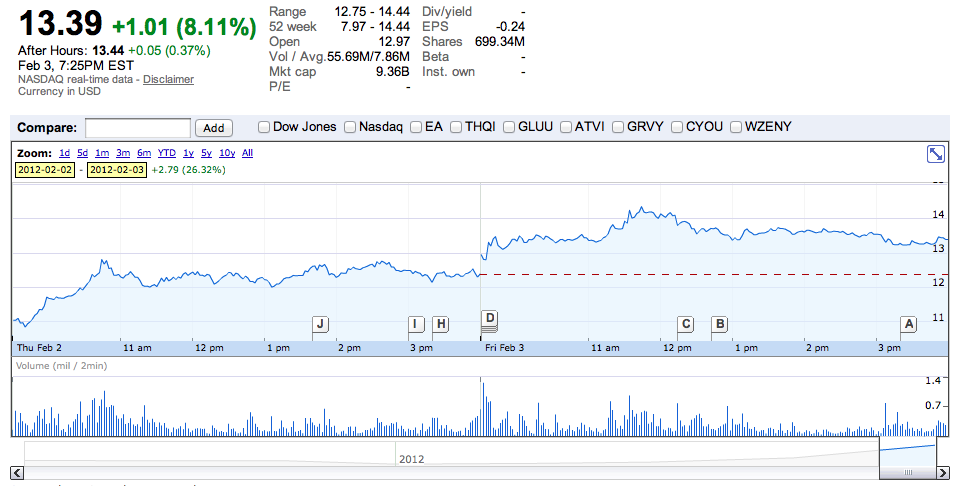
In the two days since, Zynga’s stock has gone up more than 26%, to close at $13.39 this evening.

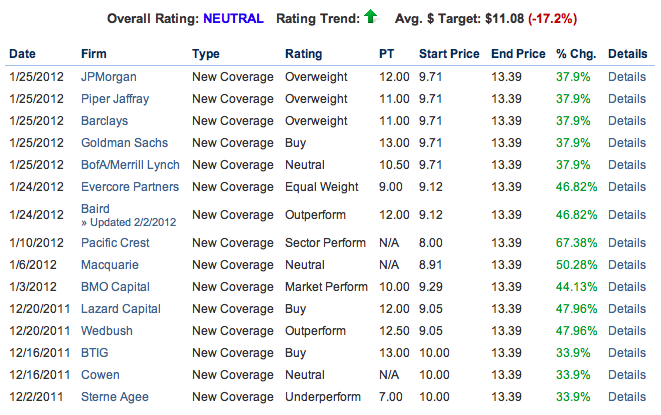
This is far more than most analysts had previously projected. The ones who began covering Zynga after its December IPO had pegged its stock well under ten bucks. When analysts at banks who underwrote Zynga entered the fray a couple weeks ago, they were unsurprisingly more bullish. Following the end of the quiet period, Goldman Sachs, Morgan Stanley, J.P. Morgan and Barclays Capital, along with analysts from banks not involved in the IPO, all put their target price above Zynga’s public opening amount of $10.

This drove the Street’s average target price up to $11.08, as you can see from the StreetInsider table below.

Existing industry research, namely the Inside Virtual Goods report from my previous company, Inside Network, had indicated as of last fall that virtual goods revenue from Facebook applications reached $500 million last year. Facebook’s prospectus more than confirmed this on Wednesday, revealing that a strong fourth quarter had actually put the number a little higher, at $557 million.

There are other data points you can use to try to figure out Zynga’s position with that number. AppData traffic shows that it has a dominant traffic position on Facebook’s platform. It gets 90% of its revenue from Facebook, but first Facebook collects 30% of its virtual goods transaction sales, per terms that have been in effect since midway through last year. And, Zynga has since at least 2009 used Facebook ads as a main way to bring in new and returning users.

The problem is how to add this up. The Wall Street Journal’s Rolfe Winkler explains the confusion in how to calculate the results:

Different assumptions lead to different estimates for Zynga’s fourth-quarter “bookings,” which is the preferred method for measuring Zynga’s top line. Macquarie analyst Ben Schachter’s quick-and-dirty analysis says Facebook’s disclosure implies $268 million for Zynga’s bookings for the fourth quarter, short of the $302 million analysts are expecting. Baird Equity Research analyst Colin Sebastian digs deeper, making more assumptions, and comes out with a number of $315 million. Both analyses included many caveats.

Heavy trading volumes indicate high volatility among investors. Zynga will do its first ever earnings call on February 14th. Get ready for some new estimates.


I Use Wikipedia More Than Makeup

Screen Shot 2012-02-03 at 7.23.35 PM

I just donated $40 to Wikipedia, because I promised myself I would every time I poked fun at its holiday donation drive and then just never got around to it. Did you know that you could actually donate during the off-season (Via the covert “Donate to Wikipedia” link at the far left of each individual entry page)? I didn’t, before I asked Wikipedia founder Jimmy Wales whether it was possible to donate in the off-season. Spoiler alert, it is.

My 40 bucks got me, in addition to the very sweet ‘Thank You’ letter below, the satisfaction of paying duly for something I use all the freakin’ time.

Dear Alexia,

You are amazing, thank you so much for donating to the Wikimedia Foundation!

This is how we pay our bills — it’s people like you, giving five dollars, twenty dollars, a hundred dollars. My favourite donation last year was five pounds from a little girl in England, who had persuaded her parents to let her donate her allowance. It’s people like you, joining with that girl, who make it possible for Wikipedia to continue providing free, easy access to unbiased information, for everyone around the world. For everyone who helps pay for it, and for those who can’t afford to help. Thank you so much.

I know it’s easy to ignore our appeals, and I’m glad that you didn’t. From me, and from the tens of thousands of volunteers who write Wikipedia: thank you for helping us make the world a better place. We will use your money carefully, and I thank you for your trust in us.

Thanks,

Sue Gardner
Wikimedia Foundation Executive Director

This year the Wikimedia Foundation raised $20 million during its high gear donation drive, to cover a total budget of $28.3 million — the deficit is made up in grants and off-season donations. Money raised is spent on things like servers, bandwidth, maintenance and staff. Here are the financials if you want to dig deeper.

During the online encyclopedia’s blackout protest of SOPA, many off us felt the pang of “You don’t know what you’ve got until its gone” when we wanted to know something about, let’s say, Exponential Growth and that info wasn’t readily available. Google would be a bunch of spam if not for Wikipedia.

I personally use Wikipedia more than I use makeup, multiple times a day. And I spend a good amount of money on makeup, AT LEAST $40 on a mascara/lippy combo.

What do you use Wikipedia more than? Do the math …


Google Adjusts Political Posture With Sponsorship Of Conservative Conference

redblu

In interesting but ultimately not very shocking news, Google has signed on as a major sponsor of the Conservative Political Action Conference, which is more or less what it sounds like. Not that there’s anything wrong with that. It’s just a little odd seeing Google, which is becoming increasingly political, listed next to such organizations as the Koch Institute, the Heritage Foundation, and the NRA.

But this isn’t the moment Google comes out as a closet Republican. It’s actually quite in keeping with Google’s position of aggressive neutrality.

Google says that it’s there because it’s a great place to promote their election-tracking site, push Google+ as a platform for sharing and collaborating, and because the conference is fairly young and tech-savvy. Hard to accuse them of pandering, or of partisan pandering anyway.

And that’s sort of the point. Google will no doubt be sponsoring similar events on the left side of the political spectrum as well (they say as much, but haven’t announced anything specific). The message is: hey, we just provide a service. No agenda here.

Not that Google is totally apolitical, but their fierce opposition to SOPA was more like a mother bear defending its cubs than a deliberate political decision. On the other hand, they did go out of their way to take an official stance against Proposition 8. By and large, though, they have avoided taking a stance on hot-button issues.

Can Google actually remain neutral? SOPA was the product of bipartisan ignorance and greed, not just left or right, but what if the next bill threatening a Google territory were to be led by one party or the other? Or what if Google refuses to support, say, a communications embargo with a terrorist-harboring country, or such like? The dance they’re doing will become increasingly difficult if they insist on putting their neutrality on a pedestal for much longer.

On the other hand, this may be overthinking it. Why can’t a company spend a little cash to have a ring in the political circus, and not choose sides overtly? No reason. But, as has been observed in other contexts, sometimes the only winning move is not to play.