YouTube’s Latest Original Programming: Olympic-Style Lightsaber Relays

chris hardwick lightsaber

Here’s a fun example of the original programming that YouTube is supposed to be investing in these days — a relay from Santa Monica to San Diego. With lightsabers.

Geek celebrity Chris Hardwick is announcing the event, dubbed Course of the Force, on the YouTube blog. Hardwick hosts the popular Nerdist podcast, and he plans to launch a Nerdist YouTube channel in April,which he says will include “Neil Patrick Harris, Rob Zombie, Awkward Family Videos, The Dudesons and The Kids in the Hall,” plus more programming that covers “gaming, science, tech and cosplay.”

As for Course of the Force, it sounds a creative way to grab eyeballs in the lead up to San Diego Comic-Con. He’s describing it as an “Olympic-torch-style” relay run. Each of the approximately 500 participants will purchase a segment of the run, and over five days, they will take turns carrying a lightsaber from the Santa Monica Pier to Comic-Con. The event is a partnership between Nerdist Industries, Lucasfilm, and Machina, and naturally the whole thing will be livestreamed on YouTube. Costumes are optional but encouraged. Oh, and the proceeds go to the Make a Wish Foundation.

This all sounds entertaining (or at least entertainingly terrible), but if Hardwick repeats the event, I’m hoping he spreads the love among nerd franchises. Specifically, I know that he’s a pretty big Doctor Who fan — so next year, how about a sonic screwdriver?


Kodak Shutters Digital Camera Business In Favor Of Licensing, Photo Printing

kodakcat1

Consider today the end of an era for one of the most iconic brands in the imaging industry. While their bankruptcy protection filing from last month signaled the need for some drastic action, it’s still a bit of a shock to see Kodak announce that they are putting all of their digital cameras, camcorders, and picture frames out to pasture.

When all is said and done, Kodak expects annual operating savings of around $100 million, but the bigger loss is going to be that of a cultural icon. Kodak will still exist, sure, but primarily as a purveyor of desktop printers as well as online and retail photo printing services.

The company is also looking to expand its brand licensing program in order to bring in some much-needed revenue, but their consumer imaging division is shaping up to be a shell of its former self.

The phase out process is set to begin during the first half of this year, and Kodak has reached out to their retail partners in order to make sure their last remaining customers aren’t left in the lurch when it comes to support and warranties.

Kodak CMO Pradeep Jotwani notes that the company has been scaling back their efforts in the digital imaging space in order to focus on more lucrative aspects of their business. It’s a understandable move for Kodak to make — the company has been on the ropes for quite some time now, with slumping camera sales and some high profile departures only adding fuel to the fire. Even so, the loss of a once-dominant player in the industry stands as a reminder to competitors that staying nimble and innovative is the key to survival.

Consider the blurring lines between cell phones and cameras. Kodak dipped their toes into the water by lending their name and optics to the Motorola MOTOZINE, but never really pursued the space further. Now, a study from the NPD Group points at smartphone camera use supplanting the need for a standalone camera, and a timely gamble back then could have made for smoother seas these past few years.


Shopzilla Founder Launches Cheers: The “Like Button” For The World Around You

cheers_app-logo_gray_h

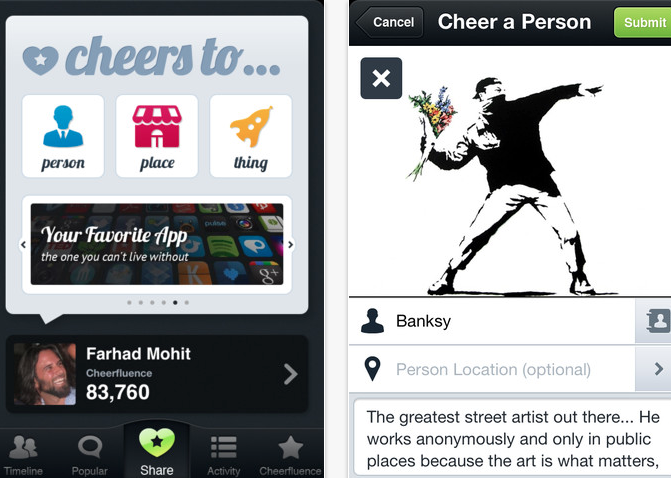
The “toast” is an age-old, time-honored tradition, where we raise a glass to pay tribute to — and express our goodwill towards — friends, loved ones, and sometimes even our fellow man. They are even known to be meaningfully punctuated with by a good drinking song or two. And now, thanks to BizRate.com and Shopzilla Founder Farhad Mohit, there is, as they say, an app for that expression of goodwill. Yes, “cheers” is no longer simply a word that accompanies toasts — or the place where everyone knows your name — it’s also the “world’s first positivity app,” for the iPhone.

What am I talking about? Chee.rs, a free iPhone app that launches today on the App Store, was conceived with a simple, altruistic sentiment in mind: To help people express love and appreciation for just about anything and from just about anywhere. While that may sound a little bit sappy, this is meant to be a serious business.

The Cheers founder sold Shopzilla in 2005 for $569 million and went on to start DotSpots and Gri.pe (both of which are TechCrunch Disrupt companies). DotSpots hit the deadpool, but Mohit went on to create Cheerful, Inc, bringing Gripe and Cheers together under one roof, behind an impressive team from Google, StumbleUpon, and more.

The Cheers founder tells us that the app is meant to be the “Like button” for the world around you, except that it has the potential to be more meaningful because it allows you to create, control, and give voice to each “cheer.” Yes, there are now over 500,000 iPhone apps, and, no, we’re not aware of any apps that celebrate love and appreciation via mobile sharing.

So how does Cheers work? When you come across something in your daily wanderings that makes you want to express your love or appreciation (in socially appropriate ways, of course), you open the app, snap a picture, add some appreciative text, and share your cheer. While users are not required to be positive in their messages, nor are they required to snap a photo, the design of the app is tailored toward the inclusion of images. Both positivity and photo sharing are “highly encouraged,” the founder says.

Once a user shares their cheer, they can blast it out on Facebook, Twitter, via email, and on the Web, watching as it spreads across their social circles. Friends and other users can “like” the post or comment and reciprocate. Creating a Cheer takes less than 30 seconds, and users can create Cheers around people, places, or things, as Mohit says that he wants to keep the use case as broad as possible, to encourage engagement and sharing of restaurants, movies, books, friends, pets, and so on. The app also contains its own user rating system: In other words, the more you cheer, the more “Cheerfluence” you accrue, allowing other users to track the extent of your social cheerleading.

There’s been a lot of talk in the mobile space centering around serendipity, and the potential that location-based mobile services have to help you find something you’ll enjoy even when you’re not looking for it. While Cheers has the requisite location layer baked in, it’s not an explicitly location-based service.

But it still has some of those elements of serendipity, as Mohit cited the example of sharing a Cheers about a particular person, which was then commented on by an old friend. Through this Cheers, he was able to reconnect with that person. In that way, Cheers intends to connect people, and facilitate discovery of things you’re likely to enjoy based on affirmations of similar interests and experiences.

Those checking out the app may also notice that the app looks similar, design-wise, to some other popular social and discovery-based mobile apps. Kevin Rose’s Oink comes to mind. Mohit says that Cheers was co-developed in tandem with Oink, but the real inspiration came from Instagram’s model of photo sharing.

The more jaded among us may find reason to scoff at all this mobile love fest. Maybe it’s the approach of Valentine’s Day, but I think there’s something to be said for lowering the barriers to sharing appreciation for our favorite people, events, and entertainment in an environment dedicated to making tributes.

Cheers is still very early in its development, as Mohit says that there’s plenty left to be done in terms of better taping into Facebook “likes,” increasing activity on app itself, the ability to link to other Cheers, better browsing, and upgrades to the camera functionality, including flash. These are all things slated for future upgrades, along with developing apps for other mobile platforms.

The app has a ways to go before it reaches the tipping point, and it remains to be seen exactly how Cheers will monetize, though there is some definite potential around enabling local businesses to tap into users who blast out Cheers for their services, or branding of users with high “Cheerfluence” scores, for example. Either way, it’s probably still worth raising a glass to sharing the love. For more, check out Cheers at home here. Check it out and let us know what you think.


Nielsen: Cord Cutting And Internet TV Viewing On The Rise

cross-platform-viewing-chart

According to a new report from Nielsen, the number of U.S. homes that have broadband Internet, but only free, broadcast TV, is on the rise. Although representing less than 5% of TV households, the number has grown 22.8% over the past year.

In addition, the behaviors within these homes are unique. These broadband/broadcast-only households stream video twice as much as the general population, says Nielsen, and they watch half as much TV.

Nielsen hesitates to dump all these households in the “cord cutters” bucket, though, saying that while perhaps some are cord cutters (the term that refers to those who gave up cable TV for streaming TV/streaming video), other homes may be former broadcast-only homes that now have upgraded Internet service. Even though the exact percentages are unknown, combined, this two groups are making up the small, but growing demographic of Internet TV watching homes without paid TV.

Roughly the same percentage of consumers in this new and growing group of U.S. TV households watch traditional TV, stream or use the Internet as in all the cross-platform homes, but the difference is the time spent on these activities.

The broadcast-only homes spent 122.6 minutes per day watching TV compared with cross-platform homes’ 265.5 minutes. Not surprisingly, they stream more video, at 11.2 minutes per day vs. 5 minutes for the traditional households.

Those streaming numbers are interesting, however. Neither household (traditional or broadcast-only) is streaming the equivalent of even a sitcom’s worth of television. In other words, the Internet may not be just a new medium for TV to travel over, it’s an alternative to TV watching entirely.

Specifically, younger Americans are growing up involved in different activities beyond staring vacantly at the TV screen, it seems. Those aged 12 to 34 are spending less time in front of the TV (120.56 monthly minutes), but those older than 35 are spending more. And those over 55 watch the most (195.10 minutes per month).

Overall, few TV households are willing to give up the luxury of either TV or the Internet, regardless of how they choose to view either medium. The vast majority of TV households (90.4%) still pay for a TV subscription, and roughly tw0-thirds (75.3%) pay for broadband. The percentages of both have remained stable, despite the down economy. In fact, the number of homes paying for both a subscription and broadband has even increased by 5.5% over the past year.

TV viewing isn’t just being impacted by the Internet, Nielsen found. From Q3 2008 to Q3 2011, the number of those watching time-shifted TV has increased by 65.9%, and mobile video viewing has seen a 205.7% increase in users. Meanwhile, watching TV on the Internet has increased by just 21.7% during the same time. What these numbers show is that the issue isn’t as simple as switching from one medium to another (traditional TV to video on the laptop, e.g.), but that there are today a plethora of new TV consumption choices. Americans are experimenting with finding the mix that’s right for them. And that mix may not even be consistently applied by every member under the same roof.


Protesters March Toward Apple Stores On The Heels Of A Foxconn Hack

applestore

It would seem that representatives from Change.org and SumOfUs.org have organized a global protest against Apple’s use of Foxconn and other Chinese manufacturing plants to build the iPhone and iPad.

This comes on the heels of a New York Times series exposing harsh working conditions in said plants. 250,000 people have signed petitions calling for a “worker protection strategy”, which will today be delivered to Apple stores in a number of major cities, including New York.

We’ve known about the harsh conditions at Foxconn since well before the NYT series. The media reported on suicides during 2007, and the plant got extensive coverage after the number of jumpers went up drastically between March and May of 2010.

Despite the fact that the story’s well documented, this NYT series has really fired people up. Along with today’s planned protest, we’re hearing reports that a group called Swagg Security has hacked Foxconn, retrieving usernames and passwords and uploading the materials onto The Pirate Bay.

You can check out Swagg Security’s “press release” here, but be prepared for misspellings and this unsettling feeling that the world only gets worse and worse.

An excerpt:

We believe there is no reality in hacktivism, even with good intentions. We know those who claim to be “hacktivists” that inside of you, a suppressed part of you, enjoys playing a part in the anarchist event of hacking of an infrastructure. One which at the same time presents a challenge, upon completing reveals an almost unknown feeling of a menacing satisfaction. We encourage not to continue quelling such a natural emotion but to embrace it. Only when embracing what society has taught you to hinder, is when you realize your own identity.


Appcelerator Acquires Mobile Cloud Services Startup Cocoafish

Appcelerator-Cocoafish

Appcelerator, the company behind the popular Titanium app-building platform, is announcing its third acquisition today. The company is buying Cocoafish, a mobile app infrastructure provider that lets developers add various features to apps including messaging capabilities, push notifications, photo uploads, checkins and other social features, storage, discussion forums and more. Although the name implies an iOS affiliation, Cocoafish is actually a cross-platform backend service provider supporting iOS, Android, and even Flash and Ruby.

Starting in Q2 2012, the features Cocoafish previously offered will relaunch as “Appcelerator Cloud Services (ACS)” as a part of the company’s Titanium Platform, and as complete iOS, Android, REST and Javascript SDKs for non-Titanium customers.

The acquisition follows Appcelerator’s previous buyouts of other mobile app infrastructure providers, including the enterprise-focused Aptana and, more recently, Particle Code, which brought additional HTML5 capabilities to Titanium. With Cocoafish, Appcelerator is aiming for the broader mobile market, the company explains – not just Titanium users. Now developers using Objective-C, Java, PhoneGap, Sencha or HTML5 will have access to a scalable server-side backend, similar to what other backend service providers like StackMob, Urban Airship or Parse are offering.

According to Jeff Haynie, Appcelerator CEO, the company chose Cocoafish because it’s the “most complete solution.”

“We took a look at all these companies, and what we liked [about Cocoafish] was that they have 25 well-designed, well-tested services supported,” he explained. “They’re sets of interfaces that work together.”

However, it could be argued that other possible acquisition targets simply weren’t on the market. For example, Urban Airship has been doing a little acquiring of its own in recent months, snapping up SimpleGeo to fill out its own offerings. Asked if Appcelerator considered other companies prior to Cocoafish, Haynie said they “had all sorts of conversations at different levels” with competitors, but were ultimately drawn to Cocoafish for a few key reasons, beyond its feature set. The startup hadn’t raised money, were already profitable, and they were a small, 10-person bootstrapped team based in San Francisco. It just made sense.

The new Appcelerator-branded product will roll out on March 31st, but the company is already planning to continue the work Cocoafish had started. By Q3, the plan is to launch an on-demand, private cloud offering so developers with increased security needs can run the whole stack in their own cloud. There are also plans to support Node.js, expand the common services to offer more features (like video), and offer more identity management options for enterprise customers, like RSA SecureID and Active Directory support, for example.

Appecelerator today has over 35,000 apps that have been built using the Titanium platform, and those apps have been deployed on 40 million devices. But there are also 1.6 million web developers with the company who already use a Javascript API to build native or HTML5 apps, all of whom could also take advantage of ACS.

Although the acquisition makes Appcelerator a direct competitor to the other backend services it already supports in Titanium, Haynie assured us that there would be no change in terms of which backend services developers can use. “Like any platform company, you compete on some things, but on other things you’re helping each other out,” he said of how the new offering impacts competing services.


BoardProspects Wants To Help Companies ‘Build Better Boards’, Raises $650,000

Teenager Skateboarding

Don’t you just hate when you’re out skateboarding, minding your own business, and suddenly one of the wheels comes off and you break a kneecap? Well now there’s a new startup called BoardProspects, which aims to help companies build better boards. A quick glance at their website reveals that the company is not going to be able to solve your skateboarding woes, however, but it may help your business roll more smoothly.

If your company is in need of new members for the board of directors (cough Yahoo cough) or the advisory board (cough Honeywell cough), you may want to give Boston-based BoardProspects’ upcoming offering a second look.

Having just raised a $650,000 seed round, BoardProspects basically offers a platform that connects individuals (‘prospects’) with organizations, and also provides educational resources and tools to improve boardroom service.

The online community is set to launch some time in the second quarter of this year, but the first 1,000 people to pre-register for the service will receive a free lifetime premium membership (the company didn’t mention what this entails, but surely it must be good!).

Here’s the problem that BoardProspects says it identified:

There are more than 60,000 publicly traded companies in the United States that are required by law to have a board of directors. In the Fortune 1,000 alone, there are more than 1,100 directors currently serving that are over 70 years old, according to GMI Research, the leading independent provider of global corporate governance, ESG and accounting risk ratings and research.

The number of vacancies for the nearly 1.6 million non-profit organizations in the United States is exponentially larger, with more than 1.8 million of these seats turning over each year. These dramatic numbers do not include the hundreds of thousands of private companies that could benefit from building a board of directors or an advisory board, recruiting valuable members, or applying best practices to improve board performance.

Poised to prove that it’s not just about ‘who you know’, BoardProspects aims to apply social networking mechanics and technologies to “transform the way that boards and prospects connect, communicate, and serve”. It’s unclear whether they also make rad skateboards.

Angel investors who participated in the seed round include Mike Verrochi (managing partner at Blue Rock Ventures), Brendan McCarthy (managing director of Goldman Sachs) and Paul Sullivan, partner of family-owned Sullivan Tire.


Trion Worlds Brings Rift To China

rift

Game-maker Trion Worlds is revealing its global ambitions — it just announced a partnership with Chinese Internet company Shanda to release Trion’s online roleplaying game Rift in China.

The game had a successful launch in the United States and Europe last year, winning a bunch of awards, attracted 1 million registered users in its first four months, and supposedly bringing in $100 million in revenue. Trion CEO Lars Buttler says he sees Asia as the company’s “next great frontier,” one that he plans to conquer through the Shanda deal and another partnership to launch in Korea. In fact, Buttler says that across most financial metrics, the new agreement is the largest deal ever to license a Western game in China. (However, he declined to share those numbers.)

There have been a few other success stories, like World of Warcraft, but for the most part, Western games haven’t had much success in China, Buttler says. Naturally, he thinks Rift will be a different story.

“So many people are afraid of China,” he says. “We think they are amazing. They can teach us, they can be great markets for us.”

As for what will make Rift work when others have failed, Buttler says represents a unique approach to gaming, one that combines the high quality of traditional gaming with the rapid iteration — for example, he says Trion released seven “massive” updates to Rift in the first nine months. That gives the games a “live” quality that should attract Chinese gamers and also makes piracy less attractive.

Boiling down his reasons to be optimistic, Buttler says, “Rift is great, we listen, we can innovate quickly, we will innovate for Asia as quickly as we do for [the United States].”

The Chinese launch date will be announced later.


Report: Apple To Announce The iPad 3 The First Week Of March

iPad

Shocking news of the day: Apple is preparing to announce the iPad 3. Crazy news, I know. That announcement, if AllThingsD is to be believed, should come in the first week of March. The next-gen tablet itself is reportedly an upgraded version of the iPad 2, featuring a dual-core CPU and a higher-resolution display. But then again, that’s to be expected. Of course the iPad 3 will have better specs than the year-old iPad 2.

Apple announced the iPad 2 in the same timeframe last year. Steve Jobs made a surprise return from medical leave to deliver the announcement. It was sadly the last Jobsnote. There’s no word who will take the stage and announce the iPad 3, though.

If this rumor doesn’t pan out, it’s still a safe bet that the iPad 3 announcement is right around the corner. Apple generally sends invites out two weeks in advance so the announcement could still happen this month.


Waze Lets You Report Traffic With A Wave Of Your Hand

photo (3)

If you’re one of the 12 million drivers who use real-time traffic data from Waze, there’s a drawback — the smartphone app depends on users to collect traffic data, but if a driver is stuck in traffic or spots an accident, that’s exactly when they shouldn’t be fiddling with their phone. That’s why the Kleiner Perkins-backed startup  developed a new voice interface, which it’s launching today.

Michal Habdank-Kolaczkowski, the company’s director of communications, recently demonstrated the new controls for me. The demo took place in the TechCrunch office, rather than a moving car, but I still think Waze has come up with a pretty elegant solution. Habdank-Kolaczkowski showed off reporting traffic to Waze with just a couple of voice commands — “report traffic”, then, when prompted to choose from different traffic levels, he said, “moderate.”

And when Waze team members say the experience is “hands free,” they mean it. To activate voice control, Habdank-Kolaczkowski didn’t have to touch his phone at all. He just waved his hand in front of the device, a gesture that was detected by the iPhone proximity sensor. (So, okay, technically, you’re using your hand, but in a natural way that shouldn’t interfere with your driving.) You’ll need to have the Waze app on for this to work, but that’s normal procedure anyway — drivers are supposed to leave the app on during the commute, so that’s it’s automatically gathering traffic data as they drive.

Waze VP Community Geographer DiAnn Eisnor says Waze already prevents users from typing when they’re driving and the app is open. Voice controls were an obvious next step, and for a while, the company was hoping that Apple would make Siri voice commands available to third-party app developers. Eisnor said she’s still hopeful, and when if it happens, Waze will happily jump on-board. In the meantime, the company moved forward on its own, building the new interface using open source voice technology.

For now, the voice commands are iPhone-only, and they’re limited to a few key use cases — reporting traffic and asking for directions home or to the office. Eisnor said Waze plans to expand the app’s vocabulary over time, and also bring voice commands to its Android app.


Socialbakers Brings Its Leading European Social Analytics Platform To The U.S.

social-bakers-logo

With more companies vying for the attention of customers on social media channels, content producers, marketers and more are always looking for ways to better track the engagement and reach of their social media footprints — across the globe. Socialbakers, a young startup founded in 2009 has emerged as one of the leading social analytics platforms in Europe. Since raising $2 million in September from Earlybird Capital Ventures and breaking into the black, the startup has turned its sights to the U.S., becoming the exclusive analytics partner with Facebook and others to provide social media analytics throughout the presidential campaign.

The company is now officially getting serious about securing a foothold in the states, as it today announced the launch of its U.S. headquarters in San Francisco. To support its arrival on American soil, Socialbakers is also announced a new U.S. leadership team to be based in the Bay Area, which includes veteran technology executive Martin Huml as President and COO and Katrina Wong as VP of Marketing.

Huml, who will lead U.S. operations, has previously served as the company’s chairman, and founded a company which became an exclusive distributor for Apple in central and eastern Europe. He also formerly worked at Credit Suisse before founding San Francisco-based investment consulting firm, Runway Capital. Katrina Wong, who will lead the company’s go-to-market strategy, previously led corporate marketing at Zuora, and worked in marketing at both SAP and Salesforce.com.

The team plans to build on the traction of its social monitoring platform in Europe, which includes a roster of more than 750 customers and 275,000 registered marketing users (with companies like Danone, Vodafone, Samsung, Lufthansa And Peugoet licensing the premium version of its service), on top of the 60 U.S. brands already using its technology.

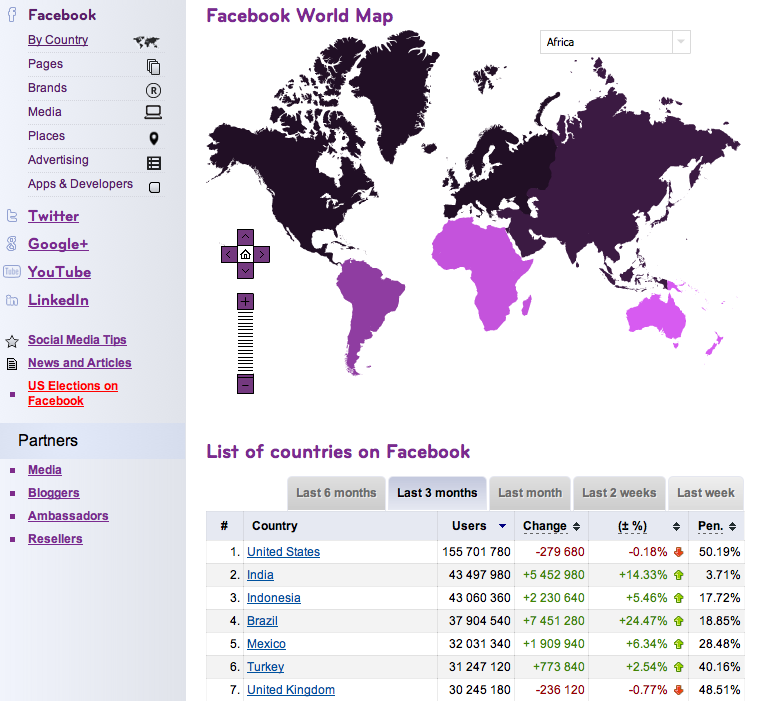
So what does the company do, exactly? Socialbakers’ analytics platform measures the effectiveness of social marketing campaigns across the major social networks, like Twitter, Facebook, YouTube, LinkedIn, and Google+ through its two flagship products. The first, called “Engagement Analytics,” enables statistical analysis of Facebook worldwide, including Facebook Pages, Places, Facebook apps, developers on Facebook, as well as advertising prices. “Engagement Builder,” by contrast offers benchmarking, competitive reporting, and integrated workflow functionality to enable businesses to track a variety of social media metrics.

Jan Rezab, Socialbakers CEO, tells us that he’s seen a surprising amount of SMBs failing to integrate competitive benchmarking and intelligence into their social media strategies, opting to simply tap into certain streams to monitor keywords. While it’s easy for companies today to hook into a search stream and look at individual profiles themselves, the key is obviously to build a robust set of metrics around those profiles and streams. Volume matters, as he says that companies can no longer assume that their users will engage with their Twitter or Facebook content.

By showing companies what works through an “Engagement Rate,” which not only tracks the low-hanging fruit like the number of fans and likes, but the number of comments, the type of engagement, how many people are picking up particular posts, how they’re sharing it, which pieces of content are going viral — and perhaps most importantly — how these engagement metrics compare to that of their competitors.

Much of the data on the platform Socialbakers offers for free (as most of it is public data that is openly available, just poorly aggregated), a resource used increasingly by marketers. Of course, the company also offers a set of “pro” SaaS tools, for which companies pay between $100 and $1,000 per month depending on the number of fans their pages have attracted.

The team believes that the U.S. is home to a fragmented analytics market, and by quickly scaling its platform over the course of the next year, it can become a player in the space. The CEO said that it plans to double the size of its U.S.-based team over the next two months, in addition to growing the international team to more than 100 employees.

“We want to help all the companies using Twitter, Google+, Facebook, and YouTube, get out of the dark,” the CEO said. While that’s no easy feat, we could definitely use a bigger lightbulb.

For more, check out the company at home here.


Meundies Wants To Send You A New Pair Of Underwear Every Month

Screen Shot 2012-02-09 at 3.56.56 AM

In the same space as other “get random stuff sent to you” startups (but especially Manpacks) Meundies launches today to bring users high quality underwear choices in a month to month subscription model.

The Meundies onboarding process basically functions like that of Stylemint, where users select the styles and colors they like and the startup provides them with personalized choices, for $16 a month per item in addition to free shipping and returns. Members have the option of skipping a month or putting their membership on pause during the first five days of each month. Members can also cancel their membership at any time without penalty. Yay!

Meundies co-founders Barak Diskin and Jonathan Shokrian view Meundies as a true eCommerce service — cutting out retail middlemen and brand licensing fees in order to save their customers money on basics. According to Diskin, Meundies are 30% cheaper than comparable brands, starting at $16 for a Meundies-branded pair of underwear versus $26 for brands like Calvin Klein or Cosabella.

As part of the Meundies schtick, the company guarantees that their product is the “most comfortable underwear ever”, and it takes great lengths to personally gauge quality control in the American and Turkish factories where it manufactures its product, establish relationships with manufacturers and communicate with customers directly through Facebook, Twitter and Pinterest in order to pinpoint exactly what they want.

“It’s a headache to shop in stores for items you aren’t allowed to try on or don’t need to try on because you already know your size,” says Diskin, “We’ve created a membership program for replenishment items like underwear and socks so that you can have them delivered to your door monthly, quarterly, or whenever you want rather than having to run to the store once there are holes in them.”

The founders view their market as $5 billion in universal underwear spend for men and $15 billion for women and only see those numbers as increasing as their scope expands.

Diskin tells me that the  eventual goal is to make the highest quality products, producing premium undergarments for people who want easy access to top quality apparel. Eventually the company wants to go long into all sorts of basic clothing items, from leggings to sweats to shirts, etc.

TechCrunch readers can try out Meundies with the code “TECHCRUNCH” in order to get half off their first purchase. Don’tcha wish your tech blog was hot like mine?


Infogr.am Gets HackFwd Backing To Democratize Cool Info-graphics

Screen Shot 2012-02-09 at 15.56.38

European accelerator HackFwd just announced that Infogr.am from Riga in Latvia as its latest investment. Infogr.am’s product is gunning to be a kind of Adobe Illustrator for online, allowing anyone to create cool info-graphics. The web-based application needs no programming or design skills, and works in the same way that you can snap a photo and share it on your social networks. Users make a statement or an argument graphically and then share it. An infographic can be embedded on a page or shared as a link or an image directly.


Amazon Plays The Price Card In The Battle Against iPads

Amazon used to be able to sell the Kindle based on its readability in sunlight. That’s a fair comparison to make and the old advertising featured little more than people being happy reading. To wit:

But the commercial above takes a different tack. The old “it works in the sun” line is still is still in there, but I assure you that Amazon is most interested in getting the more expensive and potentially more lucrative Kindle Fires out the door. What do they do? They suggest that the kids can hang out in the shade with their Fires while mom schools an old fool and his iPad. And all three of those devices still cost less than an iPad (or similarly outfitted tablet). Sneaky, sneaky, Amazon.

In fairness, two Fires and a standard Kindle are still cheaper than an iPad, but I suspect the kiddos in that Daiquiri-stained sloth tent would still rather watch videos and play games on a more capable device. But this is Amazon’s version of price-conscious Club Med, and who are we to judge?


Modo Labs Brings A New Mobile Platform To College Campuses

collegephone

I remember my freshman year of college. It was a tiny campus, but I still found myself looking for classes and wandering through a maze-like library for most of the first year I was there. At the time, my phone wasn’t much help to me, but now that smartphones are taking over the market, Modo Labs is ready to help college students spend even more time on fiddling around on their phones.

The company today made the latest version of its Mobile Campus Solution available, which is meant to give Universities the ability to create a mobile platform for their students. The platform will work on mobile web, iOS, and Android, just to make sure no one’s left out.

Students will be able to access Learning Management Systems, course catalogs, schedules, announcements, materials and grades from the courses module. Athletes, sorority girls, and other sports fans will be able to check out scores and game-related information via mobile, while book worms will have access to a library module, offering up locations and various resources.

The platform — built on Kurogo Mobile Optimized Middleware — will have “live update” functionality for on-campus transit, as well as dining information and a photo hub.

As of right now, over 150 universities including Villanova and Boston College are using mobile offerings powered by Kurogo.