Patience is a Virtue, for Losers

lazy cat

Editor’s note: Contributor Ashkan Karbasfrooshan is the founder and CEO of WatchMojo.  Follow him @ashkan.

Patience is one of the seven virtues, the lesser-known cousins of the seven sins.  And indeed, “patience is a virtue” – or so goes the saying.  But another saying states that “fortune favors the bold.” So which one is it?

Well, here’s the thing.  Yes, life is a marathon, but whether you define success by recognition, respect, money, power or fame – success is subjective, relative and fluid and boils down to Ambition, Vision, Determination, Execution, Luck and Timing.

In other words, success doesn’t fall in your lap; never has, never will. Besides, life’s too short, so don’t sit back.

 “I haven’t got a lot of patience”, Jeffrey Katzenberg

It’s not that patience isn’t valued; it’s that no one else is actually all that patient.  Whether you are growing a business or chasing a girl or trying to lose weight or auditioning on American Idol, no one will sit around and wait for results.

They will be impatient. This doesn’t mean you should be impatient, it just means that in the words of George Jackson: “Patience has its limits.  Take it too far, and it’s cowardice.”

Success is Most Definitely a Target, Albeit a Moving One

Regardless of what drives you and how you define it, people care about the outcome of your efforts and not the journey; frankly, the experience you gain throughout your journey is really only of value to you.  But since we have limited needs but infinite wants, we tend to compete with everybody for the spoils.  As such, if you think that you will be rewarded for your patience, you’re a sucker, and will end up a loser.

This Ain’t The Super Bowl

It’s commonplace to use sports analogies in business, I do it all the time. But whereas in sports you compete with one or multiple individuals or teams, in business you ultimately compete against yourself: Apple really didn’t care that much about Research In Motion’s Blackberry.

Once you venture into a business, you need to put enough points on the board and then manage the clock (told you I liked sports analogies).  To do that you need to get ahead.

People who Preach Patience are Patronizing You

“We are telling the American people to have patience, courage, resolve and determination” Muammar Gaddafi.

Oftentimes those who urge you to remain patient are in fact patronizing you.  As football coach Steve Spurrier said: ”If people like you too much, it’s probably because they’re beating you”.

Be honest: how often has someone you looked up to told you that if you basically sat on your ambition and dreams they’d eventually open doors for you.

How often did they deliver?  Let me jog your memory: never.  If they did, it’s because you posed no threat to them.  You will be successful despite those people, not because of them.

Life is a Big Game of Musical Chairs

All of this Tony Robbins-esque talk is nice, but how does it help you:

If you’re working on a product, don’t wait for perfection.  “Perfection is the enemy of The Good”.  Even that messiah of perfection and attention to detail, Steve Jobs, reminded  everyone that “real artists ship”.  So did Mark Zuckerberg: Stay Focused, Keep Shipping.

If you see an opening for a job, don’t sit still.  No one will pull you aside and offer you the gig.  Go for it.  No one will think any lesser of you for going after the ball.  They’ll respect you, albeit reluctantly.

Don’t wait to close that round of funding before tackling the big opportunities you see; make it happen to the best of your abilities.

Now, A Word of Caution

1)      Balance is everything in life.  Too much impatience never helped anyone. I can list 100 quotes to that effect.

2)      Shortcuts get a bad rep, but they’re there for a reason. Those who fail to take advantage of them are in fact, ironically, lazy or unimaginative.

3)      Nothing replaces tact, dignity, respect and diplomacy.  It’s fine to press the pedal to the metal, but treat people the way you want to be treated.

4)      Wearing your ambition on your sleeve is a recipe to get cut off at the knees; hence the Russian quote “The tallest blade of grass is the first to be cut by the scythe”.

5)      If you’re perceived as too brazen and ballsy then you won’t even know whose butt you should kiss since no one will give you the time of day to start off with.

6)      Reduced patience only means heightened risk.  You can score by moving down the field 10-yards at a time or throwing a Hail Mary. Clearly, one comes with more danger.

7)      Nothing can replace preparation and practice.

The Paradox of Patience

Of course, patience is in itself not static.  For example,

  • Once you have children, suddenly you become more patient, but ruthlessly, you have less time to spare for those who waste your time.
  • As you become more successful in life, you become more comfortable to let the clock run out.

When it’s over and done: if you want to end up in a better position than where you started, then burn the playbook they give you and write you own.

Photo credit: Nicolò Paternoster


Instagram Just Gave You One Less Reason To Use Camera+

Screen Shot 2012-02-11 at 12.58.19 AM

Photosharing app Instagram went through a subtle redesign this afternoon. In addition to the brand new “Sierra” filter, Notifications improvements and a UI/UX refresh where the feed, popular, share and news buttons have all been divorced of their copy and are now just streamlined symbols, the company has added the “Lux” feature.

Lux, denoted by an eclipse symbol in the bottom left hand corner of the app’s image edit dashboard,  is basically an adjustment of image brightness, midtone contrast and saturation in order to bring out the details in an iPhone photo — sort of like what iPhone HDR wishes it was.

Those of you familiar with iPhone photography might be familiar with the basic premise of Lux (boost midtones) as you’ve probably already been using it in another popular app, Camera+

I downloaded the $1.99 Camera+ app a couple months ago just so I could use this much-lauded “Clarity” feature, which, if you’re the type of person who likes to impress your friends with your iPhone “photography” skills, was the secret first step in the process of creating a successful Instagram post,  basically …

1) Open Camera+

2) Use Clarity.

3) Save photo to Camera.

4) Open Instagram.

5) Upload photo from Camera.

6) Use filter.

7) Post.

8) Revel in the Likes.

Instagram Lux saves users steps 1 through 3 — Which is huge (and brings things to a level playing field for those of you that are too lazy to obsess over phone photography have never heard of Camera+). Basically Lux is the biggest thing since Tilt Shift.

And just you wait until Instagram starts letting people rotate their photos! Or comes to Android even!

In the meantime iOS users can find Instagram in the App Store here.


Zynga Marketing Master Padma Rao Joins Foundation Capital As An Entrepreneur In Residence

31baa62

Padma Rao’s analytical marketing skills have made a big impact at more than one company in the Bay Area, and now she’s bringing a decade of experiences to her new role as an entrepreneur in residence at Foundation Capital.

Her most recent efforts helped turn a gaming startup into a booming public company.

Few people realized it at the time, but in late 2008 and early 2009 social game developer Zynga had figured out how to get a great return on investment from Facebook advertising. The social network had developed its ad system over the previous few years to the point that it was able to deliver ads closely targeted to users’ interests — but most people hadn’t realized that yet, so prices were cheap.

Rao joined Zynga at the beginning of 2009 to help lead the development of its marketing platform. An engineer by training, she took a look at the few third-party ad bidding tools available for Facebook and decided the company needed to build its own. She did the same for its user email system. The market timing turned out to be perfect. Zynga had also just figured out how to monetize casual-style simulation games, and in quick succession over the course of the year, it launched hits like FarmVille, Café World, PetVille and FishVille. As I detailed in this December article, the inexpensive growth it got via ads and social communication features during this period brought it up to traffic levels that it has worked hard to pass even today.

“I like having the technical chops to understand what needs to happen and why — and to understand why something might take a long time,” she tells me. “It makes a big difference, especially in online marketing, which is actually a very technical business. Having that background has saved me more than once… my approach is, if a tool doesn’t exist, we’ll build it.”

Zynga wasn’t the first place she’s done this. During a three year stint at Gap earlier last decade, she discovered that getting results from direct marketing were taking up to two and a half weeks. So she created a tool that would deliver results in 30 minutes. “This didn’t just mean faster results, it meant iterating faster, it changed the business” she explains. “It’s all about getting the right tools for people.”

She’s becoming an EIR for the same reason a lot of other product people do, including her new Foundation EIR colleague and former Twitter product head Anamitra Banerji. “I’ve had my head down working at companies,” she says, “and I’ve never taken the opportunity to see everything that’s out there.”

So what is she working on at Foundation? She’s actually already been doing some consulting work with social browser Rockmelt and other startups already. But she’s far from deciding whether to join or found. “I want to stay on the consumer side of things, and obviously mobile is fascinating — there’s lots of functionality that’s not probably not leveraged like it could be…. My dream is to start something, but I don’t want to do it just for the sake of doing it. If I find something great that someone else has started, I’m not going to ignore that because ‘I want to be a founder.’”


Busta Rhymes Waxes Enthusiastic On Google Music

busta

When Google Music launched a couple months ago, there was some criticism regarding how the service was promoted. What many saw as just another music locker and streaming service (albeit a perfectly good and free one) others saw as a great new vector for music sales and distribution. But the music locker portion seemed to hog the spotlight, and the cool Band Camp-esque new artist hubs lurked in the gloom.

Busta Rhymes seems to be a fan of the latter, and not just because he’s in an official partnership. In an interview on MTV, he was positively effusive about Google’s new platform. Check out the short clip, from MTV’s Sucka Free:

I think he’s being truthful when he says that “with that power that they have, that it was almost blasphemous for them to not have their hands in music as well.” Google, via YouTube, is the world’s foremost player in video distribution on the web (though as far as purchased content goes, Netflix is king). One almost wonders why music didn’t come first.

In case you were wondering that, the reason is that the user-focused structure of YouTube makes it a platform for viral videos and self-expression, not studio-produced content. They’ve been trying to change that, but it hasn’t been very effective (people don’t think of YouTube that way, for good reaosn). Google Music lets them start fresh and try to build something that works both from the top down and the bottom up. So whether they “sign” guys like Busta or a dude recording on an 8-track in his living room, they can provide an end-to-end buying, listening, and sharing solution.

“Google ain’t really trying to just sell music” is about as capsule-sized a summary as you can get, and it’s true. Google hates selling things, in fact. And in the music world, it might be that in a few years, selling things like music tracks just won’t be something you do, and Google will have positioned itself well to be a non-purchase solution.


Whale Hunting: Facebook Hooks 1st-Time Buyers With $5 Of Game Credits For $1

Free Facebook Credits

Only about 5% Facebook gamers pay to play freemium games. If Facebook could up this percentage, it and its third-party app developers could make a lot more money. That’s the idea behind a new promotion Facebook announced today where those who’ve never bought Facebook Credits virtual currency before will be offered $4 in free Credits when they buy $1. This gets users to set up their credit card and experience the rush of paying for an enhanced gaming experience.

Years ago when Facebook first launched its Credits virtual currency, it offered free Credits to some users. While this might have got them hooked on spending virtual currency, it didn’t addict them to paying for it.

Facebook needs credit card numbers badly. Apple has amassed an enormous collection after 10 years of iTunes Mp3 sales, which is now helping it easily sell apps and in-app purchases. If Facebook wants to grow its revenue to satisfy outside investors and be a competitive mobile gaming platform, it needs to get users ready to pay.

But like the street corner pusher says, “this ain’t no charity”. Facebook is only surfacing the promotion in sidebar ads, and TrialPay in-game promotions and offer walls to those who haven’t already bought Credits. User than have to set up a credit card or connect a PayPal account and pay $1 to get the extra $4, or 40 Credits. And next time, they’ll have to pay full price. Facebook wisely does not provide any way to reach the promotion directly in order to deter users from trying to cheat their way to free currency.

If you want to claim your own free Credits, your best bet is to play games by clients of Facebook’s official offers partner TrialPay, such as those by Playfish, Playdom, Kabam, Crowdstar, and iWin. These include The Sims Social, Gardens of Time, It Girl, and Kingdoms of Camelot. Then visit the offer wall or click through Deal Spot signs within games.

With any luck, Facebook will be able to up the percentage of users who monetize, and thereby discover new whales — gamers who spend orders of magnitude more than the average payer and drive the bottom lines of both indie developers and giants like Zynga. Call him Ishmael…Zuckerberg.

[Image Credit: Screenrant]


Kickstarter’s Big Day: $1.6M Pledged In 24 Hours

hooray1.large

They say when it rains, it pours. That’s not usually a good thing, but when it’s raining money, things are a little different. That was the case at Kickstarter yesterday, where they had their biggest day of funding ever, beating the record set… the day before yesterday.

It was also the day that marked the first Kickstarter project to break $1,000,000 in funding. And the day that marked the second project to hit that number. And New York’s city council endorsed the site as a way to highlight community projects that need funding. Oh, and they’re on Portlandia.

Definitely the biggest day in the site’s history, then. They’ve commemorated it with a great blog post that might just make your Friday a little better. It also brings up a few new and interesting questions regarding how the site should or will be used. But first, watch the Portlandia clip:

Double Fine, whose adventure game drove much of the funding sum (and is up to nearly $1.5M alone as of this writing), is different from many projects we’ve seen. Often Kickstarter is thought of as a venue for people with very limited means but a good idea to execute that idea. The Elevate Dock is a good example of this.

But Double Fine is an established game studio with office space, employees, and many products under its belt? Why should it go to Kickstarter? Well, Tim Schafer explains that in the video, at least for this project: no publisher would go near a point and click adventure game, but they knew at least some people wanted it. Reasonable enough.

The question, really, is why we even question it. If people want to make something, and people want to fund it, why shouldn’t it be on Kickstarter? The easy stuff — cool accessories or small devices that need a little capital to get started — are just the first wave. Why not pothole repair on a neighborhood street? Why not a new coffee shop? Why not a feature film? Some of these have been tried, no doubt, and perhaps failed — but the principle is sound. If you want to make it, and others want you to make it, this is a way for you to connect.

Congratulations to the Kickstarter, Elevation Dock, and Double Fine teams. Great way to end the week.


Look Out AT&T Customers, Your Upgrade Fee Doubles On Sunday

ATT

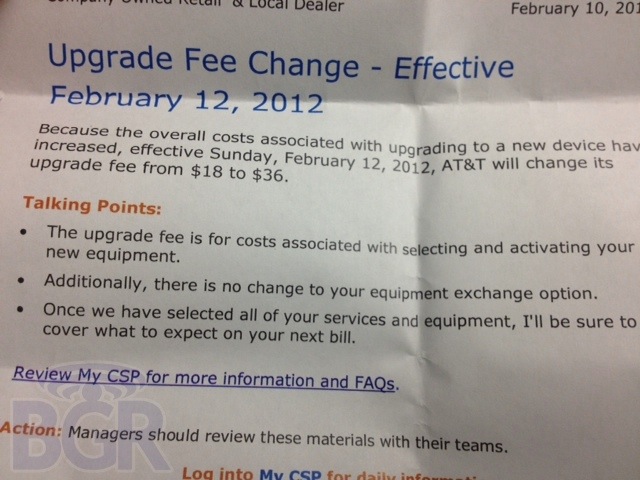
If you’re an AT&T customer coming off of a contract and looking to snap up a new phone, you should probably get on that right now. According to an AT&T memo obtained by BGR, AT&T will be raising their device upgrade fee from $18 to $36 as of February 12, which means you’ve got until Sunday to swap phones before your first post-upgrade bill gets even bigger.

The memo states that the fee hike is needed because “the overall costs associated with upgrading to a new device have increased.”

In AT&T’s defense, it’s a fee that’s most people will only have to deal with once every two years or so, but the additional cost is unlikely to please customers. They’re also not the only big carrier that has had to hike up their fees — Sprint made the transition to a $36 upgrade fee this past September. But still, AT&T doubling their upgrade fee is a puzzling move when their biggest rival (Verizon) still doesn’t charge one at all.

Strangely, the part of the memo that BGR has released doesn’t mention anything about a cap like the one Sprint offers, so it’s possible that families and groups looking to upgrade en masse could really get stung here.

And here’s a question worth thinking about: what will the consumers have to say? Verizon Wireless got a very public earful when it was discovered that they planned to charge customers a $2 “convenience fee” whenever they used a credit card to make an online or over-the-phone bill payment. After one day, public pressure and scrutiny from the FCC forced Verizon to kill the plan in its tracks. Given enough exposure, AT&T customer may be inclined to lash out in a similar way.

Hopefully this move doesn’t inspire Verizon to try something similar. We’ve seen it happen before: Verizon killed their unlimited data plans one year after AT&T did, and AT&T began requiring data packages for messaging phones not long after Verizon implemented the idea.


New Hybrid Solar Cells Harness More Of The Sun’s Light Spectrum

Quantum Dot

Scientists at the University of Cambridge in the UK have found a way to improve the efficiency of photovoltaic cells by as much as 25% through harnessing more of the sun’s spectrum than most traditional silicon-based solar cells can.

The new design, developed at the university’s Cavendish Laboratory in the Department of Physics, can absorb both red and blue light, and generates electrons from photons at a two-to-one ratio on the blue light spectrum. Most current solar cells lose blue photon energy as heat, leaving them unable to turn more than about 34% of the sunlight they absorb into power.

The team, led by professors Neil Greenham and Sir Richard Friend, recently published results in a paper. The hybrid cells have an added organic semiconductor called pentacene, which helps harness blue light energy to strengthen the electrical current coming from the cell, making the product up to 44% efficient.

The university’s team also innovated on how the cells are made, by producing the cells in bulk using a roll-to-roll printing technique. While cheaper, more efficient photovoltaics sound promising, there remain hurdles to be overcome. The greatest costs in building a solar power plant are installation hardware, labor and land, so a cheaper solar cell is only a piece of the puzzle.


High Performance for High Society

<< Previous
|
Next >>


The Mercedes-Benz ML63 AMG

<< Previous
|
Next >>

Like bacon-laced ice cream or deep-fried turducken, the ultra high performance SUV is a curious amalgam of ingredients governed by an inscrutable raison d’être. How does this mutant automotive strain survive the vagaries of the market, and what draws drivers to this genre like a spacecraft to a black hole?

Rather than ponder the why, let’s consider the how.

The ass-kicking SUV was unofficially inaugurated in the automotive heyday of the mid-’80s, when the Lamborghini LM002 ignited passion among the oil sheikh set with its carbureted V12 and angularly ginormous bodywork. The Italian curiosity only sold 328 examples, but paved the way (ahem!) for the niche-within-a-niche: the supercar trapped in the sport ute’s body.

Contemporary examples include the BMW X5M ($87,250) and Porsche Cayenne Turbo ($107,100), and though these evolved specimens may not look as cartoonishly delicious or devilishly despicable as the “Rambo Lambo,” they stand as wonderfully improbable achievements within a richly regulated, petroleum-endangered zeitgeist that harbors fear and loathing for the insensible.

This is not a supercar or sport coupe, but rather a four-wheeled frivolity cloaked under the guise of usable space and cargo hauling utility.

Since I’ve recently criss-crossed the rambling backroads of central California in Mercedes-Benz’s newest such offering — the $95,865 ML63 AMG — allow me to explicate, or at least try to make sense of this pre-apocalyptic, muscle-engined madness. For starters, let’s play devil’s advocate and recall that a nice, base model ML350 can be had for nearly half the dough. It will transport you from A to B in commendable efficacy and decent luxury, even if Mercedes-Benz deems it reasonable to make real leather an option. Seriously.

But the standard ML is incapable of inducing lung-emptying bliss on every onramp, or responding to steering input with anything remotely resembling obedience. The off-the-rack donor car, though vastly improved over its predecessor in numerous ways including a lighter, stronger chassis, a quieter ride, and the lowest aerodynamic drag coefficient of any sport ute, is an achievement in satisfying the fat middle of the bell curve of buyers, not the edgy extreme of enthusiasts. So while Mercedes-Benz engineers clearly worked overtime to enhance the function-oriented ML, it took the mad scientists at AMG to get its freak on.

Still skeptical? Once the ball of your right foot reaches for the wool carpet beneath, you just might be charged with instant comprehension of the indelible charms of this rolling contradiction, as though the knowledge transferred directly from the accelerator pedal to your hippocampus. This is not a supercar or sport coupe, but rather a four-wheeled frivolity cloaked under the guise of usable space and cargo hauling utility. Call it cognitive dissonance or just plain silly, but the way this weighty vehicle presses you against its perforated leather is unexpected at the very least, and delightfully counterintuitive, at best.

The power source is a twin-turbocharged, 5.5-liter V8 that replaces the naturally aspirated 6.2-liter lump. In a textbook case of less-is-more, the smaller mill churns more power — 518 horsepower and 516 pound-feet of torque — while also yielding 28 percent better fuel economy, though it’s still only expected to average 16 mpg, combined.

Add the $6,050 AMG Development Package, and output is boosted to 550 horsepower and 560 pound-feet, and top speed is raised to 174 mph — proof there’s always a little more to squeeze from these already hard-working engines. Expect to reach 60 mph in 4.7 seconds, or 4.6 with the optional engine boost. Those rates of acceleration are accompanied by a deep, heartwarming exhaust note that sounds like the feeling of whiskey going down your gullet, punctuated by snorty “braps” as the 7-speed transmission changes gears.

Attack a winding highway, and this Merc becomes a merciless accomplice, squirting, punching, and dancing its way through the twists until you or your companion reaches for the barf bag.

Apart from badges and model-specific trim, there’s little within the ML63′s heavily upholstered leather interior to suggest what lurks beneath the gently raked bonnet. But there is more texture and detail to behold than the non-AMG iteration, thanks to the standard Designo package which brings supple cowhide to the dashboard, armrests, and door trim, and offers more aggressively bolstered seats for your cornering enjoyment.

When the road kinks, that padding proves integral to the experience: stiffer shock and spring rates work with an “Active Curve” system that uses a hydraulic pump to selectively firm up the suspension and de-couple the roll bars when necessary. As a result, the ML63 combines a buttery ride with shockingly sticky and responsive roadholding, allowing you to easily forget its multi-ton curb weight. Attack a winding highway, and this Merc becomes a merciless accomplice, squirting, punching, and dancing its way through the twists until you or your companion reaches for the barf bag.

Should AMG sully its race-bred name by slapping its badge on absolutely anything that rolls out of Mercedes-Benz’s product lineup? Does a 550 horsepower SUV have a logical place in the automotive universe? And is the ML63 even worth mentioning in the same breath as a brilliant achievement like the SLS AMG?

At the end of the day, a car like the ML63 can be distilled down to a simple ratio of want versus need: You may not deem it necessary to hurtle down the highway in such a profligate, high-profile chariot, and you’re certainly entitled to raise an eyebrow as this bad boy blasts past you on the interstate.

But if you have the means and are appropriately corruptible by the curiosity of physics-altering power-to-weight ratios and muscular interpretations of otherwise function-oriented SUVs, you may just find that the ML63 — like a juicy slice of turducken — scratches an itch you never knew you had.

WIRED Logic-defying performance. Functional luxury. Wood, leather, wool and chrome trim abound. Brutal numbers, soothing ride. An SUV you actually enjoy driving.

TIRED Overly discreet styling. Upsetting MSRP. Fatty could use a diet. Anticipate slings and arrows from the Prius set.

Photos by Basem Wasef/Wired

Built to Last

Photo: Jim Merithew/Wired.com

Any lasting relationship isn’t reliant on looks alone. Sure, it starts with lust. But we get older, slower. We grow love handles and extra chins. But we stay together because, ultimately, the connection is based on something deeper than the superficial.

It’s a dramatic conceit to apply to a smartphone, but an apt one — when Motorola rebooted its iconic Razr brand last November with the debut of the remarkably svelte Droid Razr, we fell in love with its looks. Like the iconic, massively popular Razr V3 flip-phone released just seven years ago, the Droid Razr was sexy and slim.

But then Motorola pulled back the curtain on its next Razr iteration, the Droid Razr Maxx. It looks like its former self, but it’s been retooled to include a massive battery — the extra two-odd millimeters in thickness that were scooped away from the first Droid Razr’s backside have been filled in, and the slim profile of last year’s design has been obliterated. Otherwise, it looks like the same phone, but now it wears plus-size jeans. It’s heftier too. At 145 grams, it’s 20 grams heavier than the Razr.

With the Razr Maxx’s supercharged battery, Moto goes a long way toward solving what is arguably the biggest issue in mobile devices today: longevity.

The extra junk in the trunk comes with a payoff — an upgraded 3,300 mAh battery cell, one which Motorola promises will deliver up to 21 hours of talk time and over 350 hours on standby.

With the Razr Maxx’s supercharged battery, Moto goes a long way toward solving what is arguably the biggest issue in mobile devices today: longevity. Even the iPhone — the darling device of the mobile world — took serious heat for its lack of stamina after receiving the latest iOS software update.

No matter how sleek or functional a phone is, it ain’t nothing without enough juice to make it last, and the Razr Maxx’s purported battery life is unprecedented among today’s smart devices.

The verdict? The Razr Maxx makes good on Motorola’s claims. The phone stood up to 12 hours of continuous YouTube video playback — more grueling than voice calls — in my testing before running out of steam. And on a full charge under regular-use conditions (the occasional call or three, light web browsing, playing around with an app here and there), I literally went for three whole days without having to plug it in.

This longevity is only compounded by Moto’s Smart Actions management system, the company’s ingenious software-based approach for tracking and adjusting feature usage and energy consumption. It switches certain functions on and off automatically when the phone’s sensors detect a specific set of user-defined conditions. For example, when your battery dips below a certain point, say 20 percent, you can instruct the phone to automatically dim the screen and turn off the 4G and GPS radios. Also, the phone will use known Wi-Fi networks to determine your location. It knows when you’ve left your pad and you’re walking around (switch on 4G), or when you’ve arrived at the office (turn off 4G, silence your “Hey Ya” ringtone). Pretty nifty stuff.

If you’re superficial enough to care only about what’s on the outside, you may as well get the Droid Razr. Both phones are nearly identical in terms of specs and materials: 1.2GHz dual-core processor, 8-megapixel rear-facing camera with an HD-capable front-facing camera, a microSD slot, and a 4.3-inch super AMOLED screen are all standard on both devices. They both run Android 2.3.5 Gingerbread, and both are upgradeable to Ice Cream Sandwich. It’s just that with its beefier battery, the Droid Razr Maxx is chunkier and more costly — the Maxx hits stores at $300, and the price of the previous Razr just dropped to $200.

I like what Motorola is doing with its hardware across all of its latest phones, Razr or otherwise. It’s part of a larger emphasis on industrial design in the mobile world, as manufacturers like Nokia and Motorola have started paying closer attention to materials, flourishes and details once otherwise overlooked.

Moto’s latest phones are built atop an aluminum chassis, strong enough to withstand numerous waist-high drops. One of the defining features of the Razr line is the Kevlar mesh backing. This Razr Maxx feels smooth and exotic in the hand. It’s almost like touching the cool surface of a piece of glazed pottery. And like scores of other smartphones, the screen is kept safe with a Gorilla Glass facade.

But as nice as the Maxx’s outsides are, it’s really not about looks. It’s what’s inside that counts. And that, my friends, is what a good relationship is all about.

WIRED So much POWER. Fantastic build quality, even if it’s bulkier than the first Droid Razr. Smart Actions boost battery life even further.

TIRED $300 price tag is wince-worthy. It’s, uh, kinda huge. Non-HD screen is a bummer, considering all the juice there to power it.

A Business Laptop That’s Good for Nights and Weekends, Too

HP Folio 13 notebook

Photo by Jon Snyder/Wired

With the Folio 13, HP arrives both a bit late and a bit heavy to the ultrabook party.

While the Folio looks quite svelte, it is technically over the weight limit Intel has set for ultrabooks. The official limit is 3.1 lbs, and the Folio tips the scales at 3.3 lbs, so it’s a stretch to use that term as a descriptive. It’s hardly back-breaking, but compared to featherweight machines like the 2.4-pound Toshiba Portege Z835, it’s absolutely huge.

Apart from heft, you’ll find its feature set to be typical of ultrabooks: 1.6GHz Core i5, 4GB of RAM, a 128GB SSD hard drive, and a 13.3-inch screen at 1366 x 768-pixel resolution. The chiclet keyboard is backlit and fairly comfortable, the only layout concern being the oddly designed arrow-key panel. Ports include HDMI, two USB 2.0 ports, an SD card slot, and a full-size Ethernet port.

The touchpad is a bit of a mess. While it’s spacious and responsive, the built-in buttons are extremely stiff to the point of unusability. You’ll quickly turn to tapping instead of clicking on this system … perhaps until you break down and spring for an external mouse.

The good news: Performance is exceptional, especially for a machine that barely tops $1,000. Despite its humble CPU, the Folio 13 cranked out solid benchmark numbers across the board and even managed to turn in respectable gaming figures, despite relying on integrated graphics for its video processing. Compared to the aforementioned Portege, scores were 20 to 30 percent better on most of my tests.

The one downside to this was that the fan on the Folio whined so loudly when it was under heavy load that I thought I was going to have to relent and give the thing its blankie already.

Oddly, HP is positioning the Folio 13 as both a consumer and a business notebook, and given its no-nonsense design, that makes sense. There’s even a version you can buy with a TPM chip inside for the crypto-obsessed guys in the IT department. The version sold through most consumer outlets, however, has a mountain of shovelware preinstalled — “HP Games,” an eBay icon, and two apps for streaming and creating music. The commercial/business versions don’t have any of these preloaded apps.

WIRED Great performance in a reasonably slim and quite sturdy package. Good pricing, yet it’s clear that corners weren’t cut in either specs or build quality. Exceptional battery life up to an hour longer than competitors.

TIRED Very dim screen. At 3.3 pounds, it’s less “ultra” than the rest of the market. Too much preinstalled junk on our test unit.

Little Lenses: 3 Miniature Cameras Tested

<< Previous
|
Next >>


Kodak Easy Share Mini 200

Sure, your smartphone has a camera. It takes awesome 8-megapixel photos that you can upload to Instagram or Facebook where they’re tagged, liked, and commented upon. But everybody’s phone does that stuff. To truly stand out and claim your own hill on the island of photo-nerd coolness, you need one of these miniature cameras.

Tools for self-styled spies, objects of collector lust, pocket candy for the retro-fetish set — no matter the motive, these tiny machines make picture-taking fun and different.

The Full Package

Kodak’s Easy Share Mini M200 manages to house just about all the features of a larger point-and-shoot, but in a super-compact package that fits in the palm of your hand.

It lacks the visual panache of the other mini cams on our list. But since you can pick one up for between $70 and $90, it would make a great first digital camera, especially for a kid with small hands or an adult who doesn’t own a smartphone (it’s 3.5 inches wide and 2 inches tall, about the size of a business card). There are plenty of customizable options, but the basic controls still remain intuitive to use.

It takes photos up to 10 megapixels, and it has a good flash. In other respects, however, it’s not really that much better than a smartphone camera. If size isn’t one of the major reasons you’re considering this pint-sized camera, you’d be better served digging up $50 to $100 more for something like a low-end PowerShot for slightly higher-quality images. But compared to the other tiny cams on our list, the M200 captures the best-quality images.

The top of the camera has buttons for power, the shutter, and image settings, and next to the 2.5-inch LCD on back, there are another half dozen clearly marked controls. The M200 starts out on Smart Capture mode to automatically adjust settings for general photo scenarios, but you can switch to one of 17 different scenes if you have a specific photographic need — sunsets, action shots, panoramas. The high ISO setting for low-light shots performs admirably. You can also self-adjust the white balance, and there’s a 3X optical zoom for close-ups.

The Easy Share camera comes with Kodak’s Share Button desktop software. You enter your e-mail and social networking preferences, then, as you’re out shooting photos and videos, you can select the ones you want to share using the hardware “Share” button on the back of the camera. The next time you plug the camera into your computer, the photos you selected will automatically be delivered to the destination you chose, whether it be to a specific e-mail account or your Facebook page. It seems unnecessary, given how easy it is to drag and drop photos to share them in different places on your desktop.

WIRED Slim, 3.5-ounce body is comfortable in a pocket. Fits in your palm, so it’s easy to hide. Has a better lens, better sensor and better flash than most smartphones, even if only by a small margin. Convex mirror on the front for self portraits.

TIRED Lack of image stabilization can make for blurry photos without a flash, and shaky video if your hands aren’t steady. Video resolution is VGA (640×480), no HD option.

Kodak Easy Share Mini M200, $90


<< Previous
|
Next >>

Google, Microsoft Search Queries Grow In January While Yahoo Continues To Slide

yahoo

comScore has released its ‘explicit’ U.S. search data for January of this year and while Google and Microsoft Bring’s search share continues to grow, Yahoo’s share dropped both year over year and month over month. This comes after Bing overtook Yahoo in terms of search queries for the first time in December. While Bing grew slightly from December 2011 to January, Google reached its highest share since December 2010 this past month.

Google search queries increased 6% year over year in January, to 66.2%, compared with 65.9% in December 2011 and 65.6% in January 2011. Bing queries increased 21% year over year in January to 15.2%, compared with 15.1% in December 2011 and 13.1% in January 2011. Yahoo queries are on a downward spiral, decresing 8% year over year in January to 14.1%, compared with 14.5% in December 2011, 15.1% in November 2011 and 16.1% in January 2011. Yikes.

On a combined basis, Bing and Yahoo’s share of searches was 29.3%, compared with 29.6% in December 2011 and 29.2% in January 2011. Clearly, despite the fact that Bing’s technology is now powering Yahoo’s search, the rollup is still not powerful enough to overtake Google search share.

AOL queries declined 6% year over year January to 1.6%, compared with 1.6% in December 2011 and 1.7% in January 2011. And Ask.com queries declined 8% year over year in January to 3%, compared with 2.9% in December 2011 and 3.4% in January 2011.

It’s important to note that this data does not include search queries from mobile devices, which could boost Google’s share further. And these refer to “explicit” US search market share, which includes searches when someone actually types a query into a search box.

comScore also reports that the general search market continued to grow at double-digit rates in 2011, posting an 11-percent increase in 2011. Apparently, this momentum was driven by a 3 percent gain in unique searchers and a 7 percent gain in the number of searches per searcher.

Google’s search query volume grew 10 percent, driven mostly by gains in searches per searcher (up
7 percent). Bing had the highest growth in search query volume in 2011 at 40 percent, propelled by sizeable gains in both unique searchers (up 6 percent) and searches per searcher (up 31 percent).


Fab.com Rolls Out New Mobile Apps With Browse By Color & “Fab Shops”

fab-ipad

After hitting 2 million members at the end of last month, design shopping startup Fab.com is today rolling out new iOS applications that offer a number of new features and improvements. In addition to an updated layout, search and navigational elements, one of the apps’ biggest new features is the inclusion of the recently launched new storefronts called “Fab Shops.”

These Fab Shops went live late January, allowing Fab.com members to visually browse through products via dedicated online storefronts that were organized around product categories, as opposed to by designers. That way, if you wanted to shop only for jewelry or furniture, for example, you could simply drill down into those items using the new Fab Shops option. Shops could also be sorted by both popularity and price, when they launched on the web.

With today’s mobile and tablet app updates, the shops section is split into “pop-up shops” and “more shops,” and a sort button lets you rank them by price, by bestselling, most favorited, or by “random” (the default). There are now over 20 shops to choose from.

Next to the shops button at the top of the screen, are buttons that let you see just “new” items, or those that are “ending soon.”

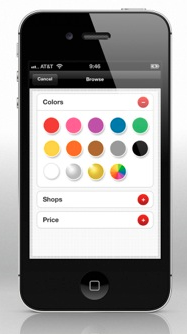
Also new is an updated browse menu that lets you find products by shop, price, or, in an Etsy-like fashion, by color, also featured which launched first on the web.

Since the arrival of Fab.com’s mobile apps in October, the number of sales from mobile have been increasing. Today, iPad users purchase at 4 times the rate of web users and iPhone users purchase at 2 times the rate of web users. iPad orders are also significantly larger (by basket size) than web orders, the company reports.

Fab says that mobile accounts for a quarter of all of its orders, so it makes sense that it would continue to evolve the mobile experience to match up to that of the web. Given these statistics, however, it may even be prudent to design mobile-first for the next round of updates.

The new apps are in the iTunes App Store now, so check for updates. Fab is hinting at a new “iPad-specific” app in the works that’s coming soon, but nothing more on what that will involve just yet.