India’s IT Minister Prevaricates On Social Censorship Policy

india_flag_map

India’s Information Technology Minister, Kapil Sibal, has gone on the record to say that “once and for all, without any obfuscation, no government in India will ever censor social media.” This must come as a surprise to the companies and individuals that have been blocked, sued, or antagonized by the government in months past.

Many social media websites, as well as larger indexing services like Google and Yahoo, have been asked to take down material or were the target of suits accusing them of hosting material the government deemed inappropriate. As late as December, Sibal himself said he hoped that such material “never gets uploaded.” So he will have to excuse the internet community if it does not take his assurances seriously.

He also, perhaps more worryingly, said he would force companies “to give us the data, where these images are being uploaded and who is doing it.” That would seem to cross the line from mere censorship to active suppression of subversives.

It is worth noting that our contributor Semil Shah downplayed the importance of Sibal’s statements at the time. That said, the statements were made and courts have echoed them, so they are at least worth including in the discussion.

Google India, in January, responded to the suits with the reasonable and one would think self-evident argument:

No human interference is possible and, moreover, it can’t be feasible to check such incidents. Billions of people across the globe post their articles on the website. Yes, they may be defamatory, obscene but cannot be checked. We cannot control billion minds. Some are conservative, some are liberal and some write all the defamatory and obnoxious articles on web pages. There is a procedure for getting them removed.

Extremely clear words from Mukul Rohatgi, one of Google India’s lawyers on the case.

As with SOPA, one of the obvious arguments (especially in light of things like the Megaupload takedown) is that there are indeed mechanisms in place for removing such things. But any entity making such requests must consider whether their efforts are reasonable and likely to produce any effect. Any effort to remove all obscene, objectionable and defamatory from the internet is doomed to failure.

Sibal’s promise will be impossible to keep. It is clearly at odds with the priorities of the government at this time, and even if it were not, it appears that their policies are liable to sudden change at any moment. India can either choose to accept the internet as it is and use the tools available to regulate it, or they can, as the Delhi High Court threatened, block all infringing websites in the style of China and Iran. Their fantasy policy of actively monitoring the billions of items uploaded or written on the internet is rooted in ignorance, and sooner or later must be abandoned.

Chances are that a country as smart and young as India would never adopt such hostile measures towards its own freedom and the platform that has enabled so much of its growth. But whether it’s political posturing, overexuberant press, or the blustering of disconnected politicians is difficult to tell without a little time to put things into perspective.


Shoutlet Fires Off New Trigger-Based Social Marketing Platform

Shoutlet Logo

Here’s why social media marketing is broken: my company wants to launch a contest on our Facebook app and website and post about to all our fans and followers, post when we hit 1000 entries, and post again when the contest ends after 5000 entries. Sequencing like this was difficult because marketing team would have to monitor for those milestones to be reached, then manually rotate our apps and publish updates.

Social marketing platform Shoutlet today launches a way to turn the cacophony of disparate campaigns into a concerted push. It’s called Social Switchboard, it uses trigger-based campaign publishing, and your marketing department wants it.

Social Switchboard lets marketers schedule status updates, tweets, YouTube videos, emails, apps and more to be published when a trigger is hit, such as a Facebook Page reaching a certain Like count or a number of contest entries being submitted.

Shoutlet also has a new drag-and-drop application builder and an enhanced social CRM system for creating apps and choosing who to send marketing messages to. Next it’s building its own Ads API product that will leverage the CRM data and taps into Social Switchboard to launch ad campaigns alongside promotional apps and status updates.

When I interviewed Shoutlet in September, I worred it was wasting its $9.2 million in funding by offering a breadth of services widely available elsewhere. I recommended the company get serious about the Facebook Ads API which has proved a big money maker, and focus on differentiators to help it compete with Buddy Media, Vitrue, and other big social marketing platforms.

I’m not worried for Shoutlet anymore. At least not until other social marketing platforms wise up and add trigger-based campaign publishing too.

[Image Credit: redcmarketing]


OptimalKeyword Chooses All The Right Words For Your Social Advertising Campaign

explorer-preview

Startup XA.net has been offering its technology to Facebook advertisers for several years, but this week, with the launch of optimalKeyWord, it’s trying to reach new customers who need help finding the right keywords for their campaigns.

CEO Rob Leathern demonstrated the service for me last week. He said XA’s current clients are big social network advertisers, normally spending at least $10,000 on Facebook ads each month. With optimalKeyword, Leathern said he can help smaller advertisers address a common question: What are the most effective keywords for reaching the audience that I want?

There are two main pieces to the optimalKeyword service. First, there’s the Expander, where advertisers can build enter a keyword and get a list of other keywords that reach similar audiences. For example, if TechCrunch wanted to launch a Facebook advertising campaign (I’m not sure why we’d want to do that, but go with it), obviously we could advertise to Facebook users based on the keyword “TechCrunch,” but optimalKeyword says that we could reach a similar audience by advertising to Facebook users who are interested in Klout, Esquire (?), and Yelp. It also tells us the reach of each term and the male-female breakdown.

The other product, which hasn’t launched yet, is called Explore. In some ways, it’s similar to Expand — you type in a keyword and find out about related keywords. However, instead of just getting a list, Explore visualizes the relationship between different keywords. You can enter multiple keywords and see what terms they have in common (for example, you could reach fans of Breaking Bad, The New Yorker, and Mad Men by targeting “louis ck”), and also click on individual terms to find new relationships.

This is all built on XA’s existing analytics technology, Leathern said, and it also integrates with XA’s other services (so you could export the keywords into the company’s optim.al campaign manager for example) — but it’s much more affordable. Pricing for optimalKeyword Expand starts at $25 per 10 credits, and each credit gets you one keyword search.


The Number Of Mobile Devices Will Exceed World’s Population By 2012 (& Other Shocking Figures)

multiple-devices-2016

Despite its long and boring name, Cisco’s “Visual Networking Index (VNI) Global Mobile Data Traffic Forecast Update” is one of the more fascinating data-filled reports you’ll read this year. The report examines the dramatic growth we’re seeing in the mobile Internet space, including the massive demands for mobile data, the growth of mobile video, and the rise of the smartphone as new gateway to the web itself.

Globally, mobile data traffic grew 2.3-fold over 2011, more than doubling for the fourth year in a row. The traffic even grew faster than Cisco had earlier predicted: they had pegged growth at 131% year-over-year. In actuality, traffic grew by 133%.

In 2011, mobile data traffic was 8 times the size of the entire global Internet in 2000 (597 petabytes vs. 75 petabytes). That was only a dozen years ago, but it may as well have been eons.

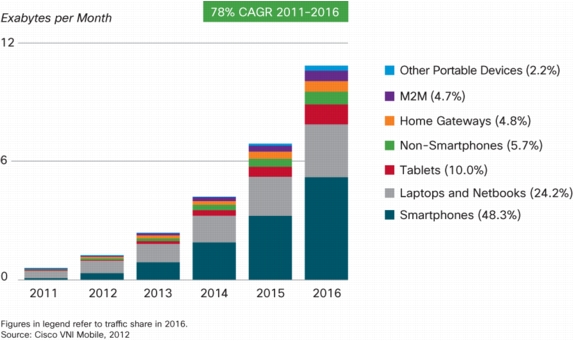
And, in one of the report’s more telling figures, the number of mobile-connected devices will exceed the number of people on earth by the end of 2012. By 2016, there will be 1.4 mobile devices per capita. That year, there will be over 10 billion mobile-connected devices, including machine-to-machine (M2M) modules. Again, the number will exceed the world’s population at that time (7.3 billion).

VIDEO

The mobile web’s growth, and its unending need for more data, more connectivity and more bandwidth, shows no signs of slowing. One of the top activities for mobile users in particular, is mobile video. For the first time, video accounted for over half of all traffic (52%). This is, in part, due to the increases in connectivity and phones capable of video viewing. By 2016, video will be over 70% of traffic.

Video’s growth can also be attributed to the increases in devices that can do more, faster at greater speeds, which help to impact the global bottom line in terms of data usage. Case in point: 4G phones, only 0.2% of mobile connections, are already accounting for 6% of mobile data traffic. By 2016, 4G will reach 6% of all connections, but 36% of total traffic, or 9 times that of non-4G phones.

The top 1% of mobile data subscribers, meanwhile, account for 24% of data traffic. And smartphones as a group, still a minority representing only 12% of the total handsets in use today, now account for over 82% of global handset traffic.

MOBILE CLOUD

In some cases, mobile cloud apps are video apps (think YouTube and Netflix), but other times they’re music (Pandora, Spotify), gaming, or social networking apps. But the increases in mobile connectivity have allowed what would otherwise be limited hardware devices to function as tools for media consumption.

A user with an 8 GB smartphone who streams music and video will consume more content over 2 years that can be stored on the device itself. And a smartphone owner who uses Netflix, Pandora and Facebook will generate more than twice the volume of traffic as generated by a smartphone owner only using email and web apps.

SMARTPHONES

Smartphones are growing in popularity and usage, too, as indicated by the increases in the group’s data traffic demands. In 2011, the average smartphone usage nearly tripled, up from 55 MB/month last year to 150 MB/month today. By 2012, over 100 million smartphone users will be using over 1 GB/month of data. And by 2016, the monthly global smartphone data traffic will pass 10 exabytes per month, with the average smartphone generating 2.6 GB/month, a 17-fold increase from 2011′s average.

FEATURE PHONES

Even though the perception in developed markets like ours is that smartphones are everywhere, the majority of the mobile market is still using basic handsets. In 2011, these devices accounted for 88% of the mobile landscape, and their mobile data usage increased 2.3-fold to 4.3 MB from 1.9 MB last year. In other words, even “dumb phones” are getting smarter, and capable of consuming more mobile data.

TABLETS

But the mobile web is no longer accessed by handsets alone. Tablets are a growing group, too, with their own data demands. The number of mobile-connected tablets tripled last year to 34 million, each generating 3.4 times more traffic than the average smartphone (517 MB/month vs. 150 MB/month for smartphones). By 2016, tablets will be 10% of global mobile data traffic.

Or, in what may be my favorite number from the report: by 2016, mobile-connected tablets will generate almost as much traffic as the entire global mobile network does in 2012, 1.1 exabytes per month. (The global network will reach 1.3 exabytes/month next year). Think about that: the tablet Internet will grow that quickly to become the size of this year’s mobile Internet. If you’re working on anything in the mobile space and have put off addressing how you’ll meet the needs of the tablet user, you’re already behind. And it goes without saying that if you’re building for the web and haven’t addressed mobile, you’re basically just lost.

ANDROID VS IPHONE

Finally, what good mobile data could refrain from weighing in on the Android vs. iPhone battle? In terms of data consumption, it appears Android is winning (well, using more data – I’m not sure if that’s “winning.”) As Android apps are freer to run in the background, the figure is not so surprising. But this is also a function of Android’s increased global market share. Today, Android devices’ data consumption is 29% higher than Apple devices in terms of megabytes used per month per connection.

There’s tons more data in this report – I’m barely scratching the surface. To read more, head over here.


Minority-Focused NewME Accelerator Announces Second Class of Startups

newme logo

NewME Accelerator, the incubator launched last year to support minority entrepreneurs, just announced its latest group of startups.

In her blog post about the new class (NewME’s second), founder and CEO Angel Benton also talks about the success rate of the first group of NewME alums — 60 percent of them have raised money, adding up to a little more than $500,000 in total funding.

For the current class, Benton says NewME received more than 300 applications. This year’s program will be based in the Hub San Francisco co-working space. Participants in the 12-week program don’t receive funding from NewME, but they get to live and work with a community of entrepreneurs, and they also receive mentorship and access to services from NewME partners. (Last month, the program added Andreessen Horowitz as a partner and sponsor.) In exchange, NewME takes a 4 percent stake in the company.

Even though the second session is just about to start, NewME is already accepting applications for the next class, which starts in August. While most of the promotion around NewME has focused on African-American entrepreneurs, the program is also interested in companies with founders and CEOs from other underrepresented minorities, namely those who are women or Latinos.

Here are the new companies (the descriptions come from NewME):

The Modul.us
Founder: Rachel Brooks
Desription: TheModul.us allows small businesses to affordably configure products through their software.

Butlr
Founder: Andre Gabriel
Description: Butlr gives you the easiest, funnest way to find any kind of deal on the Web.

Ubi Video
Founder: James Norman
Description: We are a discovery entertainment platform that offers the only digital video experience you can call your own.

AgLocal
Founder: Naithan Jones
Description: AgLocal connects independent farmers and producers with the demand of local business and consumers.

Helpr
Founder: Tendekai Muchenje
Description: Helpr is a one stop customer care portal that literally makes customer care as simple as @#*!.

Kairos (still in private testing)
Founder: Amanda McClure
Description: Kairos overlays data on top of real life interactions in the enterprise market using facial recognition and augmented reality.

pictureMENU (still in private testing)
Founder: Christopher Lyons
Description: pictureMenu allows restaurants to bring their menu’s into the 21st century by allowing them to create “smart menus” accessible via tablets and mobile phones. pictureMenu’s tie into a restaurants POS system.


Should Mark Zuckerberg Think Twice About Establishing A Dynasty?

joaquin phoenix

Editor’s note: Charley Moore is a lawyer and the founder of online legal service Rocket Lawyer.

Congratulations Facebook! You have made history and changed the world. So, here are some thoughts from one of your biggest fans. Like the rest of the planet, I love Facebook and use it every day. So, there may never be a better time than now, when things are going really well, to add a dose of humility and perspective to the Facebook conversation.

Remember the movie Gladiator? Commodus, the bad son, murdered his aging father, Emperor Marcus Aurelius, preventing him from passing the empire down to his adopted good son, Maximus. Thus, instead of carrying on a centuries old tradition of merit-based succession, power passed to an unworthy blood relative and corruption followed.

What does this have to do with Facebook founder Mark Zuckerberg? Well, according to the $5 billion IPO filing, legal documents give him absolute control over the post-IPO company, even beyond the grave, just like a Roman emperor. That kind of power can have unintended consequences.

The story of Facebook’s spectacularly successful founder serves as a blueprint for others who hope to create corporate dynasties. Still, both he and those who seek to emulate him would be wise to take the counsel of history and establish at least a minimally representative corporate governance structure that includes one or more independent board members.

How did governance get to this point?

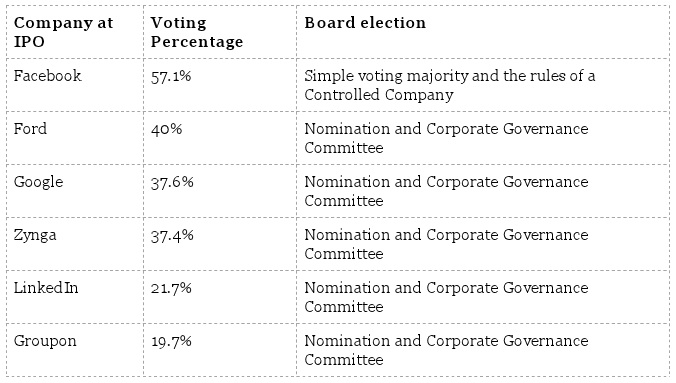
Facebook came of age after Google’s founders obtained super majority control at IPO, followed by LinkedIn, Groupon and Zynga (and more). In its early days, Sean Parker, a serial entrepreneur (Napster, Plaxo) who played an important early role as a confidante to Mr. Zuckerberg, helped convince him of the importance of founders maintaining control. As such, the Facebook founder has long dominated his board of directors, appointing three out of five seats.

Now, Facebook takes the founder-control trend to the extreme. By converting his shares into a class of super-voting stock at IPO, and designating Facebook as a “controlled company,” Zuckerberg will not only control 57.1% of the vote, but will also have the legal right to name 100% of the board of directors. He can also designate whomever he chooses as the successor to his corporate authority.

The unintended consequence of such absolute control may be the opposite of what Zuckerberg hopes. It isn’t a stretch to believe that he genuinely wants control in order to keep the business focused on the long-term social mission he described in his letter to shareholders, rather than the short-term gains often demanded by financial managers. What may happen instead is that the post-IPO business finds itself subject to whimsical decision-making and vulnerable to the inevitable securities lawsuits.

When founder-controlled companies sell shares to the public, they should plan for the possibility of the emperor at some point “having no clothes.” Eventually, even the best founders can lose their mojo, or appoint a successor who proves unequal to the task. This is when having independent views and fiduciaries can help shield the business from liability and guide it to a better place, even without legal control.

Of course, founder-controlled companies are often extraordinarily successful. In the United States, the founding family is an influential investor in more than one-third of the Standard & Poor’s 500 companies. Founding family owned companies tend to do well because of the long-term influence, interest, and investment of owners who are motivated by mission, not just by financial gain.

For example, Ford Motor Company has managed to sustain a profitable founding family business since Henry Ford incorporated it in 1903. Since 1956, the Ford family has wielded at least 40% of the company’s voting rights by setting up a system to ensure that only family members can own Class B stock. The family’s voting power includes the exclusive right to approve a merger, sale, or liquidation of the company.

In their desire to control but not stifle the business, the Fords enlisted qualified advisers, including original counsel Clifford Longley, investor Goldman Sachs, and independent directors. And it worked; Ford has survived multiple recessions, including the most recent economic downturn. Ford was the only American carmaker that didn’t need a government bailout.

Mr. Zuckerberg has so far made a different choice about the governance of Facebook. While appointing Sheryl Sandberg as a strong #2 has been brilliant, what will he do when she moves on? He and his heirs can exercise more corporate power post-IPO than when it was private. Opting to function as a “controlled company,” Facebook will be exempt from the customary stock exchange corporate governance rules that apply to the vast majority of public companies.

From the Facebook prospectus (S-1):

Because we qualify as a “controlled company” under the corporate governance rules for publicly-listed companies, we are not required to have a majority of our board of directors be independent, nor are we required to have a compensation committee or an independent nominating function.

Instead of a nominating committee for directors, all directors will be selected, removed and replaced by Mr. Zuckerberg, who is also imbued with the power to unilaterally choose a successor.

Mr. Zuckerberg has the ability to control the outcome of matters submitted to our stockholders for approval, including the election of directors and any merger, consolidation, or sale of all or substantially all of our assets … Additionally, in the event that Mr. Zuckerberg controls our company at the time of his death, control may be transferred to a person or entity that he designates as his successor.

While Larry Page, Sergey Brin, and Eric Schmidt at Google also maintain control, with
majority ownership and voting rights, the triumvirate approach has balanced governance, and none of their rights extends to the power to appoint and remove independent directors at will. The same goes for Reid Hoffman at LinkedIn, Andrew Mason at Groupon and Mark Pincus at Zynga.

So, if you are a company founder, and you single-mindedly want to make your business a founder-controlled dynasty, Facebook is your blueprint. If, on the other hand, your goals include protecting the durability of the company you founded, even when you and your heirs may no longer project the visionary qualities that you do today, you should: 1) empower your company’s non-founder shareholders to elect at least 1 independent director; and 2) commit to a succession plan that is not hereditary by default.

Eva Arevuo also contributed to this article.


Agencies Show Their Age On Mobile

michael douglas phone

Editor’s note: David Hewitt is VP, global mobile practice lead at digital agency SapientNitro.

Mobile strategy is about more than just phones. Mobile platforms and engagement strategies in our digitally enabled world need to support all marketing initiatives, both offline and online, and be truly multi-channel. Mobile maturity is one area, however, where brands and agencies are playing catch-up with consumer demand.

A siloed approach to mobile has been commonplace over the past couple of years. Many agencies have supplemented traditional creative with mobile ads that lack a larger strategy, subbing out app development that offers no real value and failing to thoughtfully consider the best platforms and devices for mobile campaigns.

For example, Shazam recently made a splash by enabling second screen synchronization with the Super Bowl broadcast, and the company says it saw record engagement during the game. Unfortunately, problems arose because not all hub pages were optimized and users had to complete Bud Light’s age verification screen on a screen that was not touch-friendly. Considering the large number of iPhones participating, it should have also linked straight to the promoted song on iTunes, instead of emailing it a day later. It’s likely that there was a lot of user drop-off, especially given the three-step process.

Missed opportunities like this will become less common over the next year as brands and agencies fight to stay ahead of the curve, proving 2012 will be a game-changer for mobile.

This shift to a more optimized mobile experience is not merely because the industry is a year older, but because enough agency and brand leadership are seeing a critical mass of mobile and multi-channel initiatives bear fruit. Marketers are realizing the growing risk of doing nothing.

This year, the market demands a more entrepreneurial mindset. Mobile is not just the hot topic of the moment — it’s the future. Embracing this reality requires a shift in thinking and many brands still do not have a mobile or encompassing digital strategy in place. Moreover, many agencies are still growing a set of basic mobile capabilities. Creating both smartphone and tablet-optimized experiences, along with the increasing need to pick platforms and develop apps, is becoming the norm.

Last but not least, 2012 is begging for brands to truly integrate mobile with commerce and CRM programs, and create new integrated experiences for in-store, at home and on-the-go.

While 2012 brings a new confidence to place bigger investment bets in mobile, here are some tips and trends to consider:

  • Look at all of the touch points and device considerations that surround a mobile campaign. Consider environmental conditions like in-store Wi-Fi, device detection and fallback tactics such as developing SMS or mobile web alternatives to more specialized mobile tactics.
  • As mobile becomes more integrated with other touch points, the need to get store Ops and IT involved becomes a critical success factor. Pick an agency that knows how to work intimately with all facets of your organization.
  • On the flip side, some agencies and platform providers are so bent on serving every device that the entire experience gets ‘dumbed down’ so far that it doesn’t engage anyone effectively, especially the smartphone crowd that is more likely to participate. Know what devices to optimize for and how far to take it. Remember not to just look at today’s device penetration for a market, but also the consumer behavior that goes with it and where the trend lines point.
  • As the promise of enterprise mobile solutions and point of sales integration continues to heat up, plan for concepts and pilots that set a bigger stage for follow-on investment.
  • 2012 will be the year of getting websites and relevant marketing assets optimized for tablets, not just smartphones — especially as tablets continue to heat up for mobile commerce and chip away at market share for everyday PC tasks.
  • ‘Big Data’ is back as a buzzword and unsurprisingly so; the more multiple channels are connected, the more we need data to serve up the right experience to the right prospect and customer. There is a lot of opportunity here with location-based service integration and better behavioral and preference-based targeting. However, most of the real benefits won’t be realized until 2013-2014.
  • As most direct consumer brands have a mobile app of some sort, expect to see enhancements that bring context aware features, embedded loyalty, and in some cases pre-paid and mobile wallet capabilities.
  • Much of 2011′s mobile marketing budgets were still made up of slush fund ad budgets. Expect to see more purposeful campaigns and sizable budgets set aside for mobile.
  • Look to work with agencies and partners that don’t just put a person in the room that ‘gets mobile’ but has shown they can deliver it across channels and touch points.

Various agencies and brands sit in very different places across the mobile and multi-channel maturity curve. In 2012, those that don’t figure out mobile will really start to show their declining relevancy to today’s consumer.


Big Cuts at Airy Labs, Ex-Employees Blame Management

airy labs

Airy Labs, an educational gaming startup backed by Google Ventures and others, has eliminated the vast majority of its 20-person staff, leaving only a skeleton crew to keep the company going.

That’s what I’ve been told by former employees, and when you bring up the “team” page of the Airy Labs website, you now get a 404 error message. (There’s still a link from the jobs page.) When I contacted founder and CEO Andrew Hsu, he acknowledged that there have been cuts, saying, “We’re a young company and we tried some early experiments… some worked and some didn’t, so now we’re focusing a smaller team on the areas that worked.”

Airy Labs develops learning games for smartphones. Like many startups, the company began with lots of promise, particularly in Hsu himself. He’s someone for whom the word “prodigy” seems inadequate — according to the company biography, at the age of 16 he graduated from the University of Washington with three bachelor of science degrees, and at 19 he was a fourth-year Ph.D. candidate in neuroscience at Stanford. That’s when he left to start Airy.

Hsu received a Thiel Fellowship, which is the “20 Under 20″ program started by PayPal co-founder Peter Thiel to encourage students to drop out (or at least take a break) from college and create companies instead. For a while, Hsu looked like the program’s biggest success story, since he was the first to raise venture funding, specifically from Google, Foundation Capital, and Playdom founder Rick Thompson.

(I notified the Thiel Fellowship about this post and asked if they wanted to comment, but I did not receive a response.)

The former employees I spoke to offered their version of what went wrong — an account that may, of course, be colored by their current negativity towards the company. Despite his credentials, they place the blame for Airy Labs’ problems squarely on Hsu and his family. For one thing, they say Andrew Hsu wasn’t the only one running the company. Instead, they claim that his father David Hsu was the real boss (he was described to the team as the chief strategist and later as the COO). His mother was also involved in management, and his younger brother was often around too. The family usually holed up in one office that was inaccessible to employees. There was even an email address for reaching all three adults: [email protected].

The former employees say it was surprising to find a traditional family-run business beneath the veneer of a venture-backed startup, especially since the family relationship was never explicitly disclosed — they had to piece it together from inference, based on hints like Andrew Hsu’s YouTube videos.

They have other complaints. 9am to 6pm were declared “library” hours in the office, when employees were supposed to communicate via instant messaging and emails rather than talking out loud. A promised break period wasn’t consistently honored. At the end of every day, some team members were required to have individual debriefings with either David or Andrew Hsu, which would keep people in the office until 9 or 10pm or later. They were regularly expected to work six- or seven-day weeks.

Individually, these practices might not seem entirely unreasonable at a hard-driving startup, but the former employees say that collectively, this made for a micromanaged, overworked staff. Late last year, the team rebelled, demanding more reasonable hours, and the Hsus gave in. However, some team members were told that the new, laxer rules did not apply to them.

They also describe Airy as a paranoid, secretive environment. They say the Hsus refused to commit anything to writing, and would become angry if anyone complained via email (rather than verbally). Employees were warned against socializing or discussing their compensation with other members of the team. At the same time, office life was obsessively documented in photos, a practice that extended to people interviewing for jobs. And things got worse after a negative review of the company was posted on Glassdoor — at that point, lectures about loyalty became common, and employees were told not to speak to anyone who had left the company.

Speaking of Glassdoor, the anonymous employee reviews on the site support the broad strokes of the account I heard. One review is positive, the other five all focus on a single theme — bad management. One reviewer said the management team “reminded me of my parents.” In some ways, that was positive, as there were “random bouts of affection.” But in many ways, it was not:

The management were unlike parents in that they definitely didn’t love us. They asked for work hours that are probably normal in the country they’re from, but are not okay here. I don’t think they adjusted for culture difference. That’s how I’m choosing to look at it, anyway. The time and efforts they asked their employers [sic] to put in did not align with the pay they handed out (somewhat understandable as they are a young start-up) or with the appreciation they showed.

I wish they would understand that everyone who joined did so because Airy Labs holds a wonderful vision. We employees were/are there to help them work toward this vision because we believe in it too. The employees are definitely not in it for the money. Many of us sacrificed family time we can never get back to build their vision, which we made our own. The ones who couldn’t take the work load left right away. It’d be nice if the ones who stayed were shown more appreciation and human kindness.

Worst of all from a business perspective, the former employees say there was no clear vision, no sense of how the company was going to achieve its goal (described on the site as “creating the next generation of social learning games for kids”). For one thing, Airy didn’t have a full-time game designer for several months last fall. Although the company released seven games in relatively quick succession during that period (some of them, like Mini Catch, achieved high rankings in the Apple App Store), productivity since then has slowed as everyone devoted their energy to a big product, one that has yet to launch and whose goals were constantly shifting. The former employees say these shifts weren’t brought on by brilliant new ideas, but instead by Andrew Hsu’s desire to chase the latest trends.

While this was going on, they say Hsu promised more funding was coming, in the form of a Series A. (At this point, Airy Labs had raised $1.5 million.) He was hiring aggressively, growing the company to 20 people and saying that it would soon be 40. However, that Series A still hasn’t materialized, and the company wasn’t earning much revenue, having released the games for free and only introducing in-app purchases several months later. Eventually, employees were told that investors had become concerned about the business, so the team would have to take a pay cut. Some employees quit then, and soon after, others were laid off or told to take an unpaid vacation.

Now, the former employees say the only people left are an engineer, two artists, an administrator/executive assistant, and Andrew Hsu. Desks in the big Palo Alto office are being rented out to other companies. (Hsu also sent out messages to Stanford email lists looking for tenants.)

I provided Hsu with a summary of this article, and he responded with the following statement:

We’re a young company and we tried some early experiments… some worked and some didn’t, so now we’re focusing a smaller team on the areas that worked. I’m a first-time CEO and certainly made some mistakes, including growing the company too fast. I feel good about where we’re headed and while we’re having strategy changes, I am fortunate to have my awesome advisors, investors, and experienced mentors to lean on to guide me through this difficult process. Their input was instrumental in making these decisions. I am also making a number of management team changes that will ultimately help me lead the company through the new strategy. I was and continue to be the sole decision maker in the company.

I sincerely appreciate the hard work and diligence from all of our past team members, but I had to make the right but difficult decision for the company at that time, to keep us moving forward. I wish them all the best in their future endeavors. We are currently working on some innovative, exciting projects that are coming out soon. Our space is new and interesting and requires innovation, and we’re currently formulating our next plan of attack.

Looking back on the experience, the former employees say they are most disappointed to have given so much time and energy to the Airy Labs vision, when they’re now convinced the executives had no idea how to make that vision a reality, and no desire to recruit more experienced advisors.

“Andrew said he was fully committed to that vision,” one says. “I hope that’s true. I hope they succeed. I hope they build back up.”


Four Mistakes Publishers Make When Bringing Content to Tablets

new york times ipad

Editor’s note: Mitch Lazar is the CEO of news reader startup Taptu. He was the founder or co-founder of CNN.com, CNN Mobile, and Cartoon Network Mobile.

Many revolutions have been televised, but the publishing revolution has already become digitized, and now, mobilized.

There’s no doubt that the second half of 2011 was a difficult period for newspaper and magazine publishers. An Audit Bureau of Circulations report revealed that single-copy sales of consumer magazines dropped by nearly 10 percent in a year, while the five magazines with the highest newsstand sales all reported sharp declines as well. Most importantly, the fall in sales has hit revenues, making it more important than ever for publishing businesses to rapidly modernize their trade.

As readers move toward tablets and mobile phones, there’s no question that these new reading devices will dictate the success and failure of the media industry. Successful publishers will be able to reincarnate their digital content onto these gadgets. So why are so many publishers stumbling in their mobile strategy? From over committing to a multitude of mobile platforms, to underwhelming app experiences, we’re seeing a lot of mistakes that should not be repeated:

1. Trying and failing to reinvent the wheel.

Many big and small publishers have top-notch tech teams and significant resources, but often fall into the trap of believing that only the teams inside their own building can create the best platforms and experiences. Not true.

Partnerships are the prime way big and small media companies can succeed in building their audiences in the new media world. Small startups are creating amazing technology that can help publishers grow their distribution plans. By tapping into these talented, focused teams, the publishing world can quickly distribute content in a compelling and engaging way using tomorrow’s trends, not yesterday’s opportunities.

Don’t reinvent the wheel, because by the time you do, a new wheel will already be in motion.

2. Getting left out of the mix.

If you think about it, listening to music on the radio or going clubbing exposes you to great new tunes you may not have discovered. Thanks to DJs, and discovery services, we all find new music we love and want to share. This curation and sharing experience has now come to the world of digital publishing. Modern social news aggregators are essentially content DJs that deliver awesome content to consumers through a fun and easy experience, whether that be via flicking, tapping or flipping a device screen. Publishers that are getting this right are experiencing booms in their digital readership solely due to the fact that new discovery tools and networks like Facebook and Twitter turn on new readers to great recommended content.

News needs distribution. In the old days, publishers put their newspapers under the door of every hotel room, at the front door of many homes or at the street corner. Today success is determined by how well publishers join and participate in social media and the news revolution. Discovery services like news readers can help.

Sadly, some publishers have avoided these discovery tools. They’ve wanted their content to only live in their controlled spaces, or have channels that include only their sourced and created content. But consumers are demanding more. Through news readers, they are browsing and uncovering new content and sources they never knew existed by taking advantage of search technologies that create serendipity for discovery, sharing and recommendations.

News reader users are building streams of curated topics across genres and receiving a plethora of content from editors across publications. Take the Super Bowl, for example. In days gone by, you had to hunt and peck your way through each editorial version of ESPN, CNNSI or Yahoo Sports. Now, you can DJ your own news mix to see what sports editors and the social crowd are saying about every aspect of the Super Bowl, making the user experience engaging, time saving, and far and away supreme to traditional news searches. When users like what they see, they share stories with their friends, families and followers—proving themselves a key ingredient for successful distribution. In the end, news readers and other discovery services drive more people back to media destinations where the cash register rings.

3. Ignoring brand potential.

Big branded publishers have an amazing treasure trove of content at their fingertips from many different brands or labels. They create enormous amounts of content every day. In fact, some of the largest media companies have several amazing newspapers or magazines in their stable, but many have not ventured into mixing and mashing content from their various publications into a new and exciting branded experience.

In this fast changing digital landscape, the time is ripe to test the waters for launching new aggregated services. The cost is not great and the upside can be very rewarding. It puts a spin on traditional distribution, and focusing on one deep vertical with existing brands lets publishers try new distribution strategies without cannibalizing their existing audiences and revenue.

Take Glo from MSN, for example. In collaboration with Hachette Filipacci Media and BermanBraun, they built a top lifestyle destination for women with a brilliant mix of aggregated media from across their stables of content. Using existing content from their print worlds, they created a new avenue for digital audiences to consume their great content, while taking advantage of an opportunity to build a new business at a relatively low cost.

4. Searching in the wrong places.

Distribution and discovery of publisher content used to take place primarily in traditional search engines like Google, Yahoo!, and Bing with traditional investments in search engine optimization (SEO) techniques that led users seeking one particular query to discover content from another related outlet. Content tagged a certain way shows higher up in the algorithmic search results, prompting users to click on it and publishers to receive the benefit of picking up greater share of audiences when SEO is done right. It’s a type of free advertising publishers and media owners have used in their distribution plans. However, news readers like Taptu, Flipboard, Pulse and Zite are demonstrating the modern form of SEO, where users discover and share stories that have the perfect context and relevance to each user.

While reading a stream of content, people are exposed to related stories or served up other similar stories from a variety of publishers, leading users to share, tweet or follow links back to large media and publishers. So, for example, if a user searches ‘NFL mock draft 2012,’ they will instantly find a variety of new sources that have become experts on the topic like Walter Football. Walter who? Yes, Walter Football. Welcome to the new world of mobile search.

In speaking with more than 100 digital publishers across the world, the consistent thing we hear is, “We know mobile is critical, but going mobile is easier said than done.” Hopefully the publishing industry can learn from what I see every day and take simple, cost-effective steps towards winning in mobile without letting history repeat itself.


Where The Ladies At? Pinterest. 2 Million Daily Facebook Users, 97% Of Fans Are Women

I Heart Pinterest

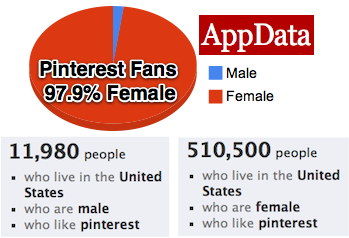
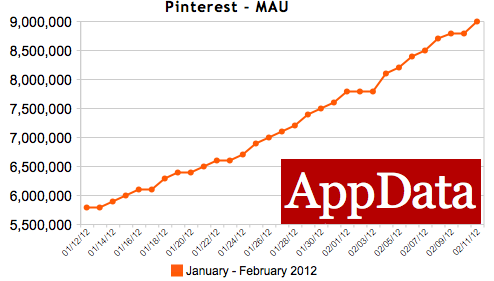
OMG. Pinterest now has over 10.4 million registered users, 9 million monthly Facebook-connected users, and 2 million daily Facebook users, according to Inside Network’s AppData tracking service. With gorgeous photography, and links to shopping sites, Pinterest is becoming an obsession for flocks of women. And they’re not afraid to show it, I mean, Like it. AppData and Facebook’s advertising tool show that over 97% of Pinterest’s Facebook fans are women.

The stunningly feminine fan base could be a telling proxy for Pinterest’s actual user base, which totals over 10.4 million considering that’s how many users follow the official “Pinterest” account.

Even though it was co-founded by three men, the site’s not shy about courting women. It’s About page describes that “People use pinboards to plan their weddings, decorate their homes, and organize their favorite recipes.”

Sure, dudes can do all those things too, but they’re probably not addicted to pinning tuxedos and power tools like women pin brides dresses and bundt cakes. Pinterest’s easy-to-use Pin It bookmarklet and the joy of curation is keeping ladies and gentlemen engaged.

Over 1/5 of its fast-growing Facebook-connected monthly user count use Pinterest each day. At the start of 2012 the daily user count was just 810,000, but now its at 2 million according to AppData. This week comScore said Pinterest hit 10 million U.S. monthly unique visitors faster than any independent site in history.

There are so many beautiful things to share, and they don’t deserve to slip into obscurity at the bottom of our Twitter feeds and Facebook profiles. Pinterest gives people the chance to say “I love this, and not just today. This helps define me.”

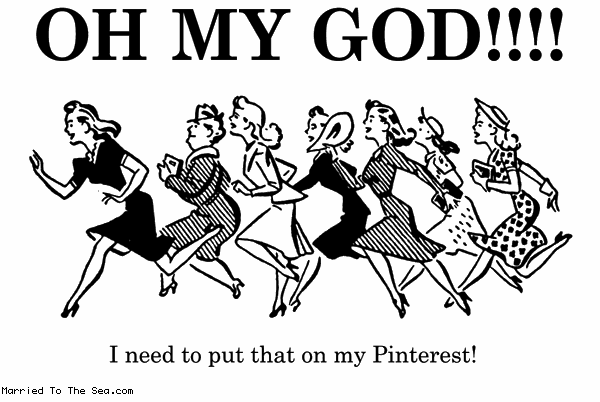
[Image Credit: Married To The Sea]


Moshi Monster Madness (In Which I Get A Snookums Tattoo)

Moshi Tattoo

It’s February, which means Toy Fair in New York City. Every year, Mind Candy CEO Michael Acton Smith comes to town to peddle his little monsters. Those would be Moshi Monsters, one of the largest social game sites for kids 6 to 11, with 10 million monthly visitors. It’s huge in the UK, and this year Smith is going to make a major push into the U.S.

And it’s not just online. Moshi Monsters are finding their way into all sorts of kids merchandise, including collectible toy figurines (more than 20 million sold in the UK alone last year), plush dolls, games, the No. 1 kids magazine in the UK, mobile apps, and even temporary tattoos. While we were talking about his plans in the video above, Smith put one of the tattoos of the Snookums “moshling” character on my arm. My kids were pretty impressed when I showed it to them.

Last year, Smith’s goal was to sell $100 million worth of Moshi Monster merchandise, and he exceeded that goal, selling $105 million worth directly and through licensees. Mind Candy’s revenues was a portion of that, but it is profitable with 100 employees and Smith says revenues “tripled” last year.

He is constantly pushing the brand into new areas, including Moshi TV, which is like a YouTube for Kids with a mix of original and curated programming. If you haven’t heard of Moshi Monsters yet, you will. The toys will be in Walmart, JC Penny and pretty much everywhere else this year.


Is Facebook Finally Going To Do Something Interesting?

facebook_people

I can think of few subjects less interesting than Facebook’s forthcoming IPO. There, I said it.

I honestly don’t get what the big deal is. So a few thousand people will finally liquidize their locked-up wealth, and the hoi polloi will at last be able to buy Facebook shares. Stop the presses! (It won’t meaningfully affect their ability to buy other companies; they already have $4 billion in cash on hand, and I seriously doubt they have any multibillion dollar acquisitions in mind.)

I guess if you measure innovation by keeping financial score, this seems exciting, but if you measure by, you know, actual innovation, this is a total nonevent.

However. All the IPO furore has introduced one interesting data point: Mark Zuckerberg’s S-1 letter, which includes the unexpectedly striking–daring, even–paragraphs

We hope to change how people relate to their governments and social institutions.

We believe building tools to help people share can bring a more honest and transparent dialogue around government that could lead to more direct empowerment of people, more accountability for officials and better solutions to some of the biggest problems of our time.

By giving people the power to share, we are starting to see people make their voices heard on a different scale from what has historically been possible. These voices will increase in number and volume. They cannot be ignored. Over time, we expect governments will become more responsive to issues and concerns raised directly by all their people rather than through intermediaries controlled by a select few.

Whoa.

Now, I’m on record as a pretty harsh critic of Facebook. Not because I think they’re evil, but because everything they do has always seemed mediocre, homogenizing, and painfully, painfully dull. (With the sole exception of Timeline, which is interesting in that it introduces long-term context to a previously transient medium, but not exactly world-changing.) To quote, er, myself:

Facebook has become to the social web what Microsoft is to the desktop: mindbogglingly gargantuan, relentlessly mediocre, and almost inescapable.

There’s nothing mediocre about what Zuckerberg wrote above. It’s downright inspirational. He’s talking about his intent to actually change the way the whole world works, using Facebook as a lever.

But how, exactly? I mean, full marks for bold words, but there’s still a vast uncrossed chasm between idea and execution, and the road to hell remains paved with good intentions.

His letter also includes a bunch of boilerplate crap about creating a “more open culture” through the magic of “people sharing more”, but come on. First, there’s a massive wall of diminishing returns there: as people share more, the value and importance of what we share decreases. First we get used to sharing online at all; then we start sharing what’s important to us; then we wind up dumping our entire Spotify playlist on our friends.

Second, that sits more than a little uncomfortably with the fact that the only people to date who actually have changed the world in an important way using Facebook as a lever, the revolutionaries of the Arab Spring, were people who had to keep their identities and locations secret; had they followed Facebook’s “share more!” ethos, they would have failed and been tortured to death. So that’s awkward.

No, if Zuckerberg really wants to change the way the world works, he’s going to have to introduce something entirely new. Like what? you inquire. Funny you should ask: I happen to have a couple of ideas. They’re wild speculation, of course — but I think they at least give an idea of the order of magnitude of innovation that’s required here.

1. Online Parliaments

This is the most obvious, and the best fit. Right now Facebook is mostly about social groups, ie people you know. But what if they expanded their remit to organizations? And I mean any scale of organization, ranging from your local arts centre to, say, the Republican Party. Sure, they can and do already have Facebook Pages, but what if their members could use Facebook to hold binding votes for their representatives? Conversely, what if those organizations could raise money from their members directly via Facebook (in exchange for a 5% fee, of course) — and then the Facebook-voted representatives could decide what to do with those funds?

That would introduce a Facebook aspect like a mega-Kickstarter, which would be significant in and of itself…

Seems to me that Kickstarter is the most important tech company since Facebook. Maybe more important in the long run.—
Tim O'Reilly (@timoreilly) February 09, 2012

…but more importantly, it would introduce Facebook into the political sphere. Aside from the money machine it would become for every political party, an elected representative of, say, twenty million verified Facebook users — “Ladies and gentlemen, the junior senator from Reddit!” — would be a major political figure, regardless of their pedigree or location, if only for the size of their pulpit.

It could even be a step towards direct online democracy, a la John Brunner’s prophetic The Shockwave Rider. There would obviously be technical challenges: verifying the electoral registers, a reliable and secure voting system, some protections against fraud, etc. But they seem surmountable.

2. Eyes On The Sky

This one’s a little crazier: what if Facebook built a mechanism for protest?

I don’t mean the Occupy movement. I mean a means for people to indicate that authority is being abused or corrupted. That petty thugs prevent people from taking pictures from a public walkway, even though they have every right to do so. When innocent people are victimized by police brutality. When bureaucrats in developing nations have to be bribed to do their jobs.

Right now there’s usually no recourse for abuse of authority, except for

  • taking your complaint to the authority in question, which promises it will investigate itself and then stacks the deck against you
  • going to the media, which is a lottery at the best of times.

What if Facebook provided such a recourse? A universal complaints department, if you will, one that uses their extraordinary reach as both searchlight and spotlight. That’s not as awkward a fit as it first sounds. After all, the fight against fraud and corruption is one of transparency — indeed, the world’s primary anti-corruption organization is called Transparency International — and I think we can all agree Facebook is all about transparency. If you go back and read Zuckerberg’s words, you’ll find they actually fit this notion pretty well.

What else might Facebook do to truly change the way the world works? Heck, I don’t have even half of the answers. Chime in with your own suggestions in the comments. But what’s clear to me, at least, is that if Mark Zuckerberg actually wants to put his money where his mouth his, he needs to do something new. “More of the same” won’t even come close to cutting it.


Gillmor Gang 02.10.12 (TCTV)

Gillmor Gang test pattern

The Gillmor Gang — John Borthwick, Robert Scoble, Kevin Marks, and Steve Gillmor — took a leisurely stroll on a late winter Friday afternoon. The subjects: Path and the Address Book, SuperBowl dynamics, and 21st Century Fox, aka the new television/social media hybrid model.

It may seem like all stories are self-referential in this time of trending to zero barrier to entry, but as with many realtime transitions, it’s hard to see the forest for the trees until you get enough altitude. With 98 million simulsharing social media out of 119 million in realtime, the uber address book that’s being built will absorb all the big players including Facebook and Twitter.

@stevegillmor, @scobleizer, @borthwick, @kevinmarks

Produced and directed by Tina Chase Gillmor @tinagillmor


Don’t Call Me a Douchebag

fear

Editor’s note: James Altucher is an investor, programmer, author, and entrepreneur. He is Managing Director of Formula Capital and has written 6 books on investing. His latest book is I Was Blind But Now I SeeYou can follow him @jaltucher.

I was once backstage at a news show. Six  people were on a box in the screen screaming at each other about the economy. The producer was laughing. He leaned over to me and said, “the whole idea of this is to fill the time between one commercial segment and the next.”

Every day they want to scare me. Greece is going to suddenly disappear. Or have some sort of debt “contagion” that will spread across the Atlantic. Everyone is a “contagion” expert. Just like we were all experts on “Avian Flu”. Whatever happened to that one? Did anyone die of Avian flu?

Here’s what happens in a newsroom. I know this because I’ve been in many newsrooms: Top editor/producer says: Ok. What do we have to work with? Reporter says: Well, the economy is up. Editor says: Not good enough. Reporter says: Well, radiation from a tiny island in Japan might hit San Francisco tomorrow. Editor/Producer: BINGO! And then it’s all over the news. And then everyone in San Francisco gets sick from iodine pills. And then no radiation hits. And the media moves on: ECONOMY HEADING FOR PROBABLE RECESSION!

No apologies.

I want an apology.

For me, its personal. Some economist (Mish Shedlock) wrote a blog post in 2010, “James, you are completely whacko”” because of my stance on the economy. Nouriel Roubini thought I was crazy that we weren’t going into another recession (in mid 2010). Some random guy made a cartoon video “Altucher is a douchebag” a year ago because of my economic stance. The stock market is up 30% since then. No apology.

Why do they make it so personal? I never in my life called anyone a “whacko”. Who even says “whacko”? Isn’t it spelled “wacko”? Or “douchebag”. Here’s my daughters watching the “douchebag” video. I thought it would be educational for them to learn why people think their dad is a method used to clean the inside of a vagina.

Entrepreneurs don’t need to care about the economy. In fact, the worse the economy, the better the time it is to start a business. Because the one thing I know about every bad economic situation in the US – it always gets better. Since 1600.

But, unfortunately now, the economy is on fire and is going to stay that way for awhile.

Here’s why, in quick bullet points:

– 23 consecutive months of private sector job growth.

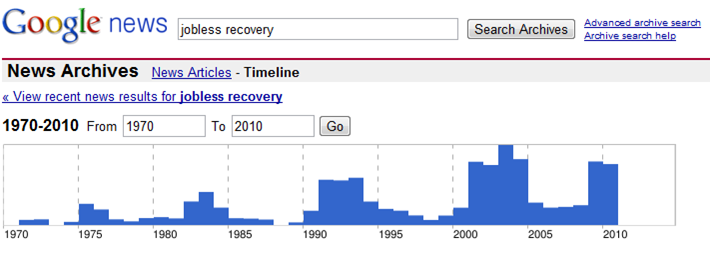
Just an aside. I searched on Google News to track the occurrences of the words “jobless recovery” across every news source. Here’s the result:

In other words, after every single recession, all the newspapers spoke about a “jobless recovery”. Well, we had one again. And guess what. 23 consecutive months of private sector job growth is what’s called “good news”.

  • real GDP has grown for 10 consecutive quarters. People will say, “oh that’s fueled by QE2”. No it isn’t. QE2 might be bad or good. We don’t know yet. The last dollar in QE2 was spent in June, 2011. It takes 6-18 months, if not longer, for the effects of QE2 to be felt. So we just don’t know yet. What we do know is: 10 consecutive quarters of GDP growth is what’s called a “good thing”.
  • car sales are up 53% from the bottom in 2009.
  • earnings yield on stocks are at 7.4%, treasury yields are at 2%. Remember back in Ancient Times? Like the 1980s and 1990s? This ratio was reversed. Does that mean the S&P 500 is going to triple? Maybe. Maybe not. But it means stocks are a much more lucrative bet now than treasury yields.
  • money supply is growing – this means that banks are finally starting to lend. Money supply is measured by M2. This has just been starting (see the “six months” I mention above.)
  • corporate cash at a high. Not only that but…

  • first recession in 200 years where cash increased quarter over quarter every single quarter. So wait a second, didn’t we have a recession. Yeah, but companies made more money than ever by firing all of their dead weight. Is this good or bad? I don’t know. But now employment coming back and cash is in the bank.
  • trailing P/E on S&P is 12. P/E is price over earnings and is used to gauge whether the market is cheap or not. The average is 15, about 20% higher. If you look at forward earnings, the forward P/E is about 10 (because of earnings growth and all of the announced buybacks). That means the  market could easily be worth more than 50% higher than where it is now. Well, the media  can say, “what if profits go down?” Yeah, what if? Shut up.

Well, what about Greece?  Yeah, I say, what about Greece. I was on TV a month ago and this came up. I said, “Greece to the Eurozone is like Rhode Island to the United States in terms of GDP.” And I live 40 minutes from Rhode Island and have never set foot in it. So why should I care about some beach resort 5,000 miles away.

So the response from the erudite reporter was, “but investor psychology cares about Greece.”

“Yeah,” I said, “because of you every day blabbering about it on TV. Let’s talk about Kim Kardashian instead. A much more interesting topic.”

So what does this all mean? Does this mean your life is going to be better because the economy is going to be better? Who knows. That’s up to you to choose. Does this mean the media will start apologizing for all the misinformation? No, of course not. They will just figure out the next thing that scares you.

Does this mean that I will start getting apologies. Absolutely not. I’m nobody.

It does mean this: turn off the TV. Don’t read the newspapers. Stop blaming the economy or Greece or “Avian Flu”. Sleep 9 hours a day. And once you can ignore all of these distractions you will have the time to start a business and get rich, regardless of what the talking heads (including me) are saying about the economy. Good luck and godspeed.

(Or you can also read my latest post on “How to Break out of Prison”)


Motorola Droid 4 Review: Initial Impressions (Video)

droid 4

Before we chat out the Droid 4 there’s a bit of other news we need to address right quick. As you’ll surely notice, we’re doing smartphone reviews a little differently now. That said, this video and my basic hands-on impressions are just the first in a three-part series reviewing the phone. Stay tuned for what comes next!

Alright then, back to business…

The Motorola Droid 4 has spent exactly 24 hours on shelves, and from the time I’ve spent with the phone I wouldn’t be surprised to hear that it’s doing quite well there.

If you keep up with phones you know that the Droid 4 is a big deal, the fourth in Motorola’s Droid brand (which happens to be one of the most successful Android brands we’ve seen to date), and a QWERTY-packing beast if I may say so. The thing about it, however, is that the keyboard (any physical keyboard) is becoming less and less necessary.

To be clear, I think that the Droid 4 keyboard is possibly one of the best I’ve ever used. It gives a solid tactile feedback and is fairly easy to navigate. The fact that it’s backlit only adds to my infatuation. But… a combination of great auto-correct and Swype nearly makes that keyboard useless.

I understand that back in the day typing on a touchscreen was super annoying, since the auto-correct wasn’t quite up to snuff. That’s not really the case anymore, and I almost feel like anyone who insists on a physical QWERTY is doing so simply because they’re so used to it.

Truth be told the transition can be tough from QWERTY to soft keys, but Swype can make that transition a lot easier and you’ll ultimately be much faster in the typing department.

Still, for those of you who demand QWERTY-style satisfaction, I can’t recommend a better handset than the Droid 4. The 4-inch screen compliments the size and weight of the phone perfectly, and it honestly doesn’t feel that much smaller than the 4.3-inch Razr display.

Watching movies and playing games is still just as great, in terms of size, but it only made me feel “eh” in terms of quality. Sure, it’s plenty bright and pixel-dense, but it doesn’t have the wow factor of these 720p displays we’re seeing lately.

I didn’t experience any serious issues with the phone in terms of performance, and it would seem that 1GB of RAM combined with that 1.2GHz dual-core processor can handle basic tasks and multitasking just fine. At the same time, I’ve only spent about 24 hours with it, so things may change with heavier testing.

As you can see in the video, the Droid 4 looks much more like the Razr or Razr Maxx than it does its other Droid family members. I almost wish that Kevlar fiber casing was along for the ride, too, but that might ruin one of the best things about the Droid 4: its $199.99 price tag from Verizon.

We’ll be hitting you with more on the Droid 4 as the week progresses, so stay tuned for the rest of our review.

Note: I mistakenly stated in the video that the Droid 4 runs Android 2.3.5 Gingerbread, when it in fact runs Android 2.3.6. My apologies.