Thanksgiving online shopping hits record $5.1B, up 21.5% on 2019, 47% of sales via mobile

Thanksgiving for many is about eating, seeing family, reflecting and relaxing for the day. But for an increasing number of us, it also seems to be about shopping. Collectively, consumers in the U.S. spent a record $5.1 billion buying goods online yesterday, according to analytics from Adobe.

The company’s marketing technology division is following online sales in real-time at 80 of the top 100 retailers in the U.S., covering some 100 million SKUs. While the final sales figure fell well short of the $6 billion that Adobe originally predicted, it’s still the highest amount ever spent during Thanksgiving, a day when brick-and-mortar stores (in cities where they have not been shut down due to the pandemic) are traditionally closed.

Adobe said that combined with online shopping activity in recent weeks, and its forecasts for the weeks ahead (including today, Black Friday) U.S. online retailers are still on target to clear $189 billion in this holiday season — a period that others are also predicting will be strong. Black Friday and Cyber Monday in particular will remain the two biggest online sale days, with today’s sales expected to be between $8.9 billion and $10.6 billion (or between 20% and 42% higher compared to last year).

Meanwhile, analytics from Shopify, which tracks activity across more than 1 million merchants using its e-commerce platform, indicate that the average cart price globally was $86.80, and in the U.S. specifically it was $90.40.

Adobe said one reason that sales fell short of its original estimates is because the holiday sales cycle now starts even earlier for many retailers: “Retailers of all sizes appear to have successfully moved shoppers to buy earlier in the season with early discounts and effective promotions,” the company noted. Indeed, leading up to Thanksgiving, each day this week had sales of more than $3 billion.

“While yesterday was a record-breaking Thanksgiving Day with over $5 billion spent online, it didn’t come with the kind of aggressive growth rate we’ve seen with the start of the pandemic,” elaborated Taylor Schreiner, director of Adobe Digital Insights. “Heavy discounts and aggressive promotions starting in early November succeeded at getting consumers to open their wallets earlier. While COVID-19, the elections and uncertainty around stimulus packages impacted consumer shopping behaviors and made this an unprecedented year in e-commerce, many consumers are still holding off on remaining gift purchases until today and Cyber Monday in hopes of scoring the best deals.”

To put Adobe’s $5.1 billion figure into some context, the overall holiday sales season represents a 33.1% jump on 2019, and Thanksgiving itself is up 21.5%, when shoppers spent $4.2 billion online on Thanksgiving.

The numbers are a hopefully encouraging sign that despite some of the economic declines of 2020 caused by the COVID-19 pandemic, retailers will at least be able to make up for some of their losses in the next couple of months, traditionally the most important period for sales.

As we have been reporting over the last several months, overall, 2020 has been a high watermark year for e-commerce, with the bigger trend of more browsing and shopping online — which has been growing for years — getting a notable boost from the COVID-19 pandemic.

The push for more social distancing to slow the spread of the coronavirus has driven many to stay away from crowded places like stores, and it has forced us to stay at home, where we have turned to the internet to get things done.

These trends are not only seeing those already familiar with online shopping spending more. It’s also introducing a new category of shoppers to that platform.

Adobe said that so far this week, 9% of all sales have been “generated by net new customers as traditional brick-and-mortar shoppers turn online to complete transactions in light of shop closures and efforts to avoid virus transmission through in-person contact.” Tellingly, in U.S. states where there are more CoVID-19 restrictions — either related to numbers that can gather, or in the closure of some venues like shops — online sales growth was 47% higher.

Black Friday, the day after Thanksgiving, has traditionally been marked as the start of holiday shopping, but the growth of e-commerce has given more prominence to Thanksgiving Day, when physical stores are closed and many of us are milling about the house possibly with not much to do. This year seems to be following through on that trend.

“Families have many traditions during the holidays. Travel restrictions, stay-at-home orders and fear of spreading the virus are, however, preventing Americans from enjoying so many of them. Shopping online is one festive habit that can be maintained online and sales figures are showcasing that gifting remains a much beloved tradition this year,” said Schreiner.

(That’s not to say that Black Friday won’t be big: Adobe predicts that it will break $10.3 billion in sales online this year.)

Some drilling down into what is selling:

Adobe said that board games and other categories that “bring the focus on family” are seeing a strong surge, with sales up five times over last year. Chess is seeing a special surge of interest in the wake of the popular Netflix series, “The Queen’s Gambit.”

Similarly — in keeping with how much we are all shopping for groceries online now — grocery sales in the last week were up a whopping 596% compared to October, as people stocked up for the long weekend (whether or not, it seems, it was being spent with family).

Other top items include Hyrule Warriors: Age of Calamity, Just Dance 2021, as well as vTech toys and Rainbow High dolls.

Amazon’s announcement this week that it would be offering more options for delivery this season speaks to how e-commerce is growing beyond simple home delivery, and how this has become a key part of how retailers are differentiating their businesses from each other. Curbside pickup has grown by 116% over last year this week, and expedited shipping is up 49%. Adobe said that 56% of items purchased online were received via curbside pickup or expedited shipping.   

As predicted, smartphones are playing an ever-stronger role, too. Adobe said $25.5 billion has been spent via smartphones in November to date — up 48% over 2019. As the day went on, more people shifted to shopping on their handsets, with smartphones accounting for roughly half of all online sales (versus 38.6% just in the morning). Shopify was even more bullish on smartphones: It said that they accounted for a whopping 70% of all the sales on its platform on Thanksgiving globally.

In the U.S., Adobe said that big retailers continue to dominate how people shop, with the likes of Walmart, Target, Amazon and others pulling in more than $1 billion in revenue annually, collectively seeing their sales go up 147% since October. Part of the reason could be more sophisticated websites, with conversion rates 100% higher than those of smaller businesses. (That leaves a big opening for companies that can build tools to help smaller businesses compete better on this front.)

It should be noted, though, that the Shopify story paints a different picture. As a platform to enable any brand to build an e-commerce experience into their online profile, its focus on the “long tail” of online retailers, with some 1 million merchants using its platform to power the sales, run fulfillment and more. Shopify will be publishing more detailed results on Black Friday, but the message seems to be that the size of the business isn’t everything: Having an efficient sales experience for what you are selling is.

Shopify said that peak U.S. sales per minute on its platform happened at about 9 p.m. EST, with $919,000 selling per minute at 4:35 p.m. EST being the highest peak of sales when including global purchases. LA, New York and London were the most active cities.

AstraZeneca says it will likely do another study of COVID-19 vaccine after accidental lower dose shows higher efficacy

AstraZeneca’s CEO told Bloomberg that the pharmaceutical company will likely conduct another global trial of the effectiveness of its COVID-19 vaccine trial, following the disclosure that the more effective dosage in the existing Phase 3 clinical trial was actually administered by accident. AstraZeneca and its partner the University of Oxford reported interim results that showed 62% efficacy for a full two-dose regimen, and a 90% efficacy rate for a half-dose followed by a full dose – which the scientists developing the drug later acknowledged was actually just an accidental administration of what was supposed to be two full doses.

To be clear, this shouldn’t dampen anyone’s optimism about the Oxford/AstraZeneca vaccine. The results are still very promising, and an additional trial is being done only to ensure that what was seen as a result of the accidental half-dosage is actually borne out when the vaccine is administered that way intentionally. That said, this could extend the amount of time that it takes for the Oxford vaccine to be approved in the U.S., since this will proceed ahead of a planned U.S. trial that would be required for the FDA to approve it for use domestically.

The Oxford vaccine’s rollout to the rest of the world likely won’t be affected, according to AstraZeneca’s CEO, since the studies that have been conducted, including safety data, are already in place from participants around the world outside of the U.S.

While vaccine candidates from Moderna and Pfizer have also shown very strong efficacy in early Phase 3 data, hopes are riding high on the AstraZeneca version because it relies on a different technology, can be stored and transported at standard refrigerator temperatures rather than frozen, and costs just a fraction per dose compared to the other two leading vaccines in development.

That makes it an incredibly valuable resource for global inoculation programs, including distribution where cost and transportation infrastructures are major concerns.

Bigblue wants to automate e-commerce fulfillment in Europe

Meet Bigblue, a French startup that just raised a $3.6 million seed round (€3 million) to build an end-to-end fulfillment solution in Europe. If you sell products on your own website and across multiple marketplaces, you can use Bigblue to handle everything that happens after a transaction.

Bigblue doesn’t try to reinvent the wheel. Instead, it partners with existing logistics companies so that you only have to manage one relationship with Bigblue. It means that Bigblue works with several fulfillment centers to store your products as well as multiple shipping carriers.

Essentially, Bigblue lets you improve the experience for your customers. When you start using Bigblue, you send your products to a fulfillment center and you integrate Bigblue with your online stores. The startup has integrations with Shopify, WooCommerce, Magento, Wix Store, Prestashop, Fastmag and Amazon’s marketplace.

When a client orders a product from you, it is packed and shipped directly from the fulfillment center to your customers. Bigblue customers pay a flat fee per order and don’t have to deal with anything. Some packages might be delivered through DHL, others might be sent out using Chronopost, etc. It is completely transparent as Bigblue chooses the right carrier for you.

The startup also gives you more visibility into your shipping process. Retailers get an overview of their operations and can see the inventory from Bigblue’s interface. Clients receive branded delivery emails.

While it’s hard to build a good logistics network if you’re a small e-commerce company, Bigblue lets you compete more directly with Amazon big e-commerce websites. You can level up the customer experience without putting together an in-house logistics team.

Samaipata is leading today’s funding round. Bpifrance is contributing to the round. Plug and Play, Clément Benoit, Thibaud Elziere and Olivier Bonnet are also investing.

With the new influx of funding, the startup plans to hire 50 people and improve its product. You can expect more integrations with e-commerce platforms, ERPs and marketplaces. Bigblue is also going to build out its own shipment tracking pages and email personalization toolkit. The company will also improve product returns and delivery ETAs.

Foxconn could move some iPad and MacBook production to Vietnam

Following a request from Apple, Foxconn could be shifting production out of China for some iPad and MacBook models according to a report from Reuters. The new assembly lines would be based in Vietnam.

As a recent investigation from The Information highlighted, both companies are intrinsically connected. The Taiwanese manufacturer is Apple’s main production partner. Apple is also Foxconn’s main client. When it comes to raw numbers, Foxconn is making 60% to 70% of iPhones, Apple’s main product.

Over the past few years, Apple has tried to diversify its supply chain in two major ways. First, Apple is trying to work with other manufacturing companies, such as Luxshare Precision Industry and Wistron.

Second, Apple is trying to manufacture its products in different countries. New tariffs and import restrictions have made that issue more pressing.

According to Reuters, Apple asked Foxconn to move some iPad and MacBook assembly to Vietnam. The assembly line should be operating at some point during the first half of 2021.

In addition to Vietnam, Foxconn also produces iPhone 11 devices in a plant near Chennai, India. Wistron also assembles iPhone models in India. Foxconn has also manufactured some iPhone models in Brazil.

US Fertility says patient data was stolen in a ransomware attack

U.S. Fertility, one of the largest networks of fertility clinics in the United States, has confirmed it was hit by a ransomware attack and that data was taken.

The company was formed in May as a partnership between Shady Grove Fertility, a fertility clinic with dozens of locations across the U.S. East Coast, and Amulet Capital Partners, a private equity firm that invests largely in the healthcare space. As a joint venture, U.S. Fertility now claims 55 locations across the U.S., including California.

In a statement, U.S. Fertility said that the hackers “acquired a limited number of files” during the month that they were in its systems, until the ransomware was triggered on September 14. That’s a common technique of data-stealing ransomware, which steals data before encrypting the victim’s network for ransom. Some ransomware groups publish the stolen files on their websites if their ransom demand isn’t paid.

U.S. Fertility said some personal information, like names and addresses, were taken in the attack. Some patients also had their Social Security numbers taken. But the company warned that the attack may have involved protected health information. Under U.S. law, that can include information about a person’s health or medical conditions, like test results and medical records.

When reached, Amulet spokesperson Melissa Sheer declined to comment further or answer any of our questions.

U.S. Fertility didn’t say why it took more than two months to publicly disclose the attack, but said in the notice that its disclosure was not delayed at the request of law enforcement.

This is the latest attack targeting the healthcare sector. In September, one of the largest hospital systems in the U.S., Universal Health Services, was hit by the Ryuk ransomware, forcing some affected emergency rooms to close and to turn patients away. Several other fertility clinics have been attacked by ransomware in recent months.

Read more:

GDPR enforcement must level up to catch big tech, report warns

A new report by European consumer protection umbrella group Beuc, reflecting on the barriers to effective cross-border enforcement of the EU’s flagship data protection framework, makes awkward reading for the regional lawmakers and regulators as they seek to shape the next decades of digital oversight across the bloc.

Beuc’s members filed a series of complaints against Google’s use of location data in November 2018 — but some two years on from raising privacy concerns there’s been no resolution of the complaints.

Since 2018, legal cases in ??, ?? &?? have been launched against Google in relation to their collection and use of location data. Since then, nothing happened while Google generated $251billion from advertising revenue. pic.twitter.com/tNkUvXrAan
— The Consumer Voice (@beuc) November 26, 2020

The tech giant continues to make billions in ad revenue, including by processing and monetizing internet users’ location data. Its lead data protection supervisor, under GDPR’s one-stop-shop mechanism for dealing with cross-border complaints, Ireland’s Data Protection Commission (DPC), did finally open an investigation in February this year.

But it could still be years before Google faces any regulatory action in Europe related to its location tracking.

This is because Ireland’s DPC has yet to issue any cross-border GDPR decisions, some 2.5 years after the regulation started being applied. (Although, as we reported recently, a case related to a Twitter data breach is inching toward a result in the coming days.)

By contrast, France’s data watchdog, the CNIL, was able to complete a GDPR investigation into the transparency of Google’s data processing in much quicker order last year.

This summer French courts also confirmed the $57 million fine it issued, slapping down Google’s appeal.

But the case predated Google coming under the jurisdiction of the DPC. And Ireland’s data regulator has to deal with a disproportionate number of multinational tech companies, given how many have established their EU base in the country.

The DPC has a major backlog of cross-border cases, with more than 20 GDPR probes involving a number of tech companies including Apple, Facebook/WhatsApp and LinkedIn. (Google has also been under investigation in Ireland over its adtech since 2019.)

This week the EU’s internet market commissioner, Thierry Breton, said regional lawmakers are well-aware of enforcement “bottlenecks” in the General Data Protection Regulation (GDPR).

He suggested the commission has learned lessons from this friction — claiming it will ensure similar concerns don’t affect the future working of a regulatory proposal related to data reuse that he was out speaking in public to introduce.

The commission wants to create standard conditions for rights-respecting reuse of industrial data across the EU, via a new Data Governance Act (DGA), which proposes similar oversight mechanisms as are involved in the EU’s oversight of personal data — including national agencies monitoring compliance and a centralized EU steering body (which they’re planning to call the European Data Innovation Board as a mirror entity to the European Data Protection Board).

The commission’s ambitious agenda for updating and expanding the EU’s digital rules framework, means criticism of GDPR risks taking the shine off the DGA before the ink has dried on the proposal document — putting pressure on lawmakers to find creative ways to unblock GDPR’s enforcement “bottleneck.” (Creative because national agencies are responsible for day-to-day oversight, and member states are responsible for resourcing DPAs.) 

In an initial GDPR review this summer, the commission praised the regulation as a “modern and horizontal piece of legislation” and a “global reference point” — claiming it’s served as a point of inspiration for California’s CCPA and other emerging digital privacy frameworks around the world.

But they also conceded GDPR enforcement is lacking.

The best answer to this concern “will be a decision from the Irish data protection authority about important cases,” the EU’s justice commissioner, Didier Reynders, said in June.

Five months later European citizens are still waiting.

Beuc’s report — which it’s called “The long and winding road: Two years of the GDPR: A cross-border data protection case from a consumer perspective” — details the procedural obstacles its member organizations have faced in seeking to obtain a decision related to the original complaints, which were filed with a variety of DPAs around the EU.

This includes concerns of the Irish DPC making unnecessary “information and admissibility checks;” as well as rejecting complaints brought by an interested organization on the grounds they lack a mandate under Irish law, because it does not allow for third party redress (yet the Dutch consumer organization had filed the complaint under Dutch law which does …).

The report also queries why the DPC chose to open its own volition inquiry into Google’s location data activities (rather than a complaint-led inquiry) — which Beuc says risks a further delay to reaching a decision on the complaints themselves.

It further points out that the DPC’s probe of Google only looks at activity since February 2020 not November 2018 when the complaints were made — meaning there’s a missing chunk of Google’s location data processing that’s not even being investigated yet.

It notes that three of its member organizations involved in the Google complaints had considered applying for a judicial review of the DPC’s decision (NB: others have resorted to that route) — but they decided not to proceed in part because of the significant legal costs it would have entailed.

The report also points out the inherent imbalance of GDPR’s one-stop-shop mechanism shifting the administration of complaints to the location of companies under investigation — arguing they therefore benefit from “easier access to justice” (versus the ordinary consumer faced with undertaking legal proceedings in a different country and (likely) language).

“If the lead authority is in a country with tradition in ‘common law,’ like Ireland, things can become even more complex and costly,” Beuc’s report further notes.

Another issue it raises is the overarching one of rights complaints having to fight what it dubs “a moving target” — given well-resourced tech companies can leverage regulatory delays to (superficially) tweak practices, greasing continued abuse with misleading PR campaigns. (Something Beuc accuses Google of doing.)

DPAs must “adapt their enforcement approach to intervene more rapidly and directly.” it concludes.

“Over two years have passed since the GDPR became applicable, we have now reached a turning point. The GDPR must finally show its strength and become a catalyst for urgently needed changes in business practices,” Beuc goes on in a summary of its recommendations. “Our members experience and that of other civil society organisations, reveals a series of obstacles that significantly hamper the effective application of the GDPR and the correct functioning of its enforcement system.

BEUC recommends to the relevant EU and national authorities to make a comprehensive and joint effort to ensure the swift enforcement of the rules and improve the position of data subjects and their representing organisations, particularly in the framework of cross-border enforcement cases.”

We reached out to the Commission and the Irish DPC with questions about the report. But at the time of writing neither had responded. We’ve also asked Google for comment.

Update: The DPC’s deputy commissioner, Graham Doyle, told us the reason it chose to open a “forward-looking” inquiry into Google’s location practices in early 2020 was it wanted to be able to investigate “in real time” rather than try to go back and replicate how things were.

Doyle also said the location-related Google complaints had been lodged with different DPAs at difference times — meaning some complaints had taken considerably longer to reach Ireland than November 2018, raising questions about the efficiency of the current procedures for European DPAs to send complaints to a lead supervisor.

“The complaints in question were lodged with different Supervisory Authorities on different dates from November 2018,” he said. “The DPC received these complaints in July 2019, following which we engaged with Beuc. We then opened an own-volition inquiry in February 2020 in a manner that will enable us to undertake real-time testing in order to evidence our findings.”

Beuc earlier sent a list of eight recommendations for “efficient” GDPR enforcement to the commission in May.

Update II: A commission spokesperson pointed back to its earlier evaluation of the GDPR this summer, flagging follow-up actions it committed to at that point — such as continuing bilateral exchanges with member states on proper implementation of the regulation.

It also said that it would “continue to use all the tools at its disposal to foster compliance by member states with their obligations” — including, potentially, instigating infringement procedures if necessary.

Additional follow-up actions related to “implementing and complementing” the legal framework that it detailed in the report included supporting “further exchanges of views and national practices between member states on topics that are subject to further specification at national level so as to reduce the level of fragmentation of the single market, such as processing of personal data relating to health and research, or which are subject to balancing with other rights such as the freedom of expression;” and to push for “a consistent application of the data protection framework in relation to new technologies to support innovation and technological developments.” 

The commission also said it would use the GDPR Member States Expert Group to “facilitate discussions and sharing of experience between member states and with the commission,” with a view to improving the regulation’s operation.

In the area of GDPR’s governance system, EU lawmakers committed to continue to monitor the effectiveness and independence of national DPAs, and said they would work to encourage cooperation between regulators (“in particular in fields such as competition, electronic communications, security of network and information systems and consumer policy”), while also supporting the EDPB to assess how procedures related to cross-border cases could be improved.  

Equity Dive: Edtech’s 2020 wakeup call

Hello and welcome back to Equity, TechCrunch’s venture capital-focused podcast (now on Twitter!), where we unpack the numbers behind the headlines.

This week, we’re doing a first-ever for the show and taking a deep dive into one specific sector: Edtech.

Natasha Mascarenhas has covered education technology since Stanford first closed down classes in the wake of the coronavirus pandemic. In the wake of the historic shuttering of much of the United States’ traditional institutions of education, the sector has formed new unicorns, attracted record-breaking venture capital totals, and most of all, enjoyed time in a long-overdue spotlight.

For this Equity Dive, we zero onto one part of that conversation: Edtech’s impact on higher education. We brought together Udacity co-founder and Kitty Hawk CEO Sebastian Thrun, Eschaton founder and college dropout Ian Dilick, and Cowboy Ventures investor Jomayra Herrera to answer our biggest questions.

Here’s what we got into:

  • How the state of remote school is leading to gap years among students.
  • A framework for how to think of higher education’s main three products (including which is most defensible over time).
  • What learnings we can take from this COVID-19 experiment on remote schooling to apply to the future.
  • Why edtech is flocking to the notion of life-long learning.
  • The reality of who self-paced learning serves — and who it leaves out.

And much, much more. If you celebrate, thank you for spending part of your Thanksgiving with the Equity crew. We’re so thankful to have this platform and audience, and it means a ton that y’all tune in each week.

Finally, if you liked this format and want to see more, feel free to tweet us your thoughts or leave us a review on Apple Podcasts. Talk soon!

Equity drops every Monday at 7:00 a.m. PST and Thursday afternoon as fast as we can get it out, so subscribe to us on Apple PodcastsOvercastSpotify and all the casts.

TikTok’s epic rise and stumble

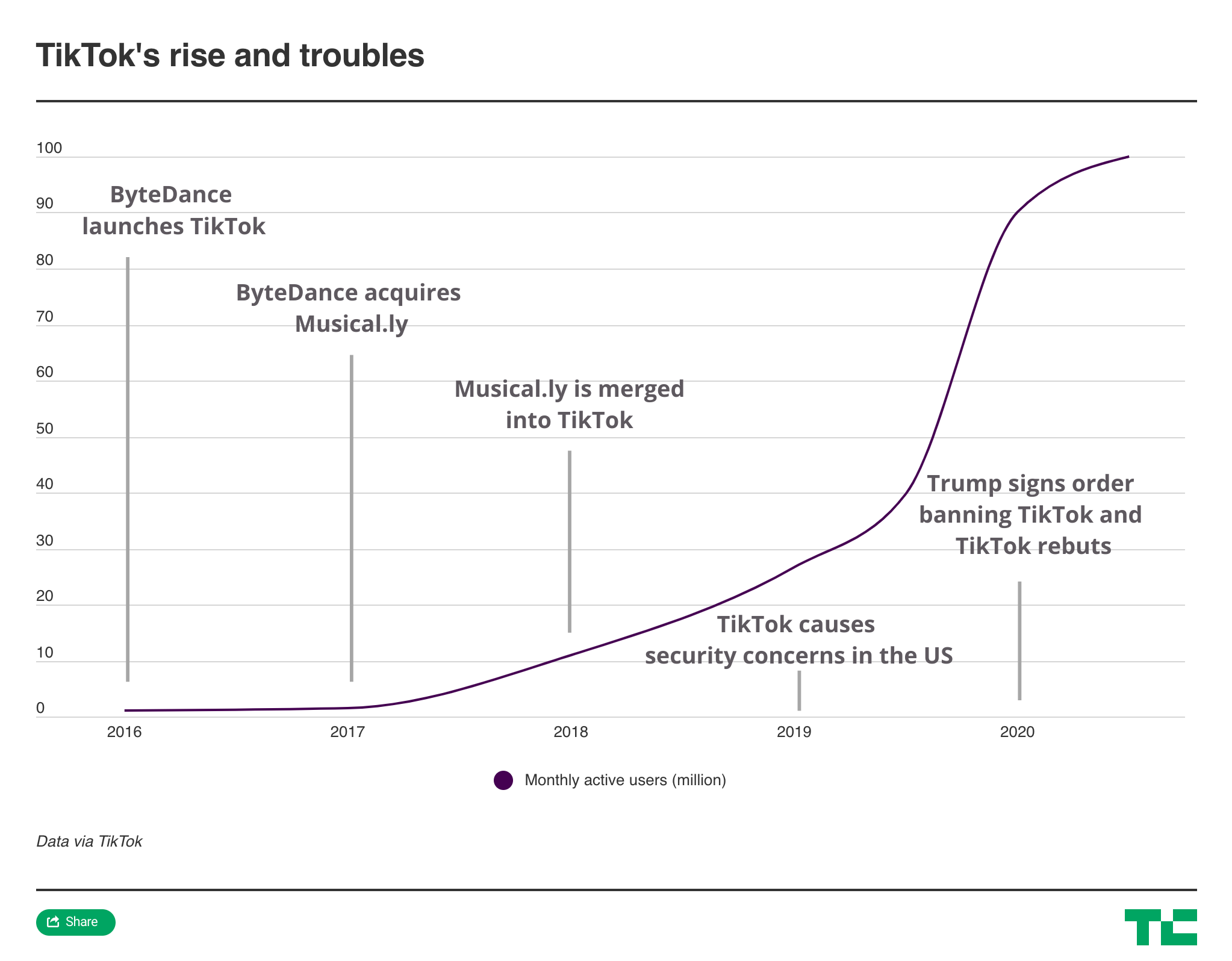
TikTok’s rise in the West is unprecedented for any Chinese tech company, and so is the amount of attention it has attracted from politicians worldwide. Below is a timeline of how TikTok grew from what some considered another “copycat” short video app to global dominance and eventually became a target of the U.S. government.

2012-2017: The emergence of TikTok

These years were a period of fast growth for ByteDance, the Beijing-based parent company behind TikTok. Originally launched in China as Douyin, the video-sharing app quickly was wildly successful in its domestic market before setting its sights on the rest of the world. 

2012 

Zhang Yiming, a 29-year-old serial engineer, establishes ByteDance in Beijing.

2014

Chinese product designer Alex Zhu launches Musical.ly.

2016

ByteDance launches Douyin, which is regarded by many as a Musical.ly clone. It launches Douyin’s overseas version TikTok later that year.

2017-2019: TikTok takes off in the United States

TikTok merges with Musical.ly and and launches in the U.S., where it quickly becomes popular, the first social media app from a Chinese tech company to achieve that level of success there. But at the same time, its ownership leads to questions about national security and censorship, against the backdrop of the U.S.-China tariff wars and increased scrutiny of Chinese tech companies (including Huawei and ZTE) under the Trump administration.

2017

November

ByteDance buys Musical.ly for $800 million to $1 billion. (link)

2018

August

TikTok merges with Musical.ly and becomes available in the U.S. (link)

October

TikTok surpasses Facebook, Instagram, Snapchat and YouTube in downloads. (link)

November

Facebook launches TikTok rival Lasso. (link)

2019

February

TikTok reaches one billion installs on the App Store and Google Play. (link)

The U.S. Federal Trade Commission fines TikTok $5.7 million over violation of children’s privacy law. (link)

May

TikTok tops the App Store for the fifth quarter in a row. (link)

September

TikTok is found censoring topics considered sensitive by the Beijing government. (link)

October

TikTok bans political ads (link) but does not appear to take action on hashtags related to American politics. (link)

TikTok taps corporate law firm K&L Gates for advice on content moderation in the U.S. (link)

U.S. lawmakers ask intelligence chief Joseph Maguire to investigate if TikTok poses a threat to national security. (link)

TikTok says it has never been asked by the Chinese government to remove any content and would not do so if asked. (link)

November

The Committee on Foreign Investment in the United States reportedly opens a national security probe into TikTok. (link)

Instagram launches TikTok rival Reels. (link)

TikTok apologizes for removing a viral video about abuses against Uighurs. (link)

December

The U.S. Navy reportedly bans TikTok. (link)

The first half of 2020: Growth amid government scrutiny

The app is now a mainstay of online culture in America, especially among Generation Z, and its user base has grown even wider as people seek diversions during the COVID-19 pandemic. But TikTok faces an escalating series of government actions, creating confusion about its future in America. 

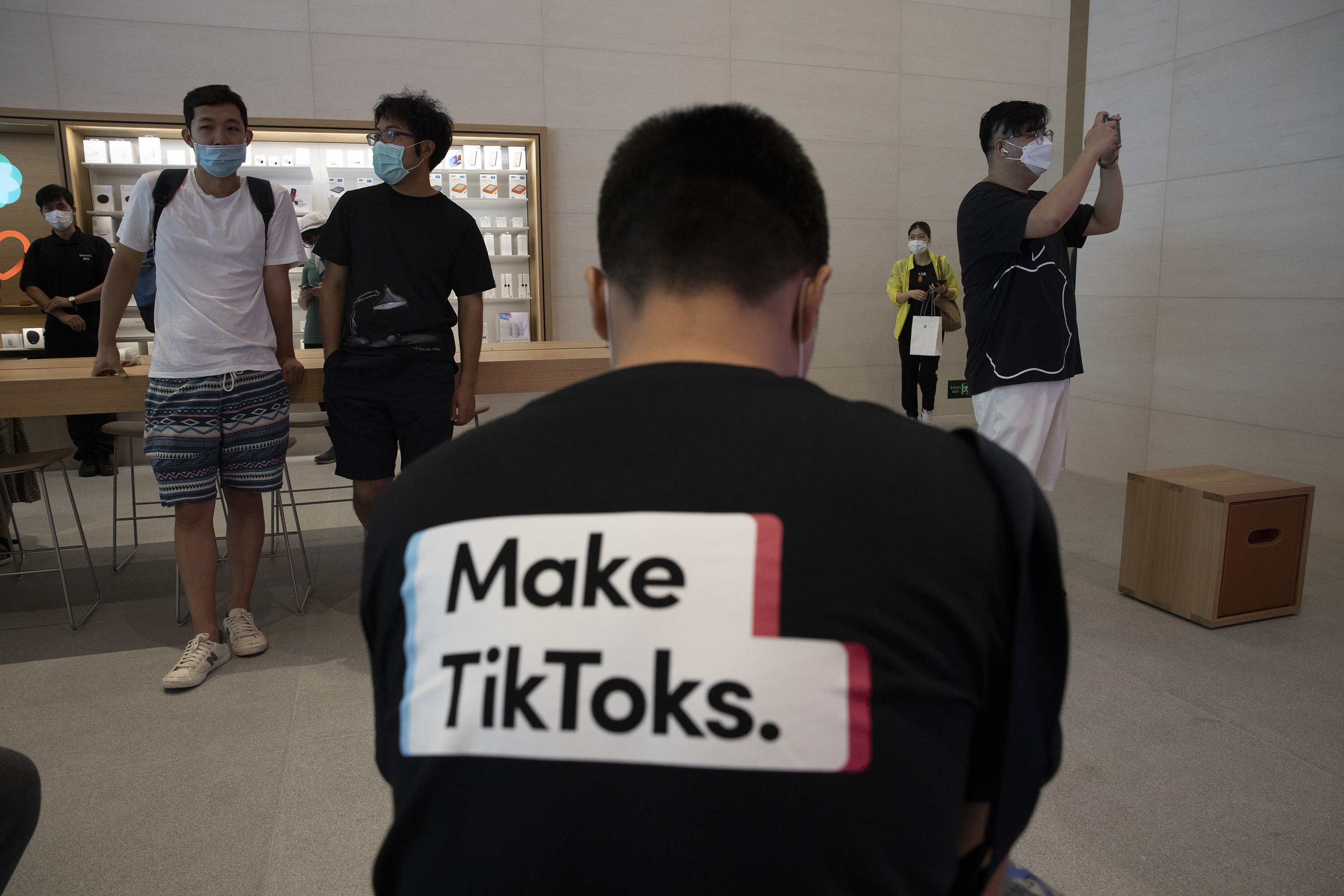
A man wearing a shirt promoting TikTok is seen at an Apple store in Beijing

A man wearing a shirt promoting TikTok is seen at an Apple store in Beijing on Friday, July 17, 2020. Image Credits: AP Photo/Ng Han Guan

2020

January

Revived Dubsmash grows into TikTok’s imminent rival. (link)

March

TikTok lets outside experts examine its moderation practices at its “transparency center.” (link)

Senators introduce a bill to restrict the use of TikTok on government devices. (link)

TikTok brings in outside experts to craft content policies. (link)

April

TikTok introduces parental controls. (link)

TikTok tops two billion downloads. (link)

June

TikTok discloses how its content recommendation system works. (link)

YouTube launches TikTok rival. (link)

July

Facebook shuts down TikTok rival Lasso. (link)

Secretary of State Mike Pompeo says the U.S. is looking to ban TikTok. (link)

TikTok announced a $200 million fund for U.S. creators. (link)

Trump told reporters he will use executive power to ban TikTok. (link)

The second half of 2020: TikTok versus the U.S. government

After weeks of speculation, Trump signs an executive order in August against ByteDance. ByteDance begins seeking American buyers for TikTok, but the company also fights the executive order in court. A group of TikTok creators also file a lawsuit challenging the order. The last few months of 2020 become a relentless, and often confusing, flurry of events and new developments for TikTok observers, with no end in sight. 

August

Reports say ByteDance agrees to divest TikTok’s U.S. operations and Microsoft will take over. (link)

Trump signals opposition to the ByteDance-Microsoft deal. (link)

Microsoft announces discussions about the TikTok purchase will complete no later than September 15. (link)

Trump shifts tone and says he expects a cut from the TikTok sale. (link)

TikTok broadens fact-checking partnerships ahead of the U.S. election. (link)

August 7: In the most significant escalation of tensions between the U.S. government and TikTok, Trump signs an executive order banning “transactions” with ByteDance in 45 days, or on September 20. (link). TikTok says the order was “issued without any due process” and would risk “undermining global businesses’ trust in the United States’ commitment to the rule of law.” (link)

August 9: TikTok reportedly plans to challenge the Trump administration ban. (link)

Oracle is also reportedly bidding for the TikTok sale. (link)

August 24: TikTok and ByteDance file their first lawsuit in federal court against the executive order, naming President Trump, Secretary of State Wilbur Ross and the U.S. Department of Commerce as defendants. The suit seeks to prevent the government from banning TikTok. Filed in U.S. District Court Central District of California (case number 2:20-cv-7672), it claims Trump’s executive order is unconstitutional.  (link)

TikTok reaches 100 million users in the U.S. (link)

August 27: TikTok CEO Kevin Mayer resigns after 100 days. (link)

Kevin Mayer. Image Credits: Jesse Grant/Getty Images for Disney

Walmart says it has expressed interest in teaming up with Microsoft to bid for TikTok. (link)

August 28: China’s revised export laws could block TikTok’s divestment. (link)

September

China says it would rather see TikTok shuttered than sold to an American firm. (link)

September 13: Oracle confirms it is part of a proposal submitted by ByteDance to the Treasury Department in which Oracle will serve as the “trusted technology provider.” (link)

September 18: The Commerce Department publishes regulations against TikTok that will take effect in two phases. The app will no longer be distributed in U.S. app stores as of September 20, but it gets an extension on how it operates until November 12. After that, however, it will no longer be able to use internet hosting services in the U.S., rendering it inaccessible. (link)

On the same day as the Commerce Department’s announcement, two separate lawsuits are filed against Trump’s executive order against TikTok. One is filed by ByteDance, while the other is by three TikTok creators.

The one filed by TikTok and ByteDance is in U.S. District Court for the District of Columbia (case number 20-cv-02658), naming President Trump, Secretary of Commerce Wilbur Ross and the Commerce Department as defendants. It is very similar to the suit ByteDance previously filed in California. TikTok and ByteDance’s lawyers argue that Trump’s executive order violates the Administrative Procedure Act, the right to free speech, and due process and takings clauses.

The other lawsuit, filed by TikTok creators Douglas Marland, Cosette Rinab and Alec Chambers, also names the president, Ross and the Department of Commerce as defendants. The suit, filed in the U.S. District Court for the Eastern District of Pennsylvania (case number 2:20-cv-04597), argues that Trump’s executive order “violates the first and fifth amendments of the U.S. Constitution and exceeds the President’s statutory authority.”

September 19: One day before the September 20 deadline that would have forced Google and Apple to remove TikTok from their app stores, the Commerce Department extends it by a week to September 27. This is reportedly to give ByteDance, Oracle and Walmart time to finalize their deal.

On the same day, Marland, Rinab and Chambers, the three TikTok creators, file their first motion for a preliminary injunction against Trump’s executive order. They argue that the executive order violates freedom of speech and deprives them of “protected liberty and property interests without due process,” because if a ban goes into effect, it would prevent them from making income from TikTok-related activities, like promotional and branding work.

September 20: After filing the D.C. District Court lawsuit against Trump’s executive order, TikTok and ByteDance formally withdraw their similar pending suit in the U.S. District Court of Central District of California.

September 21: ByteDance and Oracle confirm the deal but send conflicting statements over TikTok’s new ownership. TikTok is valued at an estimated $60 billion. (link)

September 22: China’s state newspaper says China won’t approve the TikTok sale, labeling it “extortion.” (link)

September 23: TikTok and ByteDance ask the U.S. District Court for the District of Columbia to grant a preliminary injunction against the executive order, arguing that the September 27 ban removing TikTok from app stores will “inflict direct, immediate, and irreparable harm on Plaintiffs during the pendency of this case.” (link)

September 26: U.S. District Court Judge Wendy Beetlestone denies Marland, Rinab and Chambers’ motion for a preliminary injunction against the executive order, writing that the three did not demonstrate “they will suffer immediate, irreparable harm if users and prospective users cannot download or update” TikTok after September 27, since they will still be able to use the app.

September 27: Just hours before the TikTok ban was set to go into effect, U.S. District Court Judge Carl J. Nichols grants ByteDance’s request for a preliminary injunction while the court considers whether the app poses a risk to national security. (link)

September 29: TikTok launches a U.S. election guide in the app. (link)

October

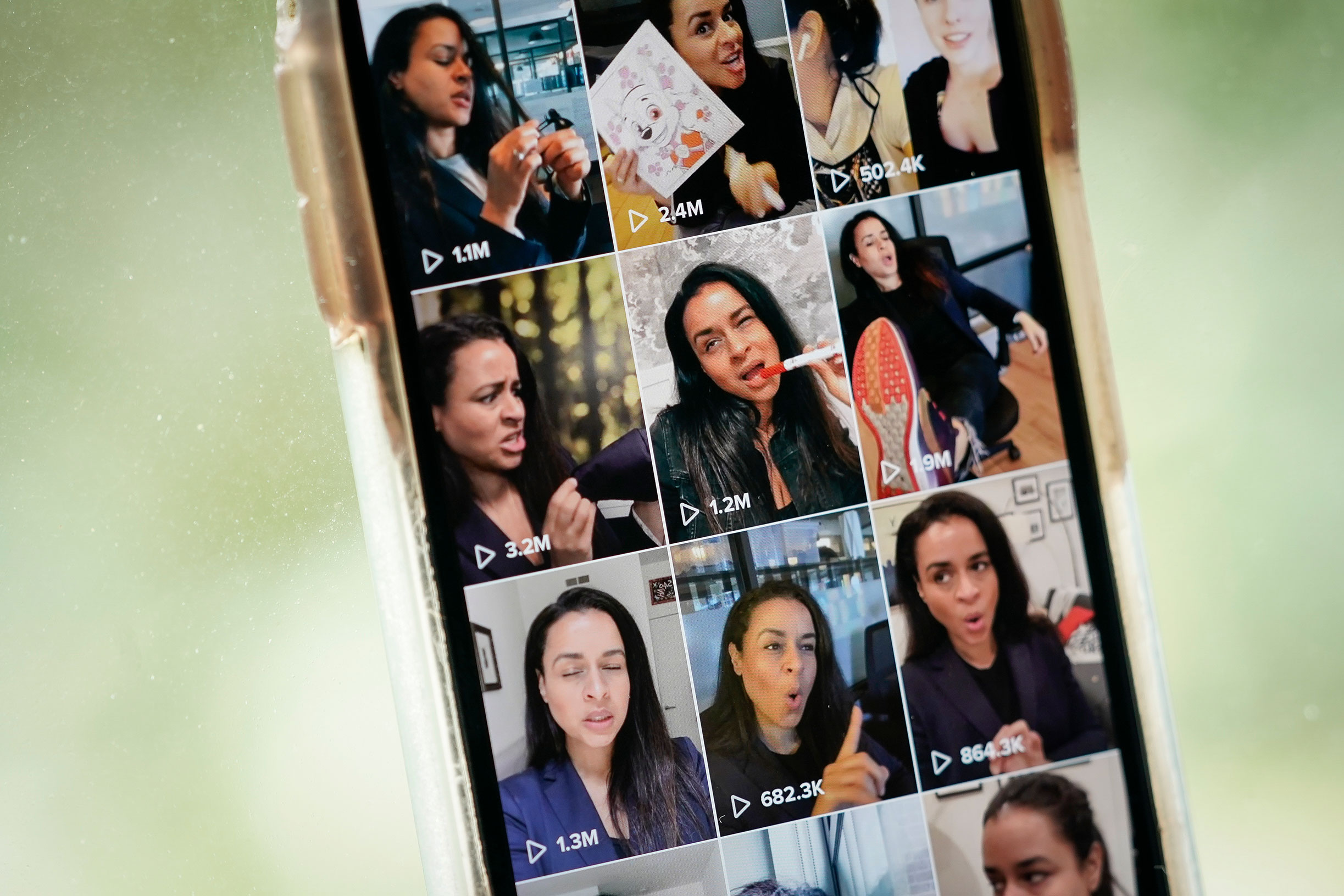
comedian Sarah Cooper's page is displayed on the TikTok app

WASHINGTON, D.C.—AUGUST 07: In this photo illustration, comedian Sarah Cooper’s page is displayed on the TikTok app. Image Credits: Drew Angerer/Getty Images

Snapchat launches a TikTok rival. (link)

TikTok says it’s enforcing actions against hate speech. (link)

TikTok partners with Shopify on social commerce. (link)

October 13: After failing to win their first request for a preliminary injunction, TikTok creators Marland, Rinab and Chambers file a second one. This time, their request focuses on the Commerce Department’s November 12 deadline, which they say will make it impossible for users to access or post content on TikTok if it goes into effect.

October 30: U.S. District Judge Wendy Beetlestone grants TikTok creators Marland, Chambers and Rinab’s second request for a preliminary injunction against the TikTok ban. (link)

November

November 7: After five days of waiting for vote counts, Joe Biden is declared the president-elect by CNN, followed by the AP, NBC, CBS, ABC and Fox News. With Biden set to be sworn in as president on January 20, the future of Trump’s executive order against TikTok becomes even more uncertain.

November 10: ByteDance asks the federal appeals court to vacate the U.S. government’s divestiture order that would force it to sell the app’s American operations by November 12. Filed as part of the lawsuit in D.C. District Court, ByteDance said it asked the Committee on Foreign Investments in the United States for an extension, but hadn’t been granted one yet. (link)

November 12: This is the day that the Commerce Department’s ban on transactions with ByteDance, including providing internet hosting services to TikTok (which would stop the app from being able to operate in the U.S.), was set to go into effect. But instead the case becomes more convoluted as the U.S. government sends mixed messages about TikTok’s future.

The Commerce Department says it will abide by the preliminary injunction granted on October 30 by Judge Beetlestone, pending further legal developments. But, around the same time, the Justice Department files an appeal against Beetlestone’s ruling. Then Judge Nichols sets new deadlines (December 14 and 28) in the D.C. District Court lawsuit (the one filed by ByteDance against the Trump administration) for both sides to file motions and other new documents in the case. (link)

November 25: The Trump administration grants ByteDance a seven-day extension of the divestiture order. The deadline for ByteDance to finalize a sale of TikTok is now December 4.

This timeline will be updated as developments occur.

Rockstar programmer: Rivers Cuomo finds meaning in coding

“Hi, I’m Rivers from the band, Weezer,” Rivers Cuomo says with a slight smile and a wave. He turns away from the camera for a bit, before launching into his best infomercial pitch. “Imagine you’re on tour, and you’re sitting in your dressing room or your tour bus. You’re backstage. You have stage fright, you’re stressing out. You’re pacing back and forth. And then on top of that, your tour manager is constantly calling you, asking you logistical questions.”

As far as internet pitch videos go, it’s not the most universal. If anything, the three-minute clip loses any hope of populist appeal by the end. In a final shot, the singer in a maroon SpaceX hoodie is the last up the ramp onto a private jet. The plane door closes revealing a Weezer flying “W” logo.

“Download Drivetimes now, on GitHub,” Cuomo adds in voice-over. “This is CS50X.”

It’s not the most polished app pitch video, and Cuomo’s elevator pitch could probably do with a bit of refining before approaching venture capitalists about a seed round. As far as final projects for online programming courses go, however, it’s something to behold. The images alternate between pages of code, Google spreadsheets and POV shots as he takes the stage for a co-headlining tour with the Pixies.

It helped earn Cuomo a 95 in the class.

But while, in its current configuration, the Drivetimes tour scheduling tool might have limited appeal, the musician’s final project from Harvard’s follow-up course, CS50W, is immediately apparent for an army of fans who have followed his quarter-century-plus career.

This week Cuomo dropped more than 2,400 demos totaling more than 86 hours. Spanning 1976 to 2015, the songs range in quality from tape-recorded sketches to more polished fare. Some would eventually find their way onto Weezer’s 13 albums, or assorted side projects. Others wouldn’t be so lucky.

Available through Cuomo’s “Mr. Rivers’ Neighborhood” site, the tracks are gathered into nine bundles, each available for $9 a piece. “By the way,” Cuomo writers at the bottom of a disclaimer, “this market is my final project for a course I’m taking in web programming.”

For half a decade, the platinum-selling rock star has been moonlighting as a computer programming student.

“I was always a spreadsheet guy,” Cuomo tells TechCrunch. “Around 2000, I think I started in Microsoft Access and then Excel. Just keeping track of all my songs and demos and ideas. Spreadsheets got more and more complicated to the point where it was like, ‘Well, I’m kind of almost writing code here in these formulas, except it’s super hard to use. So maybe I should actually do programming instead.’ ”

It would be an odd side hustle for practically any other successful musician. For Cuomo, however, it’s the next logical step. In the wake of the massive success of Weezer’s self-titled debut, he enrolled as a sophomore at Harvard, spending a year living in a dorm. He would ultimately leave school to record the band’s much-loved follow-up, Pinkerton, but two more more enrollments in 1997 and 2004 found the musician ultimately graduating with an English BA in 2006.

CS50 found Cuomo returning to Harvard — at least in spirit. The course is hosted online by the university, a free introduction to computer science.

“I went through some online courses and was looking for something that looked appealing and so I saw the Harvard CS50 was very popular,” Cuomo says. “So I was like, ‘Well, I’ll give this a shot.’ It didn’t take immediately. The first week course was using Scratch. I don’t know if you know that, but it’s like kind of click and drag type of programming, and you’re making a little video game.”

A six-week course stretched out for six months for the musician. That same year, the musician — now a father of two — played dozens of shows and recorded Weezer’s 10th album, the Grammy-nominated White Album.

“When we hit Python halfway through the course,” Cuomo says, “I was just amazed at how powerful it was and intuitive it was for me, and I could just get so much done. Then by the end of the course, I was writing programs that were really helping me manage my day-to-day life as a traveling musician and then also managing my spreadsheets and managing my work as a creative artist.”

For Cuomo, productivity has never been much of an issue. The band has two albums completed beyond this year’s Black Album, and he’s already begun work on two more follow-ups. What has seemingly been a bigger issue, however, is organizing those thoughts. That’s where the spreadsheets and database come in.

The “thousands” of spreadsheets became a database, cataloging Cuomo’s own demos and work he was studying from other artists.

“For years it seemed like kind of a waste of time or an indulgence,” he says. “I should be writing a new song or recording a song rather than just cataloging these old ideas, but I’ve found that, years later, I’m able to very efficiently make use of these ancient ideas because I can just tell my Python program, ‘Hey, show me all the ideas I have at 126 BPM in the key of A flat that start with a third degree of the scale and the melody and are in Dorian mode and that my manager has given three stars or more to.’ ”

He admits that the process may be lacking in some of the rock and roll romanticism for which fans of the bands might hope. But in spite of drawing on pages of analytics, Cuomo insists there’s still magic present.

For Cuomo, productivity has never been much of an issue. Given his level of productivity, however, organizing all of those thoughts can get tricky. That’s where the spreadsheets and database come in.

“There’s still plenty of room for spontaneity and inspiration in what we traditionally think of as human creativity,” Cuomo explains. “One of my heroes in this realm is Igor Stravinsky. There’s a collection of his lectures called “Poetics of Music.” And he had a note in that collection. He said he has no interest in a composer that’s only using one of his faculties, like a composer that says, ‘I am only going to write what pops into my head spontaneously when I’m in some kind of a creative zone. I won’t use any of my other tools.’

“He says, ‘No, I prefer to listen to the music of a composer who’s using every faculty at his disposal, his intuition, but also his intellect and his ability to analyze and categorize and make use of everything he has.’ I find that those ended up being the most wild and unpredictable and creative compositions.”

And there’s been no shortage of compositions. Cuomo says the band has two albums completed beyond this year’s Black Album, and he’s already begun work on two more follow-ups. After decades of feeling beholden to the 18-month major label album release cycle, the singer says that after the Demos project, he has a newfound interest in finding more ways to release music directly to fans.

“I don’t feel like I’m really good at understanding the big-picture marketplace and how to make the biggest impact in the world,” he says. “My manager is so good at that, but I just told them like, ‘Hey, this feels like something here. First of all, it’s really fun. The fans are really happy. It’s super easy for everyone involved.’ The coding part wasn’t easy, but for everyone else, it’s a couple of clicks and you’ve got all this music, and it’s a cheap price, and there’s no middleman. PayPal takes a little bit, but it’s nothing like a major label. So, this could be something. And there’s just something, it feels so good when it’s directly from me to the audience.”

For now, computer science continues to take up a major chunk of his time. Cuomo estimates that he’s been spending around 70% of his work hours on programming projects. On Wednesday nights, he helps out with programming for a meditation site (another decades-long passion), and he plans to take Harvard’s follow-up CS50M course, which centers around developing for mobile apps.

There are, however, no immediate plans to quit his day job.

“I can’t see me getting a job at a startup or something or maintaining somebody’s website,” he says. “But maybe the line between rock star and web developer is getting blurred so that musicians will be making more and more use of technological tools. Besides just the music software, we’ll be making more and more use of means of distribution and organization and creativity that’s coming out in the way we code our connection to the audience.”


Daily Crunch: Amazon Web Services stumble

An Amazon Web Services outage has a wide effect, Salesforce might be buying Slack and Pinterest tests new support for virtual events. This is your Daily Crunch for November 25, 2020.

And for those of you who celebrate Thanksgiving: Enjoy! There will be no newsletter tomorrow, and then Darrell Etherington will be filling in for me on Friday.

The big story: Amazon Web Services stumble

Amazon Web Services began experiencing issues earlier today, which caused issues for sites and services that rely on its cloud infrastructure — as writer Zack Whittaker discovered when he tried to use his Roomba.

Amazon said the issue was largely localized to North America, and that it was working on a resolution. Meanwhile, a number of other companies, such as Adobe and Roku, have pointed to the AWS outage as the reason for their own service issues.

The tech giants

Slack’s stock climbs on possible Salesforce acquisition — News that Salesforce is interested in buying Slack sent shares of the smaller firm sharply higher today.

Pinterest tests online events with dedicated ‘class communities’ — The company has been spotted testing a new feature that allows users to sign up for Zoom classes through Pinterest.

France starts collecting tax on tech giants — This tax applies to companies that generate more than €750 million in revenue globally and €25 million in France, and that operate either a marketplace or an ad business.

Startups, funding and venture capital

Tiger Global invests in India’s Unacademy at $2B valuation — Unacademy helps students prepare for competitive exams to get into college.

WeGift, the ‘incentive marketing’ platform, collects $8M in new funding — Founded in 2016, WeGift wants to digitize the $700 billion rewards and incentives industry.

Cast.ai nabs $7.7M seed to remove barriers between public clouds — The company was started with the idea that developers should be able to get the best of each of the public clouds without being locked in.

Advice and analysis from Extra Crunch

Insurtech’s big year gets bigger as Metromile looks to go public — Metromile, a startup competing in the auto insurance market, is going public via SPAC.

Join us for a live Q&A with Sapphire’s Jai Das on Tuesday at 2 pm EST/11 am PST — Das has invested in companies like MuleSoft, Alteryx, Square and Sumo Logic.

(Extra Crunch is our membership program, which aims to democratize information about startups. You can sign up here.)

Everything else

Gift Guide: Smart exercise gear to hunker down and get fit with — Smart exercise and health gear is smarter than ever.

Instead of yule log, watch this interactive dumpster fire because 2020 — Sure, why not.

The Daily Crunch is TechCrunch’s roundup of our biggest and most important stories. If you’d like to get this delivered to your inbox every day at around 3pm Pacific, you can subscribe here.

Talking tech’s exodus, Twitter’s labels, and Medium’s next moves with founder Ev Williams

Earlier today, we had the chance to talk with Twitter and Medium cofounder Ev Williams, along with operator-turned investor James Joaquin, who helps oversee the day-to-day of the mission-focused venture firm they separately cofounded six years ago, Obvious Ventures.

We collectively discussed lot of venture-y things, some of which we’ll publish next week, so stayed tuned. In the meantime, we spent some time talking specifically with Williams about both Twitter and Medium and some of the day’s biggest headlines. Following are some excerpts from that chat, lightly edited for length and clarity.

TC: A lot of tech CEOs have been saying goodbye to San Francisco in 2020. Do you think the trend is attracting too much attention or perhaps not enough?

EW: I moved away from the Bay Area a little over a year ago, with my family to New York. I’d lived in San Francisco for 20 years, and I had never lived in New York, and thought, ‘Why not go? Now seems like a good time.’ Turns out I was wrong. [Laughs.] It was a very bad time to move to New York. So I was there for for six months, and quickly came back to California, which is a great place to be in a world where you’re not going into bars and restaurants and seeing people.

TC: You moved when COVID took hold?

EW: Yes. In March, Manhattan suddenly seemed not ideal. So now I’m on the peninsula.

I’m from San Francisco. It was really, for me, just honestly looking for a change. But an enabling factor that could be common in many of these cases is the fact that I no longer have to be in the office in San Francisco every day, [whereas] for most of 20 years [beforehand], all my work life was in an office in San Francisco, generally with a company I had started, so I thought it was important to be there.

This was pre COVID and remote work. But remote work was becoming more common. And I noticed in 2018 or so, with this massive number of companies that were in San Francisco —  startups and large public companies and pre IPO companies — the competition for talent had gotten more extreme than it had ever been. So it got me —  along with a lot of founders and CEOs — thinking about maybe the advantage of hiring locally and having everybody in the same office [was a pro] that was starting to get outweighed by the cons. . . And, of course, the tools and technology that make remote work possible were getting better all the time.

TC: Given that you cofounded Twitter, I have to ask about this presidential transition that is maybe, finally happening. In January, Donald Trump will lose the privileges he enjoyed as president. Given the amount of disinformation he has published routinely, do you think Twitter should have cracked down on him sooner? How would you rate its handling of a president who really tested its boundaries in every way?

EW: I think what Twitter has done especially recently is a pretty good solution. I mean, I don’t agree with the the notion or that he should have been removed altogether a long time ago. Having the visibility, literally seeing, what what the President is thinking at any given moment, as ludicrous as it is, is helpful.

What he would be doing if he didn’t have Twitter is unclear, but he’d be doing something to get his message out there. And what the company has done most recently with the warnings on his tweets or blocking them is great. It’s providing more information. It’s kind of ‘buyer beware’ about this information. And it’s a bolder step than any platform had done previously. It’s a good version of an in between where previously [people would] talk about just kicking people off, [and] allowing freedom of speech.

TC: You started Blogger, then Twitter, then Medium. As someone who has spent much of your career  focused on content and distribution, do you have any other thoughts about what more Twitter or other platforms could be doing [to tackle disinformation]? Because there is going to be somebody who comes along again with the same autocratic tendencies.

EW: I think all of society gets more information savvy — that’s one hope over the long term. It wasn’t that long ago that if something was in “media,” it was accepted as true. And now I think everyone’s skeptical. We’ve learned that that’s not necessarily the case and certainly not online.

Unfortunately, we’re now at the point where a lot of people have lost faith in everything published or shared anywhere. But I think that’s a step along the evolution of just getting more media savvy and knowing that sources really matter, and as we build both better tools, things will get better.

TC: Speaking of content platforms, Medium charges $50 per year for users to access an unlimited amount of articles from individual writers and poets. Have you said how many subscribers the platform now has?

EW: We haven’t given a precise number, but I can tell you it’s in the high hundreds of thousands. It’s been a been a couple years now, and I’m a very firm believer in the model — not only that people will pay for quality information, but that it’s just a much healthier model for publishers, be they individuals or companies, because it creates that feedback loop of ‘quality gets rewarded.’

If people aren’t getting value, they unsubscribe, and that isn’t the case with an advertising model. If people click, you keep making money, and you can kind of keep tricking people or keep appealing to lowest-common-denominator impulses. There were a couple of decades where the mantra was ‘No one will pay for content on the internet,’ which obviously seems silly now. But that was that was the established belief for such a long time.

TC: Do you ever think you should have charged from the outset? I  sometimes wonder if it’s harder to throw on the switch afterward.

EW: Yes, and no. When we first switched to this model in 2017, we created a subscription, but the vast majority of content was — and actually still is — outside of the paywall. And our model is different than most because it’s a platform, and we don’t own the content, and we have an agreement with our creators that they can publish behind the paywall if they want, and we will pay them if they do that. But they can also publish outside the paywall if they’re not interested in making money and want maximum reach. And those those models are actually very complimentary because the scale of the platform brings a lot of people in through the top of the funnel.

Scale is really important for most businesses, but for a paywall, it’s especially important because people have to be visiting with enough frequency to actually hit the paywall and be motivated to pay.

TC: Out of curiosity, what do you make of Substack, a startup that invites writers to create their own newsletters using a subscription model and then takes a cut of their revenue in exchange for a host of back end services.

EW: There’s a bit of a creator renaissance going on right now that is part of a bigger wave of a people being willing to pay for quality information, and independent writers and thinkers actually breaking out on their own and building brands and followings. And I think we’re going to see more of that.

TC: Medium has raised $132 million over the years. Will you raise more? Where do you want to take the platform in the next 12 to 24 months?

EW: We’re not yet not yet profitable, so I anticipate that we will raise more money.

There’s a very big business to be built here. While more and more people are willing to pay for content way, I don’t think that means that most people will subscribe to dozens of sources, whether they’re websites with paywalls or newsletters. If you look at how basically every media category has evolved, a lot of them have gone through this shift from free to paid, at least at the higher end of the market. That includes music, television, and even games. And at the high end, there tend to be players who own a large part of the market, and I think that comes down to offering the best consumer value proposition — one that gives people lots of optionality, lots of personalization, and lots of value for one price.

I think that the same thing is going to play out in this area, and for the subscription that’s able to reach critical mass, that’s a multi-billion dollar business. And that’s what we’re aiming to build.

SpaceX successfully launches a Falcon 9 booster for a record seventh time

SpaceX has launched yet another Starlink mission, adding 60 more Starlink satellites to its low-Earth orbit constellation. That’s good news for its efforts to blanket the globe in high-speed broadband, and today’s flight is even better news for its equally important ambition of developing more reusable rocket systems, since the first-stage booster that helped launch today’s Falcon 9 rocket made a record-breaking seventh trip.

SpaceX broke its own reusability records of six flights for a reused first-stage rocket component, and it also recovered the booster with a controlled landing using its drone flight in the Atlantic Ocean, which means it could potentially break this record with yet another future flight for this same booster.

Today’s launch took off from Cape Canaveral Air Force Station in Florida, lifting off at 9:13 PM EST (6:13 PM PST). The flight also uses a fairing cover to protect the payload on its way to space that had flown previously, including one half that’s flown one prior mission, and another that’s been used twice before.

SpaceX aims for greater usability as a way to continue to reduce costs – every time it flies a component used in a previous mission, it realizes some degree of cost savings vs. using all new parts. Today’s mission represents likely its most cost-effective flight to date as a result.

This is SpaceX’s sixteenth Starlink mission thus far, and it has now launched nearly 1,000 total small satellites for its constellation. The service is currently operating in beta, and recently expanded from parts of the U.S. to areas in southern Canada .


Pinterest tests online events with dedicated ‘class communities’

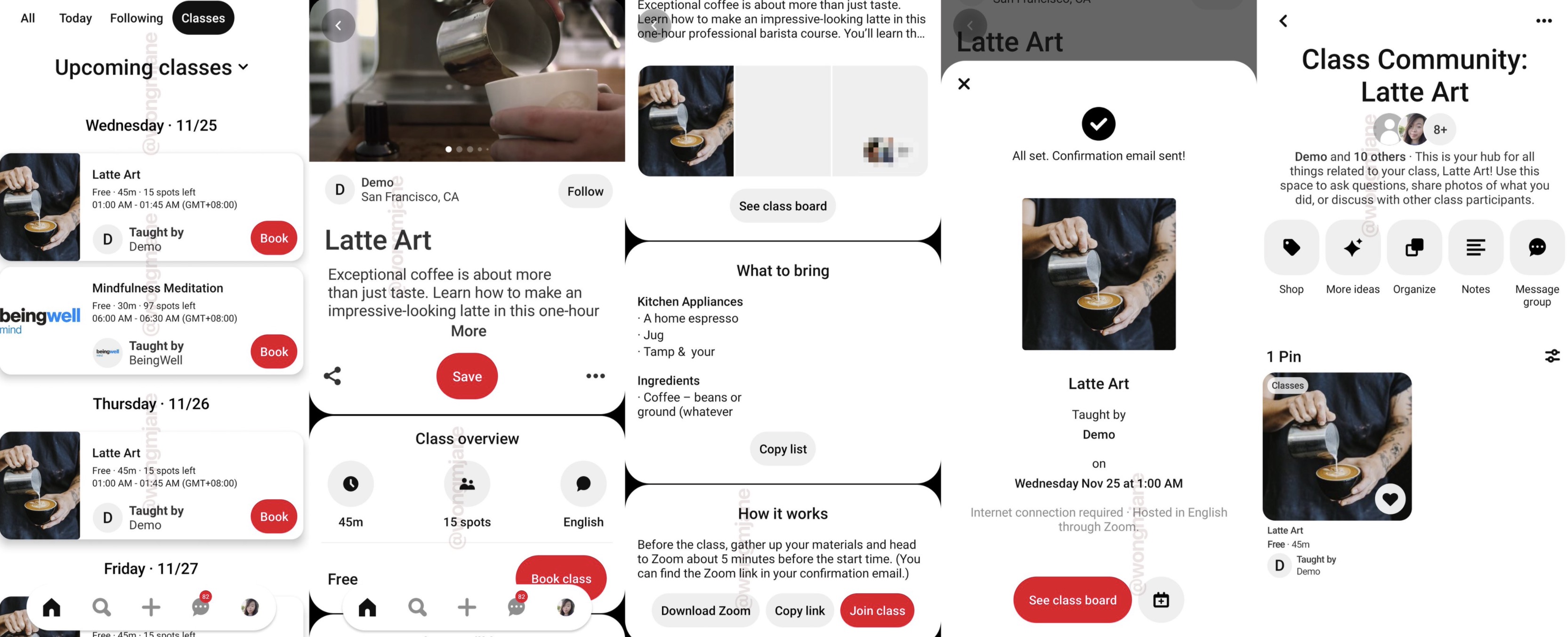
Pinterest is getting into online events. The company has been spotted testing a new feature that allows users to sign up for Zoom classes through Pinterest, while creators use Pinterest’s class boards to organize class materials, notes and other resources, or even connect with attendees through a group chat option. The company confirmed the test of online classes is an experiment now in development, but wouldn’t offer further details about its plans.

The feature itself was discovered on Tuesday by reverse engineer Jane Manchun Wong, who found details about the online classes by looking into the app’s code.

Pinterest is working on Classes where participants can join via Zoom pic.twitter.com/vhRtMCHpup

— Jane Manchun Wong (@wongmjane) November 24, 2020

Currently, you can visit some of these “demo” profiles directly — like “@pinsmeditation” or “@pinzoom123,” for example — and view their listed Class Communities. However, these communities are empty when you click through. That’s because the feature is still unreleased, Wong says.

When and if the feature is later launched to the public, the communities would include dedicated sections where creators will be able to organize their class materials — like lists of what to bring to class, notes, photos and more. They could also use these communities to offer a class overview and description, connect users to a related shop, group chat feature and more.

Creators are also able to use the communities — which are basically enhanced Pinterest boards — to respond to questions from attendees, share photos from the class and otherwise interact with the participants.

When a user wants to join a class, they can click a “book” button to sign up, and are then emailed a confirmation with the meeting details. Other buttons direct attendees to download Zoom or copy the link to join the class.

It’s not surprising that Pinterest would expand into the online events space, given its platform has become a popular tool for organizing remote learning resources during the coronavirus pandemic. Teachers have turned to Pinterest to keep track of lesson plans, get inspiration, share educational activities and more. In the early days of the pandemic, Pinterest reported record usage when the company saw more searches and saves globally in a single March weekend than ever before in its history, as a result of its usefulness as a online organizational tool.

This growth has continued throughout the year. In October, Pinterest’s stock jumped on strong earnings after the company beat on revenue and user growth metrics. The company brought in $443 million in revenue, versus $383.5 million expected, and grew its monthly active users to 442 million, versus the 436.4 million expected. Outside of the coronavirus impacts, much of this growth was due to strong international adoption, increased ad spend from advertisers boycotting Facebook and a surge of interest from users looking for iOS 14 home screen personalization ideas.

Given that the U.S. has failed to get the COVID-19 pandemic under control, many classes, events and other activities will remain virtual even as we head into 2021. The online events market may continue to grow in the years that follow, too, thanks to the kickstart the pandemic provided the industry as a whole.

“We are experimenting with ways to help creators interact more closely with their audience,” a Pinterest spokesperson said, when asked for more information.

Pinterest wouldn’t confirm additional details about its plans for online events, but did say the feature was in development and the test would help to inform the product’s direction.

Pinterest often tries out new features before launching them to a wider audience. Earlier this summer, TechCrunch reported on a Story Pins feature the company had in the works. Pinterest then launched the feature in September. If the same time frame holds up for online events, we could potentially see the feature become more widely available sometime early next year.