Highlight Needs To Let You Switch Off ‘Friend Of Friend’ Notifications Before SXSW

photo

Ambient location app Highlight is a big deal. Eldon likes it, Scoble likes it, MG and Mike like it and Grindr fan Charlie Cheever likes it. More importantly, I like it.

Before you call me out for being slightly narcissistic with the above statement (which wouldn’t make me at all unique in my field), here’s why the fact that I like it is important; In case you haven’t noticed, I am a female, which means I am an indicative use case for an app that forces you to constantly broadcast your location.

The premise behind services like Highlight and Glancee is that humans are desperate to connect with one another on a multitude of levels. Why not make it easier for them if we have the technology? As one of my VC friends rudely put it, when I expressed my love for the app, “Seems like a fad, but if it gets people laid then it’s huge.”

I’m pretty sure this is going to need females on it to go beyond Grindr and get a critical mass of people laid.

The issue with females is that we’re sensitive with regards to dudes contacting us about getting laid, hence being cautious about letting people know where we are at any given moment (I’m coming to this conclusion based on anecdotal information). Because there are serious, real world implications to being carelessly open with that sort of stuff.

Highlight had 20K users when I last spoke to founder Paul Davison a couple of weeks ago. In about a week, that number will likely exponentially increase, as people in Austin download what we’ve already touted as THE BIGGEST APP AT SXSW.

As I prepare for the coming week, I realize if Highlight doesn’t create some sort of “Only Friends” filter, and thus blocking “Friends of Friends” as well as people you have Likes in common with from seeing your location, Texas is going to be a shitshow. For example, thanks to Highlight I now know that Evan Williams and MG Siegler are both a block away from me for some reason. Imagine if I were a crazy startup founder weren’t “so over” talking to tech celebrities … I would totally change out of my pajamas and try to intercept them somehow.

I’m willing to bet that the above hypothetical is going to play out a thousand times in Austin unless Highlight fixes it so I can only see MG (who is my friend on Facebook and in real life) and not Ev.

Judging from the reactions I’m getting when I try to explain to Normals what Highlight does (“Omg IT LETS PEOPLE KNOW WHERE YOU ARE?!?!?”), mainstream society isn’t ready for it as it stands now. If things work out as founder Paul Davison envisions, one day Moms will be cool with lightweight actions like letting their friends know if they were both at the same party, but for now many are apprehensive.

“Privacy is so critical,” Davison told me in an interview, “Having people’s trust is so critical for this sort of thing. We want to build something women can use and feel safe on. If you build this product the right way you can build something that will be really useful.”

In my opinion, the “right sort of way” means allowing users to limit the app to “Friends.” Highlight is winning because unlike services like Sonar you don’t have to check in, but if its default inclusivity isn’t tempered in the next week, it will serve as a fatal flaw when we all get to early adopter Austin.

I can just imagine the stacks of Highlight messages from PR People now …

“We’re still working on basic throttling,” Davison tells me. “Tiny changes in the product have a profound impact [no kidding!] … If you do this the right way it just makes people better. It’s really hard to get it right, but if you get it right, it’s hard for me to think of something more important to be building. You’re literally giving the world a sixth sense.”

Good luck Paul.


App.net Wants To Help Mobile Apps Stand Out At SXSW

sxsw crowds

Here’s one of the great things about South by Southwest: Everyone wants to launch a cool new product there. Here’s one of the worst things about South by Southwest: Everyone wants to launch a cool new product there.

That’s why Dalton Caldwell, CEO of App.net, is holding a special App Showcase at Beauty Bar on the afternoon of March 10. In his blog post announcing the event, he writes about how hard it is for any individual startup to stand out:

Why is it getting harder to launch at SXSW? Well, if you happen to attend, the second you step off the plane you are non-stop bombarded with so much information that you enter some kind of zombie state (see also: free beer). You can’t walk 10 feet without hearing about a new sharing app, device, or location-based service. Last year I looked down and even my hotel key had an ad for a social media startup. It’s hard to break through amidst all of this, and as the event gets bigger each year the bombardment will only intensify.

Sure, there’s already a Startup Accelerator where 48 new or new-ish companies will take the stage, but Caldwell tells me there are some key differences — namely, that the App Showcase that is the only startup event that’s “mobile app-specific, not charging folks, and done as a single discrete event.” (And of course it’s also a good way for App.net, which offers landing pages and other app marketing and analytics tools, to connect with mobile developers.)

Three of the six app slots are still open and you can apply whether your app is already available or want launch at the event. Caldwell says he’s particularly interested in seeing apps from outside his Silicon Valley network. You can apply here.


From Zynga To Flipboard: Why All Eyes Are On China For The Next Mobile Boom

china mobile

Editor’s note: Chris Shen is vice president at Chinese gaming company The9. Prior to joining The9, he served as group account director and account director for several advertising agencies in Shanghai and Taipei.

If you spend any time speaking with Western mobile companies, one topic that’s likely to pop up is their “China strategy.” Due to a mix of mobile penetration, sheer population, and popularity of the mobile web, Western mobile companies recognize there’s a lot of money to be made overseas.

The idea is not without merit: China is the world’s largest mobile market with almost one billion users, 69 percent of which access the Internet through their phones on a regular basis. As such, plenty of big-name Western mobile companies have already begun entering China. However, the mobile market is still immature with issues like fragmentation and piracy, making distribution exceedingly difficult for developers. China isn’t quite yet a home away from home for Western developers, but it’s poised to be the next big mobile market.

China’s lucrative potential is especially relevant for mobile developers. Mobile apps and games were popular in China well before the United States caught on, and the market is only going to get bigger. Smartphone adoption is picking up and opening a window for Western developers to introduce new titles, while in-app purchases are on the rise in China and app downloads have almost tripled in the last year (more on that in a second).

Rise of the Smartphones

China has over 980 million mobile users. While this number is staggering, the majority of users own feature phones. As such, many local developers create apps that cater to feature phones. However, in the past few years, smartphone adoption — both iOS and Android devices — has increased significantly. According to research firm Strategy Analytics, almost 24 million smartphones were shipped to China in 2011, surpassing the number of devices in the U.S. This trend is still gaining steam and creating a profitable window for Western iOS and Android app and game developers. The9 and GREE recognized this trend early and established the $100 million Fund9 to help developers port their games to Android and distribute them in China.

Loads of Downloads

In addition to a massive user base, China’s mobile activity is also skyrocketing. More people are downloading more apps and games. According to mobile analytics site App Annie China’s mobile download numbers have grown by almost 300 percent in the last year. Additionally, research firm Distimo reported that over 30 percent of Apple’s App Store downloads were coming from China by the end of 2011, as opposed to only 18 percent at the beginning of that year.

In-App Purchases and Virtual Goods

China’s massive mobile potential is more than just a numbers game. It’s true that there are more mobile users in China than anywhere else, but they’re also starting to spend more. A lot more. According to App Annie, mobile revenue in China has nearly tripled in the last year, increasing by 187 percent. This is partially due to Apple’s recent announcement that they’re going to start accepting App Store payments in Chinese yuan. Now Western game developers can seamlessly offer virtual goods to China’s huge audience.

Western mobile companies can’t afford to ignore the Chinese market. A good example of this is Flipboard. Before launching in China, Flipboard was plagued by multiple clone apps that grew in popularity in the app’s absence. Since launching in China’s App Store, the company has been successful partnering with big-name companies like Sina and Renren. Hit mobile game maker, Rovio, saw a similar problem with loads of unlicensed Angry Birds (even a theme park) being sold in China. Their solution: open an entire Angry Birds store in China.

There’s more incentive to enter China than just to protect a brand. Companies like CrowdStar, GREE, and Zynga have all announced China ambitions.

As China’s mobile market continues to mature, it’s safe to assume that issues like piracy and fragmentation will become less problematic. For mobile game developers looking to cash in on China today, there are still some ways they can bring their apps over successfully. Finding a local partner to help with distribution, security, and catering to a Chinese audience will ensure a more successful launch.

Companies like The9 recognize both China’s complexity and its opportunity, and are eager to work with Western app developers. By leveraging carrier partnerships and working with multiple distribution channels, local partners can eliminate the headache of entering China.

Developers also need to localize their apps if they want them to succeed in China. This means not only translating apps into Chinese, but also customizing design aspects to meet cultural preferences and various channel requirements.

China is a beast already and it’s only going to get bigger. As Apple and Google continue to penetrate the market and cater to Chinese audiences, there will be a great window of opportunity for Western developers to rake in the yuan.

[image via flickr/bfishadow]


One Year Later: How Google Panda Changed Our Business

google-panda

Editor’s note: Matt Moog is the founder and CEO of Viewpoints.com. Follow him on Twitter @MattMoog.

Google Panda strikes

February 24, 2011 was a day that will live in infamy for the team here at Viewpoints. That was the day of the Google Panda update. Up until that point we had enjoyed four years of consistent traffic growth to Viewpoints.com. We managed to double traffic each year and had just reached 2.7 million unique users. We had heard that Google was planning to update its algorithm to penalize content and link farms and were excited about the bump we might get as a result. Turns out we were in for a bit of a surprise.

Viewpoints takes it on the chin

You see, Viewpoints is a consumer reviews and product ranking web site. We have 600,000 reviews of 100,000 products contributed by more than 250,000 members. We have had more than 70 million visits to the site since we launched in late 2007. All of our content is original and we always viewed all of our practices as the “right way” to do things. Apparently Google felt differently because we lost 50% of organic search traffic overnight as a result of the Panda update.

And tries some quick fixes

As the days passed and we sorted out all of the comments from Matt Cutts and industry pundits and watched the Google blog as anxiously as the faithful await the plumes of smoke from the Vatican to figure out what we could do to get back in the good graces of the Google crawler. Was it our ad density? Was it speed of our site? Did we not have the right authoritative back links? Was it that some of our reviews were short and Google was penalizing sites with ”thin content”?

The truth of the matter was that it could have been any and all of these. Although we had hundreds of thousands of great reviews, we had probably let some slip through that did not deserve to be published. And we had not paid enough attention to speed, ad density or other hall marks of a good user experience. So we set out to fix our Google problem but at the same time, we resolved to think bigger and longer term and use this opportunity to create a better user experience, regardless of what Google was looking for.

So now you can judge the results for yourself. We have spent the last 12 months as a team of 25+ professionals reinventing Viewpoints. From March to June we removed 40% of the ads across the site. We improved the speed of the site by 3x. We moderated out 80,000+ reviews that did not meet minimum quality standards. Unfortunately these changes had only a nominal impact on traffic. So we decided it was time for a more radical approach.

Time to make serious long-term changes

After making the changes listed above and 90 days after Google’s Panda update, our team decided to devote six months to a total overhaul of the Viewpoints.com user experience. This was not just a visual redesign but a soup-to-nuts, top-to-bottom overhaul. We ended up making 30 major changes to the user experience. This entire effort was basically a bet the company decision. It had been four years since we first launched and the reality is that the world had changed. It was time to question even some of the most fundamental assumptions.

Content Quality – addressing the perception of “thin” content

In addition to eliminating 80,000 reviews that did not meet our new quality standards we also decided to eliminate stand alone review pages for all but the longest reviews. This one decision removed 600,000 pages from the site. We also decided to treat very short reviews differently. A new minimum threshold was established for when a review would become publicly accessible. If you want to review a product and say “It’s awesome!” that’s fine, we just don’t think your two word review helps other consumers enough to warrant publication. We also made the tough decision to exit more than 300 review categories that had more than 90,000 reviews. We decided strategically to focus on product reviews and retire hundreds of non product review categories such as hotels, restaurants and movies. All of these decisions to improve content quality together eliminated 20% of all reviews and completely eliminated short review pages in favor of very comprehensive product pages.

We don’t know if Google will notice, but we do feel that we have addressed the issue of “thin” content the best that we can.

Site Credibility

In addition to eliminating “thin content” we also focused on the overall credibility of a site. Google suggested that site owners need to put themselves in the shoes of users and ask the question “Would I trust this site with a health issue or my credit card?”

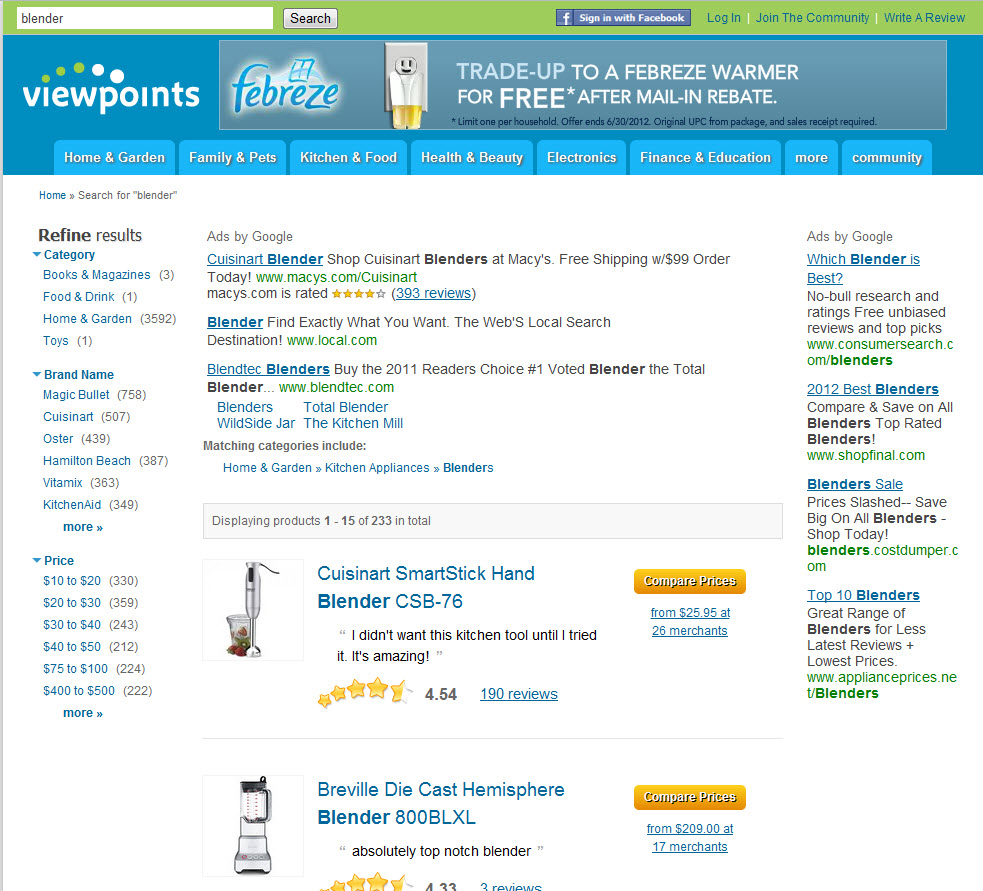
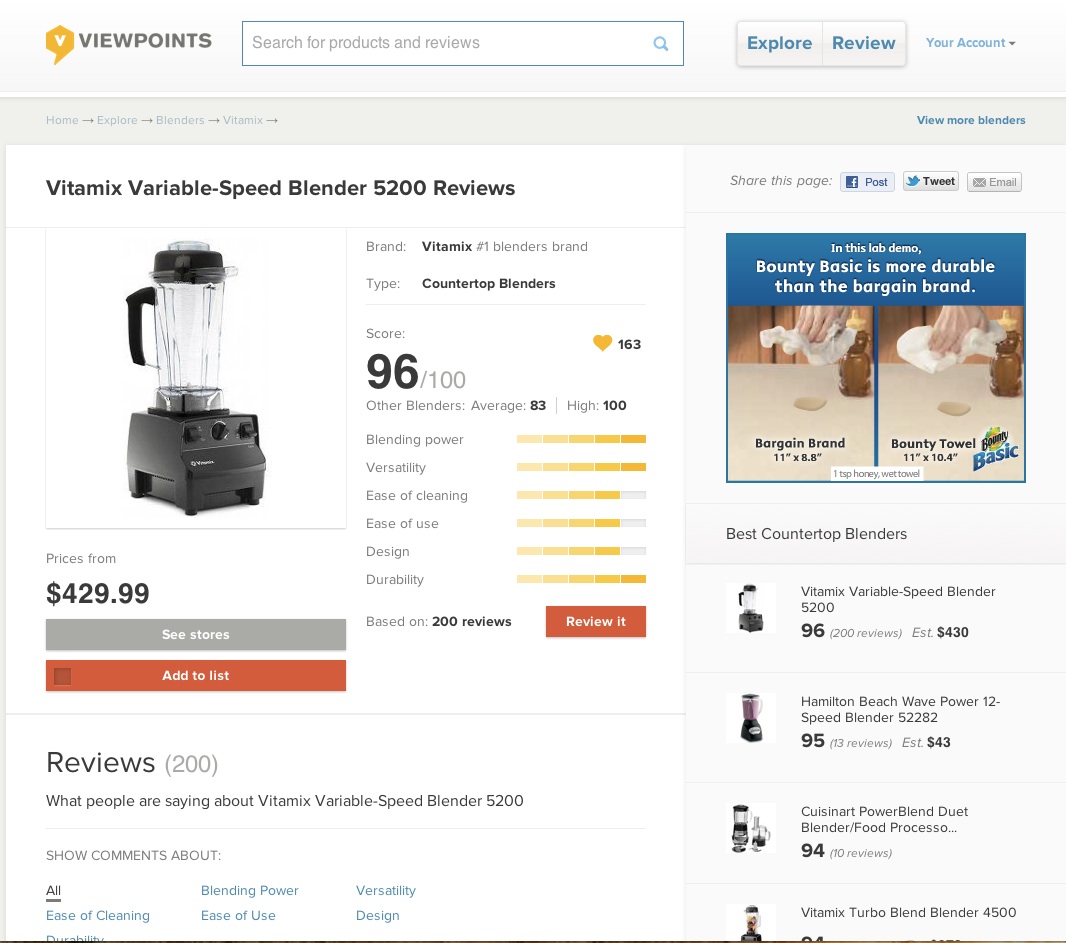
For Viewpoints, this meant cleaning up the content as outlined above as a first step, but it was also time for a redesign that was cleaner, simpler and better conveyed the credibility, quality and overall helpfulness of the site. In addition to eliminating 40% of the ads on the site, we also stripped out 15+ features that were clouding the core value proposition of consumer reviews and product rankings. For example, we made the decision to stop giving scores to products that did not have enough reviews. And we made it clear when members had connected their account to Facebook to demonstrate an extra layer of authenticity of the reviewer. You can see the following screen shots for some examples of the old design and the new.

OLD SEARCH RESULTS

NEW SEARCH RESULTS

OLD PRODUCT PAGE

NEW PRODUCT PAGE

Product Intelligence

So we have addressed content quality, site architecture and site credibility. But were we adding enough value to distinguish ourselves in a crowded market? Good question! While we firmly believe that getting the basics right (quality, credibility, ease of use etc) is the key to a great consumer reviews user experience, it became clear to us that there was another important way we could distinguish the Viewpoints user experience. We saw an opportunity to occupy the white space between expert reviews that make clear buy recommendations and the mass of consumer reviews which gave great consumer feedback but did not always help give a clear and concise buy recommendation.

We call this “Product Intelligence – for the consumer by the consumer“. We have spent a significant amount of time and resources developing scoring and ranking algorithms to smartly rank products against each other so that shoppers know what product to buy.

Diversification

As much as these changes were done to improve the user experience and in turn improve our rankings with Google, we also explicitly wanted to optimize mobile and social as two new channels that can be a new source of growing traffic to help us build our audience. The changes we made in these areas were very significant. The specific changes will be detailed in a later post.

Conclusion

So, that is how Google’s Panda update changed our business. It drove us to improve the quality of content, improve the credibility and trust of our experience and invest in Product Intelligence as a distinct point of difference in the market.

We don’t know how Google is going to respond to these changes but the important thing to note is that every change we made improved the experience for the user. So as disappointed as we were with the outcome of Panda, we will admit that it forced us to think harder about our business, about adding more value to the end user, and perhaps most importantly, take our game to another level. Game on.


PinClout Gets A Cease-And-Desist From Klout, Will Change Name

pinclout

“Klout for Pinterest” is a catchy company description, but it might not be a good idea to take it too literally.

Startup PinClout launched about a week ago, and its name seemed to make the company’s mission clear — to measure influence on fast-growing Pinterest. And there’s been positive interest, with some tech press coverage and what co-founder Chris Fay said is an average of 2,000 to 3,000 unique visitors every day. (Amazingly, it’s not the only “Klout for Pinterest.”) However, the company just received a letter from Klout’s attorney asking it to “immediately cease and desist from all use of or plans to use the PINCLOUT mark and the www.pinclout.com domain name.”

The letter argues that PinClout’s name is “confusingly similar” to Klout for several reasons: The similarity between the words, the similarity between the services, the fact that they’re directed at similar consumers, and the similar marketing channels.

PinClout co-founder Chris Fay said he was “really surprised” to get the letter. He argued that despite the superficial similarities, PinClout has different aims from Klout — yes, it provides a score between 1 and 100 to rate a user’s influence, but he said the real aim is to provide analytics tools to businesses so they can increase that influence: “It’s not really about the score itself.”

Nonetheless, Fay said that on the advice of PinClout’s lawyer, the company will be changing its name rather than getting embroiled in an long and costly legal fight. The new name is still being decided. (I pointed out that if his goal was to create something that isn’t just Klout for Pinterest, changing the name might not be a bad idea, and Fay agreed: “We can utilize this to show that we are different from them.”)

I called a Klout spokesperson, who told me the company welcomes new entries into a market they invented but also feels it’s important to avoid confusion and “protect the brand” — for themselves and for partners.

I’ve embedded the letter below.


Google Drive And The Cloud Wars

sharks

Editor’s note: Aaron Levie is co-founder and CEO at Box. Follow him on Twitter @levie.

For the past six years, any startup touching the cloud storage space has lived in anticipation and fear of Google’s entry into the market. G(od) Drive’s arrival was meant to instantly commoditize existing offerings, kill all future opportunity for new players, and leave a charred ecosystem in its wake as it battled Microsoft and Apple for control of our online lives and content. This was seen as all but a forgone conclusion among investors, press, analysts, and even competing startups since 2006 and beyond. And even beyond that.

But the Google Drive never came. Why?

“Sundar had concluded that it was an artifact of the style of computing that Google was about to usher out the door…  I don’t think we need files anymore,” Steven Levy writes in his book, In the Plex, referring to Sundar Pichai, head of Google Chrome.

Google was moving towards a world where its cloud operating system would make traditional file systems obsolete. Consumers would create and manage data without ever touching a desktop application again. Before it was ever born, Google Drive was suddenly a thing of the past. A Valley myth.

And with Google Docs, we bought into Google’s vision for reinventing how we create and interact with data. At least many of us in the tech community did. I remember thinking that Google Docs (and Writely before it) would easily take over Microsoft Office as the choice solution for creating and editing new information. How could it not?

But it turns out that lawyers still needed to share detailed, structured documents. Investment bankers wanted to access complex spreadsheets. Doctors had to review medical records. Reality set in that most people still created content using local apps like Photoshop, Autodesk and – gasp! – Microsoft Office. Google’s Chrome and cloud-only view of the world wasn’t supportive of this reality. And while the Mountain View giant stood firm with its vision for the future, users moved on in the present, signing up for file storage and sharing apps from a range of startups and tech leaders.

And now, like all good legends, Google Drive is rumored to be back on the brink of launch. Maybe the competition between Android and iOS – with the latter gaining a competitive edge with iCloud – brought it back from the dead. Or perhaps it was the traction of cloud storage startups to the tune of tens of millions of users. Whatever the reason, Google has been pulled into the market.

An inevitable entry, just delayed

When the Google Drive rumors first started in ‘06, it seemed inevitable that it and others would soon enter the space in a significant way. At Box, we were but a small guppy in waters soon to be populated by sharks with rocket launchers. (See image above.) In short, it wasn’t going to be an easy fight. Even if we were successful in acquiring and attracting consumers, getting wallet-share in a market where the price is driven to zero is immensely difficult. We had to take a different tack.

In talking with our customers, we realized the battle for big business adoption would be played out and won on a completely different set of dimensions: Instead of making decisions based on price, enterprises are utility and time sensitive; instead of being platform-specific (my mom only uses Apple products), enterprises deal with every device imaginable; and, enterprises would need a significantly more thorough set of services that would preclude consumer companies from addressing the market effectively. For these reasons and others, moving into the enterprise was an obvious choice in 2007. That’s when we hit the big red “Pivot” button that’s hidden under every startup CEO’s desk.

We decided to let the other players duke it out in the noisy consumer space, while we’d try and shake things up the quiet and dusty enterprise world. Surprisingly, it’s really only in the past year that Apple, Microsoft and (supposedly) Google have made real moves to enter the market we left behind. And with their frenzied land-grab for the consumer space, they’re driving fragmentation that’s unparalleled to anything we’ve ever seen.

The upcoming fractured cloud

Think about it: If you’re Microsoft, it’s in your best interest to make it frictionless for your customers to move data between as many Windows machines as possible. Apple equally wants to ensure your iPhone, Mac, and Apple TV all communicate synchronously. Google, for its part has long wanted to be the information hub for its customers as it moved beyond its core search vision.

But the efforts of these three players – building up their own vertically integrated technology stacks from the mobile devices to the platforms where you create content to where it’s all stored – are leading us toward a fractured and fragmented ecosystem. And this is not a group of companies that are going to play nicely together.

The world will never again look like it did in the ’90s, when a single vendor in Redmond laid claim to the vast majority of critical software we interacted with and data we produced. Already, less than half of devices connected to the internet are Windows-based. This change is absolutely great for innovation; but when Microsoft had undue control over the software world, there was something arguably soothing (as a consumer) about everything roughly working together. Unlike the traditional desktop environment, where applications were forced to let the local file system broker some level of uniformity, the cloud we’re about to enter is one that will manifest its own platform wars, proprietary approaches, and a disjointed developer and customer ecosystems.

Questions abound. Are there files in the future or not? Do we use Microsoft Office anymore? Are we just in a multi-year transition period before we’re completely cloud? If I store a document in Google, how do I get to it from my Mac? If I store a photo in my iCloud, how do share it with someone on a Windows phone?

iCloud is attempting to have applications rebuilt on top of its proprietary notion of a cloud-assisted data model. In a sense it’s trying to recreate all applications in its own image, on its own platforms, and trying to kill the concept of sync products along with it. Apple is putting some serious muscle behind this vision by integrating it more deeply into the operating system.

With Skydrive, Microsoft has a goal of “delivering personal cloud storage for billions of people.” But its historic approach to openness and cooperation leaves a lot to be desired. Microsoft Office 365 is a noble effort by Microsoft to enter the web-office market, but with nonexistent APIs to allow content import or editing, it’s yet another walled garden of information that gets created in its environment. Google, too, doesn’t have the richest history of long-term developer support.

I don’t have the answers, but the emerging problem is apparent enough. We hear it from our users and customers – in the form of confusion, consternation, and signs in the market. There is a greater abundance of applications that offer little similarity, security, or integration; and consequently go unmanaged. This is an untenable fate for enterprises. And whereas the inherent heterogeneity of devices and platforms in today’s businesses will force some degree of openness from enterprise players, there is no such check in the consumer world.

So get ready for a number of years of absolute rock-your-world style competition among major players fighting for your content and the cloud. Every photo you upload, every song you listen to, every video your capture. These guys want it. With around $200B in cash between Microsoft, Apple, and Google alone, cost is no issue; they see your data as the center of their universe. They’ll probably get it. I’m just happy to be swimming in enterprise waters.


On The Shoulders Of Giants: Y Combinator Demo Day Brings The Future To Computer History Museum

y combinator demo day

Every year, Y Combinator Demo Day, where the latest batch of incubated startups make their pitch to investors, gets a little bigger. (Or a lot.) Now, for the first time since the event began in 2005, it’s moving to a new home — the Computer History Museum.

At the last Demo Day, in August (they’re held twice a year), you could already sense that the gathering was outgrowing YC headquarters in Mountain View. Organizers pushed out the walls to accommodate a larger audience, and in order to speed through the 63 presenters (an increase of nearly 50 percent), each company was limited to a few minutes of speaking, meaning they had to give rapid-fire pitches instead of full demos. There was even a tiny stage erected for the demos.

The next Demo Day will be held on March 27, and it seems that YC has embraced the fact that it has become a big deal Silicon Valley event. While the number of demonstrating companies has only grown slightly from its last class, to 66, things have been restructured. There’s the new location, and rather than repeat the sessions several times over two days, they’re being consolidated into a single, all-day event. That should give companies more time to present, while also leaving room for plentiful breaks. Hopefully, that means attendees won’t completely lose our minds by the time the 65th (!) company is on-stage.

Partner Jessica Livingston predicts that there will be more investors than ever in attendance. (At the last Demo Day, partner Paul Graham joked that instead of holding neverending meetings with entrepreneurs, investors could “just come here twice a year.”)


Foursquare And Glancee Are Cool, But Here’s Why I’m So Excited About Using Highlight At SXSW

Austin Sunrise

The crowds and hype of South By Southwest make the massive Austin tech and media conference the perfect place for launching, well, any sort of app that needs crowds and hype to break out of tech circles and into the mainstream. So what can we expect to blow up next week, like Twitter, Foursquare, GroupMe and Beluga have in past years?

Highlight is what I’m placing my bets on — and not for what it is today, but for what it could become. That is, the long-sought replacement for business cards.

The new background location app got my attention at the beginning of February because it made it easy for me to find old friends and meet new ones without the friction of checking in. But some of you are going to prefer Glancee, because it has a tighter privacy focus, a subtle but smart algorithm for matching to nearby friends, and a beautiful design. Other people are likely to just stick to Foursquare — which is killing it these days — or maybe just Facebook Messenger (which Beluga became). Or maybe one of the dozens of other location apps that have their own ideas (or cloned ideas) for how to connect people in close proximity.

Relentless early adopter Robert Scoble has also taken a close look at each, and last weekend declared them the up-and-comers at SXSW this year. I agree — and actually meant to write a post about it, but he beat me to the punch ( for you, Scoble).

In an in-depth article for The Next Web last weekend, he sketched out three key reasons why these apps are special. By having them turned on and running in the background of your phone, they can help you find people to hang out with, learn more about nearby strangers, and tell you when your real friends are near.

All true, but there’s something bigger going on. These apps are enabling types of long-term connections that nothing else has yet, which in some ways is like remote contact sharing service Bump. This vision hasn’t manifested itself yet, but you can see the signs in the update that Highlight in particular says it’s going to push next week.

Check out what founder Paul Davison said on Thursday, when he announced his new funding round.

We want Highlight to make Austin even more fun for you – by surprising you with hidden connections, surfacing information about the people you meet, and helping you remember these people when you bump into them at a random New York coffee shop a year later.

Wait, what? Wasn’t he just supposed to be talking about South by Southwest? No. He’s talking about building a new social network on top of Facebook, the key source of user data for both his app and Glancee. This is what is going to make Austin so interesting next week. Highlight could create new value for users when they go back home, and that’s what fundamentally needs to happen when we all take our hungover flights back home.

Instead of the normal business card swapping that happens at the event, it’s sounding like Highlight is going to get some sort of feature for marking and saving the favorite people you meet in person. Thinking through the New York coffee shop scenario, imagine seeing a notification that says “You met Robert Scoble at the Trendy Startup BBQ party in Austin. Now he’s two blocks away at a bagel place. Go say hi!” Instead of just using mutual friends and Liked Facebook pages to determine relevancy, Highlight is getting a new layer of behavior data.

Now indulge a little bit of speculation about where all this could go (I don’t know Highlight’s specific plans). You can also imagine the app adding features like an auto-created group or list of “Friends From Austin.” A few weeks after the conference, what if you could see a list of all of these people and message them through Highlight to reconnect. And because Highlight uses Facebook data, it could also tap into the social network to allow users to share the phone numbers, email addresses and other contact info they already have stored. I would love a feature that said “Robert Scoble is sharing his contact info, click here to download it to your address book.”

And boom, business cards would be dead. Forget stuffing your pockets full of cardboard at a party, going back home, throwing them on your hotel room dresser as you pass out, and forgetting them when you have to rush out the next morning to catch your flight. You’d just mark the people you want to stay connected to right when you meet them, and then at your convenience connect with them later.

Here’s a little more evidence for that sort of experience. As I’ve used Highlight in San Francisco over the past month or so, I’ve found myself scrolling through to see who’s nearby, ignoring any messages from interesting people as I continue working, and then going back hours or days later — and geographically far from where I’d made the connection — and continuing the conversation. As I’ve said before, this has already connected me with old friends, introduced me to new people, and gotten me stories for my job.

So hang on to your phones, folks, because they’re going to be all you need to create a new and lasting network of friends.

[Top photo of Austin skyline via StuSeeger.]

Note: One of Highlight’s new investors is the CrunchFund. And while the partners are friends, and its largest limited partner is our parent company, AOL, I have no financial stake in the firm and TechCrunch only covers its investments when we think they’re good (not all of them) — same as any other investor who we know. Feel free to discuss with me in the comments. 


Karma Comes Around at Last

<< Previous
|
Next >>


Fisker Karma

<< Previous
|
Next >>

Curvy as a chanteuse and as bright-eyed as a Hollywood musical, the Fisker Karma is a blue-sky vision of a green future, a 5,600-pound sedan born from the unlikely marriage of low-slung looks and guilt-free consumption.

But in the four years since it debuted as a concept car in 2008, the Karma has also grown to represent what can go south in this modern era of high-stakes automotive startups. Oft-delayed and priced at $102,000, 20 percent more expensive than originally anticipated, the Karma was recently slapped with lower-than-expected fuel-efficiency numbers by the EPA, triggering the withdrawal of $529 million in funding from the Department of Energy.

“We are not dependent on the Department of Energy…. We are here to [launch and] make money on the Karma,” designer and company founder Henrik Fisker told journalists at the car’s press intro in Beverly Hills, California. “The reality is we’re selling cars every day, we’re self-sufficient, and we don’t really need that money,” he added.

Driving the Karma unfurls complex, mixed emotions; for all its slick, Speed Racer-meets-muscle car looks, a few rough spots remind you this is a beta version of future propulsion.

Political and financial hijinks aside, the Fisker Karma proved itself an alluring creature during a two-hour drive up the coast and across the looping canyon roads of Malibu, California. Exuding a panther-like road presence, the Karma’s crouched silhouette attracted the not-so-subtle interest of typically jaded Angelenos, drawing plenty of slow-downs, camera phones, and “What is it?” questions.

Remarkably, the Karma looks virtually identical to the concept car which was unveiled back in 2008. It’s an impressive but not entirely surprising achievement considering the company president also penned the Aston Martin V8 Vantage and BMW Z8. Karma rides on massive 22-inch wheels, encapsulates a compact cabin amidst a luxuriant overall length that’s less than half a foot shy of a Chevy Tahoe, and has less cargo space than a Porsche Cayman.

Climb inside and you’re hit with an even stronger sense of its intended audience: unlike anything short of a Bentley or Rolls-Royce, this cabin lives up to the plus-sized promises of its sinewy sheet metal. The materials on our $130,000 Eco Chic tester are the most environmentally friendly of the Karma lineup, but they’re also buttery soft and imaginatively finished, with whimsically tinted inlays, unusually stitch forms, and contours that seem to have emerged from a schoolboy’s doodles. Though minor details like the steering wheel-mounted buttons appear sourced from lesser domestic cars, singular focal points such as the intricately etched leaf vein patterns on the glass-topped transmission tunnel more than make up for the parts bin lapses.

Using a combination of twin 201-horsepower electric motors juiced by lithium ion batteries and a GM-sourced turbocharged 2.0 liter, 4-cylinder Ecotec engine working in conjunction with a 170 kW generator, this low-lying sedan can be operated in electric only “Stealth” mode (for a total of 32 miles according to the EPA, though Fisker claims it’s just over 50), or “Sport” mode for a blend of EV and internal combustion. Stealth is good for 0-60 mph in 7.9 seconds and a top speed of 95 mph, while Sport yields a 5.9 second sprint and a 125 mph terminal velocity. Fisker reckons a combined total range of 300 miles (with 50 of those coming from electricity, which is incrementally aided by a rooftop solar panel.) In Stealth mode, the Karma gets an EPA-rated 52 MPGe; using the gas motor, that figure drops to the 20-something range.

Driving the Karma unfurls complex, mixed emotions; for all its slick, Speed Racer-meets-muscle car looks, a few rough spots remind you this is a beta version of future propulsion. In all-electric Stealth mode, Karma accelerates as silently as you’d expect, though there’s a subtle shudder produced at low speeds as the electric motor’s stator and rotor surfaces pass over each other, a quality inherent to the technology. As tempting as it is to milk Stealth mode for all its decibel-free deliciousness (save the artificially produced, pedestrian-repelling “Tron” sound, which was authored for Fisker by Hollywood sound designers), Sport is the likelier setting, with its longer range and fossil fuel-burning accelerative assistance. And that’s also where things get a bit less sexy, with the turbocharged four-banger firing up with a noticeable hum and occasionally disarming valve clatter. The latter, incidentally, is due to the engine’s state of tune; it was designed to start at 200 rpm in its GM application, but that was figure was boosted to 1,100 rpm here, which results in a few moments of valvetrain oil starvation during cold startups before the gooey stuff gets to the metal bits.

Acceleration becomes somewhat wheezy as the Karma climbs steep hills, with the engine working noticeably harder to get these 2.75 tons of car up to speed. This Fisker can certainly scoot along respectably, with sticky road holding and good body control, thanks partly to the battery’s low center of gravity. But there are also a few unpolished edges to the drivetrain’s power delivery that don’t live up to the car’s overall sense of aesthetic polish and finessed styling — small flies in the hundred thousand dollar ointment, but flies, no less.

With 80 global dealerships set up and 2,000 cars already built, Fisker’s dream of forming a cutting edge car company from the ground up is an absolute reality, all of this despite governmental tussles and operatic criticism from the likes of Republican presidential hopeful Mitt Romney.

As with all things in the brave new world of eco-transpo, the Fisker Karma — in spite of its gorgeous design and novel execution — comes attached with a few pesky asterisks, the least of which is the possibility that it could go the way of the DeLorean, in that casual, Darwinian sort of manner. It would be a shame, really, a fate nobody outside of the most hardened ecological skeptics would wish upon this four-wheeled creation. After all, who doesn’t crave automotive utopia, even it’s tempered with a few imperfections and a prohibitive price tag?

WIRED Gorgeous concept-car styling. Imaginative interior design. Best-of-intentions eco-consciousness.

TIRED Six-figure price tag. Rough-edged drivetrain. Cramped rear seats. EPA numbers aren’t as attractive as promised.

Photos by Basem Wasef/Wired

Swap Snow for Pavement on a Freebord

Photo by Ariel Zambelich/Wired

My first clear thought is, “OK, this is going to hurt.”

I’m standing on a Freebord, a skateboard that’s been modified to ride more like a snowboard. It has two extra wheels on the center axis that spin freely, allowing you to swoop and slide around on the pavement.

This is my very first time riding one, and although I’m gliding down a fairly gentle slope, I’m quickly picking up speed and realizing that I don’t really know how to control the thing. The pavement is getting blurry and I’m getting scared. I’m looking for a patch of grass where I can bail.

“Carve,” a voice behind me shouts. “Lean forward, use your hips!” It’s John Laudin, one of the two Freebord employees who’ve taken me out for a test ride. We’re on a “bunny slope” near the beach, across town from the company’s San Francisco headquarters. On the van ride over, as we strapped on our (required) helmets, wrist guards and other protective gear, I bragged about how I’ve been riding a skateboard since adolescence, and that during my college years in Vermont, I logged dozens of hours on a snowboard. “No problem,” they said. “You’ll pick it right up.”

They had me feeling pretty confident as I stepped into the board’s “bindings” — two hard, plastic toe clips bolted onto the deck — and pushed off. But as soon as I’m pointed downhill, I’m gaining speed and wobbling all over the place. My faith evaporates.

“Carve,” John yells again, and I regain my wits. I lean forward and push hard onto my toe edge. Suddenly, the Freebord snaps into a tight turn. I glide all the way across the road, then lean back onto my heels. The wheels grab on the opposite side, and I finish drawing a giant “S” across the blacktop. Behind me, my chaperones whoop and clap.

My problem — a common one, I learn — is an over-reliance on familiar muscle memories. Instinct was telling me to ride it just like a skateboard: Point the nose downhill and bomb away. But with the Freebord, you have to constantly shift from toe edge to heel edge and carve your way down the hill. If you go straight, it’s much more difficult to control.

This snowboard-like feel is made possible by the two auxiliary wheels on the bottom of the board. The Freebord has custom trucks that resemble the ones found on a longboard, but just inside the trucks on the center line are two thinner wheels (they look like inline skate wheels) that pivot and spin 360 degrees. When you’re standing on the deck, you can kick the nose and tail around, pointing the Freebord in any direction. Shift your weight just a little onto your toes or your heels, and the outside wheels take over, giving you enough traction to hold a line. Throw some weight into each turn and you can make the tail of the board slide. Really bear down on the uphill edge and you’ll slide to a stop.

Thanks to plenty of patient coaching by my companions, I got past the mind games and was taking long runs at a brisk speed by the end of my first afternoon. On my last run, I was pushing the back of the board outward at the end of each turn, gently tail-sliding my way through big, swooping S’s.

The Freebord was invented in the late 1990s by Steen Strand, a grad student at Stanford, who wanted to bring the feel of a Tahoe powder run to the San Francisco pavement. It’s grown into a healthy niche sport. The company now employs five people and runs an international pro team. Riders from around the world post videos online and swap advice on doing tricks. Freebord’s Nick Cruit, one of my guides on my test ride, tells me the sport is particularly popular in places like Brazil and Australia, where snow-covered mountains aren’t as accessible.

Wherever and whenever snow is scarce (more places than usual this year, given the mild winter) a contraption like the Freebord is a suitable distraction for those craving some downhill carving. But the learning curve is a steep one. Even if you’ve spent years on snowboards or skateboards, it will still take a week or three to work up the legs and the bravery to go all-out on one of these. And though the sensation is close to riding a snowboard, the Freebord is something entirely unique, with different rules and different dangers. But if you’re a boardsports aficionado, it’s something you shouldn’t miss.

Touchy Subjects: Wacom’s New Tablets Add Multitouch

Photo: Ariel Zambelich/Wired.com

Wacom is the dominant name in the tablet market — not the touchy-swipey kind, but the pen-based input kind, devices that sit on your desk and serve as tools for pointing and clicking.

The company has just announced a total refresh of its marquee Intuos line, its family of tablets made for professional designers, artists and anyone who uses digital production software.

The big news is that with the Intuos5, Wacom’s tablets now fully support multitouch finger gestures. So in addition to using the input stylus of yore, you can put down the pen and scroll, pinch-to-zoom, rotate and pan just like you would on the other kind of tablet, or on one of Apple’s Magic Trackpads.

The Intuos5 can handle all the standard Mac and Windows gestures out of the box, but it can also be programmed to support custom gestures. If you want to trick out Photoshop to run some automated action when you tap or swipe in a certain way, the sky’s the limit.

Intuos5 tablets come in three sizes: small ($230), medium ($350) and large ($470). Each tablet comes with a comfortable Wacom input pen (no battery required), a pen holder that resembles an inkwell and holds extra pen nibs, and a USB cable to attach the tablet to your PC. Also available is a $40 wireless kit (a small USB receiver and a 10-hour battery) that lets you run the Intuos5 free of cables.

Wacom loaned me a medium-sized tablet to test for the month leading up to Thursday’s launch. I can say that it’s a significant improvement over the previous Intuos4 tablets, as well as a suitable upgrade for those who feel limited by the less-expensive, less-capable Bamboo tablets Wacom makes for consumers. However, while the pen-based input is crisper and more intuitive than ever, the multitouch features aren’t quite as refined as those found on a glass interface like the Magic Trackpad or a smartphone’s screen.

New features are numerous. You get extremely precise and well-defined pen-based input with 2,048 levels of pressure sensitivity and up to 60 degrees of tilt recognition. You also get a set of eight programmable function keys along the edge of the tablet to modify your taps and drags, plus a circular touch-sensitive ring for scrolling. These function keys (called “ExpressKeys”) have a new heads-up display that appears on screen when you hold your finger on of them for a second, sort of like a cheat sheet. It’s helpful when you forget which ExpressKey is mapped to “shift” and which one is mapped to “command.”

Treating it as a mouse replacement in a standard desktop environment, it fares much better than the inexpensive ($80) Wacom Bamboo tablet I’ve been using for the past six months. But where the Intuos5 really shines is in the digital production setting. Inside Adobe Creative Suite, the ExpressKeys are suddenly able to modify brushes, and the toggle button inside the touch-sensitive ring transforms the whole circular assembly into a tool for quickly cycling through layers or tabs on a floating palette. The input pen is a marvel — the sensitivity and responsiveness when you’re drawing with it are unmatched.

The addition of multitouch support is also nice here. The Intuos5 can handle all the standard Mac and Windows gestures out of the box, but it can also be programmed to support custom gestures, handling up to five fingers. If you want to trick out Photoshop to run some automated action when you tap or swipe in a certain way, the sky’s the limit.

I stuck mostly with the standard gestures during my test, finding the most useful ones to be pinch-to-zoom (especially nice in Photoshop, Google Maps, and when reading PDFs) and swiping up and down to scroll. Basically, anything involving pinching or swiping was aces. But moving the cursor around on the screen using my finger instead of the pen wasn’t as precise as I wanted it to be. Tap-to-click finger gestures were cumbersome — I often missed my target. Text selection, double-clicking, right-clicking and drag-and-drop actions were more problematic. One positive thing to note: touch input is disabled when the pen is in use, and the tablet never once got confused about which input method I wanted.

Maybe I’m spoiled by the glass touch interfaces on my other devices, but I found the Wacom’s matte black plastic surface to be less sensitive and responsive than I was expecting. I ended up keeping the input pen very close by whenever I switched to using my fingers.

WIRED Addition of multitouch support makes Wacom’s most popular input tablet even more capable. Ambidextrous design with the option to go wireless. New heads-up display on the ExpressKeys reminds you of your settings in an instant. All the settings and gestures are customizable. Pen is comfy.

TIRED Touch features lack the accuracy and responsiveness of the input pen. Coated plastic surface doesn’t come close to the feel of glass. Smoothness of gesture-based input is inconsistent.

Photo: Ariel Zambelich/Wired.com

Update: This review was updated to add more details about the multitouch features.

Enterprise Identity Management Platform ForgeRock Raises $7 Million From Accel

ForgeRock

ForgeRock, the open source vendor behind the I³ Open Identity middleware platform, has raised $7 million in series A funding from Accel Partners.

ForgeRock offers one unified platform approach to solve enterprise company’s secure Identity management challenges. The I³ Open Platform allows customers to manage Authentication, Access Management, User Entitlements, Federation, Identity lifecycle management, provisioning and more. This can be implemented in-house, or in a private or public cloud infrastructure.

I³ products currently include: OpenAM (Access Manager) for Authentication, SSO, and Cloud-enabled Federation; OpenIDM (Identity Manager), which is a scalable identity lifecycle management and provisioning solution; and OpenDJ (Directory Java, a next gen identity repository.

Accel partner Bruce Golden explains of the firm’s investment and interest in ForgeRock: Accel seeks to invest in businesses that have the potential to become category leaders in fast growing new markets, or show potential for large-scale disruption in existing markets. Identity management is a crucial business and technology issue for businesses of all sizes, and we believe that ForgeRock is well positioned to become a leader in this market.

ForgeRock enables Identity management for a number of well-known customers including Thomson Reuters, BSkyB, News International, Nokia Siemens Networks, Betfair, AOL, Toyota, Lexmark, Wirecard, Aberdeen Asset Management, OTE, Allianz, Lloyds International, VPS, Capgemini, NSB, Xerox, Vodafone, Nomura, and BNP Paribas.


Aereo Responds To Broadcasters’ Lawsuit: Your Position Does Not Have “Any Merit”

johnny_automatic_scales_of_justice

Barely two weeks ago, Erick was on hand at a news conference in which Barry Diller and company presented IAC’s latest media-tech investment — a startup called Aereo. Simply put, Aereo streams broadcast TV through the browser and provides a DVR in the cloud by “miniaturizing TV antennas and packing them in equipment that sits on the network,” as Erick wrote at the time. The cloud-based service streams over-the-air channels for just $12 a month, which means that, even in spite of the unassuming size of its antennae, Aereo’s model represents a threat to the old guard.

Today, a group of broadcasters, including Fox, Univision, and PBS filed two separate lawsuits against Aereo (the two groups collectively represent most of the major media outlets in New York City), claiming that the startup is infringing on the broadcasters’ copyrights and that its technology fails to meet the criteria of any sort of legal loophole. As such, the broadcasters are seeking an injunction, which would prevent Aereo from releasing its product on the market. In addition, the broadcasters will be seeking monetary damages “for what they claim are Aereo’s violations of the Copyright Act,” according to the New York Times.

Barry Diller loves to ruffle the feathers of old media, and there’s no way that he was unaware this was coming. According to the startup’s self-description — “Live broadcast TV, meet the Internet. Finally.” — there was no way that something like this was going to slide under the noses of the tycoons, especially considering that Aereo had been planning to roll out its service in Brooklyn in the next few weeks — and at that undercutting price point.

Disruption of traditional media has been tried again and again, and unfortunately many of those startups or companies have failed because of the legal quagmire the broadcasters can afford to mire them in. Try to mess with the structure, and there’s a good chance you’ll get sued until the cows come home.

In the lawsuit, which you can find on Scribd here, the broadcasters basically say that it doesn’t matter how big those rascally-rabbit ears on top of their boob tube are:

No amount of technological gimmickery by Aereo — or claims that it is simply providing a set of sophisticated “rabbit ears” — changes the fundamental principle of Copyright Law that those who wish to retransmit [their] broadcasts may do so only with [their] permission. Simply put, Aereo is an unauthorized Internet delivery service that is receiving, converting and retransmitting broadcast signals to its subscribers for a fee…

So there you have it. Aereo believes it is not culpable here, because its individual subscribers are linked to a set of antenna, and as Jeff Roberts at paidContent points out, Cablevision successfully defended a similar case regarding its remote digital video recorder technology, “after an appeals court found that there was no [actual] transmission to the public.”

Nonetheless, just in case there was any question of whether or not this was going to end up in court, settled by the gavel, we’ve just been pointed to Aereo’s response to the broadcasters’ lawsuits. Boiled down to a sentence, Aereo is standing firm in its innocence, and doesn’t think the broadcasters’ position has “any merit,” and will be seeing them in court, thank you very much:

Today, two groups of broadcasters filed two separate federal lawsuits against Aereo in the Southern District of New York claiming that Aereo will infringe their copyrights by making available technology which enables consumers to access broadcast television via a remote antenna and DVR. Aereo does not believe that the broadcasters’ position has any merit and it very much looks forward to a full and fair airing of the issues.

Consumers are legally entitled to access broadcast television via an antenna and they are entitled to record television content for their personal use. Innovations in technology over time, from digital signals to Digital Video Recorders (“DVRs”), have made access to television easier and better for consumers. Aereo provides technology that enables consumers to use their cloud DVR and their remote antenna to record and watch the broadcast television signal to which they are entitled anywhere they are, whether on a phone, a tablet, a television or a laptop.

Let the legal proceedings begin.

Image from Project-Pak


Gogobot’s First Big iPhone Upgrade Gives Users A Mobile, Friendsourced Trip Planner

trips_plans

With the social travel space booming, it behooves the players in the space not to do too much smelling of the roses. Social travel planning startup Gogobot has found some early adoption and buzz, winning a Crunchie for Best Design and was named one of the best 50 websites of 2011 by Time. The site launched as a place people could go to share reviews on their favorite destinations — like Yelp for travel — but quickly began adding features, including Facebook and Twitter signup and integration, game mechanics and rewards (badges and leaderboards), launched a good-looking iOS app, within a few months last year, leading to a $15 million series A raise in November.

The startup then went on to leverage its user-generated database of travel photos in a partnership with Flipboard to turn those photos into sleek, geo-tagged postcards, like a travel scrapbook. Yet, since launching its iPhone app in October, Gogobot has pretty much left its sole mobile app alone, doing a number of small releases focused on speed and performance.

That is changing today, as Gogobot has launched its first major upgrade to its iPhone app, which looks to add to the app’s utility as a social travel planner. Gogobot CEO Travis Katz tells us that, initially the team figured that users wanted to do most of their travel planning on their desktops, and use mobile to navigate their trips and share their experiences. But user feedback showed the opposite — that people want to plan their trip, explore, and share while on the go.

So the new Gogobot mobile now allows users to plan their entire trips to one of more than 60,000 travel destinations, based on recommendations from friends and those with similar interests. Users can browse reviews and photos of hotels, restaurants, and attractions (which Gogobot sorts based on their popularity within your personal network), picking and choosing from the best options to create their own travel plan. They then get instant access to maps and directions, phone numbers, hours of operation, making reservations at restaurants and booking hotels rooms right from the app.

Once they get back home, Gogobot users can surf through the photos of friends and family who are on the go, with Gogobot collecting those images into postcards. According to Katz, this has become one of Gogobot’s most popular features, and has also received an upgrade, now offering users access to two postcard styles which can be shared via Facebook, Twitter, SMS, or email.

Gogobot users can still add places and write reviews to their Gogobot passport while on the go, but browsing the best things to do, and adding those places they like to their trip plan are great new features while you’re maneuvering about on your vacation. It’s also pretty huge that Gogobot sorts the top places in any city, based on your own personal network, so if your friends have been to a specific hotel or city, Gogobot will show those friendsourced recommendations first. If you don’t, it sorts them based on popularity, and always surfaces the reviews that have personal relevance within your network first. For example, this is the passport Gogobot created for Katz, without doing any work.

And just for a sense of how far the startup has come? TripAdvisor, by all accounts the largest player in the space, which went public in December and grew revenues to $137 million in February, comes up short of Gogobot in monthly active users, according to AppData. Behind in dailies, but keep in mind that’s just for Facebook data, only a portion of Gogobot’s user base.

You can find the updated app in the App Store here.


Twitter Has (At Least) Three New VPs

elad gil

It looks like Twitter has promoted three of its directors.

A Twitter spokesperson declined to comment for this story, but the promotions aren’t exactly a secret. Both Elad Gil (pictured) and Joel Lunenfeld have updated their LinkedIn profiles to reflect their new titles — vice president of corporate strategy and vice president of global sales strategy, respectively. Gil joined Twitter after the company acquired his location data startup Mixer Labs, while Lunenfeld’s profile says he spent nearly a decade as the CEO of marketing agency Moxie Interactive.

Meanwhile, Chloe Sladden, who was Twitter’s director of content and programming, seemed to confirm via tweet that she has been promoted to VP status as well. Her LinkedIn profile hasn’t been similarly updated, but it seems safe to assume that she’s vice president of content and programming, or something in that vein. She was previously VP of Special Programming Projects at Current.

As far as I can tell, these are new positions. From the outside, at least, it looks like Twitter is just giving more seniority and fancier titles to the company’s current leadership — a natural step as it grows.