Apple Announces A $499 Retina-Equipped iPad (It’s Just Called iPad)

IMG_5857

Today, in downtown San Francisco, Apple’s CEO Tim Cook unveiled the iPad 3. “We are redefining the category that Apple created with the original iPad,” he said. The device looks very similar to the iPad 2 but the new model is equipped with internal hardware including a high-resolution screen with a 264 ppi, and as Apple’s Phil Schiller notes, is good enough to call a retina screen.

But Apple doesn’t talk about just hardware. It’s all about the experience and a screen nearly twice as sharp is something Apple hopes will push the iPad into new markets and use cases.

Inside the new iPad is an A5X processor complete with quad-core graphics. Apple states that the A5 SoC is “twice as fast” as the Tegra 3 and the A5X offers “four times the performance.”

Software

Apple has optimized all the stock apps for the new screen like the company did for the iPhone 4. Several developers were given access to the new screen specs and have updated their apps to take advantage of the new pixels.

The new A5X chip gives developers new found freedom. Apple demonstrated on stage today several apps that take full advantage of the new processing power and high resolution screen. Gaming and art apps have never looked better.

iWork is also all new and is equipped with 3D animations and new transitions. Garageband now has smart strings, a note editor and, of course, syncs with iCloud. It also has a new features called Jam Session in which 4 iOS devices running the app can play together over WiFi or Bluetooth.

Camera

Holding up the iPad to take a picture is never the most pleasurable experience, which is likely why Apple kept the camera specs on the lower-end in the previous generation models. But with all the killer camera apps available on iOS and our general enthusiasm toward imagery, Apple knows it’s time to slap something better onto the iPad. That said, the same 8-megapixel shooter fitted onto the iPhone 4S will be present and accounted for on this next-gen iPad.

The camera has the larger f/2.4 aperture to let in more light, and all the same software goodness that came with the iPhone 4S camera app — like swipe to preview, photo editing, and facial recognition — is along for the ride too.

The camera can also record video in 1080p.

The new iPad also comes equipped with a voice dictation tool that supports U.S. English, British, Australian, French, German, and Japanese. This positions the iPad for increased productivity tools — it’s a straight shot at other mobile workstation solutions.

LTE

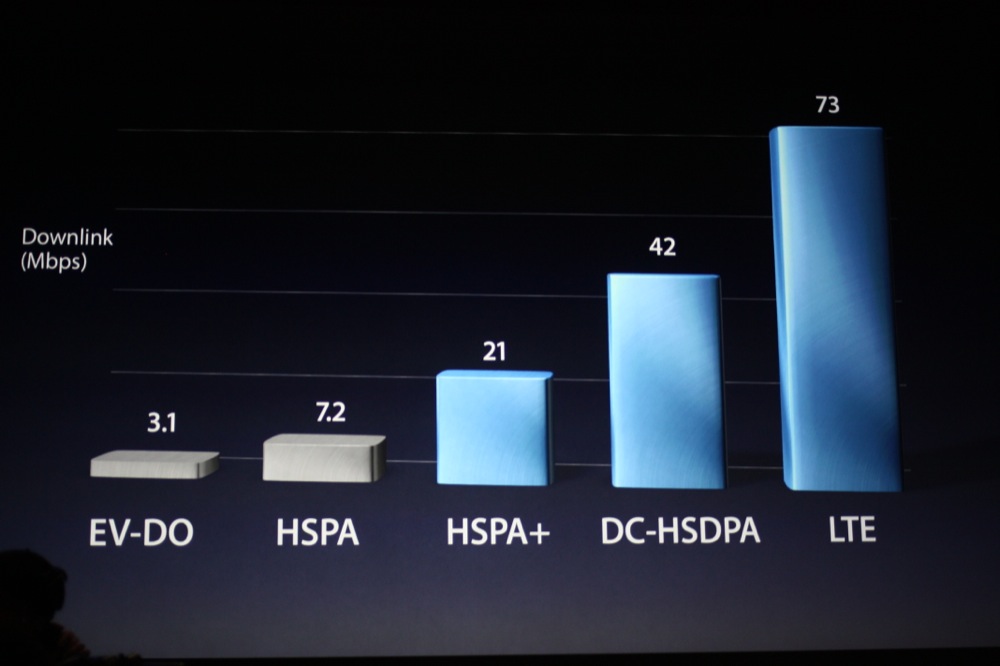
Apple has also equipped the new iPad with high speed networking. This model sports 21 Mbps HSPA+, 42Mbps DC-HSDPA and 73Mbps LTE. This is blazing fast data connectivity.

The new iPad can rock its LTE goods on Teslus, Rogers, Bell, Verizon, and AT&T (Verizon & AT&T in the states). It retains its 3G radio from before and is 3G world-ready.

Battery

The new model is 9.4mm thin and weighs in at 1.4lbs. That’s slightly heavier than the iPad 2 but the additional weight allows for larger batteries that give the new iPad, complete with its new screen and LTE radio, the same 10 hour battery life found in the iPad 2 (9 hours on LTE.)

Price and availability

Price points remain from previous models: the 16GB is $499, 32GB $599 and 64GB $699. Likewise, the LTE versions are $629, $729 and $829.

The new iPad ships on March 16th. Pre-orders are available today.


Apple’s iCloud Now Supports Movies

apple-icloud-logo1

At this morning’s Apple’s event in San Francisco, the company announced an update to its iCloud service, which will now supports – at last – movies! The movies you purchase on iTunes will be stored in the cloud and made available for re-download to any of your iOS devices – the iPhone, iPad or iPod Touch.

This is an extension to the iCloud features Apple currently offers, which until now had supported the re-downloads of purchased music and apps, available both in the iTunes desktop software and on the devices themselves.

And the news comes just in time to correlate with today’s other announcements, it seems: a new Apple TV interface.

The movies and TV shows sold in iTunes will now support 1080p, CEO Tim Cook announced on stage. Perfect for Apple’s TV’s new UI, which is also in full 1080p. More on that in a minute, of course.
The new Apple TV UI does indeed support higher resolution videos, as well as Photos (via Photo Stream) and iTunes playlists, also from iCloud. The updated UI is available on new Apple TV hardware starting today, and ships next week. More on that here.


Tim Cook Talks iOS Device Stats: 315 Million Sold, 62 Million In Q4 2011 Alone

c138ee41-1e11-4a02-a818-d5fdf604fa3a_500

While we wait for the new iPad to officially take the stage in San Francisco, Apple CEO Tim Cook has just taken the opportunity to rattle off some impressive numbers for the company’s iOS devices. The company has sold a total of 315 million iPads, iPhones, and iPod Touches, with a full 62 million of those iOS-powered devices being sold in Q4 2011 alone.

It seems as though 2011 was a banner year for iOS hardware too — of the 315 million devices sold in total, 172 million of these post-PC units were sold in 2011. With the new iPad just waiting in the wings, it’ll be interesting to see how more traction Apple will be able to eke out in the tablet space.

These three product lines alone accounted for 76% of Apple’s Q4 2011 revenue, and a quite a bit of Apple’s big Q4 performance can be pegged on the iPad’s popularity. According to Cook, 15.4 million iPads were sold during that quarter, which eclipses the sales performance of nearly every other major PC manufacturer during that same time period.

Developing…


Apple Announces An Updated Apple TV Complete With A Swanky 1080p UI

apple-ipad-3-ipad-hd-liveblog-2886

Meet the new Apple TV. It’s a lot like the Apple TVs of old in that it does not feature a traditional iOS interface centering around apps: it’s still all about content consumption.

The big update comes in the form of higher resolution videos. The updated UI sports a 1080p interface and movies can now be purchased from iTunes in that resolution as well.

iCloud is also a big part of the new Apple TV and works in a similar manner as other Apple devices. Photos can be accessed in a Photo Stream and iTunes playlists are available from the cloud as well. The new 1080p interface should make for gorgeous photo viewing.

The new Apple TV is available for ordering today and ships next week. It’s still only $99.

image via Engadget.


LIVE From The Apple iPad Event In San Francisco

apple-invite

We’re coming to you live from San Francisco’s Yuerba Buena Center from the Apple iPad HD (?) event. We’ll be liveblogging with MG and Devin and you can listen to our live commentary with Jordan and John.

We’re using ScribbleLive this time so things should go much more smoothly so keep your eye on this page for the duration of the event and then tune in at 4pm Pacific/7pm Eastern.

Update: Scribblelive is experiencing difficulties. Don’t forget to check out our live Apple iPad event commentary, and full coverage of the event here.


With Catalogs, Apple Could Be Making Big Moves In M-Commerce

Screen shot 2012-03-07 at 17.31.11

Yesterday word began to emerge that Apple had created a new section in the app store: Catalogs, where it has slowly started to funnel apps that would have previously been in other categories like Lifestyle. The news was first brought to light by the developers of Catalog Spree, a catalog aggregating app that saw itself get moved in the process.

There are a number of benefits to the new category that are pretty basic, discovery possibly being the most obvious of all. But it also signals a way for Apple to provide a whole lot more in mobile commerce services — something that people have long been anticipating but have seen little in the way of activity from the company.

Joaquin Ruiz, the founder of Catalog Spree, says he is not privy to any details of what Apple will announce today, but he does know where Apple would be best placed to do something more than just group his app with other apps like it: providing a centralized billing service for all the apps.

Offering payment services for physical goods sold through apps could work along the lines of Apple’s current in-app payment offering, which is currently used for digital goods like games credits, subscriptions and extra content. It would signal a much easier way of paying for things on a device — and Ruiz thinks would point to a lot more purchasing as a result.

“Our application is effectively a mall with every store like an individual shop with its own checkout,” he explained. And that, effectively, is multiplied many times over when you consider dozens of other catalog apps.

However, he points out, Apple has several hundred million credit card numbers — more than most banks do. “If they were to implement a centralized checkout system, that would be massive. You could visit that ‘mall’ and have a single ID to pay for everything.”

Carolina Milanesi, an analyst at Gartner, agrees: “Whether offering payments for goods through catalogs becomes an extra revenue stream for Apple remains to be seen, but what is more obvious is that it would deliver a lot of value to those owners of catalog apps.”

But as Ruiz also notes, this is an area that is probably being explored by others, too — companies like eBay and Amazon, which already provide centralized billing for many smaller storefronts, would be likely candidates for such services.

And this model would be a significant shift for Apple. For one thing, it couldn’t run something like this as it does in-app payments, where it takes a 30 percent cut of all transactions and in February said it had paid out more than $4 billion to developers to date. The margins on physical goods can be as low as ten percent, says Ruiz, so that kind of commission on transactions would never work. More likely would be the kind that credit card companies already take: between one and two percent.

What about NFC? With the Apple announcements coming up soon, it’s anyone’s guess what will actually be revealed, although guesses have been strongly favoring the announcement of a new iPad model, rather than something related to a new iPhone. (Among all the rumors we’ve seen today, but if a texture-friendly interface really did make its way to the device, that, too, would be a big boost for catalog apps as well, even if it didn’t emerge today.)

That would point to NFC continuing to remain on the backburner in terms of new technologies — although Milanesi at Gartner (as do many others) believe this is an obvious future step. “I’m sure is NFC is on their radar,” she said, but added that they are still trying to figure out the way of exploiting that, and that the more obvious first device for that would be a handset, not a tablet.

When I was at the MWC conference last week in Barcelona, mobile payments was a topic that came up again and again, and it was remarkable how many times Apple would be mentioned in the same breath as something like NFC, an area where it has never announced anything.

The thinking seems to go like this: once Apple moves on NFC, that would signal a sea change in how others would be able to use it — not unlike Apple’s move into smartphones in general.

“One of the key differences is that Apple takes the time to educate consumers, and so when they have the technology in place, the consumer can take advantage of it,” said Milanesi.

Part of that is because of Apple’s ability, for better or for worse, to essentially swipe away everything else and simplify how things work. “There are so many conflicts of interest in payments, with PayPal, Google, carriers, banks, all of them wanting a cut,” said Milanesi. “So the hope from some is that with Apple’s power, it will just come in and make it happen.”

As we said above, even without anything commercial getting announced today, discovery is a good enough reason on its own to create a separate category tab for Catalogs.

With more than half a million apps in the App Store, we hear almost daily about discovery problems, and catalogs were getting lost in Lifestyle. One example: Pimp Your Screen, currently the top paid app, has very little to do with shopping for a new blouse. Sorting that out may have been reason enough to reorganize, but if Apple’s other goal is to keep developers happy about making money, more commercial efforts can’t be too far off, either.


TCTV Live: Get Your Apple Fix With Our iPad Event Commentary

apple-invite

To be clear, there is no live stream of Apple’s upcoming iPad event so we’re giving you the next best thing. If you don’t want to keep your eye on our liveblog from the show floor, you can watch or listen to our news updates live from our NY studios where Jordan and I will attempt to bring all the news that’s fit to obsess over to you, dear viewer.

You can Tweet questions and comments with the hashtag #ipadcrunch and we’ll address them live.

Again, this is not a live stream from the show floor but an opportunity to listen to what’s going on without having to read what will be going on below. Think of it as a live event on tape. So slap on your headphones, fire up an Excel worksheet, and keep your eyes and ears on our charming and knowledgable faces.

In addition, we will have a follow-up live event at 4pm Pacific with Devin and Colleen in our San Francisco office.


D.C.’s Newest Tech Accelerator “The Fort” Debuts Inaugural Batch

logo-fort_topleft1

Hot, new Washington D.C. tech accelerator known as The Fort is debuting its inaugural class of startups today. The organization grew out the efforts from early stage VC firm Fortify Ventures LLC, also known as Fortify.vc (that’s its URL, too), which had previously invested in nearly dozen D.C.-area tech companies.

Over the past 9 months, The Fort’s co-founders, Jonathon Perrelli and Carla Valdes, have been busy trying to spark innovation in the nation’s capital. They set up the fund, invested in group of startups, created the accelerator, hosted a pitch competition called “Distilled Intelligence” which handed out $25K to winners, and selected a dozen more startups for The Fort’s first program.

“D.C. is not a place where people are always working together,” says Perrelli of the group’s efforts, “but now there is this uprising. People are trying to build something here.”

He notes that the area, despite being the center of government where important policy decisions are made, has been slow to join in the burgeoning tech scene. But things have been changing. With The Fort, the hope is to provide a path to get D.C. area startups off the ground.

The program, which gives founders anywhere from $25,000 to $100,000 in seed capital, was lured to the area from nearby Arlington thanks to a $100,000 grant from D.C. Mayor Vicent Gray. Now set up in offices on K Street two blocks from The White House, the organization its opening its doors to 12 new companies who will spend 6 months in its program.

As with most accelerators, The Fort will also provide coaching, mentorship, as well as a number of discounted and free services, including software deals, hosting, legal and accounting assistance, and even some regional and local perks like discounts on bike and car-sharing programs in the area.

Perrelli tells us too, that the program has been built to meet the unique needs of the D.C. area. The region has a lot of government contracts, obviously, but also sees travel and tourism and cybersecurity as key verticals to attack.

“We’re seconds away from the most powerful people in the country,” he says. “We’re having an impact in those areas,” says Perrelli, “and so are our companies.”

Speaking of the companies, here’s the first class:

CoFounders Lab

CoFoundersLab is dedicated to helping entrepreneurs launch new businesses by helping them overcome the first challenge in launching a startup – finding the perfect co-founder. It’s eHarmony for entrepreneurs. The service is similar to FounderDating, but serves different geographic markets.

Feastie

Feastie wants to make it easier and more affordable for people to cook healthy, tasty, home-cooked meals. The site offers a recipe engine that uses natural language processing to extract ingredient information from recipe webpages,and it provides nutritional information, shopping lists, and coupons matching.

Forensic Innovations

Forensic Innovations, Inc., which already sells a File Investigator Engine for document recovery, backup, management, security and more, aims to satisfy the need to efficiently dig through data and produce the nuggets of information hidden in today’s computers. The company is focused on building new technologies to compliment its already popular File Investigator and File Expander products.

Hinge

Hinge wants to help you expand your social graph on Facebook. It finds and matches you with the friends of friends you’ll love. All you do is answer questions about your current Facebook friends: What are they like? Which ones are your type? Hinge then learns your tastes and suggests up to five compatible friends of friends per day.

Klaggle

Klaggle is Klout for reviews and opinion based content. With its ReviewRite product, Klaggle allows consumers to write, share and discover trustworthy reviews on anything with their friends. It also lets businesses leverage the power of reviews more effectively through its patent pending analytical and search technology that scores and indexes the quality, credibility and resonance of any type of written content.

Lemur IMS

Lemur IMS is an Inventory Management System for big box retailers that connects local customers to local slow moving inventory. This system gives the customer a personal offer on an item they are seeking, and also collects market, retail, customer and community data to optimize the results per location. Using various methods of real-time communication, Lemur creates a sense of urgency and a call to action that leads to more sales.

MonthsOf.Me

MonthsOf.Me is home to visual stories about life’s moments where members easily organize their digital life, share their stories and collaborate on content. Members create visual stories using media like pictures, text, and videos in order to share moments around specific topics such as births, ballgames, weddings, concerts, and events.

NextGame

NextGame wants to connect people for the purposes of playing and participating in sports and activities. The platform includes the iPhone app, Android App, and website to bring people, locations, retailers, and event organizers together in a way that it hopes will make it the premier pickup sports app.

Saylo

Saylo is a mobile app that lets you create and join location-relevant conversations, allowing you to communicate, one-to-many with the people around you. Like a hyper-local Twitter, Saylo allows for spontaneous interaction and engagement, especially with new people around you who you don’t even know.

Social Tables

Social Tables is a web-based event planning platform for large, seated events. The service offers a suite of planning tools, built for anyone from the DIY bride to the sophisticated corporate planner, in order to make the planning experience less stressful and more efficient.

Uppidy

Uppidy lets everyone save, search and share their text/sms messages. It works on all the major smart phone platforms. The company has thousands of users worldwide and millions of messages in dozens of languages. Uppidy lets everyone keep the conversations they created regardless of carrier, provider, cell phone or cloud service.

Venga

Venga (“Let’s go” in Italian”) is a guest management platform for restaurants. It integrates with a restaurant’s Point of Sale, captures all of the information on the bill (server, dishes, check amount etc.) and turns it into actionable insights for restaurants. Products include a restaurant-branded loyalty program, guest satisfaction and targeted marketing. Advisory Board includes Top Chef’s Spike Mendelsohn and Mike Isabella and Jose Andres’ Think Food Group’s CEO Rob Wilder.


You and This YouTube Video Can Stop A Warlord: KONY 2012

Stop Kony

Joseph Kony is one of world’s worst war criminals. By using the Internet to make him famous, he can be brought to justice. The Invisible Children project’s goal is to reach 20 culture makers including Mark Zuckerberg and Bill Gates and 12 policymakers including John Kerry and Mitt Romney with the message that Kony must be stopped.

It’s working. Currently four of the global Twitter trending topics are about the mission to prevent Kony from abducting more children and turning them into soldiers and sex slaves. The mission starts with watching this video:

If the video is too long to watch now, view this trailer and come back later.

Essentially, Ugandan military forces need advisors and technology to track Kony in the jungle. Obama has devoted resources, but they’ll be withdrawn if there’s not mass public support. As the project’s founder Jason Russell explains in the video “the problem is 99 percent of the planet doesn’t know who he is. If they knew, Kony would have been stopped long ago.”

Strife in Uganda is a more nuanced issue than the video explains. Uganda is in fact strategically important to the U.S., and there are people other than Kony responsible. Donations to Invisible Children support the Ugandan military which has its own problems. Still, raising awareness of the situation can lead to an improved quality of life for an entire region.

The effort to stop Kony is a technology story because it’s using modern connectivity to make the world’s leaders listen to the world’s people. While once the mainstream media had to get involved, now the combined power of millions through the Internet can have an even bigger impact. This is another coming of age moment for YouTube, for Twitter, and for society. It’s time to use our clicks to take a stand.

Visit Invisible Children to learn more and join the movement. (Excuse the site if it loads slowly, the whole planet is getting involved.)


Sprint Could Kill Their Partnership With LightSquared Next Week

lightsquared

Aspiring wireless carrier LightSquared has seen better days — they’ve had their FCC approval for a network rollout revoked, slashed their work force by 45%, and lost their CEO in just over a month’s time. 2012 isn’t shaping up to be a banner year for the beleaguered company, but according to a report from Bloomberg, LightSquared is on the verge of losing Sprint’s support as critical network partner too.

The news of Sprint looking to bail out of the deal shouldn’t come as much of a shock to LightSquared, as Sprint essentially issued them a six-week extension/ultimatum at the end of January. If LightSquared could win approval from the FCC then the deal would continue as planned, but with only a few days left on the clock and no regulatory victories to show for it, the deal is expected to go sour as early as next week.

Sprint and LightSquared kicked off their official partnership in July 2011, with Sprint offering up 11 years worth of access to their spectrum in exchange for $9 billion in cash, $4.5 billion in service credits, and first crack at LightSquared’s satellite-oriented wireless network. At the time, it seemed like a standard win-win: LightSquared gets to offer Sprint’s 3G service in addition to their own 4G offerings, and Sprint gets in on the ground floor of a new LTE network as their relationship with Clearwire began to fizzle out.

Of course, the deal hinged on LightSquared being able to nab regulatory approval for their network tech in the first place. Things looked peachy for a while as the FCC gave them the a conditional go-ahead, but further testing showed that LightSquared’s use of the L-Band radio spectrum caused significant interference with GPS receivers that rely on an adjacent radio band. The FCC revoked their approval since LightSquared couldn’t meet the required conditions, and, well, here we are.

According to a recent securities filing, Sprint will have to shell out $74 million to LightSquared if they indeed axe the deal. While I’m sure the cash infusion would be a welcome one, it would also mean that LightSquared has one less partner at their side as they try to make their network dreams a reality.


What’s Next For Google Play? Audiobooks And Magazines

Audio books - Google Play Help

Yesterday, Google announced the launch of Google Play, a rebranded Android Market which consolidates all of Google’s media offerings, including apps, music, movies and e-books, into one portal. But it appears that Google’s ambitions to create its own iTunes-like experience won’t stop there. In the Help Center for the new Google Play, empty pages titled “Audio Books” as well as “Magazines and journals” have appeared, hinting at Google’s plans into its future content offerings.

The Audio Books page was first spotted by unofficial Google news site Google Operating System, which also discovered two genres for audiobooks listed on the site (“audio books” and “audiobooks”). However, because of the duplicated spellings, this last bit is not as telling as the placeholder page in the Google Help Center. It could be that the genres are automatically generated, the blog speculates.

It wouldn’t be surprising for Google to move into audiobooks, though, an obvious complement to their current offerings, as well as into magazines, newspapers, catalogs, educational content, TV shows, and everything else that Apple is doing now within its iTunes universe. If anything, the rebranding effort with the Android Market (as much as we may hate it), seems to speak to a desire for it to be seen as a more robust, richer offering than “just” an app store.

To that end, Google even registered several domains that suggest its ambitions. These unused domains include googleplaymagazines.com, googleplaynewspapers.com, googleplaynewsstand.com, googleplaytv.com, and many other variations on those themes.

Google is also developing a consumer-facing experience for organizing purchased e-books at the home of its former online ebookstore, an Amazon-like shopping portal found at books.google.com/books. To be clear, that’s a separate storefront from its books search engine books.google.com (which also now points to Google Play). The stalled effort at creating a home for users’ purchased ebooks now has a second chance, complete with a library of books on Google Play, including a few pre-loaded classics like Great Expectations and Pride and Prejudice. Audiobooks would fit in well here, if Google moved in that direction.

Also of note, there are magazines available in this ebooks portal too, but not in the Google Play store. It’s clearly only a matter of time before the two sites (Play and Books) are even further merged making those magazines easy to find and purchase using the revamped Android Market…err…Google Play service. After all, if you have ‘em, promote ‘em.

Not surprisingly, there’s a placeholder help page for that, too, dubbed “magazines and journals.” Newspapers and TV placeholder help pages don’t yet exist, however.


Moolah Media Announces Mobile Display Network To Take On “Blind” Competitors

moolah media

Moolah Media may be focused on performance-based mobile ads, but it isn’t ignoring the display advertising side of things — today it’s announcing a display network of its own.

CEO Shawn Scheuer says a display network has always been on the company’s road map. By opening up more inventory, this is another way to serve Moolah’s existing advertisers. Before this, he says the company wasn’t able to meet the existing demand.

Moolah has said it’s bringing in advertisers whose needs aren’t being addressed by most other mobile networks. Instead of paying publishers by the impression or click, Moolah charges based on the metrics that matter to direct-response marketers, such as form submissions and phone calls.

In January, the company said it helped 50 advertisers launch their first mobile campaign. Scheuer’s hope is that these advertisers will now skip the big ad networks entirely and come directly to Moolah with their display needs.

For its display network, Moolah is making a big deal about its transparency. The company says its real-time bidding platform allows advertisers to specify which sites its ads can and can’t be shown on. There are “some small networks” that provide similar transparency, Scheuer says, but they’re focused on brand advertisers.

“CPC networks like AdMob, JumpTap, InMobi, etc., are completely blind and do not reveal where ads are shown,” he says.


Hearst Hits 100k Cosmo App Subscribers En Route To 1 Million Paying Digital Readers

Screen shot 2012-03-07 at 15.21.53

Another milestone for old-school print magazines moving into a digital future: Cosmopolitan says that it now has 100,000 people paying to read the digital edition of its monthly fashion/beauty/lifestyle magazine. That puts publisher, Hearst, one step closer to a target set by president David Carey last November to rack up one million paying subscribers across all of its non-print editions this year.

The 100,000 readers, Hearst says, come from its presence on a number of newsstands, including Apple, Zinio, Barnes & Noble and Amazon Kindle, where prices go from $1.99 for a one-month subscription to $19.99 for a full year of the magazine.

It’s not clear which of these newsstands is selling the most at the moment (we’ve asked). Zinio was the first of these launched by Hearst back in 2005, but the boom in digital reading, and specifically paying for the privilege, has really only taken off in the last couple of years with the rise of e-reading devices and tablets like the iPad and Kindle, and so these may be the storefronts doing the most business for Hearst at the moment.

Hearst says that now it has 500,000 paying readers across the whole of its digital magazine footprint. That means the publisher has added 100,000 subscribers since the end of November. That footprint also includes titles like Esquire, Good Housekeeping, Harper’s Bazaar and O.

It looks like Cosmo — being the first to get the 100,000-subscriber-announcement treatment — may be the biggest of these at the moment. But they are all growing at a clip right now, it seems: back in November 2011, Carey noted that the subscriber base was growing at a rate of 10-15 percent per month.

But while Hearst’s big magazine brands may be carrying the day right now, the publisher is also banking on readers for digital-only spinoffs — products that in the heyday of printed magazines may have been physical editions in their own right, but today are made or broken by the amount of capital investment they would require to get off the ground. These “brand extensions” have included CFG: Cosmo for Guys on the iPad, but also one-off apps that riff on themes from the main magazine, such as Cosmopolitan’s Sex Position of the Day; more apparently are to come.

All this on top of the digital audience that Cosmo is attracting to its free online properties: Cosmopolitan.com, for example, currently has 7 million unique visitors per month, Hearst says.


The Apple Store, She Is Down

Screen Shot 2012-03-07 at 10.06.29 AM

Just as surely as the swallows winging their way back to Capistrano or my mouth herpes flaring up again, as expected, the Apple Store is down.

Remember that we will have a full liveblog plus a full, live video commentary running during the event at 1pm Eastern/10am Pacific. There is no live streaming of the event anywhere, so watch this space for what Apple has on offer.

Oh, and if you have something to say or feel like chatting anything out with us, use the hashtag #iPadCrunch on Twitter and we’ll be sure to get back to you.


GroupMe, Gilt Groupe, Jon Bon Jovi Launch SummerQAmp To Create More Quality Assurance Jobs

Unemployment continues to be an issue here in the States, but the tech industry could prove a very valuable resource when it comes to building out the American work force. That said, I sat down with GroupMe co-founder Steve Martocci recently and he just may have a plan to help solve the problem.

In conjunction with former White House CTO Aneesh Chopra, musician Jon Bon Jovi, and Gilt Groupe’s VP of Quality Engineering Kevin Haggard, GroupMe and Steve Martocci will participate in a new initiative aimed at training young people in the ways of Quality Assurance tech positions. Jibe, OnSwipe and Newton are all participating, as well. The program was developed as a commitment to the White House’s Summer Jobs + initiative, which calls businesses to work with the government to offer a path toward employment for low-income youth.

The program will focus specifically on Quality Assurance jobs, which Martocci sees as a platform to go on and do even more creative things in the tech space. The goal is to provide at the very least 1,000 QA internships this coming summer.

But you can’t expect kids to just jump up and be ready for a tech job, especially when education for it is lacking. Luckily, SummerQAmp is partnering with the CK-12 Foundation to launch an online educational platform later this year, where young people can learn more about what QA is really about and help in the development of mobile apps. Of course, the site will also function as an internship listings page.