Live Now From SXSW: TCTV’s Webcast with Highlight, Path and Hipmunk Founders (3pm CT)

sxsw hallway

From the floor of the Austin Convention Center, TechCrunch TV is live with all the latest news from SXSW. Find out what TechCrunch writers have to say about their favorite apps, events, and surprises. TCTV’s Colleen Taylor leads a roundtable with our TechCrunch writers. There was huge pre-show buzz for the app, Highlight. We’ll talk to the Founder Paul Davison and about whether it lived up to the hype.

We’ll also have interviews with Dave Morin, Founder of Path; Adam Goldstein, Co-Founder of Hipmunk; and Robert Scoble.

Our thanks to the folks at Newtek’s who are providing the studio and Tricaster for the show. If you are in Austin, join the studio audience on the 1st floor of the exhibit hall at Newtek booth #713. Or watch it on our Ustream player above.

We will be monitoring your questions and comments on twitter at #sxswcrunch.


Visit kiva.org/free To Microlend $1 Million Of Reid Hoffman’s Money

Kiva Free Trials

Today you can help someone escape poverty by trying out microlending platform Kiva, and it won’t cost you a dime. Go to kiva.org/free where Reid Hoffman has put up $1 million of his money to let 40,000 people give $25 microloans to help those in need start farms and general stores that can support their families. The Kiva Free Trials program hopes to introduce people to the positive impact of microfinance philanthropy, and get them to lend their own money next time.

TechCrunch is proud to work with Kiva to officially announce the Free Trials, and we’re challenging you our readers to see if we can loan out $250,000 in a day. So visit kiva.org/free and share it with friends. Let’s use entrepreneurship to makes the world a better place.

[Update: We’ve helped lend out $125,000 so we’re halfway to our goal. Let’s hit $250,000 by 12:30pm on Tuesday March 13, 2012.]

For those less familiar, Kiva allows you to choose between profiles of borrowers in need of start up capital to launch a small business. Unlike a typical charity, once the business is bringing in money you get yours back and can withdraw it or reinvest in another borrower. Today it’s even easier since you’re investing Reid Hoffman’s money, so you can “get the Kiva experience but you don’t have to pull out your wallet right away” says president Premal Shah.

Kiva’s been around for 5.5 years and Shaw tells me that so far 700,000 lenders have microloaned over $291 million. 98.9% of loaned money is returned, so it’s a very high-leverage, low-risk form of philanthropy that often doesn’t actually cost anything. In the Free Trials, Reid will be the one getting his money back, but you’ll still get monthly updates on how the borrower you chose is starting to support themselves. The program is only for new Kiva users. If you’ve already given a microloan, you can still invite friends.

Reid Hoffman tells me the principle he lives by is “Do something that’s not for yourself everyday”. The LinkedIn co-founder chose to fund the free trials because they “engage lots of people with what they can do to alleviate poverty, help the entrepreneurs to take control of their lives, and you can repeat and scale it. We build a better future by empowering individuals to empower themselves.”

A previous pilot of the Free Trial program lent out $200,000 in a day, and 15% of lenders came back and invested their own money. We think TechCrunch readers and the whole tech community can come together at kiva.org/free to beat both of those records and use Kiva to change the world for years to come. And all our high net-worth readers can email [email protected] to learn about putting up money to power more free trials.


Facebook Display Ads On Third-Party Sites? It’s Already Doing It For Facebook.com (On Google’s Network)

facebook display ad

There has been some speculation about when Facebook might launch an advertising network to run on sites apart from its own, using its trove of data on what its 845 million users like and share.

But while the company has been silent on whether it plans to do this, it has also quietly moved into display ads in the wider world of the Internet — via a series of ads for Facebook itself. And one of its ad network partners, ironically, has also been one of its biggest competitors: Google.

Facebook’s ads on Google’s AdSense network — brought to our attention by a tip from a reader — have been live for about six months already, TechCrunch understands, as part of a bigger display campaign running for the past couple of years (one other sighting here from Josh about a year ago).

At this point, it looks like those ads are only for Facebook itself. Yes, they’re being run to further boost their 845-million monthly active user base. But possibly also just to remind those who are registered to keep logging in and interacting.

The ads we’ve seen are fairly basic: one is aimed at encouraging visits to Facebook “find & connect with friends”; another touts the “1,000s of games” on the site. And occasionally, those ads are being run alongside Google’s ads for its own Google+ social network:

But those AdSense ads also serve as a reminder of another route Facebook could take when/if it does decide to launch a larger ad network. It could do so as a third party on another network, like AdSense, as other ad networks do.

To be clear, Facebook is not an ad network partner for AdSense right now (this is the list published by Google). And there are pre-existing ad complications between Facebook and Google that might need to be revisited in any event: in March 2011, Facebook told its developers that they could no longer use AdSense ads in their apps, because Google violated some of Facebook’s terms on data usage. One year on, it looks like Google still has not made it to that list.

In a more general sense, running display ads via a third-party network could be a useful way for Facebook to test the waters for a deeper display strategy, making more use of the social data it has been collecting from third-party sites with its like buttons and other engagement levers. It could also be a good half-way move to calm reservations from those who, as John Battelle notes, worry about the “creepiness factor” of Facebook moving into a more comprehensive social display advertising business.

Facebook and Google are nearly neck and neck when it comes to display advertising revenues at the moment. But eMarketer believes that this year Facebook might just overtake Google in display revenues — at $2.58 billion for Facebook versus $2.54 billion for Google. Longer term, however, it predicts that Google will be the bigger player.

The display ads that Facebook is now running complement the investment Facebook has made in other external online advertising, primarily in the form of search ads. Those have run not just with Google but other large search engines like Bing and Yahoo, and capitalize on the fact that “Facebook”  is one of the most searched-for terms on those sites these days.


Mamma Mia!

Three obvious but crucial points to ponder about superbikes: 1. They are brutally fast machines, with specific outputs and acceleration figures that (aided by a general lack of governmental regulation) put seven-figure supercars to shame. 2. They only get fiercer, thanks to an arms race fueled by an insatiable desire to claim bragging rights and beat the other guys on the world’s race circuits. 3. Most cost about as much as a Kia Rio.

Ducati, that more-exotic-than-the-next purveyor of two-wheeled tomfoolery, spent two decades incrementally evolving its superbike design and sticking to a trellis frame layout before completely reinventing its 2012 flagship. Dubbed the “Panigale” after the Bolognese neighborhood where the Italian manufacturer is based, the newest bike addresses its predecessor’s shortcomings with a completely re-imagined design retaining two quintessentially Ducati features: a big twin engine layout, and Desmodromic valves. Though the trellis frame and butt-burning underseat muffler are gone, the signature Ducati exhaust note remains.

The “1199″ designation isn’t entirely honest — its L-twin displaces exactly 1,198.16 cc — but besides the marketing-biased nomenclature, there’s nothing about this bike that isn’t new. The trellis frame has been replaced with a 9.2-pound aluminum monocoque that incorporates an airbox and uses the engine as a stressed member. Mass has been centralized, ie, moved towards the middle of the bike, thanks to a new, underslung exhaust system. In addition to the smaller muffler, aggressive weight savings throughout include an aluminum fuel tank, lighter wheels and brakes, and re-worked subframes to hold the seats and instrumentation in place. Overall, the Panigale jettisons a substantial 22 pounds, yielding a wet weight of 414 pounds, unfueled.

Off the line, the Panigale feels lithe and slim, with compact proportions that belie its fierce capabilities.

Among other mods, the new mill alters its internal proportions to facilitate its 25 horsepower gain, resulting in a peak figure of 195 hp at 10,750 rpm. Pistons have been widened to a massive 112 mm bore, the largest you’ll find outside the realm of supersized cruisers. The resulting oversquare ratio is fondly referred to as “Superquadro” by the Italians, and favors high-revving horsepower over midrange torque; though it approaches the bore/stroke figure of a Formula 1 engine, the Panigale still manages a thumping 98 pound-feet of torque, which peaks at a screaming 9,000 rpm. For what it’s worth, Ducati claims the most potent power-to-weight ratio of any production motorcycle.

The Panigale packs no fewer than six electronic control units governing goodies like traction control, throttle response, available ABS, and a clutchless quick-shifter. The settings are negotiated via switchgear on the left handgrip and a contrasty TFT screen befitting a jet fighter cockpit. And yes, there is, of course, a “man mode” that removes all electronic wizardry and allows free reign over those 195 horses and stellar brakes. The “S” model adds an electronically managed suspension system that adjusts rebound and compression settings from the cockpit; ABS is optional on the base and “S” models, and adds 5.5 pounds to the overall package.

When first straddling the Ducati 1199 Panigale in the paddock of the Yas Marina Formula 1 circuit in Abu Dhabi, two things become immediately apparent: Even here at a race track, I’ll be in no danger of fully exploiting this bike’s vast reserves of performance, and I won’t be fiddling with “man mode.” I’ll lean on those electronic aids while learning this track’s 21 turns.

Off the line, the Panigale feels lithe and slim, with compact proportions that belie its fierce capabilities. Shockingly, it’s also significantly more comfortable than the bike it replaces, thanks to a saddle that’s been moved closer to the handlebars, which are now wider and taller. The upright eyelines feel more accommodating than the taxing, nearly horizontal back posture induced by its predecessor, and the new positioning inspires greater confidence before the wheel has rolled forward an inch. Twist the throttle, release the clutch, and ease ahead, and the Panigale’s meaty powerband pours to the rear wheel, even though some midrange twist has been sacrificed for high-end oomph.

Paper Or Plastic?

tale

I have a confession to make: despite having reviewed a few e-readers, and having written dozens of articles about them, I’ve never really used one. I mean, I’ve used them enough to know a good one from a bad one, to understand the features, and to do a proper evaluation — but I’ve never made one part of my life, the way one makes a mobile phone or laptop part of one’s life. In that way I haven’t really used an e-reader. Until just recently.

As a book lover, I view e-readers as interlopers; as a practical person, I acknowledge them as inevitable. But in both cases, I have come to view them as a deeply unsatisfying reading experience. They fall short of paper in meaningful ways, and objecting to them should not be considered technophobic.

The future of e-books is bright, but as far as I’m concerned, right now we’re still in the dark age — though that isn’t to say the stone age.

The core experience of the new Kindle, Nook, and Kobo (pictured) is practically the same. Sure, there are aesthetic differences and the selection is different, but when you’re doing what the devices are intended to do — reading a book, page by page — they are nearly identical.

Now I expect the PR departments have already started composing a new email with their talking points about how their device is the best, but let’s be realistic. These guys are using almost exactly the same parts (the most important bit, the screen, is the same in all three) and if you took the logos off the devices, few people would be able to tell you which is which or express a strong preference.

I don’t say this to denigrate the devices. This generation of e-readers is the most user-friendly and practical by far. But aside from the change to a touchscreen, e-readers have barely advanced from the day they were first introduced. So when I say I prefer paper, that’s not sentimentality. Paper really is just better.

No, I’m not putting you on or trying to play the devil’s advocate. But I’m willing to make a few concessions first. Obviously e-readers are better in a few ways: the wireless in the Kindle which allows you to get books almost wherever you are, for instance. And you can certainly keep more books on one device than you can keep in your carry-on. But that’s pretty much where the benefits end, isn’t it?

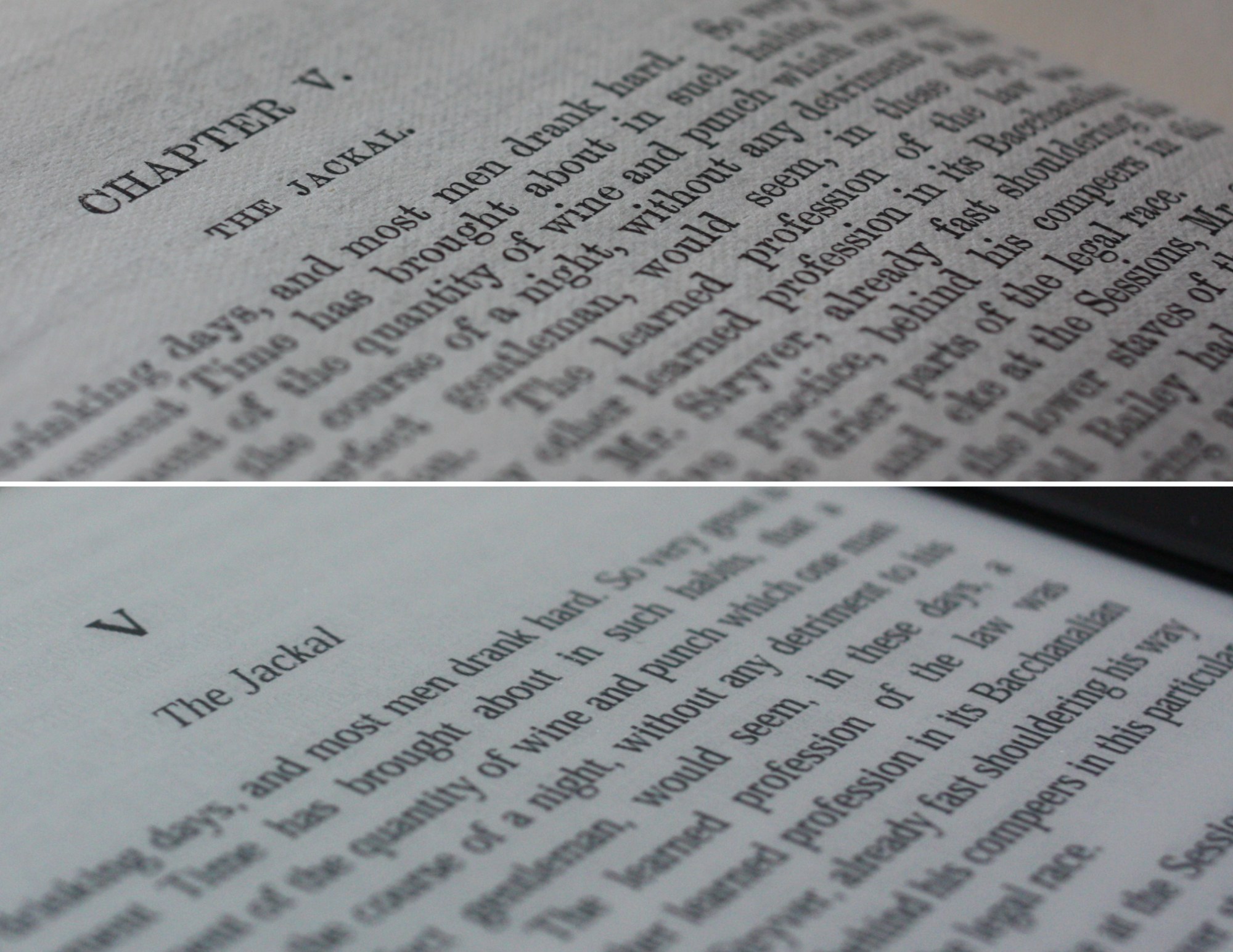
Text can be pixelated or low-contrast

The screens aren’t actually that good. You can admit it, it’s okay. Even the newest ones. They’re rather grey, and the text doesn’t really look that good, does it? They’re a bit small, too. Don’t you feel it’s a bit limiting? You can’t replace a newspaper with this thing, and images look pretty bad. That blinking thing when it refreshes itself is annoying, finding a particular chapter or passage can be a pain, and lending or borrowing books isn’t as straightforward as it could be.

Am I just being an entitled consumer? A bit, yes. But there’s a good reason for my (mild and proportionate) frustration. The makers of e-readers have made a conscious choice over the last two years or so: provide the same product at a lower price, not a better product at the same price. It’s not that I have a problem with this. I wrote two years ago (http://techcrunch.com/2010/03/24/dirt-cheap-and-no-features-to-speak-of-will-the-kobo-e-reader-sell-by-the-million/) that this was the end game for the current players. That’s only an issue if, like me, the initial devices held no interest. For many, the race to the bottom was a good thing, making the basic e-reading experience possible for an extremely low price (and getting lower year by year). This is already having serious effects on the publishing and education ecosystems.

But what you see is also the inevitable result of companies relying on a dwindling pool of OEMs capable of manufacturing parts in the millions. The leading devices all use the same third-generation E-Ink display; few people would notice differences between the way they handle text, or care either way. As I mentioned, there are differences in the interface outside of books, and in how you search and buy, that sort of thing, but the purpose of these devices is to display e-books, and they all do it without appreciable differences.

Now, when their products are the same, companies compete on bullshit. We saw this in the 90s when every Compaq, HP, Dell, and Gateway PC was using the same pieces, and we see it today with TV makers who all have the same fundamental features and have to invent new numbers to increment at every CES. Markets at this stage are ripe to be broken into, as Apple is fond of doing. This point is when it often steps into the picture. I don’t mean to imply Apple will enter the e-reader wars (in fact, the iPad is their entry in a way), but someone is going to have to change the game. Selling a commodity, which is what e-readers have become, is a dangerous business in tech, because commodities tend to devalue rather quickly.

What needs to happen? A superior product, that’s all. E-readers can’t remain dumb, paperback-sized, text display gadgets forever. If they’re going to replace books, and paper, they need to learn a few more tricks.

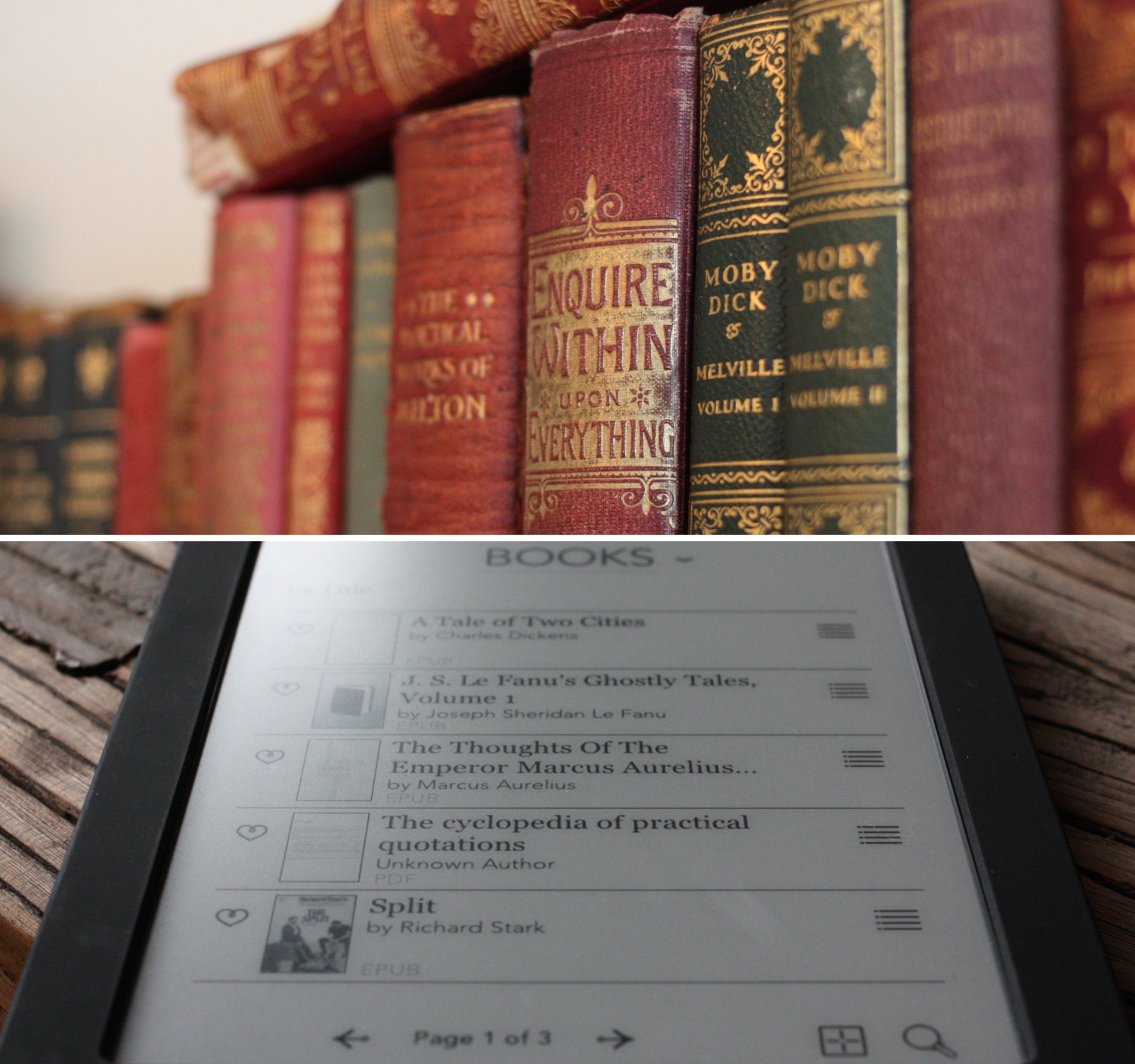
Browsing your “library” is slow and lacks discoverability; organization isn’t organic

It’ll take some time; no one wants to obsolete their own product, and these readers are setting up what is potentially a very profitable ecosystem. But at the same time, if they don’t do it, someone else might. Leave your lunch out too long and someone might just eat it for you. So you better believe that the big guys are planning real replacements for the e-reader of today, and are on the lookout for any sign that they might get beaten to the punch.

What will the new features be? Well, for example, Bridgestone has produced a screen that appears to beat E-Ink at every level. And half the electronic companies out there are hard at work on flexible OLED or bistable displays. Sony is testing the waters with a foldable tablet, and Readius has been flogging their flexible device for a while now. E Ink, conscious that they’ll have to make serious advances in order to keep their position as head bistable display honcho, is making screens that can be crumpled or attached to cloth. Color e-paper is shipping right now, though it’s not particularly good. Don’t expect the e-readers of tomorrow to be the same static window on text that they are today.

The screen quality, too, is going to have to improve. In both resolution and contrast, e-readers need to approach print on paper, or they will forever be understood as being a sub-par option, grey and indistinct. More comfortable to read on than LCDs, sure, but for how long? The advantage of the reflective display will eventually be outweighed by other factors if they don’t start moving.

And we’ll want to write on them, too. The Noteslate device, unfortunately totally fictional (but apparently now in the works), awakened a sleeping giant of gadget envy on the net. Who wouldn’t want one of those things? Yet none of the major e-reading devices are even attempting it.

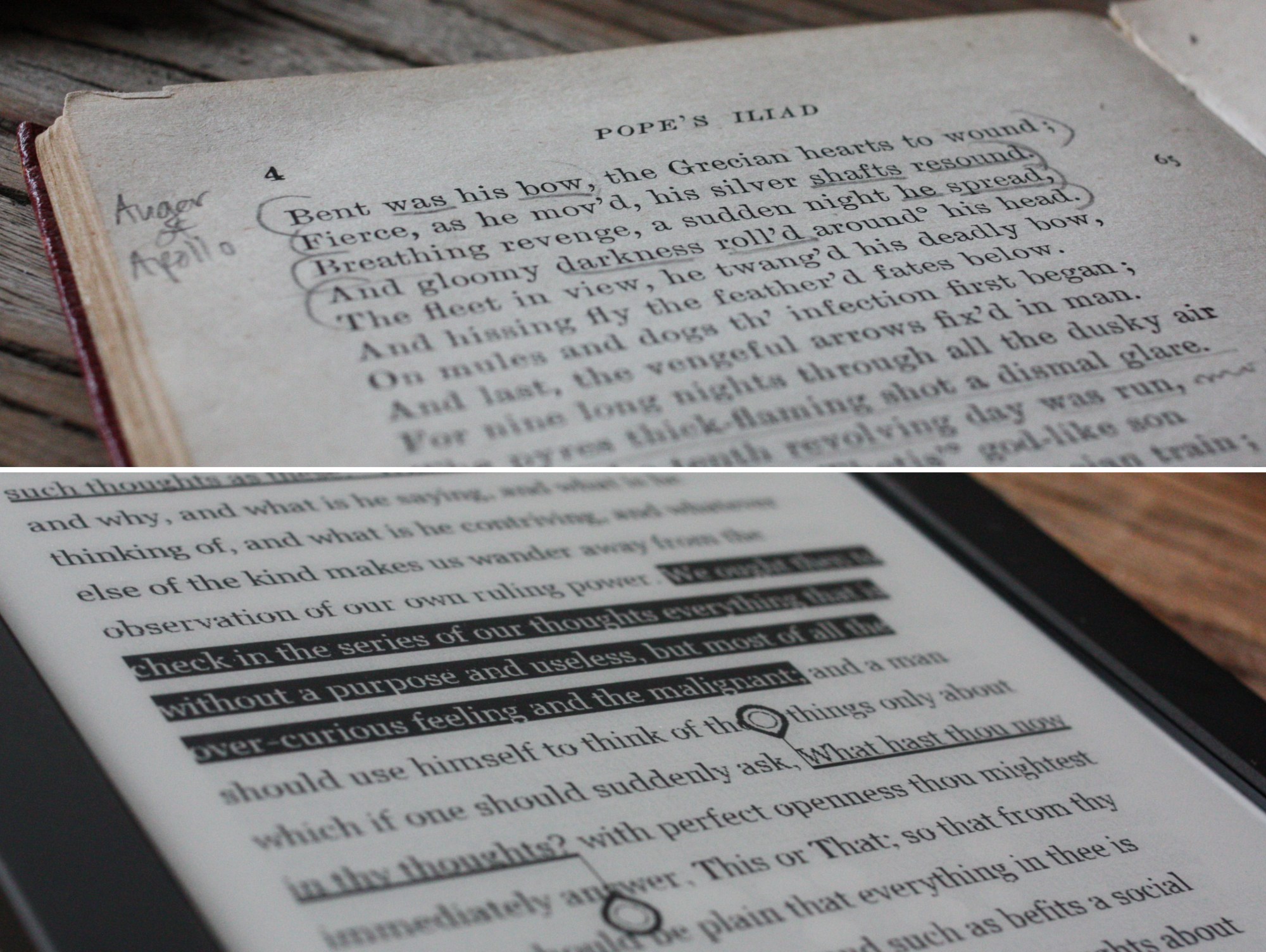
Annotating and highlighting content is clumsy and slow

What else? Social and collaborative features, no doubt, like those just beginning to be promoted; more portability and ruggedness; features to enable reading by the blind, like quality real-time text-to-speech and tactile displays; richer formatting and rendering; self-illuminating screens or text; adjustable page tint; to say all, anything you can imagine might improve the reading experience, and probably a few things you haven’t imagined yet.

These fantasy devices don’t have to beat paper at everything — after all, they’ll never beat it on battery life — it’s just a little disappointing in how few ways they better their venerable competitor. And note that the e-reader should be considered distinct from the tablet (which, though more versatile, shares many shortcomings) as a device aimed specifically at consuming and storing text, and mostly black and white text at that. I suspect that factor will remain important for years to come.

Now, it’s not as if e-reader makers have been standing still all this time. Their devices are lighter, brighter, and faster, and making the screens touchable was a good move. But the problem is that after all these improvements, e-readers’ advantages over books still aren’t very significant. If you read one or two books at a time, and not big ones, the advantage is almost nil. E-readers should be way better than books! The possibility is there; the technology is there; the demand is there. There are dozens of things we would like to be able to do with our literature, our journals, our newspapers, that are inconvenient or impossible with existing form factors (paper, tablet, PC, or other). E-readers have a world to expand into, yet they are exploring it at a snail’s pace.

Why whine about this? Think back on the last ten years. How many tablets and MIDs do you spy with your little Internet eye? Dozens, most of them failures or niche products. Because, really, they simply weren’t good enough. E-readers have caught on to some extent, more so than the early tablets and MIDs certainly, but I would suggest that this is because of a pent-up demand for a device like this and not because of any particular fitness on its part. At the moment, they’re still quite crude, really — and we only tolerate their crudeness because right now convenience is valued over utility.

No one would blame you for not buying a Palm Pilot or Newton or early MID back in the day, because although they did have a purpose, they were, even at the time, clearly not mature products. E-readers aren’t mature either; don’t be fooled by the homogeneity of today’s options. They’re like that because of the decision they made, to drop prices instead of change the product. Just because they look alike and act alike doesn’t mean they are mature, the way PCs became mature in the late 90s.

These early devices ape semi-convincingly the experience of reading a book. Is that the end game? No. Should you expect something better? Yes. Should that stop you from buying one right now? Maybe.

For me, buying the most advanced e-reader today involves too many compromises in quality. The ways in which I read and interact with my books are simply incompatible with e-readers as they exist today. So I don’t buy, though in five years their successors will have me reaching for my wallet. It’s like seeing Microsoft showing off a tablet in the early 2000s. Did I want a tablet? Sure, ever since I first saw one — probably in Star Trek. But I didn’t try to buy that one, because it’s okay to say that something isn’t good enough for you. That’s the prerogative of the consumer. I don’t want a Kindle – I want what the Kindle will become, just as I wanted what the Treo and Newton would become. There’s no shame, and maybe even a little dignity, in waiting.

I love books. I love reading. And I love technology. But I can’t bring myself to even like today’s e-readers, except as promising indicators of things to come. For now, between paper and plastic, there’s no contest.


Army Warns Of Danger Of Geotagging

loc

While for an ordinary civilian the automatic geotagging of your photos or check-ins might be convenient, in the military it can be a lethal mistake. In 2007, geotagged photos of a new fleet of helicopters allowed enemy forces to mortar the base and destroy several of them; it could just as easily have been a field hospital or barracks.

The Army has therefore published an article calling attention to this fact, though its casual tone suggests that they aren’t ready to take serious action on the issue. A warning is all it is, and perhaps also an acknowledgement that sometimes it’s better to bend with the breeze than fight it.

While soldiers in the field aren’t likely to be checking in to engagements or taking pictures of their fortifications for the kids, such things are still going to happen. Whether it’s enlisted personnel or people like embedded journalists, DoD researchers, civilian contractors, or what have you, the risk of someone posting sensitive information is real. And with the speed of sharing today, such data can propagate rapidly enough that it’s a serious security risk.

The army’s power to control the devices used by its soldiers and those around them is limited. And any attempt at locational lockdown would almost certainly end in failure. Luckily, it can still minimize the risk by making social media part of a soldier’s situational awareness. It’s a testament to the power and reach of social media that it should be entered into tactical calculations.

And while location sharing is framed primarily as a risk today, it’s obvious from the military’s pursuit of smartphones as an integral part of a soldier’s equipment that they value it as a potential asset as well.


Eyeing An IPO, Kayak 2011 Revenue Up 32 Percent To $225M; Net Income Up 21 Percent

kayak-1

Travel search giant Kayak just posted new revenue numbers for the fourth quarter and full year 2011 in a new S-1 filing with the SEC. As we heard last September, Kayak put its IPO plans on hold until market conditions improve. Now that the markets are more stabilized, it should be interesting to see when Kayak makes the push to become a public company. For the year, Kayak generated $224.5 million of revenues, up 32 percent from 2010.

Net income for the year was $9.7 million, up 21 percent from 2010′s net income of $8 million For the fourth quarter, Kayak saw a 27 percent increase in quarterly revenue, posting $53.9 million in Q4 2011 sales. In contrast, revenue grew 28 percent in the third quarter.

But the company says that typically its highest revenue quarters are the second and third quarters.

Kayak says it finished 2011 with 899 million user queries processes for travel information, representing growth of 42 percent from 2010. For 2011, Kayak had 7 million downloads, up over 70 percent from 2010.

Despite the IPO being on hold, Kayak has been consistently trying to improve its core product and add additional functionality. The company has been heads down on product development and improving customer experience over the past few months, as the company battles with Google in the travel search space.

In December, Kayak redesigned its iPad app and consolidated the app with its iPhone cousin. The company’s website most recently got a big UI upgrade, creating a more universal and comprehensive consumer experience across all Kayak platforms: web, mobile web and apps. And the search engine just debuted direct booking for flights.


Cater2.me May Be Feeding Your Favorite Startup

cater2me logo

Startup Cater2.me is trying to answer one of the rarely-discussed challenges facing any company that wants to keep a large workforce happy — feeding them meals that aren’t boring.

Cater2.me was founded in late 2010 and has already attracted some positive press attention. Now, its client list includes some startups worth bragging about, such as Yelp, Eventbrite, Tagged, Square, Dropbox, Twilio, Causes, Posterous, and Heyzap. The company is serving 40,000 lunches a month (including many to non-startups, of course.)

Co-founders Alex Lorton and Zach Yungst are both graduates from the Wharton Business School and before starting Cater2.me, both worked finance/consulting jobs in downtown San Francisco. They saw it was their time in those offices that convinced them of the opportunity. Outside, they saw a vibrant culinary world of hole-in-the-wall ethnic restaurants, food carts, and farmers markets. Inside, bland catered food.

So Cater2.me tries to bring that varied world of food into workplaces. Office managers, or whoever else is in charge of a company’s meals, can just go to the Cater2.me website and enter their needs — for example, if they need to feed 50 people every Monday, Wednesday, and Friday, and five of them are vegetarians. Then Cater2.me handles all of the logistics, bringing in a rotating menu of food from a network of small restaurants and carts — businesses that probably don’t have the time or resources to do large office catering on their own.

Eventbrite’s Brooke Michael says she started testing Cater2.me as a lunch option back in June 2011. Over time, she did more and more ordering for them, because the process was so easy and the company was so responsive to customer feedback. Now Eventbrite is even relying on the service for its breakfasts.

“Overall, they have really improved our meals at Eventbrite and have brought a lot of smiles to our employees,” she says.

This market seems to be catching the interest of investors, too. Two other catering services, Eat Club and Zero Cater, both raised $1.5 million in venture capital recently. (Eat Club reportedly served 60,000 lunches in the past year.) Cater2.me, however, remains self-funded.


Mobcaster Crowdfunds Its First TV Season

mobcaster

It’s famously difficult to get a TV show on the air — much less one that still matches your initial vision. That’s why Mobcaster has launched a new platform where creators can ask fans for the financial support to produce their shows.

The startup just had its first funding success story — The Weatherman, an Australian-produced comedy about, yes, a weatherman, which has raised the funding needed for its first season. The production company set a goal of $72,500, and it raised $73,975. (As the team notes at the beginning of the pilot episode, traditional television episodes cost hundreds of thousands of dollars at the very least, so that’s a tiny budget for a full season.)

In many ways, Mobcaster is clearly modeled on Kickstarter. Members donate however much they want, they receive rewards for different donation levels (if you donated $100 to The Weatherman, you would receive a full Producer credit, for example), and you only pay if the project reaches the minimum donation level to get made. However, co-founder Aubrey Levy points out that Kickstarter doesn’t have many TV success stories, and whereas Mobcaster is designed specifically for the television model.

Creators first raise money for a pilot episode, usually by uploading a pitch and pilot script. Then, after they’ve shot the pilot, they can use it to fundraise for a six-episode season — which is shorter than most American TV seasons, but keeps the funding needed to a manageable level. (That’s also the length of a normal British TV season.) Shows can continue for as long as the creators want, raising money one season at a time.

Levy says Mobcaster provides another crucial piece of the puzzle — distribution. The vision is to turn the site into both a crowdfunding platform and an online video channel. Otherwise, creators raise money for a show but have no place to broadcast it, and are forced to “post and pray” for an audience. Levy argues that people don’t go to any of the existing video sites for an independent TV experience. On YouTube, they expect short-form amateur content (and music videos), and on the other end you have Hulu, where people want traditional TV shows.

Mobcaster will run ads with the videos and split the revenue 50-50 with the creators. And the creators own all the intellectual property, so if there’s interest, a show might actually make the transition to traditional TV (and Mobcaster gets a small cut of the payment).

Levy, by the way, was a digital media strategist at HBO, and he says he spent six or seven months pitching a TV show the old-fashioned way. Like most pitches, it never made it on-air, and thanks to network feedback, Levy says the show had actually got worse throughout the process. Not surprisingly, Mobcaster was built in response to those experiences — it gives the creators complete creative control, and it puts the show’s survival in the hands of the fans. (Think of all the fan campaigns to save canceled shows like Arrested Development and Firefly.)

“Ultimately the TV show is being made for you, so you’re the only person who should make the decision on whether the show should live or die,” he says.


PayPal’s New Digital Wallet Will Offer Personalized Deals, Flexible Payments, And More

PayPal-1

We’ve been hearing recently about PayPal’s in-store payments platform for large retailers (which will soon be rolled out to small businesses as well). But we haven’t seen PayPal do much in the past few months with its plans for its digital wallet on the consumer side. We know PayPal has a major vision for how payments will be made in the future, but today, the company is giving us a glimpse of exactly what new features will be added to the platform in the coming year.

As PayPal’s director of communications Anuj Nayar tells us in an interview, “PayPal is changing, and this is the first major revamp of the core PayPal product. We’re known as an online payments brand but this is all part of PayPal becoming an actual wallet.”

Sam Shrauger, Vice President of Global Product and Experience for PayPal, says that the “new PayPal” will “let consumers do things with their money that have never been possible before.” One of these features is the ability to have flexibility with how you want to pay for an item in a store. So let’s say you purchase a computer from a store or online with your Starwood credit card but realize that you actually have a Best Buy credit that you wanted to use.

With the new digital wallet, you can buy something in a store, take it home and decide later how you want to pay for it. PayPal will offer a five to seven-day grace period for consumers to change their minds. So you can switch from one funding source to another, decide to pay over time in installments and even apply different sources of value (gift cards, airline miles, loyalty points, etc.) to a payment.

As we heard from PayPal over the holidays, data is going to be a huge part of the payments company’s product strategy over time. The new version of PayPal will allow you to create personal lists of items you want. Via PayPal, you can search for items, compare prices and create lists of things you want to buy for a variety of situations. PayPal will then find deals and coupons for these items on your list whether you are in the store or online.

Additionally, you’ll be able to create spending rules that tie specific cards and payment instruments to specific merchants. So you can create specific “set asides” like travel funds and set rules by purchase amount. For example, you can earmark a bank account for all grocery store purchases, and a specific credit card for entertainment and travel directly from PayPal. All you’ll need to do is pay via PayPal, and the platform will automatically recognize whether a specific payment should be drawn from a credit card or bank account.

As Shrauger writes in a post announcing these new features, “PayPal is not about replacing a card swipe with a phone tap at point of sale. We are reimagining money to free it in its digital form so that it can work better for everyone. These features and examples are only the beginning: moving forward, we’re only limited by our ability to imagine what’s possible.”

Nayar explains that there will be “an avalanche” of product announcements that will bring these features to life in the coming year, starting in late May. “This will be your new PayPal account,” he says.

This new wallet will also be able to be used with the new in-store experience at retailers (and perhaps at small businesses as well). PayPal clearly wants to become the digital wallet provider for consumers, but the company already has a number of competitors vying for this spot. Google seems to also have major ambitions to dominate in this space with Google Wallet. We’re seeing other competitors enter the space, especially in mobile. And we still don’t what Apple’s intentions are when it comes to the wallet.

But there are a few things in PayPal’s favor. First, the company already has an established user base of over 100 million active users. Second, PayPal is device-agnostic and can be layered over the web, mobile, and other platforms. The company hasn’t revealed any new mobile plans today, but that’s also sure to be a significant component of the digital wallet’s technology.


Gundotra: Google+ Won’t Let 3rd-Party Apps Post Because “Your Stream Could Easily Be Overwhelmed”

vic_gundotra_250px

Today at his SXSW fireside chat, head of Google+ Vic Gundotra said “I am 100% to blame” for the social network lacking an API seven months after launch. The reason? “Your stream could easily be overwhelmed” if Google allowed third-party apps to post content on users’ behalf.

Additionally, Gundotra criticized Facebook’s inclusion of ads on photo albums and said that only a “very small number of people have turned off social search”.

Gundotra made no guarantee a third-party posting API would be made available by the end of 2012, “I just don’t want to do it because I’ve seen other [platforms] open APIs, develop an ecosystem of third-party clients, and then shut down the API. I’m going to release that API when I’m confident we’re not going to screw over developers.”

The problem with allowing third-party apps to contribute content is that “if ranking is not good in the stream”, single apps could publish too many posts and push out authentic content from the people you follow. Gundotra said that “When Google opens an API, we want you to know we’re not going to revoke access.” Moderator Guy Kawasaki quipped that developers are used to rapidly changing APIs from Facebook, but Gundotra snapped back, “We hold ourselves to a higher standard”.

In this case, Google’s late start on social is holding it back. Facebook has had years to refine its EdgeRank algorithm for sorting the news feed and minimizing the impact of noisy friends and apps. Without such data on who and what its users are interested in, Google+ doesn’t know what to promote and hide

The senior VP of engineering seemed confused, saying “We get these messages that we’re a ghost town” but developers are still eager for access. Well guess what? If users could cross-publish posts to Google+ the way that apps like Path allow syndication to Facebook and Twitter, maybe the network wouldn’t feel so dead. Overwhelmed might be better than underwhelmed


A Better Live Wiki: HackPad Could Be Your SXSW Backchannel

Screen Shot 2012-03-09 at 1.45.37 PM

There are lots of apps for finding the right people and parties at South By Southwest this year, but what about, you know, actually going to panels and sharing your thoughts about them? Well, there’s Twitter for short-form public sharing, and messaging apps like GroupMe for group chats. But HackPad has a more serious idea: actually taking notes about the panels and keynotes you go to, with other people who care.

It sounds dangerously productive for the fun-oriented event. And it is — this is one of the better live group word-processing products I’ve seen in a while.

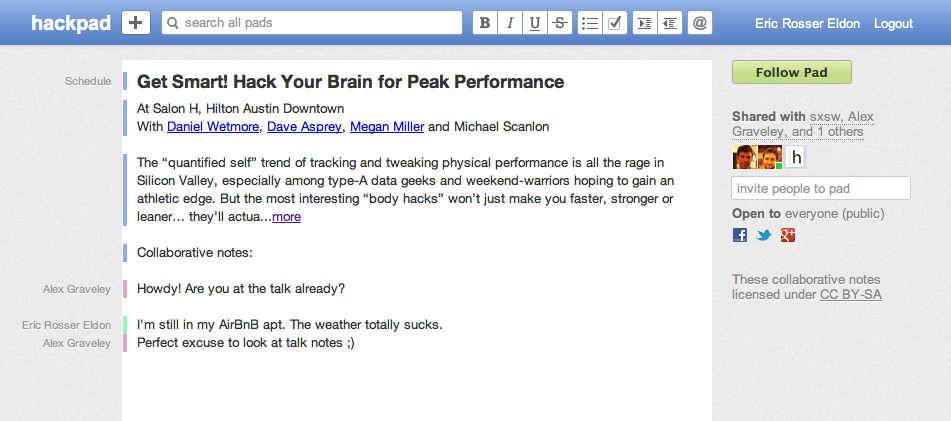
The interface is nice and simple. You log in with Facebook, or with Google or by creating a new account.  Then you can just start creating and editing docs. Participating users appear on the right side of each page, and each person gets a unique color bar on the left side of where they’re typing. Live edits are in real-time, so you can watch other users pounding out their own notes while you’re busy sharing yours.

The top menu includes a simple set of actions for all the main things you need to do. There’s a plus button for creating new docs, a search bar, and basic WYSIWYG commands including a big button for creating links to other docs or the web (something a lot of editors don’t show off well in their interfaces).

Two-man veteran engineering team Igor Kofman and Alex Graveley (who earlier in his career created Tomboy Notes) also created a special sub-site for SXSW. A list of every panel and talk  is available now at austin.hackpad.com, organized by hour and by day. If you’re here at the rain-soaked conference, or interested in any of the panels, be sure to check it out.

Overall, the Y Combinator-backed company feels like it’s on the right track for pushing online collaboration forward.


Nokia Lumia 900 Won’t Hit AT&T Shelves Until April 22

lumia-900

We’d heard a while back that the long-awaited Windows Phone-powered Lumia 900 would show up on AT&T’s shelves on March 18.

However, around the time that this rumored launch date leaked, the Lumia 900 had yet to go through its testing in the technical acceptance process. Turns out, that may be the reason BGR is now reporting that the Lumia 900 launch has been delayed to April 22.

Luckily, the Lumia 900 will still go for an absolutely ridiculous price point. And when I say ridiculous, it’s a compliment. While Windows Phone devices haven’t had the most impressive specs to date, the platform itself and Nokia build quality are certainly worth more than $100.

But that seems to be the strategy with this partnership.

Nokia has seen a rough year, to say the least, and Windows Phone has never really been what Microsoft (or anyone else) would call a success. But all the pieces are falling into place, in terms of the products themselves. Now all Nokiasoft has to do is get people on board with the platform, and that means attractive pricing.


Marvel Touts New Deal: Buy A Comic Book, Get The Digital Version Free

mobilecomics

Pop quiz, hotshot: it’s Wednesday, and that means a new shipment of comic books is sitting pretty at your local dead tree retailer. Do you schlep down to the store to buy a physical copy, or will you reach for your smartphone/tablet and buy it from the comfort of your own home?

Well, if you want the best bang for your buck, you should probably get dressed and prepare to brave the outside world. Starting in June, any Marvel comic that costs $3.99 or higher (when did comic books get so pricey?) will come with a code that lets the purchaser download a digital copy of that same comic via the Marvel Comics app for iOS or Android.

How benevolent. Not every comic will get the two-for-one treatment, but most of Marvel’s biggest names are accounted for thanks to their price tag. Think The Avengers, Amazing Spiderman, Invincible Iron Man, and Captain America, with plenty more to like on the list.

The move isn’t without its downsides though — namely, that you’ll have to wing your way to the local comic book store and carry out a financial transaction in person. Which is fine, if you’re into that sort of thing, but it’s 2012 dammit and I don’t want to move any more than I have to.

I’m kidding. Really.

Marvel tested the concept last year when they announced that their Ultimate Comics line would come bundled with a digital copy, and the move garnered the comics giant plenty of “positive reactions from both retailers and fans.” Of course it did — fans get free stuff and comic book stores get their business and the potential for increased traffic. Meanwhile, Marvel eats up the goodwill from both parties and builds awareness of their mobile marketplace (and all of its in-app purchases). Everyone’s a winner!


Stride, A CRM System Salespeople Will Hate (But Freelancers Will Love), Launches Into Beta

stide-logo

Stride, a new CRM system designed to meet the needs of freelancers and small business owners, is launching into private beta today. The product, which was born out of an actual need for a more simplified CRM system, is focused on efficiency, not a complex feature set. It’s not for adding contracts, managing cases, or allocating tasks to a team of salespeople. Instead, Stride is about deal-tracking and high-level metrics only.

“For salespeople, this app is going to make them cringe,” says Stride co-founder Andrew Dumont.

The idea for the app was sparked by Nathan Carnes and built by the team of Andrew DumontAdrian Pike, and Amiel Martin. Carnes explains the history of Stride’s creation via a blog post detailing the frustrations he had running a small design shop and not being able to find a CRM system that fit his needs.

“I didn’t need multiple salespeople or complicated reports,” he says, “and I didn’t have time to enter contacts and manage them.”

Giving up on finding a solution, Carnes decided to build one instead. That’s something that often leads to inspired ideas, frankly. And Stride, which looks attractive, simple and accessible, may just be one of those.

Andrew Dumont tells me that he felt similar to Carnes about the current state of the CRM market. Everything he used (Highrise, Salesforce, Capsule, Base, etc.) were always “way too complex and clunky,” he says.

“We like to think of Stride as the consumerization of sales tracking,” explains Dumont.

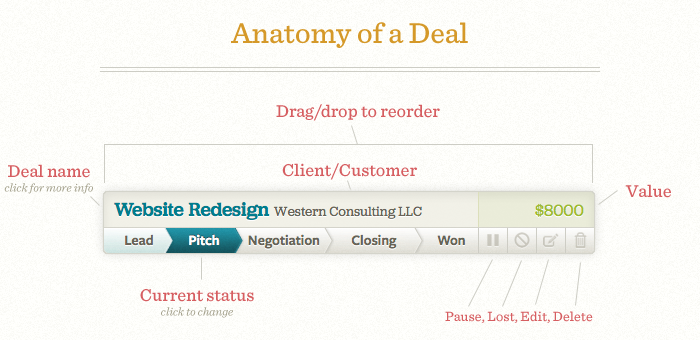
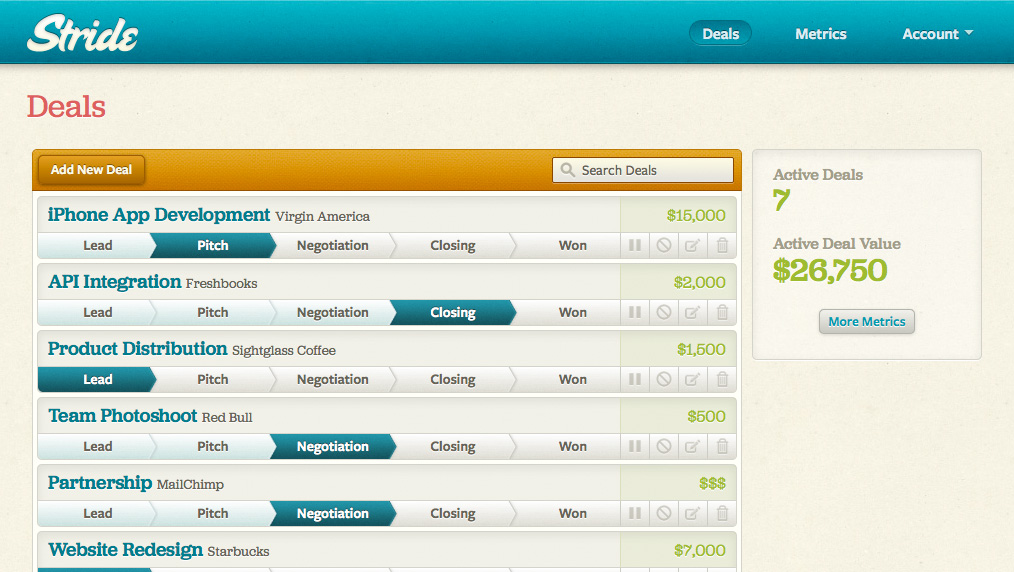
In Stride, the whole system is focused on deal-tracking, meaning any relationship that has a dollar value associated with it is entered into Slide. The deal name and status are in blue, the value (dollar amt.) is off to the right in green, and there are buttons that let you quickly change the deal’s status (lead, pitch, negotiation, closing, won) as well as buttons that let you pause, indicate if the deal is lost, edit the deal, or delete it.

Deals can also be drag-and-dropped on the dashboard, so you can organize them as you see fit.

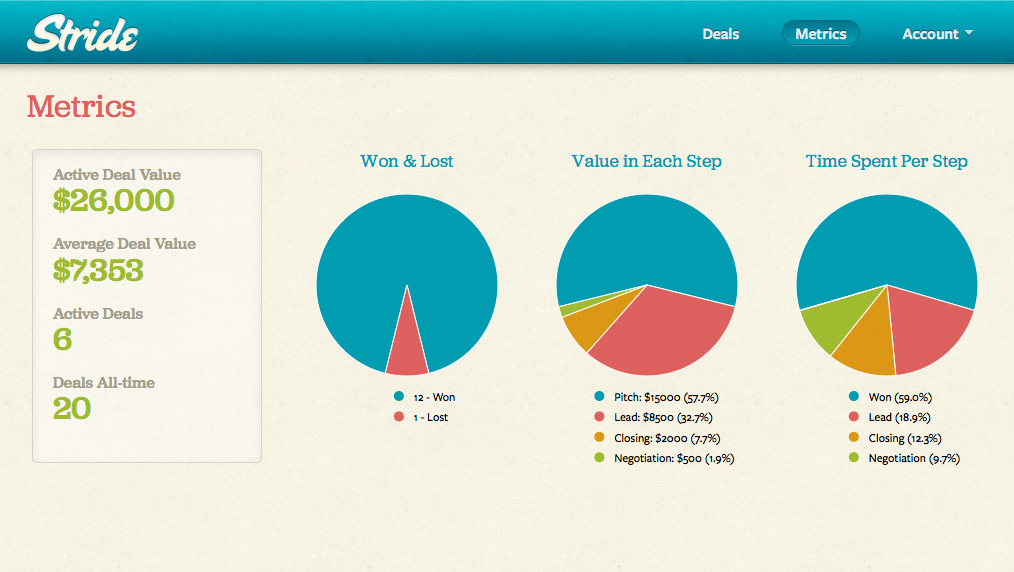
A simplified metrics section shows you the key figures you need to track: active deal value, average value, number of active deals and deals all-time. Pie charts further break down things like time and value in each step and number of deals won and lost, for example.

The simplicity of the product is promising – CRM for anyone, clearly – but there’s certainly room for Stride to grow to meet users’ demands for some slightly more complex features in the future. Although after small businesses, some owners may want to have multiple people to sign in and track deals under their own names, for example, or they may want a bit more detail to the reporting options. Given that product’s pricing starts at free (for 25 deals) and go up to $7/month for unlimited deals, adding a few carefully considered enhancements for a slight price bump seems reasonable, without worrying about the app moving into Salesforce territory.

Dumont tells me that, indeed, the plan is to add features in the near future, but to keep the focus on simplicity. Specifically, Stride will soon roll out a feature that will lets users add, edit and remove certain steps of the sales flow process to better fit their flow. The company is also adding email reminders and integrations with Quickbooks, Freshbooks, Rapportive and more, which will help reduce the complexity of using the system. And yes, they’re going mobile too, and plan to launch on iOS first.

TechCrunch readers interested in trying out the beta will need an invite code to get in. You can use the code “techcrunched” when you sign up here.