Boutique Fitness Scheduler FITiST Joins New Incubator WellTech

fitist

If you live in a big city, you’ve probably got a lot of fitness options outside the traditional gym — everything from boot camps to cycling classes to Yoga studios. Now a startup called FITiST wants to help you navigate that world, creating plans and scheduling classes across multiple boutique fitness studios.

FITist has already launched in New York City and Los Angeles, and today it announced that it’s one of the first two startups to join WellTech, a New York-based incubator for health and wellness startups.

After you join FITiST, you can choose from a number of plans, which are essentially different class packages targeted to help accomplish different fitness goals — they’re created by an editorial board that includes experts in personal training, nutrition, anatomy, and more. If you’re looking to slim down, for example, you can sign-up for a package that includes six cycling classes, six core/Pilates, four performance, and four yoga. Some of the packages are tied to a more specific circumstance. One is called “Bride” (i.e., you want to look great for your wedding), another, “New Mom”. You can also sign-up for an all-access pass of unlimited classes, or create a completely customized program with FITiST’s help.

The company says that its early members include fitness buffs who “had kind of plateaued,” but are starting to see results again thanks to FITiST’s plans.

FITiST also has access to a curated network of studios, so you can sign up directly from the site. That means you can try out a bunch of different facilities, or can set up classes in different locations depending on your schedule. It also offers last-minute deals on classes starting at 9pm the night before.

Not surprisingly, this is going to be more expensive than your standard gym membership, but the plans I’ve seen cover a pretty broad price spectrum, from $75 to $760 a month. And yes, the company wants to expand to other cities eventually.

As for WellTech, the incubator is providing at least $50,000 in funding, as well as the usual mix of mentoring, office space, and marketing. WellTech’s founders include SpaFinder CEO Peter Ellis, and it’s financed by Ellis’ firm Jubilee Investments.

WellTech also announced that Wizpert, a startup that connects users with fitness experts in real-time, has joined the program.


Pair Is A Path For The Two Of Us

pair3.23.12

Let’s say you’re in a serious relationship, but you work all the time and you’re long-distance. How do you stay close to the other person? I’ve personally had this situation for the last year and a half. My girlfriend and I use Skype, email, our phones, Facebook, and everything else we can to stay connected. We’ve even been using Instagram as a two-person social network to share photos about what we’re up to each day.

But now there’s an app to solve this exact problem. It’s called Pair, and it’s packed with the features you see in private social networks like Path, but designed for two people.

The interface starts out deceptively simple. You start by taking a photo of yourself, and then shooting a quick video on your phone (iOS only for now), that you send with the invite to your significant other.

Once they “pair” with you, you’ll be put into the app together. The interface is organized like text messages. You appear on the left, your partner on the right. But you’ll get an impressive range of options for how to stay in touch. There’s simple messaging, videos and photos (complete with the option to touch them up in Camera+). But there’s also a “thinking of you” button, which is a simple notification that’s most similar to Facebook’s classic Poke.

And, there’s a draw feature. So you can scribble all the silly pictures and sweet little ditties that you want.

The Y Combinator-backed company also provides a bunch of other smart and subtle features. A button at the top lets you turn on Facetime with a single swipe. A feature called “thumbkissing” shows your partners thumbprints whenever they’re touching the screen, and both phones will vibrate if your thumbs are on the same place. You can also create shared to-do lists and set reminders for birthdays and anniversaries. A Moments section contains all your shared photos.

The main downsides, at least in the opinion of my girlfriend, are the following: you can’t unselect photos, you can’t create captions, the text from multiple messages gets “mushed together” and makes you “look like a babbling loon.” And that’s not all, in her opinion (at this point I’m just transcribing the rants that she left for me in the app).

“The search feature is nice. But would be way more useful if they enabled photo captions. Who the fuck searches for text blurbs? If I used search, it’d probably be to locate a photo. And if I’m using an app called Pair with one other person, isn’t it implied that I’m thinking of that person? Otherwise, why wouldn’t I be posting my brilliance to Facebook?”

Maybe she needs to start blogging about tech startups or something. And cofounder Oleg Kostour tells me that they’re aware of these issues and working on them. But it doesn’t matter. Because despite all her complaints, this app is way better than our kludged Instagram setup and Skype and everything else. Get used to it, honey!


Inside The NewMe Accelerator 2012 Startup House [TCTV]

Screen shot 2012-03-23 at 5.05.28 PM

The NewMe Accelerator, a startup incubator program focused on underrepresented minorities in the tech industry, assembles a select group of tech entrepreneurs from all over the United States every year to participate in its 12-week Silicon Valley accelerator. NewMe is a residential program, meaning that the entrepreneurs all live together in a house for three months to brainstorm and hack on their respective projects — “eating, sleeping and drinking our startups,” as NewMe puts it. Along the way, mentors such as Mitch Kapor, Vivek Wadwha, Ben Horowitz and others stop by the NewMe house to provide advice, insight and inspiration.

Sounds pretty intense, right? So of course, we at TechCrunch TV were keen to check it out. At the moment, NewMe is smack in the middle of its 2012 program, so we made a visit to its house in San Francisco to see how things are shaping up so far.

In a word, being at the NewMe house is invigorating: The environment of eight strong entrepreneurs living together is certainly heady, but in a really good way. Everyone at NewMe is psyched about what they’re working on while also being super encouraging and proud of what their fellow founders have built.

In the video embedded above, you can watch NewMe partner Wayne Sutton talk about how the program has grown in recent years, the challenges that face minority entrepreneurs in tech, and much more. You also get an introduction to NewMe’s Class of 2012, and a brief introduction to some of the 7 companies that are being built inside the accelerator.

For a more in-depth look at the NewMe startups, you can watch each founder’s pitch in the video embedded below.

NewMe’s Class of 2012 startups, in the order in which they appear:

AgLocal
Founded by Naithan Jones, it’s a web and mobile marketplace that connects regular consumers with local farms that supply meat.

Butlr
Founded by Andre Gabriel, it’s a social shopping game that lets you buy real-world items with virtual currency.

PictureMenu
Founded by Christopher Lyons, it brings photo-rich restaurant menus to diners’ smartphones, aiming to eliminate paper menus entirely.

Helpr
Founded by Tendekai Muchenje, it allows users to make customer care inquiries through a social media-enabled web app, rather than through the typical telephone help line.

Kairos
Co-founded by Amanda McClure and Brian Brackeen, it has developed a new way for retail companies to report sales data and point-of-sale analytics using facial recognition and augmented reality technology.

Modul.us
Founded by Rachel Brooks, it is a software platform that enables any e-commerce company to allow their customers to customize and live-render products on the web.

Ubi Video
Founded by James Norman, it is a multi-platform video delivery solution that allows users to watch cross-platform video through one portal, and easily discover new things to watch.


FCC Documents Show Sony Chromebook, Potentially Running On ARM

top

Google’s Chromebooks haven’t exactly made a splash, but apparently not everyone has been scared off. Sony seems to think there’s gold in them thar laptops, and they’re making their own. For now it’s known as the VCC111 (probably shorthand for “Vaio Chromebook Computer, series one, 11-inch display”), according to documents and pictures from FCC testing.

The understated look continues with these Vaio Chromebooks, even as far as what appears to be a matte black unbranded shell. A white version is also shown in the test setup photos. But the most interesting thing is the processor, which is listed simply as T25, and may in fact be Nvidia’s Tegra 2 chip by that name. An ARM laptop? Hey, if Microsoft can do it, why not Google and Sony?

At 1.2GHz, with 2GB of RAM and a few of the other usual fixings, it isn’t a stunner spec-wise, but that’s kind of the point. It’s a tastefully-designed netbook designed to boot fast and get on the internet. It isn’t an ultrabook or work laptop or what have you. So it should fulfill that purpose admirably, and sell well below $500 to boot.

Release date is unclear, but they filed a confidentiality request for 180 days after August 15, 2011, so this unit has been around for a while — but they probably weren’t planning a release until at least 2012, judging by their request to keep the external photos secret for half a year.

Perhaps they’re waiting for Google I/O? Seems a bit of a long wait to release something that was more or less ready late last year. Hopefully we’ll see an official announcement soon and get our hands on the device for some real-world testing.


[via Laptop Reviews]


6waves Lolapps’ CTO and Chief Product Officer Rue And Sethi Step Down

arjun-sethi

Just a few days after social gaming company 6waves Lolapps said it was laying off most of its development staff to focus on publishing, its chief product officer Arjun Sethi and chief technology officer Brian Rue have stepped down.

6waves Lolapps was born last July out of a merger between a Facebook game developer Lolapps and a publisher 6waves. The publisher had been instrumental to the success of Lolapps’ hit Ravenwood Fair, which was considered one of the best games on the platform in late 2010 and early last year.

Clearly, the merger didn’t work exactly as intended. But with the deal, 6waves Lolapps picked up some valuable technology that helped boost revenue per day from players across the publisher’s network of titles. Sethi said his resignation after more than four years at the company was planned ahead of the layoffs.

“After more than four amazing years with Lolapps, I find it so hard to say goodbye to the team and to the impressive products that we’ve built together,” he said in a statement on his personal blog.

After joining Lolapps as its chief executive, Sethi saw the company transition from simple, very viral quiz apps in the early days of the Facebook platform when distribution was easy to more intensive games like Ravenwood Fair, which was like a mix between Frontierville and a business sim game.

Rue added in his own blog post: “It’s been a crazy ride of ups and downs and it feels very strange that it’s come to an end. I’m proud of the culture that we built, and it was especially evident this week as suddenly-former employees banded together to commiserate and find new companies to call home.

Up until recently, it looked like 6waves Lolapps was going to be a dual publisher and developer. After the two companies merged, they raised about $35 million in funding from Insight Venture Partners and South Korean gaming giant Nexon. Not long after that, the company ponied up to buy a developer in China called Smartron5 and a mobile development team through a deal to buy Escalation Studios.

Sethi hasn’t planned his next move yet. Going forward, 6waves Lolapps will focus on publishing. Its existing titles will continue to work and 6waves Lolapps is looking for a third-party team to service them.

The titles that were still in development including Ravenshire Castle will still come out. Sethi and one of Lolapps’ original co-founders Kavin Stewart will personally fund a spin-off to make that happen.

All in all, the layoffs are just another sign of how challenging the environment is for gaming companies on Facebook. It’s a very bittersweet week that underscores just how fickle the gaming industry week is with OMGPOP’s stellar turnaround and sale to Zynga and 6waves Lolapps’ sad layoffs.


Facebook The Patent Buyer: Even Before IBM, The List Includes HP, Friendster, BT… And Halliburton

facebook_logo

Facebook, according to reports, is buying up a boatload of patents from IBM — 750 in all — that will help the company shore up against potential legal attacks from Yahoo and other companies claiming the huge social network infringes on their intellectual property.

But for the past couple of years, Facebook has already been taking steps to build up its patent portfolio through the acquisition of patents from a host of other players, from large IT companies, to a patent troll and a defunct social network. And a few surprises.

Of the 60 patents that Facebook now owns that are listed with the U.S. Patent and Trademark Office, there are 15 from Facebook itself; and nine patents from HP, 11 originally from Philips Electronics (but sold to IPG and then sold by IPG to Facebook), three from UK telecoms operator BT, nine from patent holder Walker Digital, one from Divan Industries, one from Applied Industries and 11 from Friendster — the pioneering social network that died a Facebook death and eventually got sold to a Malaysian company that turned it into a gaming network.

The patents cover a wide range of areas. Some are very much in the wheelhouse of what we know as Facebook today — managing social relationships, newsfeeds and contacts, for example. Some are about technical processes that happen behind the scenes.

And some seem to cover functions that Facebook doesn’t really offer today. One relates to playlists for music or other media (“Method and apparatus for priority-based jukebox queuing”, patent number 6421651). Others seem to have a distinct e-commerce bent (“Systems and methods wherein a buyer purchases products in a plurality of product categories”, 7188080; “Method, computer product and apparatus for facilitating the provision of opinions to a shopper from a panel of peers”, 7526440).

The U.S. Patent Office also lists another 140 patent applications that have yet to be either approved or formally rejected. Many of these have been initiated by Facebook itself. But there are also some that Facebook has picked up while they are still pending. These include four more patents originally owned by Friendster, one more e-commerce patent from Walker — and, surprisingly, one from the energy and services giant Halliburton, related to data centers (“Cooling computing devices in a data center with ambient air cooled using heat from the computing devices”).

Digging into some of the back-and-forth around pending applications gives a glimpse as to why it’s so important for Facebook to acquire patents rather than try to build up the portfolio itself. (One, for example, filed by Facebook for “Facilitating Interaction Among Users of a Social Network,” was originally filed in July 2010, and just last week had a “non-final rejection” of all of its claims. Facebook can still modify and resubmit.)

It can take years to get a patent approved, and in the case of social media and gaming the process can take even longer, typically up to six to eight years or more from the time the application gets filed. Meanwhile, the potentials for lawsuits appear to be building up.

“Facebook is really the new kid on the block and they need to gird and prepare themselves with IP because the bigger kids have it,” a patent lawyer explained to me. “They have definitely been very proactive, though. Someone at that company understands that the key to a good defense is a good offense.”

So is 60 the definitive number of patents that Facebook owns today? Not necessarily: this is the number listed by the U.S. Patent Office but the patent lawyer tells us that there could be more that it has simply not registered. “There’s no requirement to record every patent with the USPTO,” he said. “It’s only something you do if and when you want to enforce it.” Although he does point out that it’s generally good practice not to stockpile patents.


Spotify Needs Big Funding To Pay Big Content’s Tax On Success

Spotify Pay Me

There’s a fundamental problem with startups that depends on premium licensed content. If you succeed, the content owners will jack up their licensing fees. This is why Business Insider’s rumor that Spotify is raising a big round of funding makes sense.

In the seven months since Spotify launched in the U.S. it’s made huge strides, signing up over 3 million paying  subscribers, and hitting 17.4 million monthly and 5.3 million daily users. Even though the record labels own a stake of the company, Spotify’s success make it a lucrative target for extortion.

Unfortunately, this is why investing in Spotify may not be wise and why firms like Andreessen-Horowitz may have passed. It’s a great service with a big lead on other music streamers. But as it scales and gains traction, the record labels will increase their tax. There’s no way Spotify will pay the same fees if it hits 15 million subscribers as it does now. That will make it harder for Spotify to return the multiple most investors want any time soon.

In most industries, if a partner charges you too high a licensing fee you can go to one of their competitors. That’s not how it works in music. You can’t get a cheaper equivalent to Michael Jackson or Lady Gaga like you could for enterprise software. If you want “Thriller” you have to pay whatever the labels ask. And even if it does, Spotify isn’t getting exclusive access to that content.

MP3.com CEO Michael Robertson writes for GigaOm that Spotify’s deal with the record labels likely has some terrible terms already. Spotify may be paying a pro-rata share of $X per subscriber, or $Y per song streamed, or Z percent of total revenues — whichever’s highest. Whether subscribership explodes, free ad-supported listening booms, or Spotify finds another revenue stream, taxes increase.

Spotify subscribers and free listeners pay their money or attention to get on-demand access to the world’s music. A year from now it will be very difficult to tell them “Hey, 1/4 of your favorite songs are going to disappear because we refused to pay the rising fee.” Spotify is therefore seriously disadvantaged in licensing negotiations.

The hope for Spotify comes at truly massive scale. It needs to survive until MP3 downloads die off. Meanwhile it has to grow so big that it becomes both a significant direct source of revenue to the labels via licensing fees, but also a crucial discovery and awareness tool that inspires concert ticket and merchandise sales that labels take a cut of in new 360-deals.

At that point, some of the power will shift back to Spotify and it may be able to secure a more reasonable fee structure. That’s years away, though, so Spotify needs the runway of a big funding round.


MOG Finally Gets Around To Releasing A Native Windows App

fuzzy_windows

MOG has been making headlines this week because of their potential acquisition by Taiwanese phone manufacturer HTC, but their newest announcement sadly doesn’t mention anything of the like. Instead, the popular on-demand music service has finally pushed out a a version of their desktop player for the Windows-running masses.

The move seems to have come just in time too — some of the MOG natives have been getting restless lately. I can’t say I blame them, as MOG has long since released applications for OS X, iOS and Android, not to mention their appearances in a few cars.

Heck, MOG first announced that they had a Windows version of the application in the works way back in September when they first released their Mac client. Such a tease!

Joking aside, Windows fans hoping for a few extra features to make their seven-month wait worthwhile may come away a little disappointed — this new Windows build packs all the same features the Mac version (except for support for a remote control). Still full support for AirPlay, keyboard shortcuts, and the ability to play music at a 320 kbps bitrate is nothing to sneeze at when you’ve only ever been able to fiddle with the service through a web browser.

If you’re a Windows-devoted MOG user you’ve probably already taken the plunge, but the client can be downloaded here in case you’ve yet to get your groove on.


Groupon Acquires FeeFighters, The BillShrink For Business Services

FeeFighters

FeeFighters, a three-year old comparison shopping site for credit card processors, is announcing today it has been acquired by Groupon. The Chicago-based startup, which provides businesses with a way to find the best merchant account provider for their needs, has also been offering businesses other tools such as its new payment gateway called Samurai.

FeeFighters says that the acquisition will not impact any major changes to its product line, and that most of the team will be transitioned to Groupon.

In a company blog post, FeeFighters CEO Sean Harper writes:

Our goals have always been to help small businesses run more efficiently, and by teaming up with Groupon, a pioneer in local e-commerce, we are able to execute on that goal even better than we were as an independent company.

He notes that the Samurai gateway and the FeeFighters and Samurai brands will all continue on as before, post-acquisition.

Groupon has been on a shopping spree lately, buying up a number of startups, including Kima Labs, Hyperpublic, Adku, and others in recent weeks.

With the FeeFighters acquisition, the focus is clearly on gaining technology aimed to help Groupon’s merchant partners, an area which the company has been diving into more deeply lately, with this month’s launch of the Groupon Scheduler booking service, another product that came out of an acquisition (OpenCal), as an example.

FeeFighters (formerly TransFS) is backed by $1.6 million in venture funding, which includes investments from Excelerate Labs, Hyde Park Angels, 500 Startups, Sandbox Industries, OCA Venture Partners, and Arizona Bay Technology.

As of its January round, FeeFighters stated it had saved customers $30,000,000 in processing fees, with a typical user saving 40% in fees. The company had been planning to expand its current payments business product to other business financial services (including payroll processing and employee health insurance plans).


RunKeeper Co-Founder And COO Michael Sheeley Exits Company

profile2

Michael Sheeley, the co-founder of super popular health and fitness analytics app RunKeeper, stepped down from his role as COO and Chief Product Officer at the company this week. He announced his departure in a post on his personal blog Thursday, and the news was first picked up by the Boston Business Journal.

Details around Sheeley’s abrupt departure from FitnessKeeper (RunKeeper’s parent company) are scant. In his blog post, Sheeley alluded to starting a new business, but that seems to be in the idea stage:

“…I know this is just the beginning for this company. I, however, will be moving on. I’ll still be around town, I’ll still be blogging about software and the Massachusetts start-up ecosystem. I’ll still be offering my time to help out other entrepreneurs in whatever way I can. I never say ‘no’ to meeting and helping other entrepreneurs.

For me, I’m an entrepreneur. I start businesses. I create. It is what I love to do. …stay tuned.”

Sheeley, a repeat entrepreneur who was trained as a software engineer, started developing RunKeeper with FitnessKeeper CTO Joe Bondi back in 2008. Since then, FitnessKeeper has raised $11.5 million in venture capital (most recently in a $10 million Series B round in November 2011) and is reportedly on track to employ more than 40 people this year.

We’ve reached out to FitnessKeeper and Sheeley for more details about the departure, and will update this post with any additional information we receive.


Fly Or Die: Apple TV

Screen shot 2012-03-23 at 4.25.31 PM

Apple’s third-generation Apple TV didn’t really enjoy the limelight upon arrival. Something flashier stole the show.

But it’s still an important product, especially considering that the way we consume media is rapidly changing. Matt and I discuss this, and actually end up arguing a little bit more than I expected, in this episode of Fly or Die. In fact, the conversation actually delves into the way both Matt and I feel Apple has changed the tech ecosystem.

But as far as Apple TV goes, we’re both fans. Upgraded innards, including 1080p playback courtesy of that A5 chip and upgraded RAM, only leave new buyers without a reason to resist. Current Apple TV owners may even be swayed by the fact that they can now view 1080p and enjoy the magic of AirPlay for another hundo.

“It’s an easy fly.”


Tagstand Relaunches NFC Task Launcher App, Makes NFC Way Less Geeky

nfc-task-launch

YC-backed Tagstand, a company intent on helping make NFC more of a mainstream technology, is rebooting its Android app, NFC Task Launcher with a whole new feature set and user interface. The app was already one of the top NFC-based utilities in the Android Market Google Play store before coming under Tagstand’s control recently, when the app’s creator joined the team.

The company also says it saw a big uptick in demand for NFC tags when Google released the Galaxy Nexus, and it’s now selling as many tags in a day as it did during the entire month of June, when the service first launched.

Tagstand, you may remember, raised a $1.1 million funding round back in October which included many notable angels. The full list at the time: Yuri Milner, SV Angel, Naval Ravikant, Paul Buchheit, Yael Shazeer, Christina Brodbeck, Anand Agarawala, Mike Berolzheimer, Bee Partners, Quotidian Ventures, TEEC (Chinese angel network), Vaizra Investments (Israeli fund), Dean Smith, Christopher Morton, and Anand Swaminathan.

The company says that it’s since added new investors to its round, including YC partners Harjeet Taggar, Garry Tan, and Alexis Ohanian, and Kavin Bharti Mittal of Bharti Telecom in India.

At the time of the funding, Tagstand was focused mainly on offering tools and other special NFC-equipped stickers to individuals, companies and brands. But since then, the creator of the Android app NFC Task Launcher, Joshua Krohn, joined the team, bringing his experience on mobile with him.

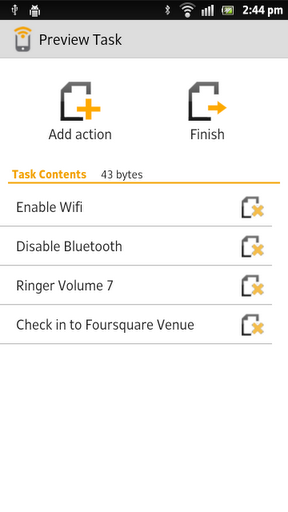
Before the app, users would first visit Tagstand’s website to purchase NFC starter kits, tags or stickers. The NFC tags can be configured using a web-based control panel or, now, the Task Launcher app itself. For Android users familiar with the popular Automator application, NFC Task Launcher is very similar except that the tasks it automates are kicked off by scanning an NFC tag, rather than some other sort of pre-programmed event.

For example, Tagstand co-founder Kulveer Taggar tells me that he has a tag on his keychain that’s configured so that, when he enters a coffee shop where he wants to work, he simply taps that tag with his phone, and his laptop is instantly tethered to his phone’s Wi-Fi hotspot. When finished working, he taps it again to switch the hotspot off.

Meanwhile, co-founder Omar Seyal likes to use the app when cooking – he set timers for 10, 20 and 30 minutes, which he begins by tapping the phone to an NFC tag.

You could also use NFC Task Launcher to switch between “office” and “home” settings on your phone, turn on or off your ringer or alarm, instantly check-in on Foursquare, send tweets and about a million other things, many of which are detailed here on the app’s description page in the Android Market Google Play store.

With the recent relaunch of the app (version 3), the user interface has gotten a big overhaul to be more user-friendly and the app itself has seen a number of improvements. It now offers better saved task management, improved Switch creation, improved dialogs for writing tags (both for success and for errors), and it has added support for newer tag types. There’s also a new pack of tags designed especially for fans of the Android app.

If you remember what the app looked like before, this is great update. As for making NFC more mainstream, that may prove to be more of a challenge. NFC, while a promising technology, faces a number of adoption hurdles ranging from OEM adoption to business partnerships that encourage use (as in the case of mobile payments). And, of course, there’s always what Apple ends up doing – still a big unknown. But for those Android users already ahead of the curve, or who just like doing cool stuff with their phones, the NFC Task Launcher app is a good one to try.


Tracks.by Scores Likes For Lil Wayne, Now The Music Promo Platform Is Giving Out Invites

tracksby_logo_black

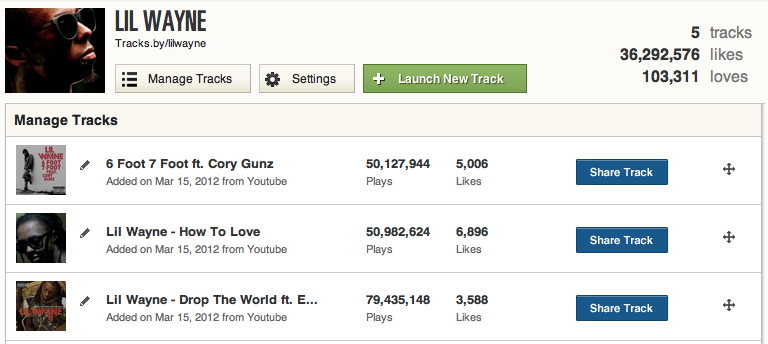
One-hundred top hip-hoppers and indie rockers use Tracks.by to release their music and videos on Facebook. Now after a year of private work with a handpicked roster, Tracks.by is for the first time publicly offering invites to its music promotion platform. Artists and their managers can use Tracks.by to send out content that requires a Like or an email signup to play.

Big name investors see potential in Tracks.by’s focus on style, the feed, and building email lists. Path’s Dave Morin, Menlo Ventures, Lil Wayne’s manager Cortez Bryant and others have seeded Tracks.by. TechCrunch readers can sign up for an invite to Tracks.by below.

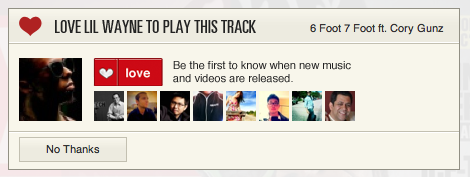
What makes Tracks.by so powerful is its Love button campaigns that let artists squeeze more dollars out of their existing Facebook fans. See, Tracks.by artists can publish Like-gated songs and music videos that play in-line within the feed, but they’ll mostly reach fans who’ve already Liked. Love button campaigns go a step further, allowing artists to ask existing fans “If you love me, sign up for email notifications to get early and exclusive content”.

Fans click the Love button and accept a Facebook data access permission, and their email address is automatically provided to the artist. Then when the performer releases an album, new merchandise, or concert tickets, they can send emails to people who love them, activating their most loyal followers to nab them a viral and sales boost.

Since Like- and Love-gated campaigns are value exchanges, they work best for established artists who have fans eager for their content. Smaller acts may want to just freely distribute their music rather than putting up a barrier to potential fans they haven’t won over yet. Tracks.by’s campaigns integrate with YouTube, VEVO, and Soundcloud, as well and include analytics.

Tracks.by was founded in June 2011 by Matt Schlicht and Mazy Kazerooni of Ustream, where they made connections with some of the world’s biggest musicians while leading product and VIP support. Node.js contributor Chase Sechrist and FbFund’s Erik Smith are also founders, and Matt and Mazy picked up their old boss at Ustream Bryan Kim as their first hire to complete the five-man team.

Beyond Morin, Menlo, and Cortez Bryant, Tracks.by’s investors include Greylock’s Josh Elman, Automattic’s Matt Mullenweg, Venture51, Zynga’s Alex Le, Mob Wars’ Dave Maestri, Naval and Nivi of Angelist, and Redpoint’s David Wu. Drake, Pitbull, Diddy, and Kimbra are some of the artists on the platform, and it works. Lil Wayne made a song available only to those who Loved him, and picked up 100,000 Loves and email addresses in 24 hours. Fellow rapper Gucci Mane picked up 600,000 plays of his album in 3 days via Tracks.by.

The fledgling music startup faces stern competition from more full-featured and well-funded music profile apps like BandPage and ReverbNation. It will need to move away from the grind of its old custom service model and keep innovating on its scalable platform. Otherwise it could be copied and become just a feature of another service.

To stay current and differentiate itself, Tracks.by is working on Twitter publishing, a transition to the Timeline Page format, and a Facebook Open Graph integration that will post to the Ticker whenever someone Loves an artist or plays/downloads one of their songs. I also wouldn’t be surprised if Tracks.by one day started catering to brands in addition to musicians.

I asked Ayal Kleinman, VP of New Media for Warner Brothers Records who has some artists on Tracks.by what he thought of the tool. He told me “rather than trying to replicate Myspace, it really embraces Facebook and how people are sharing music.” Marketers constantly ask ‘what’s the value of a Facebook Like?’. The answer is follow-up marketing, but a Love on Tracks.by can generate even more cash money.

Musicians and artist managers, visit this exclusive TechCrunch readers’ URL http://tracks.by/#beta-invite-tc to request an invite to use Tracks.by


A Twitter Conversation With NASA Led To Angry Birds Space

angry-birds-space

Angry Birds Space, Rovio Mobile’s first genuinely new game in a year, has some humble origins.

The idea for Angry Birds Space actually originated in a challenge NASA made to Rovio nearly a year ago on Twitter. Asserting that smartphones today have more computing power than the machines that powered the lunar landing in 1969, NASA said it would help Rovio launch birds if pigs could fly in space. (Yes, really.)

Hey @RovioMobile, our computers are a bit better than they were in ’69. We might be able to help you launch birds if you find pigs in space.

— NASA (@NASA) March 27, 2011

A year later, it’s really happening. The Finnish mobile gaming juggernaut attached a giant Angry Birds slingshot to the Seattle Space Needle yesterday and had an astronaut demo the game from the International Space Station two weeks ago. NASA scientists even helped out in designing the physics-engine for the new game.

Inventiveness and spontaneity have made Rovio the company it is today. Hardly anyone working there has a deep marketing background and yet Rovio is pulling off stunts on the Space Needle — for free (thanks to T-Mobile).

“It helps to be a bit crazy,” says the company’s chief marketing officer and Mighty Eagle Peter Vesterbacka. “We’re naive enough not to know what we can’t do.”

The crazy seems to be working. Rovio is probably the most unorthodox mobile gaming company in the industry given its history, revenue mix and ownership. Over time, the company is actually becoming less reliant on pure gaming revenue as it pulls in cash from licensing, merchandising and books. A film and animated shorts are in the works too.

The company plans four more totally new games this year, not counting the usual seasonal releases and the versions of Angry Birds that show up on other platforms like Facebook and Chrome Web Store.

“We want to make Angry Birds a permanent part of pop culture,” Vesterbacka says. He adds, “Last year was about building the infrastructure, and this year we’ll be doing five new games.”

Would this finally include a game from the pig’s perspective? “Maybe. That’s not a bad guess,” he says.

Rovio also has a very unique ownership structure as a family-owned business, given the company’s long history of making 52 failed games before producing Angry Birds and its Scandinavian roots. Kaj Hed, who is the father of Rovio chief executive Mikael Hed, owns close to 70 percent of the company, giving him the power to block outcomes like a sale.

That father-son dynamic has caused tension from time to time over the years. In 2005, the current CEO Mikael Hed left out of a disagreement with his father about how to grow the company and didn’t return until four years later when he was able to lay the groundwork for Angry Birds’ launch in December 2009. The $42 million round the company raised last year was even dubbed the “father liquidity” round by one insider, as the proceeds largely went to cash Kaj Hed out, according to several sources with knowledge of the terms.

“We’re 100 percent sure he’ll do the right thing,” Vesterbacka said of Kaj Hed. “He’s great. He’s very strategic. He’s very smart and he knows what he’s doing.”

As for this year, it’s all about stepping up Rovio’s reach into other mediums and its capacity to produce more games. Last year the company sold 25 million plush toys, ranging from $5 to $99 and it earns a single-digit percentage revenue share from those sales.

The Angry Birds Space launch is also coupled with all kinds of merchandise including a National Geographic book about space and a special edition of News Corp.’s iPad magazine The Daily that explains the development of the game. There’s also a load of Angry Birds Space-themed apparel, plush toys, phones and fruit snacks that are coming to Walmart soon. Hidden on the price tags and packaging are clues that unlock extra levels in the game.

“This is the first time ever that you have a mobile-originated game launching with a full line-up of merchandise at Walmart,” Vesterbacka says. “It’s like a bigger launch than a movie.”

Plus, the company is still an advertising juggernaut with more than 10 billion impressions per month, a number that’s sure to rise with the launch of Angry Birds Space. (I hear the effective cost per thousand impressions for a casual mobile game generally runs from $0.20 to $0.50, so a back of the envelope calculation suggests $2 to $5 million a month in pure ad revenue.)

Rovio is also ramping up in China, where the company has just four employees. While it’s often difficult to build a profitable mobile app business in China because of piracy, jailbroken phones and fragmentation, Vesterbacka is optimistic.

“We’re not there yet, but we’re the most copied brand and most loved brand in China,” he says. “You should be very, very concerned if you don’t have copies in China. That means that there is no interest.” The game is already pre-installed on Lenovo tablets and many kinds of Nokia devices there.

Then there’s the Facebook version of Angry Birds, which is up to 18.1 million monthly active users. Daily active users are holding at around 2.5 million players, putting it just behind EA’s Sims Social on app tracking service AppData.

Vesterbacka says that he’s not worried about exhausting the Angry Birds brand and going the way of Pokemon or Mighty Morphin Power Rangers as a passing childhood fad. He says Angry Birds is a universal brand, not just one for children.

“We don’t feel like we’re anywhere even close. On my way to the U.K., I bumped into four people who had never heard of Angry Birds,” he says. “We’re just scratching the surface. Not everybody knows about Angry Birds and there are 7 billion people on the planet.”

And why stop at Earth?